




Abstract
Adolescents in the United States experience abusive relationship behaviors at alarming rates; yet formal education on navigating harmful relationship dynamics is lacking. Thus, many teens use the internet to disclose abuse experiences and seek information or advice from their online peers. To better understand the types of responses, advice, and information teens receive from their online peers, we analyzed peer-to-peer discussions about abusive relationship behaviors from teens in the Reddit community r/teenrelationships. Using qualitative content analysis, we analyzed comment responses (n = 154) to Reddit posts (n = 56) in which teen users discussed experiences of interpersonal harm or abuse. We constructed 4 primary themes and 14 associated subcategories. Responses were predominantly supportive in tone, with commenters providing advice for next steps (84%), education in healthy versus unhealthy relationships (70%), and general support (44%). A smaller proportion (21%) of comments were categorized as unsupportive or misleading. These findings emphasize the importance of including psychoeducation on how to respond to disclosures of abuse in prevention programming for teen dating violence and developing online interventions to facilitate and support help-seeking behaviors.
Keywords
Introduction
Adolescents in the United States experience teen dating violence (TDV) at alarming rates (Basile et al., 2020), and formal education on navigating abusive relationships (e.g., via health education in schools) is lacking (SIECUS, 2024). Thus, teens often turn to the internet for information about sex and relationships (Döring, 2021; Waling et al., 2023), including for help dealing with abusive or potentially abusive situations (PettyJohn, Cary, et al., 2025; PettyJohn, Tasnim, et al., 2025). The use of online forums to disclose or discuss issues related to teen relationship abuse warrants examination into the content and quality of peer responses to such disclosures; however, literature in this area is currently lacking. Emergent research has analyzed peer responses to online disclosures of child abuse or neglect and identified predominantly supportive conversations (Williams et al., 2023). However, more research is needed to understand how teens respond to their online peers who describe relationship abuse. Thus, we sought to explore the peer-to-peer advice and information regarding abusive relationship behaviors that teens are receiving from online peers in the Reddit community, r/teenrelationships.
Teen Experiences of Relational Abuse
TDV encompasses several forms of partner-directed behavior occurring in adolescent romantic or dating relationships including physical violence, sexual violence, psychological aggression, cyber violence, and stalking (Centers for Disease Control and Prevention, 2025; Piolanti et al., 2023). Findings from the 2021 Youth Risk Behavior Survey indicate that 8.5% and 9.7% of U.S. high school students experienced physical TDV and sexual TDV in the past year, respectively (Clayton et al., 2023). Higher prevalence rates of TDV are reported among teen girls and LGBTQ teens compared to boys and non-LGBTQ teens (Basile et al., 2020; Dank et al., 2014; Walls et al., 2019). Sexual assault victimization, which is not always confined to the context of a dating relationship, is also prevalent during teenage years. Indeed, 35% of women and 30% of men with lifetime experiences of rape report their first victimizations as occurring between ages 11 and 17 (Basile et al., 2022).
Abusive relationship experiences are associated with negative outcomes for those victimized, including poor physical and mental health outcomes (Malherbe et al., 2023), as well as suicidal ideation (Bonomi et al., 2013; Silverman et al., 2001). Immediate impacts of sexual assault include internalizing symptoms of fear and safety concerns for both teen girls and boys, as well as physical injury, sexually transmitted infection (STI) diagnosis, and unwanted pregnancy (Basile et al., 2022). Furthermore, longitudinal research demonstrates that experiencing TDV in adolescence consistently predicts future violence involvement in adulthood, increased risk behaviors (i.e., substance use), and poor mental health outcomes including internalizing symptoms and post-traumatic stress disorder (see Piolanti et al., 2023 for a meta-analysis).
Given the prevalence and negative outcomes of abusive relationship behaviors among teens, it is unsurprising that teens report wanting information on how to develop healthy relationships. For example, when given the opportunity to ask their classmates questions as part of a peer-led sex education class, 13.9% of adolescents asked about love, dating, ideal relationships, and gender expectations (Bauer et al., 2020). Similarly, college students report wanting to have learned more from school-based sex education about the mental, emotional, relational, and social aspects of sexual relationships, including how to deal with sexual assault and coercion (Astle et al., 2021). Thus, with a lack of education on healthy dating and sexual relationships from formal sources, teens often turn to online peers for support.
Teen Help-Seeking for Relationship Abuse
Research suggests that teens are hesitant to disclose relational abuse for a variety of reasons including fear of retaliation, embarrassment, shame, stigma, a desire for privacy, a lack of knowledge about support services, or a lack of trust with adults (see Bundock et al., 2020 for a review). Teens are more likely to disclose issues of violence in sexual and romantic relationships to informal sources (e.g., friends and peers) than formal sources (e.g., adults, teachers, social workers; Bundock et al., 2020; Moore et al., 2015). For example, among middle school students who experienced peer sexual harassment, only half disclosed their experience to others, most often disclosing to friends rather than parents or other trusted adults (Lunde et al., 2025). Beyond these reasons for hesitation, many youth avoid telling adults about abusive situations due to concerns about confidentiality and mandatory reporting policies which can diminish their sense of control (Bundock et al., 2020; PettyJohn, Tasnim, et al., 2025).
Help-seeking behaviors may also be gendered. Across studies examining gender differences in help-seeking behaviors, girls were more likely to report TDV than boys, which may in part be due to masculinity norms that restrict emotional vulnerability (Bundock et al., 2020, p. 362). In addition to in-person peers, teens are increasingly turning to peers online. The internet and social media platforms have become popular tools for teens seeking advice, connection, and support for navigating romantic and sexual relationships (Gorissen et al., 2023). Some online platforms allow for the anonymity of users (e.g., Reddit), which may create an online environment more conducive to open disclosures with minimized personal risk (Gorissen, 2024).
Young People’s Online Disclosures of Abuse
The #MeToo Movement and hashtag activism campaigns related to intimate partner and sexual violence have spurred significant research about online disclosure among adults and the types of responses they receive (see Gorissen et al., 2023 for review). Research suggests that minors have also long used the internet to search for information and advice about abuse as well (Webber & Moors, 2015; Webber & Wilmot, 2013), with recent interest in how youth utilize contemporary social media platforms for this purpose. While little research has been conducted thus far on social media disclosures of teen relationship abuse, a growing body of recent literature on disclosures of child abuse or neglect can provide useful context for these online behaviors among young people.
Analyses of posts made to the sites TalkLife (based in the United States) and Childline (based in the United Kingdom) have demonstrated that many young people use social media to disclose diverse forms of maltreatment, usually in the context of their families (Bennett et al., 2023; Johansen et al., 2024; Williams et al., 2023, 2024). Users post within these communities for myriad reasons including asking for information or advice, validating their experiences (e.g., “is this normal?”), and seeking emotional support (Bennett et al., 2023; Williams et al., 2024). Notably, these studies were limited to secondary analyses of public posts, and these social media platforms are unique because they are designed and moderated to provide peer-to-peer support amongst young people. However, a recent study using primary interview data from young adults (n = 23; ages 18–21) who disclosed child maltreatment using “traditional” social media sites (e.g., Reddit, Instagram, Snapchat) identified similar motivations amongst participants (PettyJohn, Tasnim, et al., 2025).
Only one known project has analyzed teens’ disclosures of relationship abuse on a contemporary social media platform (PettyJohn, Cary, et al., 2025); this project also provided data for the present study. In this prior work, our team identified that within the “top” (i.e., most popular) posts (n = 180) about “sex” within the Reddit community called “r/teenrelationships,” 40.6% asked about abusive or potentially abusive situations. The posts were predominantly made by female-identified Reddit users who described experiences ranging from emotional abuse to harassment, sexual coercion, and assault. These users typically described (often in great detail) their harmful relationship experiences and explicitly asked for information, advice, or general support from their peers (e.g., “someone please tell me what to do”; PettyJohn, Cary, et al., 2025, p. 7).
Peer Responses to Young People’s Online Disclosures of Abuse
Research on peer responses following young people’s online disclosures of different forms of abuse is limited. Early research on the topic analyzed responses posted between 2010 and 2013 to an internet forum produced by MTV which enabled adolescent users to discuss difficulties in romantic relationships (Kim et al., 2017). Adolescents’ most common recommendation was to break up with partners with whom they were having difficulties, and in cases where users asked about situations involving psychological or physical abuse, responses were more likely to suggest seeking help from friends, family, or other trusted adults (Kim et al., 2017). Another secondary analysis of peer responses posted on TalkLife found that 92.5% of posts disclosing child maltreatment (n = 265) had at least one comment, 79.2% had more than one, and when a specific request was made in the disclosure post (e.g., asking for advice), this was met by at least one comment 92.4% of the time (Williams et al., 2023). Content analysis identified that peer responses were predominantly supportive in tone, most often offering action-oriented advice (e.g., report, coping skills), emotional support (e.g., offering empathy, saying “it’s not your fault”), asking for more information (e.g., “what solutions have you already tried?”), or responding with their own disclosures of abuse (Williams et al., 2023). A minority of comments were characterized as unsupportive (e.g., joking around, trying to rationalize the abuse; Williams et al., 2023).
In qualitative interview research with young adults who disclosed childhood maltreatment on social media, participants described digital support communities as a “lifeline” for helping them cope (PettyJohn, Tasnim, et al., 2025). They reported receiving peer support through a variety of mechanisms, including one-on-one or group settings, anonymous or personalized accounts, both publicly (e.g., in comment sections) or privately (e.g., via direct messaging; PettyJohn, Tasnim, et al., 2025). The most impactful part of these online interactions was mutual emotional support; however, participants also provided concrete examples of peers providing resources (e.g., YouTube videos or PDF’s teaching coping skills), mutual aid (e.g., sending money for a rideshare), or referrals to offline help (e.g., Child Protective Services, therapy; PettyJohn, Tasnim, et al., 2025). Participants reported that negative responses to disclosures were rare; though, they highlighted risks associated with minors sharing vulnerable information online and asking for support (e.g., grooming by adults; PettyJohn, Tasnim, et al., 2025).
The current study expands on the existing literature by exploring peer responses to teen disclosures of abuse in relationship contexts in a sample of posts on the popular social media website, Reddit. Findings of this work can inform practitioners and educators working with teens, as well as safety and intervention strategies for social media platforms, such as Reddit, where teens may disclose and seek advice for relationship abuse.
The Present Study
The aim of the present study was to qualitatively analyze commenters’ responses (n = 154) to Reddit posts (n = 56) in which teen users discussed experiences of interpersonal harm or abuse. Our sample was drawn from posts on the r/teenrelationships subreddit which had been identified in prior research (PettyJohn, Cary, et al., 2025) as describing experiences of abuse or potential abuse (i.e., feeling used sexually, emotional abuse, sexual coercion, sexual assault, resistance to contraception use). We sought to answer the following research question: What types of peer responses do teens receive when seeking advice about their experiences of abusive relationship behaviors on the social media platform, Reddit?
Method
Analytical Sample
Comments analyzed in this study were responses to posts which discussed abusive or potentially abusive situations in the r/teenrelationships community over a 1-year period. This subreddit, r/teenrelationships, is an online forum with more than 20,000 members and is intended for teens to ask questions about relationships. Our data derive from a prior study (PettyJohn, Cary, et al., 2025) that analyzed the content of 180 “top” posts (i.e., most popular) which discussed “sex” and were shared in the r/teenrelationships subreddit community between February 2023 and February 2024. These posts were extracted and analyzed using qualitative content analysis to identify what advice or information about sexual behaviors teens were seeking out on Reddit (PettyJohn, Cary, et al., 2025). The second largest category within this content analysis (representing 40.6% of the sample) were posts where teens asked for help identifying or responding to “red flag” or abusive behaviors. This “red flag” category included posts where teens described feeling used sexually (n = 14 posts), experiences of emotional abuse (n = 14 posts), sexual coercion (n = 12 posts), sexual assault (n = 12 posts), sexual harassment (n = 9 posts), and/or partner resistance to contraceptive use (n = 3 posts). For the present study, we also included posts where teens described abusive behaviors (e.g., partners criticizing their appearance, pressuring them to have sex) without personally characterizing them as abusive (n = 15 posts). Posts were double coded between subcategories as relevant, thus multiple forms of abuse or described abusive behaviors could be present within a single post. These criteria resulted in a total of 63 posts in which teens described experiences of abusive or potentially abusive situations. Among these posts, seven did not have any associated comments. The remaining 56 posts contained a total of 201 individual comments, of which 47 comments were made by the original poster (OP) and were not analyzed. This resulted in a final analytic sample of 154 comments. Posts included in our analytic sample had an average of approximately three comments per post from users other than the OP (M = 2.75, SD = 2.84). Due to the anonymous nature of Reddit accounts, we cannot speak to the commenters’ sociodemographic identities.
Analysis
We analyzed the comments left on teens’ Reddit posts discussing interpersonal violence using qualitative content analysis (Elo & Kyngäs, 2008). Our research team consisted of three White cisgender women (KMC, MEP, EN) who are scholars in social work, violence against women, sexual/reproductive health, and social media use. Our analytical process followed an inductive approach defined by three phases: (a) preparation, (b) organizing, and (c) reporting (Elo & Kyngäs, 2008). During the preparation phase, we determined the unit of analysis to be individual comments from Reddit users (not including follow-up comments made by the OP). In the organization phase, two coders (KMC and MEP) independently read and reread comments and engaged in memoing to develop initial content categories. Team discussion following the memoing process led to the development of a preliminary codebook which we then applied to a portion of comment sections. We then met to discuss discrepancies in coding and refine codes and definitions to develop a final codebook. The codebook and code definitions can be found in Table 1. The final codebook was then applied to the complete analytic sample with each coder applying the codebook independently to an assigned portion of the sample. Each individual comment could have multiple codes applied to it, though each individual code could only be applied once to a single comment (e.g., if an individual comment from a single user contained multiple instances of the advice to “break up,” the code would only be applied a single time to that comment). A third consensus coder (EN) tested the final codebook against the full data and noted discrepancies in coding decisions. We met together as a full team to discuss any discrepancies in coding between the primary coders and consensus coder. Discrepancies were discussed and resolved through team discussion. The final reporting phase included preparing a report of our analytical process and results.
Codebook With Code Definitions.
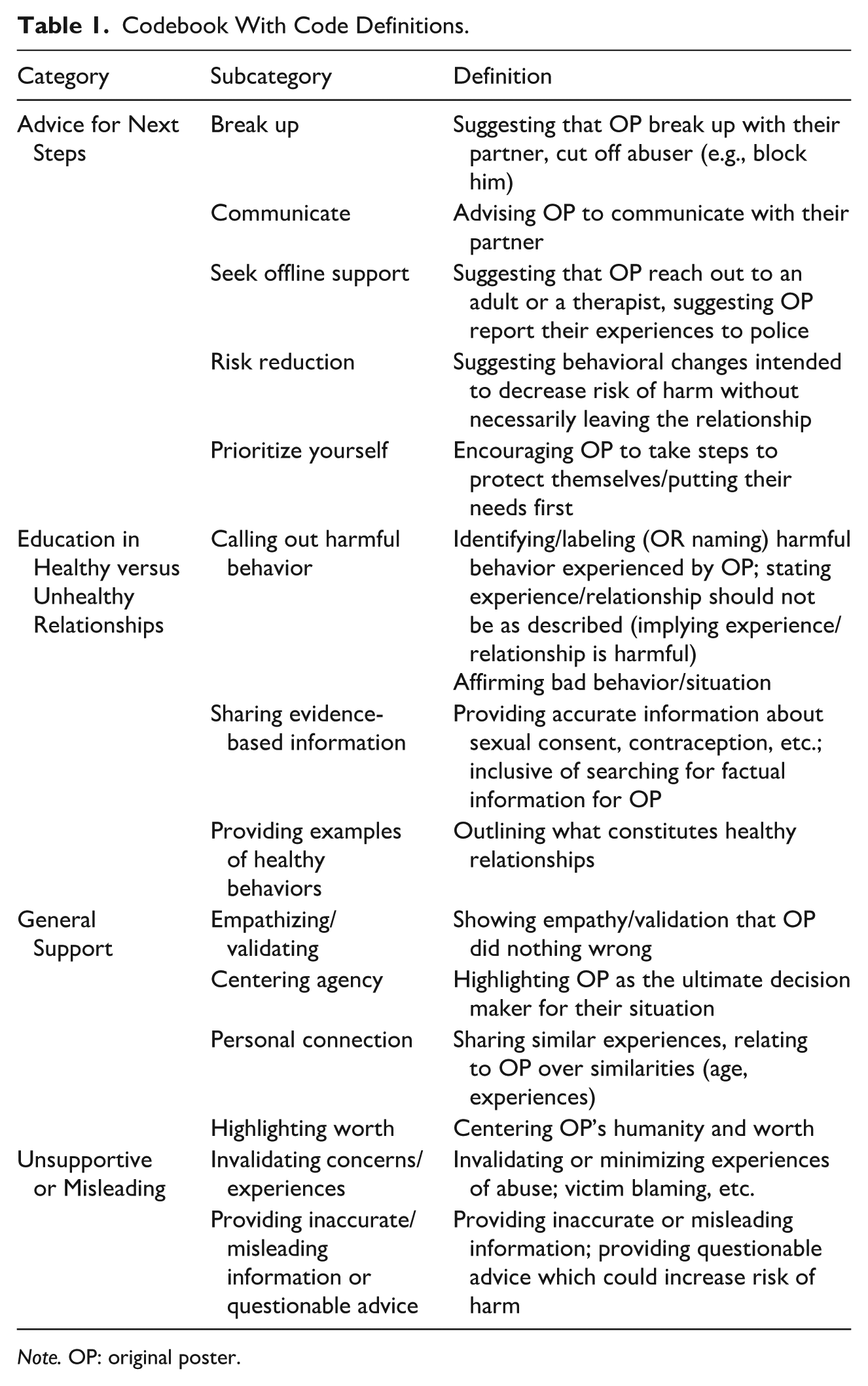
Note. OP: original poster.
Results
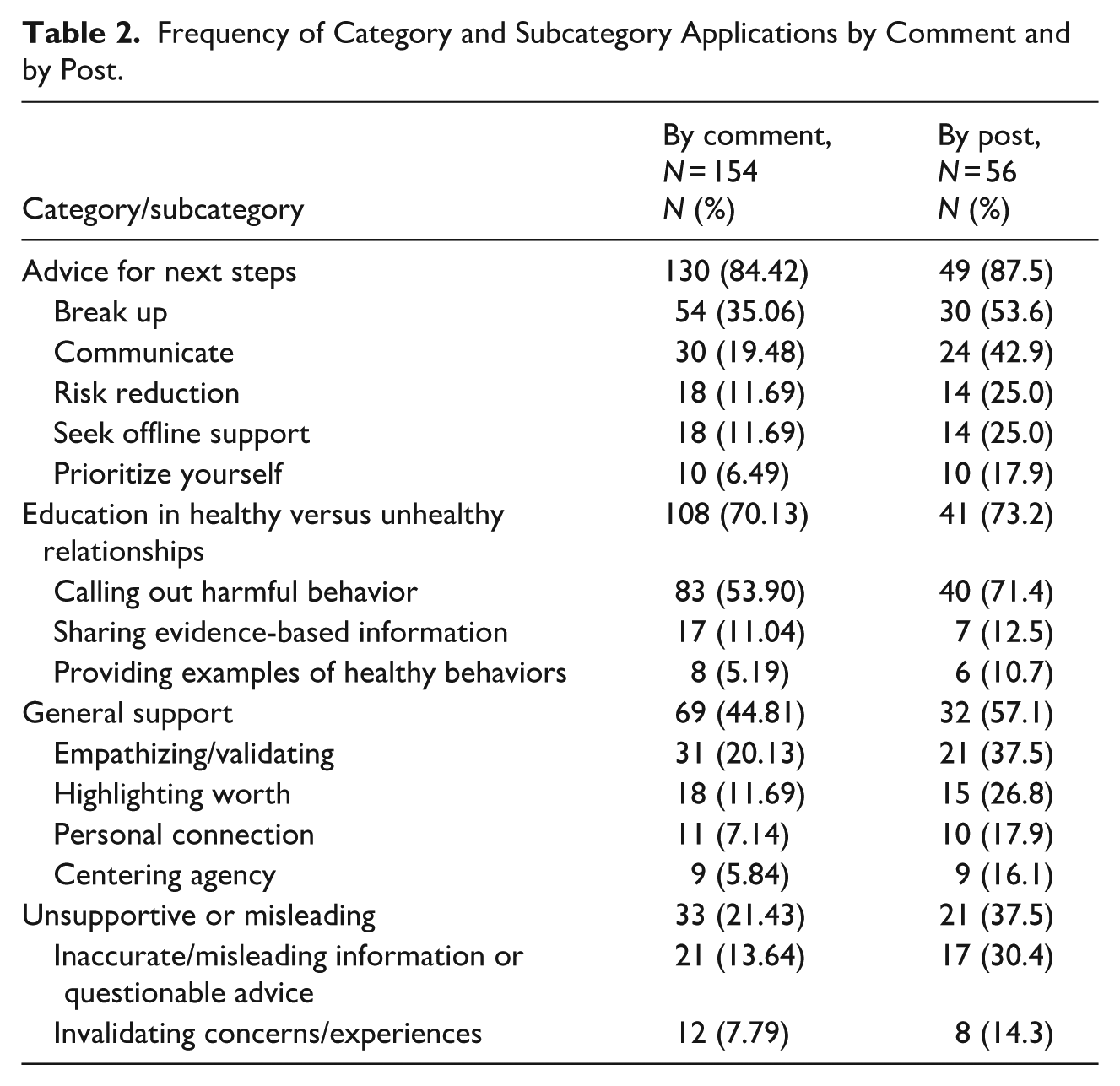
Comments were predominantly supportive in tone, with commenters offering advice for next steps (84%), education in healthy versus unhealthy relationships (70%), and general support (44%). A smaller proportion (21%) of comments were categorized as unsupportive or misleading. We describe each of these four categories and 14 associated subcategories below alongside exemplar quotes which are provided verbatim, with no corrections to spelling/grammar. Each quote is followed by parentheses containing a post identification number. Frequencies of code applications are reported in Table 2.
Frequency of Category and Subcategory Applications by Comment and by Post.
Advice for Next Steps
Commenters offered myriad advice to posters for what their next steps could be for dealing with an abusive or potentially abusive situation, including: break up with the partner causing harm; communicate with their partner; seek offline support; reduce risk; and prioritize oneself. The most frequent piece of advice was to break up with the partner causing harm (n = 54; 35%). Some statements about ending the relationship were straightforward and concise: “definitely end things” (138), “leave right now” (171), and “My advice? Drop him” (202). Other commenters offered more explanation for their advice, for example: “He’s not even considering your feelings, you need to leave him” (15). Often, suggestions to break up were part of “if/then” statements explaining that if the partner’s behavior did not change or if the partner caused further harm, then a breakup was in order. For example, one commenter said: “If he continues with this behavior, it’s a clear sign that he is not respecting your boundaries and it might be necessary to reassess the relationship” (4), and another offered, “I’d say talk to her about it and if nothing changes end it” (7). Finally, some commenters acknowledged that while breaking up is difficult, it may be best for the poster long term:
I would just break up and get out of the relationship asap. It’ll hurt, I know, but he sounds like a super shitty person and if you decide to remain in the relationship after the break, you’ll only get hurt more. (55)
The second most frequent piece of advice offered was for posters to communicate with their partner (n = 30, 19%). Some comments generally suggested that posters share their emotions or concerns with their partner, for example: “talk to her about how you feel” (7), and “Have a honest conversation about it and try to respect eachother” (258). Other commenters specified the issues that posters should discuss and offered talking points, for example: “I’d say just talk to him and be upfront, say you feel uncomfortable around him/you don’t want to be friends/hes too sexual/your personalitys are too different etc.” (87). Notably, a handful of posts offered this advice for situations where communication may not have been the best or safest approach. For example, one poster described being distressed because her boyfriend sexually assaulted her. In response, a commenter suggested:
I would sit him down have a face to face convo and tell him how you feel and that it’s not something insignificant. Tell him he’s sexually abused you and I’d threaten to even break up with him if he did it again. (15)
Commenters also made suggestions for posters to seek support offline from trusted adults (e.g., parent, teacher, law enforcement) for help with their situation (n = 18, 12%). One commenter said: “please consider telling a trusted friend or adult about this because this is coercion and is beyond not okay” (15). In several posts, commenters suggested reporting abusive experiences to authority figures or police: “Can’t you complain to a teacher? Or maybe even the police and report it as harassment?” (92). Other commenters acknowledged that seeking advice online may not be as effective as seeking offline advice from an adult/professional. For example: “I’d rather you talk to a professional for this type of advice” (13), and “Is there a school counselor or advisor that may be available to you? Reddit is one way to ask for advice, but I don’t think it’s the most reliable” (43).
Some advice focused on risk reduction, suggesting behavioral changes intended to decrease risk of harm for the poster without necessarily ending the relationship. This was advised primarily toward posters who were uncomfortable or felt abused by their partner’s sexual behaviors, including disagreements about birth control or frequency of sex (e.g., “Always wear a condom if you’re young and don’t want to get pregnant, and to prevent stis;” 95), and taking/saving sexual images. In response to a poster who described finding non-consensual intimate images on her boyfriend’s phone, a commenter advised: “I think that you should delete all the photos on your boyfriend phone in which you are naked or in a really explicit pose, just to be sure in the worst scenario you won’t have problems” (78). On another post which discussed sexting, a commenter highlighted the potential risk for the poster even in consensual situations: “Also taking and sending nudes of yourself at age 15 is creating and distributing CP [child pornography] and I would strongly urge you to stop and wipe all your devices and cloud storages clean of it” (98).
Finally, several commenters suggested that posters focus less on their partner or the relationship that is causing them harm and instead prioritize themselves. One commenter explained: “it’s essential to prioritize your own well-being and not stay in a relationship that makes you feel disrespected or uncomfortable” (4). Others suggested: “I feel like you should take a mental health break” (58) and “You need to kind of concentrate on yourself. Do things that you love, take up new hobbies and just go with it” (46).
Education in Healthy Versus Unhealthy Relationships
Nearly three-quarters (70%) of the comments provided education in healthy versus unhealthy relationships by calling out harmful behavior, sharing evidence-based information, and/or providing examples of healthy behaviors. Calling out harmful behavior was the most common sub-category (n = 83, 54%). Commenters were quick to identify that experiences shared by posters were abusive, harmful, or otherwise not acceptable in a healthy romantic or sexual relationship. In several cases, they labeled posters’ experiences using language from the violence field (e.g., “he 100% was emotionally abusing you,” 122). One poster described her partner repeatedly asking her to engage in anal sex until she acquiesced and then continuing anal sex after she had asked him to stop; she asked for advice saying, “I (16f) think my bf (17m) might have sexually assaulted me and I don’t know what to do” (15). Multiple commenters offered affirmation: “There’s no other way to put it but you’ve been in a sexually abusive relationship”; “what your boyfriend did to you is sexual assault”; and “it is absolutely scumbag behavior.” In another post, one commenter did not explicitly label the poster’s experience as physical abuse but did indicate that: “there is also no proper excuse for her slapping you unless it was genuinely by accident” (219). Although some commenters used “technical” terms to describe abusive situations, users more frequently communicated their concerns using colloquial terms like “red flag,” “weird,” or “sketchy.” Pointing out disrespect from a partner was common: “she obviously didn’t respect you in the beginning which means she probably doesn’t respect you now. that’s not someone you should be with” (63). Commenters also identified instances in which posters were being sexualized and/or objectified by their partners, “he’s sexualizing you. it seems like he sees you like an object not a person” (4). Finally, because most posters in this subreddit share their own and their partners’ ages, some commenters identified potentially harmful age and maturity gaps that may or may not have been addressed by posters themselves. For example, “this age gap is also relatively concerning, ESPECIALLY if he’s making you feel uncomfortable” (138), and “I don’t think it’s appropriate to be with a 15 yo [year old] boy being a 17 yo girl because of the CLEAR maturity gap” (242).
In addition to calling out harmful behavior, commenters provided evidence-based information to posters (n = 17, 11%). For example, commenters provided definitions of sexual assault, sexual coercion, and sexual consent:
Him begging you to have sex is known as coercion and should not be tolerated. Consent is ALWAYS something the two of you have to have an absolute YES on, is never something he should beg you to do with him, and never something you feel like you should just “let him” get. Whenever you say “no,” or “stop,” and he keeps going, he is committing sexual assault and your feelings and his actions should not be ignored. (15)
In situations with sexual abuse or resistance to contraceptives, commenters mostly provided posters with accurate information and talking points about pregnancy and STI prevention for example: “Condoms are a safety measure for both you and him. They reduce the chances of an unwanted pregnancy” (40). In one instance where a poster’s male partner was claiming to experience pain and possible infertility due to lack of intercourse, seemingly to coerce her into sex, a commenter did some research and reported back findings from a reputable medical source:
I did some research because i really wanted to help you but I can’t seem to find anything on a condition like this [. . .] Found mayoclinic descriptions of ways men can go infertile and abstinence was not listed in fact in a seperate study on abstinence it was encouraged as it can lead to higher fertility. (113)
A smaller proportion of commenters provided examples of healthy relationship behaviors (n = 8, 5%). For example, one commenter stated, “relationships are about communicating, loving and supporting” (81). Another highlighted the importance of mutual respect in a relationship, “It’s important for partners to show respect and consideration for each other’s feelings” (4). Finally, one commenter described healthy aspects of their own relationship:
My partner and I haven’t done it [sex] yet but we already have discussed clear boundaries for whenever we do. Don’t do things the other is uncomfortable with, both need to consent, if one asks to stop we stop etc. (98)
General Support
General support from commenters included offering empathy and validation, highlighting the posters’ worth, creating personal connections, and centering posters’ agency. Messages of empathizing and validating were present in nearly half of the comments (n = 69, 45%), often in the form of general sympathy about the poster’s situation: “I am so sorry that this is happening to you love” (40). Commenters validated when posters were feeling upset or unsure: “i would also be so scared” (59), and “it’s understandable that you’re confused and concerned about the red flag behaviors you’re noticing” (4). Many responses assured posters that they were not at fault for their abusive experiences: “they were the ones breaking boundaries in that situation, not you” (98), and “none of this is your fault” (32). Finally, commenters also validated posters’ decision-making, particularly when they chose to get out of harmful relationships, saying things like, “you’ve done the right thing” (111), and “you did the best thing you could’ve done for yourself” (122).
Commenters also showed support for posters by highlighting their inherent worth as human beings (n = 18, 12%). Most often, commenters stated that posters “deserve better” than how their partner is treating them. Other commenters provided compliments and encouraged posters that they would find happiness in the future. For example, one user wrote, “you are strong, you are worthy, and you are capable. you will find someone that will treat you right and make you happy” (122). Thus, commenters assured posters that their self-worth should not be reduced due to their experiences of violence.
Some commenters responded to posts by offering personal connections to their own experiences (n = 11, 7%), seemingly to try and build community with the poster and/or to validate their advice. For example, a commenter shared that they were going through a similar experience as the poster, saying, “I too am 17F and am breaking up w [with] my 19M partner soon bc [because] he can’t stay loyal and always says hurtful shit. If he tried telling me to shut up I’d end everything right then and there” (81). Other commenters shared examples of what they had done to improve harmful situations from their own pasts: “i went through a similar situation with my boyfriend, all he wanted was sex and it got exhausting and took a massive toll on my mental health. when i left i felt much better” (7).
Finally, a handful of commenters demonstrated general support by providing advice while centering the posters’ agency (n = 9, 6%), seeming to take an empowerment approach when talking with people experiencing abuse. For example, a commenter responded to a post about a cheating partner by explaining that the partner’s behaviors are not healthy and recommending they break up, but ending with, “This is my advice alone do with it as you please” (70). Commenters encouraged posters to make decisions that felt best to them based on their knowledge of their own circumstances, “honestly, do what you think is right for you” (7), and “trust ur gut girl” (81).
Misleading or Unsupportive Comments
A minority of comments contained responses from commenters that provided inaccurate or misleading information or questionable advice (n = 21, 14%). The tone of these comments suggested that users were attempting to be supportive; however, such advice could increase risk of negative health and safety outcomes for the poster. In example, one comment to a poster who was experiencing sexual coercion from her boyfriend advised, “Maybe he could hire a prostitute or something if he needs to have sex” (113), a suggestion that could have negative legal and health ramifications for both parties. Several comments shared inaccurate or misleading information regarding contraceptives, such as minimizing the need to protect against sexually transmitted infections, “Me and bf [boyfriend] only use birth control and never been pregnant, birth control alone is enough when your sexual partners don’t change all the time” (95), and claiming that hormonal birth control will, “ABSOLUTELY RUIN YOUR BODY” (13) or “ruin your fertility if used too much” (40). Other comments advised engaging in relationship behaviors that violence prevention experts would characterize as unhealthy and risk escalation of abuse. This included normalizing surveillance behaviors [“it is not bad to check each other phones” (78)] and suggesting retaliation against someone who had caused them harm. For example, “If you want to teach him a lesson tho, you should like other guys pics [on social media]. To show him how you feel” (30) and “if you do get corralled into sending more [sexually explicit] pictures make sure he sends some back. Then he CAN’T blackmail you” (59).
A small number of comments contained content that invalidated the poster’s concerns or experiences of abuse (n = 12, 8%). For example, some comments argued that the behavior posters experienced was not abusive or harmful saying, “He definitely didn’t do anything wrong here, if you don’t like his humor or posts, your personalities just don’t match” (4) or “what he did isn’t unreasonable” (40). Other invalidating responses were simply flippant in tone, such as: “he literally used you for his benefit don’t be dumb” (242) and “sucks to be you. gl [good luck] bro” (125). In response to a post which described, in detail, a clear example of sexual violence, one commenter invalidated the poster’s experiences by writing: “. . .it wasn’t coercion, we might not have his full dialogue but from what we can read he didn’t convince her to do it he pushed her and pushed her until she caved” (15). The same user asked, “why didn’t she leave this fuckin creep???” (15). Other commenters on the post responded to this user by defining sexual coercion, labeling their responses as victim blaming, and validating the poster’s experiences as a form of sexual violence. Thus, in some comment threads, invalidating comments were challenged by other users to support and educate the poster and other commenters, though this was not always the case.
Discussion
A growing body of literature suggests that many young people turn to social media platforms to disclose or seek help related to experiences of abuse (Bennett et al., 2023; Johansen et al., 2024; Williams et al., 2024), making it critical to understand the types of responses they receive from online peers. The current study is among the first to examine peer responses to descriptions of teen relationship violence on a contemporary social media platform. Through analyzing comments (n = 154) made to posts discussing abusive or potentially abusive situations in the r/teenrelationships subreddit, we identified that most responses included advice about next steps (84%) or education about healthy versus unhealthy relationships (70%), about half offered general support (45%), while a smaller proportion provided misleading information or unsupportive commentary (21%). These findings align with the existing research on peer responses to online disclosures of general relationship difficulties (via a now defunct MTV website; Kim et al., 2017) and child maltreatment (via TalkLife; Williams et al., 2023), in that youth are generally supportive and eager to provide each other with feedback and advice.
The majority of comments provided advice and general support for posters. Given that many teens only disclose abuse to peers (Bundock et al., 2020), and responses received can shape survivors’ well-being and decision-making trajectories regarding help-seeking (Sylaska & Edwards, 2014), it is important to consider how the comment responses in this study align with best practices recommended by the violence field. The non-profit organizations RAINN (2025) and the National Domestic Violence Hotline (n.d.) highlight the importance of listening, believing survivors, demonstrating empathy, and taking a non-judgmental stance when receiving a disclosure. These tactics were present within comments in our sample, particularly among comments which provided general support through offering validation, empathy, and highlighting agency. However, survivor support organizations also emphasize the importance of support persons continuing to check-in and providing concrete resource recommendations for survivors. While some of our data demonstrated back and forth conversations between the poster and a commenter, there was not public evidence (on these particular posts) of sustained relationships within the online community. Moreover, while 12% of comments advised posters to seek offline support (e.g., talk to your parent or a school counselor), few suggested specific professional resources (e.g., the National Domestic Violence Hotline or RAINN).
In responding to posters’ disclosures of abuse, commenters in our sample frequently provided education in identifying unhealthy relationships or facilitating healthy relationships. Indeed, more than half of all comments (54%) in our sample helped identify or called out abusive behaviors that were described by the poster. This is a meaningful finding given that the first step toward help-seeking requires survivors to identify their experiences as harmful (Liang et al., 2005). This finding also supports that teens are largely capable of identifying both healthy and unhealthy romantic relationship attributes, as has been noted in prior research (Brar et al., 2023). Teens themselves have identified that education on healthy relationships is lacking within formal sexuality education (Helmer et al., 2015), and given that teens tend to seek informal sexuality education online (Waling et al., 2023), it is promising that informal education on healthy relationships and sexual health education is being provided by peers online, when it is sought out.
A small number of comments in our sample presented inaccurate and misleading information or invalidated posters’ experiences. Prior research findings demonstrate that teens struggle to identify non-physical forms of harm (like anger, jealousy, and controlling behaviors) as problematic (Brar et al., 2023), potentially explaining why some commenters were unable to identify posters’ disclosures as abuse. Additionally, comments that invalidated experiences of sexual abuse specifically may have been the result of taking sexual precedence to imply that any sexual activity within the confines of an ongoing sexual relationship is consensual (Livingston et al., 2004; Willis & Jozkowski, 2019), thus contributing to a lack of understanding of sexual violence and coercion.
Notably, studied platforms such as Reddit and TalkLife each involve strict content moderation either from mental health professionals (TalkLife) or from users within the community (Reddit), meaning community members have more direct control in keeping discussions relevant and non-abusive (Seering, 2020). Social media communities with stronger moderation practices (e.g., flagging or removing content deemed to be inappropriate) have been shown to encourage participation among users (e.g., responding to other users’ posts; Wise et al., 2006). Thus, it should not be assumed that findings from these platforms are representative of responses to teen posts about abuse across all social media platforms, particularly those with weaker moderation practices implemented at the company level (e.g., Instagram, Facebook; Seering, 2020). However, this work does support that moderated platforms designed for peer-to-peer support can provide opportunities for teens to receive empathetic responses to disclosures of abuse, including evidence-based information and referrals to supportive resources (PettyJohn, Tasnim, et al., 2025).
Implications
Despite offering general advice and support, commenters rarely suggested that posters seek additional support beyond online peers. These gaps in peer responses emphasize the importance of including psychoeducation on how to respond to disclosures of abuse in prevention programming for TDV (Morrison et al., 2023). They also present an opportunity for interventions using language learning models (LLMs) to detect disclosures of relationship abuse from teens within social media communities and provide “pop-up” information about relationship violence and directing them to professional resources. A growing body of literature using LLMs to detect and respond to suicidality in online forums could help inform this application (Holmes et al., 2025). This type of intervention could supplement the supportive work happening amongst teens in certain social media forums by ensuring that posters receive evidence-based information and appropriate referrals (Williams et al., 2023).
Through our analysis, we identified nuance in teens’ use of language and terminology within the online platform, Reddit. For example, our results demonstrate that teens today appear to be more likely to use language related to encouraging personal empowerment in the context of relationships (e.g., advice to prioritize oneself; highlighting the poster’s worth) compared to what has been demonstrated in previous research. Additionally, though some commenters explicitly labeled incidents as “abuse,” most framed the behaviors as problematic using softer terms like “red flag” or “sketchy.” These language choices can be contextualized by long standing research on teens’ use of generational and culturally specific terms when talking about dating violence or sex, stemming from either lack of knowledge about technical terms or a desire to minimize certain situations (Barratt et al., 1998; Martin et al., 2012). Research with adolescents who were providing feedback on a safety planning mobile app for domestic violence expressed desire to find a “mid-ground” to describe relationships “between unhealthy and abusive” (Debnam & Kumodzi, 2021, p. 6829). The participants explained that even when they identified harmful behaviors in their friends’ relationships, they were hesitant to describe it as abuse, partly for fear that friends may be less likely to listen to valid concerns if they disagree with the characterization (Debnam & Kumodzi, 2021). These findings emphasize the importance of practitioners having community-specific knowledge about the terms teens are using to describe abusive behaviors. Because terms like “red flag” can take on diverse meanings, practitioners should start by assessing what experiences teens are trying to describe and ensure that any “technical” terms used by the practitioner (e.g., emotional abuse) are explained and feel comfortable for the teens involved (Barratt et al., 1998; Martin et al., 2012).
Finally, our findings of responses that invalidated teens’ abuse experiences and provided misinformation can serve as identifiers of gaps in sexual health education. For example, responses that incorrectly understood sexual consent and sexual coercion speak to the need for sexual health education that is inclusive of instruction on sexual consent communication. We also noted gaps in knowledge surrounding contraception such as misunderstanding the importance of barrier methods in preventing STI transmission and misinformation regarding potential side effects of hormonal birth control. These responses also point to the need for more nuanced explanation of contraception methods. Interventions teaching teens how to respond to peers who disclose relationship abuse, whether the disclosure occurs in-person or online, would be beneficial as well (Hébert et al., 2014).
Limitations and Future Directions
The current study was limited in ways that should be addressed in future research. Our sample was drawn from a dataset which identified posts in r/teenrelationships discussing “sex” (PettyJohn, Cary, et al., 2025). As such, our findings may be narrowly relevant to abuse dynamics involving a sexual component, likely missing posts and responses about other types of relational abuse. Future work should expand on our methods to identify more diverse types of TDV and explore whether differences exist in online peer responses based on the type of abuse that is being described. Recent vignette-based work found that teens are more apt to label physical or sexual abuse (both in-person or online) as dating violence compared to psychological forms of abuse, and that victim blaming attitudes varied by type of abuse as well, with victims of physical abuse receiving the least amount of blame (Morrison et al., 2023). Such factors may also influence the types of comments teens provide to disclosures of abusive situations on social media.
The current study only included public Reddit comments; we were not able to assess any responses posters may have received via direct messaging, a mode of peer support that has been identified as common amongst teens disclosing child maltreatment (Schwab-Reese et al., 2025). Additionally, while some of the posts in our sample included comment responses from the original poster, we did not have sufficient data to analyze if or how users reacted to or acted on the comments given by peers. Thus, more research is needed to assess whether provided advice, suggestions, or characterizations of abuse are internalized or acted upon by the posters who receive feedback from peers. Qualitative work exploring more private peer discussions of TDV on social media platforms and whether peer responses shape users’ offline behaviors in relation to victimization experiences is warranted. Finally, given the anonymized nature of Reddit users, we were not able to contextualize our findings in relation to the race/ethnicities, sexual, or gender identities of the original poster or peer respondents. Given that LGBTQIA+ teens, especially may seek community and advice from their online peers, further examination of these online interactions with consideration to potential gender stereotypes and understanding of sexual identity would be beneficial. Moreover, future research should prioritize exploring how teens from marginalized or under-resourced communities navigate online spaces when seeking support or responding to peers about instances of relationship abuse.
Conclusions
Adolescents are using online forums and social media to disclose experiences of relational abuse, seeking advice and information. Our findings suggest that, on the online forum Reddit, the peer-to-peer advice and information teens are receiving following disclosure is overwhelmingly supportive, trauma-informed, and factually accurate, though there were some instances of invalidation and misinformation. Moderated forums for peer-to-peer support can serve as a helpful context for teens to seek advice and information, as well as provide opportunities for immediate intervention via LLM detection of violence disclosures to provide resources and referrals.
Footnotes

Ethical Considerations
This research was deemed exempt from human subject oversight by the Institutional Review Board at the second author’s institution.
Funding
The authors received no financial support for the research and/or authorship of this article.
Declaration of Conflicting Interests
The authors declared no potential conflicts of interests with respect to the authorship and/or publication of this article.
Data Availability Statement
Data for the present study are publicly available on the social media website, Reddit.