




Abstract
Following recent social movements such as the #MeToo movement, there has been an increase in media reports of sexual assault across a range of sports (e.g. hockey, gymnastics, and swimming). In many of these cases, victims have reported the alleged assault years or decades later. The current research sought to examine the effect of delayed reporting of sexual assault, as well as defendant and victim gender, on mock-jurors’ decisions in a sexual assault in sports case. Participants (N = 736) read a mock-trial transcript depicting a sexual assault in sports case in which a swim coach allegedly abused an athlete. The trial transcript varied defendant gender (male or female), victim gender (male or female), and the length of time that it took the victim to report the alleged sexual assault (1-, 10-, or 20-years). Mock-jurors provided ratings of the defendant and victim, as well as continuous and dichotomous (i.e. guilty, not guilty) ratings of defendant guilt. Participants also responded to a questionnaire assessing personal belief in rape myths. Results indicated that delayed reporting and mock-jurors’ belief in rape myths influenced mock-jurors’ perceptions and decisions. Specifically, mock-jurors assigned higher guilt ratings, rendered more guilty verdicts, and perceived the victim more favourably when there was a short delay (1-year) compared to a longer delay (10- or 20-years). Additionally, higher endorsement of rape myths was associated with lower guilt ratings, a lower likelihood of rendering a guilty verdict, more favourable perceptions of the defendant, and less favourable perceptions of the victim. Implications and directions for future research are discussed.
Introduction
Participation in sport, both at the recreational and elite level, offers a range of physical health benefits, such as reduced risk of diabetes (Kujala et al., 2003) and increased aerobic fitness (Oja et al., 2015), along with various mental health benefits (e.g. higher life satisfaction and self-esteem; Eather et al., 2023). However, there is also a harmful side to sports, as athletes face the risk of victimisation from peers, coaches, and other authority figures (Haandrikman et al., 2023). Indeed, sexual misconduct in sports has gained significant attention in recent years, following numerous high-profile scandals in Canada (e.g. Hockey Canada and Gymnastics Canada [Aziz, 2022]) and the United States (e.g. USA Gymnastics [White, 2022] and USA Swimming [Doe v. USA Swimming, 2022]). In many of these cases, there were long delays between the occurrence of the alleged sexual abuse and the victim’s reporting to police. The length of reporting delay is likely to influence mock-jurors’ decisions in sexual abuse in sports cases, as some mock-juror research has indicated that delays in reporting of sexual assault are associated with less favourable perceptions of the victim than immediate reporting (e.g. Balogh et al., 2003). This study aims to contribute to this gap by examining how jurors interpret delayed disclosures in the context of coach-athlete sexual assault allegations.
In addition, it is worthwhile to examine how gender influences perceptions and decisions in a sexual assault in sports case. In general, gender is a strong predictor of sexual violence, with most sexual assault cases involving a female victim and a male perpetrator (Department of Justice Canada [DOJC], 2022). For example, in Canada, approximately 85% of sexual assault cases involve a female victim, and in 97% of these cases, the perpetrator is male (DOJC, 2022). In sports, women and girls also are at an increased risk of sexual violence from a male perpetrator compared to men and boys, with 21% of female athletes reporting sexual victimisation in sport – nearly twice the rate of males (Liao & Craig, 2023). Although sexual assault cases involving a female victim and a male perpetrator are most typical, cases involving male victims and female perpetrators also occur. Therefore, it is important to examine how the victim and defendant’s gender may influence mock-jurors’ decisions in sexual abuse in sports cases.
While sexual assault has been studied in various mock-juror contexts, sports present a unique context that merits investigation. Sporting environments are often shaped by hierarchies of power, physicality, and a culture of toughness, which can complicate perceptions of consent and coercion. At the elite level in particular, athletes are often socially isolated from family and peers, with coaches and other authority figures holding positions of power over athletes (Liao & Craig, 2023). Moreover, sports culture may foster norms such as a ‘boys will be boys’ mentality or the belief that athletes, particularly male athletes, are unlikely to be victims. These norms can lead to underreporting and the normalization of misconduct. Unlike other contexts where formal reporting policies exist (e.g. workplaces), the relationships and physical closeness common in sport can blur boundaries and obscure misconduct. Despite high-profile cases in recent years that have brought the issue of sexual abuse in sports to light, there remains a lack of empirical evidence regarding how different factors (i.e. delayed disclosure and gender) influence mock-jurors’ decisions in a sexual assault sports case.
Delayed Reporting
Victims of sexual violence are often reluctant to report their abuse to police. In one study, Jones et al. (2009) found that approximately 25% of women who presented to a clinic or hospital setting for treatment following a sexual assault chose not to report to police. There are various explanations for why victims choose not to report, including situational factors (e.g. familiarity with the perpetrator) or psychological factors (e.g. anxiety, shame; Jones et al., 2009). In sports, victims may be particularly reluctant to report due to the power imbalance between a coach and athlete. Moreover, victims at the elite level may be fearful of retaliation that could affect their careers.
Research examining the effect of delayed reporting on mock-jurors’ decision-making has typically focused on historic child sexual abuse (HCSA) cases (i.e. cases in which the victim was a child at the time of abuse, but an adult at the time of reporting). Studies focusing on HCSA cases have generally found that immediate reporting (or short delays in reporting) is associated with less favourable perceptions of the defendant and more favourable perceptions of the victim, compared with longer delays. For example, Pozzulo et al. (2010) compared the effect of a 2-year reporting delay to a 30-year delay on mock-jurors’ guilt decisions and sentencing recommendations in an HCSA case and found that mock-jurors assigned higher guilt ratings and lengthier sentence recommendations with the 2-year delay than the 30-year delay. Other research has found similar findings in HCSA cases (e.g. Pica et al., 2021). Studies examining delayed reporting in HCSA cases have also found that the effect of delayed reporting is influenced by other factors, such as victim gender. For example, Bunting (2014) found that longer delays increased the likelihood of prosecution when the victim was female; longer delays did not increase the likelihood of prosecution for male victims.
Fewer studies have examined the effect of delayed reporting when the victim was an adult at the time of the alleged assault. In an early study, Balogh et al. (2003) examined the effect of a short delay (i.e. 18-months) and found that mock-jurors were more likely to render a guilty verdict with no delay in reporting compared to when there was a reporting delay. More recent research involving adult victims has examined lengthier reporting delays that are years or decades long. Some of this research has indicated the effect of delayed reporting may have a non-linear relationship, such that mock-jurors perceive the defendant less favourably with short and long delays but perceive the defendant more favourably with moderate delays. For example, Thompson et al. (2021) found that victims were perceived as being more credible when there was a 1- or 20-year reporting delay, as opposed to a 10-year delay. Similarly, Fraser et al. (2021) found that mock-jurors had an increased likelihood of rendering a guilty verdict when there was a 25-year delay, compared to a 15-year delay. However, other research has indicated that there is a linear relationship between delay and guilt outcomes. For example, Thompson and Pozzulo (2024) found that mock-jurors were more likely to render a guilty verdict with a short delay (2 months) than longer delays of 10- or 20-years. Other research has found similar findings (e.g. Pica et al., 2024, Experiment 2), though some research has found no effect of delayed reporting (e.g. Fraser et al., 2023; Pica et al., 2024, Experiment 1). Therefore, due to inconsistency in findings, delayed reporting remains an important factor to examine in sexual assault cases.
Victim and Defendant Gender
Although women and girls are more likely to be victims of sexual abuse in sports, and men are more likely to be perpetrators of this abuse, there are also cases in which the genders of the victim-perpetrator dyad are not prototypical (e.g. male victim and male perpetrator). For example, Kelsey McKay, a male football coach in Canada, was convicted of sexually abusing nine male athletes over several years (Gowriluk, 2024). In another ‘non-prototypical’ case, Madison Biluk, a female hockey coach in Canada, was found guilty of sexual assault involving a female athlete (Dow, 2024). In a juror decision-making context, defendant and victim gender are likely to influence jurors’ decisions due to stereotypes of sexual abuse that involve the prototypical female victim and male perpetrator.
Indeed, mock-juror research suggests that mock-jurors perceive cases with a female victim and male perpetrator as more prototypical of sexual assault than cases involving a male victim and female perpetrator (Starosta et al., 2024). Additionally, research examining victim gender indicates that female victims are perceived as less blameworthy than male victims (e.g. Pica et al., 2021; Sommer et al., 2016; Starosta & Schuller, 2020). One explanation for these findings is that male victims may be viewed as conflicting with traditional male stereotypes, such as being sexually aggressive (Murnen et al., 2002). However, some studies report the opposite effect of victim gender. For instance, Pica et al. (2021) found that mock-jurors assigned higher guilt ratings in cases with a male victim than a female victim. Other research has suggested that victim gender does not significantly influence mock-juror decisions in sexual assault cases (e.g. Ellingwood et al., 2023). In studies examining the effect of defendant gender, male defendants are typically viewed more negatively than their female counterparts (e.g. Mazzella & Feingold, 1994; Stevens et al., 2022). However, some studies have found the opposite effect (e.g. Wayne et al., 2001). In one of the few studies that have varied both victim and defendant gender in sexual misconduct cases, Ostermann and Watson (2024) found that male victims received higher blame than female victims. Interestingly, female and male perpetrators received equal blame, however, participants rated the crime as more serious when the perpetrator was male, as opposed to female. In another study, mock-jurors were found to perceive defendants more negatively when the victim and the defendant were the same gender (e.g. Wayne et al., 2001).
In cases involving sexual misconduct, a male defendant may be viewed more negatively than a female defendant, while female victims may be viewed more positively than male victims, due to cognitive scripts related to rape (referred to as rape scripts), which are beliefs about what is typical of ‘real’ rape (Crome & McCabe, 2001). Importantly, these cognitive scripts often rely on rape myths. Furthermore, it is important to consider the societal and cultural perceptions surrounding cases where the perpetrator is female and the victim is male. There is often a different framing of these scenarios, such that the perceived severity of the offense may be minimised. For example, there may be cultural narratives that view male victims as less vulnerable, which may lead to underreporting from male victims or a lack of appropriate responses when males do report abuse. Some studies suggest tolerance of female-on-male violence, in contrast to the stigmatisation often associated with male-on-female aggression. However, given the lack of research in sexual abuse in sports contexts, it is possible that mock-jurors may hold different gender stereotypes and beliefs surrounding rape in sports cases than in sexual assault cases in general.
Rape Myths
In recent years, there has been an increase in the reporting of sexual assault to police (Conroy, 2024). However, among the sexual assault cases that are prosecuted, many do not result in a conviction (Cotter, 2024). Studies suggest that a contributing factor to the low conviction rates in sexual assault cases is jurors’ beliefs in rape myths (e.g. Dinos et al., 2015). Rape myths are false beliefs about sexual assault that often place blame on the victim. For example, one common rape myth is, ‘if a girl is raped while she is drunk, she is at least somewhat responsible for letting things get out of control’ (McMahon & Farmer, 2011).
Research involving mock-jurors has shown that individuals who strongly endorse rape myths tend to view the victim less credibly and the defendant more favourably (e.g. Dinos et al., 2015). However, most of this research has focused on rape myths involving female victims. More recently, there has been growing attention to rape myths involving male victims. For example, Weare & Willmott (2025) developed a measurement tool to assess rape myths surrounding female-perpetrated sexual violence against men. Interestingly, some studies have suggested that attitudes toward gendered violence do not differ by perpetrator gender (see Conroy et al., 2024), though further research is needed.
Additionally, rape myth endorsement appears to vary based on participant characteristics, such as gender. In a UK sample, Willmott and Widanaralalage (2024) found that men were more likely than women to endorse male rape myths and reported lower levels of empathy toward sexual assault victims than female participants. These findings suggest that it is important to examine how rape myths interact with factors such as gender and delayed reporting to influence mock-juror decision-making, as these factors are likely to trigger stereotypes about what is typical in a sexual assault case.
The Current Research
The purpose of the current research was to examine how delayed reporting, defendant gender, and victim gender influence mock-jurors’ perceptions and decisions in a sexual assault in sports case. The current research also examined whether mock-jurors’ belief in rape myths moderated the effects of delayed reporting, victim gender, and defendant gender on the outcome variables. The hypotheses for the current study are as follows:
It was hypothesised that shorter delays in reporting (i.e. 1-year) would result in higher guilt ratings, an increased likelihood of rendering a guilty verdict, less favourable perceptions of the defendant, and more favourable perceptions of the victim, than when there are longer delays in reporting (10- or 20-years). These hypotheses are based on previous studies, which have found that short delays in reporting result in more guilty verdicts than longer delays (e.g. Balogh et al., 2003; Thompson & Pozzulo, 2024).
Based on past research (e.g. Stevens et al., 2022), it was also hypothesised that mock-jurors would assign higher guilt ratings, render more guilty verdicts, perceive the defendant less favourably, and perceive the victim more favourably when the victim was female, as opposed to male.
Additionally, based on previous studies (e.g. Pica et al., 2021; Starosta & Schuller, 2020), it was hypothesized that mock-jurors would assign higher guilt ratings, render more guilty verdicts, perceive the defendant less favourably, and perceive the victim more favourably when the defendant is male, as opposed to female.
It was hypothesised that when there are long delays in reporting, mock-jurors’ who hold high endorsement of rape myths would render less guilty verdicts, assign lower guilt ratings, perceive the defendant more favourably, and perceive the victim less favourably than when there is a shorter delay in reporting (i.e. 1-year); for mock-jurors’ with low endorsement of rape myths, it was hypothesised that delayed reporting may not influence the outcome variables.
The analyses examining rape myth endorsement in combination with victim gender and defendant were exploratory; therefore, no a priori hypotheses are presented.
Method
Participants
Participants (N = 736) were recruited from a University in Ontario, Canada. The majority of participants identified as female (68.5%, n = 504); 30.6% of participants identified as male (n = 225), 0.7% identified as non-binary (n = 5), and two participants preferred not to say. The majority of participants also identified as Caucasian/White (60.6%, n = 446), followed by Black Canadian (12.4%, n = 91), West Asian (6.1%, n = 45), mixed ethnicity (5.8%, n = 43), South Asian (5.4%, n = 40), Southeast Asian (3.5%, n = 26), East Asian (2.9%, n = 21), Latin American (1.8%, n = 13), and Indigenous Canadian (1.2%, n = 9); two participants did not report their ethnicity. Participants’ ages ranged from 18- to 52-years-old (Mage = 19.98, SD = 4.06). All participants received course credit for their participation. Participants provided informed consent to participate in the study. Given the sensitive nature of the mock-transcript used in the current research, participants were informed that the study involved mild psychological risks and that they could withdraw from the study at any point and still receive compensation.
Design
A 2 (victim gender: male or female) × 2 (defendant gender: male or female) × 3 (reporting delay: 1, 10, or 20 years) between-participants factorial design was used. The dependant variables were dichotomous verdict (guilty, not guilty), continuous guilt ratings, and perceptions of the victim and defendant.
Measures
Trial Transcript
There were twelve versions of a seven-page mock-trial transcript that varied the gender of the victim (male or female), the gender of the defendant (male or female), and the length of reporting delay (1, 10, or 20 years) presented to mock-jurors. Each transcript was approximately 3,000 words. The mock-trial transcript provided instructions from the judge, followed by testimonies from six witnesses (i.e. the officer who took the victim’s statement, the victim, the victim’s friend, the defendant, the defendant’s friend, and the defendant’s coworker), closing statements from the Crown and Defence, and concluded with final instructions from the judge. Specifically, the trial transcripts described a sexual assault case in which the defendant, a swimming team coach (either male or female), was accused of sexually assaulting the victim, a swimmer on the swim team (either male or female), either 1, 10, or 20 years ago; all other details in the transcript remained unchanged. The transcript describes that the victim delayed reporting the assault due to various reasons, including fear, shame, self-blame, power imbalance, lack of emotional readiness, and decided to report the sexual assault due to inspiration from other survivors speaking out in the media.
Verdict Form
Mock-jurors were asked to provide both a continuous guilt rating for the defendant on a 101-point scale from 0 (not guilty) to 100 (guilty) and a dichotomous verdict decision (i.e. guilty or not guilty). Although a dichotomous verdict is the only meaningful outcome in a real-life trial, continuous guilt ratings are useful to understand mock-jurors’ perceptions of guilt when they are not forced into making a dichotomous decision.
Victim and Defendant Ratings
Mock-jurors provided ratings regarding their perceptions of the victim’s testimony across five dimensions (i.e. truthful, accurate, believable, credible, reliable) on a 5-point scale from 1 (strongly disagree) to 5 (strongly agree). For example, mock-jurors were asked to indicate their agreement to the following statement, ‘The victim’s testimony was truthful’. Mock-jurors also provided ratings regarding their perceptions of the defendant on the same five dimensions.
IRMA Scale
Mock-jurors were asked to complete the updated Illinois Rape Myth Acceptance (IRMA) scale (McMahon & Farmer, 2011), which contains 22 items relating to respondent’s acceptance of rape myths (e.g. ‘Rape accusations are often used as a way of getting back at guys’). Mock-jurors provided their agreement to each item on a scale from 1 (strongly agree) to 5 (strongly disagree), with lower scores indicating higher rape myth acceptance. In the current study, responses from the 22 items were averaged to create an overall rape myth score for each participant, as has been done in other research (e.g. Ioannides & Willmott, 2024).
Manipulation Check
Mock-jurors completed three multiple-choice manipulation check questions to ensure that the mock-trial transcript was understood. The manipulation check questions referred to each of the three manipulated variables. Moreover, mock-jurors were asked, ‘What was the gender of the defendant?’, ‘What was the gender of the alleged victim?’, and ‘How many years did the alleged victim wait to report the alleged sexual assault’.
Procedure
Participants were recruited online using SONA and data were collected using the online survey platform, Qualtrics; each participant gave informed consent to participate in the study. Participants were provided a unique study URL that randomly assigned them to one of the twelve conditions. Participants first completed a demographics form and were then asked to read the mock-trial transcript. Following this, participants completed the verdict form, victim and defendant perception ratings form, and the IRMA scale. Finally, participants completed the manipulation check questions and were then debriefed and thanked for their participation in the study.
Results
Manipulation Check
There were 912 participants who were recruited to participate in the study; however, 176 participants failed at least one of the three manipulation check questions (i.e. regarding defendant gender, victim gender, and length of delayed reporting) and thus were excluded from further analyses. The following analyses were based on data from the remaining 736 participants.
Dichotomous Verdict
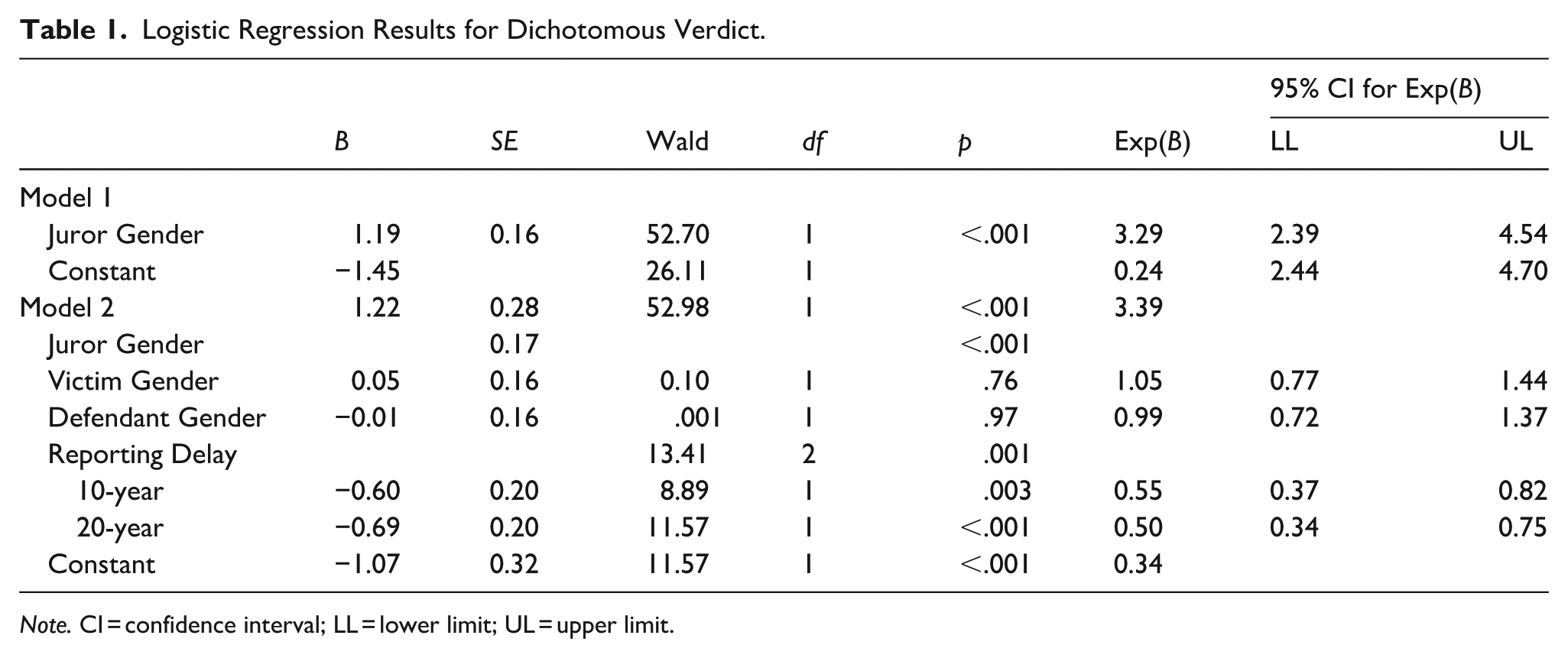
A hierarchical binary logistic regression analysis was conducted to examine the influence of defendant gender (male or female), victim gender (male or female), and delayed reporting (1, 10, or 20 years) on mock-jurors’ guilt verdicts (0 = not guilty, 1 = guilty). Mock-jurors’ gender also was included as a covariate. At step one of the analysis, mock-juror gender was included. At step two, defendant gender, victim gender, and delayed reporting (1-year delay was the reference group) were included in the model. At step three, the two-way interactions between defendant gender, victim gender, and delayed reporting were included in the model. Model 3 containing the interactions was not significant, and as such, Model 2 was retained, χ2(5) = 69.18, p < .001.
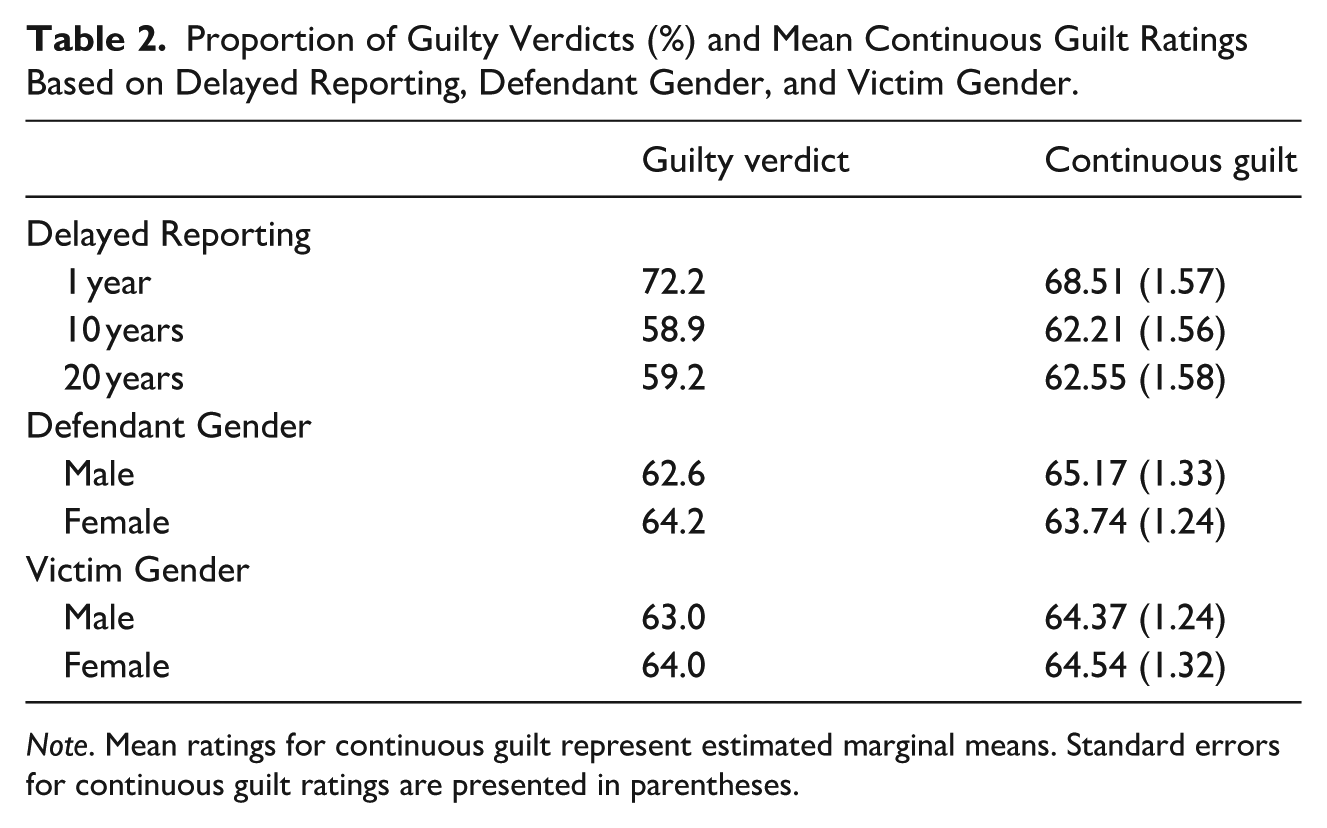
Controlling for mock-juror gender, there was a significant effect of delayed reporting, Wald’s χ2(2) = 13.41, p = .001. When there was a 10-year delay, the odds of mock-jurors rendering a guilty verdict decreased 45% compared to when there was a 1-year delay, B = −0.60, SE = .20, Wald’s χ2(1) = 8.89, p = .003, e B = 0.55, 95% CI [0.37, 0.82]. Similarly, when there was a 20-year delay, the odds of mock-jurors rendering a guilty verdict decreased by 50% compared to when there was a 1-year delay, B = −0.69, SE = .20, Wald’s χ2(1) = 11.57, p < .001, e B = 0.50, [0.34, 0.75]. There was no significant effect of defendant gender or victim gender. See Table 1 for logistic regression results and Table 2 for percentage of guilty verdicts based on delayed reporting, defendant gender, and victim gender.
Logistic Regression Results for Dichotomous Verdict.
Note. CI = confidence interval; LL = lower limit; UL = upper limit.
Proportion of Guilty Verdicts (%) and Mean Continuous Guilt Ratings Based on Delayed Reporting, Defendant Gender, and Victim Gender.
Note. Mean ratings for continuous guilt represent estimated marginal means. Standard errors for continuous guilt ratings are presented in parentheses.
Continuous Guilt
A three-way analysis of covariance (ANCOVA) was conducted to examine whether defendant gender, victim gender, and delayed reporting influenced mock-juror decision-making. Mock-juror gender was included as a covariate. Controlling for mock-juror gender, there was found to be a significant effect of delayed reporting, F(2, 735) = 5.04, p = .007, partial η2 = .01. Follow-up analyses, using a Bonferroni correction for multiple comparisons, indicated that mock-jurors assigned significantly higher guilt ratings when there was a 1-year delay (M = 68.51, SE = 1.57) compared to a 10-year delay (M = 62.68, SE = 1.56, p = .026). Additionally, mock-jurors assigned significantly higher ratings of guilt when there was a 1-year delay compared to a 20-year delay (M = 62.17, SE = 1.58, p = .014). There was no significant difference when there was a 10- versus a 20-year delay. The remaining effects and interactions were not significant. See Table 2 for estimated marginal means for continuous guilt based on delayed reporting, defendant gender, and victim gender.
Defendant Perception Ratings
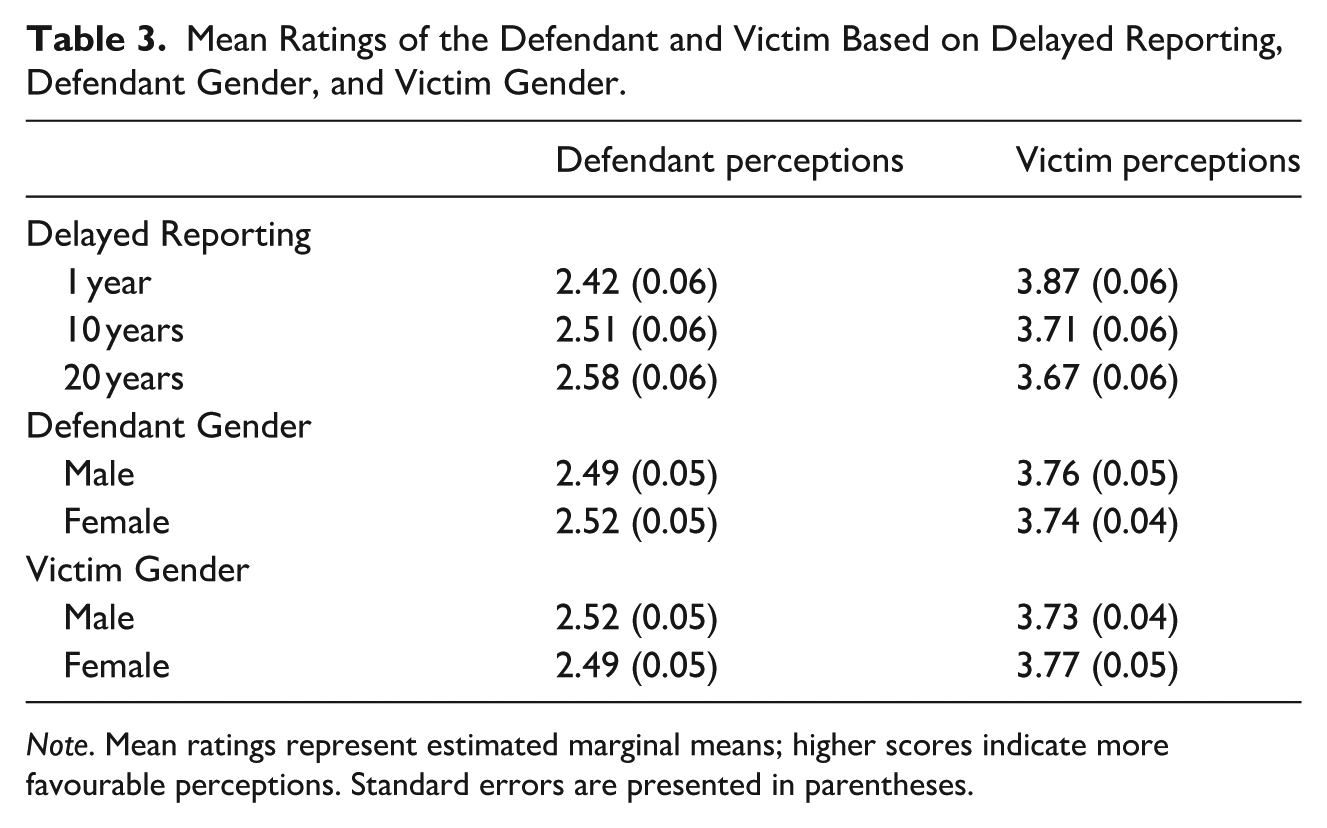
Mock-jurors responded to a series of statements regarding their perceptions of the defendant. A reliability analysis was conducted, and results indicated that it was appropriate to combine the defendant perception items into a composite score (Cronbach’s α = .94). The composite score was created by averaging participants’ responses on the five items. A three-way ANCOVA was conducted to examine the effects of defendant gender, victim gender, and delayed reporting on mock-jurors’ perceptions of the defendant. Mock-juror gender was also included as a covariate in the model. There were no significant effects or interactions. See Table 3 for estimated marginal means for defendant perception ratings based on delayed reporting, defendant gender, and victim gender.
Mean Ratings of the Defendant and Victim Based on Delayed Reporting, Defendant Gender, and Victim Gender.
Note. Mean ratings represent estimated marginal means; higher scores indicate more favourable perceptions. Standard errors are presented in parentheses.
Victim Perception Ratings
Mock-jurors responded to a series of statements regarding their perceptions of the alleged victim. A reliability analysis was conducted and results indicated that it was appropriate to combine the victim perception items into a composite score (Cronbach’s α = .94). The composite score was created by averaging participants’ responses on the five items. A three-way ANCOVA was conducted to investigate the effect of defendant gender, victim gender, and delayed reporting on perceptions of the victim. Mock-juror gender was also included as a covariate in the model. Controlling for mock-juror gender, there was found to be a significant effect of delayed reporting, F(2, 735) = 3.77, p = .02, partial η2 = .01. Follow-up analyses using a Bonferroni correction showed that mock-jurors held significantly more favourable perceptions of the victim when there was a 1-year delay (M = 3.87, SE = 0.06) compared with a 20-year delay (M = 3.67, SE = 0.06, p = .028). There were no significant differences between the 1- and 10-year delay (M = 3.71, SE = 0.06) or between the 10- and 20-year delay. The remaining effects and interactions were not significant. See Table 3 for estimated marginal means for victim perception ratings based on delayed reporting, defendant gender, and victim gender.
Rape Myths, Delayed Reporting, and Gender
The following set of analyses examined whether mock-jurors’ endorsement of rape myths influenced the outcome variables (dichotmous guilt, continuous guilt, defendant perceptions, and victim perceptions), and whether rape myth scores moderated the effects of delayed reporting, victim gender, and defendant gender on the outcome variables. Mock-jurors’ responses to the 22 items on the IRMA scale were averaged and the overall scores were transformed using grand mean centering. Mock-jurors’ overall scores on IRMA ranged from 1.0 to 5.0 (M = 4.18, SD = 0.95), with higher scores indicating greater disagreement with rape myths.
Dichotomous Verdict
A hierarchical binary logistic regression analysis was conducted to examine whether mock-jurors’ endorsement of rape myths influenced guilt verdicts, and whether rape myths moderated the effects of delayed reporting, victim gender, and defendant gender on guilt verdicts (0 = not guilty, 1 = guilty). Block 1 included mock-jurors’ rape myth scores (mean-centered) and delayed reporting (1-year delay was the reference group). Block 2 included the two-way interaction terms between rape myths and delayed reporting, victim gender, and defendant gender. Model 1 containing the main effects was significant, χ2(5) = 20.90, p < .001. There was a significant effect of rape myths, B = 0.22, SE = .08, Wald’s χ2(1) = 7.69, p = .006, e B = 1.25, 95% CI [1.07, 1.46]. For each unit increase in rape myth scores (i.e. higher disagreement with rape myths), mock-jurors were 1.25 times more likely to render a guilty verdict. However, the two-way interactions between rape myths and delayed reporting, victim gender, and defendant gender were not significant, suggesting that mock-jurors’ endorsement of rape myths did not moderate the effects of delayed reporting, victim gender, and defendant gender on dichotomous verdicts.
Continuous Guilt
A hierarchical multiple linear regression analysis was conducted to examine whether mock-jurors’ endorsement of rape myths influenced ratings of guilt on a continuous scale, and whether rape myths moderated the effects of delayed reporting, victim gender, and defendant gender on continuous guilt. Delayed reporting was dummy coded with the 1-year delay as the reference group; interaction terms were created between the two delayed reporting dummy variables and rape myth scores (mean-centered). There was a signficant main effect of rape myths, B = 2.94, SE = .98, t = 3.01, p = .003, 95% CI [1.02, 4.85]. For each one-unit increase in mock-jurors’ rape myth endorsement, mock-jurors’ ratings of defendant guilt increased 2.94 units. However, the interactions between mock-jurors’ rape myths and delayed reporting, vicitim gender, and defendant gender were not significant, suggesting that rape myths did not moderate the effects of delayed reporting, victim gender, and defendant gender on continuous guilt.
Defendant Perceptions
A hierarchical multiple linear regression analysis was conducted to examine whether mock-jurors’ endorsement of rape myths influenced mock-jurors’ perceptions of the defendant, and whether rape myths moderated the effects of delayed reporting, victim gender, and defendant gender on defendant perceptions. Delayed reporting was dummy coded with the 1-year delay as the reference group; interaction terms were created between the two delayed reporting dummy variables and rape myth scores (mean-centered). There was a signficant main effect of rape myths, B = −0.12, SE = 0.04, t = −3.26, p = .001, 95% CI [−0.19, −0.05]. For each one-unit increase in mock-jurors’ rape myth scores (i.e. higher disagreement with rape myths), mock-jurors’ perceptions of the defendant decreased 0.12 units. The interactions between mock-jurors’ rape myths and delayed reporting, victim gender, and defendant gender were not significant, suggesting that rape myths did not moderate the effects of delayed reporting, victim gender, and defendant gender on perceptions of the defendant.
Victim Perceptions
A hierarchical multiple linear regression analysis was conducted to examine whether mock-jurors’ endorsement of rape myths influenced mock-jurors’ perceptions of the victim, and whether rape myths moderated the effects of delayed reporting, victim gender, and defendant gender on victim perceptions. Delayed reporting was dummy coded with the 1-year delay as the reference group; interaction terms were created between the two delayed reporting dummy variables and rape myth scores (mean-centered). There was a signficant main effect of rape myths, B = 0.11, SE = 0.03, t = 3.10, p = .002, 95% CI [0.04, 0.17]. For each one-unit increase in mock-jurors’ rape myth score (i.e., higher disagreement with rape myths), mock-jurors’ perceptions of the victim increased 0.11 units. The interactions between mock-jurors’ rape myths and delayed reporting, victim gender, and defendant gender were not significant, suggesting that rape myths do not moderate the effects of delayed reporting, victim gender, and defendant gender on perceptions of the victim.
Discussion
In recent years, a growing number of media reports have highlighted cases of sexual abuse across a range of sports (Aziz, 2022; White, 2022). Many of these cases involve significant delays between the sexual abuse and the victim’s reporting of the incident. For example, in the case of Larry Nassar, a former doctor with USA Gymnastics, his abuse of athletes under his care spanned over two decades before victims reported the abuse (Freeman, 2018). Additionally, although perpetrators of abuse in sports are typically more likely to be male, and victims more likely to be female (Liao & Craig, 2023; Sølvberg et al., 2022), there still exist many cases involving female perpetrators and male victims. Thus, within sexual abuse in sports cases, the gender of the defendant and victim are important factors to investigate in a mock-juror decision-making paradigm.
The purpose of the current study was to investigate how a victim’s delayed reporting, defendant gender, and victim gender influences mock-juror outcomes (i.e. perceptions of the victim and defendant and ratings of defendant guilt) in a sexual assault in sports case. Additionally, the current research aimed to understand how mock-jurors’ belief in rape myths influenced case outcomes, and whether rape myth acceptance moderated the effects of delayed reporting, victim gender, and defendant gender. Although victim and defendant gender were not influential across any of the outcome variables (i.e. perceptions of the victim and defendant, continuous ratings of guilt, and dichotomous verdict), delayed reporting and mock-jurors’ belief in rape myths influenced mock-jurors’ perceptions and decisions.
Defendant and Victim Gender
In the current research, it was hypothesised that mock-jurors would perceive the victim more favourably, perceive the defendant less favourably, assign higher guilt ratings, and render more guilty verdicts when the victim was female (as opposed to male), and the defendant was male (as opposed to female). However, in contrast with these hypotheses, defendant and victim gender (controlling for mock-juror gender) did not influence any of the outcome variables. The current findings are similar to those of Pica et al. (2022), one of the only known studies to examine the influence of gender in an abuse in sports case; their study found no effect of either defendant or victim gender. Importantly, however, their study differed from the current research such that it examined emotional and physical abuse, used a vignette (rather than a mock trial transcript), and examined only pre-trial perceptions and decisions.
The current findings are unexpected given previous research on gender stereotypes, which has indicated that traits such as aggression and dominance are perceived as masculine, whereas traits such as passivity and submission are perceived as feminine (West & Zimmerman, 1987). Therefore, in the context of juror decision-making, it may seem more believable for a perpetrator to be male (rather than female) and a victim to be female (rather than male). Indeed, some researchers have suggested that the emotional trauma of male victims is not recognised to the same extent as female victims, and that female perpetrators of sexual assault receive greater sympathy than their male counterparts (e.g. Moore & Miller-Perrin, 2022). Mock-juror studies have typically found that in sexual assault cases, there is greater bias toward male victims than female victims (e.g. Levi et al., 2024) and higher attributions of guilt to male defendants than female defendants (e.g. Moore & Miller-Perrin, 2022).
An unexpected finding in the current study was the absence of typical gender-based biases often observed in male defendant–female victim sexual assault cases. One possible explanation is the salience of the coach–athlete relationship, which may highlight the power imbalance and breach of trust more strongly than gender dynamics alone. The clearly unequal nature of this relationship (with the coach occupying a position of authority and influence) may lead participants to focus more on the abuse of power than on the sex of the individuals involved. This may help explain why traditional gender biases were less pronounced in this setting. Of course, this raises the broader question of why past research involving other types of power-imbalanced relationships has sometimes yielded different results. It is possible that, in those cases, the power asymmetry was less unambiguous or less central to the narrative, whereas the coach–athlete relationship in the current study may have made the power dynamic particularly salient to participants. Further, it may be the case that in a sexual assault in sports case, mock-jurors may not hold the same stereotypes regarding gender as sexual assault cases in general. However, given the lack of research in this area, further research is warranted.
Delayed Reporting
Although some studies suggest that delayed reporting has a non-linear effect on mock-juror outcomes such that victims are perceived more favourably (and defendants are perceived less favourably) with short and long delays, as opposed to moderate delays (e.g. Fraser et al., 2021; Thompson et al., 2021), the current research does not support these findings. Furthermore, the current findings indicate that mock-jurors’ perceived the victim more favourably, assigned higher guilt ratings to the defendant, and were more likely to find the defendant guilty when there was a short delay in reporting (1-year) compared to a longer delay in reporting (i.e. 10- or 20-years). Interestingly, when comparing dichotomous verdicts and continuous guilt outcomes, the proportion of guilty verdicts at one year was higher than the continuous guilt rating, whereas this pattern reversed for longer delays. One possible explanation is that at shorter delays (i.e. 1 year), the alleged victim’s decision to report may still be perceived as credible enough to justify a guilty verdict, even if participants’ subjective guilt ratings are somewhat moderate. However, as the delay lengthens, participants may become more skeptical of the accusation, reducing the likelihood of a dichotomous guilty verdict (while still expressing a moderate degree of perceived guilt on the continuous scale). This pattern could suggest that continuous ratings capture more nuanced judgments that the dichotomous verdict may mask.
In general, the current findings are in line with findings from Thompson and Pozzulo (2024), which found that short delays in reporting (2 months) resulted in more guilty verdicts and lower ratings of defendant truthfulness compared to when there were longer delays in reporting (10- or 20-years). Unexpectedly, there was no significant effect of delayed reporting on mock-jurors’ perceptions of the defendant. However, other studies have similarly found that delayed reporting of sexual assault does not influence perceptions of defendant credibility (e.g. Franiuk et al., 2020). It is possible that delayed reporting does not influence mock-jurors’ perceptions of defendant credibility as consistently as perceptions of the victim because delayed reporting is a factor that is primarily associated with the victim (i.e. the victim’s decision to report).
The current findings can be explained by the Director’s Cut Model of juror decision-making (see Devine, 2012), which suggests that jurors’ personal characteristics and experiences, scripts and stereotypes, knowledge about the case, and knowledge about the defendant influence pre-deliberation beliefs regarding the defendant’s culpability. In the context of delayed reporting, a commonly held rape myth is that ‘real’ victims report sexual assault immediately (Smith & Skinner, 2017). Thus, in a sexual assault trial, delayed reporting may influence jurors’ decisions (particularly among those with a high degree of acceptance of rape myths) as longer delays in reporting may appear less characteristic of a ‘real’ rape victim compared with immediate or short delays in reporting. However, as suggested by Thompson and Pozzulo (2024), it is important that future research manipulate a victim’s reason for why they delayed reporting, as this could interact with the length of delayed reporting.
Rape Myths
Past research has found that mock-jurors’ belief in rape myths influences the blame that mock-jurors attribute to the victim, as well as verdicts regarding guilt (see Leverick, 2020). In line with these findings, the current study found that the higher mock-jurors’ endorsement of rape myths, the less favourable perceptions of the victim, the more favourable perceptions of the defendant, the lower guilt ratings assigned to the defendant, and the lower likelihood of rendering a guilty verdict. The current research also varied defendant and victim gender, and examined whether mock-jurors’ belief in rape myths moderated the effect of these variables on the outcome variables. Leverick (2020) suggests that it is important for researchers to examine rape myths in contexts that vary gender as most available research examines the effect of rape myths with a male perpetrator and female victim. However, mock-jurors’ belief in rape myths did not significantly interact with victim or defendant gender. As mentioned earlier, in sexual assault cases within sports, it is possible that mock-jurors may not apply the same gender stereotypes regarding what is typical of sexual assault as they would in cases more generally.
In addition to exploring how rape myths may interact with victim and defendant gender, the current research examined whether belief in rape myths moderated the effects of delayed reporting in a sexual assault in sports case. Recent research has found that the effect of delayed reporting on mock-jurors’ decisions is moderated by mock-jurors’ endorsement of rape myths. For example, Thompson and Pozzulo (2024) found that mock-jurors who held high endorsement of rape myths perceived the victim as more truthful when she reported the alleged sexual assault immediately compared to when there was a delay in reporting; mock-jurors with low endorsement of rape myths were not influenced by speed of reporting. In the current study, mock-jurors’ belief in rape myths did not moderate the effect of delayed reporting on mock-juror outcomes. However, Thompson and Pozzulo compared immediate reporting to any delay in reporting, whereas the current research compared a short delay to longer delays. This could explain the non-significant findings, as a common rape myth is that ‘real’ victims report sexual assault immediately. Although mock-jurors’ endorsement of rape myths did not moderate the effects of the predictor variables on juror outcomes, the current findings contribute to the literature on rape myths in a mock-juror context, suggesting that rape myths directly influence juror outcomes (i.e. ratings of dichotomous guilt, continuous guilt, defendant perceptions, and victim perceptions) in a sexual assault in sports case. Moreover, these findings suggest that in real-life trials, it is important to consider jurors’ beliefs in rape myths, particularly during the voir dire process, where potential jurors are screened for eligibility to serve on the jury. However, it is important to note that there has been recent debate regarding the impact of rape myths in real-life trials, with some research indicating that actual jurors are not found to hold rape myths (see Thomas, 2020), and other researchers critiquing Thomas’ conclusions (see Daly, 2023).
Limitations, Future Directions, and Conclusions
The current research has several limitations that are typical of mock-juror research. First, the current research used a student sample. Willmott et al. (2021) suggest that to ensure ecological validity, mock-jurors should be recruited from the same databases that jurors are selected from in real trials. This is because students’ perceptions and beliefs could differ from the public (from whom jurors are selected). Despite this limitation, some research has argued that findings from student samples do not significantly differ from community samples (see Bornstein et al., 2017). The current research is limited in that only mock-juror perceptions and decisions were examined; Willmott et al. suggest that mock-juror research should incorporate jury deliberation. However, the current research is informative such that it shows pre-deliberation biases that jurors could hold. As well, there is research to suggest that a small proportion of jurors may change their verdict following deliberation (e.g. see Booth et al., 2017). Finally, the current research is limited in that participants were presented with an online, written mock trial transcript, rather than viewing a more realistic in-person trial. Despite this limitation, the mock-trial transcripts used in the current study resembled a real trial such that mock-jurors were presented with opening and closing statements (from the judge, the Crown, and the Defence), statements and cross-examination of numerous witnesses, and applicable laws under the Criminal Code of Canada.
Future mock-juror research should aim to improve the ecological validity of studies, following the methodological standards outlined in Willmott et al. (2021). Additionally, future research should continue examining how delayed reporting interacts with other factors present in sexual abuse in sports cases. Foremost, future research examining delayed reporting should also examine the reason for the reporting delay. This is because the reason why a victim chose not to report the alleged sexual assault immediately is likely a central focus of real-life trials involving delayed reporting (see Thompson & Pozzulo, 2024 for a discussion). Additionally, future research examining delayed reporting should include a condition in which there was immediate reporting of sexual assault (i.e. no delay) to better understand how short delays comparatively influence jurors’ decisions. As well, because victims of sexual assault often delay reporting, and because research indicates that some aspects of memory decline over time (Pansky, 2012; Shapira & Pansky, 2019), there are likely to be inconsistencies in the testimonies of sexual assault victims. There is a growing body of literature examining the effects of delayed reporting; however, few studies have examined how delayed reporting and victim inconsistencies interact (see Pica et al., 2024). Future research should examine how delayed reporting and victim inconsistencies interact in sexual assault in sports cases. Finally, future research should examine the role of race in mock-juror decision-making in sexual assault in sports cases. Juror perceptions may be influenced by the race of the victim and/or defendant, as racial stereotypes have been found to influence mock-jurors’ decisions in other types of sexual assault cases (e.g. Barager et al., 2025), and may interact with other factors, such as gender and rape myths in a sports context.
The current study contributes to the growing body of literature on delayed reporting in sexual assault cases, indicating that in a sexual abuse in sports case, the victim is perceived more favourably, and the defendant is perceived as more guilty, with short delays in reporting as opposed to decade-long delays. In addition, the current study suggests that the victim’s and defendant’s gender are not influential in a sexual assault in sports case, although more research is needed to support these findings. Finally, mock-jurors’ belief in rape myths appears to be influential in a sexual assault in sport case; this finding is important as it suggests that potential jurors should be screened for their beliefs in rape myths and educated on rape myths. Indeed, researchers have argued that rape myth education can be effective at reducing jurors’ biases toward victims (Hudspith et al., 2024). However, some researchers caution against ‘debunking’ rape myths in actual trials, particularly cautioning against using a ‘myths vs. facts’ approach, as rape myths presented to jurors may later be remembered as fact (see Krahé, 2025). Instead, Krahe argues for an approach that informs jurors on rape myth facts, without presenting myths.
Footnotes

Funding
The authors received no financial support for the research and/or authorship of this article.
Declaration of Conflicting Interests
The authors declared no potential conflicts of interests with respect to the authorship and/or publication of this article.