




Abstract
Reports of sexual offences have increased in recent years, with many cases involving allegations against high-status individuals (e.g., Harvey Weinstein, Bill Cosby). In addition, many of these cases have involved allegations against the defendant from multiple victims, with long delays in reporting of the alleged assault. The purpose of this study was to examine the influence of defendant occupational status (low vs. high), defendant race (White, Black), number of allegations (one vs. five victims), and the length of reporting delay (5, 20, or 35 years) on mock-juror decision-making. Mock-jurors (N = 752) read a mock-trial transcript describing a sexual assault case. After reading the trial transcript, mock-jurors were asked to provide dichotomous and continuous guilt ratings, as well as ratings regarding their perceptions of the defendant and victim. Results revealed that mock-jurors rendered more guilty verdicts, assigned higher guilt ratings, and perceived the defendant less favorably and the victim more favorably, when the defendant was White (as opposed to Black) and when there were multiple allegations against the defendant. The current findings suggest that defendant race and the number of allegations are highly influential in the context of a sexual assault case.
Introduction
The prevalence of sexual assault reporting has increased in recent years with reports suggesting that one in three women, and one in four men, have experienced sexual violence in their lifetime (Centers for Disease Control and Prevention, 2019). However, conviction rates are often low. In Canada, only an estimated 12% of sexual assaults reported to police result in a conviction (Rotenberg, 2017), with similar rates found in the Unites States (Federal Bureau of Investigation, 2017). Since the height of the #MeToo movement in October 2017, many men in high-status positions received allegations of sexual assault or harassment, often with numerous victims making allegations against them. For example, over 80 women accused Harvey Weinstein, a former film producer, of sexual harassment or assault, with some reports dating back decades (Moniuszko & Kelly, 2017). Given the high rates of sexual assault reports, but low conviction rates, it is important to investigate whether certain defendant and victim characteristics influence conviction rates in sexual assault cases.
There are many factors that are known to influence jurors’ perceptions and decisions. For instance, race has been shown to be highly influential in mock-juror research, often with minority defendants being treated harsher than non-minority defendants (e.g., Clow et al., 2013; Maeder et al., 2015; Mitchell et al., 2005; Schuller et al., 2009). While there are notable #MeToo cases involving a Black Defendant (e.g., the cases of Bill Cosby and former NFL player, Marshall Faulk), the majority of #MeToo cases involve White defendants (Carlsen et al., 2018). Therefore, it is important to examine the influence of defendant race in the context of a sexual assault case. In addition, as the status of the defendant is a prominent factor in many sexual assault cases (e.g., Harvey Weinstein’s social status was at the center of public discourse; Dalton, 2022; Reuters, 2020), it is important to fully understand how status interacts with relevant legal and extra-legal factors, such as delayed reporting and multiple allegations, to influence mock-juror decision-making. Thus, the purpose of the present study was to examine the role that defendant status, in combination with defendant race, number of allegations, and delay in reporting, plays in mock-juror decision-making in a sexual assault case.
Defendant Status
In many sexual assault cases, there is public outcry following the announcement of an acquittal, due to the perception that the defendant’s social status played a role in the outcomes of the case (e.g., People v. Turner, 2015; R. v. Ghomeshi, 2016). Because of this, the current study aimed to examine how defendant status would influence jurors’ decisions in a sexual assault case where both defendant and victim characteristics were present. Shaw and Skolnick (1996) proposed the shield effect, which suggests that high-status individuals are often treated with more leniency for a minor crime (i.e., status acts as a shield). However, for more severe crime, society may hold higher expectations for those in a high-status position (known as the liability effect). Furthermore, when these expectations are broken, such as when the individual is charged with sexual assault, the consequences may be more severe (Shaw & Skolnick, 1996).
Social status can be operationalized in various ways such as socioeconomic status (SES) or occupation. When examining SES, researchers have found that those from a higher SES are often viewed as less blameworthy compared to those from a lower SES (Gleason & Harris, 1976; Osbourne & Rappaport, 1985; Willis-Esqueda, et al., 2008). Similarly, Devine and Caughlin (2014) took a meta-analytic approach to examine factors that influence jurors’ judgments and found that mock-jurors are more likely to convict a defendant who comes from a low SES compared to a high SES.
When examining status operationalized as one’s occupation, researchers typically find that those in a more “prestigious” occupation, such as a scientist, are perceived more favorably than those in a less prestigious occupation, such as a janitor (e.g., Deitz & Byrnes, 1981). In a mock-juror context, Loeffler and Lawson (2002) examined the influence of occupational status in a physical assault case, finding that mock-jurors perceived the high-status defendant (bank manager) as less likely to reoffend compared to the low-status defendant (store clerk). Similarly, Pica et al. (2020a) varied social status as a campus bartender (low status) versus a star soccer player (high status). While there was no individual effect of defendant social status, it did interact with the other variables of interest. Specifically, the defendant was rated more favorably when he was of lower social status (e.g., bartender) and the victim was described as a female who was unconscious due to consuming cold medicine (as opposed to alcohol). These findings suggest that a defendant’s occupational status interacts with relevant case factors to influence mock-jurors’ perceptions.
Though there is a lack of research examining the influence of defendant status in the context of sexual assault, early research has suggested that a defendant’s social status influences perceptions of whether the defendant is likely to have committed a specific crime. Moreover, research has suggested that crimes are typically perceived as low (e.g., car theft) or high status (embezzlement), and when the defendant’s status is congruent with the status of the crime, there is an increased likelihood that mock-jurors will render a guilty verdict (Gordon et al., 1996; Hoffman, 1981; Willis-Esqueda et al., 2008). Thus, it is possible that a defendant’s occupational status influences whether they are perceived as likely to have committed sexual assault.
The current study sought to extend this literature by varying occupational social status as high (dentist) versus low (landscaper) in a sexual assault case; as low status individuals are often perceived as more likely to commit crime, the low status (landscaper) defendant may be perceived as more likely to have committed sexual assault, as opposed to the high-status (dentist) defendant. However, it is unclear whether the act of sexual assault is perceived as a high- or low-status crime.
Defendant Race
Researchers have reliably demonstrated that the race of the defendant influences mock-jurors’ judgements (Devine & Caughlin, 2014; Maeder et al., 2015; Mitchell et al., 2005). Race is an important avenue to examine as it has been found to influence juror decision-making in a range of contexts such as murder (ForsterLee et al., 2006), child sexual abuse (Bottoms et al., 2004), embezzlement, and burglary (Gordon et al., 1988). More specifically, mock-juror research has typically found a bias toward racial minorities. For example, mock-jurors have been found to assign higher guilt ratings, render more guilty verdicts, and recommend harsher sentencing for minority-race defendants, as opposed to White defendants (e.g., Maeder et al., 2015; Mitchell et al., 2005; Schuller et al., 2009). However, it is important to note that some research has found the opposite effect (e.g., Maeder & Yamamoto, 2019; Pica et al., 2017) or no effect of defendant race (e.g., Mazzella & Feingold, 1994; McManus et al., 2018).
Within the context of sexual assault cases similar to those of the #MeToo movement, it is important to understand whether racial bias and stereotypes influence jurors’ judgements. Researchers have noted that the pervasive stereotype that criminals are Black has persisted for decades in the United States (e.g., Eberhardt et al., 2004; Russell, 2002), with similar stereotypes regarding racial minorities in Canada (e.g., Morrison et al., 2014); this may explain why many researchers find that racial minorities are often perceived more negatively than White individuals (e.g., Chiricos et al., 2004; Devine & Caughlin, 2014; Maeder et al., 2015). However, in Canada, researchers have found that the impact of race is not as profound, suggesting that Canadians may be aware of the pervasive stereotypes surrounding the word “criminal” and minorities. The theory of aversive racism (Gaertner & Dovidio, 2005) suggests that due to overt racial attitudes being increasingly unacceptable in society, individuals will be less likely to exhibit racist attitudes when racial issues are made salient. However, when racial issues are less salient, it is theorized that individuals will display subtle forms of racism.
Although the impact of race may not be as profound in Canada, racial minorities have been found to be overrepresented in terms of incarceration rates. In 2020 and 2021, there was found to be an overrepresentation of Indigenous youth and adults in provincial and federal custody (Statistics Canada, 2022a). Moreover, Indigenous people were found to be admitted at a rate of approximately 30%, despite representing only 5% of the general population. Although no data is available at the federal level, Black individuals have also been found to be overrepresented in provincial custody (Statistics Canada, 2022a). In the Canadian provinces of British Columbia, Alberta, Ontario, and Nova Scotia, 10% of adult admissions to custody involved Black individuals, despite the Black population representing approximately 4% of the general population.
Race–crime congruency
One factor that may influence the impact of race on jurors’ judgements is the degree of race–crime congruency. Early research found that almost half of surveyed Canadians believed that race determined the likelihood that a person would commit a crime, with a large proportion of individuals reporting that Black Canadians were likely to commit crime (Henry et al., 1996). More specifically, research has found that individuals hold stereotypes of crimes committed by different races. For example, individuals often associate crimes such as fraud, embezzlement, child sexual abuse, and sexual assault as committed by White perpetrators (Bitter et al., 2022; Jones & Kaplan, 2003; Sunnafrank & Fontes, 1983), whereas crimes such as armed robbery or theft have been perceived as likely to be committed by a Black perpetrator (e.g., Skorinko & Spellman, 2013; Welch, 2007). In a mock-juror context, theories of race–crime congruency suggest that mock-jurors are more likely to convict defendants for crimes that are perceived to be congruent with their race, as opposed to crimes that are non-congruent (Jones & Kaplan, 2003). For example, in one of the first studies to examine the race–crime congruency effect, Gordon et al. (1988) found that a White defendant received harsher sentencing for embezzlement than a Black defendant, and a Black defendant received harsher sentencing for burglary than a White defendant. This is supported by recent research which has found that mock-jurors are harsher toward Black defendants on trial for a stereotypically Black crime than Black defendants accused of a non-stereotypically Black crime (e.g., Maeder et al., 2016; Petsko & Bodenhausen, 2019 1 ). These findings suggest that when a crime is “congruent” with one’s race, it may be more believable that the individual committed the crime, compared to when the crime in question is perceived to be incongruent with the defendant’s race.
Victim Characteristics
When examining victim characteristics, it is important to acknowledge that jurors often hold preconceived notions regarding sexual assault (e.g., the typical length of time that it takes for a victim to report an assault). An abundance of research has examined mock-jurors’ acceptance of rape myths (e.g., “If both people are drunk, it can’t be rape”; McMahon & Farmer, 2011), finding that mock-jurors rely on rape myths and stereotypes regarding sexual assault when rendering a verdict decision. For example, research has found that mock-jurors’ acceptance of rape myths is negatively associated with ratings of victim believability in a sexual assault case (Willmott et al., 2018). Similarly, in a systematic review of the literature, Leverick (2020) found that jurors’ false beliefs regarding rape influences how evidence is evaluated in sexual assault cases, influencing final verdict decisions.
Delayed reporting
In many sexual assault cases, some time may elapse between when an alleged sexual assault occurred and when the victim decides to come forward (Clay-Warner & Burt, 2005; Connolly & Read, 2006; Fisher et al., 2003). For example, in the Harvey Weinstein case, numerous victims reported the sexual misconduct decades after it occurred (Moniuszko & Kelly, 2017). Such a delay in reporting of a sexual assault has been found to influence jurors’ perceptions of a victim’s credibility (Ellison & Munro, 2009). Research has demonstrated that the longer the delay in reporting, the less likely the defendant will be found guilty and the more likely the victim is perceived unfavorably, as opposed to when the sexual misconduct is reported immediately (Balogh et al., 2003; Franiuk et al., 2019).
Research has typically focused on historic child sexual abuse cases where a victim of child abuse comes forward years later, often in adulthood (Read et al., 2006). However, few studies have examined the impact of delayed reporting when the victim was an adult at the time of the sexual assault. Given the recent cases that have surfaced concerning delayed reporting of prior sexual assault, it is important to understand how delay may impact mock-jurors’ judgments. The few studies that have examined delayed reporting with adult victims typically compare no delay to a shorter delay (i.e., 1 to 2 years) and have found that shorter delays in, or immediate, reporting of sexual assault often results in more favorable outcomes for the victim. Balogh et al. (2003) reported that compared with an immediate delay, a short delay (1.5 years) resulted in lower guilt ratings attributed to the defendant and more negative perceptions of the victim. This finding suggests that any delay in reporting is detrimental to a victim’s credibility.
However, recent research examining longer delays in reporting suggest that there may be a non-linear effect of reporting delay. For example, Thompson et al. (2021) found that sexual assault victims were perceived as being less believable when there was a 10-year delay in reporting, compared to a 1- or 20-year delay. Similarly, Fraser et al. (2021) found that mock-jurors rendered more guilty verdicts when there was a 25-year reporting delay, as opposed to a 15-year reporting delay, suggesting that the victim was perceived as more believable when reporting the alleged sexual assault after a longer delay. Although a shorter delay was not included in the study conducted by Fraser and colleagues (e.g., a 1-year delay), combined with the findings from Thompson et al. (2021), these findings could suggest that there is a non-linear association between reporting delay and mock-jurors’ judgements. That is, at the shorter and longer end of sexual assault reporting delays, mock-jurors may perceive the victim coming forward immediately, or after a long period of time, as more believable than a moderate delay.
Number of victims
Another recurring theme among sexual assault cases is multiple allegations, from multiple women, against a single perpetrator (Corey, 2017). For example, James Franco, a famous actor, had five different women come forward with allegations; Harvey Weinstein had several women coming forward with their claims of his sexual misconduct with them (Moniuszko, 2017). To date, we know of one study that has systematically varied the number of allegations (one, three, or five alleged victims) on mock-jurors’ decisions (Thompson et al., 2021). Thompson et al. found that compared to only one allegation, mock-jurors were more likely to render a guilty verdict for the defendant when three or five different allegations were made. Moreover, this also was true for how mock-jurors viewed the victim; there were more favorable views when there were additional allegations to back up the victim’s claims. More favorable views of the defendant were held when only one allegation was made compared to three or five. The results of Thompson and colleagues’ study suggest that multiple allegations against a defendant, hinders the defendant’s credibility and increases the victim’s credibility. Moreover, as the number of women confirming the victims’ story increases, jurors’ doubt in the victim’s story may decrease. Because of this, it is important to understand what factors may interact with number of allegations to influence jurors’ judgments in a sexual assault case.
The Current Research
The purpose of the current study was to examine the effects of defendant status, defendant race, delayed reporting, and multiple allegations on mock-juror decision-making in a sexual assault case. As discussed, these factors are relevant in cases involving adult victims of sexual assault, which is important to understand given the increase in reporting of such cases (Levy & Mattsson, 2022; Rotenberg & Cotter, 2018). The main hypotheses for the current study are as follows:
Based on past research, it was hypothesized that mock-jurors would render (a) more guilty verdicts, (b) higher guilt ratings, (c) less favorable perceptions of the defendant, and (d) more favorable perceptions of the victim when the defendant was described as having a lower occupational status (i.e., landscaper) as opposed to a higher occupational status (e.g., dentist). This was based on past research which suggests that low status individuals are perceived as more likely to commit crime than high-status individuals (Devine & Caughlin, 2014). However, it is possible that certain crimes (e.g., sexual assault) are perceived as congruent with a high-status individual (and therefore, perceived as more likely to have occurred), as opposed to a low status individual.
In addition, it was hypothesized that mock-jurors would render (a) more guilty verdicts, as well as provide (b) higher guilt ratings, (c) less favorable defendant ratings, and (d) more favorable victim ratings, when the defendant was White, as opposed to Black, based on theories of race–crime congruency (i.e., sexual assault has been perceived as being more typical of White perpetrators, as opposed to other racial minorities; Bitter et al., 2022; Jones & Kaplan, 2003; Sunnafrank & Fontes, 1983).
In regard to reporting delay, it was hypothesized that the relationship between delayed reporting and mock-jurors’ judgements would be non-linear, such that moderate delays in reporting would be more likely to result in (a) a guilty verdict, (b) higher guilt ratings, (c) less favorable perceptions of the defendant, and (d) more favorable perceptions of the victim than shorter or longer reporting delays; however, past research is limited (see Fraser et al., 2021; Thompson et al., 2021).
Finally, based on one of the only known studies to date (Thompson et al., 2021), it was hypothesized that mock-jurors would (a) render more guilty verdicts, (b) higher guilt ratings, (c) less favorable perceptions of the defendant, and (d) more favorable perceptions of the victim, when there were a higher number of allegations against the defendant. As few studies have examined the combined effect of these factors, analyses examining interaction effects were exploratory.
Method
Participants
Participants (N = 752) were recruited from a University in Eastern Ontario, Canada. Only those who were jury-eligible (i.e., 18 years or older and a Canadian citizen) were permitted to participate in the study. The minimum number of required participants was determined through an a priori power analysis using the statistical software program, G*Power. The power analysis was calculated based on 80% power and a small to moderate effect size (f = .15), which is typical in mock-juror research (Devine, 2012). Participants’ ages ranged from 18- to 59-years old (Mage = 20.7), with the majority of participants identifying as female (69.4%, n = 522). The majority of participants also identified as White (63.0%, n = 474), followed by Black (10.6%, n = 80), West Asian (6.6%, n = 50), Mixed origin (6.1%, n = 46), South Asian (5.9%, n = 44), East Asian (2.5%, n = 19), Southeast Asian (2.5%, n = 19), Latin American (1.2%, n = 9), and Indigenous Canadian (0.8%, n = 6). There were five participants who did not report their ethnicity. All participants received course credit for taking part in the study.
Design
A 2 (defendant status: low, high) × 2 (defendant race: Black, White) × 2 (number of allegations: one, five alleged victim[s]) × 3 (reporting delay: 5, 20, 35 years) between-participants factorial design was used.
Measures
Trial transcript
Twenty-four versions of an eight-page mock-trial transcript 2 depicting a sexual assault case were created (see Supplemental Appendix A). The trial transcript varied the status of the defendant (low [landscaper], high [dentist]), defendant race (Black, White), number of allegations (one, five alleged victim[s]), and reporting delay (5, 20, 35 years); all other details remained constant. The transcript describes a scenario in which the alleged victim claims that she was sexually assaulted when she was a client of the defendant. In regard to the number of allegations, the transcript mentions that the victim was either the only victim to come forward (one allegation condition) or the fifth victim to come forward (five allegations condition). The transcripts began with juror instructions from the judge, followed by opening statements from the Crown and Defence. Then, testimonies from three Crown witnesses (i.e., the officer who took the victim’s statement, the victim, the victim’s friend) and three Defence witnesses (i.e., the defendant’s co-worker, the defendant, and the defendant’s friend) were presented. The transcript concluded with closing statements from the Crown and Defence, and final instructions from the judge.
Verdict form
Participants were asked to rate the defendant’s guilt on a 101-point scale (0 = not guilty, 100 = guilty). Although dichotomous verdict (i.e., guilty, not guilty) is the only impactful decision that real-life juries reach, it is valuable to examine continuous guilt ratings to understand mock-jurors’ perceptions of defendant guilt when they are not forced into a dichotomy of guilt. After deciding continuous guilt ratings, participants were asked to render a dichotomous verdict (i.e., guilty or not guilty).
Victim and defendant ratings
Participants were asked to provide ratings of their perceptions of the victim’s testimony on various dimensions (i.e., honesty, accuracy, reliability, credibility, and believability). Ratings were made on a 101-point scale (0 = not at all, 100 = absolutely). Mock-jurors also were asked to rate the defendant’s testimony in a similar manner. Victim and defendant ratings are included to understand the degree to which mock-jurors hold favorable perceptions of the victim and defendant. Ultimately, these perceptions may influence mock-jurors’ continuous and dichotomous verdict decisions.
Manipulation check
Participants were asked four multiple-choice questions to ensure that the trial transcript was understood. The four questions evaluated whether mock-jurors remembered information related to each of the four variables of interest (i.e., defendant status, defendant race, number of allegations, and reporting delay).
Procedure
Data were collected using the online survey tool, Qualtrics. Participants were provided a unique URL to the study and were randomly assigned to one of the 24 conditions. After providing consent to participate, participants were asked to provide demographic information. Then, participants read a trial transcript describing a sexual offence. The race of the defendant (i.e., Black, White), the occupational status of the defendant (i.e., low status—landscaper, high status—dentist), the number of allegations (i.e., one victim, five victims), and delay in reporting (i.e., 5, 20, 35 years) were manipulated. After reading the trial transcript, participants were asked to reach a dichotomous verdict (i.e., guilty/not guilty) and continuous verdict (0 = Not Guilty to 100 = Guilty). Participants then rated their perceptions of the defendant and victim, and completed the manipulation check questionnaire. Finally, participants were debriefed and thanked for participating in the study. Participants took an average of 23.42 min to complete the study.
Results
Manipulation Check
A total of 933 participants took part in the study; however, data from 181 participants were excluded from the analyses due to incorrect responding to at least one of the four manipulation check questions. Moreover, 108 (11.6%) participants responded incorrectly to the question regarding defendant status, 83 (8.9%) participants responded incorrectly to the question regarding defendant race, 101 (10.8%) participants responded incorrectly to the question regarding the number of allegations, and 126 (13.5%) participants responded incorrectly to the question regarding the reporting delay. Finally, 17 (1.8%) participants failed all four manipulation check questions. Data from the remaining 752 participants were included in the following analyses.
Dichotomous Guilt (Hypotheses 1a, 2a, 3a, and 4a)
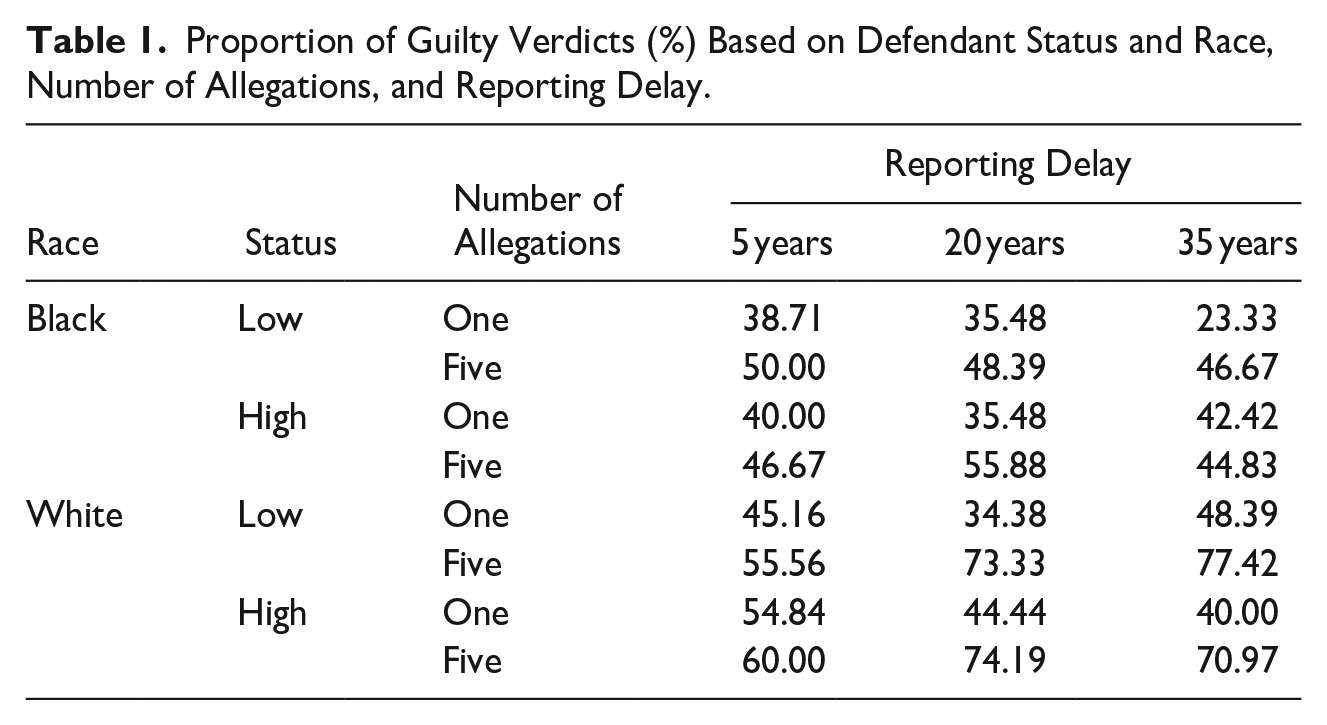
Participants were asked to render a dichotomous verdict decision based on the trial transcript they were provided. The percentages of guilty verdicts within each condition are shown in Table 1. A hierarchical logistic regression analysis was conducted to examine the influence of defendant race, defendant status, number of alleged victims, and delay in reporting on mock-jurors’ dichotomous verdicts (i.e., guilty, not guilty) 3 . Model 1 included all main effects, model 2 included the two-way interaction terms, model 3 included the three-way interaction terms, and model 4 included the four-way interaction terms. Model 1 was significant, χ2 (5) = 41.34, p < .001. There was found to be a significant effect of race, such that mock-jurors were 1.8 times the odds more likely to reach a guilty verdict when the defendant was White compared to when the defendant was Black, B = 0.58, SE = 0.15, Wald’s χ2 (1) = 14.96, p < .001, Exp(B) = 1.79, 95% CI [1.33, 2.40]. There also was found to be an effect of the number of alleged victims, such that mock-jurors were 2.1 times the odds more likely to reach a guilty verdict when there were five alleged victims than when there was one alleged victim, B = 0.76, SE = 0.15, Wald χ2 (1) = 25.75, p < .001, Exp(B) = 2.14, 95% CI [1.60, 2.88]. Interestingly, there was no significant main effect of defendant status, B = 0.13, SE = 0.15, Wald χ2 (1) = .69, p = .41, Exp(B) = 1.13, 95% CI [0.84, 1.52], and no significant main effect of delay in reporting, Wald χ2 (2) = .09, p = .96. Additionally, there were no significant interactions, and the remaining models were not significant.
Proportion of Guilty Verdicts (%) Based on Defendant Status and Race, Number of Allegations, and Reporting Delay.
Continuous Guilt (Hypotheses 1b, 2b, 3b, and 4b)
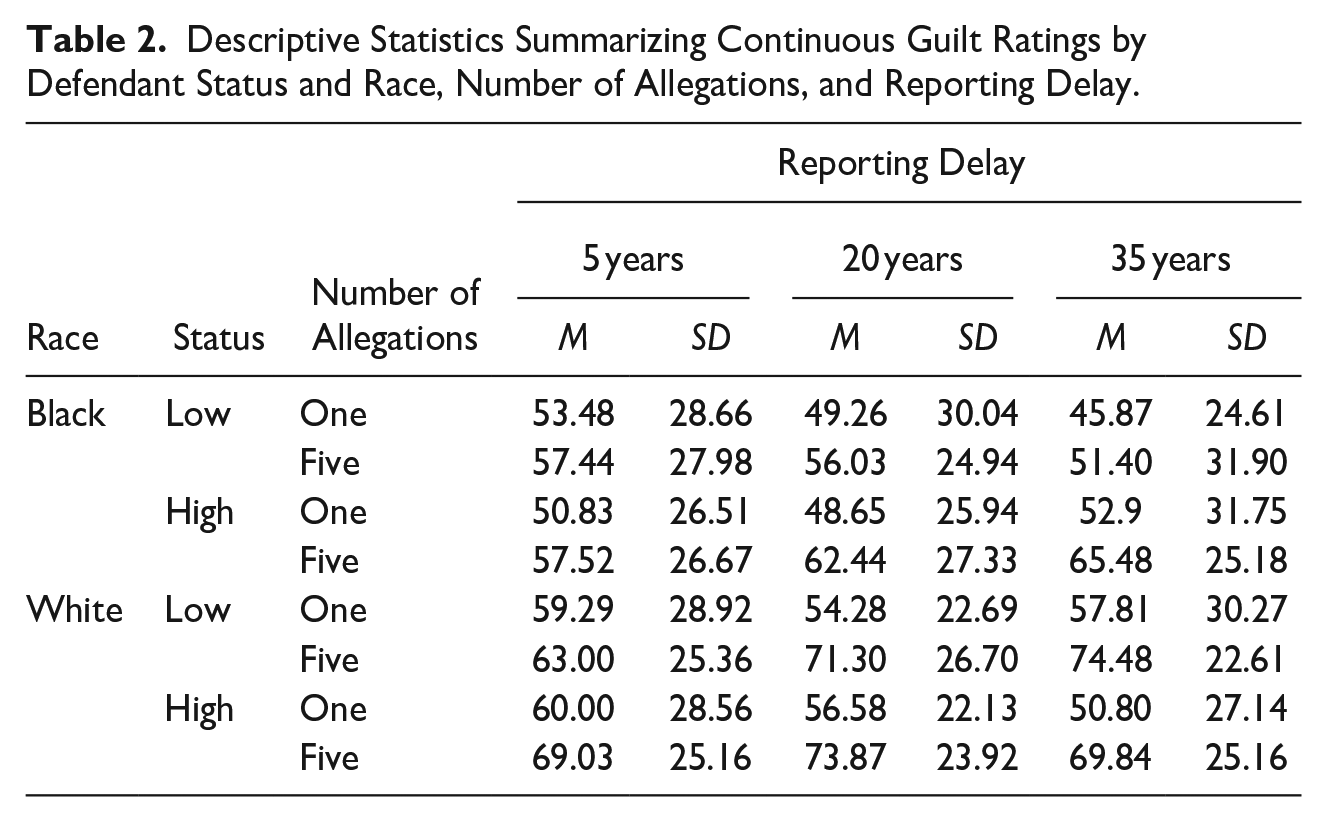
Participants rated the degree to which they believed the defendant to be guilty on a 101-point scale (0 [definitely not guilty] to 100 [definitely guilty]). A four-way ANOVA was conducted to examine whether defendant race, defendant status, number of alleged victims, and delay in reporting influenced mock-jurors’ continuous guilt ratings (see Table 2 for descriptive statistics). There was found to be a significant effect of race, F(1, 727) = 21.52, p < .001, partial η 2 = .03, such that mock-jurors assigned higher guilt ratings when the defendant was White (M = 63.24, SD = 26.54) than when the defendant was Black (M = 54.30, SD = 27.90). Additionally, there was a significant effect of the number of alleged victims, F(1, 727) = 31.61, p < .001, partial η 2 = .04, such that mock-jurors assigned higher guilt ratings when there were five alleged victims (M = 64.30, SD = 26.77) than when there was one alleged victim (M = 53.39, SD = 27.31). The remaining effects and interactions were not significant.
Descriptive Statistics Summarizing Continuous Guilt Ratings by Defendant Status and Race, Number of Allegations, and Reporting Delay.
Perceptions of Defendant (Hypotheses 1c, 2c, 3c, and 4c)
Participants were asked to complete a series of questions concerning the defendant’s responsibility for the alleged crime, the defendant’s intentions to commit the crime, whether the defendant was the person who committed the alleged assault, and the likelihood that the defendant committed the assault. All four questions were significantly correlated (p < .001), thus, a composite score was created (α = .95) by averaging each participant’s responses to the questions 4 . Importantly, higher composite scores represented less favorable perceptions of the defendant. A four-way ANOVA was conducted to determine whether defendant race, defendant status, the number of alleged victims, and delay in reporting influenced mock-jurors’ perceptions of the defendant (see Table 3 for descriptive statistics). There was a significant effect of defendant race, F(1, 728) = 34.12, p < .001, partial η 2 = .05, and the number of alleged victims, F(1, 728) = 32.82, p < .001, partial η 2 = .04. That is, mock-jurors held more favorable perceptions of the defendant when the defendant was Black (M = 43.97, SD = 45.24) compared to when the defendant was White (M = 61.00, SD = 36.20). Mock-jurors also held more favorable perceptions of the defendant when there was allegedly one victim (M = 44.25, SD = 42.44) compared to when there were allegedly five victims (M = 60.94, SD = 39.41). The remaining effects and interactions were not significant.
Descriptive Statistics Summarizing Composite Defendant Ratings by Defendant Race and Status, Number of Allegations, and Reporting Delay.
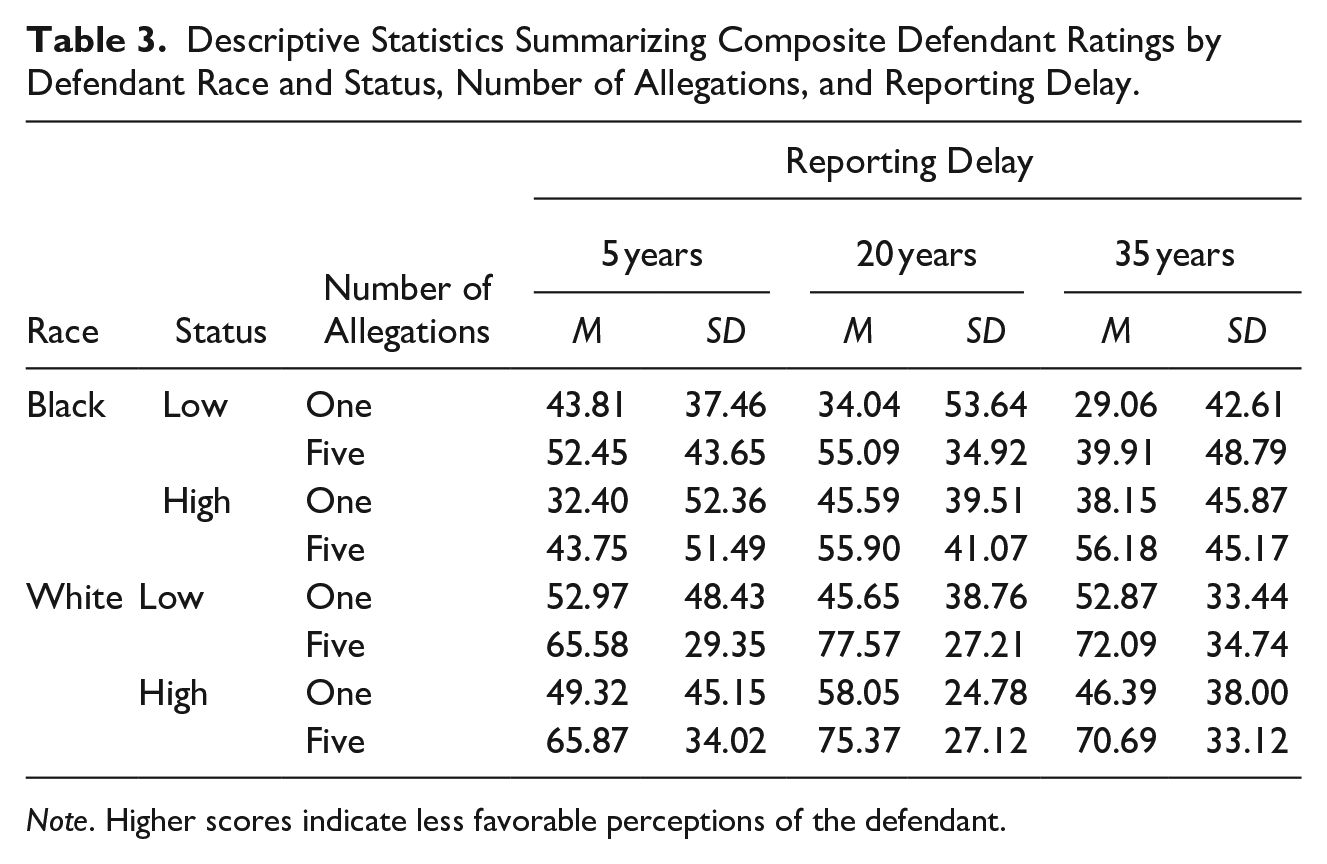
Note. Higher scores indicate less favorable perceptions of the defendant.
Perceptions of the Victim (Hypotheses 1d, 2d, 3d, and 4d)
Mock-jurors also were asked a series of questions regarding their perceptions of the victim (i.e., truthfulness, accuracy, honesty, believability, trustworthiness, and reliability). All six questions were significantly correlated (p < .001), thus, a composite score was created (α = .98), with higher composite scores representing more favorable perceptions of the victim. A four-way ANOVA was conducted to examine whether defendant race, defendant status, the number of alleged victims, and delay in reporting influenced mock-jurors’ perceptions of the victim (see Table 4 for descriptive statistics). There was a significant effect of defendant race, F(1, 703) = 17.73, p < .001, partial η 2 = .03, such that mock-jurors held more favorable perceptions of the victim when the defendant was White (M = 67.10, SD = 27.88) compared to when the defendant was Black (M = 58.19, SD = 29.63). There was also a significant effect of the number of alleged victims, F(1, 703) = 39.93, p < .001, partial η 2 = .05, such that mock-jurors held more favorable perceptions of the victim when there were allegedly five victims (M = 69.36, SD = 26.73) compared to when there was allegedly one victim (M = 56.10, SD = 29.85). The remaining effects and interactions were not significant.
Descriptive Statistics Summarizing Composite Victim Ratings by Defendant Race and Status, Number of Allegations, and Reporting Delay.
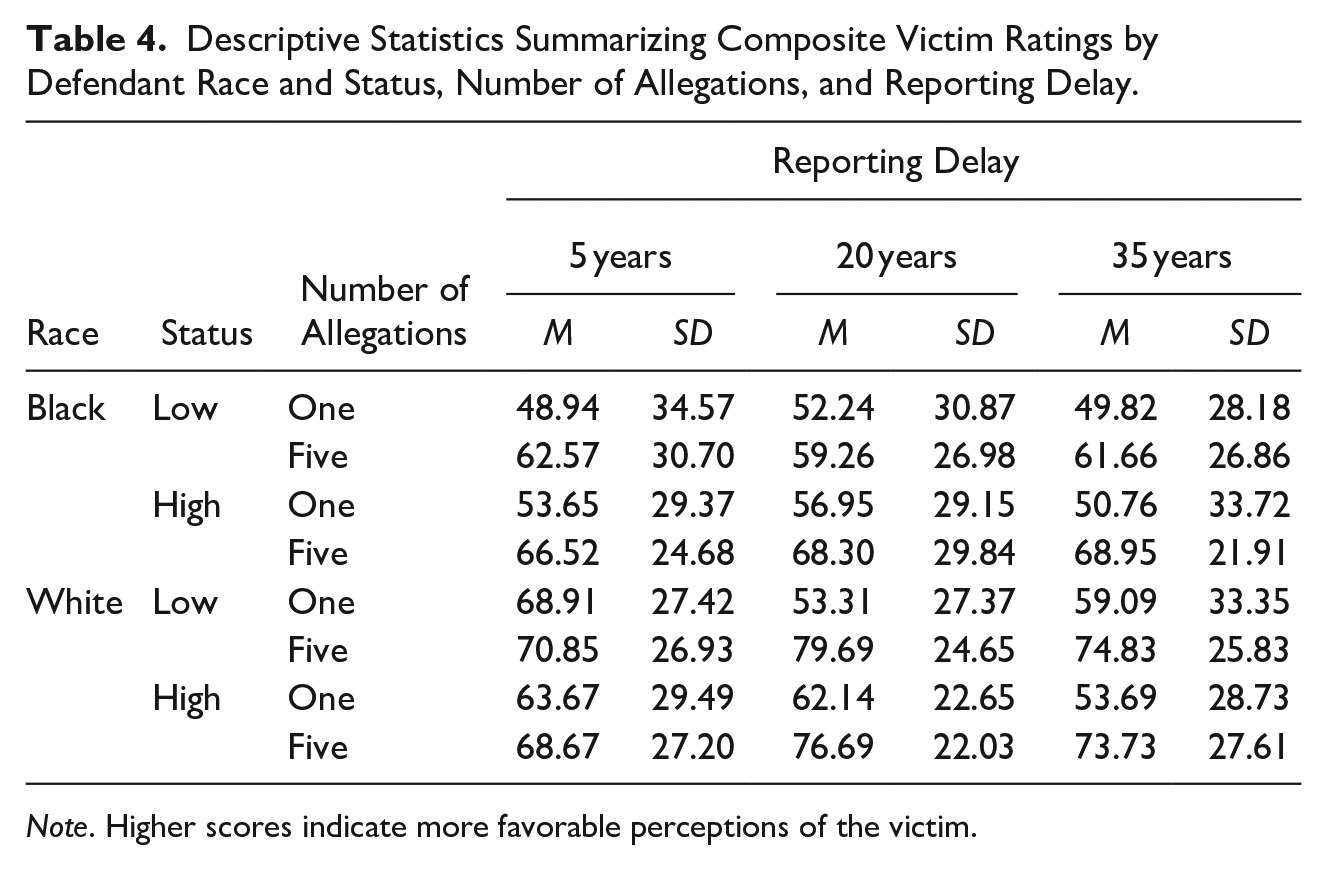
Note. Higher scores indicate more favorable perceptions of the victim.
Discussion
The purpose of the current research was to examine whether defendant race and occupational status, the number of allegations against the defendant, and delayed reporting of an alleged sexual assault influences mock-jurors’ perceptions and decisions. Given the abundance of sexual assault cases against high-status defendants in recent years, often with long delays in reporting, it is important to understand how jurors are influenced by relevant case factors. Moreover, only a few studies have examined the influence of delayed reporting in sexual assault cases involving adult victims (e.g., Balogh et al., 2003; Fraser et al., 2021; Thompson et al., 2021), and no known research has examined the influence of delayed reporting in combination with defendant status and other relevant case factors (i.e., defendant race and number of allegations).
Defendant Status (Hypothesis 1)
Contrary to our hypotheses, defendant status did not significantly influence mock-jurors’ perceptions of the defendant or victim, nor did it influence guilt judgements. It was hypothesized that a low-status defendant (i.e., landscaper) would result in more guilty verdicts than a high-status defendant (i.e., dentist) given past research has found that low-status individuals are perceived as likely to commit crime (Devine & Caughlin, 2014). It could be that neither of the occupations are perceived as being associated with sexual assault. Moreover, 48.1% of those in the low-status condition and 50.8% of those in the high-status condition rendered a guilty verdict, indicating that neither of these conditions resulted in a high proportion of guilty verdicts. It is possible that mock-jurors perceived both the landscaper and dentist as unlikely to commit sexual assault, but other low-status (e.g., a dishwasher) versus high-status occupations (e.g., lawyer) may have resulted in a significant difference in verdict decisions. However, it is also possible that occupational status is not highly influential in a sexual assault case, particularly in combination with other influential factors such as multiple allegations or defendant race.
Defendant Race (Hypothesis 2)
The current findings revealed that mock-jurors held less favorable perceptions of the White defendant than the Black defendant. Moreover, mock-jurors assigned higher guilt ratings, were more likely to render a guilty verdict, held less favorable perceptions of the defendant, and more favorable perceptions of the victim when the defendant was described as White, as opposed to Black.
There are several competing explanations for the current findings. First, in line with theories of race–crime congruency, mock-jurors in the current study may have perceived the sexual assault as more typical of a White perpetrator than a Black perpetrator. This is supported by past research which suggests that acts of sexual assault are often perceived to be committed by White individuals (Bitter et al., 2022; Jones & Kaplan, 2003; Sunnafrank & Fontes, 1983). Second, research has suggested that individuals of racial minorities are perceived as more likely to commit crime in general, compared with White individuals. Thus, it is possible that mock-jurors’ were aware of racial stereotypes of criminality and attempted to correct for bias in their responding. This would be supported by the theory of aversive racism (Gaertner & Dovidio, 2005), which suggests that when racial issues are salient, and overt racial attitudes are not socially acceptable, individuals are less likely to display racist attitudes. However, it is important to note that race was not a highly salient issue within the trial transcripts (i.e., the defendant’s race was mentioned only four times throughout).
Finally, social identity theory (SIT; Tajfel & Turner, 1986), which explains how individuals interact with members of their in- and out-group (e.g., based on race) may help to make sense of the current findings. The SIT suggests that individuals aim to maintain a positive self-image by acting favorably toward members of their in-group (and unfavorably toward members of the out-group). Relatedly, the black sheep effect suggests that individuals tend to be more punitive to unfavorable members of their in-group (e.g., those who commit a severe crime, such as sexual assault) than similarly unfavorable members of the out-group (Marques & Paez, 1994). In the current research, majority of participants were White (63%); thus, mock-jurors’ may have been more punitive toward members of their in-group (i.e., the White defendant) to maintain a positive group identity.
Delayed Reporting (Hypothesis 3)
There was hypothesized to be a non-linear effect of delayed reporting, such that short (5 years) and long (35 years) delays in reporting would result in higher guilt ratings, more guilty verdicts, less favorable perceptions of the defendant, and more favorable perceptions of the victim, as opposed to a moderate delay in reporting (i.e., 20 years). This was hypothesized based on past research which has found that short (e.g., immediate) delays and longer delays result in a greater proportion of guilty verdicts than moderate delays (e.g., Balogh et al., 2003; Fraser et al., 2021; Thompson et al., 2021). However, the current research did not find a significant effect of reporting delay on mock-jurors’ perceptions and decisions.
Recent studies examining the impact of delayed reporting have found that moderate delays (e.g., 10 or 15 years) result in less guilty verdicts (Fraser et al., 2021) and less favorable perceptions of the victim (Thompson et al., 2021) than shorter (e.g., 1 year) or longer delays (e.g., 20 or 25 years). However, in the current research, it is possible that a 5- and 20-year delay are perceived as equally believable; had there been a more moderate delay in reporting (e.g., 10 to 15 years), significance may have emerged. As mentioned, past research has suggested that the effect of delayed reporting is non-linear, with victim believability peaking at short and long delays and flattening at the higher end of reporting delay. Further, the current research may have captured only the short and longer delays in reporting, thus explaining why no significance emerged.
Number of Allegations (Hypothesis 4)
As hypothesized, the current research found that mock-jurors assigned higher guilt ratings, rendered more guilty verdicts, held less favorable perceptions of the defendant, and more favorable perceptions of the victim when there were five alleged victims versus one alleged victim. The current findings suggest that mock-jurors perceive multiple allegations as evidence that the defendant was likely to have committed the sexual offence in question.
These findings are in line with Thompson et al. (2021), which is one of the few studies to examine the influence of the number of allegations against a defendant in a sexual assault case. Thompson and colleagues found that mock-jurors viewed the victim as more believable, and were more likely to render a guilty verdict, when there were multiple allegations against the defendant (as opposed to one allegation). Though not directly relevant to the number of alleged victims, Pica et al. (2020b) also examined the influence of the number of allegations in a sexual harassment case, specifically allegations made by a single individual. Results revealed that mock-jurors were more likely to render a guilty verdict, held more favorable perceptions of the victim, and held less favorable perceptions of the defendant when the victim did not make prior allegations of sexual harassment. These results suggest that the number of allegations is a highly influential factor on mock-jurors’ judgements in the context of sexual misconduct.
Drawing on theories of social psychology, the current findings can be explained by Kelley’s (1967) covariation model, which was recently presented as an explanation in Thompson et al. (2021). The covariation model proposes an attribution theory to describe how individuals make inferences when interpreting the cause of an event. This model ascribes the cause of an event to a stimulus, person, or environment dimension, with consensus on a dimension indicating that the dimension is likely to have caused the event. In the current research, the allegation of sexual assault (i.e., the event) would be based on consensus on the stimulus (victim) and person (defendant) dimensions. Moreover, if there is only one allegation, consensus is low, and the event would likely be attributed to the alleged victim. However, if there are multiple allegations, consensus is high, and the sexual assault would likely be attributed to the defendant. Thus, in the current research, multiple allegations against the defendant likely increased jurors’ consensus regarding the defendant committing the sexual assault and decreased mock-jurors’ doubt regarding the victim’s story.
Limitations and Future Directions
There are several limitations of the current research. First, the current study used a sample of undergraduate students. This is limiting as results may not be representative of the wider jury-eligible population. Although researchers have suggested that undergraduate samples (as opposed to representative community samples) limit the generalizability of mock-juror research (e.g., Nunez et al., 2011; Wiener et al., 2011), recent research using a meta-analytic approach has suggested that guilt judgements do not differ between student and community mock-juror samples (Bornstein et al., 2017). Similarly, the sample is imbalanced in terms of participant race. Although participants who identified as Black were the second largest group (i.e., 10.6%), the majority of the sample identified as White (i.e., 63%). This has implications for the current findings, such that the results are largely representative of those who identify as White. However, it is important to note that the proportion of participants who identified as White in the current study resembles the proportion of those who identify as White in the Canadian population (67.4%; Statistics Canada, 2022b). Moreover, the proportion of mock-jurors who identified as White in the current research is likely to reflect the composition of real-life juries in Canada.
In addition, the current study examined the perceptions and decisions of individual mock-jurors, rather than jurors’ judgements after group deliberation, which does not reflect real-life court settings. Although many researchers have noted that a lack of group deliberation is a threat to ecological validity (e.g., Nunez et al., 2011), studies involving non-deliberating jurors are useful to inform pre-trial attitudes. Nonetheless, future research should examine mock-juror decision-making in the context of group-deliberation. The current research is also limited such that participation occurred online. There has been concern among researchers that online samples produce lower quality data than in-person samples. However, recent research has suggested that online mock-juror samples have similar ecological validity as in-person samples. For example, Maeder et al. (2018) found that the manipulation check failure rate for an online mock-juror sample was similar to that of an in-person sample, suggesting that online participants were no less aware of the manipulated variables than in-person participants.
An additional limitation is that the current research involved a short trial participation length (i.e., 23 min), compared with real-life trials that can take place over days. Further, mock-jurors in the current study were asked to read the excerpt of a mock-trial, in contrast to trials that present recorded or live evidence. Although these limitations may influence the ecological validity of the current study, it is important to note that such limitations are typical of mock-juror research due to various restraints (e.g., time, resources, or restrictions associated with involving real-life jurors in research; Willmott et al., 2021). In addition, the current study attempted to replicate a real-life trial in a way that was realistically possible given practical restraints, which is a recommendation provided by Willmott et al. (2021) for conducting mock-juror research. Moreover, mock-jurors read a mock-trial transcript that presented pre-trial and final instructions from the judge (including relevant laws from the Criminal Code), opening and closing statements from the Crown and Defence, as well as testimony from Crown and Defence witnesses. Furthermore, the current research meets the minimum standards for mock-juror research described by Willmott et al. (2021), such that all participants were jury-eligible in Canada (i.e., 18 years or older and a Canadian citizen).
Finally, findings regarding occupational status are specific to only the occupations used in the current study; future research should explore different operationalizations and manipulations of defendant status. Future research should also explore a range of number of allegations to determine whether there is a linear effect, or whether more than one allegation (e.g., two allegations) is perceived as similarly believable as many allegations (e.g., 10 allegations). Finally, future research should continue to examine the impact of delayed reporting, including a moderate delay condition to capture the full range of the effect of reporting delays.
Conclusion
The current research is one of the first studies to examine the influence of defendant status and race, delayed reporting, and number of allegations on mock-juror decision-making in a sexual assault case. The race of the defendant and the number of allegations were found to be highly influential, such that mock-jurors rendered more guilty verdicts, assigned higher guilt ratings, perceived the defendant less favorably and the victim more favorably, when the defendant was White (compared to Black) and when there were multiple allegations against the defendant. These findings have important implications for researchers, as it is suggested that within sexual assault cases, defendant race and the number of alleged victims who come forward, influence how jurors may evaluate the facts of a case. Researchers should continue to examine the influence of defendant race and number of allegations in combination with other relevant factors. Ultimately, this study can inform future research, which in time, can inform those in the criminal justice system on the factors that influence juror decision-making in a sexual assault case. For example, the current research could inform the development of interventions such as juror instructions and expert testimony; research has found that interventions are effective at reducing rape myth acceptance among jurors (e.g., Hudspith et al., 2023).
Although past research has found that delayed reporting of a sexual offence is influential in a mock-juror context (e.g., Balogh et al., 2003; Fraser et al., 2021; Thompson et al., 2021), delayed reporting did not significantly influence mock-jurors’ decisions in the current study. Future research should continue to examine the effect of delayed reporting, including a moderate reporting delay (e.g., 10 years). In addition, the effect of defendant status was not significant. As victims may take long periods of time to come forward with their allegations of sexual assault, future research should explore the influence of defendant status across a range of occupations and different operationalizations of status (e.g., socioeconomic status).
Supplemental Material
sj-docx-1-jiv-10.1177_08862605231153873 – Supplemental material for Mock-Jurors’ Judgements in a Sexual Assault Case: The Influence of Defendant Race and Occupational Status, Delayed Reporting, and Multiple Allegations
Supplemental material, sj-docx-1-jiv-10.1177_08862605231153873 for Mock-Jurors’ Judgements in a Sexual Assault Case: The Influence of Defendant Race and Occupational Status, Delayed Reporting, and Multiple Allegations by Bailey M. Fraser, Emily Pica and Joanna D. Pozzulo in Journal of Interpersonal Violence
Footnotes
Declaration of Conflicting Interests
The author(s) declared no potential conflicts of interests with respect to the authorship and/or publication of this article.
Funding
The author(s) received no financial support for the research and/or authorship of this article.

Supplemental Material
Supplemental material for this article is available online.
Notes
Author Biographies
References
Supplementary Material
Please find the following supplemental material available below.
For Open Access articles published under a Creative Commons License, all supplemental material carries the same license as the article it is associated with.
For non-Open Access articles published, all supplemental material carries a non-exclusive license, and permission requests for re-use of supplemental material or any part of supplemental material shall be sent directly to the copyright owner as specified in the copyright notice associated with the article.
