




Abstract
Research regarding sexual violence myth endorsement has mainly used college student samples and focused on cisgender women victims, disregarding a diverse range of victim profiles. This study aims to provide evidence of the validity and reliability of the Gender Inclusive Rape Myth Acceptance (GIRMA) scale in the Portuguese context using a community sample. A community sample of 518 Portuguese-speaking adults participated in this study between April and June 2024. A confirmatory factor analysis was conducted, and the scale’s convergent and divergent validity and reliability were assessed. This study found evidence to support the one-factor structure of the GIRMA scale and the validity and reliability of the scale’s one-factor model. Males, heterosexuals, older individuals, and individuals with lower education levels and higher levels of sexism and social dominance orientation were more likely to endorse sexual violence myths. On the other hand, participants who knew someone who had experienced sexual violence endorsed fewer myths. Similar results were found among participants who experienced sexual violence in adulthood. The GIRMA proved to be a reliable instrument for assessing sexual violence myths in the Portuguese context, thus providing relevant cross-cultural and psychometric evidence. The evidence on sexual violence myth endorsement found in this study may contribute to better inform victim protection policies regarding their inclusiveness and prevention programs to mitigate the dissemination of these myths in community and professional settings.
Introduction
Rape myths involve societal and cultural beliefs that reinforce heteropatriarchal structures and traditional gender roles, perpetuating hypermasculinity (Urban, 2021). Rape myths are also widely accepted at both the micro and macro levels of society (Walfield, 2021). These myths include several harmful beliefs: that victims can prevent sexual violence through verbal or physical resistance (Burt, 1980; Edwards et al., 2011; Xue et al., 2019); that women provoke sexual violence through their clothing or actions (Bohner et al., 2013; Burt, 1980; Edwards et al., 2011) and secretly enjoy rape (Bohner et al., 2013; Edwards et al., 2011); and that men are unable to control their impulses, resulting in forceful sexual encounters (Bohner et al., 2013; Xue et al., 2019). Rape myths also focus on the relationship between victims and perpetrators, such as the notion that offenders are typically strangers rather than acquaintances or intimate partners (Edwards et al., 2011; G. D. Anderson & Overby, 2021; Li & Zheng, 2022). Victims are often stereotyped as young cisgender women, neglecting the diversity of individuals affected by sexual violence, including children, men, and members of the LGBTQIA+ community. These myths regarding victims’ characteristics can be harmful to those who do not meet these expectations (G. D. Anderson & Overby, 2021; Urban & Porras Pyland, 2021).
Rape myths legitimize and justify sexual violence (Lonsway & Fitzgerald, 1995; Nyúl & Kende, 2023), not only by perpetuating victim blaming (G. D. Anderson & Overby, 2021; Li & Zheng, 2022) but also by removing the blame from the perpetrator (Li & Zheng, 2022; Murray et al., 2023). As a result, rape myths minimize the severity and impact of sexual violence (Angelone et al., 2021; Schulze et al., 2019), which can negatively affect victims’ well-being, including their physical and mental health, and even economic outcomes (G. D. Anderson & Overby, 2021). These myths permeate social and institutional settings, including legal, media, and religious institutions (Edwards et al., 2011), thereby influencing the behaviors of professionals, bystanders, victims, and perpetrators (Beshers & DiVitta, 2021). Also, these myths can be internalized by victims and survivors, leading to feelings of shame, guilt, and blame (G. D. Anderson & Overby, 2021).
Research has examined the role of individual variables in rape myth endorsement, including gender, age, and education. Overall, men show higher levels of rape myth acceptance (Beshers & DiVitta, 2021; Fávero et al., 2022; Xue et al., 2019), more victim blaming (Fávero et al., 2022), and greater tolerance for sexual violence (Fávero et al., 2022; Xue et al., 2019). However, some studies show no significant gender differences, whereas others show that women score higher on rape myth acceptance (Abeid et al., 2015; Hill & Marshall, 2018). Traditional and stereotypical gender roles (B. E. Johnson et al., 1997), hostility toward women (Lonsway & Fitzgerald, 1995), and societal norms such as hegemonic masculinity (e.g., being strong, powerful, heterosexual, aggressive, and having a dominant social position; Javaid, 2015) may contribute to these findings, as men appear to identify more with the aggressive and powerful role of the perpetrator (Gerber et al., 2004). This may lead men to rationalize rape myths and potentially justify their tendency to engage in aggressive sexual behaviors (Bohner et al., 2013). Findings regarding age as a predictor of rape myth endorsement have been inconsistent; some studies have found that older individuals endorse higher levels of rape myths (e.g., Fávero et al., 2022; Walfield, 2021), while others have found the opposite effect (e.g., Beshers & DiVitta, 2021). However, higher education tends to correlate with lower levels of rape myth endorsement (Fávero et al., 2022; Prina & Schatz-Stevens, 2019). Sociodemographic variables such as sexual orientation have been less explored. However, studies suggest that heterosexual men endorse more rape myths than gay men and especially more than lesbian and bisexual women (Canan et al., 2023; Wilson & Newins, 2019).
Research has also focused on the association between cultural beliefs, such as sexism, and rape myth acceptance. Sexism covers discriminatory attitudes and behaviors based on the individual’s biological sex (Matlin, 2012). Theoretically, two sets of sexist attitudes have been identified and conceptualized: Hostile and Benevolent Sexism (Glick & Fiske, 1996). Hostile Sexism implies beliefs associated with women’s inferiority and antipathy or intolerance toward their role as powerful decision-makers (Formiga et al., 2002). However, Benevolent Sexism implies more covert beliefs, which are more complex and subtle (Magalhães et al., 2007). Benevolent sexist beliefs and attitudes are perceived as non-prejudicial, but they have a paternalistic undertone in which women are described as fragile, while simultaneously complementing men (Formiga et al., 2002). Research has shown that both forms of sexism predict rape myth acceptance, which has been observed in studies on American (Angelone et al., 2021; Chapleau et al., 2007) and European samples (Davies et al., 2012; Nyúl & Kende, 2023). However, other predictors, such as social dominance orientation (SDO), have been overlooked, as existing literature has tended to focus more extensively on beliefs such as sexism over time (e.g., Chapleau et al., 2007; Davies et al., 2012). SDO involves the support of hierarchical and non-egalitarian intergroup connections and the desire to dominate others (Pratto et al., 1994). SDO sustains the status quo between higher-status groups (e.g., men) and lower-status groups (e.g., women; Pratto et al., 1994), as well as the oppression of the latter (Nyúl & Kende, 2023). SDO maintains societal structures through traditional rules and norms (e.g., masculine norms; Nicol & Tóth-Király, 2024), which serve to legitimize inequality and perpetuate myths that uphold these social structures (Pratto et al., 1994). More recent studies have examined the association between SDO and myth endorsement, consistently finding positive associations (Murray & Calderón, 2021; Nicol & Tóth-Király, 2024; Nyúl & Kende, 2023). These findings highlight the lack of empathy associated with SDO, which contributes to greater acceptance of myths about sexual violence (Nicol & Tóth-Király, 2024).
Despite substantial research on rape myths and their implications for victims, the literature has primarily focused on White cisgender women, disregarding victims’ diverse profiles concerning gender identity, race, and sexual orientation (George, 2025; Murray & Calderón, 2021; Urban, 2021). This narrow focus may contribute to the underreporting of rape, particularly among victims who do not fit the typical profile of cisgender women (G. D. Anderson & Overby, 2021; Urban, 2021). Evidence indicates that rape myths also affect male cisgender victims (Javaid, 2015; Kassing et al., 2005). Common myths surrounding male rape include the belief that sexual violence against men is primarily perpetrated by gay men and confined to prison settings (Javaid, 2015; Kassing et al., 2005). In addition, these myths suggest that men cannot be raped due to their physical strength and ability to defend themselves against sexual violence (Javaid, 2015; Kassing et al., 2005). They also imply that men provoke sexual activity and therefore cannot be victims (Kassing et al., 2005). Another harmful myth is that a male victim’s physical response (e.g., erection) to rape signifies consent (Javaid, 2015). Furthermore, these myths assert that male victims lose their masculinity, can easily cope with the experience of sexual violence, and that sexual minority men deserve to be raped due to perceived deviance or immorality (Javaid, 2015; Kassing et al., 2005). Research on rape myths regarding the LGBTIQA+ community is even more limited (N. L. Johnson et al., 2023; Urban & Porras Pyland, 2021), despite evidence that gay male victims are often blamed for their experiences of sexual violence (Nicol & Tóth-Király, 2024). Literature addressing myths related to transgender and gender-diverse victims is even more scarce (Urban & Porras Pyland, 2021). Continued focus on traditional, heteronormative narratives of sexual violence overlooks the diverse experiences of individuals across sexual orientations and gender identities (N. L. Johnson et al., 2023; Urban, 2021). In sum, despite more than 40 years of research, the literature on rape myths still lacks inclusive conceptualizations and measurement instruments based on the diversity of victim profiles.
Several measures have been developed over the decades to assess rape myth endorsement, namely Burt’s (1980) Rape Myth Acceptance Scale (RMAS) and Payne et al.’s (1999) Illinois Rape Myth Acceptance (IRMA) scale, which are still widely used. These scales focus on cisgender women victims and male perpetrator scenarios. However, since these instruments were developed in the 80s and 90s, concerns have been raised regarding their wording and relevance. Some authors have suggested that these items may reflect outdated myths, as increased awareness of sexual violence may refute certain misconceptions implicit in rape myths (Canan et al., 2023; Gerger et al., 2007; McMahon & Farmer, 2011). To address this issue, the Acceptance of Modern Myths about Sexual Aggression Scale (AMMSA; Gerger et al., 2007) and an updated version of the IRMA scale (McMahon & Farmer, 2011) were developed. Despite these improvements, existing instruments still present a few disadvantages. Most continue to focus on cisgender women victims and male perpetrator scenarios (e.g., RMAS; Burt, 1980; IRMA; Payne et al., 1999; AMMSA; Gerger et al., 2007), disregarding other types of sexual violence experiences and victims. While some measures were developed to assess male rape myths, such as the Male Rape Myths Scale (Melanson, 1998; Struckman-Johnson & Struckman-Johnson, 1992), they were developed based on rape myths about cisgender women victims, which may limit their effectiveness in understanding myths about cisgender men (Urban & Porras Pyland, 2021). Moreover, most of these instruments were developed and/or validated using samples of college students (e.g., IRMA), raising concerns about their generalizability (Urban & Porras Pyland, 2021). Finally, instruments that focus on the LGBTQIA+ community were recently developed, namely, the Identity Inclusive Sexual Assault Myth Scale (IISAMS) by Schulze et al. (2019) and the Gender Inclusive version of the modified IRMAS (GIIRMAS) by N. L. Johnson et al. (2023). However, their generalizability may be limited due to their sample demographics: the IISAMS used samples of college students (Schulze et al., 2019), and the GIIRMAS used a sample consisting mostly of young adults (ages 24 to 35; N. L. Johnson et al., 2023).
To fill these gaps in existing research, Urban and Porras Pyland (2021) developed the Gender Inclusive Rape Myth Acceptance (GIRMA) scale. This scale, consisting of 18 items, addresses rape myths involving cisgender women, cisgender men, and members of the LGBTIQA+ community, making it the first scale to encompass diverse sexual orientations and gender identities. The authors aimed to balance the distribution of items across different victim profiles, as well as various contexts (e.g., workplace), circumstances (e.g., alcohol use), and sexual orientations (e.g., heterosexual, gay, and bisexual). These items capture common myths, such as the minimization of the impact of sexual violence, using language adapted to contemporary cultural norms (Urban & Porras Pyland, 2021). Unlike most scales, the GIRMA was validated using a diverse sample (n = 1,028) in terms of the gender of the respondents, age (average age above 35 years), sexual orientation (heterosexual, lesbian, gay, and bisexual participants), ethnicity, and educational level (high school and college level education; Urban & Porras Pyland, 2021).
Although rape myths are socially accepted and widespread worldwide, there are differences in rape myth acceptance among countries that need to be considered (Fakunmoju et al., 2021; Hill & Marshall, 2018). Moreover, some gaps in the literature have been identified: (a) most studies use college students in their samples; (b) most rape myth instruments focus on cisgender women victims and male perpetrator scenarios, thus excluding other victims’ experiences (e.g., cisgender men and LGBTQIA+ individuals); and (c) to our knowledge, no specific rape myth endorsement measures have been adapted to the Portuguese context. Therefore, the present study aimed to: (a) adapt the GIRMA (Urban & Porras Pyland, 2021) to the Portuguese context using a community sample and (b) provide evidence on the psychometric properties of the Portuguese version of the scale. Considering the wide scope of myths and victims included in the GIRMA scale (i.e., cisgender women and men, and LGBTQIA+ individuals), sexism, SDO, and discriminatory and positive attitudes toward LGBTQIA+ individuals were used as external variables to provide evidence of the scale’s construct validity. Considering existing literature and findings (e.g., Angelone et al., 2021; Beshers & DiVitta, 2021; Nyúl & Kende, 2023), we expected GIRMA scores to show positive associations with sexism, SDO, and discriminatory attitudes toward LGBTQIA+ individuals, and show negative associations with positive attitudes toward LGBTQIA+ individuals. In addition, regarding sociodemographic variables, we expected that males, heterosexuals, and individuals with lower education levels would endorse more sexual violence myths, while sexual minorities and individuals with higher education levels would endorse fewer myths.
Method
Participants
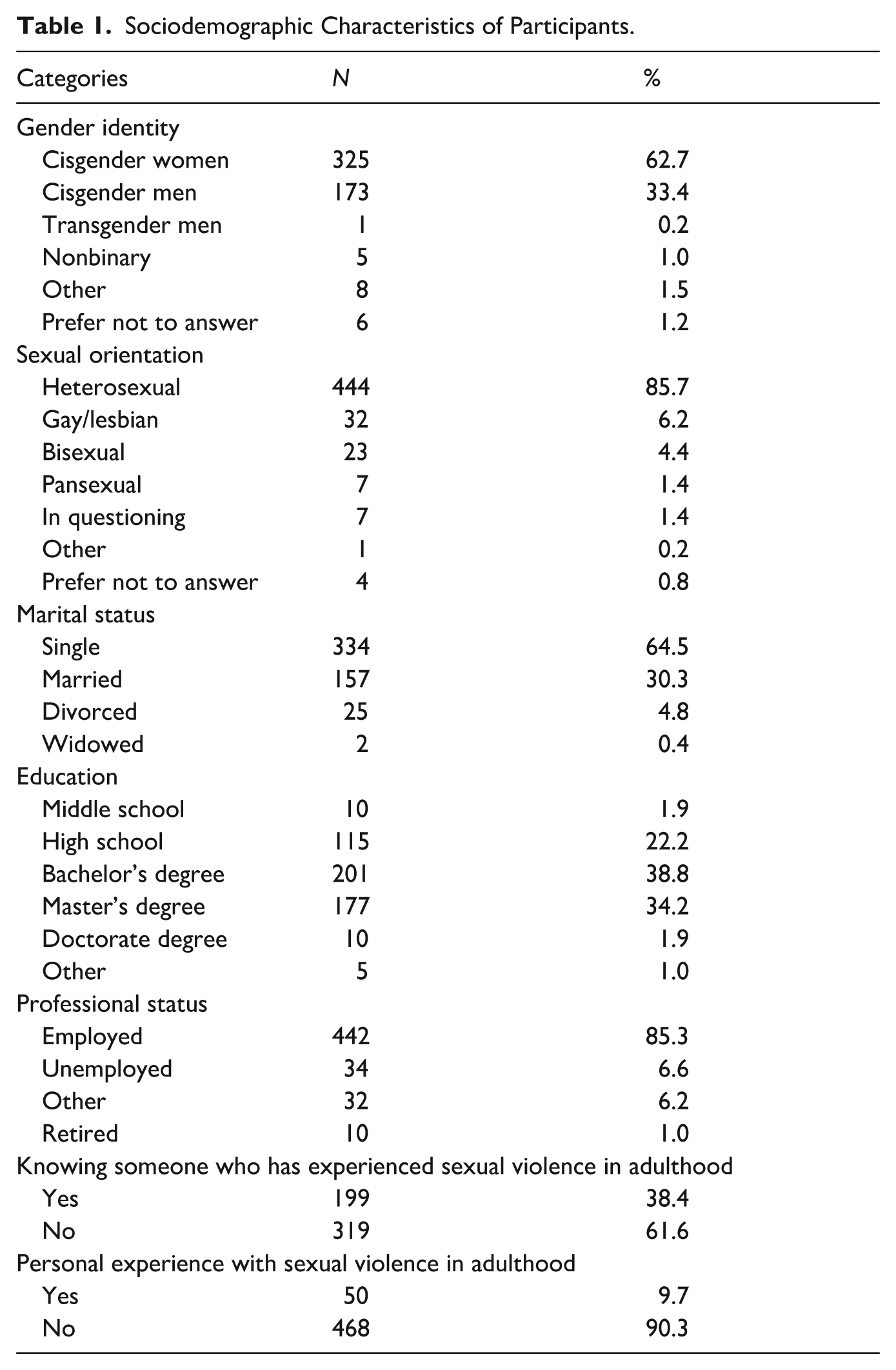
The sample included 518 Portuguese-speaking adults (age 18–75; Mage = 35.30; SD = 12.92). Most participants were cisgender women (62.7%), heterosexual (85.7%), single (64.5%), had completed higher education courses (74.9%), and were employed/working (85.3%). Approximately 38% of participants reported knowing someone who had experienced sexual violence as an adult. When asked whether they had experienced any form of sexual violence in adulthood, 9.7% reported that they had experienced it (Table 1).
Sociodemographic Characteristics of Participants.
Instruments
Sociodemographic Questionnaire
Participants completed a sociodemographic questionnaire regarding personal information and characteristics, namely age, nationality, gender identity, sexual orientation, marital status, and academic and educational experience, as well as whether they knew someone who had experienced sexual violence (i.e., Do you know (or have you ever known) anyone who has been a victim of sexual violence as an adult?) or had been a victim of sexual violence (i.e., Have you experienced any kind of sexual violence as an adult?) in adulthood.
Gender Inclusive Rape Myth Acceptance Scale
The GIRMA scale assesses rape myths regarding cisgender women, cisgender men, and gender-diverse victims, as well as victims with various sexual orientations, including heterosexual men and women and gay and bisexual men. The GIRMA is a self-report scale consisting of 18 items (e.g., “Real men can defend themselves against being raped,” “It’s only rape if a woman is penetrated by a man”) organized into a single factor and answered using a 5-point Likert scale (1 = Strongly Disagree to 5 = Strongly Agree), with higher scores indicating higher myth endorsement (Urban & Porras Pyland, 2021). Excellent internal consistency (α = .97) was found in the original study (Urban & Porras Pyland, 2021).
The Ambivalent Sexism Inventory
This scale aims to measure sexist attitudes and beliefs, consisting of 22 items assessing 2 factors: Hostile Sexism (e.g., “Women are too easily offended,” “Women fail to appreciate all men do for them”) and Benevolent Sexism (e.g., “In a disaster, women need not be rescued first,” “Women should be cherished and protected by men”). Participants are asked to score their level of agreement with different statements using a 5-point Likert scale (1 = Strongly Disagree to 5 = Strongly Agree), with higher scores reflecting more sexist attitudes on both subscales. The original version of the scale demonstrated good levels of internal consistency for both subscales across six studies: Hostile Sexism (α = .80–.92) and Benevolent Sexism (α = .73–.85) (Glick & Fiske, 1996). Similar results were found in the Portuguese context for both subscales: Hostile Sexism (α = .82) and Benevolent Sexism (α = .80; Magalhães et al., 2007) and in the current sample (Hostile Sexism: α = .86; Benevolent Sexism: α = .82).
The Short Social Dominance Orientation Scale
This scale measures the tendency to endorse a group-based hierarchy and support social inequality through four items (e.g., “Superior groups should dominate inferior groups,” “Group equality should be our ideal”) answered using a 7-point Likert scale (1 = Strongly Disagree to 7 = Strongly Agree). Lower scores indicate a preference for group inclusion and equality over dominance (Pratto et al., 2013). The scale has shown acceptable internal consistency in the original version (average α = .65 across 20 countries; Pratto et al., 2013) and in the Portuguese version (α = .64; Magalhães et al., 2022), with similar levels of internal consistency found in this study (α = .64). To provide further evidence of the instrument’s reliability, inter-item correlations were calculated (inter-item correlation = .30), showing adequate levels (Piedmont, 2014).
The Attitudes Toward Gay and Lesbian Civil Rights Scale
This eight-item scale measures participants’ attitudes toward gay and lesbian rights (e.g., “Same-sex marriage should not be allowed,” “Homosexual people should not have children because it is not natural”). Participants are asked to indicate their level of agreement with each statement using a 5-point Likert scale (1 = Strongly Disagree to 5 = Strongly Agree). Higher scores indicate greater opposition to gay and lesbian civil rights (Costa et al., 2014). Acceptable internal consistency has been provided for the scale (α = .77; Costa et al., 2014), which was also found in the current sample (α = .70).
Genderism and Transphobia Scale (Transphobia/Genderism Subscale)
The short version of the Genderism and Transphobia Scale measures attitudes, beliefs, and behaviors toward trans and gender-diverse individuals through 12 items organized in 2 factors (i.e., Transphobia/Genderism and Gender-bashing; Carrera-Fernández et al., 2020). For this study, we used the six-item Transphobia/Genderism subscale (e.g., “A man who dresses as a woman is a pervert,” “God made two sexes and two sexes only”). Participants answered these items using a 6-point Likert scale (1 = Strongly Agree to 6 = Strongly Disagree), with lower scores indicating a higher level of transphobic attitudes (Carrera-Fernández et al., 2014). The original short form of the Transphobia/Genderism subscale showed good levels of internal consistency (α =. 83; Carrera-Fernández et al., 2014), as did the Portuguese version (α = .82; Carrera-Fernández et al., 2020). In the current sample, the scale also revealed good levels of internal consistency (α = .85).
Procedures
Translation and Adaptation of the GIRMA Scale
To validate and adapt the scale, we proceeded with its translation, back-translation, and review of the items (Hambleton et al., 2005). Before this process, permission was requested from the first author of the original scale to use, translate, and adapt it. After permission was granted, the scale was translated into Portuguese by two researchers. Subsequently, the research team reviewed the translated items to resolve discrepancies and refine the linguistic aspects to ensure that items were clear and easily understood by the general Portuguese population. The translated version of the scale was then back-translated by a bilingual speaker, and the back-translated version was compared with the original version, resulting in the final Portuguese version, which was thoroughly revised by the research team. The original version of the scale was designed to measure rape myths (Urban & Porras Pyland, 2021). However, when adapting the instrument to the Portuguese version, we aimed to make it more comprehensive to measure sexual violence myths in this context.
Data Collection and Analysis
This study was approved by the Ethical Committee of the University (Ref. 46/2024). Data were collected using the Qualtrics platform (from April to June 2024) through the online dissemination of a link on social media (e.g., Facebook, Instagram, and LinkedIn) and through online advertisements on Facebook and Instagram. Thus, a non-probabilistic convenience sample was recruited using two criteria: (a) all participants had to reside in Portugal and understand the Portuguese language (spoken and written), and (b) all participants had to be at least 18 years old. Informed consent was provided before participation, including the study’s objectives, description, and research team contact details, if further clarification was required. Participation in this study was voluntary and without financial or other rewards. Participants were also informed that they could stop responding at any time during the study. After providing consent, participants completed the questionnaires in the order presented in the Instruments subsection. Specifically, before responding to the GIRMA scale, participants read the definition of sexual violence by the World Health Organization (2014).
After data collection, IBM SPSS for Windows (version 29.0) was used to analyze participants’ descriptive statistics, mean differences, reliability, and correlational analysis. A total of 685 responses were initially collected. However, 167 cases were excluded during data cleaning due to incomplete responses, resulting in a final sample of 518 participants for analysis.
A descriptive analysis of the items was performed, including skewness and kurtosis, considering acceptable absolute values inferior to 3 and 8, respectively (Kline, 2005). IBM SPSS AMOS (version 29) was used to perform confirmatory factor analysis (CFA) of the one-factor model of the original scale (Urban & Porras Pyland, 2021). The model fit was assessed using the following indices and cutoffs: Chi-square (χ2) statistics (nonsignificant), root mean square error of approximation (RMSEA) values below 0.08 (Steiger, 1990), comparative fit index (CFI; Bentler, 1990), and the Tucker-Lewis index (TLI; Bentler, 1990) values above 0.90, and the standardized root mean square residual (SRMR) below 0.09. Items with factor loadings below 0.30 were removed (Tavakol & Wetzel, 2020). Modification indices were examined to assess necessary changes, with values greater than 20 used to identify correlated errors between items within the one-factor model.
Cronbach’s alpha was used to assess the internal consistency of the Portuguese version of the GIRMA scale, and values above .60 were considered acceptable (Daud et al., 2018). Correlations between sexual violence myths, sexism, SDO, and discriminatory and positive attitudes toward LGBTIQA+ individuals were used to provide convergent and divergent validity. Finally, correlations between sexual violence myths and sociodemographic variables were performed (i.e., gender, age, sexual orientation, knowing someone who had experienced sexual violence in adulthood, and having personal experience with sexual violence in adulthood).
Results
Descriptive Statistics
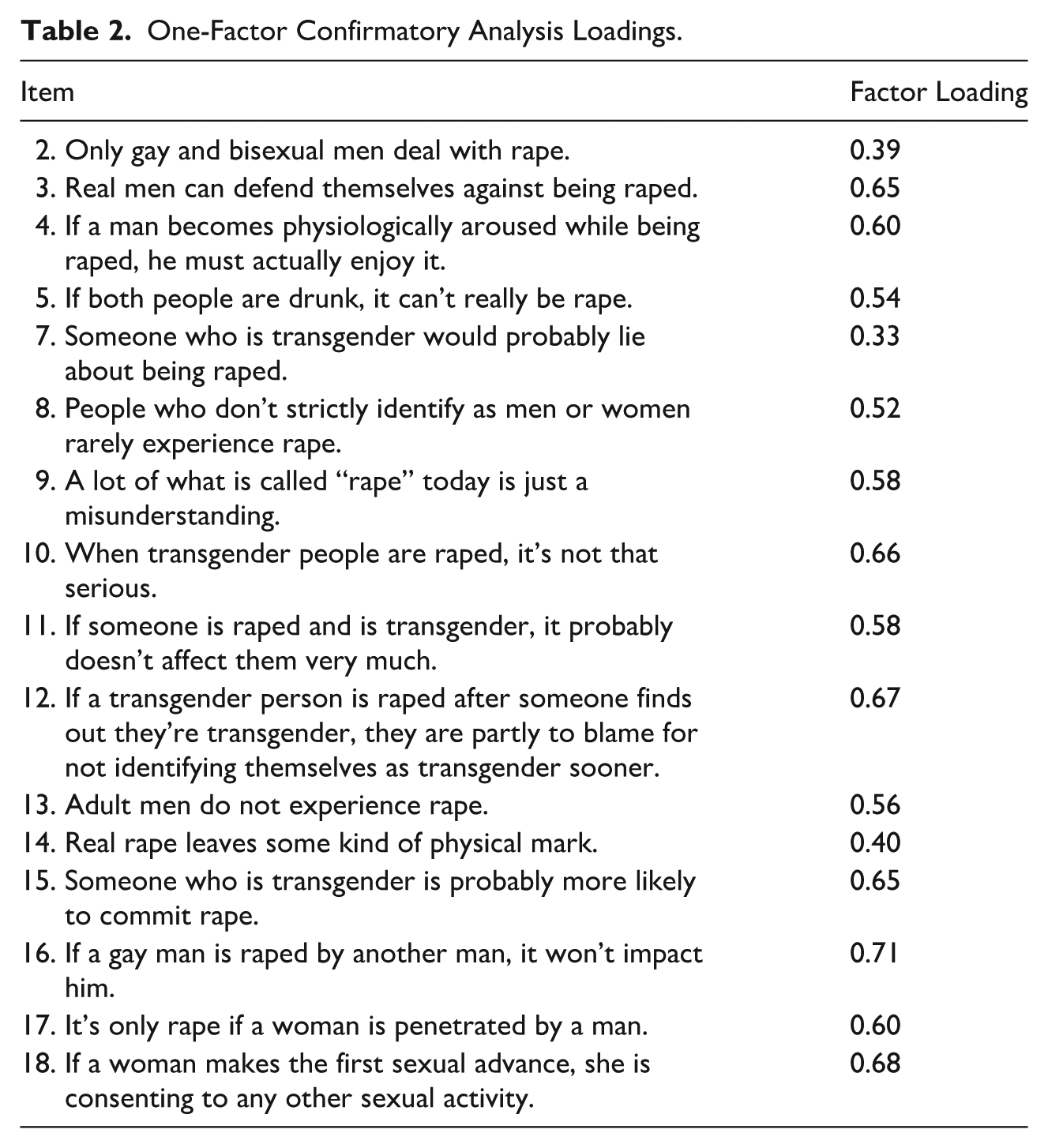
The items’ descriptive statistics (Table 2) showed violations of normality with skewness levels ranging from 0.22 to 4.49 and kurtosis levels ranging from −0.73 to 28.85. Violations of normality were particularly observed in items 2, 10, 11, 13, and 17 of the scale.
One-Factor Confirmatory Analysis Loadings.
Confirmatory Factor Analysis
CFA was conducted to test the one-factor model of the Portuguese version of the GIRMA scale employing maximum likelihood estimation. This model yielded results with poor fit indexes (χ2[135] = 610.342, p < .001; TLI = 0.82; CFI = 0.84; RMSEA = 0.08 [0.08; 0.09]; SRMR = 0.06). Based on factor loadings, items 1 (λ = .27) and 6 (λ = .23) were removed from further analysis because they presented factor loadings below 0.30. Nevertheless, the model without these two items also revealed poor fit indexes: χ2[104] = 534.172, p < .001; TLI = 0.83; CFI = 0.85; RMSEA = 0.09 [0.08; 0.10]; SRMR = 0.06.
As such, based on modification indices (MI > 20) and content similarity of the items, four pairs of errors were allowed to correlate (2–13; 10–11; 10–12; 11–12; Supplemental Table S1). These errors may be related to the conceptual similarity among certain items. Items 2 and 13 reflect common myths about male victims, particularly the beliefs that only men from sexual minorities can be victims or perpetrators of sexual violence, and that men cannot be raped. In addition, items 10, 11, and 12 all address myths concerning gender-diverse individuals (particularly transgender people), by questioning the severity of their abusive experiences and minimizing the perpetrator’s culpability.
This third model revealed an overall range of a good fit (χ2[100] = 300.099, p < .001; TLI = 0.92; CFI = 0.93; RMSEA = 0.06 [0.05; 0.70]; SRMR = 0.04). This final one-factor model is detailed in Supplemental Table S1.
Reliability
The one-factor model of the Portuguese version of the GIRMA showed good levels of internal consistency (α = .85).
Construct Validity
Positive and significant correlations were found between sexual violence myths and sexism (Hostile and Benevolent), SDO, and discriminatory attitudes toward LGBTQIA+ individuals (using the Attitudes Toward Gay and Lesbian Civil Rights Scale), thus providing evidence of the scale’s convergent validity. Conversely, regarding discriminant validity, significant negative correlations were found between sexual violence myths and positive attitudes toward LGBTQIA+ individuals (using the Transphobia/Genderism subscale).
Males, heterosexuals, and older individuals with lower educational levels outscored women, LGBTQIA+ individuals, and younger individuals with higher educational levels in sexual violence myth acceptance. Moreover, participants who knew someone who had experienced sexual violence endorsed fewer myths than those who did not. Similar results were found among individuals who experienced sexual violence in adulthood (Table 3).
Correlations with Study Variables.
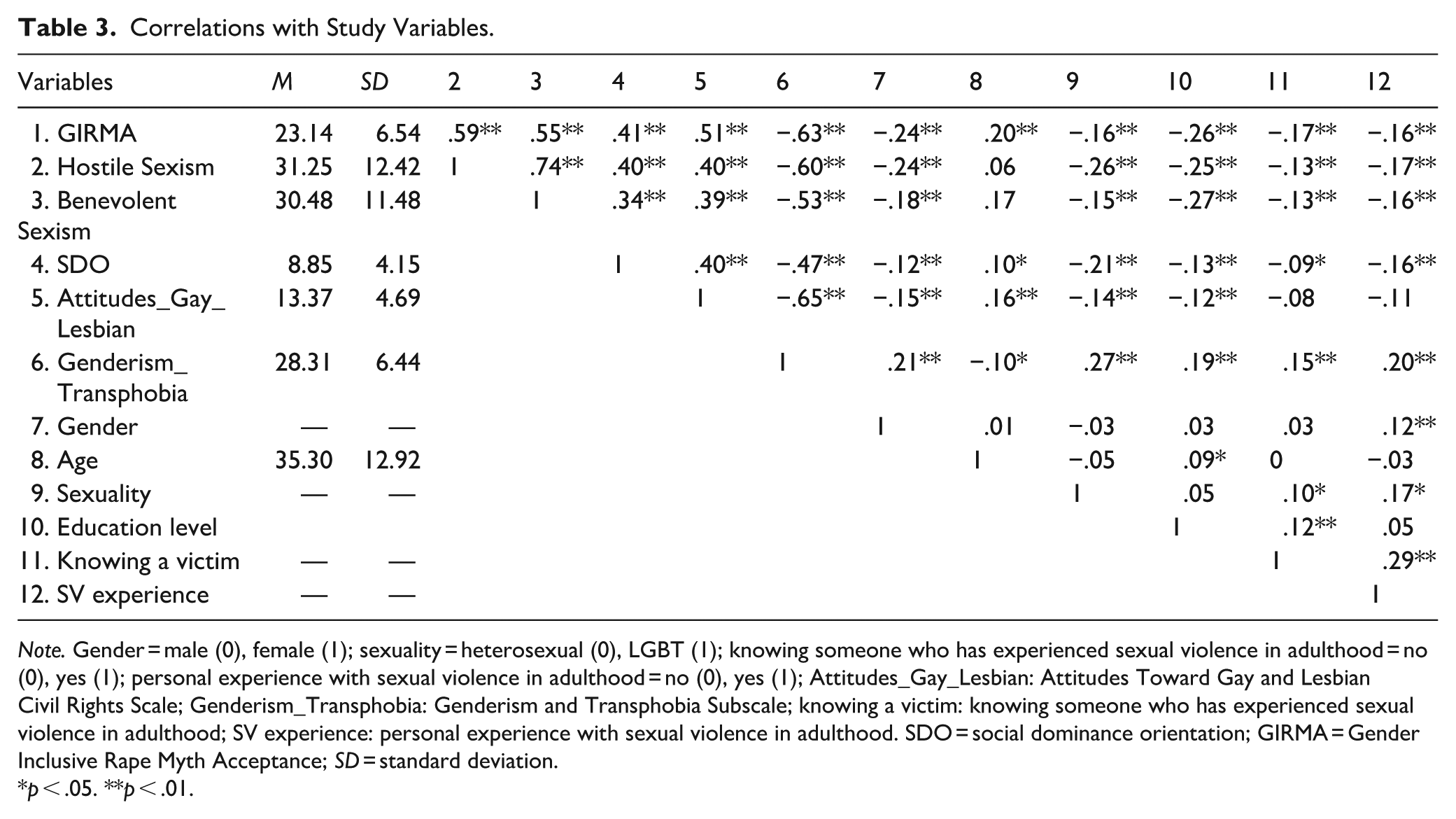
Note. Gender = male (0), female (1); sexuality = heterosexual (0), LGBT (1); knowing someone who has experienced sexual violence in adulthood = no (0), yes (1); personal experience with sexual violence in adulthood = no (0), yes (1); Attitudes_Gay_Lesbian: Attitudes Toward Gay and Lesbian Civil Rights Scale; Genderism_Transphobia: Genderism and Transphobia Subscale; knowing a victim: knowing someone who has experienced sexual violence in adulthood; SV experience: personal experience with sexual violence in adulthood. SDO = social dominance orientation; GIRMA = Gender Inclusive Rape Myth Acceptance; SD = standard deviation.
p < .05. **p < .01.
Discussion
This study aimed to provide evidence for the validity and reliability of the GIRMA scale (Urban & Porras Pyland, 2021) in a Portuguese community sample. This instrument is particularly relevant as it assesses sexual violence myths through an inclusive and diverse victim profile, which is lacking in international and Portuguese contexts. Considering the negative impact of sexual violence myth acceptance on the health and well-being of victims (G. D. Anderson & Overby, 2021), an instrument assessing sexual violence myth endorsement regarding different victim profiles is especially relevant for shifting the previous predominant focus on cisgender women victims. Furthermore, adapting and validating such instruments to other contexts and cultures is important to provide relevant cross-cultural data regarding myth endorsement. In addition, most studies focusing on sexual violence myths have used samples of college students (Urban & Porras Pyland, 2021); therefore, we aimed to fill this gap and provide evidence from a community sample.
In this study, evidence was found to support the one-factor structure of the GIRMA scale in the Portuguese context, which is consistent with the original study (Urban & Porras Pyland, 2021). However, the CFA conducted with the original 18 items revealed a poor fit. After removing two items based on factor loadings, considering the MI and item similarity, the one-factor GIRMA scale showed an adequate fit and a good level of internal consistency (α = .85). The removed items portrayed myths about sexual violence in the workplace and that sexual violence occurs when men are sexually frustrated, which may have been too overt and explicit and may have been considered less socially accepted (Canan et al., 2023; McMahon, & Farmer, 2011). Thus, the GIRMA without these two items seems to be a robust and appropriate instrument for assessing sexual violence myths in the Portuguese population.
Convergent and divergent validity of the Portuguese version of the scale were also assessed in this study. Consistent with previous findings (Angelone et al., 2021; Murray & Calderón, 2021; Nicol & Tóth-Király, 2024; Nyúl & Kende, 2023), positive and significant associations were found between sexual violence myths, sexism (Benevolent and Hostile), SDO, and discriminatory attitudes toward LGBTQIA+ individuals. In fact, sexism can contribute to a rape culture, in which men are dominant, aggressive, and initiators of sexual encounters, while women are refined ladies and gatekeepers of sex (Angelone et al., 2021). Therefore, sexist beliefs can create an environment in which individuals believe that women and/or other individuals who do not conform to traditional gender roles, norms, and stereotypes (e.g., sexual and gender minorities) want or deserve to be forced to have sex (Angelone et al., 2021; Chapleau et al., 2007). Moreover, those who believe in hierarchical and non-egalitarian intergroup connections and want to maintain them, as expressed by SDO, might also accept more myths that maintain and perpetuate inequalities, such as sexual violence myths (Nicol & Tóth-Király, 2024; Nyúl & Kende, 2023). Overall, these results show that sexual violence myths relate to beliefs that uphold a hierarchical order among individuals and groups and conservative thinking (Murray et al., 2023).
Furthermore, positive and significant associations were found between sexual violence myths and discriminatory attitudes toward LGBTQIA+ individuals. Evidence on these two specific constructs is lacking. However, the results found in this study were expected considering previous findings on discriminatory attitudes toward LGBTQIA+ individuals (e.g., homophobia) and sexual violence myth acceptance, particularly male rape myths (Davies et al., 2012; Walfield, 2021). Previous research has argued that these associations may be related to adherence to traditional gender roles (Kassing et al., 2005; Turchik & Edwards, 2012; Walfield, 2021), which can lead to negative and discriminatory attitudes toward gay men (Kassing et al., 2005) and other members of the LGBTQIA+ community. Moreover, these negative attitudes toward gay men and the endorsement of sexual violence myths can negatively affect not only sexual and gender minority men, but also heterosexual men, as being male and being a victim does not conform to stereotypical gender roles (Javaid, 2015; Kassing et al., 2005; Turchik & Edwards, 2012). Finally, results on divergent validity underpin these findings, as shown by the negative associations between sexual violence myths and positive attitudes toward LGBTQIA+ individuals.
Several associations were found in terms of sample characteristics and myth endorsement, particularly regarding the participants’ gender, sexual orientation, age, and educational level. Consistent with previous findings, men showed higher levels of myth endorsement than women (e.g., Beshers & DiVitta, 2021; Xue et al., 2019). As previously stated, gender roles, hostility toward women, and societal norms, such as hegemonic masculinity, may contribute to these observed differences (B. E. Johnson et al., 1997; Javaid, 2015; Lonsway & Fitzgerald, 1995), as men tend to identify more with the powerful and aggressive role of the perpetrator, whereas victims of sexual violence are typically viewed as feminine, weak, and defenseless (Javaid, 2015). Again, this perception is incongruent with the idea of masculinity, as well as the scenario in which men are victims of sexual violence (Turchik & Edwards, 2012). Also, heterosexual individuals endorsed more sexual violence myths than LGBTQIA+ individuals, which is consistent with previous literature (Canan et al., 2023; Wilson & Newins, 2019), suggesting that sexual minority individuals have higher levels of empathy for sexual violence victims than heterosexual men. The higher risk status of LGBTQIA+ individuals, including for sexual violence experiences, may make them more knowledgeable and sensitive to issues surrounding sexual violence (R. E. Anderson et al., 2017).
Although findings regarding age as a predictor of sexual violence myth endorsement have been inconsistent, the results of this study are consistent with those who have found that older individuals endorse more myths (Fávero et al., 2022; Kassing et al., 2005; Walfield, 2021). Older individuals tend to have lower levels of education (Kassing et al., 2005) and may adhere to more conservative and traditional gender roles, norms, and stereotypes (Suarez & Gadalla, 2010). Therefore, they may also hold stereotypical views on various issues, namely, sexual violence. In terms of educational level, individuals with higher levels of education endorsed fewer sexual violence myths, consistent with previous findings (e.g., Fávero et al., 2022). Critical thinking may play an important role in these findings, as it is one of the main outcomes of higher education (Hart et al., 2021) and is associated with the rejection of psychological misconceptions and beliefs (Bensley, 2023), which may include sexual violence myths.
In addition, this study found that individuals who knew someone who had been a victim of sexual violence or who had personal experience with sexual violence in adulthood endorsed fewer myths than those who did not. Consistent with the current study, previous research has found that a personal history of sexual victimization is a predictor of lower myth endorsement (Lathan et al., 2023; Sanchez-Ruiz et al., 2021). These findings might be explained by the theory of planned behavior (Sanchez-Ruiz et al., 2021), as subjective experiences (i.e., familiarity and experience with sexual violence) can influence attitudes. Therefore, participants with subjective experiences of this nature may be less likely to endorse these myths.
Despite the contributions of this study, several limitations must be noted. First, this study used an online convenience sample. This form of data collection has advantages such as cost efficiency, time effectiveness, increased accessibility, and ensuring the anonymity of participants (Manohar et al., 2018; Ward et al., 2014), especially for sensitive research topics such as sexual violence. However, efforts are needed in future studies to access more diverse samples, especially those who do not have access to the Internet or find it difficult to use platforms commonly used for online data collection (e.g., Qualtrics). Second, no instruments were included to assess participants’ social desirability, which may be a limitation, considering that the sensitivity of the topic may increase the likelihood of this response bias (Krumpal, 2023). Furthermore, the phrasing of the question used to assert participants’ experiences with sexual violence may not have captured all participants who might have been victims, particularly those who are unacknowledged and do not identify their experiences as “sexual violence,” as reported in previous literature (Marchewka et al., 2022). Future studies should consider asking about specific sexual violence behaviors to ascertain this information more accurately in their samples. Third, although this study focused on adult sexual violence victims of diverse genders and sexual orientations, it does not address race-related myths (Urban & Porras Pyland, 2021). Future research should focus on exploring this association. Finally, regarding recruitment and sampling, despite the efforts of the research team to ensure gender balance in the sample, such as placing online advertisements to recruit more male participants, which is considered an effective recruitment strategy (Manohar et al., 2018), this balance was not fully achieved, as most participants were cisgender women (62.7%). Therefore, the results should be interpreted with caution, given the discrepancy in gender identity in this sample. Future research should aim to develop and improve more effective strategies for recruiting male participants to ensure gender balance in their samples and assess the measurement invariance. Moreover, no specific recruitment strategies were employed in this study to ensure the inclusion of participants from the LGBTQIA+ community. Considering the limited research on sexual violence myths concerning and within this community, as well as the inclusive scope of the GIRMA scale (N. L. Johnson et al., 2023; Urban & Porras Pyland, 2021), future studies should target strategies to enhance the representation of the LGBTQIA + community in their samples. Additionally, more studies with different research designs should be conducted to determine the scale’s predictive validity.
Overall, this study provides substantial evidence for the validity and reliability of the GIRMA scale in the Portuguese context. To our knowledge, this is the first study to adapt this instrument to another language, country, and cultural context, thereby providing valuable cross-cultural and psychometric evidence.
Conclusions
Addressing and focusing on sexual violence myths is critical since professionals who interact with victims of sexual violence and policymakers may inadvertently perpetuate them (Edwards et al., 2011; Urban & Porras Pyland, 2021), thereby affecting victims’ recovery and well-being (G. D. Anderson & Overby, 2021). Therefore, evidence on the associations found in this study may be relevant for the development of different strategies and programs to prevent further dissemination of these myths and to inform the development of more inclusive social policies regarding sexual violence victims and their protection, which should consider diverse victim profiles (Edwards et al., 2011; Fakunmoju et al., 2021; G. D. Anderson & Overby, 2021; Urban, 2021).
Supplemental Material
sj-docx-1-jiv-10.1177_08862605251375357 – Supplemental material for Gender Inclusive Rape Myth Acceptance Scale: Evidence of Validity and Reliability in a Portuguese Community Sample
Supplemental material, sj-docx-1-jiv-10.1177_08862605251375357 for Gender Inclusive Rape Myth Acceptance Scale: Evidence of Validity and Reliability in a Portuguese Community Sample by Inês Chim, Nélio Brazão, Cláudia Camilo and Eunice Magalhães in Journal of Interpersonal Violence
Footnotes

Ethical Considerations
This study was approved by Iscte’s Ethical Committee (Ref. 46/2024).
Consent to Participate
Participants were presented with informed consent before data collection, including the study’s objectives, description, and contact details of the research team.
Funding
Declaration of Conflicting Interests
The authors declared no potential conflicts of interests with respect to the authorship and/or publication of this article.
Data Availability Statement
The datasets generated during and/or analyzed during the current study are available from the corresponding author on reasonable request.
Supplemental Material
Supplemental material for this article is available online.
Author Biographies
References
Supplementary Material
Please find the following supplemental material available below.
For Open Access articles published under a Creative Commons License, all supplemental material carries the same license as the article it is associated with.
For non-Open Access articles published, all supplemental material carries a non-exclusive license, and permission requests for re-use of supplemental material or any part of supplemental material shall be sent directly to the copyright owner as specified in the copyright notice associated with the article.
