




Abstract
This study examines a model predicting fear of terrorism following the October 7th attack on Israel. Grounded in construal-level theory (CLT), which highlights the significance of psychological distance (PD), this study explores the relationship between PD and fear of terrorism. It also investigates the mediating roles of negative self-labels (NSL; e.g., victim, indirect victim, harmed, spared) and positive self-labels (PSL; e.g., survivor, fighter, winner, overcomer). The online survey included Israeli civilians (N = 844) aged 18 to 90 (M = 40.34, SD = 14.87), with a nearly even gender distribution (48.9% female, 51.1% male). The majority (88.3%) were not directly exposed to the October 7th attack. The participants answered questions regarding their demographic background, perceived distance/closeness to the victims of the October 7th attack, NSL and PSL in the context of the attack, and fear of terrorism. The results indicated that our model for predicting fear of terrorism explained 30% in the variance of fear of terrorism, with NSL emerging as the most substantial contributor. Furthermore, both NSL and PSL mediated the relationship between PD and the fear of terrorism. Regarding the theoretical contribution, this study expands the application of the CLT by revealing that PD regarding the direct victims of a terrorist act can explain fear of terrorism in a population whose exposure to the attack was indirect. Furthermore, the discussion explores potential interpretations that may explain why the NSL more strongly contributed to predicting fear of terrorism than PSL and suggests that PSL plays a protective role since it reduces fears of terrorism.
Introduction
Terrorism is a chronic problem in Israel and in some parts of Israel, security threats have become almost an integral part of people’s daily life (Cohen-Louck & Levy, 2020). Nevertheless, no prior terrorist act against Israeli population was as horrific as the Hamas October 7th attack in terms of brutality, cruelty, and number of victims and casualties. On October 7, 2023, Hamas terrorists murdered more than 1,163 Israelis, injured thousands, abducted into the Gaza Strip around 251 Israelis and foreign nationals, and launched a heavy missile attack against Israeli cities (Levi-Belz et al., 2024). Considering these circumstances, the October 7th attack and the following ongoing bombing of the civilian population constitute for the Israeli public, an extreme case of national trauma. On a global scale, October 7th attack represents just an entry on the long list of terrorists’ acts and war crimes. The examples from the 21st century include, inter alia, the September 11th attacks on the United States in 2001 (2,996 deaths), the Bali bombings in 2002 in Indonesia (202 deaths), the Beslan school siege in 2004 in Russia (334 deaths) (Levy et al., 2025; List of Major Terrorist Incidents, 2024). Given the prevalence of such traumatic events globally, there is a critical need to assess their impact. To address this need, the current research focuses on fear of terrorism.
Fear of Terrorism
Terrorist attacks are extremely violent events whose aim is to inflict harm on random victims, with the intent of inducing public fear of terrorism (Onat et al., 2021). Fear of terrorism is the apprehension of becoming a terrorist act victim. Since fear of terrorism is associated with heightened perceived risk (Elmas, 2021), fear of death, anxiety, and post-traumatic stress disorder (PTSD) symptoms (Boscarino et al., 2006), and diminished well-being (Clark et al., 2020), many studies engaged in predicting vulnerability to fear of terrorism by addressing various demographic, environmental, cognitive, psychological, and personality factors (Cohen-Louck & Zvi, 2022; Kušen & Strembeck, 2023).
Research on terrorism distinguishes between direct and indirect exposure. Direct exposure refers to individuals physically harmed or victimized during an attack, while indirect exposure involves those not present but affected through family members or friends (Bajo et al., 2018). Media plays a key role in broadening indirect exposure by bringing national traumas into public view. Frequent exposure to graphic, emotionally charged content can heighten psychological distress, increase fear of terrorism, and contribute to long-term mental health issues, including PTSD (Holman et al., 2020; Silver et al., 2006; Williamson et al., 2019).
Responses to media coverage of national traumas are shaped by identification with the victims. Social identification with specific groups impacts individual reactions (Levy & Rozmann, 2023; Mackie et al., 2000) and individuals who perceive the victims as part of their in-group tend to experience greater psychological distress, especially when exposed to traumatic media content (e.g., Mash et al., 2018; Wayment, 2004). Studies on reactions to massacres show that shared identities, such as gender, ethnicity, or political affiliation, are linked to higher media exposure and stronger acute stress responses (e.g., Herberman Mash et al., 2016; Relihan et al., 2023), underscoring the central role of social identity in public responses to mass trauma. Given the importance of social identification with direct victims, this study explores the link between fear of terrorism and factors that may enhance identification with victims of national trauma: self-labeling (Boyle & Rogers, 2020), and psychological distance (PD; Trope & Liberman, 2010). This model offers new insight into fear of terrorism among indirect victims.
Self-Labeling and Fear of Terrorism
Victimization, both direct and indirect, tends to initiate a process of self-labeling (Boyle & Rogers, 2020). In victimology, self-labeling is usually referred as self-definition and self-description in terms such as victim or survivor (Papendick & Bohner, 2017). There are also mentions of additional labels such as thriver and overcomer (Ben David, 2020). This study addresses self-labeling as self-adoption of both negative and positive labels related to traumatic events in general and specifically to terrorist attacks.
The research on self-labeling has primarily focused on the context of sexual victimization and interpersonal violence against women, revealing that some individuals who experienced sexual victimization tend to label themselves as victims. Some tend to label themselves as survivors (e.g., Glenn & Byers, 2009; Levy & Eckhaus, 2020), and some use both labels (Thompson, 2000). The majority of studies on self-labeling address the social meaning of the “victim” and “survivor” labels. The findings suggest that the term “victim” is linked to notions of innocence (Thompson, 2000), but also carries negative connotations associated with vulnerability and helplessness (Hunter, 2010; Papendick & Bohner, 2017). Conversely, the term “survivor” is connected to positive attributes such as agency, initiative (Barry, 1984), a rejection of passivity, active resistance, and recovery (Convery, 2006; Levy & Eckhaus, 2020; Papendick & Bohner, 2017). Few studies that examined the effect of self-labeling as victim and survivor on mental health indicate that individuals who strongly identify as “victims” are significantly more likely to experience negative emotions such as shame, depression, and PTSD (Boyle & Clay-Warner, 2018), along with reduced self-esteem and overall distress. In contrast, those who identify as “survivors” do not show a significant effect on any of these outcomes (Boyle & Rogers, 2020).
Given that the victim–survivor dichotomy often fails to capture the complexity of victims’ experiences (Aizpitarte et al., 2023), this study included additional labels (e.g., harmed, fighter, winner) and applied a broader distinction between negative and positive self-labels. Adopting negative self-labels (NSL; e.g., victim, harmed person) may foster feelings of vulnerability and helplessness, increasing perceived threat—a factor strongly linked to fear of terrorism (Cohen-Louck, 2019). In contrast, positive self-labels (PSL; e.g., survivor, overcomer) reflect resilience or agency, traits associated with lower anxiety (Weigold & Robitschek, 2011) and reduced fear of external threats (Levy et al., 2025; Malik et al., 2020). Based on this, we hypothesized that (H1): Self-labeling is associated with fear of terrorism: (a) Adopting negative self-labels is positively associated with fear of terrorism. (b) Adopting positive self-labels is negatively associated with fear of terrorism.
Although most research on self-labeling has focused on direct trauma victims, this study examines self-labeling among indirect victims. This focus is warranted given substantial evidence that individuals indirectly exposed to terrorism or national trauma often experience similar psychological effects to directly exposed victims (Cohen-Louck, 2019; Onat et al., 2021; Williamson et al., 2019). Studies following the 9/11 attacks (Galea & Resnick, 2005) and the October 7 attacks (Ben-Ezra et al., 2024; Feingold et al., 2024) report high levels of PTSD among indirectly exposed individuals, a condition closely tied to trauma exposure. These findings support the view that indirect exposure constitutes a meaningful form of victimization (Ben-Ezra et al., 2024; Galea & Resnick, 2005; Ortega et al., 2024), underscoring the need to examine self-labeling in this population.
Construal-Level Theory, Psychological Distance, and Fear of Terrorism
Construal-level theory (CLT) posits that PD is a foundational cognitive-perceptual mechanism that shapes how individuals relate to events and others (Trope & Liberman, 2010). PD represents the perceived degree of detachment from a phenomenon and manifests in four dimensions: temporal, spatial, social, and hypothetical distance (Trope & Liberman, 2010, 2012). Temporal distance refers to how close or distant an event feels in time; spatial distance concerns its physical/ geographic proximity; social distance reflects perceived social and personal similarities between oneself and those involved (e.g., Spence et al., 2012); and hypothetical distance refers to the perceived likelihood or possibility that an individual might experience circumstances similar to those faced by the people involved (Soderberg et al., 2015). According to CLT, when individuals perceive objects, events, and concepts as psychologically close to themselves, they tend to represent and construe them more concretely, whereas when individuals perceive objects, events, and concepts as psychologically distant they tend to represent and construe these objects, events and concepts more abstractly. At the concrete level, thinking is intricately detailed, specific, and context-bound, while at the abstract level, thinking is more generalized, global, out-of-context, and non-specific (Trope & Liberman, 2010, 2012).
PD has been identified as a factor linked to concerns, risk perceptions, and fears in various contexts. Notably, research highlights a negative correlation between PD and fear of climate change (Chu & Yang, 2019) and fear of crime (Gouseti, 2016; Mellberg et al., 2022). According to Gouseti (2016), participants worry less about crimes that they perceive as psychologically distant. Moreover, temporal, social, and hypothetical dimensions of PD were identified as explanatory factors for apprehensions and fears related to crime (Mellberg et al., 2022). There are no studies on PD and fear of terrorism. Nevertheless, the impact of terror events on indirectly exposed individuals (Lynch, 2023), prompted us to inquire whether the cognitive processes involved in mental conceptualization, such as PD (Kušen & Strembeck, 2023), contribute to shaping people’s fears of terrorism. Based on the literature indicating that PD influences how abstractly or concretely individuals construe events and thereby precedes and shapes individual reactions in general (Trope & Liberman, 2010, 2012; Trope et al., 2007), and fears in particular (e.g., Chu & Yang, 2019; Gouseti, 2016; Mellberg et al., 2022), it is possible to hypothesize that (H2): A negative association exists between PD and fear of terrorism: greater PD will be associated with lower levels of fear of terrorism and vice versa.
Psychological Distance and Self-Labeling
Psychological distance (PD) shapes fears and alters individuals’ tendency to identify with situations and people. Thus, according to Shaver (1970), situational and personal similarities to a victim may heighten the perceived risk of becoming involved in a similar situation as the victim. Similarities between individuals and victims (e.g., gender, race, social status) increase identification with the victim, which is associated with feeling greater empathy and compassion (e.g., Ooms et al., 2019), perceiving oneself as a victim (Hoffner & Buchanan, 2005; Krebs, 1975; Levy & Ben-David, 2015), and integrating victimhood into one’s identity (Muller et al., 1994). These findings suggest that PD is closely tied to identification and empathy, helping explain why indirectly exposed individuals often react similarly to direct victims (e.g., Figley, 1995). Moreover, PD and abstract thinking can lessen the emotional intensity of aversive experiences (Williams et al., 2012). In the context of this study, these findings suggest that PD is a primary reaction that influences identification, which in turn may increase self-labeling. It is important to note that there is no reason to assume that the nature of the PD × Self-Labeling nexus will vary by the nature of self-labeling (negative/positive). Therefore, we hypothesize that (H3): PD is negatively associated with self-labeling: lesser PD will be associated with higher adoption of trauma-related self-labels (both positive and negative).
Since the literature review suggests that there is a negative association between PD and self-labeling, and that there is an association between self-labeling and fear of terrorism, we also hypothesize that (H4): Self-labeling mediates the correlation between PD and fear of terrorism.
The Current Research
The present study examines a model predicting fear of terrorism based on psychological distress (PD) and self-labeling. It addresses a key gap in the literature by focusing on self-labeling among individuals indirectly exposed to national trauma, an especially relevant population, as most people experience terrorism vicariously through social ties and media (Cohen-Louck, 2019; Williamson et al., 2019). This indirect exposure has intensified in recent years due to the widespread circulation of graphic, uncensored content on social media, including footage shared by terrorists themselves (Feingold et al., 2024). Such exposure may contribute to increased community-level fears (Kaskeleviciute et al., 2024) and PTSD following terror events (Abdalla et al., 2021). Also, this is the first study examining the roles of PD and self-labeling in predicting fear of terrorism. By investigating the mediating role of positive and NSL on the relationship between PD and fear of terrorism, this study presents a new viewpoint on the cognitive mechanism that shapes the fear of terrorism among indirectly exposed individuals.
Methods
Participants
This study included 844 Israeli respondents whose age range was 18 to 90 (mean = 40.34, SD = 14.87). Supplemental Table S1 presents a detailed demographic description of the sample. About half of the respondents were female (48.9%) and reported lower than average income (46.4%). More than half were married (56.4%) and nearly two thirds of the participants reported having children (61.1%). As for education, the mean number of years of education was relatively high (mean = 14.51, SD = 2.84, range = 0–36) with two thirds of the participants reporting more than 12 years of mandatory education. The majority of the participants were Jewish (85%), born in Israel (90%), and defined themselves as traditional (39.7%) or religious (17.7%). Only 11.7% of the participants were directly exposed to the October 7th attacks, and 31.8% reported indirect exposure to the victimization of relatives/friends (see Supplemental File B for detailed data).
Measures
Demographic Variables
The questionnaire gathered information on participants’ gender, age, family status, number of children, years of education, religiosity, religion, nationality, income, and political affiliation (for variable values, see Supplemental Table S1).
Exposure to Terrorism and the October 7th Attack in Israel (Supplemental File B)
To control for the effects of exposure to prior terrorist acts and to the October 7th attacks, we constructed a scale that included 11 yes (1)/no (0) questions. Respondents were asked whether they or their family were exposed to terrorist attacks prior to the October 7th event, and in regard to the October 7th events, the participants were asked whether they resided in the area of the attacks, participated in the Nova music festival, were in danger, participated in rescue efforts, etc. By summing up participants’ responses to these questions, we created two variables: Prior exposure to terrorism (first two items) and Exposure to the October 7th attack (nine items).
Psychological Distance (Supplemental File C)
The PD scale was constructed by the authors and addressed the three key aspects of perceived detachment (Trope & Liberman, 2010, 2012): social, hypothetical, and spatial distance. This scale included eight items: four items addressed social distance through social similarity to the people who were murdered and taken hostage during the events of October 7th. One item addressed spatial distance through the perceived closeness to the place where the events of October 7th occurred. The answers for these items were on a Likert scale ranging from 0 (completely disagree) to 5 (completely agree). Additionally, three items addressed hypothetical distance by the perceived chance of becoming a victim of murder and kidnapping similar to the victims of October 7th and by assessing a perceived chance that the participants’ family member could have become a victim during the events of October 7th. The answers were on a Likert scale ranging from 0 (very low chance) to 5 (very high chance); therefore, high scores indicated lower PD, and lower scores indicated high PD. To align with the phrasing in research on PD, we recoded this scale so that high scores would represent high PD and low scores would represent low PD. The Cronbach’s alpha for total PD was .82.
Self-Labeling
To assess participants’ self-labeling following the October 7th events, we created eight items presenting various labels. Regarding each label, the participants were asked “To what extent do you perceive yourself as a “__________” [a label] in light of the October 7th events and the fighting that developed as a result?” Four of the labels in the questionnaire were positive (survivor, fighter, winner, overcomer) and four of the labels were negative (victim, indirect victim, a harmed person, a spared person). The answers were on a scale from 0 (not true at all) to 9 (completely true). The questions’ presentations were randomized to prevent an effect of a specific order. The questionnaire’s structure was confirmed through structural equation modeling. The Cronbach’s alpha for PSL was .80, and for NSL was .83.
Fear of Terrorism
To examine fear of terrorism we adapted to the current events Klar’s et al. (2002) scale. It assessed how frequently participants experience fears and worries related to terrorism. Seven items addressed general fears (e.g., “Because of the security situation, I am afraid to go to specific locations”); and nine items assessed fears regarding specific terrorist acts: stabbing, car ramming, shooting, bombing, missile attacks, suicide bombing, kidnapping. The answers ranged from 1 (not at all) to 5 (all the time). The Cronbach’s alpha was .97.
Procedure
Data Collection
The data represent respondents’ self-reports through an online survey from October 26, 2023 to October 31, 2023. The university’s ethics committee provided ethical approval. The questionnaire stated that participation was anonymous and confidential, that the participants did not have to answer any question that made them uncomfortable and could stop answering at any point, and that their answers would be used only for research purposes. All participants gave their informed consent to participate in this study. The sampling from the panel was random. The sample is similar to the Israeli population in the distribution of gender, age, religiosity, residential area, and Arabs’ religions (Christian, Druze, Muslim). A survey company collected the data through an online panel. The participants were paid for their participation because the survey included many questions )see Supplemental File D for more details on sampling).
Data Analysis
The analyses were carried out using SPSS Version 25 (IBM) and AMOS24 (IBM). This study used repeated-measures ANOVA to assess the within differences between NSL and PSL. The integrative model included research variables (fear of terrorism, PD, NSL, and PSL) as well as background variable that may be associated with fear of terrorism and therefore should be controlled for. We recoded some of the nominal and ordinal demographic background into demi-variables: gender (1 = men, 0 = women); family status (1 = married, 0 = all else); parenthood (1 = have children, 0 = doesn’t have children); country of birth (1 = Israel, 0 = all else); nationality (1 = Jews, 0 = all else); political affiliation (1 = right wing, 0 = center and left wing). The decision to group all non-married participants together was a result of non-significant differences between the various groups of non-married participants. Similarly, the grouping of participants who affiliated with left-wing and center political ideology under one category was due to absence of significant differences between participants of left and center-leaning political affiliations.
Hierarchical regression analyses were conducted to test the predictive contribution of the independent variables within an integrative model. We tested multicollinearity between the variables using the variance inflation factor (VIF; Vatcheva et al., 2016), and VIF <2 indicated an absence of multicollinearity. To examine the hypothesis regarding mediation (see Supplemental File E for justifications for using mediation analysis), we estimated the indirect effect using the PROCESS v.3.4 in SPSS. NSL and PSL were included as mediators using the Hayes PROCESS, model 4 with bias-corrected bootstrapping (10,000 samples) to predict fear of terrorism through perceived PD. Gender, age, religious, exposure to the October 7th attacks, and media exposure to the attacks were included as covariates.
Results
Descriptive Findings
The mean score in fear of terrorism was relatively high (mean = 1.92, SD = 1.03, range = 0–4). More specifically, Figure 1 illustrates that subsequent to the October 7th attack, the risk of oneself or a family member becoming a hostage elicited relatively more worries than other types of terrorism-related fears.
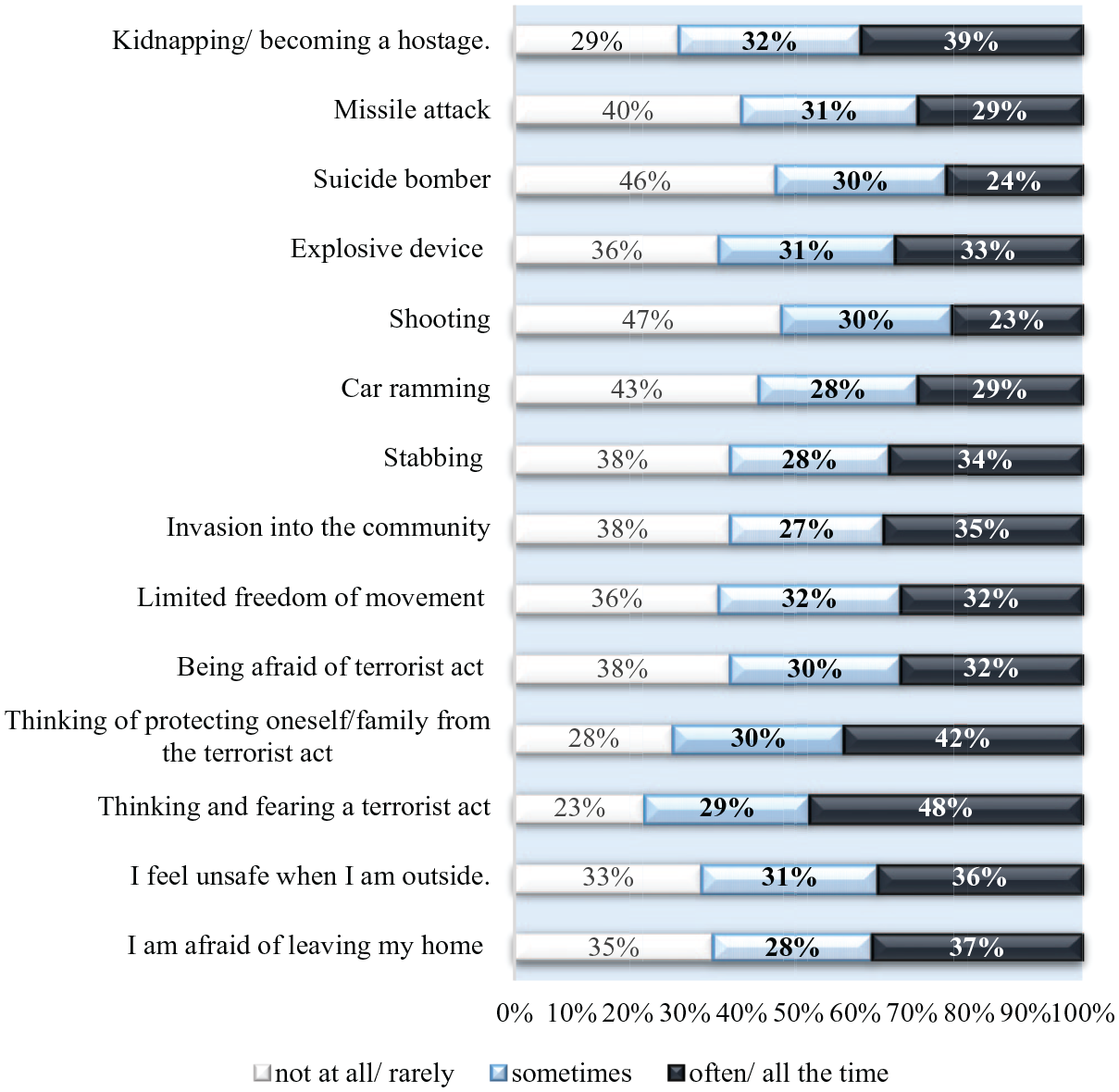
Distribution of frequencies by indices of fear of terrorism.
The PD mean score was 2.6 (SD = 1.14, range = 0–5); and regarding self-labeling, repeated measures ANOVA (F[1, 843] = 29.5, p = .00, η2 = .03) indicated significant differences in NSL and PSL. Participants were less prone to accept negative self-labels (mean = 3.48, SD =2.29, range = 0–9) than positive labels (mean = 3.89, SD = 2.20, range = 0–9). The mean score on the exposure to October 7th attack scale was 1.52 (SD = 1.58, range = 0–8) indicating relatively low levels of exposure (for detailed results see Supplemental File A). The mean score on media-content exposure was 6.53 (SD = 5.16, range = 0–24), with 57.7% of participants spending at least 5 hr, on average, watching media content related to the October 7th attack.
The Integrative Model
Supplemental Table S2 shows correlations between the variables and indicates that the correlations were mostly consistent with the expectations. Fear of terrorism positively correlates with NSL and with the average number of hours spent watching video content on the attacks. Fear of terrorism negatively correlates with PD from the victims of the October 7th attack. Higher tendency for NSL, lesser PD from the victims, and higher exposure to the media content were associated with higher fear of terrorism. These results support H2 on the association between PD and fear of terrorism. There was no significant correlation between fear of terrorism and PSL. Also, there was a significant negative correlation between fear of terrorism and such demographic variables as gender, age, religiosity, and positive correlation with exposure to the October 7th attacks. Thus, male, older, and religious participants reported lower fear of terrorism levels than female, younger, and secular and traditional participants.
With only a few exceptions, most correlations between background variables were weak and statistically non-significant, ranging from r = .00, p > .05 to r = .40, p < .001. VIF values varied from 1 to 1.1, indicating no multicollinearity. However, there were relatively strong positive correlations between age, family status, and parenthood, as well as between family status and parenthood. Therefore, in the regression, we included only age. The regression included only the background variables that were significantly correlated with fear of terrorism.
Hierarchical multiple regressions (Table 1) were used to examine the relative contribution of the research variables to predicting fear of terrorism.
The Results of the Hierarchal Regression for Prediction of Fear of Terrorism Following October 7th Attacks Against Israel.
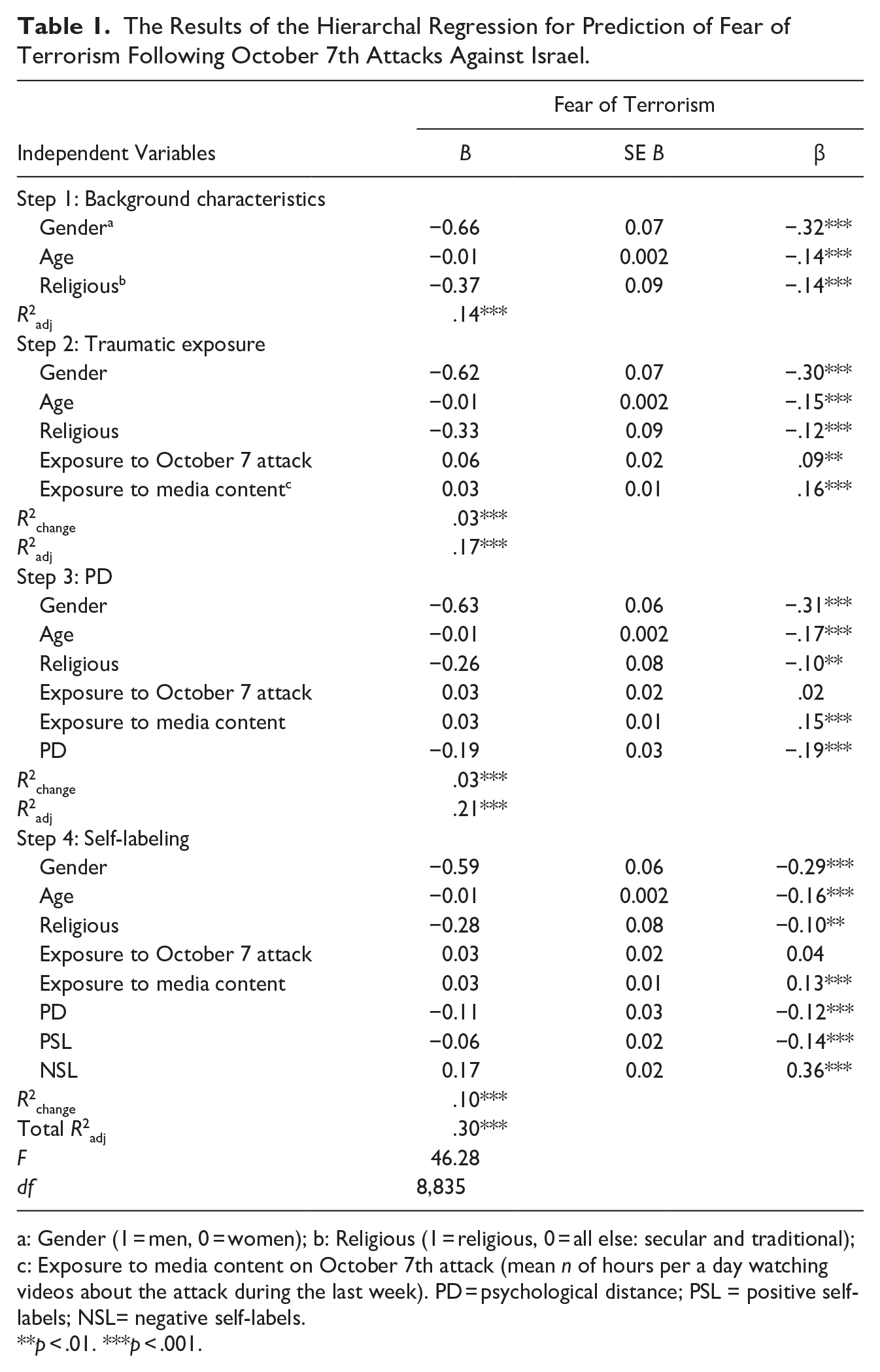
a: Gender (1 = men, 0 = women); b: Religious (1 = religious, 0 = all else: secular and traditional); c: Exposure to media content on October 7th attack (mean n of hours per a day watching videos about the attack during the last week). PD = psychological distance; PSL = positive self-labels; NSL= negative self-labels.
**p < .01. ***p < .001.
Participants’ characteristics were entered in the first step, aspects of traumatic exposure to terrorism and October 7th attacks were entered second, PD was entered in the third step, and in the fourth step, we included indicators of negative and PSL. All models were significant, and the final model added 10% to the variance explained by the model. The final model accounts for 30% of the variance in fear of terrorism following the October 7th attacks. Except for the exposure to the attacks, the contribution of the research and background variables was significant, and the strongest predictor was NSL. The results support our hypotheses, indicating a significant association between fear of terrorism, PD, and self-labeling. Lesser PD was associated with higher fear of terrorism. High levels of NSL and low levels of PSL were associated with higher fears of terrorism.
Multiple Mediation Effects of Self-Labeling
Additionally, the study examined multiple mediation effects of positive and NSL on the relationship between PD and fear of terrorism (Figure 2). In step 1 of the mediation model, we regressed PD on the mediators. PD regression on the mediator showed that NSL was significant (β = −.30, p < .001), with a bootstrap confidence interval (CI) range [−0.79, −0.051]. The regression of PD on the second mediator, PSL, was also significant (β = −.23, p < .001), bootstrap CI range [−0.61, −0.33]. These results support our hypothesis regarding the negative association between PD and self-labeling (H3). In step 2, the regression of PD on the dependent variable fear of terrorism was significant (β = −.21, p < .001), bootstrap CI range [−0.26, −0.14]. Step 3 of the analysis revealed that when controlling for both mediators (NSL and PSL), PD contributed less to the prediction of fear of terrorism (β = −.13, p < .001), bootstrap CI range [−0.18, −0.06]. The bootstrapped 95% CI for the indirect effect ranged for the mediator NSL [−0.12, −0.05] and the mediator PSL [−0.15, −0.08]. Since zero did not exist between CI ranges, these results indicate that both indirect effects are significant and therefore a partial mediation exists (H4).
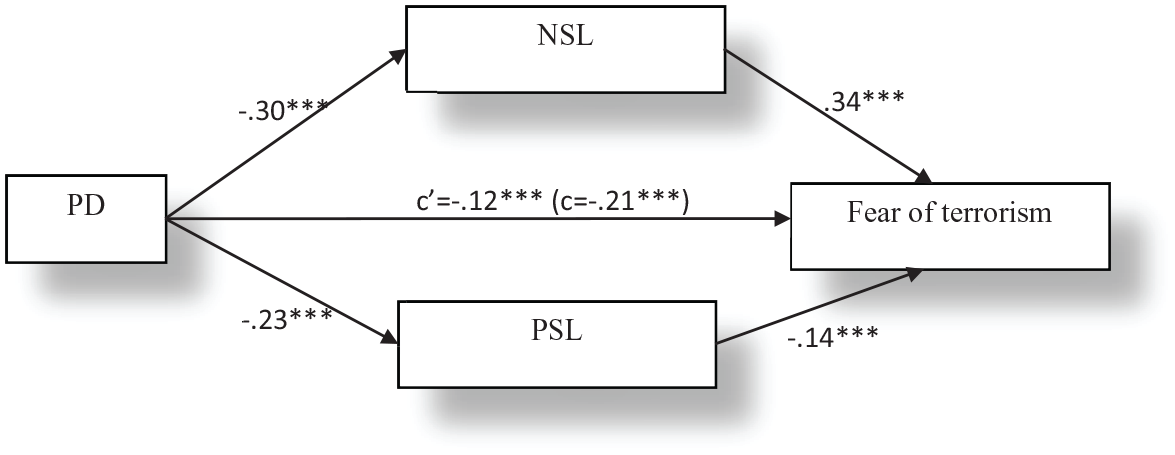
Mediation of negative self-labels (NSL) and positive self-labels (PSL) on the relationship between PD and fear of terrorism.
Discussion
This study investigated a model for predicting fear of terrorism through PD and self-labeling following the October 7th Hamas attack against Israel. Overall, relatively high levels of fear of terrorism were reported in the aftermath of the attack. Prior to the events of October 7th, most studies conducted in Israel reported low levels of fear of terrorism (e.g., Shechory-Bitton & Cohen-Louck, 2020), suggesting a process of habituation to chronic terrorism (Cohen-Louck et al., 2023). The present study shows that in the aftermath of the October 7th attacks the Israeli population was characterized by relatively high fear of terrorism. Moreover, given the substantial number of hostages (240), concerns regarding the potential risk of oneself or a family member becoming a hostage or being held in captivity were more prominent compared to other terrorism-related fears. This finding underscores the importance of addressing fear as a distinct component in terrorism-related research and highlights the dynamic, evolving nature of terrorism. Furthermore, his study’s findings support the research hypotheses, including the hypothesis on the mediation, showing that both PD and self-labeling contribute to predicting the fear of terrorism, while NSL emerged as the most significant contributor in this model.
The contribution of PD to prediction of fear of terrorism (H2) aligns with prior findings indicating a negative correlation between PD and such fears as fear of climate change (Chu & Yang, 2019), fear of COVID-19 (Levy et al., n.d.), and fear of crime (Mellberg et al., 2022). Our findings indicate that high perceived PD from the victims of the October 7th attack was associated with lower fear of terrorism. In other words, when people feel that a terrorist act is less relevant or immediate to their personal circumstances, they are likely to experience lower levels of fear associated with that threat. In terms of the CLT (Trope & Liberman, 2010), our findings suggest that participants who perceived themselves as socially, hypothetically, and geographically closer to individuals exposed to the October 7th events, their perception of the event was more concrete, detailed, and specific, and therefore probably increased individual identification with the victims and empathy toward them (Ooms et al., 2019), and in turn increased the fear of terrorism. This notion gains additional support given the negative association between PD and both types of self-labeling (H3), which indicates that higher PD is associated with weaker identification with people who experienced the October 7th attacks. Future studies should explore a possibility that identification and empathy with victims mediate the relationship between the level of conceptualization (concrete vs. abstract) and such responses as fear of terrorism, self-labeling, secondary victimization, etc.
The association between self-labeling and fear of terrorism (H1) is particularly intriguing given our focus on people who were not directly exposed to terrorist acts. Our findings show that both NSL (such as victim, injured) and PSL (e.g., survivor, winner) are associated with fear of terrorism. However, the predictive contribution of NSL was stronger than that of the PSL. In general, this finding aligns with research in the field of sexual victimization, indicating that individuals who label themselves as victims are more prone to experiencing adverse emotional outcomes (Boyle & Clay-Warner, 2018), while adoption of a positive self-label such as survivor had no effect on emotional outcomes (Boyle & Rogers, 2020). The stronger contribution of NSL may be explained by the attribution of negativity bias, in that a cognitive tendency to view or perceive events as negative, tends to have a greater impact on one’s thoughts and behaviors (Kimble & Hyatt, 2019) than positive perceptions. Although participants expressed a stronger acceptance of positive self-labels in the context of the October 7th attack, it is possible that at the time of the survey (less than a month after the attack) it was too soon for the positive self-labels to align with participants’ internal feelings. Thus, while NSL may be more closely tied to the emotional impact of an event, the PSL may represent a coping or even a defense mechanism. For example, individuals using positive self-labels may be trying to reclaim a sense of empowerment and resilience (e.g., Waldron, 2022; Wang et al., 2017) in the face of October 7th’s atrocities. Given that PSL is associated with lower distress (Boyle & Rogers, 2020), possibly by framing themselves as survivors or fighters, individuals are attempting to focus on their strength rather than dwell on victimhood, thereby facilitating psychological adaptations (Ullman & Peter-Hagene, 2016). Actively choosing positive self-labels (whether these labels emotionally fit or not) may also serve as a statement that people try to reject a sense of victimization imposed by the attacker, refuse to let the perpetrators define their identity solely in terms of being victims and actively shape a positive self-narrative. Thus, even if at the time of this survey positive self-labels were less internalized than negative self-labels, the PSL can still be meaningful as an adaptive strategy (Taylor & Armor, 1996). Further research is needed to distinguish between the roles of NSL and PSL in predicting individual fears and well-being. In addition, a longitudinal study is required to investigate the evolving nature of self-labeling and examine whether individuals tend to adopt a more positive self-perception over time.
Another key finding pertains to the mediating role of self-labeling (H4). Both negative and PSL were identified as mediators on the relationship between PD and fear of terrorism. This finding suggests that self-labeling represents one’s mental self-inclusion as a type of protagonist in a traumatic scenario and therefore influences individual levels of fear. Embracing the role of a victim, which is associated with negative and passive connotations (Boyle & Rogers, 2020), intensifies the fears of potential victimization in similar circumstances. Conversely, adopting empowering roles such as survivor or overcomer, which are linked with positive and active connotations (Ullman & Peter-Hagene, 2016), reduces such fears. Thus, it seems that PSL plays a protective role in the context of terrorism. These suggestions align with well-established findings that cognitive perceptions and appraisal play a significant role in shaping emotional experiences (Lazarus & Folkman, 1984; Li et al., 2020), including the experience of fear (on perception and fear of terrorism). According to the theory of emotion (Lazarus & Folkman, 1984), individuals interpret events in their environment, and these interpretations, or appraisals, determine the emotional response.
Limitations and Future Research
The present study is not without limitations. The primary limitation of our study is its cross-sectional design, which restricts our ability to draw causal inferences. Additional research is imperative to confirm the findings related to the causal pathways between PD, self-labeling, and fear of terrorism. It is advisable to undertake longitudinal studies to gain a more comprehensive understanding of the dynamics between these factors. A longitudinal study enables overcoming limitations associated with time constraints, allowing for the examination of self-labeling and fear of terrorism both shortly after a traumatic event as well as from a relatively long-term perspective. Also, it is important to note the underrepresentation of Arab participants in the current study, a limitation that may stem from the lower participation rates of Arab citizens in online surveys. Future studies should aim to achieve more accurate representation of the Arab population in Israel in order to better reflect the experiences and viewpoints of this key demographic group. Furthermore, future research should explore our model across diverse populations and socio-cultural contexts, including racial, ethnic, socioeconomic, and immigration backgrounds, to better understand the universality or variability of the observed patterns. Given the potential unique vulnerabilities of immigrants facing terrorism, Israel’s immigration-based society offers a meaningful context to examine whether fear of terrorism, PD, and self-labeling vary by immigration status and ethnic origin.
Secondly, this study focuses on fear of terrorism and examines the interrelationship between PD, self-labeling, and fear in the context of terrorism. However, self-labeling may be associated with a broader range of emotional, cognitive, and behavioral responses to terrorism. For instance, future research might explore whether individuals who self-label as survivors are more inclined toward seeking justice or contemplating retribution, whereas those who adopt a victim identity may be more likely to demonstrate passive or avoidant responses. Another promising direction for future research involves examining how PD may change over time, particularly in the aftermath of direct exposure to a terrorist attack. Understanding these shifts could clarify how proximity—real or perceived—interacts with identity and fear. Future studies should also consider exploring our model in the context of additional fears, such as fear of crime. Lastly, self-labeling may also be shaped by social and cultural factors, including media narratives, collective memory, and public discourse (e.g., Levy & Kerschke-Risch, 2020, 2022).
Conclusions
The contributions of this study encompass both theoretical and practical aspects. This study is, to the best of our knowledge, the first to specifically investigate the impact of self-labeling in the context of terrorism. It enriches the existing knowledge on indirectly exposure to terrorism and delineates the relationship between PD, self-labeling, and the fear of terrorism. The findings contribute to expansion of CLT’s applications (Trope & Liberman, 2010) by revealing the association between PD and fear of terrorism in the general public, and uncovering the mediating role of NSL and PSL. From a practical and clinical perspective, our findings offer valuable insights for therapeutic interventions for both direct and indirect victims of October 7th events and terrorism in general. Our findings suggest that clinical processes should address NSL and promote PSL, particularly among individuals who perceive themselves as socially, hypothetically, and spatial close to the terrorism and other traumatic events. The clinical recommendations apply not only to Israeli citizens but also to citizens in numerous other countries who are likewise compelled to confront the realities of terrorism.
Supplemental Material
sj-docx-1-jiv-10.1177_08862605251355616 – Supplemental material for Predicting Fear of Terrorism Following the Indirect Exposure to October 7th Hamas Attack Against Israel Through Psychological Distance: The Mediating Role of Self-Labeling
Supplemental material, sj-docx-1-jiv-10.1177_08862605251355616 for Predicting Fear of Terrorism Following the Indirect Exposure to October 7th Hamas Attack Against Israel Through Psychological Distance: The Mediating Role of Self-Labeling by Keren Cohen-Louck, Vered Neeman-Haviv and Inna Levy in Journal of Interpersonal Violence
Supplemental Material
sj-docx-2-jiv-10.1177_08862605251355616 – Supplemental material for Predicting Fear of Terrorism Following the Indirect Exposure to October 7th Hamas Attack Against Israel Through Psychological Distance: The Mediating Role of Self-Labeling
Supplemental material, sj-docx-2-jiv-10.1177_08862605251355616 for Predicting Fear of Terrorism Following the Indirect Exposure to October 7th Hamas Attack Against Israel Through Psychological Distance: The Mediating Role of Self-Labeling by Keren Cohen-Louck, Vered Neeman-Haviv and Inna Levy in Journal of Interpersonal Violence
Supplemental Material
sj-docx-3-jiv-10.1177_08862605251355616 – Supplemental material for Predicting Fear of Terrorism Following the Indirect Exposure to October 7th Hamas Attack Against Israel Through Psychological Distance: The Mediating Role of Self-Labeling
Supplemental material, sj-docx-3-jiv-10.1177_08862605251355616 for Predicting Fear of Terrorism Following the Indirect Exposure to October 7th Hamas Attack Against Israel Through Psychological Distance: The Mediating Role of Self-Labeling by Keren Cohen-Louck, Vered Neeman-Haviv and Inna Levy in Journal of Interpersonal Violence
Footnotes
Declaration of Conflicting Interests
The author(s) declared no potential conflicts of interests with respect to the authorship and/or publication of this article.
Funding
The author(s) disclosed receipt of the following financial support for the research and/or authorship of this article: This research was partially funded by Ariel University’s Research Authority (Grant RA2400000015).
Supplemental Material
Supplemental material for this article is available online.
Data Accessibility Statement
The data that support the findings of this study are available from the corresponding author, Vered Neeman-Haviv (via e-mail), upon reasonable request.

Author Biographies
References
Supplementary Material
Please find the following supplemental material available below.
For Open Access articles published under a Creative Commons License, all supplemental material carries the same license as the article it is associated with.
For non-Open Access articles published, all supplemental material carries a non-exclusive license, and permission requests for re-use of supplemental material or any part of supplemental material shall be sent directly to the copyright owner as specified in the copyright notice associated with the article.
