



Abstract
Intimate partner violence (IPV) within heterosexual relationships affects both men and women, yet an in-depth description of IPV against men in developing countries is still limited. This study explored community perceptions of male IPV victimization in an informal settlement in Nairobi, Kenya. We conducted 12 focus group discussions (FGDs) with 118 ever-married participants (59 men and 59 women), divided into 6 FGDs for each gender. We performed thematic analysis using NVivo software. This article presents three main themes that emerged during data analysis: (a) triggers, (b) manifestations, and (c) consequences/effects of IPV against men. Both male and female participants perceived male IPV victimization as a significant concern in the community. The poor living conditions, coupled with alcohol use, seemed to be major underlying factors, often forming the basis of spousal conflict. Emotional abuse, including denial of basic needs, acts of humiliation, and coercive control, were the most frequently cited forms of violence. The consequences of what was considered IPV against men affected victims and their families including the violent female spouses, children, and the society at large. These effects upset the health, economic, and social spheres of life with some retriggering male IPV, thus creating a vicious cycle of abuse. Notably and of concern, IPV against women was highlighted as a consequence of male victimization. Although we set out to explore community perceptions, study participants openly shared their experiences of male IPV perpetration and victimization. These findings underscore the importance of recognizing men as potential victims of IPV and contextualizing IPV prevention strategies targeting the urban poor with the goal of designing and implementing policies and interventions that address IPV holistically.
Keywords
Introduction
Intimate partner violence (IPV), defined by the World Health Organization (WHO) as any behavior that causes physical, sexual, or psychological harm to those within an intimate relationship (WHO, 2012), has predominantly been viewed as affecting women. This gendered viewpoint has been supported by the belief that men perpetrate violence with the sole aim of controlling their female partners as postulated in the Duluth Model (Pence & Paymar, 1993). Despite its heavy influence on the IPV agenda, this model has received criticism related to its simplistic emphasis on patriarchal power and control to explain IPV, a complex phenomenon (Bohall et al., 2016). This viewpoint has also been challenged by studies that have established that men are also subjected to IPV by their female partners (Bates & Taylor, 2019; C. Brooks et al., 2020; Kolbe & Büttner, 2020; Oyediran et al., 2023; Scott-Storey et al., 2023). In fact, Langhinrichsen-Rohling et al. (2012) in their systematic review established that while most IPV incidents were characterized by mutual violence, most unidirectional violence was female-perpetrated.
Despite unambiguous evidence of male victimization, prevention efforts overwhelmingly target violence against women (VAW). This skewed focus is evident in global, regional, and national violence estimates (García-Moreno et al., 2013; Sardinha et al., 2022) as well as fundamental international and regional legal frameworks, widely ratified by states, shaping domestic laws, and policies (African Union, 2003; Hester & Lilley, 2014; Meyer, 1998; UN Women, 1979). Moreover, feminist activism, a major factor in policy change, has leveraged these frameworks to prioritize VAW, further marginalizing the issue of male victimization (Weldon & Htun, 2013). These scholarly, policy, and legal efforts work synergistically to depict men exclusively as violence perpetrators. Although there is no dispute that women are disproportionately affected by IPV outcomes (Caldwell et al., 2012), IPV perpetration cannot be blamed on men only (Bates, 2016).
Documented risk factors for male IPV victimization include: having a controlling female partner, alcohol consumption by both or either spouse, perpetration of IPV, low income, low educational attainment, violence in the family of origin, history of victimization to IPV or other forms of abuse, being married, mental illness, short duration in a relationship, and ethnicity (Kolbe & Büttner, 2020; Odemba et al., 2023; Oyediran et al., 2023; Ringwald et al., 2023a; Spencer et al., 2019; Waila et al., 2022). Men experience a range of IPV forms, verbal, sexual, physical, and psychological aggression including coercive control in the form of manipulation, isolation, curtailing of personal freedom, humiliation, and gaslighting (Bates, 2020b; Machado et al., 2020; Scott-Storey et al., 2023). Just like women, the adverse health outcomes of IPV against men are both physical and mental. Physical injuries such as abrasions, stab wounds, fractures, injury to sensory organs, and burns, all of which may lead to disability are well documented in the literature (Carbone-López et al., 2006; Carmo et al., 2011; Lagdon et al., 2014; Reid et al., 2008). Chronic cardiovascular and metabolic conditions, mental disorders such as anxiety, post-traumatic stress disorder, depressive and psychosomatic symptoms, alcohol, and substance use are non-physical health outcomes (Bates, 2020b; Lagdon et al., 2014; Reid et al., 2008). Furthermore, male victimization impacts survivors’ financial well-being and social lives affecting current and future relationships (Bates, 2020a; Machado et al., 2020).
Kenya, a lower middle-income East African country with a population of about 47.5 million people comprising 42 tribes/ethnic groups, each with its own language and culture (Kenya National Bureau of Statistics [KNBS], 2019), is deeply rooted in patriarchy. Despite cultural diversity, practices like early marriage and dowry payment have historically subordinated women (Kandiyoti, 1988; Obbo, 1976; Wamue-Ngare & Njoroge, 2011). Although the 2022 Kenya Demographic Health Survey shows a higher prevalence of IPV against women (41%) compared to men (29%) (KNBS & ICF, 2023), a closer examination of informal settlements reveals similar rates for both gender (Ringwald et al., 2022). These settlements, home to 50% of Kenya’s urban population (World Bank, 2023), are characterized by heightened IPV risks such as depression and substance use linked to poor socio-economic and environmental conditions affecting the physical and psychological well-being of the residents (Ringwald, Taegtmeyer, et al., 2023b; Winter et al., 2020). In fact, IPV prevalence among male residents in informal settlements is quite high, with 76% of respondents in one study having reported such experiences (Odemba et al., 2023).
Most of the available literature on male IPV originates from developed countries; hence, there exists a knowledge gap in understanding the phenomenon within developing nations. While studies in sub-Saharan Africa, including Kenya, have grown, they often rely heavily on health survey data, providing statistics without context (Oyediran et al., 2023; Ringwald et al., 2022; Tenkorang et al., 2023; Waila et al., 2022). This quantitative research approach could be informed by the prevailing social norms that view men as invulnerable to violence, hindering the acknowledgment of male victimization (Laisser et al., 2011). To effectively address IPV, a holistic, gender-neutral perspective is important. By considering the reciprocal nature of IPV and challenging the common notion of men as sole perpetrators, researchers can develop interventions that protect both men and women (Bates, 2016). This requires in-depth qualitative research to bring out the complex factors influencing male victimization and inform evidence-based help-seeking and prevention strategies.
Since perceptions influence attitudes and behavior, understanding how communities perceive male IPV is crucial for developing effective interventions (Pickens, 2005). Therefore, this study, which was conducted in Kibera, Nairobi’s largest informal settlement, sought to answer the research question: What are the community perceptions of IPV against men? We report the findings from qualitative data collected through focus group discussions (FGDs).
Methods
Design
This was a cross-sectional study that applied qualitative research methods to explore community perceptions of IPV against men. Qualitative data was collected through FGDs conducted with men and women residing in Kibera informal settlement in Nairobi. Male IPV victimization goes against the norm in a male-dominated society; hence, the use of FGDs was considered the best approach to getting information from both men and women. The assumption is that by discussing wife–husband relationships in general, participants would be more willing to talk about IPV without feeling like they were being branded victims or perpetrators, hence avoiding stigmatization if individual participants were interviewed. Moreover, the emphasis was placed on sharing their views about male IPV rather than subjective experiences.
Study Setting
Located about 5 km from the central business district of the Capital city of Nairobi, Kibera is the largest informal settlement in Kenya. The settlement occupies about 2.5 km2 and is predominated by semi-permanent mud-walled structures with iron sheet roofs and has a population of about 250,000 residents (KNBS, 2019). The settlement lacks water sanitation and hygiene facilities with residents depending on buying water from vendors and shared pit latrines. It is a densely populated settlement whereby dwellings are tightly packed with little room for access roads; hence most houses can only be accessed on foot.
Sampling
Random sampling was used to select 6 out of the 14 villages in the settlement; the names of all 14 villages were written on small identical pieces of paper, which were then wrapped, tossed, and placed on a table and a community health volunteer (CHV) randomly picked 6 of them. CHVs drawn from the six villages assisted with purposive sampling of study participants by explaining the purpose and procedures to potential participants; only residents who were comfortable and consented to share their views in a group setting were recruited. Since we aimed to understand how the community perceived male IPV, we included men and women who were currently married, legally, and customarily or those who were living together (cohabiting) with an adult of the opposite sex and regarded themselves as husband and wife. We also included those who were widowed, divorced, or separated. Both male and female participants were recruited into the study regardless of whether they had experienced or perpetrated IPV against men. We did not recruit couples since our focus was perceptions and not individual experiences.
Data Collection
The definition of male IPV was presented as any act committed by a female spouse that the participants considered abusive to her husband. A semi-structured guide with open-ended questions, translated into Kiswahili language was used. Discussions were held on Saturdays and Sundays in public spaces, within local administration (chief’s) grounds which were not in use during the weekends. Two (one male and one female) graduate researchers experienced in qualitative data collection conducted the FGDs with one acting as a moderator and the other as a scribe during each discussion. For each of the 12 FDGs, the moderator was of the same sex as the participants, a factor that was deemed important to promote openness (Odimegwu, 2000). These researchers did not live in the study area and hence were not familiar with individual participants and they were the only ones present during the discussions. Participants were at liberty to use Kiswahili, English, or slang language provided they elaborated on terms that might not have been universally used and understood by fellow participants, the moderator, and scribe. The discussion proceedings were audio recorded, and handwritten notes were taken by the scribe. A total of 12 FGDs were conducted in April 2023, 2 in each of the 6 selected villages with men and women separately. Each FGD had between 7 and 12 participants except for 1 which had 14 male participants. A total of 118 participants (59 men and 59 women) were enrolled. The duration of the 12 FGDs ranged between 57 and 96 min.
Data Management and Analysis
The audio files were transcribed and translated by two graduates who were proficient in both English and Kiswahili languages and who were familiar with the study area. The two data collectors performed quality checks on the transcripts by reading through them and making necessary edits to ensure what was captured was a true reflection of participants’ statements as expressed during the data collection exercise. Thematic analysis was then performed guided by the six phases as proposed by Braun and Clarke (2006). Two qualitative data analysts read the transcripts (six each) independently, and each produced a list of codes that represented the data content. The 2 code lists were then merged, through consensus, to produce a coding scheme that had a total of 107 codes. This scheme guided data coding/organization with the aid of Lumivero (2023) NVivo (Version 14) software. The 2 data analysts coded the 12 transcripts collaboratively and the coding scheme was revised iteratively with some of the initial codes being merged together or dropped while others were added. The coding process produced a final coding scheme with a total of 103 codes, which were collated into 7 themes. During the review of the content under each theme, one of the seven themes was deemed to contain information that was useful in understanding the context of the study, especially regarding participants’ socio-economic status and the situation of marriages in the community. The remaining six themes were divided into two sets of three, both of whose content gave a description of the community’s perception of IPV against men to exemplify the overall phenomenon. The first set of three themes was further reviewed, and sub-themes were generated. We applied the WHO classification of IPV (WHO, 2012) for manifestations of IPV and the socio-ecological framework (Bronfenbrenner, 2000) to categorize the consequences/effects of IPV. This article presents findings drawn from the three selected themes.
Findings
Participants’ Characteristics
We sampled a total of 59 male and 59 female participants. The median age of the participants was 38 years (interquartile range: 30–47), ranging between 19 and 70 years. Although all participants had attended school, only 9.3% had attained tertiary level of education. A majority (65.25%) of the respondents were married at the time of data collection, most of whom were men with 91.53% of the male participants compared to 38.98% of the women. The main occupation among participants was casual labor comprising doing laundry among women and construction work for men. Both male and female participants engaged in small businesses such as greengrocers, hawking, hairdressing, and operating retail outlets (shops) within the settlement. The health workers were majorly CHVs. More details are presented in Table 1.
Study Participants’ Characteristics (n = 118).
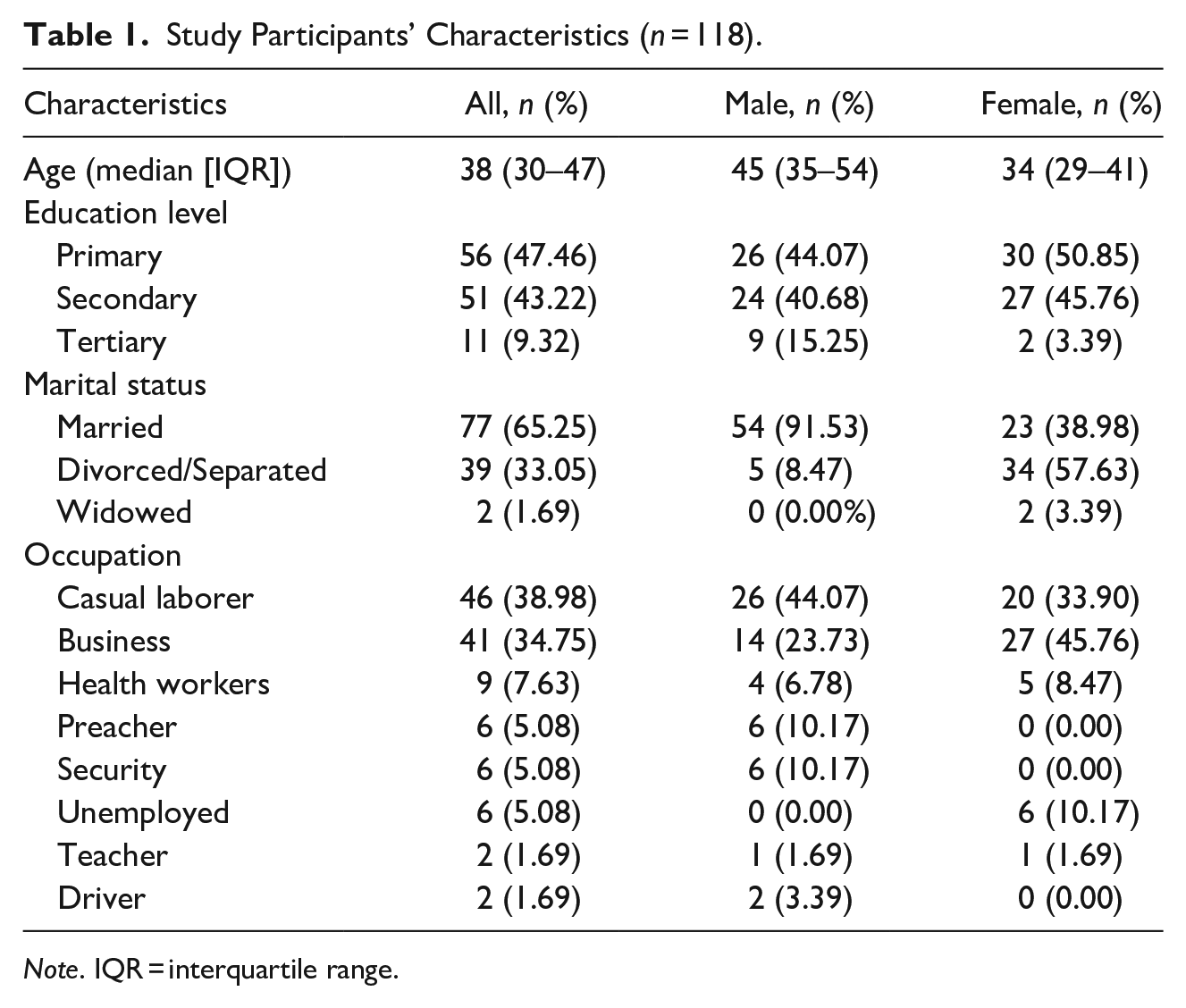
Note. IQR = interquartile range.
Findings on Community Perceptions of IPV Against Men
The participants’ narrations painted a picture of a context in which marriage is anchored on religion and culture, with the two used as a basis for determining what was required or considered acceptable behavior between spouses. References to the Holy books (Bible and Quran) and the supernatural were common during the discussions. Participants from either gender openly shared experiences of male IPV victimization and perpetration, an indication that the phenomenon was a common occurrence in their community, and this shaped their perceptions.
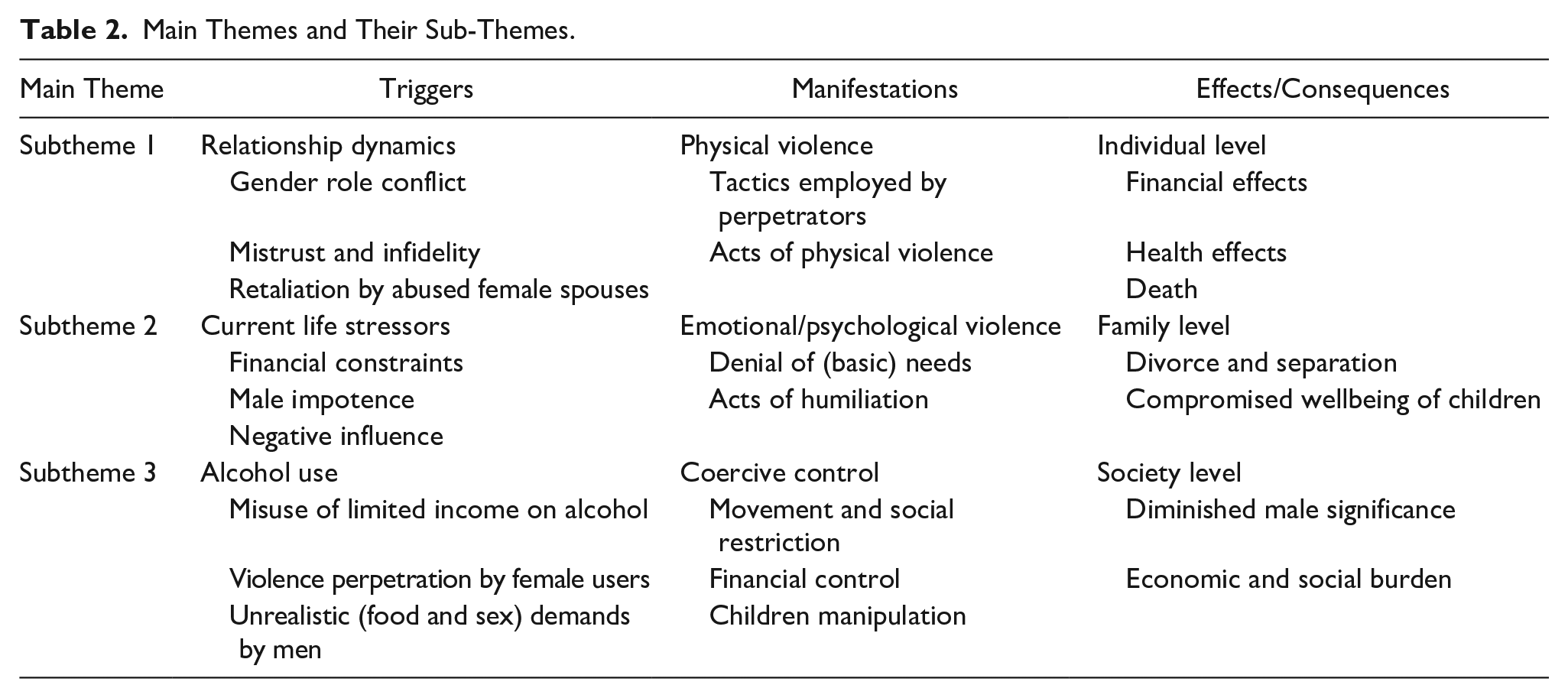
This article presents community perceptions regarding three main themes: Triggers, manifestations, and consequences/effects of IPV against men, as presented in Table 2. These themes and their accompanying sub-themes are described below and select quotes used for illustration. The quotes are identified with FGD numbers as well as the participant’s sex (M: male and F: female) and number (e.g., F1, M5) to depict diversity in views by FGD, gender, and individual participants.
Main Themes and Their Sub-Themes.
Theme 1: Triggers
We present the explanations for male IPV victimization under this theme. Poverty seemed to play a significant role in triggering spousal conflict as couples were confronted by circumstances that challenged established gender norms.
Subtheme 1a: Relationship Dynamics
Gender Role Conflict
Female participants cited some men as rigidly adhering to traditional gender roles, despite their increasing work and financial contributions. The expectation for women to perform all domestic chores led to feelings of unfairness, often escalating to conflict and IPV. Contrary to the norm, some female discussants felt that men should also assist with house chores even when they (men) are the sole breadwinners, an expectation that triggers violence if unmet.
F5: When I as the mother I am late, my husband should cook for the kids. The father says that is not his role. Then he becomes angry and in a way as the woman you see as though you came into the marriage to do work, but we came together to help each other . . .. The man feels abused, and I also feel mistreated.—FGD9 F2: When you are tied up in something he should assist you and not see that the wife does all the things, fetching water, doing everything, tending to the kids, just because he provides food and rent for the home.—FGD9
Surprisingly, some women strongly believe in traditional gender roles that assign primary financial responsibility to men. Despite having an independent income, from work, saving groups (locally referred to as chamas) and support from natal family members, these women often avoided discussing family financial matters with their spouses or contributing to household expenses. There was a perception, especially among the female participants, that men who are unable to fend for their families are lazy or irresponsible type, who simply want to be taken care of, a feeling that fueled resentment towards them, even in cases of temporary economic hardships.
M9: You also find that “mine is ours whereas hers is hers”. Anything little you have belongs to the both of you while she can have a lot.—FGD2 F4: There are also those men that don’t want to work. They want the women to go and seek on his behalf. I have two kids, I want to dress, I want to eat. I must send some money also to my mother. He expects me to feed him like a child.—FGD1.
Participants also expressed scenarios of income gap favoring women, attributed by the male discussants to gender empowerment giving preferentiality to women. These efforts made by government agencies and non-governmental organizations inadvertently position women as primary income earners and household heads, contradicting local traditional and religious expectations of male leadership at the household level. From the narrations, men who find themselves earning less than their partners are often despised and predisposed to abuse through coercion to take up roles that are considered feminine. This gender role conflict also affects households where women come from wealthier backgrounds and receive financial support from their parents or other relatives beyond what their husbands can provide.
M3: The problem we have is huge and men get no aid from the government. Women and youth receive money, but the men, there is nothing set aside for them by the government. When women receive funds, that day the man does not sleep in his house.—FGD8 M7: My wife may be going out and she says, “You, cook for the kids and clean the clothes” . . .. . . and because she brings home good income, I cannot speak. I will wash the clothes but that is not the plan even in the Bible.—FGD6 F1: I have seen two, when the woman has more money, the husband becomes a doormat, because I have more money than him, he is voiceless.—FGD3
Mistrust and Infidelity
The suspicion or confirmation that a man was having an extramarital affair was perceived to precipitate IPV. Such men are accused of spending limited family resources on other women, staying away from their matrimonial homes, or getting home late which angers their wives. Violence is also fueled by resentment towards men when women are despised by other women who have affairs with their men and whom the husbands provide for while neglecting their wives/families. Even where culture/religion allows polygamy, being seen with a potential co-wife is adequate to trigger violence.
M2: At times they get into conflict when the man gets home late and tells the woman he is late due to certain reasons, she doesn’t believe and accuses you of having been with other women. Fights start in the home.—FGD6 F10: The minute there are extra-marital affairs, life changes and there is no peace anymore, and you have the issue of lacking trust.—FGD9
For some men who marry while relatively young, the realization that they settled with the wrong partners, or they still had a youthful desire for multiple sexual partners was presented as the root cause of their trust issues.
M9: You know when you are still a young man, with a lot of youthful energy . . .. . .. . . Yes, because you are not yet content. You feel like other ladies love you and think that you did not select well, like “she is not my choice”. These are things that attract problems. Your wife now starts hating you.—FGD4
Retaliation by Abused Female Spouses
Women sometimes do things to deliberately hurt their husbands as a way of hitting back at them when they feel their men have been abusive.
F4: You find that he is used to beating you every day. If it is not slaps, it is punches, or quarrels. So, one day you decide that you also must hit him.—FGD11
For others, violence towards their men occurs when women feel the men are making children suffer by neglecting their parental responsibilities hence jeopardizing the children’s well-being. Also engaging in behaviors that are considered harmful to children such as having extramarital affairs which are believed to bring illness to young children in some cultures.
F9: Mothers are very concerned about the kids, whatever things that will benefit the kids. When you have kids that is your priority, when you see things not going right, you must raise your voice.—FGD9
Subtheme 1b: Current Life Stressors
Financial Constraints
This is marked by the lack of adequate resources to meet family financial needs as expected or desired. The constraints are related to increasing family financial needs as is the case when children start schooling or the presence of children from previous relationships whom the man has to support financially even if they are not living with him. This is augmented by a lack of understanding when female spouses do not appreciate that their men cannot maintain the living standards they enjoyed early in the marriage as financial responsibilities grow, especially with the birth of every child.
M9: For example, some of my children are not my partner’s. When I buy anything for them it seems to her that I have misused the money. But when I give her money to buy something for her child she feels like that is money well spent. When that happens we quarrel. She is an attorney of her child while I try to defend these ones that are not hers.—FGD2 M9: when children started schooling, and the fees went higher than the salary I made, which later reduced, I could not now feed her as well as I used to, which is not what she expects because she wants the same standard of living.—FGD8
In addition, the loss of an income source such as a job for the employed men or failure to secure a daily wage for male casual laborers’ triggers IPV against men who may face rejection by their spouses when they no longer have money. This seemed particularly the case in circumstances where women are not willing to chip in during times of financial difficulties.
M3: Money brings about violence, the man had money and it gets over and the woman doesn’t want him anymore.—FGD12 F6: When a man has no money, he cannot be loved by anybody {laughs} he will not be loved by anyone.—FGD7
The issue of unfulfilled ambitions such as academic and career pursuits which require finances to accomplish among women who get married before realizing their dreams was also cited. This was partly attributed to early marriages or people coming from humble backgrounds where they lacked the financial ability to empower themselves. If a man is unable to support the woman, then that becomes a source of conflict with the potential for IPV victimization.
M2: . . . you find a lady who completed secondary level education and desires to go higher yet you have probably just begun life and are still hustling so conflict arises from her attitude and expectation that she must further her education while you are not ready to support that.—FGD2
Negative influence
The influence is from friends, relatives, or neighbors and affects either the man or the woman. For instance, when men are incited by their peers to have other sex partners besides their wives, or when women are influenced by people outside their marriages to ill-treat their husbands. A commonly cited example was when wives started mounting pressure on their husbands to acquire household goods or support a lifestyle they could not afford. Other women are fed with lies about their husbands by their peers who are envious leading to friction between spouses.
M2: . . . just seeing a neighbor buying a new sofa set, she also wants her old one out to get a new one. If you cannot afford, you will see wonders.—FGD12 M10: When they see that you have a good income she feels envious and comes to your wife to tell her that you have an affair.—FGD10
Male Impotence
One participant expressed the pain men who are unable to sire go through when women are inconsiderate about their impotent status and disrespect them.
M2: Cases (of violence) arise when you as a man, you are impotent. There is a lot of challenges, if you are impotent, you are just there as a manual laborer, all because you are childless, and they still don’t understand when you are advised to visit a doctor.—FGD12
Subtheme 1c: Alcohol Use
Misuse of Limited Income
The fact that some men spend their income on alcohol and return home late without money for family needs was perceived as a potential trigger of IPV by angered wives. The violent reaction would be driven by a feeling that the man is neglecting his provision duty forcing the family into avoidable crises such as children going without meals, being sent away from school due to non-payment of school fees or being locked out of the house due to unpaid rent.
M7: Sometimes I realize men have gone off the track. How? We have neglected our domestic duties. . . .. . . But the weakness of men is getting lost in alcohol. You find a man doesn’t even remember that he has a home.—FGD6 F2: You back at home sleep hungry with the child and the man comes not even having a bearing of where the door is or the window without a shilling but he is drunk. . . .. . . You go to open the door for him. He goes peeping at the sufurias (cooking pots) they are clean empty, he wants to start arguments.—FGD1
Violence perpetration by female users
Some female spouses neglect their household duties, use the money their husbands leave for food and other household goods on alcohol, or become abusive once intoxicated.
F10: They can leave money for food for the kids, and you leave to drink when the man comes home, he finds his wife drunk. At times we abuse the men.—FGD1 M5: Also, it is bad when a woman is drunk in the house because she will spend time with her friends and when she returns home in the evening she will have planned what to tell you, which also leads to fights.—FGD10
Unrealistic food or sex demands by men
This mostly happens when they return home drunk. Such men disturb children who are already asleep, others demand that their wives wake up to warm food for them, yet others discriminate against what they are served even when they did not cater for it. Others demand conjugal rights, which is especially unreasonable if the children whose parents live in single rooms are awake.
F6: You find one dressed so well apparently to go to work but they (men) are just around some corridors drinking. At night he returns home drunk and maybe he didn’t leave any money. And that is the time he wants beef. He does not want ugali and vegetables. So you wonder, where are you going to get beef if he did not leave money for it?—FGD11 F4: Then he comes and without even waiting for the kids to sleep, he wants to have sex.—FGD5
Theme 2: Manifestations
Perceptions of manifestations of IPV against men were shaped by actions that can be categorized as either physical or emotional violence (including controlling behavior).
Subtheme 2a: Physical Violence
This subtheme presents: (a) Tactics that women devise to physically attack men who are generally stronger physically (Table 3) and (b) the actual acts of physical violence (Table 4).
Summary of Tactics Employed by Women to Physically Attack Male Spouses.
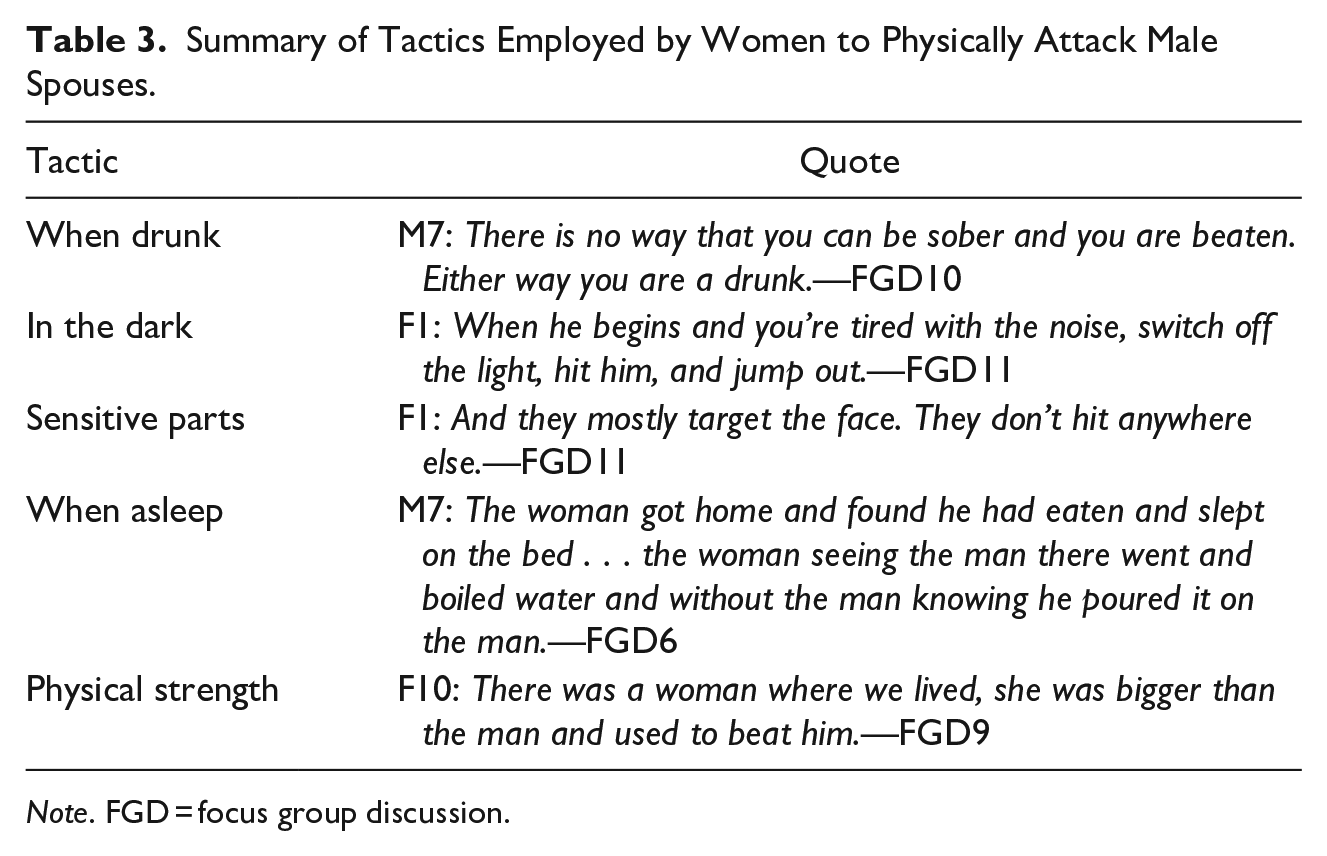
Note. FGD = focus group discussion.
Acts That Constitute Physical Violence.
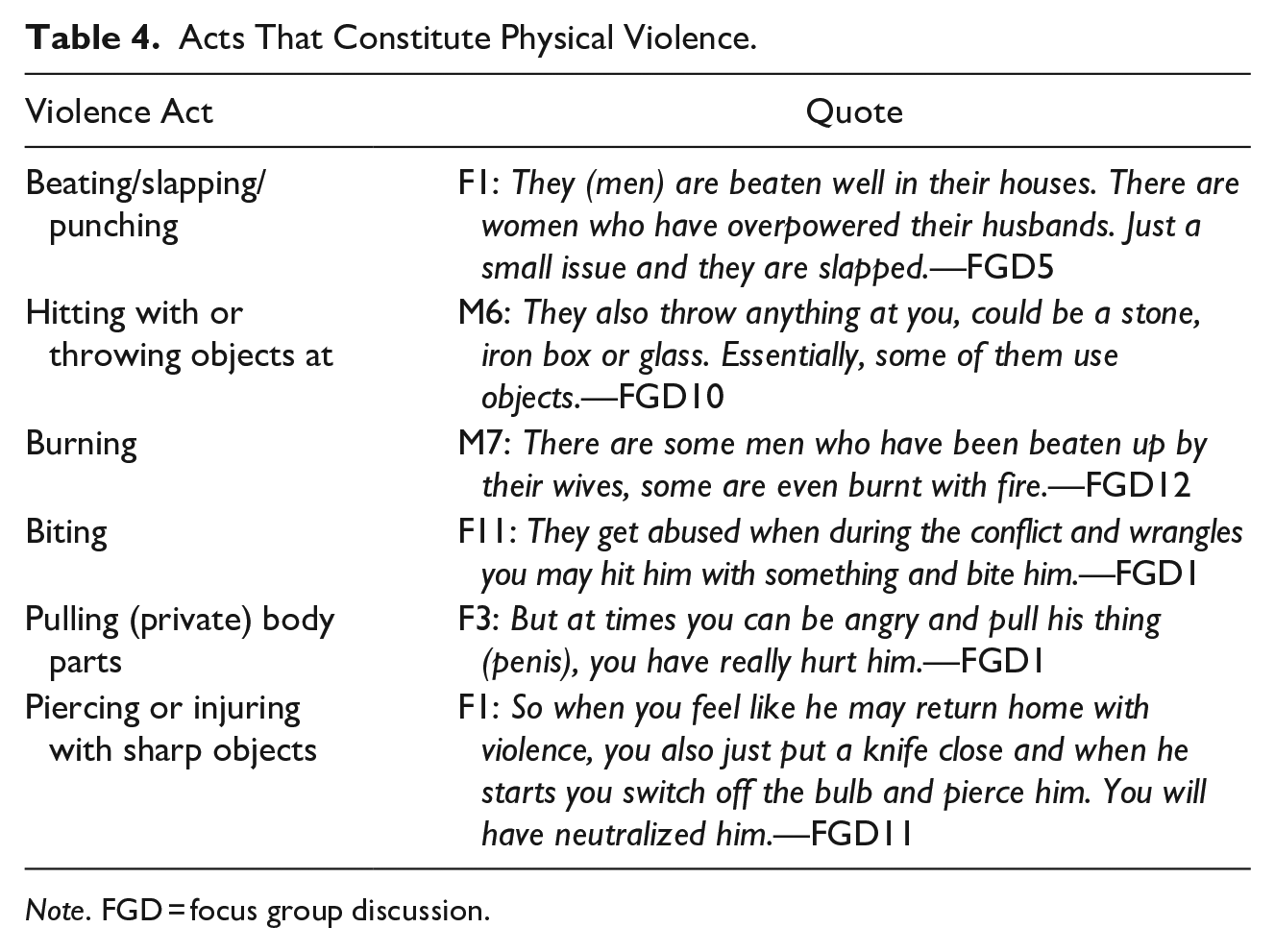
Note. FGD = focus group discussion.
Subtheme 2b: Emotional Violence
We present non-physically violent acts associated with psychological distress under this subtheme.
Denial of (Basic) Needs
Denial of food is triggered by a man’s failure to provide financially or if he forms the habit of asking where the wife gets money for food from, which insinuates that she could be having affairs with men who give her money.
M2: The day you have brought something home, even if you don’t ask, food will be availed. But when you don’t, you will be told: “Did you leave anything?” If No. “What food are you asking for?” And they have eaten.—FGD2
Denial of shelter when a man is locked out of the house when he comes home late or drunk or when he is ejected from the house for various reasons.
F6: I have one that is locked out at the verandah by the neighbor. I asked the woman, why do you do this, even if he is drunk, when you married him, he was drinking, you now have 3 children, provided he has given you food and he has gone out with his friends, he has not slept out and he has returned home why are you locking him out?—FGD9 F3: . . . he had started going out and coming with another woman, he was beaten and chased away: to go and never come back, she didn’t want to see him in her sight.—FGD7
Denial of conjugal rights by sometimes using the excuse of living in a small house, abandoning the matrimonial bed, sleeping with children or grandchildren or even spending the night at a relative’s place. Moreover, raising their voices when asked for sex so as to attract the attention of the children who enquire if there is a problem is embarrassing to the men.
F3: Because she cannot beat him, she cannot abuse him because the conflicts will start, the woman takes advantage and she does not meet her conjugal rights.—FGD3
Denial of parental rights (fatherhood) either through refusal to conceive by secretly using contraception despite knowledge of the husband’s desire to have a child or denial of child custody if a woman pushes for custody after a marriage breaks even when she knows the man is in a better position to nurture the child/ren than her.
M3: . . . she gets an implant of five years, and you don’t even have a child with her—FGD12 M9: . . . So he wanted custody of their child but in court she is the one who was granted the privilege to raise the child. That to us seemed like violence against him, because the wife is reckless, careless, and is a drunkard.—FGD2
Denial of affection and companionship when a woman does not consider it necessary to make a man feel loved and cared for or she just abandons him despite his commitment to the marriage. It was felt that this happens when a woman diverts all her attention to the children making him feel neglected or shows no concern about his looks leaving him to move around unkempt; the belief being that it is the woman’s responsibility to ensure her man is well groomed. Denial of affection was also expressed as when a woman shows no empathy if a man finds himself in a situation where he expects the wife to show understanding, care, and affection. For example, when he loses his job, and he is struggling to provide. The abandonment on the other hand is in the form of threats or actual desertion involving strategic timing when the man is away. Some sweep the houses clean by carrying household items or leaving small children behind whom a man may not have the ability to take care of.
M5: As a man you may commit yourself and you hustle and you put effort, but your wife is just there, even when she looks at you she has no business with you.—FGD12 M7: Then she starts picking fights with you, telling the children that “if your father doesn’t pay the rent, I am going to look for a way for us to move out.—FGD8
Humiliation
Verbal abuse and harassment when a woman raises her voice at her husband in the presence of children, goes where the man is hanging out with his friends to harass him, or keeps reporting him to her family or friends. Also, the use of demeaning words to describe or refer to a husband aimed at hurting the man’s ego such as comparing him with his peers or casting doubt on his sexual ability or fertility. Habitually shouting at and reprimanding the man or constantly nagging him about things he has not done or responsibilities he has not met denying him peace. The term “noise” was often used by participants to represent verbal abuse.
F3: You find that when there is a small conflict, the woman calls the mother who comes to argue with the husband. She calls her sisters too telling them, he has done this and that. So you find even her sisters have guts to call the man and reprimand him based on what the wife told her sisters.—FGD3 M6: Nowadays people are not beaten. It is psychological, like just two words and you are done. This is worse than physical abuse because it will drain you. . . . Sometimes you will be told you are not strong enough in bed and that really hurts men.—FGD10
Emasculation occurs through acts that devalue men, especially coercion to perform household chores which are considered women’s duties/roles, and denying them the opportunity to contribute during important family decisions like parenting and disciplining the children.
M7: When your male friends come to visit for example, instead of covering my nakedness, you are seated with your peers talking and she comes out calling you saying, father so, those dishes are dirty . . . the manner you are told to do it is the violence.—FGD12 M12: You just become the messenger in the house. You are told, “wash utensils, go for water, I have gone to work and when I come, I should get the clothes washed and there is water.” You have no say in that home. . . . So you are forced to wash the dirty clothes. She comes and throws them at you.—FGD8
False accusations in the form of baseless allegations of being violent, having extra-marital affairs, fabricated reports against men made to authorities such as chiefs, police, and civil society organizations defending women's rights.
M1: You may have a small issue at home and your partner reports that to FIDA (federation of women lawyers in Kenya), which takes action against you. And yet she is your wife and is probably the one who made a mistake.—FGD2 M6: They beat you and scream.... She beats you and screams; M5: It is the man being beaten but the woman is the one screaming.—FGD4
Infidelity by the woman, especially when other people in the community are aware of the cheating, depicts the man as inadequate in meeting his financial and conjugal responsibilities.
M2: The woman shows you blankly that she is seeing them and when you go walking you will meet her holding hands with him but there is nothing you can do.—FGD8 M10: So people begin to tell you things. That whenever you leave for work your wife goes somewhere (another man).—FGD10
Coercive Control
Movement and social interaction restrictions
These are marked by an obsession to monitor a man’s movement and interactions including demands to know whom he is talking to whenever his phone rings or frequent calls when he is away. Also, secluding a man from his family hence straining his relationship with parents, siblings, and close relatives.
M6: Sometimes you are at work and every time there is a call. “What are you doing?” And when she hears even a colleague’s voice she asks, “Who is that?” Those are the things that make us feel we have no peace.—FGD10 F1: You can be married in a homestead, and you do not love his people, you don’t even want his people to come close, they live away from you because you have secluded yourself and it may seem like the husband brought trouble to the homestead.—FGD7
Financial control
It involves dictating how a husband spends his income, demanding that he supports her siblings financially by paying school fees or living with them placing a heavy avoidable burden on the man. In other cases, failing to pay bills when given money or demanding money from him to pay for non-existent expenses such as school fees when a child is on scholarship. Control was also presented as financial exploitation in cases where a woman shows no commitment in the marriage as a partner but is more of a dependent who is to be taken care of. She sometimes prioritizes her natal family’s needs over the marital unit, even during financial hardships. Women carrying away household items they did not purchase when they abandoned their husbands was also presented as a form of exploitation.
F6: The man cannot even buy the mother a quarter kilogram of sugar. You pack everything and take to your natal family. The man buys things and you take to your mother.—FGD11 M7: You find that an organization is sponsoring the children through school. But she will tell you they have been sent back home for school fees. As a man you will struggle. . . .. . . But the whole thing is not real. . . .the money . . . doesn’t reach the school but is instead used by the woman for her own activities.—FGD10
Children manipulation
Some women incite children against their fathers by telling them negative things about them, straining the father-child relationship which has long-term effects. A commonly cited form of incitement is when a woman tells the children she is the one paying their school fees when their father is actually the one doing it. Others collude with children to sideline their fathers, keeping them away from the children’s important life events such as their graduation ceremonies after toiling to educate them. This manipulation was cited as making children undermine their fathers and neglect them after they have empowered them yet there was an expectation that they would help the parents once successful.
M2: After educating your children, they turn against you and are loyal to their mother. That is violence we are observing as men. Our women are taking our children after educating them and they are working, and they do not see you as a father, you become a stranger . . .. They only look after their mother .. . .. we are crying from the inside and we don’t want to curse our children, but we are crying.—FGD12
Theme 3: Consequences/Effects
The highlighted perceived consequences manifest at the individual and family level with the potential to influence societal norms and values. Moreover, there seems to be an overlap among the effects with some triggering others directly or indirectly. Similarly, some effects or their outcomes directly or indirectly trigger male IPV creating a vicious cycle of IPV as illustrated in Figure 1.
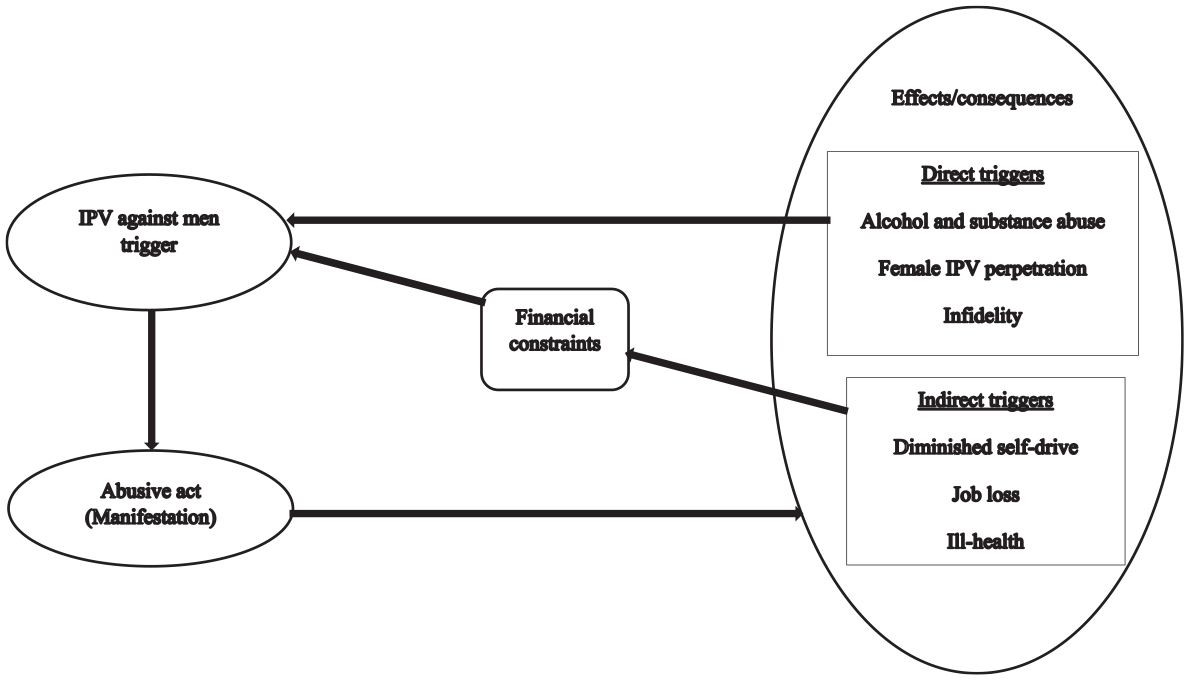
The vicious cycle of IPV against men.
Subtheme 3a: Individual Level Effects
Perceived consequences of male IPV victimization have both financial as well as health-related effects on the abused men.
Financial Effects
Job loss due to habitual lateness or absenteeism from work and reduced productivity is linked to psychological distress, low physical energy, and alcohol and substance abuse.
M10: And if the man has a job he will be overly stressed (because of IPV), which will affect his work and lead to being terminated. The employer will feel like the man does not work and he is terminated because of the stress.—FGD10 F9: Once you get to drinking alcohol you cannot keep time . . . Others have drunk till 3 AM and want to go to work, will they go to job. What excuse will he give? That leads to being fired.—FGD3
Diminished self-drive when IPV survivors lose the innate drive to keep up with activities of daily living and those geared toward income generation. Feeling overwhelmed by the abuse with no available way of arresting the situation, feelings of helplessness and hopelessness were deemed inevitable.
M5: Mostly when you have found yourself in a situation where you have no happiness in your home, you may give up in life. Your hard work nature diminishes.—FGD4 M6: I am at a point where there is nothing that I can do. I will keep seeking God till his return since I cannot break that home because the children are already adults. Let me keep praying to God till Jesus returns.—FGD6
Health Effects
Alcohol and substance abuse in instances where men turn to alcohol to escape the reality of the violence meted upon them.
M7: The other thing it leads to drug addiction. Since the moment you are depressed as a man you will resort to drinking as a result of stress. Even a man who has never taken alcohol says, I am stressed my wife is giving me stress, he is told, come take two (bottles) and the same thing happens the following day and by doing so you become an addict.—FGD12 F6: You find a man was not a drunkard, and he is in clubs drinking because he wants to be stress free when coming home, you find he was not chewing khat when he married you . . . he gets friends who chew it so that he can relieve stress.—FGD7
Communicable and non-communicable diseases, especially sexually transmitted infections, contracted when men get into extramarital affairs as a way of coping with stress related to IPV victimization. Non-communicable conditions, such as hypertension, peptic ulcer disease, loss of appetite and subsequent undesired weight loss, were other perceived effects that participants linked to prolonged exposure to IPV in silence.
F8: You will find that after all the things and noise, he will feel as though he is unwanted . . . He might have left my home without infections and then go to the other woman and find that she is infected with HIV, he will be infected.—FGD1 M9: This sickness called ulcers mostly we have, I also have it. When you look at others among us, we have pressure (hypertension). It is caused by a woman. . . . the perseverance, you end up having ulcers and pressure.—FGD6
Psychological/mental disorders such as depression, suicidal ideation, and uncontrolled aggression towards their spouses. Also fear, anxiety, and diminished self-esteem due to persistent IPV with esteem issues linked to demeaning acts which make men question their masculinity. In addition, the fact that most women take their children with them when marriage fails leaves men mentally tormented. In some instances, these psychological disorders are linked to or exacerbated by alcohol and substance abuse.
M12: You will find a man walking but throwing his arms like this while alone. Why does he do that? Because the issues he has left behind, at his home, make him speak with himself while throwing his arms in the air, because the situation has become worse . . .. . . And while out walking you just throw your hands in the air, like a mad man. We are persevering. We are violated.—FGD8 M4: Many things that affect us build wounds in our hearts because if this woman or this person you stay with is used to abusing you to that extent, if she is beating you, for instance, or it’s your wife that beats you, it builds fear in you. You become so afraid always. When you get into that home the first thing you feel is that if she asks me for money and you don’t give her she will beat you. So you become afraid and the respect fades.—FGD4 M9: It can reduce your self-esteem when you differ with your wife and she has gone to tell the neighbors about it, and they despise you since she speaks ill about you.—FGD6
Social isolation when male IPV survivors are abandoned by their friends and relatives because they are despised for having failed to keep their families together. Also, when women embarrass their men in public, other people look down upon them since they are deemed unable to take charge of their wives and domestic affairs. Such men are sometimes not given leadership responsibilities in society since their abilities are considered questionable. Others suffer self-stigma and actually isolate themselves mostly due to shame associated with IPV victimization.
F1: You will find that they are segregated by the family. There is nothing he can say in the presence of others. “What can you tell us while your own family defeated you?” They say that not knowing what transpired but you find he is voiceless in front of his fellow men because they feel he failed to manage his family.—FGD9
Reduced sex drive whereby male IPV survivors lose their sexual desire which affects their performance during sex, hence suboptimal sexual health.
M1: When you see these things (IPV), men keep silent, but we have much to share. And there is a lot of sexual matters, which are problematic, some men have lost their sex drive, which has also brought in other issues.—FGD8
Physical injuries and disabilities result from violent attacks using objects like knives for piercing or burns. This may also affect the women when the violence is mutual.
F8: As we speak now the man is missing an eye. The woman hit him with, I don’t know if it was a plate or sufuria (cooking pot).—FGD11 M7: Even when you look at him today, he got burnt everywhere. He stayed in hospital for one year.—FGD6
Death
Mortality associated with IPV takes the form of suicide, murder, or fatal avoidable accidents. Suicide is when abused men give up in life, and murder is when either spouse kills the other or the children. There are also avoidable accidents that men get involved in when they are absent-minded and preoccupied with thoughts about stressful home environments.
F1: . . . they had a misunderstanding and fought as usual, the woman escaped with an injury on the head, and the husband locked the door and hanged himself. We laid him to rest on the 12th, just the other day.—FGD7 M8: The woman puts the man under too much pressure, the man is just hit by a vehicle, gets an accident and dies. I have seen many cases like that. You know this is a slum.—FGD12
Subtheme 3b: Family Level Effects
Women, despite being the violent perpetrators also suffer its consequences and so do the children, leading to dysfunctional families.
Divorce or separation
They lead to family break-ups when persevering is no longer an option and either the man or the woman leaves. Male IPV victimization can escalate due to coping mechanisms like alcohol use or infidelity, which exacerbate tensions and strain the relationship further, leading to mutual aggression and making the home uninhabitable. Women may also engage in extramarital affairs when their men are unable to meet their sexual needs due to reduced sex drive and diminished attraction. Though both men and women sometimes leave temporarily hoping for improvement, other times it is a permanent separation, and the marriages are irretrievably broken.
M4: There was a time I left my house and I stayed away from the family for a month because of such things (abuse). I did not even care about going back.—FGD4 F6: . . . and as a woman you decide to part ways so that it may not end up in death or bad violence, you can face extreme violence and eventually die, stress and you decide to leave with the children, or you leave the children with him so that he may continue bringing them up.—FGD7
Compromised well-being of children
This happens when abused men neglect their parental responsibilities or IPV results in exposure to violence at the family level or child abuse as is the case with anger or aggression directed towards children emanating from parental conflict. There is also the possibility of children growing up in broken families or orphaned owing to parents’ deaths from incidents associated with male IPV. Some boys who lack father figures get into bad company while the girls end up with early unplanned pregnancies. Future opportunities for children in such circumstances are jeopardized by suboptimal academic achievements related to a lack of parental support and guidance through education.
M1: The violence that the men get and contributes even to challenges in the future lives of the children . . .. When violence is present, the father will neglect the child, he won’t even ask, so and so, why don’t they do their homework? He will leave the children, their future lives will be upon themselves . . . Their lives are destroyed.—FGD12 M2: Lastly when a child resembles you, they have not resembled the mother, you will have a problem in that house. This one is out of experience. And if the child listens more to you than the mother, s/he will be sleeping hungry whenever you are not there.—FGD8 M10: he will go out and in the process contract a disease like AIDS so that when one day the wife decides to do it (have sex) with the man she also contracts the disease so they both die and the children remain orphans.—FGD10
Subtheme 3c: Society Level Effects
Female-perpetrated IPV undermines the position of a man both at home and in society. Moreover, this same notion has the potential to be transferred to the next generation, a factor that could adversely affect the family unit in the future.
Reduced male significance
This happens when women no longer see the importance of men as family heads and some even feel that they can do without them. The concern that women who abuse their men set the wrong precedence for their children, especially girls who first learn from them how to live with men was raised.
M13: I wanted to say that generally the effect of violence against men is that their effort/role fails to be seen (recognized) and their significance in the community diminishes.—FGD8 M8: You will find that now it has gotten to a point they say there are many single mothers. Women say they can live without men, that they can depend on themselves, and even feed their families so what is the point of looking for a man, which is also transferred to the daughter. She says “if my mother could survive without father, why do I need to look for a husband. I can survive on my own and life will continue.”—FGD10
Economic and social burden
Presented as the the responsibility of taking care of orphaned children or coping with social misfits as a result of children being brought up in dysfunctional families marred with violence which affects how they relate with others.
M3: Our children have been destroyed mentally . . . whenever the child is in school, there is nothing they understand. When they get out from school, they start looking for a means to join bad groups of friends, and that is the foundation of armed groups here.—FGD8
Discussion
Since our study population represents those in the lowest income bracket among the city dwellers, financial constraints are inevitable. However, how women perceive and react to their men’s inability to adequately provide for their families is what seems to constitute IPV against men. In line with findings from a similar study conducted in Tanzania, the ease with which participants openly shared their experiences of victimization and perpetration of male IPV during the FGDs, despite this being a study on perceptions, is indicative that the vice is common (Laisser et al., 2011). Based on the African culture which is still well entrenched in Kenyan society, the financial provision role falls squarely on the man while the performance of house chores and child care is a woman’s role (Rwafa, 2016; Wamue-Ngare & Njoroge, 2011). This may explain why women feel justified when they decline to offer financial support to cater to family needs and maltreat men who are either unable to meet or neglect their provision responsibility. Likewise, men who are forced to perform house chores feel demeaned. Therefore, it appears that men are boxed between their provision cultural expectation and the reality of their socio-economic context that does not guarantee them bread at the end of the day hence male IPV sustenance.
The emerging income gap in favor of women promoted by deliberate efforts to grant women opportunities is perceived as a factor driving male IPV. This gap can be explained by the enactment of affirmative action which seeks to correct gender imbalances by promoting equity in access to opportunities as stipulated in the Constitution of Kenya 2010 (Kaimenyi et al., 2013). Hence, in a male-dominated community where men feel the respect accorded them is tied to their ability to provide, it can be understood why some would feel insecure when women are empowered. Extant literature reveals that the economic empowerment of women reduces their risk of IPV victimization (Kapiga et al., 2019; Schuler et al., 2016). However, such benefits associated with women's empowerment seem watered down by reports that some women undermine their partners. This breeds negative attitudes toward women’s empowerment that potentially lead to a feeling among some men that they are violated while the actions of their wives seem justified given the circumstances. Moreover, it appears that emphasis on the prevention of VAW, as depicted by the abundance of scholarly work and several legal and policy frameworks, has created the impression that women are always the victims of violence who need to be protected. This has inculcated a notion in both men and women that the law and legal frameworks work for women. This can explain why some women boldly peddle false accusations against their husbands, a form of abuse documented by other scholars because they know they will be believed (Bates, 2020a; Carmo et al., 2011; Scott-Storey et al., 2023; Walker et al., 2020).
Infidelity is a well-established trigger of IPV in studies conducted in Kenya and elsewhere (Conroy, 2014; Hatcher et al., 2013; Jewkes et al., 2017; Nemeth et al., 2012; Spencer et al., 2019). In our study, it was presented as a multifaceted factor, a trigger, manifestation, and consequence of male IPV, and in some ways is related to gendered roles and financial constraints. For instance, some female participants expressed the belief that helping a man to foot the family bills freed up his money for other women. This reveals that there is obvious competition for limited resources; by having extramarital affairs, a man automatically increases his dependents base which has the potential to land him in financial constraints affecting his ability to meet his provision role adequately. Women are therefore keen on ensuring that their men remain faithful to secure their resources for their legitimate families only. Hence, though culturally accepted and widely practiced in the past, economic, social, and health transformations in the current society no longer support polygamy (T. Brooks, 2017). Therefore, unfaithful men are sometimes subjected to maltreatment to influence their behavior. On the other hand, women engage in extra-marital affairs to take revenge on unfaithful husbands or to earn a living when the man is unable to provide. Evidence shows that in resource-poor settings, women are likely to engage in transactional sex to make ends meet (Hassan et al., 2023). This complexity of infidelity is well elaborated by Munsch (2015) when she explores gender, financial in/dependence, and marital infidelity. Her study revealed men were more likely to be unfaithful regardless of their financial standing; when they are dependent, infidelity was compensatory aimed at achieving equity in the relationship. However, financially independent women were likely to be faithful in a bid to counteract gender deviance. Her (Munsch, 2015) assertions are corroborated by statements of some participants who felt that infidelity among men is the norm and should not form grounds for IPV victimization provided they meet the family responsibilities.
Extant literature associates alcohol and substance use and IPV perpetration and victimization (Cafferky et al., 2018; Spencer et al., 2019). Women seemed angered by men who came home late drunk, making noise, and with no money or food. On the other hand, alcohol use with subsequent addiction emerged as a potential effect of exposure to abuse. Indeed, the use of alcohol has been shown to be a coping mechanism during difficult situations including those unrelated to violence (D’Aquino & Callinan, 2023; Neill et al., 2020). Stressful environments such as those marred by economic difficulties have been found to adversely affect relationship dynamics by creating problems in marriage and denying spouses an opportunity to resolve the problems constructively (Neff & Karney, 2017). We posit that negative influence is likely to be pervasive in the study community owing to the close proximity of the houses which offer little privacy, and idleness related to joblessness. Therefore, one is able to hear and see what is going on in the neighbor’s house, and this forms the basis for comparing and contrasting lifestyles through peer discussions which can be destructive.
Our findings on the manifestations of male IPV are in line with the literature, from tactics women use to physically attack their men to the actual acts of violence (Bates, 2020b; Machado et al., 2020). Similarly, controlling behavior by a spouse is a well-documented characteristic of abusive female spouses within the African context (Laisser et al., 2011; Oyediran et al., 2023; Ringwald et al., 2022; Waila et al., 2022). Guided by our study, this desire to control men can be linked to the fact that women are concerned about their men spending on others which would mean little is left for the family as evidenced by spending restriction and seclusion from his family. Regarding children incitement and control as a form a male IPV, participants explained that two factors make it possible for women to draw the children closer to themselves: the fact that men are mostly hands-off because they are occupied at work, hence giving the women money to foot bills, and when men leave their wives and children in their rural home to come to town for work. These give the children the impression that it is their mother fending for them. Despite their struggles, it was clear that parents put a lot of hope in their children and educating them is considered an investment from which parents can benefit in their old age through financial support. This explains why men felt violated when their wives incited their children against them because they knew that without a good father–child relationship, they risked being neglected by their empowered children in their old age.
Though our findings on the denial of conjugal rights as a form of IPV are consistent with those of other scholars, (Adebayo, 2014; Laisser et al., 2011), we acknowledge that this was the only abuse that could be linked to sex since none of the stated acts of violence depicted sexual violence. This hypothesis could be linked to the fact that rape and other coercive sexual acts in heterosexual relationships mostly affect women. We also do not rule out the influence of culture on the acceptable forms of sexual acts as well as the inability to discuss the same explicitly in a group setting (Fahs, 2016). We, therefore, submit that the lack of sexual acts of violence in our findings does not preclude the existence of the same and recommend further research focused on this aspect.
In keeping with the literature, we established that the consequences of IPV against men affect all their spheres of life (Bates, 2020a; Lagdon et al., 2014; Machado et al., 2020). The mental and psychological effects of IPV on men are immense; society expects men to be stoic which makes many of them suffer in silence for fear of ridicule and shame. This explains why diminished self-esteem and self-stigmatization push some into social isolation. Female participants particularly shared the observation that their husbands thrive when they feel loved and cared for but lack a sense of direction when abandoned. The feeling of diminished self-drive was evident when men were so helplessness to the point of stating that they had surrendered their lives to their creator. Consequently, some develop unhealthy habits such as alcohol abuse while others fail at self-care and often appear unkempt; factors which eventually lead to job loss and inability to provide triggering more IPV.
By neglecting his provision role, a man jeopardizes the well-being of the children. Unwilling to see their children suffer, women confront or treat their husbands in ways that are interpreted as violence, including desertion. Furthermore, although abandonment was presented as a form of IPV against men, it was also elucidated that some women leave to avoid further male-perpetrated IPV and fear of fatal outcomes. VAW is likely to trigger IPV against men in retaliation fueling mutual aggression (Bates, 2020b; Langhinrichsen-Rohling et al., 2012) leading to family break-ups as revealed by our study often leading to single-parent families. However, parenting is more than material provision and there are consequences of single parenting including poor academic performance, school dropout, and early marriages among others (Bago, 2022; Mbithi, 2019). Moreover, children sometimes blame themselves for IPV occurrence and this has an adverse effect on their development and psychological/mental health (Deboard-Lucas & Grych, 2011).
Study Limitations
Though deemed the best approach to get an in-depth description of male IPV, this study used qualitative methods applying purposive sampling of participants, which limits the generalizability of the findings. Moreover, the focus was on an urban informal settlement; hence the findings should be applied with caution to populations that do not fall under similar socio-economic status. Finally, the study population comprised ever-married men and women, limiting extrapolation of findings to non-cohabiting or same-sex intimate partners.
Study Implications
Our findings underscore the need to consider men as potential victims of IPV and contextualize IPV prevention strategies targeting the urban poor with the goal of designing and implementing policies and interventions that address IPV holistically. The revelation that male IPV victimization can trigger IPV against women and abuse to children should be a wakeup call to all actors interested in mitigating domestic violence to embrace broad-based gender-neutral strategies to make homes the safe havens they ought to be. More specifically, the findings emphasize the need to enhance programs aimed at reducing alcohol consumption and poverty in informal settlements and highlight the implications of changes in the socio-economic landscape, which may not be supportive of traditional gender norms.
Conclusion
Although we set out to explore perceptions, study participants openly shared their experiences of male IPV perpetration and victimization with regard to triggers, manifestations, and consequences. This is probably an indication that female-to-male IPV is a common occurrence in the community. Findings from this study complement previous scholarly work highlighting the plight of men as victims of female-perpetrated IPV. The role of poverty and alcohol use in triggering IPV against men cannot be ignored. Both factors indisputably affect interpersonal relationships and spousal relations. The majority of the acts that are interpreted as IPV against men are emotional in nature and although they may not inflict physical bodily harm, their psychological and mental health effects on the survivors are noteworthy. These consequences affect the abused men and their family members, including the abusive women and children through IPV against women and child abuse/neglect, respectively, not forgetting their impact at the societal level.
Footnotes
Acknowledgements
We would like to acknowledge the support and guidance provided to us by the local administrators as well as CHVs working within the study area. We would also like to thank the study participants most sincerely for their voluntary participation and the research assistants who helped with data translation and transcription.
Author Contributions
All authors contributed to the study's conception and design. Study protocol preparation and ethical and regulatory approvals were sought by Jacinta Mukulu Waila. Data collection and analysis were performed by Jacinta Mukulu Waila and Domnick Onyango Mitiro. The first draft of the manuscript was written by Jacinta Mukulu Waila and improved based on feedback from Christine Wayua Musyimi, Michael Lowery Wilson, Olaf Horstick, and Domnick Onyango Mitiro. All authors read and approved of the final manuscript.
Declaration of Conflicting Interests
The author(s) declared no potential conflicts of interests with respect to the authorship and/or publication of this article.
Funding
The author(s) received no financial support for the research and/or authorship of this article.
