




Abstract
This study examined the association between victimization and victim blaming using a sample of n = 142 participants in a generalized linear mixed model (GLMM) with the influence of subject gender, victim stereotyping level, threat level, and victim gender for victim blaming. Belief in a just world was included in the model as a covariate. Mediation analyses were conducted with the degree of identifiability with the victim and attitudes toward traditional role models as explanatory approaches. In addition, acceptance of rape myths was considered. The GLMM analyses suggest that victim blaming by male subjects was significantly higher on average than by female subjects when all other predictors were held constant. As an explanatory approach for these effects of the subjects’ gender on victim blaming, partial mediation was found with the degree of identification with the victim as a mediator. No main effects were found for the other influencing factors, but only a statistically significant three-way interaction. This indicates a differential effect of the level of stereotyping for male and female victims in conditions that end in high threat. The finding of the main effect of subjects’ gender seems to be particularly important for the legal system, as it appears to make a difference in who is asked in terms of victim blameworthiness. This finding highlights the importance of considering a victim’s personal characteristics and the need for future research with an additional focus on the characteristics of the sentencers to help clarify potential biases.
Keywords
Introduction
Victims of rape often suffer not only from the crime itself but also from what is known as secondary victimization (Campbell et al., 1999). This describes a lack of help and support after an adverse, or traumatic experience, which promotes humiliation, doubt (Martin & Powell, 1994), or blame (Pollard, 1992). The present study focuses on making the victim responsible for their victimization, known as victim blaming (Whatley, 1996), after a rape. To understand how the phenomenon of victim blaming occurs, several theories have been put forward, one of which is the defensive attribution hypothesis (Shaver, 1970) stating that blame attribution is dependent on perceived similarity to the victim and perceived vulnerability to becoming a victim of a similar assault themselves (Grubb & Turner, 2012). It is assumed that the attribution of blame is a result of the perception of one’s vulnerability and that attributing blame reduces the perceived similarity with the victim and the likelihood of one’s victimization (Pinciotti & Orcutt, 2020). Thus, this hypothesis predicts that greater similarity to the victim will decrease victim devaluation (Grubb & Turner, 2012). This is a defense mechanism designed to protect the person making the judgment from being blamed in a possible later event (Grubb & Turner, 2012).
Although many different variables of influence on victim blaming have been previously investigated (see, e.g., meta-analysis by Suarez & Gadalla, 2010), this study focused on the influence of the gender of the victim as well as the subject, the level of stereotyping of the victim, the level of threat to the victim at the end of the story, and the belief in a just world (BJW), as most relevant factors influencing the association between victimization and victim blaming and understanding the complex dynamics of the prior. Even though investigating these dynamics is challenging, as this itself may be viewed as victim blaming, we deem specifying the vulnerabilities to victimization essential, especially in helping individuals avoid revictimization and secondary victimization. However, most research on victimization has focused on demographics such as race, or income, which can identify, but not explain group differences (Hamby & Grych, 2016). This study aimed to disentangle risk and influencing factors more specifically by analyzing gender differences in various influencing factors of victim blaming in one model and additionally examining explanatory approaches therefor. In addition, the majority of the studies are based on an investigation of purely female or purely male victims, which is why a direct comparison could be profitable. The results on the level of threat to the victim at the end of the story for the victim are also largely not based on rape scenarios, which is why this gap is to be investigated in the present study. This study thus attempts to analyze the phenomena that have already been examined individually in a model and to test explanatory factors.
As stated by Hamby and Grych (2016), there is a strong tendency to blame victims in Western industrial countries where “just world” beliefs are common (Lerner, 1965) and people tend to think that everyone gets the life they deserve and consequently must have done something to cause the bad things that happened to them. Therefore, victim blaming is often explained with the help of BJW, which assumes that devaluing the victim is the result of overcompensation for an undeserved act (Grubb & Turner, 2012). A distinction can be made here between the BJW for self-compared for others or in general (Lipkusa et al., 1996). For example, studies conducted in individualistic cultures found that personal BJW was primarily associated with mental health, such as life satisfaction, whereas general BJW tended to lead to victim devaluation (Bègue & Bastounis, 2003). Furthermore, gender attitudes may often play a role in attributing blame to the victims of violence, especially sexual violence, following the idea that some women “ask for” sexual assault by the way they dress or act (Hamby & Grych, 2016). Specific risk and influencing factors for victim blaming concerning gender (i.e., of victim, or observer) and gender attitudes (e.g., stereotypes, gender roles, rape myths) will be discussed in the following, including other previously associated variables, such as situational factors and self-blame.
Victim Gender and Subject Gender
For victim blaming, a distinction can be made between characterological and behavioral blaming (Janoff-Bulman, 1979). In previous studies, female victims were assigned more characterological blame than male victims, while the pattern for behavioral blame was reversed (Howard, 1984a, 1984b). Similarly, Davies and Rogers (2006) found that female victims were blamed for being naïve, and male victims were blamed more for stereotypical “non-male” behavior, such as not hitting back.
When considering the gender of the observer, findings are more heterogeneous. Across many studies, male observers were found to engage in more victim blaming than female observers (Bell et al., 1994; Davies et al., 2009; Schneider et al., 2009). This pattern was found for both male (Davies et al., 2009; White & Kurpius, 2002) and female victims (Furnham & Boston, 1996). However, some studies found no difference in victim blaming between men and women (Culda et al., 2018; Krahé, 1988; Sims et al., 2007; Wiener et al., 1989). Previous studies have largely presented only female victims (Abrams et al., 2003; Ferrão & Gonçalves, 2015) or very rarely only male victims (Sleath & Bull, 2010; Whatley & Riggio, 1993) in the scenarios, but few direct comparisons have been made between female and male victims by manipulating gender in the scenarios (Howard, 1984a, 1984b; Strömwall et al., 2013). Therefore, in the present study, both male and female subjects were examined and the gender of the victim was manipulated. Both the presence (Allison & Wrightsman, 1993; White & Yamawaki, 2009) and the absence of gender differences are often explained by the degree of identifiability (Grubb & Turner, 2012). Based on this, this study also asked how strongly subjects identified with the victim.
Threat Level at the End of the Story
To further account for the influence of situational factors in relation to intrapersonal ones, we also examined the influence of the perceived valence of how the assault is concluded on victim blaming. Herein, Walster (1966) stated that the worse the consequences of an accident are for a victim, the more responsibility is attributed to this victim. As such, the study of Van den Bos and Maas (2009), which investigated the influence of the severity of the ending of a story about a victim of a robbery, found that participants in the study attributed more blame to the victim in the high threat story (i.e., worse ending for the victim) than in the low threat condition (i.e., better ending for the victim). However, these results are not based on rape scenarios where victim blaming is much more prevalent than for robbery, which is why this gap will be investigated in the present study.
Possible Explanatory Approaches of the Effects Analyzed
In addition, the paper aims to provide possible explanations for the effects studied, taking a closer look at the acceptance of rape myths and attitudes toward traditional role models. The term rape myths was first defined by Burt (1980) defining prejudicial or false assumptions about both the rape itself and the victim as well as the rapist. These assumptions thus influence the subjective ideas about what constitutes a “typical rape” and lead not only to problematic views about how the victim and perpetrator presumably behaved but also about the antecedents or consequences of the rape (Bohner et al., 2009). Rape myths were often only related to female victims (Brownmiller, 1975; Ellis, 1989; Ward, 1995) but also affect male victims (Van der Bruggen & Grubb, 2014). Mason et al. (2004) were able to show that higher acceptance of rape myths resulted in less belief that rape had occurred. Gender differences have also been examined within rape myth acceptance, for example, females appear to be less likely to believe rape myths than males (Hayes-Smith & Levett, 2010).
The influence of attitudes toward traditional role models and gender stereotypes was also examined. Ben-David and Schneider (2005) found that people with traditional gender role attitudes were less likely to classify the described situation as a rape, less likely to classify it as psychologically harmful, and less likely to classify it as violative of the victim’s rights. Acock and Ireland (1983) further found that female victims who violated traditional gender roles were blamed more than those who were role conforming. By contrast, a recent study by Felson and Palmore (2021) concluded that their examined relationship between traditional gender role attitudes and victim blaming was not due to gender role violation. However, traditional role attribution usually represents primarily U.S. conformity, which is why it makes sense in this study to examine the effects found in the German context.
Self-Blame
Not only blaming others but also the person themselves, so-called self-blame, often occurs after victimization (Janoff-Bulman, 1982). To find possible parallels between these two phenomena, self-blame was additionally examined in this study. Self-blame can be associated with both adaptive functions, such as gaining control over events, and maladaptive functions, for example, as a correlate with depression (Janoff-Bulman, 1979). Janoff-Bulman (1979) showed that whereas characterological self-blaming maximized perceptions of one’s vulnerability, behavioral self-blaming maximized beliefs about the avoidability of future rape. Thus, characterological self-blaming is thought to reflect self-deprecation and low self-esteem, whereas behavioral self-blaming is more likely to represent an attempt to reestablish control after victimization (Janoff-Bulman, 1982). The author also found that with female rape victims, self-blame was significantly more often behavioral than characterological (Janoff-Bulman, 1979). However, there is a paucity of data on possible gender differences within self-blaming. This gap will be addressed in the present study by comparing the responses of male and female subjects to four different self-blaming scenarios.
Aim of This Study
An important focus of this study was to examine, replicate, and extend previous findings with regard to the addressed influencing factors in a joint model, which have been often only considered individually, to provide explanatory approaches for the phenomenon of victim blaming. Specifically, this study will apply different vignettes describing male and female victims of rape with variations in the level of stereotypes and handling of the assault by the victim after its occurrence while considering observer traits through validated questionnaires.
Our main hypothesis focuses on the association between victimization and victim blaming, where we expect (a) higher BJW to be associated with more victim blaming, especially for male observers with high scores in victim blaming, measured by the selection of pre-defined responses concerning a vignette, regardless of the gender of the victim. In addition, we deem the subject gender effect on victim blaming to be mediated by the degree to which the subject identifies with the victim and by the degree to which the victims fulfill gender stereotypes (the higher the stereotype, the higher the victim blaming), and the attitude toward traditional role models. (b) We hypothesize that female victims will experience more victim blaming than male victims, especially for characterological victim blaming and for vignettes with a high-threat ending. On the part of the observer, we deem the degree of victim identifiability, self-blame, and rape myth acceptance to influence the extent of victim blaming, especially when the observer is female.
Methods
Participants
A total of n = 143 subjects (female = 83, male = 59, diverse = 1) with fluent German language skills participated in the study. Since the group size for diverse subjects was too small to be used for statistical comparison, the person was excluded. Thus, a total of 142 subjects were included in the analyses. Participants’ ages ranged from 18 to 72 years, with women having a mean age of 30.51 years (SD = 12.93) and men having a mean age of 33.86 years (SD = 16.52).
Procedure
The study has been implemented as an online survey using the web platform “Research Electronic Data Capture” (REDCap) within the Ludwig-Maximilians-Universität. After giving informed consent, all participants were asked for the sociodemographic data on gender identification, age, prevalence of mental illness with current treatment, marital status, employment, highest degree of education, knowledge of the German language, and whether the person was resident in Germany. After the demographic survey, all participants were asked to complete the scales for both general (Dalbert et al., 2002) and personal BJW (Dalbert, 2002). Randomized by REDCap, subjects were then given a scenario describing either a female or a male victim. Assessments for attitudes toward traditional role models and acceptance of rape myths followed. Afterward the participants were shown a randomized series of victim blaming and self-blame scenarios followed by questions (see below).
Measures and Scenarios
All participants were asked to complete the scales for general (Dalbert et al., 2002) and personal BJW (Dalbert, 2002), rape myth acceptance according to Bohner (1998), and attitude toward traditional role models (Petzold et al., 2015). Self-blame was assessed with an adaptation of Janoff-Bulman (1979). The participants were asked to read through the scenarios carefully, imagining that the situation described was actually experienced by themselves (for details on each questionnaire and respective internal consistencies see Supplemental Material).
To assess victim blaming, subjects were shown several vignettes, followed by questions. The victim blaming scenarios were adapted from the case descriptions of Van den Bos and Maas (2009) and the questions of Janoff-Bulman et al. (1985). Here, each scenario is a description of a meeting between two people at the end of which the victim is raped by the other person. Within these vignettes, three factors were manipulated: The gender of the victim, the degree of gender stereotype fulfillment of the victim, and the ending of the story. The gender of the victim was manipulated between male and female. The degree of stereotype conformity was either high (i.e., the victim conformed to the stereotypes of her gender) or low (i.e., the victim behaved more contrary to her gender stereotypes and conformed more to the stereotypes of the opposite gender). The description of the stereotypes was based on Magin and Stark (2010). The end of the story was manipulated according to high and low threats to the victim. In the variant with a high threat, the victim did not talk to acquaintances or the police, could hardly process the event, and developed anxiety or panic attacks. The low-threat variant was described as the victim both talking to acquaintances and filing a report with the police, being able to process the event better, and not developing any psychological abnormalities. By manipulating these three factors, there were a total of eight case vignettes, four with male victims and four with female victims. Each subject received either all four female stories or all four male stories. To avoid gender bias, half of the female subjects were randomly assigned to female vignettes and the other half to male vignettes by the REDCap program; the same was true for the male subjects. After each case vignette, participants were asked to respond to 10 statements regarding victim blaming on an 11-point scale with endpoints completely disagree to completely agree. These questions were adapted from Janoff-Bulman et al. (1985). Half of the statements represented behavioral victim blaming and the other half represented characterological victim blaming. In addition, after each scenario, control questions were inserted between the questions on victim blaming, which asked for detailed knowledge from the scenarios (e.g. about the hobby of the person described). Thus, two sum scores were formed for specific questions (for behavioral and characterological victim blaming, respectively), and a total sum score for both types of victim blaming was formed for the generalized linear mixed models (GLMM). All vignettes and questions can be found in supplements, as well as scoring information to assess victim blaming.
Design
An a priori power analysis was conducted using GPower 3.1 (Faul et al., 2007) to calculate the number of subjects needed to find medium-size effects in repeated-measures analyses of variance (ANOVA, f = .25) at a significance level of α = .05 and a power of 1 − β > .80 (Cohen, 1962). The determinations for the power analysis were calculated based on an ANOVA with repeated measures considering the effect sizes of the pilot study (n = 11), which resulted in a required sample of 130 subjects. However, since a GLMM was more suitable for the data structure, the analyses of the main study were calculated with a GLMM and for this purpose, a power analysis was calculated post hoc with the R package “simr,” based on the Monte Carlo simulation (Green & MacLeod, 2016). For all fixed effects set, the power was found to exceed 90% (α = .05) with a final sample of n = 142.
To evaluate the hypotheses raised, the “lme4” package (Bates et al., 2014) for RStudio version 4.0.1 (R Core Team, 2022) was used to calculate a mixed-effects linear analysis for the influence of subject and victim gender, level of stereotyping, story ending, and general BJW as covariates on victim blaming. As fixed effects, subject gender, victim gender, victim stereotyping level, story ending, and general BJW were included as covariates in the GLMM. Random axis intercepts were allowed as random effects for the subjects in the model. Before setting up the model equation, the variable general BJW was centered on “high” expressions to better answer the hypotheses. A standard deviation above the mean served as the cutoff value for this “high” expression (M[general BJW] = 15.73, SD[general BJW] = 4.95). This was done following previous definitions for a “high” BJW (compare Valor-Segura et al., 2011; Van den Bos & Maas, 2009). The model equation was constructed according to Zuur et al. (2009) using the top-down principle. The final model equation with main and interaction effects can be found in the supplements as well as the model performance indices. Once the model equation was established, model diagnostics of the GLMM were performed and the assumptions of normal distribution of residuals, homoscedasticity, and linearity between predictors and criterion were tested. Because the assumptions were violated, the dependent variable victim blaming was logarithmized. Subsequently, the model diagnostics were tested again, showing a good model fit. The hypotheses were interpreted with exposed coefficients. Partial
Results
Belief in a Just World
Regarding the BJW, it was analyzed whether there was a correlation between the BJW and victim blaming. General BJW was positively correlated with both behavioral (r = .231, p = .006) and characterological victim blaming (r = .236, p = .005). This is a weak to moderate effect according to Cohen (1962). Personal BJW, on the other hand, did not correlate with either characterological victim blaming (r = −.088, p = .295) or behavioral victim blaming (r = −.051, p = .546). There was no statistically significant difference between female and male subjects in either mean general BJW (t[140] = 1.54, p = 063) or mean personal BJW (t[89,65] = 0.81, p = .228). For the subsequent analyses, the general BJW was included as a covariate in the models because the correlative analyses revealed a statistically significant relationship between the general BJW and victim blaming.
Effect of the Gender of the Participant on Victim Blaming
It was also investigated whether there was a difference between male and female subjects in the level of victim blaming, regardless of the victim’s gender, and given a high BJW. For this purpose, it is helpful to take a look at the exponentiated coefficient for the predictor gender of the subject (exp[
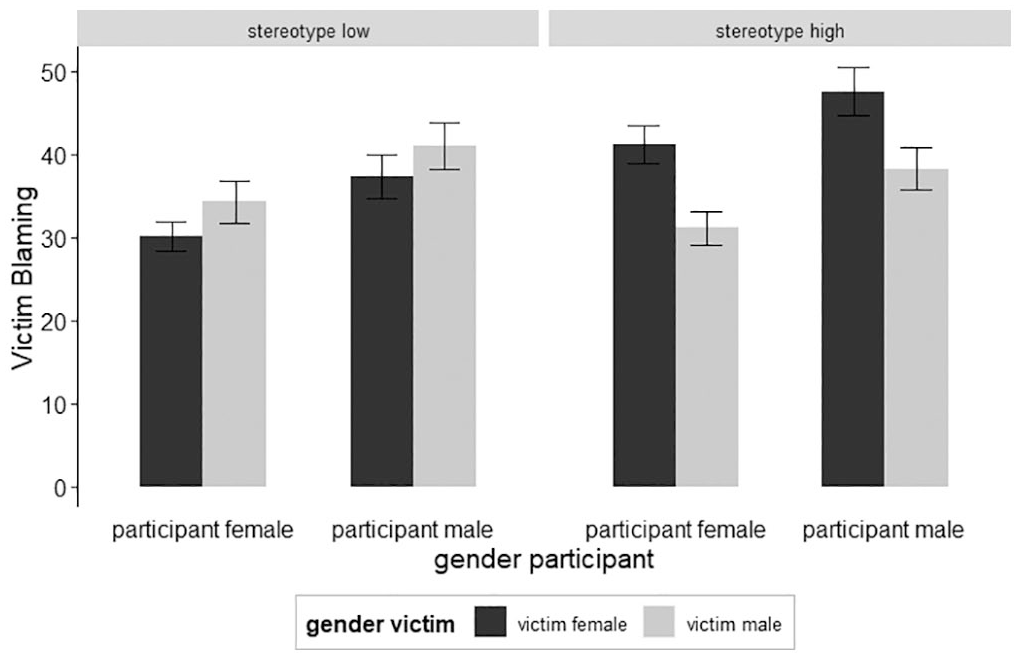
Gender differences of participants in victim blaming, split by level of stereotyping and gender of victim.
As an explanatory approach for this effect, we tested whether the subject’s gender was mediated (Baron & Kenny, 1986) by the degree of identifiability with the victim. Results show that the relationship between the gender of the subject and victim blaming was partially mediated by the degree of identification with the victim (indirect effect ab = 1.36, 95% CI [0.60, 2.39]; see Figure 2).
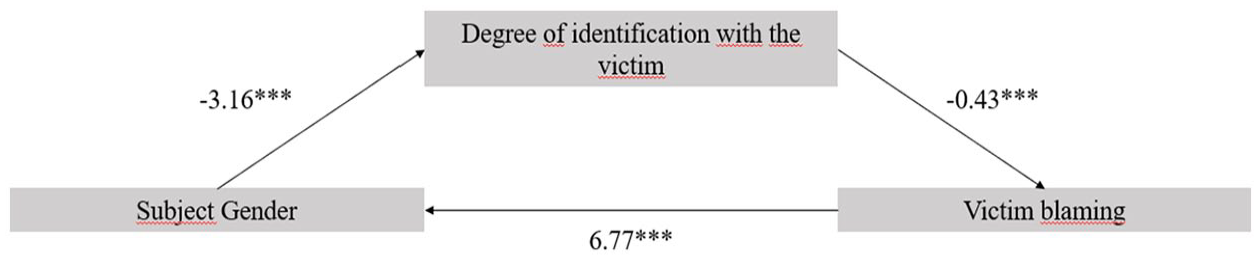
Mediation analysis with the gender of the participant as an independent variable, victim blaming as the dependent variable, and degree of identification with the victim as a mediator.
Interaction of the Predictors of Victim Gender, Threat Level at the End of the Story, and Victim Stereotyping Level
With regard to the effect of gender stereotypes on victim blaming, we examined whether victims who fulfilled gender stereotypes more were more likely to be blamed than victims who did not fulfill these less, given a high BJW. In addition, we examined whether female victims were assigned more blame than male victims. For the influence of the ending of the story, we investigated whether victims whose scenarios ended with a high threat experienced more victim blaming than victims whose scenarios ended with a low threat.
The test of the hypotheses cannot be answered separately due to a statistically significant three-way interaction between the gender of the victim, the end of the story, and the degree of stereotyping. None of the three predictors (exp[
For female victims, the interaction of the predictor’s stereotyping level and ending of the story (exp[
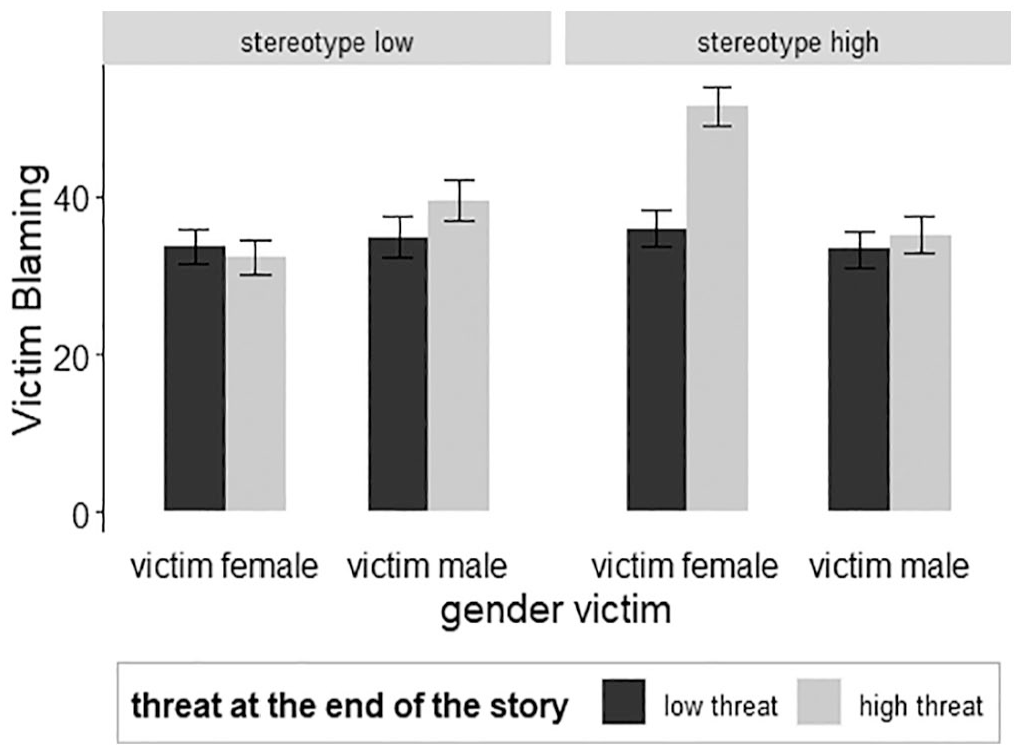
Victim blaming is a function of subject gender, end of story, and level of stereotyping.
For male victims, the exposed coefficient of the interaction between the end of the story and the gender of the victim (exp[
The exposed coefficient of the triple interaction between the degree of stereotyping, the end of the story, and the gender of the victim shows that holding the gender of the subject constant and given high values in the general BJW, victim blaming for male victims with high stereotyping and high threat was lower on average by a factor of 0.61 than for female victims. Here, too, victim blaming was significantly higher for female victims with a high level of both stereotyping and threat than when both predictors were low (exp[
Regarding the effect of the victim’s gender, we analyzed whether there were differences in the characterological or behavioral attribution of blame between male and female victims. There was a statistically significant difference between the mean behavioral victim blaming for female and male victims, which was on average 6.2 units higher for female victims (95% CI [−0.39, 12.76], t[566] = 1.85, p = .033, d = .16). For characterological victim blaming, there was no difference between the values of female and male victims (t[561,59] = 1.31, p > .05).
Effect of Identification
Results concerning the degree of identifiability moderate negative correlations with victim blaming (r = −.202, p < .001). This association was found for both men (r = −.195, p < .005) and women (r = −.169, p < .005). In addition, the further hypothesis investigated whether there was a gender difference in the ability to identify with the victim. The idea that women identify more strongly with the victim arose from the result of earlier studies in which both male and female subjects attributed a higher probability of becoming victims of an attack to women (Howard, 1984a). This was further investigated using a t-test for the degree of identification between male and female subjects, revealing a statistically significant difference between the mean level of identification of female and male subjects, with this being on average 3.16 units higher for female participants (95% CI [1.74, 4.58]; t[531.81] = 4.37, p < .001, d = .37).
As this study only asked how likely people thought it was to become a victim of a (not further specified) criminal event themselves, it was only possible to analyze whether women rated this probability for themselves as higher than men. Results indicate that there was a statistically significant difference in the self-assessment of the probability of becoming a victim of a criminal event between male and female test subjects. This was on average 8.30 units higher for female participants (95% CI [4.34, 12.27]; t[460.05] = 4.12, p < .001, d = .36).
Gender Differences in Self-Blame
Under the assumption that women more frequently blamed themselves for an event than men, we performed a t-test for characterological and behavioral self-blame between women and men. There was a statistically significant difference between the characterological self-blame of women and men, whereby, contrary to expectations, the self-blaming of men was on average 1.93 units higher than that of women (95% CI [1.38, 2.49]; t[566] = 6.84, p < .001, d = .58). A very similar effect was found for behavioral self-blaming. Here, too, there was a statistically significant difference between men and women, in which the self-blaming of men was on average 2.03 units higher than that of women (95% CI [1.50, 2.57]; t[566] = 7.46, p < .001, d = .64).
Effect of Rape Myth Acceptance
With regard to the acceptance of rape myths, correlative results between the acceptance of rape myths and behavioral and characterological victim blaming show that the degree of acceptance of rape myths correlated positively with both characterological (r = .433, p < .001) and behavioral (r = .447, p < .001) victim blaming. This means that, as expected, the more the subject accepted rape myths, the more guilt (characterological/behavioral) was attributed to a victim. According to Cohen (1962), this represents a moderate to strong correlation.
Summarizing Graphic of the GLMM
To present and summarize the results of the GLMM more comprehensibly, a model graphic with the predictors and their coefficients was created (see Figure 4). The interaction between the general BJW and the degree of stereotyping as well as the gender of the subject were not included, as it was found that the effects of holding the general BJW constant at a fixed value apply to any level of the BJW and not only given a high value (for exact results see above). The main effects and interactions with exposed coefficients are shown.
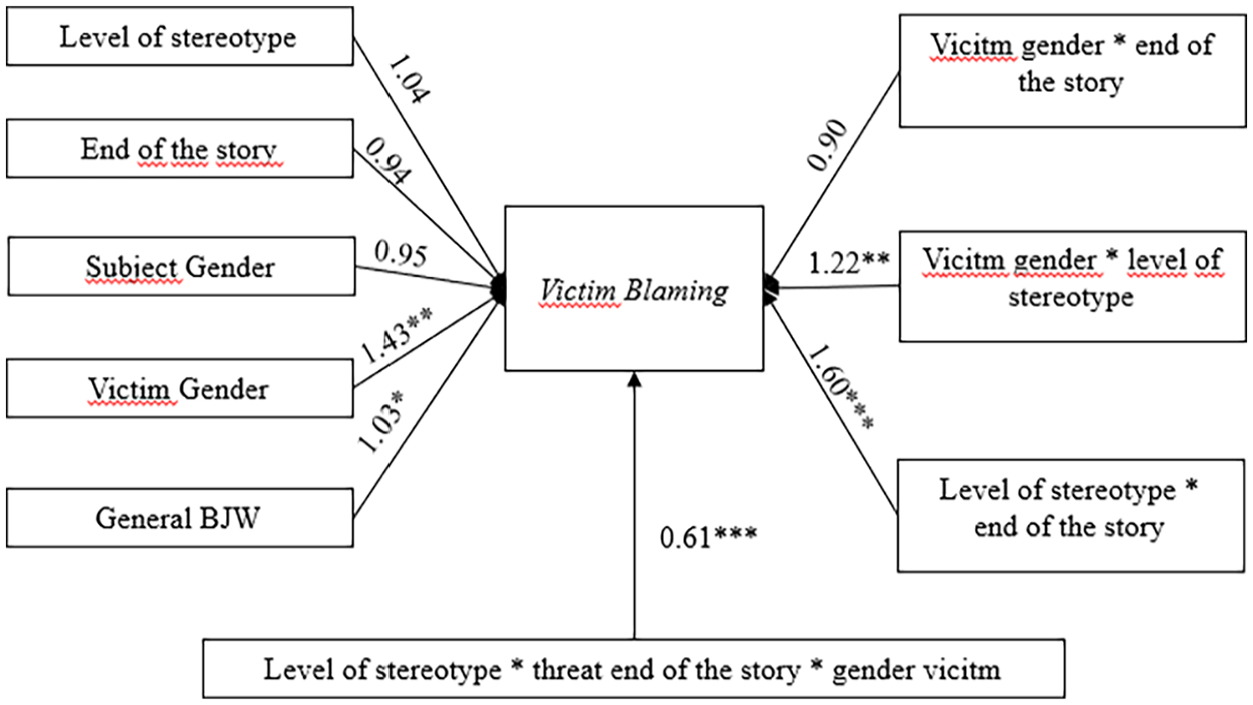
Summarizing graphic of the influence of the predictors level of stereotype, threat at the end of the story, gender victim, gender participant, covariate general BJW, and their interactions on victim blaming.
Discussion
This study investigated the risk and influencing factors of victim blaming with regard to sexual assault using vignettes. The results replicate and extend previous findings, suggesting that males engage in more victim blaming than women and identify less with victims. For the influence of the fulfillment of gender stereotypes, different effects were found for male and female victims, given a high threat for the victim at the end of the story. Acceptance of rape myths and a general view that the world is a just place where everyone gets what they deserve further amplified this effect.
Summary of the Results and Reference to Past Research
The GLMM analyses suggest that victim blaming by male test subjects was significantly higher than by female test subjects when all other predictors were held constant. Current findings on the influence of the subject’s gender on victim blaming are heterogeneous. For example, some studies have found no difference in the attribution of blame between men and women (Culda et al., 2018; Krahé, 1988; Sims et al., 2007), while many studies conclude that male subjects engaged in more victim blaming than female subjects (Davies et al., 2009; Schneider et al., 2009). However, these findings should be interpreted with caution, as both the measurement of victim blaming and the gender of the victim vary greatly across studies. For example, in the study by Culda et al. (2018), victim blaming was only measured with one question, which is a major limitation of the study. In addition, most of the studies that were unable to find gender differences were based on scenarios in which the victim was exclusively female (Culda et al., 2018; Krahé, 1988; Sims et al., 2007). The study by Davies et al. (2009), on the other hand, also manipulated the gender of the victim and had a similarly large sample as the present study, which corroborates our results. This gender effect can be further explained by our mediation analysis. In this context, female subjects can identify more strongly with the victim than male test subjects (irrespective of the victim’s gender). These results substantiate Shaver’s (1970) defensive attribution theory and the assumption that men and women have a different ability to take on the victim’s perspective and thus identify with the victim’s experience (Allison & Wrightsman, 1993). Furthermore, victim blaming for female victims was statistically significantly higher in the current study, when the victim fulfilled strong stereotypes and had an unfavorable ending concluding the described assault, while victim blaming for male victims was significantly higher when stereotypes were low and the ending was more favorable for the described victim. From this, it can be concluded that male victims are more likely to be blamed if they behave in a less stereotypical manner, while female victims are more likely to be blamed if they behave in a stereotype-conforming manner (given that subject gender is held constant and the ending of the story is unfavorable). This finding is consistent with findings on rape myths and assumptions about “masculinity” and “femininity,” such that female victims were blamed for being naïve and male victims for showing “non-masculine” behaviors, such as not fighting back (Davies & Rogers, 2006). A direct comparison of the results of this German sample with those from other countries to find possible cultural explanations appears difficult, as there are heterogeneous findings within the country. It would therefore be beneficial in future studies to use the same study to survey people from different countries and cultural backgrounds.
We also found a positive correlation for both genders between the general BJW and both behavioral and characterological victim blaming, but no correlation was found between the personal BJW and either form of victim blaming. Previous studies have also found a positive correlation between BJW and victim blaming (Bizer et al., 2012; Keller & Siegrist, 2010; Montada et al., 1988; Smith et al., 2011). However, in some cases, no distinction was made between general and personal BJW, or only one of the two constructs was used. In addition, the type of assault differs across studies (e.g., often marginalized persons living in poverty or with a physical, or mental illness (Bizer et al., 2012; Keller & Siegrist, 2010; Montada et al., 1988; Smith et al., 2011), which limits comparability. The positive correlation between the general BJW and victim blaming in the present study is in line with the finding that the personal BJW can be associated primarily with mental health, for example, life satisfaction, whereas the general BJW tends to lead to a devaluation of victims (Bègue & Bastounis, 2003).
With regard to self-blame, male subjects had higher scores for both characterological and behavioral self-blaming than women. Since Howard (1984a) found in her study that females were more likely to be victims of assault and the researcher concluded that victimization is perceived as a female experience, the present study assumed as an alternative hypothesis that women engage in more self-blaming than men. However, there are also findings suggesting that self-blame occurs in both women (Eaton, 2019) and men (Walker et al., 2005). One possible explanation for the gender differences found in the present study could be that both the male and female subjects were influenced in their judgments of the self-blaming vignettes by the four victim blaming vignettes, in which the perpetrator was always male and that the men may have engaged in more self-blaming and the women in less self-blaming as a result. This study also found a positive correlation between the acceptance of rape myths and victim blaming, which is consistent with previous literature (Ferrão & Gonçalves, 2015; Mason et al., 2004; Yamawaki, 2009).
Limitations
Compared to other studies in this field of research, our sample size was relatively small. Another weakness of the present study was the between-subject design, meaning that each subject read either only scenarios with female or only male subjects. However, an attempt was made to counteract possible confounds by randomly assigning both types of vignettes to the subjects. However, as not all people who clicked on the study link also completed the study, the male test subjects read more male than female scenarios overall. Nevertheless, the use of female and male vignettes in one model remains a strength of this study, as this has been rarely addressed previously.
Another limitation is the fact that subjects were not asked about their attitudes toward homosexuality. As the perpetrators in each vignette were male and some of the victims were also male, there could be a confound with regards to homophobia, as there are findings that show that homophobia has an effect on victim blaming (Davies & Rogers, 2006; Davies et al., 2012; White & Yamawaki, 2009). In a review by Davies and Rogers (2006), all studies examined found that homosexual victims were blamed more than heterosexual victims. In addition to recording homophobic attitudes, manipulation checks could have been used to control for sexual orientation of the subjects assigned to the victims.
Furthermore, the attempt to capture both self-blaming and victim blaming in one model can also be seen as a point of criticism, as the directly consecutive questions may influence each other. For example, it is possible that both male and female subjects could be affected in their own attribution of guilt by the victim blaming vignettes with only male perpetrators.
It can also be noted as a limitation that all perpetrators were described as male. This was intended to ensure statistical comparability and additional manipulation of another factor would hardly have been feasible due to the associated further increase in the number of vignettes. However, there are only a few, and mainly older, studies that have investigated the effect of manipulating the gender of the perpetrator (Smith et al., 1988). With regard to the rape of men by women, it remains difficult for people to imagine that a dominant woman can force a man to have sexual intercourse against his will because they have been socialized to believe that men are the active and women the passive part (Smith et al., 1988). Future research may want to examine whether socialization has changed in recent years and what measures would be helpful to create more awareness of male rape by women. It is also important to raise awareness of the occurrence and importance of educating people about the rape of men by men.
It must further be critically noted that the collected sample was less heterogeneous than desired, due to the snowball system as a recruitment method. Thus, the majority of the subjects had a high level of education, and the age range extended from 18 to 72 years with an average of around 32 years. The results of this study are further limited to people who identify as male or female. In the present study, the question about gender identification was broader given the opportunity of defining one’s self as diverse; however, this included only one person, which is why they had to be excluded from the analyses due to a lack of statistical usability. It would therefore be very important to make greater efforts to ensure a heterogeneous sample in future studies and to raise awareness of the importance of consensus in dealing with diversity in research.
In addition, limitations can be identified with regard to the statistical analysis. Due to the hierarchical data structure, multilevel analysis is an adequate method of choice, but the required sample size also depends on the level at which the parameters of theoretical interest lie. Since hypotheses were formulated for both level 1 and level 2 parameters, it was challenging to weigh more level 1 observations or more level 2 units. However, the post hoc power analysis showed a power of over 90%. In addition, it can be discussed whether the implementation of mediation analyses with victim blaming as the dependent variable, gender of the subject as the independent variable, and identifiability as a mediator on the one hand, and victim blaming as the dependent variable, degree of stereotyping as the independent variable and attitude toward traditional role models on the other, is justifiable despite the lack of the necessary temporal precedence due to the cross-sectional data structure. The decision to conduct the mediation analyses was made due to a temporal sequence of the first gender of the subject, then identification with the victim, followed by victim blaming. The temporal precedence of the second mediation model can be viewed somewhat more critically.
Future Research and Prospects
An interesting follow-up question to the current findings would be to consider possible generational differences with regard to victim blaming and attitudes toward traditional role models to assess the possible effects of previous education or sensitization to the topic. As Geiger et al. (2004) found, age and gender appear to be strong predictors of rape-tolerant attitudes and victim blaming. However, students from different grades were compared here (Geiger et al., 2004), which is why looking at different generations would be a sensible extension. Focusing on specific characteristics of the subjects could shed light on what factors, in addition to the acceptance of rape myths, BJW, and attitudes toward traditional role models, influence the extent of victim blaming on the part of the judging persons. We exploratorily compared descriptives between individuals aged below 30, above 30, and above 50 (see Supplemental Material). It also seems important to focus more on the assessment of male victims of female perpetrators and homosexual victims, as this can have a significant impact on how much credibility they receive in the legal system or how well they access the medical care system. It would therefore be interesting to conduct a similar study with staff from medical, psychotherapeutic, or legal institutions to raise awareness. With regard to diversity in research, it should be emphasized once again that it is important to make more of an effort to use heterogeneous samples in the future to move away from heteronormativity in research as well.
Conclusion
In sum, the present study makes an important contribution to research regarding the topic of victim blaming, as it not only replicates previous findings and is thus one of the few studies with German samples to offer a comparison with results from other countries but also represents an attempt to examine various factors influencing victim blaming and explanatory approaches in one model (whose validity of use is underlined by the high Intraclass Correlation). The manipulation of the victim’s gender can be cited as a major strength of this study, allowing for a direct comparison of the different influences of the degree of stereotyping, the end of the story, and the gender of the subject on victim blaming for female or male victims. In particular, the influence of the degree of stereotyping for male and female victims on the extent of victim blaming illustrates how important it is to continue to reduce gender stereotypes in society. This study highlights the complexity of victimization and victim blaming, with factors such as personal characteristics, societal attitudes, and social support (whether or not the rape was reported and interpersonally processed) influencing the degree of victim blaming. Understanding these factors can inform interventions and support systems to address victim blaming and promote better outcomes for victims of various forms of victimization.
Supplemental Material
sj-docx-1-jiv-10.1177_08862605241270030 – Supplemental material for “It’s Your Own Fault”: Factors Influencing Victim Blaming
Supplemental material, sj-docx-1-jiv-10.1177_08862605241270030 for “It’s Your Own Fault”: Factors Influencing Victim Blaming by Louisa Pauline Witte and Aleya Flechsenhar in Journal of Interpersonal Violence
Footnotes
Acknowledgements
We would like to thank the “Statistisches Beratungslabor” (StaBLab), the scientific statistical advisory service of the Ludwig-Maximilians-Universtität München, for their support and advice.
Author Contributions
L. P. W.: study conceptualization, data collection and analysis, and writing and editing the manuscript. A. F.: study conceptualization, writing and editing the manuscript.
Declaration of Conflicting Interests
The author(s) declared no potential conflicts of interests with respect to the authorship and/or publication of this article.
Funding
The author(s) received no financial support for the research and/or authorship of this article.

Supplemental Material
Supplemental material for this article is available online.
Notes
Author Biographies
References
Supplementary Material
Please find the following supplemental material available below.
For Open Access articles published under a Creative Commons License, all supplemental material carries the same license as the article it is associated with.
For non-Open Access articles published, all supplemental material carries a non-exclusive license, and permission requests for re-use of supplemental material or any part of supplemental material shall be sent directly to the copyright owner as specified in the copyright notice associated with the article.
