




Abstract
Intimate partner violence (IPV) is a major public health problem, associated with considerable consequences for the victims. Among the risk factors associated with the perpetration of male IPV, attachment insecurities (avoidance, anxiety) and affect dysregulation (AD) have received strong empirical support. A few studies showed that hostility toward women (HTW) is a correlate of IPV perpetration, but none have explored hostility toward men (HTM). This study’s aim was to test direct and indirect associations between romantic attachment insecurities and IPV perpetration (psychological, physical, and sexual coercion) through AD in men seeking help, and to examine the moderator role of HTW and HTM in theses links. A sample of 1,845 men aged between 18 and 88 years and from a diverse population (e.g., cultural background, education, and sexual orientation) were recruited through 18 community organizations providing IPV services in a Canadian province. As part of the systematic assessment protocol of each organization, participants answered a series of online questionnaires. Results from a path analysis model showed indirect associations between attachment insecurities (avoidance and anxiety) and IPV perpetration (psychological, physical, and sexual coercion) through AD. Beyond these links, attachment avoidance was also directly associated with psychological violence, attachment anxiety with sexual coercion, and HTM with sexual coercion. The results revealed two moderation effects: higher HTW amplified the link between AD and physical IPV, whereas higher HTM amplified the link between AD and sexual coercion. Results highlight the relevance of assessing attachment, AD, and gender hostility in IPV programs. They also highlight the relevance of targeting HTM as a risk marker for IPV perpetration in men.
Keywords
Intimate partner violence (IPV) is a complex phenomenon, and its risk markers are numerous. According to the World Health Organization (WHO, 2021), 27% of women across the world, aged between 15 and 49 years, report having experienced physical or sexual violence from their partner. Research has shown that IPV can cause many consequences for the victims, including injuries and post-traumatic stress disorder (Lutgendorf, 2019). The high occurrence and deleterious consequences of IPV among victims support the importance of identifying its potential risk markers to prevent and reduce its occurrence.
Although IPV can be perpetrated by both men and women and is sometimes part of a bidirectional dynamic (e.g., Bates, 2016), authors have suggested that severe physical violence (e.g., homicide) is mostly perpetrated by men (e.g., Field & Caetano, 2005). Thus, trying to understand the risk markers of IPV perpetrated by men is an important endeavor to identify specific treatment goals. Research has shown that romantic attachment insecurities (i.e., attachment-related avoidance and anxiety) are a robust correlate of IPV perpetration (see Velotti et al., 2022, for a review). Another well-documented risk marker associated with IPV perpetration is affect dysregulation (AD; Pollard & Cantos, 2021; Théorêt et al., 2020). A few studies have identified hostility toward women (HTW) as a correlate of IPV perpetration (Gildner et al., 2021; Parrott & Zeichner, 2003). To our knowledge, none have addressed the possible role of hostility toward men (HTM) to understand men’s perpetrated IPV and several studies have relied on samples of students, limiting the generalization of the results (e.g., Forbes et al., 2004). A better understanding of the characteristics of men who perpetrate IPV could lead to concrete results for clinical practice. Thus, examining the risk markers of IPV perpetrated by men seeking help is important.
Intimate Partner Violence
IPV is defined as any behavior by an intimate partner or ex-partner that causes psychological, physical, or sexual harm to the person in the relationship (WHO, 2021). Acts of IPV can take various forms. Acts of psychological violence represent the most widespread form of IPV. Psychological IPV refers to the use of verbal (e.g., insulting, denigrating) and non-verbal (e.g., ignoring the person, breaking an object) communication with the intent to harm the other person psychologically. Acts of physical violence remain one of the most studied forms of IPV because of their highly damaging impact (Velotti et al., 2018). Physical IPV refers to the use of physical force (e.g., hitting, pushing) on the partner as a way to resolve conflicts (Straus et al., 1996). Finally, acts of sexual coercion refer to the intentional use of behaviors to coerce the partner to engage in a sexual act without their consent (e.g., kissing, unwanted penetrative sex acts; Straus et al., 1996).
Although many theories have been put forward to understand the perpetration of IPV, most recognize the importance of considering its multifactorial nature. The current study relied on the I3 theory (Finkel et al., 2012), which aims to understand and prevent violence by positing that IPV can be predicted by three interacting processes (i.e., instigation, impellance, and inhibition). According to the I3 theory, people are more likely to perpetrate acts of violence when instigation (i.e., direct exposure to a situation that increases the likelihood of violence) and impellance (i.e., dispositional factors that increase the likelihood of violence in presence of instigation) factors are high and inhibition factors are low (Finkel et al., 2012). In this study, we propose that romantic attachment insecurities would act as an impellance factor increasing the likelihood that an instigation factor (e.g., conflict) would lead to IPV, and that AD and gender hostility would act as low inhibition factors increasing the likelihood of perpetrating IPV.
Attachment
Bowlby (1969/1982) suggested that children assure their survival by establishing proximity with their attachment figures. According to attachment theory, the quality and stability of the interactions with their caregivers will contribute to the development of the children’s mental representations of themselves and others (Mikulincer & Shaver, 2016). In adulthood, the romantic partner would become the primary attachment figure (Hazan & Shaver, 1987). Brennan et al. (1998) conceptualized romantic attachment into two continuous dimensions: avoidance (negative representation of others) and anxiety (negative representation of oneself). Attachment avoidance is characterized by a mistrust toward romantic partners and a tendency to avoid emotional intimacy through the deactivation of the attachment system (e.g., denial, Mikulincer & Shaver, 2016). Attachment anxiety is characterized by a feeling of being unworthy of love and an excessive tendency to seek proximity and attention from the romantic partner through the hyperactivation of the attachment system (e.g., amplified emotions). In contrast, securely attached individuals present low levels of attachment-related avoidance and anxiety in their romantic relationship.
Individuals with romantic attachment insecurities might use violence as a maladaptive conflict resolution strategy (Mikulincer & Shaver, 2016). Individuals high in attachment avoidance could resort to violence to maintain a distance with their partner when they fear losing their independence, while individuals high in attachment anxiety could use violence to restore proximity with their partner when they perceive that they are being rejected or ignored by them (Dutton, 2011). To date, research has demonstrated a robust pattern of associations between attachment insecurities and IPV perpetration (see Velotti et al., 2018, for a systematic review and Velotti et al., 2022, for a meta-analysis). However, there remain some inconsistencies among studies, and few have examined multiple forms of violence in the same study. Indeed, some authors did not find significant links between attachment avoidance and IPV (e.g., Godbout et al., 2017). A recent meta-analysis conducted by Velotti et al. (2022) among men and women aged 14 and above revealed that attachment avoidance was weakly correlated with psychological (r = .14) and physical (r = .12) IPV, and moderately correlated with sexual IPV (r = .20). Attachment anxiety was also correlated moderately with physical IPV (r = .19), and highly with psychological (r = .30) and sexual IPV (r = .35). These results highlight the robust associations between attachment and IPV and the importance of distinguishing different forms of IPV. Yet, it remains important to explain why men with attachment insecurities are more likely to resort to IPV. Because the attachment system is closely related to the ways in which individuals regulate their emotions (Mikulincer & Shaver, 2016), AD could be a relevant intermediary mechanism to study.
Affect Dysregulation
AD refers to the incapacity to tolerate and manage high-intensity emotions (e.g., emotional instability; difficulty inhibiting the expression of anger; Briere & Runtz, 2002). According to attachment theory, children’s regulatory systems develop through interactions with their caregiver (Bowlby, 1969/1982). In adulthood, the attachment system is used to deal with various forms of potential threats, such as conflict with partners. People with attachment insecurities tend to use maladaptive emotion regulation strategies to resolve conflicts (Mikulincer & Shaver, 2016). Individuals high in attachment avoidance tend to deny or minimize their emotional response to avoid the activation of their attachment system, whereas individuals high in attachment anxiety tend to experience and express their emotions with higher intensity to get their partner’s attention (Mikulincer & Shaver, 2016). Brenning and Braet (2013) showed that teenagers with attachment insecurities have more difficulty regulating anger and sadness. Another study showed that adult men and women with attachment insecurities reported more AD than those with secure attachment (Henschel et al., 2020). Many authors postulated that violence would be an extreme form of a maladaptive emotional regulation strategy (e.g., Jakupcak et al., 2005). Indeed, individuals who have difficulties regulating their emotions tend to use more externalizing behaviors, such as IPV perpetration. As such, AD is considered a well-known risk marker for IPV perpetration (Pollard & Cantos, 2021; Théorêt et al., 2020).
Few researchers have studied AD as an intermediate mechanism to understand the links between attachment and IPV perpetration. Brassard et al. (2014) have shown that attachment avoidance in men seeking help for violence-related difficulties was indirectly related to their perpetration of psychological IPV (but not physical violence) through anger-in (i.e., repression). Attachment anxiety was directly and indirectly related to psychological and physical IPV through three anger regulation strategies (i.e., anger-in, anger-out, and poor anger control). Likewise, Guzman-Gonzalez et al. (2016) found that AD explains the links between attachment insecurities (avoidance and anxiety) and physical IPV perpetration in men and women. More recently, Théorêt et al. (2020) found that attachment anxiety in teenagers was indirectly related to their higher perpetration of psychological IPV via AD, but only among teenage girls. Although these results are empirically and clinically relevant, they cannot explain why some men with difficulties with affect regulation perpetrate IPV while others do not. Another factor that could decrease inhibition, namely gender hostility, may be an interesting variable to explore.
Gender Hostility
Gender hostility is defined as a general negative feeling toward a particular sex/gender (Check, 1988). It is also the tendency to ruminate on past negative experiences enacted by the female or male sex/gender. While the association between HTW and sexual violence is well established (e.g., Zinzow & Thompson, 2015), results are less consistent for psychological and physical IPV.
In a sample of 232 Spanish men and women, Allen et al. (2009) observed that hostile sexism was not related to the perpetration of minor acts of physical violence. However, Robertson and Murachver (2007) compared 39 incarcerated with 133 nonincarcerated men and women in New Zealand and found that hostility and negative attitudes toward women were the best predictors of the perpetration of severe levels of psychological IPV and minor to severe levels of physical IPV. Finally, Forbes et al. (2004) showed that HTW was a stronger predictor of psychological, physical, and sexual violence than sexist and rape beliefs among college men.
Some authors have studied the combination of anger dysregulation and HTW to understand IPV perpetration. In their study among 263 male students, Parrott and Zeichner (2003) found a moderation effect in which the association between trait anger and the frequency of acts of violence was stronger when students reported higher HTW. Recently, Gildner et al. (2021) relied on the I3 theory and showed that HTW amplifies the association between impulse control difficulties and physical IPV perpetration among college men.
To date, no study has examined the link between HTM and IPV among a male population. However, some studies have been conducted with similar concepts or with female populations. For instance, Straus and Yodanis (1996) showed that college women’s HTM was positively related to their IPV perpetration against men. Few authors have explored HTW among samples of women. Robertson and Murachver (2007) have found that HTW was positively linked to women’s physical and psychological IPV perpetration toward men. Moreover, HTW was strongly related to violence approval. This suggests that hostility toward one’s own gender could be related to IPV perpetration toward the other. Studies conducted among men have also shown that men report high levels of pressure to meet the traditional norms of masculinity (Jakupcak et al., 2005). This societal pressure could result in strong negative emotions (e.g., shame, anger) that could lead some men to develop HTM. In addition, some authors have suggested that cultures that conceptualize masculinity as power, domination, and toughness can socialize men in ways that encourage the perpetration of violent behavior (Smith et al., 2015). In fact, a meta-analysis has demonstrated that masculine ideology (i.e., adherence to sexism, hostile sexual attitudes, and patriarchy) was positively related to sexual coercion against women (Murnen et al., 2002). These results support the relevance of exploring the role of HTM in male-perpetrated IPV. Moreover, since HTM and HTW are two similar concepts (Check, 1988) and that some authors (Parrott & Zeichner, 2003) found that HTW amplified the association between trait anger and IPV, it would be an original and relevant avenue to explore whether HTM could play a similar role.
The Current Study
We aimed to explore the role of AD and gender hostility as intermediary variables in the associations among romantic attachment insecurities (avoidance, anxiety) and IPV perpetration (psychological, physical, and sexual coercion) in a sample of men seeking help who are diverse in terms of age, cultural background, and socioeconomic status. We expected that higher attachment greater avoidance (H1) and anxiety (H2) would be indirectly associated with psychological and physical IPV perpetration via higher AD. Given the lack of empirical support, a research question was formulated to examine the links between attachment insecurities and sexual coercion via AD (Q1). We also expected that HTW would moderate the associations between AD and IPV perpetration (psychological, physical, and sexual coercion): these links would be higher in the presence of high HTW (H3). Because no studies have investigated the role of HTM in the links between AD and IPV, a second research question aimed to explore the moderator role of HTM in the links between AD and IPV perpetration (Q2).
Method
Participants
The sample consisted of 1,845 Canadian men in treatment for IPV difficulties. They were aged between 18 and 88 years (M = 37.29, SD = 11.15). Men who were born in Canada made up 88% of the sample and 4.8% of the participants mentioned belonging to the Indigenous community. The majority spoke French (93.9%; 5.2% English; 0.9% another language). Most of them reported being heterosexual (95.8%), whereas 2.8% identified as part of the LGBTQ+ community (i.e., homosexual, bisexual, pansexual, two-spirits). Only 0.2% did not identify as male (i.e., other, non-binary). Most men (72.9%) had completed a high school education (or less) and 57.6% worked full time. Although all participants had been in a relationship in the past year, 36.4% were currently single, 34.7% were cohabiting with their partner, 13.9% were married, 11.3% were in a relationship without cohabiting with their partner, and 2.8% reported another type of relationship (0.2% polyamory, 0.4% sexual partners only, 2.2% dating). The median annual income was between CAN$40,000 and CAN$44,999. Finally, most men reported having children (73.4%) and 40.8% reported being in a court process for domestic or family violence.
Procedure
This study was part of a larger ongoing research project in partnership with a national association in a province of Canada. The participants were recruited through 18 community organizations providing IPV services for men seeking help. To take part in the study, participants had to be born or identify as a male, be 18 years or older, and have been in an intimate relationship in the past year. During the systematic assessment protocol of each organization, they had to answer a series of online questionnaires (30–40 minutes) through the secure platform Qualtrics. They could answer the questionnaires on a computer, an electronic tablet, or verbally to their facilitator, either at the organization or at home. Before receiving services, all new users had to answer the questionnaires, but they were free to participate in the research or not. This research was approved by the research ethics committees of the researchers’ institutions.
Measures
Measures were selected based on their brevity and psychometric properties. Each questionnaire could be answered in French, English, or Spanish. Cronbach alpha coefficients are shown in Table 1 for all measures, except for perpetrated acts of violence (only two items per scale). Participants also completed a sociodemographic questionnaire assessing general information (age, country of origin, Indigenous community, language, sexual orientation, gender, education, work and relational status, annual income, number of children, and judicial process).
Descriptive Statistics, Pearson Correlations, and Cronbach’s Alpha Coefficients.
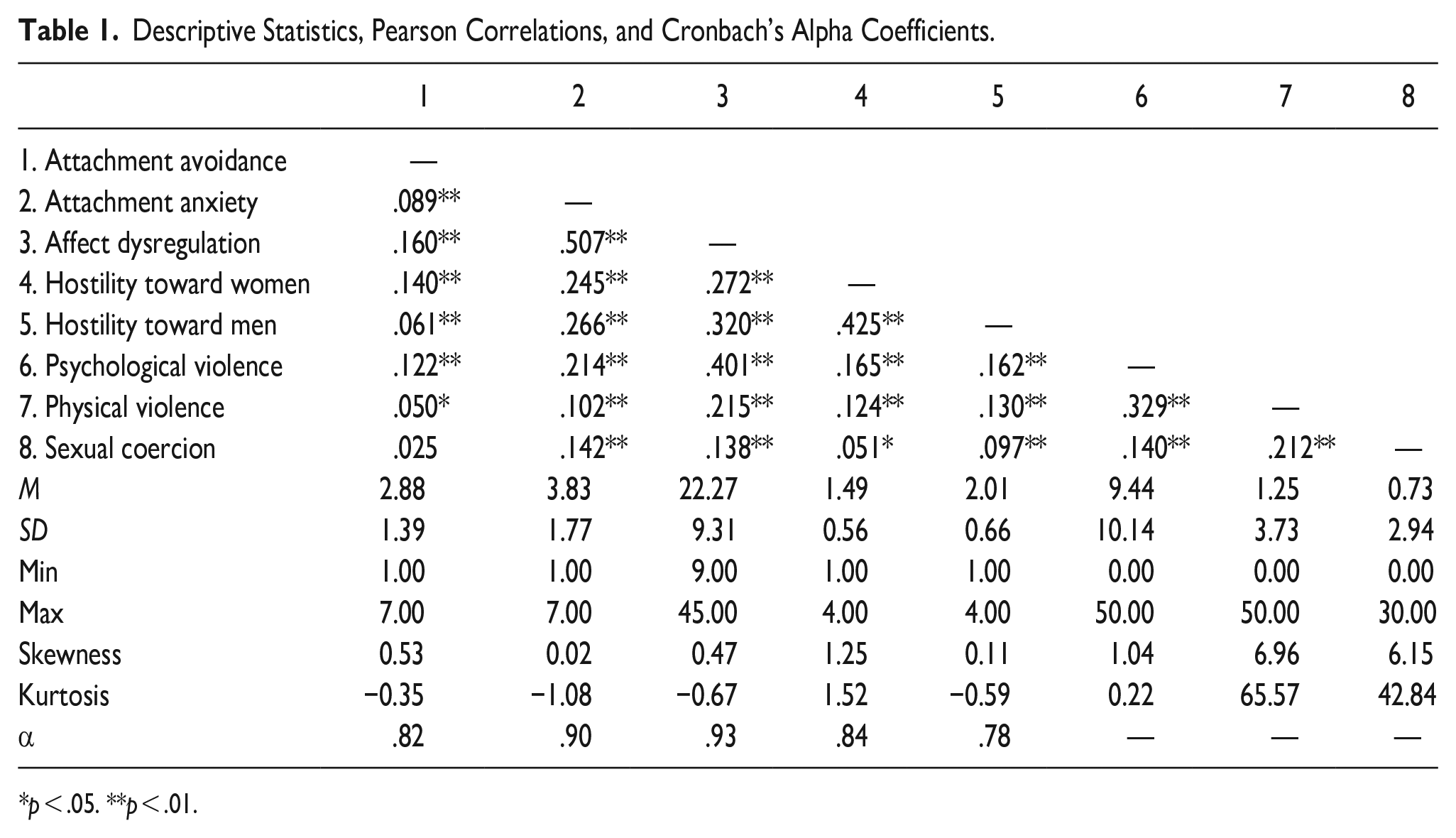
p < .05. **p < .01.
Intimate Partner Violence
The frequency of psychological, physical, and sexual IPV perpetration in the past year was assessed with the Revised Conflict Tactics Scales—Short form (CTS2S; Straus & Douglas, 2004). Psychological IPV, physical IPV, and sexual coercion were each measured by two items. Men had to rate each item on a scale from 0 (this never happened) to 6 (more than 20 times in the past year) with an answer assessing previous use of IPV (yes, but not in the last year). As directed by Straus et al. (1996), the midpoints of the rating categories (e.g., “3–5 times in the past year” was coded 4) were summed to create the participant’s scores for each form of violence. Higher scores reflect higher frequency of IPV-perpetrated acts in the past year. The validity of the CTS2S has been established by correlations with the original CTS2, which shows adequate internal reliability for psychological (α = .79), physical (α = .86), and sexual (α = .87) IPV (Straus et al., 1996).
Attachment
Attachment-related avoidance (6 items) and anxiety (6 items) were assessed with the 12-item short version of the Experiences in Close Relationships (ECR-12; Lafontaine et al., 2016). Participants rated each item on a seven-point Likert scale ranging from 1 (strongly disagree) to 7 (strongly agree). The score for each dimension was computed by averaging its respective items. Higher scores represent a higher level of attachment insecurities. The ECR-12 has demonstrated adequate internal reliability for avoidance (α = .74–.83) and anxiety (α = .78–.87) as well as good factorial validity among six samples of adults in Canada (Lafontaine et al., 2016).
Affect Dysregulation
AD was assessed by using the Inventory of Altered Self-Capacities (IASC; Briere, 2000). The affect regulation scale included nine items. Participants indicated the frequency at which they experienced each of the items in the last 6 months on a five-point scale ranging from 1 (never) to 5 (very often). The total score was computed by summing each item, a higher score representing a more important regulation difficulty. The affect regulation scale demonstrated adequate internal reliability (α = .89–.91) and its construct validity is supported by confirmatory factor analyses (Bigras & Godbout, 2020).
Gender Hostility
Gender hostility was measured by the 10-item brief version of the Gender Hostility Scales (GHS; Dutton et al., 2006). This scale assesses HTW (5 items) and HTM (5 items). Participants rated each item on a four-point scale ranging from 1 (strongly disagree) to 4 (strongly agree). The subscales scores were computed by averaging their relevant items. Higher scores reflect more gender hostility. The GHS demonstrated adequate internal reliability (α = 70–.83) across 15 countries, and confirmatory factor analyses support its construct validity (Dutton et al., 2006). To reach adequate internal consistency, we removed one item from the HTM questionnaire.
Data Analysis Strategy
Preliminary descriptive analyses, alpha coefficients, indices of normality, and bivariate correlations were conducted using IBM SPSS 27. To identify potential covariates, we ran Pearson correlations and analyses of variance (ANOVAs) between demographic variables and the three scores of violence. The regression analyses’ assumptions (multivariate extreme values, multicollinearity, normality of the residuals, homoscedasticity) were verified. Single imputation was conducted with Mplus 8.3 using the Full Information Maximum Likelihood to deal with missing data. Mplus deals with missing values, computes direct, indirect, and moderation links simultaneously and estimates indirect links based on 10,000 bootstrapping samples.
To test all research questions and hypotheses, a single path analysis was conducted with Mplus to test a conditional mediation process model. This model allowed for the examination of the indirect links between attachment insecurities (avoidance, H1; anxiety, H2) and IPV (psychological, physical, sexual coercion) perpetration via AD. Moreover, this model allowed examining whether HTW (H3) and HTM (Q2) would moderate the links between AD and the three forms of IPV perpetration. The model considers the correlation between the two attachment dimensions as well as the correlations between the residuals for the three forms of IPV. We used 10,000 bootstrapping samples to estimate confidence intervals around indirect and moderation links. Based on Kline’s (2015) guidelines, the model’s adjustment to the data was assessed based on four indicators: a nonsignificant Chi-square, a Comparative Fit Index (CFI) higher than .95, a Root Mean Square Error of Approximation (RMSEA) and a Standardized Root Mean Squared Residual (SRMR) lower than .08.
Results
Preliminary Analyses
Table 1 presents the descriptive statistics and bivariate Pearson correlations between the main variables. Bivariate correlations revealed positive significant links between most study variables, except for the link between attachment avoidance and sexual coercion. Even though the results suggested weak correlations for most of the study variables, we found moderate correlations between HTW and HTM, and between AD and psychological IPV perpetration. We also found a strong correlation between attachment anxiety and AD. Missing values in the main variables varied between 0.1% and 1.4% and a Little’s MCAR test revealed that they were not missing completely at random, χ2 (74) = 105.37, p = .010.
In the sample, 80.8% of the participants reported having perpetrated at least one act of psychological IPV, 35.9% perpetrated at least one act of physical IPV, and 14.2% perpetrated at least one act of sexual coercion in the last year. Participants reported more HTM than HTW. Most variables did not depart from normality except for HTW, physical IPV, and sexual coercion. To address non-normality, we used a robust estimator in the main analysis.
Pearson correlations conducted between demographic variables and the three scores of violence showed that younger men perpetrated more psychological IPV, r = –.080, p = .001, and men with a lower income perpetrated more physical IPV, r = –.066, p = .007. ANOVAs revealed no differences on the three scores of violence according to sexual orientation and work status. Men born in Canada perpetrated more psychological IPV than those born elsewhere, F(1,1828) = 26.135, p < .001, η2 = .014. Men who had not completed more than a high school education reported more acts of psychological IPV than others, F(1,1824) = 10.586, p = .001, η2 = .006. Men who were in a current relationship were less likely to have perpetrated sexual coercion than men who were not, F(1,1802) = 12.154, p = .001, η2 = .007. Finally, men who were in a court process for domestic or family violence reported more acts of physical IPV than men who were not, F(1,1802) = 15.512, p < .001, η2 = .009. Since all these results revealed small effect sizes (η2 < .060, r < .30; Cohen, 1988), they were not retained as covariates.
Main Analysis
To investigate the indirect associations between attachment insecurities and perpetrated IPV (psychological, physical, sexual coercion) via AD and the moderating role of gender hostility (women, men) in the associations between AD and IPV perpetration, we conducted a single path analysis. Associations between attachment and gender hostility, as well as between AD and gender hostility, were controlled for to increase model fit. The model demonstrated an adequate fit, χ2 (8) = 19.303, p = .013, χ2/df = 2.413, CFI = .992, RMSEA = .028, 90% CI [.012, .044], SRMR = .018. Assumptions of the regression analyses were met. The model explained 16.7% of psychological IPV, 5.8% of physical IPV, and 3.1% of sexual coercion.
Indirect Role of AD
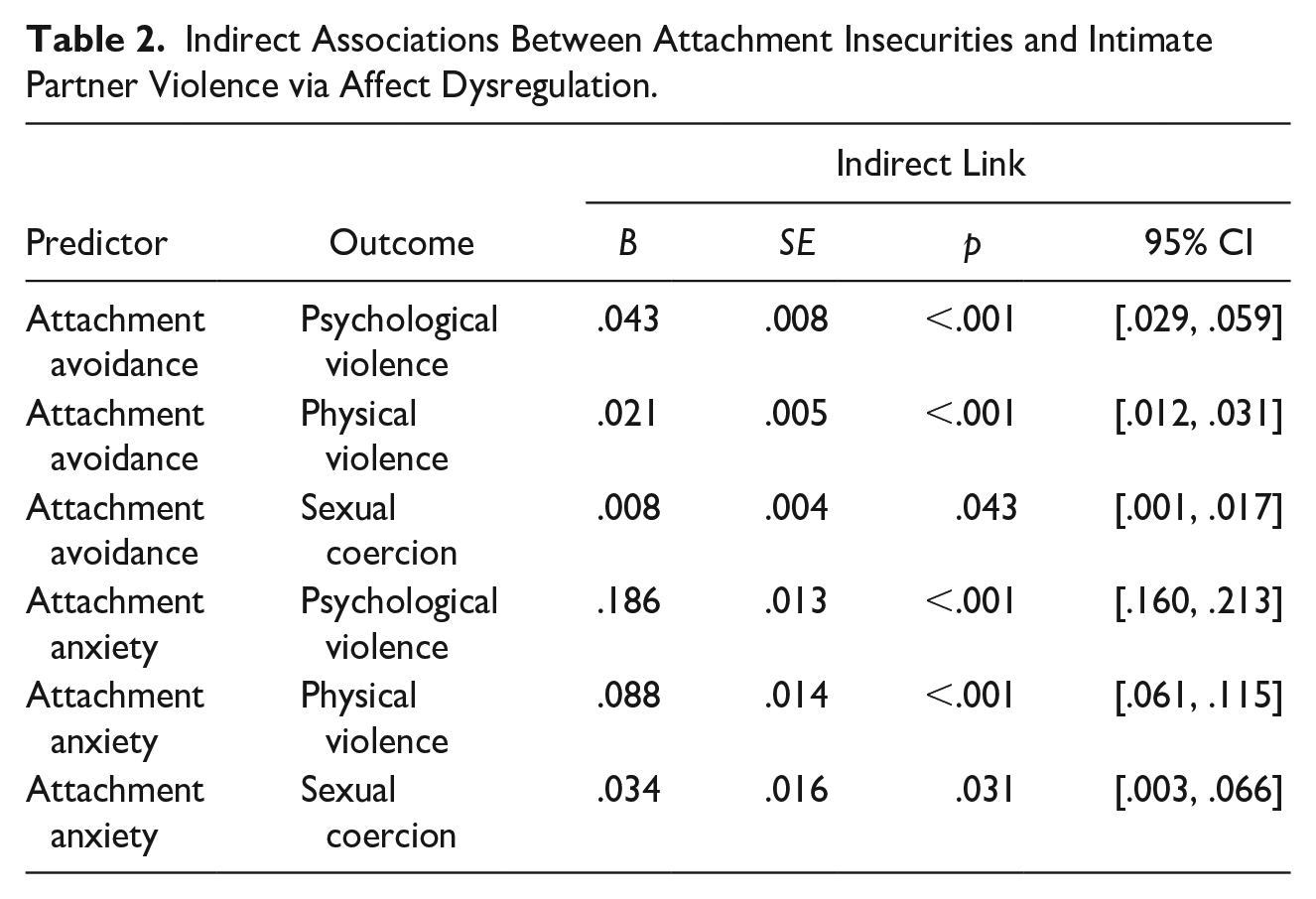
Figure 1 presents the results of the path analysis examining the indirect role of AD in the associations between attachment insecurities (avoidance, anxiety) and IPV perpetration (psychological, physical, sexual coercion). As shown in Table 2, significant indirect effects revealed that higher scores of attachment avoidance and anxiety were positively related to AD, which in turn, was positively related to the perpetration of psychological, physical, and sexual violence. Beyond these indirect effects, direct links remained between attachment avoidance and psychological IPV and between attachment anxiety and sexual coercion.
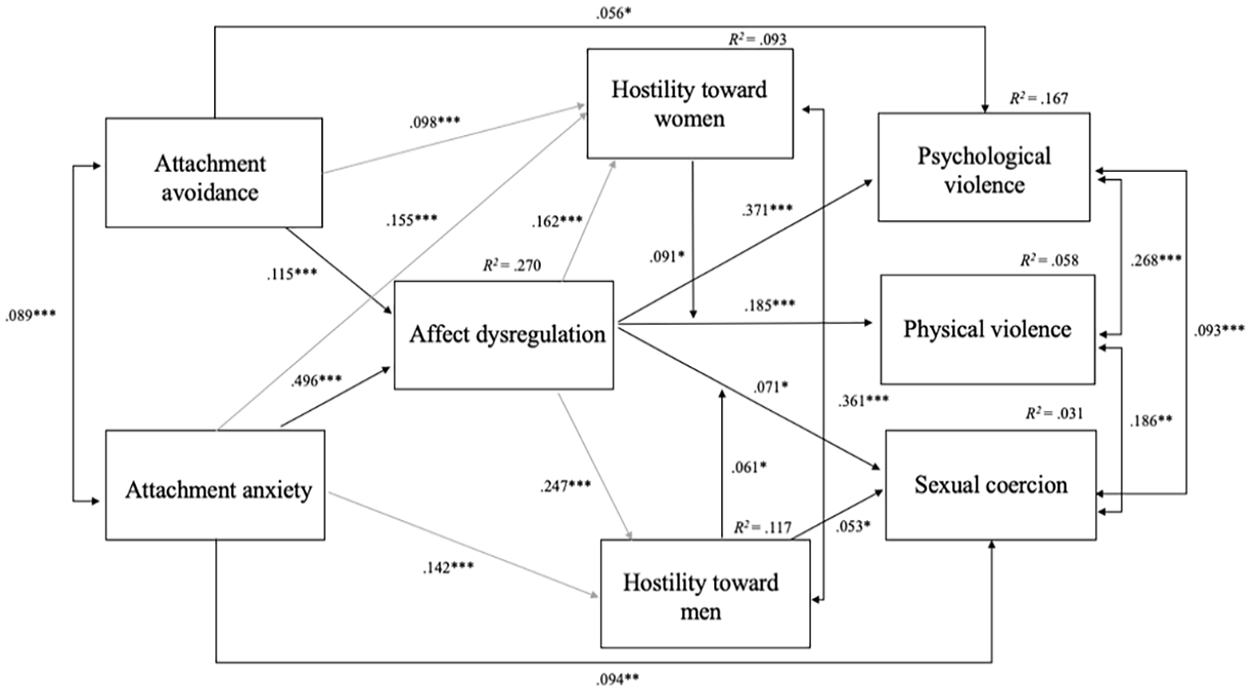
Associations among attachment insecurities, affect dysregulation, gender hostility, and perpetration of intimate partner violence.
Indirect Associations Between Attachment Insecurities and Intimate Partner Violence via Affect Dysregulation.
Moderating Role of Gender Hostility
Figure 2 shows the results of the moderating role of gender hostility in the associations between AD and IPV perpetration. Two moderating effects were found. A first moderation effect showed that only HTW moderates the link between AD and physical IPV perpetration (B = .091, SE = .045, p = .043, 95% CI [.012, .189]) (see Figure 2a). More specifically, when HTW was high (one SD above the mean; B = .279, SE = .062, p < .001, 95% CI [.175, .420]) or moderate (B = .196, SE = .034, p < .001, 95% CI [.134, .269]), AD was positively related to physical IPV perpetration, whereas when HTW was low (one SD below the mean), the link between AD and physical IPV perpetration was not significant (B = .112, SE = .053, p = .035, 95% CI [−.001, .210]). A second moderation effect showed that HTM moderates the association between AD and sexual coercion perpetration (B = .061, SE = .029, p = .033, 95% CI [.011, .124]; see Figure 2b). The results revealed that AD was positively related to sexual coercion perpetration when HTM was high (one SD above the mean; B = .174, SE = .047, p < .001, 95% CI [.092, .280]) or moderate (B = .113, SE = .029, p < .001, 95% CI [.060, .175]), but not when HTM was low (one SD below the mean; B = .052, SE = .039, p = .180, 95% CI [−.024, .128]).
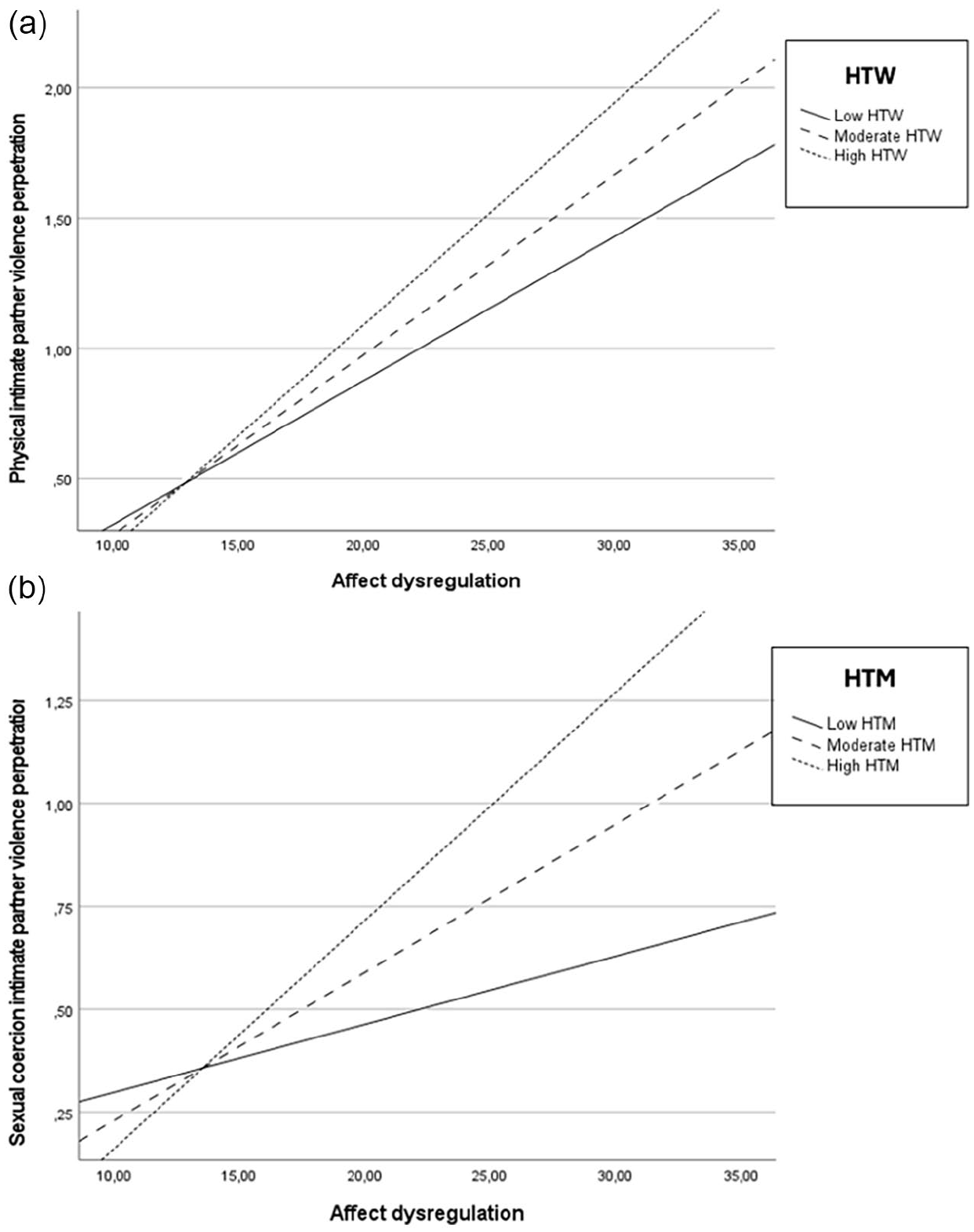
The moderating role of (a) hostility toward women and (b) hostility toward men in the associations between affect dysregulation and intimate partner violence perpetration in men seeking help.
Discussion
This study’s aim was to test direct and indirect associations among attachment insecurities (avoidance, anxiety) and IPV perpetration (psychological, physical, and sexual violence) via AD in a large and inclusive sample of men seeking help, and to examine the moderator role of gender hostility in theses links. Although we found some preliminary links between sociodemographic factors and IPV perpetration in our sample (e.g., age, education, country of origin), these links were very small in magnitude (from 0.4% to 1.6% of explained variance) and could have emerged because of the very large sample size. Our original findings were consistent with the I3 theory, in that attachment insecurities (high impellance), AD (low inhibition), and gender hostility (low inhibition) were related to and interacted with one another to predict IPV perpetration in men seeking help.
The results supported our first two hypotheses and our first research question by showing that attachment insecurities (avoidance, anxiety) were positively and indirectly related to psychological, physical, and sexual IPV perpetration via AD. Thus, men who reported more attachment insecurities were more likely to have difficulties regulating their emotions, which in turn was related to their perpetration of more acts of psychological, physical and, sexual IPV. These results are consistent and extend past studies (Brassard et al., 2014; Guzman-Gonzalez et al., 2016; Théorêt et al., 2020) and attachment theory (Mikulincer & Shaver, 2016) in examining three forms of IPV in a clinical population. When men high in avoidance feel threatened (e.g., feeling criticized), they may resort to maladaptive affect regulation strategies such as the tendency to deny their emotions and to avoid contact with their partner via the deactivation of their attachment system. If their needs for independence are, despite their efforts, not respected by their partner, men high in avoidance could use violence as an extreme form of maladaptive regulation strategy to maintain an emotional and physical distance with their partner (Allison et al., 2008; Dutton, 2011). When men high in anxiety feel threatened (e.g., lack of reassurance from their partner), they may resort to maladaptive affect regulation strategies such as the amplification of distress and excessive attempts to get reassured via the hyperactivation of their attachment system. If their needs for proximity are still not met, they could resort to violence as a dysfunctional way to restore proximity with their partner (Allison et al., 2008; Dutton, 2011). Beyond these links, attachment avoidance was also directly associated with psychological violence, whereas attachment anxiety was directly associated with sexual coercion. Those results suggest that other factors need to be considered when examining the attachment—IPV links, such as conflict resolution strategies or (sexual) communication patterns (Velotti et al., 2018).
Our results partially supported the third hypothesis by showing that HTW amplified the link between AD and physical IPV only. In men reporting moderate to high level of HTW, higher levels of AD were related to perpetrating more acts of physical violence. However, this link was not significant in men reporting low level of HTW. This result corroborates and extends past studies conducted on male students showing that HTW moderates the link between impulsivity or anger dysregulation and IPV perpetration (Gildner et al., 2021; Parrott & Zeichner, 2003). One possible explanation could include undesirable emotions related to the female population (Gilligan, 2003) and the use of physical violence as a socially acceptable masculine response (Jakupcak et al., 2005). Indeed, HTW often stems from bad experiences with the female population, which generate undesirable emotions (e.g., shame, anger). Among men with high HTW, use of physical IPV might be viewed as socially acceptable, and therefore more often used when emotionally dysregulated (Jakupcak et al., 2005). However, in the absence of such hostile views of women, AD may no longer relate to physical IPV perpetration, suggesting that positive (or neutral) views of women may act as a protective or inhibiting factor, in keeping with the I3 model (Finkel et al., 2012). One unexpected result was that HTW did not amplify the link between AD and psychological and sexual IPV. Some explanations are possible. HTW might not amplify the link between AD and psychological IPV because the association between them is already the strongest. Thus, these results suggest that other variables might explain the link between AD and psychological IPV. Regarding sexual IPV, most studies that have shown a link between HTW and sexual coercion have assessed sexual coercion against women in general (e.g., foreign women, dating women; Zinzow & Thompson, 2015) rather than the intimate partner, suggesting that HTW might amplify the link between AD and sexual coercion specifically in less intimate types of relationship.
Finally, those innovative results helped answer our second research question by showing that HTM amplified the link between AD and sexual IPV. Precisely, men with higher difficulties regulating their emotions are more likely to perpetrate sexual coercion if they also reported a moderate or high level of HTM, but not if they reported a low level. This result suggests that a low level of HTM could act as a protective factor for the perpetration of sexual coercion among men with high AD. Beyond this moderation effect, HTM was also directly associated with sexual coercion, highlighting the important role of HTM as a risk marker in future research on sexual coercion. This result could be explained by the fact that cultures that promote masculinity in terms of power, dominance, and toughness can socialize men in ways that encourage the use of violence (Smith et al., 2015). Men who value the concepts surrounding masculinity may develop insecurities related to their own masculinity when they fail to meet societal expectations. This societal pressure could generate strong negative emotions (e.g., distress, shame, anger) and contribute to more hostile views of men. These men could then adopt behaviors increasing their masculinity in contexts where their masculine identity would be threatened (Vandello & Blosson, 2013), such as sexual interactions. Thus, sexual coercion (imbued with dominance and power) could be used to regulate unpleasant emotions related to a threatened masculine identity (Jakupcak et al., 2005).
Implications
This study involving a large and diverse sample of men seeking help for IPV can provide some clinical implications. First, we found that attachment insecurities, AD, and gender hostility are related to IPV perpetration, which supports the relevance of considering these key concepts when assessing men seeking help to tailor their intervention plans. Yet, clinical studies incorporating these concepts are needed to examine the treatment efficacy among men seeking help. Second, our results underline the importance of addressing affect regulation in IPV prevention and treatment programs. Since attachment is difficult to modify, affect regulation is an interesting skill to target in individual or group therapy to reduce the frequency of IPV. Affect regulation skills can be learned by men dealing with IPV difficulties, as these skills may help them better identify and tolerate unpleasant emotions (Garofalo et al., 2020). Third, this study offers innovative results showing that HTM and HTW are key factors to consider in the understanding of IPV perpetration. Raising awareness among practitioners about how gender hostility may affect cognitions, emotions, and behaviors that may lead to violence can help improve some theoretical models for preventing or treating it. Helping men recognize their generalized anger not only toward women but also toward men could be a new step in trying to reduce acts of physical and sexual violence toward their partners. The use of cognitive-behavioral therapy may also help men change their maladaptive beliefs about masculine norms (Primack et al., 2010).
Limitations and Future Research
The current study presents some limitations. First, only men’s points of view are considered in the study. Future research could attempt to recruit couples for a more complete portrait of IPV perpetration. Second, the use of self-reported questionnaires such as the CTS2S is limited by a lack of context when assessing IPV, as well as recall and social desirability biases that can lead to underreporting, especially among perpetrators of IPV (Visschers et al., 2017). Combining self-report questionnaires with observational methods and clinical interviews could help rescind some of the limitations of the use of self-report measures. Third, despite the use of inclusive questions to assess participants’ characteristics (i.e., sexual orientation, gender identity, age, country of origin, Indigenous community, language), the current sample represents mostly a population of French-Canadian heterosexual cis-gender males, which limits the generalization of our results to a more diverse sample of IPV perpetrators. Most studies on IPV have been conducted across a heterosexual and cisgender population and few have explored IPV among same-sex partners (e.g., Gabbay & Lafontaine, 2017). Since the result could be different when the partner is not a woman, further studies relying on larger samples of participants with diverse gender identities and sexual orientations are necessary to provide more nuances in the results. Fourth, we did not consider the role of substance use in our model, although a recent meta-analysis of 22 studies demonstrated that AD was strongly related to substance use (Stellern et al., 2023). Future studies could include this risk factor to better understand the links between AD, gender hostility, and IPV. Finally, the cross-sectional design of the study does not allow us to make causal inferences or to verify the temporal sequence of the main variables. Future research could adopt a longitudinal study design to understand the directionality of these links.
Footnotes
Declaration of Conflicting Interests
The author(s) declared no potential conflicts of interests with respect to the authorship and/or publication of this article.
Funding
The author(s) disclosed receipt of the following financial support for the research and/or authorship of this article: This research was funded by a SSHRC Development grant (# 890-2020-0029).
