




Abstract
While the global rates of intimate partner violence (IPV) for Indigenous women have been acknowledged as substantial, few studies have incorporated an analysis of the impacts of colonization in the context of IPV. This secondary mixed-methods analysis explored the experiences of 40 Indigenous women from the Canadian prairie provinces who were abused by their intimate partners. The women discussed the impact of colonization, including the use of residential schools, to break down family life, spiritual beliefs, and languages, at times linking this to IPV. Of the 40 women, 38 described male partners as the abusers and two identified female abusive partners. Consistent with the literature, many of the male partners physically assaulted the respondents so severely that the women were injured and were at risk of death. Almost half of the men (47.4%) used sexually coercive strategies and/or sexually assaulted the women. Implications include the importance of professionals considering the broader historical experiences and possible trauma of Indigenous women who seek assistance for IPV from abusive partners.
Keywords
Introduction
In Canada, intimate partner violence (IPV) against Indigenous women is a significant issue with prevalence studies documenting that Indigenous women are abused by their intimate partners at a rate three times higher than non-Indigenous women (21% of Indigenous women compared to 7% of non-Indigenous women) (Brownridge, 2008; Brzozowski et al., 2008). Indigenous women are also at greater risk of being sexually assaulted by their partners and are more likely to have experienced severe and potentially life-threatening forms of violence used against them (Brownridge, 2003, 2008; Heidinger, 2021).
If women leave abusive partners, they remain at significant risk of harm. However, the risks of leaving are even greater for Indigenous women, with Brownridge (2006) estimating that 45.5% of Indigenous women are abused by former partners compared to 9.8% of non-Indigenous women. Indigenous women were more likely to fear their partner killing them, and eight times more Indigenous women were murdered by intimate partners than non-Indigenous women (Brownridge, 2003; Brzozowski et al., 2008). Yet, many Canadian Indigenous women, a term that includes those of Indigenous, Métis, and Inuit backgrounds, have also experienced trauma linked to racist events and/or colonial practices of the past and present. The current analysis examines the extent to which IPV and colonialism intersect in the narratives of 40 Canadian Indigenous women.
Theoretical Perspectives
Burnette and Figley (2017) developed the “Ecosystemic Framework of Historical Oppression, Resilience, and Transcendence” in relation to Indigenous peoples in the United States. It considers both oppressive historical conditions, such as colonization, and those of the present, such as discrimination, in explaining the current problem of IPV. It can be applied in the Canadian context as the framework allows for variation in the specifics of both historical and local conditions. This framework provides a clear rationale for examining the IPV of Indigenous women in the current study in the context of their history of racism and colonialized practices.
Colonialism and Canadian Indigenous Peoples
Indigenous peoples have been oppressed and dehumanized through the process of colonization (Andersson et al., 2010). Colonialism describes the deliberate actions of the dominant group to “modify or eliminate the laws, customs, and belief systems of a community . . . taking over a community’s social structures, governance, and administration and often imposing a different religion and worldview” (McGillivray & Comaskey, 1999, p. xiv).
The first Canadian residential schools opened in the 1620s (Miller, 2003). Indigenous individuals typically concluded that their residential school experiences interfered with healthy family and interpersonal relationships, their ability to be affectionate with their children, and they were often afraid of being touched (Miller, 2003; Shepard et al., 2006). Some men reported that their complete segregation from girls interfered with their ability to relate to women, thereby contributing to their abusive behaviors toward their partners (Miller, 2003).
Many contend that the destabilization of Indigenous families persists (Blackstock et al., 2004; Olsen Harper, 2011; Shepard et al., 2006). As only one example, Indigenous children are overrepresented in the child welfare system. While 5% of Canadian children are Indigenous, Indigenous children represent 22% of substantiated child maltreatment cases; Indigenous families were four times more likely to be investigated by children’s aid than non-Indigenous families and Indigenous children were 12 times more likely to be placed in foster care than non-Indigenous children (Trocmé, 2010).
When speculating about what factors place Indigenous women at greater risk for IPV, most agree that the legacy of colonization is central to disrupting traditional values and culture, using residential schools to break down family life, spiritual beliefs, and languages, as well as systemic discrimination, and racism (Andersson et al., 2010; Olsen Harper, 2011; Truth and Reconciliation Commission of Canada, 2015). Thus, any discussion about IPV against Indigenous women should consider the impact of colonization.
Nevertheless, while studies about the impacts of IPV on abused Indigenous women are available, few describe the abuse in the context of colonialization and systemic oppression; exceptions being Brownridge et al. (2017) who incorporated the issue into their literature review, and McKinley et al. (2021) and McKenzie et al., (2022), both of whom gathered information about historical oppression in their qualitative studies. With access to a unique set of 40 in-depth interviews with Indigenous women from Canada’s three prairie provinces, the current study focuses on how IPV intersects with issues of colonialization. These provinces have the highest rates of self-reported spousal violence (national average = 6%; Saskatchewan = 8.2%; Alberta = 7.6%; Manitoba = 7.4%) (Statistics Canada, 2011). Indigenous people in the prairies constitute 39.2% of the First Nations population and 50.4% of the Métis population in Canada. As such, the current study was conducted in a part of Canada with a significant Indigenous population and where IPV is a serious social problem.
Method
The original study, “The Healing Journey,” is a longitudinal, mixed-methods (quantitative/qualitative) Canadian study of 665 abused women from Alberta, Saskatchewan, and Manitoba (Tutty et al., 2020, 2021). Both academics and community agency members of the research team assisted in designing the research and recruiting participants from services to abused women across the three Canadian prairie provinces. The inclusion criteria were women who were (a) 18 years or older; (b) have experienced IPV in the previous 5 years; (c) not suffering from a major mental health problem that would impair their comprehension or memory; and (d) not currently in crisis. Data were collected in seven waves between 2005 and 2009. Trained interviewers conducted in-depth surveys with participants every 6 months over 3.5 years.
Mixed-methods studies include both quantitative and qualitative components (Bergman, 2011). The quantitative component in the original research consisted of surveys and self-report measures of IPV and mental health. For the current analysis, one-time semi-structured qualitative interviews were conducted from 2005 to 2006 with a subsample of the 665 respondents comprising 91 women, 40 of whom were Indigenous.
The interview guide asked each woman about her experiences of IPV, how she coped, whether she had any support, what her life is like now, and what she envisioned for her life in the next 5 years. If women did not mention the influence of their racial background, they were asked, “You haven’t said whether being Indigenous was part of the violence you experienced. If yes, tell me more.” Of the 24 research assistants who interviewed the 40 Indigenous women for the qualitative component, only two were Indigenous, having interviewed five respondents. The interviews were audio-recorded and transcribed verbatim for analysis. Ethics approval for the current analysis was from the Conjoint Faculties Research Ethics Board of the University of Calgary.
Quantitative Variables
Intimate Partner Violence
The nature of the IPV was assessed by the Composite Abuse Scale (CAS) (Hegarty et al., 2005). This screening measure consists of 30 items rated for frequency in the past 12 months on a six-point scale from never to daily, with a possible total of 150. The four subscales are as follows: Severe Combined Abuse (8 items; possible score 0–40; suggested cutoff of 1), Physical Abuse (7 items; possible score 0–35; cutoff of 1), Emotional Abuse (11 items; possible score 0–55; cutoff of 3), and Harassment (4 items; possible score 0–20; cutoff of 2). The suggested clinical cutoff for the total score is 7. The scale has demonstrated convergent and discriminant validity (Hegarty et al., 2005). Cronbach’s alpha in the current study is .93.
Child Abuse, Health, and Mental Health Conditions
Child abuse history was collected via structured questions with “yes/no” answers: “Were you abused as a child or adolescent? (a) physical, (b) sexual, (c) emotional/psychological, (d) witnessing abuse among family members” (consistent with Elias et al., 2012). The responses were then recoded as “no child abuse,” “any child sexual abuse,” and “child abuse excluding sexual abuse” (physical abuse and/or emotional/psychological/verbal abuse, and/or witnessing violence).
Qualitative Secondary Data Analysis
Qualitative secondary analysis re-uses preexisting qualitative data from previous research (Heaton, 2008; Irwin & Winterton, 2011; Whiteside et al., 2012). This is useful because qualitative studies often produce “a wealth of data (including methodological and analytical data) that is not used in subsequent analyses. Secondary analysis thus enables greater use to be made of qualitative data beyond the project which originally produced them” (Doyle et al, 2016; Irwin & Winterton, 2011, p. 3; Thorne, 1998).
The interviews were analyzed by the first author as her dissertation research, conducting first-level coding, which entails word-by-word scrutiny of the narratives to identify prominent themes and subthemes (Braun & Clarke, 2006), and second-level coding examines the themes and subthemes to identify similarities, differences, and gaps using the constant comparative method (Thorne, 1998). NVivo 11, Lumivero was used to manage the data throughout the analytic process. As suggested by Heaton (2008), the four criteria, outlined by Lincoln and Guba (1985), credibility, dependability, confirmability, and transferability were used to establish trustworthiness, meaning that one can have confidence that the study was conducted ethically and fairly; the findings accurately represent the respondents’ experiences, and the researcher’s interpretations are credible (Padgett, 1998). In the current interviews, the detailed quotes were considered in context to ensure that the women’s views were accurately represented. These were then triangulated by source (more than one respondent raising similar issues), analyst, and negative case analysis. Triangulation was used to establish dependability. Confirmability was established through triangulation and negative case analysis.
Results
The Study Respondents
The demographic information describing the 40 women respondents is presented in Table 1. All 40 women lived in Canada’s prairie provinces (8 in Alberta, 18 in Saskatchewan, and 14 in Manitoba). The women ranged in age from 20 to 78 years with a mean of 37.7 years. The women mostly (35% or 87.5%) self-identified as heterosexual, with five (12.5%) as members of the LGBTQ community or as Two-Spirit, a term that reflects the gender and sexual variance in individuals of North American Indigenous backgrounds (Ristock et al., 2019). Notably, both women who described female abusive partners self-identified as lesbian. Interestingly, 22 of the women’s partners (55%) were Indigenous, while 18 (45%) were White.
Women’s Demographic Profiles.
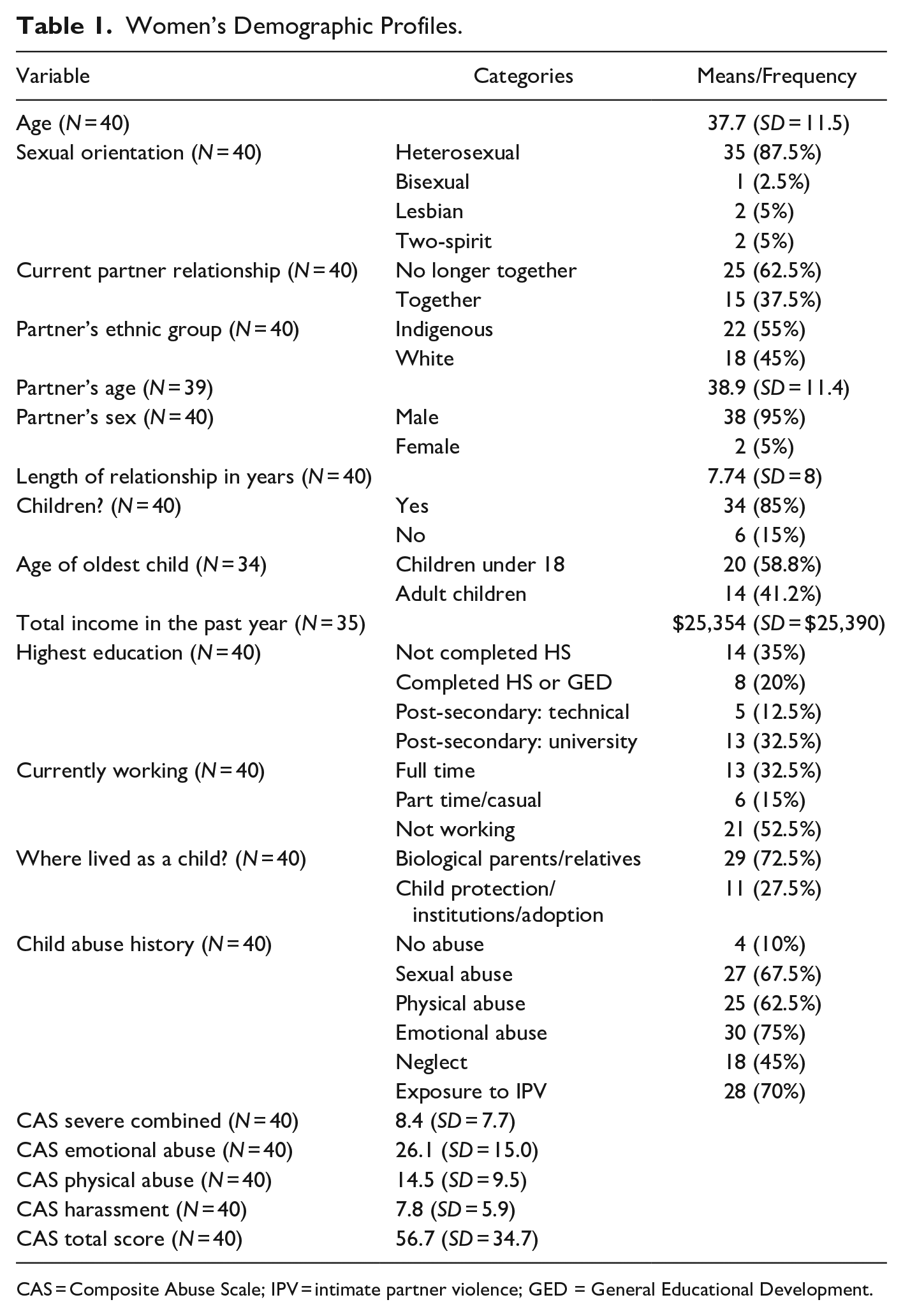
CAS = Composite Abuse Scale; IPV = intimate partner violence; GED = General Educational Development.
In all, 25 women (62.5%) no longer lived with their abusive partners. More than one-third still resided with partners (15% or 37.5%). The lengths of the relationships with the abusive partners ranged from 6 months to 41 years, with a mean length of 7.7 years. In all, 34 women (85%) had children. Among these, 20 (58.8%) had children under the age of 18, whereas the children of the other 14 respondents (41.2%) were adults. The women’s highest level of education varied; 35% (14) had not completed high school, while 32.5% (13) had attended university. Of the 35 women who reported their income in the past year, their incomes ranged from $451.00 to $100,000.00 with a mean income of $25,354. Slightly over half of the women (21 or 52.5%) were not currently working.
Regarding their experiences in childhood, almost three-quarters (72.6%) had resided with their nuclear families (26) or with relatives (3). The other 11 women had lived elsewhere as children: seven women (17.5%) were involved with the child protection system (CPS), foster care, and/or the criminal justice system; one (2.5%) was adopted; and three (7.5%) had attended residential schools. Only four women had not experienced any childhood abuse; thus, 90% had been abused as children. Of the 36 women who disclosed childhood maltreatment, 27 (67.5%) had been sexually abused, 25 (62.5%) experienced physical abuse, 30 (75%) experienced emotional abuse, and 18 (45%) were neglected. In addition, 28 (70%) women had been exposed to IPV against their mothers, with seven having stayed in violence against women (VAW) shelters during childhood.
With respect to the quantitative analysis of the seriousness of the IPV, the women’s scores on the CAS subscales indicated that they had experienced considerable physical abuse, emotional abuse and harassment, as well as Severe Combined Abuse (all above the clinical cutoff scores).
Qualitative Interview Themes
As shown in Table 2, seven themes emerged from the narrative interviews that contextualize the women’s lives, highlighting the impact of colonization from their own or relative’s attendance at residential schools, childhood abuse, apprehensions from Child Protective Services, community violence on reserve and in cities, and effects on the women’s parenting. The women themselves identified these issues in their narratives about their “Healing Journeys.” The subsequent section presents qualitative themes about the nature of the IPV first from the 38 male partners, then the two female partners.
Qualitative Themes Colonization and IPV.
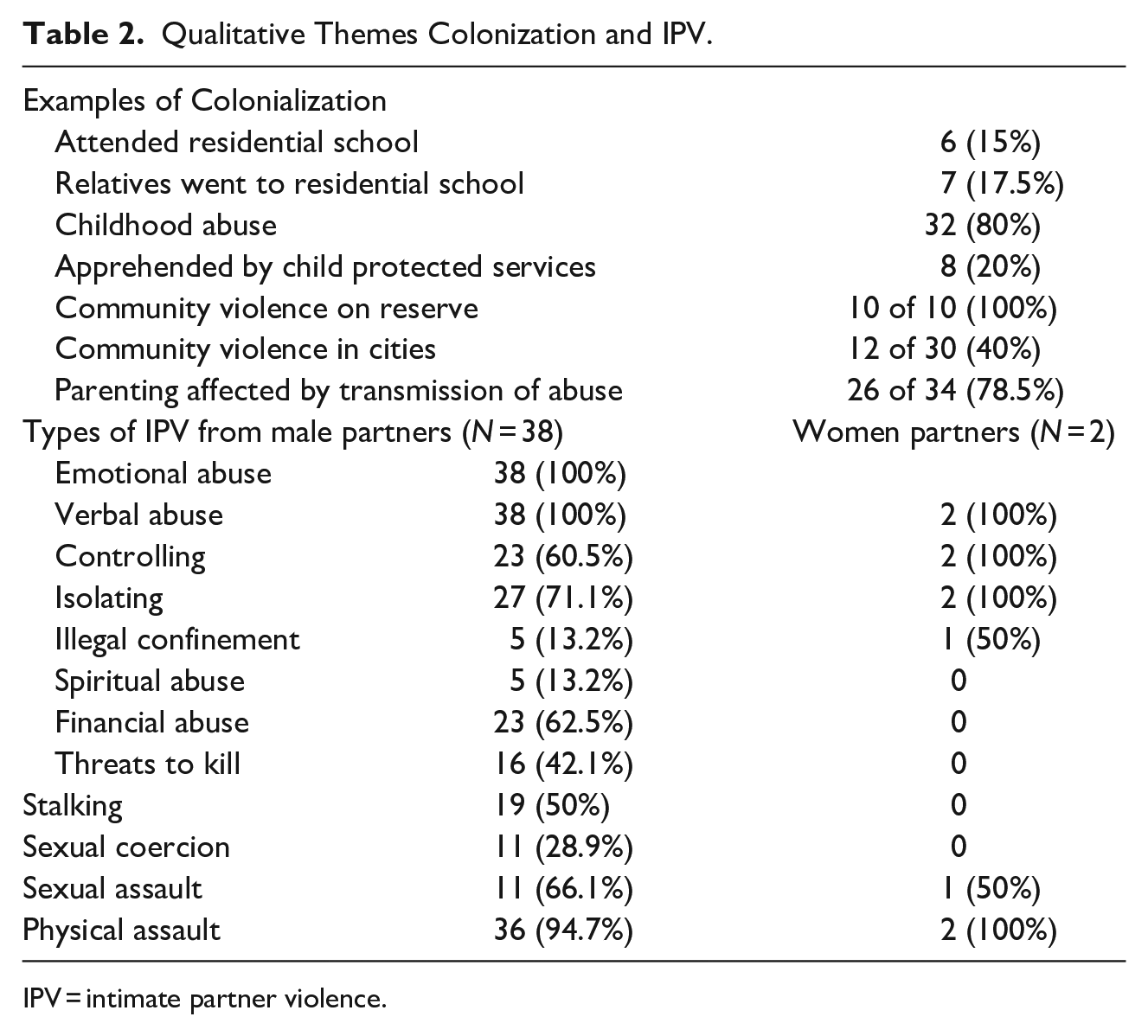
IPV = intimate partner violence.
The Context of the Lives of the Indigenous Women
The Impacts of Colonization
In all, 32 (80%) women linked colonization, intergenerational abuse, and IPV, commenting, for example, “My parents were taught a certain way, their parents were taught a certain way, and I was taught a certain way. They say we’re the highest stats [for IPV]. I see it.” Two women mentioned the impact of learning about Indigenous history, with one noting, “When they couldn’t annihilate us, they assimilated us. My parents, my grandparents went through residential school, and all this abuse has come from it.” Another woman mentioned that, once she learned Indigenous history, her views changed; “I used to be angry toward my parents because I didn’t understand why they were so bitter. Now I do.”
Residential School Experiences
Six of the 40 women (15%) had lived in residential schools, and another seven (17.5%) highlighted how it had impacted their parents and/or grandparents. Three women disclosed how difficult it had been to adjust to life without their family; “I had no family members, and I didn’t like the way I was being treated at the school.” “It was a lonely part of your life because you were alone. I was the only one of my family there.”
One woman described being treated abusively by a staff member, “She was a childcare worker and was abusing little girls that were there.” Another disclosed sexual abuse, stating “I experienced abuse when in boarding school for 6 years by the nuns and the preachers. I don’t really talk about that sexual abuse. It hurts too much.” One interviewee felt targeted by perpetrators because she is Two-spirited. Three women spoke of the racism that they experienced at residential schools. “A woman told me, ‘You’re ugly, you’ll never be anything in your life.” Another reported “We went to school with town kids. If there were anything stolen, police would come and look through our residence.”
Two women ran away, while another two began using drugs and alcohol. Another discussed the long-term influence of residential school on her sense of well-being, commenting, “I don’t care about myself anymore, after the sexual abuse. I hate being Native because the people that abused me were mostly Aboriginal.”
Seven women (17.5%) discussed how residential schools impacted their parents’ ability to parent and, in turn, how it impacted their ability to parent, including the following: I got to understand the residential school experience. I used to wonder, ‘Why is my mom like that?’ She’s so shut-off. My mother was never hands-on, never smiled. Being removed and not having a lot of nurturing, she didn’t know what to do.
Respondents’ Childhood Abuse
In all, 32 women discussed their childhood maltreatment. Three-quarters of the women (24 of 32, or 75%) had been exposed to IPV primarily by their mothers by their fathers. One woman highlighted their fathers’ physically abusive behaviors. “I didn’t see my dad and my mom fight, but I heard, and I saw the aftermath the next day.” By contrast, other respondents did see, disclosing. “All memories of my childhood are violent. My father was very abusive towards my mother. Everybody was afraid of him.”
One-quarter of the respondents’ mothers (6 of 24, or 25%) had been severely physically injured by the IPV. One woman’s father ultimately murdered her mother: My dad picked up one of those old irons from on top of the stove and he put it on her back. My mom had epilepsy and would go into convulsions, and he would pour boiling hot water on her. She was only 27. She died.
Besides witnessing IPV, the women were also directly abused and/or neglected; 10 (31.3%) experienced neglect from their parents. “I grew way too fast; my parents were not there for me. I was on my own.” Six women disclosed that their basic needs were often unmet: With the drinking and the fighting, being so transient, we never had any money. The three of us sisters had to sleep in the same bed. People would come and drink with my mom and dad. Everybody would eat everything. So, we were always left without food.
Nine of the 10 women (90%) disclosed that their safety needs were not being met, commenting, “We were in an apartment by ourselves. All the time.” Another related, They’d sit in the bar, and we’d wait. One night after the bar closed, my mom saw these kids sleeping in this old car. She calls to my dad, “Look at those kids, they must be cold.” It was her own kids.
Approximately one-third of the women (12 of 32, or 37.5%) had been physically abused by their parents. Although not all the respondents disclosed who had physically abused them, six women were physically abused by their mothers or stepmothers, five by their fathers. Of these women, two were physically abused by both parents. “There were times when I would ask my mom for something. I was probably a pushy teenager, but her response was to punch me in the face. If I didn’t put makeup on the bruises, she wouldn’t hit me again” and “I started off being abused by my parents. I usually got beaten to go to bed or beaten for coming home late. I drank most of my life because I was always scared. I always had to hide.”
In total, 14 of the 32 women (43.8%) were sexually abused as children. Not all the women disclosed who abused them, but for those who did, over half (8 of 14, or 57.14%) had been sexually abused by multiple perpetrators. Five of the 14 (35.71%) were abused by their fathers or stepfathers; five (35.71%) were abused by various relatives, such as older siblings, cousins, or grandfathers. Five (35.71%) were abused by friends of their parents, while four (28.57%) were abused by individuals in the community (such as neighbors, teachers, and a friend’s older brother). One woman disclosed, “My parents would bring parties home from the bar. People would creep into our rooms, and there’d be men touching us.”
Child Protective Services
Given the respondents’ childhood experiences, it is not surprising that eight women (20%) had been apprehended by the CPS. All eight women were placed in foster care: Six disclosed living with multiple foster families. Two were sexually abused while in foster care. Another lived in a foster home in which she was not sexually abused, but another foster child was being sexually abused by their foster father. She devised a plan to protect this child.
Community Violence
Finally, all 10 respondents who lived on reserve not only dealt with abuse within their families but also observed violence from other individuals around them; sometimes people that their parents had invited into their home, or neighbors, or individuals from the community. Four women associated the violence with drinking.
Five women spoke of the IPV that they observed in their communities commenting for example, “In the wintertime, my auntie ran away from her husband because he was abusive to her, and she ended up freezing [to death].” And “On our reserve it was normal for women to have black eyes all the time. My uncle used to beat up his wife in front of us. He ended up killing her and he never served any time.”
Similar issues regarding community violence were raised by 12 of the 30 women (40%) who lived in urban areas were exposed to the violence that their neighbors, friends, and/or family members experienced. Five women identified parties as a potential source of danger; two women witnessed friends being physically assaulted, three women were physically assaulted, and two were sexually assaulted. Another three women were sexually assaulted in their community by strangers or men that they thought were friends. “I got raped by this guy with a gun and he held me for nine hours.”
Colonization, IPV, and Parenting
Of the 34 women with children, 26 (76.5%) raised concerns about the history of intergenerational abuse through colonization and abuse from their partners. They were determined to protect their children and to ensure that their parenting did not continue the same legacy for their children. In all, 14 women connected their parenting to the intergenerational transmission of abuse through colonization. In total, 23 of the 34 women with children (67.6%) were concerned that their partners’ abusive behavior was impacting their children, thus leading to the transmission of abuse to another generation. As one mother described, I look at the way my kids sometimes play, things that they mimic; things they heard him say. My kids are hitting each other. I don’t want my kids to see this. I saw it when I was growing up, and I don’t want my kids to see that.
Although some women found it challenging, all 26 wanted to parent their children differently, to be patient, to treat them with respect and dignity, and to give them peaceful childhoods. They wanted to teach their children to also treat others with respect and dignity. The women wanted their children to have childhoods in which they could be children.
This section has provided important context to the lives of the Indigenous women interviewed for our project. These issues add background to the nature of the IPV that the women experienced from both male and female abusive partners, the substance of the following sections.
The Nature of the IPV by Male Partners
Emotional Abuse
The emotional abuse by male partners encompassed verbal abuse, controlling behaviors, isolation, illegal confinement, financial abuse, spiritual abuse, and threats to kill them. All 38 partners verbally abused the respondents. In all, 21 women (55.3%) discussed the verbal abuse in detail, highlighting their partners’ demeaning and insulting remarks about the respondent’s appearance (12 of 21, or 57.1%) and/or their intelligence and/or abilities (15 of 21, or 71.4%) such as in the following quote, “The belittling, the mimicking, and the petty things were daily. He called me fat, stupid; nothing I could do was right. I was clumsy, I was sloppy, I was dirty.” Two White male partners (9.5%) made explicit racist remarks such as, “You’re fucking stupid, just like the rest of the Indians in your family.”
In all, 23 partners (60.5%) controlled all aspects of the women’s daily activities, including running the household. One woman commented, “We couldn’t eat until he ate. I was only allowed to make so much. Most of the time, I’d do without, because I’d give my share to the kids.” Four men used reproductive coercion to stop the women from accessing birth control. One woman noted, “I told him, “I’m going to go on birth control because I can’t handle more [children] right now.” He said, “No you’re not. WTF do you need birth control for? Are you going to bed with somebody else?!”
The partners of 27 (71.1%) isolated them from friends (21 of 27, or 77.8%) and family (8 of 27, or 29.6%). As one example, “He started locking the doors. When my friends came, he wouldn’t allow me to open the door. I settled into a life in prison. I was 15.” Eight of the 27 men (29.6%) moved the interviewees to more isolated rural or remote communities mentioning for example, “He wanted to leave because they [community members] wouldn’t let him be aggressive towards me. He moved [us] far down south. I felt isolated; I had nowhere to run.”
Five interviewees (13.2%) reported incidents in which they were illegally confined by their partners, commenting, for example, “He took the phone away, so if he went to work, I didn’t have a phone. The door locked from the outside. It was a deadbolt, and I didn’t have a key so I couldn’t get out of the house.”
In all, 23 of the men (62.5%) were financially abusive, for example, taking the women’s paychecks or rigidly controlling family finances, as indicated in the following quote:
I had to budget for clothes. I had to know almost to the penny how much I would need for food. He would look at the list and I could only get what’s on the list. There was a budget for clothing, but it wasn’t enough. I had four children.
Five men (13.2%) used spirituality to manipulate or denigrate the interviewees. One woman’s partner used her unfamiliarity with his different Indigenous group’s spirituality to control her, stating that it was unacceptable for her to kiss or hug a friend, particularly a male friend.
Stalking
While they still lived with their partners, six women described the men as stalking them. Besides driving them to work, being there during their lunch breaks and picking them up after work or school, their partners would watch them. “I was working at a little cafe. He would sit there, [or] have somebody sit there and watch me.” After separating, 19 women (50%) were stalked by their former partners, nine disclosing that their former partners had stalked them for years. Their former partner’s stalking was disturbing and disruptive to their lives. As one woman disclosed, “It was very scary stalking. It was there 24/7. The phone calls never stopped. They [police] put a trace on my phone. In a 72-hr period over 500 phone calls were traced.”
Sexual Coercion and Assault
The women described almost half of the men as using sexually coercive strategies (11 or 28.9%) and/or sexually assaulted them (11 or 28.9%). As mentioned, 11 men sexually assaulted their partners as indicated in the following quote: Our sex life changed to being on demand. He started to get really aggressive. It was forceful and mean. It was happening nightly. One night he came home from the bar, and I was sleeping. He got up on my neck and shoved his penis in my mouth; I couldn’t breathe. I thought, if I just got this over, he would get off. I got him off, in my mouth. I rolled over and threw up all over the floor.
Three men used extreme violence and/or weapons while sexually assaulting the respondents, such as: I got pregnant. I was excited to tell him. He smacked me across the face and said, “Whose is it?” I was horrified. I heard the door slam. Later he came with a lock for the bedroom [door]. He put me in the bedroom and told me I could come out when I told him the truth. I kept begging him to believe me. That night he raped me to the point that I was hemorrhaging. In the morning, I was rushed to the hospital, and I lost the baby.
Physical Assaults
In all, 36 men (94.7%) physically assaulted their partners. Two of these intentionally assaulted the women in places where their injuries would not show. “He’d purposefully hit me in spots that would be covered; I used to just wear sweaters. I wouldn’t wear shorts.” The women described their partner’s physically abusive behaviors commenting, for example, “I was abused once a week for 10 years. It was normal for me to have a black eye on one side that was going away and a black eye on the other side.” And, “We had a wood stove. One time he threw me into that; I [got a] big bruise because it was hot. That bruise showed up more because of the heat, burst all into bubbles. Skin got burnt.”
In all, 29 men physically assaulted their partners so severely that the women were physically injured and might have died from the assaults. In total, 13 women disclosed injuries that ranged from broken noses, fingers, wrists, jaws, and ribs, to dislocated or fractured vertebrae, and/or required hospitalization. The men also used weapons against them, not merely threatening their use, as was noted previously. Three men used knives: “It’s my legs because I’m kicking him and fighting, trying to get away from him. It [knife] hits muscle, I can’t walk.”
Threats and Attempts to Kill
In all, 16 male partners (42.1%) threatened to kill the women, both indirectly (6 of 16, or 37.5%) and directly (12 of 16, or 75%). Indirect threats included vague comments that none-the-less implied real threats, such as one man stating, “They’ll never find the body. No body. No crime.” Another man told his wife, “If I wasn’t with him, I wouldn’t be with anybody.” Seven men directly threatened the women with weapons: three with knives. Another four men pointed firearms at the women during incidents in which their lives were in significant danger, such as the following: The last day, he pushed me all over the place. Hair torn out of my crotch, torn out of my head. He took his gun off the shelf, and he pointed at me. If I had said, “Don’t shoot,” he probably would have shot me. He was totally drunk.
After the relationships ended, four men continued to threaten to murder the respondents, as one woman noted, “He has threatened my life so many times. I’m still scared.”
In total, 22 women (of 29, or 75.9%) believed that their partners were going to kill them. One woman commented as follows: I was sure he would kill me. He tried several times, screaming, “I’ll smash your face until nobody will stand the sight of you.” He dislocated my jaw. I was a mess. I said, “I’m not putting up with your beatings.” He said, “I don’t beat you!” I said, “How did all these bones get broken?” He said, “They break so easy.”
Nine men strangled their partners, three of these men also used objects such as an alarm clock cord, and a seatbelt in the attacks. Moreover, while strangling, two men also smothered their partners: “I thought I was going to die because he’d take my son’s sleepers and choke me until I blacked out. That happened three times.”
The Nature of the IPV by Female Partners
The women’s female partners were primarily emotionally and verbally abusive. One partner used her sexual orientation against her. “I wanted another child, and she’d accuse me of not being a lesbian. She said if I had another child, she’d leave me.” Both women were controlled by their partners, who determined when and how they completed their daily activities and isolated them. One woman commented, “For three years, she accused me of having affairs. It turned out she was having one.”
One woman was illegally confined by her female partner noting, “I was locked in my basement for days.” Both female partners physically abused them; for example, “She punched me in the eye. I scratched my cornea on her ring. I was afraid of her after that.” One was sexually assaulted by her female partner, disclosing, “She tried to rape me. She was drunk so I caved to her.”
Discussion
Although they were not asked explicitly about their histories and colonization, nor to link their partners’ IPV to their experiences of colonialism, the 40 women’s narratives are consistent with the literature discussing the impact of colonization, including the use of residential schools to break down family life, spiritual beliefs, and languages (Andersson et al., 2010; Baskin, 2020; Brownridge, 2003, 2008; Burnette, 2016; McGillivray & Comaskey, 1999; Olsen Harper, 2011; Truth and Reconciliation Commission of Canada, 2015). This exploratory study cannot, nor was it intended to, imply a causal link, but to consider IPV in the context of the women’s Indigenous histories. Each will be considered in the following sections, linking the current findings to the available research.
The Context of Colonization
The women recounted histories that included considerable life events consistent with the colonization of Canadian Indigenous peoples. Although only a small number of women (15%) described having attended residential school and only 17.5% discussed the impact of residential schools on their parents and/or grandparents, the harm of the residential school system is well documented (Baskin, 2020; Hoffart & Jones, 2018; Olsen Harper, 2011; Truth and Reconciliation Commission of Canada, 2015).
Nevertheless, the impact of colonization, systemic oppression, and residential schools on generations of their families and communities seems apparent in that 90% of the women had experienced childhood abuse, consistent with Heidinger (2021), who concluded that 42% of Indigenous women had experienced physical or sexual abuse “by an adult during childhood compared with 28% of non-Indigenous women” (p. 7; see also Brownridge et al., 2017).
Even if Indigenous individuals have not experienced residential schools themselves, the destabilization of Indigenous families persists through the generations (Baskin, 2020; Brownridge et al., 2017; Burnette, 2016; Olsen Harper, 2011; Shepard et al., 2006). Of the women who spoke of their childhood experiences, one-quarter (28.1%) of respondents had been involved with Child Protection Services (CPS), consistent with research that identifies the over-representation of Indigenous children in the CPS (Blackstock et al., 2004).
Exploring the respondents’ lives in context from childhood through to their current circumstances highlights the impacts of colonization, racism, and systemic oppression, emphasizing the destruction of individual lives and Indigenous communities. Furthermore, it underscores that the partners’ abusive behavior was just one piece of the violence that the women faced in their daily lives.
The recurring themes of colonization, racism, and systemic oppression were not necessarily overt, in that the women did not name their experiences using these terms. However, racism and systematic oppression were clearly present in the women’s descriptions of how they were treated throughout their lives and the barriers they faced. The fact that most of the interviewers were White likely also played a part as the Indigenous women may not have felt comfortable talking about racism directly with them. It is also possible that the interviewers did not have the knowledge to probe these considerations.
The Women’s Experiences of IPV
This research focused on an important population of Western Canada, Indigenous women whose intimate partners abused them. As previously mentioned, Canadian Indigenous women are abused at three times the rate of non-Indigenous women (Brownridge, 2008; Brzozowski et al., 2008). In this study, the mean scores of all the CAS subscales regarding the severity of IPV were well above the clinical cutoffs, which was confirmed by the women’s narratives in the qualitative interviews.
While all the 38 male abusive partners were emotionally and verbally abusive, the severity of the men’s physical abuse must be emphasized. Close to one-quarter of the men stalked the women while they were still together, similar to Sinha’s study (2013). Almost half the men used sexually coercive strategies, or they sexually assaulted their partners, consistent with research that Indigenous women are at greater risk of being sexually assaulted by their partners (Brownridge, 2003, 2008; Heidinger, 2021).
Partner sexual assault is an under-researched area (Bagwell-Grey et al., 2015; Logan et al., 2015; Tutty et al., 2023). Guggisberg (2019) suggested that Indigenous women may face even greater confusion given the legacy of colonization and intergenerational transmission of abuse, which also includes sexual assaults. Thus, it is understandable that over one-quarter of the women who experienced sexual coercion and/or sexual assault expressed confusion regarding these concepts, struggling with patriarchal views that it is a woman’s duty to have sex with her partner whenever he wants it (Bagwell-Grey et al., 2015). In their analysis of the total sample of 665 women in the Healing Journey study, Tutty and Nixon (2022) concluded that, “the nature of physical partner abuse is more severe for women whose partners also sexual assault them” (p. 2).
Consistent with Heidinger (2021), over three-quarters of the men (80.6%) physically assaulted their Indigenous partners so severely that the women were physically injured and could perhaps have died from the assaults. Another 42.1% of the men made either indirect or direct threats to kill the respondents (Johnson et al., 2019). Three-quarters of the women believed that their partners could kill them, consistent with Johnson et al. (2019).
The public often assumes that if women leave their abusive partners, they will be free of IPV. Yet, it is clear that, for many, leaving their partners did not end the abuse. Indeed, Indigenous women are at greater risk of violence from former partners than non-Indigenous women (Brownridge, 2006, 2008; Pedersen et al., 2013). One-quarter of the respondents in the current study were physically assaulted by former partners and half were stalked, almost half of whom disclosed that their former partners had stalked them for years, which is consistent with the literature (Pedersen et al., 2013, Sinha, 2013).
Moreover, Pedersen et al. (2013) concluded that Indigenous women are at greater risk of stalking once the relationship had ended if the men had used coercive controlling tactics, including verbally abusive, demeaning comments; were jealous; attempted to isolate the women from friends/family, and/or controlling of the women’s daily routines. All these factors apply to the respondents, all 38 women had experienced verbal abuse, 71% of the partners were jealous, 71% isolated the respondents from friends and/or family, and 69% of the partners controlled the women’s daily whereabouts,
It was unanticipated that five women would identify as lesbian, bisexual, or Two-Spirit with two of the abusive partners being female. While recent literature exploring IPV in the LGBTQ community indicates that IPV rates are higher in the LGBTQ community than in the heterosexual community (Coston, 2021; Decker et al., 2018; Ristock et al., 2019) could find no published studies focusing on Indigenous Two-Spirit/LGBTQ and IPV. More recently, Heidinger (2021) reported that Indigenous LGBTQ and Two-Spirit people are five times more likely to be abused by an intimate partner than Non-Indigenous LGTBQ and Two Spirit people. The two female partners in the current study committed acts of emotional abuse (including control, financial abuse, using the respondent’s sexual orientation against her, and illegal confinement), sexual assault, physical assault and stalking, consistent with the literature on LGBTQ abusers (Decker et al., 2018; Kimmes et al., 2019).
Implications
The implications for clinical practice, research, and education intersect with the need to understand colonization and what it means to decolonize. Jackson and colleagues (2015) contend that social worker students need in-depth training about Indigenous peoples and their history to understand how colonization devastated Indigenous cultures through historical programs and legislation, including residential schools, broken treaties, and intergenerational trauma. Such exploration needs to recognize systemic oppression, discrimination, and stereotyping.
Because social workers often work within CPSs, an in-depth understanding of Indigenous history and colonization seems especially pertinent, given the disproportionate number of children in care (Blackstock et al., 2004). Such education could increase social workers’ awareness, as well as their ability to understand and discuss decolonization in all aspects of their endeavors, whether as researchers or clinicians.
From a research perspective, few studies reviewed for the current research consider IPV in the context of the colonialization and systemic oppression that Indigenous women experience; exceptions being McKinley et al. (2021) and McKenzie et al. (2022), both qualitative studies. Partnering with Indigenous communities using participatory research designs that rely on the perspectives of Indigenous women abused by their intimate partners is recommended.
Limitations of the Current Study
A central concern is that limitations from the primary study apply to subsequent analyses (Whiteside et al., 2012). The major limitation of the primary study was using a convenience sample of women from VAW shelters or counseling agencies, so the results could not be generalized, although this is less of a concern for qualitative research. In addition, despite training on how to conduct semi-structured qualitative interviews, some research assistants were inexperienced, sometimes treating the interview guide like a structured survey. Nevertheless, the Healing Journey investigators considered the fact that the research assistants had previously conducted two-to-three of the Wave interviews with each woman as of primary importance, as most had developed collaborative relationships.
The interview guide included no specific queries about colonization or racism, and many women may have not seen such details as of interest to the researchers’ primary focus on IPV. As such, the numbers discussing these issues of importance to living as an Indigenous woman in Canada are certainly under-estimated. In 21 of the 40 interviews, the interviewers did not ask the suggested interview guide probe about whether being Indigenous influenced their experiences.
Also, only two interviewers and neither of the two co-authors were Indigenous, which might have affected both the interview process and the data analysis. However, even with the inexperience of the interviewers, the respondents were persistent in discussing the severity of their partner’s abuse; placing their partner’s abusive behavior in context by sharing the violence they had experienced throughout their lives, as well as the oppression and racism, and pieces of their healing journeys in depth. In the future, researchers could more directly ask Indigenous women about how and/or whether they connect their experiences of IPV and colonialization.
Conclusion
There is a paucity of literature on the complex experiences of Indigenous women living in the prairie provinces who have been abused by intimate partners. A strength of this study is that it helps address this gap. So many social science research projects focus on one form of interpersonal violence, for example, studying victims or perpetrators of child abuse, or sexual assaults or IPV. As noted, few other authors (McKenzie et al., 2022; McKinley et al., 2021) have similarly examined the interconnections of these forms of abuse, in the context of the cultural realities of the lives of Indigenous peoples.
The current secondary mixed-methods analysis provides in-depth, contextual information about the concerns faced by Canadian Indigenous women abused by their intimate partners. The results highlight the severity of their partner’s abusive behavior, including intimate partner sexual abuse (Tutty et al., 2023). It places their partner’s abusive behavior in the context of the women’s lives by exploring their backgrounds and current life circumstances, confirming the intersecting impacts of colonization, systemic oppression, and racism in their lives. Discrimination and system oppression are not just historic injustices but exist today. In accordance with this, a recent review of global family violence prevention documentation reinforced Western paradigms and ignored the systemic impacts of issues such as colonialization or Indigenous worldviews (Fotheringham et al., 2021).
Importantly, even though the women reported serious IPV and numerous examples of the negative effects of colonialization, they remained resilient. As noted in a parallel secondary qualitative analysis (Ogden et al., under review), on average, the women’s scores on several mental health measures were not in the clinical ranges and they actively sought support from families, friends, and community resources.
The women shared intimate details of their personal histories and current circumstances, emphasizing the complexity of the issues with which they are dealing. Only by taking their voices seriously can we develop more multifaced approaches to practices, programs, and services that are truly helpful and, ultimately, establish a more equitable and decolonized society.
Footnotes
Acknowledgements
Cindy Ogden thanks the members of her PhD committee, Dr. Leslie Tutty, Dr. David Este, Dr. Billie Thurston, and Dr. Anne-Marie McLaughlin, for their time, effort, and interest.
Declaration of Conflicting Interests
The author(s) declared no potential conflicts of interest with respect to the research, authorship, and/or publication of this article.
Funding
The author(s) received no financial support for the research, authorship, and/or publication of this article.
