




Abstract
Child neglect is considered the most common form of child maltreatment with severe implications for children’s development. Nonetheless, there is a dearth of scholarly literature examining child neglect, possibly stemming from a lack of consistent definition. The current qualitative study addresses this gap by aiming to understand the phenomena of child neglect from the direct perspective of youth from the general population, a perspective that has so far barely been considered. Data were collected by 10 focus groups conducted among multicultural youth aged 12 to 15 years in the north of Israel. The qualitative-thematic analysis generated three main themes, each including several subthemes: (a) experience of neglectful behavior (lack of parental care, lack of parental priority, dynamics of blaming the child, rejection, and relinquishment of the child); (b) instrumental characteristics of neglect (lack of material and financial investment in the child, expressions of neglect in providing food and nutrition, poor appearance and hygiene of the child and home); (c) lack of parental involvement (lack of parental guidance, lack of communication and availability, lack of presence in the child’s life). The perspectives of the Israeli youth resembled existing conceptualizations of child neglect. The youth also added a new dimension to the conceptualizations in their focus on the emotional context involved in the range of neglectful behaviors they described. This new conceptualization of child neglect is discussed together with some suggestions for how it can inform better professional practice.
Child neglect is the most common form of child maltreatment, and, similarly to child abuse, has severe implications for children’s development (Kim et al., 2017; Lui et al., 2020; Turner et al., 2019), including cognitive impairment and health problems (Naughton et al., 2017; Vanderminden et al., 2019). Nonetheless, there is a dearth of scholarly literature examining child neglect (Gorin, 2016; Moody et al., 2018; Stoltenborgh et al., 2013), and two decades ago, this lacuna was already coined the “neglect of neglect” (Dubowitz, 1994; Kaplan et al., 1999). It exists despite the claim of experts that child neglect should be studied separately from other types of maltreatment (Dubowitz et al., 2002), given its unique implications (Hildyard & Wolfe, 2002). The absence of a clear definition is a significant reason suggested for the lack of academic studies on the phenomenon (Daniel, 2017; Kobulsky et al., 2019; Straus & Kantor, 2005). Moreover, based on their international literature review on child neglect, Kobulsky et al. (2019) concluded: “Dialogue is needed regarding the definitions and boundaries of neglect, including components of neglect in diverse cultures” (p. 21).
The current study addresses this gap by aiming to understand the phenomena of child neglect from a perspective that so far has barely been considered: the youth’s perspective. Collecting these perspectives in the multicultural Israeli context among youth who are 12 to 15 years old can shed some light on the phenomenon; as identifying the terminology of child neglect from a youth’s perspective might support the development of a better theoretical and methodological framework for measuring and intervening with child neglect. The study further suits the general call for the development of a more inclusive policy that takes into account the children’s perspectives and thereby promotes their rights (Ben-Arieh et al., 2014).
Literature Review
Child neglect generally includes a partial or complete lack of adequate supervision and protection, as well as unfulfilled basic needs such as food, clothing, medical care, shelter, and education (Barnett et al., 2010; Institute of Medicine and National Research Council [IMNRC], 2014). While there are a few typologies, one common typology for adolescent neglect refers to four main domains: physical, cognitive, emotional, and supervisory (Dubowitz et al., 2011). Neglect is considered a specific type of child maltreatment, with detrimental effects on the children’s well-being, development, social skills, and achievements, as well as affecting physical and mental health spanning the life of the child (Dubowitz et al., 2005; Elias et al., 2018; Maguire-Jack & Showalter, 2016; Naughton et al., 2017; Turner et al., 2019; Vanderminden et al., 2019).
Regardless of the magnitude and severe implications of child neglect, its academic study is narrow (Moody et al., 2018; Stoltenborgh et al., 2013). Neglect, and particularly psychological neglect as a subtype, is understudied relative to other forms of maltreatment and abuse (Christ et al., 2017). The terminology is quite perplexing, and social researchers and lawmakers alike define and categorize neglect variously (IMNRC, 2014), influenced by different value systems and norms (Nadan et al., 2015). Child abuse and neglect laws usually define neglect as a parental behavior of omission or passive nonfulfillment that places the child in jeopardy. Thus, acts of omission rather than commission usually are characterized as neglect (IMNRC, 2014).
As a result of underreporting combined with the multifarious definitions, knowledge of neglect incidence is limited, both locally and globally (Christ et al., 2017; Kobulsky et al., 2019). Despite these obstacles, an estimated 75% of cases substantiated annually in the United States that are categorized as child maltreatment involve issues of neglect (Elias et al., 2018; Janczewski, 2015). Additionally, in the United States, according to the U.S. Department of Health & Human Services (2023), children’s deaths due to neglect accounted for 85.8% of all maltreatment-related deaths in 2021. One of the concerns that is part of the complexity of child neglect is the fact that it is a continuous variable (DeLong-Hamilton et al., 2016), and that its identification depends on workers’ subjective perspectives, which tend to have high variability (Elias et al., 2018). Accordingly, it has been claimed that a child-centered definition of child neglect focusing on whether the children’s needs are inadequately met might be a clearer option (Christ et al., 2017; Dubowitz & Kobulsky, 2022). This emphasizes the need to better understand different perspectives regarding child neglect, and specifically taking a child-focused approach (Christ et al., 2017) to understand the perspectives of children and youth. Furthermore, a recent literature review identified that mainstream studies on neglect generally excluded the lived experiences and points of view of parents and children and thus “appear to be insufficient for an optimal understanding of the situation of families” (Lafantaisie et al., 2020, p. 425).
Perspectives on Child Neglect
The majority of studies examining how various groups define child neglect did so in terms of the harm caused by the neglectful behavior. This limited body of research mainly examined the perspectives of the general public (Ringwalt & Caye, 1989), professionals from fields including health, education, psychology, and law enforcement (Horwath, 2007; Stone, 1998), and people from different ethnic groups (e.g., Dubowitz et al., 1998; Evans-Campbell, 2008; Newton, 2017; Rose & Meezan, 1996). These studies were based on dozens of vignettes describing types of neglectful behavior considering the child’s age. Only limited studies sought more open definitions or different perspectives on what classifies a specific behavior as neglectful (Gorin, 2016; Horwath, 2007). Some of these studies have shown that the perspectives of child neglect varied by aspects such as gender (Evans-Campbell, 2008; Ringwalt & Caye, 1989), education (Evans-Campbell, 2008; Ringwalt & Caye, 1989), and ethnicity (Dubowitz et al., 1998; Rose & Meezan, 1996).
Differences were also found between the way child welfare practitioners and laypeople defined child neglect. For example, it was found that practitioners tend to rate behavior as less harmful than the laypeople (Dubowitz et al., 1998; Rose & Meezan, 1996). This tendency is attributed to practitioners’ exposure to hard cases of neglect that raise their threshold. Further, child welfare practitioners tended to perceive psychological neglect as more harmful than physical neglect, compared to laypeople (Stone, 1998). However, a study of more varied types of professionals, including medical doctors, police officers, social workers, and speech therapists, found that most of them perceived physical harm and lack of supervision as more harmful than a lack of stimulation and poor nutrition (Horwath, 2007).
Children’s and Youth’s Perspectives of Neglect
The general importance of studying the perspectives of children and youth stems from research demonstrating discrepancies between the perspectives of children and adults (Ben-Arieh & Ofir, 2002). Moreover, the United Nation Convention on the Rights of the Child emphasizes children’s right to consult, express their views, and influence their lives. The “sociology of childhood” claims that childhood should be considered a structural category (Qvortrup, 2009) and emphasizes that children in various locations and contexts experience very different childhoods (Mayall, 2015). This theoretical discourse indicates that children are knowledgeable regarding their worldviews and the contexts in which they live, thus, their views must be heard (Clarke et al., 2011; Marey-Sarwan, 2019).
Whereas a few studies have compared the views of parents and children on child maltreatment in general (Ige & Fawole, 2011; Lev-Wiesel et al., 2019), the majority of research that involved children and youth in the context of child neglect mainly tried to estimate the prevalence of experiencing various types of behavior that might be considered neglectful by children and youth (e.g., Christ et al., 2017; Kobulsky et al., 2019; Raws, 2016). Only limited research specifically addresses perceptions of child neglect by children and youth (Gorin, 2016). In one such rare quantitative study, Choi and Thomas (2015) asked Korean children and parents to evaluate the seriousness of statements on different domains of child neglect. The study reported that both groups considered child neglect moderately serious, a finding that the the authors attributed to the Asian culture. Moreover, children rated child neglect situations more seriously than parents, with significant differences in several domains.
In a small qualitative research project in the United Kingdom, focus groups were conducted with 51 young people involved with the welfare system who experienced child neglect (Gorin, 2016). The study found that young people had very different perceptions and definitions of neglect than adults. Most of the participants perceived neglect as a lack of appropriate parental responsibility and care. Interestingly, the youth in Gorin’s study viewed neglect as part of a wider spectrum of harm that can occur to children, and highlighted that “what is neglectful” varied, depending on how the behavior makes the young person feel. Finally, in another qualitative study, Lavi and Katz (2016) analyzed the forensic investigations of young children in Israel with evidence suggesting a high probability of experiencing neglect, to characterize how children narrate their experiences and how they understood neglect. The study findings refer to children’s inability to verbalize neglect and to the conflict that they experienced during their investigation, which led many of them to try to explain their parents’ behavior.
As has been described above, most of the literature trying to gauge perspectives on child neglect and the way it is defined focuses on adults’ perspectives. Only very limited research has focused on children’s general perspectives on the phenomena. To fill this gap, this study aims to gain a better understanding of how child neglect is perceived, understood, and defined from a youth’s point of view. We, therefore, focus on the following research question: How do Israeli Jewish and Arab youth define and describe child neglect?
Methods
This study employed a qualitative paradigm to incorporate complex and multiple perspectives regarding the phenomenon of child neglect. It aimed to gain a holistic understanding by examining perceptions, worldviews, and meanings that are influenced by the participants’ subjective interpretations (Denzin & Lincoln, 2011).
The Study Context
In Israel, child neglect was cited as the reason for children being reported for child maltreatment in 31% of the cases in 2018 (The Israel National Council for the Child [INCC], 2019). Israeli society has substantial ethnic and religious diversity. In Israel, 70% of children are Jewish, 22.1% Muslim, 1.4% Christian, and 1.6% Druze (INCC, 2019). The non-Jewish population is mainly Arab.
In the current study, data were gathered using 10 focus groups that involved a total of 63 Israeli youth from the northern part of Israel (34 girls and 29 boys) aged 12 to 15 years. Six groups were conducted with Jewish youth, from both urban and nonurban settings. Two of these groups included more religious (orthodox) youth, and one of the groups was conducted in a center for youth at risk (having emotional and social difficulties, usually in the context of poverty). Four groups were conducted with Arab youth, including both Muslims and Druze. The diversity of the groups intended to consider intersectionality (Crenshaw, 1990) hopefully allows for the capture of some of the main ethnic identities that youth in Israel typically hold (INCC, 2019).
Data Collection
Employing focus groups is particularly appropriate to our study because the groups enable the collective construction of knowledge without disconnecting the study participants from their social context (Robinson, 2020). Moreover, in the context of children and youth, focus groups are claimed to provide a good solution to the issue of power relations between youth and adult researchers, as discussed in a seminal article by Punch (2002). Each focus group discussion consisted of between five and nine youths and lasted for about 1 hr. The groups were conducted by one of the authors and a research assistant. Youth between 12 and 15 years of age in the north of Israel were recruited by community education after-school programs for youth, which circulated a call for participants. For those who agreed, focus groups were scheduled to meet where the programs took place. In the context of the study, it should be noted that we do not know if any youth experienced neglect.
Each focus group began with a brief explanation about the study, then an introductory game to help the youth feel at ease, followed by basic leading questions. (Are you familiar with the term “neglect?” What do you consider as basic caring needs in children’s lives? What should be considered child neglect? How do you define neglectful parenting?) We concluded with a short debriefing and feedback collection of the experience. All encounters with the study participants occurred in their mother tongue. Participants received a small, unexpected gift in thanks for their participation.
Data Analysis
As part of the qualitative analysis, the focus group discussions were audiotaped, fully transcribed verbatim, and anonymized. The texts were read and reread several times by the four authors. It should be noted, in terms of positionality, that all authors are females from northern Israel; one Muslim Arab and the others were nonorthodox Jewish. Data analysis followed the thematic analysis method (Patton, 2015). In the first stage, the researchers acquired familiarity with the data (immersion) by reading the texts several times. In the second stage, we used open coding to identify basic meaning units in the text relevant to the research topic (Corbin & Strauss, 2015). In the third stage, we created links and hierarchies among and within the codes (subcategories) that were established using axial coding to assemble the data and present connections among major themes in new ways, which suggested innovative interpretations of the data (Corbin & Strauss, 2015). Then those units were coded according to recurrent themes, with the themes mapped according to methodically identified interconnections (Denzin, 2017). The themes were finalized after thorough discussions. This method places the main focus on participants’ perceptions, feelings, and experiences as the main sources of the data and is considered appropriate when examining a broad research question. The sample was analyzed as a whole.
To promote the study’s trustworthiness and rigor, the authors used reflexivity (Guba, 1981; Krefting, 1991) by keeping a field diary that provided contextual information and allowed reflection during data analysis, providing a means of reflection for the interviewers and understanding the interviews in context, as well as understanding the effects of the researchers’ viewpoints and values (Patton, 2015). The authors conducted the data analysis of all the material separately and then reviewed the themes and patterns together. In cases of disagreement in the analysis, they discussed the data until they reached consensus (Guion et al., 2011). All the study data and the different stages of analysis were saved to allow for reexamination and assessment of the researcher’s conclusions and for reliability of the collected data (Denzin & Lincoln, 2011).
Ethical Approval
The study was approved by the Ethics Committee of Tel-Hai College. All participants and their parents signed informed consent forms. The focus group conductor emphasized the youth’s ability to withdraw their participation at any stage during the group session if they felt uncomfortable (Smith, 2011). Moreover, although the youth were not asked about their specific situations but generally about the phenomenon, as the study deals with sensitive issues, participants were offered referrals for professional help. Group session recordings and transcripts were stored in a locked file on a password-protected hard drive. In addition, all participants’ names appearing in quotations were changed to pseudonyms to safeguard their privacy (Allen & Wiles, 2016).
Findings
Analysis of the findings yielded three main themes regarding the dynamics and characteristics of child neglect as a phenomenon from the youth’s perspective. Within each theme, the analyses identified subthemes that ranged from less to more serious behaviors. The first theme addresses the implications of child neglect. The second theme deals with instrumental characteristics of neglect, and the third theme deals with neglect as a lack of involvement. The themes and their subthemes are described below and depicted in Figure 1.
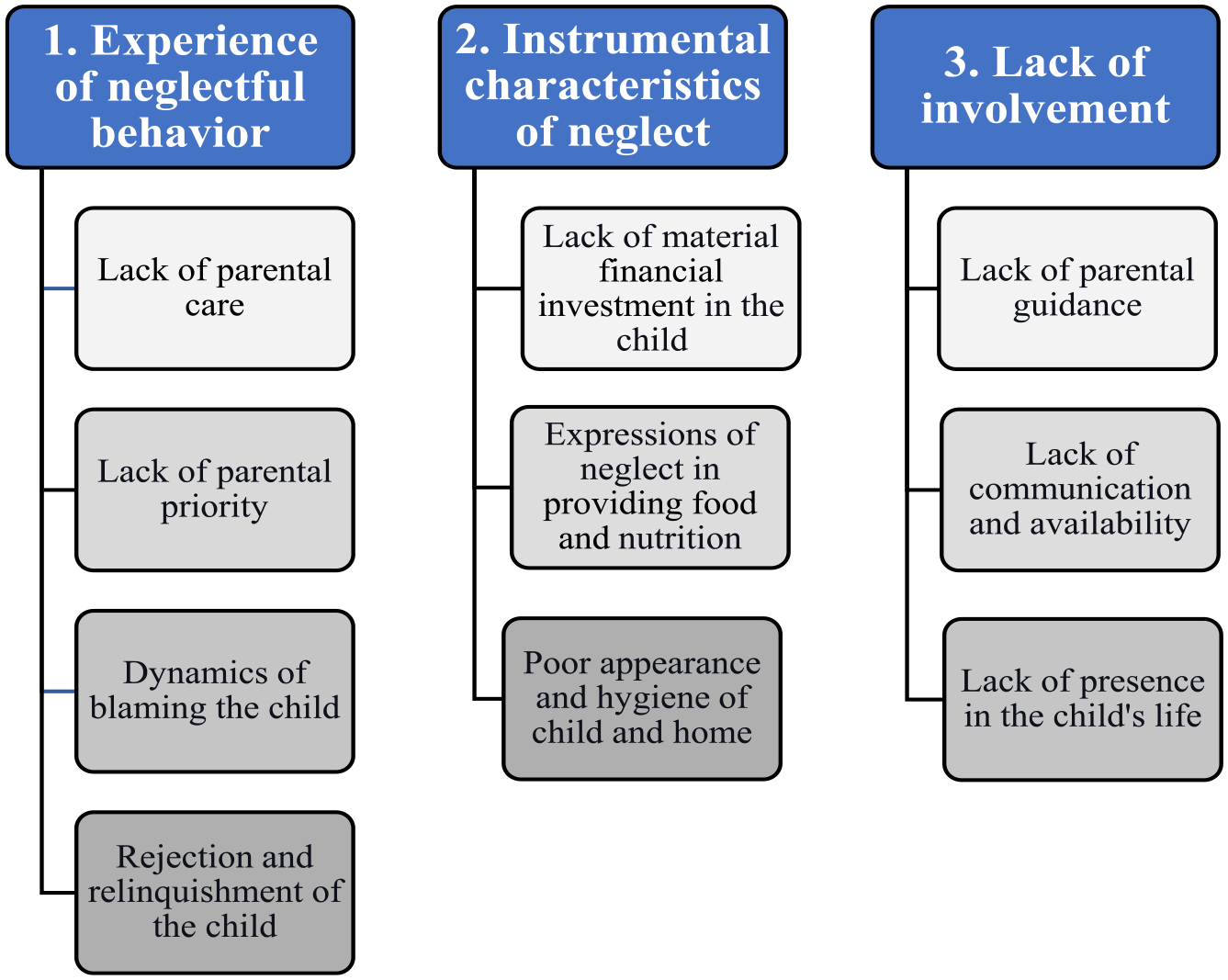
Child neglect from the perspective of youth: three main themes and their subthemes.
Experience of Neglectful Behavior
In response to questions relating to the meaning of the concept of neglect, the youth talked about the experience of neglectful behaviors by parents that were part of what they viewed as neglect. This theme comprises four subthemes: neglect as a lack of parental care, neglect as a lack of parental priority, neglect as dynamics of blaming the child, and neglect as the rejection and relinquishment of a child by the parent.
Lack of Parental Care
Most youths viewed neglect as indifference and a lack of caring on the part of their parents. The verb “care” was the common verb in the context of parental neglect in the words of the youth: A neglected child [is a child] that no one cares about, neither parents nor perhaps even friends. (Jewish, female) They do not care about him; they do not give him love and do not show him compassion. (Jewish, male)
The youth linked the lack of caring at home to the child not taking care of himself: If parents do not care about their children and do not give them a feeling that they are a part of them and their lives, the child begins to feel that he is a stranger to them and neglects himself in everything. (Arab, female)
Part of caring was an expectation from parents to understand their needs: [Our parents] do not care about us . . . do not see what we are missing . . . only when we say it. (Arab, female)
Another participant connected care with protection when he described a state of neglect: A parent who leaves the child without someone who will serve as a “dome,” who will buffer the reality and protect the child. (Jewish, male)
The boy in this quote expects parents to provide a “protective dome” for their child; analogous to the Israeli invention of the “Iron Dome” rocket defense system. In the opinion of these youths, parental care and support for the child include protection from external dangers.
Lack of Parental Priority
In the words of the study participants, many statements and examples refer to neglect as a situation in which the child is far from the top of their parents’ priorities. They gave examples of problematic priorities of the parents, for example: Parents care more about themselves than their children. (Jewish, female) [Parents] who ignore the child, who buy him things that are less good, or don’t give him enough attention. (Jewish, male)
The youth emphasized the low priority of the child who receives less because the parent is occupied with other things: One who forgets her children and takes care of her husband. (Arab, female) Instead [of caring for their children], they spend money on scratch cards and cigarettes. (Arab, female)
Parental Dynamics of Blaming the Child
The youth identified different family dynamics of blaming the child for his or her condition, which is repeated in the context of neglect. For example, a girl in one of the groups referred to situations in which a child does not receive help with schoolwork, but the parents still blame them for their poor academic results: When you get a low score on the test, you are asked why you did not study enough. (Arab, Female) They say you yourself caused the problems. . . not that they [the parents] stand by us. . . they are against us. (Arab, female)
It seems that they see the mother’s accusations as the opposite of the support, assistance, and comfort that the child expects: She (the mother) does not try to solve the problem. She is just angry, angry at him, and yells at him, “Why did you get a failing grade?,” instead of trying to improve the situation by saying “It’s not terrible, next time will be better,” or “Do you want me to help you?” (Jewish, male)
Rejection and Relinquishment of the Child
Study participants noted situations of “active” rejection and the parent’s unwillingness to communicate with the child, for example: A parent who does not want to be in touch with his son. (Jewish, male)
An issue came up in another group, of rejecting a child based on a religious approach in the context of Jewish ultraorthodox society and children who chose not to be as religious as their parents: In my opinion, parents who discard their children because they do not get along with their views, is also a kind of neglect. (Jewish, male)
In another group, expressions of rejection arose in the context of divorced parents: The most common word among parents is . . . “Go to your mother” or “Go to your father.” (Arab, female) [Quoting her mother] “If it doesn’t suit you . . . move into your father’s house and he will educate you.” (Arab, female)
The “transfer” could also be out of home, as one girl shared that her parents’ “threaten” to send her off to boarding school as an expression of neglect in her opinion: Maybe some of you have heard this sentence: “If you stay like this . . . you will be taken to a boarding school, where you can do whatever you want.” I heard it not once, not twice, not ten times, and not a hundred times. (Arab, female)
Instrumental Characteristics of Neglect
The study findings showed that the youth addressed several instrumental characteristics related to how children’s physical needs are not met as part of child neglect. This theme included three subthemes: lack of material investment in the child, expressions of neglect in nutrition, and poor appearance and hygiene of the child and home.
Lack of Material and Financial Investment in the Child
Participants from different groups described the lack of material and financial investment in the child as an expression of neglect. They talked about not buying clothes or school supplies and not giving allowance money. They referred to situations where the family has some money, but the parents do not invest even a small amount in the child: Neglect is when the father has money and does not give any. (Arab, female)
The youth also tied the instrumental element in with the emotional climate, describing a situation where the house is not oriented toward the child and has no relation to the things that are important to him: In general, I think there is such a gray atmosphere [in a neglected house], with very few toys and very few things that are related to the child. (Jewish, male) [Describing a neglected house] A house so messed up, you can’t find yourself. (Jewish, female)
Expressions of Neglect in Providing Food and Nutrition
The youth emphasized nutrition as a component of neglect referring to the quality of the food, the priority the parent gave to feeding the child, and the direct efforts of the parent in preparing the child’s food: [Parents] bring you cheap and unhealthy things, while on the other hand, they spend on unimportant things. (Jewish, female)
Regarding parents’ lack of direct effort in preparing the food: [The mother] does not have the strength to prepare food . . .so she gives money to go buy food. Some parents say, “You will manage, go eat with a friend.” (Arab, male)
The following quote continues this trend, shedding light on the importance of the emotional investment component of providing food and nutrition in a parent–child relationship: I think parents who buy food [order out rather than cooking] are somewhat neglectful, though it can [still] greatly affect the child. They should just warm the food, like [from] the heart, even if the food was bought . . . then heat it for them, or from time to time prepare something for them. (Jewish, female)
The girl’s remarks emphasize the emotional component presented in feeding, revealing the connection that youth make between the warm food and the warmth of the parents’ hearts toward their children. It should be noted that in this group there was a discussion on whether serving ready-made food is an expression of neglect: Even if it is [ordered] food from outside [the house], it does not matter. What is most important is to have someone welcoming you, who thought of you, and made an effort for you. (Jewish, male)
Thus, it seems that when the youth refer to the parent’s responsibility to feed their children, they refer to the parent’s active involvement in food making and serving as an expression of emotional investment and warmth toward their child.
Poor Appearance and Hygiene of the Child and Home
Study participants addressed the fact that neglected children are not externally well groomed. Their remarks predominantly referred to torn or unsuitable clothing or to body odor and lack of grooming: His clothes are old, dirty, and untidy. (Jewish, male) He does not shower; he always has a bad odor. (Arab, female)
The discussions relate to the way the child is seen externally, but also to the way he is emotionally experienced by others, as the physical aspect caused isolation: It also has to do with how you look. If you turn up with wild hair, yellow teeth, and you look like a ghost, no one will want to go near you. (Jewish, female)
Additional voices referred to the way the house of a neglected child looked: Maybe it’s a house that is not clean, not just that things are everywhere, but you go in and the floor is very dirty and there is always dust, etc. Let’s just say dust on the dining table means the parents don’t care. (Jewish, female)
Lack of Parental Involvement
The analysis revealed that the youth in the various focus groups defined neglect as a lack of parental presence, supervision, and guidance in various aspects. As these three subthemes have some overlap, they can be viewed as a range of parents’ physical and emotional availability. This theme encompassed three subthemes: lack of availability of parental guidance, lack of listening as a lack of parental support, and parents who are not present while their children are home alone or wandering around aimlessly.
Lack of Parental Guidance
Quite a few statements of participants referred to the lack of mentoring, guidance, and even boundary setting as an expression of neglect. Most of the youth attributed the inability of a child suffering from neglect to get along in the outside world and with the peer group, to the lack of guidance from the parents: They [neglected children] themselves do not know how to behave in the real world, because they had no one to explain to them what to do and how to behave and so on, and that is going to mess them up] in a lot of different places. (Jewish, male)
The youth referred to situations where a child has to stay alone at home for many hours, and what might be possible consequences: He does not have a guide—the father and mother—he does not have these tools because they are not with him, he is neglected at home. (Jewish, female) A child who becomes a criminal or brat, who has no home to balance him. (Jewish, male)
It seems that from the perspective of youth, one of the parents’ roles is to give the child tools to get along in the world, and a deficit in that role is considered neglect: [Cynically addressing a rhetorical question to the parents] Did you ever tell us anything?! Did you ever come and tell us not to make trouble? Did you give us any direction? (Arab, female)
Lack of Communication and Availability
The study participants referred to poor communication as well as parental lack of listening to their children, which takes place in a neglected home, and does not allow the youth to feel cared for and supported. It seems that proper listening and communication, which encourage and support, are considered appropriate parenting styles for children, and are associated with helping them through difficult situations. An expression of this can be seen in the expected interaction between a parent and a child: The parents’ speech style should be encouraging and appropriate for the children, their behavior with him should be pleasant, and they should listen to the child and stand by him when needed. For example, when something bothers him, his parents must be by his side, help him, and provide for his needs. (Arab, male)
In another example, a lack of listening can be an expression of parental inaccessibility: The parents can be at home all day . . . and not be in contact with the child, occupied in their affairs all day, [they can] see the child wants to be with his parents and talk to them; however, they neglect him, they do not let him talk to them. (Jewish, male)
The boy’s description of this lack of communication and his noting that that child wants something from the parent but the parent “neglect[s]” the child, reflects an emotional unavailability of the parent, manifested in a lack of listening and availability to the child. His quote emphasizes that the parents’ emotional absence is unrelated to their physical absence when he noted that “they can be at home all day.”
Lack of Presence in the Child’s Life
Study participants cited the physical absence of parents from their children’s lives as an expression of neglect. They described situations in which the parents are not at home and the children are left on their own, and in parallel, situations in which children are alone outside their homes until late. The main reasons mentioned for the parents’ absence were the parents’ pastimes: [Parents] left their kids alone, walking around the neighborhood and sitting in a cafe with hookahs until late. (Arab, female) I think a neglectful parent can be. . . say, a parent who goes to a movie once a week while leaving the kids alone. (Jewish, female)
References to children wandering outside the home—because parents are at work—came up: For example, if the father and mother are always at work, it causes the child to spend more time on the street. (Jewish, male) [Describing a boy] Never at home, always somewhere else or with someone else, in places in the park or something, who has no reason or desire to go home. (Jewish, female)
Relatedly, the participants also referred to the lack of parental involvement in the child’s educational environment. For example, in one group, a dynamic of neglect was described when a child does not go to school and her or his parents know about it yet ignore it or do nothing about it: They know he is going somewhere else. (Arab, male) Saying nothing [to the child], the teachers invite the parents to school, and they do not come. (Arab, male)
Discussion
This current study aimed to develop a better understanding of how child neglect is perceived and defined from a youth’s point of view. The qualitative-thematic analysis of content (Braun & Clarke, 2006) yielded three main themes, which reveal how the phenomenon of child neglect is perceived, interpreted, and imagined among the youth who participated in the focus groups, interviewing boys and girls, Arabs and Jews from diverse communities in the north of Israel.
The analysis of the data revealed a deep picture of the phenomenon of child neglect from the eyes of the youth, which is complex and takes place in a variety of dimensions. This adheres to professionals’ perspectives, which also tend to show high variability in their conceptualization of neglect (Elias et al., 2018). Part of the themes revealed a range of behaviors with different severity, just as former literature has referred to child neglect as a continuous variable (DeLong-Hamilton et al., 2016).
The first theme relates to parental behaviors that might lead to child neglect from the perspective of the youth. It presents a range from a more passive lack of parental care to deficits in the parents’ priorities to a more active dynamic of blaming and even rejecting the child. Youth addressed parental neglect as behaviors that ignore their emotional needs, a main aspect of emotional neglect (Ludwig & Rostain, 2009). While in most cases they did not mention feelings directly, we identified the emotional aspect involved in these neglectful behaviors as part of the meaning of child neglect from their perspective. Specifically, the youth strongly reacted to the term “care.” This finding is strongly related to the findings of the single somewhat similar study that was done in the United Kingdom with youth in contact with the welfare system, which showed that most of the participants perceived neglect as a lack of appropriate parental responsibility and caring (Gorin, 2016). They also related to the consequences of a lack of care for the children, in terms of lack of protection from the environment. This adheres to the common conceptualization of child neglect as mainly acts of omission rather than commission (IMNRC, 2014). The many implications and expressions that the youth attribute to parents’ lack of care for their children’s condition can stem from the relatively young age of the study’s participants, who still feel highly dependent on their parents.
The second theme addresses the instrumental characteristics the youth also identified as part of child neglect, referring to poor appearance and hygiene of the child, malnourishment, and lack of material investment in the child. These various instrumental aspects adhere to some of those typically defined as part of child neglect (Barnett et al., 2010; IMNRC, 2014). However, this theme was less central to the youth’s narrative of child neglect. Additionally, to some extent, the instrumental component also had an emotional aspect in the way the youth referred to it. In many of the discussions, the youth were mainly occupied with what the physical deprivation symbolized in the relationship with the child. Thus, for example, they did not particularly care if the parents made the food or if it was bought; they saw importance in the way the food was served to the child with care and love. The youth’s perspective reflects a stand that gives much room for symbolic interaction. Symbolic interaction was already claimed to be a powerful theory for understanding family dynamics long ago (Stryker, 1968). Furthermore, this finding adheres to what Gorin (2016) found, suggesting that youth’s perspective of “what is neglectful” varied, depending on how the behavior made the young person feel.
Another interesting finding is that participants referred to the lack of material and financial investment in the child as a parental choice that does not necessarily stem from poverty or lack of resources. This finding can be explained by the fact that the youth did not identify neglect with situations of parents who are unable to provide for their children’s needs due to economic reasons (an issue thoroughly discussed by Elias et al., 2018), but rather with the parents’ conscious choice to ignore their children’s needs. This criticism of parents who put themselves high in their priorities appeared to some extent in all three themes of the study. It highlights youth’s basic expectation from parents to prioritize their children’s needs over their own. This view might reflect the cultural characteristic of Israel as a child-oriented society (Rubin et al., 2017) in which children tend to be very much at the center of the family and society.
The third theme deals with neglect as a lack of parental involvement, also presented as a range in the parents’ physical and emotional availability; from parents who are not present and their child is home alone or wandering around, through lack of communication and availability, to a lack of parental guidance. The study findings showed that youth attach so much importance to the quality time that parents spend with their children that they perceive the lack of recreation time together as neglect. This is consistent with the findings of Luthar and Crossman (2013) who described the emotional disconnection between some affluent parents and their children that happens when they are often left alone due to their long working hours. However, in the current study we find that while the youth talked about parents who work long hours, most of the criticism was directed at parents whose children were left alone at home or roamed the streets while they spent time elsewhere, with other people. Youth emphasized parents’ conscious choice of putting their pastimes at a higher priority than spending time with their child, while doing so for work purposes was viewed as more acceptable.
According to the participants, a lack of listening and communication with parents does not allow them to feel cared for and supported. In terms of communication, proper listening and involvement in the child’s life were viewed as encouraging and appropriate parenting, associated with standing by them. Interestingly, the youth emphasized that the parents’ emotional absence is unrelated to their physical absence, which in a way meant that the parents chose to ignore the child’s desire to communicate with them.
Quite a few statements of the participants referred to the lack of mentoring, guidance, and even boundary setting, as an expression of neglect. From the youth’s perspective, one of the parents’ roles is to give the child tools to get along in the world, and a deficit in that role was considered neglect. Parents who do not provide guidance and set boundaries make it difficult for the child to behave appropriately in society in general, and among their peer groups in particular (Fosco et al., 2014; Luthar & Crossman, 2013). This theme in which participants express an expectation of parental involvement in setting boundaries is interesting as professionals often meet youth in distress who suffer because of issues around parental boundaries (Batool, 2013).
Across all three themes, the emotional aspect was apparent in the youth’s narrative. While this was not articulated directly, it was identified by all the authors in all of the groups they conducted. They noted situations in which parents may not be emotionally available or even have no emotional connection with their children and also attributed emotional intention to physical behavior. However, it should be emphasized that these were the descriptions openly brought by participants when we asked about child neglect.
This finding is significant because emotional neglect is challenging for professionals. It is more difficult to detect, and, perhaps accordingly, the main focus of definitions and practice has been typically on harsh living conditions, hygiene, nutrition, and poor dress (Brandon et al., 2014). Moreover, the focus the youth have shown toward the emotional aspect is interesting and important especially as psychological neglect is considered particularly understudied (Christ et al., 2017). However, a few studies did show emotional neglect has many implications for children; for example, it was found to be linked to child psychiatric disorders (Young et al., 2011) and depression (Webb et al., 2007). Additionally, some evidence shows that social workers perceive psychological neglect as more harmful than physical neglect (Bernard, 2019; Stone, 1998).
A possible reason why the youth attributed more meaning to the emotional aspects might lie in the fact that they came from diverse backgrounds, so for a lot of them material deprivation was less of an issue. This background is one of the unique contributions of this study since most former research about youth’s and children’s perspectives—however scarce—has focused on populations related to the welfare context and poor families (Bywaters et al., 2016; Morris et al., 2018). This background is important as it is known that child neglect can occur in various contexts, also among affluent families (Bernard, 2019; Luthar & Crossman, 2013).
Finally, youths’ conceptualizations of child neglect in the analysis we conducted, did not seem to differ in any explicit way by gender or by culture. That is, there were no noticeable differences between males and females, or between the more or less religious Jews, as well as between Jewish and Arab youth. This is in contrast to some previous literature that found differences in perspectives of child neglect among adults by gender (Evans-Campbell, 2008; Ringwalt & Caye, 1989) and ethnicity (Dubowitz et al., 1998; Rose & Meezan, 1996). The fact that these differences by gender and culture/ethnicity were found among adults in previous research, but not among youth in the current study suggests that distinctions between youths’ and adults’ perspectives are an important area for further inquiry.
Study Limitations
While the study sheds light on a unique perspective of child neglect that has received little attention in the literature, it also has a few notable limitations. First, we focused only on the perspectives of youth in the north of Israel. We did not have groups from other parts of Israel due to budget limitations. We also did not collect the perspectives of other relevant groups such as parents and different types of professionals. While the perspectives of these groups have been addressed in some studies (Evans-Campbell, 2008; Newton, 2017; Horwath, 2007;), a larger study that compares the perspective of youth, parents, and professionals is warranted. The study tried to cover the main relevant diversity considerations in terms of the youths’ ethnic, religious, and gender backgrounds. However, this can be further extended, and future studies can conduct a series of focus groups in each of these intersections specifically, for example, collecting data among Arabs in different areas in Israel, and among orthodox and ultraorthodox Jews. Perhaps this limitation is what caused the fact that we did not notice any differences in the perspectives of youth coming from different backgrounds. Another limitation is that we focused on a specific age group of youth between 12 and 15 years old. This group reflects only one segment of adolescence and more research with other groups is warranted. Of course, all of these limitations do not allow the study findings to be generalized.
The participants we recruited were from the general youth population, and accordingly, we do not know if any had experienced neglect (asking about this would have posed ethical complications). While this is also one of the contributions of this study, as all the former studies focus on youth known to welfare authorities, this also influenced our ability to understand from which environmental context their perspective came. Finally, a general inevitable limitation refers to the fact the study was conducted in the participant’s native language—Arabic or Hebrew—and, naturally, we encountered difficulties sometimes in conveying the exact words of the speaker when translating to English without losing any of the meaning.
Conclusions and Recommendations
Our findings emphasize the need for more critical dialogue about child neglect conceptualization, the importance of listening to youth voices, and the need to take into account their points of view on significant issues concerning their lives. The study participants described child neglect first of all in terms of not being cared for, mainly due to being a low priority for the parent. Emotional neglect is critical from youth’s perspective across all three themes identified. The definitions of neglect as arising in this study describe a range of parental behavior perceived by adolescents as child neglect that are partly passive and partly more active, but common to all is that they are perceived by them as a conscious choice of the parents—and that is what seems to matter.
For decades, an extensive body of research has focused on effects of parent–child interaction in the first years, showing that child neglect in the terms of understimulation can cause damage to the brain and developmental delays (National Scientific Council on the Developing Child, 2012). While, of course, early childhood is the most critical time for child development, perhaps one of the main implications of the study is that parent–child interaction is vital also during adolescence, at least from the youth perspective. More study is needed to evaluate the exact effects of experiencing child neglect in the terms the youth pointed out in this study.
Footnotes
Declaration of Conflicting Interests
The author(s) declared no potential conflicts of interests with respect to the authorship and/or publication of this article.
Funding
The author(s) disclosed receipt of the following financial support for the research and/or authorship of this article: The study was conducted by the Center for Research on Child poverty and neglect, at Tel-Hai College supported by Haruv Institute.
Ethics Approval
The study was approved by the Ethics Committee of Tel-Hai College. Consent to participate and for application: All participants and their parents signed informed consent forms (consent letters are available in Hebrew).
