




Abstract
High-quality video and audio recordings of violent crimes, captured using now ubiquitous digital technologies, play an increasingly important role in the administration of justice. However, the effects of exposure to gruesome material presented in this form on criminal justice professionals who analyze, evaluate, and use this potentially traumatic content in the context of their work, are largely unknown. Using long interviews and constructivist grounded theory, this qualitative study sought to explore experiences of exposure to video evidence of violent crime among Canadian criminal justice professionals. Sixteen individuals including police, lawyers, judges, psychiatrists, law clerks, and court reporters volunteered to participate in qualitative long interviews asking about workplace exposures to violent videos. Themes identified address the ubiquity of video evidence of violent crime; proximity to violence through video; being blindsided through lack of preparedness for violent content; repeated exposures through multiple and protracted viewings; insufficient customary methods for self-protection; and the enduring impact of exposure to videoed violence. We determine that criminal justice professionals are increasingly and repeatedly presented with deeply disturbing imagery that was once imperceptible or unknowable and thus previously held at a greater distance. Elements of what is newly visible and audible in video evidence of violent crime create a new emotional proximity to violence that potentially increases the risks of secondary trauma and underscores the need for improved safety measures.
Introduction
I guess what I’m trying to say is that as the world becomes more digital … more and more people are going to be exposed to profoundly, emotionally generating video material and … I think that there is an inherent risk for significant parts of the population to be traumatized and perhaps [they] don’t even know their own vulnerability. (JAMIE)
The ubiquitous nature of high-quality video and audio that now captures much of our daily existence, increasingly serves as a valuable source of evidence in the investigation and prosecution of violent crimes (Brayne et al., 2018; Dodge, 2018; Dodge et al., 2019; Henry & Powell, 2016; Powell et al., 2015; Powell & Henry, 2018). While this may indeed serve the purposes of the criminal justice system, the effects of exposure to gruesome videos of interpersonal violence on criminal justice professionals who may be required to analyze, evaluate, and/or categorize this potentially traumatic content in the context of their work, are largely unknown. While a growing number of scholars are demonstrating that exposure to distressing materials while working on cases involving trauma can have serious negative consequences for professionals (Nen et al., 2011; Seigfried-Spellar, 2018), some recent evidence suggests that the specific and particularly problematic impact of video evidence requires further examination (Bourke & Craun, 2014; Denk-Florea et al., 2020; Powell et al., 2015).
Occupational stress injuries, as a consequence of both direct (Regehr et al., 2021; Ricciardelli et al., 2020; Schuster & Dwyer, 2020; Wagner et al., 2020) and indirect exposure to disturbing incidents of human tragedy, are of recent and growing concern among a number of professions (Brady, 2017; Greinacher et al., 2019; Hurrell et al., 2018; MacEachern et al., 2019; Pirelli et al., 2020; Ricciardelli et al., 2020). To this end, the DSM-5 now includes in its criteria for posttraumatic stress disorder (PTSD), indirect exposure to aversive details of the trauma in the course of professional duties, with specific mention of first responders (American Psychiatric Association, 2013). A robust literature addresses PTSD in first responders who witness death and interpersonal violence firsthand. A more limited but growing body of research has examined indirect secondary traumatic stressors and their effects in other professions or roles within the justice system, such as lawyers (Leclerc et al., 2020; Seamone, 2013; Zwisohn et al., 2018), judges (Edwards & Miller, 2019; Polak et al., 2019), and jurors (Haragi et al., 2020; Lonergan et al., 2016; McQuiston et al., 2019). Importantly, while a number of scholars have begun to examine the traumatic impact of digital evidence more broadly, sometimes briefly discussing the particularly traumatic potential of video (e.g., online child sexual abuse material including still images and text; Bourke & Craun, 2014; Burruss et al., 2018; Denk-Florea et al., 2020; Powell et al., 2015; Seigfried-Spellar, 2018), almost no research has specifically addressed what might now be considered an overwhelming barrage of potentially traumatic, obscene, and gruesome video evidence of violent crimes in all their unique graphic intensity (Kimpel, 2021). Experimental evidence concerning posttraumatic stress responses, however, may offer some insights into the possible consequences of intimately engaging with violent video evidence as a matter of workplace requirements.
Originating in the 1960s, the trauma film paradigm (TFP) was first developed by Lazarus et al. (1962) as an acute psychological stress-inducing stimulus that could replicate real-life stressful events under controlled conditions. In the 1970s, the TFP was further explored by Horowitz et al. (1976; 1969, 1975) to examine the occurrence of psychic trauma and intrusive memories subsequent to film viewing. Segments of aversive films (either fictitious or documentary) that include gruesome violence, abuse, death, and/or injury are presented to participants in an effort to generate and assess various short and longer-term cognitive, emotional, affective, and physiological responses (Arnaudova & Hagenaars, 2017; Holmes & Bourne, 2008; Lazarus et al., 1962). More recently, researchers have conducted a series of experiments using the TFP to explore the cognitive and neural mechanisms behind the formation of flashbacks and intrusive memories, particularly with respect to the development of PTSD (Bourne et al., 2013; Clark & Mackay, 2015; Clark et al., 2014, 2015).
It is now well established that variously-themed violent films consistently generate physiological stress responses (e.g., changes in heart rate and salivary cortisol) and intrusive thoughts (e.g., flashbacks, intrusive memories) in the days and weeks following lab-based exposures (Arnaudova & Hagenaars, 2017; James et al., 2016; Weidmann et al., 2009). Scenes depicting sexual violence and gross physical injury may be particularly effective at eliciting trauma-related symptoms (Arnaudova & Hagenaars, 2017; Weidmann et al., 2009). Not only can viewing these films produce intrusive thoughts, but listening to verbal accounts of the scenes alone will also produce intrusive mental images (Perez et al., 2010; Seamone, 2013), especially in those with a preference for visual processing (Krans et al., 2011). Other individual differences in processing style (Hagenaars et al., 2016), prior history of traumatic exposures (Rattel et al., 2019), and emotional susceptibility to witnessing others’ trauma (Trautmann et al., 2018) may also have an impact on the development of trauma symptoms after exposure to violent videos. Outside of the criminal justice system, such harms were acknowledged when Facebook agreed to pay a settlement of $52, 000, 000 (USD) for failing to protect the mental health of workers moderating disturbing content on the platform (Paul, 2020). Many moderators were repeatedly exposed to video content depicting graphic forms of interpersonal violence including child sexual abuse, beheadings, and terrorism, and suffered from PTSD as a result.
As Pinchevski (2016) observes, the trauma film paradigm is largely responsible for “naturalizing the idea that visual exposure to violence could have clinically observable consequences” with important implications for how we understand the causes and development of PTSD (p. 60). Traumatic films, while originally conceived of as a replicable device for closely observing stress responses that were analogous to any visually stressful incidents, now provide invaluable insights as an experimental paradigm that is increasingly analogous to todays’ context; trauma mediated through digital capture and playback. Violent video evidence in the justice system can thus be understood as an additional site of trauma, amplifying its impact and causing injury far beyond the original act. The safe management of such volumes of evidence—from discovery to digital afterlife—is then of course, of mounting concern. While the ubiquity of such evidence may realize new benefits for criminal justice professionals (Backes et al., 2021; Brookman & Jones, 2021; Cook et al., 2019, 2021; Westera & Powell, 2017), its potential to traumatize and re-traumatize viewers in novel ways poses many new moral, psychological, ethical, and social concerns worthy of exploration. Qualitative interviewing is effective for investigating the lived experiences of criminal justice professionals who are regularly exposed to traumatic material (Weir et al., 2020), and more specifically, their experiences with the emerging ubiquity of violent videos. This paper presents the results of a qualitative study which sought to determine the impact of exposure to video evidence of violent crime on Canadian criminal justice professionals including crime analysts, police, lawyers, judges, psychiatrists, law clerks, and court reporters.
Methods
This project adopted a discovery-oriented qualitative design, utilizing constructivist grounded theory method. Originally developed by Glaser and Strauss (Glaser & Strauss, 1967) grounded theory “takes a systemic, inductive, comparative and interactive approach to inquiry” and fosters the development of theory in understudied areas (Charmaz, 2008, p. 166). Building on earlier work, Charmaz (2000; 2014) proposed an adaptation—constructivist grounded theory (CGT)—which underpins a grounded theory approach with a constructivist paradigm. That is, CGT asserts that data and meaning, rather than emerging as an objective truth, are co-constructed through the relationship between the researchers and the participants (Birks & Mills, 2015; Charmaz, 2017; Chun Tie et al., 2019). While other qualitative approaches such as thematic analysis may have delivered similar findings (Braun & Clarke, 2021a), it is CGT’s concern with maximum variation and information-rich sampling, concurrent data collection and analysis, and the explicit development of new concepts for the theoretical conceptualization of social processes that remain grounded in participant perspectives—in this case, the contexts and processes related to working with potentially traumatic video evidence and its impact—that drew us to this method (Charmaz & Thornberg, 2020).
To this end, this research engaged in dialogues with civilian crime analysts, police investigators, legal professionals (court reporters, lawyers, and judges), and forensic mental health professionals, using the long-interview method of data collection (McCracken, 1988) in support of thick description and credibility (Lietz & Zayas, 2010). The long-interview method utilizes open-ended questions to foster the exploration of experiences and elicit relevant stories, in this case related to workplace exposure to violent videos (McCracken, 1988). Participants were asked to recount the nature of cases encountered that involved video evidence, types and sources of the video evidence encountered, the use of the video evidence in the administration of justice and its impact, and their thoughts on the impact of video evidence on victims of the violence and their families. For example, the interview guide included such questions as: “What role does video evidence play in investigations/cases?”, “Describe any differences in your experience with video evidence compared to other types of evidence (e.g., victim testimony, audio evidence, text, still images, etc.),” “How has it impacted your work?”, “Do you feel supported?”, and “What are the challenges?”. Consistent with a CGT approach to constant comparison, our emphasis on different questions shifted throughout data collection. For example, initial interviews dwelled on and made clear the ubiquitous nature of video evidence and the multiple sources and formats through which video evidence surfaces in the criminal justice process, while this became less of a focus in latter interviews.
Further, once our attention had been drawn to the embodied aspects of working with this material, we sought to specifically document experiences with video violence drawing on an affective-discursive psychosocial approach (Wetherell, 2012) to understand the complexities of participants’ experiences (Lykke, 2010). We captured salient affective processes of looking at (Ringrose & Coleman, 2013) and consuming large doses of videoed violence. For instance, we considered how image, sound, and repetition are all affective dynamics that can help us understand how participants are navigating difficult and unpleasant and potentially traumatic embodied responses to video evidence. The proposal was approved by the Human Subjects Research Ethics Board at The University of Toronto.
Participants
Participant pseudonyms and years/areas of experience with video evidence of violent crimes.
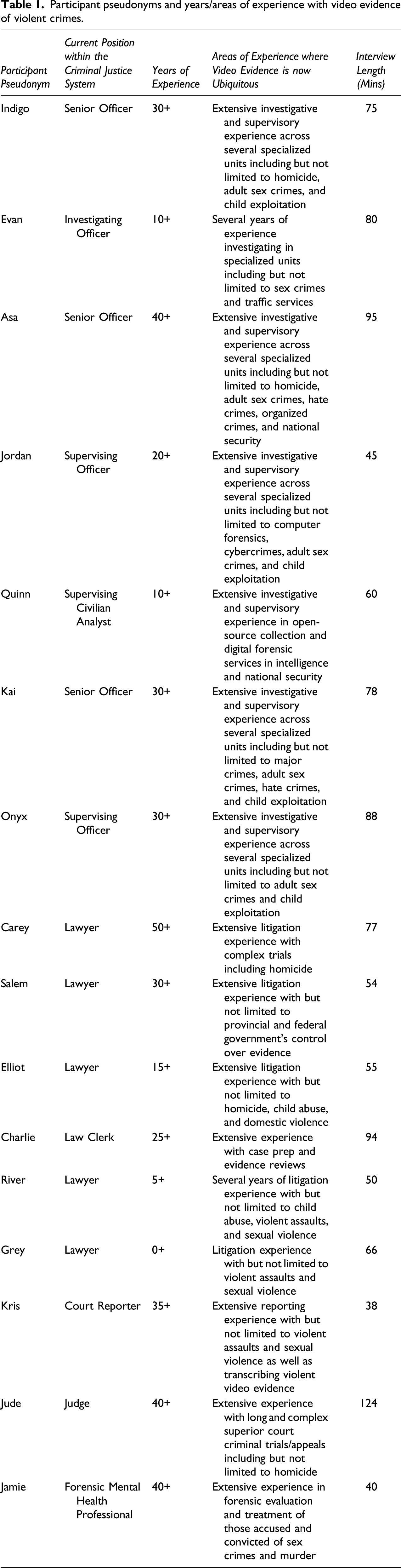
While policing-associated participants largely drew on their experiences working within specialized units (e.g., organized crime, major crimes, hate crimes, sexual assaults, child exploitation, homicide, cybercrimes, forensic video analysis, digital device forensics, national security, intelligence, and traffic services), much of the video evidence they discussed would first have been obtained and viewed by those working in frontline policing, suggesting widespread organizational exposures given recent socio-technological trends (Stratton et al., 2017). While legal professionals also largely drew on their experiences working within specialized teams or areas (e.g., homicides, sexual violence and assaults, child abuse, domestic violence, and aggravated assaults), many of the videos they discussed were representative of the general trend towards the use of visual evidence in criminal justice proceedings overall (Brayne et al., 2018). Years of practice ranged from 4.5 years to over 50, with all participants suggesting that recent technological advances and the accompanying ubiquitous use of recording devices had radically altered the landscape of the criminal justice system with significant increases in exposure to potentially traumatic content. Thus, while invited participants were understood to support information-rich sampling, another aspect of a CGT approach (Cho & Lee, 2014), we did not encounter any individuals who declined to participate for lack of experience with video evidence.
We note that the actual voices of victims are an omission from this study. The reasons for this are multifaceted. First, many of the cases that surfaced in this project involved extreme levels of violence and tragically, some of those cases did not have surviving victims. For those who did survive, ethical concerns prevented us from asking to be connected to survivors by the criminal justice professionals. Thus, the focus of this project was on the perspectives of those who are responsible for the investigation, procurement, examination, analysis, sharing, and deliberation of video evidence in the criminal justice system in Canada. We also note that while gender diversity exists in our sample, other forms of diversity are not reflected. Unfortunately, this is a consequence of the nature of the population being sampled. We are mindful of the need to conduct inclusive research that is responsive to diversity and equity initiatives, and are aware that our focus on this population necessarily limits the generalizability of our findings.
Data Analysis
The interviews were professionally transcribed verbatim for line-by-line micro-analysis. Open, axial, and selective coding as typically used in grounded theory were employed to further determine germane categories (Strauss & Corbin, 1998). Throughout coding and as transcripts were added, we applied the constant comparison method, originally developed to analyze data derived from a grounded theory approach (Strauss & Corbin, 1998). This method of analysis allows for comparison of data between interviews of each participant but also for comparison of codes and categories within interviews. To begin, each author initially open coded a portion of the interviews to establish preliminary codes of interest and analytic focuses. We then together examined the coded interviews which both established agreement and provided opportunity to discuss and revise differences, as well as shift focus during subsequent interviews. For example, after interviewing and analyzing initial data from more senior criminal justice professionals with earlier experiences of working with video evidence, we recognized we needed to also interview more junior professionals working directly in the present-day context of overwhelming sources of mediated violence found in criminal justice processes.
To narrow the initial number of codes, we then focused our coding to examine and further refine and define those that were most frequent or important such as the ubiquity, sources, quality, and importance of video evidence, its management throughout the criminal justice system, the nature and context of viewing such videos, symptoms, effects, and reactions to viewing, as well as participant perspectives on the impact on victims and families, and instances of organizational support for workers. For example, one code of significant interest was “symptoms,” which we fleshed out as a category by enveloping other codes such as nightmares, insomnia, flashbacks, weight loss, and increased anxiety, among many others. Axial coding was then used to determine the inter-relationships between categories and selective coding built and clarified concepts and helped to integrate and refine the emerging theory according to the perspectives of criminal justice professionals (Birks & Mills, 2015; Charmaz, 2006; Corbin & Strauss, 2008). For instance, the categories “symptoms” and “embodied processes” were used to theoretically saturate the core conceptual category “enduring impact” (Charmaz & Thornberg, 2020). ”Enduring impact” was established as the core category based on its accommodation of maximal variation in experience, its centrality among the other related concepts, its frequent appearance in the data, and it’s power to explain professionals’ experiences (Charmaz & Thornberg, 2020; Latta & Goodman, 2011; Strauss & Corbin, 1998). Nevertheless, as an iterative and reflexive practice, coding is context dependent, never complete, and never reaches a fixed endpoint (Braun & Clarke, 2021b). Thus, we aimed to demonstrate saturation and conceptual rigor through our emergent conceptual model and theoretical explanations of the current data (Low, 2019), given prior research using the trauma film paradigm.
Trustworthiness in Qualitative Research
Trustworthiness in qualitative research has traditionally focused on verisimilitude or the appearance of truth (Connelly & Clandinin, 1990), that is, achieving a sense of resonance or congruence with the audience who may have experienced similar situations (Ollerenshaw & Creswell, 2002). Additional suggested criteria are the utility of the narrative in terms of assisting with comprehension of an experience and enhancing future problem-solving of a group (Loh, 2013). In this respect, our forms of trustworthiness included prolonged engagement, triangulation, peer validation, and member checking (Lietz & Zayas, 2010; Loh, 2013). Specifically, our collective prior experience in conducting research on the impact of workplace trauma exposure was essential. Additionally, trustworthiness was ensured through longstanding relationships with this community prior to the interview process. We further engaged in repeated meetings and follow-up discussions with individual participants. We also engaged in the triangulation of data from various interviews with different professionals and the relevant literature. Finally, we discussed emerging findings with other experts in the field and then followed up by checking emerging hypotheses from earlier interviews in subsequent ones.
Findings
In keeping with the original aims of this study and the nature of questions posed in long interviews, the results are presented in six broad categories that have been visually conceptualized in Figure 1: the contextualizing categories including ubiquity of violent video evidence; proximity to violence through video evidence; blindsided through lack of preparedness; repeated exposures; insufficient customary self-protections; and the core category enduring impact of video evidence of violent crime. Enduring impact of video evidence of violent crime on criminal justice professionals.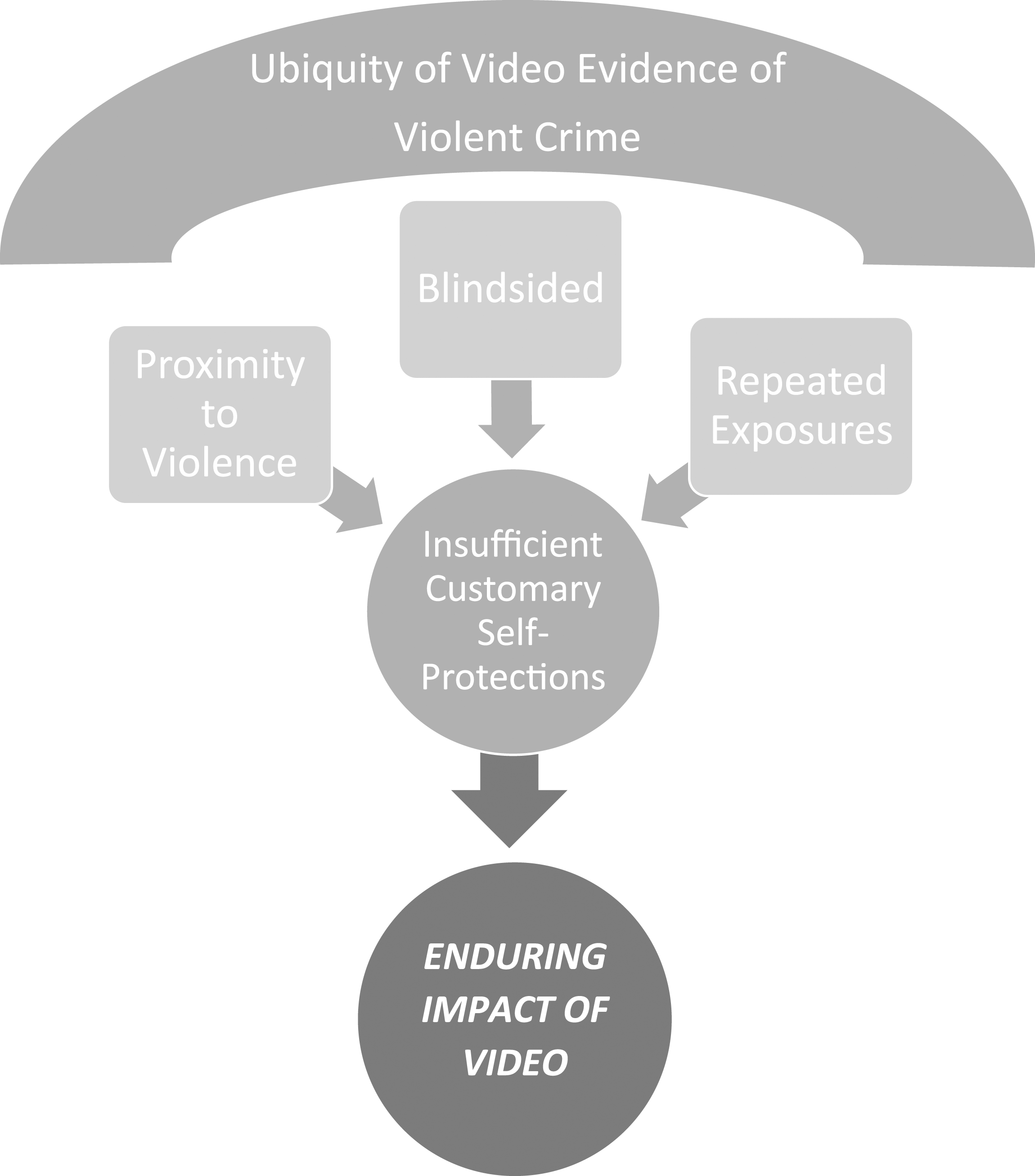
The now ubiquitous nature of high-quality video and audio evidence was clear across participant accounts of their routine work responsibilities, suggesting recent rapid changes in the evidentiary landscape of the criminal justice system and providing important context for our core finding. As one officer commented “nowadays everything is caught on camera” (EVAN), another suggested that “if anything’s happening, you can pretty much automatically assume that somebody’s got it on video, so it’s just a matter of figuring out who” (ONYX). A judge further noted “there are cameras everywhere” and they “pick up all sorts of things that weren’t anticipated,” adding video evidence is now “the mainstay of a lot of cases, particularly in some of the murder cases” (JUDE). Experienced officers often commented on the changes they had witnessed throughout their careers. One officer recognized “there was a bit of a switch towards the end of the time I was in child exploitation where a majority of the evidence was video versus still images” and then added that “moving forward to all the work we did on different files, homicide, hold-ups, child exploitation, drug squad cases, there was a lot more video and dealing with video evidence” (JORDAN). Other participants described the purposeful exploitation of greater technological access and enhancements in creating audio and video recordings of violent crimes. For instance, in relation to child sexual exploitation material, one officer noted that “because of technology, there’s more out there. There’s more being created.” (KAI). An assistant crown attorney similarly noted, “It’s the child abuse cases, for some reason they want to take videos of all their sexual offending. That’s part of it, to brag to other offenders online.” (ELLIOT).
In policing organizations, the volume of video evidence had grown to the point of creating new units dedicated to video analysis, alone. Consequently, a senior officer explains, “we can have investigators sitting in a room alone viewing that material for eight hours straight…So, you’re really exposing somebody to massive amounts of video to watch.” (JORDAN). Another senior officer notes that even with the addition of specialized units that there is a constant struggle to keep pace with the exponential growth of video. “We have civilian analysts who actually analyze the videos...So, we’re starting to catch up. We’re always behind…And I could grow it by 10 times.” (INDIGO). Similarly, in court processes, the ubiquity of video evidence had altered the expectations of courtroom participants. An assistant crown attorney describes, “I do think it is so common that people now expect it like, where’s the surveillance video…why didn’t someone capture that on a camera…was there any video captured of that?” (ELLIOT). Thus, a general awareness among, and many examples from, the lived experiences of participants suggested recent widespread engagement with video evidence that necessitated a new mediated form of proximity to violence across criminal justice professional roles.
Alongside concerns about the growing quantity of video were specifics about intensifications in the quality of video and audio recordings, again providing important context for the material changes in both evidence and the experience of working with evidence of this nature. One officer recounts “For a long time we just sort of had to squint and sort of guess what was happening” adding that the video evidence is much different than it used to be; “but the video is of insane quality now, and a lot of it has audio with it … even just the video that you get from a hallway of an apartment right now, you can count the thread count. They are so, so clear.” (INDIGO). Another officer described surveillance video saying “the video was so incredibly good ... this video was like watching a 4K movie” when recounting the viewing of an aggravated assault that later became a homicide. In detail, the officer recalled he literally was bleeding out...you can literally see when he goes unconscious from loss of blood because he got stabbed in the femoral artery. And you can literally see when…she makes a tourniquet. And you literally see him come back to life. (ONYX)
Units dealing with national security, who regularly conduct open-source collection in search of extremist threats, are frequently confronted with beheading videos, among other aspects of violent extremism. Officers and analysts report that terrorist entities will use “really sophisticated” (ASA) modern “video game” or “Hollywood techniques” in creating propaganda to “look like a movie” (QUINN). Content creators will “set a soundtrack to it…they’ll build and build and build to the death…When you see buildings blow up, they have a drone filming it and they do the spin.” This analyst went on to explain that “Naturally, anybody that’s human, you’re drawn into those techniques more so than just looking at an image.... you know it’s not props, it’s actual individuals that are being killed” (QUINN).
Describing the use of video during a trial a judge suggests, “video evidence...is more real, because it shows you exactly what happened” (JUDE). This judge continues and further describes the benefit of this “more real” evidence for the courts—and paradoxically the danger for viewers, “you don’t have to sort of picture it in your mind as you’re listening to the witness describe it. You can actually see it with your own eyes…you can play it as often as you want...You can stop it, you can enlarge it” (JUDE). For instance, an assistant crown attorney similarly describes a case where the “entire offence” was on video when “the accused ran over my victim with a vehicle, he ended up being pieces on the ground because of the speed” and then added that the video “was really important, not only for the identity of the accused, but…to show the actions of the accused. So, I had to play that multiple times, in multiple different speeds.” (ELLIOT). In this regard, a legal professional concludes “it’s the shock factor of the visual screening magnifies the impact” (SALEM). Thus, video evidence is relied upon “to sort of put you in the shoes of the participants” (GREY), drawing potentially naïve and unprepared viewers closer to actual events in ways never before possible.
While some advances in awareness of the potential impact of violent video evidence have been made in recent years, most notably with respect to video involving the sexual exploitation of children, participants regularly spoke of their earlier or initial engagement with violent video evidence as characterized by an unwary approach and lack of preparedness for its potential impact. One officer explains initial exposures to graphic video as staggering. “I think the first time you see something really horrific on video, it’s something that… you could never go back in time and not see it. So, sometimes they’re so shocking to you that it really takes you back.” (JORDAN). An assistant crown attorney similarly states, especially the first initial reaction is probably the worst one… you know that this image is going to be captured in your brain. It’s going into that storage unit eventually, so it becomes part of your psyche… I know there’s a potential for this to flashback at any time. (RIVER)
Those responsible for the supervision of investigators also questioned the extent to which officers are initially prepared for what they will inevitably be viewing. I’m not so sure how prepared they are for what they are about to see, and probably maybe even think that they will have no difficulty with it until it’s too late. And I don’t think there’s enough education in letting them know. (INDIGO)
An assistant crown attorney adds that some amount of prior warning and education may have been helpful in establishing a more measured, informed approach. I wished they had showed you some things that you have to watch when you become a Crown because you have no idea…and there’s no training to it. And then, here you are watching a crime scene video or looking at photos and no one has ever told you how you should react to that or what you should think about that or how hard it can be. (ELLIOT)
Others discussed that through the nature of their exploratory investigations or new prosecutions that they often didn’t know or couldn’t predict the extent of the distressing video content they might encounter. A senior officer involved in national security investigations describes the possibilities of the unknown as “when we send investigators and analysts to go review seized data, we don’t know what they’re going to pop open and find…be careful because we don’t know what’s in Pandora’s box.” (ASA). Given such circumstances, an analyst explains “Any time you open up a phone [or computer]…You prepare yourself for the worst, that’s the best thing…but the risk is just that it’s so unpredictable. You don’t know what you’re going to encounter, so you can’t prepare yourself,” adding that “you might see the most PC pictures of them with their kids or you could see horrific beheading videos, or you could see super violent pornography, or you could see that they’re cheating on their wife.” (QUINN).
According to participants, the dynamic nature of the workplace and time constraints preclude an informed and measured approach to violent video evidence. As one legal professional explained, It’s not like an organized thing. You’re pretty responsive, so you don’t have time to say, oh, I’m going to sit down and mentally do this. It’s just like you’re doing it.…you don’t have much of a choice on when you’re watching them or where you’re watching them. (RIVER)
Both the volume and nature of new information captured in video evidence demanded greater attention and sustained focus from viewers. The sheer number of times individuals viewed videos for gleaning all the necessary information often figured into their descriptions of what was required to proceed with both investigations and trials. For instance, one officer describes viewing a video discovered in a homicide investigation, “I watched it on my own because I recognized how egregious it was…The case with the baby, I probably looked at it 50 times, 13 seconds.” (INDIGO). This same officer later adds of others’ work, The same with child exploitation, they watch images. I can’t tell you how many times they watch it over and over and over and over again, especially the identifiers. So, they all look at an act and they will home in on the blanket or the cup or the window, and that’s how they determine where it is so that they can properly assess…. (INDIGO)
As one law clerk working on the case of a serial offender who recorded sexually violent assaults that later became murders recalled, “I watched those videos, in total, nine times...the first time, I watched them without really stopping…Just watching as if I was watching a normal video...It was hours and hours. And it was extremely graphic” and then further describes of the repeated viewing “[a]nd then the other eight times, I watched them frame by frame.” (CHARLIE).
Repeated viewing was also necessary across extended periods of time as one assistant crown attorney explains, I probably have to watch videos four or five times, maybe once or twice before pre-trial. And the times where you’re sort of preparing for a pre-trail, that might be once or twice within a 48-hour time span, whereas in the course of preparing for a trial, I think, I might watch a video half a dozen times within the three to four days leading up to that trial. (GREY)
Another explains, You’re going to want to watch it when you first screen the case. You’re going to want to watch it as you prepare your witnesses. You’re going to watch it in court. You’re going to watch it again when you’re doing your closing submissions. (RIVER)
Repeated viewing was sometimes understood as a potentially damaging yet necessary aspect of comprehensively analyzing violent video evidence, “I also recognized to watch that over and over again was going to be hurtful. I think post it has an effect. At the time, it’s just what we’re doing, right?” (INDIGO).
Participants often spoke of their own personal structured, methodical, and technical approaches to analyzing video, much of the time in an effort to zoom out or distance themselves and avoid any emotional engagement with the material that might lead to full appreciation of the content. As one investigator explains, I just kept it very methodical in the way that, as soon as I started watching it, I just created a flowchart, a chronological, just time, timestamp, video file number, and … just kept it very structured, I suppose. Rather than me just watching it in pieces and trying to make sense of it. (EVAN)
An assistant crown attorney similarly relates, I do tend to kind of zone out on the actual violence that’s happening in that frame or video and focus on the detail I’m trying to extrapolate. Just look at the stripes, just look at the stripes, don’t look at what he’s actually doing, which I find helpful and makes it easier to keep watching. (RIVER)
Although this crown suggests focusing on the little details makes it easier to keep watching, the investigator suggests the possibility of compounding effects. “I just focus on little things like that within each one to just pull me through each case without it compounding negative thoughts on each one on top of the next.” (EVAN).
Participants often spoke, however, of aspects of viewing videos that might preclude the maintenance of distance and rather intensify emotional proximity. One investigator compares the examination of photos to videos by suggesting the need to “immerse” oneself in the video to adequately capture all the information. “You could flip through a dozen pictures really easily and get a sense of what’s going on. But the video, you have to immerse yourself in and sit there and watch it…you have to be more attentive to viewing it.” (JORDAN). An analyst in national security suggests that when learning about subjects of interest, it’s necessary to “live and breathe” (QUINN) the content that subjects are both consuming themselves (e.g., hate propaganda, graphic beheadings, and violent pornography) or creating for others to consume, suggesting that successfully understanding and capturing the critical details while analyzing videos requires deep emotion-based engagement, a nearness to the content not otherwise experienced. As with the quality, quantity, preponderance, and realities of viewing violent video evidence, the meticulous and exhaustive analysis of these videos can be seen to narrow the distance between viewers and the traumatic events they are viewing.
As previously suggested through descriptions of personal technical and clinical approaches to analyzing videos, participants often spoke of the need to compartmentalize their work with distressing video, audio, and image evidence—separating and/or suppressing their emotional responses to their work and detaching and/or distancing themselves from the traumatic content—to mitigate overwhelming distress at the weight of fully realizing the content of their work. However, the self-protections once maintained by personal strategies began to falter with exposure to new forms of mediated violence. An investigator working in sex crimes describes, I try to eliminate that filter where any kind of shock of it or judgment about it is left behind. So, it’s really just looking at it from a very matter-of-fact sort of way…rather than deduce or come to any kind of conclusions of what’s going on exactly. (EVAN)
Another investigator suggests analyzing these videos requires a process of removing any kind of emotional reaction in favor of a non-feeling clinical approach to information gathering. So, I’m separating my emotion and how I feel about this…what do I have to know to prove my offence? What do I have to detail to show that the offence is substantiated? (ONYX)
Strategies also often focused on the ability to physically and psychologically leave work at work. As the analyst who previously explained they must “live and breathe” their subjects of interest, they then must also be able to turn the “obsession” off and on again. So, you have to live and breathe that file but when you walk away from your laptop, you have to not think about that person anymore...you have to not think about work anymore, and then you have to turn it back on and be obsessed with the person for the next eight hours. (QUINN)
Similarly, an investigator describes the process of shutting down the computer as similar to shutting down the work intellectually and emotionally as well. Just leaving work at work, that’s a big thing. So, after watching these things, and even just closing it off and taking out the USB. Just those automatic movements kind of make me able to shut that down in my head too, and in my emotional bank, that okay, it’s closed for the day, and it stays in the computer, kind of thing. (EVAN)
Another investigator suggests, however, that working in today’s digitally mediated context, truly leaving work at work is no longer possible, as the content they are working with is often in the public domain. [W]hen it was just part of our world, it was probably more manageable. But now it’s part of everybody’s world. So, when we just had to view it just as part of your work, I think you probably could compartmentalize it more, as opposed to now when I leave work, it’s there again…It’s on TV. It’s on the internet…It’s everywhere… It’s constant. There is no break. (INDIGO)
Another investigator, singularly privy to the graphic video evidence in a sexual assault investigation similarly describes how media and public access to the evidence during the trial came as an additional shock and invasion of privacy. [F]or so long, I’m pretty sure I was the only one that watched it from start to finish… and then once the media started putting up portions of it, …It was almost like other people were let in on the horrors of it. (EVAN)
With changes due to pandemic lockdowns and work-from-home policies, however, leaving work at work has again become increasingly difficult. Articulating previously subconscious strategies, an investigator then further recognizes, [T]here’s very few instances when I’ve watched video at home...But anything of particular violence I haven’t opened up at home. So, that’s maybe my subconscious way of having dealt with it is that the heavy stuff, I’ll leave it at work…if I think about it, I wouldn’t want to bring that into my personal space. (EVAN)
When asked about how working from home might have changed viewing violent video evidence, one assistant crown attorney stated, Terrible. I was very reticent to bring that material into my home…Yeah, it was helpful having a physical barrier between your not work life and your work life...I would never have brought that stuff into my bedroom if it wasn’t the only option. (RIVER)
Another assistant crown attorney similarly describes the isolation of working from home with such distressing content.
I guess just physically speaking, now I’m at home and I’m by myself in my little office. It used to be that you’re in a pod, where I have a dozen or so team members who are all around me and we don’t have closed offices … and sometimes that’s I think a benefit because you have colleagues there to assist you when you’re looking at something that might be disturbing, versus now it’s just me at home. (GREY)
Compartmentalization when working with still images and other forms of evidence at times seemed possible and probable but descriptions of working with violent video evidence in today’s mediated context suggested that existing strategies may no longer be adequate in defending their wellness, as one assistant crown attorney directly suggests, “I think the long-term effects of being able to compartmentalize a photo, I always found it easier to sort of compartmentalize a photo rather than a video showing something.” (ELLIOT). An investigator explains her doubt, I have a bit of an innate ability to really compartmentalise things. Maybe someday that’ll all come crashing in on me. But I think the thing is that even if you can compartmentalise all of that, the biggest issue is just that it just leaves you so jaded about everybody and everything. Even if you can … put that image out of your mind, you can’t get over the feeling of that you don’t trust anybody or anything. (ONYX)
An assistant crown attorney similarly explains of compartmentalization and the consequences, I think in order to deal with everything, you sort of have to emotionally close yourself off a little bit at times. And that impacts your ability to sort of meaningfully relate to the people around you or just kind of empathize with them, because you sort of have to shut off that part of yourself at least for the time in particular when you’re dealing with something like this in a trial. (GREY)
The investigator we first heard from here also suggests, I think in the moment of when you have to look at it, you’re doing your job…And as I say, compartmentalisation helps, but at some point...it bleeds into your psyche in ways that you’re probably not going to fix that. You’re probably never going to. (ONYX)
A forensic mental health professional, who has publicly discussed personal difficulties with PTSD, although trained in compartmentalizing potentially traumatic content, suggests the overwhelming power of the information contained in violent video evidence, “mental compartmentalization of dealing with this...I think that was sort of something I had been trained to do and I can still do it, post-mortems, that thing” and then discloses “but obviously at a certain point it just failed. It failed in the video things.” (JAMIE).
Some participants came to describe new awareness and mounting psychological wear and tear that was related to their initially unguarded approaches to viewing violent video. Upon reflecting on early career practices and approaches, an assistant crown attorney says, I think at the outset of my career, I believed I could just take it all on, and I didn’t really think that I would need to set up a space to view violent material or put myself in the right mind frame to do that…I would just kind of do it anytime, anywhere. (GREY)
Whereas now, “As I start moving more…through my career, I’ve realized that there are times where I just don’t have the bandwidth to deal with certain things…I’m a bit more selective I guess in terms of when I approach the material.” (GREY). Another assistant crown attorney describes similar changes over time with mounting fatigue that came as a result of early eagerness and openness to the material. There’s definitely a fatigue. Early stages of my career, it was really no problem for me to view it at all and I wasn’t apprehensive about it. It was just part of the job. It didn’t cause me any qualms at all really. It’s just I think now a fatigue has set in where I’ve become very apprehensive about viewing anything unnecessarily...I just don’t want to be exposed to it anymore. (RIVER)
Given the current ubiquity of video evidence and its transmission as new forms of mediated violence, emotional proximity to and apprehension of violent events has been redefined for criminal justice professionals. Engaging with the material—often in a repeated and protracted manner—professionals are sometimes blindsided and unprepared for effectively managing its use while maintaining their own well-being. As we considered these aspects of the work, we then developed a core category that theoretically conceptualized the enduring impact of video as experienced by participants. Descriptions of the long-term impact of viewing video evidence were characterized by the idea that video provides much more “live” visual and auditory information concerning actions and emotions, leaving much less room for cognitive or emotional distancing strategies. As an investigator explains, “certainly the videos made it even more real of them being real children or real victims because they were live. Not that [photo] images didn’t, but the videos just had far more physical and mental impact on me, for sure.” (KAI). An assistant crown attorney explains, you are seeing it [the offence] happen. You’re seeing the actions of people, it’s not just captured in a still. You’re seeing the reactions of people and you’re having your own reaction...there’s a drastic difference. You actually see a live sort of person reacting to things. (ELLIOT)
A court reporter suggests, “I think that if I had just heard the story, no video, I wouldn’t have pictured that. That’s something my brain would do to protect me.” (KRIS). A law clerk describes the time prior to video evidence as, You had information, and it was in writing. It was witness statements. It was physical evidence that the police had collected. So, you were able to imagine in your mind what had occurred, and create, possibly, with the evidence, an alternative theory… You have that buffer. …This [torture and murder video] left no possibility for alternative theory…it was there for you and you could not get rid of it...It was the sounds. The sounds, the voices, are what stayed with me the longest. The voices… (CHARLIE)
Others also felt the addition of the audio information held the greatest significance for potentially traumatic effects. A senior officer and experienced investigator suggests “now you don’t have to guess at what was said. You don’t have to guess at what it sounded like as that person was dying.” (INDIGO). A forensic mental health professional similarly recalls of a particularly heinous example of video evidence, “The worst thing for me was the audio…it was either the despair in their voice and sometimes the audio combined with the emotional distress was…that I just couldn’t tolerate, I just couldn’t. So that sort of stuff I kind of avoid like the plague.” (JAMIE). Another legal professional suggests of the same unbearable video evidence that even hearing the audio portion alone may be too much for open courtrooms; “they had the audio but not the visual...I feel like a written transcript would have been sufficient…I’m not sure they needed to hear it” (SALEM).
Bringing “more of the senses into play,” still others felt the combination of motion and sound, where “all the dots are connected” for the viewer and the least amount of “guessing” is required, carried the most weight with respect to potentially harmful effects. As one investigator describes, the power of voice is definitely traumatic as well… it’s kind of like you watch a scary movie, and you turn the music off and it’s really not that scary. It’s kind of the same thing…I feel like the audio brings more of the senses into play. (ONYX)
Another officer similarly describes, You’ve got another sense that’s being drawn in. You’re not just looking at it with your eyes. Now your ears are drawn in as well. So, I think that that is just going to make it more dimensional, so give it more life, which is a good thing for court. I’m not so sure it’s a good thing for anybody to listen or watch. (INDIGO)
This same officer then adds of this noted change in evidence, “now people are seeing it live and there’s no guessing anymore. So, I think there’s probably untold damage being done by it that nobody realizes.” (INDIGO).
For these participants, motion makes emotion more visible while sound makes emotion more audible, thus bridging the viewer and distant event. In other words, video has the effect of placing the viewer “in the shoes” of the videoed individuals while simultaneously bringing the experiences of the videoed individuals into the viewer in an embodied response, as viewers “relive the trauma” (KAI). A sex crimes investigator describes how videos “stay” and “speak” to her, sometimes it’s not even what I’m watching, but sometimes it’s more me seeing, for example, a facial reaction…I had one case in particular that kind of stays with me where...the act was caught on camera. But it was more her facial expression during the incident that stayed with me. And it really spoke to me. (EVAN)
An assistant crown attorney describes an early career experience with video evidence that suggests a daily embodied experience of the homicide through nightly awakenings, and a victim that “lives with” her. The participant suggests this embodied experience of the murder was created directly through the video of the scene that included the deceased’s body: “I still to this day wake up at 3:30 in the morning, that was when the very first homicide I did [occurred]. She was killed at 3:30 a.m. and until this very day I wake up at 3:30 every night.” (ELLIOT).
Along with embodied experiences such as nightly awakenings, moving images and sounds became deeply imbedded memories that sometimes flashback. As the law clerk we previously heard from describes, “I couldn’t get these tapes out of my head…They were embedded in my brain, and I could not get them out.” (CHARLIE). As an officer describes, “they play” back from an inventory that was created when initially examined through repeated viewing for critical details. They play…there are a bunch that I can pretty much just turn my mind to quickly and I can go right back to them... I could tell you exactly what he was wearing. I can tell you exactly how long it is. I can tell you the colour of his shoes... (INDIGO)
Another senior officer likens the imbedded images to physical “scars” from personally reliving the traumas, “I can still see the images and hear them. I don’t think that it will ever go if it hasn’t by now…I think those kind of scars will probably always be there...you relive it.” (KAI).
Discussion
When the most heinous of crimes are “caught on camera,” the engagement with such evidence in investigations and court processes is likely to have an effect on those involved. Accordingly, as video evidence becomes a defining feature of violent crime (Sandberg & Ugelvik, 2017), consideration of procedures and protocols for its safe management have never been more critical. This is especially the case given those working within the criminal justice system are already at greater risk of repeated traumatic exposures and chronic stress. Qualitative findings in this project suggest that the increasing occurrence of video evidence of violent crimes is a likely source of trauma that requires further consideration at individual, systems, and policy levels throughout the justice system.
Using experimental evidence from the trauma film paradigm (TFP) to both demonstrate the potentially traumatic impact of video evidence of violent crime, as well as contextualize our findings, we suggest the ubiquity of violent video; novel emotional proximity to violence through video; lack of preparedness for violent content; repetition of traumatic exposures; failure of customary methods for self-protection; and the lasting effects of exposure to video evidence are new elements contributing to workplace trauma and the development of PTSD in a digital age.
Researchers examining social and emotional information processing are increasingly utilizing video stimuli, as opposed to written stimuli, precisely because videos are more ecologically valid, engaging and emotionally triggering to viewers, especially videos of an aversive, stress-inducing quality (Coccaro et al., 2021; Nanni et al., 2018). Furthermore, motion in facial expressions provides more emotional information to viewers, thus activating more emotion-specific brain regions (Trautmann et al., 2009), while the emotional information in audio recordings likely adds another layer of affective activation, increasing the risk for secondary trauma when the voice content involves the traumatic experiences of others (Etherington, 2007; Kiyimba & O’Reilly, 2016). In line with Pinchevski (2016), our findings suggest that within the criminal justice context, these unique qualities of video—alongside its pervasive use and repeated transmission—allow for the transfer of trauma between individuals in unprecedented ways, amplifying its impact and causing injury far beyond the original physical acts of violence against victims. Rather than “imagining what it would be like to be in their shoes” (Coddington, 2017, p. 68), video evidence of violent crime immortalizes actual events, drawing viewers closer to aspects of offending that would have otherwise been fleeting, imperceptible, or unknowable through traditional forms of evidence, investigation, prosecution, or defense. Thus, the “perpetual visibility” (Biber, 2017, p. 19) of these real moments is what allows trauma to travel in, through, and between bodies, from one body to another, across space and time. Indeed, the rapid pace of technological advance and exponential production and transmissibility of video appears to have far outpaced organizational awareness, preparedness, and response (Dodge et al., 2019). With respect to preparedness for dealing with potentially traumatic videos, work with the TFP suggests that conceptions of trauma prior to exposure can shape vulnerability to event-related distress in the days following exposure (Jones & McNally, 2021), suggesting an opportunity for the implementation of trauma prevention measures prior to and during the viewing of potentially traumatic materials. For instance, increasing perceptions of self-efficacy prior to exposure can reduce visual intrusions from the trauma film in the days following exposure (Rahman et al., 2019), while the presence of a support animal can reduce subjective ratings of stress and anxiety during a trauma film exposure (Lass-Hennemann et al., 2014).
Nevertheless, repeated viewing of horrific images over an extended period leads to substantial stress responses and worse emotional distress (Schuster et al., 2001). Furthermore, repeated viewing that attends to the “little things” may have pronounced traumatic effects. For instance, local and specific—rather than general global—processing of intricate details may lead to more frequent reexperiencing of videoed images as flashbacks (Hagenaars et al., 2016).
As endorsed by many of our participants, cognitive reappraisal tactics such as distancing and reinterpretation of aversive images are likely to successfully down-regulate negative feelings when viewing still photographs (Hermann et al., 2021), but the same does not hold true for moving images and sound recordings. The repeated and immersive qualities to viewing and analyzing graphic video evidence not previously witnessed in this context, suggest further susceptibility to the emotions of others that is difficult to override (Trautmann et al., 2009, 2018), giving way for sustained impact. For instance, emotion contagion, or the susceptibility to another’s emotional experiences moderates reported levels of anxiety as well as physiological stress responses to viewing traumatic films (Trautmann et al., 2018). For our participants, the mediated copresence with victims and assailants during the actual events has narrowed the emotional proximity to violence in such a way that viewers relive the traumas with each and every viewing, potentially developing an embodied reexperiencing of the original traumas, for days, weeks, months, and even years following exposure.
Implications and Recommendations
In other fields such as journalism and human rights advocacy there is growing evidence of the traumatic impact of viewing violent videos without ever working in war zones or human rights catastrophes (Baker et al., 2020; Feinstein et al., 2014; Zeng, 2018). Some, such as the Dart Center for Journalism & Trauma and The Eyewitness Media Hub, are making efforts to recognize the traumatic impact, providing tips sheets for working with traumatic videos and developing standards of viewing practice in an effort to mitigate the traumatic impact of the content workers regularly view as part of their workday (Dubberley et al., 2015; Rees, 2017). For instance, training for safer viewing of graphic videos among human rights open-source investigators—while not all possible in the criminal justice context (e.g., muting audio or clicking through extreme frames)—includes strategies such as discussing and processing graphic materials with others who understand the work, limiting exposure to graphic material by setting limits on content or case caps through shared roles, taking breaks, reducing the length of viewing periods, and avoiding such content in their personal lives, as well as learning from more experienced investigators and drawing physical and mental boundaries between work and home (Baker et al., 2020). Further, institutions should support the efforts of employees by allowing for adequate preparedness such as training that includes trauma theory and research, normalizing reactions to traumatic content, labeling graphic content, providing some description of the content, supporting healthy work/life balance, and encouraging appropriate boundaries and help-seeking (Baker et al., 2020; Hill et al., 2020). When human rights advocates feel supported by their organization in their help-seeking then access to psychological supports is associated with lower levels of PTSD (Parnes et al., 2020). In human rights video analysis, as is the case in some areas of policing, machine learning and computer vision have the potential to support efforts to reduce exposures when large volumes of material must be cataloged and analyzed (Aronson, 2018).
Conclusion
Overall, reports from professionals working throughout the criminal justice system suggest that both exponential growth in quantity, improvements in quality, and increasing reliance upon video evidence pose significant risks for those required to work with such materials. Viewers are increasingly and repeatedly presented with deeply emotional information that was once imperceptible or unknowable and thus held at a greater distance. As such, videos of this nature are not solely new and improved tools for conventional criminal justice processes, but rather, exponential growth of these videos creates new calls for a deeper examination and consideration of the potentially traumatic impact they may have throughout the justice system. Our findings suggest elements of what is newly visible in high-quality video, and newly audible in sound recordings, at unprecedented quantities, have the effect of creating a new emotional proximity to violence that perhaps supports a greater degree and prevalence of secondary trauma among workers.
Footnotes
Declaration of Conflicting Interests
The author(s) declared no potential conflicts of interest with respect to the research, authorship, and/or publication of this article.
Funding
The author(s) received no financial support for the research, authorship, and/or publication of this article.
