




Abstract
Research on psychological effects of exposure to political violence has focused mainly on the effect of environmental factors whereas the effect of individual differences is understudied. The present study offers an integrative model of the contribution of personality traits, ego-resiliency, and coping styles to post-traumatic stress (PTS) symptomatology of civilians exposed to chronic political violence. Three-hundred and thirty-two Israeli citizens living in the south region of Israel were asked to report their experience with different types of political violence incidents, their coping strategies, and PTS symptoms. The participants were also asked to complete the Big Five personality Inventory and Ego-Resiliency Scale. Structural Equation Modeling (SEM) analysis indicated that ego-resiliency and emotion-focused coping mediate the relationship between big five personality traits and levels of stress symptoms. It is suggested that neurotic people are more vulnerable to PTS due to low levels of ego-resiliency and a preference to use emotion-focused coping strategies.
Keywords
Introduction
The Israeli population has been exposed to chronic political violence since the outbreak of the Second Intifada 1 in October 2000 (Cohen-Louck & Levy, 2020). The southern region of Israel, particularly the Gaza area, has been the main target of missiles attacks. These attacks cause death, injury, substantial property loss, and disruption of daily life. As such, the attacks and the continuous threat of attacks have yielded significant long-term psychological stress, including post-traumatic stress disorder (PTSD) (Mor & Dardeck, 2017; Nuttman-Shwartz & Shoval-Zuckerman, 2016).
Studies on the psychological effects of political violence-exposure focus on environmental factors (Gelkopf et al., 2012; Shechory-Bitton & Cohen-Louck, 2020). However, the environmental factors alone cannot account for the stress reaction and PTSD, as both environmental and personality variables are essential for coping with and adaptation to traumatic events and also for maintaining mental health (Kim & Yang, 2017). There is a need for deeper knowledge on the role of personality factors in adaptation to and coping with traumas (Besser et al., 2015; Skalski et al., 2021). The present study aimed to fill this gap by examining the contribution of personality dimensions. We focused on the big five personality traits, in addition to ego-resiliency and coping styles. The contribution of coping styles was examined, since personality traits are associated with coping styles (Afshar et al., 2015; Lee‐Baggley et al., 2005) and coping styles are essential factors in facing political violence (Cohen-Louck & Ben-David, 2017; Cohen-Louck & Levy, 2020). Thus, this study explores the relations between personality traits (big five and ego-resiliency), coping styles, and PTS symptoms due to chronic political violence.
Big Five Personality Traits
Personality traits are traditionally conceptualized as dimensions of consistent individual differences in patterns of thoughts, feelings, and actions across developmental periods and contexts (McCrae & Costa, 2003). Many personality trait models exist, but over the last 15 years the consensus has coalesced around the five-factor model. The “big five” personality traits model includes Neuroticism, Extraversion, Openness, Agreeableness, and Conscientiousness (Costa & McCrae, 1992; Williams, 1999).
Neuroticism is the tendency to experience negative arousal and adverse effects such as fear, sadness, embarrassment, anger, guilt, and disgust. People with high levels of neuroticism are prone to have irrational ideas, are less able to control their impulses, and tend to see ordinary situations as hostile (Costa & McCrae, 1992; Zeng & Chi, 2007). Conversely, extraversion represents a tendency to be positive, assertive, active, energetic, social, talkative, and warm (McCrae & John, 1992; Watson & Clark, 1997). Openness to experiences manifests in creativeness, curiousness, sensitivity to aesthetics, and openness to new ideas and experiences (McCrae & John, 1992; Sharp et al., 2010). Agreeableness is an indicator of altruism, empathy, and trust. Finally, conscientiousness reveals a tendency to plan, organize, and be goal-oriented. Individuals with high levels of conscientiousness are more careful, reliable, self-controlled, organized, and efficient (Costa & McCrae, 1992; McCrae & John, 1992).
Personality and Reactions to Trauma and Political Violence
Individual differences in personality traits play an important role in the vulnerability to and development of PTS symptoms (Di Crosta et al., 2020; Jakšić et al., 2012). Neuroticism was positively associated with anxiety, stress, and PTSD (Di Crosta et al., 2020; Kroencke et al., 2020) while extraversion, agreeableness, openness to experiences, and conscientiousness were all related with better adaptation to stress (e.g., Jakšić et al., 2012; Vasilopoulos & Brouard, 2020) and lower negative effects and PTSD symptoms (Penley & Tomaka, 2002; Madamet et al., 2018; Yoo et al., 2018).
As far as political violence is concerned, the few existing findings are inconsistent. A study on the November 2015 Paris terrorist attacks found that neuroticism, conscientiousness, and agreeableness were positively associated with fear of terror attacks (Vasilopoulos & Brouard, 2020). In contrast to this pattern, Makkonen et al. (2020) found that only neuroticism was related to fear of political violence. A study on Israeli civilian reactions to political violence during the Al-Aqsa Intifada in 2003 found that high neuroticism and conscientiousness were associated with stronger reactions to political violence (Shmotkin & Keinan, 2011), while other personality traits were not associated. These studies examined sporadic exposure to political violence among the general population. It will be interesting to examine the associations between personality traits and PTS symptoms nowadays, given that political violence in Israel became chronic, and among a population that is directly exposed to chronic political violence. Based on the study conducted in Israel, we hypothesize that:
H1: There is a positive association between neuroticism and conscientiousness and PTS symptoms.
Big Five Personality Traits, Coping Styles, and PTS
One of the factors that may account for the association between personality traits and PTS is coping (Afshar et al., 2015; Lee‐Baggley et al., 2005). Coping represents behavioral and cognitive efforts to deal with stressful encounters (Folkman, 2013; Folkman & Moskowitz, 2000). Two basic coping styles are problem- and emotion-focused. The first addresses the problem, whereas the second deals with the emotional and psychological outcomes of the problem (Chesney et al., 2006; Folkman, 2013; Lazarus & Folkman, 1984).
The research on personality and coping styles has been supported by several studies (Afshar et al., 2015; Penley & Tomaka, 2002; Leandro & Castillo, 2010). However, the association of personality with coping styles has yet to be examined in the context of political violence. The research indicates that individuals with high neuroticism scores are more likely to exhibit low coping ability in dealing with a threatening stimulus (Mroczek & Almeida, 2004; Penley & Tomaka, 2002). They also use more emotion-focused coping strategies (Costa & McCrae, 1992), including avoidance and disengagement (Bouchard, 2003; Zeidner & Ben-Zur, 2014) that manifest in self-blame, denial, and increased negative emotions (Leger et al., 2016). Extraversion, on the other hand, is associated with a tendency to use active coping strategies and seek social support (Watson & Hubbard, 1996; Vollrath & Torgersen, 2000). Individuals with high conscientiousness, openness, and agreeableness also tend to choose problem-focused coping strategies such as positive reinterpretation, growth, and active coping (Afshar et al., 2015; Leandro & Castillo, 2010; Prentice et al., 2020).
As such, only neuroticism is associated with ineffective coping strategies that lead to poor results in stressful situations. Therefore, we hypothesize that in the context of political violence:
H2: There is a positive association between neuroticism and emotion-focused coping, and a positive association between extraversion, conscientiousness, openness and agreeableness and problem-focused coping. As for coping and PTS, studies on coping with political violence reveal that problem-focused active coping strategies, like searching for suspicious objects and identifying suspects, protect against distress. In contrast, emotion-focused coping styles like giving up, denial, self-distraction, dissociation, self-blame, and looking for social support increase the likelihood of experiencing stress and PTS symptoms (Braun-Lewensohn et al., 2009; Gil, 2005; Nuttman-Shwartz & Dekel, 2009). Therefore, we hypothesize that:
H3: There is a positive association between emotion-focused coping and PTS symptoms, and a negative association between problem-focused coping and PTS symptoms.
Ego-Resiliency, Big Five Personality Traits, and PTS Symptoms
Ego-resiliency is defined as an ability to be flexible and engage in resourceful adaptation to ever-changing situations and environmental demands (Block, 2002; Block & Block, 1980; Block & Kremen, 1996). It was found to play an essential role in facing stressful and traumatic situations (Philippe et al., 2011).
Studies indicate that ego-resiliency is associated with decreased PTS symptoms (e.g., Skalski et al., 2021). Although ego-resiliency was not studied in the context of political violence, it was found to mediate the relationship between trauma and psychological symptoms such as anxiety, depression, and self-harm behaviors and was found to be a protective factor (Philippe et al., 2011; Waqas et al., 2018). Individuals at the higher end of ego-resiliency are often resourceful and adaptive in new situations. They can shift their behaviors with a versatile set of cognitive and social actions to search for adaptive solutions and generally quickly adjust to changes. Conversely, those at the lower end tend to be more fragile and exhibit little adaptive flexibility when encountering stressful situations, and therefore have difficulty recovering from stress and trauma (Causadias et al., 2012). Studies that examined the associations between ego-resiliency and the big five personality traits show that extraversion, openness, agreeableness, and conscientiousness are positively related with ego-resiliency, whereas neuroticism is negatively related to it (Fayombo, 2010; Zeb et al., 2013). Based on this research, we hypothesize that:
H4: Ego-resiliency is negatively associated with PTS symptoms.
H5: There is a positive association between extraversion, openness, agreeableness, conscientiousness and ego-resiliency, and a negative association between neuroticism and ego-resiliency. Finally, this study focuses on a model that investigates the associations between the big five personality traits, ego-resiliency, coping style, and PTS symptoms. The literature review indicates that the big five personality traits are associated with ego-resiliency, while ego-resiliency is negatively associated with PTS symptoms. The literature review also indicates that the big five personality traits are associated with coping styles, while coping styles are associated with PTS symptoms. Therefore, we hypothesize that:
H6: Ego-resiliency mediates the relationship between the big five personality traits and PTS symptoms.
H7: Coping styles mediate the relationship between the big five personality traits and PTS symptoms
The Current Study
The current research examines the interrelationship between big five personality traits, ego-resiliency, coping styles, and PTS symptoms. It is significant in several ways. First, it explores these relations in the context of chronic political violence. Second, it assesses a model of these relations, a model that facilitates a better understanding of the interrelationships between these variables, which can be useful in preventive and therapeutic work with civilians that are coping with chronic political violence.
Method
The current study is part of a research project designed to study factors associated with mental health consequences caused by exposure to chronic political violence among civilians living in the south region of Israel.
Participants
Participants in this study were 332 Israeli citizens, living in the south region of Israel exposed to long term political violence. They were 218 females (65.7%) and 114 males (34.3%), between the ages of 18 and 59 years (M = 25.60, SD = 7.63). Most were Israeli born (N = 301, 91.8%), and have been living in the area up to 56 years (M = 16.42, SD = 9.67). About three fourths of them were single (N = 258, 77.7%), while others were mostly married (N = 65, 19.6%), and about 15% of them had children (N = 52, 15.7%). Most had a high school education (N = 204, 62.2%), or an academic education (N = 122, 37.2%), and were secular (N = 134, 40.4%), partly religious (N = 89, 26.8%), or religious (N = 109, 32.8%).
Instruments
Exposure to political violence
The participants were asked to report their experience with incidents of missile attacks they encountered. Three questions were posed, based on previous research (Shechory-Bitton, 2013; Shechory-Bitton & Cohen-Louck, 2018). Based on these three questions, three variables of exposure to political violence were computed. The first two variables, in accordance with the definitions stated by Gelkopf et al. (2012) were: 1. Personal exposure to political violence: (0) no exposure, (1) heard or saw a missile fall, (2) I was physically injured; 2. Family/friend exposure to political violence: (0) no exposure, (1) family member or friend heard or saw a missile fall, (2) family member or friend was physically injured. The third variable was named prolonged exposure and pertained to the number of periods of time the participant perceived himself or herself to have been exposed to political violence, ranging from zero (0) to five (5).
Big five personality traits
Personality was evaluated using a Hebrew version of the Big Five personality Inventory (BFI; John et al., 1991). The participants rated the 44-items comprising the five subscales of Neuroticism, Extraversion, Openness to Experience, Agreeableness, and Conscientiousness on a 5-point scale, ranging from 1 (strongly agree) to 5 (strongly disagree). Higher scores represent higher levels of the trait. The internal consistency indices for each factor were: Extraversion: α = .64, Agreeableness: α = .84, Conscientiousness: α = .85, Neuroticism: α = .78, and Openness to Experience: α = .79.
Ego-resiliency
Ego-resiliency was measured using the Hebrew version of the Ego-Resiliency Scale (ER; Block & Kremen, 1996; Shane, 2013). The ER consists of 14 self-report items assessing the capacity to be psychologically resilient and flexibly modify responses to situational demands (e.g., “I quickly get over and recover from being startled,” “I enjoy dealing with new and unusual situations”). The respondents rated each item on a scale ranging from 1 (does not apply at all) to 4 (applies very strongly). Higher scores reflect greater ego-resiliency. Internal consistency was α =.79.
Coping
Coping was measured using the 30 item Hebrew version of Carver et al.‘s COPE scale (Ben-Zur & Zeidner, 1995; Carver et al., 1989). The participants were asked to report the extent to which they used different coping options in dealing with the ongoing threats of the missiles attacks on a 4-point scale ranging from 0 (not at all) to 3 (to a great extent). Higher scores represent greater use of each strategy. The internal consistency indices were: Problem-focused: α = .88 and emotion-focused: α = .79.
Post-traumatic stress symptoms
Post-traumatic stress symptoms (PTS) were measured using the PTSD Symptom Levels (PSL) questionnaire (Gil et al., 2015, 2016). The PSL consists of 20 self-report items that corresponds to the 20 DSM5 diagnostic criteria for PTSD. The participants rated each item on a 4-point scale of severity ranging from 0 (not at all) to 3 (severely). Higher scores reflect greater PTS. Due to positive skewness values, these variables were log transformed. The internal consistency indices were: α = .95 for the total score, α = .90 for Intrusion, α = 0.87 for Avoidance, α = .91 for Negative alterations, and α = .86 for Arousal.
Procedure
Participants were recruited through social media postings on Facebook. The postings invited civilians from the south region of Israel facing the threat of missile attacks to participate in a study on responses to political violence. Invitations to participate were sent on December, 2018 and data collection lasted until December, 2019. During this period, 584 missile attacks occurred in the southern region of Israel. Interested individuals were directed to an online questionnaire where they were provided with information about the nature of the study and their rights as research participants, including the right to anonymity and the right to end their participation in the study at any time. Upon providing electronic informed consent to participate in the study, the participants were directed to complete the online questionnaire (see the Instruments section). The study was approved by the Ethics committee of the university.
Data analysis
Data were analyzed with SPSS version 27. Internal consistencies were calculated and variables were composed with item means. The variable of PTS was positively skewed and was thus log transformed. The study variables were described with means and standard deviations, and Pearson correlations were calculated between them. Pearson correlations and independent t-tests were calculated between PTS and the demographic and background characteristics, to identify background variables that needed to be controlled for. The hypotheses were examined with a path analysis, using AMOS version 27. Chi square, NFI, NNFI, CFI, and RMSEA were used as measures of fit. In addition, family/friend exposure to political violence, prolonged exposure to political violence, duration of living in the area, and religiosity were controlled for. Continuous variables were standardized. Control variables were allowed to correlate among themselves, and so were the independent variables and the mediators. Specific mediation effects were interpreted with the Monte Carlo Method for Assessing Mediation (Preacher & Selig, 2012; Selig & Preacher, 2008) with bootstrapping of 20,000 samples and 95% confidence interval.
Results
Most participants (N = 310, 93.4%) reported that they heard or saw a missile fall, and four participants (1.2%) reported being injured. Only a few reported not being personally exposed to political violence (N = 18, 5.4%), yet in these cases a family member or a friend were exposed to political violence. Family/friend exposure to political violence was reported as none by some participants (N = 24, 7.2%), while most reported that a family member of a friend heard or saw a missile fall (N = 190, 57.2%), or was injured (N = 118, 35.5%). On average, participants have experienced 2.84 periods of political violence (SD = 1.66, range 0–5). About 10% of the participants were classified in the clinical range of PTSD (N = 36, 10.8%).
As personal exposure had low variance it was excluded from the analyses. Family/friend exposure to political violence was dichotomously defined as: (1) a family member or a friend was injured, (0) a family member or a friend heard or saw a missile fall, or none. Prolonged exposure was used as a continuous variable as it ranged from 0 to 5, and did not deviate from normal distribution (skewness = −0.19, SE = 0.13). PTS was higher when a family member or a friend was injured (M = 0.77, SD = 0.71) than when they heard or saw a missile fall (M = 0.59, SD = 0.59) (t (220.73) = 2.20, p = .029). It was positively related with prolonged exposure as well, although weakly so (r = .14, p = .009).
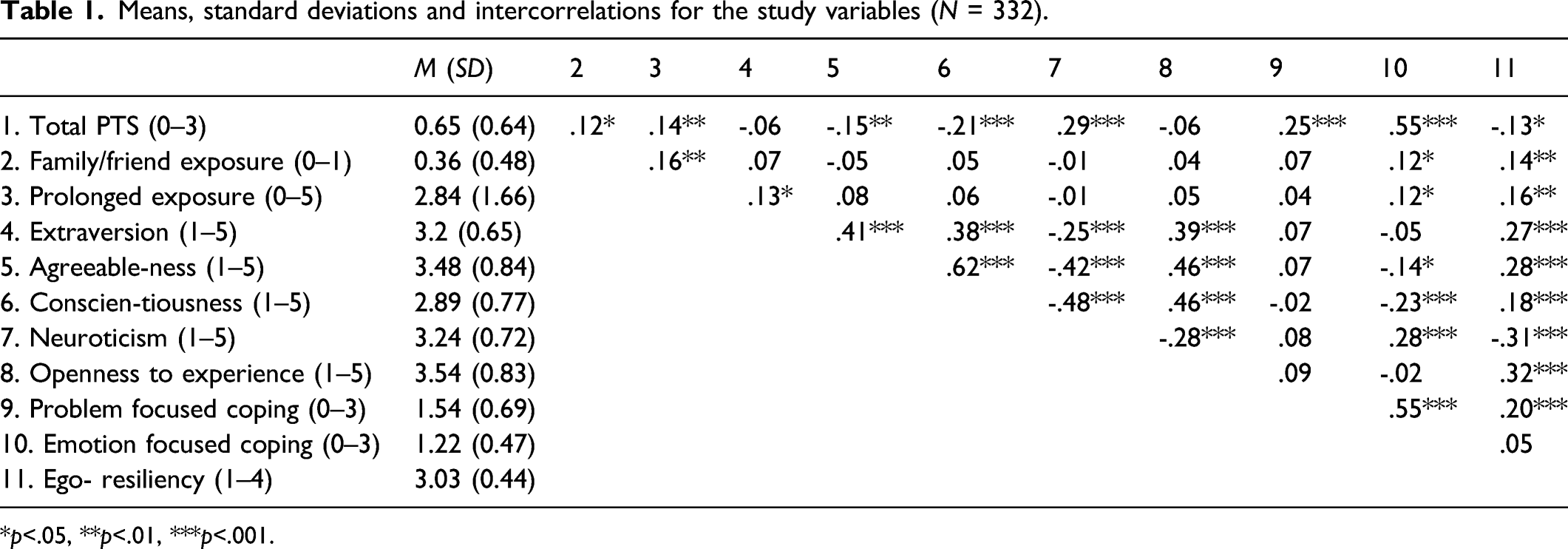
Means, standard deviations and intercorrelations for the study variables (N = 332).
*p<.05, **p<.01, ***p<.001.
As mentioned above, PTS was positively related with family/friend exposure (a family member or a friend was injured/a family member of a friend heard or saw a missile fall, or none), as well as with prolonged exposure to political violence. Further, duration of living in the area was positively related with PTS (r = .15, p = .006), and so was religiosity, with partly religious and religious participants showing higher levels of PTS (M = 0.72, SD = 0.68) than secular participants (M = 0.55, SD = 0.57) (t (330) = 2.36, p = .019). Other background variables were unrelated with PTS, and thus the hypotheses were examined while controlling for family/friend exposure to political violence, prolonged exposure to political violence, duration of living in the area, and religiosity. (Correlations among these variables ranged between r = −.01 p = .892 and r = .16 p =.003).
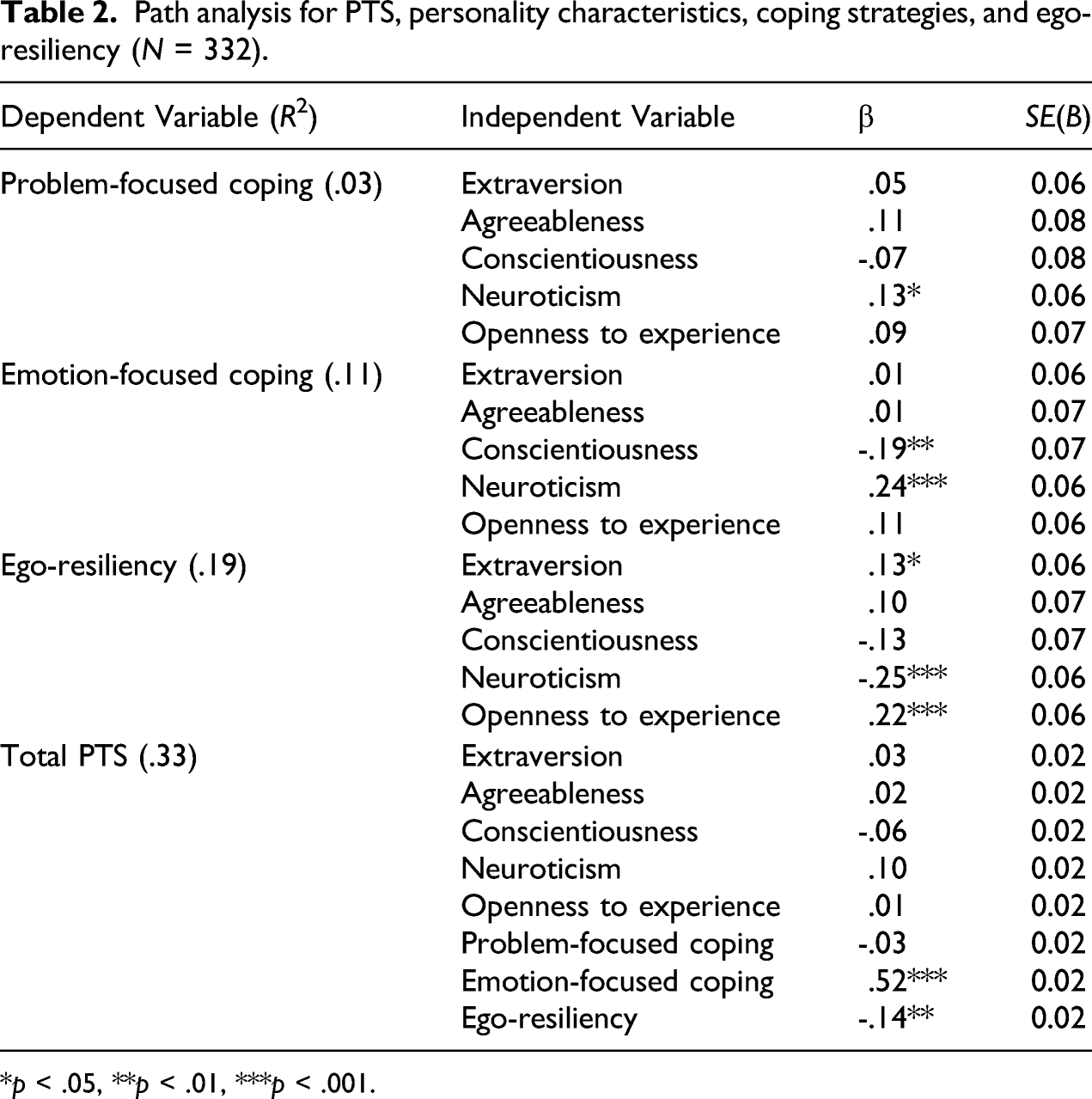
Path analysis for PTS, personality characteristics, coping strategies, and ego-resiliency (N = 332).
*p < .05, **p < .01, ***p < .001.
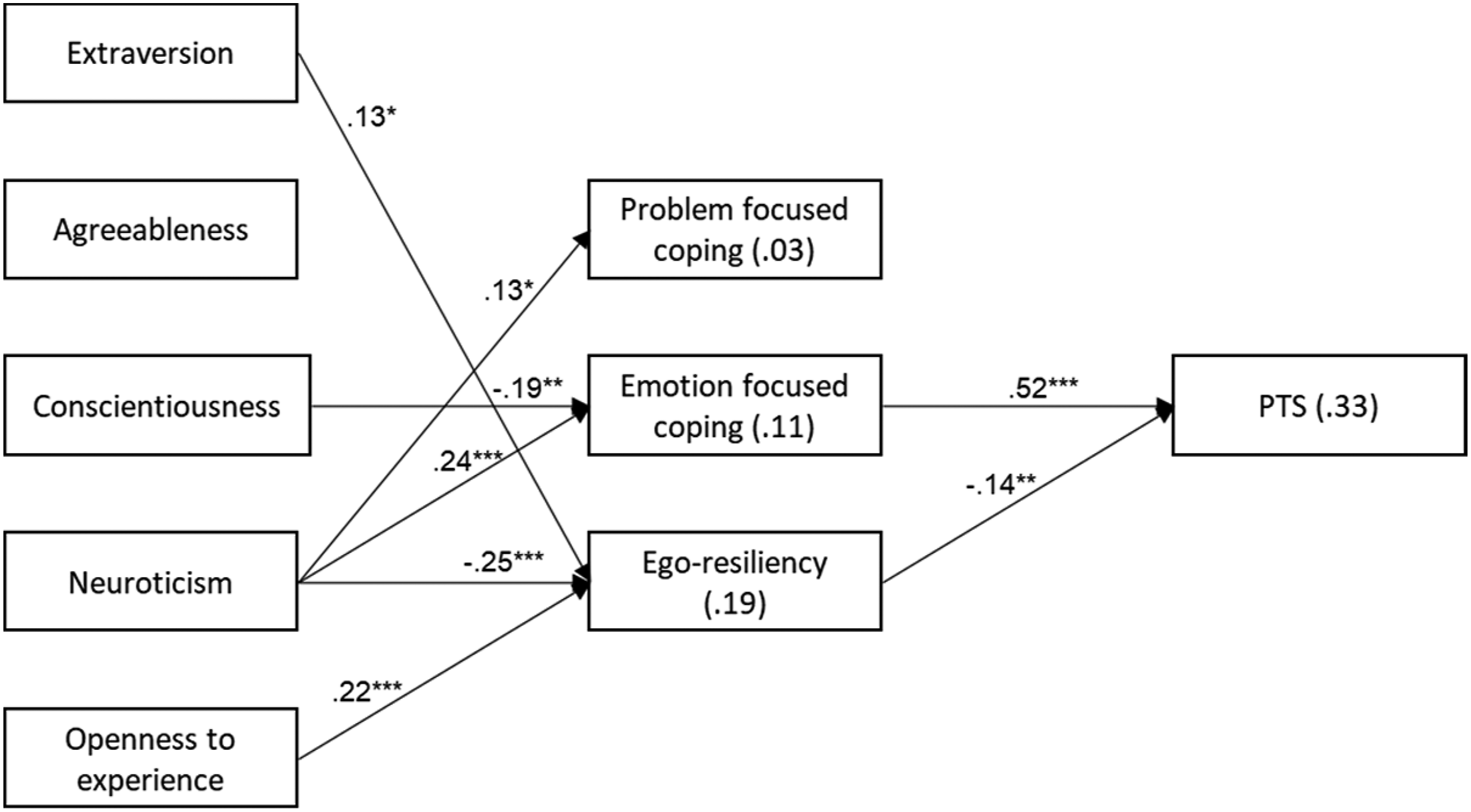
Path analysis for PTS, personality characteristics, coping strategies, and ego-resiliency. Note. R2 – values within rectangles. β – standardized regression coefficients-values above arrows.
Results show significant direct and indirect relationships. Higher extraversion and higher openness to experience were related with higher ego-resiliency; higher conscientiousness was related with lower use of emotion-focused coping; and higher neuroticism was related with greater use of both coping strategies, as well as lower ego-resiliency. Furthermore, greater use of emotion-focused coping was related with higher PTS, and higher ego-resiliency was related with lower PTS. Problem-focused coping was unrelated with PTS.
Several indirect relationships appear plausible (see Figure 1) and were found significant. First, higher extraversion was related with higher ego-resiliency, which was then related with lower PTS (95% CI: −0.0150, −0.0007). Second, higher openness to experience was related with higher ego-resiliency, which was then related with lower PTS (95% CI: −0.0220, −0.0030). Third, lower neuroticism was related with higher ego-resiliency, which was then related with lower PTS (95% CI: 0.0037, 0.0242). Furthermore, lower neuroticism was related with lower emotion-focused coping, which was then related with lower PTS (95% CI: 0.0230, 0.0721). Finally, higher conscientiousness was related with lower emotion focused coping as well, which was then related with lower PTS (95% CI: −0.0633, −0.0094).
In sum, several personality characteristics—mainly neuroticism but also extraversion, openness to experience, and conscientiousness—were indirectly related with PTS, through ego-resiliency and emotion-focused coping, beyond the control variables of family/friend exposure to political violence, prolonged exposure to political violence, duration of living in the area, and religiosity.
Discussion
This study focused on investigating the relations between personality and PTS symptoms due to chronic exposure to political violence, as well as possible factors that mediate these relations. We proposed a possible mediation of coping styles and ego-resiliency. The findings support most of the research hypotheses and the mediation model, showing that personality traits are differentially associated with coping styles and ego-resiliency, and coping styles and ego-resiliency are associated with PTS symptoms.
Ego-resiliency was found to mediate the relationship between extroversion, openness to experience and neuroticism and PTS symptoms. It appears that individuals with high levels of extroversion, openness to experience, and emotional stability are characterized by higher levels of ego-resiliency, and the higher levels of ego-resiliency are associated with lower levels of PTS symptoms. Ego-resiliency, therefore, seems to have a protective role. Our model corresponds with the findings of prior studies showing that ego-resiliency mediates between exposure to traumatic events and psychological distress (Philippe et al., 2011; Waqas et al., 2018). The present study extends this effect to distress related to political violence.
Ego-resiliency did not mediate the relationship between conscientiousness and agreeableness and PTS symptoms, and individuals with high conscientiousness and agreeableness reported lower levels of distress regardless of their level of ego-resiliency. Future studies should explore other psychological factors that may account for the negative relationship between conscientiousness and agreeableness and post-traumatic stress symptoms.
Another key finding refers to the mediating role of coping styles. As hypothesized, emotion-focused coping mediated the relations between neuroticism and PTS, such that high neuroticism was linked to a high tendency to use emotion-focused coping, and emotion-focused coping was associated with high levels of PTS. It seems that for neuroticism, both low ego-resiliency and emotion-focused coping may be possible routes for developing PTS. Prior studies have found that people with high neuroticism tend to be more anxious, stressful, and suffer from high levels of PTSD following various kinds of traumatic events (Di Crosta et al., 2020; Kroencke et al., 2020). Our findings correspond with these findings and indicate that neuroticism increases individual vulnerability to develop PTSD in the context of exposure to chronic political violence. Furthermore, the current study presents a possible explanation for this pattern. According to our model, neurotic people may be more vulnerable to PTS due to lower levels of ego-resiliency and using emotion-focused coping strategies. We suggest that these mechanisms may account not just for higher levels of stress symptoms due to chronic political violence, but also for higher emotional distress in other stressful situations. Therefore, future studies may wish to explore the model in additional stressful contexts.
Conscientiousness, too, was associated with emotion-focused coping and PTS, yet in a different direction than the one expected. Contrary to our hypothesis, higher conscientiousness was related with lower levels of stress symptoms. This pattern contradicts Shmotkin and Keinan’s findings (2011) of an association between high conscientiousness and stronger reactions to political violence during the Al-Aqsa Intifada in 2003. However, their study examined reactions to one sporadic, relatively short-term event, whereas the current study examined reactions to a chronic state of political violence. Perhaps conscientiousness characteristics—carefulness, self-control, efficiency, and goal-oriented behavior—are useful in coping with chronic political violence. It may be that orderly, careful and planned behavior is helpful in learning how to adjust to living under conditions of constant threat.
In the absence of research on the big five personality traits and coping with political violence, our expectation for a relation between agreeableness, extroversion, and openness to experience and coping style was based on previous research in the larger field of coping. This expectation might not be suitable for coping with political violence, and specifically for coping with chronic political violence. Coping with chronic political violence may be different in a few respects. For one, chronic political violence is somewhat more predictable than a one-off terror event (Cohen-Louck & Levy, 2020), may result in habituation over time (Cohen-Louck & Saka, 2017), and may thus be associated with lower use of coping strategies (Cohen-Louck & Ben-David, 2017), at least for some individuals. Normalization of living under continuous political violence may be more plausible for emotionally stable individuals, whereas neurotic ones may become even less balanced than usual and continue their unsuccessful efforts to cope. Future research on the subjective experience of living with chronic political violence, by various personality characteristics, will allow a better understanding, and verify whether habituation and normalization occur.
The present study is not without limitations. One such limitation is the cross-sectional nature of our data. Further research that uses longitudinal designs is needed to support the findings on causal pathways between the big five personality traits, coping styles, ego-resiliency, and PTS symptoms. Furthermore, this study is based on self-reports; therefore, the results represent participants’ subjective assessment of their personality traits, ego-resiliency, levels of traumatic stress and ways of coping. Additionally, the external validity of the findings may be somewhat limited because the sample was a convenience sample. Finally, although the findings may be relevant in general for people who are exposed to political violence, caution should be exercised when generalizing them to other populations, as ways of coping with stress and adversity may be culturally dependent. Future research should examine the link between personality, ego-resiliency, coping, and PTS symptoms among diverse populations, including different racial and ethnic groups, people from different socioeconomic status, and immigrants. People who have emigrated may constitute a special population. Immigration is often a stressful life event, which requires long adaptation and coping with difficulties. Thus, immigrants, who face both the difficulties of immigration and political violence, may show different ego-resiliency and patterns of coping. Israel is an immigration country comprised of Jews from all over the world who came to live in it within the Law of Return (Shechory & Ben-David, 2010). It should be informative to examine whether the relations of personality, ego-resiliency, coping, and PTS are related to immigration to Israel, and by immigrants’ different descent.
Conclusions
The contributions of this novel study are both theoretical and practical. It contributes to the body of literature by presenting a model describing a relationship between the big five personality traits, ego-resiliency, coping styles, and PTS symptoms. According to our model, ego-resiliency and emotion-focused coping mediate the relationship between personality traits and stress symptoms. In addition, to the best of our knowledge, this study is the first to focus on the contribution of ego-resiliency and the big five to coping with chronic political violence. Future research should expand this research avenue. From a practical, clinical standpoint, our findings are also useful for preventive and therapeutic work with direct and indirect victims of chronic political violence. It is suggested that clinical processes and therapy focus on promoting ego-resiliency, especially among individuals characterized by high neuroticism.
Future research should continue the direction of the present study and focus on the relations between personality and stress responses due to political violence. Other possible mediating factors—both psychological and environmental—should be explored. For example, an individual’s subjective sense of control over various aspects of life (also known as locus of control) may affect coping with stress related situations (e.g., Arslan et al., 2009; Zvi & Elaad, 2016) and is very interesting to look at in the context of coping with ongoing uncontrollable stress related to political violence. Knowledge of the role of individual differences will allow a more integrative understanding of the effects of long-term political violence.
Footnotes
Declaration of conflicting interests
The author(s) declared no potential conflicts of interest with respect to the research, authorship, and/or publication of this article.
Funding
The author(s) received no financial support for the research, authorship, and/or publication of this article.
Data Accessibility Statement
The data that support the findings of this study are available from the corresponding author Keren Cohen-Louck (via e-mail), upon reasonable request.
