




Abstract
Stalking and obsessive relational intrusions both refer to a pervasive and unwanted pattern of pursuit behaviors, the former being a criminal offense evoking fear and a sense of menace in the victim, while the latter may be perceived as annoying or otherwise undesirable, but not necessarily fear inducing. While the individual and societal costs of stalking and obsessive relational intrusion are increasingly recognized, research regarding these behaviors and their consequences has been limited by measurement issues, as most studies have relied on questionnaires and checklists based on very limited validation data. The goal of the present study is to report on the development and validation of the Stalking and Obsessive Relational Intrusions Questionnaire (SORI-Q), a 28-item self-report questionnaire designed to probe for perpetration of stalking-like behaviors. Young adults (age 18–30 years) from a community sample (N = 1,804; 82.6% women) were recruited online. They completed the SORI-Q, along with measures of dark personality traits, insecure attachment dimensions, and intimate partner violence. Overall, the SORI-Q displayed sound psychometric properties. Exploratory and Confirmatory Factor Analysis yielded a two-factor solution (Hyper-intimacy and Domineering control) with adequate to good fit indices. The total scale and the two factor scores showed high internal consistency (above 0.70 for all indices). A number of gender differences were observed at total-, factor-, and item-level, the most outstanding being that women had a higher score on the total SORI-Q score, and on the Domineering control factor and most of its items. The questionnaire showed conceptually meaningful positive correlations with dark personality traits, attachment anxiety, and intimate partner violence. Dominance analysis revealed that attachment anxiety and Machiavellianism were the strongest statistical predictors of SORI-Q scores. The SORI-Q should be seen as a promising new measure of stalking-like and ORI behaviors in young adults from community settings.
Introduction
Stalking is defined as “a course of conduct directed at a specific person that involves repeated visual or physical proximity, non-consensual communication, or verbal, written, or implied threats or a combination thereof, that would cause a reasonable person fear” (National Criminal Justice Association, 1993, pp. 43–44). It refers to a pervasive and unwanted pattern of pursuit behaviors that can be frightening, threatening, harassing, and potentially dangerous. While its prevalence in the United States varies considerably depending on its operationalization (see Rosay et al., 2020, for a summary), the National Intimate Partner and Sexual Violence Survey reveals that about one in six women and one in 17 men have experienced stalking in their lifetime (Smith et al., 2018). It is a major public health concern, with high societal and individual costs, including substantial distress, posttraumatic stress symptoms, depression, anxiety, suicidal ideation, and panic attacks (e.g., Stevens et al., 2021). The economic toll of stalking (e.g., medical care, mental health services, lost salary) has been estimated between US$235 and US$449 million for women in America (Max et al., 2004). In forensic practice, stalking is often conceptualized as a continuation and extension of intimate partner violence (IPV); perpetrators of stalking and perpetrators of IPV do actually share a number of characteristics (e.g., substance misuse, history of IPV, prior criminal history, unemployment), although they also appear to show some key differences (e.g., greater variety of methods or patterns of pursuit behaviors among stalking perpetrators; Flowers et al., 2020).
While the term “stalking” refers to a legal definition involving repeated and fear-inducing actions, a closely related phenomenon likely to be much more widespread is the unwanted pursuit of intimacy. Terms such as unwanted pursuit behavior (Langhinrichsen-Rohling et al., 2000) and persistent pursuit (Davis et al., 2012) have been proposed to study this phenomenon. Cupach and Spitzberg (1998, pp. 234–235) have coined the term obsessive relational intrusion (ORI) as an integrative concept to describe “a pattern of repeated and unwanted pursuit and invasion of one’s sense of physical or symbolic privacy by another person, either stranger or acquaintance, who desires and/or presumes an intimate relationship.” There are two significant differences between stalking and ORI (Spitzberg & Cupach, 2007): (a) some stalkers do not pursue intimacy or a relationship with their target and (b) ORI behaviors do not always cross the threshold of fear or threat; some may be perceived as annoying or otherwise undesirable, but not necessarily fear-inducing—although relatively low levels of ORI are often viewed as threatening (Cupach & Spitzberg, 2000). ORI and stalking are not mutually exclusive, as persistent behaviors seeking intimacy that elicit fear in the target can eventually become stalking as legally defined. There are also conceptual overlaps between stalking and ORI, and the motivation underlying both sets of behaviors is often quite similar. Motivations have been grouped into “expressive” (e.g., love or infatuation, anger, rage, and grief), “instrumental” (e.g., a desire to control the target, or to harm them through intimidation, humiliation, or revenge), “personalogical” (e.g., mental disorders, including erotomania, personality disorders or pathological personality traits, or lack of social skills and competency), and “contextual” (e.g., breakup, nostalgia, presence of rivals, incidental life stressors such as unemployment, or economic stress; Spitzberg & Cupach, 2014).
Measurement of Stalking Behaviors and ORI
Literature on stalking-like and ORI behaviors is characterized by both the existence of a wide array of instruments assessing perpetration and victimization (see McEwan et al., 2021; Spitzberg & Cupach, 2014, for a summary), and, simultaneously, a paucity of findings regarding the quality of these measures (Fox et al., 2011). To date, no gold standard measure has clearly emerged in the field. This prompted many researchers to turn to ad hoc measures that either consist of a “home-made” checklist of stalking-like behaviors, or a selection of the best items from previous instruments (e.g., Katz & Rich, 2015; Shorey et al., 2015). Many existing instruments provide a limited coverage of the whole range of stalking and ORI behaviors (e.g., only focusing on fear-inducing behaviors). Some measures focus on either stalking perpetration or stalking victimization, but not both, whereas others only focus on behaviors limited to one specific form of romantic relationships (e.g., a current or a terminated relationship; Katz & Rich, 2015; Lee & O'Sullivan, 2014; Shorey et al., 2015). It also appears that very few measures assess both offline (in-person) and online stalking (or cyberstalking), resulting in the necessity to incorporate two distinct measures of these types of pursuit behaviors in some studies (e.g., Dardis et al., 2019). Finally, the capacity of existing instruments to cover forms of stalking-like and ORI behaviors believed to be more typical of female perpetrators (e.g., flirting, engaging in attention-seeking behaviors, online shaming) has been questioned (Davis et al., 2012); the focus on fear-inducing indicators in past research likely influenced whether women and men were classified as victims or perpetrators, respectively (Davis et al. 2012; Lyndon et al. 2012; also see Rosay et al., 2020, for a discussion).
Development of the Stalking and Obsessive Relational Intrusions Questionnaire
The need for a valid self-report measure of stalking and ORI behaviors, in conjunction with the shortcomings of existing measures (see, e.g., Davis et al., 2012; Fox et al., 2011), led us to develop a new scale, the Stalking and Obsessive Relational Intrusions Questionnaire (SORI-Q; Savard et al., 2015 ). We wished to develop a scale that: (a) was relatively concise; (b) would provide a wide coverage of stalking-like and ORI behaviors, including milder ones (i.e., that could arouse boredom, annoyance, or irritation in the victim); (c) focused on behaviors likely to be relatively common, including in community settings; (d) would focus on close, intimate relationships (whether these are actual or desired relationships); (e) would include items formulated in a descriptive, operationalized, and non-judgmental manner; (f) was “contemporary”, that is, covering online and social media behaviors; (g) targeted behaviors likely to be present in young perpetrators (18–30 years old); (h) was not overly redundant with measures of related constructs such as IPV (e.g., did not focus on overt violent behaviors); and (i) following Davis et al.’s (2012) suggestion, included behaviors more typical of female perpetrators.
In the first step of the SORI-Q’s development, we generated items based on five existing measures of stalking and ORI (the Stalking Behavior Checklist [Coleman, 1997]; the Stalking Behaviors Inventory [Johnson & Kercher, 2009]; the Stalking Measure [Lacey et al., 2013]; the Cyber-obsessional pursuit [Spitzberg & Hoobler, 2002]; and the Survey of Obsessive Relational Intrusions [Spitzberg & Cupach, 2014]). The focus was to identify non-redundant items corresponding to all criteria mentioned above. We retained 43 potential stalking-like and ORI behaviors, which were formulated into potential items in line with the objectives outlined above. This pool of items was then reviewed by a panel of five experts on couple and interpersonal violence (three university professors and two senior clinical psychologists), and five undergraduate students (one male, four female) from the target population of young adults. They rated all items for their representativeness of stalking and ORI, on a scale ranging from 0 (Not representative at all) to 5 (Totally representative), and for their overall quality (formulation, clarity, etc.), also on a scale ranging from 0 (Very poor quality) to 5 (Very good quality). Members of the panel also had the opportunity to comment on existing items and to suggest other potential items that were not included in our original review. Items with a mean score ≤4.5 on either scale were revised and reassessed by the members of the panel until a mean score of >4.5 was attained; this led to the revision of 10 items. Panel members suggested the addition of 10 items to the original item pool; all these suggestions were retained, leading to the formulation of 10 additional items based on these suggestions that were also reviewed according to the procedure mentioned above.
We chose a response format similar to the Conflict Tactics Scales (CTS2; Straus et al., 1996), a self-report measure of IPV that allows participants to rate, for each item, both their experience of perpetration, and their experience of victimization. Thus, all SORI-Q items probe for perpetration and victimization of stalking-like and ORI behaviors. Fifty-three item pairs (perpetration and victimization) were included in the original version of the scale. The response format used in the CTS2 was also favored, with a seven-point scale ranging from This never occurred to This occurred 20 times or more over the past year. In line with Straus et al. (1996), we suggest that two different metrics should be reported for the total and subscale scores in nonclinical samples: a dichotomous “prevalence” variable (i.e., did each behavior occur at least once in the past year?) and a “chronicity” variable based on occurrences (i.e., how many times did it occur in the past year?). For the latter, the SORI-Q is scored by adding the midpoint for the anchor point chosen by the participant (e.g., for the anchor point 6–10 times in the past year, a score of 8 should be given; for the anchor point 11–20 times over the past year, a score of 15 should be given; for the 20 times or more in the past year, a score of 25 is suggested, following Straus et al., [1996]). As a first step, and because of space limitations, initial validation of the scale in the present article will focus on perpetration.
An empirical pretest study (N = 415) was conducted ( Gamache et al., 2018 ) with the main objective of reducing the number of items based on classical test theory (CTT). We fixed as a priori criteria that the retained items should (a) have a prevalence of ≥ 2% and (b) have a corrected item-scale correlation (ISC) figure of ≥ 0.30 with the total scale. Results suggested that the total scale had good internal consistency (α = 0.86) and conceptually meaningful associations with stalking- and ORI-related constructs, including dark personality traits (Machiavellianism, narcissism, psychopathy), insecure attachment dimensions, and IPV. However, limitations included instability of factors (with very few items displaying strong loadings >0.50), the presence of items with very low variance (< 2%), and a very low number of male participants (n = 57). A total of 25 item pairs did not meet our criteria for item selection (17 had a prevalence < 2%, 8 had an ISC < 0.30), and were eliminated for further use of the SORI-Q. Therefore, the final version of the SORI-Q, which will be the focus of the present validation study, includes 28 item pairs.
The Present Study
The present study aims at exploring the psychometric properties of the SORI-Q for stalking perpetrators in a community sample. Analyses include: (a) Exploratory and Confirmatory Factor Analyses. We did not have precise a priori expectation regarding the factorial structure of the instrument. Indeed, while Spitzberg and Cupach (2014) have identified up to nine distinguishable clusters of stalking behaviors, 1 results from the aforementioned pilot study on the SORI-Q ( Gamache et al., 2018 ), although inconclusive, suggested that up to six factors may be present (Intrusive control, Aggression in the form of shaming, Hyper-intimacy, Aggression in the form of provocation, Relational intrusions, and Surveillance); (b) Internal consistency; (c) Examination of gender differences. Even though research generally finds that men are more likely to be perpetrators than females (e.g., Tjaden & Thoennes, 1998), findings from community samples tend to show less disparity in contrast with clinical or forensic samples (Spitzberg & Cupach, 2007). Given that one of the instrument’s purpose was to provide an improved coverage of stalking-like and ORI behaviors in women, we nonetheless expect to see higher endorsement of some items for female participants; this might be especially true for items probing for covert or cyberstalking behaviors (e.g., Berry & Bainbridge, 2017; March et al., 2020; Purcell et al., 2010; Smoker & March, 2017); (d) Convergent-discriminant validity with measures of maladaptive personality traits, insecure attachment dimensions, and IPV. In line with previous results using pathological narcissism (Ménard & Pincus, 2012) and Dark Tetrad (i.e., Machiavellianism, psychopathy, narcissism, and everyday sadism; March et al., 2020; Smoker & March, 2017) as external criteria, low to moderate correlations with maladaptive personality traits are expected. Previous results on the relationship between attachment insecurity and stalking suggest that attachment anxiety should be significantly correlated with the SORI-Q (e.g., Lewis et al., 2001; Patton et al., 2010); attachment avoidance is less likely to show significant associations. As for IPV, previous studies have shown a significant relationship with stalking-like and ORI behaviors (Norris et al., 2011). For the present study, we believe that very high correlations (>0.75, or R2 >0.50) with IPV would be indicative of poor discriminant validity for the SORI-Q, as stalking-like and ORI behaviors are expected to be distinct from IPV, although they most certainly are inter-correlated constructs; and (e) dominance analysis to determine the relative contribution of dark personality traits and insecure attachment dimensions to the statistical prediction of stalking-like and ORI behaviors.
Method
Participants and Procedure
A total sample of 1804 French-speaking Canadian participants (82.6% cisgender women, 16.4% cisgender men, 1.0% non-binary) aged 18–30 years old (M = 24.35, SD = 3.40) were included in the study. We specifically targeted this age group for recruitment, in line with our objective to develop a measure focusing on stalking-like and ORI behaviors in young adults. There were two recruitment waves, one from Jan–Apr 2018 (n = 516), the other from Sept–Nov 2020 (n = 1,288). 2 Participants were recruited through social media, online message boards, and institutional e-mail from two universities in the Province of Quebec, Canada; data were collected anonymously and computerized via an online platform (SurveyMonkey). Most participants were full-time or part-time students (52.1%) and a significant proportion identified as full-time or part-time workers (40.1%). Most participants (90.4%) had post-high-school education, and 44.1% had a university degree. The majority (67.7%) were in a couple relationship.
All participants gave informed consent. They had the chance to enter a draw for five $50 gift certificates, and had the opportunity to receive, on demand, a summary of the general findings (but not of their individual results) of the study. This project was approved by two ethics institutional review boards from (Université du Québec à Trois-Rivières and Université Laval).
Measures
The Dirty Dozen (DD; Jonason & Webster, 2010; French translation and validation by Savard et al., 2017) is a 12-item measure, using a nine-point Likert scale, that assesses Machiavellianism (strategic and calculating interpersonal orientation; α = 0.82), psychopathy (selfishness, callousness, and lack of empathy and remorse; α = 0.62), and narcissism (grandiose sense of self-importance and entitlement; α = 0.84) according to the Dark Triad conceptualization (Paulhus & Williams, 2002).
A short form of the Experiences in Close Relationship Questionnaire (ECR-12; Lafontaine et al., 2015), a 12-item self-report, was used to assess both dimensions of romantic attachment: Anxiety (fear of abandonment; α = 0.88) and Avoidance (discomfort with closeness and interdependence; α = 0.88). Items are scored on a seven-point scale.
The CTS-23 (Straus et al., 1996; French translation and validation by Lussier [1997]) is a 78-item self-report assessing violence and aggression in intimate relationships, scored on a seven-point scale reflecting frequency of violent behaviors (ranging from Had never occurred to More than 20 times in the past year). The instrument provides five sub-scores, three of which were used in the present study: Physical aggression (α = 0.74), Psychological aggression (α = 0.76), and Nonviolent negotiation behaviors (α = 0.94).
Statistical Analyses
Factor structure was assessed with Exploratory Factor Analysis (EFA) and Confirmatory Factor Analysis (CFA), using Mplus version 8.4 (Muthén & Muthén, 2017). EFA was conducted on a random split-half sample (n = 881) that was previously determined using the “Select cases: random sample” option in SPSS. 4 CFA was then conducted on the remaining half of the sample (n = 923) as a confirmatory test of the retained factor solution. All factor models were tested on the rank-order (untransformed) participant’s responses using the weighted least squares means and variance adjusted (WLSMV) estimator based on the polychoric correlation matrix, which is better suited to the ordered-categorical nature of Likert scales (Beauducel & Herzberg, 2006), and an oblique Geomin rotation was applied for both EFA and CFA. Evaluation of the models was based on the Comparative Fit Index (CFI; adequate fit: >0.90; good fit: >0.95), the Tucker-Lewis Index (TLI; adequate fit: >0.90; good fit: >0.95), the Root Mean Square Error of Approximation (RMSEA; adequate fit: <0.10; good fit: <0.06), and the Standardized Root Mean Square Residual (SRMR; good fit: <0.08; Hu & Bentler, 1999). A parallel analysis (O’Connor, 2000) was also run to determine the upper limit of possible factor solutions based on comparison of actual eigenvalues with ones generated through a simulation using 100 samples with the same characteristics (n of participants and items) as ours. A factor loading ≥0.32 was considered significant (Comrey & Lee, 1992). Reliability of factor scores from the final solution was assessed following Beauducel et al.’s (2016) procedure to compute Thurstone’s, Bartlett’s, and McDonald’s factor score estimators. Factor interpretability was also considered in the final selection of the model. As an evaluation of configural invariance, the same measurement model was examined separately for women and men through CFA; if the same measurement model fits the data well across both gender subsamples, then configural invariance is considered to be supported (Xu & Tracey, 2017).
Cronbach alphas were used to assess internal consistency of the total SORI-Q and its factors. Differences across genders were evaluated for both metrics used to determine the total SORI-Q score, using chi-squares (for the dichotomous prevalence) and nonparametric group comparison (Mann-Whitney) for the number of occurrences. Convergent-discriminant validity was first assessed through bivariate correlations between the SORI-Q and external criteria (DT traits, dimensions of attachment insecurity, IPV). Then, to explore the relative contribution of DT traits and dimensions of attachment insecurity to the statistical prediction of SORI-Q scores (total and factors), a dominance analysis was conducted. Dominance analysis determines the “statistical dominance” of one predictor over another in regression models by a head-to-head comparison of their additional R2 contributions across all possible subset models (Azen & Budescu, 2006). They were computed with the RLM macro for SPSS developed by Hayes (2017). Because an important skewness of data was expected, two precautions were implemented: (a) Spearman rank-order correlations were preferred to Pearson correlations and (b) a logarithmic transformation of SORI-Q scores (i.e., the total and the two factor scores) was applied to improve the normality of the distribution; those logarithmically transformed scores were used for correlational and dominance analyses; for both analyses, scores based on occurrences were used.
Results
Exploratory (n = 881) and Confirmatory (n = 923) Factor Analysis of the Stalking and Obsessive Relational Intrusions Questionnaire.
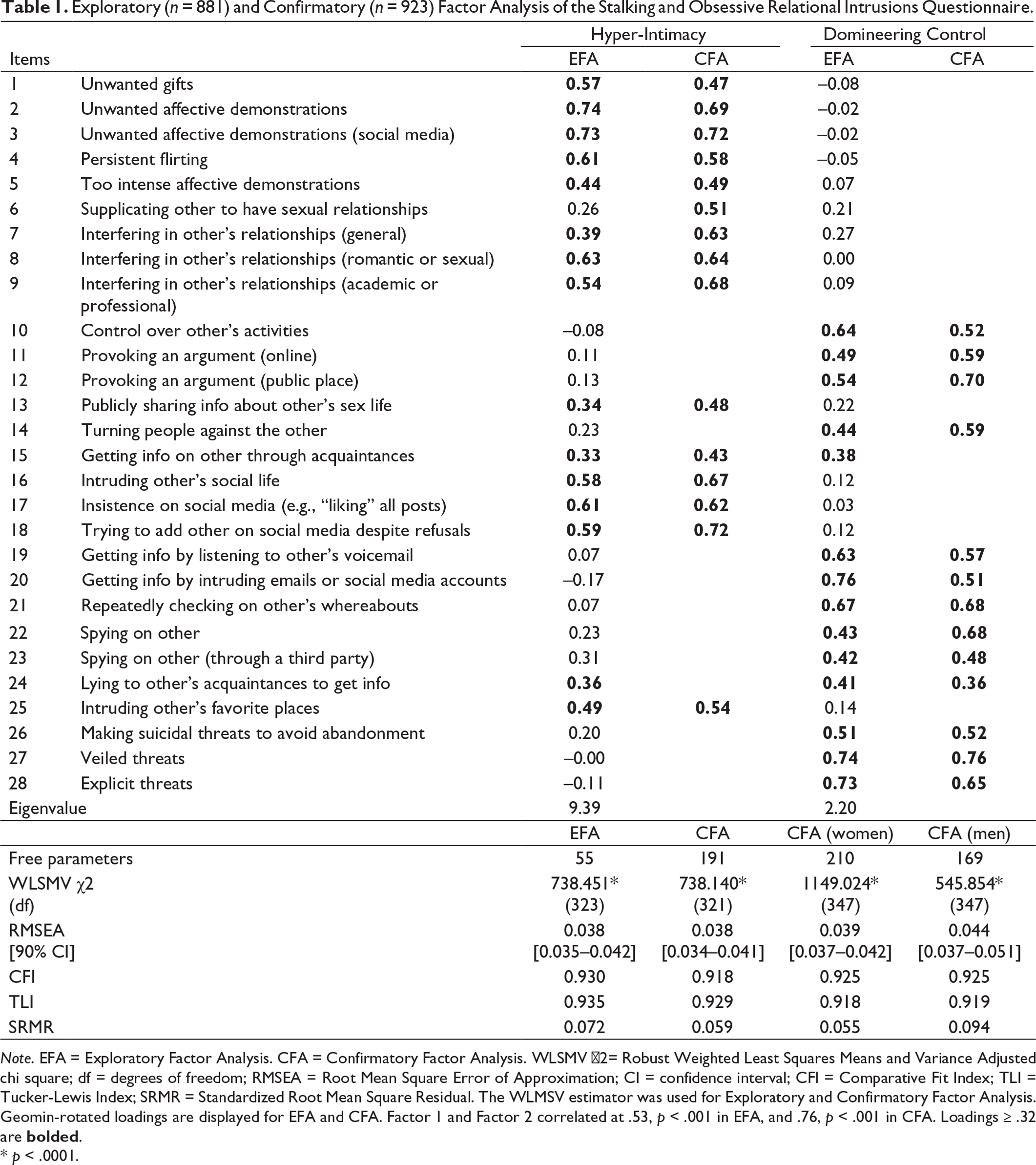
Note. EFA = Exploratory Factor Analysis. CFA = Confirmatory Factor Analysis. WLSMV χ2= Robust Weighted Least Squares Means and Variance Adjusted chi square; df = degrees of freedom; RMSEA = Root Mean Square Error of Approximation; CI = confidence interval; CFI = Comparative Fit Index; TLI = Tucker-Lewis Index; SRMR = Standardized Root Mean Square Residual. The WLMSV estimator was used for Exploratory and Confirmatory Factor Analysis. Geomin-rotated loadings are displayed for EFA and CFA. Factor 1 and Factor 2 correlated at .53, p > .001 in EFA, and .76, p > .001 in CFA. Loadings ≥ .32 are
* p > .0001.
Descriptive Statistics and Gender Differences for the Stalking and Obsessive Relational Intrusions Questionnaire Items and Factors.
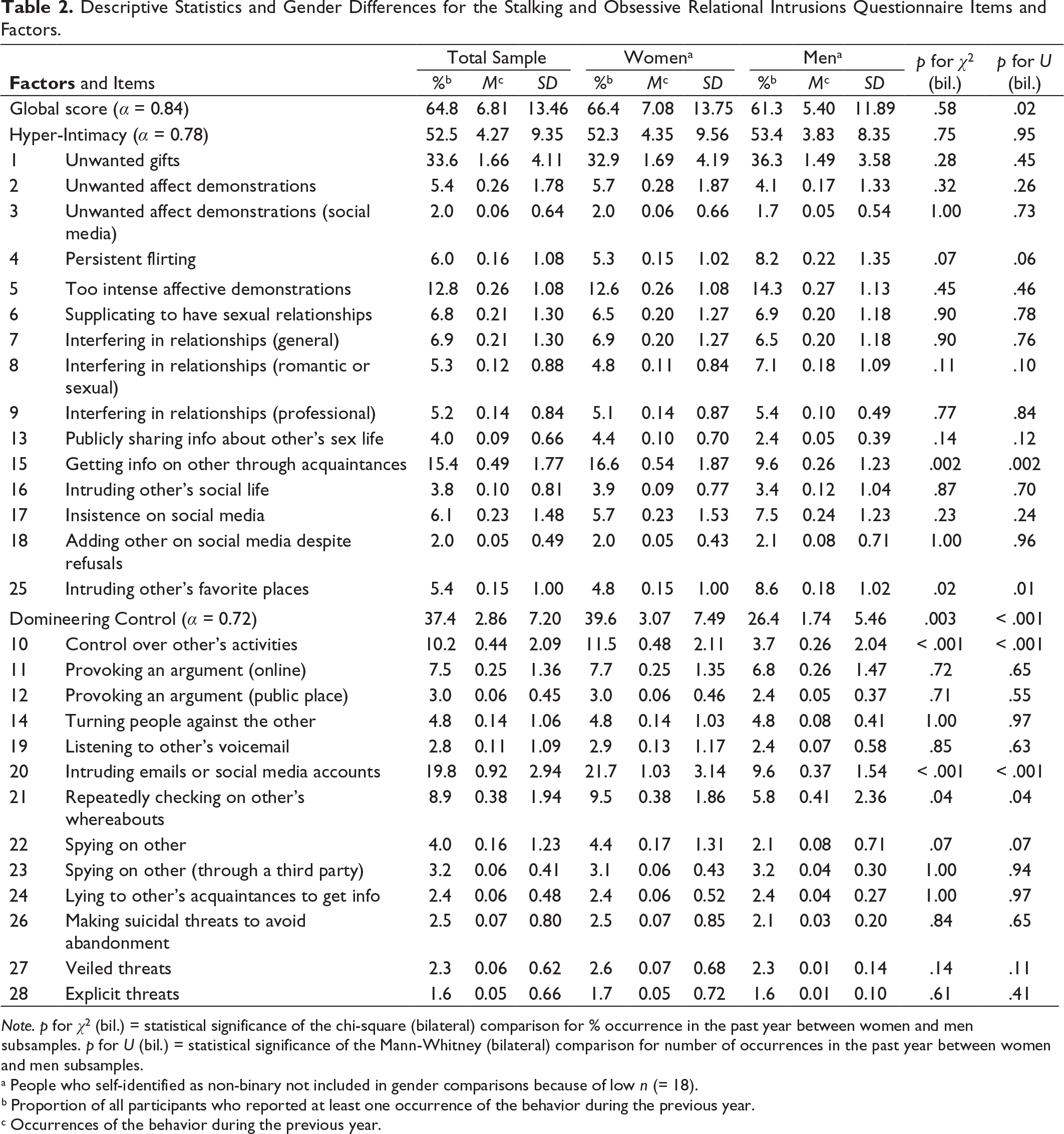
Note. p for χ2 (bil.) = statistical significance of the chi-square (bilateral) comparison for % occurrence in the past year between women and men subsamples. p for U (bil.) = statistical significance of the Mann-Whitney (bilateral) comparison for number of occurrences in the past year between women and men subsamples.
a People who self-identified as non-binary not included in gender comparisons because of low n (= 18).
b Proportion of all participants who reported at least one occurrence of the behavior during the previous year.
c Occurrences of the behavior during the previous year.
Convergent and Discriminant Validity of the Stalking and Obsessive Relational Intrusions Questionnaire.
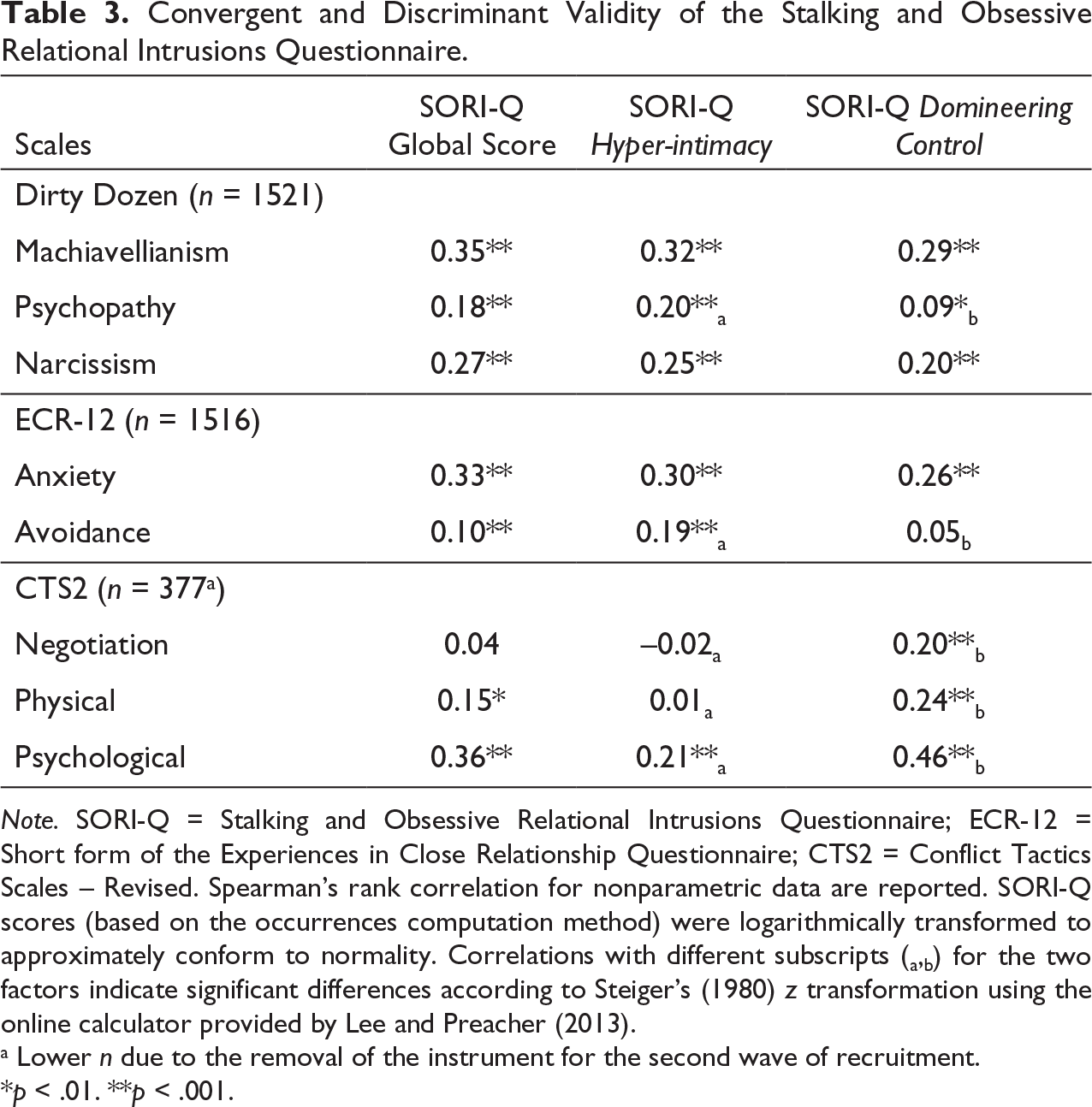
Note. SORI-Q = Stalking and Obsessive Relational Intrusions Questionnaire; ECR-12 = Short form of the Experiences in Close Relationship Questionnaire; CTS2 = Conflict Tactics Scales – Revised. Spearman’s rank correlation for nonparametric data are reported. SORI-Q scores (based on the occurrences computation method) were logarithmically transformed to approximately conform to normality. Correlations with different subscripts (a,b) for the two factors indicate significant differences according to Steiger’s (1980) z transformation using the online calculator provided by Lee and Preacher (2013).
a Lower n due to the removal of the instrument for the second wave of recruitment.
*p < .01. **p < .001.
Dominance Matrices for the Statistical Prediction of SORI-Q Total and Factor Scores.
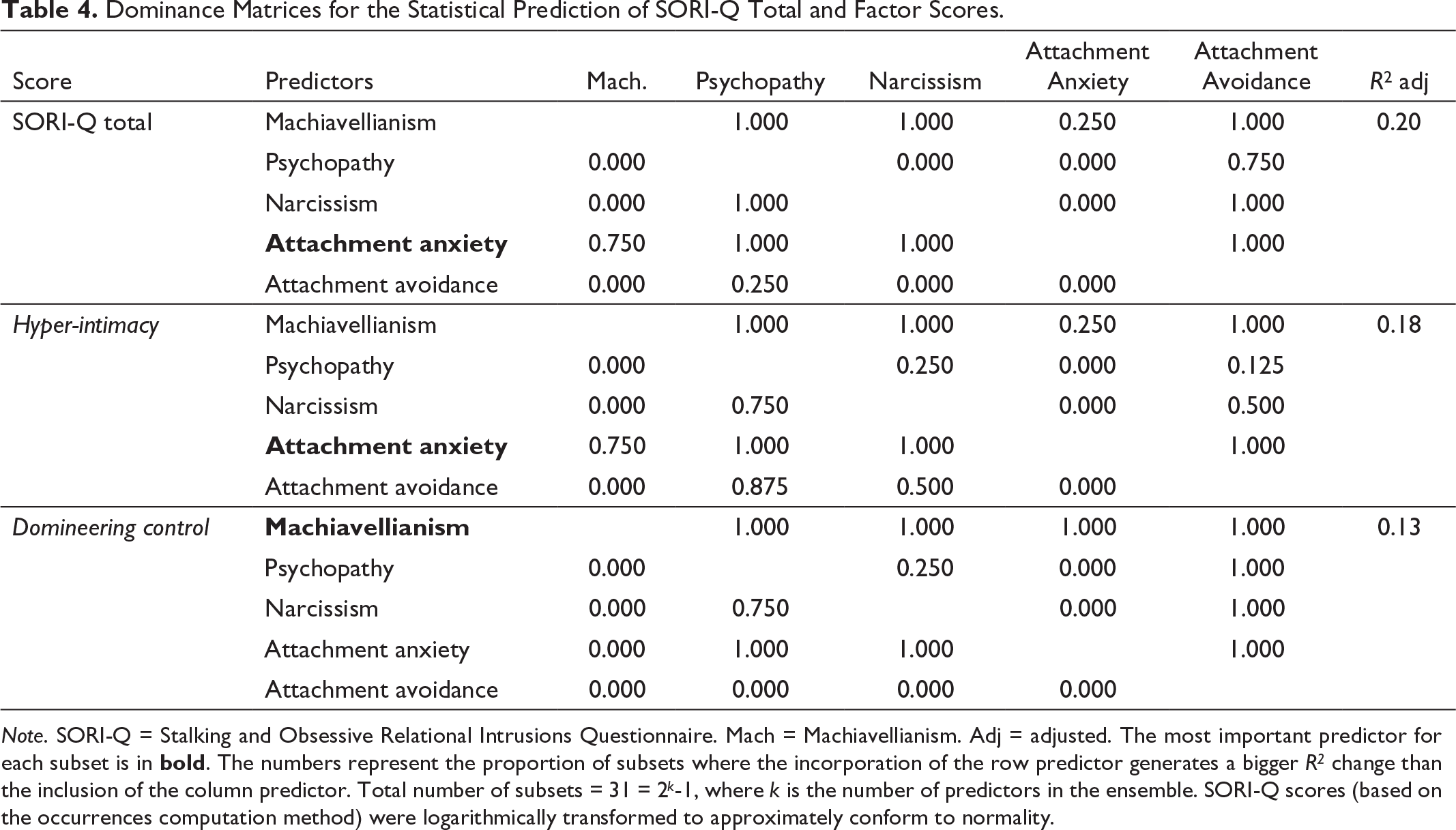
Note. SORI-Q = Stalking and Obsessive Relational Intrusions Questionnaire. Mach = Machiavellianism. Adj = adjusted. The most important predictor for each subset is in
Discussion
The main purpose of the present study was to report on the development and psychometric properties of the SORI-Q, a recently developed self-report measure covering a wide range of stalking-like and ORI behaviors. The study provides important preliminary results in support of its validity in a relatively large community sample of young adults.
EFA and CFA revealed a sound two-factor solution with adequate to good model fits according to all indices. There were minimal cross-loadings (two items, #15 and #24) for the retained solution, and only one item (#6) did not have a loading >0.32 on any factor in EFA but performed better in CFA. Importantly, the factor structure showed configural invariance for gender, as satisfactory fits were obtained in both the women and men subsamples (with SRMR in the men subsample as the lone unsatisfactory fit), providing preliminary evidence that the two-factor structure holds regardless of gender. 7 The first factor, Hyper-intimacy, includes for the most part items reflective of typical courtship activities but taken to an excessive level; it also comprises items pertaining to invasion of personal boundaries and relationships. The second factor, Domineering control, includes behaviors reflective of hostile control and domination over the other, including overt threats and intimidation; it also comprises more intrusive forms of control and boundary violations (e.g., going through other’s voicemail, emails, or social media accounts), and surveillance/spying. Both factors included items that could correspond to “cyberstalking” (see, e.g., Spitzberg & Hoobler, 2002), although online behaviors included in the Hyper-intimacy factor relate more to a persistent research for closeness and intimacy (e.g., insistence on social media) while those in the Domineering control factor convey more aggressiveness and coercion (e.g., provoking an argument online, intruding social media or applications). Our two-factor solution is in contrast with Spitzberg and Cupach’s (2014) suggestion, based on an extensive literature review, of up to nine distinguishable clusters of stalking behaviors. However, a recent principal component analysis conducted on the 22-item Stalking Assessment Indices (SAI; McEwan et al., 2021), a self-report assessing more severe forms of stalking, also yielded two components that bear resemblance to ours: Their first component captured Spitzberg and Cupach’s (2014) themes of surveillance and mediated and interactional contact, and possibly hyper-intimacy according to the authors (similarly to our Hyper-intimacy factor), while their second captured harassment and intimidation, coercion and threat, invasion, and aggression and violence (similarly to our Domineering control factor).
Internal consistency was satisfactory for the total SORI-Q and for both factor scores. In general, response distribution tended to suggest that stalking-like and ORI behaviors had a relatively low base rate in the present sample; further studies should include participant groups (e.g., clinical, forensic) where these behaviors are likely to be more prevalent. It should be noted, however, that some behaviors had higher prevalence, including five reported by >10% of participants in the previous year, which suggests that the SORI-Q reasonably meets its intended purpose of covering relatively common stalking-like and ORI behaviors.
One of our main findings is that a number of significant gender differences were identified, using two different computation methods (dichotomous prevalence and number of occurrences). Women showed higher mean scores for the total SORI-Q scale (albeit only when using the number of occurrences metric), and for the Domineering control factor and four of its items; women and men, however, had mostly similar prevalence and number of occurrences scores on the Hyper-intimacy factor. This is in contrast with traditional views on stalking, that is, the assumption of a male-perpetrator/female-victim dynamic (e.g., Spitzberg et al., 2010), but consistent with recent studies conducted in community samples, where perpetration of more covert forms of stalking-like behaviors (e.g., cyberstalking) in intimate relationships was found to be more prevalent among women (March et al., 2020; Smoker & March, 2017). Indeed, in the present study, behaviors for which women had higher scores correspond to mostly covert behaviors as well (e.g., proxy pursuit, going through emails and social media accounts). These observations call for further investigations on the interplay between gender, stalking-like and ORI behaviors, and attachment issues, as attachment anxiety, which is higher in women (see Del Giudice, 2011, for a meta-analysis), has been associated with feelings of anger/jealousy during breakups and with more coercive ways of dealing with interpersonal conflict (e.g., Brennan & Shaver, 1995; Davis et al., 2003).
One important observation, and one important caveat of the present study, ensue from results on gender differences. On the one hand, these results support that the SORI-Q, in line with one of its main objectives, is a sensitive tool to detect stalking-like and ORI behaviors that may be more typical in women, which was identified as a major shortcoming in previous research (see Davis et al., 2012). On the other hand, they may also be an indication that despite its broad coverage of stalking-like and ORI behaviors, the SORI-Q might be more limited in its coverage of more overt and severe stalking behaviors more typically encountered in men (e.g., physical violence, vandalizing property). This is partly in line with the objectives behind the SORI-Q’s development (i.e., coverage of behaviors likely to be relatively common, including in community participants, and with minimal redundancy with related constructs such as IPV). It is also likely partly due to the strategy behind selection of items. Indeed, after a pilot study on a larger pool of items ( Gamache et al., 2018 ), CTT was preferred over other strategies (e.g., item-response theory) for item selection, which led to the elimination of highly infrequent behaviors (e.g., sending threatening pictures, breaking into other’s property) that may be more typical of male perpetrators. The CTT approach to item selection in stalking measurement has been recently disputed by McEwan et al. (2021), who suggested that removal of items based on CTT indicators may reduce the validity of the index by potentially excluding items that capture a unique characteristic of the construct. While the CTT approach is certainly defensible in line with the objectives that guided the development of the SORI-Q (i.e., providing a wide coverage of common stalking-like and ORI behaviors), it may have resulted in a more limited coverage of the most severe end of the continuum of those behaviors; this is also highlighted by the low correlation between SORI-Q total score and CTS2 physical violence, which can be seen as a positive reflection of the scale’s discriminant validity, but at the same time, as a demonstration of the more limited coverage of the overt aggression component included in multiple definitions and measures of stalking and ORI (see Spitzberg & Cupach, 2014). Thus, while the present validation study tends to establish the SORI-Q as a valid and sensitive measure of “everyday stalking” in young adults, especially in young women, more work is needed before ruling on its usefulness in contexts where more severe and overt forms of stalking and interpersonal violence are expected. It should be kept in mind that gender differences in self-reported perpetration could be related to gender differences in contextual/social norms. Society would consider men-perpetrated stalking to be much more dangerous and fear-inducing than women-perpetrated stalking, and as a result, men are arguably less likely to report stalking perpetration than women (see Rosay et al., 2020, for a discussion on gender differences in stalking literature).
Spearman rank-order correlations with dark personality traits showed a difference between the two SORI-Q factors for psychopathic traits only (rs with Hyper-intimacy > Domineering control). Correlation figures were in a range similar to those reported in previous research on dark personality traits and intimate partner cyberstalking (March et al., 2020; Smoker & March, 2017); in the present study, Machiavellianism, which depicts a cold and strategic approach to interpersonal relationships, showed the strongest correlation with the total SORI-Q score (rs = 0.35) and both factor scores (rs respectively at 0.32 and 0.29). The two factors showed a different pattern of association with insecure attachment dimensions; while both were similarly correlated with attachment anxiety, only Hyper-intimacy was significantly associated with attachment avoidance, in a weak to moderate range (rs = 0.19). Moreover, Domineering control showed a stronger association with IPV, both psychological and physical—and, somewhat paradoxically, with better negotiation tactics. The latter result might be due to the fact that higher Domineering control scores are associated with a higher likelihood of being currently involved in a romantic relationship, while a higher Hyper-intimacy score was associated with a lower probability. 8 This may entail the use of more negotiation strategies, in parallel with more dysfunctional relational tactics, to meet relationship goals (e.g., to maintain control over, or to avoid distancing from the partner). Correlational results were supported by findings from dominance analysis, which showed that attachment anxiety and Machiavellianism were the most “dominant” variables in the prediction of SORI-Q scores. These results suggest that fear of abandonment and a cold and strategic interpersonal orientation are especially relevant in the understanding of stalking and obsessive relational intrusions. It should be noted, however, that the present study did not include a measure of everyday sadism, which was the dark trait with the strongest associations with intimate partner cyberstalking in previous research (March et al., 2020; Smoker & March, 2017); future research including measures of everyday sadism is needed to determine the relative importance of these variables in the prediction of stalking-like behaviors as assessed by the SORI-Q. Importantly, a different pattern of dominance was observed across factors, as attachment anxiety was key in Hyper-intimacy prediction, while Machiavellianism was the most significant predictor for Domineering control; as a whole, dark traits were more important in the prediction of the latter, as narcissism and psychopathy completely dominated attachment avoidance.
While being fully aware that the cross-sectional nature of our study does not allow drawing causal explanation on the relationships between constructs under study, we will nonetheless cautiously propose the following hypothetical, integrative picture regarding both factors. Hyper-intimacy may be more reflective of individuals somewhat conflicted between a desire for intimate relationships, while experiencing some discomfort and confusion about closeness and interpersonal boundaries (as reflected in the positive attachment avoidance figure). These individuals may hold distorted ideas about courtship and seduction (including the use of Machiavellian-like manipulative and calculating behaviors), and they may be confused and puzzled about rejection and unrequited feelings, which may be met with denial and may trigger hyper-intimacy courtship behaviors in order to gain or reclaim the other’s love or affection. More antagonistic reactions (e.g., manipulation, defensive grandiosity) may occur when rejection becomes obvious to them. As for the Domineering control factor, individuals with higher scores may be highly distressed when the other is unavailable, unresponsive, distances themselves, or ends an existing relationship; in turn, it may trigger efforts to control the other in order to avoid rejection and assert dominance, which is similar to the pursuit-distance pattern documented in dysfunctional couples (e.g., Mikulincer & Shaver, 2016). This “controlling pursuit” may become more and more manipulative, hostile, and domineering as the other moves further away; rage and despair may lead to threats and to actual violence, which may first be used to coerce the other into giving into their demands, and eventually as retaliation for rejection. This portrayal is in line with previous research on reactions to breakups, which has shown that attachment-related anxiety is associated with more extreme distress and dysfunctional coping strategies, including greater preoccupation with the lost partner, greater perseveration over the loss, exaggerated attempts to re-establish the relationship, and angry and vengeful behavior (Davis et al., 2003). Given the aforementioned caveats regarding the correlational and cross-sectional nature of our data, these integrative hypotheses should be considered as speculative at this point; more sophisticated, multivariate, and longitudinal designs are required in future studies to further our understanding of the relationships between these variables.
Some limitations and diversity issues regarding the present findings must be addressed. The questionnaire was developed in French, and validated in a sample including only French-speaking Canadians. Proper validation of the existing English translation, as well as translation-adaptation to other languages and validation in diverse cultural groups, is warranted. Our sample also had a severely unbalanced gender ratio (82.6% women), and ethnic background was not available in the dataset. Testing the psychometric properties of the SORI-Q in adults >30 years old will be a necessary step in its development, as well as with participants from diverse socioeconomic backgrounds and educational levels, as the present sample included a high proportion of highly educated participants. Information on the participant’s sexual orientation was unavailable for data analysis. Concurrent validity with other established stalking measures could not be tested; the recent validation of the Stalking Assessment Indices (McEwan et al., 2021) might be a promising avenue in that regard. Finally, self-reporting of perpetration of stalking-like and ORI behaviors is most probably an issue, as they are likely to be underreported; this cannot be excluded in the present study despite a complete anonymity and a formulation of items that was intended to minimize socially desirable responding (e.g., items are descriptive, nonjudgmental, and do not require the respondent to make inferences on the impact of their behavior). Comparing reported occurrences of perpetrated versus suffered stalking-like and ORI behaviors might shed some light on the matter. Large discrepancies between perpetration and victimization would likely indicate that participants are more willing to report the latter, even in completely anonymous surveys, or that there is a smaller number of “stalkers” who have made several victims.
A second, crucial step in the validation of the SORI-Q will involve reporting data on stalking-ORI victimization, as measured by the SORI-Q but not reported in the present study due to space limitations. The development of an informant version of the SORI-Q would also be a useful next step in the scale’s validation. The present study mostly focused on “personalogical” external variables; more comprehensive and integrative models of stalking prediction should also include variables from the “expressive”, “instrumental”, and “contextual” categories outlined by Spitzberg and Cupach (2014); our statistical prediction models including dark personality traits and insecure attachment dimensions explained a relatively modest variance of SORI-Q scores (total R2 = 20%), a good indication that broader models are required. Further studies should also look to explore individual meaning or reason for engaging in stalking and ORI behaviors, in order to better understand perpetrators’ underlying intentions and motivations.
Footnotes
Declaration of Conflicting Interests
Funding
The author(s) disclosed receipt of the following financial support for the research, authorship, and/or publication of this article: This work was supported by the Fonds de recherche du Québec - Société et culture (grant #253052) and by the Fonds institutionnel de recherche from the Université du Québec à Trois-Rivières, both awarded to Dominick Gamache.
Notes

Supplemental material
Author Biographies
References
Supplementary Material
Please find the following supplemental material available below.
For Open Access articles published under a Creative Commons License, all supplemental material carries the same license as the article it is associated with.
For non-Open Access articles published, all supplemental material carries a non-exclusive license, and permission requests for re-use of supplemental material or any part of supplemental material shall be sent directly to the copyright owner as specified in the copyright notice associated with the article.
