




Abstract
Most studies of stalking are conducted with samples from individualist cultures. Little is known about the phenomenon within collectivist cultures. The present study is arguably the first stalking study conducted in Hong Kong. Specifically, this study investigates a large sample of Asian college students’ (N = 2,496) perceptions of stalking behavior, potential reasons for stalking, and coping strategies that may be employed by stalking victims. Associations between these variables and gender and culture (Hong Kong vs. Mainland China) were also explored. Gender was more strongly associated with perceptions of stalking behavior than was culture. Gender was less strongly associated with perceptions concerning motivations for stalking and the effectiveness of coping strategies that may be employed by stalking victims than was culture. Effect sizes for all associations with culture were small, perhaps due to a high degree of similarity between the two cultures examined. The findings are generally supportive of similar results produced by previous work conducted within individualistic Western cultures, suggesting that stalking and the way that it is perceived may be universal in nature. This study concludes with the argument that legislation against stalking needs to be extended to non-Western countries, such as Hong Kong and Mainland China, as antistalking laws are relatively scarce outside Western industrialized countries.
Introduction
Stalking is a severe societal problem that has attracted significant attention from academics, practitioners, policy makers, and the general public. Rates vary according to the definition of stalking employed within individual studies, but it is widely accepted that stalking is not uncommon and may be universal (Sheridan, Scott, & Roberts, 2016). Large-scale representative surveys in three different countries point to similar lifetime prevalence rates: one in five U.K. women and one in 18 U.K. men (Home Office, 2011), one in five Australian women and one in 12 Australian men (Australian Bureau of Statistics, 2016), one in six U.S. women and one in 19 U.S. men (Breiding et al., 2014). The mean incidence rate from college population studies (19%) tends to be relatively similar to rates produced by general population studies (see Spitzberg, 2002, meta-analysis of 103 stalking studies).
Stalking lacks a consensus concerning standardized definition, especially among researchers. To illustrate, stalking has been defined in several ways, such as by strict legal definitions that require the stalker to demonstrate intent and the victim to feel fear, or by broader definitions that include lists of constituent behavior (see, for example, Jordan, Wilcox, & Pritchard, 2007; Pereira, Matos, Sheridan, & Scott, 2015; Tjaden & Thoennes, 1998). Despite the variation in defining stalking and its constituent activities, the negative impact on those victimized by such behavior is clearly substantial. Victims of stalking typically experience a wide array of psychological, physical, social, and financial costs (Spitzberg & Cupach, 2007). For instance, victims may invest in additional security measures and socialize less as a result of their fear of stalking (e.g., Sheridan & Lyndon, 2012), and after continued stalking victimization, victims and survivors have reported poorer sociodemographic and psychosocial status when compared with controls (e.g., Narud, Friestad, & Dahl, 2014).
One research area that has received considerable attention in recent years is perceptions of stalking. Like investigations of actual experience of stalking, explorations of perceptions of different aspects of stalking (e.g., perpetration and victimization) are important. Earlier work has identified misconceptions that the general public hold about stalking behavior and appropriate responses to it, noting that misconceptions, if left unaddressed, may lead to a lack of demand for policy and social change (e.g., Lambert, Smith, Geistman, Cluse-Tolar, & Jiang, 2013).
Gender and Stalking Behavior
Stalking is generally viewed as a gendered offense, with males more likely to be the offenders and females most likely to be the victims (Pathé, Mullen, & Purcell, 2000). In fact, Spitzberg’s (2002) meta-analysis reported that over 70% of stalkers are males and over 80% of victims are females. Studies overwhelmingly indicate that opposite-gender stalking is the most prevalent type of stalking (e.g., Kropp, Hart, & Lyon, 2002; Meloy & Gothard, 1995; Mullen, Pathé, Purcell, & Stuart, 1999; Tjaden & Thoennes, 1998). Nevertheless, same-gender stalking is not uncommon (e.g., Meloy & Boyd, 2003; Pathé et al., 2000; Purcell, Pathé, & Mullen, 2010; Strand & McEwan, 2011).
Research that focuses on perceptions of stalking has primarily sought to identify behavior that people consider to be constituent of stalking (e.g., Dennison & Thomson, 2002; Sheridan & Davies, 2001; Sheridan & Scott, 2010; Yanowitz, 2006). In her American college sample, Yanowitz (2006) found that females selected a larger number of activities as stalking behavior than did males, irrespective of their personal stalking experiences. Similarly, and also using an American college sample, Lambert and colleagues (2013) reported that females were more likely than males to judge that stalking occurred more regularly and was harmful to the victim, regardless of personal stalking victimization experiences. In McKeon, McEwan, and Luebbers’s (2015) study of Australian community members and police officers, males were found to endorse problematic stalking myths more strongly than their female counterparts. Nevertheless, there are studies that have failed to report any gender differences in perceptions of stalking behavior (e.g., Cass, 2011; Sheridan, Gillett, & Davies, 2002; Spitzberg & Veksler, 2007).
Cultural Practices and Stalking Behavior
The limited research on cross-cultural comparisons of stalking has demonstrated that differences in cultural practices and values may play a vital role in influencing perceptions of stalking behavior (Chapman & Spitzberg, 2003; Sheridan et al., 2016). Chapman and Spitzberg (2003) found that more American than Japanese students (41% vs. 34%) who had been “persistently pursued” tended to believe that their experience constituted stalking. Nevertheless, significantly more Japanese students than their American counterparts perceived their experience as “threatening” (40% vs. 11%), and this trend was more noticeable in males. The authors attributed these differences as partly due to the collectivist nature of Japanese society and the individualist nature of American society. As noted by Shavitt, Lee, and Johnson (2008), individualistic cultures (e.g., the United States, the United Kingdom, and Australia) are characterized by people who desire independent relationships with others and prioritize their own personal goals over the goals of their larger social groups. Collectivist cultures (e.g., Mainland China, Indonesia, and India) are characterized by people who prefer interdependent relationships with others and prioritize the goals of their larger social groups over their personal ones. It may be that a threat toward an individual may be perceived as a threat toward and disruption within the peer group as a whole.
A more recent large cross-national study conducted by Sheridan and colleagues (2016) of 1,734 female undergraduate samples from 12 countries (Armenia, Australia, England, Egypt, Finland, India, Indonesia, Italy, Japan, Portugal, Scotland, and Trinidad) has reported some interesting findings that may relate to cultural differences. Hofstede’s dimensions of national cultures (see Hofstede, 1979), including a measure of individualism/collectivism, were adopted in this study, along with the Gender Empowerment Measure (GEM; to measure gender inequality and females’ relative empowerment between countries). Sheridan and colleagues (2016) reported that females from countries scoring lower on individualism (e.g., Indonesia, Trinidad) reported more severe intrusions (e.g., forced sexual contact, being spied upon), while women from countries with higher individualism scores (e.g., Finland, Scotland) reported more innocuous intrusions (such as being asked for dates or being asked for casual sex at social events). Furthermore, the GEM and individualism–collectivism scores correlated (.60), with lower gender equality ratings being related to high collectivism scores and vice versa. These findings are in line with Archer’s (2006) cross-cultural findings on violence, in which females’ susceptibility to male aggression was negatively correlated with both individualism and gender empowerment. Clearly, cultural influences on perceptions and experiences of stalking and intrusive behavior are apparent and should not be overlooked. Studies examining these variables may be able to provide indicators of how acceptable stalking is considered to be in different locations, particularly given that stalking is so difficult to define. As such, the limited literature requires expansion.
The Present Study
Geographically located in the Asia Pacific region, Hong Kong has been a special administrative region (SAR) of the People’s Republic of China (PRC) since July 1997. With approximately 95% of its population of Chinese descent, Hong Kong is a modernized Chinese society and is one of the major financial hubs in Asia Pacific. Before its return to the PRC, Hong Kong was a British colony for more than 150 years. Therefore, substantial Western influences on the daily life of Hong Kongers are expected. Specifically, younger people in Hong Kong generally balance their Western modernized lifestyle with traditional Chinese cultural values and practices. In contrast, the way of life of Chinese Mainlanders largely follows traditional Chinese teachings and cultural values, 1 although modernization with Westernized influences is evident in some megacities in recent decades (e.g., Shanghai, Beijing, and Guangzhou).
Stalking may be conceptualized as an old behavior, but a new crime (Meloy, 1999). The first antistalking law was only enacted in the United States in 1990 (Meloy, 2007). It is not regarded as a crime in a majority of countries, particularly in most non-Western countries (Sheridan et al., 2016). Stalking is yet to be legislated against in Hong Kong. Although the Hong Kong Law Reform Commission (LRC) published a report on stalking in 2000 (The Law Reform Commission of Hong Kong, 2000), the severity of stalking offenses did not receive much attention until the Hong Kong Government published a consultation paper to consult the public on an antistalking law in December 2011 (Hong Kong Government, 2011). When the consultation period ended in March 2012, the Government commissioned a consultant to study the experience of overseas jurisdictions in implementing antistalking legislation, and findings were presented to the Legislative Council Panel on Constitutional Affairs in December 2013 (Centre for Comparative and Public Law of the University of Hong Kong, 2013). Nothing has been announced by the Government since then.
Given this, the present study is important in two ways. Arguably the first study in Hong Kong, the present work, aims to examine perceptions of stalking perpetration and victimization among postsecondary educated young male and female adults from Hong Kong and Mainland China, recruited at 10 Hong Kong universities. The study explores overall perceptions of stalking behavior, perceived reasons for stalking perpetration, and perceived effectiveness of victim coping strategies. Differences that may relate to gender and culture were also examined, as earlier works indicate that males and females and those from different cultural backgrounds may differ in their perceptions of stalking (e.g., Lambert et al., 2013; Scott, Rajakaruna, & Sheridan, 2014; Sheridan et al., 2016).
Notably, both Hong Kong and Mainland China are culturally collectivist. However, the most recent Hofstede scores indicate that mainland China is overall more collectivist than Hong Kong, with an individualism–collectivism score of 20 for mainland China and a score of 25 for Hong Kong (https://geert-hofstede.com/national-culture.html). Although this difference is not great (Australia, for example, has a Hofstede score of 90 for individualism–collectivism), we would expect some cultural influence on how stalking is viewed overall, as previous work has identified cultural differences even in countries whose individualism–collectivism scores were not far apart (see Sheridan et al., 2016). Based on previous findings, respondents from more highly collectivist countries would be expected to be more accepting of aggressive courtship, and we also may expect to find some differences in perceptions of coping strategies and triggers for stalking, as interpretations of these would be expected to relate to how stalking is viewed overall.
Although a plethora of literature on perceptions of stalking is now available, most of these studies were conducted within individualist cultures (e.g., Australia, the United States, and the United Kingdom). As Chapman and Spitzberg (2003) argued, findings generated from samples obtained from individualist cultures cannot be generalized to collectivist cultures. This makes the present study essential to advancing our knowledge on the topic. Second, the findings of this study are anticipated to inform practice in relation to social services for victims of stalking, and development or refinement of public and social policies to help curb the phenomenon of stalking perpetration. It was anticipated that gender would influence perceptions of stalking, with females more likely to judge a range of intrusive items as constituent of stalking. No predictions were made concerning gendered judgments regarding reasons for stalking and the effectiveness of victim coping strategies. It was anticipated that culture would influence judgments of what constituted stalking, but that this difference would not be great as both the cultures examined are largely collectivist.
Method
Participants and Procedure
Participants were recruited from eight public (i.e., government-funded) and two private universities in Hong Kong. These public universities and their approximate total enrollment numbers are as follows: City University of Hong Kong (18,000), Hong Kong Baptist University (8,200), Hong Kong Institute of Education (8,500), Lingnan University of Hong Kong (4,400), Polytechnic University of Hong Kong (29,000), The Chinese University of Hong Kong (19,900), The University of Hong Kong (27,400), and The University of Science and Technology (14,200). Open University of Hong Kong and Shue Yan University were the two private universities, with total enrollments approximating 16,100 and 2,800, respectively. Ethical approval was obtained from the first author’s university prior to the administration of this study. Participants were either approached randomly within university compounds (e.g., student cafeterias, reading corners, libraries, and common areas) with no preset time period (i.e., about 15 months). With prior consent from the relevant instructors, participants were also recruited through different academic courses during their class break or end of class session. The participants’ informed consent was obtained, with acknowledgment that their participation in this study was completely voluntary and without any monetary reward. Participants were assured that their responses to the anonymous paper-pencil questionnaire would be kept confidential and used only for research purposes. An average of 25 min was required to complete the questionnaire. The response and cooperation rate for the survey was about 90%.
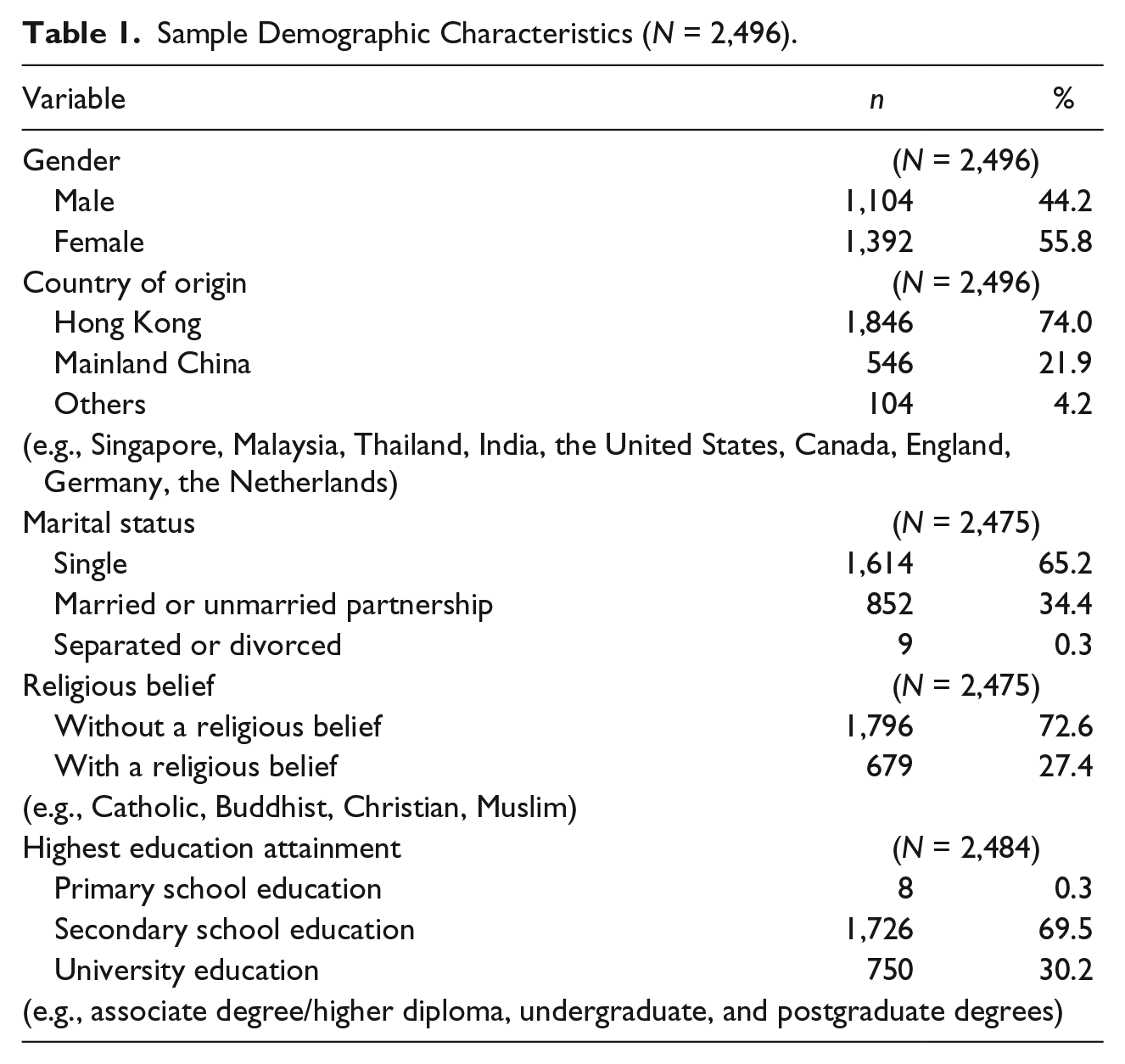
This study sampled 2,496 participants, with 55.8% being female (N = 1,392) and the remaining 44.2% male (N = 1,104; see Table 1). On average, participants were aged 21.42 years (SD = 2.93, range = 17-48). Males, on average, were aged 21.88 years (SD = 3.28), while the average age of females was 21.06 (SD = 2.58); and this difference was significant (t = 6.78, p < .001). A large majority of the participants were Hong Kongers (74%; n = 1,846), and 21.9% (n = 546) were from Mainland China. The remaining participants (4.2%; n = 104) were international exchange students from other countries (e.g., Singapore, Malaysia, Thailand, India, the United States, Canada, England, Germany, and the Netherlands). These respondents were excluded from analyses that included culture as a variable. Nearly, two thirds (65.2%) of the participants were single and about three quarters (72.6%) reported having no particular religious belief. Almost all participants reported they had completed at least secondary school education (99.7%).
Sample Demographic Characteristics (N = 2,496).
Measures
Self-report measures were adopted to assess participants’ (a) perceptions of stalking behavior, (b) perceived reasons for stalking perpetration, and (c) perceived effective coping strategies for stalking victims. The questionnaire with these measures was printed in both English and Chinese versions for participants with different language needs. To accommodate the local Chinese population, the English written scales were initially translated by an experienced and academically qualified English-to-Chinese translator. Next, the Chinese version scales were back translated to English to ascertain face validity, and to compare with the original English written scales to assure content similarity.
Perceptions of stalking behavior
A scale comprising 12 stalking behaviors was adopted from Amar’s (2006) study. Of these items, nine were taken from Tjaden and Thoennes’s (1998) “National Violence Against Women Survey” (NVAWS), and the remaining three items were found in the stalking literature that described stalking behaviors (Amar, 2006). Three stalking categories were used with four items each in the categories of “surveillance,” “approach,” and “intimidation and aggression.” Participants were not supplied any context and nor were they instructed to adopt a particular role (e.g., recipient of the behavior). Rather, they were asked, “Which of the following behaviors would you perceive as a stalking behavior?” The response format was “yes/no.” Sample items include, “Followed or spied on you” (surveillance item), “Made unsolicited phone calls to you” (approach item), and “Ever threatened to harm or kill you” (intimidation and aggression item). The Cronbach’s α of this measure was .79 (males = .80, females = .76) in the present study and .83 in Amar’s (2006) work.
Perceived reasons for stalking perpetration
Baum, Catalano, Rand, and Rose’s (2009) items measuring victim perceptions of why stalking began were adopted in this study. A scale of 12 items was used to assess participants’ perceived reasons for the offender to engage in stalking perpetration. A “yes/no” response format was utilized to determine whether items were perceived as reasons to initiate stalking perpetration. Sample items include, “Different cultural beliefs/back-ground,” “To control the victim,” and “To keep the victim in the relationship.” The internal consistency of this measure was .82 (males = .81, females = .83) in the present work.
Perceived effective coping strategies of stalking victimization
A stalking coping survey, based on a comprehensive literature review, was created by Cupach and Spitzberg (2004) and later employed by Amar and Alexy (2010). The survey was adopted in this study to measure participants’ perceived effectiveness of strategies that could be employed to cope with stalking victimization. This 40-item scale assesses five categories of coping tactics (i.e., moving inward, moving outward, moving away, moving toward or with, and moving against). A “yes/no” response format was used to determine whether participants perceived the items as effective coping strategies. Sample items include, “Deny the problem” (moving inward tactic), “Engage in social support” (moving outward tactic), “Ignore the stalker’s behavior” (moving away tactic), “Bargain with the stalker” (moving toward or with tactic), and “Issue verbal warnings or threats to the stalker” (moving against tactic). Cronbach’s alpha was .79 (males = .80, females = .76) in the current study and .88 in Amar and Alexy’s (2010) work.
Analytic Strategy
In this study, descriptive statistics were presented to illustrate (a) participants’ perceptions of stalking behavior, (b) perceived reasons for stalking perpetration, and (c) perceived effective coping strategies for stalking victimization. In addition, chi-square analyses were performed to examine associations between these perceptions and gender and culture. Regression analyses explored which of gender and culture had the strongest relationship with the dependent variables.
Results
Associations Between Gender and Culture and Perceptions of Stalking Behavior
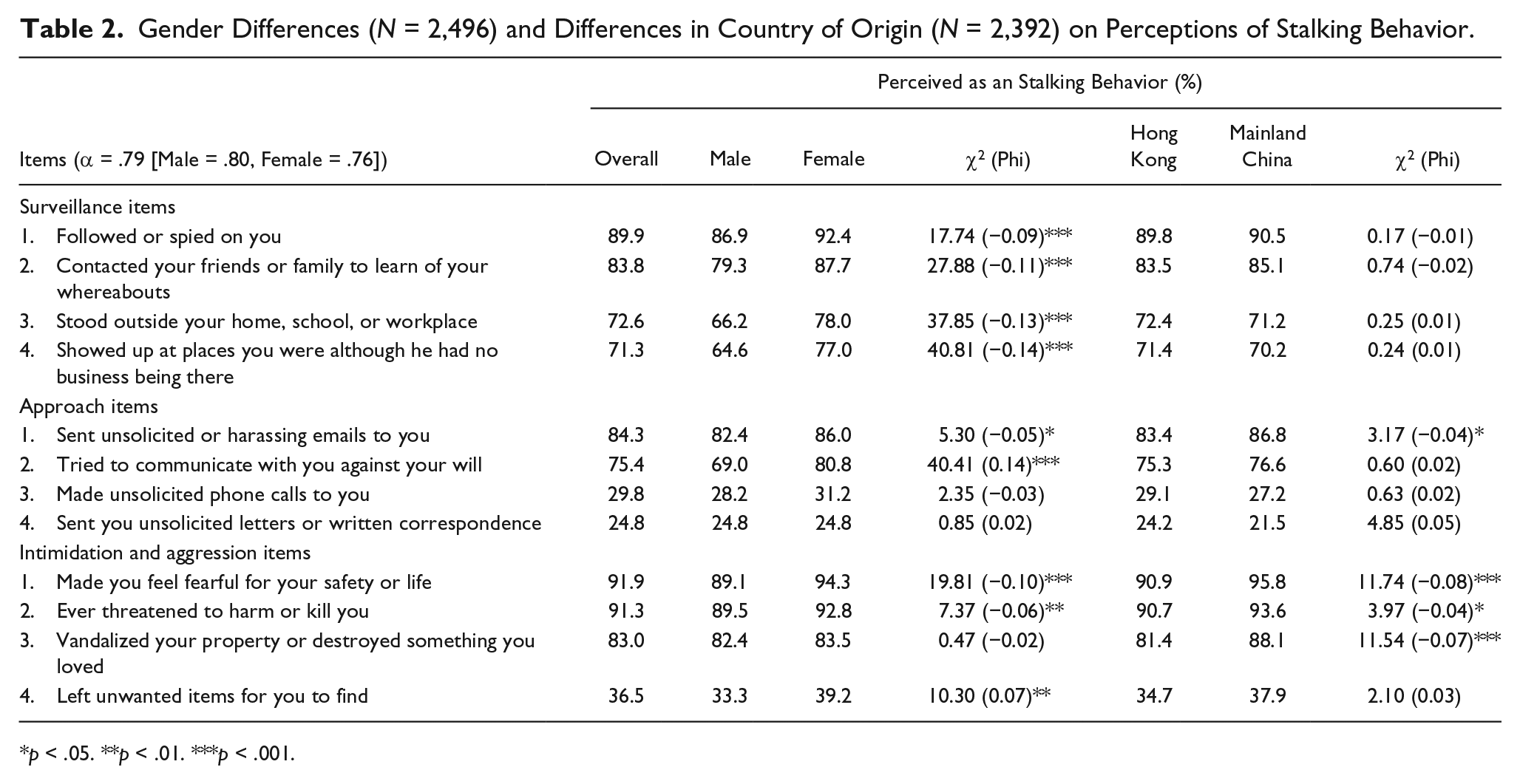
Mean scores for male and female ratings of stalking behavior and local and nonlocal (i.e., Chinese Mainlanders) ratings of stalking behavior are presented in Table 2. In general, a high degree of consensus (i.e., above 80%) was evident for half of the 12 items in terms of whether they were considered as stalking behavior. Interestingly, gender differences in perceptions of stalking behavior were observed for nine items. Relative to males, significantly more females perceived the nine items to constitute stalking. Two of the three nonsignificant items were those with the lowest levels of general agreement that they were stalking. Four items were found to differ significantly between Chinese Mainlanders and Hong Kongers. As with gender, significant differences between cultural groups tended to occur in relation to those items that most participants judged to constitute stalking. Nonetheless, these differences were not great and their effect size was rather weak.
Gender Differences (N = 2,496) and Differences in Country of Origin (N = 2,392) on Perceptions of Stalking Behavior.
p < .05. **p < .01. ***p < .001.
A multiple linear regression was performed with yes/no response ratings of the 12 stalking behaviors summed to form the dependent variable. Participant gender and place of origin (Hong Kong vs. Mainland China) were the independent variables. The overall model was significant, F(1, 2134) = 24.42, p < .001, as were both of the independent variables. Combined, gender and place (Hong Kong vs. Mainland China) explained 23% of the variance, with place contributing just 4%. Unstandardized beta scores for gender and place were and −0.74 and −0.13, respectively.
Associations Between Gender and Culture and Perceived Reasons for Stalking Perpetration
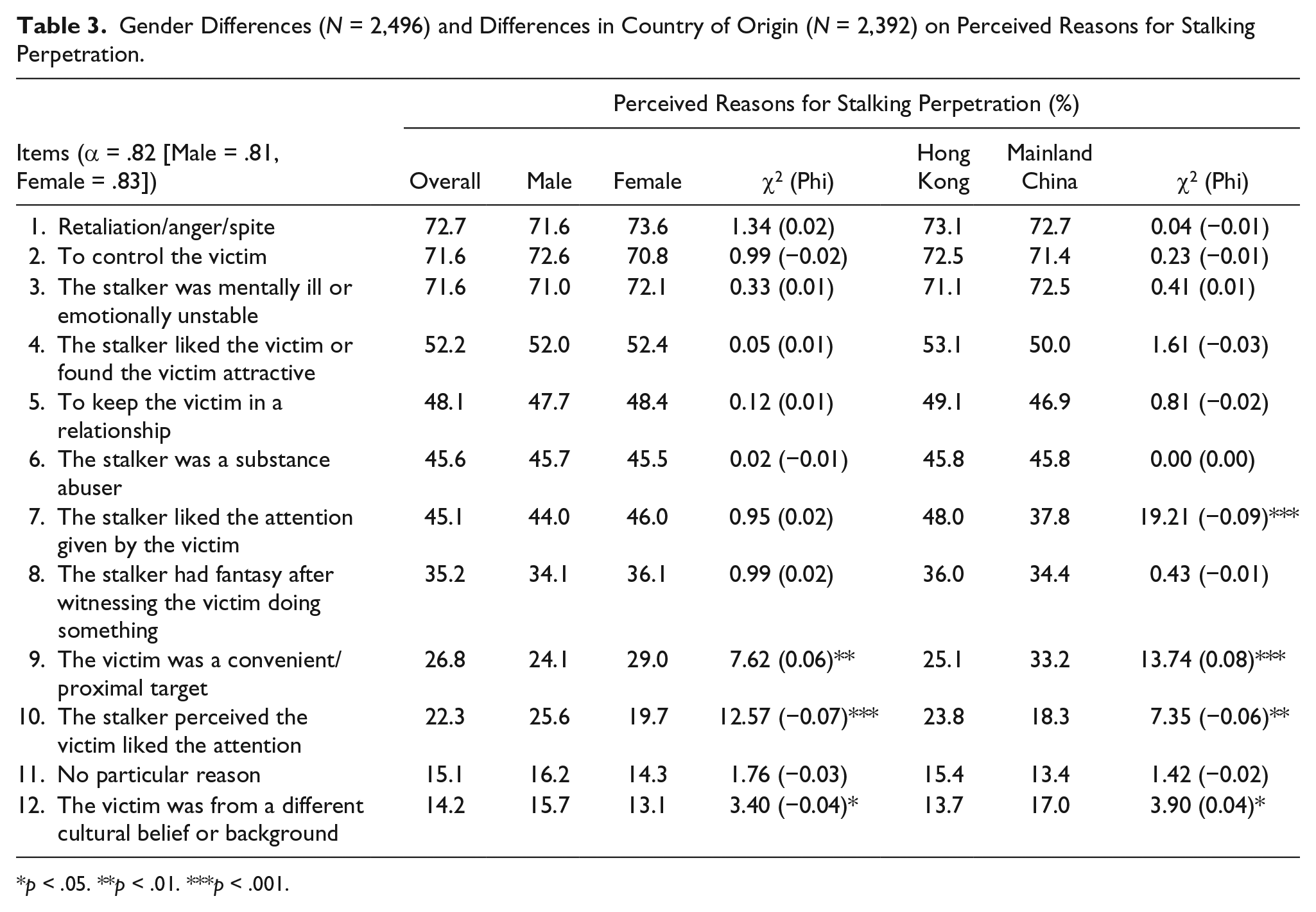
As shown in Table 3, only three items produced at least 70% consensus that they were reasons for offenders to perpetrate stalking behavior. Despite the low consensus for most items, gender differences were found for three of the reasons. Relative to females, significantly more males considered “The stalker perceived the victim liked the attention” (25.6% vs. 19.7%) and “The victim was from a different cultural belief or background” (15.7% vs. 13.1%) to be reasons for stalking. Conversely, significantly more females than males perceived “The stalker was lonely and the victim was a convenient target” (29% vs. 24.1%) to be a reason to engage in stalking behavior. Pertaining to the perceptions of Hong Kongers and Chinese Mainlanders, significantly more Hong Kongers regarded “The stalker liked the attention given by the victim” (48% vs. 37.8%) and “The stalker perceived the victim liked the attention” (23.8% vs. 18.3%) to be offending motives. In contrast, significantly more Chinese Mainlanders perceived the reasons to be “The stalker was lonely and the victim was a convenient target” (33.2% vs. 25.1%) and “The victim was from a different cultural belief or background” (17% vs. 13.7%). Again, differences with large effect sizes relating to perceived reasons for stalking perpetration were not observed.
Gender Differences (N = 2,496) and Differences in Country of Origin (N = 2,392) on Perceived Reasons for Stalking Perpetration.
p < .05. **p < .01. ***p < .001.
A multiple linear regression was performed with yes/no response ratings of the 12 potential reasons for stalking perpetration summed to form the dependent variable. Participant gender and place of origin (Hong Kong vs. Mainland China) were the independent variables. The overall model was significant, F(1, 2494) = 4.47, p < .04, but only one independent variable was significant, namely, place of origin, which explained just 2% of the variance, with gender not contributing. Unstandardized beta scores for gender and place were and 0.06 and −0.14, respectively.
Associations Between Gender and Culture and Perceived Effective Coping Strategies for Stalking Victimization
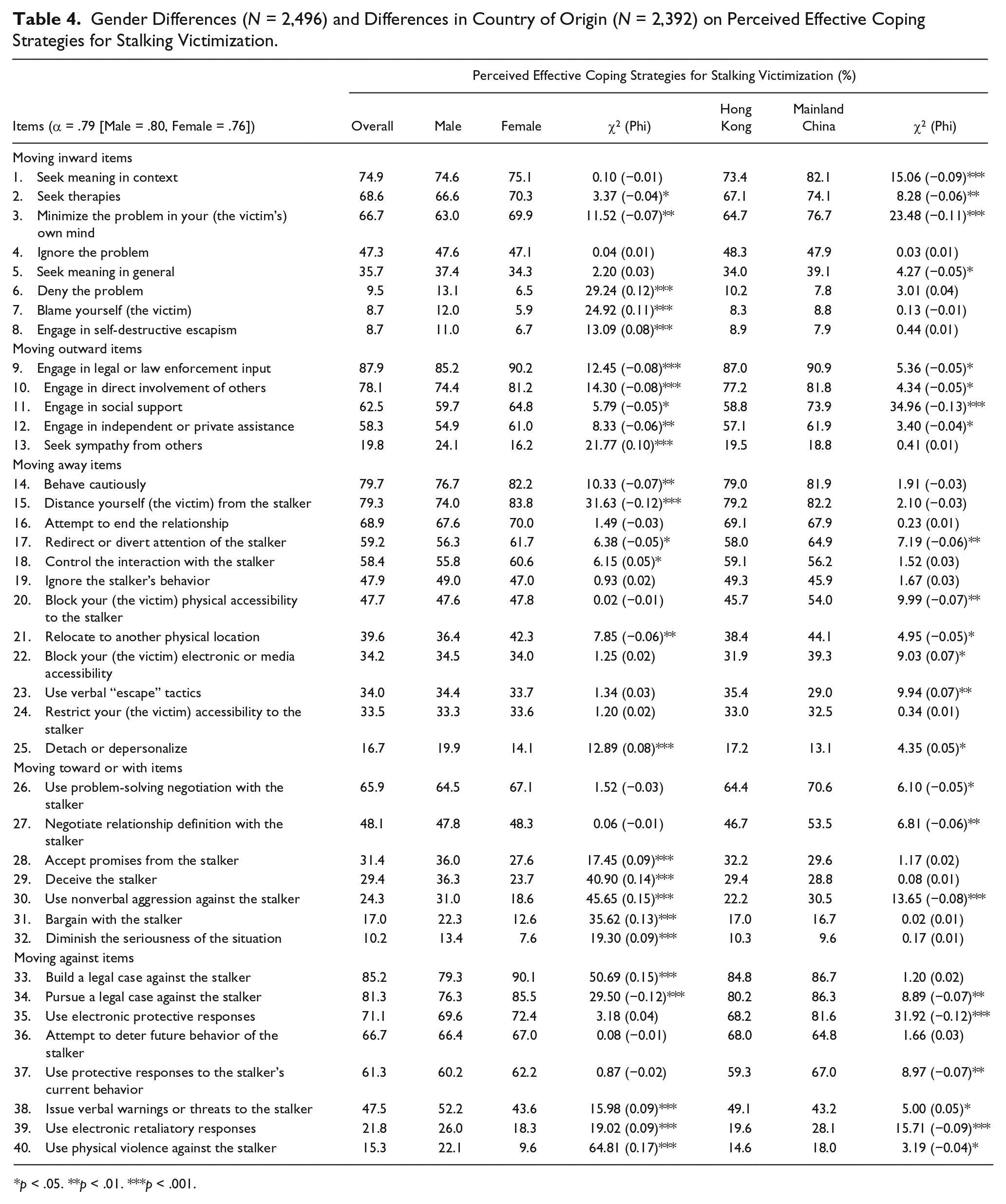
Mean scores for perceived effective coping strategies based on gender and culture practices are presented in Table 4. Out of 40 possibilities, only three coping strategies were found to have a high degree of consensus (i.e., above 80%) that they would be effective, namely, “Engage in legal or law enforcement input” (87.9%), a moving outward tactic; and “Build a legal case against the stalker” (85.2%) and (similarly) “Pursue a legal case against the stalker” (81.3%), both moving against tactics. Gender differences in perceived effective coping strategies were found for 26 items: in all five of the moving outward tactics, six moving away tactics, five moving inward tactics, five moving toward or with tactics, and five moving against tactics. Women were more likely to endorse entering therapy and engaging the support of third parties as effective coping strategies, along with building a legal case, creating distance between victim and stalker, and victim relocation. Men were more likely to endorse the following strategies as effective: trying to deceive and bargain with the stalker, take an aggressive stance toward the stalker, and threaten and physical assault the stalker, to deny the problem and detach and depersonalize.
Gender Differences (N = 2,496) and Differences in Country of Origin (N = 2,392) on Perceived Effective Coping Strategies for Stalking Victimization.
p < .05. **p < .01. ***p < .001.
Differences between Hong Kongers and Chinese Mainlanders regarding some coping strategies perceived as effective were also noted: namely, six moving away tactics, six moving against tactics, four moving inward tactics, four moving outward tactics, and three moving toward or with tactics. In 20 cases, Chinese mainlanders were more likely to endorse a particular strategy as effective; Hong Kongers did so in relation to just three items. Despite the observed differences in gender and cultural practices, the effect of these differences was not large in general.
A multiple linear regression was performed with yes/no response ratings of the 40 responses to coping with stalking summed to form the dependent variable. Participant gender and place of origin (Hong Kong vs. Mainland China) were the independent variables. The overall model was significant, F(1, 1980) = 8.54, p < .004, but only one independent variable was significant, namely, place of origin, which explained just 4% of the variance, with gender contributing zero. Unstandardized beta scores for gender and place were and −0.26 and −1.30, respectively.
Discussion
Using a large sample of young male and female adults recruited at 10 universities in Hong Kong, the present study examined perceptions of 12 stalking behavior, 12 potential reasons for stalking perpetration, and 40 coping strategies for victims of stalking. The primary aim was to conduct the first study of perceptions of stalking within an Asian sample and also to explore associations between these perceptions and participant gender and culture. This is the first known study to compare the relative contributions of gender and culture with perceptions of stalking and stalking-related phenomena.
The findings of this study suggest that there are some significant differences in perceptions of stalking between males and females, and between Hong Kongers and Chinese Mainlanders. Relative to males, significantly more females perceived the listed surveillance, approach, intimidation, and aggressive activities as stalking behavior. This may be due to the fact that females more commonly experience stalking victimization than males (e.g., Baum et al., 2009; Sheridan, Blaauw, & Davies, 2003), and defensive attribution theory may in turn explain these more internalized and attributional type of judgments (see, for example, Elkins, Philips, & Konopaske, 2002, as cited in Scott, Rajakaruna, Sheridan, & Gavin, 2015). This theory asserts that if a person is making a judgment in a situation where they share some attributes with a potential victim of wrongdoing, then they are likely to produce empathy-based responses. An alternative explanation concerns the “gender gap” (Whitehead & Blankenship, 2000, as cited in Lambert et al., 2013). That is, women generally are more liberal in their perceptions of social issues and more supportive of progressive social causes and demonstrated a greater willingness to extend rights to minority groups and women. It has long been noted that the gender gap as evidenced by opinion polling transcends culture and nationality (see Boulding, 1984).
Although mixed findings have been produced by earlier studies, with some works finding that women are more likely to identify intrusive behavior than men (e.g., Finnegan & Fritz, 2012; Lambert et al., 2013; Yanowitz, 2006), and others not finding this association (see, for example, Cass, 2011; Sheridan et al., 2002; Spitzberg & Veksler, 2007), an opposing pattern of males being more likely to judge intrusive acts as constituting stalking has not been seen. As such, we may state that the judgments of Hong Kong and Chinese females generally support previous findings from the United Kingdom, the United States, and Australia that women are more likely than men to view intrusive acts as stalking.
Gender was found to explain far more of the variance in relation to judgments of stalking behavior than was culture (23% as compared with 4%). Perhaps, acculturation of Mainland Chinese students to Hong Kong culture has resulted in their psychological adaptation to the host culture and way of life (Yu, Stewart, Liu, & Lam, 2014). As noted, acculturation is an important feature in understanding international students and immigrants’ adaptation to a new environment (Tartakovsky, 2007). Although some specific cultural practices can be observed, people in Hong Kong and Mainland China generally follow traditional Chinese values and norms. Therefore, small differences found in their perceptions of stalking are not unreasonable. Future work should compare countries that differ more widely in terms of variables such as individualism/collectivism, participant gender, and gender empowerment. It is yet to know which of these has the greatest influence on perceptions of stalking and other intrusive activities. The present findings may provide clues but, given the potential cultural similarity between Hong Kong and Mainland China, cannot provide clear answers.
With regard to perceived reasons for stalking perpetration and perceived effectiveness of various coping strategies, significant gender differences and differences between Hong Kongers and Chinese Mainlanders were not generally found. Gender differences identified in relation to coping strategies tended to conform to gender role expectations. Women were more likely to endorse the strategies of seeking therapy, engaging the support of various third parties (including their social circle and the police), relocating, behaving cautiously, and staying away from the stalker. Men, alternatively, were more likely to endorse moving toward and moving against items that included using physical and other forms of aggression against the stalker, denying the problem, and engaging in self-destructive escapism. Even where significant group differences were noted, however, they were not large. As such, we may argue that, participants, regardless of their gender and country of origin, shared relatively similar perceptions regarding likely reasons for stalking perpetration and effective coping strategies for stalking victims. Sheridan and colleagues (2003) asserted that stalking is difficult to clearly define, and noted that some legislation comprehensively details which behavior are punishable while laws in other countries apply only broad terms. In yet other countries (including Mainland China and Hong Kong), specific antistalking legislation does not exist. Regardless, the findings of the present work support those of similar works that found generally high levels of agreement that various core behaviors constitute stalking. This speaks to a potential universality of perceptions of stalking. The regression analyses indicated that overall, culture had a small but significant relationship with perceptions of stalking motivations and coping strategies, with gender not contributing to the models. Future studies then, should not only examine which of culture and gender have the greatest bearing on perceptions of stalking but also which have the largest association with different aspects of stalking perceptions.
Future studies of stalking perceptions need to move away from a tight focus on the participant-specific variables of gender and personal experience of stalking. This is because the literature on this topic generally tends to produce small effect sizes (e.g., Finnegan & Fritz, 2012; Lambert et al., 2013; Scott, et al., 2015), and the findings are not easily and clearly interpreted in those studies that have included other variables. For instance, in Lambert et al.’s study, male college students were more likely than female students to perceive stalking as involving strangers but were also more likely than females to blame stalking victims. Therefore, it is questionable as to which factor explains the largest proportion of the variance. Could it be age, education level, authoritarian attitudes, or personality factors? Clearly, only comprehensive research can explain this phenomenon.
Until then, it is suggested that culture continues to be explored as an important variable relating to attitudes toward and perceptions of stalking. That the current findings support those of previous works undertaken within Western individualistic countries is worthy of note and adds further fuel to the assertion that stalking may be universal. As such, we could argue that legislation against stalking needs to be extended to non-Western countries, as currently antistalking laws would appear to be scarce outside Western industrialized nations (there is no all-encompassing up to date list but a good overview may be found at https://www.stalkingriskprofile.com/what-is-stalking/stalking-legislation/international-legislation). At present, most stalking-related offenses in Hong Kong and Mainland China are dealt with via the issuance of restraining orders as a majority of cases appear to be domestically oriented (e.g., ex-spouse, ex-boyfriend/girlfriend). Under the protection of civil law in Hong Kong, victims of stalking could pursue for compensation in the forms of private nuisance (i.e., the perpetrator has interfered with the ordinary and reasonable use or enjoyment of the victim’s property) or trespass to the person (i.e., attempted or actual battery or assault against the victim; Lee & Lam, 2015). Nonetheless, the current criminal justice actions are not sufficient to address the issue well.
The present work has a number of strengths and weaknesses. The Chinese Mainlanders no longer lived in Mainland China. Rather, they were studying in Hong Kong. Still, it is worthy of note that significant differences were identified between the two groups. Of course, the sample is not representative of either location. A student sample was chosen on the basis of comparability to prior studies based on student samples, rather than representativeness. The sample may perhaps be considered representative of the wider Hong Kong student population, given its large size and the more than 90% response rate. That being said, this sample was not representative of the entire young adult population in Hong Kong and the Mainland China as nonuniversity educated young adults were not representatively sampled in this study. Hence, generalization of the findings to the entire young adult population is not possible. Although the measures employed in the study were largely preexisting tools with good validity and reliability, they were developed in the West. As such, they may not properly capture the nature of stalking as experienced within Far Eastern collectivist cultures. Future work should collect data on the nature of stalking, employing a mixed methods approach, to create tools that may better capture non-Western stalking experiences. Although findings in this study were empirically supported by a large sample, this study was nonetheless limited to the lack of depth in the participants’ responses.
In conclusion, the present study has indicated that gender was more strongly associated with a large sample’s perceptions of stalking activities than was culture. Conversely, gender was not found to be associated with perceptions concerning motivations for stalking and the effectiveness of coping strategies that may be employed by stalking victims, whereas culture was. However, culture alone explained very little of the variance. The significant but small associations with culture may be explained by a high degree of similarity between the two cultures examined, and suggest that comparisons of more diverse nations may produce interesting results. It is suggested that future studies take a mixed methods approach to provide context for the judgments made. This may provide insight into why gender and culture may be differentially associated with different aspects of stalking perceptions. The present results further point to universality of stalking behavior, in that findings supported those produced within individualistic Western cultures. As such, it is suggested that stalking specific legislation be encouraged in countries where it does not presently exist. In addition, those who provide counseling and other support services to both victims and perpetrators of interpersonal crime should be made aware of both the devastating impact of stalking and its ubiquitous nature, with potential of escalation in severity and violence (e.g., sexual assault and homicide; Chan, 2015; Chan & Heide, 2016). More specifically, given the gender differences associated with perceptions of stalking behavior, social service providers may consider developing new protocols or refining existing ones to be more gender-specific. For instance, social support given to victims could be made more gender sensitive by taking into account differential types of support anticipated by males and females. Females may lean toward psychological support and, thus, may favor counseling, while males may favor more problem-focused solutions. Providing a choice of support services may encourage more victims to come forward.
Footnotes
Declaration of Conflicting Interests
The author(s) declared no potential conflicts of interest with respect to the research, authorship, and/or publication of this article.
Funding
The author(s) disclosed receipt of the following financial support for the research, authorship, and/or publication of this article: This research was supported by City University of Hong Kong, Hong Kong, SAR [7200367(SS)] with funding provided to the first author.