




Abstract
Stalking victimization, regardless of victim–stalker relationship, has been associated with negative consequences including high fear levels, mental health problems, and resource losses. Much of the research on stalking has focused on (ex)partner stalking victim experiences and consequences; however, many women are stalked by acquaintances. This is one of the first studies to examine acquaintance stalking victims who did (n = 140) and who did not (n = 222) experience negative work consequences from stalking victimization. Results found that just over half of the acquaintance stalking victims indicated the stalker was someone from work or school. Overall, many acquaintance stalking victims regardless of work losses experienced work interference, although those with work losses experienced increased work interference and job performance problems. Additionally, stalking victims with negative work consequences experienced more stalking threats, life interference, more non-work-related resource losses, and had higher stalking-related fear levels than victims without work losses. Regardless of group, stalking victims lost an average of nine different resources other than work losses, and resource losses were associated with current negative mental health symptoms and help-seeking. Help-seeking, outside of friends or family, even though they endured stalking for an average of almost 2 years, was low for all of the victims. However, acquaintance stalking victims with work losses sought help from more sources on average. Implications from this study suggest that safety at work should be a primary concern for all types of stalking victims, and workplace policies should consider stalking as a separate category of victimization.
I was going through a rough time during this period of my life. At first he was sweet and acted encouraging and supportive. He was constantly complimenting me and boosting my ego, but then he just started constantly calling and texting me. He would call or text at like 3 a.m. at night and leave weird voicemails. Sometimes it was just him breathing. One time at work our shifts ended at the same time so I tried to quickly make it out to my car without him noticing me, [but] that didn’t work. He tried calling out to me so he could walk out with me, but I walked faster and got into my car. He then got into his car and started following me. I noticed and I tried to look up the nearest police station because I heard online that if someone is following you, go to a police station. I was panicking and shaking though and trying to drive and look up the info and at the same time I was looking at my rear-view mirror and trying to dodge him. Luckily, I was in the far-right lane and we were approaching a green light, I sped up then I checked my blind spot and the lanes to my left and at the last second I swerved to the farthest lane (the left turning lane) and I made it. It eventually got to a point where I had to notify the store manager. Luckily, she was a woman and had my back and stood up for me when HR was contacted. HR interviewed me, but they victim shamed me. It was very sudden as we had been fine and [got along] well beforehand. He spread a lot of false, damaging rumors about me to people I knew, people I worked with and even people I didn’t know. It affected my work life, and he was in a position of authority at work so I felt I couldn’t do much about it and he would get away with everything. This was a coworker who repeatedly harassed me while at work. What bothered me most was after another coworker had reported his behavior to our bosses and they talked with me about it, they didn’t do anything to keep him from me during work hours.
1
Overall, in the United States, it is estimated that 1 in 3 to 1 in 6 women will be stalked in their lifetime (Smith et al., 2017, 2022). Stalking can be defined as a repeated course of conduct that creates fear or concern for safety or extreme emotional distress in the target (Logan and Walker, 2010b). Stalking victims cope with a number of consequences including extreme fear of physical harm and concern for the safety of others (Logan and Walker, 2017a). One less discussed, but frequent consequence of stalking, is life sabotage (Logan and Walker, 2017a). Stalkers sabotage victims’ lives by targeting resources including financial, social, status-related, personal, and long-term resources (Logan and Walker, 2017a, 2017b). In particular, stalkers often target victims at their workplace. One small study found that employed stalking victims experienced twice as many stalking tactics and were pursued three times longer than unemployed victims (Nicastro et al., 2000). Another study found that 41% of partner abuse victims experienced workplace consequences such as missed days of work, tardiness, and abuser intrusion, and that stalking behavior increased negative work consequences (Blodgett and Lanigan, 2018). Research suggests stalkers interfere with victim employment in three main ways including on-the-job harassment, work disruption, and performance problems (Logan et al., 2007; Swanberg et al., 2007; Swanberg and Logan, 2005, 2007). Overall, the research on stalking and employment is limited and much of it is focused on (ex)partner stalking victims (Blodgett and Lanigan, 2018; Logan et al., 2007; Macgregor et al., 2016, 2021, 2022; Showalter, 2016; Showalter et al., 2019; Swanberg et al., 2007; Swanberg and Logan, 2005, 2007; Wathen et al., 2015) even though a significant number of women are stalked by acquaintances (Smith et al., 2018). Acquaintance stalking victims are individuals stalked by relatives (other than (ex)spouses/partners), removed relatives (e.g. ex-husband’s father, daughter’s ex-father-in-law), close or distant acquaintances, or authority figures.
The current study focuses on women stalked by acquaintances because women are more likely to be victims of stalking and, among men and women stalked, women have increased consequences of stalking victimization (Logan, 2020b, 2022; Matos et al., 2019; Smith et al., 2022; Villacampa and Pujols, 2017, 2019). National estimates of stalking suggest that over one-third (35.3–40.6%) of female stalking victims were stalked by acquaintances including a family member other than partner or spouse, person of authority, or acquaintance (Smith et al., 2018, 2022; Villacampa and Pujols, 2017). In samples with younger people, rates of stalking are higher, and younger individuals experience more acquaintance stalking than in national samples (Björklund et al., 2010; Fedina et al., 2020; Logan, 2020a; Logan and Walker, 2021; Villacampa and Pujols, 2017, 2019). One study found that although acquaintance stalkers were not as threatening and violent as (ex)partner stalkers, they were more threatening and violent than stranger and celebrity stalkers (Mohandie et al., 2006). Another study found that both (ex)partner stalking victims and acquaintance stalking victims lost an average of almost 10 days of employment due to the stalker which was higher than those being stalked by strangers (6 days, Peterson et al., 2018). Thus, although there are limited studies, it does appear that acquaintance stalking victims experience stalking at work and work-related consequences. It may also be that some victims of acquaintance stalkers met those stalkers through work (e.g. coworkers, supervisors, or customers/clients of the business; Sheridan et al., 2019).
Stalking can also impact resources other than employment by directly sabotaging those resources, or more indirectly by sabotaging a victim’s employment (Adams et al., 2012; Logan and Walker, 2017a, 2017b). Resources can be divided into several key categories such as basic (e.g. housing, transportation, income), status-related (e.g. education, opportunities, reputation), investment-related (e.g. time, savings), and personal (e.g. mental health, health, sleep; Hobfall, 1989; Hobfall and Lilly, 1993; Logan and Showalter, 2021). Significant distress can result when key resources are threatened and/or actually lost (Hobfall, 1989; Hobfall and Lilly, 1993). When one valued resource is lost, the loss of more resources can occur—referred to as a resource loss cycle (Hobfall, 1989; Hobfall and Lilly, 1993). A recent study found that negative work consequences from stalking were associated with other resource losses, and those other resource losses were most associated with ongoing mental health problems among (ex)partner stalking victims (Logan and Showalter, 2021). The current study will examine workplace harassment, work losses, other resource losses, and current mental health symptoms among acquaintance stalking victims.
Mental health problems such as depression, anxiety, and post-traumatic stress disorder (PTSD) are common among stalking victims in general (Korkodeilou, 2017; Kuehner et al., 2012; Logan et al., 2006; Logan and Walker, 2010b; Stevens et al., 2021). One hypothesis is that sustained fear levels are the main pathway between interpersonal victimization and negative health outcomes (Foster et al., 2016; Fragkaki et al., 2016; Grinshteyn et al., 2016; Logan and Walker, 2021; Stafford et al., 2007). In fact, it has been hypothesized that fear may be the most harmful component of being stalked, although more research is needed (Davis et al., 2002; Fleming et al., 2012; Logan and Walker, 2009b, 2017a, 2021; Sheridan and Lyndon, 2012). Chronic fear is part of the arousal system response to stress that results in ‘wear and tear’ on the body and mind resulting in adverse consequences for mental and physical health (McEwen, 1998; Wong et al., 2014). One study found that (ex)partner stalking victims who experienced work-related consequences had higher stalking-related fear than (ex)partner stalking victims who did not experience work-related consequences (Logan and Showalter, 2021).
Studies show that higher fear levels are associated with increased stalker threats and violence as well as with increased life sabotage (e.g. negative economic and social consequences) (Cattaneo et al., 2007; Fleming et al., 2012; Logan and Walker, 2009a, 2017a, 2010a; Sheridan and Lyndon, 2012). Although there is more limited research on acquaintance stalking victims, several recent studies found there are many similarities in experiences of (ex)partner and acquaintance stalking victims with regard to the course of conduct and negative outcomes (Logan, 2019, 2020a, 2022). Another study examined individuals stalked by coworkers or customers compared to individual’s stalked by (ex)partners who harassed them at work and also found more similarities than differences in stalking course of conduct and work interference (Sheridan et al., 2019). That same study also found that more individuals with stalkers from the workplace disclosed the stalking to their organizational management than individuals with (ex)partner stalkers (Sheridan et al., 2019).
Help-seeking and support may help stalking victims maintain work, health, and safety (Logan et al., 2007; Macgregor et al., 2022; Swanberg et al., 2007). However, even though stalking is associated with significant danger including lethality, data suggest that stalking is under-reported and, even when reported to police, it is under-investigated (Brady and Nobles, 2017; Korkodeilou, 2016; Lynch and Logan, 2015; Ngo, 2019, 2020). There is limited research on stalking victim help-seeking, but the few studies that have been done suggest help-seeking among stalking victims is more likely with higher fear levels and more severe stalking conduct (Ménard and Cox, 2016; Reyns and Englebrecht, 2014). One study found that losing time at work was also associated with increased help-seeking among stalking victims (Reyns and Englebrecht, 2014). Acquaintance stalking victims are likely to have fewer options for help-seeking available to them as many victim service agencies focus on specific subgroups of victims such as partner abuse or human trafficking victims rather than stalking victims without those co-occurring victimizations. Few, if any, studies have examined acquaintance stalking victim help-seeking.
This is one of the first studies to examine acquaintance stalking victim experiences of work losses, mental health outcomes, and help-seeking. Within this context, the current study will (1) compare stalking course of conduct, stalking-related fear, work interference, resource losses, help-seeking, and current mental health symptoms among acquaintance stalking victims who did (n = 140) and who did not (n = 222) experience work losses; and (2) examine factors associated with current depression and anxiety symptoms, current PTSD symptoms, and help-seeking including stalking course of conduct, stalking-related fear, work losses, and other resource losses.
Method
Sample
Sample characteristics
Participants were 362 women from the United States and the United Kingdom who were 25.1 years old on average (ages ranged from 18 to 58). Overall, participants worked full time (42.5%) or part-time (27.6%) and most had at least some college education (87.5%). Just under half were students (49.5%). Most participants identified as White (75.7%). Smaller proportions of the sample identified as Hispanic (9.0%), Black (5.1%), and Asian (6.1%). The last incident of stalking was 1 year or less for just over one-quarter of the sample (26.9%), between 1 and 3 years for about 40% of the sample (40.9%), between 4 and 5 years for about a one-fifth of the sample (21.7%), and between 6 and 8 years for 10.5% of the sample. There were no differences by group on any demographic factor or on length of time since last episode of stalking.
Sample recruitment
All data were collected via Prolific, an online data collection platform that connects researchers with individuals who are paid for volunteering to participate in online research (Palan and Schitter, 2018). Data collection for the current study took place from June to August 2021. The recruitment sample was restricted to women between the ages of 18 and 60 years. Participants first had the opportunity to fill out a short screening survey which took about 4 minutes on average and were paid $0.65. Of the 10,980 women screened who had complete data, 22.5% met stalking criteria (Brief Stalking and Harassment Assessment, Logan and Walker, 2021) and indicated they had been stalked by an acquaintance. Eligibility for the full study included having a male stalker and that the last episode of stalking was between 0 and 8 years resulting in 1,414 who were eligible. The larger study was seeking to examine stalking and stalking consequences by acquaintances who had also sexually harassed or assaulted their victims, which meant that 711 (50.3%) were invited to participate in the full study. Of those invited, 461 returned surveys, and 78.5% of the returned surveys had complete data making the final sample 362. The full study took about 25 minutes and paid $5.00. The study was approved by the University IRB and all participants were provided with referral resources.
Measures
Demographic and relationship characteristics
Sociodemographic characteristics assessed included age, education, employment, whether they were currently a student, and race/ethnicity.
Stalking course of conduct and fear
Stalking course of conduct
The stalking measures for the full study are from the Stalking and Harassment Assessment and Risk Profile (SHARP, Logan, 2020a; Logan and Walker, 2017a). 2 The same questions to assess stalking course of conduct were included on the screener and the full study and must have been answered consistently. The four (Yes/No) questions were: Has anyone ever (1) tracked or monitored you in any way? (2) repeatedly invaded your life/privacy by initiating unwanted contact with you (e.g. repeated phone calls, texts, messages, emails, gifts, breaking into your car or home when you were not around, or made other unwanted intrusions)? (3) more than one time, intimidated or scared you through threats, property damage, threatening or actual harm of pets, or other means? (4) significantly and directly interfered with your life? (e.g. spread rumors or publicly humiliated you, jeopardized your job, interfered with your finances, interfered with your housing)? Participants were also asked if they had been physically or sexually assaulted while being harassed/stalked (Yes/No). For stalking victimization, participants must have indicated at least one of the above items (1 to 4) and that they were somewhat or extremely afraid or concerned for their safety or the safety of close others.
Additionally, participants were asked how long they had been stalked. Participants were also asked about specific life interference tactics including whether (Yes/No): (1) they had been regularly contacted or harassed in more than one way; (2) they had been bothered at more than one location other than contact through the phone or computer; (3) they were harassed through the court system (e.g. multiple court filings, drag you into court repeatedly and deliberately); and (4) they had friends or family threaten, harass, intimidate, stalk, or attack you. Participants were also asked (Yes/No) if the behavior had increased in frequency or severity in recent weeks or months (or over time when it was happening) and how many days, in a typical 30-day period, the stalker approached or confronted them and how many days, in a typical 30-day period, the stalker had interfered with their life.
Six threats during the harassment/stalking were assessed (Yes/No) including whether: (1) the stalker left objects, made gestures, or said things that felt threatening but were not direct threats; (2) threatened to hurt or kill you; (3) described in detail how he planned to harm you; (4) threatened, harassed, stalked, or assaulted others close to you; (5) threatened to destroy property, harm pets, or to sabotage you in other ways; and (6) the stalker threatened suicide.
Participants were asked whether victims felt they were more vulnerable because there were things about the environment that limited their ability to be safe (Yes/No). If they answered affirmatively, then they were asked whether it was because they worked or went to school with the stalker and whether the stalker was in a position of authority over the victim.
Stalking-related fear and perceived stalker capability of harm to others
Responses to four questions were summed including how much the stalker’s action made them afraid or concerned for their own safety and the safety of others, to what extent they had made life changes for safety reasons because of the stalker, and to what extent they were concerned about a significant financial or social impact because of the stalker with response options 0 = Not at all, 1 = Somewhat, 2 = Extremely. Participants were asked how capable they felt the stalker was of harming them or harming others with response options (0 = Not at all; 1 = Somewhat; 3 = Extremely).
Work interference
Work interference was assessed with seven items (No/Yes) for on-the-job harassment, three items (No/Yes) for work disruption, and three items (No/Yes) for interference with job performance (see Table 2). These items were adapted from prior work (Logan et al., 2007).
Work and other resource losses
Work losses were assessed with two (No/Yes) items (1) because of the harassment/stalking there were problems at work (e.g. you asked for certain accommodations which made you look bad at work, your performance was not as good as it could have been, you missed time at work); and (2) because of the harassment/stalking you lost a job or were unable to work for a period of time. Other resource losses while being harassed/stalked were also examined. Four categories of resources were used as suggested by the Conservation of Resources (COR) theory (Hobfall, 1989; Hobfall and Lilly, 1993) including: basic (e.g. food, housing), personal (e.g. feeling bad about oneself, sleep problems), status-related (e.g. social support/networks, opportunity for advancement), and investment-related (e.g. time) resources (see Table 3). Participants were also asked whether they were still experiencing significant problems because of the stalking/harassment (Yes/No).
Mental health
Depression items were adapted from the Patient Health Questionnaire-9 (PHQ-9) and asked about nine symptoms listed as criteria in the Diagnostic and Statistical Manual of Mental Disorders (4th ed.; DSM-IV) for diagnosis of major depressive disorder (Kroenke et al., 2001). Participants were asked to report on the frequency of the symptoms in the past 2 weeks with responses: 0 = Not at all, 1 = Several days, 2 = Over half the days, 3 = Nearly every day, with scores ranging from 0 to 27. Anxiety symptom questions are from the Generalized Anxiety Disorder (GAD-7). The GAD-7 was developed to identify probable cases of generalized anxiety disorder and to assess symptom severity for the criteria symptoms in the DSM-IV (Spitzer et al., 2006). Participants were asked to report on the frequency of seven symptoms in the past 2 weeks with responses: 0 = Not at all, 1 = Several days, 2 = Over half the days, 3 = Nearly every day with scores ranging from 0 to 21. Because depression and anxiety symptoms were highly correlated (r = 0.789), the combined symptoms count was used in the multivariate analysis.
PTSD symptoms were assessed using a four-item PTSD checklist derived from the PCL-5. The four-item scale has been shown to be reliable and valid and data suggest the measure is a good screening tool for PTSD (Price et al., 2016). A summed score was used in this study which ranges from 0 to 16.
Help-seeking
Participants were asked whether they had ever talked to any of the listed resources (Yes/No) about the harassment/stalking (see Table 4). The total number of different sources victims sought help from was created by summing the number of ‘Yes’ response.
Analysis plan
Chi-square tests and analyses of variance (ANOVAs) were used to examine bivariate differences for two groups of stalking victims: those who reported they had experienced work losses (n = 140) which was 38.7% of the sample, and those who reported they did not experience work losses (n = 222). Due to multiple comparisons, only p < 0.01 was noted for significance level for bivariate analysis. Three linear regressions were used to examine factors associated with symptoms of depression and anxiety, PTSD, and the number of different help-seeking resources. Factors examined included participant age, length of time since last stalking episode, physical assault during the stalking, sexual assault during the stalking, years of stalking duration, number of different stalking threats, stalking-related fear level, perceived capability of the stalker to harm, work losses, and other resource losses. Independent variables were examined for multicollinearity and the tolerance and variance inflation factor (VIF) were within the acceptable ranges (tolerance > 0.10 and VIF < 1.8, Mertler and Vannatta, 2005).
Results
Stalking course of conduct and stalking-related fear
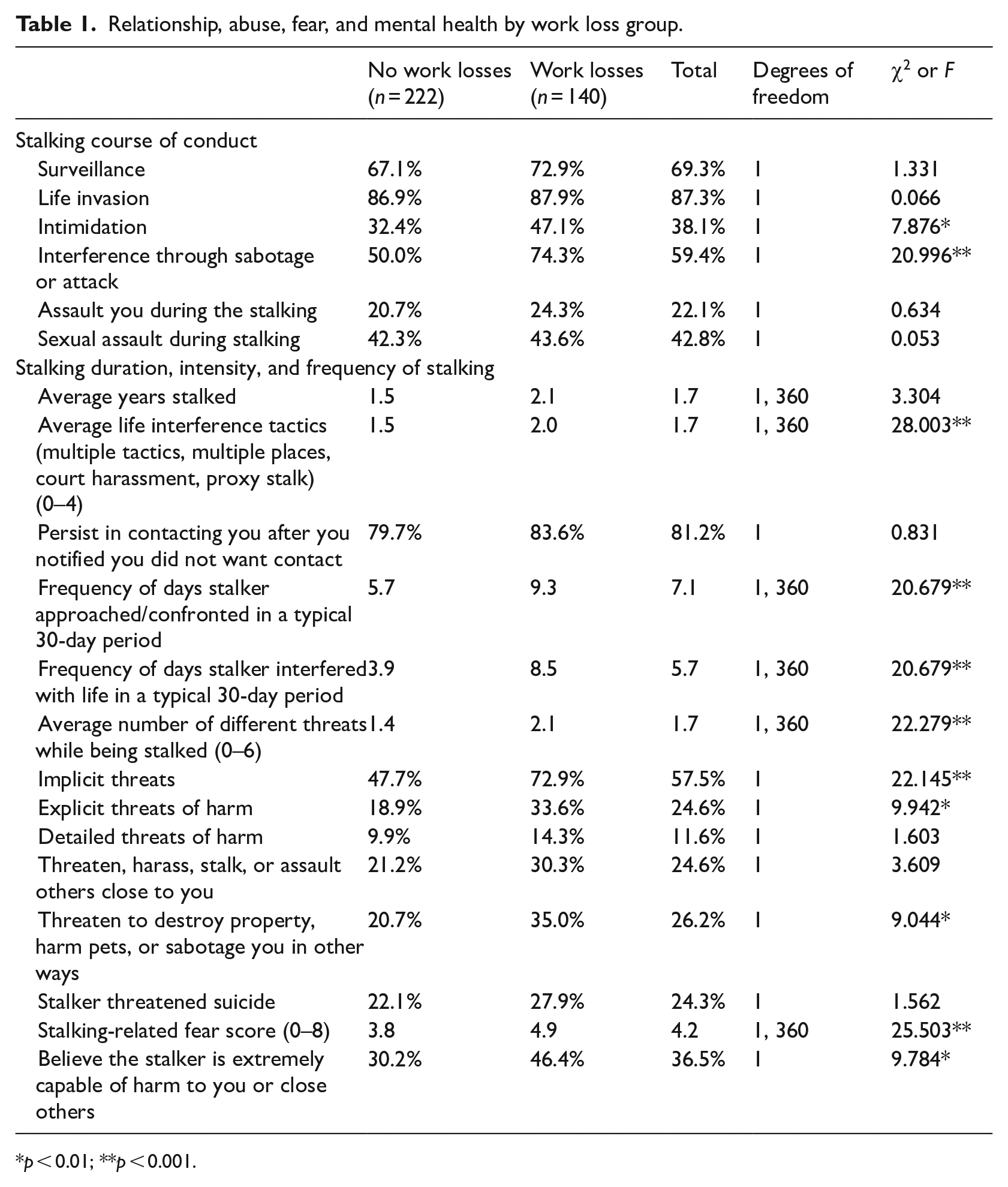
As shown in Table 1, more women who experienced work losses reported more intimidation and life interference tactics than women who did not experience work losses. Women with work losses experienced more tactics of interference as well as more days, in a typical month, of approach and life interference. Also, women with work losses experienced a greater number of threats and, in particular, more of them experienced both implicit and explicit threats as well as threats of property destruction or other life sabotage compared to women with no work losses.
Relationship, abuse, fear, and mental health by work loss group.
p < 0.01; **p < 0.001.
Women with work losses had higher stalking-related fear levels and more of them believed the stalker was capable of harming them or others close to them than women without work losses.
Work interference and disruption
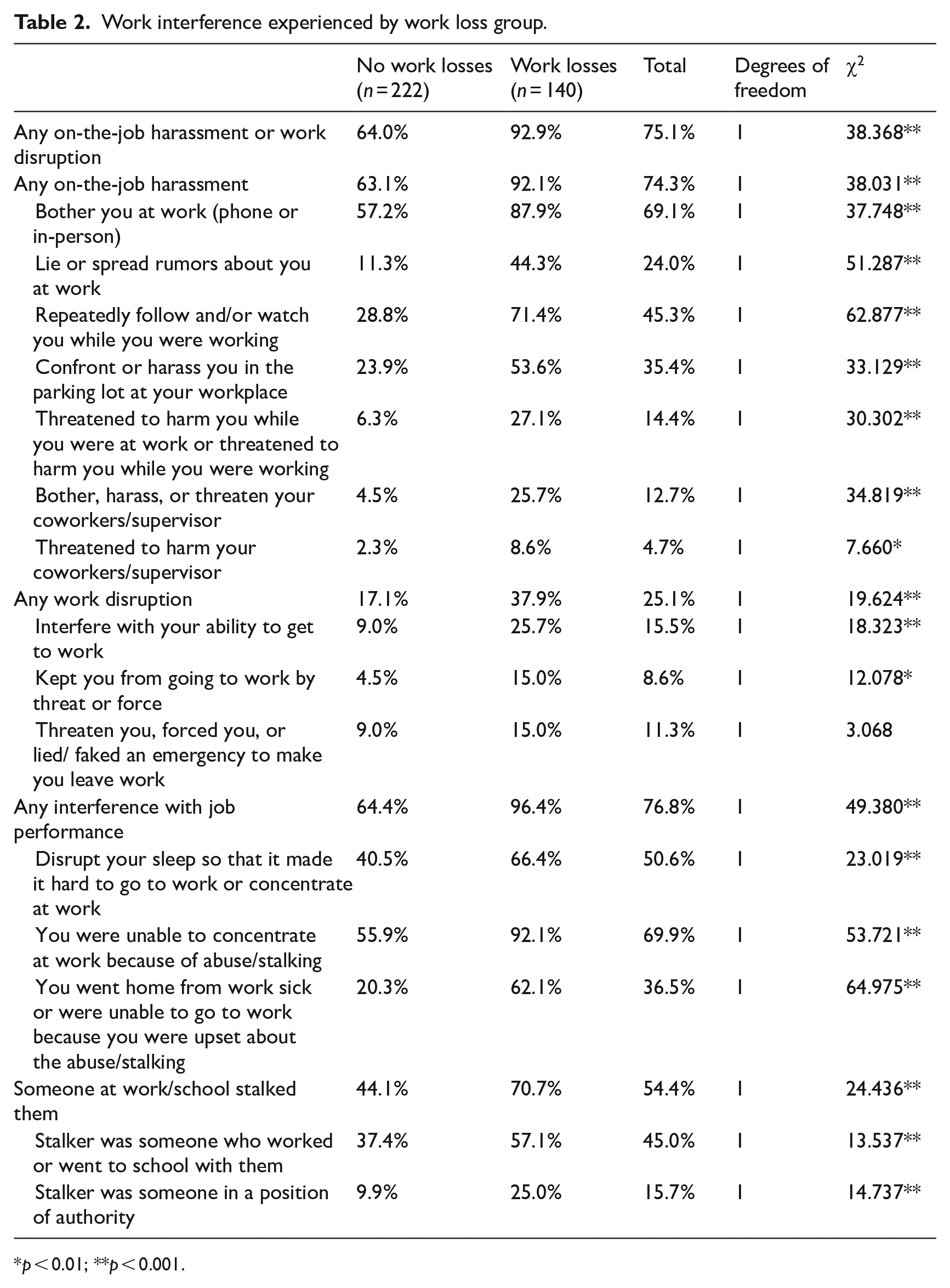
More women with work losses experienced on-the-job harassment, work disruption, and work performance problems than women without work losses (see Table 2). However, it should be noted that many in the current study, regardless of work losses, experienced harassment at work by acquaintance stalkers.
Work interference experienced by work loss group.
p < 0.01; **p < 0.001.
Table 2 also shows that over 57% of women with work losses reported the stalker was someone who worked with them (compared to 37.4% of women with no work losses) and 25% reported the stalker was in a position of authority over them (compared to 9.9% of women with no work losses). Overall, over half (54.4%) of the women in the study had been stalked by someone who worked or went to school with them or was in a position of authority over them.
Other resource losses
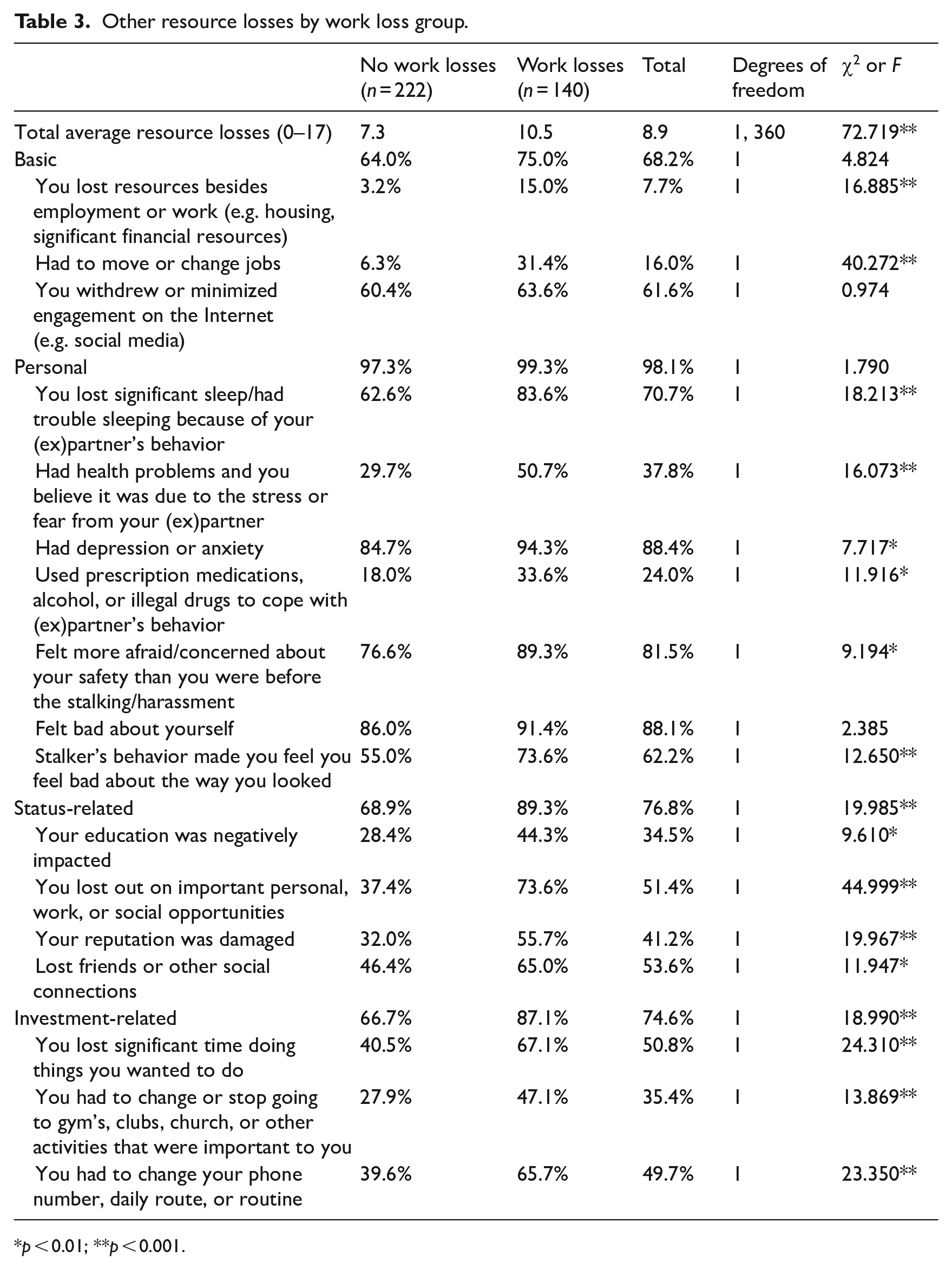
Overall, acquaintance stalking victims lost about 9 resources, other than work losses, out of the 17 measured resources (see Table 3). In particular, 98% reported they lost personal resources, about three-quarters reported they lost status and investment-related resources and 68% lost basic resources. Even so, women with work losses reported more resource losses other than work losses (10.5 vs 7.3) and more of them lost status and investment-related resources than women with no work losses.
Other resource losses by work loss group.
p < 0.01; **p < 0.001.
Help-seeking
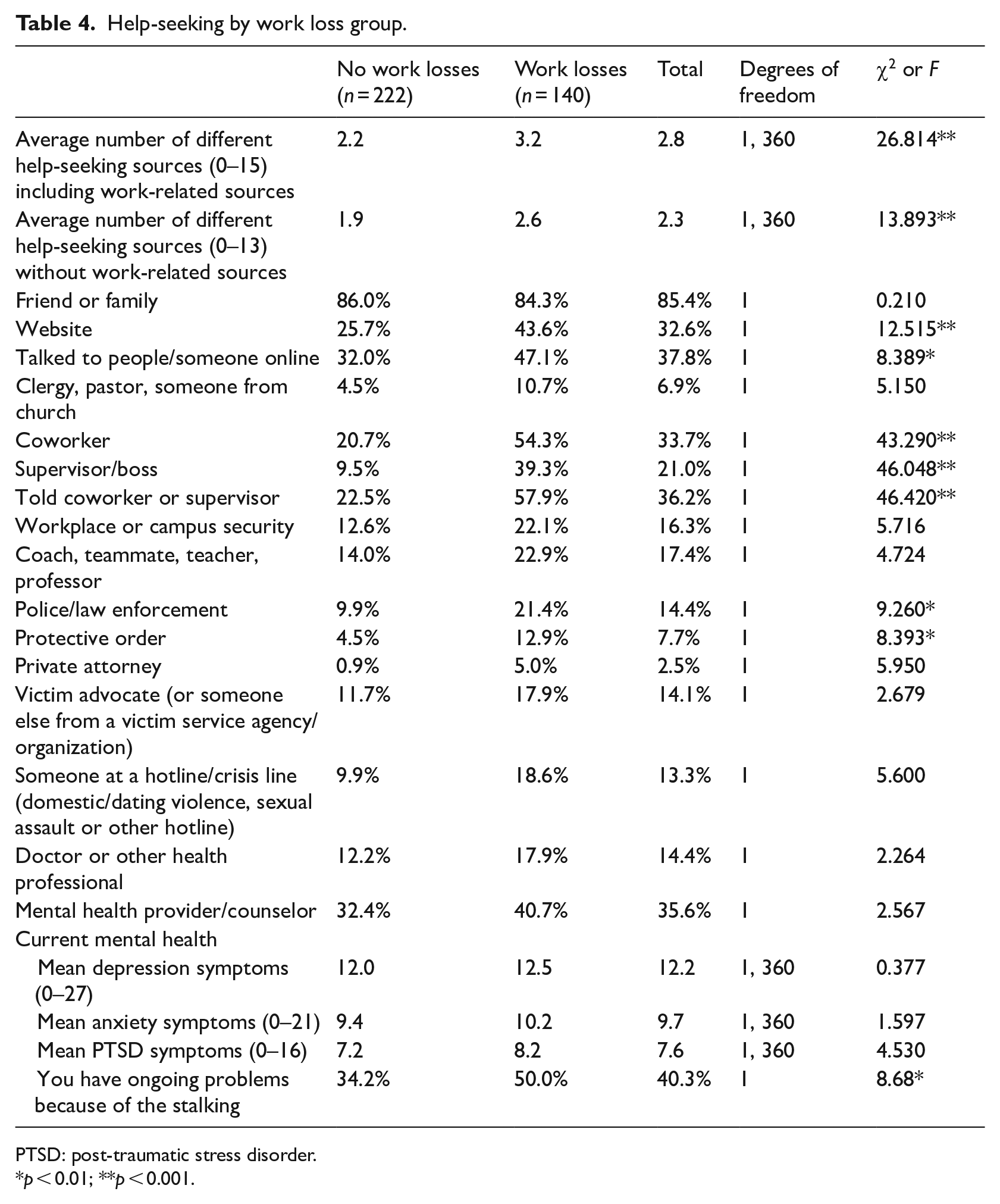
Acquaintance stalking victims, regardless of group, used an average of about three different help-seeking sources as shown in Table 4. The majority of the sample reported they sought help from friends or family (85.4%) while around one-third indicated they used online resources (e.g. a website, talked to someone online), talked to a coworker, or talked to a mental health provider or counselor. Only 14.4% overall reported they had talked to a victim advocate or someone from a victim service agency or organization and only 13.3% indicated they talked to someone from a hotline. More women with work losses reported talking to a coworker and/or supervisor, used online resources, talked to police, and/or sought a protective order than women with no work losses. Women with work losses used significantly more help-seeking sources whether or not work sources (coworkers, supervisors) were included in the count.
Help-seeking by work loss group.
PTSD: post-traumatic stress disorder.
p < 0.01; **p < 0.001.
Current mental health and ongoing problems
There were no bivariate differences for depression, anxiety, or PTSD symptoms between the two groups (Table 4). However, half of the women with work losses reported ongoing problems because of the stalking compared to just over a third of those with no work losses.
Multivariate analysis of factors related to mental health symptoms and help-seeking
As shown in Table 5, the number of other resource losses was uniquely positively associated with depression and anxiety symptoms and PTSD. Furthermore, younger victims, victims who experienced sexual assault, and those with a longer duration of stalking had significantly increased depression and anxiety symptoms. Sexual assault and increased stalking duration were also associated with increased PTSD symptoms.
Multivariate analysis.
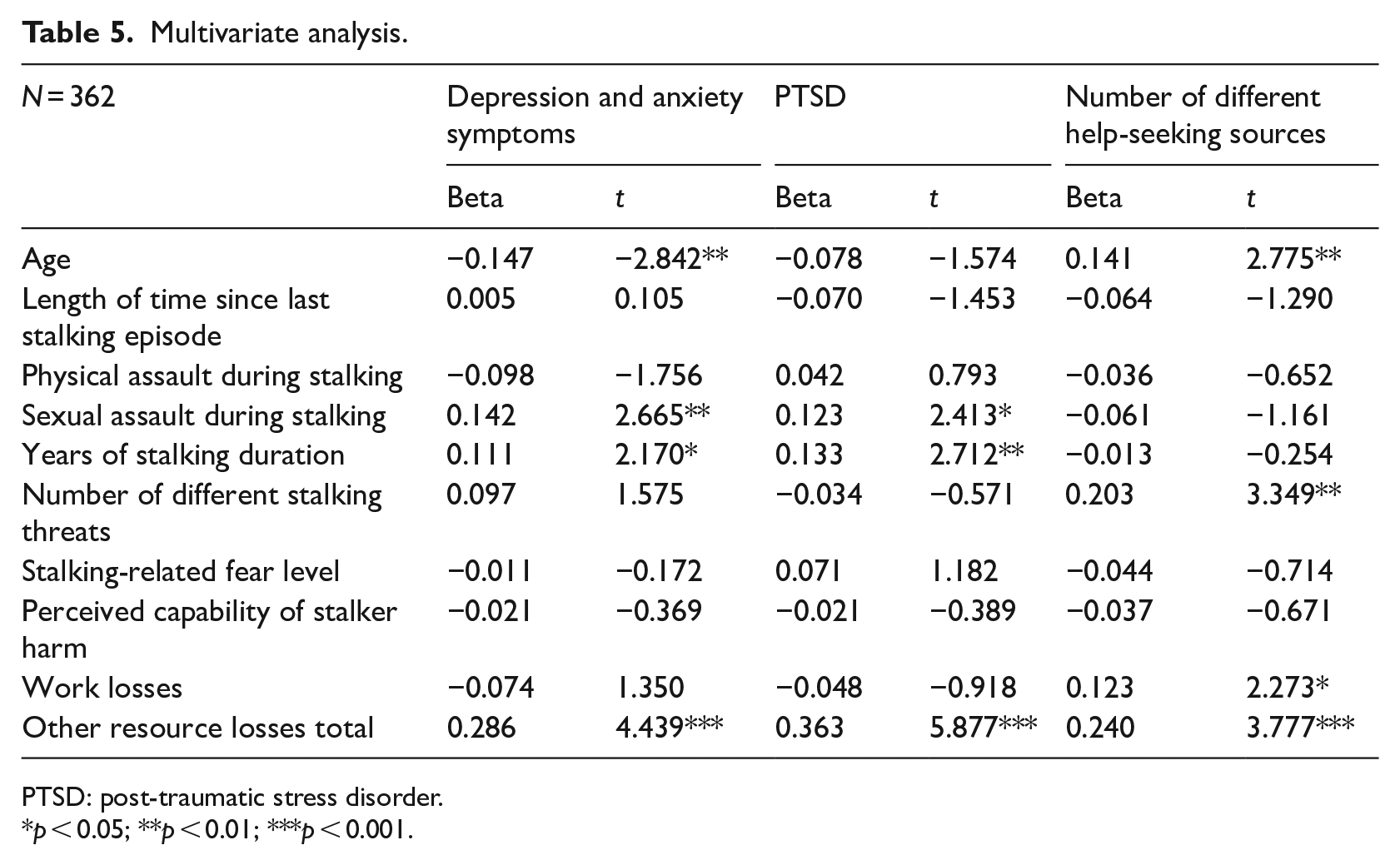
PTSD: post-traumatic stress disorder.
p < 0.05; **p < 0.01; ***p < 0.001.
The regression examining help-seeking sources found that, in addition to other resources, older victims, the number of different stalking threats, and work and other resource losses were uniquely associated with increased help-seeking sources. The regression was rerun using help-seeking sources that did not include coworkers or supervisors and found that other resource losses (B = 0.273, t = 4.234, p < 0.001) and number of different threats (B = 0.212, t = 3.448, p < 0.01) were uniquely associated with a higher number of different help-seeking sources (not shown in a table).
Discussion
Stalking research has grown significantly over the past two decades (Logan and Walker, 2017a). However, acquaintance stalking victim experiences and consequences have received more limited research attention even though a significant number of women, and men, are stalked by acquaintances (Smith et al., 2017). Victim workplaces have frequently been targeted by stalkers although most of the research on workplace consequences of stalking has focused on (ex)partner stalkers (Logan and Showalter, 2021; Showalter, 2016). Employment is an essential resource for most people and is an easy way for stalkers target victims, regardless of the prior stalker–victim relationship. More specifically, many places of employment are open to the public, making it easy to target victims at work. Workplace stalking not only impacts the victim but it also impacts other employees and potentially overall workplace functioning (Blodgett and Lanigan, 2018) and safety (Logan and Lynch, 2021). At the same time, employers have come a long way in educating, training, recognizing, and addressing sexual harassment but little has been done to address stalking even though stalking has been associated with physical/sexual assault and lethal violence (Logan and Walker, 2017a). The current study is one of the first to examine experiences of acquaintance stalking victims, workplace losses, mental health outcomes, and help-seeking. There were four main findings of this study including: (1) overall, many acquaintance stalking victims in the current study, regardless of work losses, experienced work interference; (2) acquaintance stalking victims with work losses experienced more life interference and threats, they had higher stalking-related fear levels, and more of them experienced work harassment; (3) help-seeking among acquaintance stalking victims, even though they endured stalking for an average of almost 2 years, was low, although women with work losses sought help from more sources on average; and (4) overall, acquaintance stalking victims lost an average of nine different resources other than work losses, and other resource losses (not work losses) were associated with current negative mental health symptoms and help-seeking.
Several studies with large samples of employed adults suggest that 40–50% of women and 20% of men have experienced partner abuse, and many of those individuals experience stalking and disruption at work as well as negative workplace consequences (Blodgett and Lanigan, 2018; Macgregor et al., 2016; Wathen et al., 2015). Similarly, the current study found that over three-quarters of acquaintance stalking victims experienced on-the-job harassment and interference with job performance while over one-quarter experienced work disruption. Studies of workplace interference by partner abusers have found that stalking in general, and specifically, more frequent and intense stalking conduct was associated with increased negative work consequences for victims (Blodgett and Lanigan, 2018; Logan et al., 2007; Logan and Showalter, 2021). Similarly, in the current study, acquaintance stalking victims with work losses experienced significantly more stalking threats, more life interference, and had higher stalking-related fear levels. Stalking victims with work losses also experienced more work interference and job performance problems.
Results of the current study suggest the need for employers to understand and educate their employees about stalking and to have policies in place to identify and address stalking as soon as it begins. Educating employees about stalking can help facilitate safety because many employees may not recognize it immediately. One study found that one-third of workplace stalking victims did not recognize stalking until a year later or longer after it began (Sheridan et al., 2019). Other research suggests that if stalking victims do not recognize what is happening as stalking they tend to engage in less help-seeking (Ménard and Cox, 2016). This is especially important given many victims meet their stalker at work (Sheridan et al., 2019). The current study found that over half (54.4%) of the women in the study had been stalked by someone who worked or went to school with them or was in a position of authority over them. Furthermore, many stalkers use workplace time and/or resources to stalk, harass, or monitor others and coworkers and supervisors need clear direction about how to report and respond to these behaviors (Scott et al., 2017). Workplace policies may be especially crucial to help employees experiencing stalking at work so they can get the support they need. Increased support can facilitate safety and decrease fear levels (Logan and Walker, 2017a). Decreased fear levels may be associated with less harmful physical and mental health outcomes (Logan, 2019; Logan and Walker, 2010b, 2017a, 2021).
In the current study, help-seeking outside of friends or family was relatively rare especially given that the average stalking course of conduct was 1.7 years. Not only is it embarrassing to tell others about the stalking but finding help for acquaintance stalking victims may be particularly difficult. Many victim service agencies do not serve stalking victims unless they have other victimization experiences such as partner abuse or human trafficking. Although stalking in general is misunderstood and often not taken seriously, stranger and acquaintance stalking cases, outside of public figures, may be even less understood. This may be one reason that many victims in the current study turned to online resources for help. Online help-seeking and seeking help at work, particularly for those with work losses, were more frequently used than other sources. Additionally, about one-third of the stalking victims, overall, reported they had talked to a mental health provider or a counselor. Only 14% of the victims in the current study reported they talked to police and less than 8% indicated they had sought a protective order although more of those with work losses sought help from police (21.4%) and/or protective orders (12.9%). Also, although stalking can exacerbate or create new health problems (Davis et al., 2002), only 14.4% of acquaintance stalking victims in the current study disclosed the stalking victimization to a health professional. More research is needed to better understand why these acquaintance stalking victims, who experienced significant resource losses and fear, are not using the criminal or civil justice system for help as well as what their experiences are for those who do seek help through the justice system.
Workplaces provide both a convenient place to stalk victims and a resource that stalkers often sabotage (Logan and Walker, 2017a; Nicastro et al., 2000). Resources can be defined as anything of value to an individual (Hobfall, 1989; Hobfall and Lilly, 1993). As they are valued, it makes it particularly painful to lose them especially when the loss is due to a stalker. Furthermore, when stalking victims seek help, they are likely to be seeking help for their personal safety but also to try to stop resources from being lost or destroyed. Yet, stalking is not taken seriously by the civil and criminal justice system and often safety planning does not address aspects of victimization beyond physical safety. Overall, almost 70% of the victims in the current study reported they had lost basic resources and about three-quarters reported they had lost status-related and/or investment-related resources. Additionally, over 70% had sleep problems because of the stalking and harassment. Over 98% had lost personal resources. In particular, 88% reported they felt bad about themselves, had depression or anxiety, and over 80% had increased fear levels because of the stalking and harassment. Several studies have found that interpersonal victimization erodes self-esteem and self-identity although those studies are from partner abuse victims (Logan et al., 2006; Matheson et al., 2015). The partner abuse literature suggests that the journey to healing, when victimization has been sustained over a period of time and impacted self-esteem and self-identity, is long and difficult particularly when women have fewer resources (Matheson et al., 2015). The current study suggests that acquaintance stalking victimization also erodes self-esteem although this aspect of stalking has received limited research attention. Employment could serve as a safe place for victims (Logan et al., 2006; Swanberg et al., 2005, 2007) or at least allow victims a refuge from the stalking temporarily which can be very helpful in coping with stalking. If employers can create a safe environment for the employee, it can manifest in increased productivity. For example, employers could create confidential spaces where employees can have access to information and support, to raise concerns, and make complaints. Employers could also allow victims flexibility in scheduling and work conditions when possible. Another option may be for employees to partner with organizations or agencies that specialize in gender-based violence that they can refer employees to if needed and/or to bring in law enforcement or other security professionals to safety plan with stalking victims and other employees (Allan, 2019; Logan, 2021).
Those with work losses, in the current study, also reported more resource losses overall than those with no work losses. Furthermore, half of those with work losses reported they were experiencing ongoing problems compared to one-third of those without work losses. The multivariate analysis found that resource losses (but not work losses) were associated with increased anxiety and depression symptoms, PTSD symptoms, and help-seeking sources. These results underscore the importance of resource loss and speak to the long-term harm from stalking. Similar results were found among a sample of (ex)partner stalking victims (Logan and Showalter, 2021) suggesting that resource loss from stalking is an extremely harmful consequence of being stalked and is related to the ability to recover from stalking victimization. More research is needed to better understand the timing and relationship of work losses and other resource losses and how to reverse the resource loss spirals for stalking victims.
Limitations
This study used a sample of women acquaintance stalking victims who had been sexually assaulted or sexually harassed by the stalker and who had been stalked by a male acquaintance, thus limiting generalizability to all acquaintance stalking victims. Furthermore, the sample was not very diverse as the majority of the sample were White, employed, and almost 90% had some college. Future research is needed on acquaintance stalking victims with diverse backgrounds and experiences. Even with the sample limitations, however, there were several concerning findings which suggest more research is needed for acquaintance stalking victims. Additionally, the questions in the study about the level of support for those who disclosed and how the support might differ for those with stalkers from the workplace versus those with stalkers outside of the workplace are needed. The work losses measures were cursory and understanding more details about what happened, timing of events, and why survivors thought they experienced work losses would be informative. There is also limited research examining a wide variety of resource losses among stalking victims or how to best protect those resources from stalkers.
Conclusion and implications
Stalking victims suffer significant negative consequences with very little help in coping with the stalking situation (Brady and Nobles, 2017; Korkodeilou, 2016; Logan and Walker, 2017a; Ngo, 2019, 2020). Employment is a crucial resource for victims but also provides a convenient place for stalkers, regardless of the victim–stalker relationship, to target their victims. Yet, employers have been slow to respond with policies to protect employees and particularly from stalking (Better Workplaces (BW), 2019; Blando et al., 2020). It is crucial that employees be protected from stalking and that they are able to get support, education, information, and other help they need to sustain the ability to work as well as to protect other resources. Workplaces, when notified of an employee being stalked, must consider that stalking at the workplace is most likely a fraction of what victims are enduring 24 hours a day 7 days a week and that every aspect of their life has been disrupted (Logan and Walker, 2010b, 2017a). Thus, safety planning with stalking victims needs to consider workplaces as a primary target for safety planning and protection (Logan and Walker, 2018). Employers may need to either refer victims to victim service agencies or others who specialize in safety planning with stalking victims or obtain proper safety planning training.
Implications from this study suggest that safety at work is a primary concern for all types of stalking victims and workplace policies should consider stalking as a separate category of victimization. Policies should also address both internal and external stalkers as the tools available to stalkers and safety strategies will differ depending on stalker access to the workplace and the victim. Employers could also train employees how to recognize, respond, and refer the situation to others for action (Allan, 2019; Logan, 2021). Furthermore, training all employees is necessary to ensure they know how to, and feel comfortable in doing so, report any stalking contacts (Allan, 2019; Logan, 2021). Training all employees in dealing with someone trying to get private information about others, someone who calls or shows up excessively, or someone who starts harassing them could increase workplace safety overall. Furthermore, accountability for policies, trainings, and general safety measures is crucial. In other words, employee safety is not a one-time event but is an ongoing dynamic situation. Thus, ensuring policies, trainings, and needs are acceptable and effective for employees is important as is checking in periodically with any employees who endured stalking to ensure the measures put in place are or did work effectively (Allan, 2019; Logan, 2021).
Footnotes
Acknowledgements
The authors acknowledge the University of Kentucky Department of Behavioral Science for funding this research as well as Jeb Messer for help with the data collection.