




Abstract
This article delves into the nuanced struggles of Muslim women within the socio-political landscape of Kashmir, whose loved ones experienced enforced disappearances by military forces. Using the framework of critical feminist theory and Islamic feminism in particular, this article analyses the agency of Muslim women survivors of enforced disappearances while negotiating their socio-economic problems and legal battles for seeking justice. Using narratives and case study analysis, we shed light on the everyday struggles, socio-economic challenges and legal struggles experienced by these survivors of enforced disappearances of loved ones. We show how enforced disappearances have a socio-economic and psychological impact on the lives of women whose loved ones have been forcibly disappeared. Apart from continuing their everyday struggles, these women also engaged with the court of law to pursue the cases of their disappeared loved ones. Moreover, amid violent conflict in Kashmir and disappeared male members of a family, the gender roles change. Broadly, the research contributes to a deeper understanding of the complex relationship between gender and conflict by analyzing the multifaceted challenges experienced by survivors in Kashmir, thus indicating a possibility for strengthening social work advocacy and support in conflict zones.
Introduction
Enforced disappearance is one of the most severe human rights violations. It is an act which leads to an abduction of a person by the state, either directly or indirectly, without any trace or protection of law. The International Convention for the Protection of All Persons from Enforced Disappearance (ICPPED) defines enforced disappearance as: Arrest, detention, abduction or any other form of deprivation of liberty by agents of the State or by persons or groups of persons acting with the authorization, support or acquiescence of the State, followed by a refusal to acknowledge the deprivation of liberty or by concealment of the fate or whereabouts of the disappeared person, which places such a person outside the protection of the law (Article 2; International Convention for the Protection of All Persons from Enforced Disappearance [ICPPED], 2006).
Enforced disappearance is different from other crimes and human rights violations as there is an involvement of the state. While differentiating it from other crimes, Scovazzi and Citroni (2007) point out that “other crimes involve the arrest of the person by a private individual for various criminal purposes, such as asking for a ransom” (p. 272). Enforced disappearance is considered a crime under the covenant of international law. Accordingly, states are obligated to criminalize acts of enforced disappearance and to bring those responsible to justice. In addition to infringing on the fundamental rights of the victim, enforced disappearances put their family members into a state of anguish, hoping to find their loved one and, at the same time, fearing the worst.
Enforced disappearance was one of the methods used to suppress the self-determination movement, which challenged the Indian state's legitimacy in Indian Administered Kashmir (IAK) (Hassan, 2018). To maintain its sovereign power, the Indian state turned into what Agamben has termed a state of exception (2005) by the enforcing of a new legality, which gave impunity to this institutionalized violence, resulting in human rights violations. Reportedly, there are over 8,000 documented cases of enforced disappearances in Jammu and Kashmir, India (Association of Parents of Disappeared Persons [APDP], 2011). Many male youths in Kashmir (18 to 35 years old) are still missing after the police and military forces picked them up during the combing operations or raids, and their families are unable to know their whereabouts.
The enforced disappearance of the family breadwinner or head of the household inflicts a profound socio-economic impact on the surviving female members, compelling them to seek employment as laborers or domestic workers in external households. Women, being primarily responsible for the care and support of their children, face formidable challenges in the aftermath of the disappearance. However, rather than being mere victims of enforced disappearances of loved ones, these women act as “survivors” who exercise their agency by navigating socio-economic challenges and engaging with legal institutions, such as courts, to seek justice for their loved ones.
This article examines the experiences of women survivors of enforced disappearances in Kashmir, whose (male) family members have been forcibly disappeared by the state. Applying a theoretical framework of Islamic feminism (Mahmood, 2005), the article analyses the agentive role of these survivors while facing socio-economic problems and their legal struggles to seek justice. Historically, discourse on gender, conflict, peace, and security has predominantly portrayed women as victims (Enloe, 2000; Sjoberg, 2006). Drawing from Muslim and critical feminist perspectives (Crenshaw, 1989; Mahmood, 2005), the study argues against the portrayal of Muslim women from the Global South as a homogeneous group. While focusing on survivors of enforced disappearances, it highlights that women in conflict zones exhibit agency in the face of adversity. Employing real-life cases, this research adds nuance to existing scholarship (Kazi, 2008; Malik, 2018; Zia, 2019) by examining how Muslim women in conflict contexts demonstrate resilience, resist oppression, and actively negotiate for justice — thereby reshaping the socio-political and legal realities around them and contributing to a more layered understanding of gendered agency.
Genesis of Conflict and Human Rights Violations
There is a vast scholarship focusing on the root causes of the Kashmir conflict, which points towards the disputed nature of the relationship of Kashmir to the Union of India (Bose 2009, 2021; Lamb, 1991; Schofield, 2003; Varshney, 1991; Whitehead, 2007). Most of these scholars argue that the genesis of the Kashmir conflict lies in the partition of British India into India and Pakistan in 1947, and the subsequent contestation over the territory of Kashmir by these two newly independent states.
The contestation over the territory of Kashmir by India and Pakistan led to war in 1947, resulting in Kashmir's division into two parts. The United Nations Security Council passed a resolution stating that “the future status of Jammu and Kashmir shall be determined by the will of the people” (Lamb, 1991, p. 203). India and Pakistan did not implement the resolutions of the United Nations for a referendum, and the territory remained divided, each part administered by two states. Instead of granting the right to self-determination, the Indian state developed a mechanism of asymmetric federalism and acknowledged its internal autonomy through Article 370 of its constitution (Noorani, 2011). Thus, the Indian state promised to maintain the relationship with this newly added federal unit by granting it a “special status” and establishing democracy through electoral politics. However, the events that unfolded in post-1950 Kashmir reveal that the special status was not respected and free and fair elections were not conducted. What followed, in reality, was the manipulation of national interests to control Kashmir, which were given priority over any principle of democracy (Bose, 2009).
Post-1990s Armed Struggle and Counter-Insurgency
The Kashmir conflict came to light again at the international level in the post-1990 period when political and militant groups launched an armed struggle to challenge Indian sovereignty over Kashmir. Academic works (Bose, 2009; Hassan, 2009) looked at the re-emergence of the self-determination movement in the post-1990s period in Kashmir. Although these works documented the mass protests, demonstrations, and strikes against the Indian state, they failed to account for the coercive response of the Indian state, which resulted in human rights violations. In contrast to this, there are works (Bose, 2021; Dewan, 1994; Duschinski & Hoffman, 2011; Hassan, 2011; Wani et al., 2013) which explored various measures taken by state authorities to suppress the self-determination movement, after which different notorious cases of human rights abuses came to the forefront. These works have focused on human rights abuses such as mass killings, unwarranted arrests, detentions, torture, custodial killings, and enforced disappearances. However, the impact of violent conflict and human rights violations on women in Kashmir was largely overlooked (Butalia, 2002; Ray, 2009).
Only a few feminist scholars engaged with this topic (Khan, 2007; Manchanda, 2001), focusing on the participation of women in the political movement and the gendered impact of the violence led by state and non-state actors. In post-1990s Kashmir, women experienced violence in the form of torture, detention, rapes, and killing, in both private and public places. Additionally, women also faced indirect violence through the death, arrest, torture, or disappearance of their loved ones. Moreover, not only were Kashmiri Muslim women survivors of human rights violations, but they also actively participated in protest marches in support of the self-determination movement.
Kashmiri Muslim Women — Survivors and Activists
Kashmiri Muslim women have been playing a crucial role in shaping various aspects of the society of Kashmir for some time (Mushtaq, 2018). Without participating in active politics, Kashmiri Muslim women have been playing a remarkable role and exercising agency in the private and public spheres (Hassan, 2018). Amidst violent conflict between state and non-state actors, the line between the public and private space started blurring, resulting in direct and indirect violence against women.
Despite a significant number of reported and well-documented cases of enforced disappearance, the Indian state continues to be in denial. Instead of any acknowledgement, the state keeps human rights organizations and even the family members of the disappeared people under constant surveillance. Consequently, the women whose kith and kin have been forcibly disappeared emerged as a large group of “survivors” of this form of violence. As Muslim women, these women are often stereotyped as “oppressed”, “weak”, and without any agency, and most of the academic works portray them merely as “victims” (Dewan, 1994; Hanif & Ullah, 2018; Petersen & Vedel, 1994).
Enforced Disappearance and Women Survivors
In 1994, Parveena Ahangar co-founded a collective called the Association of Parents of Disappeared Persons (APDP), along with other women survivors of those who had been forcibly disappeared, in order to address their collective vulnerability and to demand the whereabouts of their loved ones. Recent literature has examined the structure and functioning of APDP and its role in sensitizing people to the issue of enforced disappearances (Falak, 2018; Mathur, 2016; Zia, 2019). Although some civil liberty groups in Kashmir continued to raise the issue of human rights violations, there was an absence of social work addressing the socio-economic problems faced by survivors of enforced disappearances (Amnesty International, 1999; Chatterji et al., 2009; Zia, 2019). Henceforth, in such a void, APDP provided a platform for these survivors to exercise their agency and continue their struggle for justice.
Some scholarship (D'Souza, 2016; Haq, 2020; Mathur, 2016; Qutab, 2012) has focused on the changing gender roles vis-à-vis survivors who had to accept the different roles in public to support their families. Women were economically dependent on the male family members, and after the disappearance of these earning members of the family, they experienced economic destitution (Singh, 2019). Some of the women survivors lost shelter as they neither found a place in their in-laws’ houses nor were welcomed back at their parental homes (Zia, 2016). However, these women survivors ventured beyond their socially assigned roles, confronting socio-economic challenges and engaging in protracted legal battles in courts to seek justice for their disappeared loved ones.
Feminist legal scholars have argued that the law is patriarchal and male-biased from law-making to its implementation (MacKinnon, 1989, 2005). In conflict zones, the relationship between gender and law gets more complex. Women survivors of enforced disappearances in Kashmir have resorted to legal institutions such as courts as part of their activism, hopeful to attain justice for their loved ones. However, within the realm of conflict zones, women survivors have to confront often paralyzed legal frameworks pursuing justice becomes futile with systematic failures, political interferences, and institutional biases (Debecker, 2019). Women survivors of enforced disappearances approaching the legal courts with cases of their disappeared sons/husbands have witnessed enduring impunity of perpetrators and are trapped in a state of perpetual legal limbo. The persistent culture of impunity compels women survivors of enforced disappearances to navigate a labyrinth of bureaucratic channels, only to return empty-handed, inflicting cycles of violence and victimization on them (Chauhan, 2013).
It is essential to look at the struggle and agency of these women in facing the socio-economic challenges and their negotiations while dealing with legal institutions. Therefore, this article explores the emergence of local expressions of gendered agency in response to enforced disappearances by the state and within the context of state legal authorities. Our analysis will challenge depictions of Muslim women as passive victims in previous literature on Kashmir by focusing on Kashmiri Muslim women's quest for justice and, ultimately, their changing roles amidst violent conflict.
Theoretical Framework
Historically, women's agency in conflict zones remains understudied, and the sole focus has remained confined to victimization (Butalia, 2002; Duschinski, 2009; Moser & Clark, 2001). In the case of Kashmir, the academic literature predominantly focused on the causes of the Kashmir conflict and post-1990s violent politics, ignoring issues of gender and women's positionality (Bose, 2009; Lamb, 1991; Varshney, 1991). As discussed in the above section, some recent scholarship on Kashmir has explored the role of women in the Kashmir conflict, and their victimhood has been analyzed at length (Butalia, 2002; Duschinski, 2009; Manchanda, 2001; Ray, 2009). However, the agentive role played by Muslim women in Kashmir under different circumstances in conflict remains underexplored.
This article is informed by critical feminist theorization, and particularly Islamic feminism, to understand the everyday struggles of the women survivors of enforced disappearances and their agentive role while negotiating with the courts to seek justice (Crenshaw, 1989; Mahmood, 2005). We apply Mahmood's approach (2005) to study Muslim women's agency in response to enforced disappearances in Kashmir.
For an extended period, feminist theorization was dominated by Western feminist theory, which focuses on the historical oppression of women and the intersection of theory and practice to address it. This scholarship (Cockburn, 2001; Scott, 1988) points out that gender roles that result from the relative positioning of men and women pervade due to the power hierarchy that prevails in society. Therefore, for Western feminist theory, gender is an essential aspect of social relationships based on the perceived differences between the sexes, which define the power dynamics between men and women. According to this notion, women are disadvantaged in this power relationship. However, it fails to provide a deeper understanding of various nuances of the struggles of Muslim women in the Global South, such as survivors of enforced disappearances in Kashmir.
Claiming that women all over the world share a common experience in their oppression under patriarchy, Western feminism presents itself as a philosophy and activism to rescue “Third World Women”. Homogenizing women across the globe neglects other oppressive power structures such as religion, national identity, and ethnicity. Mohanty (1984) criticized Western feminist discourse for reducing the “Third World Woman” as a homogeneous group and ignoring the diversity of experience within this group. She argues that most Western scholarship has defined “Third World Women” by the universal oppression of being sexually constrained, ignorant of their subjugation, and bound by family traditions that the Western feminist can save them from. On the contrary, Islamic feminist thought points out that being religious or spiritual and having agency of one's own are not always opposing poles (Mahmood, 2005).
Islamic feminism started as a new gender discourse by the early 1990s (Mojab, 2001), focusing primarily on critical analysis and reinterpretation of Islamic texts, such as the Quran and Hadith (sayings and actions of Prophet Muhammad) and challenging the patriarchal interpretations influenced by various cultures (Ahmad, 1992; Mernissi, 1991). Highlighting egalitarian principles of Islam, Islamic feminism maintains that Islam is not inherently patriarchal; instead, all humans are equal in the eyes of Allah and, subsequently, should be treated as such in all aspects of life, including social, economic, and political spheres. Using a gender-inclusive perspective, Islamic feminists focus on the process of reinterpretation, called “ijtihad”, to reclaim the egalitarian spirit of Islam and empower Muslim women to assert their rights and challenge oppressive practices (Mir-Hosseini, 2002). Although scholars of Islamic feminism share a common aim, there are debates and diverse opinions within this scholarship. So, it may be more suitable to talk of Islamic feminism(s), which can be differentiated by cultural, regional, and doctrinal differences, which have led to divergent schools of thought (Mirza, 2008).
Broadly, this scholarship is divided into two main groups — first, those who see the inequality of sexes in Islam as divinely ordinated and second, those who have engaged in progressive readings of the Quran and the Hadith to unearth the authentic configuration of women's rights in Islam. Scholars in the first category, such as Safia Iqbal, argue about the delineation between the public and the private in which men and women inhabit different domains under the “separate but equal” rubric (Iqbal, 1988). Therefore, this strand of Islamic feminism emphasizes that women and men have different roles and occupy different spheres of life. It is this definition of equality that challenges conservative representations of women as spiritually inferior to men. The second approach includes scholars like Amina Wadud, who are developing readings of scripture that often depart radically from classical interpretations and critically analyze the viability of locating gender equality within Islam (Wadud, 2006). Agency and empowerment of Muslim women is one of the central tenets of this approach of Islamic feminism (Mahmood, 2005), where Muslim women are encouraged to participate actively in society, decision-making processes, and education, and even to demand justice while advocating for their rights.
While advocating for Islamic feminism, Mir-Hosseini (2006) argues that gender roles and women's rights, rather than being fixed and absolute, are cultural constructs and, hence, can be transformed through activism and advocacy. Over time, Muslim women have been successful in negotiating gender relations and, by playing an active role in various socio-political and legal spheres, effectively moderating restrictions as well. Islamic feminists have posed a challenge to the traditional Western-centric perspectives on Islam and Muslim women and offer a more contextualized understanding of women's experiences and struggles within the Muslim world (Mahmood, 2005). By recognizing the agency of Muslim women, Islamic feminism compels Western media to reconsider the portrayal of Muslim women as “docile” and “agency-less victims” of their religion. By emphasizing the agentive role played by Muslim women, it challenges Western narratives about Islam and the homogenization of Muslim women. It provides a constructive path for Muslim women to advocate for gender equality without compromising their Islamic identity. Mahmood (2005) argues that Muslim women have agency in terms of their “capacity for action that historically specific relations enable and create” (p.18). She also points out that the Islamic principles and jurisprudence perceived by “Western liberals” as reductionist and detrimental to women's freedom are not challenged by these women; instead, their goal is to attain higher levels of piety.
Methods
Study Design
This article is based on fieldwork conducted in the three districts of Kashmir Valley — Srinagar, Budgam and Anantnag — between June 2022 and September 2023. Not only were these three districts volatile during the 1990s, but human rights organizations documented the highest number of enforced disappearances from there. The narratives in this article are drawn from the case study method to examine the individual experiences of women survivors of enforced disappearances and to explore their socio-economic hardships and interactions with legal institutions, thereby analyzing their agentive roles.
This study is based on three in-depth case studies. The semi-structured questionnaire employed for the interviews with the research participants was prepared in English, but the questions were translated into Kashmiri. Most of the interviews with the survivors of enforced disappearances were conducted either at their homes or at the APDP office which they visit twice for meetings. For instance, the interviews for the two survivors discussed in detail were held at their residential places, with time varying from one to two hours. The interview with the first participant was held in five meetings at the APDP office and lasted 30 min to one hour for each meeting.
Both researchers interviewed women survivors, recorded the interviews with prior consent, transcribed the interviews, and successfully developed the codebook. The researchers were transparent to the participants about their role in the study, and free and informed consent was obtained. Through detailed briefings, participants were informed about the study's purpose and potential risks, and assured of their right to withdraw at any stage without consequence.
Recruitment and Participants
The study utilized snowball sampling to reach politically sensitive populations. The snowball sampling technique involves a chain-referral process where one identified participant facilitates access to “hidden or hard-to-reach or socially sensitive populations” (Pasikowski, 2023, p. 112). The research process started by visiting the office of the APDP, which has been engaged in documenting enforced disappearances in Kashmir since the early 1990s. At APDP, researchers met the first research participant (a woman survivor) who provided information about similar cases. We recruited for cases where the participant had a loved one who was forcibly disappeared. The cases reflected both shared and differing experiences of socio-economic challenges, and involved legal action pursued against the state.
Another target group of participants included activists from APDP, journalists who had covered these stories in newspapers, and lawyers associated with these legal cases. Structured, open-ended, in-depth interviews were held with them for data triangulation, where different people are interviewed to gather the same data, to enrich the data (Donkoh & Mensah, 2023). Further, the integration of their viewpoints helped reduce the chances of data inconsistencies and enhanced the depth and credibility of the data.
Data Analysis
We employed content analysis, which focuses on “the study of the content concerning the meanings, contexts and intentions contained in messages” (Prasad, 2008, p. 1), to systematically code and analyze transcripts for relevant themes, ideas, phrases, and insights connected to the research questions around gender, conflict, and agency. The content analysis helped us identify how often certain words or ideas appear in the survivors’ narratives of the enforced disappearances. The theoretical tenets from critical feminist theory such as patriarchy and its intersection with nationalism, religious identity, and military occupation were used to develop the codebook categories (Crenshaw, 1989; Mahmood, 2005; Mohanty, 1984). We noted the frequency of words/ideas and examined the context and language across the narratives to classify these into different categories. Therefore, categorizing words and ideas with similar meanings helped us develop codes. The codebook developed for this research work is illustrated below:
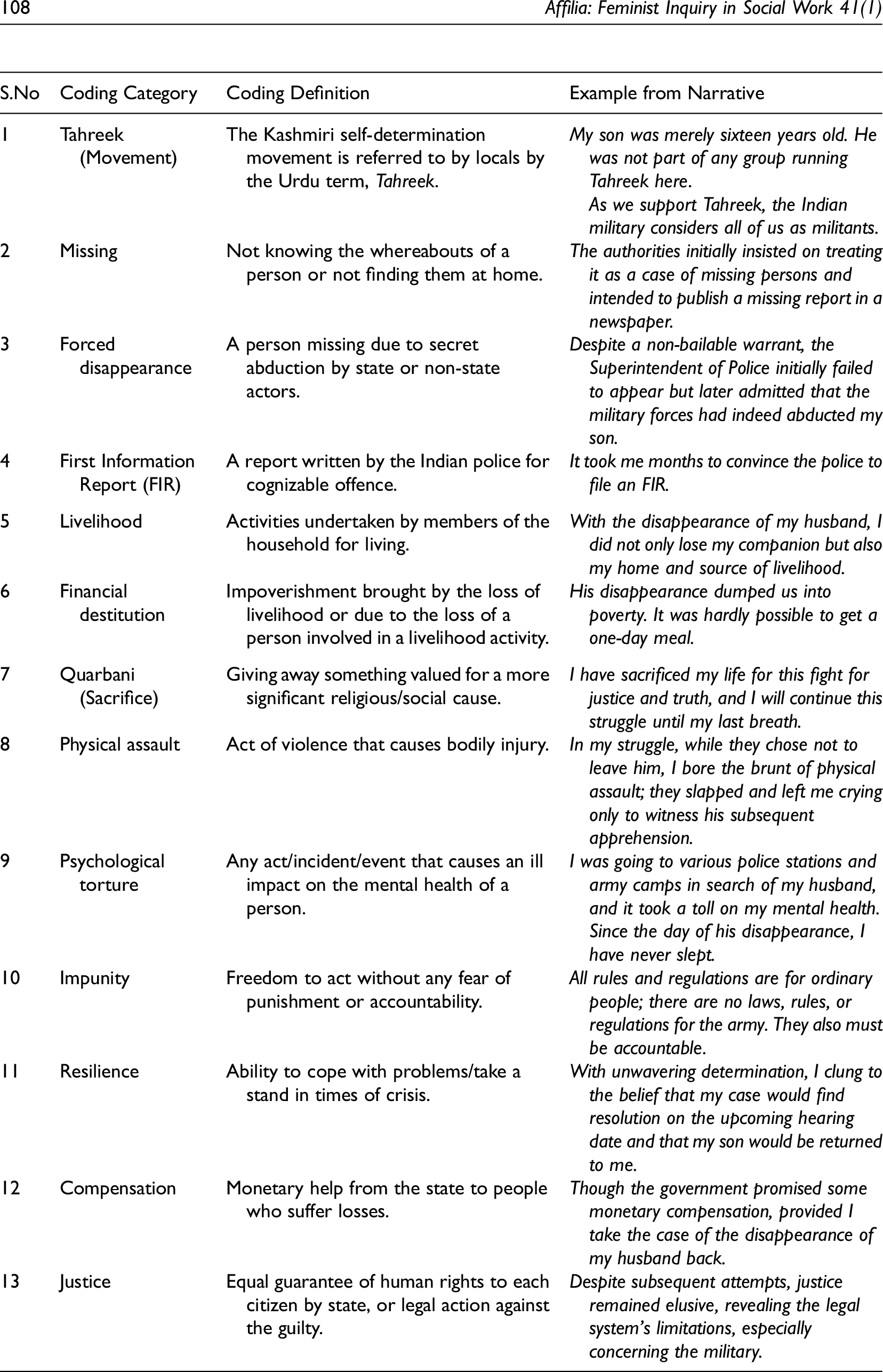
Using content analysis, we could draw valid inferences from verbal, visual, or written data to describe the experiences of the women survivors. Here, it was not merely used as a counting process but rather to link the results to the context of the violent period of 1990s Kashmir. Therefore, we employed qualitative latent analysis, as we were not only interested in what the participants said, but also in exploring the socio-political and emotional meanings embedded in their narratives (Braun & Clarke, 2006; Burnard, 1995).
Positionality of Researchers
The authors of this research article are affiliated with a public university in Kashmir. The first author is a research scholar, and the second is working as a faculty member. Both the authors, being born in Muslim families in Kashmir valley, knowing the Kashmiri language, and living through and witnessing the violent politics in Kashmir, qualify as “insiders”. However, neither of them experienced enforced disappearances of any of their family members or relatives. In addition, neither of them hold membership in human rights groups, such as the APDP, which works on the issue of enforced disappearances in Kashmir. Therefore, both of them are “outsiders” as far as this research on the women survivors of the enforced disappearances is concerned. Given this positionality of authors, we acknowledge that our own experiences, disciplinary knowledge, and politics may have influenced the interpretation presented in the findings and discussion section. Moreover, our affiliation with the public university may have represented a position of privilege compared to many research participants. Therefore, the analysis presented in this research may be subjected to further refinement as more scholarship on the issue of enforced disappearances in Kashmir continues to emerge from varied disciplines.
Statement on Ethics
The research study was approved by the Institutional Review Board (IRB) of the university associated with both authors. The research participants for this article provided informed consent before their formal interviews, and the authors sought their permission to use the documents of their respective legal cases. Due to the high state surveillance structure at work in villages, two survivors asked to keep their identities anonymous. The third survivor, a prominent human rights defender and head of APDP, requested that her original identity be used in this research work. As a result, we use pseudonyms for two of the women survivors, while the original name is used in the third case. The identity of journalists, lawyers, and human rights defenders who provided their insights for this research has not been disclosed to safeguard their privacy and confidentiality.
Findings
Almost all the districts of the Kashmir valley witnessed violence in the post-1990s period, resulting in human rights violations, including enforced disappearances. Kashmiri Muslim women across the districts whose loved ones disappeared had to face socio-economic problems, and some of them took the path of legal struggles to seek justice. The three different cases presented in this study illustrate the experiences that represent the intersection of religious identity, class, urban-rural background, and legal knowledge.
Case - I
Zareefa: “If he returns, how will I recognize that it is him?”
Zareefa was a fifty-five-year-old woman, hailing from a rural area about forty kilometers from the main town of district Anantnag. Her life played out like a tragedy, defined by the mysterious disappearance of her husband, Abdullah Dar, about thirty years ago. It was the time when the Armed Forces Special Powers Act (AFSPA), which gave impunity to Indian forces to arrest or shoot on mere suspicion, was already implemented by the Indian Parliament (Kazi, 2008). Zareefa's husband was a humble farmer without links to any militant or anti-state political organizations. Due to his disappearance on April 19, 1992, an abrupt void left by his absence cast a long shadow over Zareefa and her five young children. According to a human rights defender from Srinagar who had documented this case, “Abdullah Dar was not just a husband and father but the sole income source supporting his family.” For twelve excruciating years, Zareefa searched relentlessly, determined to discover what had happened to her husband. In searching for her husband, she gave up the only source of security and livelihood for her family — their ancestral home and land. She followed the army's assurances of her husband's return, dead or alive, through numerous police stations and military camps from village to city. In an interview with us, she recalled: “The army colonel said that after the inquiry, he will be returned to you, either dead or alive.”
Zareefa, even after thirty years, vividly recalls the exact words of the army colonel. Her husband's life was reduced to a binary outcome, dead or alive, denying her any space for justice and accountability. The promises were empty, and bureaucracy provided no consolation. The army colonel's assurances of an investigation and subsequent release were a cruel facade. A senior journalist who had covered the cases of enforced disappearances in the 1990s period for a local English Daily said that police and army officers often gave assurances of the return of disappeared to avoid protests or court cases. Zareefa, with her five children, felt stuck in an endless loop of despair and hopelessness. As she described: “Nothing remained in the base. His disappearance dumped us into poverty. It was hardly possible to get a one-day meal.”
Both Zareefa's mental and physical well-being took a hit throughout this dreadful loss. The stress and uncertainty aged her beyond her years, creating a stark contrast between her struggles and the seemingly tranquil lives of others around her. Financial destitution forced Zareefa into manual labor, working in fields and households to sustain her children. Education became a distant dream for them due to the overwhelming presence of poverty in their lives. No social work organization came forward to help her during these tough times. She said: “Neither any social nor religious organization helped me and my children. Only at the time of Eid would a Masjid committee provide us with some lump sum amount of money.”
Betrayed even by her own family, Zareefa was subjected to further difficulties when her brother took advantage of her frailty by seizing and selling her remaining assets. Forced to leave her parental home, she lived in a shabby shelter one kilometer from her residence until a new house was built.
Even after twenty years had passed, the scars of Abdullah Dar's disappearance still haunted Zareefa. She grappled with the relentless fear and uncertainty about her husband's fate, and this fear has left her unable to sleep. Although she is often surrounded by family and friends, she continues to experience a sense of loneliness due to her husband's absence. Yet, an enduring hope remains that she may one day find some trace of him or that he might return home. The echoes of her resilience resonate through the valley, a poignant reminder of the untold stories that linger in the shadows of conflict: “Since the day of his disappearance, I have never slept. The whole night, I had been thinking about him, where he would be, what would happen to him, and when he would return. If Abdullah Dar returns, how will I know it is him? I will recognize the mole on his face, then call my neighbors to help me ensure it is him. (tears welling up) It is just so hard…”
Zareefa's assertion illustrates how her husband's disappearance led to a fragmentation of relational continuity. Beyond his physical absence, she experienced an ambiguity marked by the erosion of memory, identity, and emotional certainty.
Not aware of the legal procedures, Zareefa did not take the case of her husband's disappearances to the court of law. According to a human rights defender working with APDP, it was only almost a decade after his disappearance that APDP documented his case for the legal procedures.
Case - II
Halima: “With the disappearance of my husband, I did not only lose my companion but also my home and source livelihood.”
In her fifties, Halima symbolized strength living in a small village near Bijbehara in South Kashmir, whose life took an unexpected turn on the fateful night of May 8, 1994. Halima's husband, a dedicated cleric working in the revenue department, was a well-educated man with aspirations of joining the prestigious Kashmir Administrative Service (KAS). Little did the couple know that their dreams would be shattered by an unforeseen event that unfolded at night. Around 2:30 A.M., the tranquility of their home was shattered as approximately fifty military personnel surrounded their residence. Some forcefully entered, seizing Halima's husband, who was diligently preparing for the KAS examinations. A brave woman, Halima confronted the armed men, determined to protect her husband. However, her efforts were met with violence as she was slapped and hit in the struggle. Despite her valiant attempts, her husband was taken away, leaving Halima and her family in shock and despair. The military forces detained the family, locking the doors of their home. In a desperate bid for help, Halima managed to escape through a window, only to be caught, her hands tied behind her back and a patch over her mouth. Remembering this incident, she said: “In my struggle, while they chose not to leave him, I bore the brunt of physical assault; they slapped and left me there crying, only to witness his subsequent apprehension. Following this, the military incarcerated me within the confines of the house, sealing our fate by bolting the doors shut.”
Halima and her family sought justice the following day by filing a report at the nearby army camp and the Pahalgam police station. However, the military denied involvement, adding to the mystery surrounding the disappearance. Days later, Halima received information that her husband had been seen in the house of his friend in critical condition. Despite his previous release, he was arrested again by the same commandos who had taken him initially. The family's attempts to seek the truth were met with consistent denial from the army. Without any First Information Report (FIR) at the Police station, it became difficult for Halima to get any lawyer to agree to take a case of her husband's disappearance. Additionally, there was no financial support from anyone to support her legal battle or hire a lawyer. It took years to convince the local police to lodge an FIR in this case but there was no army personnel named or unit mentioned. After contacting other survivors at the office of APDP, Halima contacted the lawyer who helped her register a case in court. According to Halima's lawyer, who also represents other survivors, “Halima is not educated, but she arranged the case file of her husband very meticulously, keeping all small details related to his disappearance. She also keeps educating herself on the legal language and the various laws that are part of the legal procedure for her husband's case.” After two hearings at the lower court, the case was dismissed as the army personnel or the unit alleged in the disappearances remained unidentified.
As years passed, Halima faced numerous hardships. Without any permanent income except a small orchard of walnuts, she relied on the support of her in-laws, who themselves succumbed to the depression caused by their son's disappearance. Two daughters and the weight of uncertainty became Halima's companions, leading to health issues for the family. Although there were social work organizations in her locality that worked on issues such as domestic violence and providing entrepreneurial skills to women, none of these wanted to address the problems of survivors of enforced disappearances. As she pointed out: “Some organizations in our locality would help marginalized women. However, for the cases of enforced disappearances, none of these organizations come forward due to security apprehensions.”
However, in the face of adversity, Halima exhibited unwavering strength. She educated her daughters and maintained her household with resilience. Despite the pain and turmoil, Halima clung to hope, awaiting her husband's return with the phrase, “mulaqat chhu meharaj” - the pleasure of seeing is everything.
Case - III
Parveena: “I have safeguarded and cared for these fellow victims of enforced disappearance with a commitment surpassing that extended to my blood relation. I have sacrificed my life for this fight for justice and truth, and I will continue this struggle until my last breath.”
Parveena Ahangar was a sixty-year-old woman from Srinagar whose name was a fixture among South Asia's critical human rights defenders. In 2017, she was awarded the Rafto prize by the Rafto Foundation, Norway, to recognize her struggle for survivors’ families of enforced disappearances. She was a chairperson of the APDP and a survivor of enforced disappearances who was peacefully living her life with her family before the disappearance of her son.
Within the framework of gender dynamics, her case offered a detailed examination of how people may respond to dreadful events to prevent more harm. The events that led to Parveena's suffering began on August 18, 1990, when her sixteen-year-old son Javaid was kidnapped during a night raid at Batamaloo, Srinagar, by the National Security Guards (NSG), a counter-insurgency unit of the Indian army. Like many other cases of enforced disappearances, there was a denial from the state authorities, as she explained: “The authorities initially insisted on treating it as a case of missing persons and intended to publish a missing report in a newspaper. Still, my son was not missing — he was abducted.”
Her firm belief in her son's innocence prompted her to continue a persistent search for him. She spent months wandering a complex network of jails and detentions centers, such as the Papa-II and Harinawas detention centers. Parveena contacted people with connections inside the Indian military system for help. She went to state authorities, lawmakers, the Jammu and Kashmir legislature, and the Indian parliament as part of her outreach efforts. A senior editor from an Urdu Daily, who was a ground reporter in the 1990s period, showed us a picture from his archives which shows Parveena stopping a police vehicle on the road to protest against the disappearance of her son.
Parveena sought the assistance of sympathetic local advocates, who were dedicated to helping survivors of enforced disappearances. On March 7, 1991, with their aid, she submitted a habeas corpus petition to the High Court of Jammu and Kashmir. Parveena's ability to remain determined in difficult situations and her thoughtful use of legal strategies demonstrated a sophisticated resistance to the unfairness ingrained in the system. She described her legal battle as follows: “Testimonies from neighbors, relatives, and the Control Room's SP were crucial in court. Despite a non-bailable warrant, the SP initially failed to appear but later admitted that the military forces had indeed abducted my son. An inquiry report supported my case.”
Following the second habeas corpus petition, a crucial legal advancement occurred in the Indian court, signifying a noteworthy milestone in this battle for justice. On October 3, 1991, the High Court issued a significant order mandating a thorough judicial inquiry led by Additional District Judge Srinagar. The investigating procedure, which lasted for several months, concluded with the filing of the judicial inquiry report to the High Court on March 12, 1992. The information presented in this report was crucial in revealing the responsibility of the accused involved in the allegations of abduction of Javaid Ahangar and his innocence under consideration. The investigations revealed a disturbing account of August 17 and August 18, 1990, in Batamaloo, Srinagar.
Despite initial hurdles in filing a FIR, Parveena demonstrated persistence, eventually succeeding in initiating legal proceedings. Pursuing justice involved navigating complex legal processes. Key accusers involved in the abducting of Javaid Ahangar were identified: all of them were associated with the National Security Guard. The severe nature of the charges and the confirmation of guilt in the court inquiry report emphasized the severity of the situation. These disclosures led to the commencement of legal action, resulting in the case being moved to the Court of the Judicial Magistrate (CJM) in 1997. The High Court's mandate had put the wheels of justice in action, leading to a court forum where the accused would undergo examination, and the legal procedure would ensue. As Parveena recalled: “That night, I could not sleep with this expectation that tomorrow, they would show me my son's face. The night was haunting me, and I was yearning for the morning. The Chief Judicial Magistrate acknowledged my efforts but recommended returning to court. Despite subsequent attempts, justice remained elusive, revealing the legal system's limitations, especially concerning the military.”
Although the Chief Judicial Magistrate ordered the appearance of guilty ones in front of CJM, one among them was not able to attend owing to a fatal cancer diagnosis and admission to Pune Hospital. A delegation from the Chief Judicial Magistrate's office visited the Pune hospital to get his report. The court ordered the other two accused to come to Srinagar, but the colonel, the army's public relations officer, came as the representative of the two in court. The colonel asked Parveena, who introduced herself as Javaid's mother, if she sought monetary compensation or a job. She refused, explicitly stating that her only want was for her son to return. Parveena firmly rejected the Rs. 10 lakh offer to drop the lawsuit. For her, it was not merely a legal struggle to get justice for her disappeared son, but an emotional journey. As she explained: For thirty long years, my life has revolved around the hope that each date I marked on the calendar would finally bring me face-to-face with my disappeared son. The repetition of this cycle became a defining feature of my existence. With unwavering determination, I clung to the belief that my case would find resolution on the upcoming hearing date and that my son would be returned to me. Each night was spent immersed in the hopeful thought that the next day would end my relentless pursuit and my son would be brought back into my life. Amid this enduring struggle, my daughter grew from a five-year-old to a mother of two. She had been a constant companion on my visits to the court, a silent witness to the emotional turbulence of each session. The journey from the courtroom to motherhood added another layer to our familial tale, highlighting the generational impact of my son's absence. Despite countless court sessions, some fruitful, others leading to yet another date, I always attended every appointment. Each date held the promise of a reunion; unfortunately, it never happened. The struggle extended to the United Nations, facing opposition from family members and neighbors to local political leaders.
With this fragile hope amid uncertainty, Parveena did not miss a single hearing. Upon the conclusion of the court proceedings, the file on Parveena's case traversed through bureaucratic channels. It reached the Indian Home Ministry on June 25, 1996, seeking authorization to prosecute the three accused. However, on July 24, 1996, the Central Government, in a communication, declined to grant sanction for the prosecution. Under the provisions of the AFSPA, Indian armed forces cannot be prosecuted without the sanction of the Indian Home Ministry. This incident prompted a revaluation of how the Armed Forces Special Powers Act (AFSPA) influences the implementation of justice, leading to debates on achieving a delicate balance between national security priorities and the protection of human rights. It also underscores the need for a well-developed legal structure that aligns security concerns with constitutional values in areas affected by a conflict, advocating for reasonable reform that addresses the complexities associated with the AFSPA. Consequently, the Ministry of Home Affairs refrained from endorsing the pursuit of legal action in Parveena's case. This pronounced denial underscored the intricate intersection of legal frameworks and governmental discretion, leaving an indelible mark on the quest for justice in this instance. As Parveena reflected: “The Indian justice system has lost credibility in my eyes. All rules and regulations are for ordinary people; there are no laws, rules, or regulations for the army. They also must be accountable. There must be accountability rather than impunity so that innocent people can get justice.”
Parveena's journey was full of hardships and her role in creating a platform called APDP for others who face state violence has earned her the title “the Iron Lady of Kashmir”. Parveena's expression on her relationship with fellow survivors of enforced disappearances exemplifies “affective solidarity” (Juris, 2008), where she embraced them beyond familial ties. Their shared grief transformed into collective strength, forming bonds out of mutual pain and struggle. The APDP emerged from this affective solidarity, challenged isolation, reclaimed public space for women, and asserted collective resilience in the face of state denial. Parveena's journey of loss, hardships, and resilience reflects the complex realities surrounding gender and enforced disappearances in Kashmir. Her continued commitment to the pursuit of justice illustrates how women navigate personal grief and sheds light on the gendered dimensions of legal struggle and accountability in the context of prolonged conflict.
Discussion — Common Threads and Specificities
This study analyzed the lived experiences of women survivors of enforced disappearances in Kashmir whose loved ones had been abducted. We examined the socio-economic challenges they face as a result. The narratives of these women survivors highlighted how they negotiate with legal institutions to seek justice for their disappeared loved ones.
In the post-1990s period, Kashmir witnessed a violent conflict which led to human rights violations, such as killing, torture, detention, and loss of property. The suffering of women in Kashmir was beyond death and destruction. Kashmiri Muslim women became the direct victims of rape, molestation, and torture; they also suffered indirectly by being related to men (Qutab, 2012). For instance, enforced disappearance, used as a coercive tool by military forces, targeted men. However, it was women also, notably wives and mothers of the disappeared, who were profoundly impacted by the disappearances, despite not being the primary targets themselves. According to a report published by the International Commission of Jurists (ICJ) in 2017, around 8000 enforced disappearances have been reported in Kashmir during the period 1989–2012 (Noorani, 2003). These men, with an average age of 18–35, made crucial economic contributions to their families, so their disappearance reduced livelihoods for those left behind. Women suffered from devastating social, economic, and psychological repercussions because of the loss of male family members.
The wives and mothers of the disappeared also face further challenges: ongoing victimization in the private sphere as a result of poverty, family conflict, and psychological trauma. Economically, the loss of the primary breadwinner or head of household forced women into low-paying, insecure jobs, increasing their risk of exploitation. The stories and narratives presented in this article trace the struggle of the women survivors who were left to struggle for their survival, and most of them were forced to venture out of their homes in search of paid work to support their families. The cases of Zareefa and Halima point out how the sudden loss of the primary breadwinner often pushed women to poverty and suffering. Like many others, Zareefa and Halima both attained the status of “half-widow” — the women whose husbands have disappeared or are missing in the conflict are often presumed dead, even though there is no proof of death. For both Zareefa and Halima, there was uncertainty about the existence of their respective husbands; they never received any official recognition of their status as “widows”, as there was no proof of their husbands’ death.
Under the circumstances, pressure mounted on these women survivors to assume the role of household breadwinners. The interviews with women survivors from different districts of Kashmir Valley highlighted that many of them worked as wage laborers, sold agricultural products, or worked as domestic help, and some even begged. In a patriarchal Kashmiri society, the change in the gender roles and venturing of these women into public spaces brings criticism from relatives and neighbors. As narrated by the women survivors, there were no social or religious social work organizations to help them in these times of distress. It is pertinent to mention here that the experiences of the women survivors vary spatially; women from rural areas, like Zareefa and Halima, were left with fewer choices of livelihood, whereas Parveena, who hailed from the urban area, had some support system. Therefore, the women struggled between new roles and responsibilities on one side and their vulnerabilities on the other. Despite the socio-economic challenges and societal restrictions, the women showed resilience and continued to work to support the daily needs of their children.
As there was no proof of the disappeared person's death, the women survivors encountered difficulties in seeking widow relief pensions from the state social welfare department. They are even denied in pursuing any compensation from the government for being victims of conflict. Women survivors whose husbands were subjected to enforced disappearances also faced problems within the family vis-à-vis their property rights, compensations, and socio-religious dictates over remarriage. The rightful share in their husband's property, as was highlighted earlier in the case of Zareefa, was denied to them and their children.
In the absence of documentary proof of the husband's death, the law is also not helpful in upholding their property rights. On the one hand, they are evicted from the husband's house and on the other hand, their paternal family is not ready to take them back. The wives of disappeared men are caught in a bad situation as they can neither remarry nor declare their husbands dead. They have to wait for the disappeared to come back. Being Muslim, the women survivors had to abide by the Shariah norms for the consideration of remarriage. In Jammu and Kashmir, Muslims follow the Shariah (Muslim Personal Law) in matters of marriage, divorce, and inheritance. The Shariah law allows the remarriage of Muslim women whose husbands are missing after the completion of a “waiting period”, which is four years according to Section 2 of the Dissolution of Muslim Marriage Act, 1939. In the case of half-widows, it was only in 2013 that a consensus was reached among Ulema (religious scholars), the APDP, and civil society members on a four-year waiting period (Singh & Mishra, 2024). After this period, a half-widow could remarry upon consulting a Qazi (Islamic Judge) who would declare the missing person dead after a thorough investigation.
Neither of the participants in this study whose husbands were disappeared chose to remarry, despite being permitted to do so under the Shariah law and even pressured or encouraged by their relatives. It reflects how they mediated their religious rights within a social context shaped by stigma and cultural expectations. Their decision not to remarry was influenced by multiple factors, including grief, the responsibilities of children, and a sense of loyalty towards their disappeared husbands. Over time, this choice evolved into a form of ongoing resistance and an enduring commitment to the pursuit of justice for their loved ones.
In addition, the women survivors also experience difficulties in seeking legal justice and compensation from the state institutions for the disappearance of their loved ones. First and foremost, what women encounter is the police and military forces' denial of their involvement in the disappearances. It takes much time to convince the police to lodge a FIR in case of any disappearance at the respective police stations. All the research participants revealed that the senior police officers were not ready to lodge a case of disappearance, even when there were witnesses prepared to speak about the crime. In all three cases, Zareefa, Halima, and Parveena experienced denial by the state authorities about the disappearance of their respective family member.
The survivor family, particularly women, kept on searching for their loved ones in police stations, army camps, detention centers, jails, and even at graveyards. Searching for the missing in violence-prone and suspicious environments was not easy. It also drained the scant economic resources of the household. Even if the FIR is lodged in some cases, it becomes cumbersome for these women to negotiate with legal institutions, such as courts.
In addition to socio-economic hardships, a fundamental challenge faced by the women survivors of disappeared men is the lack of legal and administrative justice and the inability to find answers regarding the fate of their loved one. Most of them, being illiterate or without any legal knowledge, had to depend on others to file and update the legal documents related to their cases. There was no charitable trust or organization available for free legal advocacy to help these women fight their court cases. The legal procedure is complicated, lengthy, and daunting for women who often live far from cities, and most have no formal education. Parveena Ahanger's experience of seeking legal recourse for her disappeared son affirms that pursuing justice remedies is an exhausting process, and the problems faced by the women are compounded rather than addressed by the legal and administrative processes. In pursuing justice, there are delays, high costs, and harassment, which are tiresome enough for most and lead to further misery. Despite all odds, Praveena collected and meticulously managed all the legal documents related to her son's case.
Courts, traditionally being male-dominated spaces, have often been unwelcoming to women (MacKinnon, 2005; Pateman, 1983). Parveena approached the court at a time when there were hardly any women employed there. She stepped into this domain and disrupted conventional norms that stigmatize women's presence in the public sphere. What stood out in all the cases used for this article is that more than getting any compensation from the state, the women survivors wanted to know the truth regarding what happened to their disappeared family member.
Moreover, the women survivors featured in this study maintain their distinct beliefs, practices, and identities within Islam. At the same time, they show critical engagement with the patriarchal customs, ideas, and practices that have been endorsed or imposed on Muslim women in Kashmir. Their experiences present a formidable challenge to “double patriarchy” — the intersecting forces of religious and state patriarchy (Kazi, 2008). Parveena Ahangar's assertion, “I threw away my burqa when I started searching for my son; like ‘a warrior’, I challenged the state”, illustrates a significant transformation in her self-perception and public role. Discarding the burqa — while deeply symbolic — does not signify a rejection of faith; rather, it encapsulates a profound assertion of her agency and a challenge to gendered expectations that confine women to the private sphere. The act represents a defiance of the socially sanctioned role of mourning in silence, and a deliberate step toward confronting public and legal domains in the pursuit of justice.
Implications for Social Work Practice
In conflict zones, social work intervention provides a multi-dimensional approach (Ghaderi & Sonnenberg, 2021; Jan et al., 2024; Said, 2015). However, as outlined above, in Kashmir, the practice of social work remained largely non-existent. APDP provided essential support to the family survivors of enforced disappearances in terms of socio-psychological, medical, and legal support, and also helped gather documentation on the disappearances. However, there remains an urgent need for social support for women survivors in Kashmir. As a patriarchal society, Kashmir offers limited space for women's employment (Mir, 2017; Sarvesh, 2022). Social workers need to implement community-building initiatives such as education and vocational training for women to foster empowerment and offer a sense of normalcy and routine.
Human rights advocates and social workers can significantly facilitate free legal aid and push for protective measures for such vulnerable groups. Their advocacy may also help in addressing the root causes of structural violence, poverty, and systemic oppression which these women survivors face while dealing with legal institutions. Such social work practice can foster long-term peace-building and justice.
Culturally-sensitive interventions are at the core of this approach (Snoubar, 2021). The engagement of local leaders and residents can play a crucial role in the design and delivery of aid, thereby helping to build resilience within the community by establishing robust social and emotional support networks. As this study has shown, survivors of enforced disappearances face an “ambiguous loss” (Pauline & Boss, 2009, p. 21), leading to depression and trauma. Social work intervention is needed to provide trauma-informed care and psychological support to women survivors and their families.
The social work contributions in conflict zones are profound, yet significant challenges persist (Seifert, 2021; Velychko, 2023). Kashmir, one of the most militarized zones in the world, is marked by high levels of surveillance, which restricts the free mobility of social workers (Zia, 2021). Furthermore, civil society interventions can also be curtailed by mistrust and fear generated from state scrutiny, harassment, and threats of being labeled as engaging in “anti-national” activities (Qadri & Manzoor, 2021).
Civil society, however, can avoid potential harm by adopting a contextually grounded, participatory, and rights-based approach (Dominelli & Hackett, 2012). Rather than applying top-down or externally imposed solutions, programs need to be designed in alignment with the lived realities of survivors. Prioritizing their dignity, agency and informed consent and ensuring their active involvement in both planning and implementation can foster trust and lead to more effective outcomes. Beyond service delivery, social work needs to act as a vehicle for structural and institutional change.
Conclusion
This article analyzed the lived experiences of women survivors of enforced disappearances of their loved ones in Kashmir. Although the violent conflict in Kashmir affected the lives of all sections of society, we show how women experienced direct and indirect impacts of this violence. Overall, we show how enforced disappearances as a coercive measure of the state in Kashmir have proved detrimental to the lives of the women left behind. This coercive measure has resulted in the blurring of the thin line between private and public spaces for the women survivors due to the loss of the primary breadwinner. Therefore, the women faced socio-economic challenges that were gendered: they were subjected to poverty, without any property rights and fewer avenues of socially-accepted means of livelihood. Despite the difficulties, these women continued their struggle in searching for their loved ones and fought lengthy legal battles. Even without showing explicit resistance against the state institutions, the women survivors exercised their agency while negotiating with family, community leaders, and religious and legal institutions.
Enforced disappearance is a serious human rights violation, which is not limited to the Global South but occurs in many conflict zones throughout the globe. Due to pressure from international organizations, such as the United Nations and Amnesty International, these violations have ceased in many parts of the world, particularly in Latin America and Southeast Asia. It is time for the Indian state to pass legislation that criminalizes acts of enforced disappearances instead of blanket refusal by the state agencies. As we outlined in our study, there is no compensation or relief given to the women survivors as they do not have any proof of the death of their loved ones. It is the responsibility of the National Human Rights Commission (NHRC) of India to investigate cases of enforced disappearances and recommend compensation.
Although a small sample of three case studies cannot speak about the general experiences of all the women survivors in Kashmir, these narratives foreground the indirect impact of violence on the everyday lives of women and their struggles to seek justice. As there are no social work organizations to address the socio-economic problems or facilitate the legal mechanisms for the women survivors, this article invites social workers and civil liberty groups to work with the women survivors. The civil liberty groups in India should pressure the government to end the impunity enjoyed by the perpetrators of the disappearances.
Footnotes
Declaration of Conflicting Interests
The authors declared no potential conflicts of interest with respect to the research, authorship, and/or publication of this article.
Funding
The authors received no financial support for the research, authorship, and/or publication of this article.
