




Abstract
Rooted in Indigenist and critical feminist research principles and traditional Indigenous values and ethics in research, Ceremony-based Participatory and Practice Research (CerBPPR) is an essential approach for conducting research with, by, and for Indigenous communities. In this article, we define CerBPPR through presenting a project centering Indigenous health knowledge and storytelling, detailing the ceremonial protocols and practices interwoven throughout the research process—from design and development through data collection and dissemination. Through an examination of reflections from community members engaged in the project, core principles for research with, by, and for Indigenous peoples are illustrated as they are embodied and embedded within the CerBPPR approach. Findings from oral histories reflecting on the storytelling methods used in the research highlight the ways that community members felt healed, comforted, grateful, inspired, and connected to future generations throughout the project and demonstrate the promise of this approach as both research method and healing practice. In the spirit of feminist disruptions to mainstream research reporting, we use ceremonial prompts, moments of pause, invitations, and offerings to tap into the reader's humanity and embodied experience to approximate the sensory experience of participating in our storytelling/witnessing circle and as illustration of what is possible with CerBPPR.
Keywords
*Invitation
Welcome to the circle. As you read this, generate an image of a circular table in your mind. There are snacks and tissues in the middle of this table (always on hand to satiate the inevitable need for nourishment and for the tears that emerge from sadness, rage, and laughter). Light from the window filters through. This is our safe space—a space to speak from our hearts without judgment or evaluation. Now, after you have settled into this image, let the picture go, and hold onto the feeling of presence in your body as you prepare to read the story that follows. As you read, imagine where your story converges with the stories we share here including our journey to developing this project centered on ceremony-based participatory and practice research and with the Indigenous community members and their ancestors who are always present. Consider your own ancestors. Where does your story depart from those shared here? What fills the spaces between convergence and departure? It is our aim to hold, witness, make meaning, and preserve the stories told here. This is for us. It is for our ancestors. It is for those who have yet to come.
Introduction: Ceremony in Research
Indigenous scholars have called for research with and for Indigenous communities to be regarded as a sacred or ceremonial process (Archibald, 2008; Kovach, 2021; Wilson, 2008). That is, we must engage in the entirety of the research process with a deep commitment to respect, relational accountability, reciprocity, and cultural traditions (Archibald, 2008; Wilson, 2008). Understanding that Indigenous peoples have always been scholars, scientists, and innovators (Cajete, 2000, 2004), we place ourselves as Indigenist social work researchers and relatives following the path of the ancestors who used science to understand and create deep and multidirectional relationships of interdependence with each other, the world, and the cosmos. We simultaneously hold the truth that historical and contemporary mainstream western approaches to research have been exploitative, extractive, and violent toward Indigenous peoples (Tuhiwai Smith, 2000). As such, it is our goal to design, define, and practice research methodologies that name and heal the legacy of colonial research approaches and that directly aim at transformative possibilities for the communities with whom we work and build. We use the term Indigenist to describe the philosophical approach within our research paradigm that “centers Indigenous ontology, epistemology, and axiology, particularly relational accountability” (Hughes et al., 2023, p. 510). Here, the term Indigenous refers to original peoples and their cultural traditions, as well as a set of similar shared beliefs, understandings, practices, and colonial histories amongst global Indigenous communities (Hughes & Barlo, 2020). As a diverse group of scholars including Indigenous and non-Indigenous people, we are committed to the values, ethics, and principles embedded in Indigenous worldviews and relationality (Hughes & Barlo, 2020; Hughes et al., 2023), while centering liberatory aims of Indigenous peoples (Rigney, 1999). Consistent with the value of representation in Indigenist and critical feminist research, our research team is led by two Indigenous Latine womxn professors (first author and principal investigator is a multiracial Chicana of Yaqui descent; last author and co-investigator is Chicana of P’urhépecha descent). All members of our research team have been Indigenous, Native American, Latine, Black, or people of color with expertise in Indigenous and culturally grounded qualitative research methodologies. All aspects of the project have been directed, reviewed, and approved by a Community Advisory Board (CAB) composed of Native American and Indigenous Latine community leaders of diverse genders with cultural and professional knowledge in mental health, K −12 education, higher education curriculum development, HIV and health disparity advocacy, Tribal law, Tribal education, environmental justice, social work, and culturally responsive program management.
When we say that research is ceremony, we borrow from Indigenous Xicanx queer scholar, Susy Zepeda (2022), who describes ceremony as “an internal prayer of transformation… guided by ancestors, elders, and lineages…based in traditional Indigenous praxis with intention to restore alignment with spirit or re-root connection to the Earth” (p. 12). Minnecunju Elder Lionel Kinunwa describes ceremony as “not just the period at the end of the sentence. It is the required preparation that happens long before the event” (as cited in Wilson, 2008, p. 60). We understand that ceremonies can occur in simple private acts and intimate moments, or in communities with more elaborate, structured ceremonial traditions. Ceremony can be any respectful and intentional effort to honor, celebrate, heal, protect or transform the individuals and communities participating.
In our research, we work to ensure that every aspect of our methodology—from project design to data collection to dissemination—is driven by this intentional prayer to restore, reconnect, and heal from the impacts of historical and ongoing colonialism. We also intentionally use ceremony to celebrate, center and amplify the strengths, resistance strategies, imagination and creativity of our communities within each of these domains. In this article, we describe Ceremony-Based Participatory and Practice Research (CerBPPR) principles using a research project that centers on witnessing methodology (Beltrán, 2023) as a case example. We begin with a description of our theoretical and methodological genealogy, including the project design and development of our storytelling method to illustrate how CerBPPR can be implemented. Utilizing excerpts from oral histories that reflect on our storytelling methods, we highlight the ways that community members felt healed, comforted, grateful, connected, and inspired throughout the project to demonstrate the promise of this approach. In this paper, we depart from a standard approach to organizing academic findings. Rather, in the spirit of feminist disruptions to positivist norms, we use moments of pause, invitations, and offerings to tap into the reader's humanity and embodied experience to approximate the sensory experience of participating in our storytelling/witnessing circle. Amplifying Goodkind et al.'s (2021) description of critical feminist principles and practice, we understand this work to be conceptual, epistemological, and political. Critical feminisms understand the historical and ongoing impact of western, male-centric, heteronormative, colonial and positivist approaches to knowledge while questioning and challenging how we know what we know and therefore how we do what we do. Conceptual principles include adopting a holistic worldview, consideration of complexity and intersectionality, committing to understanding context, honoring relationships, and emphasizing praxis (Goodkind et al., 2021). Epistemological principles include questioning assumptions and “truths”, reframing problems, dilemmas, and goals, challenging positivism, centering the importance of positionality, perspective, and the need for ongoing reflexivity, and centering the voices and experiences of those with historically targeted identities (Goodkind et al., 2021). Political principles center social justice commitments and collective liberation and include recognizing that the personal is (always) political, acknowledging and addressing differential power, committing to liberation, reimagining justice and care with communities most affected, and committing to taking a stand (Goodkind et al., 2021). We have designed this CerBPPR project to embody and reflect these values and praxis.
From Community-Based to Ceremony-Based Participatory and Practice Research
CerBPPR derives from Community-based Participatory Research (CBPR), a research methodology centering partnership and collaboration between researchers and community participants throughout all aspects of the research project (Israel et al., 1998; Wallerstein & Duran, 2006). CBPR has been used throughout the last thirty years to interrupt and address health disparities (Burke et al., 2013; Israel et al., 2005; Wallerstein & Duran, 2006), particularly among communities at greatest risk. Among Indigenous communities, CBPR has been used as a research methodology to address health inequities and advance health promotion (Dignan et al., 2014; Helm et al., 2015; Holkup et al., 2004; Kaholokula et al., 2018; Mau et al., 2010; Vawer et al., 2019; Yang et al., 2019) and has been slowly taken up by social work research (Branom, 2012; Lightfoot et al., 2014). In Indigenous communities, CBPR projects have been successful in centering relationships, collaboration, and sustainability within communities, and utilize culturally specific adaptations to the research approach (Brockie et al., 2017; Mau et al., 2010). However, as these community-based approaches with well-intentioned ethical guidelines for how to conduct research with and for community are utilized by mainstream health research, questions and findings can forward deficit-based outcomes such as inter-group comparisons that highlight poorer health outcomes (Hyett et al., 2019). While these guidelines may illuminate systems of inequality that must be addressed, they often rely on deficit-based, damage-centered narratives that reinforce stigmatization, stereotypes, and disempowerment of Indigenous communities (Hyett et al., 2019; Tuck, 2009). Social work research and practice historically (and currently) participates in creating and reinforcing these harmful narratives. Through its origins as an apparatus of the settler state and its ongoing participation in the “logics of conquest, extraction, apprehension, management, and pacification (Fortier & Hon Sin Wong, 437)”, social work continues to uphold and advance the settler colonial project (Fortier & Hon Sin Wong, 2018). As Indigenist social work researchers, we maintain that, to conduct liberatory research with and for Indigenous peoples, we must hold fast to our values and ethics anchored in Indigenous worldviews and relationality, as we also conduct and translate research that transcends the technologies of extraction and exploitation. Accordingly, our design of CerBPPR is directly aimed at disrupting the social work practice and research trajectory of dehistoricization (Fortier & Hon Sin Wong, 2018, p. 437).
Community engagement within Indigenous communities is a balance of relationship, mutuality, and relies deeply on the knowledge that the researcher has about the community they are partnering with (Ka‘opua et al., 2017). Within these deeply relational partnerships must also be a concrete commitment to countering deficit-based, damage-centered narratives while simultaneously working with and for communities to “craft our research to capture our desire instead” (Tuck, 2009, p. 416). Accordingly, we must work to center community's understanding of complexity and imagination for their own health and well-being and how research can document and reflect their goals and desires (Tuck, 2009).
In recent years, several Indigenous scholars, as well as researchers working with Indigenous communities, have been implementing a modified version of CBPR rooted in Indigenous epistemologies that incorporate cultural and ceremonial practices in the research methods and interventions (Dickerson et al., 2020; Fernandez et al., 2020; Johansen, 2012; Schultz et al., 2016). Through the inclusion of ceremony and Indigenous protocols, recognition of the need for epistemological as well as procedural modifications to research design, implementation, and evaluation are quite apparent. This epistemological shift away from western ways of knowing, being, and doing in research centers Indigenous perspectives on interconnectedness, creativity, and healing strategies; these modifications to CBPR present promising practices for research with Indigenous communities. Dr. Karina Walters, a citizen of the Choctaw Nation of Oklahoma and leading health equity scholar, describes this approach of community-based participation and practice centered on ceremony and cultural traditions as an innovative, culturally responsive method of engagement and partnership with Indigenous communities that centers practical interventions that can be embedded in research (2018). For example, in their health and substance use prevention research project, Yappalli: The Choctaw Road to Health, Choctaw community members re-walked portions of the Trail of Tears with participants to address grief and the impact of historical trauma on the community's current health outcomes (Schultz et al., 2016; Walters, 2018). Embedding the intervention within a Choctaw-specific clan system model and land-based practice allowed Choctaw members to connect with the health knowledge component of the intervention more deeply as it was reflective of their tribal and ancestral experiences and traditions (Schultz et al., 2016; Walters, 2018).
We build on Walter's (2018) description of ceremony and culture-centered research within the Yappalli project to include participatory principles emerging from decades of CBPR research literature as we further define Ceremony-Based Participatory and Practice Research more broadly. We hold community at the center of both research and ceremonial processes and ultimately, the ways we conduct research from project design, data collection, analysis to dissemination, are driven by, overseen with, and responsive to communities’ desires and guidance. This research explicitly includes ceremonial practices as well as the intentionality and epistemological shifts required to embrace that how we do research can be ceremonial in and of itself. As such, we understand that this research can also be practice and/or intervention; the process is often just as important as the knowledge gained and, therefore, has implications for social work research as well as practice.
Indigenist Research: Theoretical Underpinnings of CerBPPR
In his development of a decolonial research paradigm, Australian Aboriginal scholar Lester-Iribbina Rigney (1999), identified the social construction of race and its correlated racist movements as culpable in defining Aboriginal and Indigenous peoples and their epistemologies as inferior within the dominant social order. This allowed violent targeting and marginalization of both peoples, including in knowledge production and scholarship. Rigney (1999) built upon the feminist movement's liberatory aims—centering women's voices, experiences, knowledges, histories, epistemologies, and self-determination to develop and define Indigenist research principles:
Resistance as the emancipatory imperative; Political integrity; and Privileging Indigenous voices. (Rigney, 1999; p. 116)
To engage resistance as the emancipatory imperative means that research is used as one tool in the struggle for recognition of self-determination and that it engages the issues and impacts of historical and ongoing colonization (Rigney, 1999). To the extent that research attends to this agenda, Rigney (1999) asserts that it must also be designed and implemented by Indigenous peoples, a priority at the core of political integrity. Finally, privileging Indigenous voices means that those who are most impacted by colonial violence, who also embody lived experiences, cultural traditions, inspirations, challenges, and aspirations should be the ones telling their stories (Rigney, 1999). Since Rigney first defined these principles, several key Indigenous scholars have expanded the possibilities of research in service of Indigenous liberation by drawing specific attention to unique methodological considerations of Indigenous research as necessarily aligned with spiritual and cultural values and ethics, which we define below (Archibald, 2008; Kovach, 2021; Tuhiwai Smith, 2000; Wilson, 2008).
Respect, Reciprocity, Relationality, and Reverence
Various counts of relational principles have been advanced by Indigenous scholars. Each scholar describes the fundamental humility, respect, and reciprocal exchanges that must ground collaborative and generative knowledge processes with and for Indigenous communities. Here, we use Opaswayak Cree scholar Shawn Wilson's (2008) definitions of the three R's: respect, reciprocity, relationality (which includes relational accountability). Evelyn Steinhauer (cited in Wilson, 2008) draws from the Cree concept of kihceyitowinin (respect) as “the basic law of life” which: …Regulates how we treat Mother Earth, the plants, the animals, and our brothers and sisters of all races. Respect means you listen intently to other's ideas, that you do not insist that your idea prevails. By listening intently, you show honor, consider the well-being of others, and treat others with kindness and courtesy. (Wilson, 2008, p. 58)
Intimately connected to respect is the concept of reciprocity. Steinhauer cites Cora Weber-Pillwax, explaining that respect is “more than saying please and thank you, and reciprocity is “more than giving a gift” (cited in Wilson, 2008, p. 58); reciprocity recognizes the interconnectedness of all beings and our interrelationships with one another. Wilson (2008) describes relationality as a foundation of Indigenous epistemology and axiology in which reality is formed by relationships. He posits that deep relational ways of being are fundamental to what it means to be Indigenous. Furthermore, relationality is a collective process that bonds a community or group and encompasses our connections to the land, ancestors, and all other-than-human beings (Wilson, 2008).
Wilson (2008) describes relational accountability as being accountable to oneself, as well as others stating: You have to be true to yourself and put your own true voice in there, and those stories that speak to you. That is retaining your integrity; it's honoring the lessons you’ve learned through saying that they have become a part of who you are. The research ceremony is grounded in community, and with the relationships that are being built comes the recognition that I am an integral part of the community, too. (Wilson, 2008, p. 123)
In other words, accountability is both collective and external—individual and internal.
In describing Indigenous story work, Stó:lō/St’at’imc scholar Joanne Archibald (2008) incorporates a fourth R—reverence—into Indigenous values and ethics for research. She describes reverence as a concept that brings in the spiritual aspect of conducting research. This can take the form of prayers or thankful words at the beginning of gatherings that allow individuals to “connect to their inner being, to each other, and to the Indigenous topic being discussed” (p. 5). Through intentional connections with our own and each other's spiritual selves, this practice of reverence can be practiced in this research.
Each of these traditional Indigenous values are embedded throughout all aspects of our research methodology as well as research design and implementation. In the following case example, we present our approach to embodying our CerBPPR and analyze alignment with each of the four “Rs,”
CerBPPR Project Design – A Case Example
Embracing Indigenist and critical feminist research principles with a commitment to the traditional values of respect, reciprocity, relationality, and reverence in the research process, we developed the Our Stories, Our Medicine Archive (OSOMA) project. In this project, we are conducting in-depth oral histories and cultural artifact documentation with urban Native American and Indigenous Latine 1 communities to both digitally preserve traditional cultural and health knowledge and document community-driven solutions to our most pressing health needs toward an interactive, web-based digital archive. While initially a response to the desire for community involvement and representation in Indigenous health counternarratives, the project continued to develop in response to the persistent unmet health needs experienced by urban Native American and Indigenous Latine communities through western approaches to prevention and treatment of chronic preventable health conditions (e.g., diabetes, cardiovascular disease). That is, we responded to a call from community members to address health challenges through documenting, amplifying, and making accessible the many remedies, practices, and creative strategies that are helping people get and stay well. We were intentional and ceremonial with all aspects of the design and development of the project and protocol.
In 2017 we began by sitting in a circle around a table in one of the original investigator's offices. Our team met every other week and took turns telling personal and family stories about health, culture, loss, and strengths to explore and experience the process of storytelling. As described in the beginning of the article and consistent with Native and Indigenous practices of providing food, nourishment, and care in community, we always had snacks and water during what were sometimes long discussions and tissues for the inevitable tears of laughter and grief that emerged from sharing our stories. These “story circle” meetings quickly became the core of our protocol development. In this story circle space, we drafted and experimented with questions that represented different components of an adapted four directions framework informed by Mexica/Aztec epistemologies 2 (Colín, 2014; Facio & Lara, 2014; Young, 2023); a framework culturally syntonic with many Tribal cultures. While specific components of the four directions framework (also referred to as a medicine wheel) vary by Tribal nations, the general concepts are often similar across Tribal and Indigenous cultural groups. Specifically, the four directions framework depicts a circular structure with two lines in a cross dissecting the circle into four equal domains representing interconnectedness of all aspects of being and the need to strive for balance within the represented domains (Greer & Lemacks, 2024; Mashford-Pringle & Shawanda, 2023). Each quadrant of the framework may represent a specific direction, energy, element, season, stage of life, and individual and collective expressions of mind, body, spirit, and community as they correspond to aspects of health and well-being. Using this framework, we developed an in-depth oral history questionnaire about community member perceptions of their individual, family, community and Tribal health needs and strengths. Each question we developed was based on the aspects of health and well-being represented in the framework. For example, as the West direction in our framework represents feminine energy/earth or physical aspects of life, we created questions asking for stories related to health behaviors and cultural practices (e.g., “What are the biggest health concerns for you, your family, tribe, and/or community? and What are the cultural traditions, practices, or remedies that keep you well?”). In our process, we also used the Four-Seasons of Ethnography approach (González, 2000) to pace the project's development in alignment with the natural world. The Four Seasons is an Indigenous methodological approach rooted in a circular analysis, where the research is developed iteratively, and with intention. This methodological framework required individual and collective introspection throughout each “season” or phase of the work (See Table 1).
Four Seasons Research Approach Adapted from González, 2000.
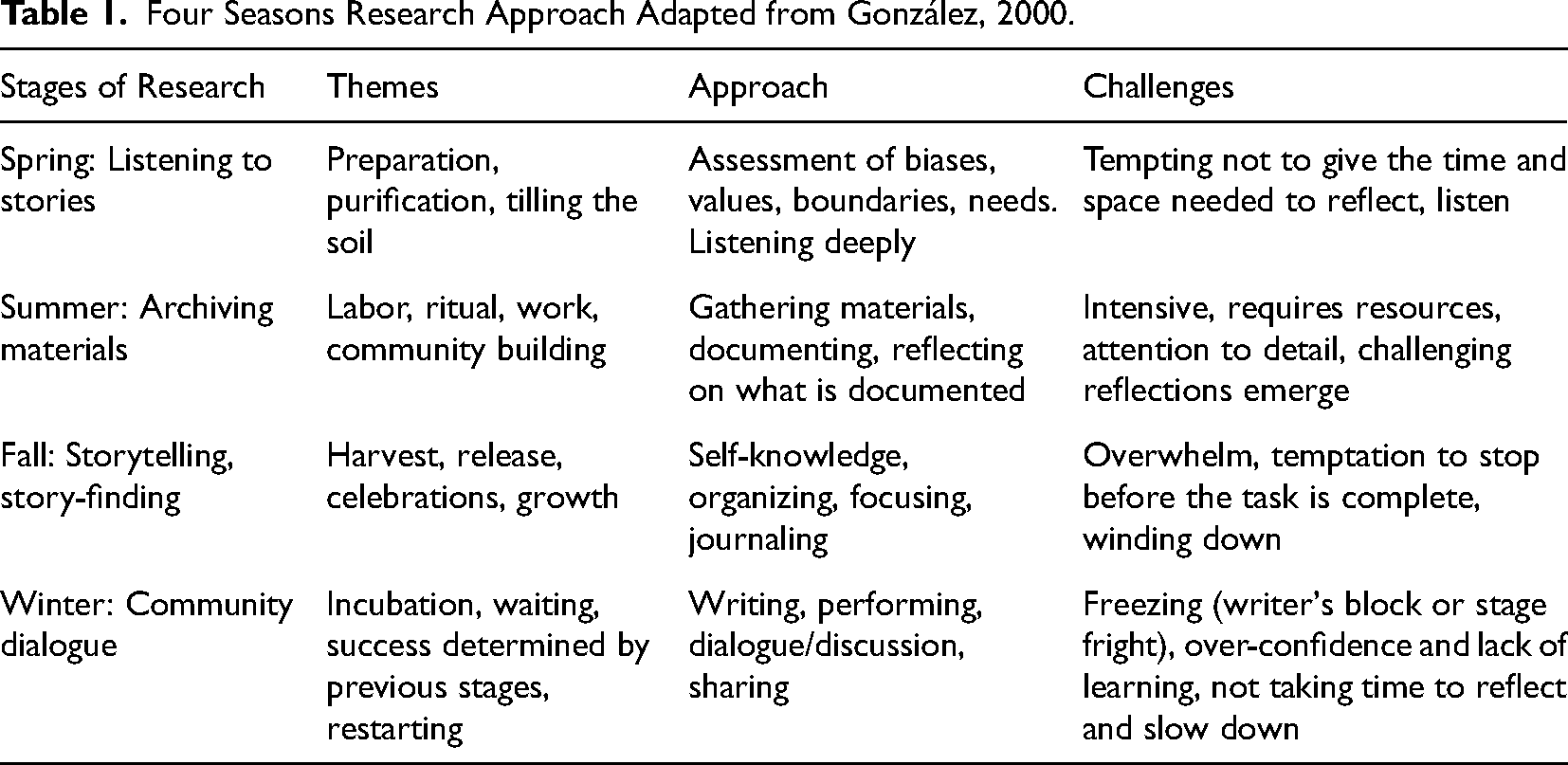
Likened to “ceremony” by González (2000, p. 637), this process allowed us to identify multiple stages of the research, and the different themes, approaches, and challenges to attend to. As we moved toward the summer season of our project work, we further developed our protocol. We documented how each story circle meeting generated a range of experiences depending on the storyteller and listeners. We realized that as we told our stories, we were creating new knowledge for ourselves as the storytellers. We also realized that the listeners were experiencing a transformative process in bearing witness to the stories and the storyteller's affective experience. We could see that through engaging stories, we were simultaneously looking back to understand, while also considering the present moment. Because all of us were experiencing change with each storytelling and story listening session, we understood that this was also a generative experience that should be documented. Alvarez (2016) developed a reflexive witnessing protocol to capture embodied, affective, and creative experiences experienced in research interviews. We integrated this into our protocol to creatively document third-level witnessing as an additional source of data (see Table 2 and attached Figure 1 completed worksheet for reflection categories and prompts).
Dialogic Research Reflection Worksheet Categories and Prompts

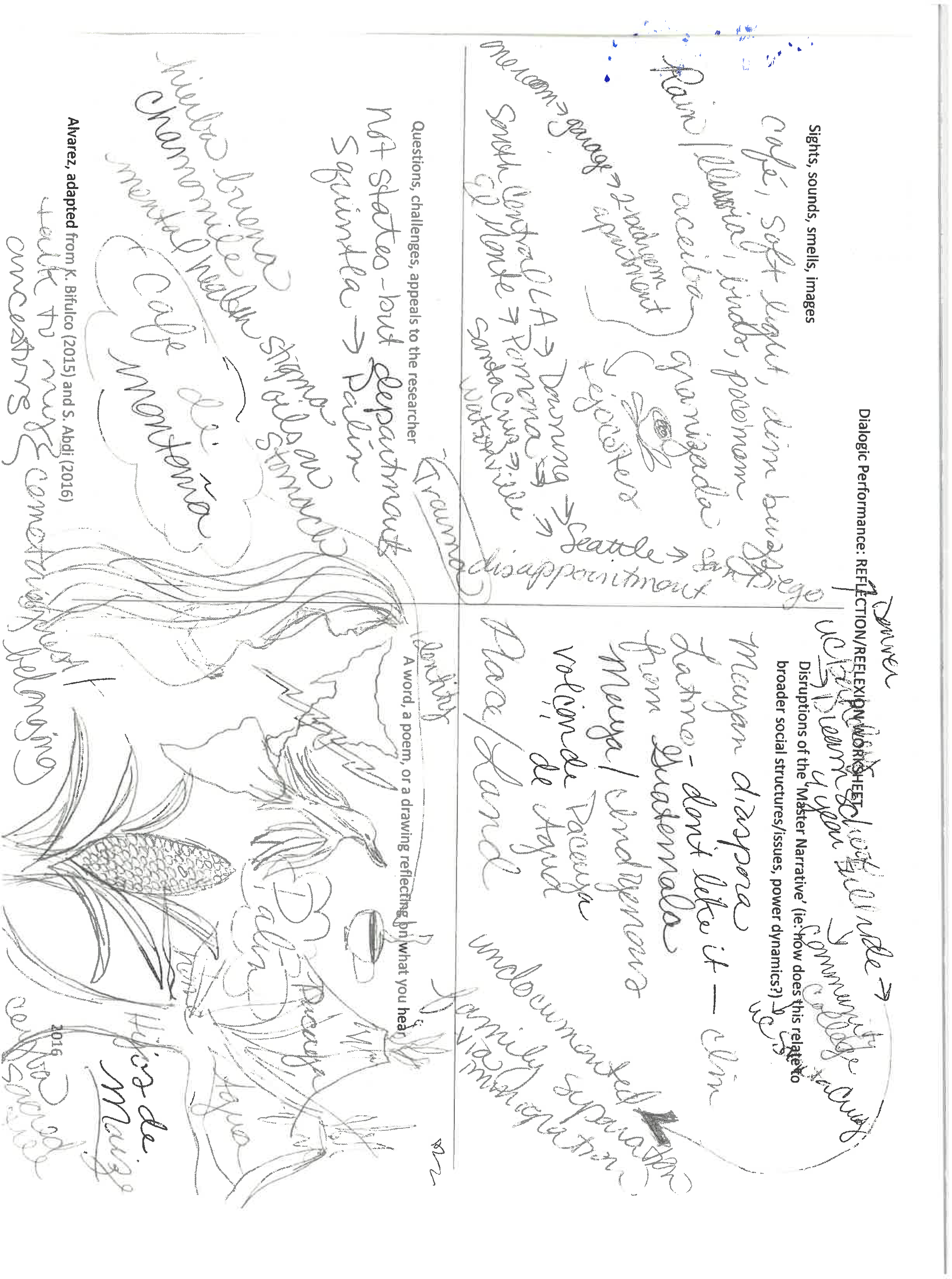
Example of Completed Dialogic Performance: Reflection/Reflexion Worksheet (Alvarez, 2016).
Methods: Storytelling and Witnessing
For many Indigenous communities, storytelling is understood as a fundamental thread holding together intricate and profound cultural values, ethics, traditions, language, and relationships. Storytelling, which has been used as an Indigenous research practice, is also a ceremonial process (Sium & Ritskes, 2013) through which sacred cultural knowledge is preserved and conveyed to community (Hodge et al., 2002; Iseke, 2014; Rieger et al., 2023). As we had in our story circles, within our methodology, we center the process of storytelling and consider each participating community member a storyteller, but we also articulate the importance of those who are listening to the stories and the unique roles these witnesses play. Our interview protocol is based on multiple levels of witnessing (Iseke, 2014), in which the storyteller is a witness to their own story and recollection of events, while the interviewer drives the questions following the story's narrative arc and acts as a witness to the process of sharing the story. Another member of the research team is a third-level witness and acts as a “witness in the process of witnessing the testimonies of others” (Felman & Laub, 1992, as cited in Iseke, 2024, p. 311) through quiet listening and documenting reflections, including poems, sensory words, doodles or drawings, feeling responses, and disruptions to the dominant narrative (Alvarez, 2016). Within this method, we are consistent with Indigenous ways of doing by creating a circular relational space, and acknowledging that we, as the researchers, are also dynamically in relationship to the story being told (Iseke, 2014; Kovach, 2021; Lavallée, 2009; Wilson, 2008). This method requires a team of researchers and a storyteller. In this group structure, we aim to create a sense of communal sharing that reflects traditional Indigenous talking circles or platicas ceremoniales (ceremonial dialogues) with their invitation for each community member—and each witness—to speak from their heart. In that spirit, community members are given the questions ahead of time and the questionnaire, which provides a loose structure using the domains of the four directions framework, acts as a map for the story sharing. Specifically, we invite community members to lead the direction of their own story, responding to questions and prompts within the questionnaire as they choose. At the end of the session, the interviewer is also invited to reflect the story back to the community member or to explore other story paths that may emerge. We close each session by asking participants and witnesses to reflect on their experiences and lessons learned from the interview process. As some of our research team is non-Indigenous, we provided multiple trainings on the protocol and process to ensure that all team members understood that the method is non-hierarchical, circular, relational, and reflexive. We also required that each researcher observed several (no less than three) interviews and conducted practice interviews before engaging in the formal oral history collection process.
Though storytelling was once considered a strictly oral tradition, contemporary digital technologies (e.g., digital photography, digital audio recording, digital video, 3-D printing, web-based hosting platforms, etc.) can facilitate the recording and preserving of historical cultural knowledge and practices as well as document dynamic contemporary cultural health knowledge and practices. Accordingly, in this project, we weave together the oral tradition and sacred talking circle pedagogy with digital technologies that help us preserve and protect our community's stories.
*Pause
Let's pause here. Take a moment to breathe. Inhale. Exhale. What do you feel in your body? Do you need to get up and stretch, maybe walk around, or even get some fresh air before we continue? Similar to how we engage our community members, we offer you a moment of respite. In this circle, we give space to our bodies, minds, and spirits. Do whatever you need to do before we go on. We will be right here.
From Principles to Practice
Through detailing this case example, we have described the Indigenous methodologies that have informed our research design. We have articulated the values and principles that ground and guide this research. Here we describe how we put these principles into practice in concrete ways.
Respect. Embodying the practice of respect in this research project involved paying close attention to the individuals with whom we partnered. In each aspect of our research protocol, we aimed to embody this principle. During recruitment and eligibility screening, we introduced ourselves and explained our backgrounds and our intentions for the work to align with Indigenous and critical feminist protocols of naming our positionality (Beltrán, 2023; Beltrán et al., 2024; Goodkind et al., 2021). Before we began interviews, we invited everyone in the space to explain, name, and claim: Who are you and who are your people? We also took simple but concrete steps to make people feel welcome. When we conducted interviews, we met people at the parking garage and walked with them to the recording location or went to their homes or another location of their choosing. We brought snacks, water, and offered regular breaks throughout the interview process. We were responsive to local traditions and customs such as using sage or cedar to smudge (cleanse or purify) the space, as well as emergent needs and practices to ensure accessibility needs are met (e.g., tending to a participant's service animal while they were interviewed). We prioritized the health and safety of our communities and changed our plans and processes when necessary. During the height of the COVID-19 pandemic, for example, we transitioned from in-person interviews to virtual interviews and our photographers took pictures of participants and their artifacts outdoors.
Reciprocity. For this research to be guided by the spirit of reciprocity, we must ground this work in the understanding that colonial research legacies have deeply harmed Indigenous communities. There is no singular way to properly compensate a participant for sharing their lived experience and ancestral knowledge, and we understand that we are asking people to give a lot of themselves, their histories, and their time. Standard research approaches to providing incentives of gift cards or honoraria do not align with this concept. With the guidance of our CAB, we made the case for providing our community members a fee worthy of their time and energy as well as paying for parking and mileage reimbursements when participants drove a long distance. In that respect, we also prioritized their time and schedules as opposed to what was most convenient for us. We have conducted interviews in the evenings, weekends, or across multiple sessions to best accommodate the needs of community members. As a practice, we also sought ways to offer gratitude in other forms. In some cases, depending on who conducted the interview, we brought cultural gifts to demonstrate our offering of ourselves and our cultural traditions.
Reverence. Integrating the practice of reverence into our research protocols invites deep personal reflection among the participants and research team themselves. It also establishes that we are participating in a sacred process. Prayer does not often play an integral role in a research project, but grounding our protocols in prayer sets the intentions for the work. We always offered community members the option to begin with prayer, devotion, smudge, or other ways of setting our intentions. As researchers, we acknowledge the sacred nature of our time together and we understand the storytelling process to be agential and powerful. We honor the power and lived experiences of our community members with our laughter and our tears as opposed to stoic observation.
Relationality (relational accountability). To practice relationality and relational accountability is to honor the foundations of Indigenous epistemologies, which are relationships to self, to others, and to the natural world around us. Central to this practice is our own critical reflexivity, and consistent reflection on power as it manifests throughout our research protocols. We used our weekly research team meetings to reflect on any areas of concern, curiosity, or inequity we perceived. As such, we offered one another accountability and practical constructive feedback about how to address those issues. We sought guidance from outside ourselves as well, taking direction from our CAB regarding the best practices and protocols for how we collected and interacted with the stories. We designed a multi-level consent form with detailed options for how community member stories may be shared (or not), and we conduct iterative check-ins with community members regarding these decisions. Community members are also given copies of their oral history interview videos and digital artifacts (e.g., portraits, pictures of cultural objects, or scanned documents) and we invite them to inform us of their preference for content they would like to keep private, only available to designated people, public, or any configuration of these options. We have built these options into our custom content management system and website, which gives us the ability to make certain knowledge, stories, or people completely private, available to only specific community members who register and are approved, or publicly available. We also practice engaging in and forming deep relational networks in an ongoing basis, acknowledging our own places in the stories we hear. In our witnessing protocol we are asked to share ourselves and the ways the stories have echoed in our own lived experiences. Specifically, in addition to the process questions we ask of our community members, we also share how the experience and stories have affected us.
CerBPPR Participation Reflections: Evidence of 4 R's in Action
The study just recently concluded the third phase of data collection. The pilot phase used a convenience sample strategy to conduct 10 oral histories with graduate students, staff, and faculty within our university and associated cultural affinity community who identified as Indigenous, Native American, and Indigenous Latine. The second phase of data collection utilized a mixed strategy of convenience and snowball sampling, using community referrals, social media, and email listservs to recruit an additional 20 community members from university organizations, cultural affinity community groups, community member social networks, and professional and community networks of CAB members. Of the total 30 community members from waves one and two, 26 completed the demographic questionnaire. Their ages ranged from 18 to 65 (mean = 42), and 54% (n=14) identified as cis-gender women, 19% (n=5) as cis-gender men, 15% (n=4) as gender non-conforming/non-binary. One community member identified as transgender, one reported that the categories did not reflect their gender identity, and one preferred not to say.
Demographic questions were designed to account for intersectional race/ethnicity and Indigenous or Tribal identities. Within demographic categories, 12% (n=3) identified solely as Latine, 34% (n=9) identified as Native American or Indigenous (non-Latine), and more than half (n=14) identified as both Latine and Native or Indigenous. When asked about ethnic identity terms, community members identified as Chicano/a, Indigenous, Indigena, Maya, Mexican, Native, Peruvian, Puerto Rican, and Xicana. Community members further described their Indigenous or Tribal heritage as Andina, Aztec, Comanche, Diné/Navajo, Genízaro Apache, Indeh, Mexica, Ñ‘uu Savi, Otomí, Poqomam, P’urépecha, Taíno, Tihua, Tehua, Ute, and Yaqui. This analysis, which occurred before the third wave of recruitment, draws from interviews within the first two waves of data collection.
During the reflective portions of the interviews, we asked community members: “How does it feel to be asked and to answer these questions? How different do you feel after answering them?” Analysis first proceeded with data immersion (Green et al., 2007) in which two researchers took memos on their initial impressions of listening to the reflective portions (Birks et al., 2008). Next, portions of the interviews that were identified during data immersion as salient were transcribed verbatim. The researchers then applied initial coding across transcripts to create preliminary themes, which were then reviewed across all texts by a broader team of researchers to generate a final list of codes and themes (Saldana, 2021). This iterative process of thematic analysis resulted in five final themes: comfort, healing, inspiration, gratitude, and offering to future generations. Each theme is discussed in greater detail below. The interview excerpts that are core to this specificity have been edited for readability and identifying details have been omitted or changed to protect confidentiality.
Comfort
The communal and circular space of our witnessing methodology allowed for multiple people to reflect the community member's story back to them, as is common with talking circle pedagogies. Community members described the embodied experience of the talking circle with witnesses present as a uniquely impactful and validating space: It felt good. I actually haven't done anything like this before. I really liked the fact that there was more than one person present. It felt like there's more validation to what I’m trying to say, or what I’m saying, as opposed to just one person… It feels like I have more people to go off of that, which is good for me.
The sense of validation also contributed to an experience of comfort within the interview process. Another community member described how this sense of comfort in a communal space allowed them to speak honestly: I felt comfortable, like it was just a conversation… I felt like some of [the questions] I had some prepared answers, but as a part of the interview, things come up in your mind that the questions kind of triggers that you didn't think it would, so I think that helped me without trying to be too prepared, and it felt more honest… it just felt more true.
Amidst this comfort, community members described a sense of surprise regarding how much more open they were than they anticipated they would be before experiencing the space. This community member described how they began to feel comfortable in the process of sharing and was able to share their authentic truth: Some of these things that I talked about were secretive for a long time. And so I wasn't sure that I was gonna share those things, but they’re all part of my story. They’re all part of who–what– made me ME. So, as I started talking… I felt comfortable just going with what I know is my truth.
Healing
Community members also described generating a sense of catharsis through sharing their stories within a communal space, because it helped them see their stories with new eyes, which provided a healing process and invitation for more personal exploration. For example, one community member said: It was healing because I still have grief, and so being able to just talk about the loss– the lossES (participant emphasis) I’ve had… Just to remember why I do what I do, too, like why I’m passionate about serving my community, why I want to be a mentor, why I want people to trust and heal this beautiful ugly life, cuz they’re still things to be joyful for… And I hope that this brings comfort to others because it's brought me a lot of comfort, too.
Community members also described an understanding that their healing journey is a process and that speaking their stories out loud helped them identify what they still have left to explore and heal. This reflection demonstrates the desire to keep going. This next quote comes from a community member who found himself talking about his father during the interview: I’m still healing… there's things that, things in my memory that I do know that will help me. An example would be talking about my father. Like, I don't talk about him often but, when I do, there's these instances that I know I still need to work on.
Inspiration
Community members also described how the interview process inspired them to keep exploring and excavating their own histories. For example, one participant said, “I loved it. I’m gonna keep these questions cuz I want to journal about them and see where it takes me.” The process also inspired community members to share about the oral history interview experience with family and community, which is key to the relational value we described above. Now I want to know where I came from, and just learn more about what all these things mean… there's a very symbolic figure that a lot of the pottery has, and it's a fish, and I don't know why, and I’m like, I have to call my cousin and I have to ask her why we use a lot of the fish… it just got me thinking like, oh crap, there's like so much that I don't know about my family, like, my grandparents.
Another community member said: If it weren't for this, a lot of things would’ve just been lost and not talked about. And it's great because I’ve been talking with my sister… she loves history, and kind of even sparked her too. She told me, “Send me the questions because I’m gonna answer them for myself.”
Gratitude
Nearly all community members expressed some form of appreciation or gratitude for the opportunity to share and preserve their stories. One community member noted that “I feel great. I actually feel like I need to say something else. I definitely feel grateful for everything. That gratitude, it's one of the highest emotions that we can carry.” This was echoed by another community member who described gratitude for the time to reflect within the process. This methodology invites community members and researchers alike to slow down and settle into the reflective and relational space. If it weren't for this… I would not even talk about this… And even thinking about where I am now and how all these things had to happen for me to be here now, it's just, it's awesome. I feel very grateful, I feel very grateful of everything that you know, my grandparents’ parents, my grandparents, my parents, just everything that they’ve gone through.
An Offering to Future Generations
While many approaches to data collection are focused on gathering information for a research team to later analyze absent from the people participating in the research, our methodology integrates a meaning-making process for/with our community members. This moment of pause also allowed community members to consider the implications of sharing and preserving their stories. Community members describe their perceptions of the purpose and utility of sharing their stories as necessary for future generations. I really appreciate that this project is being done, and it's not for my sake, it's for the sake of our community… While I recognize that I’m related to all these [historical] events, I’m not sure I carry them in the same way that my elders, that my ancestors did… But I can still tell the stories, and that's what this is… first person stories, original sources, that people can reference far into the future if they have any question about what our were ancestors like, what did our ancestors say about this, what knowledge would they leave or impart to us?
Sharing the stories and information with future generations is also understood as a decolonizing act. For example, one participant described how anti-Indigenous sentiments are common in her community and that sharing her experience as an Indigenous Mexican person may not only help her family feel a sense of pride but may also spark curiosity and ignite exploration in the broader community, toward disrupting anti-Indigenous ideology. I’m really curious to see afterwards what this all ends up being, who gets to see this, who gets to hear this… especially because in some of my community, we try to minimize Indigeneity, or people try to remove themselves from their Indigenous roots, so it feels in a way like I’m bringing back something that hopefully I will be able to share also with family or maybe there will be curiosity for someone else to know about our culture and our roots.
Discussion
As we review these themes and the feedback from community members about the impacts of the process on their experience, we begin to see the ways that the embodiment of respect, reciprocity, relationality, and reverence are also echoed in their words, and thus their research participation experience. As we hear about themes related to comfort, we reflect on what it means to be deeply listened to, to be invited to show up as your whole self, to be profoundly and fully respected. In the themes of healing and inspiration, we reflect on the agential, empowering, and even interventionist power of storytelling and see that the process itself can be a gift for the community members as another way to approach reciprocity. The recurrence of gratitude as an outcome of this process connects to the ceremonial processes of reverence, and the demonstration of intentional time and care to give thanks and honor the time that we are sharing with others. The multiple ways that community members described this work as benefiting their future generations and their broader communities are evidence of relational accountability within research, and to the interconnectedness and simultaneity of life and our lived experiences. Further, we reflect on how this work is rooted in the desire to disrupt social work's colonial practices of extraction and exploitation of Native and Indigenous land and life. We also reflect on the ways this future generational focus aligns with our aims to facilitate intergenerational and collective healing and celebration of strengths and creativity, which is consistent with Indigenist and critical feminist liberatory aims, and most importantly, the community's wishes to leave something beautiful for the generations to come.
These reflections point to the ways that these core principles and values for research with and for Indigenous communities are and have been centered throughout this research process. Components of respect, reciprocity, relationality, and reverence are each highlighted by these findings, and are brought to life through the words of the community members themselves, which is evidence that the process is a crucial element of not only documenting stories as data but also transformative social change. As we explored earlier, given its history as an apparatus of upholding settler colonialism, social work as a field has a lot of work to do in reconciling its history with the truth and aligning its actions with its goals. Yet, even if still aspirational, these findings align with social work's articulated aims to uphold social justice, equity, and dignity in practice and research. More broadly, however, we can begin to see that through the implementation of this CerBPPR project, we have begun to define the method more concretely. CerBPPR has, until now, been undefined in the literature, and through this investigation of the methodological foundations in hand with this practical application, a clearer picture has emerged. CerBPPR is an intentional, community-driven, multifaceted approach to research with and for Indigenous communities. Through the centering of Indigenous voices, Indigenous resistance, and the examination of power and politic, CerBPPR is aligned with an Indigenist and critical feminist approach to research. If we are to truly live into our values of transformation, liberation, and political integrity, we must integrate concrete steps and strategies into our research and practice, which is what we hope we have begun to document. Future research should seek to produce even clearer understandings of the utility, aspects, and range of CerBPPR implementation approaches in Indigenous communities and in communities impacted by settler colonialism, historical trauma, and ongoing structural inequality toward naming, documenting, and amplifying the inherent wisdom, strength, creativity and innovations that have been largely left out of research literature.
Conclusion
The spaces we create for sharing knowledge and meaning making should be grounded in ceremony rather than culturally additive; their optimal versions intentional, not transactional. They are imbued with reverence through the space, time, and relationships we cultivate in our shared experiences. Using CerBPPR methods that engage Indigenous communities in the design, implementation, and evaluation of research projects, that are also rooted in Indigenous epistemologies, has the potential for greater and deeper outcomes for communities to articulate and live into their own strengths, traditions, and practices for well-being. Furthermore, CerBPPR should be centered in the strengths of cultural knowledge within the communities themselves therefore elevating and amplifying the strengths of individuals and communities beyond the challenges and obstacles they face. Ultimately, this project uniquely contributes to the growing body of knowledge about research and scholarship that engages with Indigenous communities in meaningful ways. CerBPPR shifts the narrative away from Indigenous risk, deficit, and damage towards Indigenous health and healing and invites us into a circle that we can come to know as home.
*Offering
We will end with an invitation: Consider your own ceremonies and reflect on your own memories. How might these processes be more intertwined than you may have noticed? What would it mean for you to create ceremony with your own remembering? What might it do for your health, your healing? How does it feel to honor those possibilities for yourself? For your community? Consider what you might offer this process, too. And with this, we raise our hands to you in gratitude.
Footnotes
Acknowledgments
The authors would like to extend our heartfelt gratitude to all the community members who have so generously shared their stories with us. Thank you for your laughter, tears, patience, compassion, strength and creativity. We also want to acknowledge Dr. Debora Ortega for her support in the initial development of the OSOMA project. Thank you, Dr. Deb, for letting us use your office and table to imagine something beautiful. Thank you to Interdisciplinary Research Institute for (In)Equality Faculty Director, Dr. Tom Romero, for the support and amplification of our efforts. We want to acknowledge the intellectual contributions of Bonifacio Sanchez, David Barillas-Chon, and Angel Hinzo in our original story circle process. We offer deep thanks to Steven Yazzie, Gabriel Fermin, Courtney Blackmer-Raynolds, and Mark Woolcott for their artistic contributions to the documentation and preservation of our community members and their artifacts. Finally, we want to acknowledge additional OSOMA research team members Xochilt Alamillo, Lisa Colón, Olivia Hunte, Tina Hulama, and Iris Vanegas; our expert digital librarians, Denisse Solis, Katherine Crowe, and Jack Maness; our archive intern Kassandra Rendon-Morales. And we extend a special thank you to the phenomenal members of our Community Advisory Board for guiding us along the way.
Declaration of Conflicting Interests
The authors declared no potential conflicts of interest with respect to the research, authorship, and/or publication of this article.
Funding
The authors disclosed receipt of the following financial support for the research, authorship, and/or publication of this article: This work was supported by the National Institutes of Health National Libraries of Medicine, (grant number 5G08LM013186). Additional support was provided by the University of Denver PROF grant and the Interdisciplinary Research Institute for the Study of (In)Equality faculty grant. The content is solely the responsibility of the authors and does not necessarily represent the official views of the University of Denver, IRISE, or the National Institutes of Health.
