




Abstract
This study examines child support debt through an intersectional lens, focusing on its disproportionate impact on women and its unique implications within social relationships. Drawing from a 10-month longitudinal qualitative study with low-income mothers in Santiago, Chile, we challenge existing regulations governing child support provisions. We uncover discrepancies between judicial regulations and women's economic realities, revealing how current laws favor middle-class men. We explore the distinctions women make in delineating this debt relationship and the unique social dynamics involved. The research highlights how child support debt impacts women's identity construction and agency. By integrating intersectional analysis, the study underscores the complexity of child support debt, emphasizing the need to consider gender, class, and social context in understanding this phenomenon. Our findings suggest that current regulations fail to address the needs of low-income women, highlighting the importance of policy reforms to ensure equitable support.
“Papito corazón” is a colloquial phrase in Chile whose closest literal translation is “daddy dearest” and is most akin to the phrase “deadbeat dad” in English. The Spanish phrase is somewhat sarcastic in its use of the terms “heart/dear” [two options for the word corazón] and “daddy” [papito] whereas the English phrase is more directly derogatory. Regardless, they both refer to those men who fail to take responsibility for their children, men who do not pay child support and do not provide care for their children, leaving these tasks entirely to their mothers. In Chile, this is a common occurrence that particularly affects low-income women. According to the numbers, by 2020 child support non-payment had reached 84%, wherein nine out of ten debtors were men and 65% of those who did not receive the payments were in the lowest-income population. The estimated amount of total debt for that year arose to approximately USD 224,000 million (Boletín Presidencial, 2020). 1
In mid-2020, this problem reached peak visibility when an unprecedented policy was drawn up allowing the early withdrawal of pension funds from individual workers’ savings accounts as a measure to directly inject liquidity into Chilean households. Thus, on July 30, 2020, Law No. 21,248 was enacted, letting workers withdraw 10% of their own pension fund savings for the first time, stipulating that “withdrawn funds will be considered extraordinarily non-collectible for debt repayment, with the exception of those stemming from child-support obligations” (BCN, 2020). This meant the 10% pension fund withdrawal also enabled, via court order, retention of the withdrawn funds of parents who had not met their duty to pay child support for the purpose of shrinking that debt.
The debate over withholding the debtors’ money made the gender dimension of non-payment of child support more visible. Mothers have been culturally viewed as more suitable for caregiving, so they are often the ones who take on the full responsibility of finding ways to financially support their children (Hakovirta et al., 2022; Yopo, 2021). These care tasks, both in Chile and the Global South in general, are provided in contexts of inadequate social assistance (Moore, 2020) and high levels of poverty in female-headed households (Salinas, 2003).
In this article, we aim to examine the experiences of low-income female heads of household in Santiago, Chile, regarding the non-payment of child support. By conducting a multilevel intersectional analysis of interviews with ten women, we explore the discrepancies between regulatory provisions governing child support and the economic realities faced by low-income families. Our findings reveal how current regulations, designed with middle-class men's advantages in mind—such as formal employment, stable income, and shared financial responsibilities—fail to address the needs of low-income mothers 2 . This mismatch hinders timely support payments and exacerbates the economic hardships faced by these women. Through this analysis, we question the existing social norms and highlight the urgent need for policy reforms that consider the lived experiences of low-income mothers.
The article consists of four parts. First, we discuss why the failure to pay child support should be understood as a gendered phenomenon and review the Chilean case of female heads of household. Next, we present the regulatory framework that governs child support in Chile. From there we present our methodological framework, and we close by presenting the main results and finishing with a discussion.
Child Support is a Gendered Phenomenon
This article is based on the fact that non-compliance with child support is a gendered phenomenon, as it particularly affects women who are the ones left in charge of the children, and therefore the primary child support recipients (Cozzolino & Williams, 2017; Goodall & Cook, 2020; Natalier, 2018; Sands & Nuccio, 1989).
Following the work of Cozzolino and Williams (2017), our view is that despite its importance, there is a lack of theoretical depth concerning this phenomenon. In general, the literature on this subject has focused on the financial effects of child support non-payment (Bartfeld, 2000; Hakovirta, 2011; Walter et al., 2010). Along these lines, Natalier and Hewitt (2014) demonstrated how traditional family arrangements contribute to male dominance and the subordination of women after separation. Natalier (2018) advances this discussion by asserting that child support non-payment should be considered economic abuse that not only reproduces gender inequalities, but also restricts women's economic autonomy and affects their identity as mothers.
In a context of expanding neoliberalization and sociocultural change, which confronts parents with the permanent specter of insecurity and limited support for responding to growing social demands (Schild, 2022; Vergara et al., 2018; Yopo, 2021), parenting is increasingly understood as a taxing process in material, economic, temporal and emotional terms (Lee, 2001). The works of Cozzolino and Williams (2017) show that the expectation towards fathers has been reoriented towards a greater valorization of the time they dedicate to the care of their children, while in the case of mothers it is increasingly envisaged that they will be able to materially support their children.
The economic burden borne by mothers after separation is also affected by the way in which state institutions and policies have tended to naturalize women's financial responsibility for the non-compliance of their ex-partners (Roll & East, 2012). What some have called “state bureaucracy” that makes it easier for men not to pay child support (Smyth et al., 2014), Natalier et al. (2018) respond to a form of “gender governance” that is facilitated through state and institutional policies mandating child support.
Starting with the dominant narratives, the father is the one who has historically assumed the role of economically providing for the household (Doucet, 2020; Kabeer, 2013). This idea is supported by a binary conception that separates breadwinning and caregiving into two discrete concepts (Doucet, 2020). However, in this research we understand that the activities that mothers engage in to ensure their children's well-being are part of provisioning, i.e., work that women perform daily to acquire the material and immaterial resources to fulfill the responsibilities of guaranteeing the good of the family (Neysmith et al., 2010). This idea, coming from feminist economics (Berik & Kongar, 2021), seeks to account for the ways in which unpaid care and paid employment become intertwined for women experiencing financial insecurity (Taylor, 2004). Under this perspective, provisioning includes visible provisioning tasks (formal and informal activities in the job market and community commitments), unseen activities (focused on taking care of one's own and others’ health, activating support networks, requesting financial assistance, and others), efforts to earn money and those that are done to ensure the safety of oneself and children (Neysmith et al., 2010).
On the other hand, returning to the work of Patricia Hill Collins (1994, 2000), reference for Black feminisms and intersectionality, provisioning tasks can also endow women with agency. She analyzed the experience of African-American women and found that while for some white middle-class women care work can be felt as oppression, from the point of view of Black working-class women, supporting their children provides a sense of empowerment and self-affirmation.
In this vein, Keil and Elizabeth (2019) problematize that most studies on the payment of child support focus on normative models of white families in the Western world, arguing that frameworks are needed for observing the organization of gender relations and the distribution and management of financial resources within other structures of intersecting categories. An intersectional analysis must recognize that the category of gender is not all-embracing and other categories of differentiation such as class, race, and others should be considered (Acker, 2006), enhancing an understanding of social complexity in contexts of inequality and precariousness (McCall, 2005).
Being a Female Head of Household: the Chilean Backdrop
In Chile, having women in charge of supporting and raising children is a long-standing phenomenon linked to the persistence of traditional gender norms. In recent years, the maternalist logics that position women as the main caregivers and men as absent figures have also been reproduced by the conversion into a neoliberal system through the implementation of targeted and subsidiary social welfare policies (Staab, 2012; Yopo, 2021). As the neoliberal expectation is for women to become wage-earners while continuing to be the mainstay of reproductive work at home (Schild, 2022), the difficulties in reconciling entry into the labor market with parenting tasks have persisted in recent socioeconomic transformations. In Chile, one in five women states she is not part of the labor market due to her caregiving tasks, whereas the number of men who do not participate in the labor force for similar reasons has yet to reach 1% (Ministerio de la Mujer y Equidad de Género, 2019).
Indeed, in recent years, the management of children's care has been determined by the high rate of single-parent households headed by women in the country. According to figures provided by MinMujeryEG (2019), in 2017 the number of female-headed households stood at 42.4%, 73.4% of which were single-parent households. This high occurrence of female heads of household has gone hand in hand with the “feminization of poverty” phenomenon. In fact, the largest number of heads of household in poverty are women, totaling 9.2% of the population, while those headed by men in poverty only reach 6.4% (Ministerio de Desarrollo Social, 2017).
The pandemic and its respective health restriction measures intensified these vulnerabilities. The increase in poverty during this period turned out to be much greater in single-parent households headed by women, rising from 11.8% to 15.2% between 2017 and 2020 (Ministerio de Desarrollo Social, 2020). Furthermore, during the pandemic, 40% of households with female heads of household saw a reduction in the number of employed persons with a consequent drop in income, in contrast to 24% for male-headed households. In addition, a greater proportion of female heads of household had to resort to strategies to address their income shortages, such as selling personal property, dipping into savings, going into debt, or ceasing to pay existing debts (PNUD, 2020).
Procedures and Regulations Governing Child Support in Chile
The main laws regulating child support (according to the “alimentary pension” legislation) in Chile include the Civil Code, Law No. 14,908 on Family Abandonment and Alimentary Pension Payment enacted in 1962 and Law No. 19,968, creating family courts enacted in 2004. The complementarity between these three legal bodies determines the specific procedures, establishing the child support obligations not only as a legal duty, but also as a fundamental right to life and physical and mental integrity (Valdivia et al., 2014).
In general, the law establishes the duty of parents to cover the costs of educating and raising their children, with the intent that the provisions must enable a subsistence level that accords with the social position of the child and that the capacities and circumstances of the debtor be considered. The duty to provide shall persist until the youth reaches 21 years of age or 28 if studying. The legislation establishes the criteria regarding the sums, stating that the minimum amount is equivalent to 40% of the monthly minimum wage in the case of a single child, and 30% of the minimum wage in the event of more than one child. The maximum amount may not exceed 50% of the total income of the person paying child support. 3
The procedure to regulate child support payment consists of two stages. First comes mediation and determining the monthly amount, and second is the fulfillment of the payment and the associated guarantees. For the first stage, the current legislation contains an obligation to go through a mediation system for the purposes of the parties discussing the child support payment, which prioritizes the goal of preventing future conflicts by establishing a mutual agreement. This first stage can be initiated at the behest of the person responsible for the care of children and adolescents in the case of minors (be they parents, grandparents, or guardians), or directly by the support recipients in the event they are over 18 years of age. If an agreement is reached, the mediation center issues a legal certificate in which the amount and payment method are set. If the mediation does not culminate in an agreement, the center delivers a certificate of unsuccessful mediation, which can be presented by the plaintiff in a family court authorized to initiate a lawsuit and allow a judge to be the one who determines the amount and payment conditions. The parties involved in this trial must present: 1) proof of kinship with the defendant; 2) a list of the dependent's needs based on proof of expenses and economic capacity; 3) a declaration of the financial capacity of the defendant through paycheck receipts, income tax statements, and others.
Once the amount and payment terms have been formalized, either through mediation or lawsuit, the legislation sets out regulations to guarantee payment compliance and sanction the accrual of unpaid sums. Thus, if the agreed payment is not made in the manner established by law, the settlement of child support debt is requested, and corresponding enforcement measures are decreed against the debtor. The main enforcement measures are as follows; overnight detention for up to 15 days, 24-h detention for up to 30 days, a passport seizure order until full payment is made, suspension of a driver's license for up to six months, seizure of property or assets, and even the withholding of a part of the salary by the employer. In addition, it is established that if the child support is not paid or is not enough to meet the needs of the child, the grandparents may be sued (unless their only source of income is an old-age, disability, or survivor's pension).
Methodology
This article is the result of wider research conducted between September 2021 and September 2022 that discusses the adaptation practices to manage the economic uncertainty in female-headed households in Santiago, Chile. Specifically, concrete economic practices of everyday that seek to ease the fears related to their expectations of the future are explored. The methodology used was qualitative follow-up economic ethnography in fourteen low-incomes households of the Metropolitan Region. This type of ethnography is a research method characterized by confronting the categories of scientific-academic thinking with those arising from the economic practice of households and individuals (Dufy & Weber, 2009). In this case it includes interviews, field notes, shopping notebooks and photographic record. However, for the purpose of this article, we will work with the material from the qualitative follow-up interviews. These interviews seek to accompany their individuals over a period of time to explore the multiplicity of negotiations, repertoires and valuations that occur in the contexts of domestic interaction (Villarreal, 2009). A cycle of follow-up interviews (3 interviews per household) was conducted during the months of November 2021 and January and May 2022.
In changing circumstances, in which mobility restriction measures were permanently adjusted to the socio-sanitary context, the time-tracking perspective developed allows us to present the different scenarios to which women had to adapt. One of these scenarios was the unprecedented measure of withholding the 10% pension fund withdrawal of child support debtors. Indeed, this article is an emerging finding of this follow-up process, insofar as in the narrative of the women participants the discussion about the limits and possibilities of this unexpected income took an unexpected relevance in our interviews. For this reason, we decided to conduct a multi-level analysis (Winker & Degele, 2011) and to complement the interviews with a documentary analysis of Chilean legislation and print media discussions. This was done with the goal of understanding how legal regulations organize the social structure and guide the action of all parties involved in this process.
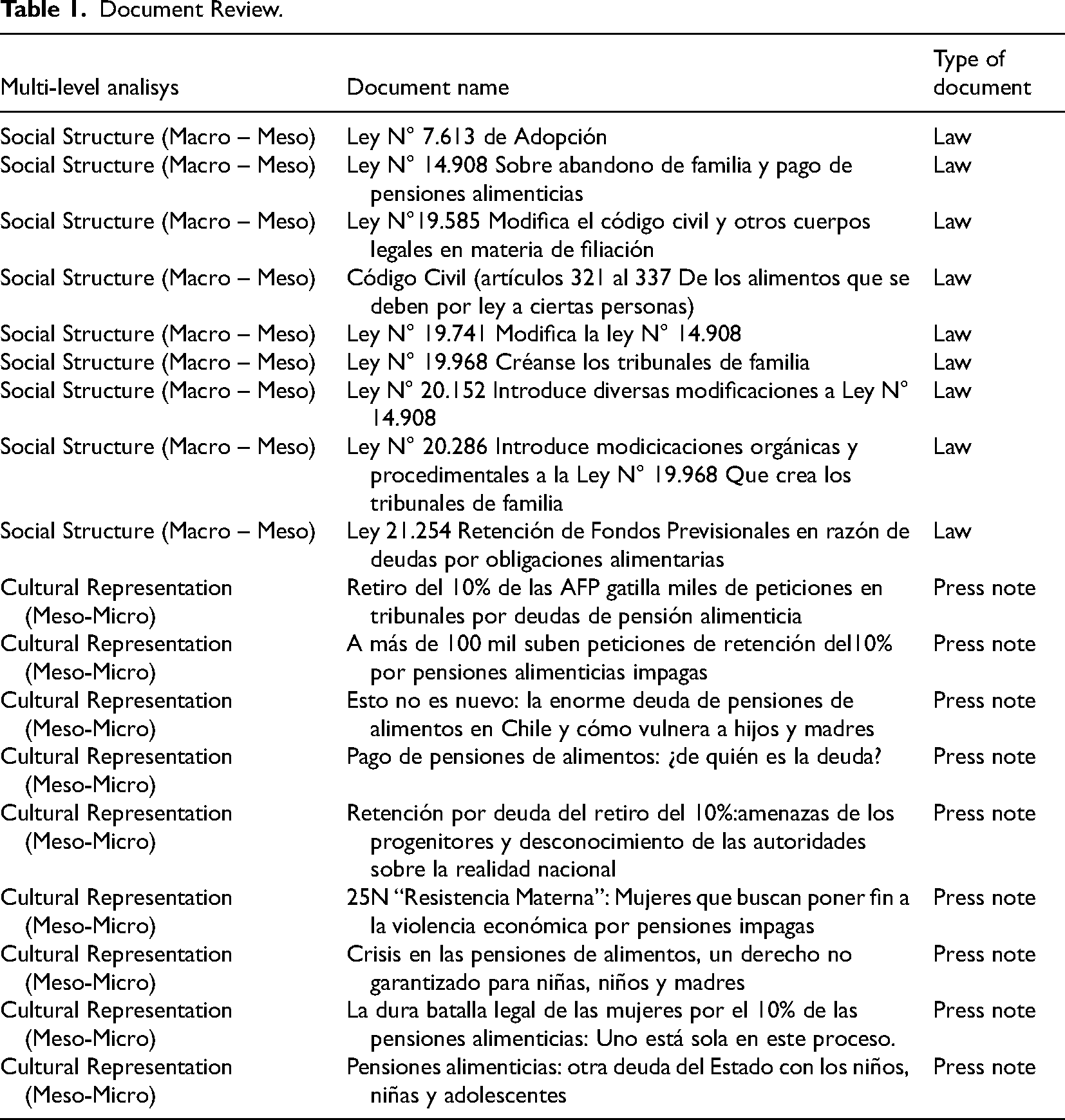
Aiming to account for the portrayals that get propagated concerning the non-payment of child support in Chile, we conducted a documentary review (Table 1) that covers the June 2020 to June 2021 period in which the topics of the 10% pension fund withdrawal and the act of withholding it from debtors were publicly discussed. Two criteria were used to select the documents: 1) that they make explicit reference to the regulations governing child support in Chile; 2) that the text provide information about women who do not receive child support.
Document Review.
Sample
The sample size for this research was 15 low-income female heads of household living in Santiago, Chile, who at the time of the interviews had children that depended economically on them and who at the time of the first interview were working either under contract or as self-employed workers. As this research was conducted in a post-lockdown period of COVID-19, in which the participation rate of women in the job market suffered a setback of more than 10 years in this indicator (PNUD, 2020), the variable type of contract was not consider in the sampling. As for the participants, they were recruited through public social services, non-profit organizations, and community centers that provide services to this population.
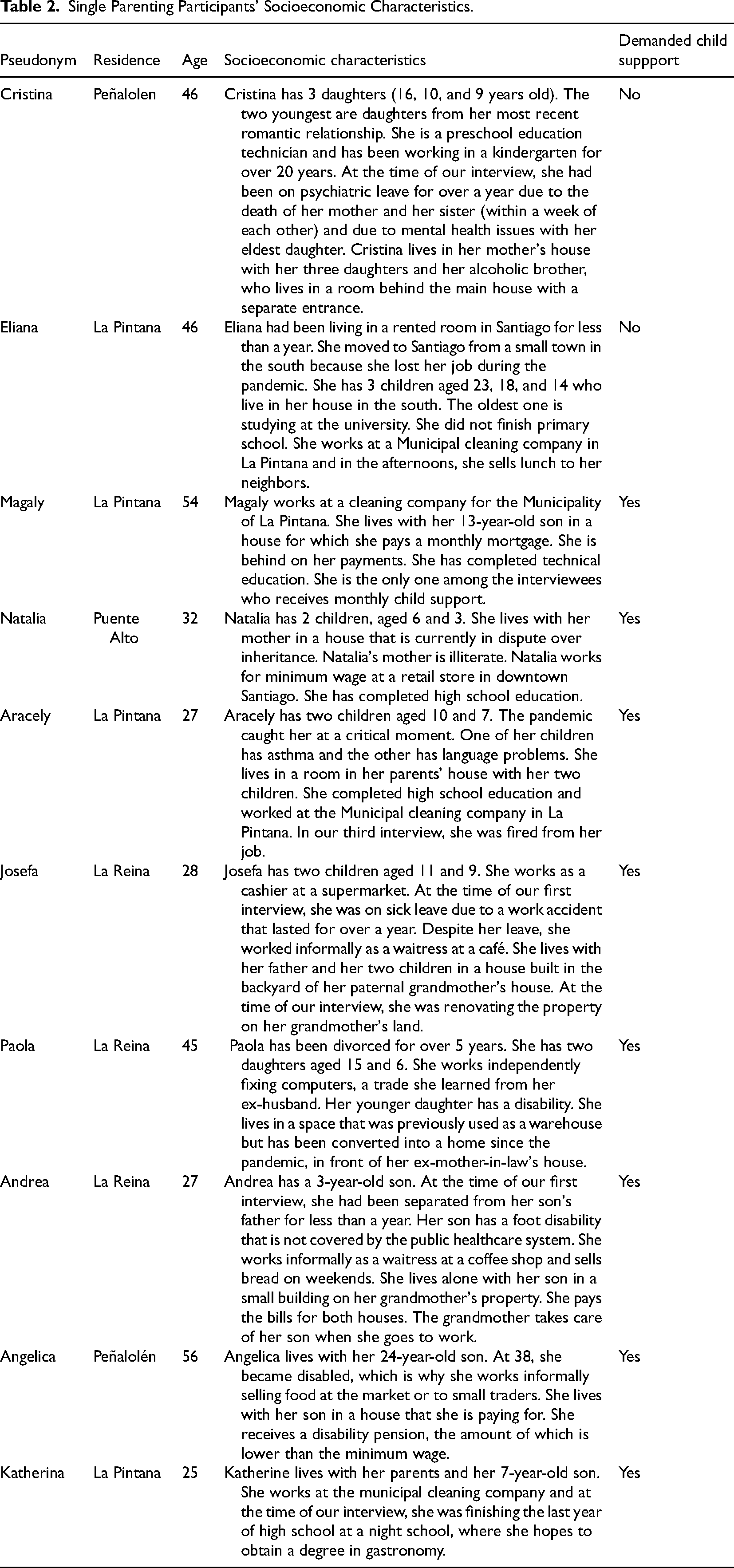
For the purposes of this article, we will only analyze the cases of mothers – regardless of whether they had initiated legal proceedings for child support – who were neither living with the father of their children nor in an affective-sexual relationship with him at the time of the interviews. The analysis unit was composed of ten low-income households headed by women between 25 and 69 years of age that have dependent children. Table 2 contains the participants’ demographic characteristics. Of the total participants, 80% were salaried employees and nearly 20% were self-employed. Regarding education levels, most had completed high school.
Single Parenting Participants’ Socioeconomic Characteristics.
Prior to the interviews, participants consented to their audio-recording and transcription. We explained the study and its aims to them as well as their role in exploring the research question before the interviews began. Participants signed a written informed consent form that detailed their rights, the risks and benefits of participation, and a description of the study. We assured them that their identities would be kept private throughout the research process. In fact, the names used are fictitious. The informed consent was approved by the ethics committee of the Authors’ University.
Analysis
In keeping with Winker and Degele's (2011) proposal of a multi-level analysis from an intersectional perspective focused on observing the macro, meso and micro dimensions, the first thing we did was analyze the interview contents using the thematic analysis technique (Paillé & Mucchielli, 2008).
Recognizing intersectionality as a heterogeneous field of study that has developed a wide diversity of theoretical and analytical tools (Cho et al., 2013), the proposed model by the authors “consider social structures, including organizations and institutions (macro and meso level), as well as processes of identity construction (micro level) and cultural symbols (level of representation)” (Winker & Degele, 2011, p. 52). Based on the matrix of domination theorized by Patricia Hill Collins (1990), this proposal of analysis emphasizes the intersection not only of categories, but above all the systemic/structural (meso-macro-micro) levels that traverse social phenomena.
For the case of this study, focusing mainly on the intersection of gender and class, we focused on the multi-level interaction from the legal regulations and the experiences of the interviewed women. From here, the data analysis process was guided by the steps suggested by Winker and Degele (2011) of reviewing symbolic representations and structural constructions in the corpus analyzed, to then compare and establish links between these levels.
Our aim was to identify and classify the themes that emerged in the accounts of their experiences with child support, interrogating the categories that the women deployed to understand their situation, the ways in which they related to the legislation, and the interpretative patterns they used to understand their own agency. Next, the categories that emerged during the regulatory document review were compared with the matrix of codes that we had worked from when analyzing the interviews. It contains three dimensions for comparison: (1) child support access and definition; (2) effectiveness of the measure; (3) delinquency and default.
Findings
The following results explore the experiences of low-income mothers dealing with the non-payment of child support, highlighting how they navigate this issue with or without pursuing legal action. We’re interested in exploring how this image is constructed in relation to the norm that regulates these processes and the available images of motherhood circulating in Chilean culture, which continue to play a central role in women's self-understanding (Sasunkevich, 2019). We begin by exploring the gap between the normative provisions that stipulate child support and the economic practices of low-income families, based on two narrative lines. First, we analyze the narratives constructed by women who have not sued to explain their decision not to pursue legal action. Second, we examine accounts of experiences of non-payment. Our findings indicate that despite discursive differences between women who have not filed lawsuits and those who have, both groups share the belief that the norm does not resolve the issue of non-payment of child support. In the following section, we examine how women's economic responsibility paradoxically functions as agency, driving them to act in ways that grant them a sense of pride and self-confidence. Successfully raising children without financial support becomes a source of pride for mothers.
With or Without Suing: “I Still Have to Fend for Myself”
Cristina (46 years old, nursery school assistant, three children) lives in a community in the southern area of Santiago with her three daughters. She has recently resumed contact with the father of her oldest (16 years old) after almost ten years of not having heard from him. Meanwhile, the two younger girls (14 and 11 years old) had not seen their father since he had left home about three years prior. As Cristina recalls, the day he left the house he said to her, “You are your daughters’ mother, so you have to fend for yourself.” The link between the cessation of sharing a roof as a couple and the termination of parental responsibilities is a shared aspect of the stories of Cristina and Eliana (46 years old). Both lost contact with the father of their children the day they left the house they had once shared. In Eliana's case, she has not received any kind of financial support for more than 20 years.
When we ask Cristina why she had never sued for child support, her response was that she considers it to be “a waste of time.” She prefers to resolve things through “goodwill”, meaning outside the judicial system. According to her, the procedure is cumbersome and they ask her for a collection of data that she does not have; for example, the defendant's address. “What's the point of suing if I’m certain that one day he’ll say ‘You know, I don’t have any money to give you. I don’t have fifty this month, but I can give you thirty.’ So why should I bother going to court if he’ll never comply? Besides, he’s going to ask to visit my daughter, and she doesn’t want to see him. So, I don’t want any obligatory visits where the children are taken away crying. No, I don’t want that.” (Interview, January 2022, Santiago, Chile).
In our last interview, Cristina told us that after many attempts she had managed to communicate with her daughters’ father to arrange financial support. Cristina had been on medical leave for some time as a result of a series of problems that her family had gone through during the last year. Her older sister and mother had died a few months ago, only a week apart, and her eldest daughter presented a set of depressive symptoms, which required her to take a leave of absence to provide the necessary care. In that context, her income had been reduced and although she did some extra work to be able to earn more money (selling clothes at the fair and selling cigarettes) she needed her daughters’ father to “pay his fair share”. However, the conversation did not bear the expected fruits. The girls’ father agreed to help her financially, but only if she let him take the girls to his parents’ house outside of Santiago. She replied that she was unwilling to let them go with him. Cristina: “I told him, ‘If something happens to my daughters, the responsibility will fall on me. And what happens then? They can take them away from me, because I turned them over without having a court order, and we’re separated. So I can’t risk something bad happening to my daughters because he wants to take them on a trip… Then he said to me ‘Well, then sue me. Besides, I don’t have a job so they’ll just detain me’. I responded, ‘I don’t care. I don’t care if you get arrested, that's your problem because you’re the irresponsible one, not me.’ Interviewer: And you sued him? Cristina: No, I left it there, … The thing is that I need him to meet with me so we can talk and reach an agreement.” (Interview, May 2022 Santiago de Chile).
In her account, Cristina clearly shows the tension caused by judicially resolving the issue of child support. On the one hand, she prefers to avoid a court agreement so as not to be forced to establish a visitation schedule, but she also knows that it is very difficult to get financial support without an agreement.
Eliana, a 46-year-old municipal cleaning worker, says she has never sued her children's father. “As mothers we have to take care of our children, while men get to choose not to be responsible for them,” (Interview, January 2022, Santiago, Chile). However, when her daughter reached the age of majority, she decided to sue him. She wanted to go to college and thought that the money would help her pay for her studies. However, despite the fact that the lawsuit was settled in his daughter's favor, he never gave her the stipulated money. Eliana said, “He sold everything he had so as not to give any to his child. He even denied being her father. He asked me for a DNA test. I gave him the DNA test, which came back with 99.9% certainty, and he still kept saying they weren’t his children,” (Interview, January, 2022 Santiago de Chile). The daughter never filed any enforcement measures, and Eliana continues to send her money every single month to help her pay for living expenses.
“Having to fend for herself” for Cristina and Eliana is a reality that will not be changed by a lawsuit. Like them, many women in Chile decide not to go through the judicial system knowing the bureaucratic obstacles of the process, the rulings of judges that benefit debtors and the constant range of violence to which they are exposed, wrought by their children's fathers and the system itself.
“In the end the Money Never Arrives”: on Child Support Non-payment and its Effects on the Women's Trajectories
To set the child support amounts, Chilean courts consider a collection of documents that are evaluated either by the mediation center or a judge, if and when the case goes to trial. Although the needs of the child are considered by submitting a list of expenses as part of the requested documentation that is usually provided by the mother, the information used to set the amount has to do with the assets and economic capacity of the defendant. The institution also asks for paycheck receipts, tax returns, and other papers. In the case of our interviewees, child support amounts ranged from USD 123 to USD 247 per month.
Like many of the Chilean women who have sued for child support, having to deal with a “papito corazón” is an experience our interviewees have in common. Indeed, of the five women participants who had sued, only Magaly (54 years old, nursery school assistant) had received the agreed economic support on time. As she told us, her child's father is a police officer and “His job requires him to pay child support to make sure his résumé is impeccable. That's why he's always paid child support,” (Interview, September, 2022, Santiago, Chile). However, the rest of the women receive the child support payments somewhat intermittently. “The money shows up when it occurs to him to make the deposit,” says Natalia (24 years old, saleswoman, two children). For Aracely (27 years old, municipal cleaner, two children) the day he makes the deposit “a miracle” has occurred. Andrea (26 years old, waitress, one son) tells us that the father of her child stopped making the support payments when he began a relationship with another woman. The payment frequency is so intermittent that none of these women budget that money into their fixed monthly expenses.
Josefa (28 years old, supermarket cashier, two children) said that in three years she has received child support four times. Her ex-partner's parents paid three of those four because of an enforcement measure she had sought for non-payment. The other one came from the 10% pension fund withdrawal from which she managed to retain approximately USD 223. At the time of our first interview it did not even add up to 5% of the total debt that the father owes. Likewise, Andrea said that the 10% she retained was only sufficient to recover a portion of what was owed. “I was able to collect eight hundred thousand pesos (USD 998) with the first withdrawal of the 10%. That was all he had,” (Interview, November 2021, Santiago, Chile). In both cases, they failed to receive more money because both men are informal workers. Therefore, they have no pension savings nor any way of proving their income. Essentially, the legislation governing child support is based on the demonstrable assets and economic capacity of the person who is being sued. Therefore, the likelihood of collection is limited to those fathers with work histories that are uncommon in low-income segments of the population, such as having a formal job, paying pension fund contributions, and similar.
However, beyond the regulatory structure that governs child support and its obvious dissociation with the economic reality of low-income people, for our interviewees child support non-payment was not necessarily a regulatory problem; rather, it has to do with priorities. While for the women providing for their children's economic well-being is their main task, it is optional for their fathers. Josefa explains it by saying, “He never has any money. He has other priorities, and now he has another baby. That's how I see it. His priorities are not his children. He loves them, goes to see them, and plays with them. They have a good time when they are with him, but it's not like when he gets some money he asks me if the children need anything, not at all. He has no such priorities,” (Interview, January 2022 Santiago, Chile).
Josefa says she differentiates between the economic negligence of her children's father and his right to see them, which is why he has always respected the visitation arrangement. At the time, she was even willing to accede to the father's request to share custody of the children during the pandemic. As she tells us, when the topic of the “papito corazón” began to appear in the press and the new collection measures that the law sought to implement were disseminated, her children's father asked for mediation to get shared custody. Since at that time the pandemic was underway so the children did not have in-person classes, Josefa accepted. However, at the time of the mediation he reversed course when he realized that despite having shared custody, he would have to continue paying past child support to Josefa. “The first thing he said [at the time of mediation] was ‘Okay then, I don’t have to pay you child support anymore because the children will spend a week with me and then another with you’ and I said, Well you already don’t pay me. In any case, you’ve never paid me before’. Then the mediator looked at me and said ‘What?’ ‘That's right,’ I said, ‘He hasn’t given me any child support,’ and I showed the mediator the paper attesting to the debt he owed me. The mediator then said ‘now then, regardless of whether you have shared custody you’ll have to keep paying. You’re going to have to pay child support anyway because you haven’t even bought them a pair of sneakers, and that's not fair.’ So then a few weeks later I had my children back home just as before. He told me he couldn’t take care of the kids anymore because he had to work. Since eliminating the child support didn’t work out for him like he wanted, they live with me again,” (Interview, January 2022, Santiago, Chile).
In the case of Paola (45 years old, computer technician, two daughters) the non-payment of negotiated child support was grave. As she tells us, when her ex-husband left the house they judicially agreed that he would take over the rent payments on the apartment where she and her two daughters lived at the time. Paola was not earning any income. Her eldest daughter had had mental health problems and the youngest had a physical condition requiring ongoing rehabilitation therapies, so she had decided to dedicate her time to caring for her daughters. For a while everything worked out well, until her ex-husband stopped paying the rent. Since he paid the landlord directly, Paola was unaware of this breach until the eviction notice arrived. Paola had to look for a place to live in the midst of the pandemic while having no income of her own. In that context, her former mother-in-law offered to lend her a space she used to use for storage. Despite having not been designed for habitation, she had to accept since she was running the risk of having her daughters taken away from her. “When they were going to evict me from the apartment, they threatened to take away the girls. SENAME (National Service for Minors) was going to take them away from me. That's when my ex's mom let me use the storeroom. But when I told the social worker that it had been a business before, they threatened me again, saying that it wasn’t housing and the girls couldn’t live there. It's not a tent on the street, I said. It's a roof overhead. Well, so we had to fix it up. We built a shower, added a sink, and so we transformed it into a living space,” (Interview, November 2021, Santiago, Chile).
Failing to fulfill the court settlement had, in Paola's case, concrete material effects that put her physical integrity and that of her daughters at risk. Despite all that this change meant for them, in our last interview Paola told us that the girls’ father had entered a request for child support reduction. “He started paying 300,000 per month (USD 324), and then he asked for mediation. Now he is paying 200,000 (USD 216), plus an additional 50,000 (USD 54) that he goes to cover the money he still owes me from before. I think he owes me about five million pesos (…) and now he wants to pay less. What am I going to do with 200?” (Interview, April 2022, Santiago, Chile).
Unlike the agility with which child support reduction requests proceed, our interviewees are suspicious of the effectiveness with which enforcement measures for non-payment are processed. Either because the men constantly change addresses or “never have money”, most of the interviewees do not trust the effectiveness of the measure. Josefa tells us that during the pandemic, her lawyer called to say that since her children's father had been accumulating debt for child support non-payment for some time, she should go to the office to request that he be taken into custody. She told us that she went and signed the form. However, afterwards she learned that the measure could not be carried out because of the pandemic. “When I signed the paper [the lawyer] tells me that because of the pandemic, they couldn’t take him into custody. They were only going to tell him that he had an outstanding arrest warrant. So, I said, ‘Why did you have me sign something if they’re not going to take him into custody, if in the end they never do anything?’” (Interview, November 2022, Santiago, Chile).
Despite the burdensome effects that child support non-payment has had on the study participants, they all shoulder the economic care of their children as a task they must carry out alone. For them, judicializing these processes does not necessarily ensure compliance with economic agreements. Whether due to differences in priorities or because enforcement measures are ineffective, women assume that once the relationship with the father of their children is over, their financial support largely ends.
who is Responsible for non-Payment?: the Women by Default
“They don’t have a dad and without a dad, the mom is the one who has to be there. So regardless of whether you want to do it or not, you have to do the work so that your children are well,” (Interview, January 2022, Santiago, Chile), Eliana (46 years old, municipal cleaner, three children) said in our first interview to explain the reasons why she came to Santiago to work during an ongoing pandemic. She and her three children used to live in a small town in southern Chile where she worked as a restaurant waitress. Eliana lost her job because the restaurant closed due to the pandemic. Although she managed to survive the first year making handicrafts out of recycled materials, during the second year of confinement her economic situation grew more difficult, so she decided to go live in Santiago. In Santiago, she got a job with a contract and a set income for the first time ever, which means she can organize her expenses and send money to her three children each month. She said she sends almost all of her money to them and since it is not enough to cover her expenses, she began taking orders for lunches that she sells on the side. With that money, she pays the rent on her room and has enough for “her things”. Eliana tells us that she hopes that “When she is done with her middle daughter and her studies” she can start worrying about herself more. “Because a mom is always thinking about her children and making sure they’re not lacking anything, but when can you think about yourself? And although it sounds strange, despite all the hard times I’ve been through, I’m really happy with who I am now. I’ve learned things about myself that were hidden before and to value them, to feel more capable, more of a grown woman because I used to be very cowardly,” (Interview, January 2022, Santiago, Chile).
Eliana's sense of pride in having learned to “fend for herself” is a feeling that is shared in the accounts of the other mothers we interviewed. The experience of having to take responsibility for one's children serves as a catalyst. It mobilized them to find ways to earn an income and respond to the needs of their children and to experience economic independence that in some cases they had never had before.
That is how Andrea (27 years old, waitress, one son) sees it, who lived for a time with her child's father in a small house built on her grandmother's land. They had made an agreement with the grandmother to share expenses. Juan (the father of her child) was in charge of paying the water bill. When Andrea separated from Juan and he left home, Andrea realized that he had never paid that bill, which stood at approximately USD 618. If she did not pay the debt, her and her grandmother's water would be cut off. In that context she had to go out to look for work. She had never worked for pay before that. The first time we interviewed her, she had been working as a waitress in a bar near her home for two months, and she was very proud to be “independent” for the first time. “I feel independent. I can go buy things for my son and that makes me feel great. I might not make a lot of money, but I have my things. It's done with my effort. I’m the one who buys things for my son,” (Interview, November 2022, Santiago, Chile).
For all of the women interviewed, being able to give their children what they need is an experience of achievement in two ways. First of all, they feel pride in being able to provide financially for their children despite the difficulties and lack of support they receive from the fathers. Additionally, they feel that economic independence protects them from comments that others may make about their status as “single mothers”. “I don’t like them to get involved in my business. People are always going around giving their opinion around here. I don’t like it when they offer opinions about my life. When I returned home to live with my dad (after their separated), everyone spoke ill of me. I prefer to fend for myself so that my children don’t lack anything, and they don’t have to ask anyone for anything. Even if I’m starving myself, I don’t ask for anything, not bread, nor a slice of bread, not even a crumb. Nothing,” (Interview, May 2022, Santiago, Chile).
Being able to provide financially for their children despite all the disadvantages that this implies for these women is their main source of pride and self-recognition. This makes them feel that they are helping not only ensure their children's current well-being, but they are also building a better future for them. Essentially, they are working to break the cycle of poverty and motivate their children to fight for a better future.
Discussion and Conclusion
This study offers an analysis from an intersectional perspective of the provisioning task that result from not receiving child support in the experience of mothers from low-income backgrounds in Santiago, Chile. Based on the longitudinal qualitative 10-month follow-up with mothers from low-income groups in Santiago, Chile, our results problematize, based on the experience of the women interviewed, the regulations that govern child support provisions in Chile and the interactions of this process with the identity construction processes related to cultural constructions of motherhood.
Questioning the legal norms based on the women's experiences, the findings are primarily about why women are reluctant to sue to get payment and often are unsuccessful when they do. Our work identified which elements of the legislation the women identify as critical and that, in their opinion, hinder the satisfactory fulfillment of the agreements. These elements relate specifically to: (1) child support access and the ways in which it is defined; and (2) the effectiveness of enforcement measures and payment oversight.
With respect to access, the rule stipulates that in order to make an effective claim, the defendants must prove income and have a known address. These requirements discourage women from suing, since most legal measures assume of having formal jobs; however, in the low-income population, informality is a nearly universal reality. Indeed, according to recent figures from the National Employment Survey in Chile, the unemployment rate stands at 16%, while the informality rate is 27.3% (INE, 2023). Not sharing their addresses is not only part of the strategies that men use to avoid being sued, but residential instability is also one of the characteristics of informal and precarious working conditions. Given the difficulty of proving income, the child support amount was set based on the minimum salary in most of the studied cases.
The amounts are not only misaligned with respect to the costs necessary to financially support children in a context of low social protection and affective relationships mediated by consumer relations (Vergara et al., 2018), but also constitute a mandate from the legislative structure towards women so that they take on the full economic responsibility for their children's care. In line with the work of Natalier et al. (2018), our results show that the State and its forms of institutionality have tended to naturalize the financial responsibility of women in the care of their children, favoring male financial discretion.
On the other hand, the interviewed women identify the limited effectiveness of enforcement measures as another regulatory obstacle. Suing for non-payment implies not only that the women must initiate a judicial process of uncertain outcome, but that these measures may also encourage the entire termination of a father's financial responsibility. In the experience of our interviewees, if fathers prove that they cannot pay the determined amounts, third parties will be designated as responsible for payments. Thus, the defendants’ parents are the ones who usually bear this cost. This judicial settlement does not satisfy the women who expect their children's fathers to shoulder their own responsibility, so they prefer not to sue. In addition, women are usually familiar with the economic situation of their ex-partners’ families and realize that making his payments may cause financial problems for them. In the sense of Zelizer (1994), the social meanings that women assign to the money received for child support are marked according to its origin. Having a third party settle the debt is not the same as having the defendant pay what he owes. In other words, the legitimacy of child support money depends on its source.
Women's low trust in the legal system's capacity to remedy the child support agreements is an interpretive pattern that those who have decided not to sue also use to justify their decision. Despite the public repudiation that permeates Chilean society of the “papito corazón”, the domestic caring and provisioning tasks continue to be a maternal responsibility. This idea takes root as of the moment their ex-partners leave the shared home and expressly state that they will not contribute any more funds. For the interviewees, non-payment also responds to a masculine cultural predisposition to disregard the provision of income and childcare once the couple breaks up.
In accordance with previous work, we understand that taking care of children without the economic support of ex-partners has a high personal and social cost (Bubeck, 1995), especially for poor women (Ehrenreich & Hochschild, 2003). In line with the work of Neysmith et al. (2010), we argue that provisioning is a task that intertwines visible and invisible activities in the search to provide money and security. In terms of the relationship between the two, this is practical work that is completely oriented towards the goal of economically sustaining a household. This job requires high sophistication, as it necessitates anticipating expenses, managing income and knowing how to handle uncertainties. Indeed, all our interviewees were engaged in more than one economic activity. Some had health problems as a result of the over-exertion demanded by the pace of work and most did not have any pension savings.
However, such highly demanding provisioning efforts are also an important source of identity construction for the mothers. Much of their satisfaction and sense of achievement can be measured in terms of the level to which they successfully fulfill this role. As the work of Hill-Collins (2000) shows, provisioning activities are a key part of poor women's agency. This valuation reinforces their personal capacities, but also fulfills a social protection function, as it shields them from the judgments that external actors (extended family, community, workplace) assign to their role as mothers. In societies like Chile where motherhood and family have a high social value (Murray, 2014), being a good caregiver and a capable provider can provide women with empowerment resources that allow them to see this capacity as a meaningful achievement.
Another one of our research findings accounts for the distinction that some of our interviewees make between the failure to pay child support and the fathers’ affections toward their children. This idea making a distinction between being an “absent father” and a “delinquent father” (Doucet, 2020) can be viewed from two stances. First, there is what Doucet (2020) calls the dominant narratives of fatherhood, which tend to separate caregiving activities from those linked to child support, both as a concept and as a practice. These patriarchal narratives favor binary conceptions about the paternal implication in which caregiving is not the same as provisioning, and therefore, each of them can be addressed separately without questioning the affection of the father-child relationship. Second, this distinction can also be understood from what Zelizer (1994) calls the logic of “hostile worlds”, a mindset in which affective relationships are understood as something different from economic relations. This argument seeks to demarcate a disconnect between what is considered part of the economic responsibilities of parents – which would respond to a formal, rational and cold sphere – with the need to maintain an affective bond between the child and his or her parents. Not mixing the spheres is a way for women to protect their children. Indeed, women report being active in encouraging children to continue to see their fathers (if both the father and children wish to) even though they fail to meet their financial obligations. The contention inherent in this distinction gives rise to the need to delve further into the ways in which the boundaries between support payments and caregiving are demarcated.
Lastly, we would like to call attention to the contributions of a multilevel intersectional analysis in addressing the norms of care and support of children as a gendered phenomenon. Reading this through an intersectional lens enhances the utility of observing the intersection of categories like gender and class when constructing interpretations of greater complexity at different levels that constitute a matrix of domination (Collins & Bilge, 2016). In this respect, it is not only the intersection of categories that defines an intersectional analysis, but also the cross-observation of social dynamics at these different structural levels (Clarke & McCall, 2013). By exploring this phenomenon through these intersectional lenses, the findings show how current regulations governing child support are based on middleclass male privilege, creating a distance that hinders women with low-income backgrounds from receiving that support. This is related not only to the indications established by Chilean regulations, but also to the experiences of the women interviewed, who often know that they will not be able to comply with the established requirements, deciding to stay out of the system. From this intersectional analysis, it is possible to see that this has a direct impact on the reproduction of an intersected normative and symbolic structure, where not fitting with the legal figure implies that women continue to take care of the absence of the father.
We must also point out that the conclusions are situated and thus limited to the specific context of the data production. This is an interpretative study, which emerges from the findings of a longitudinal investigation conducted in Chile. In this regard, our approach is not framed as a study of the law, but rather offers a way to interpret the regulations governing child support based on the experiences of mothers who do not receive the agreed-upon support. We suggest that this approach be applied to other national contexts to enrich this discussion.
Footnotes
Declaration of Conflicting Interests
The authors declared no potential conflicts of interest with respect to the research, authorship, and/or publication of this article.
Funding
The author(s) disclosed receipt of the following financial support for the research, authorship, and/or publication of this article: VID University of Chile; National Agency for Research and Development of Chile (ANID) with its regular Fondecyt project, Grant/Award Number: 1220039.
