




Abstract
Social work practice is not a highly paid or high-status occupation. The historical roots of social work lie in charity work directed toward social needs and poverty, with much of this work previously women's unpaid work. This set the stage for a norm of unpaid labor in the predominantly female occupation. Women who are mature-aged, lone parents, carers and on low income have continuously been the numerical majority within social work. As such, the unpaid field placement disproportionately affects women. This article provides a gendered analysis of qualitative data obtained from women participants in a national survey of social work students from five Australian universities (n = 409) following 1000 h of field education placement. Open-ended questions aimed to explore the experiences of financial stress from lengthy unpaid placements on the mental health and well-being of social work students. The findings contribute to a growing body of feminist literature critiquing the current field education model and argue for significant reflection, flexibility, and change. To meet the collective social work goals of social justice and dismantling systemic oppression, a new placement model is needed that is both inclusive and sustainable.
Introduction
The social work profession is a highly gendered, low-status occupation, with the majority of the workforce being women (McPhail, 2004) and not highly paid. Wages and conditions have always been relatively poor in frontline care occupations (O’Dwyer, 2021). Today, social work has still not acquired the status of traditionally male-dominated professions. Examples of workplaces in which stereotypically masculine qualities are highly valued are engineering, skilled trade occupations, and professions in construction (Meeussen et al., 2022). The historical roots of social work lie in charity work that was directed toward social needs and poverty, with much of this work being women's work and unpaid (Dahle, 2012). In most societies, women do the majority of the work when raising and caring for families, while men spend more extended periods engaged in paid work (King-Dejardin, 2019). Social work education and practice has not been immune to holding traditional assumptions and beliefs about gender roles, and these gendered patterns appear to have continued into contemporary social work (Western, 2019).
Participant demographics.
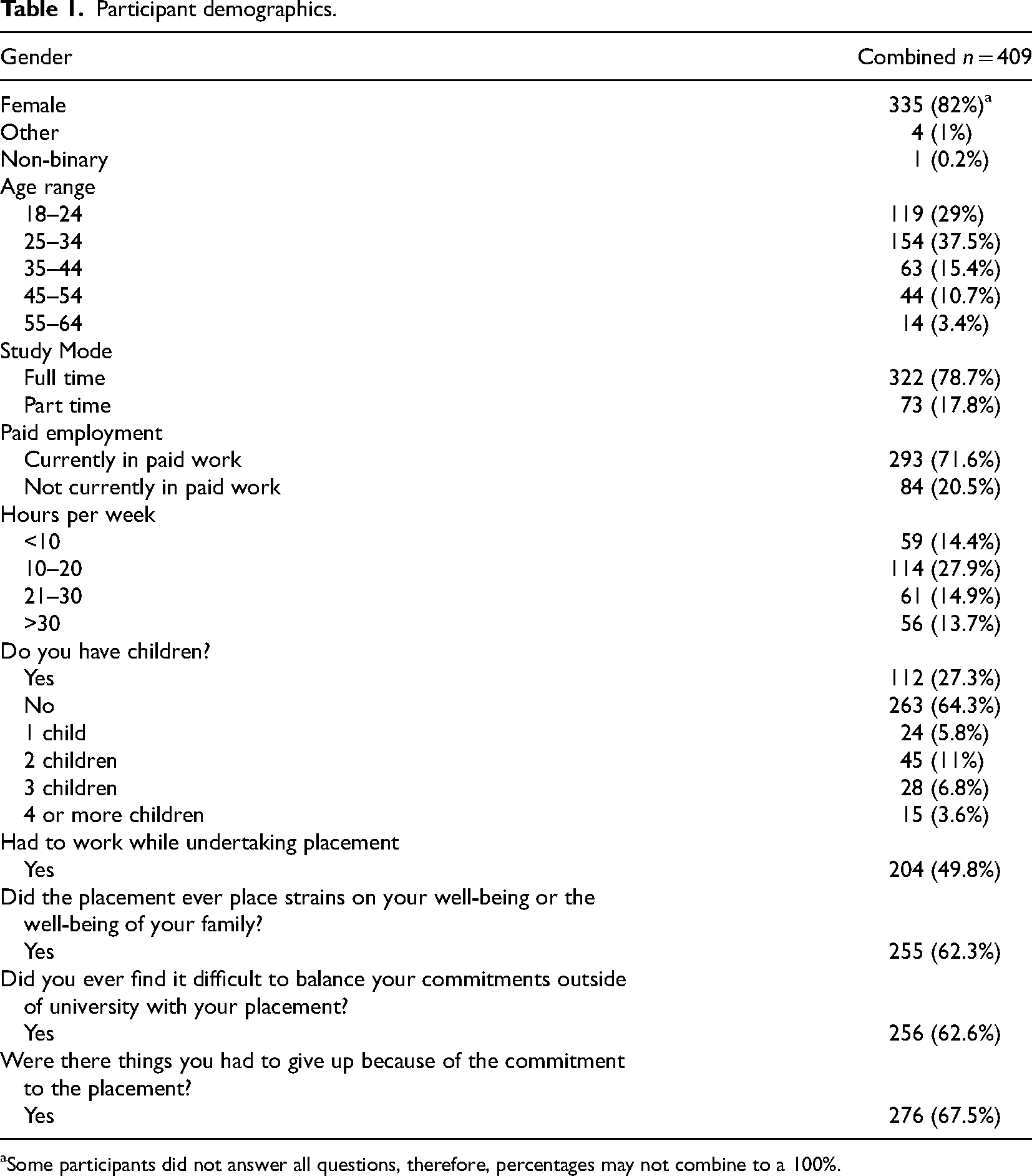
Some participants did not answer all questions, therefore, percentages may not combine to a 100%.
Caring in social work is feminized and perceived as an extension of the traditional female role of wife and mother (Jones et al., 2019). Our conceptual definition of “care work” is work that provides a face-to-face service to clients and develops their capabilities including learning, skill acquisition, or physical or psychological health (England et al., 2002). As O’Dwyer points out (2021) “Care work is among the most gender-segregated occupations in Australia” (p. 6). Women are expected to offer care to their family members out of love and obligation, and how one thinks about care work is “strongly affected by schemas about gender and motherhood” (England et al., 2002, p. 457). Moreover, as England and colleagues (2002) note, “those who work in occupations involving care face a relative wage penalty” (p. 545) despite their skill set and job demand. This has set the stage for a norm of unpaid labor in this predominantly female sector and lends legitimacy to institutional practices that reinforce and benefit from cost-saving measures such as low wages and unpaid work.
Notably, women have continuously been the numerical majority within social work (Khunou et al., 2012). In Australia, over 80% of all professional social workers and social work students are female (Jones et al., 2019) and these trends are also evident internationally (Fiore & Facchini, 2013; Jones et al., 2019). Although social work is a profession practiced mostly by women, men disproportionately occupy senior roles (Jones et al., 2019). As Western (2019) contends “‘gendered discourses, structures, and power dynamics’ have contributed to men occupying positions of power and prestige despite the majority of educators and practitioners being women” (p. 117). Although men also receive a financial penalty for working in care work professions (England et al., 2002), women in management and top positions are a numerical minority (Fiore & Facchini, 2013). Women are less likely than men to hold management roles in the human services. When women do occupy such roles, they earn less money than their male peers (Jones et al., 2019). Despite the gender pay gap lessening, one recent Australian Government report (2019) stated that female social work graduates earned between 3.8% and 5.5% less than their male counterparts. Nationally the gender pay gap is 13% (Australian Government, 2023). Men are better compensated for their leadership roles, while women's practical client work continues to be poorly paid (Dahle, 2012; O’Dwyer, 2021).
Background
A core component of social work education involves students gaining experience in the field through two placements. The accrediting body, the Australian Association of Social Work (AASW), defines placement as a “robust and fulfilling learning experience” where students gain the competence and confidence required to enter the professional world (AASW, 2021, p. 9). Placement is widely understood as a signature pedagogy that provides links between theoretical classroom learning and real-work practice and the competence required to enter the profession (Egan et al., 2018; Hay et al., 2019). However, students undertaking social work field education in the UK, Canada, Aotearoa New Zealand, and Australia (Durand et al., 2021) describe their experience of placement as living in poverty (Gair & Baglow, 2018b, p. 3). While the intention behind placements is to encourage students to view themselves as having value, it is, unfortunately, resulting in student voices being silenced and some students’ legitimate concerns being denied (Durand et al., 2021). Students are no longer the traditional school-leavers (young people who have just left secondary school), and therefore, the profile and demographic of students entering university must be considered (Gair & Baglow, 2017; Hodge et al., 2021; Johnstone et al., 2016; Morley et al., 2023).
There are now 130,000 students studying social work degrees across 30 Australian universities and the majority identify as female and are of mature age (Hosken & Epstein, 2021). Most universities consider anyone over the age of 21 to be a mature-age student. The AASW mandates the completion of at least 1000 h of field education placement, which are typically unpaid. However, an evidence base to support the rationale for the mandatory 1000 h is not provided in the literature (Durand et al., 2021; Hodge et al., 2021; Morley et al., 2019). Significantly, this historical model of field education continues today despite being proven to only benefit those with economic means (Aguilera et al., 2022). Oke and colleagues (2023) point out this is not dissimilar to social work's “placement programme in the United Kingdom where students are required to complete 200 days, including 30 ‘skills days’” (p. 1667), as is the case for social work, many other university courses that have long placements and are heavily populated by women, for example, nursing or occupational therapy (Oke et al., 2023, p. 1667). In this way, constructions of gender and class are integral to the social work profession, where women tend to be paid less and have more restricted opportunities than men (Oke et al., 2023).
The AASW's Australian Social Work Education and Accreditation Standards (ASWEAS) set guidelines for field education in Australia (2021). Yet, the ASWEAS is predominantly a gender-neutral text because it is developed as if gender has no relevance (Hosken & Epstein, 2021). For example, in their mandated requirement of a minimum of 140 h (20 days) face-to-face classroom-based learning, the ASWEAS makes reference to “all students” as a homogenous, genderless group (AASW, 2020, p. 16), disregarding gendered barriers around caring responsibilities for social work students (Hosken & Epstein, 2021). Moreover, the ASWEAS does not account for considerations around income to afford childcare or to travel to attend on-campus and makes the assumption that students should adapt their circumstances to a gender-neutral construction of students’ lived experiences. This is at odds with social work education, given the numeric dominance of female-identifying social work students, educators, practitioners, and service users (Crisp, 2018). The majority of social work students may not be as able to easily comply with the gender-neutral metrics of the ASWEAS (Hosken & Epstein, 2021). In this way, the unpaid placement experience is highly gendered, as it disproportionately affects women (Baglow & Gair, 2019a; Morley & Clarke, 2020).
Recent research critiques the current Australian model of lengthy, unpaid placements, as it has been found to pose a major barrier to study success. This is, in part, due to the proportion of students in paid employment while studying due to increased financial pressures such as the rising cost of living and the lack of government financial assistance such as AusStudy or Youth Allowance (Gair & Baglow, 2017). As such, it is increasingly common for social work students to be juggling multiple responsibilities, including balancing paid employment; family responsibilities; study requirements; personal responsibilities; and financial pressures (Hemy et al., 2016; Hodge et al., 2021; Morley et al., 2023). As stated, recent research indicates that social work students describe their circumstances as living in poverty (Gair & Baglow, 2017), struggling to pay for essential items such as rent, utilities, or transport-related costs (Brough et al., 2015); therefore, needing to work long hours on top of their studies in order to survive (Arkoudis et al., 2019; Hodge et al., 2021; Johnstone et al., 2016). Stress, anxiety, and negative impacts on mental health and well-being are the result for students while on placement (Hemy et al., 2016).
University students are no longer the traditional school-leavers with the rise in working-class, first-generation university students, First Nations peoples, international students, LGBTQI+ peoples, mature-aged students and those with multiple family responsibilities studying social work (Aguilera et al., 2022; Gair & Baglow 2018a). Social work practice aims to treat all people with respect and amplify marginalized voices, however, certain cohorts, such as students from working-class, first generation, and Indigenous backgrounds, still face great adversity within their experiences of field education as they may already be under financial and social stresses in many aspects of their lives, often due to structural and social disadvantage, over-indebtedness, material hardship, welfare cuts, and modest means (Aguilera et al., 2022; Baglow & Gair 2019b). As such, there are significant costs for female social work students, in Australia and internationally. These include negative impacts on female students’ finances, family life, employment stability, and health and attrition rates (Hodge et al., 2021). Despite social work's historic commitment to alleviating social and economic injustice, women, particularly lone parents, carers, and those on low income, have been identified as some of the most disadvantaged groups in terms of pay, opportunities for progression, and inequitable participation in public life (Hodge et al., 2021; Lister, 2003).
A UK study of social work students found a relationship between emotional exhaustion and necessary employment in part-time jobs (Collins et al., 2010). Similarly, Australian studies identified that balancing placement, work, and family exacerbates mental health issues (Gair & Baglow, 2018a; Johnstone et al., 2016). The AASW has conducted research and found social work students were adversely affected by a lack of finances, reporting not enough money for educational resources (52%), being overtired from long working hours in paid employment (47%), needing to skip classes in order to attend a paid job (34%), needing to defer a course or reduce study load in order to work (29%), lack of finances increasing the likelihood of dropping out of the course (27%), and heightened financial burden during placements (72%) (AASW, 2014).
The effect of completing 1000 h of unpaid placement can also contribute to students withdrawing from the degree (Hemy, 2021; Hodge et al., 2021), or compromising the quality of learning output and experience (Hemy et al., 2016; Richardson et al., 2013). Moreover, stress and anxiety impact the mental health and well-being of students undertaking placement, especially those who experience financial hardship (Hemy et al., 2016). In Australia, the student cohort undertaking the BBSW has greater numbers of mature-aged students than other applied disciplines in undergraduate study (Baglow & Gair, 2019a). As social work has a higher percentage of female students with children, not only are the students at risk of mental health issues and burnout (Benner & Curl, 2018), potentially so are their children. Indeed, young children and adolescents’ stress can have a greater impact on emotional and social development compared to that in adults (Singh et al., 2020). Thus, poverty experienced in childhood and socioeconomic disadvantage (episodic and/or persistent) has a detrimental effect on mental health of children (Benner & Curl, 2018; Cohen et al., 2010; Rod et al., 2020; Wise, 2016).
The purpose of this article is to report on findings from participants who identified as female as part of a national Australian study that included all genders, which examined the experiences of lengthy unpaid placements on social work students. Thus, the unique focus of this article is on how women experience placements. This is because, as Cox and colleagues (2022) argue, the gendered nature of financial stress and how this impacts well-being need to be further explored. This paper addresses the following research questions: (1) What are the experiences of lengthy unpaid placements on female students’ mental health and well-being? (2) What kinds of conflicts do female students experience between unpaid placements and personal obligations? (3) How do female students experience the financial costs of unpaid field placements?
Methodology
A survey was conducted across five Australian universities (where the first author had a working relationship with the field education departments) with social work students who had undertaken at least one placement as part of either a Bachelor of Social Work or Master of Social Work Qualifying program (as 1000 h of placement is a requirement of both degrees) and gained 409 responses. The Head of Social Work from each social work department gave written consent to assisting in recruitment. All students who had undertaken a first or second placement were invited to participate via a group email invitation sent out by each university's Field Educators. The survey was comprised of 21 questions both qualitative and quantitative.
Participants were invited to self-complete an anonymous online survey that included open-ended questions that sought to reveal insights into the research questions. The survey questions also consisted of demographics, employment status, and hours of paid work.
The qualitative data obtained were analyzed thematically, guided by Braun and Clarke's (2019) reflexive thematic analysis to generate themes. In their discussion on meaning and meaning making and critical reflexivity, Braun and Clarke (2019) point out, meaning and meaning-making, and viewing these as always context-bound, positioned and situated … qualitative data analysis is about telling “stories”, about interpreting, and creating, not discovering and finding the “truth” that is either “out there” and in findable from, or buried deep within the data (p. 591).
As such, reflexive thematic analysis is not about “accurate” and “reliable” coding, or achieving consensus between coders, but about the researchers’ reflective and thoughtful engagement with their data and their reflexive and thoughtful engagement with the analytic process. Thus, we understood our role in knowledge production as at the heart of this approach, with coding requiring “a continual bending back on oneself” (Braun & Clarke, 2019, p. 594). We constantly questioned and queried the assumptions we were making in interpreting and coding the data (Braun & Clarke, 2019). As multiple coders are the norm in thematic analysis, the first two authors coded the data with their coding approach being collaborative and reflexive. In this way, “deep and prolonged data immersion, thoughtfulness and reflection … that is active and generative” required us to articulate the assumptions that informed our approach, an approach that required reflexivity, theoretical knowingness, and transparency (Braun & Clarke, 2019, p. 592). By recursive reading and reflection, we worked back and forth between the codes and the data on a weekly basis via Zoom, for a period of six weeks, looking for connections across cases, making comparisons, and examining exceptions. There are different approaches to thematic analysis; being aware of this and doing thematic analysis in a deliberate way, can help avoid confusion and mismatches in concept and practice (Braun & Clarke, 2019).
The themes that we constructed included the following: anxiety, stress, and burnout; lone parents, carers, and low incomes; and the financial cost of placement. In this work, we attended to power and relationships and were guided by feminist post-modernism (Mosier, 2022). While there are various interpretations of critical theory, the view that the authors are drawing on combines radical/structural and feminist perspectives with some postmodern principles and critique (Morley, 2003). An overt inclusion of critical feminist theories and practices can highlight the central place of gender in social work education (Western, 2019). Moreover, as critical theorists, we are committed to understanding the historical and political origins of knowledge and the processes of how values and vested interests come to be dominantly represented as fact (Morley et al., 2019). As such, objectivity is neither possible nor desirable (Mosier, 2022).
Researcher Positionality
The six authors work in three different Australian states and one Australian Territory. Five of the six authors are critical social workers and, as such, are committed to post-modernism, critical race, postcolonial, feminist, and critically self-reflective teaching and practice (Macías, 2013). The authors’ values are underpinned by social work's core values of human rights and social justice. One of the authors is not a social worker but is situated in a research group in the Clinical and Health Sciences division in an Australian university. Five authors identify as cisgender, settler, heterosexual white women and four are mothers to daughters and sons. Thus, five of the six authors are academic scholars who inhabit privileged spaces as white bodies, while at times gender, class, ethnicity, and family constellation challenges this privilege (Hodge, 2015). In addition to the privilege their whiteness provides them, their relative privilege has been largely enabled by access to education despite multiple challenges. One of the authors is a First Nations Australian woman with strong connection to Giabal Country—Mirra Queenslander, and mother and nanna with cultural responsibilities. She holds an academic post, is a social worker and facilitator of knowledge sharing spaces, and a researcher. The authors reflexively engaged with the data in order to understand their situatedness and this demanded critical engagement with their own images of the world, marginalization and privilege, interpretation, contradictions, and ethics (Lash, 2003).
Reflexive Statement Regarding Field Placement
The first author undertook both placements, which she found incredibly valuable. However, she was a single mother of four young children and had to support herself financially during placement by drawing down on her mortgage, which was a huge setback. The second author did not undertake a placement. The third author did two rural placements requiring 2 and 3 hours of travel by car each day and worked nights and weekends to pay for the petrol. One placement was a fantastic learning experience, and worth the effort. The other was not. There was no life outside placement, work, and driving. It was utterly exhausting. The fourth author completed placements while working part-time and raising four children and a grandchild. Having no private transport meant long days (and high costs) taking children to school, grandchild to day-care prior to traveling to placement and needed to work weekends to cover the additional costs. The fifth author worked weekends during placement to cover the cost of fulltime childcare. The first placement was in a feminist organization and was a really great experience, but the final placement was not worth the stress or the poverty. The sixth author worked nights and studied full time while completing two placements; it was a very difficult time. The first placement was in a strong and generous feminist organization and has been the lodestar for understanding her own personal experiences of gender discrimination and sexual abuse/harassment throughout her life as well as those of others and has informed feminist understandings of how to take action to redress gender-based inequality including current efforts to ensure social work placements cease to reproduce discrimination.
Ethics
Ethics approval for this study was obtained by Victorian University Human Research Ethics Committee in 2019. During data collection process, the first author moved universities and subsequently, ethics approval was obtained by Charles Darwin Human Research Ethics Committee in early 2022. All aspects of the research were conducted in accordance with the requirements.
Results
Quantitative Data
Findings from the entire data set revealed that 82% of students identified as female and one percent stated their gender as “other” or “non-binary.” At the time of the survey, students were completing or had completed 1000 h of placement and 71% (n = 293) were in paid work (greater than 10 h per week and less than 30 h per week). Just under 79% of the students were studying full time. Almost 50% of the students stated that they had to work while completing study and 1000 h of placement. When asked if the placement ever placed a strain on their well-being or the well-being of their family, over 62% of students said yes. When asked if it was difficult balancing commitments outside of university and placement 63% also stated yes (n = 256). Moreover, 68% of participants stated that there were things in their lives that they had to give up in order to complete their placement. A limitation of the study is that the survey did not collect data on the respondents’ race/ethnicity. A further limitation is that open texted boxes for qualitative questions did not collect the experiences specifically of LGBTQI+ students, or students with disabilities (Table 1).
Qualitative Data
Questions with open text boxes invited respondents to elaborate on their views in detail. The answers helped us to understand not just the level of stress and anxiety female students experienced while undertaking their placements but also offered explanations as to why this might be so. The following section presents the three key themes constructed from the data.
Anxiety, Stress, and Burnout
When asked what are the impacts that social work students’ report unpaid placements have on their well-being, almost all women described a negative impact on their mental health, repeatedly drawing on phrases such as mental stress and mental exhaustion because of the financial burden of unpaid placement. Moreover, the women describe getting sick and feeling burnout. It is well known in the literature that students who work are at higher risk of burnout because combining employment with the student role diminishes their capacity to fully devote time and energy to the singular pursuit of employment or study (Benner & Curl, 2018) and this is exacerbated by placements. Further, an inability to implement self-care can increase burnout in both the student and the future practitioner (Benner & Curl, 2018). This is aptly summarized by one student in the following quote: “The associated stress has adversely impacted on both my physical and mental health to the point where I have required medical and psychological interventions.”
One woman stated that she was stressed to the point of suicide, while others considered dropping out of their degrees due to their stress levels, as the following women explain: “I already have mental health issues which I am able to normally maintain. However, since being on placement, I am having more suicidal thoughts than I have in a long time, I’ve considered dropping out of uni. I am severely unhappy.” “Incredible stress—Financially, mentally, emotionally, physically, socially.”
“I feel burnout after studying and working. I don't have time to enjoy my life.”
Benner and Curl (2018, p. 306) have found in their discussion on balancing studies with paid work for social work students that “the biggest toll of employment seems to be on health, physical and mental, again contributing to the risk of burnout.”
Experiences of Physical Ill-Health Through Placement Related Stress
Not only did the women's health deteriorate mentally while on placement but their physical health was also detrimentally affected due to stress, as they were no longer able to engage in their normal strategies for relaxation or attend essential medical appointments. This resulted in significant health problems, as the following student quotes highlight: “… I used to exercise before or after work but can't do this on placement. I am constantly stressed and overwhelmed. I used to go to the community library and choose books to read for pleasure, but I have not done this for almost 10 months. I cannot afford to buy new shoes so am going to placement in shoes which have holes in the soles. This has hurt my feet which I cannot afford to see a podiatrist. My diabetes is now unmanageable, and I do not have time to see a specialist; my levels were always good beforehand. I have had to give up seeing a dentist and have to suffer with an untreated cavity which makes me irritable because of the pain. I have no time to relax, I am always working or on placement or doing assignments.” “I have suffered depression, anxiety, and stress which has resulted in creating high blood pressure, and digestive problems such as irritable bowel syndrome.”
Being unable to see a podiatrist or have dental treatment during placement negatively impacted on the women's physical health. One woman shared that due to financial stress she was forced into “cutting down on fresh food and resorted to McDonalds.” Another woman stated she was unable to receive medical care:
Sometimes I had doctors’ appointments to attend and because I would be spending my day at placement I would try and make the appointments during lunch hour which sometimes did not turn out ok as the doctor might be running behind time some days meaning I would have to extend my time at the clinic or return to placement without seeing the doctor.
The following quote indicates how the respondent's health was compromised due to her inability to see her doctor:
Exhausted mentally and physically, unable to look after your wellbeing, every day you don't make it to placement puts you behind. Even difficult to make time with your doctor, as by the time I get home it is dark, no time for self-care, practice my faith and just look after my mental health. Overtime, issues outside of placement and the placement itself, makes a person very stressed and exhausted.
Another woman explains how she uses cannabis or other drugs to manage the anxiety:
My anxiety was through the roof which caused my physical health to deteriorate (autoimmune disease). Due to stress, I was also using cannabis regularly to calm myself every Friday evening throughout my first placement.
Efforts to retain paid work while coping with the demands of placement contributed to participants’ fatigue, stress, and ill health. Physical and mental ill-health are associated with burnout for social work students in the classroom even prior to becoming a practitioner (Benner & Curl, 2018). The possibility that some students may be entering the profession already experiencing burnout is concerning. As Benner and Curl (2018, p. 307) point out “Knowing that students are economically vulnerable, which can lead to academic concerns and health consequences, physical and mental, should provide the incentive to identify resources.” There was little time for self-care practices with some women self-medicating with drugs or needing to engage in psychological interventions. In line with previous research, these findings highlight how the financial burdens associated with placement adversely impacted women's mental health and well-being, and for many, have an impact on their learning (Gair & Baglow, 2018a; Hemy, 2021; Richardson et al., 2013).
Lone Parents, Carers, and Low Incomes
In response to being asked if they found it difficult to balance their commitments outside of university with their placements, the women stated that placement presented significant challenges associated with family responsibilities that were exacerbated by reduced income. For many women, including those who were also balancing caring responsibilities, their work–life balance was negatively impacted by placement. Social relationships were affected because students could not devote the time or attention required by them. The women also spoke about the financial pressure on family and relationships because they were unable to engage in paid work: “Less financial stability means more personal stress, as well as more stress within my relationships.” “My family is under financial pressure because while on unpaid placement, I cannot work.”
“Being away from home and trying to stretch the budget and still keep “home” running, and barely having enough money for food and yet you are expected to turn up to work and basically have no money for lunch.”
The following quotes emphasize the stress of combining family roles with placement: “It has been a very stressful situation attending placement and university commitments and not being able to attend to my children during school holidays.” “It is stressful being a mother/carer of a special needs child.” “… my children's health and wellbeing also suffered as I was unable to meet their needs and I had to rely on my older children which should not have been the case, and this has impeded on family dynamics and relationships. Placement was extremely overwhelming and impacted on both physical and mental health which resulted in me taking a whole week off at one point as recommended by the doctor.”
Almost all participants disclosed experiencing a physical toll and high stress levels that were attributed to managing their other roles and financial instability while undertaking placement. Students consistently reported feeling exhausted and overworked and that their ability to be a good parent’ was compromised: “Consistently being stressed and overworked. To meet the demands of family, work, university study (and placement) I am required to work in excess of a full-time workload BEFORE attending to my personal responsibilities and trying to find time to self-care. I often wake early (compromising sleep) to squeeze in time to exercise. I have had to prioritise study on weekends, meaning I have limited time to connect with family and friends. It is a constant feeling of not giving anything 100%, an endless to-do list, and physical exhaustion.” “Managing all of these commitments causes me a lot of stress. There are times when I need to drop everything to be there for the kids or my partner and this may coincide with assessment due dates etc. Having to maintain my business while on placement is also stressful as I am working two jobs but only getting paid for one.”
“I am always stressed about my ability to be a good parent and give them enough care while trying to focus on study. I feel like I'm drowning and at any moment one unexpected bill or illness could cost me years of work on my degree.”
Stress Caused Through Accumulating Debt
When exploring how they were able to support themselves and their families during placement, the women described having to redraw on their mortgage, increase credit card debt, and exhaust savings. The impact of being dependent on others for money did result in a changed view of themselves. The following participants explain how they were forced to delay mortgage payments and borrow money:
“I have redrawn my mortgage and delayed payments. I have maxed out my credit card and have increased my debt. I have an accumulation of large payments which are due or overdue such as car registration or licence renewal. I have exhausted my savings. I have borrowed money from my parents to pay bills.”
“My dad had to give me money as I wasn't working, and he is a single father.”
“I borrowed money from family for travel and accommodation.”
Most of the women had family responsibilities that demanded their time and attention in competition with that required for placement. The participants’ family roles entailed multidimensional demands which often conflicted with placement. The sense of having less time to fulfill their roles in the family and the impact on family well-being were a significant theme across the data.
The Financial Cost of Placement
When asked if there were things that the women had to give up because of the commitment to the placement, overwhelmingly it was paid employment. Most of the women disclosed being financially vulnerable due to placement costs and this caused feelings of inadequacy and shame. They stated that they were unable to maintain the same income and had additional expenses, such as petrol, parking, and childcare. Recent research conducted in the US found single mothers’ rates of poverty remains constant—approximately one in three households headed by a single mother fall below the federal poverty line (Martin-West, 2019). Significantly reduced income was predominantly linked to working fewer hours or being out of paid employment. This burden of lost income and sense of economic vulnerability was also related to job security. The resulting poverty and inability to pay for food experienced by participants was an ongoing issue. This is in line with research that found food insecurity is an issue for students (Nazmi et al., 2019), in particular students studying social work (Burgess & Shier, 2018; Crutchfield et al., 2020; Miles et al., 2017). The women also pointed out they were unable to buy clothes and pay for health-related expenses during placement. This was alongside limited time spent with family, friends, and self-care. Their concerns are illustrated in the following comments: “… In addition to the costs incurred for the units of study, it has cost me over $36,000 in LOST INCOME … just to undertake my placement. My limited availability to my current role has also damaged my professional reputation, has affected professional relationships (others in the team having to “pick up”) and impacts the kinds of tasks I can do. Social time, time with my baby, time with partner … Self-care …. PHYSICALLY NO TIME for important self-care.” “The primary impact of a placement is poverty. Basic needs: food, clothes, health related expenses. Social needs: seeing family and friends mental/emotional needs: self-care, down-time, rest, exercise.”
The women felt forced to give up self-care plans, recreational activities, healthy eating, sleeping, friendships, and community participation due to lack of time and financial restraints. The following woman explains how difficult medical costs were to manage.
I found that there was simply too much to commit to for one person to manage and for a short period of time whilst completing placement that I had to drop other commitments until the workload lessened. I also found it difficult as I had an accident which had a significant financial impact; therefore, I was unable to reduce any of my work hours as I had ongoing medical costs to meet along with living expenses and with an unpaid placement that required 3–4 days it was particularly difficult to manage on my own.
Poverty Induced Shame and Stigma
The burden of being unable to maintain paid work left the women feeling inadequate. Scholars have attempted to promote theoretical understandings of the notion of shame with discussions about related human emotions, including guilt, embarrassment, and pride (Chase & Walker, 2013). However, those who live in poverty continue to be viewed as lazy and undeserving, through a harmful narrative that plays a significant role in perpetuating and sustaining poverty (O’Hara, 2020). Even though social work students understand the social determinants of poverty (Crutchfield et al., 2020) they are not exempt from feelings of inadequacy, self-blame, and stigma when experiencing poverty or high levels of emotional distress themselves. It is often assumed that a person's economic position is earned, whether it is high or low, and as such many believe that one's economic position is fair and just (Kiebler & Stewart, 2023). Yet this assumption is far from reality.
Social work is all about improving clients’ self-worth/esteem and assisting them to access services that will provide basic needs such as housing, food, and utilities which will enable them to function in society. For students of social work, struggling with many unmet personal basic needs while trying to alleviate these same circumstances with their clients can be a daunting prospect. This may leave students on placement with the knowledge that they are trying to achieve an insurmountable task with their own self-esteem/worth at high risk, while trying to alleviate this same condition in their client base (Crutchfield et al., 2020; Miles et al., 2017). Importantly, Smith et al. (2022) point out that a social work professional identity is dynamic, relational, and socially co-constructed and socialization within field education settings constitutes a significant contribution to the process of socialization into the profession. In the following quote, the woman reveals the shame she experienced and being compelled to lie: “One day I was unable to go to field placement because I did not have enough petrol money. I was too embarrassed to tell anyone and instead had to lie and say I was sick.”
The following woman explains how that lack of placement flexibility impacted on paid employment: “I had to quit my job because there was no flexibility for me to drop back to a day or two during my second placement … and no guarantee of there being work for me if I left for 3.5 months … this is a part of why I'm disappointed by this placement experience as I was learning and applying more social work knowledge in the projects I was running in my human service job at home than I have in this placement … When I went to apply for RPL for my first placement, I was told by the uni not to bother because I didn't have enough work experience despite technically meeting the eligibility criteria.”
Being unable to receive RPL (Recognition of Prior Learning) and not being recognized for existing pursuits and contributions in the field was a cause of frustration for many. According to the ASWEAS, a student must have worked for at least the equivalent of three full-time years in a setting deemed appropriate as a field education setting to be recognized as credit for prior learning (AASW, 2021). Juggling employment and placement led to a level of fatigue which had a negative impact on some women's ability to expend energy on their learning. These findings indicate that the participants faced significant financial strain while undertaking placement through needing to cut back on paid work, but this also impacted on the women's perceptions of deservingness (Kiebler & Stewart, 2023). As Tonsing and Barn (2017) write, shame is a social force that can have tremendous impact on people's lives. In this way, the women were reflecting a sense of a deficiency of self that needed to be hidden from others.
Discussion and Conclusion
We began this study with the aim to better understand the impacts of lengthy, unpaid placements on women studying social work. Our research and teaching are shaped by a commitment to disrupting oppressive structures, and valuing lived experience knowledge (Moran et al., 2022). Employment is an economic necessity for most students (Brough et al., 2015; Hemy et al., 2016; Oke et al., 2023). As gender powerfully mediates people's potential to participate in paid work or accumulate capital, when women have reduced opportunities to participate in paid work or accumulate capital in their own right, their class position is mediated by, and cannot be separated from, their gendered family relations (O’Dwyer, 2021). Although employment can increase the risk of burnout in social work students, some protective factors can be implemented to help reduce that risk (Benner & Curl, 2018).
Our findings suggest that the financial cost of completing a field education placement for women contributes to poor physical and mental health and changes “the terms in which students participate in the workforce” (Oke et al., 2023) including having to stop paid work because of placement. This is antithetical to the AASW Code of Ethics, which outlines that it is informed by principles of human dignity and worth, social justice, and fairness, including the goals of enhancing people's individual and collective well-being, social development, and addressing systemic barriers to full recognition and participation (AASW, 2020). Some serious consideration needs to be given to the fact that the experience of women undertaking field education is diametrically opposed to the AASW's espoused Code of Ethics.
It is worth noting that women continued to bear a larger share of unpaid work and caring responsibilities (Alonso et al., 2019; Farre et al., 2022; Sullivan, 2019), particularly women who are mothers, as households with children have a more strongly gendered division of labor than those without children (Craig, 2006). Moreover, the concentration of work and care together in one location, the family home, during the COVID-19 pandemic further increased the unpaid workload of women (Craig & Churchill, 2021). Alonso et al. (2019, p. 5) point out in their discussion of female unpaid work, “Laws, regulations, and other social institutional constraints that restrict women's ability to work, manage their wealth, or run businesses are associated with higher female unpaid work and lower male unpaid work.” Further, unpaid work is associated with greater mental health burden, negative effects on quality of life, and a higher risk of depressive and anxiety symptoms among women (Seedat & Rondon, 2021). Indeed, research has identified that due to the cognitive and emotional involvement, lack of time for leisure, family or friends, and self-care from unpaid work can eventually lead to physical and emotional distress, depression, and anxiety (Seedat & Rondon, 2021).
Our data highlight the disadvantages women experienced in undertaking social work placements. It underscores the need for targeted interventions from social work's accreditation body to reduce women's unpaid work hours (Cowan, 2021). Social work has a “mandate to uphold social justice” (Gair & Baglow, 2018a, p. 207). Ironically, while we are training women to provide social work services, we are not providing them with the care and support they require. Basic human rights include the right to social services: “Everyone has the right to rest and leisure, including reasonable limitation of working hours and periodic holidays with pay” (Universal Declaration of Human Rights at 70: 30 Articles on 30 Articles - Article 24).
The stark reality is that lengthy unpaid placements continue to discriminate against women. Financial hardship, and other disadvantage, is a reality for women from diverse backgrounds when undertaking lengthy unpaid placements in social work, not just in Australia but also internationally. There are, of course, strategies that can be adopted in attempting to mitigate these challenges. Research on social work placements in the COVID-19 pandemic highlights how service delivery amid lockdown restrictions has been reimagined (Morley & Clarke, 2020; O’Keeffe et al., 2022). Industry needs social work faculty and accrediting bodies to also respond to changes caused by COVID-19 by developing new approaches to placements (O’Keeffe et al., 2022). Social work field education in its current format is no longer fit for its purpose. As O’Keeffe et al. (2022, pp. 18–19) point out “reverting back to pre-pandemic field education conditions and requirements would incorrectly assume that social work and human services agencies have not evolved their practice throughout this time.” We believe that the kind of paradigm shifts needed come only from moments of deep destabilization (Macías, 2013). We hope that some of the lessons learned in Australia may suggest wider tactics for change and reform at home and abroad. Nevertheless, whatever we come up with, the space for maneuver will, inevitably, be restricted, firstly, by social work's accreditation body and secondly, by women's continuing responsibilities as primary carers. As Morley (2013, p. 126) contends, when writing about the persistence of gender inequality in social work, what we need is “new rules for a very different game.” It is the “different game” that social work education providers, accrediting bodies, and other key stakeholders must now create together.
Footnotes
Declaration of Conflicting Interests
The author(s) declared no potential conflicts of interest with respect to the research, authorship, and/or publication of this article.
Funding
The author(s) received no financial support for the research, authorship, and/or publication of this article.
