




Abstract
This article analyzes the current feelings of Finnish low-income working lone mothers and their views on what it means to be poor in the welfare state of Finland. This is done by analyzing written accounts of lone mothers through a qualitative content analysis. The data was collected in 2015 and 2021. The analysis reveals that mothers’ feelings of poverty have similarities to those described in data collected in a different context over 20 years ago. The article is inspired by an article published in Affilia in the year 2003 by Lynn McIntyre, Suzanne Officer, and Lynne M. Robinson. In their paper, McIntyre et al. analyzed the feelings of poor Canadian lone mothers. While the welfare regime and services influence how life is organized, it is evident that self-sacrifice for the children caused by poverty is very much a part of the written accounts of Finnish mothers. We show that while there are a few cultural differences in the feelings that lone mothers undergo on account of their low-income status, feelings such as loneliness are persistent and often shared regardless of time or geographical location. Therefore, we suggest that low-income mothers should be given greater support by society and governments to be able to feel hopeful and empowered rather than poor and alone.
The inspiration to write this article came when the first author gave a lecture on poor working mothers in Finland on a course our research project Working poor in postindustrial welfare state organized. The article Feeling poor: The felt experience of low-income lone mothers published by Lynn McIntyre et al. (2003) in Affilia was used as course reading. Numerous students commented that they suspected that things might have changed or be different now since the data of the article was collected over 20 years ago. They seemed to have a strong belief that things usually get better over time, and they knew the story of the Finnish welfare state that scores very well in international comparison. Thus, during the lecture, it surprised some of them that there may be persistent social problems in different times and contexts. Their suspects made the authors curious, and the first author began searching for the feelings described in the data that were collected in Finland in 2015 and 2021 and found similarities to Canadian lone 1 mothers’ descriptions in the article published in 2003. Soon, it was evident that a similar narration of feelings was also rather evident in the data we collected, and an in-depth analysis was required to obtain a better understanding of the feelings described by lone mothers in contemporary Finland.
McIntyre et al. (2003, p. 317) describe “what it means to be poor from the perspective of poor women” and discuss “the ways in which these women resist or cope with the stress of poverty and how they attribute meaning to their control over their experiences.” Our goal is to analyze the data we collected and see what has changed, or not, in the last two decades and what are the culturally specific descriptions between mothers living in Canada and Finland.
Our study takes a particular stance in the field of poverty studies. While studies on poor mothers have been of interest to numerous researchers in recent years (e.g., Bradshaw et al., 2018; Gazso & McDaniel, 2010; Isola et al., 2022) the nuances of being a low-income, yet working, lone mother are still not completely understood. Overall, studies on poverty have concentrated on social security reforms and their effects on people in high-income countries (Simpson et al., 2021); moreover, these studies introduce work as the best social security in the United Kingdom (UK; Millar, 2005; Millar & Ridge, 2009). Mothers’ poverty has been studied as a risk factor for mothers who receive social assistance in Sweden (Stranz & Wiklund, 2012), Canada, and the United States (US; Gazso & McDaniel, 2010), but less research has been conducted on feelings of poverty (for US context, see, e.g., Edin & Lein, 1997; Hays, 2004; Mink, 1999). In Finland, the research has concentrated more on families and children (e.g., Haanpää et al., 2019; Kallio & Hakovirta, 2020) rather than feelings or mothering. Yet, it is common knowledge that poverty decreases overall well-being (Broussard et al., 2012). Earlier research reveals that apart from being poor, the health of Finnish lone mothers is worse than those of women who are married and have children. This is explained by the social and emotional support women get when married as well as because married women or cohabiting women experience lower economic stress (Roos et al., 2005.)
In this study, we analyze the feelings these poor, yet working mothers describe. We want to add to the feminist tradition that “what has been personal, invisible, and unimportant is profoundly political” (Nathanson, 2008, p. 243) while being aware and conscious of the possible challenges involved. Ramazanoğlu and Holland (2002) highlighted that while there is a contextual and discursive side to analyzing experiences, we can also obtain important information regarding gendered inequalities and the similarities and differences in the lives of mothers. We aim to understand the personal experiences as political and through that as generally significant and important. Analyzing feelings provides us with an opportunity to see how these low-income working women reflect on their mothering and how they express being experts on their own lives in the socio-political culture context of Finland.
Working Mothers in Finland
Finland is a relatively small country located in northern Europe, with a population of little over 5.5 million (Statistics Finland, 2022), while Canada in northern America has almost 37 million inhabitants (Statistics Canada, 2022). When comparing these two countries today, we see that Finland, famous for equal opportunities for women, ranks second in the Global Gender Gap Index, while Canada is listed 24th (Global Gender Gap Report 2021). Gender equality is a core value in Finnish policymaking, the social-democratic welfare system has established the dual-earner model, and women are used to working full-time. However, in 2022, over 84% of families with a lone parent were lone mother families (Statistics Finland, 2023a).
In addition, changes in work are affecting these families; the European trend is that in-work poverty is increasing, and the reasons can be found in atypical jobs and in work and social policy reforms (e.g., Filandri & Struffolino, 2019; Lohhmann & Marx, 2019). Moreover, involuntary part-time jobs are more typical for women (Haataja et al., 2011, p. 27). As a consequence, a great part of families do not have two adults who work full-time, although the prices of housing and basic consumption as well as low wages in female-dominated sectors on strongly gender-segregated labor markets (Mustosmäki et al., 2021) would require two earners in a family. For example, lone mothers living in the Helsinki capital area with high living costs or women living in the countryside who have to commute long distances for work and incur high expenditures on fuel are often in a position where their pay is not sufficiently high to survive without benefits from the government or municipality. Work has also become more intense and women, in particular, have reported feeling tired and listless at work (Sutela et al., 2019).
Further, the fact that the salary in female-dominated occupation is low has resulted in labor shortage in female-dominated areas of work (Ojala et al., 2019; Working Life Barometer, 2022). The changes in work are also creating contradictions: work may not be enough to get one by and it may also be something one does not enjoy at all, but in the Nordic countries working has been a sign of belonging to society (Julkunen, 2002) and being employed is still highly valued in Finland (Pyöriä et al., 2017).
Today, the employment rate among mothers whose youngest child was aged under 17 is over 80% (Statistics Finland, 2023b). In contrast, in Canada, mothers have been expected to stay at home and take care of the children and the home (Leigh et al., 2012). At the time McIntyre et al. wrote their article in the year 2000 the employment rate was 70.4% (Statistics Canada, 2022). All children in Finland are entitled to daycare services and it is culturally acceptable that children are cared for in daycare centers. This implies that the municipalities provide childcare services until the child turns six and, thereafter, the children are directed by law to attend preschool (free of charge) for one year, and then they join primary school when they become seven years of age. Further, the fees in municipally organized daycare facilities vary based on the income of the parent or parents. This makes daycare services accessible for most, since low income is compensated for. Education is free in Finland and children are provided with one hot meal (in accordance with nutritional recommendations) daily at school.
Social benefits and the manner in which society supports working women have traditionally protected full-time working (lone) mothers in Finland (see Ikonen et al., 2022) whereas in Canada the support is weaker (Russell et al., 2008). However, when comparing statistics from the 1970s to 2000, Canada has become more like Finland and other European countries, than, for example, the US, thereby implying that living alone or being the only breadwinner increases the risk of poverty more than lack of work does (Airio, 2006). The latest income distribution statistics of Finland reveal that lone mothers are highly represented in the lower income groups as compared to married women or lone fathers in Finland (Statistics Finland, 2019).
In Canada, back in 2001, children living with a lone mother were at the highest risk of living in poverty when compared to children living with both parents (National Council of Welfare, 2001); in Finland, the Nordic model of social transfers reduces the child poverty rate significantly (Bradshaw et al., 2018, p. 351). To achieve social equality and fairness, the Nordic model (dating back to the ending of the Second World War) has meant strong state intervention with the goal of full employment and social redistribution (Veggeland, 2016). However, even if Finnish children's poverty rates are low compared to international levels, children with lone mothers are at a greater risk of poverty (Bucelli & McKnight, 2023).
Data and Methods
The analyzed data consist of written accounts that we collected in June 2015 and May to August 2021 as part of our research project. Our invitation welcomed participation from all those who felt they belonged to the “working poor” category: we did not set any earning limits or specify who is “poor,” but people who participated were asked about their income level in a background questionnaire that they were requested to fill out. People were invited to write to us about their everyday lives and the experiences they had, for example, in relation to social benefits. The invitation to write was published on our university webpage, on different social media platforms, and on discussion boards. On both occasions, the research group was successful in getting media coverage and therefore the invitation to write caught wide audiences.
Our research complies with the guidelines of the Finnish National Board on Research Integrity. Ethical review was not required since all participation was voluntary, and our research did not include collecting data in a way that might have jeopardized participants’ health or legal rights which is in line with the national guidelines on research ethics. A description of the processing of personal data for scientific research purposes was published with the 2021 call and all respondents were asked to read through a research notification. After that, all participants were asked to accept the following agreement to voluntary participation. All participants were asked for a permit to archive the data and with permission the data will be archived in the Finnish Social Science Data Archive after the research is finished.
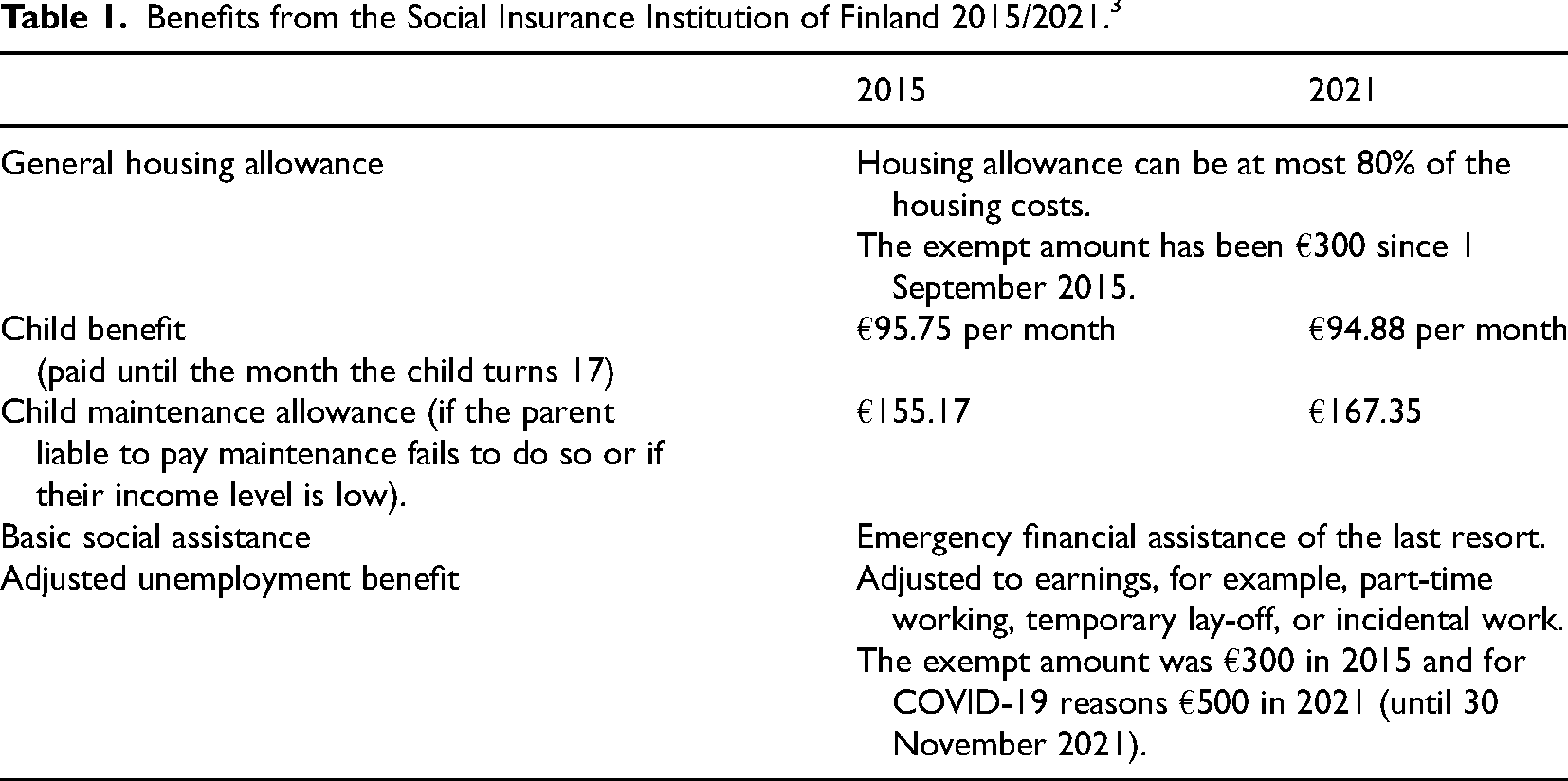
Overall, 170 people responded to our invitation in 2015; among these, 64 women had children, but the age and number of children were not asked. In 2021, 247 people participated in our study and were asked if they had children as well as the age of their children. This time, 127 mothers participated in the project. This makes it a total of 191 mothers who participated in our data collection process. We chose to use both data sets for this article since the feelings described did not significantly differ during this period of six years. We do recognize that the COVID-19 pandemic influenced people and that makes our 2021 different from 2015 data. The pandemic is even told as a positive change, as we will show soon. The most common benefits received by lone Finnish mothers are listed in Table 1.
Benefits from the Social Insurance Institution of Finland 2015/2021. 3
While our data is based on insufficient work income, the occurrence of food insecurity was the objective of McIntyre et al.’s (2003) article. They used data collected in 1999 and 2000 in the four Atlantic Provinces as part of The Hungry Mothers of Barely Fed Children study. The data includes results of a questionnaire (n = 141, 345 comments), interviews (n = 24), and comments of returning results session (n = 33, 250 comments) from mothers living below the poverty line.
In our data, to exclude mothers who live with a partner (married or cohabiting), we analyzed those written accounts that combined the following background variables: women, have children, divorced, widowed, or single (n = 78). While reading the answers, the word “lone mother” was paid extra attention, as was “child” or “children.” With regard to the written accounts from 2021, and since we knew the age of the children, closer attention was given to those studies in which children were underaged or had just turned 18. Only a few wrote that they had joint custody with the father of the children, but only one stated that it actually meant that the child was staying with the father every other week (however, the mother in question had also another child that she parented alone). Table 2 presents the demographic and personal characteristics of respondents. We have included information about the mothers’ living area and education level to indicate that they are not a cohesive group although many of them have a relatively high education and live in bigger cities.
The Demographic and Personal Characteristics of Respondents.
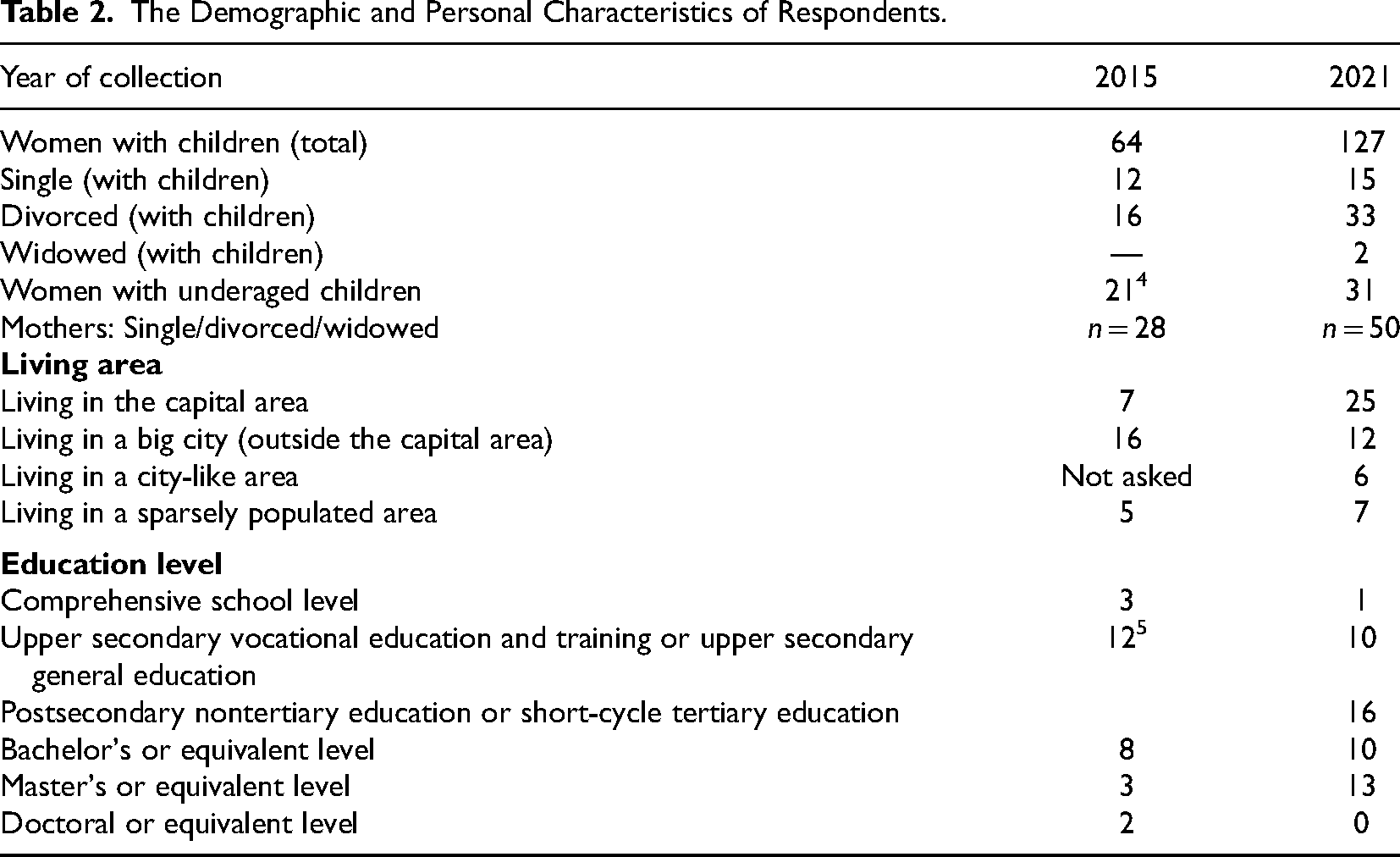
The extent of education of the mothers in our data ranges from education at a comprehensive level (in Finland, this means nine years of compulsory education, ending when the child turns 18 years of age) to doctoral degrees. The participants can also be categorized as those who feel comfortable talking about their struggles compared to those who do not see any point or do not have the strength to participate in studies like ours. With all this combined, we were not able to achieve diversity in the same manner as the data described in McIntyre et al. (2003): for example, we did not ask any questions regarding ethnicity. We are aware that analyzing the intersectional differences from our data is not very evident. We can take a closer look at gender and class, but other intersecting differences might be hidden from us. For example, age or body size is somewhat present in the writings but not discussed much and we know that ethnic diversity is becoming more common in Finland and—based on statistics—immigrant children are at risk of poverty in Finland, which implies that immigrant mothers are more likely to be poor (Obućina & Ilmakunnas, 2020). To be able to participate in our study, these mothers needed to be able to understand and write in either Finnish or English. In 2015, our invitation to write was only published in Finnish; in 2021, we also published the invitation in English. This leads to the fact that we obtained only a few responses from immigrants and only one from an immigrant mother born in the 1950s (who had lived in Finland for 7 years at the time of the collection) who did not mention her children.
As in McIntyre et al.'s study, we also used qualitative content analysis (Elo et al., 2014) to analyze the data and the “social, emotional, physical, or psychological effects of poverty” (McIntyre et al., 2003, p. 320) that was described by mothers. A further examination of the data revealed several components of the concept of feeling poor, which were subcategorized as “domains” of the main theme of feeling poor. Since the data comprised 78 written accounts, some very short and some longer descriptions (altogether 37 A4 pages of text), we were able to read the data several times and familiarize ourselves with it.
While we conducted our analysis in accordance with McIntyre et al.'s article, we did not want to focus only on the feeling domains described in their article but proceeded inductively and wanted to keep our analysis open for different interpretations as well. What we did was that we first searched for feelings in general. The first writer highlighted all points of the texts where feelings were discussed by reading and marking the text by hand. After identifying all the different feelings, we started to map them under the domains given by McIntyre et al. (2003). This way we could identify different feelings the mothers expressed and found many similarities with data collected over 20 years ago but also some differences. We will discuss the results in the next section.
We approach feelings as socially expressed and interpreted. We are not reflecting the feeling domains in terms of individual psychology but are analyzing feelings that are affected by the social situation and interactions with others.
Results
The 10 feeling domains that McIntyre et al. (2003, p. 321) found in the written descriptions submitted by the Finnish mothers who participated in our data collection process. These domains include (1) feeling deprived, (2) righteous, (3) the need for occupational choice, (4) relatively better positioned than others, (5) the need to manage the appearance of poverty, (6) judged/degraded, (7) guilty, (8) isolated and alone, (9) dependent, and (10) despondent. While we were able to identify the same feeling domains, we also recognized a few cultural differences that we discuss when relevant in each domain. We added (11) hopeful and hopefulness to the list of feelings described.
Feeling Deprived
Like Canadian mothers, Finnish mothers also strongly emphasized how they put their children first. They described how they do not eat or buy anything for themselves to ensure that the child or children could get at least something to eat or to wear. Like a mother of two describes, “There are several times that I have cooked only for the children,” thereby implying that she skips meals when needed to provide the children with something to eat. She explains how they have not had vegetables, fruits, or meat because they simply cannot afford to buy them.
Thus, self-sacrifice by lone mothers is evident in the descriptions. In the Finnish context, the fact that mothers work is not culturally considered bad mothering, vice versa. Nevertheless, the fact that these mothers cannot provide their children with everything they need implies that the mothers sacrifice their own needs for their children. The idea of being a good and caring mother, despite struggling financially, came up in several written accounts. One mother of two who has been a lone mother for 10 years describes her situation in the following manner: My children are the most important thing to me in the world, I always put them first. Life has been a struggle to get a living and to ensure the well-being of my children. I have tried to make sure that they do not stand out because of our poorness but it's hard. You must give up everything to be able to get the children clothes and things outside the flea market.
Righteous
Similarly to McIntyre et al.’s (2003, p. 322) article, feeling righteous supported mothers’ beliefs that they had the ability to be good mothers as well as good citizens. The mothers expressed how they were raising their children to become decent individuals with the hope of a better future for them. Prior research on poor lone Finnish mothers revealed that mothers are directed by “the culturally valuable function of raising a good citizen” (Isola et al., 2022, p. 200). This implies that mothers themselves could feel like they have succeeded despite monetary difficulties and provided their children with opportunities to be better off in the future (Isola et al., 2022, p. 200).
Further, the attempt to be a decent mother was substantially present in the written accounts and gave these mothers strength to go on even when realizing that others may give up: At times it feels like I’m going to break into two because I’m so tired, but I have decided to survive, goddammit! I work like crazy. Sometimes I wonder why I work myself into the ground when there are people who just give up. My excessive sense of responsibility just won’t let me give in.
The Need for Occupational Choice
The mothers in our data identified as poor working mothers (they were in unstable situations that also caused them to be underemployed or unemployed occasionally). In Canadian data, participants were mother-workers, full-time mothers, or mother-students. The Finnish mothers in our data did discuss the impossibility of studying because they had their children to support, but some of them also remembered what it was like when they were studying and their children were small.
Being a stay-at-home mother is not a typical choice in Finland, but few did describe how they had stayed at home during their children's early years. Otherwise, our data does not include stories of full-time mothers and the choice of being a stay-at-home mother is discussed only to a certain extent. One freelancer mother describes that her freelancing is ideal for raising a child alone and being able to choose when to work. She does write that she is sometimes unable to take any holidays because she feels that she needs to accept the offered work: Sometimes I wonder if there is something wrong with my attitude, because I accept all shifts even if there is no additional value for me in taking them. The feeling of being needed and the desire to be trusted by the employers wins every time.
This finding supports what researchers have noted earlier: apart from increasing the employment rate, the jobs that people do should also have meaning, enable skill development, and motivate the people doing them (Gallie, 2002; Martela & Pessi, 2018). However, the motivation in the extract comes from the feeling of being needed and trusted and not from feeling motivated by the work itself. Based on the written accounts, the possibility to choose often seems to be for others.
Relatively Better Positioned Than Others
Like Canadian mothers, Finnish mothers find some parts of being poor easier for them than others. They reflect on the choices and opportunities they have had. Moreover, in the data collected in 2021, the fact that COVID-19 impacted everyone made it easier for many, as everyone had to stay at home and no one could travel or be expected to throw expensive parties (e.g., children's birthdays or graduation). One mother of two describes the pandemic situation in the following manner: The restrictions during the COVID year were not a problem for us. I was pleased that we didn’t need to go anywhere. Another mother of three describes their life in a rather positive manner, which also emphasizes the resourcefulness they possess in the face of a lack of financial resources: The hobbies we do are cheap, we go outdoors a lot, we use the library a lot, we do handicrafts, paint paintings, cook good food and we are a happy threesome enjoying spending time together and who love each other. Besides the lack of money, everything is all right.
The Need to Manage the Appearance of Poverty
The mothers in our data reflected substantially on the appearance of poverty (Cappellini et al., 2019). Apart from not being able to buy the clothes the children wanted, they were occasionally unable to get the clothes or footwear they needed. Some would explain to their children that they did not want to participate in consumption that would ultimately lead to the destruction of the planet even if the real or, at least, parallel reason was that they could not afford to buy things or travel. In addition, children's hobbies came up in many accounts. The mothers stated that that is what they attempt to do—to ensure that their child (children) is (are) able to participate in at least one hobby. While Canadian mothers would homeschool their children to avoid the possibility that their children would not fit into a school (McIntyre et al., 2003), Finnish mothers or families rarely do.
Further, avoiding the company of other (adults) came up in the following account of a mother of three, living with her youngest child (aged 15 years): I am ashamed of being poor and the fact that I do not make enough money to improve our standard of living. Apart from my older children, I do not invite anyone to our home. In my free time, I avoid the company of others for fear of not being able to say anything (about furnishing, hobbies, home ownership, investing, getting a new car, etc.) nor do I invite them to visit my home. I concentrate on my work and my children, that's all that I got.
Thus, managing appearances makes mothers avoid the company of others and, therefore, influences their social life. It is also about the feeling of not fitting in and being left out because of being poor (Garbarino, 1998).
Feeling Judged/Degraded
The Finnish mothers did not write much about the feeling of being judged or degraded but the feeling of shame (Gibson, 2020) or embarrassment was present a lot. Because there are no full-time mothers included in our data, the talk about food banks is usually brought up when they say that they do not have the time to go there because they work during the opening hours of the food bank. One mother did bring up the fact that she got charity food from a merchant she knew, and this made it possible for her not to go to the same food bank as her customers from work. One part of her job was to advise poor people, but her salary was not sufficient to support her living with two teenagers.
The feeling of being different from others came up in this account of a mother who was working part-time in high-demanding care work: Isn’t there something profoundly wrong when you cannot survive on your salary and your constant poorness is causing shame? That shame sneaks upon you on the workplace coffee table when it turns out that you are the only one that does not travel, in the parent's evening at school when it turns out that your son is the only one that does not play football, in the cellar where bikes are stored when you remember that you do not have enough money to buy new bicycles for the children to replace the ones stolen, or in the garage where your dirty car wreck is parked next to the Audis or new station wagons, in the store before payday where you have to count if you have enough balance on your account to pay for the food for the rest of the week.
Since paid employment is valued and “triggers pride,” the fact that mothers were working protected some of them from the feeling of judgment or degradation (see Leonard & Kelly 2022, p. 854). Nevertheless, they were rather aware of what is expected of mothers and how their lives should be. The accounts also embodied resistance to being ashamed and expressions of being proud. One mother of three wrote that she did not have to survive on her own and has had support from various people apart from friends and family—for example, the Finnish Social Insurance Institution, social workers, child protection services, church welfare, family workers, and doctors, to name a few of the professionals and charities that she lists as having been involved with. She continues, “I am not ashamed of being poor or the fact that I have survived as a lone mother of three, I am proud of it. We have survived all!”
Guilt
The mothers expressed feeling bad for the children. They wanted to be able to support their hobbies or give them nice things that other children were able to get. Guilt was combined with frustration; there was nothing more to do to be able to save money, as described by a mother of two who also describes how her youngest child had difficulties understanding the value of money and the fact that they cannot buy birthday presents that cost 20 euros: There is nothing we could spend less money on. I have shopped around to get the best electric rate schedule and we do not go to the hairdresser (I cut the children's hair). Last year, the youngest did not have any hobbies because I simply did not have any money to support a hobby. I feel bad about not being able to support her. She
2
is physically and musically talented.
One mother of two now grown-up children described how her younger son made her feel guilty about not having food for him. This was when he was growing up as a teenager in middle school. The mother felt guilt-tripped by her son.
Isolated and Alone
Being the only parent made many of the mothers feel isolated and alone. The fact that they could not participate in society as expected or buy things to make life easier was bothering many of them (see Garbarino, 1998). A mother whose children were grown up remembered how she was surprised that she was so alone after her husband left them: “Poverty is different from when I was a kid. [Now] There is no community, the whole village does not bring up anyone anymore. The poor are left alone, and no one seems to care.”
Further, a mother of an eight-year-old child describes how she never got to study the subjects she wanted to study to engage in her preferred occupation and, therefore, she has had to settle for lower pay and being poor, which she finds very stressful: Life feels heavy and like enslavement. Everywhere you look you can see happy and high-income people who own expensive homes and furniture, device, clothes, technology etc. These people tell and guide you how to get to be like them. You are only accepted in this society if you make at least 5000 euros net income per month and you have a fancy title and a university degree. These people think that everyone can attain a high standard of living and that everyone has the same opportunities in life. I feel alone in many ways. I have only a few relatives and the relationships are distant, I live alone with my 13-year-old son […] As a lone parent, I have to stretch beyond my own limits because no one helps. Being poor means that you do not have time to yourself or to recover, that year after year you simply must go on alone.
Dependent
As explained earlier, the mothers do get benefits from the government or municipalities. We also know that lone mothers are overrepresented among people who get some sort of social benefit (Isola et al., 2022), which indicates that lone mothers are, in many ways, in a dependent position. When listing the benefits in the written accounts, housing benefits were mentioned most frequently. Housing benefits were modified in 2015, when €300 from every adult's earned income was set apart as protected income. This resulted in more people getting housing benefits than did earlier. The change is evident in the numbers: since 2015 the percentage of people receiving housing benefits has risen from 24% to 39% (National Audit Office of Finland, 2023).
A few lone mothers felt that social support was not for them; in a sense, they appeared to have internalized the neoliberal ethos of making it on their own. The mother referred to earlier, who is living with her 15-year-old son, even wrote how she felt that making a living was a question of worthiness: To me, it is a point of honor to survive on your own work. I have decided that if honest working (in your own company or elsewhere) is not enough to support and get a decent living then I am fit to get out of this world.
Despondent
Similar to mothers in McIntyre et al. (2003), the mothers in our data did not express that they are depressed in a clinical sense. A few of them mentioned that they had a diagnosis of depression or anxiety, but a majority expressed that they felt sad or anxious because of their situation. The mothers in our data did wonder about their choices in the past but also worried about the future and the fact that they could be poor forever. One mother of two underaged children reflected on her situation and the differences with others who travel and buy things in the following manner: “I do sometimes stop to think that what should I have done differently and at what point so that my life would be different now.”
Not being able to give the children all they want or need was very commonly discussed as something that caused sorrow among mothers, as already evident in previous domains. Our final domain is hopefulness and hopelessness. We believe that by adding these domains we can show that feeling poor is very closely linked to feeling that there are choices in life.
Hopefulness/Hopelessness
Beyond the domain of McIntyre et al.'s (2003) study, we recognize the domain of hope. It comes up both as hopefulness and hopelessness. Hope comes up in the written accounts in different ways: there is hope for a better future for the children and that when they grow up, they do not need to live in poverty. Even if low income has serious effects on children, they still live in a welfare state and can rely on having basic welfare services (Isola et al., 2019; see also Esping-Andersen, 2002). The mothers expressed hope that their children have grown up to be strong and independent, resourceful, and smart enough to survive in life. There is also hope for the mothers themselves; they dream that things might get better when the children are on their own, that the mothers could live in smaller apartments, maybe outside the city and, therefore, have lower rents or mortgages. This could possibly imply that the women who have not concentrated on their well-being could even travel and do things that “normal people who work” do.
To have options is something that the hopeful ones appear to have in common (Garbarino, 1998). Further, hopefulness is connected to being grateful. There are descriptions of being grateful for the children as well as for the work the mothers are doing. The ones who did not see any hope feared that they might get sick or die before their children are grown up. For them, the situation was more hopeless. They did not see that things might change for the better in the future, but described the situation as ongoing and desperate: life is a constant struggle and fight from one payday to the next, as one mother described. Low income makes pensions more problematic for women. If this was once a problem for women working in agriculture (Silvasti, 2001) or female-dominated care-related jobs, where pay has always been low, now more women in unstable employment are facing the same situation: their pension accrual is low. One mother describes her situation in the following manner: I am planning on getting a second job for the weekends as soon as my children get a bit older. I am already thinking of retirement and what jobs I could do part-time while retired. I know my pension is going to be low.
A mother who hoped that her children could be educated also expressed how she feared for the future. There are barely any changes in the state welfare support system and she feared that the political decisions would make living even harder for low-income mothers and families: Sometimes the future seems hopeless and downright frightening. The constant talk of cuts and the impoverishing politics terrifies me. What to give up when there is nothing that can be taken. Do we need to stop eating or are we going to be thrown out of our home?
Any surprise occurrence of a breakdown—for example, if a domestic appliance would break down or the car needs servicing—was often described as an impossible situation that might have long-term effects on their everyday budgets. Living with a constant fear of something breaking down caused feelings of hopelessness.
Conclusion
This article was set in the context of the postindustrial welfare state of Finland in which women have a long history of attending the workforce full-time and where the welfare state supports it through childcare and the school system but where the changes in employment have had effects too. For many, full-time employment is not available and even for those who are highly educated, full-time permanent employment is not easily attainable. Nevertheless, the mothers in our article do not express a desire to stop working; they consider work as something that they do to set an example for their children as well as to have a higher sense of self-worth. This is linked to the Finnish culture, where work is highly valued (Pyöriä et al., 2017), and people might feel ashamed to live fully on social support, as described by a few mothers in our data. The two data collections in 2015 and 2021 gave us writings that were similar: in-work poverty creates negative feelings. Overall, the Finnish mothers’ feelings of being poor had numerous similarities to those in McIntyre et al.'s (2003) article published over 20 years ago, which shows that there are persistent social problems in different times and contexts.
Further, being a good mother was often connected to ensuring that even if the children were not living middle-class lives, they would not lack in love and care. As Isola et al. (2019) describe in their article of gendered experiences of poverty, the mothers in our study found meaning and significance in child-rearing and this gave them a sense of worth. Many described how their children were the most important and precious and that helped the mothers to cope with the stress of low incomes. However, the children also added to the mothers’ stress since the future of the children was pondered upon a lot in terms of struggling to provide them the same opportunities as children from wealthier families.
Based on our analysis, being a low-income working lone mother appeared to imply loneliness at numerous levels. They would self-sacrifice to ensure that the children got better food and the clothes they needed (Cappellini et al., 2019). They oversaw the upbringing of their children as good citizens (Isola et al., 2022), while they needed to accept all the work offered to them. The mothers described how COVID-19 had also made staying at home a necessity for all and, therefore, it was a good thing. They described how they did not invite anyone to their homes because they were ashamed of it (in terms of size, old furniture, etc.); they did not meet people outside work in social gatherings or felt that they could not participate in discussions about holidays or expensive goods since they had nothing to say and therefore the pandemic made it easier to be just like anyone else—not seeing anyone or going anywhere was expected and approved.
The Nordic model of social benefits was also discussed in the written accounts (Bradshaw et al., 2018). Many of the women who wrote to us were dependent on different types of benefits, such as housing allowance, adjusted unemployment benefits, and, occasionally, income support. The economic stress was constant (Roos et al., 2005). Based on the written accounts, work is no longer the best social security there is. For many lone mothers, the salary they got from their (often unstable) jobs was not sufficient to help them survive until the next payday. Thus, the challenge for the welfare state of Finland is to ensure that these mothers and children are not left out (Garbarino, 1998) but supported as citizens.
Key Implications and Contributions
Our article adds to the knowledge of those who work with impoverished mothers but also provides fodder for academic discussions on what it means to feel poor. By analyzing the written accounts, we obtained from low-income lone mothers, we are participating in the feminist discussions by acknowledging these feelings that might otherwise be invisible and unseen. There is political importance in bringing the viewpoints of these mothers into the realm of academic discussions and to legitimize them as speaking subjects: lone mothers living with low income should not be deemed as vulnerable without their own agency (Turner & Maschi 2015). The feelings of low-income lone mothers analyzed here indicate that these women partially feel that they do not belong to the mainstream society and may need support from social services or at least the knowledge of what benefits they are entitled to. To enable these women to be “experts on themselves” (McIntyre et al., 2003, p. 329) remains a relevant feminist approach for people working with impoverished mothers (Shepard & Dziengel, 2016; Turner & Maschi, 2015). The professionals mentioned in the writing accounts were only a few, but it is highly relevant to discuss and identify how poor mothers are treated by social workers.
While McIntyre et al. (2003) describe that Canadian mothers were not hopeless, we believe that being hopeful or hopeless is one characteristic that defines the writing accounts we collected. Our analysis reveals that political talk about future cuts in social benefits causes uncertainty and even fear for the future. This is an important perspective and an interesting one for future research: what are the circumstances that are the most influential in making low-income, working mothers feel hopeful or hopefulness? Apart from individual characteristics, there are also political decisions that can support the creation of hope. A growing number of lone mothers are challenging the manner in which the welfare state of Finland is built, where everything is based on the two-breadwinner model; they reiterate that this is not the case anymore and the social support system should adapt and change to serve lone mothers better.
Footnotes
Declaration of Conflicting Interests
The authors declared no potential conflicts of interest with respect to the research, authorship, and/or publication of this article.
Funding
The authors disclosed receipt of the following financial support for the research, authorship, and/or publication of this article: This work was supported by the Suomen Kulttuurirahasto (grant number 00220392).
