




Abstract
Social work praxis has long been in conversation with feminist praxis and has more recently been informed by an anticolonial feminist praxis that aims to center theorizing, activism, and service delivery around individuals and communities considered “most marginalized.” While this “most marginalized” class may be deemed newly worthy social service consumers this framing reinforces extant settler colonial hierarchies of power and oppression by constituting new classes of “deserving” and “undeserving” social service recipients. This article explores how the feminist organizing, scholarship, and activism of the past decade—specifically around the #MeToo movement and trans-exclusionary radical feminism (TERF) wars—have impacted social work praxis and laid bare the dualistic binds of a post-structuralism that has been consumed and recast within neoliberalism as demobilized identity politics. By examining these limitations, questions are raised regarding next steps for a social work praxis concerned with justice, transformation, and liberation.
Social work praxis (Fortier & Wong, 2019; Stanley, 2020) and feminist organizing (Janiewski, 2001) in the United States have historically been embedded within settler colonial power structures, an uncomfortable reality that many social workers and feminists have been more visibly grappling with in the context of and in conversation with broader anti-colonial movements across the world. In the United States, this has been perhaps most apparent in the wake of the murder of George Floyd and the subsequent social unrest. Black, Chicana, Latinx, queer, and other intersectional feminists who have long critiqued what is broadly referred to as feminism within the United States as specifically White feminism has gained more visibility within this national feminist discourse as they ask yet again, whose feminism? Simultaneously, American social workers have begun to confront the legacy of historically oppressive policies, practices, and structures that have dictated what social services are available, where they are available, and by whom they are performed in ways that have been complicit with the projects of settler colonialism (Stanley, 2020).
Borrowing from Veracini (2013)—who distinguishes settler colonialism as a colonialism in which “colonisers ‘come to stay and to establish new political orders for themselves” (p. 313)—as well as from Jacobs (2009), and Stanley (2020), I define settler colonialism as referring to the societal institutions, structures, and legal practices that enable the maintenance of a dominant cisgender, heterosexual, White ruling class over Indigenous, racialized, and sexually minoritized “Others.” Building on the critical feminist discourse of the past 50 years, this article examines how what I call fourth wave feminism has perpetuated existing settler colonial power structures—including racism, classism, heterosexism, and cisgenderism—within the trans-exclusionary radical feminist (TERF) wars and the #MeToo movement and the implications of this broader cultural discourse for a feminist social work praxis with liberatory aims. More pointedly, I examine how liberal feminism gave way to a neoliberal feminism (Rottenberg, 2014) that has perpetuated inequality, eschewing liberatory goals in favor of individual advantages in ways that reinforce settler colonial power structures. I discuss several fractures within feminist organizing that have constituted an “us vs. them” framing, which has been paralleled by and has influenced the framing of the “deserving vs. underserving” social service recipient. Ultimately, this paper asks if we are doomed to remain trapped in this deserving-undeserving dichotomy as long as feminist organizing and social services remain entrenched within the power structures of settler colonialism.
What follows is an interrogation of these binary oppositions as they have appeared within the so-called “TERF wars” and the #MeToo movement. By exploring the gender essentialism vs. constructionism framing that undergirds the TERF wars and the impact of the victim vs. perpetrator framing within both the TERF wars and the #MeToo movement, I question the inevitability of these mutually constituted oppositions and their impact on social work praxis, asking what an alternative, liberatory framework might look like and how we might begin to work toward such a goal. In short, what can critical feminisms do beyond deconstruction and critique? What kind of movement might deconstruction build?
Background
In order to interrogate contemporary feminist organizing, it is necessary to recall the historical underpinnings of these practices and movements. While a detailed history is beyond the scope of this paper, I will attempt here to briefly trace some of this history in a way that highlights some of the foundational theorizing within American feminist thought. As I do this, it is important to note that much of this history and theorizing is contested. This is perhaps most evident in the vague boundaries of what are referred to as the first three waves of feminism. I do not aim here to definitively place dates around these waves or to neatly categorize theorizing as belonging discreetly to one wave or another in my accounting of these and what I refer to as fourth wave feminism. Instead, I will use these waves as guideposts intended to help orient my discussion of contemporary feminist thought and organizing. I invite the reader to continue to interrogate these framings and my logic rather than accepting or rejecting them outright, as I see this discursive process as essential to the vitality of ongoing feminist work.
Defining Feminism
Bell hooks defines feminism as “a movement to end sexist oppression [that] directs our attention to systems of domination and the inter-relatedness of sex, race, and class oppression” (1984, p. 31). As hooks points out, there have historically been a number of divergent definitions of feminism, the preponderance of which undermine mobilization efforts. As others have noted (Arruzza et al., 2019; Gray & Boddy, 2010), mainstream western media overwhelmingly uses the word “feminism” to denote a specific kind of liberal feminism that is less concerned with mobilization than with ideals of individual liberty that contrast with hooks’ definition. In what follows, I will briefly outline some historical thinking from the first through third waves of this liberal feminism that contrasts with hooks’ definition of feminism and that I see as laying the ground for what I call fourth wave feminism. In doing so, I do not intend to privilege one way of theorizing above another, rather to examine how ways of theorizing and organizing have been discursively constituted over time and how they have contributed to this contemporary fourth wave feminism. I will use the terrain of the TERF wars and the #MeToo movement to more concretely examine how some of the divergent goals and machinations of fourth wave feminism have been shaped neoliberalism and by the waves that preceded and raise questions about how this history has influenced contemporary social work praxis.
The Waves
First wave feminism in the United States typically refers to the period of organizing and consciousness-raising from the Seneca Falls convention in 1848 to the passage of the 19th Amendment in 1920 (Gray & Boddy, 2010). While it is sometimes construed as a joint abolition and suffrage movement, the people who would later be identified as first wave feminists organized and agitated for the emancipation of women on a number of fronts including abolition, suffrage, prohibition, and labor. These emancipatory efforts aligned with a broader American rights framework in which people sought (and continue to seek) “rights” which “are theorized to be found in a notional state of nature alleged to protect against coercive state power and political tyranny” and whose “hallmarks are universality; equal inclusion; freedom as autonomy; and pre-social, antipolitical placelessness” (Somers & Roberts, 2008, p. 387) but which nonetheless are conferred not by nature, but by the state via citizenship. The passage of the 19th Amendment (which granted suffrage to women but was limited in effect for Black women as a result of racist state laws) might be understood as existing within this rights framework and marking one of several points of departure from liberatory feminism for liberal feminism, as the latter became more clearly concerned with garnering additional rights for the now enfranchised White women (Davis, 1981).
The most distinct priorities of liberal feminism to emerge after the World Wars were educational parity, wage equity, and reproductive freedom (see Table 1). Meanwhile, Black women continued to advocate for suffrage ahead of the passage of the Civil Rights Act of 1964 and the Voting Rights Act of 1965, crystalizing a fracture between White liberal feminism and Black feminism (Davis, 1981; Feagin, 2001; Hill Collins, 2000; Kemp & Brandwein, 2010). This period, roughly between the 1960s and 1980s is what is often referred to the second wave of feminism.
The waves of feminism.
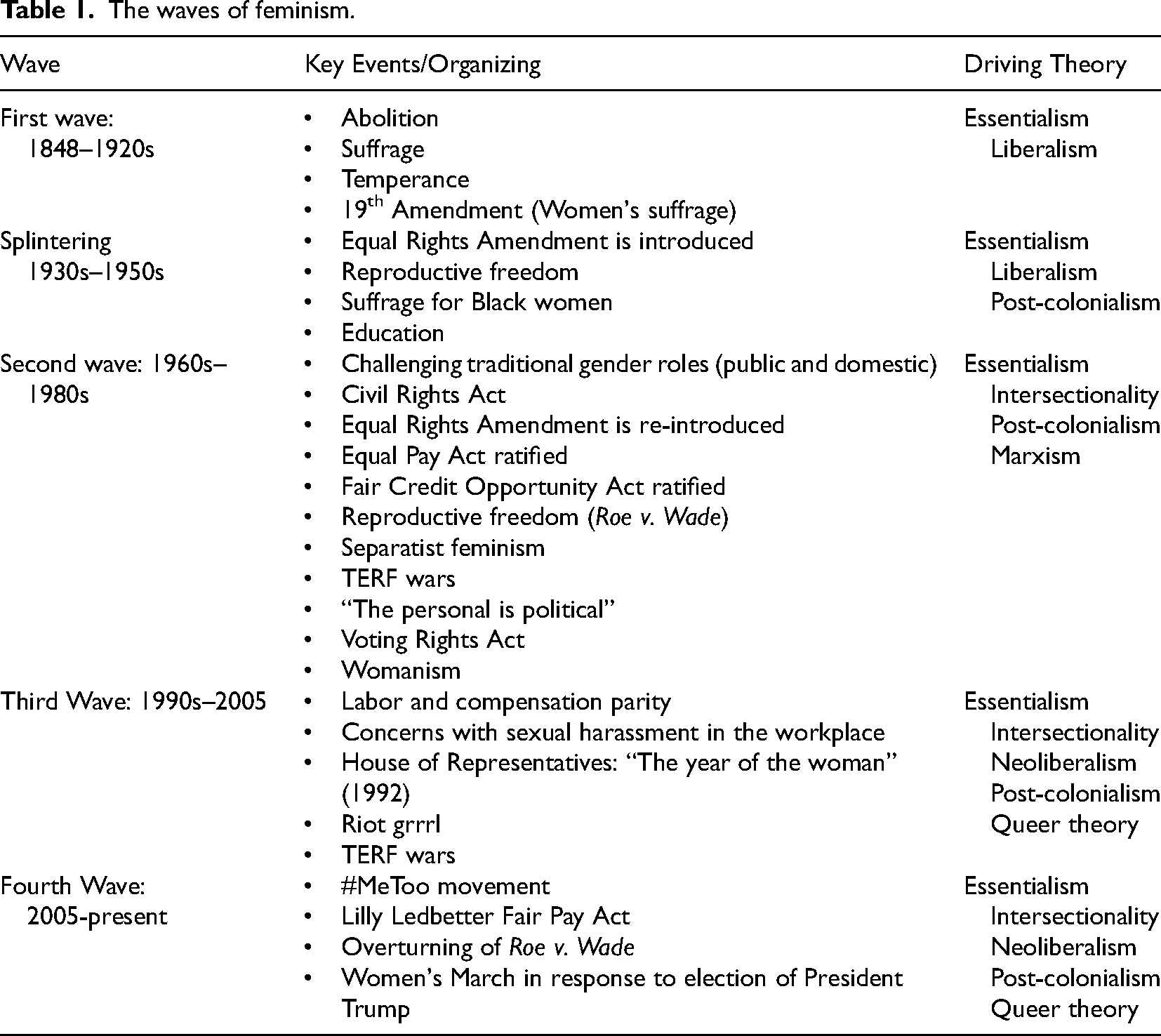
Third wave feminism coincided with the rise of internet access across the United States in the 1990s. The traction of online publishing and blogging enabled non-academic experts to reach increasingly broad audiences. In some ways, this briefly robust period of feminist publishing on sites like Feministing (Valenti, 2004) and the Hairpin (Zimmerman, 2016) (both now defunct) might be thought of as a Millennial corollary to the feminist zines of the previous generation. Across the West, there was hope that the internet would democratize the production and distribution of knowledge (König, 2013). Within the sphere of feminist publication, the internet offered a promise of national and global audiences for feminist discourse. Unlike zines, however, these sites required an increasing cash flow to sustain the demand for seemingly endless content. As was the case in other corners of the internet (König, 2013), the ideal of democratization in the feminist blogosphere was never realized due a combination of pressures, a detailed exploration of which is beyond the scope of this paper. Ultimately, independent feminist blogging gave way to social media with the start of the #MeToo movement (I will discuss this in greater detail in the sections that follow). It is perhaps unsurprising in this current moment in which even the largest newspapers struggle to remain afloat that these feminist sites were largely shuttered by the end of 2019. While a full exploration of the machinations of this media evolution is beyond the scope of this article, it is important to note that these more long-form, professionalized publications were quickly replaced by the more individualized voices of social media influencers. Though this phenomenon was not unique to feminism, it affected feminism and feminist organizing in particular ways and represented another shift away from collectivism toward individualism, reinforcing existing hierarchical, settler colonial power structures (Archer, 2019; Keller, 2019; Thorpe et al., 2017; Toffoletti & Thorpe, 2018).
I see this shift as marking the approximate start of what I refer to as fourth wave neoliberal feminism. The influence of neoliberalism, defined as “a theory of political economic practices that proposes that human well-being can best be advanced by liberating individual entrepreneurial freedoms and skills within an institutional framework characterized by strong private property rights, free markets, and free trade” (Harvey, 2005, p. 2), has spread from the 1970s to the present day (Harvey, 2005) and has reinforced the goals of liberal (as opposed to liberatory) feminism. Where liberal feminism aimed to broadly advance individual liberties within a rights framework, neoliberal feminism, a term coined by Catherine Rottenberg (2014), has arguably sought the same ends more narrowly via the channels of private capital and the marketplace. Abramovitz and Zelnick (2021) have highlighted the influence of this neoliberal turn on social work praxis, which they argue is evident in the privatization of public welfare and the increasing operationalization of managerialism within social service delivery. I see the replacement of collectivist zines and blogs with individual influencers via social media accounts as further evidence of this neoliberal influence on mainstream feminism.
Within academia, scholars of critical race theory, post-colonial studies, and queer theory have provided new language and critical frameworks with which to understand this neoliberal feminism (Rottenberg, 2014). This crucial work has enabled critical scholars to begin to articulate and account for the many ways in which power has affected particular groups with a new shared—though often contested—language. This language and theorizing—from Crenshaw's “intersectionality” (1989) to Spivak's “strategic essentialism” (1985/1996), from Hartsock's “feminist standpoint” (2017) to Butler's “gender performativity” (1990/2007) among many, many others—has increasingly informed social work praxis, as is probably best exemplified by the founding of Afilia: Feminist Inquiry in Social Work (formerly known as Afilia: Journal of Women and Social Work) in 1986. Forums such as this and a growing number of interdisciplinary projects and panels within academia have provided space for an ongoing, contentious discourse that has repeatedly raised questions regarding power, identity, language, and organizing tactics. As a Millennial, I have only lived within this moment, a moment that is further characterized by a particular kind of tension within modernist identity politics. I am certain that I have very particular blind spots related to this limited frame and standpoint, which is why I identify my position here (Hartsock, 1983/2017). From this position, I am also certain that the position of women in the United States during this fourth wave of feminism remains entrapped within settler colonial power structures. Here are a few things that have happened on the national stage within the past month (from the time of writing) that inform this knowledge: 1. a jury awarded a famous actor $15 million in a lawsuit in which he claimed he was defamed by his ex-wife because she referred to herself as a survivor of domestic abuse, despite the fact that another judge had found that the actor had indeed abused his now ex-wife (New York Times, 2022); 2. the Fédération International de Natation (FINA) effectively banned all transwomen from international competitive swimming (2022); 3. the United States Supreme Court handed down a decision (Dobbs v. Jackson Women's Health Organization, 2022) overruling Roe v. Wade (1973) and Planned Parenthood v. Casey (1992), revoking a woman's constitutional right to an abortion and effectively outlawing the practice in roughly half of the country.
While post-modernists have no doubt labored and continue to labor to interrogate, to deconstruct, and to articulate the precise machinations that laid the ground for these events to transpire, modernist neoliberal feminists alternately decry and celebrate these events, depending on their particular self-interest. What, then, are the goals of social work praxis? Do we have an obligation to support the autonomy of the individual when it is at odds with the goals of equity and justice? In the sections that follow, I will attempt to answer these questions by using the tools of critical theory and deconstruction to understand the TERF wars of third and fourth wave feminism and the #MeToo movement that I see as ushering in what I will refer to throughout this paper as fourth wave feminism, a wave characterized by continued tension between modernist and post-modernist framings of power in the neoliberal landscape of late capitalism.
Trans-Exclusionary Radical Feminism: Who is a Woman?
The trans-exclusionary radical feminism (TERF) wars are typically traced back to the publication of The Transsexual Empire by Janice Raymond in 1979. In this scathing publication, Raymond grounds an essentially transphobic argument on a naturalized or essentialist conception of gender in which womanhood and femininity are construed as being the inevitable gender of all people identified as female at birth. While this framing is fundamentally in line with broader essentialist discourse, what Raymond claims makes her feminism radical is a rejection of all identities that we might now refer to as transgender, gender creative, or gender non-conforming. In effect, this framing creates a new modernist hierarchy of oppression in which women who are identified as female at birth are oppressed (she goes so far as to invoke rape) not only by cis men but by also by trans women who, “merely cut off the most obvious means of invading women so that they seem noninvasive” (p. 104).
This publication followed a period of increasing visibility and acceptance by the medicolegal community in the United States throughout the 1960s and 1970s (Meyerowitz, 2002) and might be understood as a conservative backlash dressed up in the language of separatist feminism. What has come to be known as trans-exclusionary radical feminism might also be framed as gender essentialist feminism with a pointedly transphobic thrust that frames the very existence of trans* people in general and transwomen in particular, as inherently violent against cis women. The resurgence of this TERF identification more recently might likewise be understood as partially due to a backlash against the increasing visibility and acceptance of trans* people in media and politics that echoes other historical backlashes (Faludi, 1991; Herdt, 2009). Further, the self-identification of TERF amongst more visible celebrities, such as author J.K. Rowling and comedian Dave Chapelle, might be seen as an extension of consumer feminism in that the act of identifying oneself with such a contentious moniker serves to increase media attention. While an in-depth exploration of the effectiveness of boycotts in the digital media age is beyond the scope of this article, arguably, in the current media environment boycotts may be less effective as attention itself has been monetized. As a result, though these celebrities have faced calls to boycott their works and the platforms that support them, these boycotts have not succeeded in de-platforming—let alone de-funding—either of them.
I first read The Transsexual Empire (Raymond, 1979) and Sandy Stone's 1987 response “The Empire strikes back: A posttransexual manifesto” as a graduate student well over two decades after the publication of the latter. I recall a rather aligned discourse in the classroom that framed Raymond as transphobic and that seemed to be that. Who was a woman? In the social-constructionist tenor of the debate, anyone who self-identified as such. Why should identity be anyone else's business unless the identity holder decided to share? This shifted when someone brought up the more contemporary debate around the South African runner Caster Semenya. Essentially, the room agreed that she was socially a woman, but there was not a clear consensus on whether or not she was biologically “qualified” to compete within the category of women's track.
I admit that the shift in framing from social to biological alone did not move me, but the relation to sport and advantage did. In that instance, I recalled a moment in high school in which a coach asked if we might consider taking performance-enhancing steroids in order to win at all costs. This question was clearly rhetorical and followed by a tirade against cheating. There was no room for debate, and I had apparently internalized this message. Reflecting outside of that immediate moment, I was eventually able to realize that this shift in the conversation in my graduate class was misguided in its conflation of gender and sex. Women's sports are just that—sports for women, not sports for biologic females, which is in and of itself an ambiguous category as demonstrated by the various intersex conditions, within which Semenya is classed (Pastor, 2019) and which was imprecisely conflated with trans* identities in this instance. Further, I recognized that the conversation around cheating in sports served as a particular kind of messaging aimed toward working class people—people for whom sports can represent a mythology of American meritocracy (a promise to transcend poverty, a ticket out of the neighborhood, to college, wealth, fame, etc.—another message that I had apparently internalized)—intended to obscure systemic inequity by aiming the focus of the disaffected working class onto a new cultural bogeyman. By focusing on so-called “sex verification tests” and “unfair advantages” (Pastor, 2019), the sloppy conflation of sex with is obscured by fear and moral panic, a tried-and-true tactic of the political right (Herdt, 2009; Lakoff, 2004).
That the right has trotted out intersex and trans* 1 people as a bogeyman to distract from a deep and increasing wealth divide while willfully ignoring the prevalence of cheating via doping and match-fixing—among other things—that earns these same wealthy individuals (from club owners to league presidents) untold sums should come as no surprise. Boogeymen have long been deployed by anti-public spending and xenophobic interests to continuously erode the social safety net. Thanks to critical deconstruction within social work discourse, this ploy should seem familiar, especially when situated alongside the “uncivilized immigrant” that justified forced labor and abuse in almshouses, the “harlot” that justified the exclusion of single mothers from mothers’ pensions, and the “welfare queen” used to further dismantle the already threadbare social safety net, all of whom exist among so many other strategic boogeymen. While deconstruction has enabled social workers to understand how flimsy these tropes are in terms of being tethered to any semblance of reality and while being simultaneously immensely powerful in terms of political impact, social work as a field has been slow to advocate explicitly for the rights of trans*, intersex, and nonbinary people.
It was not until 2005 that the National Association of Social Workers (NASW) explicitly included trans* people in the name of the working group now called the National Committee on Lesbian, Gay, Bisexual, and Transgender Issues. While I am not asserting that a rights-based framework is the best tactic that social workers might pursue in the interest of promoting equity and justice for trans* people, I am highlighting how this absence within the NASW, which has largely advocated for the rights and empowerment of individuals signals complicity with a transphobic status quo. In other words, the fact that the National Committee on Lesbian, Gay and Bisexual Issues existed (in line with a modernist identity politics) without either the inclusion of “transgender issues” within it or an additional committee identified as such implies a particular kind of indifference to the position of trans* people.
Ultimately, the platform of trans-exclusionary radical feminism reinforces two oversimplified and so inevitably false narratives. The first presumption is that trans* people are committing some kind of gender fraud, and the second is that transwomen's existence is an act of violence against cisgender women (Raymond, 1979). The framing of “violence against women,” much like individual rights frameworks, has become so naturalized in broader discourse that the dichotomous victim-perpetrator model is rarely examined in social work praxis. The adoption of this framing by TERFs likely accounts for their longevity, as they have attempted to justify the demonization and exclusion of trans women by equating them with perpetrators of sexual violence. Again, this creation of a bogeyman or cultural pariah is not unique to TERFs, but it is unique in the ways that it deploys gender essentialism to pervert the separatist framing of “violence against women” as applying to certain kinds of women by equating them with cisgender men.
#MeToo: Who is a Victim?
In 2005, after years of personal reflection and grassroots organizing within prominent Black political organizations, Tarana Burke began organizing women affected by sexual abuse and sexual assault in a project that she dubbed “me too” (Burke, 2021). Over a decade later, in 2017 actor Alyssa Milano first tweeted #MeToo, encouraging others to tweet their own stories of sexual violence with the hashtag “me too”. After this hashtag went viral, Burke and Milano were elevated together when Time magazine anointed what they dubbed “The Silence Breakers” as “Person of the Year” (Zacharek et al., 2017). As discussed previously, the internet, feminist blogging, and eventually social media forever changed feminist organizing, and the viral spread of #MeToo on social media was emblematic of this shift. Within the first week of Milano's post, the hashtag had been tweeted over 1.5 million times with an estimated 6–34 million users seeing first-person disclosures from someone within their network (Modrek & Chakalov, 2019).
This virality preceded and doubtless impacted the firing and eventual prosecution of Milano's intended target, film producer Harvey Weinstein, as well as several prominent powerful men, particularly within media and entertainment. These impacts, however, were largely stratified along the lines of class and race (Berg, 2020). Analyses of Twitter data show that most of the early virality of #MeToo was among White cisgender women, and the more visible takedowns of powerful men were related to workplace violence and harassment (Berg, 2020; Gill & Orgad, 2018; Palmer et al., 2020; Pellegrini, 2018). In this way, the discourse regarding power within the #MeToo movement narrowed significantly from Burke's original iteration, which she addressed in an interview: No matter how much I keep talking about power and privilege, they keep bringing it back to individuals. . . It defeats the purpose to not have those folks centered—I’m talking black and brown girls, queer folks. There's no conversation in this whole thing about transgender folks and sexual violence. There's no conversation in this about people with disabilities and sexual violence. We need to talk about Native Americans, who have the highest rate of sexual violence in this country. (Adetiba & Burke, 2017/2018, pp. 20–21)
It is clear that Burke's advocacy for a focus on the margins aims to broaden the scope of #MeToo organizing in ways that address how power and oppression are exerted through the dimensions of race, class, gender, sexual identity, and ability. As Berg (2020) compellingly argues, the focus within the #MeToo movement on the harm caused to wealthy White women is consistent with mainstream liberal feminism that seeks only to advance the individual interests of bourgeoise feminists and is wholly uninterested in dismantling systems of oppression. This is made clear by the narrow legal remedies that bourgeoise feminists seek, actions which ultimately contribute to the reinforcement of these very systems of oppression and domination. Even in instances where in which feminist and minoritized plaintiffs are awarded and/or case law is progressively influenced, the punitive goals of incarceration and monetary retribution and the incrementalism of case law serve only to obscure the very power structures that perpetuate inequity and harm, and so ultimately serve as maintenance of the status quo and are wholly incompatible with liberation (Menke, 2020; Spade, 2011).
The recent civil suit between actors Amber Heard and Johnny Depp is reflective of these limitations and raises several important questions for the #MeToo movement as well as for social workers concerned with agency and surveillance, among other things. A very brief summary of the events that preceded the publicly aired trial is that Mr. Depp sued Ms. Heard for defamation after she referred to herself as “a public figure representing domestic abuse” in a 2018 opinion piece in the Washington Post. Though Ms. Heard did not name Depp in her article and courts in both the United States and the United Kingdom had previously found that Mr. Depp had, in fact, abused his then-wife Amber Heard (as evidenced by the restraining order granted to Ms. Heard in the United States and the libel lawsuit Mr. Depp lost to a tabloid in the United Kingdom, as the courts found that the tabloid's accounting of him as having assaulted Ms. Heard was accurate), Mr. Depp nonetheless filed suit accusing Ms. Heard of defamation that he claimed caused him to lose several jobs. Over the course of a six-week, televised and livestreamed trial, Mr. Depp's attorneys—Camile Vasquez chief among them—successfully portrayed Ms. Heard as an unsympathetic victim, leading to further public humiliation and a $15 million settlement for Mr. Depp.
The Depp Heard lawsuit is instructive in three ways. First, it lays bare the limitations of the modernist victim-perpetrator model of crime and punishment. Second, it makes clear the dangers of inviting surveillance and regulation into the private sphere. Third, it demonstrates the limitations of a misappropriated version of intersectionality that pervades popular discourse. While the unalienable rights to “life, liberty and the pursuit of happiness” cited in the United States Declaration of Independence are often held up as core American rights, it is, in fact the negative rights enshrined within the United States Constitution (most poignantly within the Bill of Rights) that ground the American legal system and the remedies to injustice available to American citizens. These much more narrowly construed negative rights sought to prevent the infringement of government on what the founders framed as the natural rights of land-owning White men; a legacy that remains largely intact. In the absence of a positive guarantee to life, liberty, and the pursuit of happiness for all people, the onus has historically been and continues to be on those falling outside of the category of White, wealthy, cisgender, heterosexual man to prove that they are worthy victims by making themselves legible within these dominant power structures by way of incremental, single issue politics (Spade, 2011). Again, this worthiness should seem familiar to social workers aware of the history of distinguishing the deserving from the undeserving poor. That Ms. Heard failed to qualify as a worthy victim—even despite her immense privilege as a famous, wealthy, White woman—should then come as little surprise. Confronted with the immense resources—financial and social—of Mr. Depp, Ms. Heard was outmatched from the outset. Beyond this limitation in terms of firepower, it is important to examine the ways in which this narrow path to justice impacts not just Ms. Heard, but the many voices within the #MeToo movement.
In order to be conveyed as a “worthy victim”, one is expected to provide ample proof. Just what constitutes ample proof is incredibly opaque and forces the one who has been violated to first publicly declare that they are a victim. While a full exploration of the role and impact of mainstream media in and on this process is beyond the scope of this paper, the examples of both Burke and Milano and Heard and Depp demonstrate how this public process invites public scrutiny and surveillance into the life of the violated, who must lay prostrate for examination, ultimately reinforcing existing power dynamics. The messiness of a normal life is then put on trial, held up for inspection and weighed against impossible ideals fabricated by those with the most power. From Anita Hill and Clarence Thomas to Christine Blasey Ford and Brett Kavanaugh, to Amber Heard and Johnny Depp, though the details differ the outcome is always the same: the violated remains violated, becomes a public victim and then a victim of the public. Meanwhile, the violator is granted the great latitude of privacy and perversely transformed into the victim of the violated.
Finally, the public vilification and humiliation of Ms. Heard (as with Ms. Hill and Ms. Blasey Ford) throughout the trial might be understood as having arisen in part from an identity politics that deploys an appropriation and misrepresentation of intersectionality. The fact that the language of “intersection” centered in Crenshaw's definition of “intersectionality” (1989) has not been able to prevent the distortion of this term into an additive, adversarial frame speaks to the strength of the prevailing discourse regarding equity and justice that focuses on the position of the individual in ways that obscure power stratifications. This contradictory rendering of “intersectionality”—one that I hear repeated all too often amongst social workers—essentially amounts to a calculus of the marginalized and privileged statuses of an individual. This calculus inevitably pits the marginalized against the marginalized in a sort of race to the bottom of a hierarchy of oppressions. Rather than understanding the intersection between gender, race, and class in which Ms. Heard exists relative to Mr. Depp, as Crenshaw instructs, she was overwhelmingly construed by Mr. Depp's legal counsel and the public writ large as a rich, spoiled, White woman. The choice to have Mr. Depp's counsel lead by a Latina woman, then, can be seen as a blatantly strategic move within this model of perverted, competitive “intersectionality.”
This trial makes clear how the victim-perpetrator model and its legal remedies to violation, violence, and injustice serve only to further subvert and oppress those in positions of less power. Further, it demonstrates how the spectacle of these trials reinforces a façade of legitimacy and saps untold resources at the expense, not just of the woman on trial, but of all who might be helped by the diversion of these expenses toward the concrete needs of the poor. As social workers concerned with justice, we must ask not just if victims are worthy of care, but how the creation of the victim is in itself an uncaring and disempowering act that is always inflicted by tools of domination and oppression.
Discussion: Who is Worthy of Care?
As social workers often laboring within interlocking systems of oppression and domination, we are repeatedly forced to ask who is worthy of care? This is especially true in the age of neoliberalism, which has been characterized by managed care and a disappearing social safety net. Just as social programs themselves are forced to prove their worthiness of funding, a case manager might close the case of a client they cannot locate, a clinician might discharge a client who no longer “meets criteria” for services. More concretely, a transwoman might be excluded from services on account of her gender, or someone impacted by sexual violence might be excluded (or, perhaps worse, compelled to submit to services or treatment) from services on account of any number of things, such as a prior legal history that is deemed enough to exclude her from the category of victim. Though we might at times find solace in clearly defined parameters of “qualification” in the face of overwork, we must recognize that we are both overworked and tasked with sorting people into deserving and undeserving classes as a result of a prevailing system of settler colonialism (Fortier & Wong, 2019; Stanley, 2020).
Just as the decoupling of abolition from suffrage in first wave feminism represented the beginning of liberal feminism's abandonment of a class-conscious struggle, so too did the professionalization of social work within the neoliberal era represent the beginning of social work's abandonment of these same liberatory goals. Thus, neoliberal feminism has become an immobilized identity label that rests on ideals of personal choice (often expressed in some form of purchasing power) and is divorced from organizing and activism (Rottenberg, 2014). If social work praxis and social work education become similarly consumed by neoliberal goals—such as a preoccupation with sorting the deserving from the undeserving in practice or a focus solely on skill-building at the expense of critical inquiry in education—the aims of social justice and equity might as well be removed from our ethical code. And so precisely when we are faced with burnout and shrinking budgets, we must be careful not to throw our hands up and say that there is nothing that deconstruction can help us do. This end is the precise goal of neoliberalism: to promote ideals of individual exceptionalism and personal responsibility in ways that obscure the power structures within which we are entrenched in order to encourage an unthinking majority to refrain from organizing, agitating, and advocating for justice and equity. Instead, we must be diligent in our work to incorporate critical theorizing and organizing into curricula, perhaps most especially when there are sighs from students who have deeply internalized the notion of strength and liberty only ever being individualized, as opposed to a collective liberation.
As the TERF wars and the #MeToo movement demonstrate, there are clear limitations to essentialist, identity-based organizing. In the TERF wars, cisgender women are pitted against transwomen and in the #MeToo movement victims are pitted against perpetrators. Both of these narrow framings detract from an emancipatory struggle by reifying the very power structures of neoliberalism. Rather than argue over which power structure—patriarchy, racism, heterosexism, classism, etc.—is the most oppressive, or whose position is the most marginalized, perhaps we might organize around shared values of liberation and anti-oppressive praxis. To continue to hierarchize hierarchies is to remain entrapped within a neoliberal, settler colonial project. To add and subtract oppressions and advantages to calculate individualized righteousness is to continue to perpetuate oppression. I believe that this is what Lorde (1979/2007) meant when she famously asserted: For the master's tools will never dismantle the master's house. They may allow us temporarily to beat him at his own game, but they will never enable us to bring about genuine change. And this fact is only threatening to those women who still define the master's house as their only source of support. . . . The failure of academic feminists to recognize difference as a crucial strength is a failure to reach beyond the first patriarchal lesson. In our world, divide and conquer must become define and empower. (p. 112)
While academic feminists have since done well to define diverse feminist standpoints—a task that largely remains within the academy—the act or acts of collective empowerment have largely been offset by the neoliberal goals of individual empowerment.
As critical feminist social workers, we must be careful not to be complicit in the creation of new deserving and undeserving classes. Likewise, we must take care not to become further entrenched within a surveillance state that polices women in very particular kinds of ways, especially with regard to violence, gender expression, and abortion care. Heeding the instruction of bell hooks (1984), we must rightfully recognize the distinction between deserving and undeserving classes as the legacy of the bourgeoise feminism that has since become liberal feminism. Further, we must recognize that the calls to “protect” within this framework are, in fact, calls to police, to regulate, to punish, and to incarcerate. Perhaps this contemporary (neo)liberal feminism might be countered by a new wave of social activism. As many Black, queer, and lesbian feminists have long contended, a values-oriented organizing might enable coalition building across diverse and sometimes divergent interests toward a unifying goal of liberation (Anzaldúa, 1987/2007; Cohen, 2005; Kemp & Brandwein, 2010; Lorde, 1979/2007; Vaid, 2012).
Conclusion: Deconstructing to Build
The essentialist framing that conflates sex with gender and attempts to delineate the categories of woman, victim, and deserving poor predates contemporary discourse in such a way that this framing has in some ways itself become naturalized, even within deconstructionist discourse and language. It is crucial then to recognize and clearly state that deconstruction is not the same as destruction or anti-construction, both of which are suggestive of a newly dogmatic opposite. Rather, deconstruction is a commitment to dismantling naturalized hegemonic power structures writ large in order to rebuild anew. The threat of destruction has long been used to frenzy populations into fascism, and so academics must take special care to make clear the goals of deconstruction. This is no small task, especially when compounded by the apparent fragility of democracy in this era of proliferating conspiracy theories and so-called “alternative facts” masquerading as free speech. Overwhelmed by the chaos spurred by fake news, rampant gun violence, climate change, democratic backsliding, and political polarization (among other things), there seems to be a great panic that the middle ground is disappearing. Rather than retreat inward to a place of demobilization or mobilize outward in an attempt to find a no-less black-and-white but wholly apolitical “perfect victim” around whom to organize, we might celebrate the disappearance of the middle as the end of an always untenable neoliberalism.
With this, we might envision a truly radical critical feminism that is not separatist, but rather unifying with the transformative goal of dismantling the vestiges of liberal and neoliberal feminism (Rottenberg, 2014) in the interest of building toward liberation for all people. Feminists aligned with anti-capitalist movements (Arruzza et al., 2019; Aruzza, 2013; Combahee River Collective, 1981/1983; Davis, 1981; de Beauvoir, 1949/1956; Hill Collins, 2000, hooks, 1984; Vaid, 2012) have long voiced these aims, while White liberal feminists have too often abandoned these values over time. If, as feminists, as social workers, as human beings concerned with social justice, we continue to ignore the fact that the neoliberal project has been forged and reinforced with the master's tools, liberation will prove impossible. How might we reject the status of victim, not in favor of survivor or a performative solidarity with a survivor class? Likewise, how might we reject rigid gender categories, in light of the fact that they are a means of regulation embedded deeply within settler colonialism? In order to sidestep this whole oppressive paradigm, how might we create new language and new tools of mutual support and transformation? How might we ensure that, in the words of Cathy Cohen, “the process of movement building be rooted not in our shared history or identity but in our shared and marginal relationship to dominant power that normalizes, legitimizes, and privileges” (2005, p. 43). It is vital that we be diligent in our efforts to educate and learn, recognizing that these are the tools of empowerment that enable us to deconstruct not to destroy, but to reveal the workings of interconnected systems of power so that we might rebuild a house for diverse, resilient coalitions, a house for universal liberation.
Footnotes
Declaration of Conflicting Interests
The author(s) declared no potential conflicts of interest with respect to the research, authorship, and/or publication of this article.
Funding
The author(s) received no financial support for the research, authorship, and/or publication of this article.
