




Abstract
This article updates a previous content analysis of abstracts published in 17 social work journals from 1988 to 1997, which responded to the search words women and social work. Comparisons include the number of articles per journal, women’s social identities, themes and curricular areas, authors' analytical methods, and the amount and degree of feminist content. The findings revealed a decrease in both women’s and feminist content. Mothers/caregivers, medical/mental health patients, and battered women continued to be the most frequent referents. Health, mental health, and violence prevailed in themes, casework/human behavior and the social environment and social policy dominated curricular areas, and empirical articles topped the analytic category.
The literature is replete with documented compatibilities and partnerships between social work and feminism (Bricker-Jenkins & Hooyman, 1986; Collins, 1986; Nes & Iadicola, 1989; Swigonski, 1994; Valentich, 1986; Wetzel, 1986). Gross (2000, p. 8) noted that like other helping professions, the ideals of feminist social work “are rooted in the same foundation of shared responsibility for social change and development, democratically defined decision-making processes, and the substitution of flattened hierarchies for pyramidal relationships.” Gordon (1986, p. 75) documented the “thick and complex history of feminist involvement in … moral reform [anti-prostitution] and anti-alcohol movements, in Progressive Era campaigns to reform the living and spending habits of the poor, in campaigns for industrial protective legislation and affirmative action.”
Despite a sturdy history of feminist–social work collaboration, areas of contention persist (Grise-Owens, 2002). It has been argued that social work has historically resisted and marginalized feminism, consequently perpetuating individualistic explanations and responses to women’s needs and problems (Hudson, 1985), seemingly more comfortable with notions of individual empowerment than of social and economic empowerment (Chandler & Jones, 2003). In addition, feminist theory has been criticized for not always being clearly understood, begging a more complex and complete understanding (McPhail, 2008). Although social work and feminism are both concerned with social relations as well as social change, gender is often omitted in social policy analysis and history (Gordon, 1990; Netting & Rodwell, 1998; Nichols-Casebolt, 1998; Weil, Gamble, & Williams, 1998).
Many approaches have been debated to address the omission of gender in the social work curriculum and to strengthen the relationship between feminism and social work. Many educators have promoted the infusion of feminist content into the social work curriculum (e.g., Bartlett, Tebb, & Chadha, 1995; Dore, 1994; Raske & Evens, 2000), while others have argued against the “add and stir” approach (e.g., Grise-Owens, 2002). Another approach includes applying feminist principles to leadership development in social work (Lazzari, Colarossi, & Collins, 2009). Since 1969, the Council on the Role and Status of Women of the Council on Social Work Education [CSWE] has continually monitored women’s status as faculty members and students, the proportion of women serving in leadership positions in CSWE, the presence and nature of women’s content in the educational curriculum, and the manner in which women are represented in the social work literature (Alvarez, Collins, Graber, & Lazarri, 2008).
Although the social work journal literature provides a formidable channel for voicing women’s issues and advocating for their attention, it has historically been criticized for containing “only limited space for articles on so-called women’s issues” (Saunders, 1986, p. 3) and making references that perpetuate stereotypical assumptions about women’s roles (Statham, 1978; Wilson, 1977, 1980). Early studies that examined the coverage of women’s issues in social work journals found that no more than 14 of all the articles published in any one year focused on women’s issues, with women primarily depicted in traditional roles (Abramovitz, 1978; Deanow, 1986) or as clients (Nichols-Casebolt, Krysik, & Hamilton, 1994; Quam & Austin, 1984). Topics were addressed as gender neutral even when they primarily affected women (Nichols-Casebolt et al., 1994); women were disproportionately referred to as mothers, victims, patients, and research participants (Barretti, 2001); and gender or a feminist perspective was rarely used as a framework for analysis (Barretti, 2001; Deanow, 1986; Nichols-Casebolt et al., 1994). Rose and Hanssen (2006, cited in McPhail, 2008) found that between 1977 and 1986, no social work teaching journals used the term feminism or feminist in the titles or abstracts, and between 1987 and 2005, only 15 articles used the term feminist, and 4 used the term feminism. Inattention to gender and subtle and systemic sexist language have been analyzed in the Journal of Social Work Education (Grise-Owens, 2002), a journal that has consistently lagged behind other journals in its publication of women’s content (Barretti, 2001; Nichols-Casebolt et al., 1994; Quam & Austin, 1984).
The findings presented above paint a problematic picture for social work students, practitioners, and academic researchers who turn to the journal literature to conduct research on women, especially when the articles and the language used within them imply a marginal status for women’s issues and a tenuous relationship with feminism. This article reports on an analysis that aimed to determine what the journal literature has communicated as a whole and over time to students, practitioners, and academics who search for the most prevalent themes, social roles, and curricular areas that affect women in social work. Despite its documented limitations (e.g., Shek, 2008; Taylor, Dempster, & Donnelly, 2003), many universities and academics maintain access and allegiance to the Social Work Abstracts Database [SWAB] (Flatley, Lilla, & Widner, 2007), “the oldest and most easily recognized abstracting service for social workers” (p. 47), to conduct this research. This electronic database, dedicated solely to social work journals, is produced and funded by the National Association of Social Workers and provides coverage of more than 500 social work journals from 1977 to the present (NASW Press, 2011). SWAB is also recommended over the Social Services Abstracts Database [SSA] when the research preference calls for domestic rather than international journals (Flatley et al., 2007).
The purpose of this study was to characterize the articles on women and social work from 17 social work journals that were abstracted in SWAB from 1998 to 2007, report the findings, and compare them to the findings from a content analysis conducted in the previous 10-year period [1988-1997] (Barretti, 2001), using the following seven questions to guide both analyses: How many articles on women did each social work journal contain? In which journals was content on women’s most likely to appear? What social identities or roles were most frequently used to depict women? Which themes pertaining to women captured the most attention? Which social work curricular areas were most frequently mentioned? Which analytical methods were used by the authors? To what extent was the article feminist or reflected a variation of feminism?
Three additional questions were also addressed in the updated study: Were women used as research participants in the articles that were coded as empirical? Did the abstract of the article specifically state that it included women of color? Did the author use a human rights perspective or use human rights language?
Method
Since the updated study was a replication, I repeated the methodology exactly as it was used in the original study (see Barretti, 2001). Since several studies in social work demonstrated the successful use of abstracts as a database in content analysis (e.g., Deanow, 1986; Schofield & Amodeo, 1999; Zimbalist, 1978), this method was used for classifying and characterizing abstracts that responded to the words women and social work in SWAB for the two equal 10-year periods; 1988–1997 and 1998–2007 (Barretti, 2001). I used previously established and pretested categories and codes that corresponded to the research questions and then “interviewed” each qualifying abstract for this information. Some additional subthemes were added as they emerged inductively from the language in the later cohort of abstracts. Hence, the coding instrument was pretested again with another four coders who were all social work academics and practitioners. On the basis of the results of the pretest, I collapsed the subthemes into previously established categories and renamed others until at least 80% agreement was reached. I tabulated frequencies and percentages for each category in SPSS for the updated study and then compared the data for the two periods.
While designing the original study and experimenting with various search words and phrases, I found that the words women and social work cast the widest net to find the most articles on or about women, including those that contained feminist content. All codes for all categories, including the articles' degree of feminism, were determined by the manifest language in the title or abstract. Manifest coding is considered to be highly reliable and reduces possible ambiguities in meaning (Neuman, 2000) and is particularly useful for a nuanced phenomenon, like feminism, when the concept under investigation is open to wide interpretation. McPhail (2008) wrote of the difficulty of pinning down a definition of feminism, citing Hirshman’s (2006, p. 18) critique of “choice feminism,” which she used to refer to a diluted form of feminism in which “anything counts as feminism as long as a woman chooses it” (McPhail, 2008, p. 35). Because of the many documented “misuses and misunderstandings of feminism” that McPhail (2008, p. 36) cited, I did not assume to predict or interpret the authors' intentions or the feminist orientation underlying the articles, since what the authors considered feminist is only subjectively valid. Thus, no predetermined definition of feminism was used to guide the study. Abstracts were classified as “self-identifiably feminist” when the title or abstract specifically included the word feminist. Abstracts were classified as “somewhat feminist” when the abstracts did not include the word feminist but used such terms as “patriarchy, gender oppression, gender justice, gender inequities, women’s rights, sexism, regulation of women’s behavior, or gender biases” (Barretti, 2001, p. 285). All other articles that were about women but lacked a gender-lens perspective were classified as “not feminist.”
Limitations
No computation was made in either study to calculate a journal’s rate of publication of women’s content relative to the overall number of articles published by that journal in each year. It should also be noted that SWAB, as an electronic database, has been criticized for its bias in favor of abstracting articles from NASW journals and thus may not serve as a reliable indicator of the content of all published social work journals (Holden, Barker, Covert-Vail, Rosenberg, & Cohen, 2008) or of all articles about women. However, it was not the intent of the study to investigate SWAB’s reliability but rather to report what is available and found in SWAB when it is used by social work students and academics who are conducting research on women and social work in 17 domestic journals.
However, I did attempt to correct for some of SWAB’s limitations that emerged spontaneously during the updated search. First, my original study (Barretti, 2001), published in Affilia, was not indexed, although it clearly contained the search words women and social work in the title. Second, none of the articles that was published in Affilia in 2002 was indexed in SWAB. When I checked this omission against Affilia’s website and the SSA, I found 16 qualifying abstracts. I added 10 of the abstracts to the sample because they contained the search words women and social work in the abstract. The other six abstracts were related to social work, although not discipline specific, and many were feminist, but because they did not include the term social work anywhere in the abstract, I did not include them in the sample to maintain consistency with the search criteria. To control further for the questionable reliability of the SWAB database, I then randomly selected two other years [2001 and 2007] and cross-checked them with Affilia’s website and the SSA. The tallies between the two databases were equal with SWAB’s for both years. As with 2002, there were several feminist articles relevant to, but not written specifically for, social work, and because they did not include the term social work anywhere in their abstracts, they were not included in the sample.
Also, it is important to note that when the data for the first study [1988-1997] were published (Barretti, 2001), all the abstracts for 1997 were not yet indexed in SWAB and thus not reported in the article. The plus sign after 1988–1997 in the tables and narrative include the additional 50 abstracts that were added to all the 1988–1997 data and to all the analyses in all content areas for this comparison study.
Findings
The findings presented in this section are organized according to the research questions, with Questions 8–10 asked only in the 1998–2007 study.
Questions 1 and 2
Table 1 indicates the number of articles published in 17 social work journals from 1988 to1997 and from 1998 to 2007, which included the search words women and social work. The final column indicates the change in the publication of women’s content in each journal. The last row indicates the total change in the number and percentage of women’s content between the two periods. From 1988 to 1997, 617 articles were published that contained women’s content, and from 1998 to 2007, 505 such articles were published. Overall, the data indicate a reduction of 112 articles (−18.15%) containing women’s content in the 17 social work journals between the two periods. As in the earlier study, during the 1998–2007 period, Affilia continued to contribute the most articles (190, or 37.62%), followed by Social Work in Health Care (51, or 10.10%). The remaining 15 journals together contributed only a little over a half of all articles containing women's content (n=164 or 52.28%). Note that the addition of the 1997(+) adjunct articles raised the overall number and percentage of feminist articles published by Affilia for the 1988–1997 period by 20, or 18%, increasing the total number to 102, or 59% overall, when compared to the data (92, or 41%) reported in the earlier study (Barretti, 2001).
Change in the Number of Articles Containing Women’s Content, by Journal, Between 1988–1997+ and 1998–2007
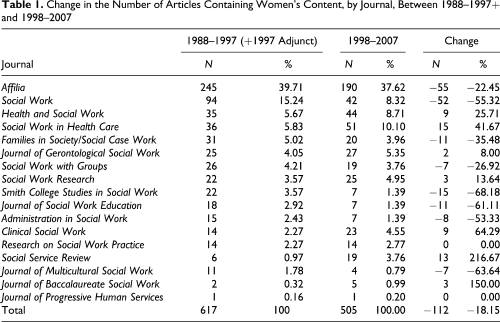
Although Affilia contributed the most articles in 1998–2007, I found 55 fewer articles in that journal (−22.45%) for this period than in the earlier one; Social Work also experienced a reduction of 52 articles (−55.32%), and the Journal of Social Work Education experienced a reduction of 11 articles (−61.11%) from the earlier period. The latter two journals published less than half the number of articles containing women’s content in 1998–2007 than they did in 1988–1997. This is a significant reduction, since the number of articles published in these two journals during 1988–1997 originally represented only 15.24% and 2.92%, respectively, of all women’s content for that period. However, some journals increased their publication of women’s content during the 1998–2007 period: Social Work in Health Care (n = 15, or 41.67%), Social Service Review (n = 13, or 216.67%), Clinical Social Work (n = 9, or 64.29%), and Health and Social Work (n = 9, or 25.71%). Also, slight increases were found for the Journal of Gerontological Social Work, Social Work Research and the Journal of Multicultural Social Work. Two journals; Research on Social Work Practice and the Journal of Progressive Human Services, experienced no change in women’s content.
Question 3
Table 2 indicates the change in frequency of referents to women’s social identities between 1988–1997 and 1998–2007. These referents fell into three categories: Client, Family, and Worker. Overall, the total number of referents to women’s social identities dropped from 789 to 737 (n = −52, or −6.6%) between the two periods. There was an increase of 33 referents in the client category (8.10% for category and 7.8% overall), a reduction of 60 referents in the family category (−25.70% for category and −6.0% overall), and a reduction of 25 referents in the worker category (−13.70% for category and −1.70% overall).
Change in the Frequency of Referents to Women’s Social Identities Between 1988–1997+ and 1998–2007
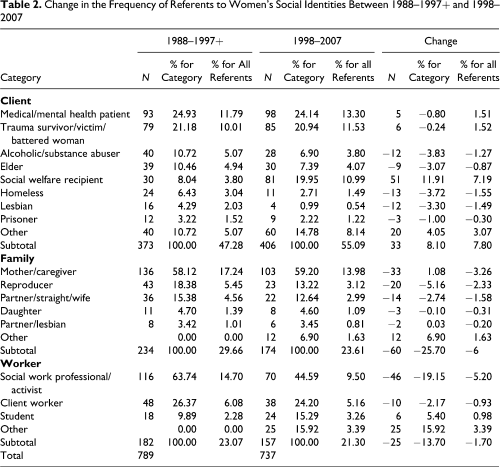
The highest increase in the client category was for welfare recipients (n = 51, or 11.9% for category and 7.2% overall); there was also a slight increase for trauma survivors/battered women and a decrease for women as substance abusers (n = −12, or −3.8% for category and 1.3% overall). In the family category, the mother/caregiver category experienced the largest reduction (n = −33, or −3.2% overall), yet the percentage change for the category was still a gain of +1.1% because of the low number of other referents in the family category (174 for the current study compared to 234 in the earlier study). The biggest loss in the worker referents was in the social work professional category. The category “other” was added to the family and worker categories to account for the referents that did not fit into the other categories. In the family category, these referents included single or divorced women, sister, and family members of capital offenders.
Question 4
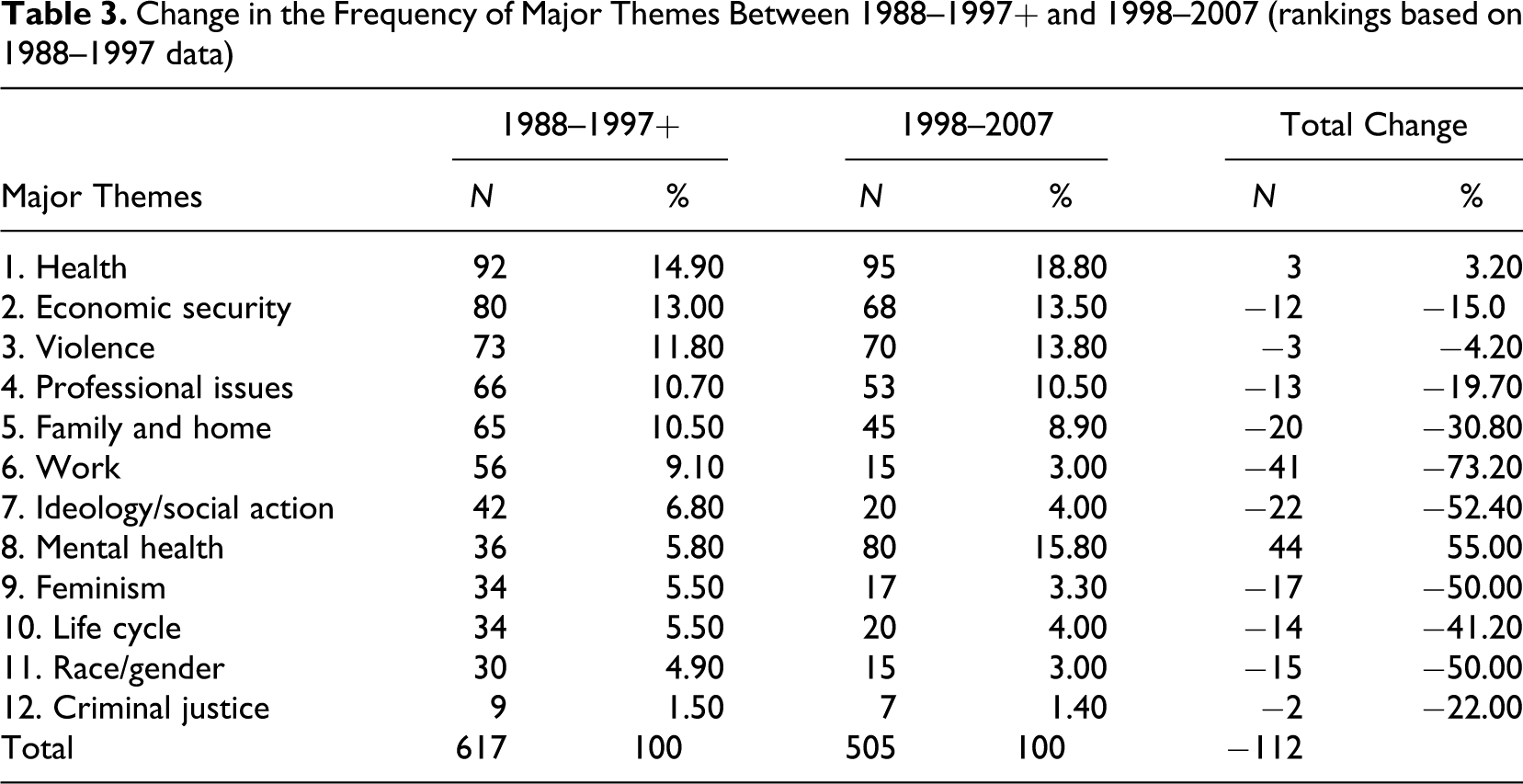
Table 3 indicates the change in frequency of major themes in women’s content between 1988–1997+ and 1998–2007. The health category continued to be the most prevalent major theme in the articles containing women’s content in the 17 journals, with a slight increase in this category between the two periods (n = 3, or 3.2%). Because there was a significant increase in the mental health category (n = 44, or 55%) between the two periods, this category was bumped up from seventh place in the earlier period to second place in the later period. There was a significant decrease in the economic security category (n = −12, or −15%), which was bumped from second place to fourth place in the later study. The violence category experienced a slight reduction (n = −3, or −4.2%) but remained the third most prevalent category. Professional issues (n = −13, or −19.7%) and family and home (n = −20, or −30.8%) were each bumped down one place in the new rankings. The work category experienced a significant reduction (n = −41, or −73.2%) and was bumped down from sixth to ninth place. It was tied with race/gender for ninth place. The life-cycle category experienced a reduction but was bumped up from 10th to 7th place. It was tied with ideology/social action, which experienced a significant reduction (n = −22, or 52.4%) yet maintained the same position in the new rankings. Similarly, the number of articles with feminism and race/gender as a major theme was reduced by half, yet feminism was bumped up one place, and race/gender was bumped up two places. Both categories maintained their same positions in the new rankings. In sum, the new rankings for 1998–2007 by frequency were (1) Health, (2) Mental Health, (3) Violence, (4) Economic security, (5) Professional issues, (6) Family and home, (7) Ideology/social action and the Life cycle, (8) Feminism, (9) Work and Race and gender, and (10) Criminal justice. Note that the abstracts were also coded for subcategories after they were coded for one of the 12 major themes. The number of subcategories started at 53 and was later collapsed to 38 to improve intercoder reliability. The new subcategory rankings by prevalence were battered women, practice/research/educational issues, welfare programs/reform, caregiving/parenting, mental health services/therapy/counseling, and substance abuse.
Change in the Frequency of Major Themes Between 1988–1997+ and 1998–2007 (rankings based on 1988–1997 data)
Question 5
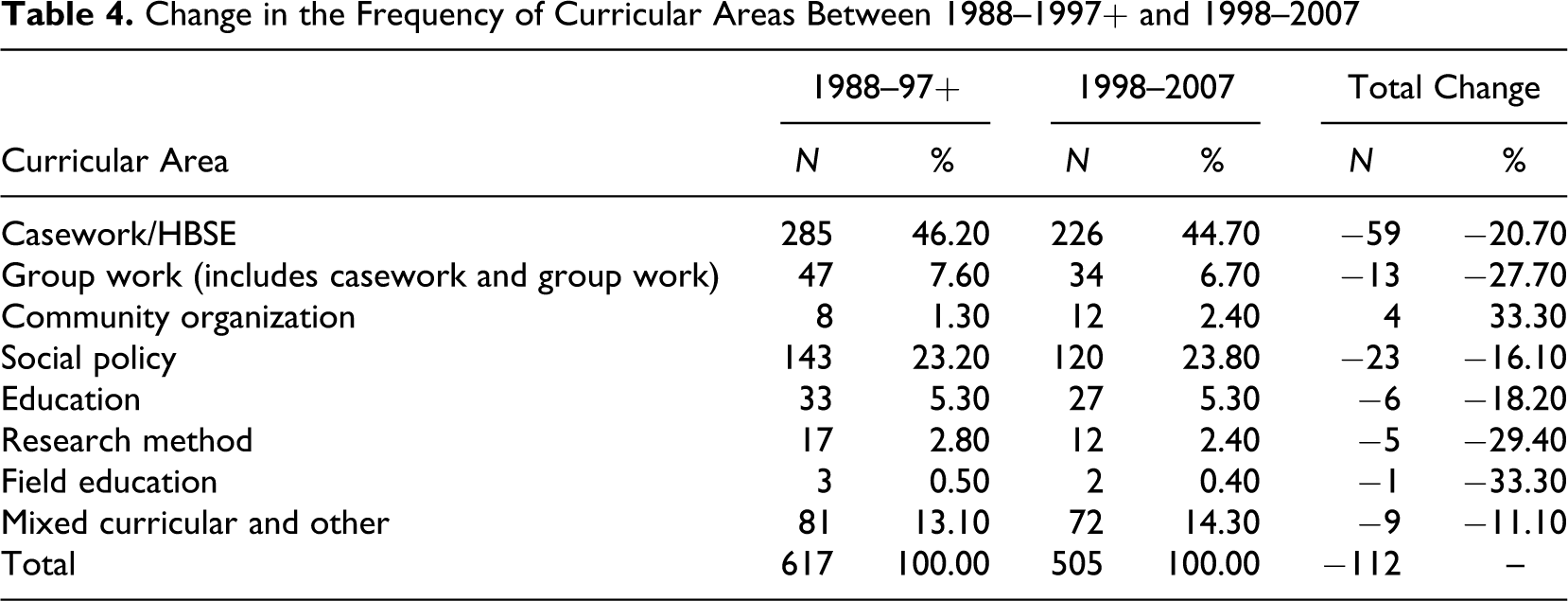
Table 4 reports the change in the frequency of curricular area for the periods 1988–1997+ and 1998–2007. Casework/Human Behavior and the Social Environment (HBSE) and social policy combined continued to lead as the top two curricular areas and together accounted for more than 65 of all articles in both periods, although there were numerical decreases in both categories. The number of articles in the casework/HBSE area decreased by 59, or −20.70%, and the number of articles in the social policy area decreased by 23, or −16.10%. There was a slight increase in articles on community organization (n = +4, or 33.30%). The group work category experienced a decline of 13 articles, or −27.7%, while all the other categories similarly experienced slight declines. When added together, articles in the categories of field education, community organization, and research methods together represented only about 5% of all articles in both periods.
Change in the Frequency of Curricular Areas Between 1988–1997+ and 1998–2007
Question 6
Table 5 reports the change in frequency in the analytic perspective between 1988–1997+ and 1998–2007. As stated in the previous study, the Empirical category consisted of quantitative and qualitative studies and mixed quantitative and qualitative studies in which original data were collected by the authors for the purpose of the articles or a secondary analysis of previously collected data (e.g., national data) was used for the purpose of the study. The Nonempirical category included articles of a conceptual, theoretical, or practical nature. Also included in this category were narratives, Nonempirical case studies, literature reviews, historical studies, and descriptions of programs (in which the unit of analysis was a specific program, model, or treatment approach, but Empirical data were not collected or the data that were collected were not the focus of the article).
Change in the Frequency of Analytic Perspectives Between 1988–1997+ and 1998–2007
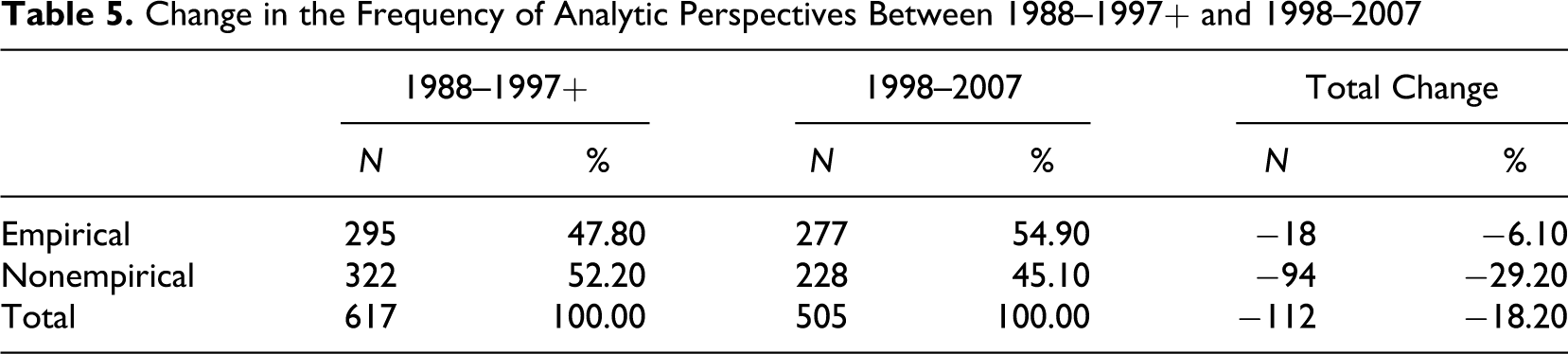
Articles in the Empirical category represented 277 (54.90%) of all articles on women and social work. In a change from the earlier period, the number of Empirical articles exceeded the number of Nonempirical articles on women and social work in the 1998–2007 period. Empirical articles accounted for slightly less than half the articles during the 1988–1997 period. However, in a change from that period, when quantitative studies represented 36.2% of all articles and qualitative studies represented less than 11% of all articles, in the 1998–2007 period, the number of quantitative studies represented 28% of all articles, and the number of qualitative studies represented 24.2% of all articles. These changes indicate a decrease in quantitative articles, an increase in qualitative articles, and a more equitable distribution overall between the quantitative and qualitative categories in the Empirical category during the later period.
Question 7
Table 6 reflects the change in the number of articles containing Feminist content in the 17 journals during 1988–1997+ and 1998–2007. During the 1988–1997+ period, the number of self-identifiably Feminist articles (n = 76, or 12.31%) and Somewhat Feminist articles (n = 97, or 15.72%) together accounted for a total of 173 articles (or 28.03%), a little over a quarter of all articles published during that period. However, during the 1998–2007 period, the number of self-identifiably Feminist articles and Somewhat Feminist articles were equal (n = 58 or 11.48%, each). The two categories combined constituted less than a quarter (n = 116, or 22.96%) of all articles published during that period. Thus, between the two periods, there was a decrease of 18 (−23.69%) self-identifiably feminist articles and 39 (−40.21%) Somewhat Feminist articles. Overall, when the two categories were combined, they constituted 57 (33%) of all the articles published in the later period compared with the earlier period.
Change in the Frequency of Feminist Content in Individual Journals Between 1988–1997+ and 1998–2007 (Feminist and Somewhat Feminist Content Combined)
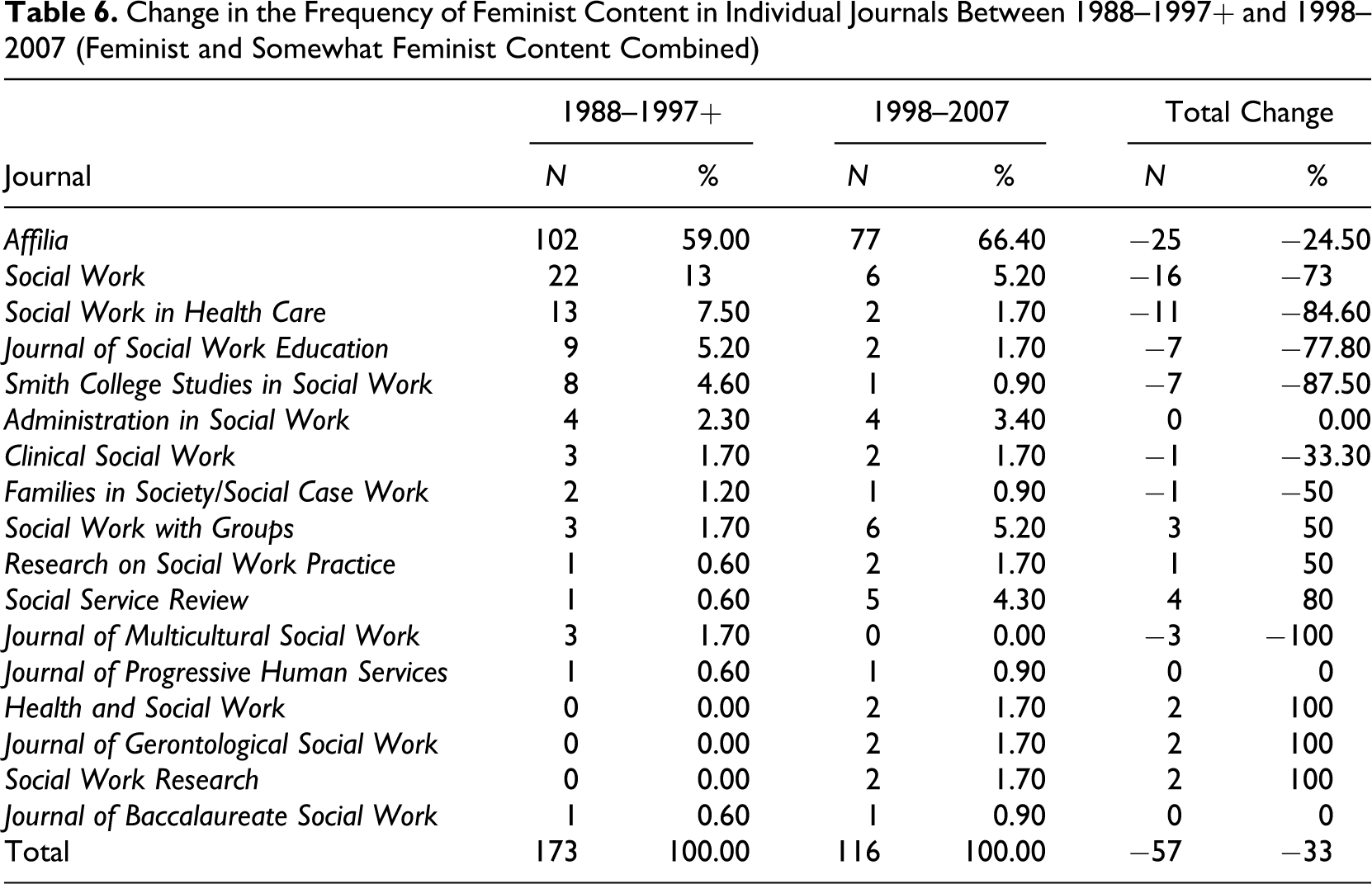
Affilia continued to publish the majority of self-identifiably feminist and articles in the 1998–2007 (n = 77), representing 66.40% of all articles about women with Feminist content. This number represents a decrease from the earlier period, when Affilia published 102 articles, or 59% of all Feminist content in 1988–1997. Although there was a reduction of 25 articles (or −24.50%) with Feminist content published by Affilia in the later period, the reduced number still represented a larger percentage of Feminist articles published during 1998–2007 (66.40%) than during 1988–97+ (59.00%) because of the overall reduction in Feminist content in most of the other journals during the later period. Social Work published only 6 (5.20%) self-identifiably feminist and Somewhat Feminist articles during 1998–2007, a reduction of 16 (or −73%) from its earlier number of 22 articles, or 13% of all articles published during 1988–1997. The Journal of Social Work Education published only 2 articles, or 1.70% of all articles with self-identifiably Feminist and Somewhat Feminist content during 1998–2007, a reduction of 7 (or −77.80%) from its earlier number of 9 articles, or 5.20% of all articles published during 1988–1997. Social Service Review added the most Feminist content in the later period (n = 4, or 80%). No other journal in the sample added more than two articles to this category. Most journals reduced the already low number of articles in this category.
The remainder of the articles containing women’s content was in the Not Feminist category. A total of 389 Not Feminist articles were published in 1998–2007, compared with 444 in 1988–1997. Where in the earlier period, the Not Feminist articles represented 71.96% of all the articles about women, in the later period, they represented 77.02%. There was a decrease of only 12.39% (n = −55) in 1998–2007 compared with 1998–2007.
Question 8
In addition to coding for women’s overtly stated social identities (see Table 2), I coded the abstracts for referents to women as research participants. The purpose of adding this category was to follow up on an observation from the earlier study that found that women clients were increasingly being used as research participants in empirical studies, rather than being treated for the problem under discussion in the articles. The articles that I coded as empirical for the analytic perspective category reported in Table 5 were not sufficient to answer this question, since some of the authors conducted a secondary analysis of available data in their studies and thus did not use any human subjects in their research. The data reflected an almost even split between women as research participants (n = 255, or 50.5%) and women not used as research participants (n = 250 or 49.5%) in the 1998–2007 sample.
Question 9
The abstracts were also analyzed to answer the question, “Did the abstract specifically state that the research included women of color?” For the purposes of this study, color included any racial, ethnic, cultural, or religious minority. Three codes were used for this category: yes, no, and color or diversity implied (the abstract used language, such as “diverse women” or “international women”). The data reflected that only 151, or 29.90% of all the abstracts (n = 505) met the criteria for including women of color. Another 15, or 2.97%, of all the abstracts met the criteria for color or diversity implied. The two categories collapsed totaled 166, or only 32.87% of all abstracts. Thus, the majority of abstracts (n = 339, or 67.13%) did not include women of color or imply color or diversity. It is worth noting that Affilia accounted for 48, or 9.50%, of all abstracts that were coded as including women of color and 7 (1.38%) in which diversity was implied. Thus, Affilia contributed 55 articles, or 10.9% of all abstracts in which the term women of color was either included or implied, representing approximately a third of all abstracts in this category.
Question 10
I added the 10th question to the study to find out if a human rights perspective was supplanting a feminist one in the literature, a hypothesis that was not supported by the data. Thus, I analyzed the abstracts to answer the question, “Did the author employ a human rights perspective or use human rights language in the abstract?” Three codes were used for this category: yes, a self-identifiable human rights perspective (the article specifically stated that the issue, theory, intervention under investigation was a human rights issue); no evidence of a human rights perspective or language; and a human rights perspective/language implied [i.e., the author used terminology, such as anti-oppressive practice; economic, social, and cultural rights; (protection against) discrimination based on race, color, sex, language, religion, and political opinion; civil and political rights against arbitrary powers of the state; and equal protection under the law (the right to due process; inalienable rights; freedom of speech and belief; the right to assembly, education, work, and liberty; freedom from torture; and international law or justice]. Only 15 (or 2.97%) of a total of 505 abstracts included a self-identifiable human rights perspective, and 64 abstracts (or 12.67%) used implied human rights language or perspectives. When the two categories were combined, a total of 79 (or 15.64% of all abstracts) included some human rights language or perspective. Thus, 426 abstracts (or 84.36% of all abstracts) did not mention a human rights perspective or use human rights language.
Affilia accounted for 11 of the 15 articles with a self-identifiable human rights perspective and 42 of the 64 abstracts with an implied human rights language or perspective. Thus, Affilia contributed 53 of the 79 articles (or 10.5% of the 15.64%) combined human rights content to the 1998–2007 abstracts in the sample.
Discussion
According to the data presented in this article, 1998–2007 experienced a decline in the number of articles containing women’s content and an even sharper decline in the number of articles written from a feminist or somewhat feminist perspective in the 17 journals that were sampled compared to the previous 10-year period. The noted limitations of SWAB should not be considered separate from the findings, but rather, considered an intrinsic part of them. SWAB’s omissions in abstracting entire issues of Affilia between 1997 and 2005 (Holden et al., 2008; Holden, Barker, Covert-Vail, Rosenberg, & Cohen, 2009) represent metaphorical omissions of women and feminism in other aspects of social work. A chasm continues to persist between the iterated importance of diversity and representation of women in social work and the exclusionary practices of SWAB’s abstracting. Curiously, this deficiency remains largely unaddressed by NASW, despite a formidable growing empirical literature on SWAB’s limitations. Omissions in social work’s database create omissions in social work’s knowledge, specifically with regard to women, their issues, and the orientations that practitioners and academics use to view and work with them. Who will take responsibility for fueling the inadvertent sexism that occurs as a result of the exclusionary practices of the profession’s signature database?
Although the findings may not present a complete representation of all articles pertaining to women and social work in the 17 journals, they arguably represent a cross section of what has been written and that sample remains largely not feminist in orientation. What accounts for this increasing trend? Are authors not writing and submitting articles on women and feminism? If they are writing them, are journals not publishing their submissions? Does the noted scarcity of women’s content further dissuade junior faculty and researchers from adding to the literature on women? More broadly, are women’s issues falling off the table? Is a self-identifiably feminist perspective no longer acceptable to journals that must be more selective about what they do print? Affilia has continued to contribute the most articles containing women’s content and articles written from a feminist perspective, yet it should not have to carry the burden for the rest of the profession, especially when this content has been virtually nonexistent in the two most visible journals of the profession: Social Work and the Journal of Social Work Education, whose content on women declined even further from the previous low numbers in the later period.
In addition to the decrease in feminist content, the 1998–2007 analysis revealed little change in other content areas. Health/Reproductive health, and now Mental Health, followed by Violence, led as the major themes in this period. Casework/HBSE and Social Policy continued to be the most highly represented curricular areas. The literature has increasingly referred to women in their client roles and less often in their family and professional roles, although the mother/caregiver referent remained the highest among all others in this period. In the Client category, women continued to be typified as predominantly medical or mental health patients and battered women or survivors of abuse. A sharp increase occurred from 1998 to 2007 in referents to women as social welfare recipients but oddly the Economic Security theme dropped from second to fourth place. This change may indicate that the prevalent theme in articles referring to poor women may have not been their economic security but other (more clinical?) aspects of their oppressed condition. The increase in the number of articles (to more than half the original number) in the Mental Health category seems to suggest this possibility. Articles about community and union activism may address the marginalized status of entire industries of feminized labor and larger gender-based inequities (Chandler & Jones, 2003), yet articles on Community Organization remained scarce. The journal literature has clearly become more empirical, and women have more often been used as research participants than as clients, continuing a shift from a practice-oriented literature toward a more research-oriented one. Perhaps the profession has forfeited the “practice” part of “evidence-based practice” in its quest to become more scientific. Surely, it behooves the profession to reassess the assumed gains of increasing its scientific respectability with the cost of lost intervention in the lives of women, especially when that trade-off includes addressing women of color/diversity in only about a third of all abstracts and failing to adopt a feminist or human rights perspective in this quest for knowledge in the majority of its publications about women.
On one level, the decreases observed in feminist and women’s content may reflect social work’s preoccupation with larger political and international exigencies that affect our society and the strained economic pace of the past 10 years. However, it would then stand to reason that the literature would reflect these issues and how they specifically affect women, yet this has not been the case. The reduction of articles subsumed under the Ideology/Social Action theme the insubstantial number of references to human rights, and the marginal representation of women of color seem to indicate otherwise.
Compounding the decrease in articles generated is the decrease in the number of articles published in each journal. On the face of it, most journals seem to be shrinking and thinning, publishing less overall than they did even 10 years ago. Increasingly, the journals must compete with other forms of electronic media; online journals and information sites that arguably keep better pace with current issues in the profession than do print journals, which lose considerable time in the preparation, review, and printing processes. If journals must reduce the number of articles per journal, then it stands to reason that they will be more selective about what they do accept for inclusion. As in previous periods, women’s content has often been viewed as supplemental, not central—a special interest that can be satisfied satisfactorily through Affilia, the designated journal for women and social work. Women’s content has long suffered as a casualty of provincialism; now it may suffer as a casualty of retrenchment as well. However, the availability of other media for disseminating women’s content and galvanizing practice and policy initiatives offers new opportunities for social work students, feminist practitioners, and scholars who want to turn the tide on the diminishment of women and women’s issues in the profession. Perhaps it is time to try a new strategy—to explore and avail ourselves of other venues for the more immediate expression, representation, and advocacy of women’s issues in social work.
Footnotes
The author declared no potential conflicts of interest with respect to the research, authorship, and/or publication of this article.
The author received no financial support for the research, authorship, and/or publication of this article.