




Abstract
Largely operating online, incels are predominantly male individuals who are frustrated by their involuntary celibacy—their inability to get a romantic or sexual partner. Their worldview is grounded in hostile sexism largely directed at women and shared contempt for mainstream dating standards and feminism. Some incels posit that they can undertake specific racially-defined actions (i.e., skin bleaching, lying about one's ethnicity, cosmetic surgery) to increase their access to women by appearing more white and, hence, more desirable. By thematically analyzing 10 online incel forums on the topic of race, this research identifies the role of race as a sustaining facilitator of networked misogyny and white supremacy. Despite these racialized efforts to appear more white, many incels conclude that these efforts to change themselves are largely ineffective in increasing their access to women. Seeing as over half of incels seek counseling and social work services, this research puts forth several implications for social workers supporting incel clients and highlights the importance of understanding the role that race plays in incel clients’ rhetoric—not only in reproducing racism, but also in provoking violence-sustaining affects (e.g., anger, disappointment, resentment) that generate a shared sense of betrayal and reinforce gender-based violence.
The last few decades have shed light on a growing incel community (Branson-Potts & Winton, 2018; Cecco, 2019; Howard, 2020). Largely existing in the virtual realm, the incel community refers to a group of individuals, predominantly men, who are involuntarily celibate and frustrated by their inability to obtain a romantic or sexual relationship with women. The incel community's dominant worldview is threaded by hostile sexism directed at women, contempt for mainstream dating standards and an immense disdain for feminist ideology (Baele et al., 2021). Aggrieved entitlement to women's bodies lies at the root of incel discourse, particularly the idea that women are gatekeepers of sex and romance—and the denial of such births feelings of male oppression and victimization which then warrants sexism, retribution, and violent repercussions against themselves and others (Baele et al., 2021; Ging, 2019; O’Malley et al., 2020).
According to Speckhard et al. (2021), over half of incel men seek counseling and social work services. Other times, incels may be mandated into short-term counseling following a violent event or threat of violence in order to receive mental health care (Van Brunt & Taylor, 2021). This research highlights the importance of understanding how race and, in particular, whiteness work to sustain networked misogyny within incel communities. Considering the feminization of the caring field wherein women comprise the majority of social workers and mental health practitioners (Lin et al., 2015; Moyser, 2017), clinicians must understand the role that race plays in incel clients’ rhetoric in sustaining racism and gender-based violence.
One of the most common themes within incel doctrine is the pill metaphor. Stemming from the popular film The Matrix, three dominant pills constitute incel ideology. Those who swallow the bluepill unquestionably accept reality; these bluepilled individuals remain uncritical, uphold the status quo and fail to see any unfairness within the dating realm (e.g., believing that appearance does not matter when finding romance). Swallowing the redpill means believing that mainstream dating standards are unfair. Unlike bluepilled individuals, redpilled incels emphasize a series of actions one can take to access women (e.g., believing that appearance matters but you can do certain things to find romance such as improving your social skills). Finally, those who swallow the blackpill accept reality as a fatalistic, immutable and inescapable situation (e.g., believing that appearance matters and there is nothing you can do about it—you will never find romance if you are conventionally unattractive). Incels commonly identify as redpilled or blackpilled, whereas non-incels who uphold mainstream views are seen as being bluepilled.
A core ideological subset of redpill incel dogma is called racepill ideology. What, then, does it mean for an incel to swallow the racepill? And how do incels construct whiteness? In incel rhetoric, swallowing the racepill posits a critical consciousness-esque recognition that an incel's racial positionality negatively impacts their ability to be romantically and/or sexually successful with women, oftentimes resulting in what incels call “sexual racism” (“Racepill,” 2021; Wallace, 2021) 1 . The prevalence of these racialized conversations is significant when considering the ways in which contemporary headlines increasingly paint incels as enraged white men who are fueled by their celibate frustrations and enact violent, often-murderous acts against women. Incels are typically portrayed as angry white men in mainstream media; however, a considerable number of incels identify as Black, Indigenous, and People of Color (BIPOC) and may not readily identify with the same privileges and experiences allotted to white incels.
More so, the redpill posits that incels should undertake specific actions to increase their sexual market value (SMV) and alleviate their inceldom, including upholding the Just Be White (JBW) theory and pursuing whitemaxxing. For redpilled incels subscribing to the racepill, whiteness embodies a larger SMV. In other words, proponents of JBW theory consider whiteness to be the most desirable race and hence the most successful in the dating realm (“JBW Theory,” 2021). These JBW adherents encourage various racially-defined techniques, called whitemaxxing, for racialized incels to gain leverage in the sexual hierarchy of attractiveness—a hierarchy that is fundamentally formed on the basis of whiteness. Whitemaxxing techniques promise racialized incels that they can climb the racialized hierarchy of attractiveness by pursuing techniques such as skin bleaching, lying about one's ethnicity, and legal name changes to appear more white and hence more desirable (Wallace, 2021; “Whitemaxxing,” 2021).
Despite these racialized promises, many incels have concluded that these efforts to appear more white are largely ineffective in accessing women. This paper employs Lauren Berlant's (2011) theory of cruel optimism to highlight how these unattainable racialized promises can provoke violence-sustaining affects (e.g., anger, disappointment, resentment) that ultimately blame women and generate a shared sense of betrayal. In what follows, the heart of this study analyzes ten online incel forums on the topic of race to explore how whiteness is constructed and operationalized in incel discourse. This research suggests that while lack of whiteness is a predictor of perceived romantic shortcomings for racialized incels, critical race discourses are ultimately dismissed and substituted with knee-jerk inclinations toward woman-blaming and networked misogyny. Implications for social workers supporting incel clients are discussed with specific attention given to navigating racially-defined conversations in therapeutic contexts.
Ugly Guys Finish Last: Incels, Lookism, and Networked Misogyny
In the 1990s, a queer student named Alana 2 who was experiencing difficulty dating hand-coded an online peer-support message board titled “Alana's Involuntary Celibacy Project” to create a safe and supportive space for individuals who found themselves in a similar situation (“About,” 2019). The collective membership term was later shortened to incel. Over time, and to Alana's surprise, the incel community considerably deviated from its compassionate roots—and this deviation was intertwined with a change in user base demographics and worldviews as well (Beauchamp, 2019; Vogt & Goldman, 2018; Williams, 2018). As it is now known, the incel community's dominant worldview is grounded in hostile sexism largely directed at women and a shared contempt for mainstream dating standards and feminism (Baele et al., 2021). For Messner (2016), three key societal changes sustain incel ideologies: “the professional institutionalization of feminism, the rise of postfeminist sensibility, and shifts in the political economy (especially deindustrialization and the rise of the neoliberal state)” (p. 6). In their inductive analysis of online incel posts (n = 8,324), O’Malley et al. (2020) found five key narratives within incel discourse: (a) the sexual market, referring to an unjust female-led sexual marketplace where women carry all of the romantic selection power; (b) women are naturally evil, referring to women as a source of trauma, cruelty, dishonesty, and a state of being less biologically evolved; (c) legitimizing masculinity, referring to the ways in which incels objectify and dehumanize women while reinforcing tropes of masculinity and power; (d) male oppression, referring to incels as biologically oppressed both by more attractive men and socio-sexually oppressed by women and feminism; and (e) violence validation and justification, referring to incels validating violence toward others (e.g., women) and themselves (e.g., self-harm).
The first empirical study on the incel community found that most incels experienced feelings of frustration, anger, and sadness attributed to their lack of romantic and sexual intimacy (Donnelly et al., 2001). In a quantitative survey administered to incels (n = 272), Speckhard et al. (2021) found that almost all incels are male (99.6%) and identify as heterosexual (93.8%). Many incels live in North America and Western Europe (63.3%), are typically around 24 years old, and are largely either middle class (65.4%) or working class (30.1%) (Speckhard et al., 2021). Although not exclusively, most experience social challenges (e.g., poor social skills, exclusion, history of bullying) and mental health challenges (e.g., anxiety, post-traumatic stress disorder, depression, suicidal ideation) (O’Malley et al., 2020; Pelzer et al., 2021). As Speckhard et al. (2021) concludes, although “incels have been discussed in the mainstream media almost exclusively in the context of violent crime” (p. 92), the vast majority of incels are not actively violent.
Almost all incels consider themselves to be unattractive and hence disadvantaged due to their unattractiveness (Bratich & Banet-Weiser, 2019; Castle, 2019; Glace et al., 2021). This core worldview is entrenched in the idea of lookism. For incels, lookism asserts that one's status on the desirability hierarchy is determined by physical appearance and, conversely, unattractive individuals are more prone to be sexually and romantically unsuccessful (Castle, 2019; Wallace, 2021). This Darwinist idea of sexual selection is further emphasized by the 80/20 rule, which is inherent to the incel worldview and posits that 80% of all women largely desire the top 20% of physically attractive men—leaving all other conventionally unattractive men (i.e., incels) cemented at the bottom of the hierarchy with limited opportunity to access women (Baele et al., 2021; “Hypergamy,” 2021). For incels, everyone is assigned an SMV based on Eurocentric tropes of beauty and aestheticism. Largely centered on physical appearance, one's SMV represents their attractiveness, desirability and, hence, their ability to access women.
Getting Mogged by Whiteness: JBW and Whitemaxxing
According to incel community slang, to be mogged by someone is to be dominated and outshined by them. In the depths of online incel forums, countless incels complain how they are mogged by other, more attractive white men in the dating sphere, rendering them as unfavorable or second-class romantic options for women. Many other incels argue about the validity of JBW theory and whitemaxxing tactics, which are both subsets of racepill ideology. As previously outlined, the racepill serves to highlight the impact of race on one's dating success. Blackpilled incels who swallow the racepill believe that one's racial makeup impacts their ability to be successful with women, particularly for incels who are BIPOC, and for whom there are limited or no actions one can take to improve this situation (“Racepill,” 2021; Wallace, 2021). On the other hand, redpilled incels who swallow the racepill believe that they can undertake various racially defined actions that can increase their SMV. Table 1 depicts the intersection of racepill rhetoric within differing overarching incel dogmas.
‘Racepill’ Conceptualization Within Differing Incel Dogmas.
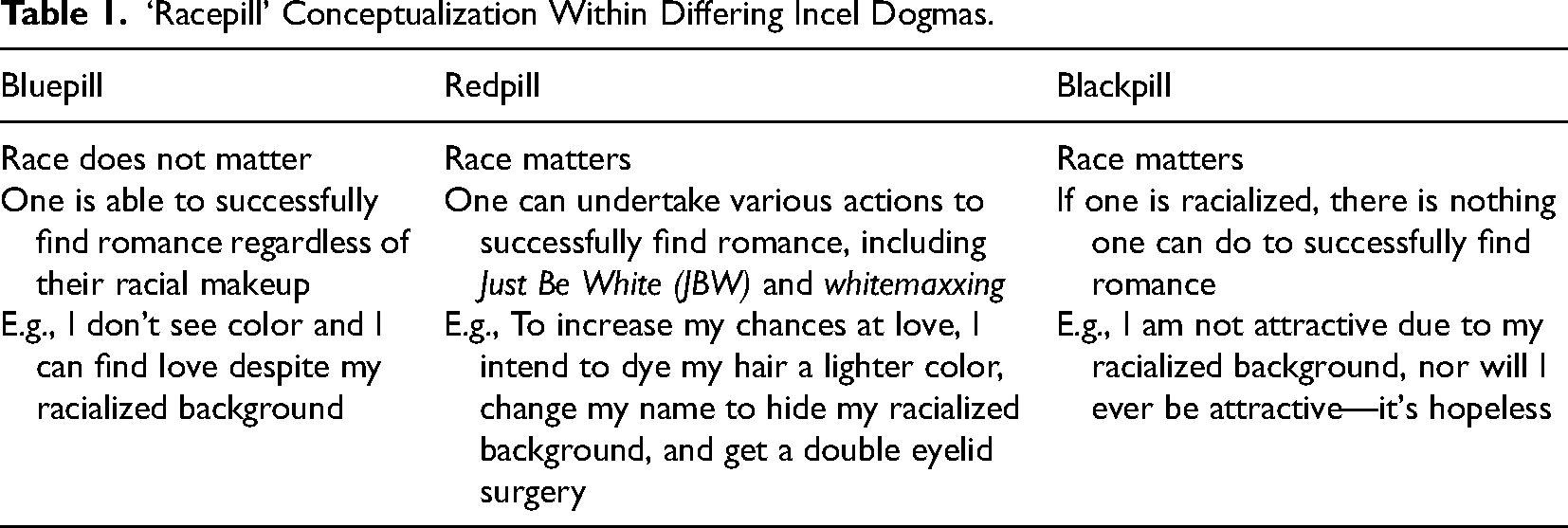
For these redpilled incels who subscribe to the JBW theory and believe that whiteness embodies a larger SMV in the dating realm, whitemaxxing techniques are seen as a way for racialized incels to gain leverage in the sexual hierarchy of attractiveness and increase their opportunities of accessing women. As illustrated in Table 2, these whitemaxxing tactics promise racialized incels that they can climb the racialized SMV hierarchy through techniques such as skin bleaching, lying about one's ethnicity, wearing eye contacts, and legal name changes to appear more white and hence more desirable (Wallace, 2021; “Whitemaxxing,” 2021).
Various Whitemaxxing Tactics.
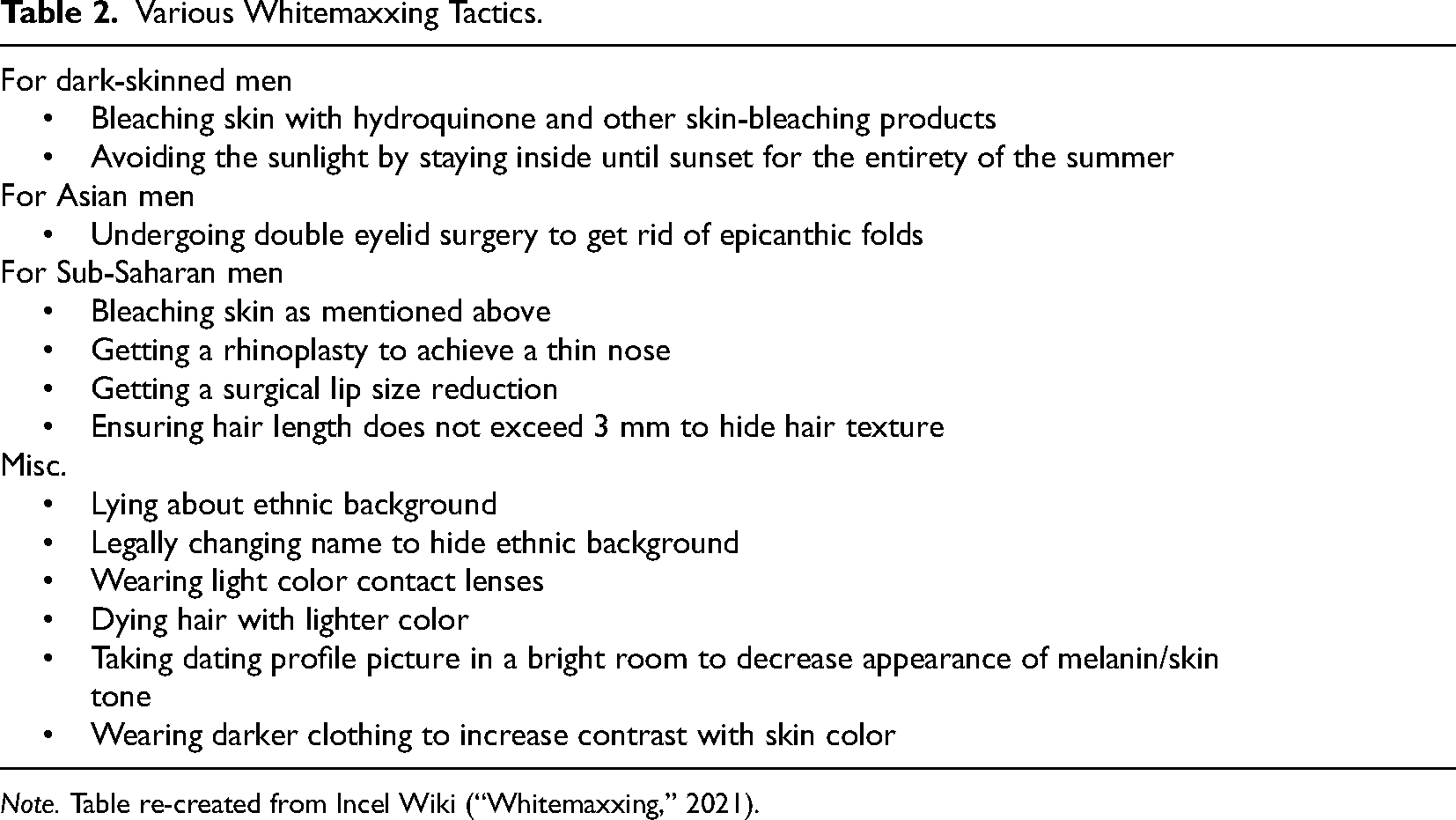
Note. Table re-created from Incel Wiki (“Whitemaxxing,” 2021).
Although incels and other online alt-right groups are associated with white identities and white supremacy, almost half of all incels identify as non-white (Høiland, 2019; Sharkey, 2021). This is echoed by Speckhard et al. (2021), who found that approximately 53.3% of incels are white and 46.7% of incels belong to BIPOC groups. As Sharkey (2021) writes, Ethnic groups that have historically been rendered less masculine than the white norm are sometimes referred to in incel contexts as “ethnicel” (https://incels.wiki/w/Ethnicel). Incels are at times also divided by racial categories, like “ricecel,” for men of Chinese ethnicity or “currycell,” for South Asians from India. These labels identify these groups as “a subset of an ethnicel, meaning one whom is on the inceldom spectrum primarily as a result of a systemic racial disadvantage” (https://incels.wiki/w/Currycel). (p. 8)
Racialized Promises, Cruel Optimism, and the Politics of Desire
The idea that attractiveness is intertwined with political forces is not new. As Srinivasan (2021) emphasizes, rather than dismissing sexual preferences as primordial, apolitical, and axiomatic processes, sexual preferences must be understood as dependent on the political context. Sexual preference is political and, by extension, so is desire. In this sense, the attraction gaze transpires into the bedroom and is informed by various political structures of oppression including sexism, racism, ableism, transphobia, and fatphobia, all under the innocent guise of a falsely naturalized “personal preference” (Rodrigues & Przybyło, 2018; Srinivasan, 2021). These political narratives often shape who we find dateable and worthy of love by assigning status and value to certain bodies on the basis of these political structures. These politics of attractiveness are entrenched in Eurocentrism and able-bodied ideals that construct subjects who better align with the attractiveness norm as more desirable: “[f]rom hair texture to skin tone, facial shape to body height and size, whiteness has been deeply conflated with beauty and goodness, and racialization with ugliness and moral failing” (Rodrigues & Przybyło, 2018, p. 10). Desire can be racist—and this is a core element of the incel racepill ontology.
For incels, however, the metaphorical arbitrator of racist desire is not a neutral, faceless force. As facilitators of what racepilled incels cite “sexual racism” (“Racepill,” 2021; Wallace, 2021), it is women who are seen as the main enforcers of sexual racism. In a similar vein, racepilled incels believe that sexual racism is an inherent pillar of lookism because whiteness allots a certain privilege in obtaining easier access to women and their bodies. In A Phenomenology of Whiteness, Ahmed (2007) highlighted that whiteness is not an ontological given. Rather, whiteness is a systemic, relational phenomenon that prescribes experiences (e.g., how to behave, what one is able to do) and is embedded in overarching structures. For Ahmed (2007), all bodies “pass through” (p. 159) whiteness and experience the world differently through their passage “which makes non-white bodies feel uncomfortable, exposed, visible, different, when they take up this [white] space” (p. 157). As racialized bodies pass through this dominant system of whiteness, they may find themselves stopped or slowed down due to their nonalignment with the racial norm. To this end, it becomes apparent how racepilled incels conceptualize the dating sphere as a “white space” (p. 159) where racialized men might get the short end of the dating stick and subsequently suffer romantically or sexually.
This sense of privilege serves as the basis of JBW theory and whitemaxxing tactics. In an almost cruelly optimistic way, this fixation on these racialized promises projects a sense of hope that JBW and whitemaxxing will ultimately unveil their path toward romance and intimacy. Lauren Berlant (2011) describes cruel optimism as “a relation of attachment to compromised conditions of possibility whose realization is discovered either to be impossible, sheer fantasy, or too possible, and toxic…Cruel optimism is the condition of maintaining an attachment to a significantly problematic object” (p. 24). For Berlant (2011), the spectrum of desire is vast and can include a wide range of wants: “[i]t might involve food, or a kind of love; it might be a fantasy of the good life, or a political project. It might rest on something simpler too, like a new habit that promises to induce in you an improved way of being” (p. 1). These attachments, however, are not always inherently cruel. Berlant's motif suggests that cruel optimism transpires only when a desired object or state of being attached impedes the attainment of that initial goal. These compulsions toward hopeful change do not necessarily feel optimistic or good either. Cruel optimism is an inherent feeling of ambition that can be characterized by a variety of feelings such as anxiety, dread, longing, excitement, and so forth (Berlant, 2011). More so, this relation of cruel optimism often operates under the guise that one's pursuits are the result of rational endurance or common sense that one's actions will bring them nearer to their object of desire. It is this affective drive that solidifies one's attachment and sustains the pursuit of whatever means necessary will bring one closer to their object of desire. Cruelty is not immediately evident, which is why this lack of recognition can be so easily mobilized to sustain hope and prevent one from attaining the object of their desire.
Berlant (2011) emphasizes that a desire is cruel when it takes the shape of a double bind, wherein “even with an image of a better good life available to sustain your optimism, it is awkward and it is threatening to detach from what is already not working” (p. 263). It is under these double binding conditions that cruel optimism flourishes: “a binding to fantasies that block the satisfactions they offer, and a binding to the promise of optimism as such that the fantasies have come to represent” (Berlant, 2011, p. 51). This dilemma is worth highlighting because it depicts the ways in which an optimistic hope or desire can create an impasse that prevents one from detaching from the very things that prevent them from attaining their desires. It is this contradictory dilemma in Berlant's (2011) account of cruel optimism that resonates so centrally in this analysis of JBW and whitemaxxing tactics within incel communities. In the same way that JBW and whitemaxxing tactics are embedded in a racialized promise of self-improvement and romantic success, these objects of desire are especially cruel when they yield a false sense of hope that they are attainable if one endures long enough and performs the actions required. Drawing on the work of Caluya (2008), although the racialized incel's subjectivity is shaped by “the accumulation of racially based sexual rejections” (p. 284), there nonetheless remains a sense of hope—administered by the antidote of JBW and whitemaxxing—that these tactics will make previously unattainable forms of intimacy, attainable.
Methods
Through a thematic analysis, this study uses qualitative data in the form of online posts that were identified and retrieved from ten incel message boards to explore how race and whiteness work to reinforce the community's shared racepilled ideology, as well as how these unattainable racialized promises can provoke violence-sustaining affects (e.g., anger, disappointment, resentment) that ultimately generate a shared sense of betrayal. Ten online discussion forums were identified from www.incels.is, 3 the largest online incel community which describes itself as a “support group for incels, men that struggle with or are unable to get into romantic relationships with women despite trying” ( “incels.is,” n.d.). As of April 2022, there were over 16,000 registered members with approximately 7.8 million posts. This online community is open access, meaning that all of the discussion forums, posts and responses are public and can be read by nonmembers. Registered users typically create an anonymous username and post and/or comment to various discussion forums on the website.
With regards to selection criteria, these 10 forums were selected on the basis of having a race-based term within the forum title, including “JBW,” “whitemaxxing,” and “racepilled.” Doing so, an implicit assumption existed that the selected forums focused on race-based topics within their discussion. The selected 10 forums range from March 2018 to February 2022, depicting the contemporary relevance of racialized rhetoric within incel communities. The 10 selected discussion forums span multiple pages totaling 440 posts made by 233 registered users, 212 of which were unique members. Each user was assigned a unique identification number in place of each individual's original username. These identification numbers were assigned not only to simplify the data analysis process by using a standard naming convention, but also to provide forum users with an additional layer of privacy in line with standard ethical guidelines for presenting online qualitative data (Hutchings & Holt, 2015; Silverman, 2013). Data retrieval was performed during April 2022, and this data set reflects all of the posts available from these ten forums at the time of retrieval.
The 10 discussion forums were captured and downloaded into PDF formats. These PDF formats reflect a “snap shot” of the original forums and do not include any comments that were modified, deleted or added following the data retrieval date in April 2022. The captured forums were then imported into NVivo, which is an qualitative data analysis software. Following several close readings of the discussion forums, each of the 10 forums were thematically coded individually and grouped into various themes (Braun & Clarke, 2021; Gibbs, 2007). Data analysis followed a pragmatic approach to qualitative analysis, integrating elements of both inductive and deductive approaches to coding. The selection criteria were guided by identifying race-based topics within forums; as such, the first wave of coding deductively concentrated on identifying any specific mentions of race, whiteness, experiences of racialization or racism, and any other race-based narratives, thoughts or beliefs that users described in their forum comments. For example, codes such as JBW, whitemaxxing, sexual racism, and racepill were initially identified within the data to highlight race-based discussions. The second wave of coding used a more inductive approach. Each forum post was analyzed once again, noting any new codes through a bottom-up process. Here, an inductive analysis captured new codes that arose from the data including woman blaming, self-hatred and affective responses such as anger and disappointment.
Employing Braun and Clarke's (2021) framework for thematic analysis, initial coding waves were followed by focused coding which revealed core themes on the topic of race and whiteness. Initial themes were identified when two or more users narrated the same belief, experience or action. For example, codes such as race, SMV and privilege were identified and contextualized in the data when multiple users discussed their perception that race has an impact on one's SMV which subsequently influences one's privilege within dating spheres. These preliminary codes were compared across transcripts and organized into the first general theme: that race matters when considering one's probability of romantic and sexual success. This iterative process allowed for the shaping of several generalized themes. Next, Braun and Clarke's (2021) reviewing phase allowed the author to revisit, separate, combine and refine these initial themes. At this stage, the main themes were separated into various secondary, more detailed themes. This process allowed for the development of general themes and subthemes. Finally, all general themes and their respective subthemes were re-read, re-organized and re-defined in order to create a final set of themes that reflect the complex ways that race and whiteness inform the community's racepilled ideology.
Tenets of feminist qualitative methods guided this thematic analysis. Both the coding and thematic development processes attended to intersections of race and whiteness, as well as to the negotiation of dominant masculine gender role norms (Braun & Clarke, 2019; Guntram & Johnson, 2018; Hesse-Biber & Leavy, 2007). Throughout the entirety of the thematic analysis of online discursive practices of incels, attention was also paid to highlighting any instances of resistances whenever possible (Hesse-Biber & Leavy, 2007). This includes capturing data within the codes and themes that depicted incels who were critical of or did not fully agree with JBW and whitemaxxing tactics.
Reflexive Statement
This work is dually informed by the author's own positionality, as well as the critical feminist perspective that the author upholds through this work. Data analysis and interpretation, then, echo the implicit assumptions embedded within the author's identity as a woman, as an outsider to the incel community, and as a feminist social work researcher. To add, the data were interpreted without any input from the incel community itself. Undoubtedly, this research acknowledges that women are autonomous beings who do not owe intimacy or romance to other individuals. This research is further guided by the assumption that the incel community is an antifeminist extension of violent masculinities and white supremacy. In this sense, there is a fundamental disconnection between the incel community's sexist worldview and this study's underlying feminist beliefs. The author recognizes the oppositional space that this research inhabits, defined by the qualitative responsibility to showcase the participants’ voices and experiences while maintaining an ethical and critical commitment to resisting deep-seated forms of harm such as misogyny, gender-based violence, and racism.
At the same time, the author uses direct quotations from the forums and maintains precise spelling and grammar as it appears written by the incels themselves. Doing so reveals the oftentimes racist and sexist discourse used by incel communities while acknowledging the ways in which overarching systems of oppression transpire into incel rhetoric. Findings not only reveal the inherent racism within the incel community, but also the internalized racism, self-harm, hopelessness, pain and sadness that incels experience. By no means does this research condone the toxicity within incel communities, but it is nonetheless vital for social workers to recognize the emotional hardship experienced. As Sharkey (2021) poignantly puts it: The spectacle of the incel for feminism should not distract us from considering these boys in terms beyond condemnation, which is what they expect of us, and to instead think about how feminist projects, which have always paid attention to the personal impact of exclusion from both social privilege and cultural ideals, might be communicated to more people clearly in need of such insights. (p. 12)
Findings
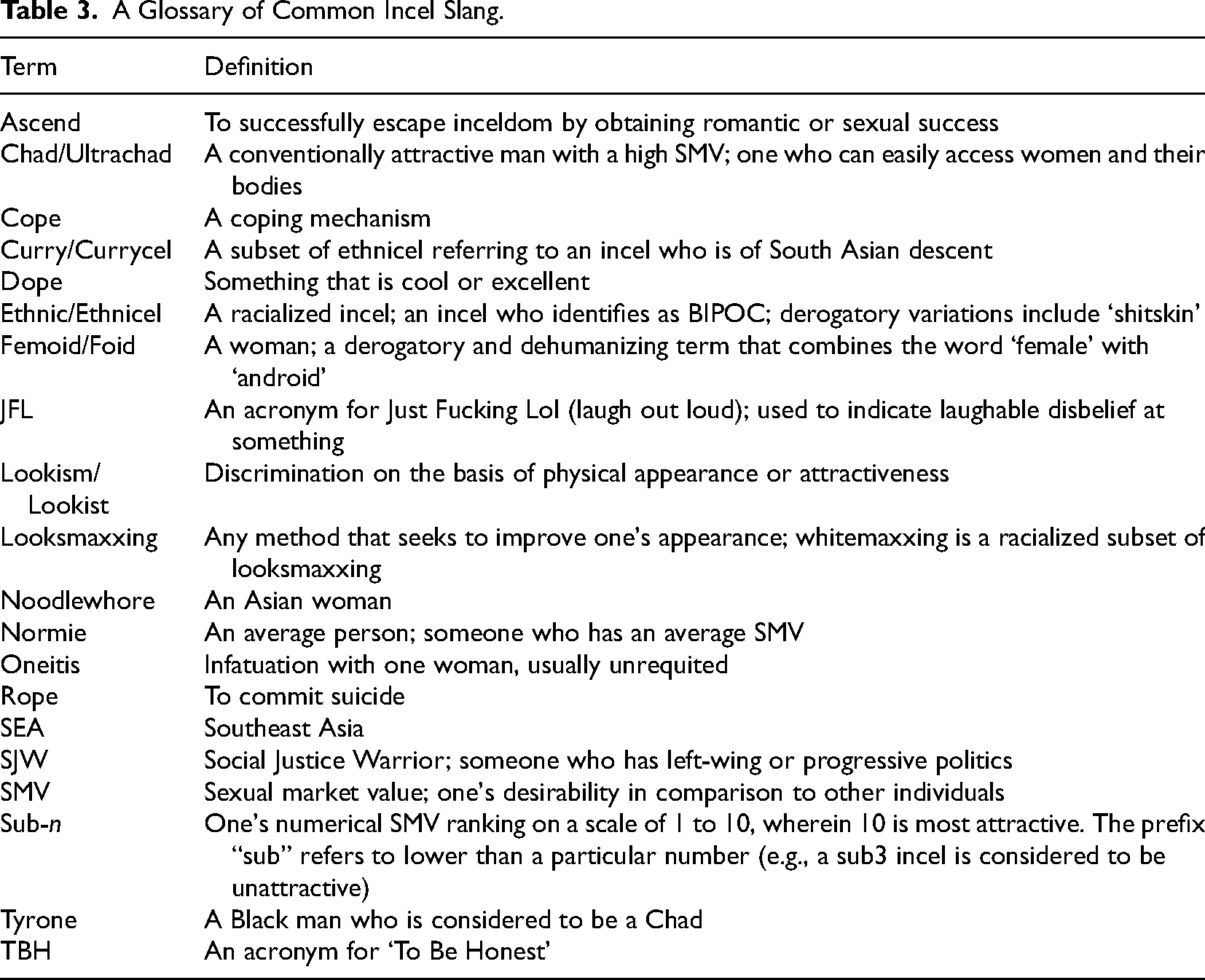
Analyzing the themes within the forums solicited a reliance on the specific inner-group terminology that incels use; a glossary of incel slang is shown in Table 3. The thematic analysis revealed four key themes, each comprised of multiple subthemes: (a) race matters when considering one's probability of romantic and sexual success; (b) race does not matter and is an irrelevant variable in one's romantic and sexual success; (c) race matters to an extent depending on the context; and (d) whether or not race matters, incels are victimized and women are ultimately to blame. These four themes and examples of each subtheme are shown in Table 4.
A Glossary of Common Incel Slang.
Themes and Subthemes Found.
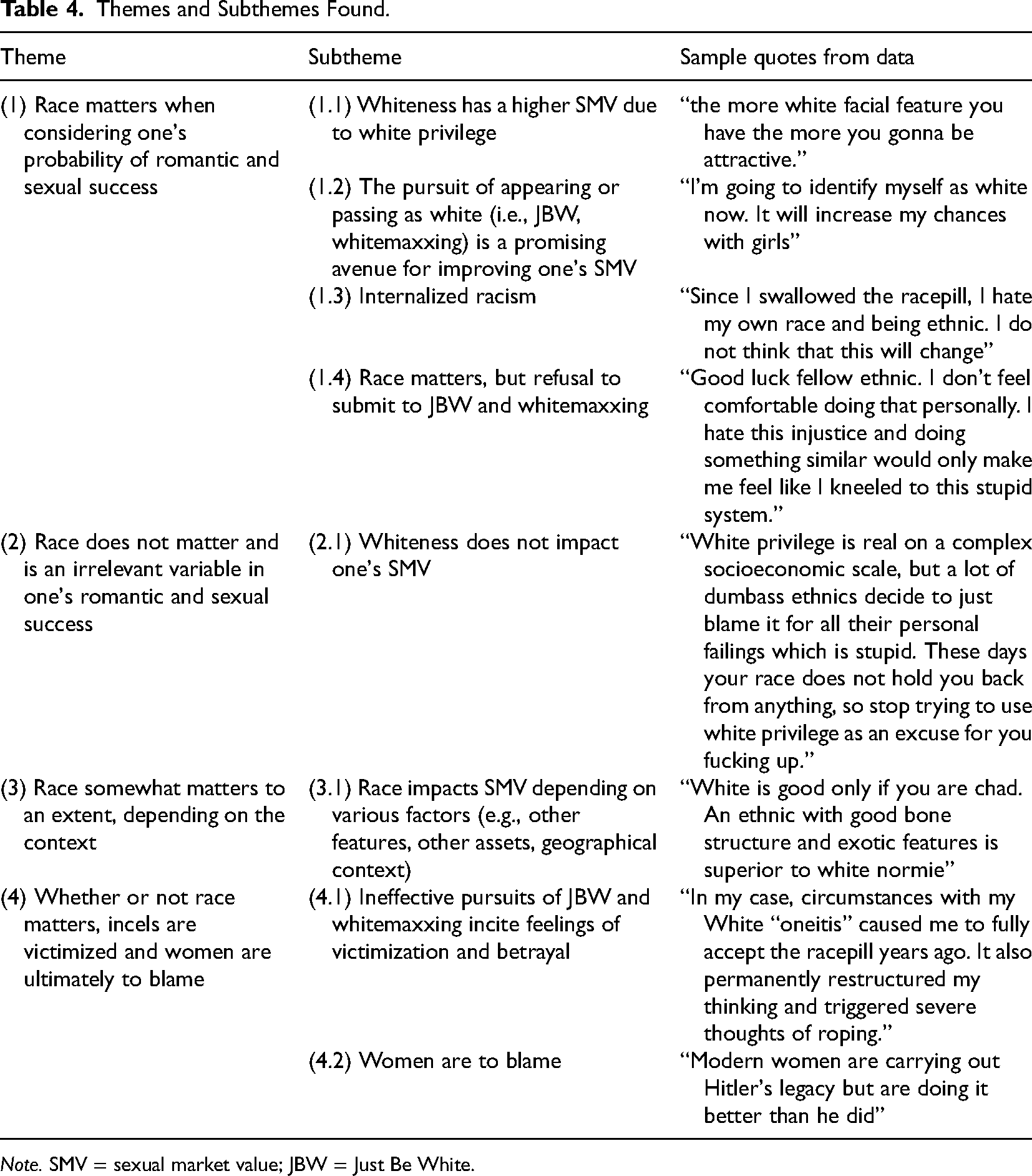
Note. SMV = sexual market value; JBW = Just Be White.
Theme I: Race Matters
Whiteness has a Higher SMV due to White Privilege
The most common theme was that race matters, and that an incel's white privilege (or lack thereof) will impact their ability to access women and their bodies. For example, some incels noted that “being white is an instant SMV boost wherever you are. It's common sense” (User 8) and that “the more white facial feature you have the more you gonna be attractive” (User 113). Many incels saw whiteness as more desirable, and some racialized incels believed that one cannot even be an incel in the first place if they are white. In other words, these incels claim that due to the overwhelming romantic and sexual privilege that whiteness brings to a white individual, one's positionality as a white incel is inherently contradictory. Others believed that although white men can identify as incels, they nonetheless carry a considerable amount of privilege in the dating sphere due to these dominant norms of attractiveness: Whites can definitely be incel but you guys have the best chances of escaping. Check the studies bro, white dudes are the most desired. Plus white privilege is real and even though you’re incel you can still benefit off of privilege which is dope. (User 97)
Many incels agreed: “I think what ethnics are trying to say is that being white is a significant plus in the dating scene, nobody is saying that whites can't be incel but rather that they have it easier than non-whites” (User 202) and that “everyone knows whites have it easier, being white won't make you an ultrachad automatically, but it will slightly increase your chances only because of your skin and facial traits” (User 44). In an almost biologically deterministic way, we see the ways in which whiteness is centered as the normative identifier of attractiveness, desirability, and SMV. Many incels who swallow the racepill uphold this belief that whiteness generates dating privileges and conversely, as one incel puts it, “if you’re ethnic you’re also probably ugly” (User 8). These beliefs undeniably reproduce the notion that attractiveness is equivalent to whiteness, and that racialization is a negative embodied experience in any romantic context.
The Pursuit of Appearing/Passing as White is a Promising Avenue for Improving One's SMV
With a core ontology rooted in the belief that whiteness is most desirable, many incels discussed and committed to several whitemaxxing tactics. As some incels explained, “I'd just do skin lightening surgery” (User 51) and “I'm going to identify myself as white now. It will increase my chances with girls” (User 88). Various whitemaxxing tactics were described including wearing colored eye contacts, dying their hair a lighter color, legally changing their name to appear more white, and perhaps even some more drastic approaches such as jaw implant surgery to make one's face appear more conventionally masculine, double eyelid surgery to change the appearance of one's eyelids, and using skin whitening creams. As one incel shares, I am a middle easterner of kurdish descent. But from now on I will keep this secret from girls. From now on, I identify myself as a white European. The next time a girl asks me about my descent, I'll say I'm half Italian and half Greece. This is a very interesting mix and most Italians and Greeks look a bit similar to us middle easterners, so they would not question that. I will also try to look more European. I am already light skinned but would like to go further. I'd soon like to buy good looking contact lenses, blue or green, to make it even more realistic. I had also thought about dyeing my hair brown or blond but this is unfortunately very harmful for the hair, which is why I will not do it. I also want to get a European name for myself. I thought of Giovanni or Pietro but if you think of something better then write in. Along with my looksmaxxing plan (nose job, new hairstyle, gym) my whitemaxxing will raise my chances with girls and hopefully I'll ascend. (User 88)
Internalized Racism
Of the racepilled incels who believe that race and, by extension, whiteness are significant determinators of one's SMV, many also identified ideas and beliefs that aligned with racism. As User 88 explains, “since I swallowed the racepill, I hate my own race and being ethnic. I do not think that this will change.” As a colossal and pervasive structure, some incels illustrated how racism becomes adopted, internalized and transformed into self-hatred, disgust toward their physical characteristics (e.g., skin color, hair texture), and desire to dissociate from their racial group. User 97 agrees, associating their own racial identity with feelings of worthlessness: “JFL @ white dudes denying the racepill. Probably because they don’t know what it's like to be a worthless ethnic.” Several incel commentators echoed these sentiments, many identifying their racialized identity as a source of disadvantage and unattractiveness: “i wish i was white” (User 145) and “being ethnic makes me sad” (User 88). Here, whiteness works to pave the road for racialized incels to succumb to internalized racism and self-loathing.
Race Matters, but Refusal to Submit to JBW and Whitemaxxing
Whereas many racialized incels spoke to internalized racism and self-hatred, a small but significant minority of other racialized incels acknowledged the role of white privilege but ultimately resisted aligning themselves with or succumbing to it. As one incel poster states, “[g]ood luck fellow ethnic. I don't feel comfortable doing that personally. I hate this injustice and doing something similar [whitemaxxing] would only make me feel like I kneeled to this stupid system” (User 12). This incel identifies JBW and whitemaxxing tactics as a form of submitting to this system of whiteness. To the above incel, these tactics feel like an “injustice” to him. It is vital to note that while a number of racialized incels come to a consensus that racialization inhibits their ability to access romance and intimacy, refusing to pursue these tactics and reproduce whiteness can be seen as an act of resistance.
Theme II: Race Does Not Matter
Whiteness Does Not Impact One's SMV
Contrasted with the incels who believed that race significantly impacts one's desirability, the next most common theme was a disbelief that whiteness is intertwined with one's ability to access women. This group of incels dismissed JBW and whitemaxxing tactics as a justification or excuse for one's personal shortcomings or inability to romantically or sexually succeed: If you believe JBW theory is real then you think “no, my face isn't the problem, it's my race! Women just don't like ethnic guys!!” Nah, your face is shitty. That's all there is to it. And there's nothing more personal and worse than knowing that your face is unattractive. (User 39) Being white alone is nothing. It’s ridiculous how some bitter ethnics are so brainwashed by the [SJWs] that they preffer to whine about how whites have it easier in comparison to them. Instead of seeing the truth, that for foids only your face, frame, height matters. (User 3)
Many of these incels identified as white, noting that their whiteness has not equipped them with any privilege in the dating sphere and that despite being white, they are still unable to successfully date: “being white has done nothing for me tbh” (User 96). Others critiqued JBW and whitemaxxing by highlighting that Black men are often successful with women: JBW is made up nonsense by coping ethnics who think not being white is their main issue when their real issue is usually being short, and the same people who promote JBW think whites have it easier than blacks which is straight up wrong. (User 39)
A number of incels concluded that race and whiteness does not impact one's SMV; instead, overall physical attractiveness matters most. This was the prime rationale used to explain why some racialized men are not considered attractive whereas others are. Many incels used Black men as prime exemplars of this success, particularly the Tyrone trope which refers to a Black man who is sexually successful (“Tyrone,” 2021). As can be seen, the hypersexualization and fetishization of Black men is not a new phenomenon.
Theme III: Race Somewhat Matters
Race Impacts SMV—to an Extent
A considerable amount of middle-ground incels reported that race matters, but only in combination with a desirable face structure, bone structure and genetics, as well as wealth, employment, and other neoliberally-defined attractive assets. As one incel claimed, “White is good only if you are chad. An ethnic with good bone structure and exotic features is superior to white normie” (User 133). Another commentator agreed, noting that “the truth is you still have to have a somewhat decent face, bone structure and height” (User 75). In this sense, the privilege that accompanies whiteness is considered to only be activated in combination with these other socio-economic and physical assets including physical appearance, employment, and wealth. Desire, hence, is dually conceptualized on racial lines as well as on class-based lines.
Other incels believed that race only becomes productive depending on one's geographical context. These incels were driven to believe that racialized tactics such as JBW and whitemaxxing are only relevant in multicultural societies that are not racially homogenous. This idea was frequently put into conversation within specific geographical contexts, including Southeast Asia and nearby countries: The racepill is just irrelevant in countries where one ethnicity takes up 95%+ of the population. In such places, even a lower SMV race might sort of become a positive for helping a man stand out from the others. Women seem to have a preference for foreign races too. (User 17) Personally i think white guys have more chances to get laid in western countries, but this only really applies if you're atleast normie tier (5+), a 5/10 white guy would destroy a 5/10 curry…but if the white guy lives in an area that's basically ONLY white he's back to square one…as his best chance would be going after noodlewhores. JBW also applies if you're rich enough…go live in SEA. (User 92)
Theme IV: Victimized Incels and Blameworthy Women
Ineffective Pursuits Cause Feelings of Victimization and Betrayal
When racepilled incels pursued JBW or whitemaxxing tactics and were met with failure, many incels cited feelings of disappointment such as anger, betrayal, hopelessness, embarrassment, self-harm, and suicidal ideation: “In my case, circumstances with my White ‘oneitis’ caused me to fully accept the racepill years ago. It also permanently restructured my thinking and triggered severe thoughts of roping” (User 209). Within the incel community, “oneitis” refers to an incel's typically unrequited infatuation with one woman (“Oneitis,” 2021). As another incels explained, I always denyed the racepill out of pride and because somehow it was so embarrassing and humiliating to admit it…but then i asked myself this: “if there's no difference between whites and ethnics in looks, then why do ethnics universally prefer white features to their own even if no whites live among them? why would almost every ethnic prefer to have blue eyes over brown eyes and white skin over brown skin, why does brown coloring look like shit"? And from that moment the countless racepills started running down my throat and it only got more and more brutal with more and more self-hate and hopelessness. (User 207)
Women are to Blame
Whether or not incels agreed on the validity of white privilege within the dating realm, almost all incels felt victimized and located women as the prime subjects of blame as a result. Women were not only blamed for reinforcing white privilege by preferring white men over racialized men, but women were also to blame for preferring attractive racialized men (i.e., dating Black men) as well as for their tendency toward virtue signaling (i.e., dating unattractive racialized men to display their good character). For example, one incel notes that “foids prefer to sleep with Chad ethnic refugee than white normie” (User 9). Another incel villainizes a woman for being romantically involved with a disabled man: “Foids will still use him for virtue signaling. Even pitty fuck him” (User 49). Some incels went as far to compare women with Nazis due to their presumed fetishization of whiteness: “Modern women are carrying out Hitler's legacy but are doing it better than he did” (User 6) and “noodlewhores are the most committed nazis and would eradicate all non-whites and non-Chads if they could” (User 77). Finally, women were also to blame for their vindictive fixation on men's nonracial qualities such as their salary, age, and status: “they only care about money” (User 34), “They only want money…If you look like you have money, you will get matches on tinder” (User 47), and “She would treat him like shit and leave him the minute he runs out of money” (User 70). Albeit these blaming tendencies were often contradictory and immensely misogynistic, there was an overwhelming agreement among these incels that women were ultimately to blame.
Discussion
The findings revealed a general consensus among the incel community that society is highly lookist, meaning that physical appearance is a key determiner of attractiveness and desirability. Although some predominantly white incels disagreed that race matters in their pursuit to access women, many still contended that whiteness plays a significant role in one's perceived desirability. Racialized tactics such as JBW and whitemaxxing are built on the essentialization of race, placing high importance on the value of whiteness within the dating sphere. These tactics work to reinforce white supremacy by urging racialized incels to change themselves to appear more white and, hence, more desirable. Here, the alignment with racism and white supremacy is embedded within these racialized promises.
JBW and whitemaxxing provide avenues of hope, especially for racialized incels who believe that these pursuits will help alleviate their inceldom. Recalling Lauren Berlant's (2011) cruel optimism, this sense of hope works to persuade racialized incels that these strategies will improve their chances of romance. This cruel optimism arises when racialized incels try to “pass through whiteness” (Ahmed, 2007, p. 159) in the dating sphere but are met with difficulty or realize that these pursuits are unsuccessful. In these discussion forums, many incels critiqued the effectiveness of these race-based solutions, arguing that they often failed to further their romantic pursuits or alleviate their distress. For these incels, JBW and whitemaxxing serve as unhappy attachments (Berlant, 2011) because they prove to be ineffective—whether that is because, as some incels identified, they are ‘too ethnic' or because they are not ‘white passing' enough.
When these racialized promises fail to provide what these incels feel entitled to, how does failure express itself? In Queer Phenomenology, Ahmed (2006) refers to disorientation as an unsettling affective experience when one feels out of place or misaligned from perceived normativity: “[d]isorientation as a bodily feeling can be unsettling, and it can shatter one's sense of confidence in the ground or one's belief that the ground on which we reside can support the actions that make a life feel liveable” (p. 157). Through their countless comments, many incels seemed to undergo a process of disorientation when they realized that these racialized pursuits were beyond reach, unsustainable, or failed to supply the dating success that they were promised. JBW and whitemaxxing served as exemplars of cruel optimism which, upon realization that these racialized promises were unattainable, produced feelings of disorientation and subsequent grievance. Many incels described turning those aggrieved disoriented feelings inward and garnering a sense of distress, hopelessness, self-hatred, anger, and internalized racism. Others turned those feelings outward and resorted to blaming women and inciting gender-based violence. All of them, however, felt victimized as a result. When understood together, this victim narrative and viewing women as the sole subjects of blame depicts the productive potential of cruel optimism in reinforcing gender-based violence, networked misogyny and white supremacy. Networked misogyny and white supremacy are not only intertwined, but they are deeply embedded in the fundamental patriarchal and racist building blocks of North American society. As Torres and Pace (2005) emphasize, the patriarchy is a focal expression of whiteness: “patriarchy has colour and if you challenge the mechanisms of racial management, you ultimately have to challenge the techniques of gender management, too” (p. 172).
Those who pursued the siren song of these racialized promises were met with vast hopelessness and perceived grievance. However, rather than critiquing the infiltration of whiteness within dating norms and the normative conceptions of beauty that construct them as undesirable, incels instead endorsed and participated in this system by reproducing this dominant discourse of beauty and the associated discipline that emanates (e.g., exclusion from dating, perceived unattractiveness, internalized racism). It is Berlant's (2011) concept of double bind that is particularly useful in this analysis of racialized cruel optimism. To quote Berlant (2011), cruel optimism's promise of progress and attainment creates an impasse that prevents the detachment “from what is already not working” (p. 263). Herein lies the double bind. Not only did the majority of incels in this study endorse and reproduce this system of white supremacy, but they also misidentified women as the key source of fault. The resulting anger, disappointment and feelings of betrayal embedded within this double bind are rooted in the promise of “what might happen” (Berlant, 2011, p. 73) or “the change that's gonna come” (p. 2) from pursuing JBW and whitemaxxing, while at the same time navigating the cyclical feelings associated with failure in attaining these desires—or perhaps even their impossibility.
Social Work, Racist Misogyny, and Beyond
It is vital to recall that although over half of incels seek therapy and counseling services, most incels deem therapy as largely unhelpful because it fails to alleviate their core presenting concerns (Speckhard et al., 2021). In other words, the majority of incels want mental health support and will pursue social work services, oftentimes finding their needs and concerns unaddressed. Herein lies a vital opportunity for social workers to engage with and support members of the incel community who may be experiencing a vast array of mental health challenges, including depression, anxiety, suicidal ideation, and self-harm, as well as various race-based concerns such as internalized racism. In a recent report prepared by the Organization for the Prevention of Violence titled Involuntary Celibates: Background for Practitioners, practitioners who support incel clients are dually encouraged to work toward understanding the individual's mental health concerns, as well as to acknowledge and validate their grievances and frustrations without sympathizing or agreeing with their belief system (Hastings et al., 2020). By prioritizing fundamental clinical skills such as active listening, validation and empathy, social workers can begin to build a therapeutic relationship with the individual—a relationship that is essential in attempting to address deeper, more complex belief systems such as racism and misogyny.
The present study has depicted how whiteness is constructed and operationalized in incel contexts. To that end, the findings illustrate that for many incels, race serves a key purpose and is inherently intertwined with misogyny, racism and the potential access to women's bodies. Social workers supporting incel clients must garner a better understanding of how race and whiteness impact the incel clients’ worldview, as well as how collective frustration acts as a sustaining facilitator of white supremacy and vindictive views toward women. Social workers must also grasp the affective ways in which failure emanates when incel clients are unable to succeed in their racialized pursuits (i.e., self-harm, anger, internalized racism). Driven by the need to prevent and address gender-based violence, social workers may also draw on existing initiatives to prevent violence against women and pursue strength-based prevention efforts that work to explore, interrupt and counter harmful narratives around race, whiteness and constructions of masculinity.
While this research has conceptualized incel rhetoric as an exemplar of misogyny and white supremacy, it is vital for social workers to remember that race is a profoundly nuanced experience and it is often intertwined with overarching systems of whiteness, desirability, and harm. This research has unveiled the ways in which ineffective racialized promises of JBW and whitemaxxing undergo a process of cruel optimism, oftentimes rendering many incels to a state of blackpilled fatalism. Social workers supporting incel clients should be aware of how race and whiteness can be mobilized to reinforce a blackpilled sense of hopelessness. The blackpill is indeed hard to swallow, especially when it implicates one's racial identity: [T]he blackpill might be liberating, but it comes at the price of the loss of comfort and naiveté, of happy innocence. Harsh truths are cold and unforgiving, and blackpill thought is full of harsh truths. Even if this is something you do not wish were true, one needs to accept that the universe does not run on wishes and hopes. The blackpill is exhausting. It’s pervasive. It’s draining. It's unfortunate. (Castle, 2019, p. 12–13)
Footnotes
Acknowledgments
The author would like to thank Dr. Dawn Moore for encouraging and supporting this research.
Declaration of Conflicting Interests
The author declared no potential conflicts of interest with respect to the research, authorship, and/or publication of this article.
Funding
The author received no financial support for the research, authorship, and/or publication of this article.
