




Abstract
As COVID-19 reached pandemic levels in March 2020, schools shifted to remote learning. Student parents in higher education had to adapt to their own remote learning and assume responsibility for childcare and their children’s education. Few studies have explored the impact of COVID-19 on mothers who are also full-time students. This study utilized a phenomenological approach to understand the lived experiences of mothering students during the COVID-19 pandemic. Student mothers were recruited from a large, public, Hispanic-serving university in a Southern state. We conducted interviews with 15 student mothers who had at least one child under the age of 18 during the first six months of the pandemic. Three main themes emerged from the analyses: (1) successfully meeting educational requirements; (2) dealing with the mental health impact of the pandemic; and (3) changing the institutional structure. The first theme captured strategies mothering students implemented to ensure their own or their children’s educational goals were met. The second theme encompassed how mothers handled the stress caused by the pandemic. The third theme explored ways that mothers resisted gendered expectations and norms around care. Implications for policy and social work practice include changing institutional structures to enhance support for mothering students.
Keywords
As the novel coronavirus (COVID-19) reached pandemic levels in March 2020, schools and institutions of higher education raced to adapt curricula to an online format (Adedoyin & Soykan, 2020). Digital instruction became the main strategy for educating children in grade school (United Nations Children’s Fund [UNICEF], 2020) as well as students at institutions of higher education. With digital instruction becoming the norm, much of the responsibility for children’s academic success and social emotional learning fell on their parents or caregivers (UNICEF, 2020). Among parents with younger children, almost half reported disruptions in childcare (Patrick et al., 2020), paralleling increases in gender gaps in employment during the initial months of the pandemic (Qian & Fuller, 2020). For parents who are also studying, this created a unique challenge as they navigated online learning for themselves and their children’s education or care. Although more than one in five undergraduate college students are parents or guardians of at least one child (Institute for Women’s Policy Research [IWPR], 2014; Gault et al., 2014; Reichlin Cruse et al., 2020), little is known about their experiences navigating remote learning and childcare responsibilities.
During the COVID-19 pandemic, student parents had to navigate additional childcare responsibilities and adjust to their own remote education. Before the pandemic, student parents had household responsibilities, childcare, and school responsibilities (Grubb & Lazerson, 2004). In balancing these three responsibilities, students—particularly mothering students—have to juggle and prioritize demands and tasks related to their children, homes, and education (Schuldt, 2011). Even after completing assignments and tasks for one's courses, parenting students have additional tasks and responsibilities that result in little time for oneself. With the change to online schools for children and childcare centers’ closures, parenting students have faced additional responsibilities and roles as they navigate their own academic success. Few studies have explored how student parents have navigated changes during the COVID-19 pandemic or how these changes have impacted their academic success. This study explored the experiences and needs of student parents during the COVID-19 pandemic.
Theoretical Framework
This study is guided by feminist theories of care (Held, 1995; Koggel & Orme, 2010; Tronto, 1989, 2020). From a feminist theory of care, it is important to “broaden our understanding of what caring for others means, both in terms of the need to restructure broader social and political institutions if caring for others is to be made a more central part of the everyday lives of everyone in society” (Tronto, 1989, p. 184). Indeed, true changes in responsibility for care would require a restructuring of how care is valued in the political and social context (Koggel & Orme, 2010). Specific to the social work profession, feminist theories can help practitioners to critically assess individual and sociopolitical factors that may impact clients, and frame assessment and interventions at the micro, meso, and macro levels (Turner & Maschi, 2015). Thus, larger conversations about the ethics of care and the role of social structures in upholding gendered division of care are needed in social work practice and research.
Although the past several decades have seen an increase in women entering the workforce and managing responsibilities outside the home, such as employment or education, women remain primarily responsible for most domestic tasks and childcare (Delphy & Leonard, 1992). In fact, when women enter the labor force, instead of reducing caring responsibilities, they tend to have a double burden of duty in which they add work responsibilities on top of family care they are expected to do (Hooyman & Gonyea, 1995). To describe the burden and balance of paid employment, housework, and emotional work that disproportionately fell on women, Duncombe and Mardsen (1995) coined the concept of the triple shift to depict the multiple roles and responsibilities women felt they needed to juggle. A recent survey found that contemporary women commonly work three shifts: work at home, a paid position, and unpaid office housework (McKinsey & Company, 2021). The concept of the triple shift has been adapted to describe mothering students, who must balance housework, emotional work, and their own studies (Schuldt, 2011; Stone & O’Shea, 2013). The triple shift is intensified for mothering students, who face interrupted study time and childcare, domestic duties, and in some cases, paid work (Stone & O'Shea, 2013; Smith, 2017).
Inequities in care may be exacerbated by the COVID-19 pandemic. Some initial research on mothers in academia during the pandemic has found that many have experienced stress and exhaustion as they negotiate the triple shift of academic productivity, housework, and childcare (Rubilar Donoso et al., 2021). Thus, this study explored the experiences of mothering students during the pandemic who had school productivity, housework, and childcare responsibilities.
Literature Review
In recent decades, enrollment in postsecondary education has increased (Beattie et al., 2018), yet, only about 50 percent of students complete college (Altonji et al., 2012). Farruggia and colleagues (2018) found positivity and grit (perseverance toward long-term goals) were associated with postsecondary student retention and academic success. But, there are also important structural factors such as a culture of competition and individualism (Thompson, 2003), access to transportation and childcare (Mottet, 2019), and student support services (Sallee & Cox, 2019) that can impact student retention and success. Research has shown that women who enroll part-time are more likely to retain than those who enroll full-time (Markle, 2015).
The triple shift is disproportionately experienced by women (Smith, 2017), and may be exacerbated when mothers simultaneously pursue higher education. In fact, in contrast to mothering students, Smith (2017) found that fathering students did not report experiences of having to balance family responsibilities with studying. This may reflect ongoing gendered expectations about care and the lack of institutional structures that could improve equity. Brooks (2015) argued that student mothers “are caught between two policy imperatives” of investing in themselves while also ensuring they are good mothers (p. 517). Maternal educational attainment can have a two-generational approach, as higher parental education is linked to better parent and child outcomes. Thus, in addition to improving their own opportunities via education, mothers who study also model the importance of education for their children. In fact, despite the barriers mothering students may face, some research suggests that they have higher grade point averages than non-parenting students (Dill & Henley, 1998; Gault et al., 2014). It is possible that parenting students feel pressured to model positive academics for their children (Haleman, 2004), showing their children how they can overcome barriers and challenges (Katz, 2013). Student mother outcomes may also indirectly impact their children as they model their commitment to studying and pursuing education (Ricco et al., 2009). Yet, pursuing higher education can add to mothers’ guilt when balancing tensions between coursework and family responsibilities (Brooks, 2015).
There are few national estimates of college/university students who are parenting. However, some estimates have found between 22 percent (Reichlin Cruse et al., 2020) and 26 percent (IWPR, 2014) of undergraduate students or 53 percent of nontraditional students to be pregnant or parenting (National Center for Education Statistics, 2002). Nontraditional students are defined by their age (e.g., 25 years or older when they begin their undergraduate studies), student status (e.g., part-time enrollment), and/or working during their studies (Chung et al., 2017). Approximately four million U.S. college students are parenting each year (IWPR, n.d.).
Some research on student mothers and fathers has found that both groups face barriers to academic success. Indeed, an estimated 52 percent of student parents drop out of college within six years of enrolling, compared to 32 percent of nonparents (U.S. Department of Education, 2014; in Wladis et al., 2018). High dropout rates among parenting students may be due to issues related to work-life balance, time constraints, and quality of the educational experience (Wladis et al., 2018), as well as financial challenges (IWPR & Ascend, 2019; Moreau & Kerner, 2015; Sallee, 2015). Other factors such as their child(ren)'s age may also impact the academic success among student parents. For example, some literature suggests that student parents with younger children encounter more challenges finishing a degree than those parenting older children (Lovell, 2014). Considering these challenges, there is a need to develop and implement university policies to accommodate and support student parents (Brown & Nichols, 2012; Springer et al., 2009).
Researchers has shown disparities among students with parenting responsibilities, as nearly 70 percent of student parents are women (Cruse et al., 2019). Sixty-two percent of university student mothers are single parents; in contrast, 61 percent of student fathers are married (IWPR, 2019). Often, student mothers face conflicts between being “good students” and cultural expectations that they also are willing to sacrifice their own needs for their children (Espinoza, 2010; Estes, 2011). Many student-parents also identify as women of color: Almost half of African American women in college have children, compared with 41 percent of American Indian women, one in three Latina women, and 29 percent of White women in college (Gault et al., 2014). A 2014 IWPR report found that one year after graduation, female students with children had $3,800 more debt than their childless peers and approximately $5,000 more debt than male students with no children (IWPR, 2014). Thus, female students with children may have more significant financial challenges than female students without children or male students with children. The disproportionate representation of women of color among student parents may partly explain some of the disproportionality students of color, particularly Black students, face in student loan debt (Baum & Johnson, 2015).
The Current Study
Guided by feminist theories of care, this study used a phenomenological approach to examine the following research question: How have student mothers navigated the triple shift (e.g., coursework, childcare, and domestic responsibilities) during the COVID-19 pandemic?
Methodology
Data for this analysis come from a qualitative study that explored student parent needs and experiences during the COVID-19 pandemic. Students were recruited from a large public university in a Southern state that is designated as a Hispanic-Serving Institution. There is a large proportion of non-traditional students at the university, including student veterans, a student body that is racially, ethnically, and age diverse, and a large proportion of students who are also parenting. The authors sent a recruitment email to the program directors at each department or school to forward to their student listservs. Students were eligible to participate if they were enrolled at least part-time at the university at the time of the study and were the primary caregiver for at least one child under age 18 at least 50% of the time. Prior to conducting the interview, participants completed a short survey that contained demographic information such as race/ethnicity, marital status, and program of study.
In-depth interviews were conducted via Zoom video conference platform in July and August 2020. Interviews lasted between 30 and 60 min and were scheduled at the convenience of participants. All interviews were conducted by one member of the research team, who had completed all required human subjects training and had been trained by the lead author of the study in interviewing techniques. Interviews were conducted using a semi-structured interview guide, were audio recorded and transcribed verbatim by a professional transcription company. Each interview began with an informed consent. All procedures were vetted and approved by the Institutional Review Board at the lead author’s institution.
Sample
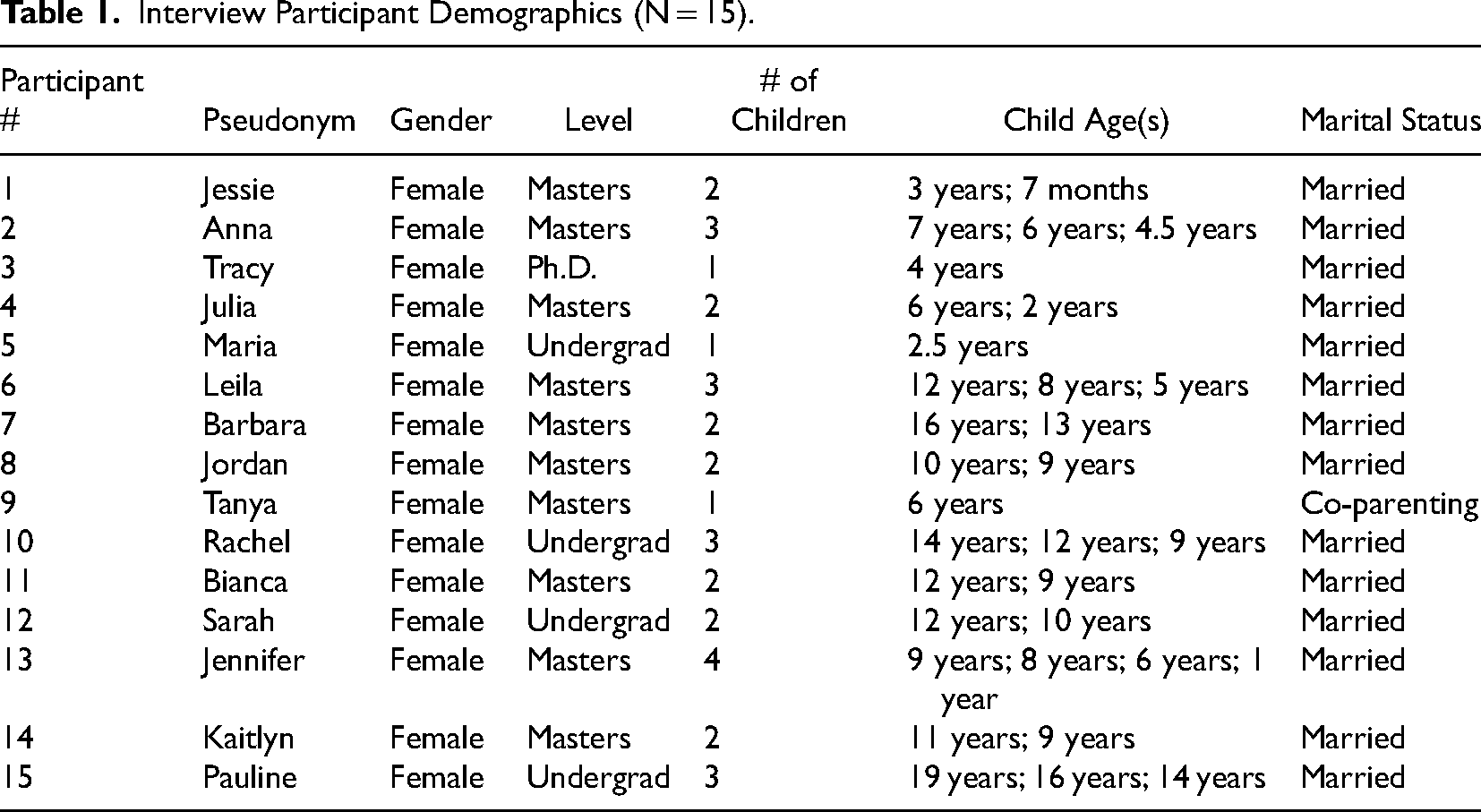
There were 15 interview participants, all of whom were women and identified as mothers of at least one child under age 18. Table 1 displays the interviewees’ demographic information. We did not collect additional individual-level information from the interviewees to maintain participant confidentiality. However, from the anonymous survey, among the student mothers who opted to participate in an interview, 52.17% identified as non-Hispanic White, 17.39% identified as non-Hispanic Black, 19.56% identified as Hispanic, 4.34% identified as Asian, 4.34% identified as Multiracial, and the remaining 2.17% preferred not to respond.
Interview Participant Demographics (N = 15).
Data Analysis
Three research team members reviewed each transcript for accuracy and assigned pseudonyms to any names that appeared. The authors used a phenomenological approach (Sloan & Bowe, 2014). Consistent with the phenomenological approach, in the first coding round, three researchers carefully reviewed each transcript and identified meaning units (Moustakas, 1994). The researchers identified meaning units based on “essential” rather than “incidental” experiences of the lived experiences of student mothers (Butler-Kisber, 2010). The researchers extracted significant statements verbatim from the transcripts and then worked together, guided by the theoretical framework, to formulate meanings and group similar meanings into larger themes (Butler-Kisber, 2010). Throughout the process, three researchers independently analyzed each transcript. During the first and second rounds of coding, the researchers bracketed—creating memos and notes as they analyzed the data—to recognize their assumptions, beliefs, or values that might impact their interpretations (Groenewald, 2004). Researchers grouped and clustered meaning units in the second coding round based on similar underlying themes (Hycner, 1999). Researchers conducted all coding in Excel, and the coders held weekly meetings to discuss emerging themes and resolve any discrepancies.
Researcher Positionality
To enhance rigor in the qualitative process, we offer a brief statement of our own positionality. Author One is an assistant professor at a large, Southern university. She was a mothering parent during her graduate studies and has had to reconcile work-family responsibilities during the COVID-19 pandemic. Author Two is a doctoral student at a large, Southern university and has pursued her education thus far single and childfree. Author Two’s work experience relevant to this study includes providing adult community college students case management services and five years as a university academic advisor. Author Three is a postdoctoral scholar at a large Southwestern university. The author started her doctoral education as a new mother on top of being an international student. During the COVID-19 pandemic, she welcomed a second baby, changed jobs, and moved to a new state. Author Four is a recent graduate of a large Southern university. She has pursued her education while being married and childfree. Author Five is an associate professor at a large Southern university and is a mother of three children, two of whom were in elementary school during the COVID-19 pandemic. During 2020–2021, she guided her children through virtual school, homeschool, and an in-person reduced density alternative school option. Author Six is an assistant professor at a large Midwestern university. He completed his master’s and doctoral degrees as a student parent before the pandemic. His research focuses on unmarried mothers’ socioeconomic disadvantages, behavioral health needs, and socioeconomic empowerment.
Results
Through the qualitative phenomenological analysis, three themes emerged: 1) successfully meeting academic requirements; 2) dealing with the mental health impact of the pandemic; and 3) changing the institutional structure. These themes were all connected by the central concept of fulfilling and challenging gendered norms. Student mothers experienced challenges with the triple shift as they fulfilled educational, childcare, and household expectations placed on them, all of which were exacerbated during the COVID-19 pandemic. On the one hand, they experienced mounting pressure not only to succeed in their own academics, but also to ensure that their children were educated—be it formally through remote classes or informally through stimulation of younger children. On the other hand, they attempted to fulfill responsibility after responsibility, leading to a feeling of struggling to keep their heads above the water to just get through the daily routines. Many mothers felt overwhelmed, anxious, and stressed with the added pressures and strain of trying to meet everyone’s expectations. Each individual theme is explored in more detail below.
Successfully Meeting Academic Requirements
The first theme that emerged was ensuring educational expectations are met: changing strategies to successfully meet academic requirements, which encompassed challenges and struggles unique to parenting students adapting to the COVID-19 pandemic. In some cases, mothers reported changing routines to meet their own educational needs or their children’s. Several mothers reported feeling like they were “being pulled in all different directions” (Jordan, mother of two), or trying to get everything done. This duality of being responsible for one’s own education and their children’s weighed on mothers. For example, Rachel, a mother of three, reported: We need help when it comes to teaching our children and trying to find times to teach ourselves. How am I supposed to do that? When am I supposed to do all this? … How am I supposed to function being a full-time student and trying to teach my kids at the same time? … I don’t have anywhere for my children to go … When you know, my job as a mom is, my husband works all day … I am still in charge of laundry, cooking, cleaning, making sure my children still get seen at their normal checkup times.
Additionally, balancing multiple roles and responsibilities often meant prioritizing family or education over the other. For example: You don’t have the luxury of just focusing on your school. It’s always going to, I guess, play second fiddle to your family, which I think is as it should be, but it doesn’t really change the fact that your time is not always your own (Leila, mother of three).
Other mothers felt overwhelmed by pressure to keep their children educated and ensure that their children were meeting their educational expectations. Often, this included pressure to learn how to become teachers for their own children. He was bored. He finished his work in about 15 min for the week and he had nothing to do. So, I would come up with my own like science project that you can go outside and do, or, you know, math and measuring … so that’s the educational thing that I would do for my kids. I felt pressured to keep them stimulated (Jordan, mother of two).
For some mothers, this meant engaging in strategies to ensure their own educational success. Given their childcare and household responsibilities, mothers often resorted to creative approaches to ensure that they could complete their own schoolwork, such as adapting to new schedules or multitasking. For example: So when I take them to practice, I sit in the car and I have two hours. That’s pretty uninterrupted. Um, and I honestly can get more done in those two hours than at home where you’ve got dishes or laundry or other things distracting you. (Jordan, mother of two).
I was used to being able to do certain things while they were at school and that’s changed a lot. There are certain things I need to do for my classes. Um, like use a lockdown browser, with the camera on and no one else can be around, and those sorts of things, or do a voice recording for Spanish. And I have to wait until they’re asleep now to do those things. (Pauline, mother of three).
Child age also impacted parental ability to continue their studies successfully. Students with older children reported having an easier time meeting their own class deadlines because their children were able to manage their own coursework, whereas those with younger children needed to give more undivided attention to them. For example, Barbara, whose two children were in middle school, reported: I’m thankful that we have children that are able to pull themselves through academically. I wouldn’t know what to do. If I had to sit with them, sit with them for their academics as well. I don’t think I would be able to continue with my studies if I had to be a parent that had to sit with them and teach them their coursework or ensure that they were doing their coursework. If my kids weren’t responsible by themselves, I don’t think I could have continued my education.
In contrast, mothers of younger children mentioned challenges due to the lack of autonomy and higher level of dependence. I take my classes here and that is really difficult because my daughter always wants to be right here in my lap, no matter what I’m doing. And if she is not in here, she’s at the door, like, let me in, let me in. (Maria, mother of one)
Around my son’s schooling, he started kindergarten last year. So, having to be responsible for his education along with mine has probably been the biggest challenge and biggest stressor. Then along with this school year, he’s going into first grade and trying to figure out, because I am still working full time, how to manage making sure he gets his education as well as continuing with my education. (Julia, mother of two)
Dealing with the Mental Health Impact of the Pandemic
The second theme that emerged was dealing with the mental health impact of the pandemic, which reflected the mental and physical health impact of the COVID-19 pandemic on student mothers. Likely as a result of the pressure mothers felt to fulfill expectations related to their education, child rearing, and household responsibilities, participants reported losing sleep, feeling anxious, and other negative effects since the beginning of the COVID-19 pandemic. Anna, a mother of three, reported: So, I would say it’s taken a toll on my health. Cumulatively, lack of sleep has a really bad effect on your health. And, so I’m aware of that, and I worry about that. I’ve certainly lost a lot of sleep due to COVID.
In addition to loss of sleep, the uncertainty of the pandemic led to worries and anxiety among student mothers. Some experienced anxiety due to uncertainty over when schools would open, or whether their family would stay healthy. Others worried about job insecurity as shelter-in-place orders led to furloughs. Rachel, a mother of three, stated: So it was also that worry of financials, where we, I mean, we had saved up money thankfully, but I knew that it would eventually run out for us paying electricity, the gas, the water, our house taxes, all that was, uh, was a major concern of where more of this money was going to come from that we didn’t see.
Given the extra stress and responsibilities, student mothers recognized the negative impacts the pandemic had had on their own well-being. Jessie, a mother of two children, stated: I think a lot of it has just been trying to keep our heads above water. But yeah, I guess [support] is something that I hadn’t really invested a lot in. Maybe I should, but I had nothing I can point to specifically right now and that’s okay. And being, oh my goodness. A wife, a nurse, a student, a parent, like, oh my gosh. Imagine how busy.
Other mothers reported “never get[ting] alone time” and losing patience with their children more quickly. While some mothers found ways to “tag team” or split schedules to prioritize their own needs, by and large student mothers reported a need for more support, flexibility, and time.
Changing the Institutional Structure
The last theme that emerged from the data was changing the institutional structure. This theme encompassed the need to change institutional or system-wide policies and practices that could better support mothering students, both during and beyond pandemic times. Within this theme, there was a sub-theme of flexibility and dismantling traditional, rigid structures and expectations. For example: At first during COVID, one of my instructors wasn’t willing to let us take the test anytime except for the two-hour window that she wanted us to take it. And another student who I didn’t know […]she spoke up and she said, ‘but I have kids. What am I supposed to do with the kids?’ And the instructor said, well, you are going to have to be at class anyway right now. So it’s not my problem, what you do with your kids. And it was so clear to me because I have kids too, thinking, well, when I’m at school, my kids can’t come in the room while I’m taking the test. They can’t bother me. Someone’s watching them, but I’m watching them now and they can come in anytime they want (Anna, mother of three).
In addition to flexible policies, several mothers mentioned that a support group for other parenting students would be helpful. University counseling services were also mentioned as a positive source of support for student parents. For example: I was able to go see a therapist and talk to somebody, everything’s just so virtual now. It is just kind of reaching out to find out if there was anything available. And I did have some really good correspondence with a lady with the university (Leila, mother of three).
Financial resources and support were also mentioned by several student parents. Some mentioned childcare-specific resources or availability, while others mentioned increased financial aid and financial supports. For example: My daughter’s childcare center was in a home and she quit watching children within the home. And so then financially there wasn’t really another option. There are daycare facilities and stuff open, but when you can’t really pay your bills or buy food, you can’t really afford childcare either (Leila, mother of three).
Discussion
This study explored the lived experiences of mothering students during the COVID-19 pandemic. Three main themes emerged from the phenomenological analyses: 1) successfully meeting academic requirements; 2) dealing with the mental health impact of the pandemic; and 3) changing the institutional structure. All three themes connect to feminist theories of care, as student mothers grappled with ethical decisions related to prioritizing their own studies or their children’s well-being, often taking on the primary caregiving role even when there was a spouse or other adult in the household. In contrast, some student mothers pushed back against gendered notions of care, calling for larger social or political changes that could promote equity within and outside of the household.
The first expectation that connects to feminist theories of care is that mothers tended to assume responsibility for their child(ren) 's education or stimulation as they faced disruptions at the front end of the pandemic. For these mothers, there was a burden to take on additional responsibilities for their children's education, often reflecting gendered norms around childcare and household duties (Petts et al., 2021). Even before COVID-19, student parents, particularly mothers, faced an education-childcare-household dilemma (Grubb & Lazerson, 2004), resulting in a triple shift of responsibilities and roles. The lack of quality childcare impacts mothering students even in non-pandemic times (Miller et al., 2011). However, findings from our study suggest that the triple shift has been exacerbated due to new roles and responsibilities navigating remote education. Although some research has examined the impact of the COVID-19 pandemic on student experiences, such as retention and graduation (Aucejo et al., 2020), our findings suggest that mothering students face an added challenge in adjusting to their online education as well as their children's.
In parallel, mothers reported having to prioritize education or family and dealing with increased stress and strain due to the added responsibilities. For some, this meant opting to supervise their children's remote learning instead of being able to focus on their classes. For others, this included distractions like a sick child or a child crying during a synchronous lecture. In the second theme, dealing with the mental health impact of the pandemic, mothers expressed how they attempted to cope as education was shifted to remote learning. The loss of physical space and separation resulted in meshing roles and responsibilities that may have been more clearly delineated in the past. For many, the routines and structure they had before the pandemic were disrupted. Their education often took a backseat to their child's, with several mothers dedicating more time and effort to take an active role in their child's education. In doing so, student mothers in our sample performed to expectations of intensive mothering (Bell, 2004) by attempting to fill new roles and excel as mothers and students and educators or stimulators of their children.
The third and final theme that emerged from our data was changing the institutional structure to address and significantly change the triple shift and its disparate impact on women. Connected to feminist theories of care (Tronto, 1989), family and the larger society are structured based on gendered roles and responsibilities (Chambers, 2005). For these mothering students, not only did they experience gendered roles within their family and an undue burden of childcare and domestic tasks. But rather, they also faced gendered institutional norms that impeded their academic success. For example, although the burden for care continues to disproportionately fall on women (Petts et al., 2021), few academic institutions offer paid family leave to students. Other researchers have examined values of institutions of education, such as individual achievement and competition, that directly contradict empathy and care of others that gender socialization ingrains from an early age. For the student mothers in our sample, changing the institutional structure included building support and visibility of the presence of parenting students on campus. This suggestion aligns with prior literature (Barton et al., 2019; Nichols et al., 2017) that has called for the visibility of parenting in the academic world. Visibility could also include connections and groups for mothering students (Brown & Nichols, 2012). Other ways to change the structure could consist of increasing accessible, affordable childcare facilities on campus, as affordable childcare can improve student parent retention (McAlpine, 2015).
Limitations
There are several limitations to note in this study. First, the authors only sampled students at one large public university in a Southern state. The sample was all mothers, and the majority were graduate students and White (despite being conducted at a Hispanic Serving Institution). All mothers were also married or co-parenting, and most had a steady income and were members of a dual-earner household. Thus, the findings of this study should be contextualized within the sample. The lack of racial diversity among the sample is consistent with studies that found members of non-dominant racial /ethnic groups to be less trusting of research participation (Mendelson et al., 2021). The sole recruitment method for this study consisted of program directors at each department or school forwarding information to students within their departments.
Implications for Policy, Social Work Practice, and Research
An emerging theme in several interviews was that flexibility and leniency largely depended on each instructor. Although some professions adapted standards related to internships or practicums during the COVID-19 pandemic (Pelly et al., 2020), mothering students in this sample reported considerable variation in university implementation of more flexible policies. Experts have noted the importance of trauma-informed approaches within schools during the COVID-19 pandemic (Collin-Vézina et al., 2020; Phelps & Sperry, 2020); trauma-informed care could guide university policies to recognize how additional stressors students face might impact their academics. Whether working in K-12 education, institutions of higher education, or in other education settings, social workers can work to integrate trauma-informed care into their own practice and agencies to ensure that organizations are responding adequately to the pandemic and its disparate impact on mothers. Specific to universities, an organizational trauma-informed approach could include more flexible guidelines for instructors to assess attendance, class participation, and more leniency on deadlines. Pass/Fail options in lieu of letter grades, no longer requiring standardized test scores for applicants, and leniency for withdrawals and incompletes are examples of temporary allowances for enrolled students at many universities.
Related to equity, participants raised an issue with courses that required utilizing video feeds when students were in the privacy of their own homes. For mothering students, video could capture their children and invade their privacy. University policies should not require use of video during synchronous classes as that may invade students’ (college/university students and school-age students) privacy. Utilizing virtual backgrounds, or “green screens,” available through most videoconference providers could mitigate confidentiality concerns.
Beyond the institutional structure, larger societal structures could better promote equity for mothering students. Changing systems could include state and federal policies promoting gender equity in higher education. For example, the 2020 federal Coronavirus Aid, Relief, and Economic Security Act (CARES) has provided emergency relief to colleges and universities during the pandemic. Under the CARES Act, funds can cover food, housing, or childcare costs (Reid, 2020). Given the unique focus on social justice and advocacy in social work, practitioners are also unique positioned to advocate for ongoing funding and relief to support parenting students during the pandemic and beyond. Providing childcare costs or support for older children when schools are not in session could help student parents focus on their studies, particularly in times of crisis such as the ongoing COVID-19 pandemic. Providing childcare support could also help change gendered expectations for mothers, normalize studying, and set parenting students up for success. Ultimately, the findings from our research expand beyond the current pandemic and help identify policies and programs that could address structural barriers that mothering students face.
In addition to policy and practice recommendations, there are also several areas that future research could explore in light of our findings. First, future research could compare these findings with a more racially and socioeconomically diverse sample and single-parent families or same-sex couples. Additional studies could include specific recruitment of undergraduate students, as much of the prior literature on student parent needs has focused on parenting students in their undergraduate studies. Future research could expand the sample to determine whether student mothers and fathers face the same barriers or whether the findings from this study are transferable to student parents at other universities. As the pandemic continues to evolve, a longitudinal study could examine factors that impact indicators of success, such as retention and graduation rates, over time.
Conclusion
The COVID-19 pandemic tasked mothering students with adapting to remote learning for themselves and their children. This study explored how student parents have navigated these changes, the barriers they have encountered, and supports that have facilitated dual learning in two-generational student households. Despite the study's limitations, findings highlight the impact of the triple shift on academics, parenting, and the need to change structural barriers to student success. As the pandemic continues to affect childcare, schools, and higher education institutions, these findings can help social worker and other professionals at colleges and universities understand mothering needs and how to create more equitable institutions.
Footnotes
Acknowledgements
We would like to acknowledge the student mothers who graciously spent an hour of their time with us for an interview.
Declaration of Conflicting Interests
The author(s) declared no potential conflicts of interest with respect to the research, authorship, and/or publication of this article.
Funding
The author(s) received no financial support for the research, authorship, and/or publication of this article.
