




Abstract
Purpose:
Supervision is an essential part of social work education. Accordingly, supervision satisfaction plays an important role in the development of the students’ professional identity. However, the factors contributing to supervision satisfaction among social work students have rarely been examined. This study examined the contribution of supervision components, peer support, secondary traumatization, and vicarious post-traumatic growth (VPTG) to supervision satisfaction.
Method:
Self-report questionnaires were distributed to 259 undergraduate social work students. Correlation and hierarchical linear regression analyses were performed.
Results:
Higher supervision satisfaction was predicted by the educational and supportive components of supervision, peer support, and VPTG, whereas the administrative component of supervision satisfaction and secondary traumatization predicted lower supervision satisfaction.
Discussion:
The findings highlight the negative ramifications of secondary traumatization and the positive contribution that supportive and educational supervision, peer support, and VPTG can have on social work students’ supervision satisfaction. Practical implications for practice and policy are discussed.
Keywords
Supervision in social work is one of the most important elements in the student’s professional development as a social worker (Beddoe, 2015; O’Donoghue &Tsui, 2013; Shulman, 2010). Indeed, students consider supervision to be the most crucial component of their preparation for practice in social work. The success of such supervision, however, hinges critically on supervisee’s satisfaction with the training process (Bass, 1985; Beddoe, & Davys, 2016).
Supervision satisfaction refers to the extent to which the supervisee’s expectations from the training align with how the supervision is performed as well as with its outcome (Shulman, 2010). Thus, when students feel that their supervisors are interested in their learning process and are available when needed, they express more satisfaction with their supervision (Bogo, 2006). In addition, students’ satisfaction depends on different aspects of the supervision process such as the quality of the relationships with the supervisor, realizing the student’s potential, the emotional support provided, the feeling that the time devoted to supervision is utilized efficiently, the experience of professional development, and so on (Bass, 1985). Studies focusing on the training process in social work and social work supervision among students have highlighted the important role of supervision satisfaction in a student’s practicum, particularly in terms of the potential effects that supervision can have on the development of professional identity (Bogo, 2006; Manning-Jones et al., 2016). Supervision satisfaction is especially important for students who are just beginning to form their professional identities and can significantly impact both students’ motivation to learn and the development of their professional identity (Kadushin, 1992; Kadushin & Harkness, 2002; Shulman, 2010). However, the factors contributing to supervision satisfaction among social work students have rarely been examined.
In Israel, social work students begin their field practicums during their first year of social work studies, as part of obtaining their bachelor’s degrees. During their 3 years of studies, the students work in social service agencies, accumulating approximately 1,000 hr of training. The clients of these services in Israel include various kinds of trauma victims exposed to extreme stress situations such as victims of domestic violence, Holocaust survivors, and military veterans suffering from post-traumatic stress disorder (PTSD). As a result of treating such clients, social work students experience high levels of stress and even emotional overload during their field training, increasing their risk of secondary traumatization (Zurbriggen, 2011). Their relatively young age (in general) and lack of professional seniority further exacerbate this risk (Litvack et al., 2010).
Ideally, supervision should help students regulate and normalize their feelings vis-à-vis the complex problems conveyed to them by their clients (Bogo & Vayda, 1998). Moreover, it should provide students with the knowledge and skills they need to better cope with the conditions that elicit traumatic reactions among their clients (Shulman, 2010). Supervision should also help students identify their own feelings of trauma and crisis situations or symptoms associated with them (Pearlman & Saakvitne, 1995; Rosenbloom et al., 1999; Sexton, 1999). Kadushin and Harkness (2002) claimed that a supervision framework that fails to fulfill these fundamental requirements results in students’ dissatisfaction with the supervisory process and can harm the development of their professional identities. These claims have been supported by previous cross-sectional studies (e.g., Ben-Shlomo et al., 2012; Levy et al., 2014).
The literature dealing with the supervisory process has identified several variables that may be associated with supervision satisfaction, such as components of supervision, individual style of the supervisor, and peer support (Bogo, 2006; Dow et al., 2009; Fortune & Abramson, 1993; Kadushin & Harkness, 2002; Peleg-Oren et al., 2007; Shulman, 2010). However, despite the key role played by supervision satisfaction in the training process of social work students (Levy et al., 2014; Shulman, 2010), no studies have examined the relationship of supervision components and peer support with supervision satisfaction. Similarly, no studies have examined the potential contribution of secondary traumatization and vicarious post-traumatic growth (VPTG), which occur among therapists who treat trauma victims, to supervision satisfaction among social work students. Indeed, secondary traumatization and VPTG have only been studied in terms of their implications for therapists, including social workers (Bride, 2007; Butler et al., 2017; Cohen et al., 2006; Figley & Ludick, 2017). However, the welfare of social work students has received little attention. Thus, the present work aims to examine the association of supervision satisfaction with focal factors in social work training, that is, supervision components, peer support, secondary traumatization, and VPTG among undergraduate social work students.
Supervision Components
As abovementioned, satisfaction with supervision refers to the compatibility between the students’ expectations of supervision and the way that supervision is provided in practice (Shulman, 2010). This compatibility is attained through three main supervision components highlighted by scholars in the supervision area as components that each supervision should be based on: supportive-emotional, educational, and administrative (Kadushin, 1992; Kadushin & Harkness, 2002; Noble & Irwin, 2009; Shulman, 2010). The supportive component refers to the emotional support the supervisor provides the students to help them cope with the stresses and challenges that arise in their fieldwork (Kadushin, 1992; Munson, 1993). The educational component refers to the supervisors’ sharing of their theoretical knowledge and information about the training framework, about the client population with whom the students interact, and about the kinds of problems that these clients might present. Moreover, supervisors must also provide their trainees with the professional skills and intervention methods that they need in order to work effectively with diverse types of problems and varied populations (Fortune & Abramson, 1993; Noble & Irwin, 2009). Lastly, the administrative component includes monitoring students’ assignments and evaluating their abilities and professional development (Hopkins & Austin, 2004; Kadushin & Harkness, 2002; Shulman, 2010). The administrative aspect of supervision also refers to its execution in a regularly scheduled manner at an appointed time and place (Kadushin, 1992).
Yet the individual style of the supervisor must also be taken into account (Dow et al., 2009; Fernando & Hulse-Killacky, 2005). In their examination of the correlation between supervisor’s style and level of supervision satisfaction among graduate students in the field of family therapy, Fernando and Hulse-Killacky (2005) identified three individual supervisor styles: attractive, interpersonally sensitive, and task-oriented. Both the attractive style and the interpersonally sensitive style include elements that have been noted in the supervision literature in the context of the supportive component of supervision (Kadushin & Harkness, 2002; Noble & Irwin, 2009), whereas the task-oriented style consists of features identified more with the educational and administrative components of supervision) Kadushin, 1992; Shulman, 2010). Described briefly, the attractive style includes aspects related to trust, friendship, and support; the interpersonally-sensitive style is reflective, intuitive, and focused on the supervisory relationship; and the task-oriented style is structured, evaluative, and goal-oriented. Fernando and Hulse-Killacky (2005) found that the more interpersonally sensitive the supervisor’s style, the higher the supervisee’s satisfaction.
The literature on supervision clearly shows the essential role played by the supportive, educational, and administrative components of supervision in fostering satisfaction with the supervision process (Kadushin, 1992; Kadushin & Harkness, 2002; Noble & Irwin, 2009; Shulman, 2010). Nonetheless, only a few studies have been conducted to explore how these components are associated with supervision satisfaction among therapists and social workers in general and fewer still among social work students (Fernando & Hulse-Killacky, 2005; Johnston & Milne, 2012; Weiss-Dagan et al., 2018).
Peer Support
Scholars in the clinical and health professions have also shown the importance of peer support in meeting students’ professional needs via the sharing of dilemmas and conflicts, the acquisition of relevant knowledge, and the attainment of skills necessary for providing treatment (Iliffe & Steed, 2000; Manning-Jones et al., 2016; Pistorius et al., 2008). Accordingly, in order to create a learning environment that enables students to assist one another as they undergo their training, many social work undergraduate courses involve work done in small study groups (Adams et al., 2009; Bogo, 2006). The study group constitutes a safe space where students can share their experiences regarding the supervision process, discuss their encounters with their clients in the field, and receive valuable feedback from the other group members. The dynamic forces that are ordinarily present in groups can also help normalize the traumatic experiences that are typical of the social work education process and can frame the dilemmas and challenges with which each group member must contend. As such, peer support in these courses is central to one’s professional development (Heirdsfield et al., 2008; Peleg-Oren et al., 2007). Although one’s peer group is known to promote the learning process in social work studies, to the best of our knowledge, no research has examined how peer support might be related to supervision satisfaction.
Secondary Traumatization
For therapists working with trauma victims, the negative ramifications of their work in the field often manifest as secondary traumatization. Figley (1995) described the general secondary traumatization scenario in which the therapist, “infected” by the trauma victim, experiences a range of symptoms similar to those reported by their clients, who are suffering from PTSD. In fact, in the latest edition of the American Psychiatric Association’s (2013) Diagnostic and Statistical Manual of Mental Disorders, Fifth Edition, the definition of PTSD was expanded to include a new criterion for the indirect exposure of therapists to trauma at work. Studies conducted in the past few years have shown that secondary traumatization is prevalent among therapists who work with trauma victims such as victims of violence and sexual abuse, distressed adolescent girls, and children at risk )Ben-Porat & Itzhaky, 2009; Bride, 2007; Butler et al., 2017; Figley & Ludick, 2017; Jenkins & Baird, 2002; Weiss-Dagan et al., 2016).
During their fieldwork, social work students are forced to confront various stressors, ranging from their supervisors’ professional expectations of them to encounters with traumatic content, the latter of which occurs both via their fieldwork and through their reading and presentation of cases in class. Due to their young age (in general) and their lack of experience and skills needed to cope with stressful and crisis situations, they are at an unusually high risk of suffering from secondary traumatization (Knight, 2010; Litvack et al., 2010; Zurbriggen, 2011). Secondary traumatization in social work students may have important implications for their supervision satisfaction; it can also dampen the students’ motivation to learn and their ability to obtain assistance from the supervisor during the training. However, despite the prevalence of secondary traumatization among social work students, there is a dearth of studies on its contribution to their satisfaction with the supervisory process.
Most of the research investigating the link between secondary traumatization and supervision satisfaction has focused on therapists, not students, and their results have been inconclusive. For example, a negative correlation between supervision satisfaction and secondary traumatization was found among therapists working with terror victims and abused children (Cohen et al., 2006; Walker, 2004). However, other studies examining therapists who worked with abused children and victims of domestic violence showed that there was no correlation between the two variables (Ben-Porat & Itzhaky, 2011; Kassam-Adams, 1995).
VPTG
The exposure of therapists to the traumatic experiences of their clients leads not only to secondary traumatization but also to positive outcomes. Indeed, therapists reported positive changes in their own lives that matched the changes they observed in the lives of the trauma victims under their care (Arnold et al., 2005). This phenomenon of VPTG was described as a positive psychological change in three main areas: therapist’s perception of self, worldview, and relationships with others (Calhoun et al., 2000; Tedeschi & Calhoun, 2006).
In recent years, the professional therapeutic community has acknowledged that the regular exposure of its members to stress and trauma cultivates the conditions for the establishment of VPTG (Kjellenberg et al., 2014; Manning-Jones et al., 2015, 2016; Michalchuk & Martin, 2019; Samios et al., 2012(. The differing conceptualizations of the correlation between secondary traumatization and VPTG notwithstanding (Ben-Porat & Itzhaky, 2009; Helgeson et al., 2006; Kjellenberg et al., 2014; Lev-Wiesel & Amir, 2003) models that describe growth processes argue that the two phenomena are inextricably bound (Cosden et al., 2016; Jayawickreme & Blackie, 2014; Linley & Josef, 2004; Tedeschi & Calhoun, 2004).
Indeed, growth can be a significant factor in the supervision process, which is based on an interactive professional relationship and reflective processes that together are expected to foster professional development and well-being among supervisees (O’Donoghue & Tsui, 2013). Studies that have examined the correlation between growth and supervision have focused only on one direction—the contribution of supervision to growth—while neglecting the reverse direction (Knight, 2013; Linley & Joseph, 2007; Pearlman & Saakvitne, 1995; Peled-Avram, 2017). Furthermore, the focus of most of the existing research is limited to therapists. The work of Linley and Joseph (2007), for example, revealed that therapists who had the highest levels of growth reported receiving supervision at work. To the best of our knowledge, however, the phenomenon of growth among social work students has not been studied. This gap in the literature raises important questions about the link between VPTG and student satisfaction with the supervision process.
The Current Study
In light of the centrality of supervision satisfaction in the process of social work supervision (Kadushin & Harkness, 2002), the current study aimed to fill the gap related to predictors of supervision satisfaction among social work students. Specifically, the study examined the contribution of the three supervision components (supportive-emotional, educational, and administrative), peer support, and training-related traumatic factors (secondary traumatization and VPTG) to supervision satisfaction among undergraduate social work students.
Method
Participants
Study participants were 259 undergraduate students (61.1% response rate) from three social work schools at academic institutions in Israel, including Bar-Ilan University, Ben-Gurion University of the Negev, and the Ruppin Academic Center. Students from all 3 years of the social work undergraduate program were included. The students ranged in age from 19 to 43 years (M = 24 years, SD = 3.19), and 90% of them were women. These demographic findings are consistent with the general population of social work students in Israel. Lastly, 71.6% of the participants were born in Israel, 10.6% were born in other countries, and 17.73% declined to indicate their country of birth. According to the students’ own reports, the average number of fieldwork hours per week per student was 11.08 (SD = 4.51), and the average number of clients per week per student was 2.76 (SD = 1.71). These values are consistent with the national averages in Israeli social work practicums.
Design and Procedures
In this quantitative cross-sectional research, a convenience sampling was used, in which all relevant students in the three researchers’ institutions were approached. After receiving approval from the internal review board at each institution, research assistants distributed questionnaires in the classrooms of the college/university with which the researchers were affiliated. The distribution of the questionnaires was done during class time, allowing the students a quiet space and time to consider their responses. They answered the questionnaires manually. The participants were informed that they could decline to participate or discontinue their participation at any time. They were told that the purpose of the research was to gauge social-work-student levels of satisfaction with the supervision they received in terms of helping them to navigate their training and remain resilient despite exposure to trauma during their fieldwork. The participants were not offered any incentives. Given that the questionnaire items touched on participants’ personal and professional lives, potentially evoking discomfort (e.g., invasion of privacy, emotional overload), they were told that they could discuss their discomfort regarding any of the questionnaire items with the researchers.
Measures
Satisfaction with supervision
The questionnaire used for this part of the study was based on the Multifactor Leadership Questionnaire developed by Bass (1985), which has 8 items designed to measure supervisee’s level of supervision satisfaction. In the present study, participants were asked to indicate the extent to which they were satisfied with different aspects of the supervision process (e.g., “the extent to which the supervisor fulfills my expectations from the supervision”; “the supervisor effectively utilizes the supervision time,” and “my professional development as a result of the supervision”). Responses were based on a 4-point Likert-type scale ranging from 0 (very dissatisfied) to 4 (very satisfied). Cronbach’s α for internal consistency as reported by Bass (1985) was .81. The instrument was translated into Hebrew and has been validated in other studies in Israel (Itzhaky, 2000). Cronbach’s α for internal consistency of the questionnaire used in this study was .96.
Supervision components during training
The extent of the student’s exposure to each supervision component during the training was measured by one question that comprises 3 items. The respondents were asked to answer the following question: In your estimation, how many minutes per week on average during the supervision sessions in your fieldwork this year were spent on: (1) emotional support (containment, empathy, relating to emotional difficulties); (2) education and teaching (providing theoretical knowledge and intervention skills); and (3) administrative issues (agency policy, procedures and information vis-à-vis the framework of supervision, reports, staff meetings)?
Peer Support Questionnaire
Based on an instrument that was developed by Aviram and Katan (1991), the Peer Support Questionnaire comprises 4 items that measure participant evaluations of several possible coworker attitudes (e.g., “They show warmth and friendship when something is bothering me and when I encounter difficulties”; “They show understanding when I’m in a bad mood”). Participants in the current study were asked to indicate the extent to which each item correctly described the behavior of their classmates on a 4-point scale ranging from 1 (not true at all) to 4 (very true). Cronbach’s α for the questionnaire was .92 in the present study.
Secondary Traumatic Stress Scale (STSS)
The STSS is based on a questionnaire developed by Bride et al. (2003) that was translated into Hebrew by Ben-Porat and Izhaky (2009). The questionnaire was designed to examine the symptoms that emerge in therapists during the course of their work with trauma victims and comprises 17 items intended to measure these traumatic symptoms as expressed in three areas: (1) intrusion (e.g., “Reminders of my work with clients upset me”), (2) avoidance (e.g., “I felt emotionally numb”), and (3) arousal (e.g., “I had trouble sleeping”). Study participants were asked to indicate how often, over the past 7 days, they had experienced the different types of symptoms as a result of their work by rating their answers on a 5-point scale ranging from 1 (never) to 5 (very frequently). For each participant, one score was derived to reflect their overall level of secondary traumatization. Cronbach’s α for internal reliability of the questionnaire used by Bride et al. (2003) was .93. In his research on social workers, Bride (2007) divided the levels of secondary traumatization into percentiles, and in so doing, he categorized the different levels of this phenomenon. These categories were used in the current study, for which a general index of secondary traumatization was constructed. The internal consistency of the index items in the present study was found to be satisfactory (Cronbach’s α = .88).
VPTG
The Post-Traumatic Growth Inventory developed by Tedeschi and Calhoun (1996) consists of 21 items designed to assess whether people’s exposure to traumatic events is accompanied by a subsequent positive change in them. The items of this instrument are divided into four general areas comprising (1) new opportunities (e.g., “New opportunities, which would not otherwise have been available to me, are available to me now”), (2) relationships with others (e.g., “I learned a great deal about how wonderful people can be”), (3) personal resilience (e.g., “I know better now that I can handle difficulties”), and (4) spiritual change (e.g., “I have a better life; I can better appreciate each day”). The authors of the questionnaire reported a Cronbach’s α for internal reliability of .90 (Calhoun et al., 2000; Tedeschi & Calhoun, 1996). To complete the questionnaire, participants were asked to use a 4-point Likert-type scale ranging from 1 (no change) to 4 (changed to a great extent) to evaluate the extent to which change occurred in themselves as a result of the trauma. For the purposes of the present study, the questionnaire was altered slightly and asked the participants to report on the changes that they had experienced as a result of their work rather than as a result of the trauma. Cronbach’s α for the internal reliability of the questionnaire used in this study was .93.
Demographic and background information
Age, gender, country of birth, year of study, and characteristics of field practicum (the average number of field work hours per week per student and the average number of clients per week per student) were recorded.
Data Analysis
Pearson’s correlations, t tests, and analyses of variance (ANOVAs) were performed to explore the relationships between background variables (age, gender, country of birth, and year of studies), supervision components (supportive-emotional, educational, and administrative), peer support, training-related traumatic factors (secondary traumatization, VPTG), and student’s level of supervision satisfaction. Additionally, a three-step hierarchical regression was conducted to examine the collective contribution of the independent variables to the explained variance of supervision satisfaction level. It should be noted that this analysis included the independent variables that were shown to correlate significantly with the dependent variable, supervision satisfaction.
Results
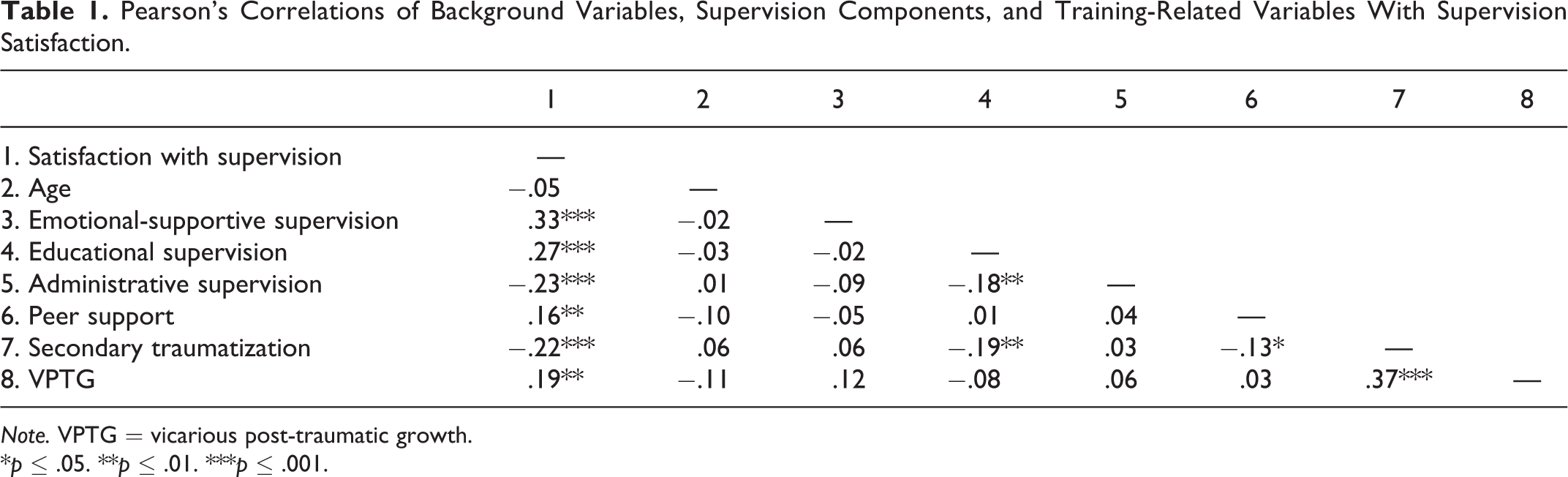
Table 1 presents the correlations of background variables, supervision components, and training-related traumatic factors with students’ level of supervision satisfaction. The background variable of age was not significantly correlated with satisfaction. Additionally, male students (M = 3.44, SD = 1.19) did not differ significantly in their levels of satisfaction compared to female students, M = 3.56, SD = 1.18, t(257) = .47. The ANOVA of year of study (i.e., first-, second-, or third-year student) revealed significant differences between the students’ levels of supervision satisfaction, F(2, 256) = 6.41, p < .01, Effect size: η2 = .05. Post hoc pairwise analysis with Bonferroni correction for multiple comparisons showed that the student’s level of supervision satisfaction was significantly higher among the first-year students) M = 3.30, SD = 1.27 (compared to students in their second year) M = 3.40, SD = 1.23 (or in their third year) M = 3.30, SD = 1.27. No differences were found between second- and third-year students.
Pearson’s Correlations of Background Variables, Supervision Components, and Training-Related Variables With Supervision Satisfaction.
Note. VPTG = vicarious post-traumatic growth.
*p ≤ .05. **p ≤ .01. ***p ≤ .001.
Analyses of the supervision components revealed that the amount of time devoted to the supportive-emotional and educational components of supervision were positively correlated with the student’s level of supervision satisfaction. In contrast, the amount of time the supervisor dedicated to the administrative component was negatively correlated with student satisfaction. Additionally, the support that students received from their peers in class was positively correlated with the level of their supervision satisfaction. Lastly, regarding the training-related traumatic factors, secondary traumatization was negatively correlated with student level of supervision satisfaction, whereas VPTG was positively correlated with it. The effect size of the significant correlations ranged from small to moderate (Ellis, 2010).
Predictors of Supervision Satisfaction
To assess the overall contribution of background variables, supervision components, and training-related traumatic factors to students’ levels of supervision satisfaction, a hierarchical regression analysis was conducted. The variables were entered in three steps (see Table 2). Background variables, supervision components, and training-related traumatic factors accounted for 36% of the variance in student satisfaction with supervision, F(10, 248) = 13.95, p < .001, where effect size was medium to large. The first stepthat included background variables contributed 4.9% to the prediction model and showed that first-year students were more satisfied with their supervision than students in their second or third years of study. This step showed only a small effect size. The second step, in which the supervision components and peer support variables were entered, exhibited the strongest predictive power, accounting for 21.4% of the explained variance, where effect size was medium to large. Specifically, Step 2 of the analysis showed that the supportive-emotional and educational components were positively associated with student’s level of satisfaction and that the administrative component was negatively associated with it. Step 2 of the analysis also showed that peer support was positively associated with supervision satisfaction. Of the training-related traumatic variables in Step 3 of the analysis, VPTG was positively associated with supervision satisfaction, whereas secondary traumatization was negatively associated with it. Step 3 of the analysis accounted for 9.8% of the variance with medium to large effect size of the additional variables.
Hierarchical Multiple Regression Analysis for Predicting Supervision Satisfaction.
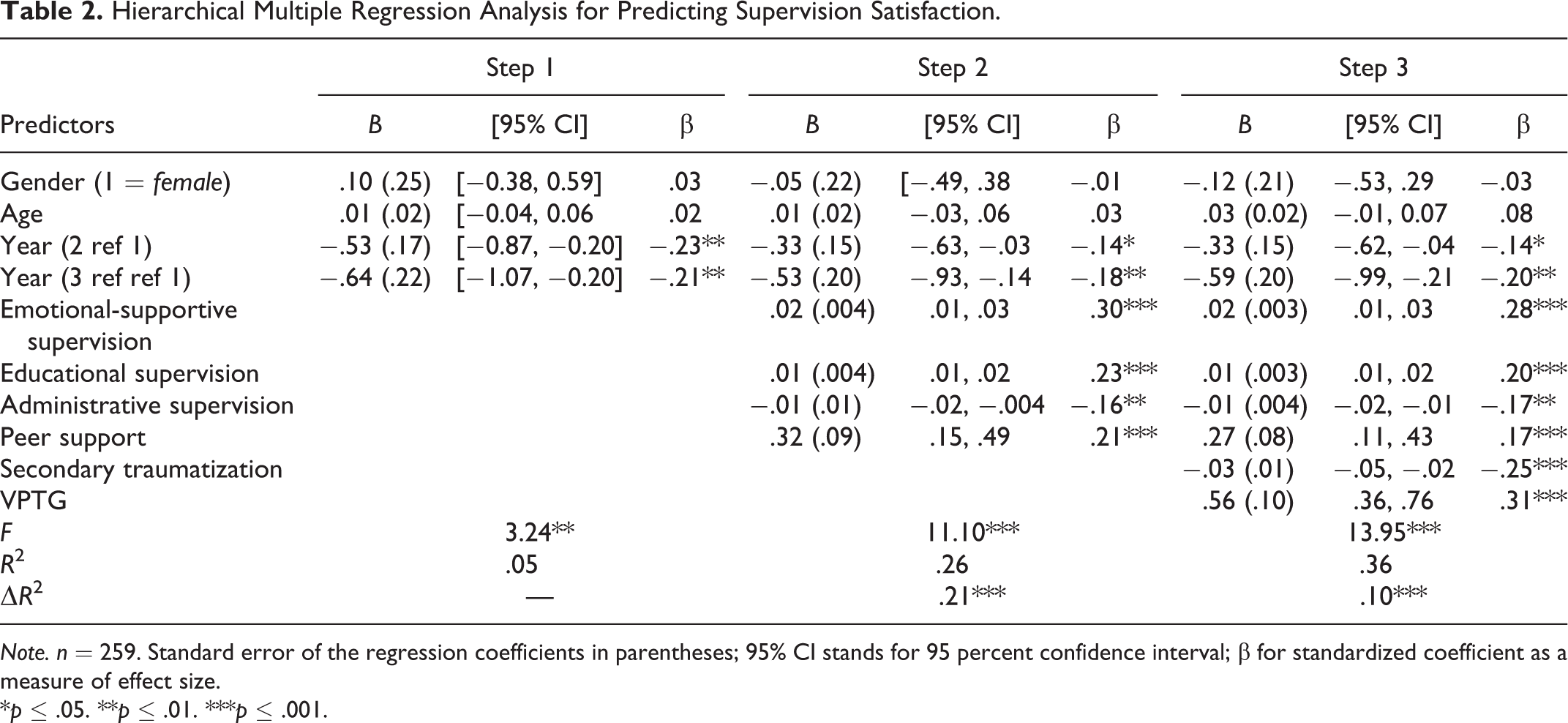
Note. n = 259. Standard error of the regression coefficients in parentheses; 95% CI stands for 95 percent confidence interval; β for standardized coefficient as a measure of effect size.
*p ≤ .05. **p ≤ .01. ***p ≤ .001.
Discussion and Applications to Practice
The extensive literature on supervision has shown that although it is considered to be a critical part of social work students’ professional development (Beddoe & Davys, 2016; O’Donoghue & Tsui, 2013; Shulman, 2010), the predictive factors of students’ satisfaction levels with the supervisory process have not received adequate research attention. The current study examined for the first time the contributions of secondary traumatization and growth, specific components of student supervision, and peer support to supervision satisfaction during social work students’ training.
The findings unequivocally demonstrate the negative implications of secondary traumatization for student supervision satisfaction. Specifically, the greater the students’ exposure to secondary traumatization, the less satisfied they were with the supervision process. These findings suggest that under conditions of emotional overload, when students can perhaps benefit most from their supervisors’ help, they may instead be reluctant to accept assistance via the professional supervision framework. Moreover, the supervisor’s typically multifaceted role, which comprises both advising students and evaluating their qualifications as therapists, may further stifle students’ wish to openly discuss their emotional reactions to their experiences as therapists-in-training (Johnston & Milne, 2012; Zerubavel & Wright, 2012). Students may also be hesitant to reveal their negative reactions to their initial work experiences as therapists out of fear that their supervisors would interpret such reactions as signs of weakness, incompatibility with the job itself, or of their excessive concern for their own welfare rather than that of their clients (Newell & MacNeil, 2010). These concerns may engender an unhealthy scenario in which the social work students, at a time when they most need supervision, are overcome by shame, and rather than seek their supervisors’ guidance, they opt instead for avoidance, secrecy, and silence. These behaviors ultimately put students at greater risk of not receiving critical professional support to relieve their emotional distress, which, in turn, can lead to dissatisfaction with the supervision process (Johnston & Milne, 2012).
Despite an increase in the number of secondary traumatization studies, this phenomenon and its symptoms and contexts still seem to be relatively unknown in the supervisory process. This is an unfortunate situation, given that a lack of awareness of the phenomenon among supervisors may hinder its timely identification and subsequent treatment. Moreover, their own insecurity vis-à-vis their ability to cope with their supervisees’ traumatic experiences may prevent them from bringing up these issues (Walker, 2004). Supervisors who do not validate and legitimize their social work students’ emotional distress may, in turn, be perceived by these students as inattentive to their emotional needs. Insofar as this scenario may influence the level of trust that develops during the supervisory relationship, it can also reduce supervisees’ motivation to learn from their supervisors and accept their support (Fortune & Abramson, 1993; Johnston & Milne, 2012).
It should be noted that the supervisory relationship during the student’s fieldwork, built naturally and gradually, is nevertheless of relatively short duration (about 8 months; a new academic supervisor each academic year). Perhaps the fleeting nature of the social work student’s professional training period precludes or hinders the development of the conditions necessary for a truly supportive supervisor–student relationship. Supervisors do not have the chance to get to know their students well over a long period of time and therefore may not identify the changes in their students as being associated with secondary traumatization. The short duration of this relationship may also contribute to the abovementioned students’ insecurity about reaching out and exposing their vulnerabilities to their supervisors.
However, in contrast to the negative link found between secondary traumatization and supervision satisfaction, the findings of the current study testify to the positive implications of VPTG for student supervision satisfaction. Specifically, the stronger the students’ belief that they had undergone a positive change and growth, at both the personal and professional levels, the stronger their supervision satisfaction. It is possible that due to the relatively short duration of the practical training framework, the supervisors preferred to focus on the positive aspects of the process, such as capabilities and competencies that may empower the students, rather than on weaknesses that might disempower them. In accordance, as the students felt more optimistic about their potential for change and growth, they seemed to associate this feeling with the more positive aspects of supervision and felt more satisfied with it.
Regarding the contribution of each supervision component to the student’s level of supervision satisfaction, the findings of the present study align with those in the literature (Fernando & Hulse-Killacky, 2005). The emotional support and knowledge components were perceived by students as being useful in the supervision framework compared to the administrative component that had the opposite effect. That is, supervision that is focused on the supervisor–supervisee relationship and that provides emotional support and knowledge seems to lead to student satisfaction. On the other hand, when the supervision emphasizes its more task-oriented elements, the supervisees seem to be less satisfied. These findings may derive from the experiences of the students as therapists during the initial stages of their training, a time when they feel insecure about their abilities as social workers and anxious about the prospect of meeting clients (Litvack et al., 2010). Indeed, already at this stage of their training, social work students are exposed to complex, emotionally demanding cases. To ensure their continued ability to help their clients, students must be provided not only with the profession’s theoretical underpinnings and accumulated practical knowledge, but they also must receive adequate emotional support from their supervisors. From the student’s point of view, therefore, the administrative component of the supervision is less crucial.
It is interesting to note that students’ supervision satisfaction was found to be significantly lower during the second and third years of study than during the first. A likely explanation for this finding is that the emotional and academic demands of the first year are much less intense than those of subsequent years, and therefore, the threshold for student satisfaction is lower. Student level of satisfaction in the ensuing years, however, plays a greater role in the subsequent development of the student’s ability to cope with the strenuous demands of the social work profession.
The findings of the present study also point to the contribution of peer support to supervision satisfaction, in line with earlier studies indicating that peer support fosters a more productive learning environment for students (Heirdsfield et al., 2008; Manning-Jones et al., 2016; Pistorius et al., 2008). In the social work curriculum, informed-intervention methods are typically studied in peer groups, a course design that may foster an environment that is more amenable to the sharing of challenges faced in fieldwork placements. Perhaps due to the students’ lack of professional experience, the peer groups that are used in method intervention classes seem to provide a safe space. That is, the students’ experiences in the peer group validate the supervision process and help clarify its contribution to their social work education while enabling them to evaluate its advantages and disadvantages.
Peer support may also be helpful in that it allows students to receive a holistic view about the possible contribution of supervision. This view includes both aspects that they had anticipated and others that they had not. As such, peer support encourages students to acknowledge the importance of some aspects of supervision that are not necessarily to their liking (e.g., administrative) but are essential to their success as social workers. The fact that peer support contributes to supervision satisfaction may also indicate that those who are able to obtain more robust support from their peers are the same ones who are able to experience supervision-related growth and feel more satisfied with it.
The current study has certain limitations. First, participant recruitment relied on convenience sampling of undergraduate social work students in three academic institutions. As such, our findings may inaccurately reflect predictors of supervision satisfaction among all students of social work. Extending the research to undergraduate social work students in other academic institutions can give a more comprehensive and valid picture about the contribution of the examined components of supervision, peer support, secondary traumatization, and VPTG to supervision satisfaction.
Second, the cross-sectional design of the study, with its focus on a single point in time, precludes an examination of causality between the variables. Future longitudinal studies can help to better understand whether the different experiences during the fieldwork affect satisfaction with supervision in a causal manner. A longitudinal study examining the student’s learning process over time may add a new layer to the correlation of secondary traumatization and VPTG with supervision satisfaction and may help better understand the link between these two phenomena and the development of professional identity among social work students. Moreover, the authors recommend that subsequent studies examine other dimensions of the supervisory relationship, such as the ability of the supervisee to receive help and the effectiveness of the supervision process relative to the student’s satisfaction with it.
The findings of this study raise three important issues about social work supervision. First, a supervisory framework that emphasizes the components of emotional support and education with an improved version of the administrative component may increase student satisfaction with the supervision process. For example, the supervisor may plan the administrative aspects together with the students to increase their involvement in the process (Beddoe, 2015). Such joint planning may increase students’ awareness of the instructor’s perspective and may promote their satisfaction with supervision.
Second, the findings of the current study stress the importance of peer support as a significant factor contributing to supervision satisfaction. Social work supervisors should encourage their supervisees to share their experiences with their peers. Such sharing may enable the students to learn what they can expect from the supervision process and adjust their expectations from the supervisor, allowing them to make better use of what the supervisor has to offer.
Third and finally, supervisees who experience severe emotional distress due to secondary trauma may exhibit lower levels of satisfaction with their supervision and be less able to see supervision as a tool that can help them resolve their distress. Accordingly, they are less likely to utilize the supervision framework to obtain assistance. However, supervisees who experience VPTG tend to express satisfaction with supervision. These students experience growth by using the supervision to help them deal with the exposure to secondary traumatization. Therefore, it is crucial that seminars on secondary traumatization and VPTG be included as integral parts of the social work curriculum. Both social work students and supervisors should familiarize themselves with the theoretical conceptualizations and professional terms necessary to enable them to recognize the symptoms of secondary traumatization. In addition, special attention should be given to training supervisors with regard to secondary traumatization in their training courses. In particular, supervisors are required to be adept at using stress coping skills and must have general awareness of the implications of exposure to distress and trauma situations for the students. Such awareness would allow them to facilitate discussions in supervision sessions about the risks of secondary traumatization alongside the benefit of VPTG.
Fieldwork education is defined as the pedagogic signature of social work education (Homonoff, 2008), and supervision is recognized as the heart of this process. Supervisee satisfaction with supervision is a significant factor in the supervisory process (Beddoe & Davys, 2016). Therefore, social work educators need to ask themselves whether they address secondary traumatization and VPTG in supervision satisfaction among students. Supervisors should also ask themselves whether both they and their supervisees are aware that emotional distress responses to conducting therapy with traumatized populations are common and whether they encourage the students to freely express themselves and discuss this distress. The social work education framework is committed to providing tools for both professionals and students to address the factors that contribute to supervision satisfaction to help them better cope with these responses as they begin—or continue—their training.
Footnotes
Declaration of Conflicting Interests
The authors declared no potential conflicts of interest with respect to the research, authorship, and/or publication of this article.
Funding
The authors received no financial support for the research, authorship, and/or publication of this article.
