




Abstract
This paper examines the perspective of marginalized young women, training to become mentors for marginalized girls, with respect to the role of the mentor. Taking a critical feminist perspective, this article gives expression to the research participants’ unique knowledge, based on life experience as marginalized girls and their lived experiences. Based on a photovoice research project with 13 participants, all marginalized young women, the findings of this paper identify three main narratives regarding the mentoring role: (1) Mentoring as a relationship; (2) Mentoring as an action for the future; and (3) Organizational belongness—the organization hosting the participants serving as an ideological, value-based, and professional home, enabling the growth of the mentor in her role. The conclusions of the article argue that marginalized young women experience mentoring as a practice that expands beyond its rational aspects, embodying within it a corrective experience of relationships and an opportunity for social change.
Introduction
Mentoring is considered a supportive relationship between an experienced and less experienced person, which serves as a framework for knowledge transfer, empowerment, and assistance, through mutual activity between the mentor and the mentee (Mullen, 2017). Mentoring in its formal and informal, professional, semi-professional, and voluntary forms, is a well-known practice spanning fields as diverse as education, business, nursing, and the therapeutic professions (Ferreres, 2018; Mullen, 2017). The therapeutic professions (including social work) have played host to a unique development relating to the mentoring practice; beginning in the field of addiction intervention, people who have received professional support have themselves become mentors. As mentors, they turn to help others facing problems similar to those that they experienced themselves. This development in mentoring practice is strongly influenced by principle of the “wounded healer”: the understanding that people who have faced and overcome adversity can develop the skills needed to provide sensitive and tailored assistance to others experiencing the same adversity (White, 2000). Over the years, mentoring programs working with various population groups (e.g., Immigrants, refugees, the homeless, and women in prostitution) have incorporated this development. One notable example of this is with youth mentoring programs (Albright et al., 2017).
When considering marginalized 1 young people, there has been criticism of the lack of research from a critical perspective regarding mentoring programs for marginalized girls and young women (Villar & Roca, 2020). It is argued that there is a need for critical and feminist-oriented research methods particularly suited to engaging with women who are working as mentors. From a feminist perspective, Bettez (2020) argued that mentoring as a feminist practice for young women and girls at risk, should adopt feminist principles at both the mentor-initiated relationship and at the macro level. Villar and Roca (2020) argued that studies with mentoring based on a feminist perspective (fementoring) should be expanded. With respect to the mentor–mentee relationship, the argument is that principles of reciprocity, acceptance, partnership, and caring should be adopted, along with the development of individual and group awareness of society’s oppressive gender structure and ways of resisting this (Bettez, 2020; Brown, 2013; Lindsay-Dennis et al., 2011; Rodriguez, 2013). At the macro level, Bettez (2011, 2017) as well as Murakami and Núñez (2014), all argued, that there should be a deeper understanding of oppressive social processes, social locations, and their effects on a person’s different identities; the understanding that the personal is the political, and of the importance of being able to organize as a community to promote social justice. These principles can promote the transformation of mentoring into a feminist space, within which marginalized girls and young women can articulate their subjectivity authentically and confidently, free themselves from oppression, and give expression to their agency as constituting a legitimate political perspective. As an example: within such a space, support and empowerment can be provided for women who have become mothers at a young age, for women victims of violence and sexual assault, for women discriminated against in the labor market, and for women living in poverty (Villar & Roca, 2020).
For the most part, existing studies point to the contribution of mentoring from the perspective of marginalized girls initiated into mentoring programs (e.g., Larsson et al., 2016b). In this context, however, two qualitative studies in which professional mentors reported their point of view about the role of a mentor in mentoring marginalized girls and young adults should be noted. Larsson et al. (2016a) highlighted the organizational context and the initial motivations that enabled women to integrate into the mentoring role. Sulimani-Aidan (2019) pointed to the challenges of mentoring in the face of the mentee’s life history and characteristics, recognizing the mentor’s expertise within his or her service and the need for support and training.
Generally speaking, in this field, there is a lack of research literature exploring how marginalized young women perceive their role as mentors—and the meaning they give to this from a critical-feminist point of view. This perspective is critical to understanding the mentoring of marginalized girls and young women, given that critical-feminist mentoring emphasizes the importance of lived experiences and the life-based knowledge of women, as well as encouraging egalitarian and participatory approaches in the helping process (Bettez, 2017). To the best of our knowledge, there have been no research studies exploring the process of marginalized young women becoming mentors. Against this background, the present study explores the mentor’s role from the critical-feminist perspective of marginalized young women participating in a Rita Center Mentoring Training Program (RCMTP) in Israel. Following the criticism about the danger of disciplining the voices of girls in mentoring programs (Bay-Cheng et al., 2006), we chose to adopt the photovoice methodology (Wang & Burris, 1997) as a critical-feminist approach to exploring the meaning of the mentoring role, combining visual and narrative expressions of their voices.
Critical-Feminist Mentoring
In this section, we will first present a review of traditional mentoring and critical mentoring, followed by literature on critical-feminist mentoring and finally a review of mentoring among marginalized young women.
The traditional definition of mentoring refers to a long-term relationship of teaching and learning, in which the knowledge and skills of the mentor are transferred to the mentee, who is usually younger and less experienced (Mullen, 2005). Mentoring can take place on a voluntary and informal basis, or on a formal and binding basis, in both cases as a way of transferring knowledge, values, worldviews, and skills, and as a form of advocacy, counseling, and support (Mullen, 2017). Over the years, however, there has been a change in the traditional definition. Fluid and diverse forms of mentoring have begun to develop, incorporating not only the transfer of knowledge and skills but also interpersonal relationships, educational processes, organizational and cultural contexts. Similarly, new types of mentoring have begun to emerge, such as group mentoring and online mentoring (Alvarez & Lazzari, 2016).
Along with the broadening of the definition of mentoring, the critical mentoring perspective has also begun to permeate the field. Critical mentoring conceptualizes the mentoring process as a space for facilitating processes that extend beyond the acquisition of social skills and competencies. To this end, principles that anchor the mentoring process include the reconstruction and co-construction of knowledge about the world; developing the ability to reflexively observe the self, different identities, and social positions; building partnerships and relationships while reducing and resisting power relations; and the acquisition of different types of knowledge and capital, in order to resist various forms of inequality (Crow, 2012).
The critical mentoring perspective can be summarized according to two main aspects. The first is the generalization or expansion of research into and the practice of mentoring, and its adoption by marginalized and excluded populations. The second, directly related to the first, is based on the adoption of critical theories for analyzing, conceptualizing, and interpreting the various processes that take place within mentoring. These goals are anchored by concepts such as power relations, unequal social structures, and the pursuit of social justice, together with transformative change and the need to develop more empowering and democratic practices of mentoring (e.g., Albright et al., 2017; Arczynski et al., 2018; Bettez, 2020; Colley, 2003). Regarding the structural barriers that may confront a mentee, Santamaría (2014) has argued that beyond personality traits and human characteristics, structural-environmental characteristics and the interaction between these two dimensions can also shape opportunities for the social inclusion of marginalized young women. Given that population groups encountering exclusion face different structural barriers deriving from the intersection of identity categories (e.g., class, ethnicity, gender, religion), mentors should consider structural barriers and their impact on the individual. Thus, according to barrier transcendence theory (Santamaría, 2014), an understanding of mentoring must combine: (1) the characteristics of the individual, which include knowledge and lived experience; (2) the behavior of the individual, which includes commitment and interest; and (3) environmental-structural characteristics, and the ability to identify barriers and opportunities within them (e.g., Murakami & Núñez, 2014). While the first two dimensions are related to the individual, the third dimension is based on a socio-ecological perspective.
Another aspect of mentoring from a critical perspective concerns the way in which feminist theory in the literature on mentoring is used to emphasize the counterweight that mentoring can provide, as opposed to traditional approaches that tend to maintain gender power relations (Bay-Cheng et al., 2006; Villar & Roca, 2020). For example, Villar and Roca (2020) conducted a comparative study of mentoring programs, characterizing programs based on a feminist agenda. They found that these programs were about empowering girls, by raising their awareness of human rights, strengthening their identity, and creating a feminist space able to provide security, support, and reciprocity, together with resistance to various types of gender-based violence. In a reflexive essay, Bettez (2020) emphasizes the uniqueness of a feminist perspective on mentoring as an outlook seeking to reconfigure the traditional mentor–mentee relationship: encouraging the reduction of power relations, positioning the mentee an active learner, and encouraging the adoption of activist practices of change and leadership. In Mullen (2017) review of different types of mentoring, she emphasizes the uniqueness of the feminist perspective as one that allows for creating a mentoring relationship based on partnership and reciprocity, as well as the integration of democratic values in the pedagogical-educational process. Thus, it can be asserted that critical-feminist mentoring is based on a process of democratizing the practice of mentoring; the task-focused technocratic aspect is minimized, while the processual aspect and the feminist elements of gender identity consciousness are strengthened (Mackey & Shannon, 2014).
Accordingly, in the literature on mentoring for marginalized young women, it has been argued that mentoring should be seen as an educational process that allows for a combination of critical pedagogy and transformative education (Crow, 2012). That is, it is a process that allows for the expression of different and additional types of knowledge condensed into hegemonic and accepted knowledge, such that marginalized voices and types of knowledge become embedded into the professional identity of the mentor (Fassinger & Hensler-McGinnis, 2005; Lloyd-Jones, 2014).
In this paper, we present a pedagogical-critical project involving marginalized young women training to become mentors at the RCMTP, in Israel. Using the photovoice methodology, the article examines the critical-feminist perspective of the participants in relation to their role as mentors. Thus, in this section, we have expanded the perspective of traditional mentoring toward critical mentoring and mentoring from a critical-feminist perspective, with reference to marginalized young women. This extension is consistent with the principles on which our research was based as well as the aims of the article that seek to point to the agency of marginalized young women, and the knowledge embodied within their lived experiences.
Method
Photovoice
The study was based on the photovoice methodology, developed along with the principles of Community-Based Participatory Research (Wang and Burris, 1997). The photovoice methodology, which is based on the critical pedagogy of Paolo Freire, is intended to encourage people to look at reality critically; to ask questions and to investigate it, in order to promote social change, equality, and social justice (Freire, 2004). By constructing a narrative out of a selected photographic image, photovoice encourages people to create a critical dialogue about the social and political realities that they share (Wang and Burris, 1997). Photovoice methodology aligns with the tenets of feminist theory, practice, and methodology. First of all, it is a research approach based on participatory action research (PAR). PAR fundamentally enables the democratization of knowledge-production processes, and realization of the right of marginalized individuals and communities to fully participate in research on their lives (e.g., Ostaszewska, 2018). It is a process that enables empowerment, community organizing, activism, and action for social change (Bell, 2015). As an alternative to hegemonic knowledge and as decolonial feminist praxis, photovoice enables the creation of a new kind of knowledge, in a way that allows for reflexive observation by community members about social positions and the various forms of inequality and oppression which one seeks to be liberated from and oppose (e.g., Cornell et al., 2019). Finally, photovoice adopts the anchor of social art, which allows different people to express their voice through photography (Spence, 1995): documenting reality, interpreting it, and participating in negotiating different social interpretations of this reality (Wang and Burris, 1997).
Practically, and in a classic way, the photovoice methodology is implemented through a project based on group work, in which the participants, who share a community of any kind (e.g., professional community, ethnic community, geographical community, etc.), present a documentation of reality relating to the project (Wang et al., 2000). The materials presented in a photovoice project enable the participants to present a critical dialogue about the reality they share. One goal of a photovoice project is the curation of an exhibition intended to present to the wider community the knowledge developed by the participants, and to influence stakeholders and policymakers accordingly (Wang and Burris, 1997).
Research Context and Procedure
The State of Israel has a youth population of approximately 970,000, with 200,000 defined by the welfare system as “at-risk.” Some of these young people are involved in various welfare and social work programs (Sulimani-Aidan, 2019). Although most programs are directed at young people “at risk” as a generational group, the Israeli Ministry of Welfare has since the 1970s operated programs and services directed specifically at adolescent girls and young women (Krumer-Nevo & Komem, 2015). Together with other government agencies, the ministry has a history of supporting (alongside philanthropist organizations) NGOs that specifically focus on working with young women at risk. This approach served as the infrastructure shaping the development of two programs, both beginning in 2002, for training marginalized young women to serve as mentors for other marginalized girls and young women. By “marginalized young women,” we are referring to Jewish and Bedouin-Moslem young women who belong to minority groups in Israeli society, such as people living in poverty, minority ethnic groups, people living in peripheral geographic communities, and people who have experienced challenging life situations such as family-related violence, sexual abuse, and social isolation.
The Rotem Center Mentoring Training Program (RCMTP) was established in 2008, in the School of Social Work at Sapir Academic College, Israel, to enable marginalized young women to engage with personal and educational development processes in a professional space with high social value. The RCMTP combines critical-social work with feminist practice and research, for the benefit of marginalized young women (RCMTP, 2020). Among other activities, the RCMTP runs a number of programs, including mentoring programs for marginalized young women.
The current research was conducted within the framework of the mentoring program at the RCMTP, as part of its yearlong social work program designed for marginalized young women. Based on a critical-feminist orientation, the training program emphasizes the use of life knowledge, among other resources, as a unique source of knowledge. In addition, participants learn about issues such as gender, helping relationships, and about issues that characterize the distress and alienation of marginalized young girls. The program is delivered in three parts: (1) An “open space” session with enrichment time on topics relevant to marginalized young women; (2) A theoretical course, in which participants learn different fields of knowledge relevant to mentoring, and practice skills; and (3) A dynamic group process, in which participants discuss personal and professional issues, consult with practitioners, and receive on-going support. During the second semester of the program, the participants are integrated into practical field training settings, as mentors in services for marginalized girls and young women. Settings include boarding schools, hostels, educational frameworks, and out-of-home institutions. During this internship, the mentors facilitate group meetings, and also serve as personal mentors for some of the girls and young women.
The photovoice project took place between January and June 2019, along with the steps outlined below:
Step 1: Participant recruitment
The photovoice project was presented to the members of the mentoring training program (N = 13) delivered by the RCMTP’s professional staff, in order to obtain their consent for participation in the project. The participants were all between 19 and 25 years old. Seven were Jewish, the rest Muslim from the Bedouin community. Two of the participants were single mothers, and three had immigrated to Israel as children from the former USSR. All of the participants had faced some form of family crisis in the past. Five reported experiencing mental health difficulties due to the challenges they faced as marginalized girls.
Step 2: Orientation workshop
As part of preparations for the photovoice sessions, an orientation meeting was convened, during which the participants were presented with the project’s goals and the principles of the methodology. A professional photographer introduced the participants to the basic principles of mobile photography. In addition, the participants were shown the key principles of the photovoice methodology, such as writing an accompanying narrative for photography, choosing a title for the photograph selected, and preparing their photovoice for the group session. The general idea of the project was presented to the participants in the form of the question: “
Step 3: Group sessions
Ten 2-hour photovoice group sessions were held between January and May 2019. The sessions were facilitated by the first author, who is experienced in running photovoice-based research projects, and the fourth author, who joined the RCMTP as part of her practical training as a social work student. Before each session, the facilitators prepared a presentation of the photos sent by the participants, as the basis for conducting the session and creating a critical dialogue.
Step 4: Preparing for the exhibition
During this phase, two extended sessions were devoted to looking at the collected photos and selecting those that the group members wished to present at the exhibition. The group also chose a name for the exhibition during this phase.
Step 5: Preparing the exhibition and process summary
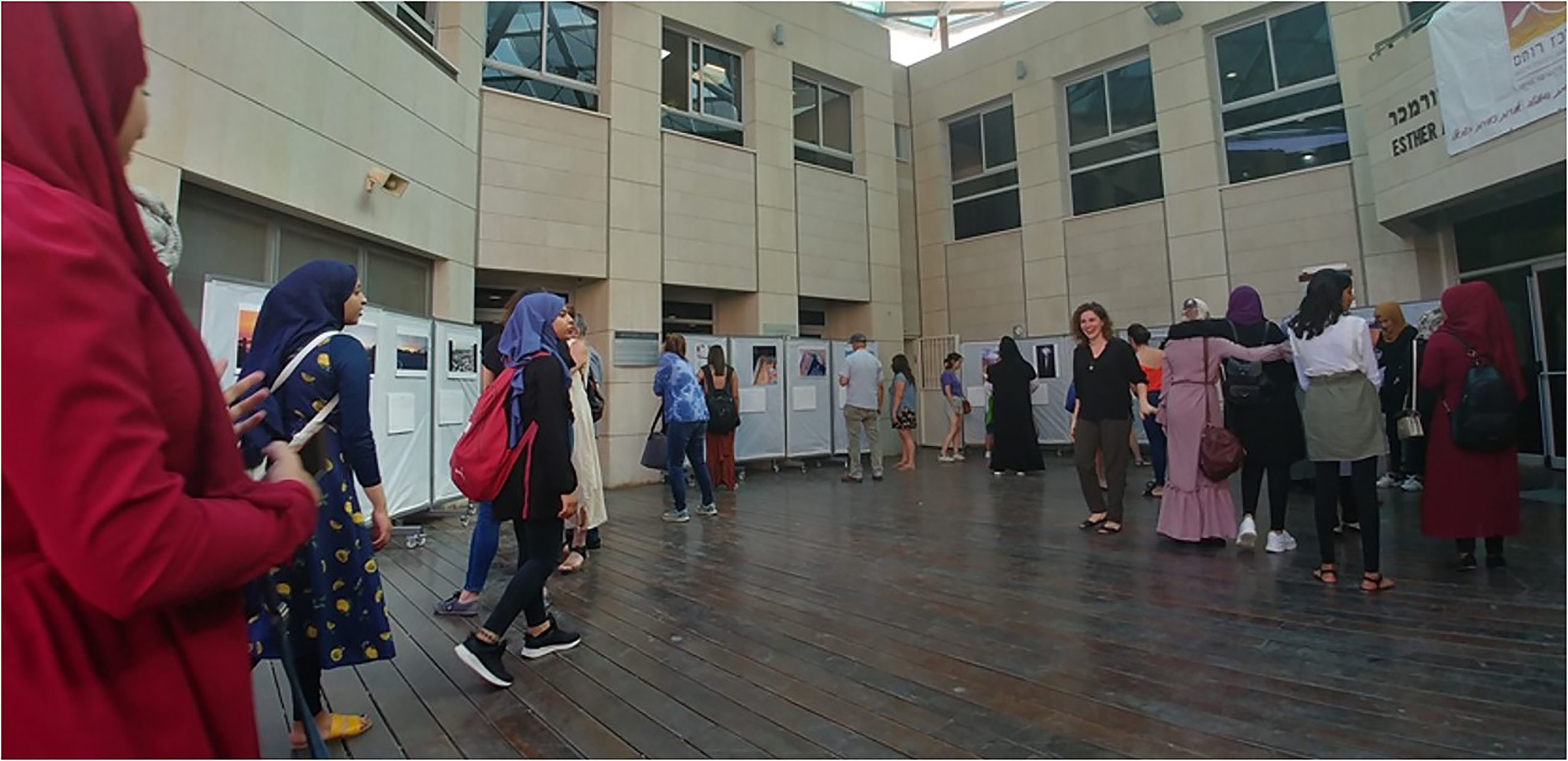
The exhibition was held at the end-of-year event of the RCMTP, which was also a celebration of the center’s 10th anniversary (Figure 8). Exhibition guests included policymakers, marginalized girls, and young women from various programs, social work professionals, and students. Representatives from the group also presented a summary of the process and explained the main messages of the exhibition.
Photographed by Menny Malka, June 2019.
Data Collection and Analysis
The database included 37 photos prepared by the participants, along with 10 sessions that were audio-recorded and subsequently transcribed. The materials were analyzed, by means of a categorical content analysis (Lieblich et al., 1998), in four stages: (1) a holistic reading of the database, to derive an initial impression of meanings, opinions, thoughts, and feelings; (2) the materials were divided into segments identified as uniquely meaningful, and recurring themes in the database were identified (e.g., Being a marginalized girl; Being knowledgeable; Sources of knowledge; What is help?; Past experiences of the mentor); (3) the themes were gathered into different categories (e.g., characterization of mentor–mentee relationship; mentoring goals; mentoring as a semi-professional identity; the mentors’ sense of belonging; values shaping the mentors actions); and (4) the categories were grouped into three narratives, which embodied the meanings that the participants gave to their role as mentors: a. Mentoring as a relationship; b. Mentoring as a future-oriented action; c. Organizational belonging. The first author of the current article conducted the analysis, which was then presented to a group of researchers specializing in young people and mentoring. Members of this group included the other authors of this article. The feedback received from the group was used by the research team to ensure the reliability of the findings (Shenton, 2004), relying on triangulation between different sources: comparison with relevant literature, presentations at conferences, and presentation of the findings to the participants and the RCMTP’s professional staff.
Ethical Considerations
The research project was approved by the Ethics Committee of the School of Social Work at the college where the RCMTP operates. In addition, the participants in the project all signed informed consent forms, and the photographs used in the photovoice were taken in strict adherence to the ethics of photography, protecting the anonymity of the participants and other people who were photographed. The names and personal details of all the participants have been changed, to protect their privacy.
Findings
The findings are organized into three narratives 2 presenting the critical-feminist perspectives of the participants regarding the mentor role. This account is followed by a discussion of the exhibition itself.
Mentoring as a Relationship
The first aspect of the mentoring role deals with the basic understanding that mentoring is a relationship combining formal and informal aspects. Several participants spoke to a combination of these aspects in an attempt to define a position that is unique to the way that they understand their role as mentors:
From darkness to light—everyone deserves light
Voice (Narrative): The picture shows a lit pillar against a dark background. The darkness represents the starting point, and light is progress. As mentors, we learned how to move forward through a few professional rules. The first is to learn to help yourself to help others. The second is to learn to identify signs of distress and a variety of problems, and the appropriate tools to help in any situation. The third is to be tolerant of those who are different from us (Figure 1).

Photographed by Alexandra, February 2019.
Alexandra’s photovoice symbolizes the developmental process of the girl mentee by the mentor: the darkness representing the starting point, and the light the progress. Alexandra points to different formal rules and principles, which emphasize the idea that mentoring is a semi-professional position anchored in the knowledge, tools, values, and principles of action that mentors learn during their training program.
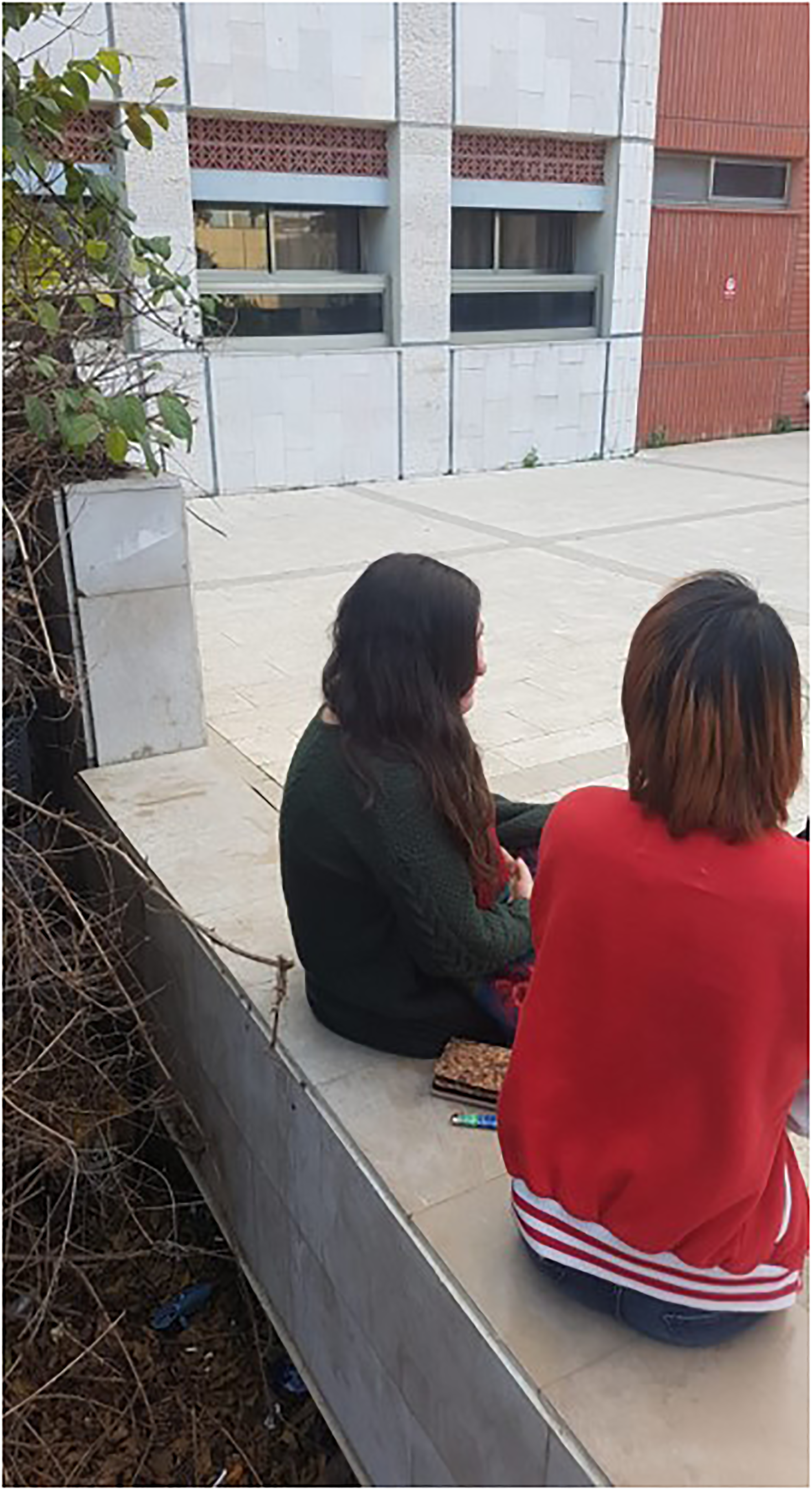
Sonia photographed two women sitting and talking. She chose the title “Beyond Visibility” for her photovoice, a way of explaining the importance of the informal aspect of the mentor–mentee relationships:
Beyond visibility
Voice (Narrative): To the eye, you see two girls having a conversation—but to me, there is something beyond that. It is a meeting between a mentor (me) and a girl. This is one of my quiet corners, where the mentor meets once a week with an amazing girl. We sit together on the bench and chat. She is free to share all that’s on her mind, and we can laugh together and talk about the ideas and thoughts going through her mind. She knows that there is someone there for her, a supportive and listening assistant. It reinforces my belief that no one should go through things alone (Figure 2).
Photographed by Sonia, March 2019.
Sonia’s photovoice emphasizes the informal aspect of mentoring with marginalized girls; the special corner in which they sit, even though it is within the academic space of the college, allows for a heart-to-heart conversation. Symbolically, it highlights the mentor’s ability to abandon rigid definitions of the helping relationship such that, as in this case, it can seem to those watching from the sidelines as though the two parties are sitting and talking as equals. This informality serves as the basis for establishing a relationship of trust and caring, highlighting a feminist perspective on forming relationships (e.g., Brown, 2013).
In the next photovoice, Sylvia incorporates another idea: how the mentor–mentee relationship is based on the mentor’s ability to draw from her own past experiences as a marginalized girl:
Get rid of addiction?
Voice (Narrative): The photo shows an arm and a razor beside it. The arm has signs of cutting. The picture reflects my addiction as a girl, cutting my arm from time to time. In most cases, other people (including professionals) think that this is attention-seeking behavior. But that's not true. It is a moment of anxiety, deep loneliness, despair. Actually, cutting my hand was my way of dealing with all these difficulties. The picture reflects the idea that the mentor, as one who has faced [similar] difficulties, can understand what the girl is going through, and so recognize that she should not rush in solving the problem (a girl who cuts her hand). She realizes that the girl doesn't need a quick solution. Instead, the girl wants her [the mentor] to be with her through these difficulties (Figure 3).

Photographed by Silvia, April 2019.
Sylvia explained to the participants that she was posing a question mark about the issue of getting rid of the girl’s addiction to cutting. The photovoice poses a question about whose needs would be served by getting get rid of the addiction serves: those of the social worker, or those of the marginalized girl? In addition, Sylvia describes her own coping process, as a marginalized girl with a tendency to cut herself. All these explain the mentor’s role from her point of view. Sylvia describes the tendency of professionals (e.g., social workers) to be alarmed by this pattern, and even to blame the girl for attention-seeking behavior. She explains how important it was for her not to give up too quickly on a pattern that was helping her at that moment; in her opinion, it was something that the mentor could understand because she herself had experienced similar distress. Sylvia’s ideas reflect a feminist perspective and practice, which seeks to moderate power relations and hierarchies within professional relationships (Bettez, 2020).
Indeed, against this background, a group dialogue developed, during which Galit presented the following example: Last week during the internship, so I opened up to the girls a bit, I told them I had not lived at home since I was 16 and a half, and then there was one girl who said to me “What, you went through things? You … who is mentoring?” And then when I told her I changed things in my life, so she said to me, “Can we talk?” Then we went to the room and I told her about my hospitalization [and so on] … Then suddenly, she could really, really, open up to me and tell me what she was going through … she really started to cry to me … until that moment, she thought she was the only one who had gone through something like this…
Thus, Galit’s example takes the meaning of the unique position of mentors—as those who had “been there,” in the not-too-distant past, as marginalized girls themselves—one step further, to a unique position of relationship, incorporating a deep understanding of what works for girls when building relationships, and their intense need for someone who understands them. In fact, Galit’s response reflects the feminist practice of self-disclosure in a helping relationship (Brown & Walker, 1990).
Mentoring as an Action for a Better Future
This narrative expresses the sense of responsibility embodied in the mentoring role, in acknowledging the right of marginalized girls to dream, as well as to imagine, of a better future. This idea embodies the negotiations that must be conducted with the boundaries of the dream, which external forces tend to enforce over marginalized girls. This is reflected in the representative examples below.
Opportunity
Voice (Narrative): The picture shows a book on medical studies that is heavy, its weight reflecting the seriousness of the book. Despite my difficulty with the English language and the gravity of the book, I held it with both hands and read from it. All my life, I have aspired to study medicine, even though this is not easy in the society I live in. In Bedouin [communities] marriage … for women marriage is given more meaning than education, and many years of investing in medical studies will have social consequences. God teaches us His ways and shows us what is the right path for us. It is important for me to try to achieve the goal I set for myself despite the difficulty, and I believe that every Bedouin woman can achieve her ambitions. In Bedouin society, the will of women is of utmost importance and I, as a mentor, believe in every woman and girl I meet, to give them the opportunity to fulfill their dreams, just as I give myself the opportunity to fulfill my dream (Figure 4).

Photographed by Rania, April 2019.
Rania photographed a medical book belonging to her cousin—who in fact was not admitted to medical studies in Israel, and thus went to study abroad to fulfill his dream. Rania states that marginalized girls are unaware of the possibility of academic studies, and what it takes to realize them. Following Rania’s photovoice, the study participants discussed the barriers that marginalized girls face. Although in the case of Rania, the barriers were attributed to her ethnic affiliation with the Bedouin community—considered a traditional and patriarchal marginalized community—the discussion was also extended to the barriers that exist for marginalized girls from other communities, in line with the feminist concept of intersectionality (Krumer-Nevo & Komem, 2015). The group agreed that there are external forces that could diminish the dreams of marginalized girls (e.g., family crisis, socioeconomic status, living area, opportunity to acquire a good education): as a result, the girls experience barriers to realize their dreams.
Stop to plan your way
Voice (Narrative): I took the picture at Sderot Train Station on the way to RCMTP. Just as a train enters the platform when and where it needs to stop, we also have to stop at certain points in life and think about what's happening now and what's next and how to help the other person who needs us to fulfill her wishes. We too, as mentors, sometimes stop like the train at the platform to see what is best for the girl we are helping to move forward (Figure 5).

Photograohed by Shira, May 2019.
Shira has linked the dream of a better future with the idea of time and movement. As the train passes between stations, stopping at various points in time and space until it reaches its final destination, so too the mentor encourages the girls to think in stages. Step by step, to plan their future. The mentor’s role in this context is to stop the girl from time to time, so that she can think about the future and what she really hopes to achieve. Following Shira’s remarks, the participants referred to the mentor’s commitment to helping marginalized girls build her vision in a tailored way. That is, to “open her eyes” so that she can recognize the options available to her as an adult in the future—in terms of education and employment, alongside reinforcing her confidence so as to enable her to build a future for herself. During the group dialogue, Sima addressed the meaning of the ability to dream: Dreams are an important thing, dreams are what makes you move on. Without a dream, you stay in the same place. A dream is something to fight for. Like going up a high mountain; if you want to get to the top, so the stones and rocks bother you less. But if you just go up with no purpose, then it's harder.
Sima points out the impact of having a dream on the sense of self-efficacy, and the meaning given to various difficulties that stand in the way of realizing the dream. In discussing this photovoice, the participants noted the role of the mentor as one who helps the girl mark the path and adjust her pace of progress. In the group dialogue, the participants’ agreement was sharpened by an acknowledgment that the barriers of marginalized girls are a part of multifaceted marginalities (Krumer-Nevo & Komem, 2015)—that is, that in addition to their gender marginalization, to which the term “glass ceiling” is usually attributed. This multifaceted marginalization establishes, as Bettez (2020) pointed out, a structure of opportunity injustice, constricting the capacity of marginalized girls to dream beyond these boundaries.
Organizational Belonging
The third narrative deals with RCMTP’s role as an organizational base, within which the participants developed and learned to be mentors. Gal refers to the significance of the RCMTP:
I am with myself in a nourishing environment
Voice (Narrative): The photograph shows a flower blossoming and a tree and soil in the background. Something I learned about myself from the program is that I can flourish in an unfamiliar environment too, and that it can even be good for me. The RCMTP is used by the mentor as a nourishing environment, a greenhouse in which it can grow—and so too the girls that it accompanies (Figure 6).

Photographed by Gal, February 2019.
Gal describes how RCMTP serves as a greenhouse in which the flower can bloom. In fact, Gal uses an image of a flower embedded in a supportive environment that allows it to bloom as a metaphor, as the RCMTP has helped her “basic self” evolve into a “professional self” with the personal and professional ability to acclimatize in new places—unlike her experience in the past as a marginalized girl.
In another example, Nadine refers to the ideological and value aspect of the RCMTP:
We are all one
Voice (Narrative): In the photo there are two women's hands, resting on each other. One [woman] is Jewish and the other is Bedouin, their hands different shades. In the mentoring program, I learned that the cultural gaps are not an obstacle and that I can make meaningful friendships and connections despite the differences that exist between us. In the program we are all one, we share a common denominator and a common path despite the differences between us (Figure 7).

Photographed by Nadine, May 2019.
Nadine’s photovoice reflects the fact that RCMTP is a space where marginalized young women from different ethnicities, cultures, and communities come together, and within it are able to enable the similarities they share to overcome their differences. It is a space of closeness and togetherness, in which the mentor’s role is shaped by human principles of acceptance and solidarity.
In a dialogue created between the participants, they referred to the way in which the RCMTP establishes a fraternity of women. As Galit described it:
Here, in the RCMTP, women from very different cultures come [creating] a mixed society. At the RCMTP I don’t feel racism or judgment, which shows that it is possible to form normal human relationships, as opposed to all the conflicts outside. We learned here that it all starts with our choice to accept who is different from us. No matter where we came from …
Galit’s description, which points to the formation of a sisterhood, links with the way in which the participants point to the RCMTP as an ideological home in which they feel both belonging and a partnership, in a way that refines the values upon which their role is based—the critical-feminist principles of justice and equality. Such principles contribute, as Bettez (2011) emphasized, to a sense of solidarity that serves as a basis for community organizing. Alongside the value base, RCMTP serves as a professional home where they also learn the practices and skills that they will use in the mentoring role.
In another session, during which a discussion was held about RCMTP’s roles, Botina noted: I think even somewhere to say “thank you” for the things we went through. Because thanks to them, we can really help other girls. That's how I see it. I will not say that I am glad that I went through certain things, but yes somewhere … yes, there is meaning here to everything we went through….
Botina’s words drew the line that runs between the participants’ meeting point with their painful history, and the way in which they give meaning to this pain as part of the process of becoming mentors. Indeed, it is in the unique space of the RCMTP that makes it possible to draw this line, where participants understand the power of their story and history, enabling self-growth as well as the capacity to offer assistance to other marginalized girls.
“If I Had Her—At Eye Level Mentoring”: Project Exhibition
The establishment of the exhibition was the concluding part of the process. As part of this process the participants discussed choosing a name for the exhibition:
Finally, the participants chose the name “If I Had Her: At Eye Level Mentoring.” The name of the exhibition reflected the significance that participants gave to the mentor’s role, as a role based on a movement looking toward the past, recalling their past experiences as marginalized girls, and then back to their current role as mentors. By saying “if I had her!”, they ask the question: “What would have happened to me if, as a marginalized girl, I had had a mentor?” Through the statement “At Eye Level Mentoring,” they answer the question in that they characterize the type of relationship that marginalized girls need—relationships that are at eye level.
This idea, embodied in the exhibition’s chosen name, seems to link the three narratives described so far: mentoring as a relationship, mentoring as a future-oriented action, and mentoring as part of organizational belonging.
Discussion
The findings suggest that the perspective of marginalized young women with respect to their experience of the role of the mentor, as developed during their training and practical specialization as mentors, can be expressed in three main narratives. Regarding the first narrative, mentoring as a relationship, participants point to the mentoring role as relying on a semi-professional identity: on the one hand including professional knowledge acquired in the mentoring training program, but on the other hand giving weight to the participants’ unique life knowledge, which itself is a source of knowledge (Rodriguez, 2013). Moreover, the significance of the mentors’ lived experience derives from their ability to access their inner world and reflect on their past experiences as marginalized girls, and from this to establish a deep connection with the experience and the needs of the girl they are mentoring—with the intention of securing an egalitarian relationship between the mentor and the mentee.
The meaning given by the participants to their unique position in the mentoring role is consistent with a critical-feminist perspective on mentoring in several aspects. First is the concept of mentoring as a relationship, which emphasizes the relationship as a central and crucial element, is of great importance in critical mentoring (Bettez, 2020). In the critical-feminist literature on mentoring, the claim is that a mentor–mentee relationship is an essential component of critical mentoring; based on ideas such as ethics of care (e.g., Collins, 2002; Held, 2006), sisterhood (Lindsay-Dennis et al., 2011), equity-based relationships (Hooks, 2010), and radical love (Bettez, 2020). In line with this, it seems that the participants emphasize within the mentor–mentee relationship the informal aspects of the engagement, in a way that contributes to minimizing the power relations between them; it also contributes to their ability to discuss their past experiences with the mentees. Thus, this line of thinking leads to the second aspect of the critical-feminist perspective of mentoring: the lived experience of the mentors, their life knowledge as a source of knowledge (Rodriguez, 2013) and thus an integral part of their semi-professional identity (Collins, 2002; Lindsay-Dennis et al., 2011, p. 80). This aspect reflects a process in which the alternative knowledge of marginalized young women who were once marginalized girls receives official recognition within the participants’ scope of action. This is also reflected in the organizational basis of the RCMTP, as discussed below. The third aspect, also linked to the component of life knowledge, relates specifically to the connection of the mentors to the wounds and pains that they had experienced previously as marginalized girls (Nguyen, 2010). This aspect is well known in the field of mentoring among addicts, as well as in the field of psychotherapy, as the “wounded healer” (White, 2000). Indeed, in the literature on feminist psychotherapy, this aspect of past wounds is described as a platform for building relationships. Thus, the therapist’s connection to her abusive childhood experiences is transformed into a deeper understanding of the therapist-patient relationship, a central factor in therapy (Brown, 2013). Moreover, in terms of critical mentoring, it is the mentor’s ability to discover vulnerabilities within their relationship (Bettez, 2020, pp. 98–102) that contributes to a more egalitarian agenda between mentor and mentee.
Regarding the second narrative, of the mentoring role from the perspective of the study’s participants, it would appear that they see mentoring as a platform of acting for social change. This is based on a social understanding of the visible and hidden limitations and barriers faced by marginalized girls. The findings show that the mentor uses both her personal experience (e.g., Rania’s photovoice) as well as the thinking and planning skills acquired in the training program (e.g., Shira’s photovoice) as a means of encouraging mentees to dream of different options for their future. When looking at mentoring as an action for a better future from a feminist-critical point of view, one can easily understand that the participants’ understanding of their role cannot be fulfilled through the notion of positive psychology alone. They refer to the ability of marginalized girls to dream as part of a political struggle, that is, part of the idea of a pedagogy of hope (Freire, 2004). Thus, unlike the positive thinking of a self-fulfilling prophecy, which fundamentally places the emphasis on the inner world of human beings (e.g., Snyder, 2002), this narrative embodies action for a better future, based on the mentors’ understanding of the structural barriers (Murakami & Núñez, 2014; Santamaría, 2014) that women, and specifically marginalized girls, face. Thus, according to the idea of “radical hope” (Mosley et al., 2020), the perception of the mentor’s role as instigating action for a better future embodies a step beyond a naive perception of reality, as well as one of the four principles of radical hope—specifically the principle of envisioning possibilities (Mosley et al., 2020, pp. 7–8). As the examples presented in the paper show, it was the ability to dream that took on primary meaning. This can be seen as a development of the idea of a glass ceiling: unlike women who can aspire to one career or another but with barriers that stop them, for marginalized girls there is no ability to dream; this is the space that the mentor is expected to fill.
Referring to the third narrative, that of the RCMTP as an organizational “home,” its main meaning from a critical-feminist perspective stems from the idea that the act of mentoring does not take place in a vacuum. This narrative is consistent with the idea of the program’s participants, marginalized young women, being positioned within a professional community due to their belonging to the RCMTP—a kind of community of practice (Holland, 2018). In terms of critical-feminist mentoring, the idea of a critical community is reflected within this narrative. According to Bettez (2011), it is the critical community of knowledge and practice in which “people who through, dialogue, active listening, and critical question posing, assist each other in critically thinking through issues of power, oppression, and privilege” (p. 10). Critical community serves as a peer mentoring space where participants share the places within which they struggle for common ideas, and personal struggles, which includes the ability to engage in critical and alternative dialogue. The notion of a critical community makes it possible to link these personal struggles to the intersectionality of the different identities of community members (Bettez, 2017, pp. 90–92).
Thus the RCMTP, as a type of organizational-community base, also provides an answer to some of the tenets and criticisms that arise in the literature on mentoring; specifically about the need for guidance, training, and professionalism on the part of the organizations that provide mentoring to different population groups in the community (Larsson et al., 2016a; Stukas et al., 2013).
It is important to note that the movement of marginalized young women who specialize as mentors move from the present to the past and back, and from the present to the future. This is reflected in the name of the exhibition, “‘If I Had Her’: Eye Level Mentoring,” a title that also embodies the connection between the mentoring role and the organizational base within which they operate. Indeed, when they imagine the past and within it the hypothetical outcomes of the marginalized girls that they themselves once were, it seems that the imaginary mentor that they meet is not operating in a vacuum. It is their experience within the RCMTP, of belonging and eye-level relationships, together with their perception as a whole person and the value given to their unique life knowledge, which sharpens the understanding that the imaginary mentor is connected to a bigger idea. All this is reflected in the feminist-organizational vision of the RCMTP, which is linked to the idea of a critical community (Bettez, 2011, 2017); one which understands the gender vector as the axis of inequality faced by marginalized girls and young women (Villar & Roca, 2020, pp. 534–535).
Thus, the perspective of marginalized young women points to the importance of mentoring as a critical-feminist practice (Hammond et al., 2015). That is, they point to mentoring as a practice that extends beyond its rational, disciplinary, or technical aspect; of mentoring as a space where there is a striving to establish eye-level relationships, in order to promote change that cannot be satisfied with the psychological aspect of girls’ “internal wounds.”
Finally, with regard to the Israeli context (see pp. 8–9), from a macro social work perspective, the study’s findings highlight the important role that NGOs play in the field. On the one hand, they facilitate the independent action of creating a home for marginalized young women: a space shaped by the precepts of intersectionality and critical feminist social work with marginalized girls (Krumer-Nevo & Komem, 2015), and with the intention of creating an experience of partnership and sisterhood between women and girls from different communities. On the other hand, NGOs are positioned as organizations working in collaboration with the welfare institutions entrusted with the task of working with marginalized girls at risk. Within this context, the importance of the findings as expressed in the three narratives makes it possible to conceptualize and actualize mentoring as a practice that combines mentoring work based on bonding and “corrective (emotional) experiences” (Rogers, 2012) within the mentor–mentee relationship; and as a professional discipline competent to establish action to promote social change, a task often considered too complex or too multifaceted for professionals working within the limitations of governmental institutions.
Limitations
This study has several limitations. First, our analysis was not able to consider the perspective of marginalized young women who had completed their training process and gained a significant period of experience as mentors. Second, the present study lacks the perspective of the marginalized girls, the mentees, in relation to the mentor’s role. This point of view is important, in order to present a broader picture about the mentor’s role, based on the knowledge and lived experience of the mentees. Finally, it should be remembered that the research was conducted within the specific organizational context of the RCMTP, and therefore requires the perspective of mentors in the training process in other organizations and contexts.
Implications for Practice
This research, which is based on a participatory methodology that combines practice and research, challenges traditional concepts of mentoring as well as research on mentoring. Relying on the findings and process of this research, we highlight the importance of incorporating participatory methodologies within mentoring programs in general, and in the mentoring training process in particular. Thus, specifically, it is recommended that mentoring organizations will implement a photovoice-based practice that can facilitate the creation of an organizational knowledge base, and from this a process of empowerment for participants. In addition, the study findings point to the importance of integrating marginalized populations, who are perceived as “needy” and “help consumers,” in mentoring programs that help them make use of their life experience as a way to provide help to others. In this sense, considering the field of research on mentoring among marginalized populations, it is important to conduct research on not only the importance of mentoring for marginalized young people emerging into adulthood (e.g., Sulimani-Aidan, 2017), but also for mentors from this population group.
With respect to the findings of the study, other mentoring programs should take into account the interrelationship that links the three narratives. The mentor’s ability to make contact and alliance with the mentee (Narrative 1), is influenced and influenced by the way in which she is allowed to see the mentoring practice as a tool of social change and struggle for a better future (Narrative 2); this requires an organizational envelope that reinforces values of change and social justice (Narrative 3). Thus, the findings of this research also underscore the importance of an organizational foundation for mentoring; the acknowledgment of mentoring as a platform that provides ideology, support, and a professional community for mentors.
Footnotes
Acknowledgements
The authors would like to thank all the participants in the project for their contribution to the group journey, the shared learningand for creating meaningful knowledge about mentoring.
Declaration of Conflicting Interests
The author(s) declared no potential conflicts of interest with respect to the research, authorship, and/or publication of this article.
Funding
The author(s) received no financial support for the research, authorship and/or publication of this article.
