




Abstract
Family support is a critical part of college student retention. Given the strength of parental educational attainment in predicting access and persistence among college students (Choy, 2001), some have questioned the capacity for families to support first-generation college students. Family support may be especially critical for first-generation college students, who value interdependence more highly than continuing generation students (Stephens et al., 2012). This paper centers the perspectives of first-generation students in a school of social work and their experiences of family support. Focus group conversations were analyzed using the Listening Guide/Voice-centered relational data analysis (Brown & Gilligan, 1992). My interpretations were also guided by Black Feminist Thought (Crenshaw, 2000; Hill Collins, 1990) and Post-Modern Feminism (Campbell & Wasco, 2000), offering an intersectional, relationally-focused analysis of the nuances of family support. Findings highlight students’ perceptions of family support, and the role that cultural expectations related to gender, race, and class play in shaping contradictory messages of family support. I offer implications for educators in schools of social work, including troubling narratives of social mobility, as part of the larger project of enhancing social justice in academia (Saulnier & Swigonski, 2006).
Keywords
“We’ll support you in getting your education as long as you don’t challenge what's going on at home … they’re supportive in getting an education but not in challenging what they want, in challenging the norms in my house or in my family…” (Maria, BSW student)
Introduction
This paper offers an intersectional (Crenshaw, 2000) analysis of the nuances of family support among first-generation students (FGS) in a school of social work. While little is known about FGS in social work, it's estimated that 46% of college students are first-generation (Lumina Foundation, 2019). FGS are commonly defined as students whose parents have not completed a four-year degree (Davis, 2010). Black, Indigenous, and people of color (BIPOC) and/or students from low-income families are disproportionately represented among FGS (Bui, 2002; Chen, 2005; Yosso, 2005; Terenzini et al., 1996). Given the imperative to build a more diverse workforce (Casstevens et al., 2012) and a student population that is predominantly white (CSWE, 2020), the experiences of FGS in social work merit attention. Attending to FGS also reflects feminist social work's commitment to social justice (Saulnier & Swigonski, 2006).
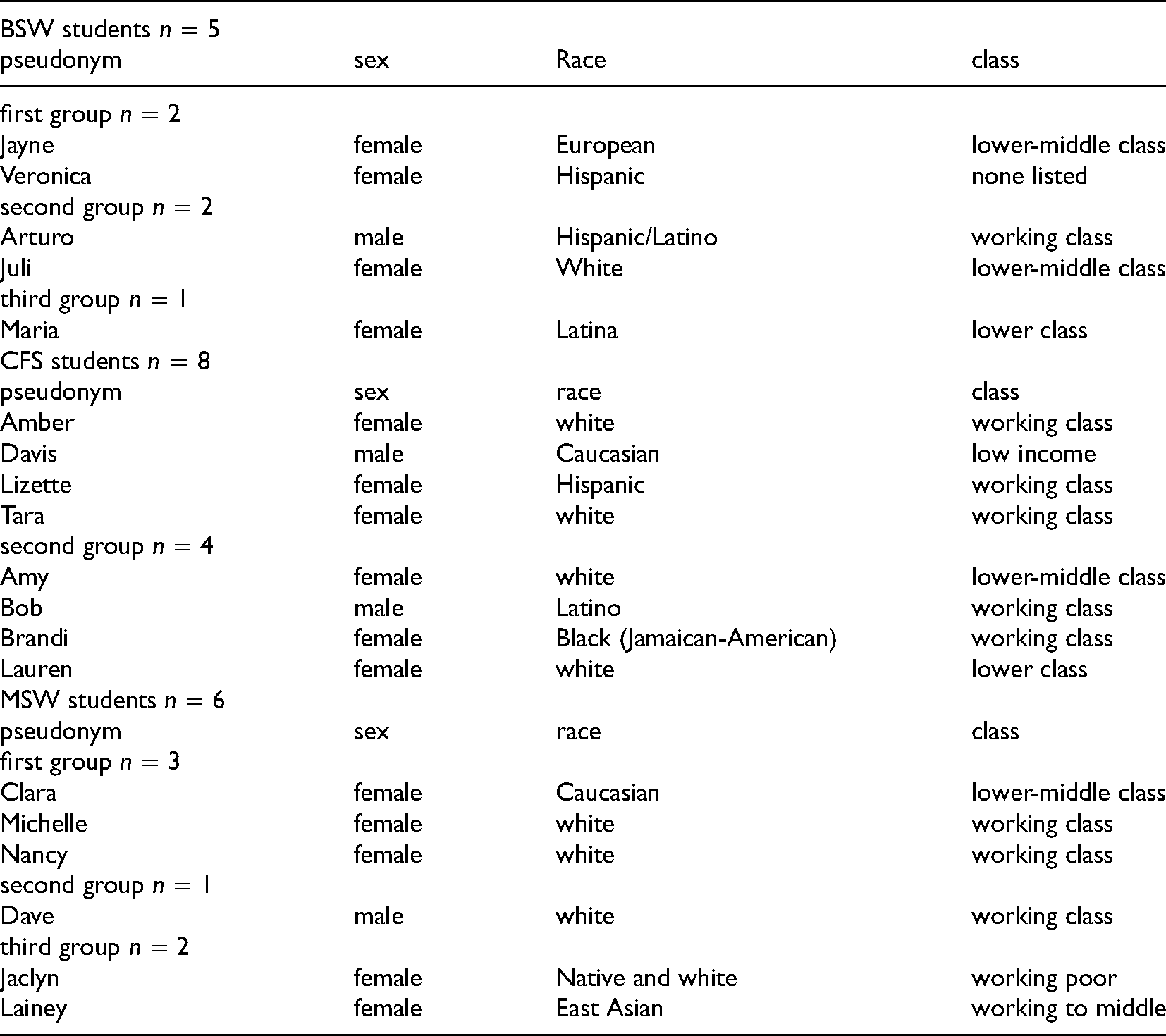
Participant Demographics.
Students reported high levels of family support, countering the deficit-focused framing (Gray, 2013) of FGS and their families, which emphasizes lack and presumes families cannot or will not support students’ educations. Family relationships were central, reflecting the value FGS place on interdependence (Stephens et al., 2012). However, family support was often tempered with questions and cautions, particularly for women. This paper centers students’ perceptions of family support, contradictions in support, and explores how the intersecting identities of students may shape messages signaling transgressions of gendered, classed, and cultural norms. While gender has received little attention in explorations of FGS (see Orbe, 2004), it may be especially salient in relational experiences of FGS. As these findings reveal, they are both honoring family and challenging deeply-held beliefs.
Literature Review
First-Generation Students and Family Support
In a time of growing inequality, family support is critical in college access, persistence, and completion (Haveman & Smeeding, 2006). Wilcox et al. (2005) argued social support was as important as academic integration in first-year retention. Support may take emotional (i.e., caring, esteem) or instrumental (i.e., providing tangible goods, helping behavior) forms, which are often interrelated: receiving instrumental support led recipients to report higher levels of emotional support (Semmer et al., 2008). Parental education level is a strong predictor of enrollment and degree completion (Choy, 2001), suggesting college experience prepares families to support students.
Given the intergenerational trend in college attainment, some have questioned families’ abilities to support FGS (Irlbeck et al., 2014; Pascarella et al., 2004). In a nationally representative survey, FGS were less likely than continuing generation students (CGS) to report family encouragement in attending college (Terenzini et al., 1996). Some BIPOC FGS in Richardson and Skinner’s (1992) interviews were told by family college was “a waste of time” (p. 31). While these studies are dated, ideas about FGS and their families’ lack of support persist. Gray (2013) noted the deficit-focused framing of FGS in an “at-risk” campus program, reflected in comments like, “first-generation students, they are packed different” (p. 1247). Tugend (2015) highlighted FGS’ challenges to adjust to college and families’ struggles to let them go, noting families’ mix of pride and “fear that they’ll evolve into someone the family no longer recognize.”
Interpreting Family Support: Questions, Cautions, and Challenges
But family questions or a perceived lack of encouragement may serve as cautions, and may even foster ongoing relationships. While Terenzini et al. (1996) study doesn’t tell us why the families of FGS didn’t support higher education, some in Richardson and Skinner’s (1992) study came from communities where others returned home with degrees that didn’t prepare them for jobs in their community. And Van Galen (2015) took issue with Tugend’s (2015) charitable take on the struggles of FGS. Struggle is inevitable, Van Galen (2015) argued, as (largely) working class FGS enter institutions where middle and upper-middle class values shape norms, but are rarely discussed. Family fears that “they’ll [students] evolve into someone the family no longer recognize[s]” (Tugend, 2015) were not uninformed biases against college-going, but wisdom gleaned through classist encounters with highly educated people (Van Galen, 2015). In this view, families who discourage or caution college going among FGS are acting out of care, concern, and a desire to maintain relationships.
This does not mean, though, that questions, challenges, or cautions don’t impede or undermine FGS. Students in Orbe’s (2004) study described family and community members being threatened by or jealous of accomplishments. FGS in Bradbury and Maher’s (2009) study reported ending relationships that became unsupportive when returning home. And discouragement may be gendered: female FGS were more likely to be challenged in educational decisions, which conflicted with culturally defined gender roles (Orbe, 2004).
First-Generation Students and Campus Culture: Confronting Independence
Understanding family support of FGS is critical, given findings that FGS value interdependence more than CGS (Chang et al., 2020; Stephens et al., 2012). FGS are confronted by a campus culture of independence (i.e., autonomy, “finding your own voice,” etc.; Stephens et al., 2012). In contrast, interdependence involves making decisions that consider the needs and desires of one's family or community, and is shaped by social class (Stephens et al., 2011) and racial and ethnic backgrounds (Chang et al., 2020; Covarrubias & Fryberg, 2015), with working class and BIPOC reporting higher levels of interdependence.
While most research has looked at FGS as a group, studies focused solely on BIPOC FGS suggest particular implications for interdependence. Chang et al. (2020) highlighted racial differences among FGS: while all FGS were cautious about burdening family or being judged, BIPOC FGS reported more fear about disturbing group harmony and higher levels of obligation. Similarly, Covarrubias and Fryberg (2015) found first-generation status and being Latino was correlated with higher family achievement guilt, with FGS reporting more family achievement guilt than CGS, and Latino FGS reporting more than white FGS. In interviews with Latinx and Asian American FGS, Covarrubias et al. (2019) argued students “never become independent,” noting several forms of familial interdependence, including emotional and financial support, language brokering, physical care, life advice, and sibling caretaking. Research with Mexican-American FGS revealed the “complicated role of familia,” with participants either engaging with family as part of their coping process, separating, or creating chosen family in college (Rodriguez et al., 2021).
London (1996) highlighted interdependence among FGS, in the “intellectual, psychological, family, and cultural dramas” (p. 9) that were part of their experiences. In his seminal study of FGS “breaking away” from family, London (1989) noted that while all students might disagree with their family about aspects of college (majors, living and working arrangements, etc.), FGS alone faced fundamental challenges to their decision to pursue college. FGS themselves also highlight interdependence with family in their persistence. In Bradbury and Maher’s (2009) study of Appalachian FGS, the majority maintained daily contact with families, and many attributed their choice of majors and careers to family needs. Bui (2002) found FGS attended college out of a sense of familial responsibility. In contrast to CGS, FGS were less likely to report attending college to follow in a siblings’ path or get out of the house. Instead, college was a way to ensure the family's financial stability. Interviews with Australian FGS using Yosso’s (2005) community cultural wealth framework revealed family support was multi-generational (O’Shea, 2015). Students fulfilled their elders’ dreams (aspirational capital) and drew support from seeing how their educations influenced younger generations (familial capital; e.g., seeing a child who sat at a table “doing uni[versity] work like mum.” (p. 73)).
First-Generation Students in Context: Social Work and Higher Education
Attending to family support of FGS is important for social work, given the demographics of FGS and social work values of social justice (NASW, 2020). Cole (2008) argued FGS are often members of groups social workers interact with in practice. As members of BIPOC and/or working-class communities, FGS in social work may bring unique strengths to the classroom and profession, including an ability to build trusting relationships within their own communities. And Barretti (2004) called for more exploratory, qualitative studies of social work education, noting our field's reliance on surveys of attitudes and values.
FGS are more likely to enroll in private, for-profit schools than CGS (16% vs. 5%) and in less selective institutions (Redford & Mulvaney Hoyer, 2017). While it didn’t attend to FGS status, a Pew report focused on BIPOC students noted the high rate of enrollment in two-year or private for-profit (11%) compared to four-year institutions (4%; Taylor et al., 2010). Given their higher enrollment in less selective, two-year, and private for-profit institutions, FGS are among underrepresented students who tend to cluster in institutions with fewer resources, which may be less equipped to support them (Carvnevale & Strohl, 2010).
Relatively little is known about FGS in schools of social work. Hodges (2000) survey of undergraduates in a social welfare program at a highly selective university revealed FGS were slightly older and more likely to be Hispanic/Latina/o. A recent survey of undergraduate social work majors at a public, four-year institution found 64% were FGS, who were more likely to be African-American, women, and non-traditional students (Simmons et al., 2018). FGS also reported more interdependent motivations for college. The authors urged CSWE to collect national data on FGS, as a necessary step in transforming a workforce which continues to be relatively privileged into one that is inclusive of communities that have been excluded from higher education.
Among the handful of articles in social work which discuss FGS is Carter-Black’s (2008) own narrative. She hinted at the importance of family support in her story of being a first-generation African-American student on a primarily white college campus: I carried much more than just the things in my suitcases that day as I left home. I also carried the hope of my family all bundled up and neatly tucked away inside where no one else could see. I was keenly aware of my precious cargo (p. 113).
Theoretical Framework
In this work I attended to identities, power, and relationships, and was guided by Black Feminist Thought (Crenshaw, 2000; Hill Collins, 2000) and Feminist Post-Modernism (Campbell & Wasco, 2000). While Black Feminist Thought arose from the experiences of African American women, Hill Collins (2000) noted its utility in projects focused on the empowerment of other marginalized groups. Black Feminist Thought views power simultaneously through a dialectical (e.g., recognizing the outsider status of all FGS) and subjective approach (e.g., recognizing differing intragroup experiences by race, class, and gender). Hill Collins (2000) also highlighted the contextual nature of power: “her gender may become more prominent when she becomes a mother, her race when she searches for housing…” (p. 293). Orbe (2008) suggested Black Feminist Thought was useful for understanding both the privileges (e.g., access to education) and disadvantages (e.g., being constructed as different) of FGS. Because FGS are a large and diverse group, this intersectional approach (Crenshaw, 2000) was necessary to attend to intragroup difference. FGS’ identities often place them at the intersections of racism, classism, sexism, and other oppressions.
I was also guided by Feminist Post-Modernism's focus on relationships in research (Campbell & Wasco, 2000). My understanding of relational being was influenced by Gergen (2009), who argued that our selves are not stable and fixed, but dynamic and co-constructed through interactions. As these interactions continually shape our sense of self, the desire to stay intelligible is a powerful motivator. Behar’s (1996) focus on the relationship between researcher and researched, and research that “breaks your heart” (p. 161) was instructive. I approached this work with a visceral awareness of the implications of family challenges, questions, and cautions. Objectivity was neither possible nor desirable.
Researcher Positionality
Like many FGS I did not realize the significance of being “first” until introduced to the concept (Orbe, 2004). Connecting with other FGS as a graduate student provided a framework for understanding earlier struggles, and recognition they were not mine alone. However, my struggles were not academic, but relational. I first set foot on a university campus as a thirty-year-old mother of two young teens. As a working-class white student, I adapted to educational spaces that were unfamiliar and structured by middle class values, and graduate study only accelerated this process (Ortega & Busch-Armendariz, 2014). But changes that made me more conversant in academia rendered me less intelligible to family. While I expected contingent acceptance in academia as an outsider, finding myself continually negotiating and re-negotiating relationships with family was unexpected and far more destabilizing.
Method
These data are drawn from a larger qualitative exploration of the relational worlds of FGS in a school of social work (Cunningham, 2016). I selected focus groups in an attempt to minimize power differences between researcher and participants and because of the relational nature of my questions (Wilkinson, 1999). I anticipated participants could benefit from learning their relational struggles were common. Two participants completed interviews when other focus group members did not show.
Recruitment began in winter of 2015 and included in-class announcements, flyers, and emails. I invited students from two undergraduate programs (Bachelor's in Social Work (BSW) and Child and Family Studies (CFS), an interdisciplinary program) and one graduate program, the Master's in Social Work (MSW). Given the limited information on FGS in social work, I included graduate students, anticipating that relational experiences would not be resolved through a bachelor's degree – and might even be heightened through graduate study. Students for whom no parent or caregiver had completed a Bachelor's degree were eligible. Forty students indicated interest and nineteen students participated in eight discussions. Data collection took place in the spring of 2015 in a school of social work at a public Northwestern urban university with an enrollment of approximately 29,000 students (University Communications, 2014). The institution is predominantly white (62% white, 9% Asian, 7% Latino/a, 3% African-American, and 1% Native American, with 10% identifying as “other,” and 8% international students, most of whom are people of color). Participants self-identified sex, race, and social class, as well as other important aspects of identity (see Table 1). A total of eight CFS students (six women; five white, two Hispanic/Latino/a, one Black; seven working class) and five BSW students (four women; three Hispanic/Latino/a, two white; a mix of working and lower-middle class) participated. Six MSW students (five women; four white, one multiracial Native American and one East Asian; five working class) participated. In this paper you’ll hear examples of support from across the groups, as all participants recognized family support. Contradictions in that support, though, were limited to women.
In addition to an ethical review by our institutional review board, I was attentive to the ethics inherent in feminist research, particularly Preissle and Han’s (2012) questions about the balance of power in research between researcher and participants. Participants selected pseudonyms, and often used this opportunity to honor family, with some “naming” themselves after family. Participants were also invited to share contact information if they would like future communications about the study. All opted to be contacted and more than half attended one of four member checking sessions in the fall of 2015 which offered preliminary themes. Three of the four participants who identified as men attended.
Because little was known about FGS’ descriptions of their relational worlds, I selected a low-structure, open-funnel format (D. Morgan, personal communication, September 11, 2011). Questions focused on their identity as student in relation to family, perceptions of distance between school and family cultures, and how they navigated that distance. Drawing on London’s (1989) observation that family voices were influential, I asked how family voices informed their processes of becoming social workers or other members of the helping profession (e.g., teachers, counselors, youth workers). All focus groups and interviews were audio recorded and transcribed.
Data Analysis
I adapted the Listening Guide, or voice-centered relational data analysis (VCRDA; Brown and Gilligan, 1992). VCRDA involves four readings of a transcript: the first focuses on the speaker and their story (e.g., metaphors, images). The second, which tracks self-referential statements, highlights the multiple and often contradictory voices of each speaker. The first two readings establish familiarity with the speaker's construction of themselves and note the researcher's reactions. The final readings focus on the stories speakers tell about relationships, and descriptions of their own political and historical situatedness. VCRDA is based on assumptions about gender that have the potential to reinforce gender essentialism, which is at odds with Black Feminist Thought and its rejection of a “universal” female experience. However, VCRDA offered a clear outline for analysis with attention to power, how participants described their identities, and the qualities of their relational worlds. I conducted all readings, engaging in peer-debriefing (Padgett et al., 2004) throughout analysis. While the first reading resembles aspects of grounded theory and thematic or narrative analysis (Gilligan & Eddy, 2017), VCRDA differs in offering a “pathway into relationship rather than a fixed framework for interpretation” (Brown & Gilligan, 1992, p. 22). Rather than focusing on coding and attendant issues (e.g., data saturation), the researcher is urged to become a resisting listener, noticing the polyphonic nature of participants’ stories, including (and especially) voices that are pushed to the margins, usually by the speaker herself. In analysis a complicated story emerged, with all students emphasizing family support, but only women highlighting tensions and contradictions alongside and within that support.
Findings
I focused on the relational worlds of FGS, assuming these were at least as, if not more, important than academics. Participants were ambivalent about relational experiences at school: some struggled, others felt deeply integrated. They were much more interested in discussing relational challenges with family. In each discussion participants began by emphasizing the support of their families. But as we spoke, there emerged a common theme of questions, challenges, and cautions.
“We Support You.…” Emotional and Instrumental Support for Education
Participants were quick to note the ways families supported their education: family support emerged early in every focus group and interview. Most of this support was emotional, in the form of encouragement. Dave, an MSW student, emphasized all the ways family was supportive, “financially, emotionally, spiritually, psychologically.” Indeed, he said, “I wouldn’t be here without my family.”
Lizette, a CFS student, shared her brother and mother's offers of support by reenacting their conversations: …I get the comments “Keep going,” “Do you need help?” “Do you need money?” “Do you need anything?” I don’t have my family around. I have them all spread out…and it's like, “need anything?” and I’m like “No, it's okay” “Are you sure? Do I need to fly out?” …And, I can say, just last week my mom left, she was here for three months with me helping me watch my boys; it was a relief.
Several participants noted how emotional support resulted in the emergence of a hero or star-like identity within their family. “In my family…it's a big deal. Like, ‘Look at you, you’re going to school. You’re gonna get your degree’” said Juli, a BSW student. Sometimes this took the form of an interest in student's coursework. Bob, a CFS student, told us about conversations with his father each term after registration, “…over the phone he’ll ask, ‘Oh, what classes are you in? What you learning about?’ He always gets really attached to it…he's always saying, you know, ‘I wish I was you.’” For FGS, these conversations may engender a complicated mix of pride and guilt: the hero or star status signaled a growing distance from family. As Michelle noted, “I experience a lot of guilt for leaving family behind … I have a cousin who is older and constantly compares herself to me … that's not my intention.”
It was less common for family members to provide instrumental support, such as assistance navigating higher education (as Michelle, an MSW student said she’d been told, “it's all you if that's what you want to do”). Here Clara, an MSW student, described her parents’ efforts: Neither of my parents even did an Associate's, and they were both like, my dad was willing to help, but they were like, “We’re just going to figure this out together. Like I don’t really know any of this stuff.” So, we would go on the computer together and do the financial aid and that was really helpful.
Family messages of support often reflected dominant cultural messages linking education and social mobility. While family members weren’t always familiar with the professions these students were preparing for, in most cases they encouraged students to finish.
“…to an Extent” Identities, Intersections, and Family Support
However, family messages of support were often tempered with concerns, questions, or challenges, particularly for women. Family voiced fears about student loan debt, questions about professions that were unfamiliar (and in some cases, threatening to family), and noted changes in students’ beliefs they attributed to schooling. To some degree all participants were threatened by the loss of relevance in their families as a result of schooling, and men were sometimes confronted when their educations emerged in ways that challenged family ideas. Dave, an MSW student, recalled his father's retort, “Oh, I can see you’ve been to college” early on in his college career. But men seemed to bear less emotional weight from these challenges. Dave noted that there are “multiple truths,” and said, “I guess I feel pretty comfortable with where I’m at and, you know, with where they’re [family] at.” Female participants were unique in facing pointed challenges about the amount of time dedicated to schoolwork, with all fifteen noting some form of questioning or cautions. Because family was usually supportive of the overall goal of education, these messages were somewhat contradictory.
Amber, a working class CFS student, highlighted the ambivalence in family messages of support. Her father told her to pursue work she loved, but also scrutinized her choice of a degree: my father's like “How are you going to pay off those loans with your fluffy degree?” … and then he turns around and he says, “Don’t do the main dang job just to bring home the paycheck, you know, do something that makes you happy.” So…it's…very contradicting.
Occasionally women noted family resistance about earning a college degree in general. This resistance seemed to arise from family members’ own experiences working in fields that didn’t require higher education. ‘Who would you rather have dig your ditch? Someone who's read about it, or someone who's done it for 20 years?’” Jaclyn's father asked her. She continued, “…It's not that they don’t agree with college, they just don’t think that people need to go to college.”
Participants also noted family concerns about their choice of degrees, particularly social work. Juli, a BSW student, noted that while some family offered support (and even celebrated) her, others were “more, dysfunctional, and so I think that they’re afraid … of me … being in social work … like somehow I’m going to lose the family identity and become a social worker to them.” Other participants’ families were blunter, saying “all we hear in the news is … social workers taking your kids away” said Maria, a BSW student. Lauren, a CFS student, noted people from her “lower class” neighborhood thought, “‘Oh, you’re gonna take my kids away!’ That's immediately what they think!” These challenges from families and home communities resonated with participants, and were only reported by women.
At other times, students were able to find some family members that supported their schooling within a larger familial context of feeling challenged. Here Nancy, a white working class MSW student explained, “with my mom and my stepdad … I think it's an important piece of my identity to them, because they want that for me, and they know that's what I want. But outside of those relationships, my role as a student is – really feels like a negative thing.”
Moments later, Nancy reflected on the role that sexism played in challenges posed by extended family: …I also think gender has been a big piece too. Like, I’ve gotten questions from family members like, “Why do you want that? Aren’t you just gonna get married?” Like, for real, I’ve heard that… [responding to gasps from other participants]. ‘Cause all of my cousins—female cousins are stay at home moms, and I have like, twenty. And they’re really perplexed by this idea that I want to — to do something different…
Lizette shared her response, again using a conversational style to illustrate, “But on the other hand, no I don’t. I need to grow…I need to keep going.” Even though Lizette felt certain about her need to keep going, she highlighted how challenging it could be to finish her Bachelor's degree in the face of this questioning. Notice here that although Lizette reported feeling support, the number of family members questioning her had grown: … my aunts and uncles, I don’t really listen to them because all I get from them, like “well, what are you doing that for, what's the point?” … …those family voices are really powerful…. They’re very powerful. They’re very powerful. They think…it doesn’t hurt and it does, so it's like, very powerful.
These questions and challenges also seemed to arise from the demands that schooling placed on female student's time. Family members expressed surprise and disbelief at the amount of time that participants spent engaged in study. Brandi, a working-class Jamaican-America CFS student, talked about the pride her mother felt, but also her surprise about the time Brandi devoted to school, which took her away from family: … as far as family goes, too, my family is supportive and it's really funny because like I said, my mom, like in Jamaica, it's like university, you just have to go to school, like that's your way out. But she didn’t know what that meant because she’d never been herself, and so she is supportive, but when… she's like, “Have you graduated yet?” and I’m like, “No mom, it takes four years to get a degree.” And she's like, “Why so long?” She's supportive, but she's very concerned because family is so important, and it's — she sees that it's been a struggle for me to go to school, I have not been able to spend as much time with family, so she can be a little resentful of that.
Maria, the working-class Latina BSW student whose quote provided the introduction for this article, paused in the middle of our interview and laughed when describing family support. Like many participants, Maria's education had led her to challenge her family's ideas about women and gender, sexuality, child rearing, and the role they could play in challenging racism. “I caught myself and I said, ‘Oh, well they’re so supportive!’ and it's like, ‘Well, kind of.’” Maria's initial response, like others, was to highlight family support. As we spoke, though, the story grew more nuanced. Maria described a pattern of resistance that had emerged as she had increasingly shared ideas from her education, and her family's ongoing dismissal of her “social work stuff.” But Maria's story also highlighted the significance of family to FGS, even amidst questions, challenges, and cautions. In the end, she did not see her degree as an individual accomplishment, but as something borne of sacrifices by generations of women in her family. “I’m the one getting the degree,” Maria told me, “but who really suffered?”
Discussion
This study builds on previous work that demonstrated the importance of interdependence (Chang et al., 2020; Covarrubias et al., 2019; Stephens et al., 2012) and family relationships (Bradbury & Maher, 2009; Bui, 2002; Carter-Black, 2008; London, 1996; O’Shea, 2015) to FGS. Perceiving family support for education was critical to these FGS. Because each conversation began with a clear endorsement of family support, I wondered if deficit-focused views of FGS and their families might be prompting this counter response.
And the families of these FGS were supportive. Families were generally positive about college, and believed it led to social mobility They offered emotional support, typically through encouragement or celebration of students’ accomplishments. Many students noted they stood out in their families because of college attendance; for some family seemed to be living out their own educational dreams through FGS. This reflected O’Shea’s (2015) findings of aspirational capital among FGS. Participants reported some instrumental support such as child care, financial assistance, and support applying to college. Like Semmer et al. (2008) found, instrumental and emotional support were intertwined: participants felt cared for when family offered tangible supports to help them manage the tasks of attending school.
It's important to note the potential drawbacks of emotional support, though, particularly for students who were celebrated or treated as somehow different than family, such as Juli, who worried about “losing the family identity.” Here Gergen’s (2009) concept of relational being is relevant: humans are motivated by a need to stay relevant and intelligible to others. Treating students like a “big deal” was counterproductive, as students desired connection over celebration.
These findings also extend previous work that noted the role sexism may play in the relational experiences of FGS (Orbe, 2004), and offer new insights through an intersectional approach (Crenshaw, 2000; Hill Collins, 2000). Gender was especially salient in shaping the contradictory messages that students received. Women were challenged and questioned about the decision to pursue a college degree; men were not. Nancy attributed her family's questions about her degree to gender, comparing herself to her cousins, who were all parenting. Class is also likely a part of her family's resistance. Hamilton and Armstrong (2009) explored the gendered experiences of college students, highlighting the difficulties working class women encountered due to expectations they would prioritize intimate relationships and family over, or at least alongside, college attendance. Schooling, which is shaped by white and middle-class norms of independence (i.e., autonomy, finding your voice, etc.; Stephens et al., 2012) was, in effect, extracting these women from the demanding roles of gendered labor (e.g., child bearing and rearing, domestic labor, and other kin-related work). By putting off child rearing (or balancing college and parenting simultaneously: three participants were mothers), female FGS challenged fundamental beliefs about their roles in families.
But these experiences were further differentiated along lines of race (Hill Collins, 2000). While white women suspected sexism was informing family member's challenges, BIPOC women faced direct challenges about upholding cultural norms. Lizette and Brandi highlighted cultural norms they were transgressing by not “drop[ping] everything” and failing to spend enough time with family, which may reflect higher obligations among BIPOC FGS (Chang et al., 2020), and expectations for interdependent contributions to family (Covarrubias et al., 2019). Lizette revealed the power of family voices in her frequent use of a conversational style to illustrate family support and challenges, and noted, “They think it doesn’t hurt, and it does.” Her words echo those of the Mexican-American FGS who wavered between engaging with and separating from family as part of their coping with college (Rodriguez et al., 2021).
Finally, this study adds a social work perspective to the literature on FGS, and extends inquiry on the experiences of FGS into a school of social work. Given the high proportions of BIPOC among FGS (Bui, 2002; Chen, 2005, Terenzini et al., 1996), and the challenges in recruiting and retaining a diverse social work workforce (Casstevens et al., 2012), it's imperative for social work educators to consider FGS. Social work education may present a unique challenge for FGS within their families, based on growing identification with a workforce that has a history of surveilling of working-class people and/or BIPOC. But social work educators are also well-suited to address the challenges FGS face, which differ along lines of race, class, and gender. Adapting Hill Collins (2000), we must consider how “her gender (and race and class) may become more prominent when she becomes a student,” and honor the centrality of family to FGS.
Implications
This work presents several implications for educators in schools of social work. First, we must listen to FGS and recognize supports they derive from family. While it's widely assumed that families are not able to support FGS, the evidentiary base for these claims is rather thin. The presence and importance of family support was emphasized in each focus group and interview, which suggests participants were presenting a counternarrative to widely held (if not always clearly articulated) beliefs that families will not or cannot help FGS.
Second, we must be conscious of discourse about FGS, and challenge deficit-laden framing of FGS and their families. Our explicit and implicit messages about social mobility (i.e., university websites and bridge programs aimed at FGS) may diminish family, through emphasizing a lack of cultural capital. Given the interdependence of FGS (Stephens et al., 2012), especially BIPOC FGS (Chang et al., 2020; Covarrubias et al., 2019), perceptions of family support matter greatly. Instead, presenting social mobility as a form of aspirational or familial capital (Yosso, 2005) recognizes students’ perseverance while honoring family contributions. Educators and administrators can replace deficit models of students and family by seeking student voices and focusing on assets and strengths (Diaz et al., 2021). The First in Our Families digital storytelling project offers an example of counternarratives which center FGS voices (Van Galen, 2021).
Ideally, listening to FGS and challenging deficit-laden discourse can lead to shifts in the culture of institutions which favor independence over interdependence. FGS, who are disproportionately working class and/or BIPOC, navigate distances between home and school while attempting to honor family traditions. But ideally the responsibility extends to our institutions, particularly those that recruit BIPOC FGS, to build upon the familial strengths of FGS and enhance cultural responsiveness. Educators can create opportunities for FGS-led conversations about schooling and family (in this research, participants were loath to end focus group discussions; for most it was the first time they’d spoken about this with others). FGS instructors can model their own paths, highlighting aspirational and familial capital. To do this effectively, schools of social work must support the hiring and retention of FGS faculty, particularly those who are BIPOC.
Family relationships may seem like a relatively small part of college life. But for FGS who were carrying the burdens of being non-traditional students, of being non-materially privileged, of being BIPOC in a primarily white institution, and of being the first in their family to complete a degree, family mattered, so much so that the stories they told of family began with support, even when that support was limited, and for women, riddled with questions, challenges, and cautions.
Limitations
This work has several limitations. First and most glaring is the potential for reifying binary conceptions of gender, through the absence of gender non-conforming and/or non-binary participants. Second, while there are several Hispanic and Latino/a students in this sample, other BIPOC (Asian, Black, and Native American) are only represented by single participants. Similarly, the limited number of males in this sample prevents generalizations about how gender may be salient among FGS as a group. The sample, though, reflects the race and gender breakdown of students in schools of social work (CSWE, 2020), and the findings offer important implications for educators in schools of social work who are working to build a more diverse and inclusive workforce (Casstevens et al., 2012), in alignment with our code of ethics (NASW, 2020).
Conclusion
This study examined the relational worlds of first-generation college students in a school of social work in a public, urban university and found family support was widespread. Upon further conversation, though, contradictions in this support emerged, particularly for women. The contradictions revealed the extent of support: college-going was questioned or challenged when it conflicted with prescribed gender roles, and BIPOC women faced additional challenges to uphold cultural norms. These findings underscore the importance of listening to FGS and recognizing family support, countering deficit-based narratives, and bring a social work perspective to the growing body of literature on FGS. They also point to a need to consider how race, class, and gender shape relational tensions that emerge between students and family. College-going, which is shaped by white and middle-class norms of independence, may pose particular relational challenges for FGS women, who challenge family beliefs about work, gender roles, and find themselves absent from work that families expect of them. Understanding how these contradictory messages influence FGS is critical to supporting their persistence in schools of social work, and ultimately, shaping a more diverse and inclusive workforce.
Footnotes
Declaration of Conflicting Interests
The author(s) declared no potential conflicts of interest with respect to the research, authorship, and/or publication of this article.
Funding
The author(s) disclosed receipt of the following financial support for the research, authorship, and/or publication of this article: This work was funded by the John F. Longres Dissertation Research Fellowship.
