




Abstract
The current study critically analyzes the dress code and uniform policies of 89 New Orleans public charter schools using content analysis. Dress code and uniform policies across the United States are deeply rooted in racism, sexism, and classism and, through their implementation, further contribute to these same oppressions. In this study, the dress code and uniform policies, including the justifications for policy, specific policy rules, and possible consequences for noncompliance, are the primary units of analysis. Drawing on intersectionality and the concept of misogynoir, this study attempts to dissect what school policies communicate about race, class, and gender. The racist, classist, and sexist language deployed within the policies is exposed while specifically centering the disproportionate regulation of young black female bodies in dress code policies. School social workers are uniquely positioned to advocate for more equitable dress code and uniform policies. This study contributes to the larger body of literature for its inclusion of data from an entire city as well as its intersectional approach.
Several stories have hit the news cycle recently regarding school dress code policies. In Alaska, 17-year-old Breckynn Willis was disqualified from a swim competition she won last September for the way the school-assigned swimsuit fit her body (Prior & Criss, 2019). Eight-year-old Marian Scott was not allowed to take her school picture in Michigan for wearing red braids (Kenney, 2019). Near New Orleans, a middle school student, Faith, was asked to leave school due to her hair extensions (Wells, 2018). Each of these cases involved female students of color. Each of these cases also resulted in community pushback. After public uproar, the decision to disqualify Willis was reversed (Prior & Criss, 2019), a photographer held a professional photo shoot with Marian Scott as a show of support (Kenney, 2019), and rapper T. I. publicly supported Faith on social media, criticizing the school policy (Wells, 2018). These stories indicate the discriminatory power of dress code policies, particularly related to race, class, and gender.
Dress code policies in the United States, including uniform policies, are deeply impacted by two cultural anxieties, fear of youth violence and fear of youth sex (Hethorn & Kaiser, 1999). These two anxieties disproportionately impact racial/ethnic minorities and female students, most notably, black girls. Uniform policies and strict dress codes policies have developed in response to these anxieties and exacerbate the treatment of black female students (Epstein et al., 2017; E. W. Morris, 2005; M. W. Morris, 2016). By mandating a “professional” look, these anxieties are countered, yet professionalism itself is often coded language as white and middle class (Jones, 2017).
Due to the disproportionate impact on black girls, this inquiry draws on critical race theory (CRT), critical race feminism (CRF), and misogynoir (Bailey & Trudy, 2018; Hill Collins, 2000). Importantly, this study centers the experiences of black girls in schools within the analysis, an identified underresearched experience (Evans-Winters & Esposito, 2010). While previous studies have explored experiences of black girls in schools (e.g., M. W. Morris, 2016; Wun, 2016a, 2016b) and analyzed dress code and uniform regulations (e.g., Aghasaleh, 2018; E. W. Morris, 2005; M. W. Morris, 2016), this study contributes to the literature by evaluating the state of dress codes and uniform policies using an intersectional lens in one city at one point in time.
Literature Review
Hethorn and Kaiser (1999) identified two twin anxieties dictating the regulation of youth clothing, cultural anxiety about youth sex and youth violence. These anxieties have contributed to the development of dress codes policies (what to wear) and in many cases, uniform policies (what not to wear; Anderson, 2002). These anxieties intersect with race, gender, and class and leave black girls particularly vulnerable to surveillance and control (Hethorn & Kaiser, 1999).
Cultural Anxieties
The first anxiety, youth violence, is almost always directed at black and brown males (Hethorn & Kaiser, 1999). This cultural anxiety emerges in policy that polices gang-related wear, sagging pants, and other styles of dress which are viewed as dangerous (Brunson, 2011; Hethorn & Kaiser, 1999; E. W. Morris, 2005; Thompson et al., 2000). Hip-hop dress is seen as defiant and therefore dangerous, particularly when worn by black boys (E. W. Morris, 2005). Strict dress code policies and even city-level sagging bans are deployed and justified as gang-violence prevention efforts (Sinopole, 2008; Thompson et al., 2000).
The second cultural anxiety around youth sex also informs the development of dress codes (Hethorn & Kaiser, 1999). This anxiety of sex is almost entirely directed at female bodies, with the intersections of race, class, and body size determining whose bodies are regulated and controlled (Hethorn & Kaiser, 1999). Black girls may be particularly targeted by this cultural anxiety. Epstein et al. (2017) found that black girls are seen as more adult than their white peers and therefore less innocent and more sexual. Black girls are more targeted for dress code violations in school because school administrators and staff perceive them as overly sexual (E. W. Morris, 2005). In general, black girls experience high rates of hyper-surveillance in schools, and this extends to control of dress (Wun, 2016a). For instance, black girls are twice as likely to be disciplined for a minor behavioral violation in school (including dress code violations) than their white peers (Epstein et al., 2017). In fact, the vague language of violations to the learning environment (obstructions, distractions) is both a common justification for strict dress code policies and a disproportionately applied violation for black girls in schools (Wun, 2016b).
The language of professionalism is deployed to regulate dress and address the twin cultural anxieties of violence and sexuality. These regulations are extended not only to ban sagging pants and tight-fitting clothing but also to dictate appropriate hairstyles, jewelry, and dress. Black hair has been regulated and controlled by Europeans since the mid-1400s as a tool of white supremacy (Patton, 2006). Now, this regulation and control are coded through the language of professionalism (Jones, 2017; O’Brien-Richardson, 2019; Patton, 2006). Professionalism, deeply embedded in white, middle-class norms, has been continuously upheld in the court system as race-neutral, despite its deployment against black men and women (Jones, 2017). Hair, in particular, is deployed as a method to control black women (Jones, 2017; O’Brien-Richardson, 2019; Patton, 2006), and in fact, hairstyles traditional to black women, when worn by white women, are typically considered socially acceptable, further exposing the double-standard and lightly veiled racism within these policies (O’Brien-Richardson, 2019). Uniform policies specifically justify themselves through the language of professionalism (Anderson, 2002) while failing to recognize the racist underpinnings of such language (Jones, 2017; O’Brien-Richardson, 2019; Patton, 2006).
New Orleans Context
A historical context of the New Orleans schools must be considered to understand the racialized nature of the contemporary local school system. After Hurricane Katrina in 2005, the public school system changed rapidly in New Orleans. Due to many abruptly made decisions in the wake of the storm, the school system was privatized and New Orleans was transformed from one unified school district into many charter schools or “public schools that are governed by independent, non-profit school boards” (NOLA Public Schools, 2019, p. 7). This privatization was headed by a politically elite, white, business class, and the constituents of the New Orleans public school system—mostly black students and their families—were left out of the decision-making processes (Goff, 2009). Constituents of the school system were left disempowered as sweeping changes were enacted without their knowledge or consent (Finn et al., 2017). Many black advocates fought against school reform, and the opposition continues today (Goff, 2009).
New Orleans is now the only school district in the country composed entirely of charter schools (Harris, 2015). Years after this controversial decision, the eyes of the nation are now fixed on New Orleans. Already, policy analysts are arguing that this experiment should be replicated in urban, low-income districts across the country (Osborne, 2012). It is more critical than ever to highlight how market-based school reform has fallen short.
In a city where over 93% of students in its public charter students are black (Parsons & Turner, 2014), New Orleans’ market choice approach to reform has largely ignored New Orleans’ troubled history of racial disparity, segregation, underfunding, and neglect. The current school system has come at cost of irreparable harm to New Orleans’ black teaching force (Buras, 2013). Before the storm, the school system provided a consistent source of employment and professional status for many black educators in New Orleans (Finn et al., 2017; Goff, 2009). After the storm, a massive number of teachers were fired, tenure was eliminated, and collective bargaining was allowed to expire (Barrett & Harris, 2015). Between 2005 and 2015, the teaching force transformed from primarily black teachers (71%) to less than half black teachers, from experienced to inexperienced, and from local to nonlocal (Barrett & Harris, 2015). Indeed, the nation has suffered no greater loss of a black teaching force all at once since desegregation (Cook & Dixson, 2013). New Orleans schools also have one of the highest segregation rates in the country, with the vast majority of its white students in private schools while their black peers attend charters (Parsons & Turner, 2014). Of the white students who do attend charters, two thirds are concentrated into three selective admissions charters (Parsons & Turner, 2014). Further, while the demographics of the student body remained predominantly black, school leaders of new charters were overwhelmingly white (Finn et al., 2017).
This mass privatization also resulted in a decentralized approach to school governance, with charter management organizations (CMOs) responsible for their own policies and procedures with little oversight of day-to-day operations (Buras, 2013). This made keeping track of school governance, administration, and policies for each school challenging for families and stakeholders. Despite limited oversight on daily operations, schools are now held accountable by shutting down schools that do not meet set criteria. Therefore, school closures, openings, and reopenings under new management are now commonplace (Buras, 2013). This constantly evolving landscape makes it difficult for even well-informed, well-resourced parents to make informed “choices” within the school choice system (Finn et al., 2017; Goff, 2009).
Under the charter model, individual schools have complete discretion at nearly every level of policy from discipline to dress codes to hiring decisions. The primary form of external oversight for these schools is concerned with test scores and little else (Sondel, 2015). Unrestrained by centralized governance and accountable only for test scores, many charters have adopted “no excuses” or “zero-tolerance” discipline approaches. These approaches are characterized by austere school policies that prioritize keeping children on task rather than engaged and emphasize surveillance and control rather than play, joy, and exploration (Sondel et al., 2019). These policies run contrary to a long literature of best practices for successfully teaching students of color (Ladson-Billings, 1998).
Although school uniform policies in New Orleans were common as early as the 1990s (Nittle, 2014), the charter movement has only perpetuated the reliance on school uniforms, particularly in zero-tolerance charter models. While uniform policies are popular in cities across the country, no other city has so little oversight and such a high incentive for student control. As cities with struggling school systems all over the country look to New Orleans as a model, it is more critical than ever to both highlight where reform has fallen short and to course correct for the future. For this reason, we focus our study on New Orleans, even though we believe it has far-reaching implications beyond the New Orleans context.
Previous Research
Although New Orleans offers a unique context to study uniforms, uniforms have a long history in U.S. public schools. Uniform policies in U.S. public schools first began voluntarily in 1987 (Cherry Hill Elementary Schools—Baltimore) and mandatorily in 1994 (Long Beach Unified District—California; Brunsma & Rockquemore, 1998; McDaniel, 2013; Wade & Stafford, 2003; Yeung, 2009). These early public school uniform policies originated in schools that were urban, primarily nonwhite, low-income, and largely considered unsuccessful. Further, schools with zero-tolerance policies are more likely to require school uniforms (Brunsma, 2006). Charter schools, which often emphasize military-style discipline policies as the antidote to poor performance, favor school uniforms for outward communication of this disciplined body (Lack, 2009). In these environments, poor student achievement is attributed to lack of discipline, while structural issues of inequity are largely ignored (Lack, 2009).
Most previous scholarship focused on uniform policies have examined their efficacy, finding no significant changes in behavioral, academic, safety, financial, or self-esteem outcomes related to uniform policies (Brunsma, 2006; Brunsma & Rockquemore, 1998; Wade & Stafford, 2003; Yeung, 2009). Additionally, studies have effectively exposed sexism (Neville-Shepard, 2019; Pomerantz, 2007; Raby, 2010), racism (Jones, 2017; Thompson et al., 2000), and discrimination toward transgender and gender-nonconforming students (Glickman, 2016; Kosbie, 2013) in dress code policies. Fewer studies have applied an intersectional analysis to dress code policies (Aghasaleh, 2018; E. W. Morris, 2005; M. W. Morris, 2016). Previous studies have examined dress code–related headlines (Neville-Shepard, 2019; Pomerantz, 2007), the legality of dress codes (Jones, 2017; Thompson et al., 2000), student experiences with policies (M. W. Morris, 2016; Raby, 2010), or the specific policies of one school (Aghasaleh, 2018; E. W. Morris, 2005). To our knowledge, no in-depth critique of post-Katrina New Orleans dress code policy exists.
Due to a long history of invisibility (Evans-Winters & Esposito, 2010), more research is needed on the impact of dress code policies with black girls as the focus. An intersectional analysis of these dress codes is imperative as dress codes are informed by cultural anxieties which are gendered, raced, and classed. This study seeks to fill this gap. Without a clear picture of the content of specific policies impacting students across many grade bands, meaningful dress code reform efforts are curtailed. This study used content analysis to critically analyze the uniform and dress code policies of all public charter schools in New Orleans. Most centrally, the study examined what these policies communicate about race, class, and gender, centering the experiences of black girls. The present study will build on this body of scholarship literature to analyze policies in New Orleans using an intersectional approach.
Theoretical Foundation
Intersectionality was the primary lens of analysis in this study. Focusing on oppression in social work using generalities has been problematized for overshadowing the specifics of gender, class, race, and sexuality (Mattson, 2014). Speaking of oppression in general terms both inhibits critical reflection and oversimplifies the complexity of power dynamics in social work practice. Therefore, following the suggestion of Mattson (2014), this analysis will rely on CRF, specifically the concept of intersectionality. Intersectionality, or the mutual influence of multiple systems of oppression, emerged from the tradition of CRT (Evans-Winters & Esposito, 2010; Hill Collins, 2000). Critical race feminists have criticized the tendency for scholars to discuss race, gender, and class as individual axes of analysis, ignoring their mutual constitution (hooks, 1981; Crenshaw, 1989; Hill Collins, 2000; Lorde, 1984). As Crenshaw (1989) observed, when one axis of oppression (sexism) is analyzed, it is invariably analyzed from the lens of the most privileged (white, middle-class women), rendering multiply oppressed groups (black women) invisible.
Moya Bailey and Trudy (2018) coined and popularized the term misogynoir to explain the specific antiblack racism and misogyny experienced by black women in 2008. This concept developed by looking specifically at racist and sexist tropes in digital media but has since expanded (Bailey, 2013; Trudy, 2014). Building on the twin cultural anxieties of violence and sexuality (Hethorn & Kaiser, 1999), dress code and uniform policies are likely developed with this racist and sexist trope in mind. Due to this misogynoir, black girls are likely more impacted by the policy; therefore, this study will center the experiences of black girls in schools. Placing black girls in the center of analysis is more inclusive as it allows for more angles of analysis and clearly illuminates the complexities of oppression (Hill Collins, 2000).
Method
Data Collection
This content analysis attempted to include all dress code policies of all public charter schools open during the 2019–2020 school year in the city of New Orleans. Under the choice system of post-Katrina New Orleans, families complete the OneApp, or “centralized, online school application” (NOLA Public Schools, 2019, p. 12) for admission into K–12 public schools. A full list of the schools was accessed and downloaded via the website for the organization Enroll Nola (NOLA Public Schools, n.d.), which, in partnership with the Orleans Parish School Board, provides basic information on all public schools and facilitates the OneApp process. As OneApp is the only way to enroll in public school, the list is assumed exhaustive.
To obtain the data, the first author followed the school website link provided on the Enroll Nola website for each school. If the link was invalid or redirected to the wrong page, the author utilized an internet search to find the school website. If the website linked a student and/or family handbook that included a dress code or uniform policy, this was downloaded. If not, the author explored the website for less formal information (e.g., a handout on uniforms). Once obtained, the policy was dated, saved electronically, and printed. Only two policies could not be obtained this way. The author emailed both schools asking for a copy of the policy. One school responded by sending the full student handbook. After a week of no response from the second school, a phone call was made. The school claimed to not have a written policy, but verbally summarized the policy, which the author wrote down and included in the data.
Sample
The full list extracted from the Enroll Nola website in November 2019 consisted of 105 schools. The first author combined duplicate schools (e.g., French and Spanish tracks of the same school) and removed schools not open for the 2019–2020 year. Additionally, schools charging tuition were removed as private schools are beyond the scope of this inquiry, narrowing the list to 86 schools. This list later increased to 89 schools as the elementary and high school policies of three schools warranted separation due to the vast differences. The racial and economic diversity of each school was obtained from a website run by the Louisiana Department of Education (LDOE, n.d.) called “Louisiana Believes.” The racial demographics included the categories of Native American, Asian, African American, Hispanic/Latino, multiple races, Pacific Islander, and white. Economic disadvantage was defined by the LDOE as students “eligible for Supplemental Nutrition Assistance Program (SNAP), Temporary Assistance for Needy Families (TANF), Medicaid, awaiting foster care, migrant, and incarcerated children” (LDOE, 2015, p. 6). The demographic information of the sample is reported in Table 1.
Demographic Information for the Total Sample.
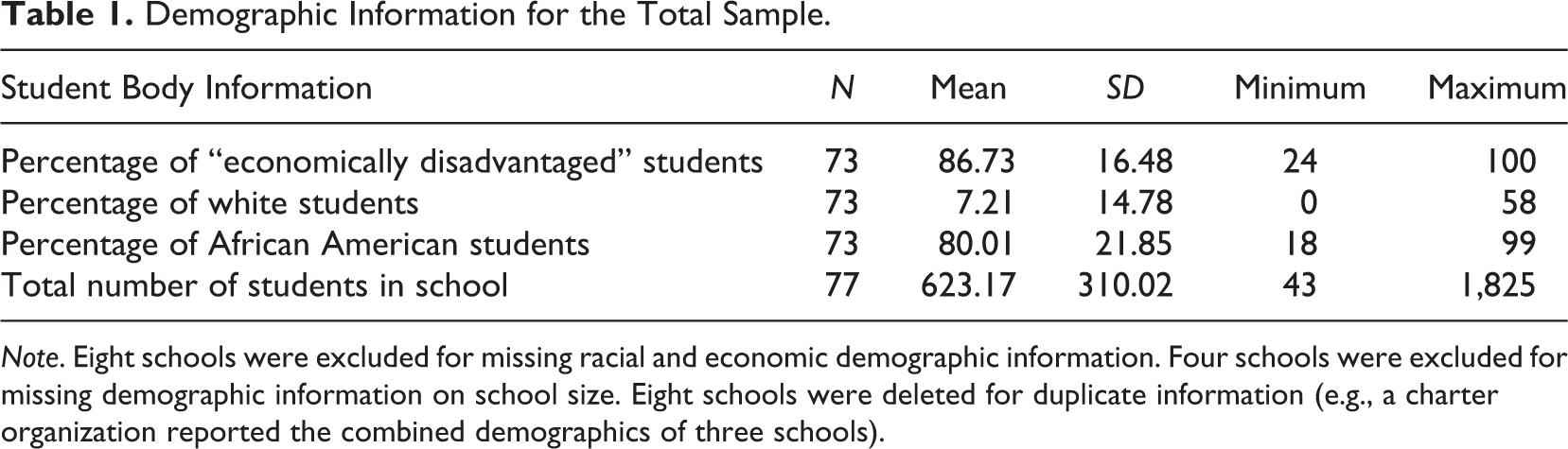
Note. Eight schools were excluded for missing racial and economic demographic information. Four schools were excluded for missing demographic information on school size. Eight schools were deleted for duplicate information (e.g., a charter organization reported the combined demographics of three schools).
The schools included in these policies are represented by 45 unique CMOs. Twenty-nine of these CMOs ran only one school. However, other CMOs included many schools, with the highest including seven schools and 10 unique policies. In this sample, CMOs encompassed 1.98 schools on average. Some CMOs provided one encompassing district-wide policy that applied to all their schools. Other CMOs provided a broad district-wide policy that was supplemented by specific school-based policies. Finally, some policies were entirely to the discretion of the school itself. Regardless of CMO affiliation, verbatim language was borrowed across schools and even across CMOs, indicating some level of collaboration in policy writing. As all policies were publicly available online, it cannot be determined the extent that school leaders actively discussed the sharing of this language, particularly in examples of parallel language across nonaffiliated schools.
Of these 89 school policies, 76 (approximately 85%) required a full uniform, with only one school specifically giving an option to opt out. Within the policies, only 21 schools (23.40%) had one single policy that applied in all situations, across all grades, all genders, and all activities. Schools differentiated dress code requirements by grade (38), gender (25), dress down days (21), spirit days (14), cocurricular activities (12), and school events/field trips (7).
Data Analysis
This content analysis was grounded in feminist standpoint epistemology that acknowledges that researcher positionality informs ways of knowing and understanding (Harding, 2004). The authors were drawn to this project as women who experienced being dress coded in school and who also worked in the school system as adults. The first author is white while the second author is black and Puerto Rican. The authors’ school experiences both overlap and diverge with the experiences of New Orleans students. The researchers compensate for the limitations in their perspective by using theories of analysis that center and prioritize black girls (Hill Collins, 2000). Therefore, the authors’ collective lived experiences, the theory of intersectionality (Crenshaw, 1989), and consulting previously written critiques of dress codes (e.g., Aghasaleh, 2018; E. W. Morris, 2005; M. W. Morris, 2016; Neville-Shepard, 2019; Pomerantz, 2007; Raby, 2010) informed our analysis and codebook.
Ten policies were selectively chosen to inductively create an initial codebook to capture the complexity of the policies. This sample included a mix of elementary and high school, uniform and nonuniform, and racial/economic demographics in an attempt to capture policy diversity within the initial codebook. The two authors independently analyzed the documents for themes and subcategories. The initial coding was completed independently to increase the validity of the codebook. After separate analysis, the authors compared findings, discovering the subcategories matched substantially across the two codebooks, with only a few minor differences. Using the information from the two independent codebooks, domain categories and specific subcategories were developed. To check reliability, a new sample of 10 schools was coded independently. After, slight adjustments were made in response to minor differences. All 89 school policies were analyzed using the finalized codebook.
The final codebook contained the domains of demographic information, general information, gender enforcement, clothing, clothing messages, nonclothing items, and value language. Variables included a combination of open-ended responses, yes/no questions, scaled questions, and checklists. Schools with more than one policy (e.g., by gender) often received multiple ratings on the same item. For instance, if a school prohibited male students from wearing earrings, but allowed female students to wear earrings smaller than a quarter, the school was coded as both 1 (size/type/style restriction) and 2 (ban) under the category of jewelry.
A combination of basic descriptive statistics and qualitative analysis was used for data analysis. Using the codebook, each dress code was coded for its objective characteristics using yes/no responses (are shorts allowed?) and scaled responses (allowed length of shorts). These findings are reported using basic descriptive statistics. For open-ended questions, including policy justifications, value language, and consequences, a process of iterative coding was used. These clauses were coded with initial themes and then refined through multiple iterations.
Results
Five major themes emerged regarding how schools justified their policies emerged. These justifications included (1) preventing distractions, (2) promoting a positive school culture, (3) allowing self-expression, (4) exhibiting professionalism, and (5) promoting safety. In addition, specific regulations were examined in relation to class, race, and gender. Finally, trends in consequences for violations were analyzed.
Justifications
The most common justification given for dress code and uniform policies was to prevent distractions, specifically distractions from the learning environment. Distractions were often discussed in general terms, with multiple schools stating “Uniforms reduce distractions,” implying that any deviation from the dress code qualified as a distraction. However, many schools were more specific, as one PK–8 school stated, “Leggings, tights, spandex, tight fitting clothing, jeans/bottoms with rips/cut-outs, inappropriate jewelry, tube tops, revealing clothing, midriffs, short shorts and other distracting wear will not be allowed [emphasis added].” Schools heavily prioritized preventing distractions of peers. One elementary school explained, “It is the responsibility of each student to use good judgment in one’s total appearance, so that the attention of others is not distracted from the purpose of the school [emphasis added].”
The second most common justification given for dress codes was to promote positive school culture through unity and discipline. This justification was used almost exclusively by uniform schools. Uniforms were described as promoting unity, teamwork, pride, and cohesion. Three high schools stated, “Uniforms unite us as a community” and five elementary schools stated, “We show respect for our appearance and our cohesion as a community through our uniforms.” Order and discipline were also heavily emphasized. Uniforms were described as a way to “enhance good order.” Many policies called for students to “manifest self-discipline” and “live up to the school’s high expectations” through their compliance with the dress code.
Another common justification for dress code policies was to promote self-expression and creativity. Unsurprisingly, these justifications were more common in schools without uniforms. In fact, six of the schools that utilized a dress code instead of a uniform policy explicitly justified this choice as an effort to encourage student expression. Some uniform schools advocated for self-expression within limits, as one high school stated “Within our uniform guidelines, students are still able to be creative, have fun, and express themselves through appropriate accessories and uniform options.” In contrast, some schools explicitly suppressed creativity in dress, as two PK–8 schools explained, “Your child will have opportunities to express his/her individual tastes, but not via his/her uniform.” These schools did not elaborate on other available forms of expression. In this sample, schools with a higher percentage of students classified as economically disadvantaged, a higher percentage of African American students, and a lower percentage of white students were more likely to enforce uniform policies (see Table 2).
Demographic Characteristics of Schools by Policy Type.
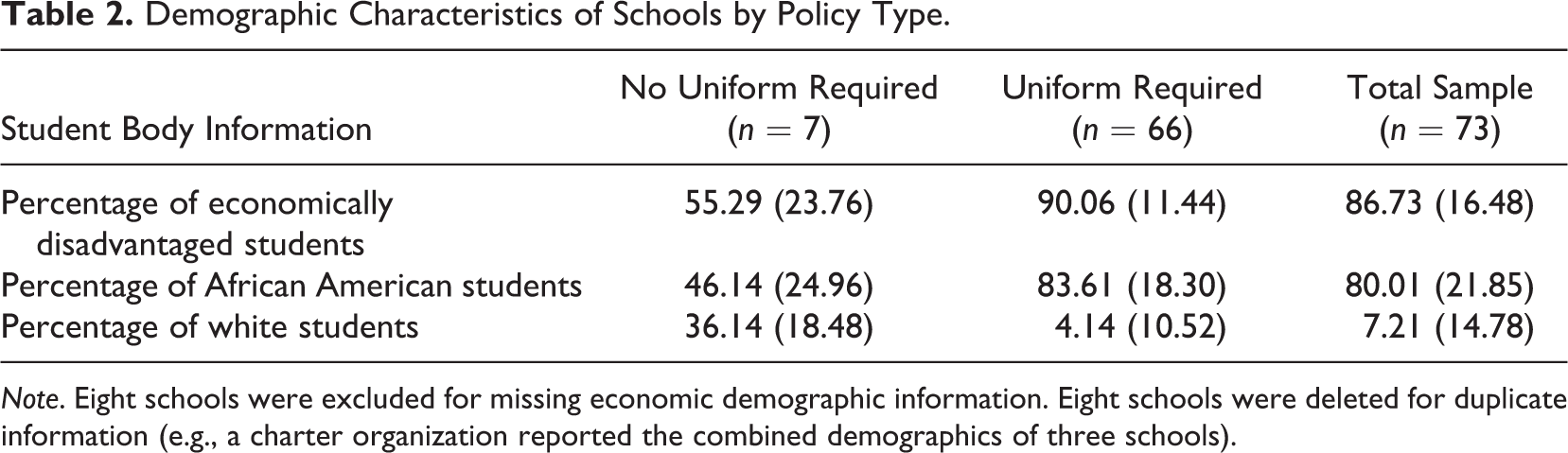
Note. Eight schools were excluded for missing economic demographic information. Eight schools were deleted for duplicate information (e.g., a charter organization reported the combined demographics of three schools).
An emphasis on professionalism was common across schools, particularly among schools with uniforms, with 10 schools explicitly stating, “Uniforms look professional.” Policies commonly referred to schools as “professional learning environments” with some even directly comparing the school setting to the workplace. Professionalism was discussed as a skill that must be taught. Policies were aimed at preparing students for the workplace, college, and life.
Finally, the safety of students was emphasized to justify dress code policies. Schools stated that their policies “ensure a safe environment.” Schools specifically banned gang-related items, required student IDs to reduce unauthorized visitors, enacted specific rules to reduce safety hazards, and banned expensive clothing items as safety precautions.
Social Class
In this sample, schools that employed uniforms policies had a higher percentage of economically disadvantaged students. Eight schools argued uniforms cost families less while one school argued uniforms cost families more. No school provided an entirely free school uniform, and only approximately 22% of schools requiring uniforms included information on resources for families who are unable to purchase uniforms. Even when supports for low-income families did exist, they were sometimes highly stigmatizing. One school required 4 parent volunteer hours in exchange for every one uniform piece. In addition to the highly stigmatizing experience of this barter, these “wages” would fall below minimum wage in most schools.
In the enforcement of uniform policies, economically disadvantaged students were further stigmatized. Eight schools required students to immediately purchase missing uniform items when out of compliance. Six of these eight schools had a population in which over 90% of students were classified as economically disadvantaged. Being forced to purchase a uniform item is a real economic burden for many economically disadvantaged students. In some cases, schools would not allow a student to attend school events, participate in graduation ceremonies, or otherwise fully participate until their “debts” were paid off. Despite the common claim that uniforms save money, the written uniform policies largely did not provide accommodations for those in need. Finally, a problem inherent to both schools with and without uniforms was the issue of cleanliness. Almost half (43) of the schools required clothing be maintained to a certain quality, and over a quarter (23) specified that students must meet certain standards of hygiene.
Race
As students in the New Orleans public charter school system are predominantly black, this inquiry focuses primarily on policy implications for black students. Like many policies meant to regulate blackness, race was never mentioned, but the racial coding was clear. Items (headscarves) and hairstyles (designs carved into hair) commonly worn by black students and important symbols of cultural pride (picks) were explicitly banned. See Table 3 for a full list. In addition to these bans, hair could not be extreme/exaggerated, trendy, or distracting, and hair must look natural, professional, modest, appropriate, acceptable, and in one case, “safe.” A few schools took hair regulations to extremes. One school banned possessing metal or plastic rattail combs or picks while another sent students home for hair violations. Another high school specified hair must be black or brown unless their natural hair “stretches beyond this description.” In short, a white student could dye their hair black regardless of their natural shade, but a black student would likely not be allowed a blonde hairstyle. Beyond vague references to preventing distractions, no substantial reasons were given for these policies.
Number of Schools Enacting Specific Regulations on Hair.
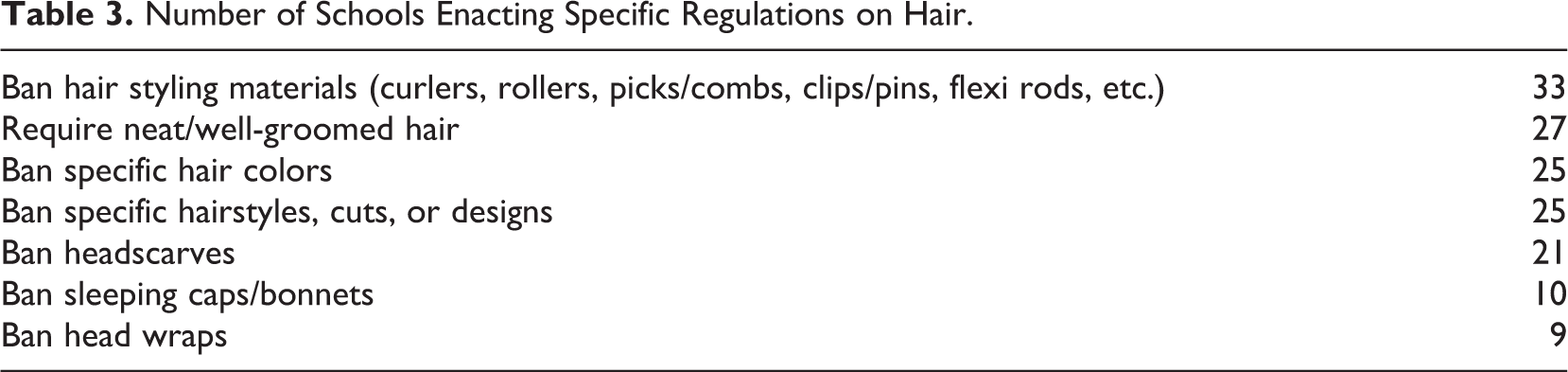
“Gang-related” items and clothing were banned in 13 schools, with little specification on what was gang-related. Additionally, looks popularized by hip-hop culture were highly regulated. In response to sagging pants, over half of the schools (53) required that pants must be worn at the waist, with five schools specifying this policy for male students only. Baggy clothing was banned in 40 schools, and visible undergarments were banned in 32 schools. In addition, other items associated with hip-hop culture like bandanas (41), kerchiefs (10), do-rags (8), stocking caps (2), and soldier rags (1) were banned. Finally, one PK–8 school banned wearing “RIP [rest in peace] shirts,” often called memorial shirts. Memorial shirts often contain a photograph of a deceased loved one, their name, birth and death dates, and a short slogan, such as “The Good Die Young” (Brooks, 2018).
Gender
Dress codes were often gender-specific with 25 schools fully separated their dress code by gender, with attire for female students in one column and attire for male students in the other. Additionally, 53 schools (52 of which required uniforms) had at least one rule that differed by gender. For instance, 22 schools explicitly banned male students, but not female students, from wearing earrings. Most commonly, the gendered rules afforded girls additional uniform options, where girls were allowed blue pants (matching the boys) or plaid pants (feminine option). However, in some schools, only the feminine option was available for girls, immediately distinguishing male and female students from their pants type, shirt type, or shoe type. Despite the claim of schools to promote unity, many schools wished to clearly separate masculine and feminine expression within their policies. In fact, of the 53 schools with at least one gendered rule, 18 listed unity, equality, or cohesion as a major goal of their policy. As some policies noted, uniforms are “a powerful visual statement of our community.” Distinguishing by gender visually communicates not one united community but a community divided by rigid gender categories.
These policies disproportionately targeted attire typically associated with female students. Jewelry, purses, makeup, and perfume were highly regulated, with over 75% of schools including at least one rule related to jewelry. The acceptable amount of skin shown was extremely detailed, sometimes down to the inch. Particularly, the amount of leg shown was a major focus (see Table 4). Despite the fact that school uniforms cover shoulders and midriff, many schools took an extra step to ban these areas, usually through regulations for dress down days. Dress codes were particularly concerned with fit as well as modesty. Tight clothing (25) and leggings (34) were commonly banned. Modesty was regulated through cleavage and low-cut top bans (17) and revealing/suggestive clothing (13). As female students are more likely to wear the majority of these items, the intended audience of these policies are clear.
Policies on Shorts/Skorts and Skirts/Dresses/Jumpers.
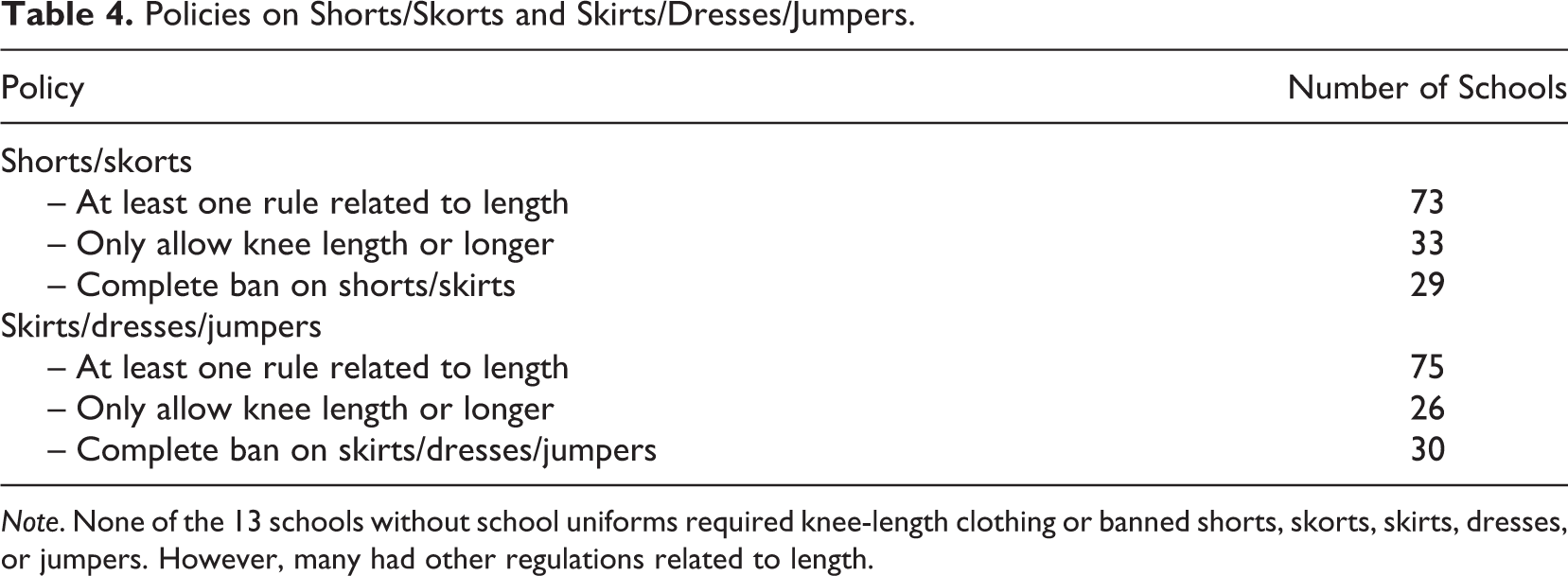
Note. None of the 13 schools without school uniforms required knee-length clothing or banned shorts, skorts, skirts, dresses, or jumpers. However, many had other regulations related to length.
Counterexamples
Despite these many examples of marginalization, there were a few counterexamples. One uniformed high school allowed “empowerment” shirts such as “Black Lives Matter” shirts. Two more high schools without uniforms wrote detailed stances against marginalization with one committed to “Ensuring that all students are treated equitably regardless of their gender/gender identification, sexual orientation, race, ethnicity, body type/size, religion, and personal style.” One of these two schools goes further, acknowledging that dress codes are often used as “tools to oppress, exclude, punish, intimidate, or otherwise negatively impact individuals’ experiences.” This acknowledgment of the potential to harm paired with the explicit banning of such practices gives an example of what a liberatory dress code policy could entail. Unfortunately, proactive policies addressing the possibility of oppressive enforcement were the exception, not the rule.
Consequences
Over 75% of dress code policies included consequences for students in violation of the code. Some descriptions were brief while others were painstakingly detailed, with the word count of consequence-related text ranging from three to 453. In addition to enforcing the stated rules, 29 schools gave school administrators final authority to determine dress code violations. These clauses clarified that students could be penalized for unwritten policies and expectations.
One of the most common responses to dress code violations was for the student to “fix” the issue. This ranged from requiring families to bring new clothing to the school (32), loaning out appropriate clothing to students (14), confiscating inappropriate items (11), and requiring students to purchase or rent clothing items (6). Confiscated items were most often able to be retrieved after school or by a parent, but one particularly egregious example promised to “discard” inappropriate socks. These policies may be particularly burdensome on economically disadvantaged and working-class families which may not be able to afford a replacement item or risk losing their job by being called to go to the school mid-shift. Only one school explicitly stated in their policy that families would never have to bring new clothes to school.
Enforcing the dress code often interrupted student instructional time, most commonly by removing students from the classroom (15), but also in the form of suspensions (7), sending students home (7), and even expulsion (1). Of the seven schools that threatened to send students home for violations, five would only do this on dress down days. Therefore, while dress down days were meant to afford students more freedom, the stakes of noncompliance were much higher. Most ironically, of these schools with lost instructional time, 12 explicitly claimed that the purpose of the dress code was to maintain academic rigor and outcomes. Removing students from the classroom directly contradicted this goal, exposing flawed logic in the policy.
Other types of consequences ranged significantly, with calling home (37), detention (23), exclusion from school activities (19), and mandatory parent conferences (17) as the most common. Progressive discipline systems were used in 29 schools, where the first violation of dress code policy typically involved a light punishment (e.g., warning, letter home) and subsequent violations resulted in increasingly harsh consequences (e.g., Saturday school, suspension). Using progressive discipline policies, relatively minor behavior infractions (uniform violations) can result in severe consequences (suspension) usually reserved for major infractions.
Discussion
Race, Gender, and Class Implications in the Justifications
The five justifications most seen in the policies of preventing distraction, promoting a positive school culture, allowing self-expression, exhibiting professionalism, and promoting safety are deeply intertwined with race, class, and gender. For instance, feminist scholarship identifies the politics of “distraction” as veiled language for perceived provocative dress, almost exclusively aimed at female students (Neville-Shepard, 2019; Pomerantz, 2007). The discourse of distraction stands in for the cultural anxiety regarding sexuality (Hethorn & Kaiser, 1999). In addition to gender, body size, class, and race all impact who is viewed as sexual or provocative, and subsequently who is regulated, surveilled, and controlled (Hethorn & Kaiser, 1999). Black girls are consistently perceived as more sexual and less innocent than their white peers regardless of their behavior and therefore are more likely to be labeled as distracting (Epstein et al., 2017; E. W. Morris, 2005; Wun, 2016b).
Additionally, some schools specified that peers (as opposed to oneself) specifically must not be distracted by dress. This approach protects the educational environment for some students while sacrificing the education of “distracting” students, despite findings that school staff are more likely to be distracted by student wear than students themselves (Hethorn & Kaiser, 1999). The students most likely to be labeled as distracting are typically female, black, economically disadvantaged, and/or curvier in size (Epstein et al., 2017; Hethorn & Kaiser, 1999; Neville-Shepard, 2019). Therefore, the language of preventing distractions can be understood in terms of race, gender, body size, and class.
Second, maintaining unity and promoting discipline, another commonly referenced uniform justification, requires enforcement. Uniform enforcement is not applied equally (Hethorn & Kaiser, 1999; E. W. Morris, 2005; E. W. Morris & Perry, 2017). For example, E. W. Morris and Perry (2017) found that black female students were three times more likely than their white female peers to be cited for minor behaviors, including dress code violations, despite similar rates of rule violation. In a series of qualitative interviews with black girls in schools, interviewees shared specific examples of this biased regulation, with one interviewee calling it a “double standard” (p. 128) dependent on both race and body type (M. W. Morris, 2016). This uneven enforcement leads to certain students experiencing hyper-surveillance (Wun, 2016b). Many interviewees felt that no matter what they wore, their bodies would be policed at school and felt frustration at the objectification imposed on them through the school system and their (male) classmates (M. W. Morris, 2016). Students in this state of surveillance are less engaged and more withdrawn, contradicting the stated goal of teamwork (Wun, 2016b). While positive school culture may be a worthy goal, the enforcement of this policy may create an antagonistic environment for certain students, particularly related to race, class, and gender.
Additionally, the dress code justification of allowing self-expression was disproportionately used by schools without uniforms. Parallel to findings from previous studies (Brunsma, 2006), schools without uniforms were more likely to have lower percentages of African American students, higher percentages of white students, and lower percentages of students identified as economically disadvantaged in our sample. This theme communicates that dress codes allow self-expression while uniforms allow limited (if any) self-expression. Given the high representation of black and economically disadvantaged students in uniform schools, self-expression is a privilege reserved for white and middle-class students.
Another common justification, professionalism, has been problematized (Hethorn & Kaiser, 1999; Jones, 2017; O’Brien-Richardson, 2019). Professionalism is often used as racially coded language for compliance with white, middle-class appearance norms (Hethorn & Kaiser, 1999). Further, racially targeted discriminatory practices in employment have been upheld under the supposed race-neutral language of professionalism (Jones, 2017). Despite this, schools throughout New Orleans attribute many of their policies to the pursuit of professionalism.
Finally, regulations justified under the language of school safety are built on the cultural anxiety of youth violence (Hethorn & Kaiser, 1999). The perceived threat of gang violence is often utilized by schools to promote strict dress code policies regardless of the actual level of threat (Thompson et al., 2000). However, clothing items are only perceived as “gang-related” when worn by certain people; hence, otherwise innocuous items become gang-related when worn by black or Latino students (E. W. Morris, 2005). Often, students disciplined for wearing “gang-related clothing” are not associated with gangs but are instead wearing clothing common to their community (E. W. Morris, 2005). These policies consistently show no impact on gang activity (Brunsma & Rockquemore, 1998; Wade & Stafford, 2003) but instead provide another outlet for the strict regulation of black and Latino male students.
Race, Gender, and Class Implications in the Regulations
Specific rules and regulations were targeted differentially along lines of race, gender, and class. Related to class, the choice to require a school uniform itself may disproportionately impact families living in poverty. Previous research shows that more affluent families do consider uniforms cost-saving, but low-income families find uniforms more expensive (West et al., 1999). Therefore, uniforms may be cheaper but only for those with class privilege. In this sample, schools with high levels of low-income students were more likely to be uniformed. Also intersecting with class, many regulations existed around cleanliness and hygiene. These standards, in addition to being highly subjective, may disproportionately impact students without stable housing as they may have difficulty obtaining routine hygiene items and face barriers in maintaining the quality of their clothing (Murphy & Tobin, 2011). Codifying these policies at the administrative level only further stigmatizes students from low-income households.
Policies targeting race were also rampant. The regulation of hair emerged as a major theme across schools. The regulation and suppression of black hair has always been a tool of white supremacy. Early slave traders observed the cultural significance of hair in the western coast of Africa and subsequently forcibly shaved the heads of Africans as a tool of dehumanization (Patton, 2006). In more contemporary times, the guise of “professional hair” has been used as a tool to legally discriminate (Jones, 2017; O’Brien-Richardson, 2019; Patton, 2006). Given this historical and contemporary context, the impact of the regulation of hair in a primarily black school system cannot be understated.
In addition to the stipulations on hair, many regulations built on the cultural anxiety of youth violence (Hethorn & Kaiser, 1999) and perpetuated the idea of black male students as dangerous (E. W. Morris, 2005). The moral panic directed at black youth often emerges in language banning items associated with hip-hop culture, and schools in our sample were apt to ban sagging pants, bandanas, and other such items, perpetuating the stereotype of the dangerous young black man (Brunson, 2011; Hethorn & Kaiser, 1999; E. W. Morris, 2005).
While only mentioned in one policy, the banning of memorial shirts was particularly disturbing. Memorial shirts are a major cultural tradition for black New Orleanians (Regis, 2001). These shirts allow students a mechanism for the communal processing of grief. By banning these shirts, the school ostracizes the bereaved from the potential support network of the school community. Beyond their role as public memorials, these shirts are increasingly employed to raise awareness of antiblack racism and police brutality, as seen in the proliferation of RIP shirts worn for Trayvon Martin, Eric Garden, and Michael Brown (Brooks, 2018). The explicit banning of this item erases an important part of the cultural heritage of black students in New Orleans and silences a critical response to oppressive power structures (Brooks, 2018; Regis, 2001). It positions schools as antithetical to activism and at odds with student’s home cultures.
Our sample of dress code policies also disproportionately targeted transgender and gender-nonconforming students. While two school policies did specify that policy enforcement should not target students based on gender identity, the remaining policies either did not acknowledge gender at all or specified different rules for boys and girls. When separate rules exist for male and female students, the gender binary (or the existence of two rigid distinct genders) is reified. A gendered dress code forces a student to outwardly communicate a fixed gender (Kosbie, 2013). When this communication is not consistent with a student’s gender identity, students are at increased risk of dropout, low grades, and behavioral problems. Even when this communication is consistent with their identity, gendered dress codes may simultaneously “out” a student to peers and family, potentially creating an unsafe environment. Due to these risk factors, gendered dress codes are a key entry point to the school-to-prison pipeline for transgender students (Glickman, 2016).
Within the policies, students were also subjected to the cultural anxiety at the sexuality of female students (Hethorn & Kaiser, 1999), viewing bare skin and tight clothes as threats to the school. These gendered rules inform the hidden curriculum behind dress codes (Aghasaleh, 2018; E. W. Morris, 2005), where students are taught what constitutes appropriate masculinity and femininity (Neville-Shepard, 2019; Pomerantz, 2007). This creates what Neville-Shepard (2019) calls “dangerous assumptions regarding cause and effect” (p. 5) where students who do not meet these impossible standards are blamed for their harassment. These notions are intertwined with white supremacist ideology that implicitly characterizes black female students as “inadequately feminine” (E. W. Morris, 2005, p. 44) and therefore deserving of harassment.
Finally, the consequences for violating dress code and uniform norms are also unlikely to be race, gender, or class neutral. The progressive consequence systems seen in this sample, where consequences escalated not by seriousness of violation, but by frequency of violation, are characteristic of zero-tolerance policies that mandate high-stakes punishments for low-stakes misbehaviors (Curran, 2019). As reflected in this study, charter schools (Curran, 2019) and schools with uniforms (Brunsma, 2006) are more likely to endorse zero-tolerance policies. While zero-tolerance policies may be applied universally, they are not equitable in that contextual factors that may limit compliance are ignored (Cassidy & Jackson, 2005). Undoubtedly, these purportedly neutral consequences disproportionately impact certain students.
Implications for Social Workers
The language used in the policies of this sample largely echoes the racism, sexism, and classism in society and contributes to the perpetuation of these oppressive structures. However, dress code policies can interrupt this cycle and create an avenue for liberatory change. School policies, such as the model dress code policy provided by Oregon National Organization for Women (2016) which promise to “not reinforce marginalization or oppression” and do not ban distracting clothing, but instead require students to “manage their own personal distractions,” challenge the status quo and offer an alternative (p. 1). Indeed, while limited, our sample also exhibited a few such examples of liberatory language currently used in schools.
Interestingly in this citywide sample, policy language from one school was often replicated (sometimes verbatim) in another school or another district. This suggests that school leaders may look to existing school policy when creating their own. Therefore, it follows that as more schools adapt equitable policy language, these policies may spread, as schools appear to communicate on policy. Therefore, change in one policy can have widespread implications.
This inquiry provides context and tools to spot misogynoir language within school dress code policies. Social workers in schools can leverage their position to rework oppressive policies toward equitable ends. Likely, many schools have not thought out the racialized, gendered, and classed implications in their policies and may be open to change, once made aware of the shortcomings. Well-intentioned policies (and complicity to these policies) further oppression, and school social workers are uniquely positioned to work with school administrators to adapt and overhaul policies. Even small changes in school policies (e.g., eradicating hair regulations, establishing alternatives to missed instructional time for noncompliance) can interrupt embedded systems of racism, classism, and sexism in the school settings. Social workers can advocate individually at the school level or collectively at the district level to make these changes.
Limitations
There are limitations to this research. Our sample is vulnerable to missing data. Some school policies were extremely detailed, while others were vague and may not have fully represented the (unwritten) policies. The findings were based on interpretation, and the researchers’ unique positionalities informed our analysis. Further, the process of reducing data may have resulted in an oversimplification of the data and the loss of important information. Finally, as schools in New Orleans change significantly from year to year, both in governance and administration, this study only illuminates the state of dress codes in New Orleans for the 2019–2020 school year. While this research addresses one specific gap in the literature, more research should be conducted. Future researchers should discuss with stakeholders how policies are enforced and interpreted at different levels of power. Ethnographic observations should look for unwritten expectations. Finally, policies in other cities or settings should be compared.
Closing Thoughts
This study analyzed the justifications, regulations, and consequences of 89 dress code and uniform policies in New Orleans public charter schools in the 2019–2020 school year. Through this exploration, the spaces for differentiated treatment at the intersections of race, gender, and class emerged, with the learning of white, middle-class, and male students valued over others. School social workers are uniquely positioned to interrupt racist, sexist, and classist policies within the school setting. This study contributes to the literature by illustrating the full scope of policies of one city at one point in time and how these policies contribute to oppression.
Footnotes
Declaration of Conflicting Interests
The author(s) declared no potential conflicts of interest with respect to the research, authorship, and/or publication of this article.
Funding
The author(s) received no financial support for the research, authorship, and/or publication of this article.
