




Abstract
The pathways of equitable access to work and residency for migrants in the United States are fraught with inconsistencies. Spouses of migrants on a specialty occupation visa (H1B) cannot obtain a social security number, and therefore, their legal standing entirely depends on their H1B spouses. Moreover, these spouses, who are predominantly women from non-Western countries, are strictly prohibited from participating in any type of income-generating activities, including self-employment. Restriction on migrant spouses’ workforce participation perpetuates their involuntary financial dependency, which creates such problems as lowered self-esteem, depression, suicidality, marital problems, and domestic violence. In this article, I build on the previous works to further illuminate how the social construction, that is, a popular image or stereotypes of non-Western women as dependents and deviants might have contributed to creating and maintaining the H4 visa regulations while contemplating its long-term impact in light of the U.S. nation-building effort based on the Theory of Social Construction of Target Populations. The social construction lens offers a framework for social work scholars, educators, and practitioners to critically examine and articulate the mechanisms through which stereotypes and bias toward vulnerable populations influence policy design and thereby dictate their life choices and positioning in society.
Although the United States maintains its reputation for being a nation of immigrants, the pathways of equitable access to work and residency for various migrant groups are fraught with inconsistencies. Foreign nationals are required to obtain approval from the U.S. government, referred to as a visa, to be lawfully admitted to the United States. Under the current immigration law, migrants who enter the United States to seek permanent residency are referred to as immigrants or lawful permanent residents. Other migrants who are admitted temporarily to pursue education, employment, and business or travel opportunities are referred to as nonimmigrants. Both immigrants and nonimmigrants must meet specific criteria to obtain visas (Wasem, 2010). Throughout this article, the term “migrants” will be used to refer to those who are residing in the United States on both immigrant and nonimmigrant visas.
An H1B visa, a type of nonimmigrant visa, is issued to foreign nationals who want to pursue employment in the United States. The H1B visa category was created under the Immigration Act of 1990 to attract immigrants with specialized skills to fill the unmet labor demand in critical fields such as high-tech industries and thereby bolster the U.S. economy (Usdansky & Espenshade, 2000). Accordingly, H1B visa applicants must possess a minimum bachelor’s degree along with professional knowledge and technical skills that are necessary to perform job functions for the positions that cannot be filled with the domestic workforce. H1B visa holders can live and work in the United States for up to 6 years and then return to their countries of origin or apply for a permanent residency in the United States (U.S. Citizenship and Immigration Services, 2020). Along with the H1B visa holders, spouses of H1B professionals and their children are admitted to the United States on a separate visa referred to as an H4 dependent visa (U.S. Citizenship and Immigration Services, 2020). This article focuses on the spouses of H1B visa holders who are predominantly women from Asian countries. For example, 93% of H4 visas from May 2015 to December 2017 were issued to women (Wilson, 2018), which represents the typical gender composition of H4 visa issuance. Among the over 130,000 H4 visas issued in 2019, the largest number of H4 visas were issued to Asians (116,234) followed by those from Europe (3,527), North America (2,897), South America (2,173), and other regions (Bureau of Consular Affairs, U.S. Department of State, n.d.). Each year, more than 80% of the H4 visas are issued to the citizens of India followed by Chinese who make up approximately 3%–5% of the total number of H4 visa issuance (American Immigration Council, 2018).
Since H4 dependent visa holders cannot apply for a social security number, their legal standing in the United States entirely depends on their H1B spouses (Balgamwalla, 2014). Moreover, H4 spouses are prohibited from participating in any type of income-generating activities while in the United States, including self-employment until their H1B spouses apply for a permanent residency. The employment restriction for H4 visa holders is designed to protect U.S. workers as other provisions within the H1B visa regulations such as imposing an annual limit to the number of issuances (Usdansky & Espenshade, 2000). Currently, such restriction is not imposed on the spouses of L and E visa holders, which are issued to executives or managers of foreign offices of U.S. companies and treaty traders or investors, respectively (U.S. Citizenship and Immigration Services, n.d.). Globally, 35 countries allow spouses of H1B equivalent visa holders to work freely including such countries as Australia, Canada, United Kingdom, Germany, and others (PERMITS Foundation, 2019).
Employment restrictions imposed by the current H4 visa regulations perpetuate H4 visa holders’ involuntary financial dependency on their H1B spouses, which in many circumstances has created such problems as social isolation, lowered self-esteem, depression, suicidality, marital conflicts, divorce, and domestic violence (Banerjee, 2012; Bhandari, 2008; Bhuyan, 2007; Kelkar, 2011). For this reason, H4 visa status has been referred to as a “curse,” “death sentence,” or a “vegetable visa” by H4 visa holders (Banerjee, 2012; Bhatnagar, 2013). Feminist scholars have pointed out the injustice rooted in the current H4 visa regulations that conform to the traditional gender role specifications (Balgamwalla, 2014; Banerjee, 2012; Bhuyan, 2007; Kelkar, 2011). During the Obama administration, some desired changes were made such as providing work permits for victims of domestic violence and for spouses of skilled workers who file permanent residency petitions ( News India Times, 2017; U.S. Citizenship and Immigration Services, 2017). However, these measures are at stake as the Trump administration announced the plan to reverse these changes in 2018 (Vijayakumar & Cunningham, 2020). The increasing anti-immigrant climate under the current administration calls attention to the timely revisiting of the issues faced by H4 visa holders.
In this article, I build on the previous scholarly works to further illuminate how the social construction, that is, a popular image or stereotypes of Asian migrant women as dependents and deviants might have contributed to creating and maintaining the H4 visa regulations. Additionally, the long-term impact of such regulations is contemplated in light of the nation-building effort of the United States based on the Theory of Social Construction of Target Populations (Schneider & Ingram, 1993). The Theory of Social Construction of Target Populations is one of the prominent theories in policy process research that studies the “interactions between public policy and its surrounding actors, events, and contexts, as well as the policy or policies’ outcomes over time” (Sabatier & Weible, 2014, p. 5). A policy design study is an approach to policy process research that specifically attends to the “processes leading up to the policy design elements and the consequent impacts on people and society” in analyzing public policies (Schneider et al., 2014, p. 107). Among various elements that influence the process of policy designing, the Theory of Social Construction of Target Populations highlights the social construction of the groups that are targeted by certain policies as critical elements that influence the key decisions in the policy-making process. Borrowing the social construction lens from this theory, in this article, I engage a broad audience beyond policy experts to rethink the issues related to the employment restriction in the H4 visa regulations, attending to the policy process dimension that has not been addressed previously.
The Theory of Social Construction of Target Populations
The Definition and the Tenets
The social construction of target populations is defined as “the cultural characterizations or popular images of the persons or groups whose behavior and well-being are affected by public policy” (Schneider & Ingram, 1993, p. 334). Schneider and Ingram contended that the social construction of target populations has a powerful influence on the key policy decision-making process regarding the fundamental policy question of “Who gets what?” Among the five propositions within the theory of social construction, the Allocation Proposition and the Feed Forward Proposition are particularly relevant to the central topic of this article.
The Allocation Proposition posits that decisions regarding the allocation of benefits and burdens to a target population are largely shaped by the combination of target groups’ power and their social construction. Schneider and Ingram (1993) suggested four types of target populations based on the power and social constructions of the target group and contended that public officials are pressured to create policies that are logically connected to target groups’ position within the typology matrix.
As illustrated in Figure 1, advantaged groups such as the elderly and small businesses have much power and are generally constructed positively, being portrayed as worthy, hardworking, and admirable. These groups often receive beneficial policies due to their perceived deservingness. On the other hand, contenders’ groups such as big corporations and insurance companies possess much power but are negatively constructed. Although they receive beneficial policies due to their power and influence, the transactions of benefit allocation are often hidden and disguised due to their negative images. Dependent groups such as mothers, children, students, and people with disabilities lack power but are positively constructed. Politicians who do not want to appear disinterested and harsh tend to prescribe beneficial policies to dependent groups. However, due to a lack of power, the benefits that they receive are unstable and are most vulnerable to funding cuts. Provisions for dependent groups are often means-tested and are difficult to access due to the burdens imposed by bureaucratic requirements. Lastly, deviant groups such as criminals or undocumented immigrants are often subject to punitive policies since they have little power and are negatively constructed in general (Schneider & Ingram, 1993).
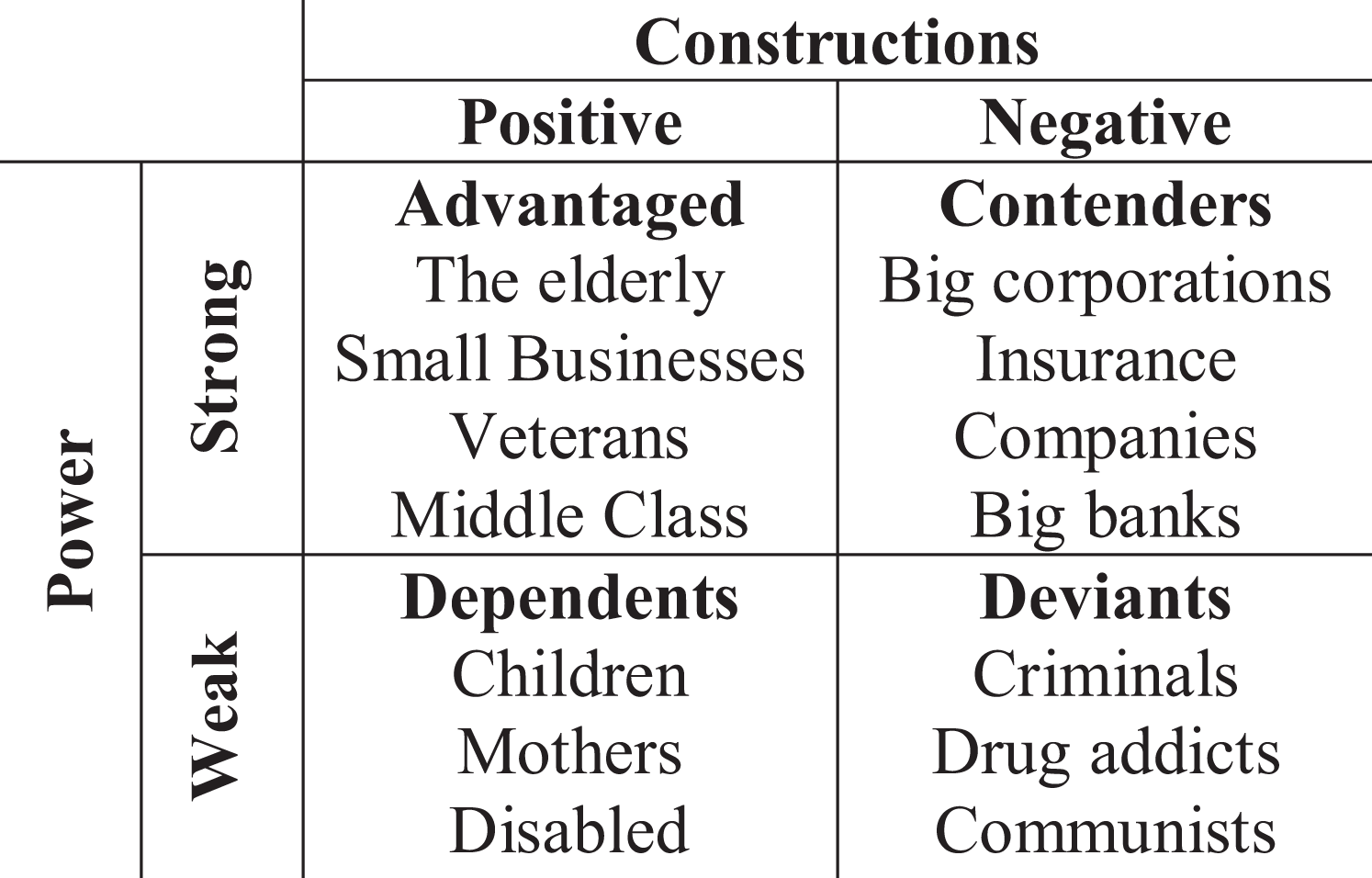
Typologies of target populations.
The Feed Forward Proposition posits that policies, based on the messages they convey about a target population regarding what they deserve and how they are to be treated, shape target groups’ government orientation and their pattern of participation in political matters. For example, advantaged groups have a strong influence on shaping policies pertaining to their well-being, owing to the power and positive social construction. These groups are generally perceived as deserving of beneficial policies by the public, and the government readily responds to their demands for positive changes when needed. Consequently, advantaged groups view the government as being reasonably fair and interested in their well-being and in turn are likely to become more active in participating in political matters.
On the other hand, dependent or deviant groups have little to no influence over shaping policy agendas pertaining to their well-being. Dependent groups learn that they can receive benefits only through the generosity of others. Therefore, their relationship with the government is understood as that of an impersonal bureaucracy and clients, which shape a pattern of political participation characterized by passivity. Similarly, deviant groups are often subject to punitive policies, which allocate more burdens than benefits to them. Thus, deviant groups learn that the government is to be entirely avoided. As a result, deviant groups are less likely to be empowered to mobilize movements directed at changing ineffective policies for them. When deviant groups engage in political matters, it is likely to involve force and illegitimate tools due to their perception toward the government as being illogical, disinterested, and harsh (Pierce et al., 2014; Schneider & Ingram, 1993; Schneider et al., 2014).
The Social Construction of Migrants in the United States
Newton (2005) argued that immigration policy making is the process of classifying migrants into deserving or undeserving groups based on their perceived contribution or harm to the well-being of the nation. The classification serves as the basis for determining what types of political, economic, social, and cultural rights various migrant groups are entitled while in the United States. At various times in American history, migrant groups have been treated as deserving or undeserving based on their images that are socially constructed as either “potential-citizens or unassimilable aliens” (Newton, 2005, p. 140). Literature points to how politicians have been able to strategically manipulate the social construction of various migrant groups to advance their political agendas (Dialto, 2005; Newton, 2005; Schneider & Ingram, 1993).
For example, the Naturalization Act of 1790 completely closed a door for Japanese immigrants and other immigrants of color to become naturalized in the United States based on the notion that only “free white persons” are entitled to U.S. citizenship (Dialto, 2005, p. 90). The Alien Land Law of 1913 prohibited Japanese farmers from purchasing any land in the state of California due to their images as economical threats to white American farmers even if their land ownership prior to the passing of the law made up less than 0.02% (Le Pore, 1979). Policies, media discourses, and institutions such as courts played important roles in shaping negative social constructions toward Japanese immigrants in the early days of their settlement in America, which allowed such injustice as forced deportation or internment toward Japanese Americans during World War II (Dialto, 2005). The Executive Order 9066 forced approximately 112,000 Japanese including over 70,000 law-abiding American citizens to give up businesses and private possessions to be placed in internment for the entire duration of the war because of their perception as “public danger” (National Archives, n.d.). Justice Murphy of the Supreme Court at the time accused its unconstitutionality, …detention in Relocation Centers of persons of Japanese ancestry regardless of loyalty is not only unauthorized by Congress or the Executive but is another example of the unconstitutional resort to racism inherent in the entire evacuation program…racial discrimination of this nature bears no reasonable relation to military necessity and is utterly foreign to the ideals and traditions of the American people.
On the other hand, Reich and Barth’s (2010) analysis of the in-state tuition bill (HB2145) in Kansas shows an example of a positive social construction that provided a basis for a beneficial policy for a migrant group. The passage of HB2145 made it possible for children of undocumented immigrants residing in Kansas to pay in-state tuition rates since 2004. The beneficiaries of this bill are subgroups of the Deferred Action for Childhood Arrivals (DACA) recipients, a program introduced by the Obama administration in 2012 and is currently on hold after being rescinded by the Trump administration in 2017 (U.S. Citizenship and Immigration Services, 2018). While being implemented, DACA offered work authorization and a temporary suspension of deportation for 2 years, subject to renewal, to eligible undocumented immigrants who arrived in the United States as children, primarily from Latin America (Batalova et al., 2014; Singer & Svajlenka, 2013).
The passage of HB2145 was an unexpected outcome, considering the conservative political climate in Kansas, which according to Reich and Barth (2010) was achieved by strategically portraying children of undocumented immigrants as future law-abiding, tax-paying citizens who are innocent victims of their parents’ decisions to illegally migrate to the United States. Additionally, the advocates emphasized that these children were local, who had lived in Kansas since their early childhood and would grow into a skilled workforce that can increase the state’s tax revenues. Reich and Barth (2010) emphasized that this proto-citizen framing based on the future-oriented social construction, in which “policy targets are presented as in terms of a life trajectory that is more prospective than retrospective” (p. 423), was crucial in passing the bill. While this highly politicized and controversial program has been criticized as reinforcing the good and bad immigrants dichotomy, further criminalizing other undocumented immigrants (Batalova et al., 2014), the passage of the in-state tuition bill in Kansas provides an example in which the effort to shape positive social construction of a migrant group led to intended but unlikely outcomes.
Social Construction of Asian Migrant Women
As I have reviewed the accounts of social constructions of various migrant groups in the United States having influenced policy-making processes, I go back to H4 visa issues, examining how social constructions of Asian migrant women as dependents and deviants might have contributed to creating and maintaining current H4 visa regulations.
H4 Visa Holders as Dependents
Balgamwalla (2014) considers the current H4 visa regulations as a modern-day reincarnation of coverture, a traditional English common law that was later adapted in America during the colonial period. Coverture institutionally discriminated married women based on the notion that a husband and a wife are one as the identity of a wife is fully incorporated into that of her husband upon marriage. Under this law, married women completely lost their legal standing including rights to own properties and to participate in the labor force (Zaher, 2002). The current H4 visa regulations, which subject H4 visa holders’ legal standing entirely on their H1B spouses, are equivalent to the doctrine of coverture (Balgamwalla, 2014).
Furthermore, Banerjee (2012) contended that the current H4 visa regulations have been constructed upon Mohanty’s (2003) notion of “average Third World women” (p. 22) in referring to non-Western women. Mohanty (2003) argued that non-Western women are often portrayed as a homogenous group characterized by shared dependencies that parallel their perceived images as being “ignorant, poor, uneducated, tradition-bound, domestic family-oriented, victimized” (p. 22) in Western feminist literature. The social construction of non-Western women as “universal dependents” (Mohanty, 2003, p. 24) is reflected in the Chinese Merchants Families—Immigration Treaty of 1880 and subsequent Oregon court’s ruling in 1890, a prototype of modern-day H4 visas, which added provisions for spouses of Chinese merchants in the United States. The following excerpt is found in the report of cases ruled by Oregon court in response to the petition made by a Chinese merchant named Wong Ham, an Oregon resident, to allow his wife and children to accompany him to the United States. It is common knowledge that Chinese women are not laborers. The station in life of petitioners, being the wife and child of a merchant, also shows that they do not belong to the laboring class.…Chinese women are not teachers, students, or merchants, and therefore, they cannot obtain the certificate necessary to show they belong to the favored class. (Smith & Sawyer, 1891, p. 533)
H4 Visa Holders as Deviants
While the historical root of the employment restrictions in the H4 visa regulations could be traced back to the long-held image of Asian women as universal dependents, more importantly, one should inquire how this outdated notion survives in the contemporary U.S. history, continuing to write poignant stories of migrant women. As Banerjee (2019) suggested, the answers to this query should be examined using the intersectional lens in order to uncover the complex interplay of race and gender issues manifested in the U.S. immigration policies.
Asian migrants in the United States have long been treated as deviants who are unassimilable aliens that threaten the national security and economic well-being of the nation (Kawai, 2005; National Archives, n.d.; Okihiro, 2014). In the late 19th and early 20th century, when the notion of “Yellow Peril” was prevalent, the growing presence of East Asians, Chinese, and Japanese, in particular, in the U.S. territory was feared as an economic, political, and cultural threat that challenges white supremacy in the nation (Kawai, 2005; Nguyen et al., 2019). While Model Minority, a term with seemingly positive connotations has become the most pervasive form of Asian stereotype since the 1960s, scholars equated Model Minority stereotype as a reproduction of Yellow Peril in a less threatening form (Kawai, 2005; Okihiro, 2014).
The term, Model Minority, was first introduced by Peterson (1966) in a New York Times article to depict the success stories of Japanese immigrants in the United States. The model minority stereotype portrays Asians as intelligent, highly educated, hardworking, self-disciplined, and law-abiding. Okihiro (2014) asserted that while “Yellow Peril” accentuates Asians’ masculine qualities as overtakers through their economic, political, and military advancement, Model Minority stereotype highlights the feminine Asian traits that could silently overpower white dominance through their success.
Contemporary scholars have pointed out numerous issues the Model Minority stereotype presents such as the mistaken homogenization of multiple subgroups among Pan-Asian populations of varied social, political, and economical positions (Teranishi et al., 2004) as well as the pressures to conform to the unrealistic ideals for success, which is highly associated with mental health issues among Asians (Cheryan & Bodenhausen, 2000; S. Lee et al., 2009). The notion of the model minority was formed based on the subgroups of East and South Asians of higher socioeconomic status in the United States and, therefore, inadequately reflects the reality of other subgroups of Asians such as the high poverty rate among Southeast Asian migrants (Kawai, 2005). The perceptions toward Asians as a homogenous group of high achievers and self-sufficiency can create barriers in developing and accessing resources to meet various needs presented among Asian populations of differential socioeconomic positions in the United States (Wong & Halgin, 2006).
Additionally, several scholars posed that the model minority stereotype may infuse negative feelings and attitudes toward Asian Americans due to their perceptions of competitiveness (Fiske et al., 2018; Nguyen et al., 2019). Fiske et al. (2018) suggested that the model minority stereotype highlights Asians’ image as being “too competent, too ambitious, too hardworking, and, simultaneously, not sociable” (p. 880). Proposing competence and warmth as the two dimensions that are central to the formation of group stereotypes, Fiske et al. (2018) contended that punitive actions such as resentment and social exclusion could be justified against groups that bear images of high competence and low warmth such as Asians, Jews, and career women. Indeed, studies report that Asians are viewed less favorably by other minority groups possibly due to the history of discounting racism and structural oppression that blacks and other minorities have faced based on the Asian immigrants’ success (Nguyen et al., 2019).
The Perpetual Foreigner stereotype, which is also frequently associated with Asians, depicts Asians as too different and exotic to be assimilated to the American way of living due to their strong adherence to family and cultural values that set them apart from other Americans (S. J. Lee & Hong, 2020). Asians in the United States are perceived as foreigners regardless of their citizenship and the years lived in the United States and thus as “others” instead of as “one of us.” Not surprisingly, Xu and Lee’s (2013) study found that both whites and blacks perceive Asians as being the least patriotic among all minorities in the United States. Some have attributed the resurgence of discrimination and violence against Asians during the outbreak of novel coronavirus (COVID-19) in 2020 to the longstanding image of Asians as “dangerous outsiders” as some government officials publicly labeled the virus as “Kung Flu,” a racial slur that intended to blame Chinese for the spread of the virus (Chan, 2020; Litam, 2020).
Taken together, the notion of Yellow Peril persists in the contemporary United States through the Model Minority and Perpetual Foreigner stereotypes. Considering the high percentage of H4 visas given to Asians each year (more than 93% in 2018), one can easily imagine how these pervasive stereotypes could have contributed to the policy decision making regarding what benefits and burdens to be allocated to this group. The following statement was made by a congresswoman in a renowned news panel:
We are giving a visa to him because he’s applied for it and because of skills he has that we do not have. Who knows she has such a skill? What is it that says that she isn’t competing with the 9.4 million American workers who can’t find jobs and why should we?…you hold that every privilege in India, privilege that is denied to almost all in India. You get special treatment when you come to this country. Love you, but not that treatment. Wait for your turn. (Erbe, 2009).
As implied in the statement, it is important to acknowledge that many of these women are highly educated middle- and upper-class citizens in their native countries, which adds another layer of complexity to the matter. Highly skilled migrant families rely on their educational, cultural, and class privileges in their native countries to overcome challenges as minorities and mainstream into the middle-class American life (Banerjee, 2012, 2019). Thus, the class rhetoric is frequently used to reinforce the justification for the punitive employment restriction in the H4 visa regulation by pushing them into the category of deviants who threaten the American economy. However, in reality, the impact of employment restrictions on the individual H4 visa holder is heightened due to their high level of education and class status as they are forced to live a life of American middle-class woman in the 1950s, staying home and caring for families, while her husband provides for the family as a breadwinner despite their qualifications (Coontz, 2011, as cited in Banerjee, 2012).
The Short-Term Impact of the H4 Visa Regulations
Workforce shortage issues in the United States, particularly in science, technology, engineering, and mathematics (STEM) fields are expected to grow in the future. According to the report submitted by the President’s Council of Advisors on Science and Technology (2012), the United States is to recruit 1 million additional STEM professionals in the next decade based on the current production rate in the U.S. higher education system. Moreover, the Public Policy Institute of California (2015) projects that if current market conditions persist, California alone will be short of 1.1 million college graduates by 2030. These reports call for strategic and nationwide efforts to fill labor market demand in the STEM and other fields that require higher education. Therefore, along with the effort to promote higher education, recruiting and retaining foreign nationals with special skills are in the best interest of America’s economy.
However, the spouse work restriction in the current H4 visa regulations creates obstacles in achieving this important national goal. According to the results from the survey of 3,300 spouses from 120 countries, who at the time of the survey were accompanying their H1B spouses in 117 host countries, 96% of the participants reported that countries that support spouses’ work permits are more attractive destinations for migration (PERMITS Foundation, 2008). Additionally, in the survey of the 56 members of the Council for Global Immigration (n.d.-a), a network of employers dedicated to helping universities, research institutes, and companies to secure international labor force, almost one half of the members responded that they have lost opportunities to hire foreign H1B professionals due to the spouse employment restriction, and over 30% of the participants reported that they have lost foreign H1B professionals. Furthermore, Vijayakumar and Cunningham (2020) found that spouse employment restrictions negatively impact high skilled workers’ job performance and life satisfaction. These studies indicate that spouses’ employment has a direct impact on the efforts to recruit and retain H1B professionals, which is crucial to foster the economic competitiveness of the United States (Council for Global Immigration, n.d.-b).
Not only that the current regulation interferes with recruiting and retaining international talents, but it also perpetuates the blindness that fails an accurate assessment of the logical connection between the perceived and actual deservingness of skilled workers and their spouses. Studies report that household labor is related to lowered professional productivity, particularly in a highly demanding professional environment, the type of jobs that most H1B professionals are likely to hold (O’Laughlin & Bischoff, 2005; Probert, 2005). Banerjee’s (2012) interviews with high-tech workers from India reveal that their professional advancement and the recognition as model minorities is often earned through their spouses’ involuntary dependency forced by their visa status. The picture of “absentee father” (p. 136) and husband spending unlimited time at work building upon their dependent spouses’ full-time unpaid household labor was described as norms in these migrant families.
While skilled workers enjoy such benefits as the right to live and work in the United States as well as the paths to citizenship, their spouses suffer punitive measures that are disproportionately directed at them as they are forced to choose between preserving their family unit by subjecting themselves as dependents or separating from their families to claim their independence. With the decision to preserve their families comes the harsh reality of the life of dependence. A fundamental error in categorizing specialty workers and their spouses into deserving and undeserving groups lies in the failure of recognizing families as an inseparable unit. The coexistence of the two contrasting groups with drastically different life experiences within a family unit inevitably creates tension, leading to marital conflicts and broken families. Based on an interview with a former H4 visa holder, Banerjee (2012) wrote: Six years after first migrating to the United States, she returned to India with a 2-year-old daughter. She remained chronically depressed, having gone through a difficult divorce. I will never forget her words: “Never go to that country on someone else’s visa. Only go if you have your visa, or you will become a basket case like me.” She now lives with her daughter in Bangalore, works in a bank as a financial analyst, and still blames her broken marriage on the U.S. government.
Long-Term Impact of the H4 Visa Regulations
The Feed Forward Proposition of the Theory of Social Construction of Target Populations provides a lens through which a possible long-term impact of H4 visa regulations could be contemplated. As mentioned earlier, the Feed Forward Proposition posits that policies send powerful messages to the public and the target groups concerning what they deserve and how they are to be treated from a policy standpoint, shaping the target groups’ citizen orientation and political participation pattern. In 2017, over 130,000 foreign nationals adjusted their legal status from temporary workers to permanent residents (Homeland Security, 2018). Considering the high percentage of naturalized H1B/H4 families, the long-term impact of H4 regulations on their government orientation and political participation should be of national interest.
According to Schneider and Ingram, dependents and deviants tend to develop a negative citizen orientation characterized by passivity or avoidance. After years of being deprived of their civil rights to participate in the workforce, H4 spouses may develop distrust toward the U.S. government and thereby develop a citizen orientation of skepticism, passivity, and avoidance. Banerjee’s (2019) interviews with H4 visa holders engaged in unauthorized self-employment found that the act of subversion, that is, “a disruption of a hegemonic idea or structure through a dissident action” (p. 191), was primarily motivated by their need to reclaim independence and to exert power over oppression than financial reasons as seen in the following statements: It was my way of showing the finger to this awful visa law and my husband’s stupid company. If I have the brains and the creativity of finding this perfect business, why wouldn’t I do it? I am not stupid. (p. 195) I could not take being invisible anymore, so I got creative and made myself a person again. And, boy it feels good to stick it to the American government. I know they have the power to deport us or whatever but, whatever…(p. 195)
Rethinking H4 Visa Regulations in View of Nation-Building
The long-term impact of the H4 visa regulations on nation-building efforts should be considered with care in light of the continued criticism of the U.S. immigration system as creating a gendered and racialized citizenship (Banerjee, 2012). Nation-building entails the “formation of countries in which the citizens feel a sufficient amount of commonality of interests, goals, and preferences so that they do not wish to separate from each other” (Alesina & Reich, 2015, p. 3). Putnam (2007) suggested that “the central challenge of modern, diversifying societies is to create a new, broader sense of “we.” Democratic nation-building is seriously hampered by inequalities and discrimination as they interfere with migrants’ developing national identities and contributing to the nation-building efforts (Oommen, 2008). Immigration policies, although seldom made explicit, are expected to serve the important purpose of nation-building by creating measures that are conducive to a seamless integration of the immigrants (Graham, 1991).
In the effort to create positive changes in the H4 regulations, the notion of future-oriented social construction (Reich & Barth, 2010) presented earlier may become useful. Changing this enduring harmful policy should be preceded with the strategic effort to deconstruct the social construction of Asian migrant women as “universal dependents” and reconstruct their well-deserved image as proto citizens with the potential to make valuable contributions to the U.S. economy and well-being. While pursuing positive changes in the H4 regulations, it is imperative not to lose sight of the class-based oppressions that many racial and ethnic minorities currently face in the United States. As mentioned previously, the H1B visa was created with a specific goal of increasing the economic competitiveness of the United States by meeting ever-increasing labor demands in specialty occupations that require specialized knowledge and skills. The very criteria to obtain this targeted visa inevitably produce a group of migrants in upper classes with relatively high education and income levels in the United States. Undoubtedly, the battle against every form of inequalities and oppression should continue and be coincided with the comprehensive immigration reform that has a clear sense of goal and direction that corresponds to the blueprint in the U.S. nation-building efforts.
However, fighting evil with another evil cannot be the answer. The attempt to settle the matter through hasty rationalization of the injustice rooted in the current H4 regulations by manipulating the social construction of vulnerable migrant women should not be condoned. Policy makers should engage in logically sound, sophisticated, and long-term assessment of this multifaceted issue and propose policies that are innovative and equitable without violating the principles of true democracy.
Conclusion
In conclusion, the current H4 regulation is a harmful policy that oppresses vulnerable groups of migrant women by suppressing their human potential and perpetuating systemic inequity and social injustice. Beneath this harmful policy lies the social construction of Asian migrant women as dependents and deviants, which rationalize the punitive policies that are incongruent to their actual deservingness.
As Schneider et al. (2014) postulated, the social construction lens helps us to understand the reasons for the enduring presence of a policy that “fails in its nominal purposes, fails to solve important public problems, perpetuates injustice, fails to support democratic institutions and produces an unequal citizenship” (Schneider et al., 2014, p. 105), such as the work restriction in the current H4 visa regulations. Policies are to serve societies’ democratic functions and cultivate healthy citizen behaviors by “enlightening, educating, and empowering citizens” (Schneider & Ingram, 1993, p. 345). Policies as the current H4 visa regulations may harm democracy through the feed-forward effects, prescribing a pattern of citizen behaviors that are expected to fail (Schneider & Ingram, 2005).
The United States is facing growing challenges in building a true democracy in the context of increasing diversity through globalization while vulnerable migrant groups continue to suffer oppression and marginalization. For long, the social work field has built professional knowledge and skills to create positive changes at the micro- and macrolevels on behalf of marginalized populations and therefore is uniquely equipped to provide support H4 visa holders under oppression. Despite the magnitude of the negative impact on migrant women, the issue has received surprisingly little attention in social work literature. In addition to the concerted efforts involving individual advocacy, community mobilization, and policy reform, scholarly discourse on H4 visa issues should continue to generate meaningful changes (Bhuyan, 2007).
Additionally, the social work profession was founded upon the core mission of raising critical consciousness around the issues that maintain systems of oppression (National Association of Social Workers, 2017). While the Theory of Social Construction of Target Population is a theory of policy design and analysis, the theory can have general implications for social work scholars, educators, and practitioners as it offers a conceptual framework to critically examine and articulate the mechanisms through which stereotypes and bias toward vulnerable populations influence policy design and thereby dictate their life choices and positioning in a society in many concrete ways. Such tools are invaluable in fostering critical consciousness regarding the issues that are faced by vulnerable migrant women. This article highlights the value and utility of the Theory of Social Construction of Target Population for social work practitioners, scholars, policy makers, and advocates who are dedicated to shifting immigration policy discourses toward building a more diverse, inclusive, civil, and democratic society.
Footnotes
Declaration of Conflicting Interests
The author(s) declared no potential conflicts of interest with respect to the research, authorship, and/or publication of this article.
Funding
The author(s) received no financial support for the research, authorship, and/or publication of this article.
