




Abstract
Nonprofit and governmental relations become increasingly formidable with a nonprofit’s number of public funding streams. Complexity of conflicting funding regulations traps the nonprofit in a state of dysfunction. Interviews with managers currently working in domestic violence advocacy organizations (DVAOs) in the United States are analyzed with a grounded analysis approach to identify the outcome of policy conflict tied to their multiple public funding streams. An unspoken policy narrative emerges that underlies more overt social policy narratives. This emergent narrative drives organizational activities toward accountability tasks and away from mission fulfillment tasks. DVAOs are bound within institutional gridlock.
Nonprofit organizations heavily dependent upon public funding can find themselves in a state of accountability myopia where funders’ accountability demands take privilege over long-term mission fulfillment (Ebrahim, 2005). These organizations are charged with implementing public policy; thus, they are obligated to report on their progress toward policy goals. When publicly funded nonprofits have complex missions, the related policy goals can be diverse and vast, while holistic accountability measures are often absent (O’Dwyer & Unerman, 2008). As a result of nuanced, and often symbolic, accountability measures from multiple funding streams, a nonprofit can be unwillingly distracted from its larger vision (Ebrahim, 2005). The organization’s duty to implement public policy and fulfill its mission is interrupted by excessive day-to-day tracking of activity and finances. This study examines this accountability myopia: among domestic violence advocacy organizations (DVAOs) in the United States.
The administration of services to victims of domestic violence, like those authorized by the Violence Against Women Act (VAWA), is conducted by nonprofit organizations and public agencies who are self-designated or authorized by either local or state government. Such services are designed to support victims before, during, and after a crisis. DVAOs are charged with implementing policy from numerous federal departments that regulate and distribute funding related to each policy. The U.S. Departments of Justice (DOJ), Health and Human Services (HHS), and Housing and Urban Development (HUD) all administer federal policies connected to individuals experiencing domestic violence and their helping organizations. Each agency provides for the public good. DOJ ensures public safety in relation to criminal justice and victim services. HHS leads domestic violence prevention by employing a public health approach. HUD’s role in reducing homelessness stems from guiding emergency shelters and transitional housing service provisions. DVAOs may directly or indirectly receive grant dollars from any or all these agencies. Some dollars are mandated, while others are competitively awarded.
The mission statement for a DVAO typically resembles the following: To provide direct services to victims of domestic violence and their children as well as to eliminate such violence through community education and public advocacy.
The intersection of diverse, and sometimes competing, public policy goals results in funding regulations that can conflict with one another and the organization’s mission. Conflict between funding regulations forces managers to choose between meeting the requirements of a funder or fulfilling their mission. Siloed, upward accountability measures also force managers into an impossible choice: to which funder regulation will the managers comply?
To compare and contrast these public policies, one must understand (1) who the policy serves, (2) where the government may intervene, and (3) how the problem is to be solved. A recently developed framework in policy theory allows room for discussion of policy implementation and a side-by-side comparison: the narrative policy framework (NPF; McBeth, Jones, & Shanahan, 2014). NPF provides a way to structure overt problems faced by the field of DVAOs and make sense of them side by side. Next, I push the framework a step further to identify a narrative hidden below the surface. I interviewed 15 DVAO managers charged with decision-making on policy compliance regarding their experiences with conflicting public policy regulations. Conflicts were put into perspective by applying the NPF. NPF, itself, is advanced by employing the framework to identify the underlying narratives driving organizational behavior which are unrelated to ending violence against women. The data demonstrate a new policy narrative has emerged challenging traditional management approaches to problem-solving, thus leading to costly consequences for the field of DVAOs.
Policy Narratives in Domestic Violence Advocacy Workspaces
DVAOs and their sister organizations in the United States, such as rape crisis centers, batterer intervention programs (BIPs), and anti-violence organizations, are embedded in larger societal contexts of public health, safety, and welfare (Yanow, 1996). A number of studies have focused on organizations addressing intimate partner violence and their intended public policy outcomes. Abrar, Lovenduski, and Margetts (2000) found that opposing policy coalitions could share similar deep core beliefs about domestic violence and yet diverge at policy design, driving differing policy outcomes. Boal and Mankowski (2014) identified policy conflict between funders for BIPs. The policy instruments guiding the certification requirements of BIPs forced the programs to choose between funders’ differing compliance measures. Other policy instruments, such as externally defined partnerships and cumbersome bureaucratic reporting mechanisms, marginalize “many antiviolence efforts at the community level” whose missions conflict or organizational structures cannot support such demands (Arnold & Ake, 2013, p. 567). Examinations of rape crisis centers have identified conflict between funders’ requirements and programmatic goals and philosophies (Corrigan, 2014; Matthews, 1995). When traditional bureaucratic approaches and accountability mechanisms are used in a self-defined feminist space, clients are more likely to express dissatisfaction in services (Bergstrom-Lynch, 2017). The relationship between this organization type and externally defined bureaucratic reporting measures clearly exhibits tension, if not outright conflict.
Broader contexts of policy implementation by this organizational type can be examined by applying a lens of policy narrative and governing narrative. According to Jones and McBeth (2010), the policy narrative is the story told by a policy approach that is time bound and has shared actors and policy settings. The narrative also outlines how the problem is addressed and the solutions (Jones & McBeth, 2010). Over the past four decades, as domestic violence policy experienced several generations of redefinition and revision, policy approaches shifted and were reframed (Abolafia, 2004; Fischer, 2003; Schechter, 1982). The use of policy narratives provides us a way to compare policy approaches across jurisdictional boundaries, time, and issue.
Perceived conflicts in policy problems and solutions guide public policy decisions (Stone, 1997). Policy goals often conflict when political problems are constructed within narratives where both sides argue that each has the broadest public interest in mind (Abrar, Lovenduski, and Margetts, 2000). A clear example of competing narratives is the debate over the 2013 Reauthorization of the VAWA. In response to a lack of police enforcement of domestic violence laws against same-sex offenders and protection for victims, domestic violence advocacy coalitions demanded an addition of lesbian, gay, bisexual and transgender (LGBT) victims to the language of the bill as a protected class. The Republican majority in the House of Representatives countered with a new bill excluding specific identification of LGBT victims and maintained their version of the bill included all victims and perpetrators. Although protection of all groups was the policy goal for both coalitions, the opposing coalitions’ language had different motivations. Inclusion, reflecting a neoconservative approach to policy making (Boucher, 2018), challenged the Republican’s ideals of the “traditional family.” Domestic violence advocacy coalitions predicted exclusion would maintain policy outcomes at the status quo: little or no protection for LGBT victims. For Republicans, their policy goal (protecting all victims of domestic violence) challenged their political goals (exclusion of LGBT families in the definition of the traditional family; Stone, 1997). Policy narrative conflict caused gridlock in Congress and a delay in the reauthorization of VAWA for over 2 years.
The narratives of the domestic violence advocacy policy subsystem are not necessarily intended to be in conflict. Instead they are intended to be complementary, by reaching different audiences, and serving different purposes like supporting the victim, holding the batterer accountable, and keeping the public at-large safe. The policy areas of public safety, public health, and eliminating homelessness are funded by multiple federal and state agencies, each with regulations grounded in their specific agency missions and clientele. Policy implementation by one type of entity can be challenging when managers are charged with implementing policies related to varying narratives simultaneously.
Narratives of government accountability compete as well. Miller (2012) describes narratives as coexisting and not always in competition. His signs, symbols, and ideographs are well-suited for description of the narratives at hand. The NPF by McBeth, Jones, and Shanahan (2014) is practical for a structured comparison of policy and the implementation challenges of DVAOs. A look at the broad policy narratives and governing narratives in question will situate this discussion in a less abstract and more operationalizable way (McBeth et al., 2014). By aligning the two schools of thought in an interpretive analysis, I am better able to bridge the practitioner–researcher gap. 1
McBeth et al.’s (2014) instrumental framework builds on Stone’s (1997) work on political decision-making. This framework can be applied to articulate where the policy process intersects with DVAO management challenges: at policy implementation. In the case of conflicting domestic violence policy narratives, policy subsystems are not necessarily working against each other, but rather they are intended to work in a holistic way to solve the societal problem of domestic violence. One policy may address crisis intervention for victims, while another may seek to rehabilitate offenders. Thus, it is imperative to highlight that a single advocacy coalition may support multiple policies or policy narratives. The breakdown of policy narratives within NPF “represents a missing class of variables in the dominant policy process theories” (Shanahan, Jones, McBeth, & Lane, 2013, p. 455). According to Shanahan et al., policy narratives are defined by their form and their content. The policy narrative form is structured by four aspects: setting, characters, plot, and moral; the narrative content is made up of two aspects: beliefs and strategies (McBeth et al., 2014; McBeth, Shanahan, Arnell, & Hathaway, 2007). These variables are employed here to identify the intersections of policies and policy subsystems impacting DVAOs.
From a Private Matter to Public Policy: Three Stages in the U.S. DVAO Policy Narrative
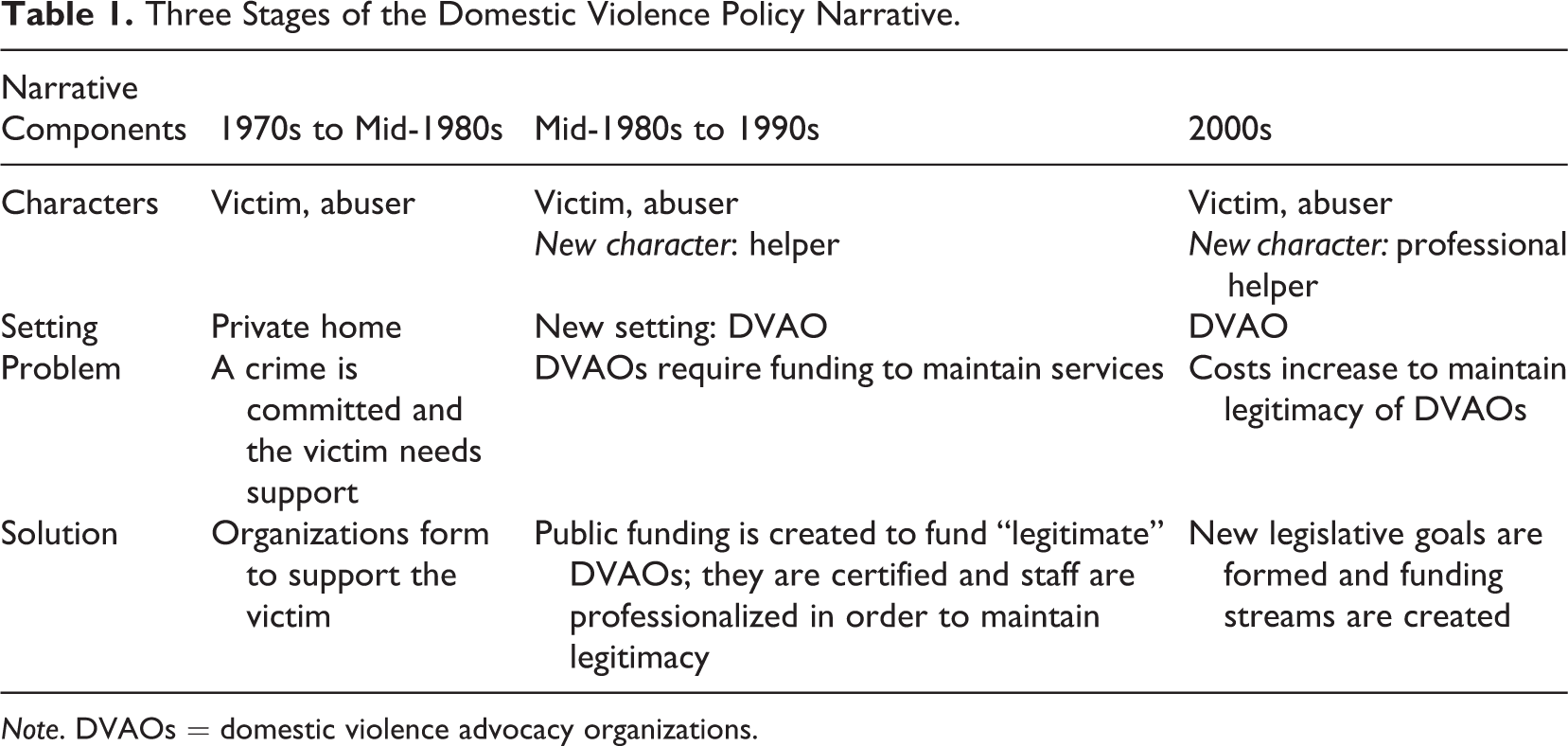
DVAOs did not just one day find themselves in this predicament of conflicting policies and narratives. Activists and advocates fought to push the private problem of domestic violence into the public light (Lehrner & Allen, 2009; Schechter, 1982). Supporting victims of domestic violence, treating their perpetrators, and working toward social change required a multiprong approach. In his book, Governing Narratives, Miller (2012) constructs an elementary road map of the path of environmental policy discourse in the form of an episodic narrative. I replicated Miller’s road map in Table 1 and applied it to the development of DVAOs. This road map provides a brief explanation of the formation of DVAOs and the public policy that impacts the DVAOs in three stages over time. Miller’s road map is combined with the components of McBeth et al.’s narrative form.
Three Stages of the Domestic Violence Policy Narrative.
Note. DVAOs = domestic violence advocacy organizations.
Beginning in the 1970s, “wifebeating” is defined as criminal behavior and organizations develop to formally serve this population. In order to provide ongoing services such as emergency shelter and legal advocacy, organizations sought legal standing and funding (Ferraro, 1981; Johnson, 1981). The demand for services grew, as did the costs for service provision. Over time, legal expertise and more formalized shelters developed using nonprofit organization legal structures status (Danis, 2006; Lehrner & Allen, 2009; Martin, 1976).
Beginning in the late 1980s, the formal 501(c)3 2 status led to the obtainment of additional public and private funding. DOJ victim advocacy funding for survivors and service providers forced the DVAOs and rape crisis centers to cooperate with the criminal justice system (Corrigan, 2014). HUD dollars linked the DVOAs to additional oversight mechanisms and cooperation (Mehrotra, Kimball, & Wahab, 2016). VAWA leaned heavily on individualized services intertwined with criminal justice solutions. With grant funding came restrictions and requirements shrouded under symbolic accountability measures leading to the need for expertise in this specialized funding. Help from individuals with professional certifications or degrees became essential. As domestic violence was better understood, staff also developed specialized legal and social welfare expertise (Bergstrom-Lynch, 2017; Danis, 2006; Lehrner & Allen, 2009).
Once services became more professionalized around 2000, organizations were certified, and staff became more specialized. Constraints on service provision increased and the bureaucratic formality drastically increased the costs to run the DVAOs. Holistic accountability measures split into numerous reporting tools. The Battered Women’s Movement found itself being pulled toward individualized service provision rooted in safety of the individual and away from social change efforts imagined by the mothers of the movement (Mehrotra et al., 2016). As services become more therapeutically oriented, trained therapists and social workers were hired. The more formally structured organizations and ties to public funding pushed organizations to hire more business administrators and fewer radical activists (Lehrner & Allen, 2009). Mehrotra, Kimball, and Wahab (2016) argue that the “braiding” of neoliberalism, criminalization, and professionalism occurring in the 1990s constrained progress toward ending domestic violence.
In effort to present the realities of work in DVAOs today, I analyzed organizational changes driven by the DVAOs in the most recent stage of the governing narrative: legitimacy through professionalization. Differentiating the narratives in relationship to policy implementation and ultimate outcomes offers a comprehensive view of the policy process and its influence on organizations charged with implementation. Analyzing the policy implementation barriers articulated through day-to-day management activities can demonstrate the broader impact of siloed policy-making. For instance, when a social welfare policy does not take into account interrelated public health or criminal justice issues, implementation of that policy is complicated.
Method
This study examined barriers nonprofits face when implementing federal and state governmental policy, using the perspective of Miller (2012) and McBeth et al. (2014) on policy narratives. I applied a grounded analysis approach to better understand the lived experiences of DVAO managers. This systematic directed method of analysis allowed an underlying policy narrative not overtly discussed in domestic violence policy conversations to emerge. The theoretical purpose of this study was to expand the use of the NPF to identify recondite narratives buried in everyday management activities (McBeth et al., 2014).
Sampling and Data Collection
Speaking directly to DVAO managers can provide insight into decision-making when selecting and utilizing government dollars to fund their organizations. The activities around and barriers to implementation are the elements of concern rather than the policies themselves. It is these lived experiences and narrative understandings (Creswell, 2013; Douglas, 1971; Fischer, 2003) that offer insight into a manager’s interpretation of a policy. These understandings take the policy maker out of the equation and bring the implementer into focus. I conducted interviews with 15 managers or executive directors of locally based DVAOs. A snowball sample of DVAOs in several U.S. states with different organizational types and funding structures was identified. 3 The seven states included were Alabama (three interviewees), California (one), Colorado (two), Georgia (three), Florida (three), New York (one), and Virginia (two). The sampling purpose is two-fold. First, the variety of states included helped articulate the variety of funding and accreditation structures in the United States. Second, sampling DVAOs with the different funding structures was an exploratory process as each DVAO is unique based on the local, state, and federal dollars the DVAOs accept. These data led to a stronger explanation of these varying structures’ impact on domestic violence public policy implementation. The sampling approach ensured the analysis was not limited to the unique funding structure of one state or locality and that the findings did not lean heavily on one type of funding administration.
Interviews were conducted by phone. Each lasted between 40 and 70 min and were semistructured in nature. Managers were asked to identify conflicts related to policy or funding streams regulating their organizations (see interview instrument in the Appendix). 4 Their perceptions on externally driven accountability mechanisms, such as grant reports, auditing activities, service tracking instruments, and fiscal accounting tools, were documented. The interviewer explored the details of the problems related to implementing and complying with policy and the impact on the DVAO fiscally and on their day-to-day operations. Finally, managers were asked how they dealt with the problems and who they sought for help.
Data Analysis
First, examples of policy conflicts were specifically identified and along with their relationship to the NPF variables: characters, settings, problems, and morals. Next, using guidance from Corbin and Straus (2008) and Brower and Jeong (2008), iterative coding was conducted in order to group the significant statements and phrases into “clusters of meanings” that are common to all or most of the subjects (Creswell, 2013, p. 82). In this stage of the analysis, the researcher interpreted and sorted the responses to the problems identified in the first stage of coding. Finally, larger themes emerged and were identified among these clusters.
I followed Yanow’s (1996; Schwartz-Shea & Yanow, 2013) lead in interpreting the statements made by the “situational actors” in the organizations when “categories of analysis” emerge. In addition to the organizations’ various funding structures, the managers come from different backgrounds. Their professional designation (attorney or social worker) and whether the managers view the organization as feminist or not (Bierra, 2007; Corrigan, 2014; Gilmore, 2007; Matthews, 1995) frames and influences their interpretations (Charmaz, 2014; Jeong, 2009) of the problems. This variation demands a sensemaking approach (Jeong, 2009).
Findings: Patterns of Incongruence
The DVAOs identify over 20 funding streams, but the findings presented here focus on the data referencing four federal policies and linked grant programs with the highest identification of regulatory conflicts: Victims of Crime Act, VAWA, the Emergency Shelter Grant, and the Family Violence Prevention and Services Act. By focusing on these four federal funding streams, the commonalities are isolated to federal policy–driving programming around the United States rather than articulating issues experienced on a state-by-state basis. These public dollars are typically not paid directly to the DVAO; instead, the federal funding flows through a state-level and/or local administering agency or nonprofit, which adds rules and accountability measures of their own via grant reporting tools. The pass-through organizations differ state to state in name and legislative purpose. For instance, depending on the state, VAWA funding may be administered by the Departments of Economic and Community Affairs, Family Services, Bureau of Investigation, or Office of the Attorney General. The legislative purposes of these organizations differ vastly as do their regulations tied to funding.
Figure 1 traces public dollars flowing from the federal departments. The flow of dollars is interrupted by pass-through entities who administer public dollars. Each state administers funding in ways dictated by its own state statutes, and no two DVAOs have identical funding structures. Although most organizations receive the federal dollars on the left of the diagram, the pass-through organizations in the middle differ state to state and, when local government is involved, county to county. This means there is no single policy solution to this issue.
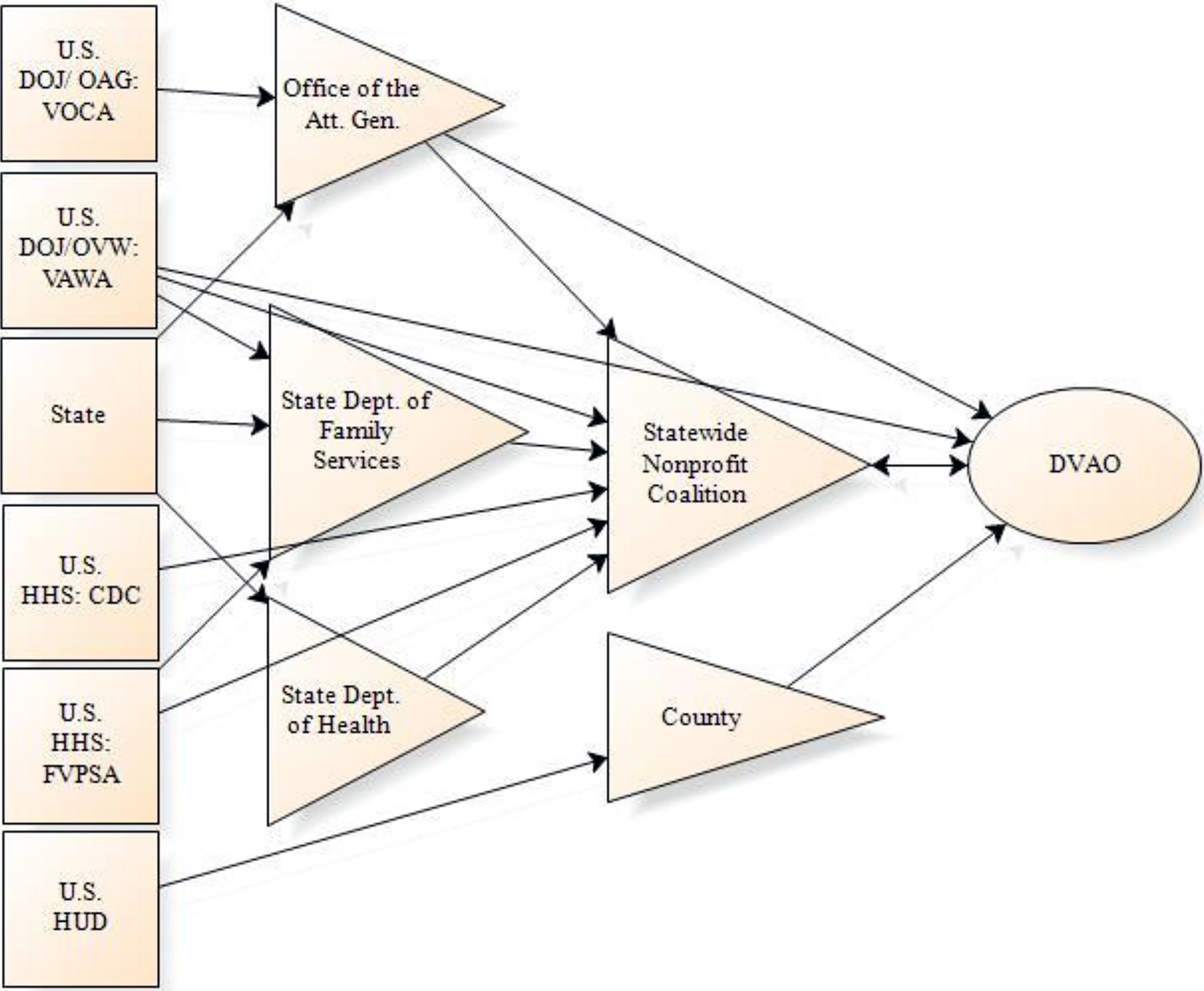
Example of funding pathways for a domestic violence advocacy organization with a statewide nonprofit coalition serving as a funding pass-through organization.
The managers spoke of the obstacles faced when implementing conflicting policy requirements. The managers view implementation conflicts as standard practice rather than as a problem rooted in policy differences. One manager described this as a case of policy incongruence. You have these grants that are sort of incongruent with one another. It’s hard for you to know where you fit, do I follow the rules of X because they’re my biggest grant, or Y because they fit my mission better?
Symbolic Accountability
Demonstrating accountability via valuable outcome measures is challenging for a DVAO (Wathen & McKeown, 2010). Although evaluation measures are commonplace, the measures employed do not always reliably evaluate mission fulfillment of these organizations and may be rooted more in symbolic accountability (Ebrahim, 2005). Measures vary by state and the type of pass-through agency. Riger and Staggs (2011) found in a national survey on state-mandated evaluation practices for DVAOs that 67% of domestic violence centers are required to supply process measurements such as frequency of services, while only 10% are required to report performance measurements that gauge their goal achievement. This evidence can explain the high usage of functional time sheets found to document activities throughout the day at the DVAOs. These sheets require staff to document their activities in 10 min or 15 min increments depending on the state requirements. This documentation sometimes requires staff to duplicate the documentation of their activities as described by this manager: For one funder, we record time spent with victims. We count it in increments of 15 minutes. Another funder is not concerned about the time; they want the number of contacts each staff person has with each victim.
In absence of a singular or holistic accountability measure, there was discrepancy determining for whom the DVAOs should demonstrate accountability. Mission statements prioritize serving the survivors, and the managers’ words were “We put the victim’s needs first! They are our number one priority.” But the actions they described demonstrated how a driving concern was pleasing the funders.
The pressure to keep the doors to the shelter open while 60–70% of their budget is from public dollars puts public policy regulations at the forefront of their activities. Rather than mission fulfillment through outcomes, the DVAOs seek mission fulfillment through secured funding. Service provision was discussed in terms of victim safety and protection of their information. But achievement is demonstrated by the measures typically demanded in their reports to funders such as support group attendance, number of days in shelter, or referrals provided to hotline callers. Organizations are caught between narratives of victim service provision and narratives of government efficiency and performance measurements.
Some federal dollars pass through multiple state and local entities before reaching the DVAO. Each entity adds rules tied to state or local policy or the legislative purpose of the entity. Figure 2 provides an example of multiple layers of pass-through entities. In this example, one funding stream starts at the DOJ and passes through the state, a county department, a county office, and an umbrella nonprofit organization.
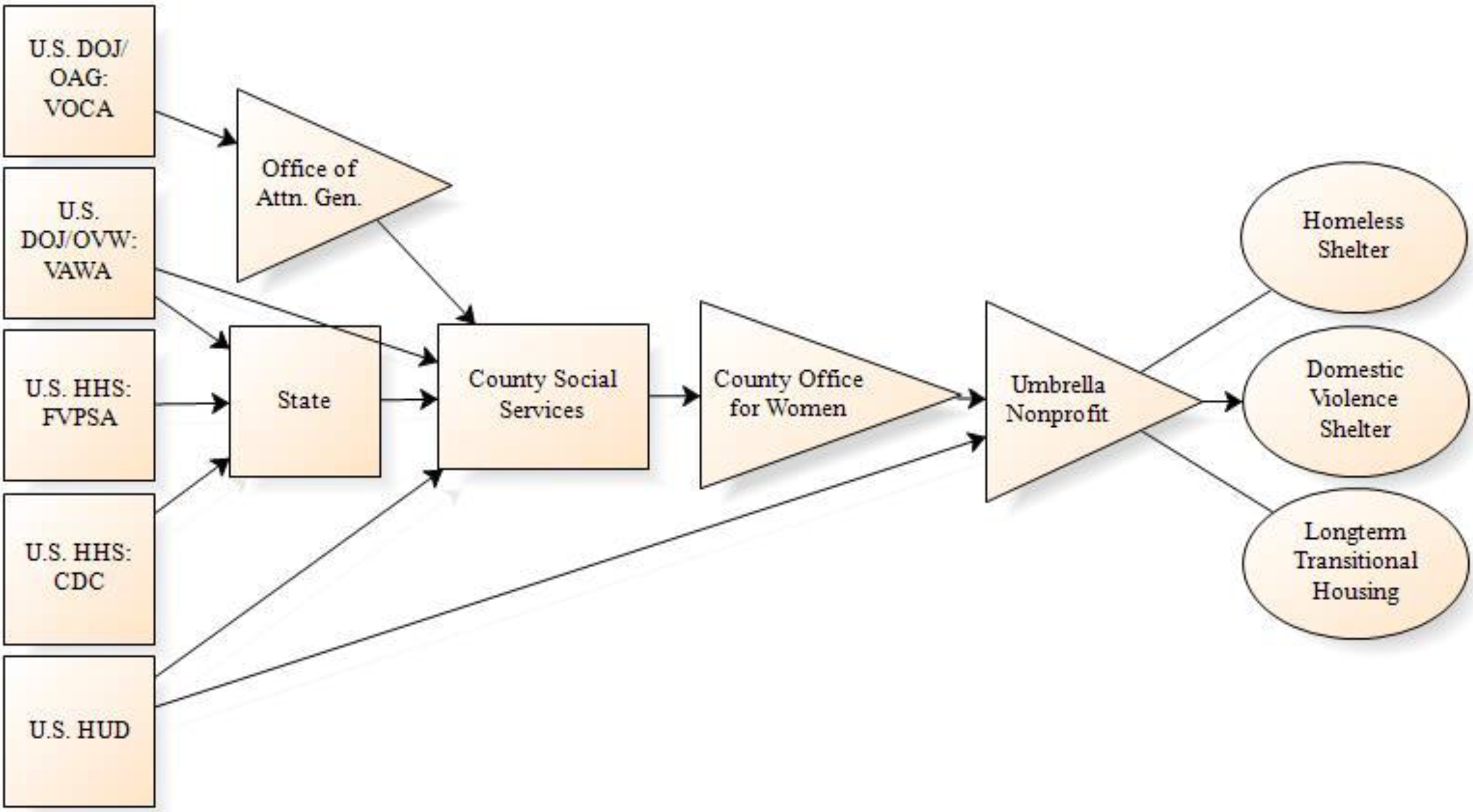
Example of funding pathways for a domestic violence advocacy organization with county entities and an umbrella organization serving as a pass-through funding organizations.
When there were multiple pass-through entities between the federal funding and the DVAO as in Figure 2, it became cumbersome to determine how to comply. When one manager was unsure about what activities her funding would permit, it was a long process to find an accurate answer. Even asking for help from their grant managers at the pass-through entity can lead to confusion. So, our grant manager ends up having to go to her boss to call the [next pass-through agency], or her boss’s boss who calls them, know what I mean? Sometimes there’s not an answer to the conflicting information. There are inherent risks if you’re not really clear on what’s allowed and what’s not. I think that if you get money coming in and you’re not really clear on what can be spent, how, and where, there’s a risk for being out of compliance during an audit.
Ethical Quandaries in the Name of Accountability
Immense documentation, state-mandated services, and questionable outcome measures led the managers to question their principles. In frustrated tones, they described ethical dilemmas resulting from conflicting service provision regulations and reporting requirements. Compliance challenges were expressed as struggles in documenting the appropriate use of funds, being in conflict with standards of practices, and as a barrier to resolution.
First, managers questioned the legitimacy of their grant spending. Funding parameters mandate staffing requirements across the board with no consideration of local need. For instance, one state required 24-hr availability of services. Around-the-clock availability worked fine for urban DVAOs but not for those located in rural areas. A manager wondered whether staffing the rural shelter around-the-clock was the best use of her finite resources. One of the counties we work with is tiny. A few days could go by without a call coming in. But we are supposed to be open 24 hours a day. Yet, we can’t put on our timesheet that we were just waiting for a call and be able to bill for that.
Others felt they were reporting data simply to check a box that the report was complete rather than to produce performance or outcome measures. A manager spent 60 hr attempting to calculate service provision numbers for a reporting form. She finally gave up and called more seasoned managers for help. She was told no one was able to complete the report properly because the electronic submission form contained errors. She wondered whether others were “wasting” their payroll to navigate problematic funding reporting forms. All DVAOs complied with the requirement of the funder and submitted something but not necessarily accurate numbers. This manager confronted her funders in a statewide grantee meeting and explained that there was no possible way to send them accurate numbers, and no DVAO in the state was able to complete the report correctly. And there was silence in the room and then what I heard was that basically they just take each of these numbers, aggregate them all together, and then submit them to the federal government. So, what that said to me is, we don’t really care. I mean, in reality if your answer to me is we aggregate the data and we send it off… …there isn’t a human actually looking at any of it and that there’s zero accountability about whether I’m telling the truth or reporting the numbers legitimately.
Second, ethical obligations were challenged in the documentation of sensitive victim information in case files. Case files are used as one form of communication with fellow staff members about the needs of the victims while receiving services. The other, and more demanding, purpose is for monitors from the funding offices to ensure compliance with their regulations. Sometimes the case notes styles differ greatly. When DVAOs attempt to increase their income to meet their budgetary demands by seeking nontraditional funding, the rules tied to that funding often do not reflect the practices of the field. Sometimes they will add a new service in order to qualify for the funding. When these new services require additional accreditations, compliance can become complicated. The accrediting bodies can require completely different service documentation. This manager explains the problem, For one [accrediting body] we’re concentrating more on what the advocate is doing, what service they are providing, and for the other we’re being told we need to document a lot more. Our case notes are a lot longer in detail for the second one. Because they want to know what the victim is presenting with, like what problems is she having? What we said to her, what we suggested, what the plan is, like…whether she’s going to come back [to shelter] or not.
When DVAOs use funding that requires a social work lens to their reporting or case notes, more documentation of service activity is required for accountability purposes. Domestic violence advocates may refuse to do it. Their justification is they are protecting the victim from potential harm and are meeting field standards of practice. When DVAOs refuse to comply for ethical reasons, however, they risk losing the money.
Third, sometimes compliance and advocacy are not compatible. DVAOs work on all levels of solving the public and individual issues of domestic violence, and politics does not end at policy implementation (Miller, 2012). One day DVAOs may be negotiating increased grant funds at their Department of Children and Families, and the next day file a complaint in the same department against a child protection worker on behalf of a victim. When you start taking government money and become a more professionalized field, then there is a control on what you say, how you say it, the grassroots movement kind of goes away because you’re scared if you do something this way or that way that you’ll lose funding. So, you’re not going to try new things, you’re not going to push the envelope. You’re not to start asking hard questions to your funder, because you’re comfortable where you are. That’s a huge risk! Right?
Some DVAOs have sought to bring this ethical quandary to the attention of funders. For example, states throughout the United States struggle with HUD’s Homeless Information Management System demands for personally identifying information about victims seeking shelter. VAWA prohibits sharing this information, thus DVAOs went to the table and refused to provide the data. The states that challenged HUD faced the largest barriers in receiving their emergency shelter grants. Delays in funding cost DVAOs a large portion of their discretionary budget while they filled the gap, and it costs staff time in trips to the state and national capitols to sort out the conflict.
In some cases, it is more prudent to let these challenges go and just do what that funder asks. Advocates are taught skills for ethical communication and interaction with victims but are not taught how to choose where their allegiances lie—with the service recipient or with the funder. DVAOs are thus caught in a perpetual dilemma between the hesitancy to demand change from funders and their understanding that change is crucial.
Institutional Gridlock
Most U.S. states have an accreditation process for DVAOs tied to access to public dollars. To maintain accreditation, DVAOs must provide services that are listed in that state’s statute or administrative rule. Common services are emergency shelter, support group, counseling, case management, child assessment, referrals and information, safety planning, and community education. But these requirements are not contextually based, compliance is costly and not always considered to be current best practice by these DVAO leaders. Solutions must adapt both to a broadened demand for services and demand from government entities for collaboration. But what if contractual obligations essential for keeping the doors open prohibit needed adaptations? Organizations become stuck in cyclical problems in operation: There is inadequate funding to function in a healthy way, but barriers exist to accessing more income. Standard practices are challenged, and the ability to push for change is diminished.
A director describes the challenge in resolving a problem with the state because of the accountability mechanisms of multiple entities. Her sister organizations are advocating for new policy solutions but she is unable to participate. [Or organization] can’t sign onto the letter in support of this initiative, because it has to go from our agency director to the county executive to the county attorney. And by the time all of that gets done the letter is already signed and out the door and our county is not able to be a part of that.
In the past, domestic violence advocates throughout the nation worked with legislators to define how shelters would use state funding. Now some states have official standards of services that are quite dated but, nevertheless, mandated. These legislatively established standards pose a barrier to new approaches to services like prevention efforts. Ultimately the administrative burden of the conflicting policies falls on the service recipient as well as the manager. I spend a lot of my time on management on service-related forms—for auditing purposes, when the monitors come out and check our case files. The documentation required for each funder lengthens the intake process for people coming into shelter.
An Underlying Policy Narrative
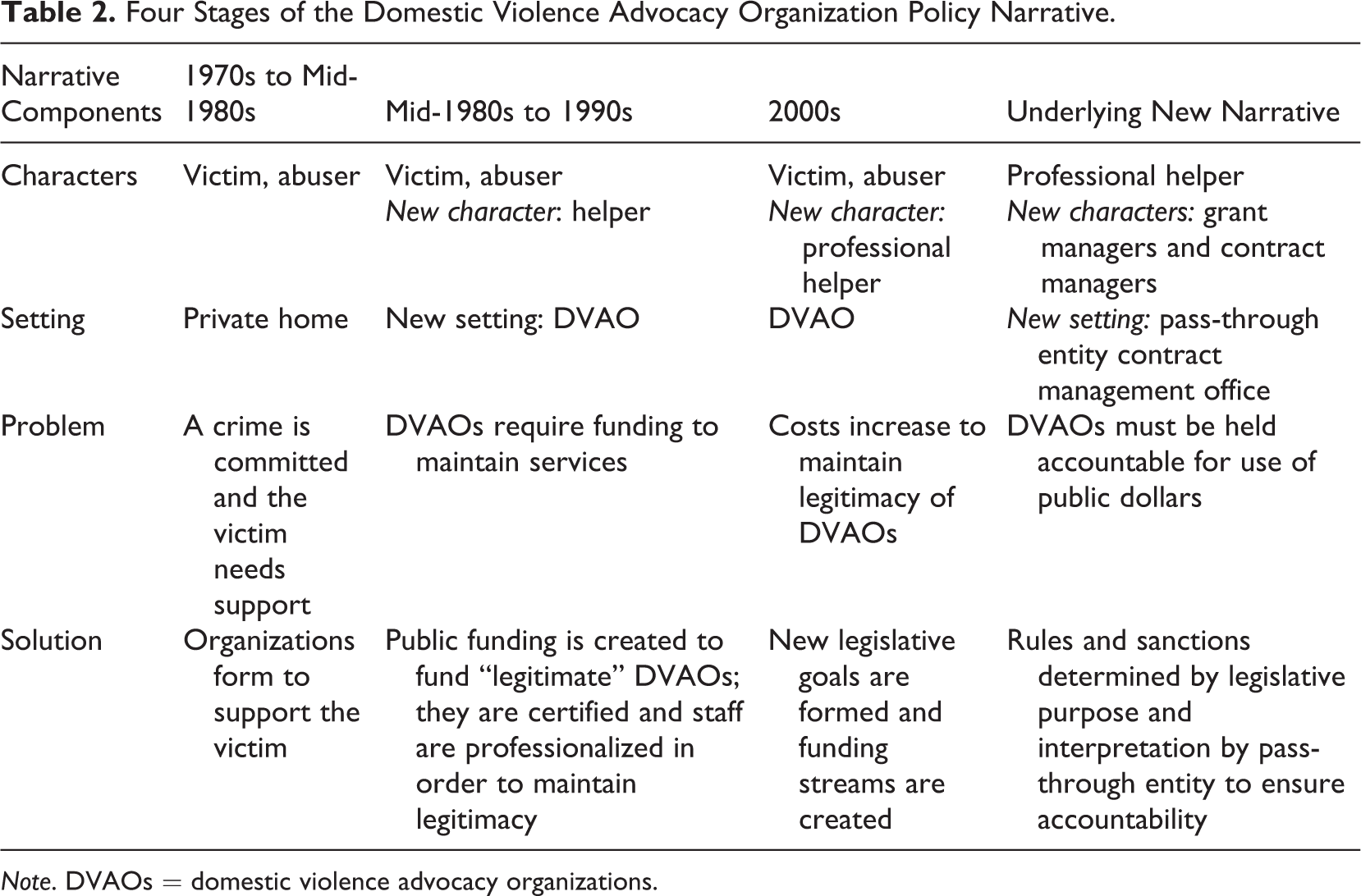
The evidence suggests there is an underlying policy narrative dictating policy solutions that are not tied to the outcomes for which DVAOs measure mission fulfillment. By pushing the NPF beyond its typical use, articulation of manifest narratives, one can employ the framework’s structure to articulate a new stage in the domestic violence policy narrative. The new narrative is not explicit in policy text but instead is embedded in each interaction between managers and policy administrators. While policy activists work tirelessly to promote policy solutions to address the problem of domestic violence, lawmakers insert additional solutions tied to their own narratives of policy effectiveness and financial stewardship and then pressure DVAOs into competitive grant structures, reflecting neoliberal policy-making (Mehrotra et al., 2016). The implications are that the daily activities of DVAOs focus on a recent, externally imposed policy narrative of compliance rather than an earlier policy narrative of supporting victim safety and societal change. The new stage in the narrative, building on three earlier stages beginning in the 1970s, is presented in Table 2.
Four Stages of the Domestic Violence Advocacy Organization Policy Narrative.
Note. DVAOs = domestic violence advocacy organizations.
This fourth stage of the domestic violence policy narrative demonstrates a shift in each aspect of the narrative form: characters, setting, problem, and solution. From the 1970s into the 2000s, policy activists fought for tools to support victims through the development of DVAOs leading to public funding and professionalized services. In the most recent stage in the narrative, the emergence of two new characters is repeatedly mentioned by DVAO managers who were not part of earlier policy narratives: the grant manager at the DVAO and contract manger/monitor at the pass-through entity. These characters do not play the role of the victim or offender nor do the characters represent the role of the helper. They are new and reflect the institutionalized dependence on government funding. These characters are administrative overhead resulting from red tape and audit culture (Owczarzak, Broaddus, & Pinkerton, 2016). Obstacles to serving victims are tied to these new characters in so far as they demand increased documentation and interaction with funding organizations.
In the 1980s and 1990s, advocates demanded government response to the individual crimes and the larger societal problem. What resulted was an institutional shift. Government responded through funding and formalization of services. The public values of accountability and transparency influenced regulations tied to these funding streams. Software, training staff, and contract management positions were developed to help the field of DVAOs comply with new requirements. The new characters that implemented these tools converged at a new setting: the grant management/administration office at the pass-through entity. The “problem” constructed in Stage 4 of the narrative is thus concerned with ensuring organizational compliance with government regulators rather than addressing problems of public safety, public health, or social welfare. This amplifies red tape, data collection, and compliance expenses. In the new narrative, accountability trumps mission.
Stage 4 of the narrative is problematic on multiple levels because it indicates DVAO resources are devoted to something other than their expressed mission, and the demands from regulatory policy conflict are growing over time. The managers describe in detail how focus on regulatory policy detracts from direct service to victims. Obligations tied to grant funding and donations require DVAOs to divert resources from mission achievement. Could DVAOs devote more resources to mission achievement by reducing the amount of time they spend documenting their time and reconciling compliance conflicts? The answer is obvious, a resounding yes. But the data demonstrate that decoupling these non-mission-related activities is not a possibility. The funders and pass-through entities focus on documenting diligence, which draws the DVAO’s attention away from community and victim needs and toward funder needs.
If DVAOs were to measure the impact of the solution dictated in the new narrative—increased documentation, rules, and sanctions tied to each governmental funding stream, what would they find? They would likely find a negative impact on service provision for each additional source of governmental funding. Like Lehrner and Allen (2009), DVAOs would also find a pull toward microlevel approach of victim services rather than the historically significant macrolevel emphasis on social change (Shepard & Pence, 1999).
The NPF provided a tool to contextualize the policy conflicts faced in a single organizational field. Although many human services subsectors face this policy problem, focusing on one setting (the DVAO), reduced the cast of characters, narrowing the relevant problems and solutions. The framework allowed for a historical context to emerge as the cast and location shifted over time. The NPF was not only helpful in explaining the manifest expression of policy narratives, but this exercise employed the framework to achieve something new: identifying latent policy narratives driving organizational behavior. Now articulated, steps can be taken to address the problematic nature of this narrative of accountability over mission.
Confronting the New Reality
Accountability measures distract DVAOs from bug mission fulfillment. My interviews with nonprofits leaders in the field of domestic violence further Ebrahim’s (2005) concept of accountability myopia: that is narrowly focused, short-term, symbolic accountability measures rather than value-based approaches. DVAOs struggle with upward accountability because the ultimate funder is one or two steps away. The pass-through entities add distinct regulations, state-by-state, inhibiting the ability of individual DVAOs across the country to collaborate in solution development.
Thus, if accountability myopia is tying the hands of the managers, then institutional approaches must be considered. For instance, block grants rather than categorical grants could be a solution, along with less burdensome paperwork and performance measure requirements. Unraveling the stipulations tied to each grant and then negotiating compliance with each drains staff time and other resources (like technology, office space, and supplies for full-time grant managers). This subtracts from the resources needed for victims, such as legal advocacy and additional beds in the shelter.
Shelter is a costly solution serving fewer victims than court services or outreach services and focuses on individual safety rather than social change (Kim, 2013). Shelter services are regulated by outside entities like the state and local health departments and HUD. These entities contribute layers of costly compliance requirements. If DVAOs had more flexibility in the services they provide in their county, they could better tailor these services to local need and up-to-date best practices. In rural counties, nonresidential services make financial sense, but state accreditation rules dictate full-service entities. To get around these rules, some communities host satellite offices for DVAOs based in neighboring counties. Still, this approach excludes the possibility of a purely local response.
The challenge arises when solutions to domestic violence are proposed that do not fit with the imposed government regulations. This institutional gridlock is an outcome of the “fetishization of safety” 5 (Kim, 2013, p. 3; Mehrotra et al., 2016) that drives the certification process. DVAOs may unwillingly emphasize safety interventions directed toward individuals rather than communities or society, undermining their capacity. Interviewees reported that as advocates in the field began to recognize the value of prevention work with youth, the web of restrictions tied to their funding streams prohibited prevention activities. Looking for a new source of income to use toward these new solutions brings greater problems: more accountability measures.
At such a juncture, DVAOs are left with three options. One, DVAOs can confront the problem (Corrigan, 2014) by contesting the prescribed conflicting policy regulations. Two, they can passively accept the conflicting requirements of the funding and absorb the costs of doing so (Wiley & Berry, 2018). Or three, they can bypass the problem and “reimagine [their] funding approaches” (Mehrotra et al., 2016, p. 160; Smith, 2007). As observed in Stage 3 of the domestic violence policy narrative, DVAOs in some states became certified by a state agency that legitimizes the organization to a host of governmental and private funding sources. Certification comes with a price that was spelled out in the data: increased documentation problems, restricted funding, and time and energy of staff members to ensure compliance with the certification status as well as the overwhelming nature of the conflicting rules. DVAOs have found themselves locked into institutionalized solutions with little room left to seek alternative solutions or innovative practices.
Conclusion
In the end, how do managers of nonprofit organizations perceive implementation of multiple public policies? The data show that managers view implementation conflicts and accountability myopia as standard practice. It is my opinion that the mothers of the Battered Women’s Movement in the 1970s did not anticipate a transition from battling the government to acknowledge the problem of wifebeating and enforce protections for victims to a suffocating state with too many policies addressing the problem and an excess of enforcers. But this is the state of DVAO management existing today as expressed in these interviews. The current state of DVAOs demonstrates a shift in funding streams, the policy narratives driving their work, and management patterns for DV services over the past 40 years.
Collectively, DVAOs leaders advocate for new policy at all levels of government for the next generation of leaders; therefore, it is imperative that policy makers and grant administrators hear their critiques. In their interviews, the managers provided insight into the daily impact of this new narrative on their current wheelhouse of management tools and strategies. Managers tell us two things. First, they tell us there are too many characters defining their work for them to successfully do their work. Much like Matthews (1995) and Corrigan (2014) reported of the Rape Crisis Movement, professionalization of the field and reliance on government funding have shifted perceptions of advocates currently doing the work. Their job priorities focus on accountability measures rather than service provision. The more funders strive to measure quality service, the less time DVAO managers must manage service provision at all. Case files at DVAOs were originally designed as a communication tool between workers to help ensure the victims’ self-defined needs were met. Now inches thick, they have been co-opted to include liability releases, surveys, staff time records, and forms to legitimize victimization. They have become a cumbersome tool driven by and used by various monitors and auditors. We must reduce the quantity of external administrators, monitors, and auditors accessing files best reserved for service provision not compliance enforcement.
Second, managers tell us they want a different policy solution: streamlined instruments that result in a reduction in compliance costs. Management solutions such as better nonprofit financial management tools, improved human resource management approaches, or grant writing classes would not solve this policy problem. Much like O’Dwyer and Unerman (2008) found, managers desire holistic instead of piecemealed accountability mechanisms. Rather than each new funding stream requiring an additional independent accountability report, DVAO managers envision an elimination of these costs. It would be naive to demand a singular performance reporting instrument for multiple agencies at various levels of government. It is, however, reasonable to ask for a reduction in reporting mechanisms only to those directly measuring public policy fulfillment. By taking advantage of the Paperwork Reduction Act of 1980, policy advocates could demand more streamlined reporting across federal departments funding their programs. DVAO leaders could work together to identify overlap or conflict in reporting measures and demand change or a reduction in their reporting tools.
A stronger coordinated effort at the national and state levels to streamline these compliance measures is necessary and possible. DVAOs describe a situation where their funding and legitimacy are tied to accreditation. Wiley and Berry (2018) found that leaders in these local organizations feel powerless in changing these the high demand for performance measures over mission-oriented activities. DVAO leaders need the tools to confront this issue. Policy advocacy efforts have supported DVAOs in negotiating the sharing of data, but the focus of these efforts is on immediate needs of victims rather than streamlining performance measures. For instance, the National Network to End Domestic Violence provides a tool for practitioners to use in coordinating the sharing of confidential information required by the Department of HUD but protected by the VAWA and the Family Violence Prevention and Services Act (Domestic Violence and Housing Technical Assistance Consortium, 2018). Some state-level domestic violence coalitions take on statewide data collection for a limited number funding streams in effort to reduce the impact on the local organizations while at the same time adding another layer of oversight. The National Coalition Against Domestic Violence biannual conference occasionally includes workshops on managing reporting tasks. Advocacy efforts by these same groups have led to powerful legislation at all levels of government to achieve safety and justice for victims of intimate partner violence. Collective action among these same advocates could be harnessed to bring about the necessary change, so that DVAOs do not remain bound to a narrative that makes it financially possible yet operationally impossible to truly fulfill their mission.
Footnotes
Appendix
Declaration of Conflicting Interests
The author(s) declared no potential conflicts of interest with respect to the research, authorship, and/or publication of this article.
Funding
The author(s) received no financial support for the research, authorship, and/or publication of this article.
