




Abstract
This article conceptualizes how place-based analysis can generate innovative understandings of sex work and spatial justice, including ways in which stigma, well-being, and marginality are embodied in sex work places. Focusing on three interconnected dimensions of place—geographic location, material environment, and sociopower structures—this article examines the unexplored realm of place and sex work. Beginning with an analysis of existing sex work literature and knowledge relating to dimensions of place, we explicate the role of feminist ideologies, juridical contexts, and the built environment as the conceptual and analytic groundwork for a place-based understanding of sex work. Architectural spatial methods then generate a place-based analysis of two case study exemplars: the Residence in Western Canada and the Strichtplatz in Zurich, Switzerland. We conclude by considering avenues to incorporate place theory into sex work research and the social work discipline, ultimately advocating for research, policy, and practice that concomitantly address sex workers’ social and spatial oppression.
Sex work scholarship continues to expand in the areas of public health, stigma, and human rights (Benoit, Jansson, Smith, & Flagg, 2018; Bowen & Bungay, 2016; Vanwesenbeeck, 2001; Weitzer, 2009). Increased considerations of juridical contexts and advocacy efforts surrounding sex work are becoming more prominent (Benoit, Jansson, Smith, & Flagg, 2017; Campbell, 2015; Comte, 2014; Jeffrey & MacDonald, 2011; Schotten, 2005), and literature exploring sex work and space is broadening (Hubbard & Sanders, 2003; Orchard, Vale, Macphail, Wender, & Oiamo, 2016; Prior & Crofts, 2015; Van Meir, 2017). Spatial research seeks to understand the role of our physical and geographic world divested from personal significance; for a space to become a place, it requires human experience and meaning (Cresswell, 2004). Place-based analysis for sex workers remains largely absent within the global research landscape, despite an understanding that women’s physical environment influences their experiences of violence, identity, and empowerment (Grittner, 2019; Meth, 2003).
This article explores the potential for advancing social justice for sex workers by generating a place-based understanding of sex work, with a particular focus on the built environment, sociostructural powers, and the varying geographical locations of sex work. We address these three layers as a first step in establishing the conceptual and analytic groundwork for research that incorporates the experiential layers of place. The article begins by analyzing sex work literature for existing knowledge relating to dimensions of place, focusing on feminist ideologies, juridical contexts, and the built environment of sex work. We then provide a place-based analysis of two case study exemplars: the Residence 1 in Western Canada and the Strichtplatz in Zurich, Switzerland. These case studies illustrate that place-based analysis generates innovative understandings of sex work and spatial justice, including ways in which stigma, well-being, and marginality are embodied by sex work places. Finally, we consider avenues for incorporating place theory into sex work research and scholarship within the social work discipline, ultimately calling for research, policy, and practice that concomitantly address sex workers’ social and spatial oppression.
Locating Ourselves
This article expresses our unique but converging disciplinary backgrounds, which come together through our shared interest in human rights and research in the field of social work. The first author is a doctoral social work student with a Master of Architecture and a professional background in participatory design and community development focusing on gender, sexuality, and the built environment. The second author has engaged in visual research for over 17 years. Starting out as a filmmaker and transitioning into an academic role in social work, her research involves working alongside communities in the areas of sex work, sexual health, and sexual rights. Together, we have a common interest in creative participatory research with sex workers that privileges lived experience as a pathway to social justice. We define sex work as the exchange of sexual activity for goods or money between two consenting adults. Exploitation and trafficking of women and children is not included within this definition or the scope of this article (Bettio, Della Giusta, & Tommaso, 2017).
Positioning Sex Work and Social Work
Social work is particularly positioned to consider the interconnection between sex work and place. Shaw (2007) asserts that the profession holds a disciplinary understanding of structural inequity, social justice, and a dedication to fostering human dignity rooted in an understanding of lived experience. Such a focus aligns with investigating the complex role of place in the lives of sex workers, unfolding the ways in which human experiences of meaning, identity, and oppression are interwoven with everyday environments.
Sex work is a long-standing interest of the social work discipline, with varying approaches and ideological stances directed toward sex workers. Sloan and Wahab (2000) trace the entangled history between social workers and sex workers from the evangelical reform era that focused on protecting female virtue from male sexual aggression in the mid-1800s, to saving women from “white slavery” and rehabilitating “fallen women,” to present-day feminist debates that situate sex work “against a backdrop of economic injustice and social inequity for women” (p. 460). Recently, social work research includes more participatory-based approaches alongside sex workers (Barlow & Hurlock, 2013; Desyllas, 2013; Wahab, 2004). For instance, Desyllas’ (2013) research about the lived experiences of sex workers demonstrates the importance of social workers listening and working alongside sex workers to ascertain what support services they require as well as playing a critical role in social activism that combats sex work stigma. Barlow and Hurlock’s (2013) 3-year participatory action research study with sex workers also focused on sharing power within a collaborative community-based framework. Wahab’s (2004) participatory research with sex workers illustrates the power of collaborative dialogue between researcher and participants to confront stigma, counter social isolation, and forge social work praxis that addresses the self-identified needs of sex workers. These community and participatory-based approaches are a strength of social work research that uniquely positions the discipline toward engaging in robust place-based analysis that explicates the interaction between human meaning and the environment.
Place: An Expanded Definition
The concept of place focuses on the connection between people and their surroundings. Place theory and research is multidisciplinary, including anthropology (Pink, Mackley, Morosanu, Mitchell, & Bhamra, 2017), human geography (Cresswell, 2004; Massey, 2013), architecture (Dovey, 2008, 2010), sociology (Gieryn, 2000), and, to a lesser degree, social work (Akesson, Burns, & Hordyk, 2017; Kemp, 2010). Agnew’s (1987) oft-cited definition is a useful starting point, wherein place is composed of three elements: (1) a specific location in the world, (2) a material setting and concrete form, and (3) meaning attached by an individual or group. These three interconnected areas are mutually constituting; in other words, “place is an inextricably intertwined knot of spatiality and sociality” (Dovey, 2010, p. 6). Place includes the houses, apartments, office towers, institutions, streetscapes, sidewalks, parks, and monuments located in a specific geographic location, which are then experienced and invested with human meaning (Gieryn, 2000). These physical and experiential dimensions of place operate both independently and reciprocally (Bourdieu, 1990; Gieryn, 2000). As explained by Pink (2015), place is the location of the body immersed in the “materiality and sensoriality of the environment” (p. 4).
Sociostructural Power and Place
Sociostructural power is one of many threads woven into place. Localized places reflect larger global sociopower structures and vice versa, a relationship Massey (2013) deems multiscalar. Likewise, Cresswell (2004) defines place as “space invested in meaning in the context of power” (p. 12). McKittrick (2006) also notes that places are organized and experienced according to unequal distributions of strength and capital. For sex work, place offers a critical lens to understand how the hierarchical sociostructural powers of gender, sexuality, colonialism, and capitalism—among others—coalesce and interpenetrate local sex work environments. The intersection of place, gender, and sexuality is particularly salient to sex work as the vast majority of sex workers identify as cisgender or transgender women, and most clients—regardless of the gender of the provider—are men (Schotten, 2005). It is well established that place is gendered (Beebeejaun, 2017; Borden, Penner, & Rendell, 2002; Kemp, 2001; Massey, 2013; Weisman, 1994). For instance, Beebeejaun (2017) stresses that places primarily meet the needs of men and heteronormative families. Weisman’s (1994) research also demonstrates how the lives of women are shaped by discrimination codified within everyday places. Geography scholars further illustrate how sexual activity shapes notions of place by depiction, recognition, and lived experience (Hubbard, 2000). Bondi (1998) asserts that sexuality’s complex relationship with gender identity must be considered when examining place, particularly in the strategies sociostructural powers use to control sexuality. Thus, heteronormative patriarchy impacts the place of sex work as society strives to regulate transgressive sexuality (Hubbard & Sanders, 2003).
Sociostructural power seeks to perpetuate the existing social order by replicating dominant ideas of gender and sexuality in the material form of place; Dovey (2008) reminds us that “the built environment is a primary medium for the techniques of establishing, legitimizing and reproducing ideology at every scale from the house to the city” (p. 45). Patriarchy is embodied within built environments that “produce and reinforce larger patterns of privilege and oppression” (Kemp, 2010, p. 123). The physical world inherently affects social processes through its creation and occupation (Gieryn, 2000; Habraken, 1998). The built form mediates experiences along spectrums of orientation, privacy, segregation, change, and difference (Dovey, 2008). The material form of place also facilitates atmospheres, curating embodied sensory experiences via manipulations of light, smell, sound, visibility, texture, and feelings of compression, expansion, and exposure. These physical environments are often viewed as immutable and innate, thus shaping our beliefs regarding what is possible for our future selves (Dovey, 2008; D. Prince, 2014).
Sex Work and Place: What is Known So Far
Feminism, Sex Work, and Place
A large portion of the literature about sex work is devoted to evaluating the diverse viewpoints through various feminist stances (Comte, 2014; Farley, 2004; Jeffreys & MacDonald, 2011; Schotten, 2005; Sloan & Wahab, 2000; van der Meulen & Durisin, 2008; Weitzer, 2009). For instance, Comte (2014) explores abolitionist and sex-positive positions within feminist literature. The abolitionist stance does not support any form of sex work and considers people involved as victims that need protection and support to leave sex work. This position is generally associated with radical feminism, where sex work is considered the objectification of women and inherently oppressive. In contrast is the sex-positive stance. Comte (2014) explains that this stance sees patriarchy as the cause of sexual female repression and describes this argument as follows: Sex-positive feminists pose sex work as an opportunity for sexual exploration and personal growth regarding one’s own sexual taboos and prejudices. According to them, we have to question the moral codes that forbid women to be “sexual” outside the legitimate couple; allow ourselves to explore sexual acts, activities, and role-playing that can be found within sex work…and ultimately, get rid of all feelings of guilt that have been socially instilled toward such sexual expression. (p. 201).
Indeed, sex work exists on a continuum of power, control, and consent. The British Columbia Coalition of Experiential Communities (BCCEC, 2009) notes that on one end of the continuum, the engagement of sexual exchange involves individual choice, control, and control of the exchange, and on the other end individual choice and control is not present. The middle area includes survival sex, where “individuals can refuse exchange, but risk financial loss and/or loss of status or stability” (BCCEC, 2009, para. 2). Sex workers along this spectrum possess a multiplicity of experiences, and while they do not have a single identity, they share the commonality of persistent stigma (Lewis, Shaver, & Maticka-Tyndale, 2013). As Zangger (2010) reminds us, all paradigms of sex work understand that sex workers are relegated to marginal economic, social, and political locations. It is this position of marginality that perpetuates stigma and violence against sex workers.
These competing feminisms are components of sociostructural power intertwined within sex work places, as these ideologies—particularly radical feminist views that frame sex work as inherently oppressive and violent—continue to influence the criminality and legislation of sex work (Campbell, 2015; Van Meir, 2017; Zangger, 2010). Academia is also beginning to understand that prior academic research concerning sex work, which often denied sex workers agency and voice (van der Meulen, 2011), has contributed to the significant social stigma that sex workers experience (Sanders, 2016; Weitzer, 2018). Thus, these feminist discourses are contributors to sociostructural power intertwined within sex work places, informing how sex work is perceived, whose voices are privileged, and what laws govern sex work.
Legislation, Sex Work, and Place
A key means through which sociostructural powers interact with sex work places is legislation; all forms of regulation impact sex workers via various spatial expressions. The four dominant models of sex work regulation are criminalization, the Nordic model, legalization, and decriminalization. The criminalization model—also known as the “dual model”—criminalizes both the selling and purchasing of any sexual services (Benoit et al., 2017). Examples of the criminalization model include Russia, South Africa, and most U.S. states (Howard, 2018). The Nordic model criminalizes the purchasing—not the selling—of sexual services (Benoit et al., 2017). In this model, sex work is considered sexual exploitation, and the aim of legislation is to protect—not punish—sex workers (Duke, Sitter, & Boggan, 2018; Vuolajärvi, 2018). The Nordic model was implemented in Sweden in 1999, Norway and Iceland in 2009, followed by Canada, Northern Ireland, and France in 2014, 2015, and 2016, respectively (Howard, 2018).
The third dominant model is the legalization model, which regulate the sex industry by labor laws and governance. Examples include the Netherlands, where legalization occurred in 2000, and Germany in 2002. The fourth model—and the one largely supported by sex work advocates—is decriminalization, where criminalization is removed. In 2003, the New Zealand Prostitution Reform Act decriminalized sex work (Howard, 2018). The purpose was “to protect sex workers from exploitation, promote sex worker’s welfare and occupational health and safety, and improve public health” (Abel, Fitzgerald, & Brunton, 2007, as cited in Howard, 2018, p. 2).
When enacted, all these four dominant models possess one commonality: framing sex workers as out-of-place exiles from community (Campbell, 2015; Sayers, 2013b). Campbell (2015) notes that Canada’s Bill C-36, which is based on the Nordic model, aims to render sex work invisible and positions sex workers as external to ideas of community by prohibiting sex work activity in public spaces. Legalization models also strive to keep sex workers invisible within the public realm. For example, in Buenos Aires, Argentina, where independent sex work is legal, law enforcement severely curtailed the use of bars and cafes for seeking clients (Van Meir, 2017). Similarly, in Australia, where sex work is legal in most states and partially decriminalized in New South Wales, municipalities routinely ban brothels from residential areas and relegate them to industrial zones (Jeffrey & Sullivan, 2009). In Nevada, United States, where brothel-based sex work is legal, sex workers remain under lockdown during their contract and are prohibited from venturing into the surrounding community (Blithe & Wolfe, 2017).
Even decriminalization models frame sex workers as spatial exiles. For example, Zangger’s (2015) research demonstrates how sex workers in Auckland, New Zealand, still work covertly under a cloud of stigma with brothels and in-home sex work viewed as antithetical to residential communities. Regulatory pressure to ensure sex workers remain invisible is a persistent form of social injustice and is a constituting element of the place of sex work.
Indoor Versus Outdoor Sex Work Places
One well-studied dimension of place in sex workers’ lives is indoor- versus outdoor-based sex work. Outdoor sex work has much higher risks than indoor sex work (Jeffrey & Sullivan, 2009; Krüsi et al., 2012). A proliferation of research indicates that sex workers experience significantly higher levels of violence on the street (Goodyear & Cusick, 2007; Hubbard & Prior, 2013; Krüsi et al., 2012; Potterat et al., 2004; Spittal et al., 2002). In comparison, sex workers working in studios, brothels, and out of their own homes, experience enhanced quality of life and psycho-social indicators including self-esteem and happiness with their work (Hubbard & Prior, 2013; Seib, Fischer, & Najman, 2009). Other research in both criminalized and Nordic model contexts indicates that housing security and a sense of home increases self-agency and decreases risk-taking among sex workers (Dickson-Gomez et al., 2009; Lazarus, Chettiar, Deering, Nabess, & Shannon, 2011). Lazarus, Chettiar, Deering, Nabess, and Shannon (2011) found that the sense of home created by women-only supportive housing in Vancouver, British Columbia, facilitated female friendships and peer support among sex workers, building the scaffolding of empowerment that provided sex workers with a stronger sense of negotiating position with clients.
The impact of indoor- versus street-based sex work on workers’ bodies is also illustrated in D. A. Prince’s (1986) study of 300 women working as either escorts, brothel workers, or as street sex workers in Nevada and California. In this study, 75% of escorts, 19% of brothel-based workers, and none of the street-based sex workers frequently orgasmed with clients. Further, indoor sex workers report much lower rates of violence than street-based sex workers due to their ability to screen clients, use alarms, and their physical proximity to other workers who can assist in an emergency (Jeffrey & Sullivan, 2009; Krüsi et al., 2012). Sanders and Campbell (2007) note that these environmental differences are part of “complex cultural characteristics that define street sex workers in a way that increases their status as a vulnerable sexual minority” (p. 15). The overwhelming evidence on the well-being benefits of indoor- versus street-based sex work spaces speaks to the importance of attending to place-based justice for sex work.
The Built Environment, Sex Work, and Place
The built environment is an integral component of understanding place and sex work yet is rarely highlighted in existing literature. Its absence is unsurprising as “architecture is mostly cast as necessary yet neutral to the life within. This relegation of built form to the unquestioned frame is its ‘silent complicity’” (Dovey, 2008, p. 291). Existing scholarship glancingly addresses the built environment’s role in in constraining and enabling sex workers.
Australian planning bylaws highlight the materiality of sex work spaces through the aim of keeping sex work invisible within communities. The four key design guidelines for sex work spaces involve unobtrusive entrances, limited signage, no conventional symbols communicating sex work, and no visible transparency between the interior space and outdoor public realm (Gorman-Murray & Prior, 2014). A “safe house brothel” in Australia is characterized efficiently as follows: Each safe house brothel has 4 to 5 rooms available for short term rental by street-based workers.…The rooms have a bed, fresh linen, a waste can, lighting and a monitored intercom. There is a single entrance to the brothel controlled by the manager. There are also separate staff areas where workers can securely keep their belongings, shower, prepare food, talk to each other, and access notice boards with health and other information. (Jeffrey & Sullivan, 2009, p. 67)
Sex workers’ desires and ideas surrounding their working environments are elusive within scholarship, but some literature reveals sex workers’ spatial desires and motivations. For instance, Quito sex workers’ desire to have murals to beautify their surroundings, while also requesting security cameras and an active police presence to create “a safe zone of tolerance” (Van Meir, 2017, p. 24). In London, Ontario, sex workers listed environmental recommendations for better lighting in a ravine commonly used for sex work (Orchard et al., 2016). Spatial choices of indoor sex workers, including those highlighted below by Hannah, a sex worker in St. John’s, Canada, emphasize spatial preferences when working from her home: She lives in a secure building where she can buzz people in, there’s off-street parking, people come and go all the time. So there’s no awkward walkthrough a hotel lobby or the worry that you may run into someone you know. Plus there’s extra security in the apartment building. If anything ever happened to Hannah, she could just scream and people would hear.…She likes the sense of control…in a way that is conducive to safety and security. (Cull, 2017, p. 89)
Two Case Studies of Sex Work and Place
The following two case studies explore the place concepts of location, material environment, and role of sociostructural power in sex work by using Dovey’s (2008, 2010) architectural approach to place analysis. The first case study is the Residence, a supportive housing space operating illegally within a Nordic legal framework, located in a large city in Western Canada. The second case study is the Strichplatz, in Zurich, Switzerland, a street-based sex work space within a legalized jurisdiction. We selected these two case studies as they are under two different legislation models (Nordic and legalization), 2 both receiving praise and critique and represent different locations on the sex work spectrum. Both case studies illustrate the interweaving threads of location, built environment, and sociostructural power implicated within place and sex work.
Spatial mapping, secondary document analysis, photo-documentation, and fieldwork observation were used to understand the form, pattern, and organization of these places. These methods for analyzing place are rooted in architectural spatial analysis and as Dovey (2010) notes can be frustratingly “slippery” (p. 9) in their resistance to disciplinary organization. We mapped each neighborhood and identified the use of buildings and outdoor spaces surrounding each location. Due to our geographic proximity, we were able to experience, walk, and photo-document the external environment of the Western Canadian case study and record our observational data in neighborhood spatial maps. For the Zurich case study, we relied on 23 digital media sources (see, e.g., Eppenberger, 2013; Gigon, 2013; Temperli, 2013) that visually and narratively document the project as well as digital architectural drawings and models of the space. For each case study, we combined these materials using architectural spatial analysis in the form of maps and multisensory collages to understand the sociospatial and material environment. Powell’s (2010) research and Dovey’s (2008, 2010) work demonstrate that combining traditional birds-eye-view cartography with close-up photo-documentation of human-scale contexts creates a nuanced visual analysis of the patterns and relationships embedded within the built environment. Accordingly, our architectural sociospatial analysis created thick descriptions of the two sex work environments, some of which are included as figures to work in tandem with the written case study components. This approach recognizes that material qualities and spatial dimensions of the built environment are themselves a text that can be read much the same as a qualitative interview (Cameron & Markus, 2003; Dovey, 2008; Rapoport, 1990).
The Residence (Western Canada)
The Residence, run by a nonprofit housing organization in Western Canada, operates as an extralegal indoor sex work environment where the 24 residents are allowed to bring clients to their rooms. The Residence, along with several other housing programs in the area, employ sex work supports that include supportive landlords, security cameras, bad clients reports, and peer support embedded within subsidized housing (Krüsi et al., 2012). Operating within a harm reduction framework, the Residence provides homes for women experiencing homelessness and who are challenged by mental health issues and addictions. Each woman has her own room, with the autonomy to entertain clients. Clients are allowed into a resident’s room during guest hours after registering at the front desk. This approach from the housing provider reflects a polymorphous (Weitzer, 2009) or integrated feminist (Schotten, 2005) understanding of sex work; women are allowed to make the best choice for themselves within their own unique circumstances.
The neighborhood context of the Residence embodies its marginal character (Figure 1). The surrounding neighborhood is renowned as a marginal space, the locus of poverty, substance use, and homelessness in Western Canada. The history of trauma and colonization embedded within this location on traditional Indigenous territory is reflected within its residential demographic, as approximately 70% of low-income street sex workers in this neighborhood are Indigenous (Culhane, 2003; Krüsi et al., 2012). Hunt (2013) points out that “today the dominant image…is that of an Indigenous sex worker” (p. 97). Canada’s 1876 Indian Act contained the country’s first anti-prostitution laws, aimed at controlling Indigenous womens’ bodies and sexuality (Boyer, 2009, p. 78; Sayer, 2013a). The historical surveillance and control of Indigenous women’s bodies are interwoven into this place of sex work.
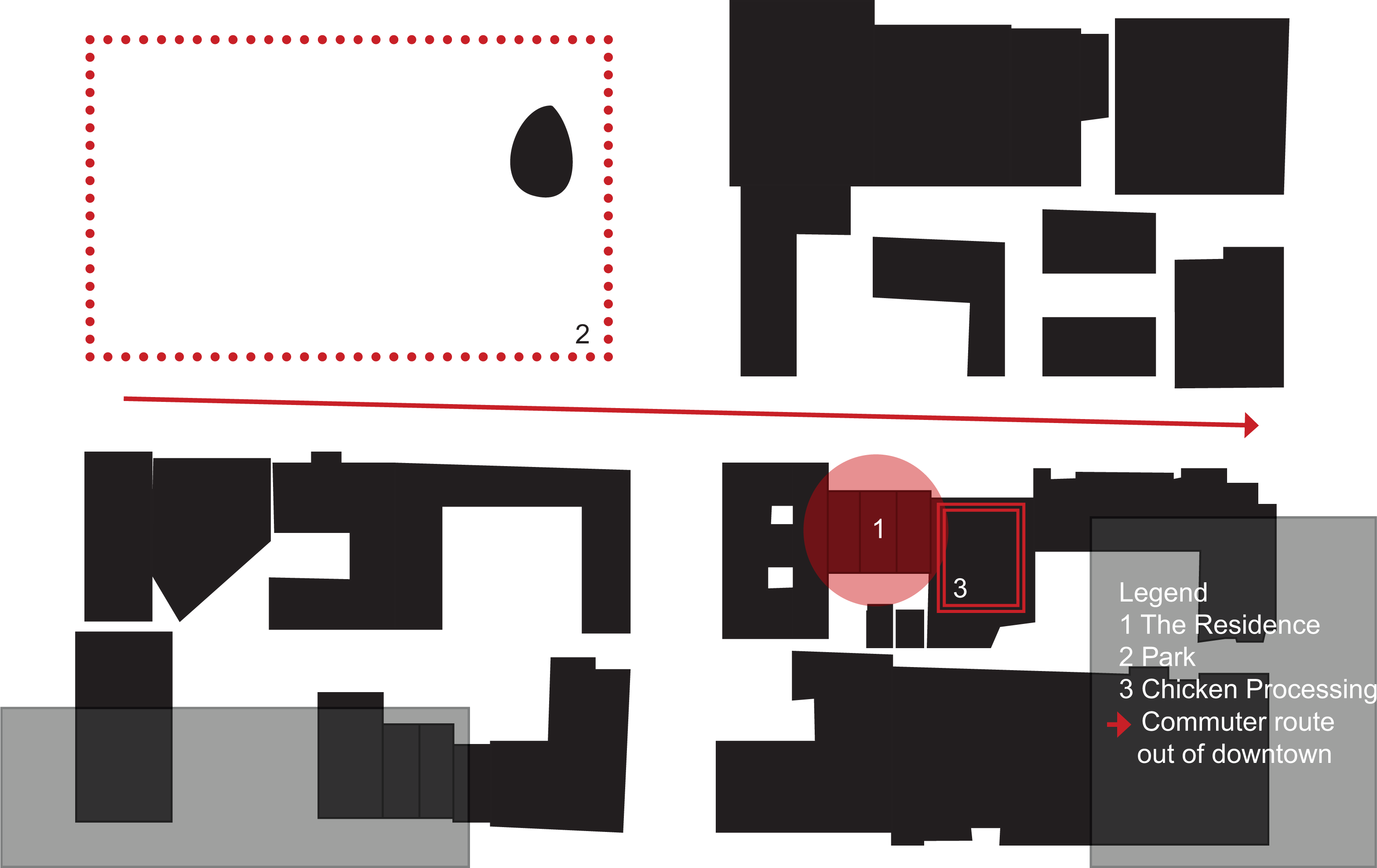
Figure ground spatial analysis of the Residence’s neighborhood context.
Situated on a busy street that ushers workers from downtown offices to outlying suburbs, this location provides an easy stopover for clients seeking sex on their commute. Kitty-corner to the northwest is a public park, a site of homeless encampments and ongoing Indigenous occupation protests (McCue, 2014). Surrounding the Residence in all directions are shelters and social services operated by Christian faith–based charities, including large blocks of housing run by the Union Gospel Mission, Servants Anonymous, and the Salvation Army. Signage for these faith-based charities perches above the streetscape, a parochial presence and reminder of strictures governing female sexuality and Christian colonizing forces. Interspersed among shelters are industrial occupancies, including a chicken processing factory. Locating sex work supportive housing in this neighborhood provides homes for these women in their community but also perpetuates their marginal physical location within the larger societal fabric. The Residence would be shut down in any other neighborhood but exists in this community through tacit agreement with the municipal police, as no residential community exists with a voice powerful enough to protest (Krüsi, Kerr, Taylor, Rhodes, & Shannon, 2016).
A three-story heritage building recently painted with a neutral brown-green with black trim, the exterior material qualities of the Residence convey its character as a home with marginal characteristics (Figure 2). The front door has a stoop for sitting perched on the sidewalk edge that is routinely occupied by its residents, a threshold between private interior and public exterior space. Different styles of curtains and a variety of personal possessions are visible in the four large bay windows overlooking the street, allowing residents to survey the streetscape below. A tiny balcony on the top floor is wedged between the top two bay windows and the balcony door is covered with hand-painted art. These features communicate a culture of care and autonomy among the residents but raise questions surrounding the experience of living and working in one room, of opening up, what may be for many women, their first private space to strangers and work.
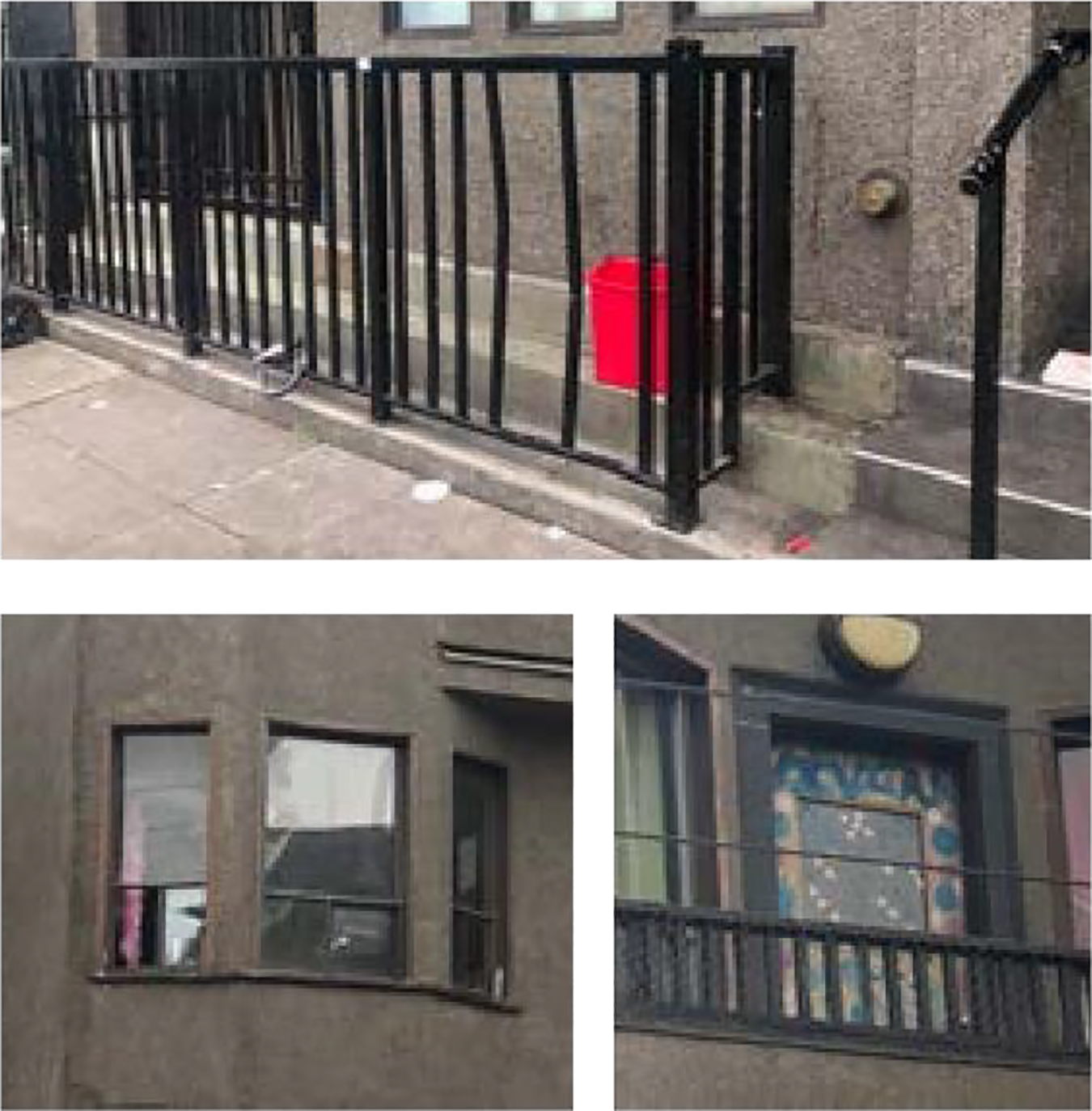
Qualities of the Residence’s built environment.
No signs indicate this building is anything other than an apartment building to the passersby on the busy sidewalk and street. Operating in contravention of Canada’s Nordic model sex work laws that criminalize sex work–related activities but not sex workers themselves, the Residence’s neutral exterior is inconspicuous, conforming to hegemonic community standards of invisibility. The materiality of the exterior reflects the violence experienced by sex workers. A black -wrought iron fence with bent rungs provides a protective barrier between the front ground floor from the sidewalk and potential interlopers. The front door is specialized for secure facilities with a steel frame and door and wire-mesh window, which were installed after the old wooden door was repeatedly kicked-in and broken (Spencer, 2017). Other supportive housing in this area do not have these physical security measures. While the Residence reflects physical care, the surrounding buildings are dilapidated. The 4-story brick heritage building to the west has boarded windows and to the east are ramshackle Victorian houses with peeling paint, chain-link fences, and broken windows.
The Residence illustrates the liminal place of sex workers within the semicriminalized context of the Nordic model; residents could have their home shut down with a shift in political will that demands enforcement of the Canadian criminal code. A local newspaper called for such a move in 2012 when it published an editorial against the Residence and similar supporting housing providers, claiming the supportive sex work housing was perpetuating the sexual exploitation of women. Under the Nordic juridical regime, sex work remains pathologized, and women living and working at the Residence strive to carve out security and dignity amid a stigmatized cultural position.
The Strichplatz (Zurich, Switzerland)
Zurich, Switzerland, legalized sex work in 1942, but outdoor sex work is still perceived as a community nuisance and confined to designated areas with less than 20% residential occupancy (Development Planning Unit Summer Lab, 2012). The Strichplatz is a drive-through designated outdoor sex work space that opened in 2013, moving outdoor sex work from the central Sihlquai area of Zurich to an outer industrial area and former landfill site (Lidz, 2016; O’Sullivan, 2013; Süess, 2014). This displacement removed sex workers from Zurich’s cultural, social, and historical center—one of the most visible areas of the city—4 km to the northwest, hidden from tourists and citizens (Figure 3). The Strichplatz is situated among movable shipping container structures used as housing for asylum seekers and offices for start-up companies (Development Planning Unit Summer Lab, 2012). Relocating sex workers to Zurich’s periphery reflects the state’s and citizens’ desire to render sex work invisible and position sex workers as outside community, grouping them with refugees and informal economy workers. Switzerland is a desirable location for Eastern European asylum seekers, and most of the women working in the sexboxen are migrants from Eastern Europe (Bachman, 2018). Conjoining refugee housing and sex work reveals larger geo-economic inequities embedded in place and contemporary struggles over citizenship and who can occupy certain geographic locations.
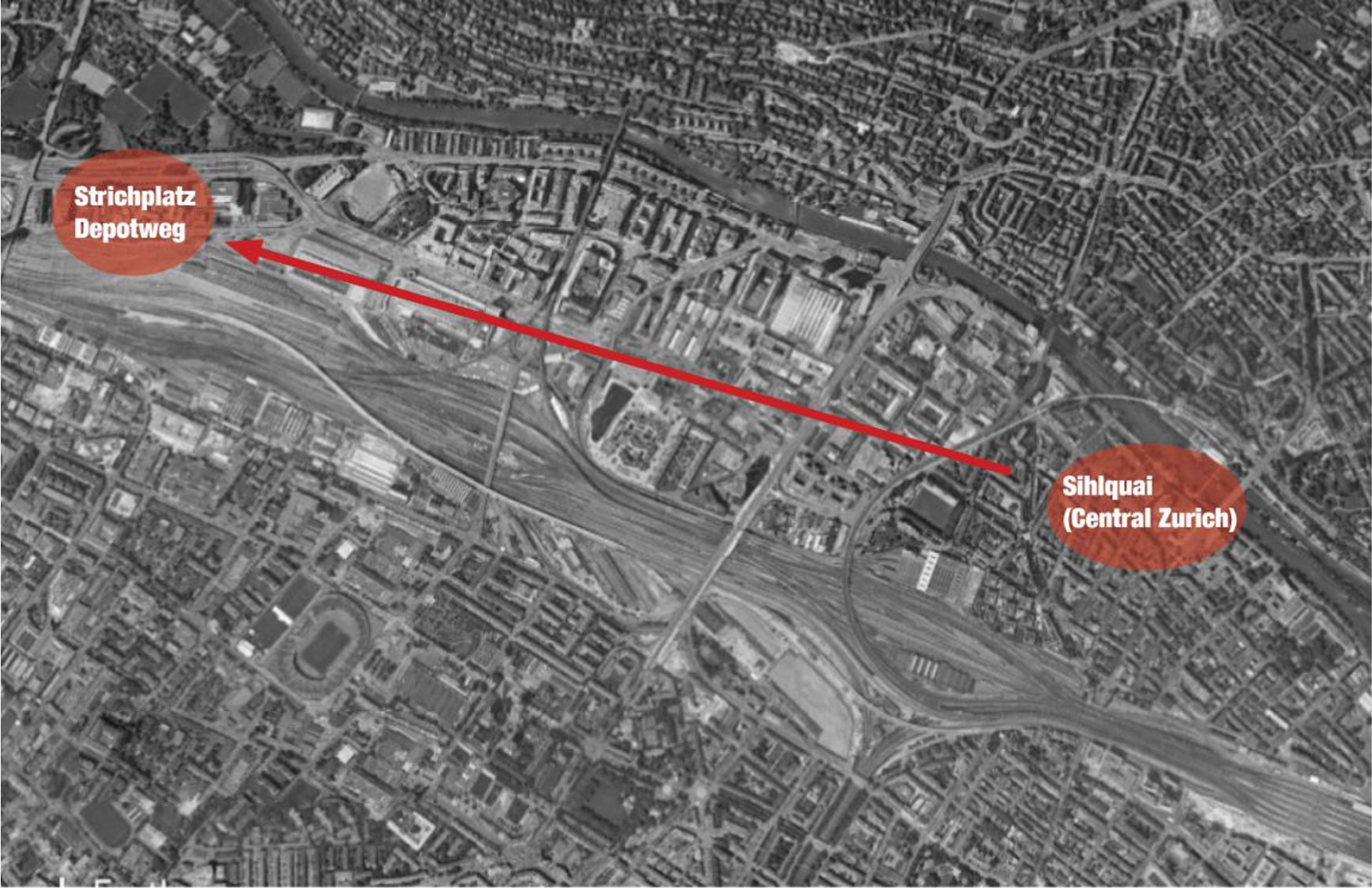
Relocation of street sex work from central Zurich to isolated outer lying industrial area.
Closed during the day and opening at 7 p.m., customers access the Strichplatz by car, motorcycle, and bicycle through one entrance/exit. Laid out along the compound’s interior road are covered wooden shelters for sex workers to wait on display, eight drive-in sex stalls, two walk-in stalls for customers who want out-of-vehicle service, bathrooms, showers, laundry, a kitchen, security, social workers, and health services. Condoms are unlimited and free. An average of 14 women work in the Strichtplatz each night and many assert the location has devalued their work, resulting in lower earnings (Gigon, 2013), highlighting the importance of place for sex workers’ finances. The opening of the Strichtplatz coincided with police action against unsanctioned outdoor sex work, subjecting sex workers to increasing fines for not working in designated areas (Gigon, 2013). When it first opened, the Strichplatz required sex workers to purchase a daily permit for working in the compound, but that ended in 2017 (Lidz, 2016). Cars driving by on the busy access road locate the compound by small road signs marked with a red umbrella. Approximately half of the average 100 cars driving through the Strichtplatz loop each night end up hiring a sex worker (Gigon, 2013). The vehicular loop of the Strichtplatz facilitates drive-through voyeurism as nothing prevents cars from entering, driving through, and viewing the workers without payment. This spatial layout reflects and continues long-standing social constructions of sex workers as othered and objects (Sanders, 2016), instead of workers in a place of employment.
The built environment of the Strichplatz communicates larger sociostructural powers involved in perpetuating sex work stigma and legislative control over sexuality; as Dovey (2008) writes, “authority becomes stabilized and legitimated through both spatial rituals and the architecture framing them” (p. 125). The entrance to the compound denotes strict state regulation, flagged on both sides with signs labeled “Verboten” and a gate across the entrance during daylight hours. Sight lines into the interior space of the Strichplatz are shielded by wooden or fabric-covered chain link fencing. The state protects community moral standards through the material environment by preventing passersby from visual exposure to sex work. The structures and service priorities within the Strichplatz also perpetuate the narrative of sex work as a public health hazard. The only decoration in the sexboxen are HIV posters and the services provided within the Strichplatz focus on health. Sanders (2004) argues that “the concentration on disease…not only blurs the whole picture of prostitution but distorts the emphasis on certain occupational risks while neglecting others” (p. 560). The overemphasis on health and sex work perpetuates the stigma of sex work that frames sex workers as disease carriers and sex work as a high-risk occupation (Begum, Hocking, Groves, Fairley, & Keogh, 2013).
Relatively spatially isolated, the wooden fence adjacent to the sexboxen was covered in graffiti on opening day (Eppenberger, 2013). The wooden walls of the sexboxen stop 1 ft. above the cement floor, the wall footings ending in concrete blocks. Each box is illuminated by a red, green, or blue neon light, highlighting the public health posters that are visible on the end walls. They ensure messages of HIV and safe sex remain visible to vehicle occupants at all times. Panic buttons and garbage bins are the only other interior items. The loop that replaces the street stroll is lined with wooden shelters and benches, where customers can drive, view, and negotiate with their preferred sex worker (Figure 4). These waiting stations possess no other comforts, apart from illumination, for the women who spend much of their nights waiting in them. The permanent neon lighting and the open-ended structure of each box do not allow sex workers to control their environment or their level of privacy while working. Further, sex workers have no means of accessing the work site other than walking along the highway and entering along the vehicular access point, an entrance designed for clients’ needs instead of the women who work there. The materiality of rough wooden walls, wooden plank benches, and unfinished concrete of the compound speak to a bare minimum of financial investment; the design and construction was completed by a design firm that specializes in temporary and affordable wooden structures (NRS Team, n.d.; Scharrer, 2013). The built environment is temporary and disposable, echoing the culture of disposability that saturates sex work (Seshia, 2010).
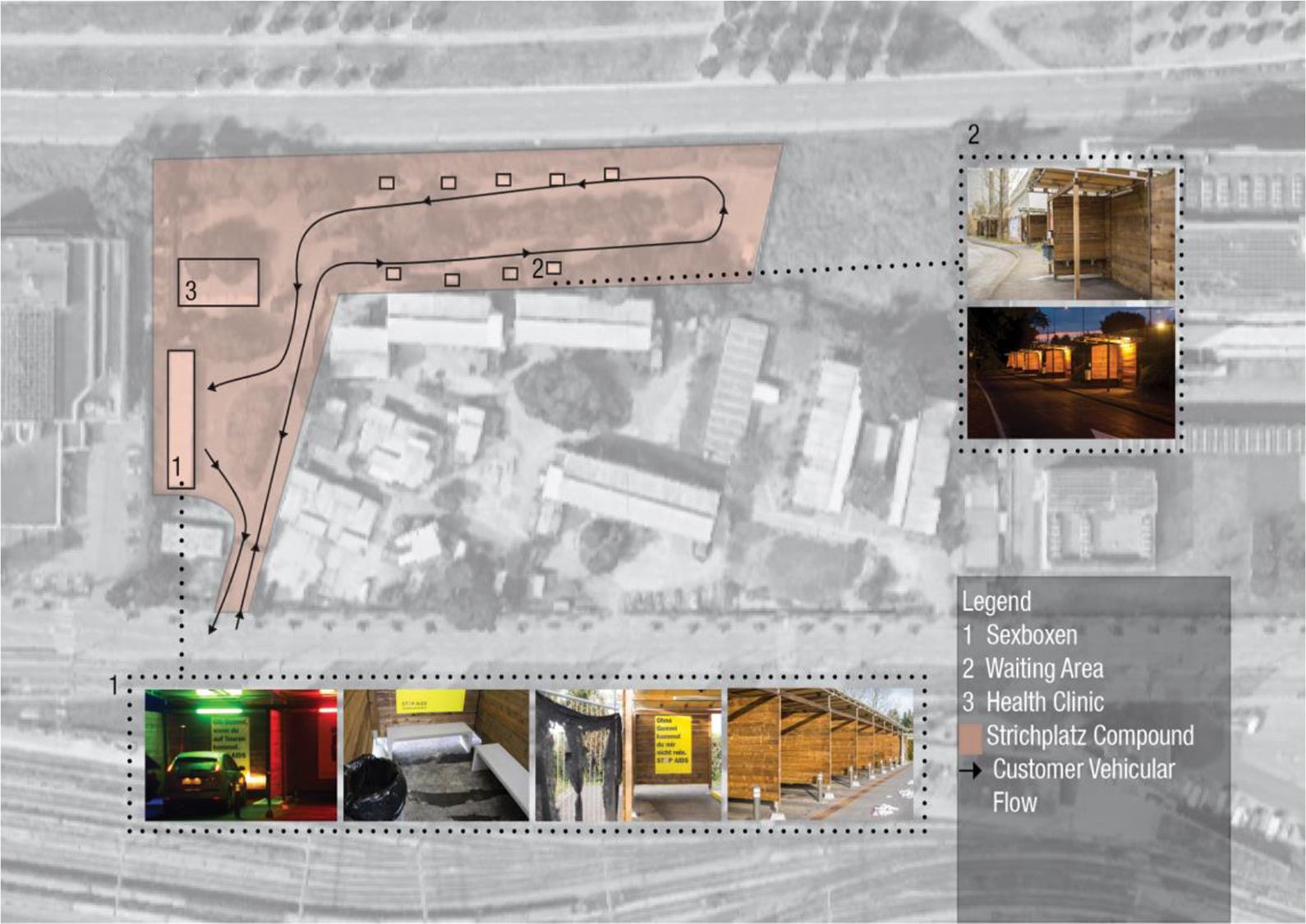
Strichplatz layout, circulation, and material qualities.
Within a legalized environment, the Strichtplatz addresses many of the needs that sociostructural powers—including academia—believe sex workers require, such as physical safety, health services, and public invisibility. However, Begum, Hocking, Groves, Fairley, and Keogh (2013) argue that “legalisation, while providing increased safety and health benefits for women, does not address the contradictory nature of their work nor the social stigma associated with it” (p. 98). A place-based analysis of the Strichtplatz supports this observation. Workers’ physical safety and health are protected, yet they remain spatially segregated, controlled by state strictures regarding working hours, and receive little consideration regarding the comfort and dignity of their working environment. Without place analysis, critical aspects surrounding the environments of sex work remain unquestioned and continue to perpetuate oppression and stigma.
Discussion
If our environments tell us who we are, and we in turn shape our environments, what is the conversation between sex work places and the women who work within them? Both case studies illustrate how the interjoined location, built environment, and sociostructural dimensions of sex work isolate sex workers outside of community and in deleterious built environments, their bodies constrained into positions of visibility/invisibility. Yet these places also offer physical safety, health care, and in the case of the Residence, a home. Expanding sex work research to include place-based analysis offers new dimensions for understanding how dominant narratives that stigmatize sex work are embodied in the sociospatial elements of place, many of which are invisible due to their cultural ubiquity. In highlighting and exploring sex work and place, social work scholarship has the opportunity to challenge the dominant discourses that operate to keep sex workers marginalized and framed as “victim” or “vermin” (Strega et al., 2014, p. 6). If sex work is perpetually framed as unseeable, describing and attending to sex workers’ environments is a radical act toward positive disruption and change.
Connecting sex work and place, we transition from the pathologized “out-of-place” to the normalized “in-place” and acknowledge sex workers’ full community citizenship (Cresswell, 2004). Sanders and Campbell (2007) discuss that for sex workers to be free from violence, we must create a culture of respect, changing the “discourse of disposability” that “incites violence and disrespect towards sex workers” (p. 15). Similarly, Lewis, Shaver, and Maticka-Tyndale (2013) reflect that “it is the persistence and pervasiveness of this stigma…that serve to maintain workers’ marginalization and to justify their discriminatory treatment” (p. 200). Applying ideas of place to sex work is part of building a culture of respect and challenging sex work stigma.
Implications for Social Work Research, Policy, and Practice
Research
Sex workers’ lives are intertwined with ubiquitous and inescapable dimensions of place (Dovey, 2008); social work research must consider how aspects of marginality are intertwined with these place elements (Taylor, 2013). In highlighting and understanding the place-based marginality of sex work, social work research can create the foundations for change.
This article demonstrates the value of sociospatial analysis applied to the places of sex work in its ability to examination sociopower structures, material environments, and geographic locations; future scholarship can build upon this scaffolding and incorporate lived experience as a dimension of place-based analysis. A critical component of place stories are the lived experiences of the women who live and work in these places, which are missing from these introductory case studies. Sex workers possess knowledge and lived experience around their work environments, and a complete place-based inquiry would include the vital component of their lived experience. Their voices can illuminate the impact of commuting to work in an industrial suburb where the main considerations are state-sanctioned invisibility, low-budget materials, and public health, as well as the interrelationship between sex work environments and identity, dignity, and well-being. Given the opportunity, what environments would sex workers create for themselves? Asking these place-based questions presents novel avenues for social work to partner with sex workers and cocreate research that addresses their lived experiences to inform policy and practice. Further, expanding the discussion about sex work and feminism to include a gendered analysis of the ways in which the place of sex work interacts with marginalization and oppression is critical to creating gender-inclusive cities (Moser, 2016).
Policy
If social work is to advance social policy that effectively addresses the full spectrum of sex workers’ human rights, place is a powerful lens through which to evaluate policy decisions. A place-based analysis of sex work aligns with structural-based social work policy, which maintains that marginalized individuals must be supported while simultaneous interventions are instigated against the roots of inequity (Taylor, 2013). This article’s attention to the sociospatial dimensions of place within the case studies demonstrates structural mechanisms through which the Nordic and legalization frameworks continue to replicate social stigma and sex work marginality. Place analysis reveals the multiscalarity of power imbalances by connecting everyday environments to sociostructural power; creating a robust understanding of this relationship offers opportunities for social work to respond via targeted transformational policy (Taylor, 2013). Decriminalizing sex work is only a starting point in addressing oppression. By understanding place, social workers can broaden their knowledge of structural inequity and work toward transforming society itself by addressing multiple elements of domination, including policies that spatially isolate sex workers as community outsiders, prioritize community “moral standards” over sex work safety, and relegate women to work environments that negate comfort, dignity, and joy. Connecting place and sex work allows social work to move beyond individual-focused interventions, advocate for antioppressive legislation, and address the root causes of sex work marginalization by working as policy advocates in partnership with urban planning, government, community associations, supportive housing, social services, and other stakeholder groups. With this enhanced understanding, social workers can join this multistakeholder context and actively promote places that address the needs of sex workers in balance with state and community desires.
Practice
Linking place and sex work offers social workers a broader scope of understanding and practice when supporting sex workers, which aligns with the profession’s hallmark theory of person-in-environment, attending to individual lives within their multidimensional environmental contexts (Kemp, Whittaker, & Tracy, 1997; McKinnon, 2008). Currently, social work practice focuses overwhelmingly on social environments, while other elements of person-in-environment are often overlooked (Ferguson, 2010; McKinnon, 2008; Närhi, 2004; Zapf, 2009). Implementing place-based practice is a vehicle for social workers to incorporate often-overlooked dimensions of person-in-environment into their practice, moving away from individual-centered interventions and toward a more holistic practice that understands, as Saleebey (2004) argues, that changing everyday environments can be a catalyst for positive change within individual lives.
Pink, Mackley, Morosanu, Mitchell, and Bhamra (2017) question what future environments should feel like to “work towards values, such as sustainability, equity, and responsibility” (p. 139). Examining place and sex work raises similar questions: What would equitable and dignified sex work environments look and feel like? We propose that a place-based understanding could create future supportive sex work environments that reflect these values. Attending to the place of sex work acknowledges sex workers as full community citizens, worthy of safe workplaces and homes, perhaps even moving toward broader environmental considerations of joy, comfort, and pleasure. For marginalized groups, place is recognized as a position from which to build resiliency, counter stigma, foster peer support, and confront injustice (Kemp, 2010). This emphasizes the powerful potential for social workers and sex workers to partner in-place and work toward a spatially just future.
Footnotes
Acknowledgment
The authors thank the assigned editor and the reviewers for their consideration and thoughtful feedback, which strengthened the paper immeasurably. Thank you to AS for the catalytic spark.
Declaration of Conflicting Interests
The author(s) declared no potential conflicts of interest with respect to the research, authorship, and/or publication of this article.
Funding
The author(s) received no financial support for the research, authorship, and/or publication of this article.
