



Abstract
Much of the research on human trafficking focuses on the prosecution of traffickers and protection of survivors after the crime has occurred. Less is known about the social disparities that make someone vulnerable to trafficking. This project examines human trafficking from a preventive focus, using data from a case study of service providers working with at-risk populations in the Kansas City, MO-KS area. The research team conducted 42 in-depth interviews with service providers working in the medical, educational, legal, and social services sectors from 2013 to 2016. Participants identified risk factors that could make someone vulnerable to labor or sexual exploitation. These factors clustered into four key areas: economic insecurity, housing insecurity, education, and migration. The research findings also suggest that human trafficking may be driven by an accumulation of risk factors that move vulnerable persons closer to labor exploitation and sex trafficking, fitting with a chain-of-risk model. We propose a model that reconceives of trafficking as a continuum that includes a range of vulnerabilities, violence, and traumas. In order to address human trafficking, policy makers and advocates need to focus on upstream prevention factors to address vulnerabilities that can lead to sex and labor exploitation.
In 2016, an estimated 76,520 men, women, and children were identified as human trafficking survivors globally (U.S. Department of State, 2017). Human trafficking affects countless other unknown survivors who remain hidden, unable to escape these cycles of violence and trauma. Even as researchers are beginning to focus their attention on the causes and consequences of trafficking in a range of settings (Brennan, 2014; Busza, 2004; Carey & Farao, 2011), there are significant gaps in our conception of human trafficking that have material consequences for people in high-risk situations whose experiences are not visible within current frameworks. The dominant discourse primarily highlights the experiences—the rescue and recovery—of young women exploited through sex trafficking (Baker, 2013; Chapkis, 2003; Srikantiah, 2007), though they are not the only population facing the trauma and violence of trafficking (Carey & Farao, 2011).
Domestic anti-trafficking policies rely on the three Ps approach of prevention, prosecution, and protection (Victims of Trafficking and Violence Protection Act, 2000). As well, the informal addition of partnerships as a fourth P encourages collaborative networks of service provision across sectors (Clinton, 2009). While much work has focused on the prosecution of traffickers and the protection of survivors, this project expands the existing scholarship to develop deeper understandings of prevention, in line with a public health framework (Todres, 2011). This project is informed by the socioecological model for violence prevention (Center for Disease Control and Prevention [CDC], 2013) that describes the interplay of multilevel—individual, relationship, community, and societal—roots of violence in order to inform and emphasize violence prevention (Carey & Farao, 2011; Dahlberg & Krug, 2002).
To broadly determine what factors perpetuate vulnerability and buffer against exploitation, this research took an organizational-level approach to facilitate an analysis of systems and structural inequalities. In the United States, service providers, including social workers, are part of a fragmented network of organizations delivering resources to clients. Understanding the system perspective is critical because organizations interact with their clients at multiple stages—before and/or after some form of exploitation has occurred—and thus can identify gaps in service access across these stages (Kelleher & McGilloway, 2009).
This project uses a grounded theory (Glaser & Strauss, 1967) approach to explore vulnerability, exploitation, and trafficking in the understudied Midwestern region of the United States, specifically the metropolitan area of Kansas City, Missouri and Kansas City, Kansas (hereafter Kansas City, MO-KS). This allowed us to examine the networks of providers in an urban metropolitan region who forge partnerships across state lines. We sought a broad range of organizations that provide a variety of care, from providing temporary housing to guiding clients through legal processes. We intentionally interviewed service providers from different sectors, as clients often work with multiple providers to address their complex needs (Schwarz & Britton, 2015).
As this qualitative research was focused on understanding patterns and factors of potential exploitation, we did not attempt to identify causal relationships. Rather, if—across this diverse set of organizations—service providers identify similar compounding factors that shape their client’s trajectory of vulnerability, this information can be used to develop interventions to prevent exploitation. While our empirical work was conducted in one location, we propose a conceptualization of trafficking that may be applicable across the United States. Inspired by the chains-of-risk model (Ben-Schlomo & Kuh, 2002; Kuh, Ben-Shlomo, Lynch, Hallqvist, & Power, 2003), we argue that human trafficking is part of a larger continuum of violence, vulnerability, and exploitation. Individuals may find their risk of trafficking increasing as the number of adverse life events and factors accumulate over time. Service providers can proactively identify these accumulating risks and offer services and resources that may disrupt and break patterns of vulnerability and exploitation.
Service Providers in Anti-Trafficking Efforts
Service providers across a range of sectors play a valuable role in identifying trafficked persons. Their direct contact with clients, in some cases over an extended period of time, establishes a unique position to look for markers of trafficking and offer a secure space for potential disclosure. Service providers are often considered a trusted community member, especially in situations when survivors fear retribution from their traffickers or legal consequences from law enforcement officers (Hodge, 2014). Individuals within the social welfare system are vital to anti-trafficking identification and service provision. Social work is guided by ethical codes and principles that prioritize both macro-level structural changes—such as addressing global economic systems driving poverty—and interpersonal, client-focused interventions (Alvarez & Alessi, 2012; Healy, 2017; Okech, Choi, Elkins, & Burns, 2018; Orme & Ross-Sheriff, 2015). Additionally, those social workers who take a feminist approach to their service provision are primed not only to understand exploitation within a structural “framework of social privileges and other oppressions” (Hahn & Scanlon, 2016, p. 339) but also to “support efforts to transform these social relations” (Swingonski & Raheim, 2011, p. 11). In other words, social work has “a dual mission to simultaneously enhance social functioning and improve social conditions” (Hahn & Scanlon, 2016, p. 331). This is also the mission of feminist social workers to partner with individual clients in care-focused work while at the same time laboring for change in the larger political, economic, and social world (Pandya, 2014; Swigonski & Raheim, 2011). Even with the backlash against the practices of second wave feminism, which were often hampered by classism and racism, feminist social work today has retained an important purpose of working for social justice across a range of structural inequalities (Swigonski & Raheim, 2011) and working to challenge power and oppression (Pandya, 2014; Tangenberg & Kemp, 2002).
This mission, to serve clients and to call for social change, translates well to human trafficking work. Hodge (2014) argues that social workers can specifically provide their expertise in program evaluation and outcome assessment, as well as their organizational practice of centering clients’ voices in their service provision, to improve anti-trafficking efforts. Androff (2011) offers a similar approach, stating that the professional “mission of serving vulnerable populations” within social work requires a critical anti-trafficking stance (p. 210). A feminist approach can also lead social workers to understand that human trafficking is driven by larger structural inequalities. They also are in a unique vantage point to understand that survivors of sex and labor trafficking may face similar challenges such as undocumented migration, violent partners, or financial insecurity that can lead to continued vulnerability and possible exploitation.
The social welfare system has a great deal of expertise in working with vulnerable clients through immigration advocacy (Healy, 2017), interpersonal violence (Hahn & Scanlon, 2016; Hardy, Compton, & McPhatter, 2013; Ritchie & Eby, 2007), and poverty alleviation programs (Adams & West, 2015). Even with training and resources about human trafficking, service providers still face challenges in their practice of identification, especially when engaging clients interpersonally. Because the indicators of trafficking are not universal—and some are contested—not every trafficked person’s situation will be recognizable within a flowchart or protocol process. Thus, service providers should also be trained on sex and labor trafficking broadly to be able to assess clients in a more in-depth manner (Alvarez & Alessi, 2012; Okech et al., 2018). Service providers may be able to identify trafficking but unable to appropriately communicate with survivors upon learning of their exploitation because of the complex trauma involved in trafficking (Hardy et al., 2013). Social work scholars have noted the importance of trauma-informed, survivor-centered practices when engaging trafficked clients (Alvarez & Alessi, 2012; Hardy et al., 2013; Heffernan & Blythe, 2014; Hodge, 2014; Kotrla, 2010; Okech et al., 2018). In this way, social workers are in a pivotal position to address the individual needs of survivors as well as advocating for structural changes in their communities, what Hahn and Scanlon (2016) describe as addressing both the “psychology and politics” of their clients (p. 339).
Chains-of-Risk and Human Trafficking
Trafficking risk factors can encapsulate a range of violence, trauma, and coercive elements (Carey & Farao, 2011). Anti-trafficking scholars have written about the role of poverty, housing insecurity or homelessness, foster care, limited access to education/educational opportunities, migration, and citizenship status (Brennan, 2014; Carey & Farao, 2011; Clawson & Goldbatt Grace, 2007; Curtis et al., 2008; Dank et al., 2017; Gazi et al., 2001; Gerassi & Nichols, 2018; Heil & Nichols, 2015; Lutnick, 2016; Nichols, 2016; Reid, Baglivio, Piquero, Greenwald, & Epps, 2017). In general, as Nichols (2016) states, “weak social institutions […] combined with a lack of social safety nets create a climate in which sex trafficking […] can flourish” (p. 95). While these factors are not a form of predestination—not every person in poverty faces trafficking—they can add to the systemic risk faced by individuals. Lutnick (2016) emphasizes the interplay of compounding risk factors: poverty, homelessness, laws that govern a young person’s ability to work, and the laws that place restrictions on the age at which a person can enter into a contract are all structural conditions that can result in trading sex as an economic strategy. (p. 17).
In order to make meaning of the connections of trafficking risk factors, we argue for an analysis rooted in a chains-of-risk model. Chains-of-risk refer to “a sequence of linked exposures that raise disease risk because one bad experience or exposure tends to lead to another and then another” (Kuh et al., 2003, p. 779). According to this framework, exposure to adverse or beneficial experiences mounts up over time, acting as mechanisms that increase the likelihood of more adverse or beneficial experiences (Ben-Schlomo & Kuh, 2002, p. 287). Exposure to adverse experiences may increase the probability of a sequential and additive exposure to more adverse experiences (Zimmerman, Hossain, & Watts, 2011); different risks may compound and create substantial challenges (Hay et al., 2007). For example, unemployment and poverty create financial instability, which may increase the risks people take in looking for income and add to the likelihood of experiencing exploitation.
Chains-of-risk can also facilitate a more prevention-centered understanding of anti-trafficking efforts and focus on upstream solutions to risk factors. As Todres (2011) writes, “A public health approach to human trafficking would prioritize prevention, which, in turn, would compel examination of the root causes of human trafficking” (p. 482). Todres’s analysis emphasizes the importance of multiple interventions to address a range of trafficking risks at micro- and macrolevels. Although he does not use the language of chains-of-risk, these two approaches align neatly—anti-trafficking prevention from an upstream, public health perspective requires the investment in resources to buffer against the accumulation of adverse risk factors.
Method
Research Design and Questions
The research design was based on grounded theory (Glaser & Strauss, 1967). We began interviewing service providers in 2013. These early interviews focused on identifying risk factors and exploring prevention from a service provider perspective. Interviewees expressed a desire to help potentially vulnerable individuals before they become exploited. Based on this consistent response, we developed two research questions. The interviews aimed to hear about the perceptions and experiences of service providers, and across multiple sectors, we heard similar concerns and frustrations. During interviews, we sought to learn about the providers’ experiences and to explore how they understood trafficking. Specifically, this project was guided by two overarching research questions: (1) What risk factors do service providers identify when reflecting on their clients’ experiences with exploitation and trafficking? and (2) Given their experience, what moments in a trafficked persons’ life or what encounters with service providers could be identified as important points of intervention to prevent exploitation?
Across these questions, it is important to emphasize that, in speaking with service providers, our research team was accessing perceptions about human trafficking, which may not necessarily match with trafficked persons’ lived experiences. This was a deliberate decision, as our project is invested in uncovering organizational responses to trafficking. These responses can be influenced by stereotypes about trafficking and clients’ own disclosures and framing of their experiences and codified into organizational practice or institutional policies.
Participant Selection and Recruitment
The sampling strategy was designed to capture a range of patterns (Morris, Popper, Rodwell, Brodine, & Brouwer, 2009) of the population of service providers connected to anti-trafficking work. Because this project sought to understand trafficking from an organizational-level perspective, we did not try to interview formerly trafficked persons. We understood some of our interview participants might be survivors themselves of trafficking or other forms of interpersonal violence and trauma. With ethics approval from the University of Kansas IRB committee, the research team conducted an online scan to find organizations working with vulnerable, exploited, or trafficked persons in Kansas City, MO-KS. We cross-referenced this with lists of participants in regional and statewide anti-trafficking coalitions. Finally, we spoke with key stakeholders in the coalitions for names of organizations and advocates working with vulnerable populations.
Through these efforts, we identified 105 organizations and service providers in Kansas City, MO-KS, that worked with or may encounter vulnerable, exploited, or trafficked persons. We contacted organizations to request interviews with senior staff and client service professionals. From these requests, 41 organizations responded positively that their organization’s work fits our study. The remaining 28 organizations self-selected out of the study because they felt they did not have enough direct contact with clients. From 2013 to 2016, we interviewed one service provider from each of the 41 participating organizations. In one case, we interviewed two service providers from the same organization, resulting in 42 total interviews.
Thirty-six organizations did not respond to our requests. These organizations are similar to those we interviewed in the nonprofit and social service sector. Given the strong overlap in organization type, we believe these nonresponses do not strongly bias our results, especially since we reached category saturation with the interviews we conducted. However, this is a potential research limitation, as service providers in nonresponding organizations could have views of trafficking that are not reflected in our analyses.
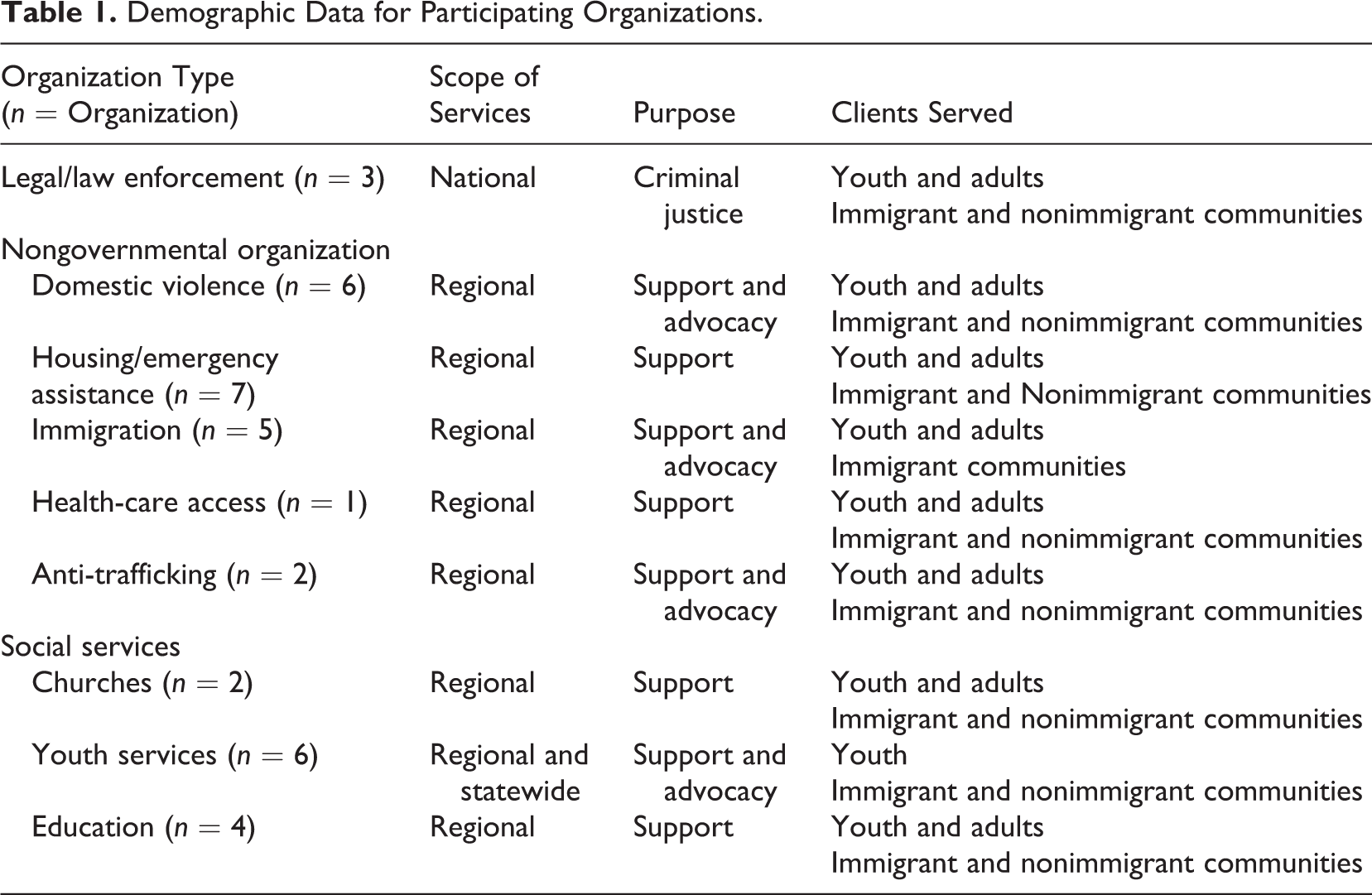
Table 1 provides details on the organizations interviewed, including organization type, scope of services, purpose, and clients served. In total, 36 different types of organizations are represented. Organization type refers to the sector of service. Because of the range of work conducted in the nongovernmental organization and social service sectors, these categories are separated into more detailed terms. Scope of services reflects the geographic parameters of these organizations’ work. Purpose denotes the primary goal of the organization’s work—criminal justice work, such as investigating crimes; support work, such as case management; and advocacy work, such as educating community members. Clients served addresses the specific age and citizenship of the populations with whom these organizations work. For the purposes of this project, our research team only gathered organizational-level data to protect interviewees’ privacy.
Demographic Data for Participating Organizations.
Data Collection
All interview participants gave their informed consent for participation. Interviews were conducted using a semistructured, open-ended interview protocol, allowing interviewers and participants to develop new ideas in the moment. Separate protocols were developed for providers in the legal sector (such as lawyers and court officers), advocacy organizations (such as immigrant rights organizations and women’s shelters), and social services (such as foster care and social workers). Each contained parallel questions addressing the key research themes but allowed for the flexibility to explore themes specific to their area of expertise. For example, given the state and federal-level legal definitions and the conflations of trafficking with other criminalized processes like smuggling or sex work, we asked all service providers how they defined human trafficking within their own organization. Because we sought to identify exploitation and trafficking risk factors, we also asked which factors would contribute to a vulnerable person becoming an exploited person. We asked each participant about trafficking “red flags” to understand the signals that lead service providers to become concerned that their client may be or has been exploited. Interviews ranged from 30 min to 2 hr, depending on the context and time granted by the participants. All interviews were audio recorded, with the exception of two participants who opted to have the researcher rely on note-taking. In the case of these two interviews, researchers audio recorded their interview notes and recollections immediately afterward to ensure the most accurate presentation of the conversation. All interviews were conducted in English and transcribed verbatim by a member of the research team.
Data Analysis
Transcriptions were analyzed using ATLAS.ti 7.1.6 to identify patterns of vulnerability and the potential risk factors of trafficking or exploitation. Inductive analysis, drawing from grounded theory (Glaser & Strauss, 1967), included (1) constant comparison techniques to identify these patterns based on predetermined codes drawn from the literature and (2) identification of new insights and emergent themes. Using ATLAS.ti.7.1.6, we entered codes manually and then returned to read each transcript—with codes noted—in its entirety. As Thomas (2006) explains, with respect to the outcomes of an inductive analysis, “Although the findings are influenced by the evaluation objectives or questions outlined by the researcher, the findings arise directly from the analysis of the raw data, not from a priori expectations or models” (p. 239). Our research questions—the practical aspects of anti-trafficking work, the perceptions of particular risk factors, and the recognition of specific prevention or intervention points—guided our inductive analysis.
Using Davies and Dodd’s (2002) concept of rigor as an ethical orientation toward careful analysis and reflexivity, we worked as coauthors to frequently discuss our strategies for data analysis and reflect on our own ideological approaches. We also privileged the expertise of our interviewees as service providers while simultaneously acknowledging the power dynamics between these two groups—the authority of our academic affiliations against the authority of their lived experiences—that may result in disconnections or multiple interpretations of the data.
Trafficking Risk Factors
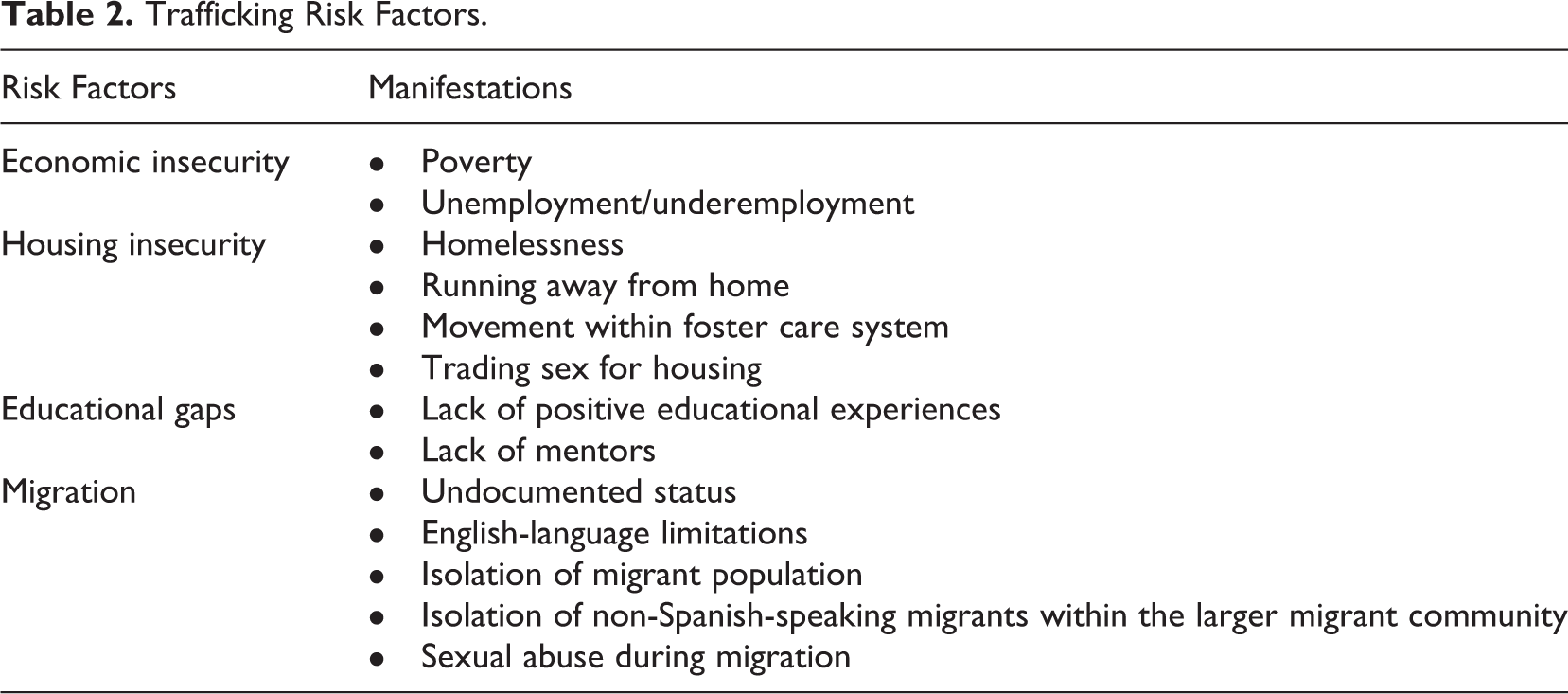
Our data analysis yielded four major clusters of trafficking risk factors: economic insecurity, housing insecurity, education gaps, and migration. Table 2 details the specific ways these factors manifest, based on our participants’ perceptions.
Trafficking Risk Factors.
In the following sections, we explore each factor using the qualitative data and connecting our participants’ understandings of risk to the broader literature on trafficking. Although these four risks factors are presented separately below, our participants often articulated the presence of more than one trafficking risk factor in their clients’ lives. Thus, we see economic insecurity, housing insecurity, education gaps, and migration as links in a chain-of-risk model.
Economic Insecurity
Overwhelmingly, service providers indicated the importance of poverty pushing people from positions of vulnerability to extreme exploitation. As one community advocate from a homelessness organization stated, “Well, if poverty were eliminated then we wouldn’t need to be here. Essentially trafficking is an outgrowth of poverty.” That the relationship between poverty and trafficking is so strong might seem self-evident, yet it is crucial because poverty creates a “tipping point.” As one immigration advocate stated, poverty and financial instability can compound to create desperate conditions that exacerbate vulnerability: It is usually somebody that knows the family and their circumstances and that has gone to them and said, “Listen, you allow your child to come with me to the U.S., […] we are going to pay her a good salary, we are going to send her to school, she is going to have an education, she is going to have a future, then she is going to be able to help you with your circumstances.” So they’re taking advantage of the desperate situation. If you’ve got children to support and parents to take care of, you would volunteer to work for a Chinese restaurant for $400 a month. You would agree to be locked in the apartment and transferred back and forth because $400 a month is better than no hundred dollars.
Many service providers spoke directly to the experiences of children in poverty. For example, one youth advocate discussed the link between childhood poverty and vulnerability: We know that children from single parent homes are just at-risk youth, and, when you’re dealing with a population of kids, you know for instance 85% of the kids we serve qualify for free or reduced lunch. I think probably across the board, not just in Kansas City, […] the more impoverished you are I think the more vulnerable you are.
Housing Insecurity
Housing insecurity and instability in the home were identified as important risk factors among our participants. Homelessness was often talked about simultaneously with poverty. As one anti-trafficking advocate described, “I would say homelessness and poverty are the number one causes [of trafficking].” Because of the material and nonmaterial benefits that housing confers (for instance, needing a permanent address to find work), a lack of secure housing aggravates a person’s overall vulnerability. Homelessness also increases the probability of being in a coercive environment. According to one advocate, “They may be homeless for whatever reason. It renders them in a position where oftentimes they may be connected with a trafficker for means of financial support or emotional support.” When someone is in such a vulnerable position, their ability to be discerning about support networks is diminished.
Housing insecurity comes from many different sources, not only from poverty. For instance, running away from home as a child and moving around the foster care system were both mentioned in our interviews as risk factors, as one youth advocate discussed: There are very few foster homes in Kansas, especially this area in Kansas in general, that are willing to work with teenagers. […] I mean our kids can be placed throughout the entire state. […] So they are moving foster home to foster home to foster home to foster. […] And so consistency and services consistency, and, you know, if it’s therapy, or, you know, whatever […] just in terms of schooling it’s all there. And there is a lot of turnover in terms of social services, which I know you are aware of, and so you know our kids are moving around. They’re cycling through different case managers. And so there is not a lot of consistency, which I think […] definitely that lends to their vulnerability.
Reliance on others for support while in a position of vulnerability ushers potential victims further toward exploitation, as another advocate said: That’s basically when a trafficker would find them and […] they would oftentimes be, like, groomed by that trafficker, in order to see that person as maybe their sole supporter. They are the sole person who helps provide food, shelter, or resources for them. They are the one person that’s telling them “I love you,” “I care about you.” […] Then […] the person may be forced or coerced or manipulated into being used for prostitution or various other types of kind of transactions related to sex acts.
Education
According to our interviewees, low educational attainment and/or negative educational experiences (such as isolation from peers and mentors or truancy) could enhance vulnerability and contribute to exploitation. This reflects similar research in the Midwest from Heil Nichols (2015), who found a connection between truancy and drop-out status and an increased “potential for exposure to traffickers” (p. 75). A lack of education may also intensify the vulnerability created by poverty, though this does not cause trafficking in and of itself. Instead, the lack of benefits that education confers—gainful employment, critical thinking, and positive relationships with teachers—increases a person’s vulnerability. One migrant rights’ advocate linked this to the possibility someone would be victimized: A lot of this stems from no education, no hope, and being desperate. […] Since they are uneducated and don’t have marketable skills and have to provide for their families or themselves means they are liable […], subject to subjugation and being victimized.
According to our respondents, education may help someone evaluate a situation and not be as susceptible to manipulation by traffickers. Respondents frequently spoke of education in broad terms as a set of skills beyond formal instruction. An anti-trafficking advocate also mentioned comprehensive sex education as an important factor, particularly in regard to sex trafficking: What I really think is that you need to start looking at prevention and education at a very early age with age-appropriate education about a new kind of stranger danger—your pimp, your dope man, these guys that can sexually exploit you someday.
Specifically, some service providers believed that sex education could be a buffer by providing information about safer sexual practices and healthy relationships. According to another advocate, If you’re raised believing and being told that you’re dirt, that you’re worthless, and all you’re good for is a sex object by somebody, then that’s really going to affect how you interact with people and how you form relationships with people.
Migration
Service providers reported that many survivors of labor trafficking are international migrants, some of whom come to the United States as undocumented laborers and fear arrest and deportation, which is mirrored in scholarship (Cleaveland, 2011). Some may have limited English language or literacy skills, which service providers specifically mentioned as a key factor blocking trafficked persons from understanding their rights or seeking assistance. This was true for both sex and labor trafficking. Participants discussed linguistic variations within migrant populations—for example, Kaqchikel or Quichua speakers embedded within Spanish-speaking communities. Many migrant outreach programs primarily target Latinx populations, though their efforts might only reach the Spanish-speaking members of these communities.
Without language comprehension, migrants and nonmigrants alike are unable to learn their rights as workers and can be manipulated by traffickers, as stated by one migrant advocate: First of all, people don’t know what their rights are because there is no one educating them in their native language. They don’t even realize what they are being victimized about, they don’t even have a right to be victimized like that, and there are remedies for it […]. They don’t realize that because nobody has told them in their language and because in a lot of the countries they come from, a lot of times you can’t trust law enforcement.
Service providers also argued that migrant populations are often disconnected from the larger communities within the Kansas City, MO-KS area, which may leave them with less access to health care, labor rights organizations, and the justice system. An English as a second language teacher highlighted this challenge for her students: “That’s probably the biggest crux of exploitation is not knowing the language and then not being documented, not being able to use the referrals that anybody else in our country would be able to use.” This challenge can function in multiple ways for exploited or trafficked migrants. For example, if an individual is disconnected from larger social networks, they may not know where to turn for resources or justice in their community. Additionally, undocumented migrants face the complications of their citizenship status restricting access to certain paths that may only be available for U.S. citizens or documented immigrants, like particular legal remedies or grant-funded social services.
Lack of language also serves the interests of traffickers by promoting isolation, which Zhang (2012) describes as a tool used by traffickers to control victims regardless of immigration status. As one respondent explained, Sometimes it is actual isolation, proximity. Most of the time it is isolation from friends and family, outside people. Not allowed to work, no access to bank accounts, not allowed a car or ability to go anywhere without reporting back.
The interviews highlighted that most undocumented labor migrants experience physical and, importantly, sexual abuse during their migration into the United States. This sexual abuse is often unspoken. As one migrant advocate described, migrants may be forced into commercial sex, fitting the legal definition of sex trafficking, to repay for their journey: Another case that comes to mind, also a very young victim [who was] sexual[ly] exploited and was brought here, trafficked. They were entered into prostitution, because that is how they can pay back for having been brought here. And then also a few of these women managed to escape, but the wounds are there.
Discussion and Conclusion
Based on their experiences with clients, the service providers in this study perceive economic insecurity, housing insecurity, education gaps, and migration to be trafficking risk factors. These perceptions align with identified risk factors in the broader literature on human trafficking (Brennan, 2014; Carey & Farao, 2011; Curtis et al., 2008; Dank et al., 2017; Gazi et al., 2001; Gerassi & Nichols, 2018; Heil & Nichols, 2015; Lutnick, 2016; Nichols, 2016). Importantly, the service providers we interviewed stated that a majority of their clients faced an accumulation of risk factors that moved vulnerable persons closer to exploitation and trafficking, fitting with a chain-of-risk model (Ben-Schlomo & Kuh, 2002; Kuh et al., 2003).
If trafficking does follow a chain-of-risk approach, then upstream interventions, as those presented in Todres (2011) public health approach, hold tremendous promise. The practice implications of upstream, structural interventions highlight the challenge for service providers, including social workers. These points of intervention exist at both the micro- and macrolevel, with microlevel interventions directing resources to clients and macrostructural interventions operating to diminish the forces driving vulnerability, such as advocacy for broad scale poverty alleviation, systemic housing security, and increased access to education. Our empirical work suggests a model to understand trafficking as a continuum or spectrum, where survivors face the effects of compounded risks differently as these factors accumulate or dissipate with interventions to meet their needs. Although no two survivors’ narratives are identical—and rarely would an individual move from vulnerability to trafficking in a linear, predictable path—the consistency we heard in our interviews indicates there are some key moments and particular risk factors that should be recognized as vital points of intervention, as seen in Figure 1.
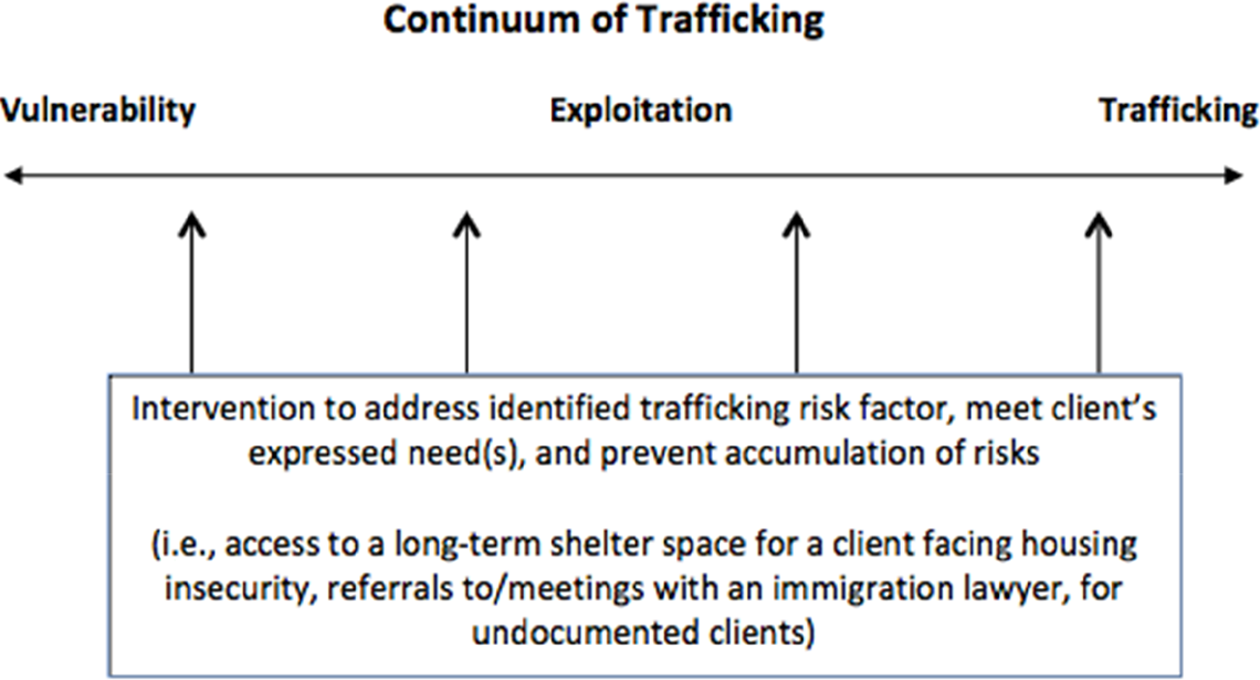
Continuum of trafficking.
Thinking of trafficking as a continuum of vulnerability, exploitation, and trafficking emphasizes the importance of prevention programs to help individuals exit the chain-of-risk before being exploited or trafficked. Understanding trafficking as a continuum of accumulating vulnerabilities or compounded risks focuses attention on survivors. It also highlights upstream social programs that can reduce the chances of harm before they reach extreme levels of trauma, violence, and exploitation. This idea of a continuum of trafficking aligns with similar research on trafficking from a service provider perspective (Carey & Farao, 2011; Countryman-Roswurm & Bolin, 2014; Gazi et al., 2001; Gerassi & Nichols, 2018; Reid et al., 2017). As Peters’s (2015) study of anti-trafficking efforts centered on New York City argues, “Trafficking occupies one end of a spectrum of exploitation, with those plotted at the ‘severe forms of trafficking’ pole being a small subset of a much larger pool of mostly undocumented exploited laborers” (p. 86). Our chains-of-risk model fits with her claim, offering an approach that service providers can access regardless of whether or not their client’s exploitation fits the legal definition of trafficking or not—if an individual is facing extreme poverty, cyclical homelessness, or legal concerns postmigration, service providers can intervene to meet those specific needs and address those trafficking risk factors.
In this way, our research further supports the CDC’s (2013) socioecological model of violence prevention, which moves from the micro to the macro, the individual to the structural (see also Okech et al., 2018). Human trafficking prevention is not just limited to interventions with individuals but also with community institutions, what Nichols (2016) categorizes as the “macrostructural forces that create a social environment where sex trafficking and exploitation can flourish” (p. 273). As Hay et al. (2007) explain, both micro- and macrolevels must be addressed in order to combat the effects of compounded risks: “Families do not exist in a social vacuum, but instead are part of a broader social context, and the community is a significant part of this” (p. 603). The goal of prevention is to create ways to decrease the probability that adverse experiences lead to an increasingly adverse outcome. Along these chains, there are points in which access to certain social structures within their communities decreases risk, such as education, poverty alleviation programs, affordable housing programs, English language instruction, and migrant advocacy organizations.
Addressing the larger social frameworks that perpetuate these chains-of-risk is critically important, especially as survivors navigate life after trafficking, sometimes with unstable employment, changing legal statuses, or new family structures. Working upstream may have the added benefit of helping a wider range of vulnerable people (Peters, 2015), some of whom would otherwise not be identified as needing support. While trafficking can happen in any context and occurs across a range of socioeconomic conditions, our research supports scholarship that argues that reducing precarity may help reduce the vulnerability of larger numbers of people (Brennan, 2014; Carey & Farao, 2011; Countryman-Roswurm & Bolin, 2014; Gazi et al., 2001; Gerassi & Nichols, 2018; Gozdziak, 2016; Lutnick, 2016; Reid et al., 2017).
Social workers play a unique role in this conceptualization of trafficking as a continuum. They, alongside service providers in the legal, medical, law enforcement, and nonprofit sectors, can break links within a chain-of-risk through their identification of exploited or trafficked persons. Participants from every sector emphasized their perception that most trafficked persons go in and out of services throughout their exploitation, including social services, housing assistance, educational systems, and medical assistance. Each of these encounters represents a missed window of opportunity to identify and assist trafficked persons in the midst of exploitation.
Our research also revealed that many trafficked persons had been identified as someone vulnerable to exploitation prior to their trafficking. When a prosecutor or social worker looked through a trafficked person’s case file, they found places where someone—an educator or a case manager—had identified the person as “at risk” of exploitation. While these missed intervention moments occurred at various times, there were several periods within a life course that appeared particularly important. For example, multiple participants suggested that aging out of foster care is a pivotal moment for youth to be vulnerable to predatory relationships and trafficking, which has been found in the broader literature (Clawson & Goldbatt Grace, 2007; Curtis et al., 2008).
These missed opportunities have implications for policy and practice (Gozdziak, 2016), including the education and training of social workers (Okech et al., 2018). Participants suggested that if organizations had more resources, they could develop interventions to prevent human trafficking before it begins rather than attempting to help victims after their exploitation. Thinking about the protocols and flowcharts often used to identify trafficking (Ahn et al., 2013), the same strategies could be used from a preventive, rather than reactive, position. Each of the risk factors identified in our study could be viewed as an intervention opportunity for social workers to connect clients facing an accumulation of these risks to the social structures that best meet their self-determined needs. Instead of waiting for clients to disclose a severe form of exploitation or trafficking, they can take a strong preventive approach at the point of homelessness, dropout status, or migration. Upon engaging with clients facing these potential risks, service providers could ascertain what resources they may need and what other sectors might be helpful in meeting their clients’ immediate and longer term needs. For example, if aging out of foster care is positioned as an intervention opportunity, a case manager might ask a series of questions to learn whether their client has a stable postfoster care residence, a job/educational opportunity, or a peer network or mentor. If they are missing one or multiple components, this service provider could connect them to resources to fill in these gaps. This is certainly not to say that this process would eliminate trafficking, but individuals facing the potential of exploitation may feel less vulnerable through their ability to access particular systems or services.
Across multiple sectors, service providers struggling to prevent exploitation and trafficking in Kansas City, MO-KS, offer useful messages for prevention efforts in other contexts. Consistently, the service providers included in this research indicated that the situations that place individuals at risk of exploitation may be both identifiable and preventable. It is not the case that certain individuals are destined to be exploited and others are not. Rather, social forces and specific experiences appear to compound over time, increasing the potential for these accumulating adverse experiences to result in extreme exploitation and potential trauma.
Prevention remains challenging for researchers and advocates, as it requires targeting structural inequalities while simultaneously addressing individual clients’ needs. Our analysis suggests that prevention opportunities are enhanced if human trafficking is conceived as a continuum of vulnerability, exploitation, and trafficking. This continuum recognizes that there may be moments to intervene in vulnerable situations with an upstream prevention focus. We also suggest that individuals may move through different stages of vulnerability or trafficking over their life course, and policies and programs must be able to adapt and understand that fluidity. Further research should explore the idea that trafficking exists on a continuum of vulnerability, violence, trauma, and exploitation. Multiple points of intervention offer hope to service providers more broadly that interventions can occur.
Footnotes
Acknowledgments
We would like to thank the entire Anti-Slavery and Human Trafficking team at the University of Kansas for their support and feedback throughout the pilot project. Additionally, special thanks go to the Institute for Policy & Social Research, the Department of Political Science, and the Department of Women, Gender, and Sexuality Studies for their continued support. Finally, we would like to thank the service providers whose voices serve as the basis of this research and who continue to work meaningfully with vulnerable, exploited, and trafficked persons in the Kansas City, MO-KS region.
Declaration of Conflicting Interests
The author(s) declared no potential conflicts of interest with respect to the research, authorship, and/or publication of this article.
Funding
The author(s) disclosed receipt of the following financial support for the research, authorship, and/or publication of this article: Funding for the ASHTI project was provided by a Level II Strategic Initiative Grant from the University of Kansas, as well as support from the Department of Political Science and Institute for Policy & Social Research.