




Abstract
The following study qualitatively explores how teen girls’ access to space and assets at a Haitian residential care facility changed 2 years after the implementation of a girls’ empowerment program called Fi Ki Fò (“strong girl” in Haitian Creole). Based on focus groups conducted with program participants (n = 17) and program teachers (n = 6), the study found that the Fi Ki Fò program increased access to physical spaces which has had implications for teenage girls’ individual and collective asset accumulation. The study also revealed that the addition of a program focused on women and girls, implemented later in the institutional life of the care facility, caused tensions with boys living on the property. The findings suggest that, while girls experienced clear benefits from the program, the lack of a supportive institutional structure and a gender transformative approach inhibited more fully realized empowerment.
Haitian residential care facilities have received international attention in recent years for their role in strengthening or, more often, undermining child protection objectives. These facilities, sometimes called orphanages, provide social services to over 32,000 children in Haiti according to Institut du Bien-Être Social et de la Recherche and the Haitian Ministry of Social Affairs and Labor (IBESR & MAST, 2013). Despite care facilities' significant role in the lives of Haitian children, there has been little study of the service provision within these facilities and how it differs based on gender. Such research would support not only improved services for boys and girls in Haiti but also offer gendered lessons for social work practitioners in the United States and around the world.
The role of international social work has been acknowledged consistently, though thinly, throughout the history of the profession. Even when discussed, too often, the flow of lessons from social work in the global south is overshadowed by those from the global north (Midgley, 1990). Perhaps this is partly because social workers in northern countries struggle to see connections to social work systems that have become outdated in their own countries. Certainly, there are important differences in practice based on locality; nonetheless, common challenges faced in social work across borders are worth examining. In the case of orphanages, although they are no longer utilized in the United States and many other countries in the north, they are still a common mechanism for service delivery to vulnerable children in the global south and often serve both boys and girls. In this respect, care facilities face similar obstacles to gender equality as youth services elsewhere. In any social work setting—orphanage or otherwise—biases that result in disparities in service provision and quality must be addressed by social workers in the interest of the profession’s commitment to social justice.
A recent evaluation of the Fi Ki Fò (strong girl) program offered an opportunity to explore how one residential care facility in Haiti allocates resources to girls differently 2 years after the implementation of a girls’ empowerment program. This study reports the results of three focus groups conducted for participants and teachers of that program which asked them to reflect on how the program had changed girls’ lives overtime. In these groups, girls and teachers shared that the program had increased access to specific physical spaces and diverse assets previously unavailable to them. They also highlighted pushback girls have received from boys living in the care facility since Fi Ki Fò began. Their observations have been analyzed using an empowerment framework which states that empowerment necessitates a dual process of marginalized populations accumulating individual and collective assets in the context of responsive and inclusive institutions willing to address the groups’ needs.
The following paper begins by first contextualizing the residential care system in Haiti. It then introduces the conceptual frameworks of empowerment, gendered spaces, and gendered asset accumulation used to interpret study results. With this understanding, a brief background of the specific case—Pwoje Espwa care facility and the Fi Ki Fò program—is provided followed by the research questions, results, and conclusions of the study.
Residential Care in Haiti
Based on a 2013 government survey, there are 752 functional residential care facilities in Haiti (IBESR & MAST, 2013). Of an estimated 32,000 children in these facilities, 80% have at least one living parent (Mulheir & Cavanagh, 2016). Typically, parents admit their children to residential care facilities because they lack access to basic health, education, or other social services. Most of these facilities are operated by international nongovernmental organizations or individuals with only 15% accredited by the Haitian government in 2013 (IBESR & MAST, 2013).
Although accreditation is crucial for government oversight and standardization, it does not necessarily indicate a higher level of service provision. Residential care facilities in Haiti, accredited or not, range in their services. Some provide housing, education, and health care; others offer community support in addition to childcare (Children’s Nutrition Program of Haiti, 2016; Free the Kids, 2017); and some notably abuse child protection standards and engage in the condemnable exploitation of children through trafficking or other profit-making schemes (Mulheir & Cavanagh, 2016). Thus, both government oversight and the provision of care itself have historically lacked standardization across the country.
Recently, the Haitian government has taken a more active role in implementing child protection policies and regulation of residential care. In 2011, the Government of Haiti ratified the Hague Convention on Inter-Country Adoption ensuring compliance with United Nations guidelines on alternative childcare models through administration and legislation (Convention on Protection of Children and Co-Operation in Respect of Intercountry Adoption, 1993). In 2013, IBESR & MAST (2013) created an inventory of residential care facilities. This inventory marked the first government attempt in recent history to record the extent of residential care facilities and their services, close those which did not meet standards, and gain increased ability to monitor ongoing child protection through residential care.
Since the publication of the report, the government has ratified two additional protocols under the Convention on the Rights of the Child and passed two laws protecting women, children, and families. They have also provided trainings around the country for 150 judges and social protection advocates to effectively implement these laws (Camille & Chen, 2015). United Nations Children’s Fund (UNICEF), which funded and supported the report on residential care facilities, has also been active in promoting reunification of children in residential care facilities with families. In 2016, those efforts were directed particularly toward two crisis situations: The deportation of children from the Dominican Republic to Haiti and children and families affected by Hurricane Matthew (UNICEF, 2017). Ultimately, the 2013 report and subsequent closure of a number of inadequate and dangerous care facilities has been the greatest change for residential care in Haiti in recent years and it did not incorporate a specifically gendered approach.
Empowerment, Gendered Asset Accumulation, and Gendered Spaces
Empowerment, gendered asset accumulation, and gendered space are central concepts to this qualitative study. This section provides the framework and working definitions of each to contextualize the qualitative focus group data which follows.
Making Sense of Women’s Empowerment
Women’s empowerment has been used as a strategy of development organizations to address poverty and broader structures of gender inequality that disadvantage women. Empowerment has become a common goal in women’s and girls’ development programs over the past two decades; however, the definition used by development organizations and researchers varies (Malhotra, Schuler, & Boender, 2002). Some shared components of the definition of empowerment that will be applied in this analysis are (1) the notion that women have been disempowered relative to men within society, (2) empowerment is achieved by women and girls themselves and cannot be provided by an external actor, (3) empowerment can be identified when women and girls have the agency to make important decisions about their lives, and (4) empowerment is never “achieved” but is an ongoing process that depends on women’s power in interpersonal and community relationships (Mosedale, 2005).
Financial asset accumulation is often upheld as an important mechanism for empowerment based on asset theory (Sherradan, 1991). In relation to the third shared aspect of empowerment definitions, financial assets are theorized to provide women increased agency to make decisions in their lives. Those endorsing the use of financial assets toward this goal suggest these assets can have far-reaching empowerment affects including increased agency, social connection, and promotion of overall well-being (Celia, 1994; Curley, Page-Adams & Sherraden, 1997; Ssewamala, Nabunya, Ilic, & Keun, 2016). Economic empowerment in these cases can include access to income-generating activities or financial resources (Berry et al., 2013; Raj et al., 2018). Evidence has shown that women’s access to these resources often leads to investment in family health and education (Quisumbing & Maluccio, 2003; Namoro & Roushdy, 2009). Additionally, women’s economic empowerment frequently improves women’s own health outcomes and has seemingly reduced intimate partner violence in some cases (Raj et al., 2018).
Although frequently utilized, financial assets are only one potential means for empowerment. While studies of this mechanism show varying outcomes on intimate partner violence, and indeed some show a reduction, there are also significant examples in which women’s new financial assets have increased intimate partner violence and other assertions of male power (Dalal, 2011; Rocca, Rathod, Falle, Pande, & Krishnan, 2009). Such examples validate critiques that financial assets alone do not address the broader structures of gender inequality contributing to women’s disempowerment (Vyas & Watts, 2009). Other cross-country studies find no correlation between women’s financial assets and partner violence (Peterman, Pereira, Bleck, Palermo, & Yount, 2017). In these cases, financial assets are demonstrably insufficient alone to address women’s marginalization.
The fourth and final component of the empowerment definition is that women’s power is dependent on interpersonal and community relationships. This facet of the definition deals with the societal perceptions of gender that disadvantage women in specific ways based on geographic location, culture, relationships, and identity (class, age, race, ethnicity, etc.; Kabeer, 2000). The feminist assertion that “the personal is political” provides a framework to understand how power dynamics play out in interpersonal relations (Hanisch, 1969). The feminist economic perspective further supports this by demonstrating that access to financial capital alone does not necessarily change women’s bargaining power in their households. Instead, women's bargaining power is often determined by gender norms which keeps women disempowered (Agarwal, 1997).
Mechanisms for Empowerment
Given the complex factors of women’s marginalization and therefore their empowerment, this article utilizes an inclusive understanding of the mechanisms necessary for empowerment beyond the simplified financial asset model described above. Empowerment herein is conceptualized as requiring both (1) multidimensional forms of asset accumulation (including social and psychological) and (2) transformation of gender norms that address interpersonal power dynamics.
For the first requirement of empowerment—multidimensional asset accumulation—Deepa Narayan’s definition of empowerment is used. Narayan, an international poverty scholar who led research for the World Bank and the United Nations, states: “empowerment is the expansion of assets and capabilities of poor people to participate in, negotiate with, influence, control, and hold accountable institutions that affect their lives” (Narayan-Parker, 2005). As part of this framework, Narayan presents “opportunity structures” and “agency of the poor” as parallel processes. Opportunity structures require inclusive institutional climates to create social and political structures allowing for equitable change. Similarly, agency for the poor is predicated on the accumulation of individual assets (beyond just financial)—including material, human, social, and psychological—for collective use and institutional bargaining (Narayan-Parker, 2005). Under these conditions, people in poverty and further marginalized subgroups, often including women, can achieve more equitable access. Thus, Narayan defines empowerment in terms of both the acquisition of assets and structural change to norms, behaviors, and processes.
The second requirement of empowerment is related to a transformation of gender norms. The transformative gender approach has evolved in recent years and has a specific focus on challenging gender norms for both men and women to address the cultural, normative, and relational aspects of women’s disempowerment (Casey, Carlson, Two Bulls, & Yager, 2016). Gender transformative approaches to empowerment begin by examining gender norms and provide opportunities for all to practice more gender equitable attitudes and behaviors (Barker, Ricardo, & Nascimento, 2007; Gupta, 2000; International Center for Research on Women, 2018). The gender transformative approach is a second component for women’s empowerment and has proven to be successful in creating more equitable power distributions between men and women including reductions of gender-based violence (Doyle et al., 2018). With just the first component—asset accumulation (financial, social, psychological, or otherwise)—women and girls may continue to face structural barriers based on male perceptions of gender norms. Thus, both (1) asset accumulation and opportunity structures and (2) transformation of gender norms are necessary for fully realized empowerment.
Gendered Asset Accumulation
In the context of Haitian residential care facilities, there is no existing basis of research describing youth access to assets—individual or collective. Studies of asset accumulation outside of Haiti, however, suggest social capital may be a particularly significant resource for marginalized groups seeking equitable treatment. Social capital is accumulated as people expand their networks by forming relationships with those outside of their existing groups (Condeluci, 2016). Condeluci (2016) notes that increasing social capital for marginalized groups can lead to better health outcomes, increased job success, and even psychological assets. In terms of poverty reduction, asset accumulation has been particularly important to women as an often-marginalized group, resulting in higher levels of social status in the household and community (Deere & Alvarado, 2016; Page-Adams & Sherraden, 1997).
In fact, social capital is often a useful starting point to accumulate other kinds of assets for many groups including vulnerable children. Some studies of orphanage care in Africa suggest that access to social support differs for children across orphanage settings. In Ghanaian orphanages, access to social support was related to improved quality of life for children (Yendork & Somhlaba, 2015). In South Africa, social capital corresponded with lower levels of post-traumatic stress disorder in AIDs-orphaned children (Cluver, Fincham, & Seedat, 2009). In a case in Rwanda, orphanage care provided more opportunities for social support than for children living on the streets (Caserta, Punamӓki, & Pirttillӓ-Backman, 2016).
As with assets, there is no readily available literature examining gendered access to resources for youth within Haitian care facilities. The Ghanaian study includes sex-disaggregated data showing that girls and boys followed a similar trend with greater access to social support at younger ages and less in adolescence. This may reflect the adolescent development period, which can be a shifting point for both girls and boys as they experience tension between (1) their authentic self and (2) voicelessness as they struggle to redefine relationships during their transition to adulthood and subsequently embrace individualism as a societally accepted alternative (Deanow, 2011). The Ghanaian study also found that girls had a higher level of self-efficacy than boys, though this may be a result of gender constructs of that particular institution, country, or a greater female tendency toward voicelessness (Deanow, 2011; Yendork & Somhlaba, 2015). A broader study of self-efficacy with sex-disaggregated data showed that while women had a slightly higher sense of self-efficacy than men, results differed significantly across cultures (Scholz, Benicio Gutiérrez, Schwarzer, & Sud, 2002).
Ultimately, women’s and girls’ access to assets—physical or social—is necessary but not sufficient to achieve empowerment (Padgett & Warnecke, 2011; Staveren, 2011). A critical factor in girls’ ability to utilize these resources to improve their lives and those of others relies also on institutional willingness to provide equal opportunity and access. Gender transformation is one approach to reduce these institutional and interpersonal barriers faced by women and girls after they have accumulated diverse assets. Often this requires the equalization of spaces that have previously been restricted for one gender over another.
Gendered Spaces
Feminist development scholars discuss the gendered nature of public and private spaces as they have been socially constructed overtime in patriarchal societies. They have identified a clear distinction between the productive sphere, typically reserved for men, and the reproductive sphere, typically reserved for women (Parpart, Connelly & Barriteau, 2000; Razavi & Miller, 1995). There are many examples over the course of history and across cultures of the ways in which male-dominated societies have relegated women to the secondary reproductive sphere (Duflo, 2012; Elson, 1999; Park, 2013). The reproductive sphere includes the domains of childbearing, childcare, and household work. By contrast, the productive sphere includes the workplace and public spaces outside of the home.
Even as women have found employment in the productive sphere, many of these gender norms remain intact around the world. Women are encouraged to remain within spaces of the reproductive sphere often through intimidation or societal expectations (Hossen & Westhues, 2010; Paul, 2011). Furthermore, gendered spaces constrain not only women but all gender identities including men and transgendered individuals (Doan, 2010). In this particular study, the relegation of women to private, household spaces is highlighted because of the particular focus of the Fi Ki Fò program and the societal value placed on engagement with the public sphere. Beyond its social value, in public spaces, people can accumulate assets that are unavailable in the private sphere. This has been one of the important results of the establishment of the Fi Ki Fò program at an institution originally designed for boys.
Background of Pwoje Espwa and the Fi Ki Fò Program
Pwoje Espwa (Project Hope) residential care facility in Les Cayes, Haiti, was founded in 1998. A U.S.-funding organization called Free the Kids (2017) supports the facility financially. Pwoje Espwa began as a nonprofit organization providing housing, food, and education to a dozen boys living on the streets in Les Cayes. Over time, it expanded to provide more boys with expanded services including health care, mental health support, team sports, and vocational training. Today, Pwoje Espwa provides residential services for both orphans and vulnerable children whose families are unable to fully support them.
For the first 9 years, Pwoje Espwa did not accept girls into residential programming because it did not feel it could appropriately accommodate them. In 2007, girls were admitted as residents for the first time partly because a new property provided adequate space for girls and boys to live separately. Despite the inclusion of girls as residents, a disparity remained between boys and girls in access to opportunities. This is a result of both Espwa’s development and existing gender inequalities in Haiti. As of 2014, there were still many opportunities available to the boys (e.g., soccer, internships, and summer classes) from which girls were excluded. While these policies did not exist to exclude women and girls, by leaving them out of the institutional framework, girls perceived social exclusion from resources and activities.
The Fi Ki Fò program began at Pwoje Espwa in September 2015. It was created to fill the void for girls’ programming which existed at the time by helping to prepare girls for life after residential care. To this end, the program combines international mentorship, skills training, local role models, and practical experiences to empower teen girls at Pwoje Espwa to become fearless authors of their own lives. The program seeks to influence systemic gender inequality by shifting perceptions of girls’ capabilities at the program level and creating a more equitable environment for women and girls at Pwoje Espwa. Girls are eligible to join the Fi Ki Fò program at age 14 and remain enrolled until they leave the property at age 18. As participants, girls take skills classes (6–10 hr per week) throughout the school year taught by local Haitian women, are paired with young professional women in the United States as pen pals, and have opportunities to make money and deposit it into a savings account established in their name. The first cohort began in the fall of 2015 with 10 girls, and the second cohort started in the fall of 2016 with 7 girls.
Study Rationale and Research Questions
What follows is a qualitative study of girls’ experiences of Fi Ki Fò based primarily on program evaluation data from focus groups conducted in May and June 2017 with participants and teachers as well as researcher observations. The primary research question was “What differences are perceived in girls’ access to opportunities at Espwa since the establishment of the Fi Ki Fò program?” The results are derived from girls’ and program teachers’ perception of girls’ access to space and assets after the establishment of the program.
The rationale for this study rests on the feminist understanding that “the personal is political” by uplifting girls’ personal experiences as the primary means to understand broader gender empowerment and transformation shifts (Hanisch, 1969). Furthermore, the gender transformative framework informed the focus group questioning process by asking girls to expand on their experiences of changes in not only assets and access to space but also relationships with people and institutions.
Limitations
This study is limited most significantly by its small size and nongeneralizability. As Fi Ki Fò is a small program, it only allows for the expression of views from 23 girls and women. Additionally, the specificities of Fi Ki Fò in its specific cultural context preclude generalizability for other girls’ programs, though it still provides meaningful insights and considerations for gender equitable social services which might be studied in other settings.
Method
The primary methodology for this qualitative study was 3 focus groups conducted 2 years after the start of the program. In focus groups with both cohorts of participants and a group of program teachers, the following question was asked: “What differences have you seen in girls’ access to opportunities at Espwa since the program?” In answering this question, girls and teachers identified changes in access to space and assets for girls pre- and post-program.
Observation was used as a secondary methodology to contextualize initial findings based on the voices of Haitian girls and women involved in the program. Observations were collected informally by the evaluator throughout the process of a broader midpoint program evaluation that included the focus groups.
The midpoint evaluation of the Fi Ki Fò program was conducted in May and June 2017 to offer feedback to stakeholders by identifying and analyzing components which were successful and those which could be improved. The evaluation was requested by the U.S. nonprofit, Write to Be, operating the Fi Ki Fò program in Haiti. Write to Be requested a culturally responsive evaluation process and product developed in collaboration with the Haitian women who run the program day-to-day. As such, Haitian women, a marginalized group central to the goals of the program, were an integral part of the evaluation. Based on the culturally responsive evaluation framework developed by Stafford Hood, the evaluation design sought to engage the most marginalized groups in all stages of the process from preparation, stakeholder engagement, and design to collection and dissemination of data (Newcomer, Hatry, & Wholey, 2015).
Design
Focus groups were conducted utilizing grounded theory rather than testing an established hypothesis. Given the paucity of literature regarding gendered access to resources and space in residential care facilities in this setting as well as the girls’ expertise in their own experience, it made sense to have participants generate the substantive knowledge of this research study (Chamberlain-Salaun, Mills, & Usher, 2013). Observations were collected informally in the process of the midpoint program evaluation by the evaluator. Thus, the observations are presented in the first person in the Results section.
Ethics
Ethical approval for the program evaluation was obtained through Haiti’s Committee Nationale Bioethique. U.S. Institutional Review Board approval was not required for this study because of its designation as a program evaluation. All participation in the study was voluntary and confidential. Girls, as well as Pwoje Espwa administrators, provided informed assent and consent for participation. As data were entered, participants’ names were replaced with codes to protect their confidentiality. The codes were only accessible to the evaluator and were kept in a separate, password-protected drive.
Participants and Recruitment
Each participant group, divided by cohort, was invited to participate in a focus group. The voluntary nature of the focus groups was verbally explained to girls 2 weeks in advance of the focus groups and again in a written consent form and verbal explanation in Creole the week of focus groups which girls signed indicating their consent. Girls were then reminded at the beginning of the group of the confidential and voluntary nature of the process and that they could decline to answer or “opt out” at any time. There was 100% participation in the focus groups and no girls chose to opt out during the process.
Procedure
Focus groups were conducted with three separate groups: the first cohort of program participants (n = 10), the second group of program participants (n = 7), and program teachers (n = 6). This nonexperimental design allowed for the acquisition of qualitative, narrative data about girls’ experiences of the program. The entire population of program participants and teachers were represented in the focus groups. Each group was facilitated by the program evaluator with the support (in participant focus groups) of a notetaker/transcriptionist. Conversations were conducted in a private room, over a meal, in Espwa’s guest house facility. The following guiding questions structured the participant focus group discussion: What is your name, age, and how long have you been in Fi Ki Fò? Tell me what you know about Fi Ki Fò and its goals. What aspects of the program help girls gain confidence and increase self-esteem? What difference have you seen in girls’ access to opportunities at Espwa since the program? What are the greatest challenges to achieving the goals of Fi Ki Fò? What could be done to improve the program and increase the likelihood of achieving the goals you articulated?
Data Analysis
Each focus group was audio taped, transcribed, and thematically coded by the program evaluator in Haitian Creole. Transcripts were then translated into English and coded by another coder for interrater reliability. Afterward, coders conferred and resolved minor discrepancies.
Results
The results of the focus groups and evaluator observations fall into three main categories: girls’ increased access to physical spaces, their access to related assets as a result these spaces, and male resistance to shifting power dynamics.
Claiming New Spaces
The participant focus groups were a forum for girls to share their feedback of the program. The frequencies of topics discussed, relevant to changes they noticed since program inception, are presented in Table 1. There were a couple notable differences between the focus group with the younger and older cohorts. The older cohort indicated that the program had changed their quality of life. The younger cohort emphasized that boys at Espwa were jealous of the program. Both cohorts referenced changing access to space and resources.
Participant Focus Group Thematic Code Frequencies.
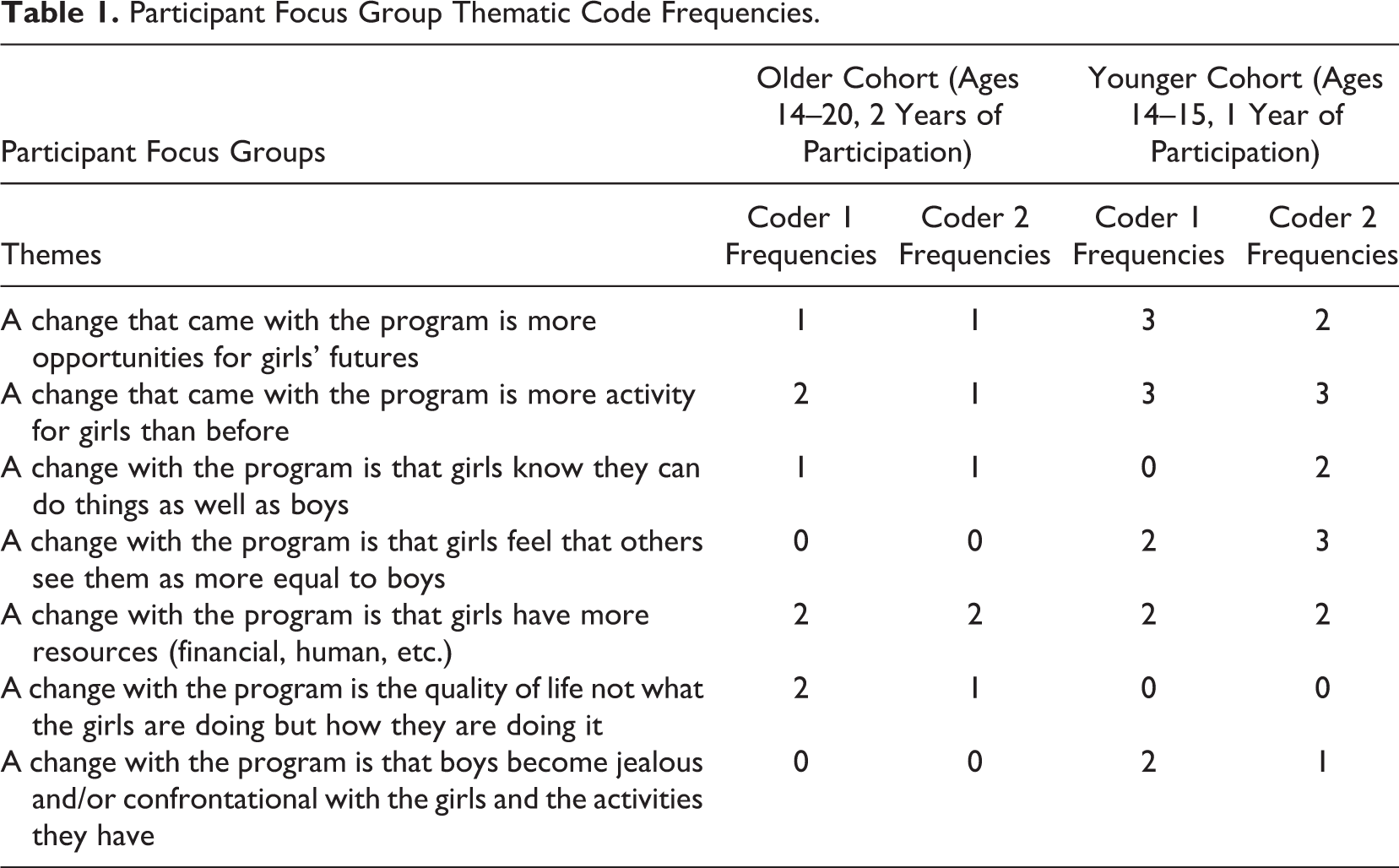
Many of the girls highlighted differences in their lives now compared to their lives before Fi Ki Fò. The primary change girls identified was increasing access to physical spaces both inside and outside the care facility. Before the Fi Ki Fò program, girls described waking up in their housing in the morning, going to school (about 50 yards away), and immediately returning home where they would rest, do laundry, and complete their homework. One girl commented on how she perceived the difference in her life before and after the program: It’s different because before the program we used to remain seated for 2 hours when we went home from school, we slept after, we studied after. Now with the program every time a little after we have our school we go to attend the program. We don’t have free time to sleep now. [laughs] We must keep being strong women. That’s what I think. When we were not yet in the Fi Ki Fò program, all we knew was go to school. We slept, studied, and we never thought we could have the same…we did not even think that we could do the same as the young men. Now that we’ve been in the Fi Ki Fò program we think, we can talk the same, we can do the same with the men.
soccer fields on campus,
skills buildings on campus,
the guest house facility on campus, and
sites in town (including a beach and botanical garden).
Soccer fields and beach
Girls visited the soccer fields on campus and the beach in town to play sports nearly every Saturday during the program. Before the program, they had not been regularly exposed to physical activities outside of dance performed in the church building. In the focus groups, some girls mentioned they had been on the three-mile walk to the beach before the program with a female staff person from Espwa, but she had restricted the girls from playing in the water and running and had required they return home immediately. Trips to the beach within Fi Ki Fò, however, typically involved those activities which were once restricted.
Skills buildings
Both girls and teachers discussed how the program’s skills classes legitimized girls’ access to buildings on property outside of their housing after school hours. Some of the girls said they had been to the sewing shop before the program began, but they now attended more frequently and were more familiar with the women working there. One program teacher described the pushback girls occasionally still receive from security guards when they try to leave their village to attend classes for the program. She described explaining the situation to the young boys living at Espwa: I try to explain to them, girls don’t have the same chances as boys. Boys can go almost anywhere they want. For girls, no. For girls it’s different. Security always asks them, where are you going? What are you doing? Don’t go. Go lie down. Go do something else.
Guest house
The guest house at Pwoje Espwa hosts volunteer groups, usually from the United States, who come to visit the facility. Before the program, girls were selectively invited to the guesthouse for activities with the visitors, but their access was limited by the volunteers’ self-designed activities. Since the Fi Ki Fò program, girls have visited the guest house more frequently for their program English classes as well as for arts and crafts and movie nights with U.S. volunteers held in the guest house. One girl said of the increased access to the building: Yes, we get to meet new people and know more. Before [the program] I would come to the Guesthouse for only a moment, now I have found many friends here, a lot of new friends. Before I didn’t know I could visit for a long time, when I came for the [church] masses I didn’t know I could stay longer. Now we talk with the visitors. Now things are better with them.
Physical Spaces Open Doors to Other Assets
What is particularly noteworthy in each of these cases is the implication of girls’ access to social connections afforded by increased access to spaces. By gaining legitimate access to spaces both on-property and off, girls said they have accumulated both human and social capital. This new freedom of movement opens up capabilities for girls to utilize their functional skills and engage with others (Sen, 1999). In terms of social capital, increased access to the guest house allows girls to interact with volunteers from the United States and speak to them in English using language skills fostered in the program. This was once a privileged social connection afforded only to older boys at Espwa who taught themselves English or learned in school. Some of those social connections resulted in boys receiving funding for their education after Espwa as well as ongoing emotional support through digital communications. Now, girls are beginning to develop similar relationships with volunteers and some visitors financially support Fi Ki Fò. Girls have also gained access to at least two new spaces where they can exercise: property soccer fields and the beach. These might also be categorized as psychological assets in the sense that physical exercise promotes good mental health or even human capital as girls build skills in soccer: A sport typically played by men in Haiti.
Male Responses
As I was conducting this research, I had the privilege to walk with the girls to the beach one morning. About a dozen of the girls happily power walked the three miles to the beach, with a soccer ball in hand, and quickly set up a field on the sand. In the minute it took them to place the goals with four short sticks, boys from other parts of the beach began to circle around the girls and their game. The boys took advantage of every opportunity to grab the soccer ball when it went out of bounds and a crowd quickly formed. Boys of all ages kept an eye on the game: not cheering or engaging with the girls verbally, just looking on seemingly to assert their ownership of the space and perhaps the game.
In the first quotation in this article, a teacher described the “pushback” girls sometimes get from security guards when they leave their housing to attend program classes. That teacher described this phenomenon in the context of her conversation with a boy living at Espwa who did not understand why a program for girls was needed. After she had described the differing interactions boys and girls have with security guards, she said the boy considered it. When the teacher explained the need for a girls’ program to the boys, she said, Many times [the boys] say: I haven’t thought about that. I didn’t know that about the girls…. Now when they see the girls do something with them, I think they are beginning to give more attention to these differences.
Teacher Focus Group Thematic Code Frequencies.
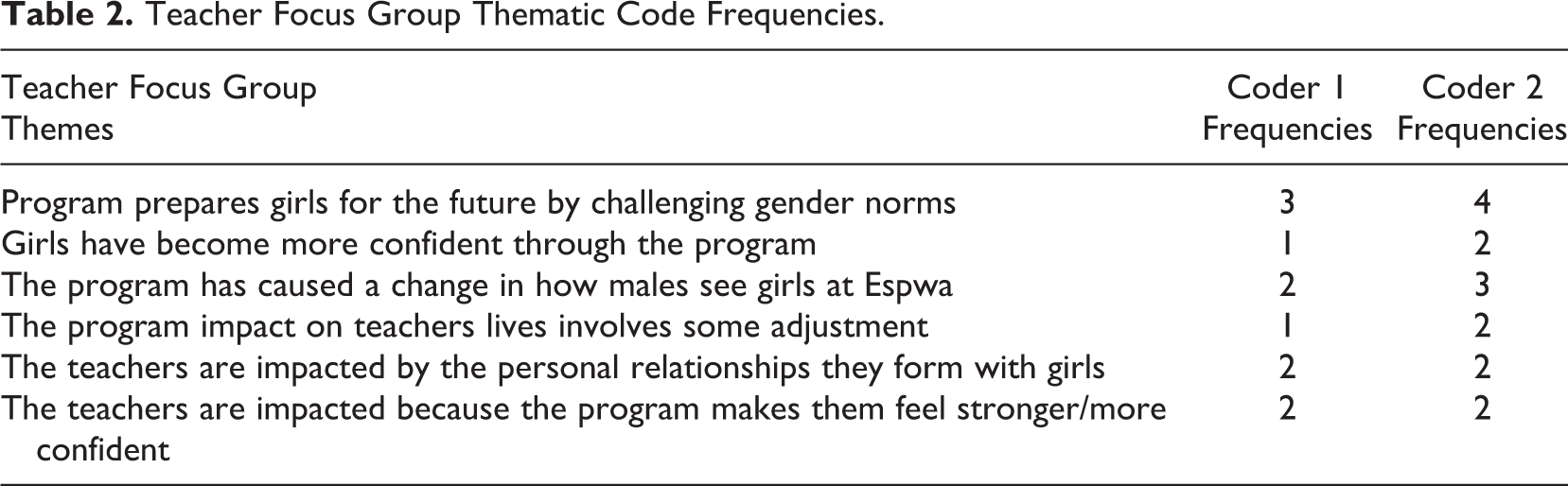
Girls also brought up some of the responses they have received from the boys at Espwa. Many girls said that the boys were jealous of the program. When asked why, they said it was because the boys felt excluded and thus teased the girls for their involvement. I am not saying women are not equal with men, but you know men take a position as though they are better, they show you at all times and pretend to be superior, as if they know they are stronger than girls. They continue [to tease] but we don’t bother with them. I say “I don’t care,” it is my talent I’m developing. I have no problem because a person is not born for them to know everything. You have to practice before you know something. But the boys don’t know these things themselves.
Discussion
Over the course of program, girls’ daily lives have changed as a result of Fi Ki Fò. Two years ago, girls were primarily confined to private spaces (their homes and school) and today they travel more frequently within the Pwoje Espwa property (the soccer field, skills buildings, and the guest house) and off the property (the beach and the botanical gardens). Before the program, lack of access to these spaces limited girls full participation in the Espwa community. As Sen (1999) writes, capability is not just defined in terms of functioning alone but also in terms of capability through freedom to do. Freedom of movement is among the freedoms that allow women and girls functioning to be realized through capability. With decreased freedom of movement, girls had been restrained before Fi Ki Fò.
Studies show that women’s freedom of movement has been restrained outside of Haiti through formal policy and gender norms and expectations within particular cultural contexts (Andreassen & Tommaso, 2018; Weekes, 2006). Restricted female access to space and freedom of movement at the personal level has long been understood as a method of control exercised by men in gender-based violence research (Sharp-Jeffs, Kelly & Klein, 2018). It is also a method of institutions, communities, and societies to exercise power based on gender norms (Gupta & Yesudian, 2006). Women’s and girls’ participation in activities taking place in these spaces influence their social relations and advantages overtime (Robeyns, 2003). Based on these studies, the finding that girls gained increased access to these four spaces—soccer fields, buildings on campus, the guest house facility, and sites in town—has implications for their opportunities to utilize their skills with increased freedom of movement. For example, as they have increasingly visited these spaces, girls have accumulated assets previously unavailable to them including social capital through interactions with U.S. volunteers, human capital through skills building and soccer, and psychological capital through exercise and group activities.
Each of these assets falls within the first component of empowerment based on Narayan’s agency of the poor framework. The required parallel component is the opportunity structure, loosely defined as institutional receptivity to the voices of marginalized groups. In some ways, the reaction of boys on and off property suggests the dominant social, institutional structures are resistant to girls’ acquisition of assets through space. The instances of security guards telling girls to stay home from skills classes perhaps best illustrate this idea. It is truly through the narratives of the girls and teachers that the applicability of the empowerment framework has come to light. The findings call for the institutions responsible for this program to create a more inclusive and responsive opportunity structure, wherein girls might use their assets to improve the well-being of their group and the larger organization.
The second component to empowerment is the gender transformative approach described throughout this article. As it stands, male reactions to girls’ increased access to space reflect hegemonic masculinities and pressure to assert dominance over girls. Thus, the individual asset-related outcomes in gender equality have been more successful than relational transformation in gender equality within this program. As a result, the outcomes for girls stop short of fully realized empowerment. Although girls have increased access to space, freedom of movement, and opportunity, progress has been stifled by male behaviors. In this case, more comprehensive empowerment has been limited by the reactions from boys outside of the property, boys on the property, and male staff.
It is not uncommon for males to act out against females in empowerment initiatives. A number of studies of women’s economic empowerment show that, in some cases, women’s increased financial asset accumulation correlates with increased domestic violence (Bolis & Hughes, 2015; Edwards, 2017). This is not always the case, and in other examples, increased financial assets correlate with decreased cases of domestic violence. Beyond a backlash to empowerment initiatives, men assert power over women through violence when women attempt to access spaces and resources. This has been studied and illustrated extensively in the context of violence against women leading to HIV/AIDs infection (Gibbs, Jacobsen, & Wilson, 2017; Jewkes, Dunkle, Nduna, & Shai, 2010; Kouyoumdjian et al., 2013). In a Haitian setting, a recent study shows how young women’s access to an internally displaced people’s camp in Leogane, Haiti, resulted in violence against them (Logie, Danile, Ahmed, & Lash, 2017). Another study showed how Haitian women seeking to access health services were raped and exposed to sexually transmitted diseases (Fawzi et al., 2005). While the male response to girls’ increased access to spaces discussed in this article is not as extreme as physical and sexual violence against women, the emergence of violent, hegemonic masculinity as a result of women’s access to space and resources is related.
Each of the three male responses presented in this study is a case for the importance of a gender transformative approach for girls to achieve more comprehensive empowerment. Although girls gained increased access to spaces with some degree of increased opportunity and agency through the Fi Ki Fò program, they continue to be limited by the male assertion of power. In HIV/AIDs initiatives, gender transformative approaches that work with men to disrupt hegemonic masculinity have proven effective at reducing violence against women and thus creating an environment conducive to empowerment (Dworkin, Treves-Kagan, & Lippman, 2013). Such a gender transformative approach is also called for in this situation. This approach would not only serve the purpose of girls’ empowerment, it would also allow men and boys who have been held to a standard of hegemonic masculinity to conceptualize manhood more inclusively. Boys and men in residential care facilities in Haiti are often oppressed themselves based on intersectional identities of skin color, class, and economic standing. The gender transformative approach could address some of the harm that norms of masculinity have caused them and those around them even while they are disadvantaged in other parts of their identity.
Finally, the limitations to girls’ empowerment caused by male behaviors beg the question: In order to implement a gender transformative framework, what sort of space needs to be cultivated? The literature on social safe spaces outlines one possible framework. Social safe spaces have been widely used by humanitarian agencies after natural disasters and conflicts to create physically and psychologically safe spaces for children to learn, socialize, and develop (Madfis, Martyris, & Triplehorn, 2010). This framework has been used successfully in Haiti after 2007s Hurricane Noel and resulted in an increased sense of ease among children, higher self-esteem, and cooperative behavior (Madfis et al., 2010). Social safe spaces have also been used in postconflict areas and have had some success particularly with traumatized children who are relearning how to cope with stressors, build confidence, and maintain healthy relationships (Henley, 2005; Hite, 2007). Given the integration of trauma-informed care for staff into the social safe spaces methodology, it may have applications for the Fi Ki Fò case by providing youth a safe space to challenge gender inequalities. In at least one case in South Africa, safe spaces were used to begin discussions of gender inequality among teachers (Jarvis, 2014). Teachers said this process allowed them to share thoughts and feelings with others that were contrary to the patriarchal structure and to transform their own understanding of their gender (Jarvis, 2014).
While studies have shown many benefits to the social safe spaces model, more research needs to be done to assess the applications for youth on gender inequality. In the context of youth, some studies question whether social safe spaces prepare children to cope with real-world challenges outside of created social safe spaces and in one case youth engaged in critical thinking within safe spaces were not able to easily apply their abilities in the world outside of their safe space (Vaughan, 2014). This issue should be considered. In the case of girls’ experiences of the Fi Ki Fò program, a gender transformative approach, utilizing social safe spaces, could provide the environment for girls to live into their increased agency and power.
Conclusion
This article has described the experiences of girls in the Fi Ki Fò program over the past 2 years as they gained increased access to space and assets. It has placed the program within the cultural context of Haitian residential care facilities. Then, it conceptualized girls’ empowerment using Narayan’s framework of assets and opportunity structures coupled with a gender transformative approach rooted in a feminist interpretation of personal and relational power dynamics. While the girls in the Fi Ki Fò program indeed found increased access to space and assets, the program benefits fell short of Narayan’s parallel necessity for an institutional opportunity structure as well as a fully gender transformative approach. These findings call for deliberate action to create institutional structures that support more male involvement in a gender transformative approach, so that girls’ empowerment can be fully realized within their communities and societies, and additionally, both men and women might be liberated from constraints of societal gender norms.
Footnotes
Acknowledgments
Participants are deeply thanked for their time and involvement in both this study and the ongoing development of the program that truly belongs to them. The author also thanks Write to Be and Pwoje Espwa Sud for facilitating this study and supporting the constant improvement of the work of the Fi Ki Fò program and Pwoje Espwa. The author is grateful for financial support from the University of Pittsburgh Nationality Rooms to conduct this evaluation.
Declaration of Conflicting Interests
The author declared no potential conflicts of interest with respect to the research, authorship, and/or publication of this article.
Funding
The author disclosed receipt of the following financial support for the research, authorship, and/or publication of this article: The author received funding from the University of Pittsburgh to conduct the program evaluation mentioned in this paper.