




Abstract
This study examines feminist attitudes and social service motivation of 681 women of two prominent Hindu orders having a global presence. Ordained Hindu women believed that commitment to religious orders, celibacy, and social service countered patriarchy. City location, work profile versatility in the order, education, and duration of being ordained, significantly influenced their views and scores on the Feminist Perspective Scale and Public Service Motivation Scale. Two implications are foregrounded: the recognition of a cohort of women who perform social service as religious duty, and a different form of feminist care ethics located within a feminist theological premise.
Membership of women in the religious orders is an act of renunciation and poses some challenges to patriarchy, which patronizes certain cultural timetables of marriage and motherhood for women. While it unveils another aspect or dimension of women’s existence, within religious orders different norms of domination operate. There is a simultaneous fidelity to and defiance of tradition, ordained Hindu women locate themselves within a more dominant male tradition and also transcend it (Selva Raj, 2004).
There is a theoretical parallel that can be drawn to Mary Daly and Rosemary Radford Ruether’s works on feminist theology that foregrounds a female religious imagery highlighting nonpatriarchal images of God. Essentially across cultures, feminist theology seeks to empower women and moves them so that they can challenge and transform the age-old hierarchical, social, and ecclesial structures that have perpetuated systems of oppression in the name of the divine and/or faith, with a sense of spiritual solidarity (Smith, 2009). There is a growing body of literature that examines the lives of women ascetics, renuniciants, and lifelong celibates from the lenses of feminist theology and feminist anthropology (Daly, 1973a, 1973b, 1984; Greene-McCreight, 2004; Kim, 2005; Miles, 2006; Moulaison, 2007; Nuth, 2006; Ruether, 1983, 2000).
Contemporary Hindu organizations and movements have increasingly begun to recruit and build a coterie of women members who join the order by renouncing the world and vowing to remain lifelong celibates (Charpentier, 2010). Those who assume leadership positions within the order are called female gurus (teachers), and there is growing literature of conceptual and empirical nature on these ordained Hindu women akin to Western discourses on feminist theology. Pechilis (2004) has said that for ordained Hindu women, the devotional path constitutes a defining characteristic and also contributes to their expectations of femininity. Through their devotional practices, the gurus performatively “domesticate” renunciation and guru leadership by foregrounding the feminine values of connection, community, and care (DeNapoli, 2013). In interpreting their renunciant roles and leadership through the lens of “maternal values,” Pechilis (2004, 2008, 2012) claims that Hindu female gurus’ leadership responds to gendered experiences, consistent with their sociobiological roles as women and social expectations of femininity.
What guides Hindu women who become a part of orders generally are aspects of duty, destiny, and devotion. Duty is understood as duty and responsibility to God/Goddess with whom they develop an intensely personal relationship and whose divine directive is actualized. Duty becomes a narrative strategy by which a solely personal intention in becoming renunciants is denied. This helps them assert agency as female ascetics and work within normative androcentric frameworks of femininity. Destiny then becomes the way in which their being the “chosen ones” is affirmed. This again serves to be a way to invoke a higher moral order and assert their agency in a patriarchal milieu. Effort nonetheless is warranted to manifest that destiny. Devotion as the third defining theme strengthens claims of them having an intimate relationship with the divine, very often continuous with childhood experiences of devotion to God and detachment from the world (cf. Bynum, 1992; see also DeNapoli, 2009; Khandelwal, 2004; Vallely, 2002). They experience continuity with traditional gender roles not as wives and mothers but rather as female ascetics (Hausner, 2006). For women ascetics, central values are community, reciprocity, and engagement vis-à-vis male-centered values of detachment, isolation, and wandering that signify ascetism. It is essentially a performance (DeNapoli, 2009; Flood, 2004), with devotional ascetism and a recreation of a female metonymic equivalent to the male somatic by-product of semen qualified as knowledge, power, and devotion (Khandelwal, Hausner, & Gold, 2006).
Altruism and philanthropy both for the followers and for the general public outside is a characteristic of these ordained Hindu women’s reaching out. Celibacy is a precondition to the achievement of self-realization for the ordained Hindu women (Chowdhry, 1996). Here, sexuality is renounced as a part of renunciation of their reproductive and productive activities. Control of sexuality is equated to conservation of “shakti” or energy and empowerment (Denton, 2004). Within an intensely patriarchal scheme of things, this has been labeled by some scholars as “anomalous” (Charpentier, 2010; Khandelwal, 2004). Female celibacy suggests that a woman can make own decisions about her sexuality. Such a choice questions the widespread patriarchal notion of female vulnerability in need of male control.
The fact remains that several Hindu women do opt for religious life, either as a matter of choice or circumstances, which eventually becomes an existential reality for them. Within the order, they perform three important role and ways of life: renunciation, celibacy, and service. Social service is considered important and as a way to serve the higher power. While they contribute to the discourse on Hindu feminist theology, what research has not answered is whether and to what extent they also hold feminist attitudes and what is their level motivation to serve. This would then build the discourse of faith-based feminist social service. The purpose of this study is to thus understand the feminist attitudes and social service motivation of ordained Hindu women belonging to two prominent orders having a transnational presence —Brahmakumaris and Chinmaya Mission, and hence a different form of feminist care ethics grounded in feminist theology.
The founder of the Brahmakumaris or the Brahmakumari World Spiritual University (estb. 1937) was Dada Lekhraj, a businessman from Sind (located now in present day Pakistan). Dada Lekhraj had divine realizations and visions of an apocalypse, which led him to pursue spirituality seriously. Initially, he began with informal spiritual discourses and meditation sessions; he was later joined by a group of householder women. Eventually, with an intense focus on spiritual pursuits, it became a group of renunciant women, in search of a spiritual life, guided by Brahma Baba (as he was popularly known) through regular dispatch of divine utterances that became their spiritual source. For day-to-day affairs, a woman called Om Radhe, who was also Brahma Baba’s spiritual consort, headed the group. In the year 1950, the group migrated to Mount Abu in Rajasthan, India, and named the center there as its headquarters, which it currently remains. After the demise of the initial leaders, women as senior members of the Brahmakumaris, now head the group. They have also expanded to many countries across the globe and set up centers where they preach their philosophy and conduct sessions of their spiritual technique, the raja-yoga. The philosophy of the Brahmakumairs is unique in that they believe in millenarianism—the limitations of the current age and an inevitable apocalypse—and raja-yoga having the potential to avert it. At present, they have centers in 98 countries and 74% of the order members are women (Ramsay, 2009; Ramsay, Manderson, & Smith, 2010; Walliss, 2007).
Chinmaya Mission, a Hindu spiritual organization, was started by a group of followers of a religious teacher Balakrishnan Menon aka Swami Chinmayananda (1916–1993) in Chennai, South India, in 1953. Chinmayananda was influenced by the Advaita Vedanta or nondualistic philosophy, which he read extensively on as a resident of the Divine Life Society in Rishikesh, North India, in the 1940s and later got initiated into ascetism in 1949 and subsequently started his own preaching and practice. Swami Tejomayananda, who joined the Mission in 1970 as a student of the Vedanta philosophy training courses, subsequently headed the organization and now the reigns are passed on to Swami Swaroopananda. The Mission essentially uses the nondualist Vedanta philosophy to validate its stance as a modern Hindu spiritual organization (Locklin & Lauwers, 2009), which now has branches across the globe. The order has 56% male members and 44% women members who are posted and working in their branches.
The present study is based in four cities and examines the feminist attitudes and social service motivation of women members of the two orders. The study has four hypotheses:
Data and Method
The main objective of the study was to assess the feminist attitudes and social service motivation of women belonging to Hindu religious orders. Specifically, the objectives are to understand the ordained Hindu women’s views on: (1) how commitment to religious orders counters patriarchy, (2) how celibacy counters patriarchy, (3) how social service by women in the religious order counters patriarchy; and, ordained Hindu women’s scores on: (4) Feminist Perspectives Scale (FPS), and (5) Public Service Motivation Scale (PSMS). A multicity survey of women in two prominent and transnational Hindu religious orders viz. Brahmakumaris and Chinmaya Mission was undertaken.
Sampling
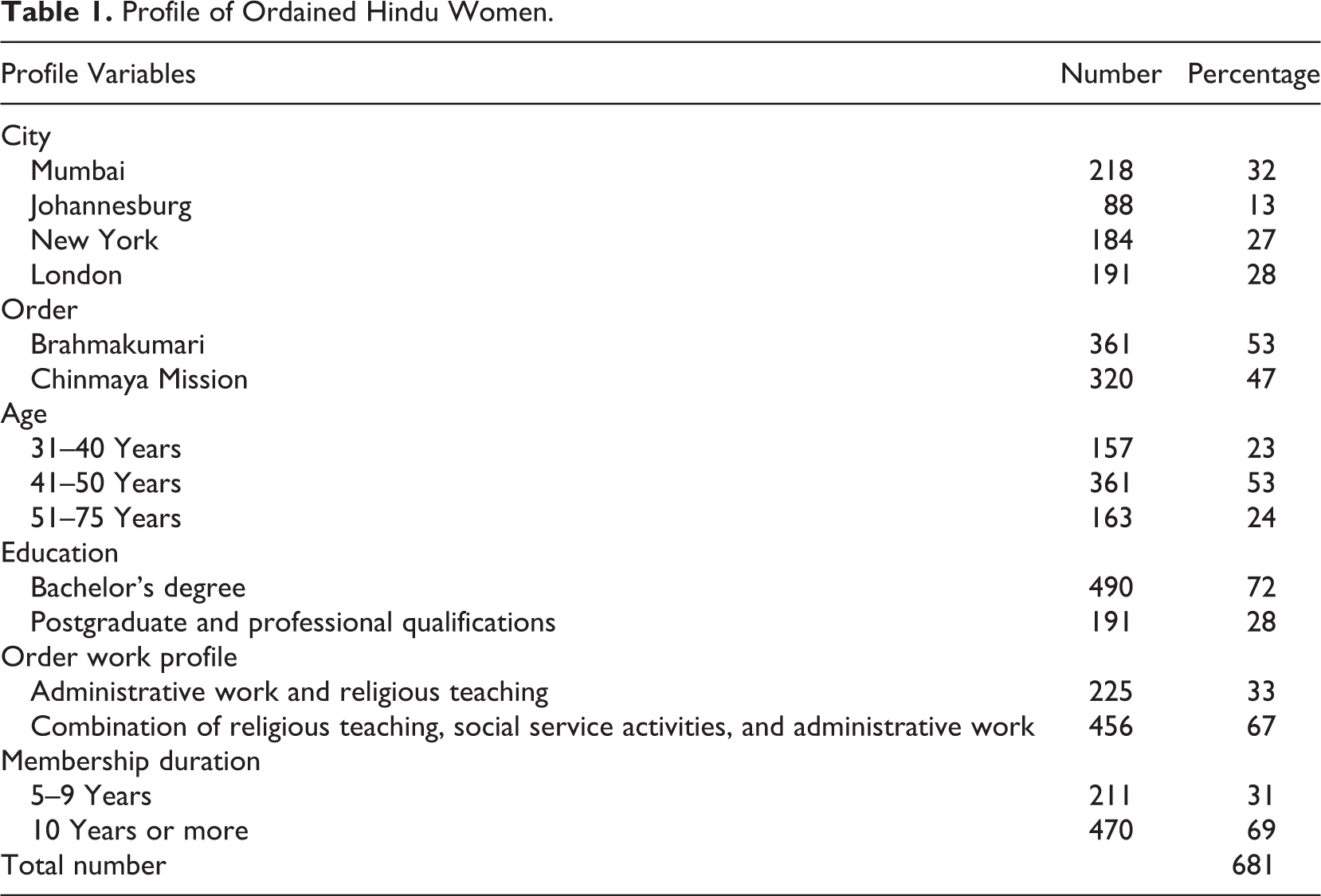
From the two orders selected for the study, a list of ordained Hindu women posted at various centers in the four cities (Mumbai, Johannesburg, New York, and London) was obtained. The rationale for selecting the orders was the huge membership of women therein as well as permission to conduct the survey. The rationale for selecting the cities was the global coverage as well as higher number of centers within, where ordained Hindu women belonging to the orders were posted for furthering the orders’ work. A total of 361 Brahmakumaris and 320 ordained women from Chinmaya Mission across the four cities comprised the sample. From the initial listing of members of each order in each city, every second name was selected and invited to participate in the study. The number of ordained women from both the orders who comprised the sample was 1,362. The city-wise distribution of the sampled members was as follows: Mumbai (218), Johannesburg (88), New York (184), and London (191). The number of Brahmakumaris based in various cities comprising the sample was as follows: Mumbai (115), Johannesburg (47), New York (98), and London (101). The number of ordained women from Chinmaya Mission based in various cities comprising the sample was as follows: Mumbai (103), Johannesburg (41), New York (86), and London (90).
Method and Measures
An interview schedule was used that comprised basic background profile questions as independent variables (city, order, age, education, order work profile, membership duration) and open-ended questions on ordained Hindu women’s views on how commitment to religious orders, celibacy, and social service countered patriarchy (as dependent variables). The dependent outcome measures of feminist attitudes and social service motivation have been measured through two scales: PSMS and FPS.
Scales
FPS developed by Henley, Meng, O’Brien, McCarthy, and Sockloskie (1998) is a 78-item scale divided into 7 subscales to measure the diversity of feminist attitudes. The seven subscales are grouped as follows: Conservative Perspective (10 Items), Liberal Feminist Perspective (10 Items), Radical Feminist Perspective (10 Items), Socialist Feminist Perspective (10 Items), Cultural Feminist Perspective (10 Items), Women of Color Perspective (10 Items), and Fembehave or Feminist Behavior Subscale (18 items). The 10 items of the conservative perspective subscale are reverse coded, and in the 18 items of the fembehave subscale, 3 items are conceived as conservative behavior items and hence reverse coded and an additional 3 items are reverse coded. Hence of the 78 items, a total of 16 items are reverse coded. Scoring of the FPS for this study has been done in a 5-point Likert-type rating ranging from 1 = strongly disagree to 5 = strongly agree. The cumulative FPS score hence ranged from 142 to 326, with higher scores indicating an intensive and diversity encompassing feminist stance (Cronbach α = .93; item-scale intercorrelation = .92; Pearson’s r = .93).
Public Service Motivation Scale (PSMS) developed by Perry (1996) comprises 40-items grouped under six subscales: attention to policy-making (5 items), commitment to public interest (7 items), social justice (5 items), civic duty (7 items), compassion (8 items), and self-sacrifice (8 items). Eleven items are reverse coded: 3 items in the attraction to policy-making subscale, 2 items in commitment to public interest subscale, 1 item in social justice subscale, 4 items in compassion subscale, and 1 item in self-sacrifice subscale. On a 5-point Likert-type rating (1 = strongly disagree to 5 = strongly agree), the score ranges from 84 to 156, with higher scores indicating greater motivation to be involved in public service (Cronbach α = .86; item-scale intercorrelation = .92; Pearson’s r = .94). The reliability tests conducted with the present data set for both the measures were similar to the theoretical values.
The scales were also cross-checked for cross-cultural validity and reliability. The schedule was developed in English and French. For majority of the respondents (93%), the English version was used. The researcher and a small team of four trained investigators at the various subcenters in the four cities, through the Year 2012, conducted face-to-face interviews. The training for investigators comprised orientation to the study objectives, schedule, and the two scales.
Consent and Ethics
Permissions were taken from the respective orders and informed consent was sought from all the ordained Hindu women through a consent form specifying the study objectives and confirming their agreement in responding to the schedule. The study abides by norms of research ethics and conforms to the guidelines of the Declaration of Helsinki.
Analysis
Data have been analyzed using the STATA 13 computer package. For the three open-ended questions, which yielded qualitative responses, two cycles of coding was done with the qualitative data obtained. Two cycles or levels of coding have been done with the qualitative data. At the first level, descriptive coding was done, which entailed summarizing in a word or phrase, the basic topic of a qualitative passage. At the second level, pattern coding was done which meant deriving explanatory or inferential codes, which identified an emergent theme, configuration, or explanation. Based on the existing conceptual categories, and the descriptive codes and emerging newer categories, material was pulled together into parsimonious units of analyses or meta codes. Descriptive statistics has been used to represent the responses of the study questions.
One-way and factorial analyses of variance determine the independent variables influencing the scale scores. Log regression models have been developed to determine independent predictors of ordained Hindu women’s views on how commitment to religious orders counters patriarchy, views on how celibacy counters patriarchy, and how social service by women in religious orders counters patriarchy. Two multiple linear regression models examine predictors of PSMS scores and FPS scores. Two structural equation models determine the effects of city and order-related variables (such as work profile and membership duration) on the PSMS and FPS scores of the ordained Hindu women as well as the covariance between the independent variables. The analysis has been geared to understand aspects and variations on ordained Hindu women’s views on religious order membership, celibacy, and social service on countering patriarchy, as well as independent effects and predictors of the two outcome measures: PSMS and FPS.
Ordained Hindu Women’s Profile
Table 1 depicts the profile of ordained Hindu women. Ordained Hindu women who were part of either the Brahmakumari or Chinmaya Mission orders for minimum 5 years were included for the purpose of the study so as to attain data on their views based on some prior experiences with order life.
Profile of Ordained Hindu Women.
Results
Ordained Hindu Women’s Views on How Commitment to Religious Orders, Celibacy, and Social Service in the Order Counter Patriarchy
Ordained Hindu women proposed two broad ways in which commitment to religious order counters patriarchy: by challenging the cultural timetables set for women on marriage and motherhood (59%) and, by asserting the idea of an independent woman’s existence not defined by traditional roles of wife and mother (41%). They said that celibacy counters patriarchy by foregrounding asexuality and hence transcending gender binaries (83%), and shifting the focus on the sexuality of women to more existential and transcendental aspects of her existence (17%). Ordained Hindu women further said that social service by women in religious orders counters patriarchy by promoting ideas of universal equity and justice (69%) and giving a different meaning to feminist care ethics by combining it with women’s religious roles (31%).
The logistic regression models were significant (Table 2). For the model identifying significant predictors of how commitment to the order counters patriarchy, the odds ratio of the predictors city, order work profile, and order membership duration were significant (prediction success = 28.96%). Ordained Hindu women from New York and London, those who did a combination of religious teaching, social service, and administrative work in the order and those who were order members for 10 years or more, were more likely to say that patriarchy was countered by women’s commitment to the order as that challenged cultural timetables of marriage and motherhood. Ordained Hindu women from Mumbai and Johannesburg, those who did religious teaching and administrative work in the order and those who belonged to the order for 5–9 years, were more likely to say that women’s commitment to the order countered patriarchy by asserting the idea of an independent woman’s existence not defined by traditional roles of wife and mother.
Logistic Regression Predictors of Ordained Hindu Women’s Views on How Commitment to Religious Orders Counters Patriarchy, on Celibacy as Countering Patriarchy and How Social Service by Women in Religious Orders Counters Patriarchy.
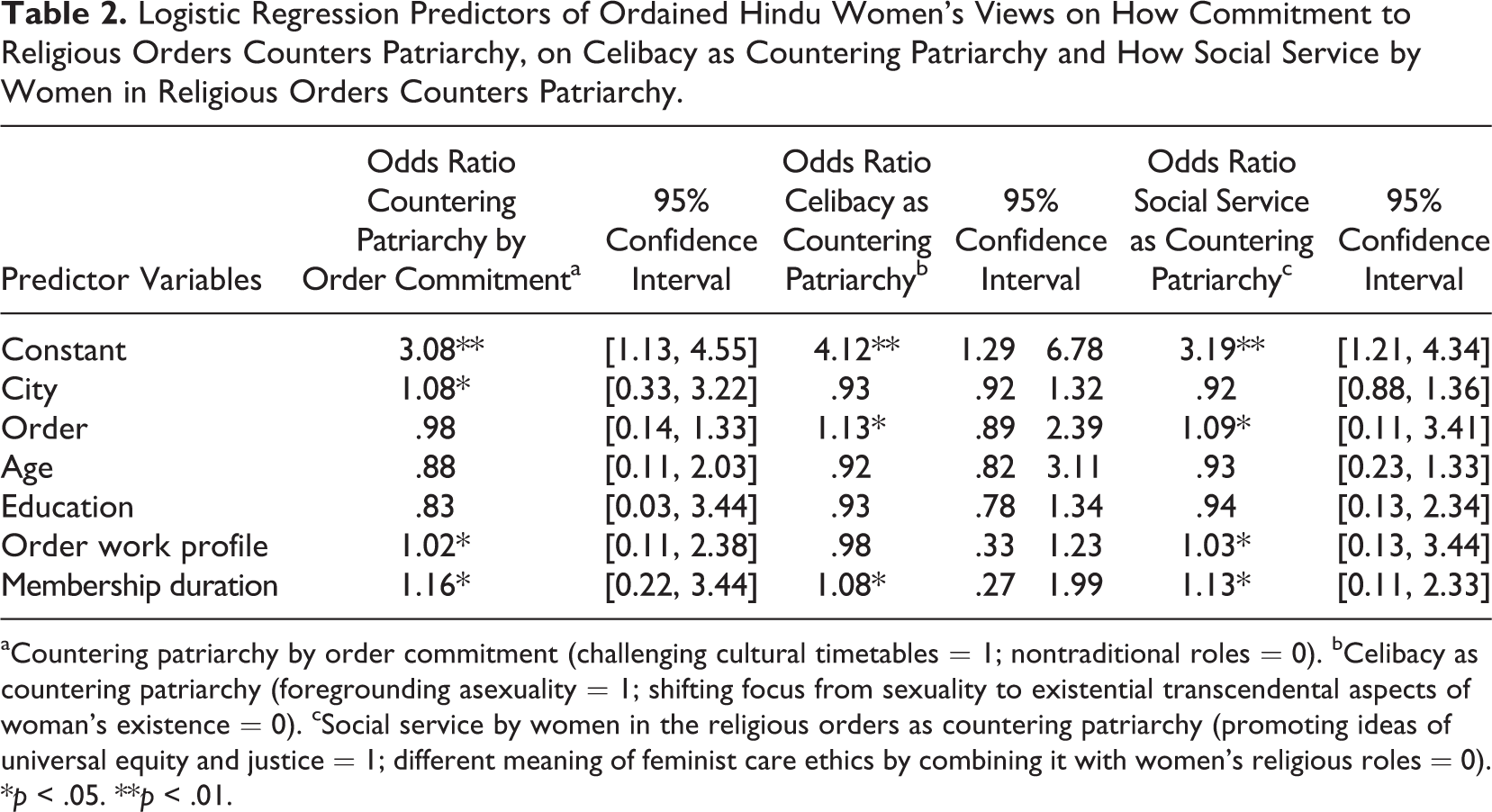
aCountering patriarchy by order commitment (challenging cultural timetables = 1; nontraditional roles = 0). bCelibacy as countering patriarchy (foregrounding asexuality = 1; shifting focus from sexuality to existential transcendental aspects of woman’s existence = 0). cSocial service by women in the religious orders as countering patriarchy (promoting ideas of universal equity and justice = 1; different meaning of feminist care ethics by combining it with women’s religious roles = 0).
*p < .05. **p < .01.
In the model identifying significant predictors of how celibacy counters patriarchy, the odds ratio of the predictors order and membership duration are significant (prediction success = 32.16%). Women belonging to the Brahmakumari order and those who belonged to the order for a longer duration, that is, 10 years or more, were more likely to say that celibacy countered patriarchy by foregrounding asexuality and hence transcending gender binaries. On the other hand, women belonging to the Chinmaya Mission order and those who were order members for a shorter duration, that is, 5–9 years, were more likely to say that celibacy countered patriarchy by shifting focus from sexuality of women to more existential and transcendental aspects of her existence.
Finally, in the log regression model determining significant predictors of how social service by women in the religious orders countered patriarchy, the odds ratio of order, order work profile, and membership duration were significant (prediction success = 29.16%). Women from the Brahmakumari order, those who did a combination of religious teaching, social service, and administrative work in the order, and those who belonged to the order for a longer duration, were more likely to say that social service by women in religious orders counters patriarchy by promoting ideas of universal equity and justice. On the other hand, women from the Chinmaya Mission order, those who did religious teaching and administrative work in the order, and those who were more recent entrants into the order, were more likely to say that women’s social service in the order countered patriarchy by giving a different meaning to feminist care ethics by combining service with women’s religious roles.
FPS Scores
The average FPS scores of the ordained Hindu women was 297.63 (SD = 15.98). One-way analyses of variance showed that the effects of city, order, work profile, and duration of membership were significant. Post hoc analyses using Scheffe post hoc criterion for significance indicated that the average FPS scores were higher for ordained Hindu women from New York and London (M = 302.87, SD = 13.89) vis-à-vis Mumbai and Johannesburg (M = 291.38, SD = 14.09), F(3, 6080) = 341.87, p = .02. FPS scores were higher for women from both the orders, but the statistical differences were significant. The average FPS scores were higher for the ordained Hindu women belonging to the Brahmakumari order (M = 304.56, SD = 3.88) vis-à-vis the Chinmaya Mission order (M = 294.31, SD = 14.52), F(1, 6080) = 288.72, p = .03. Based on this statistical difference, this means that Brahmakumari women had more intensive and diversity encompassing feminist attitudes than ordained Hindu women of the Chinmaya Mission. The average FPS scores were higher for ordained Hindu women who did a combination of religious teaching, social service, and administrative work in the order (M = 304.52, SD = 13.28) vis-à-vis religious teaching and administrative work alone (M = 286.39, SD = 12.98). The average FPS scores were higher for ordained Hindu women who were part of the order for 10 years or more (M = 308.96, SD = 12.38) vis-à-vis for those who were order members for a shorter duration, that is, 5–9 years (M = 285.34, SD = 12.38), F(1, 6080) = 289.30, p = .03. The FPS scores of the ordained Hindu women were further subjected to a four-way analysis of variance having two levels of city base (New York and London; Mumbai and Johannesburg), order (Brahmakumaris and Chinmaya Mission), work profile (combination of religious teaching, social service, and administrative work; religious teaching and administrative work), and duration of order membership (5–9 years; 10 years and above). All the effects were significant at 5% significance level. Interaction effects were nonsignificant F(3, 6080) = 165.29, p = .33.
In the regression model depicted in Table 3, the adjusted R 2 is 42.76%, that is, about 43% of the variability of the FPS, can be explained by sociodemographic profile predictors. The standard error of the estimate or the unexplained variability is 1.7982. Furthermore, model significance is through F-test statistic = 8.79, p < .01, referring to the fact that at least one predictor is significantly influencing the dependent variable. Coefficient wise significance is depicted through t-test values. The predictors that are significantly related to FPS scores are city, order, education, and order work profile. The coefficient of variance for regression is 8.23%, which means that this model can be used for prediction purposes.
Multiple Linear Regression—Predictors of Ordained Hindu Women’s FPS Scores Coefficients.a
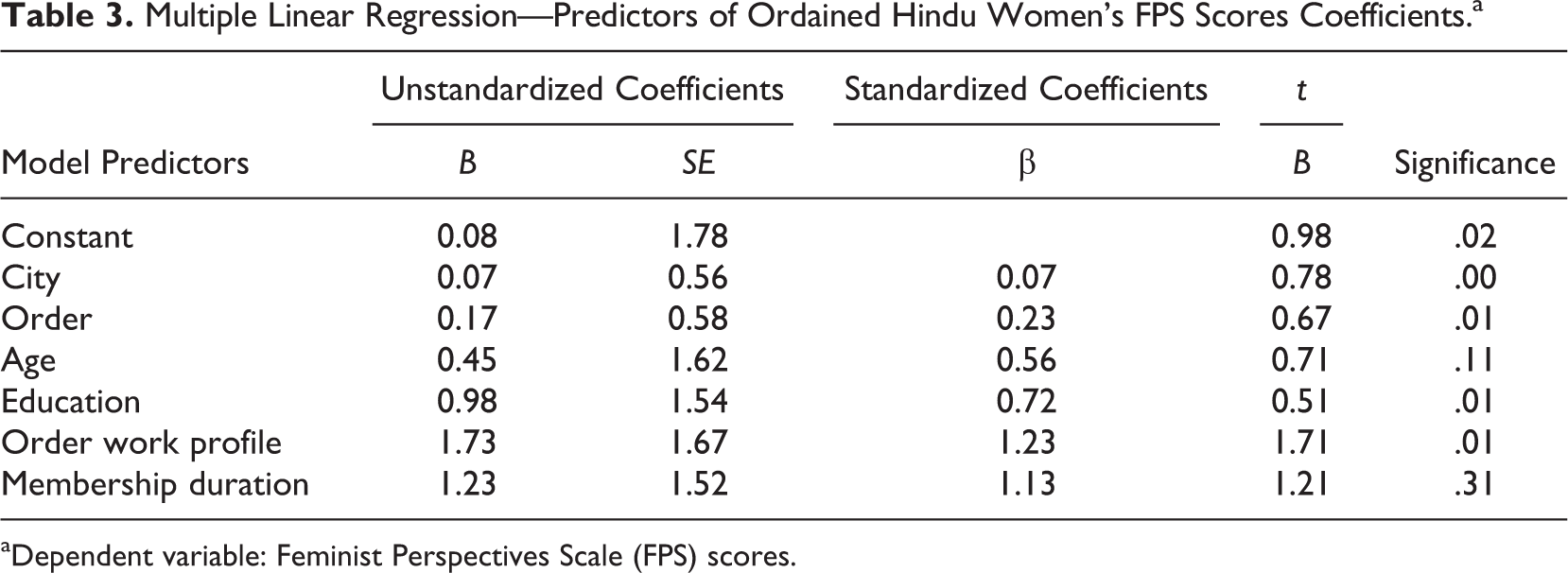
aDependent variable: Feminist Perspectives Scale (FPS) scores.
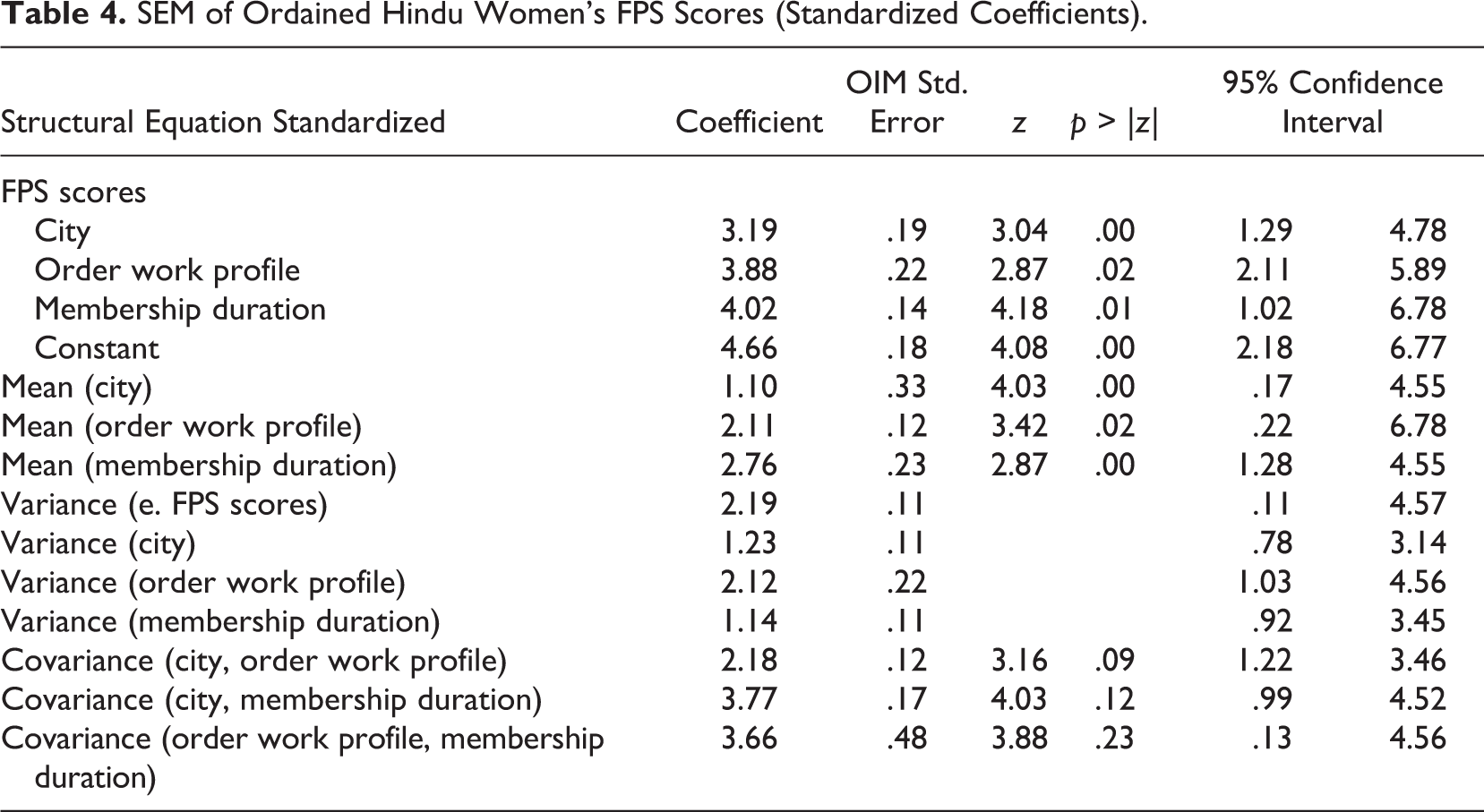
To further test the significance of city and order-related variables (work profile and duration) as predictors of FPS scores, structural equation model using maximum likelihood method and standardized coefficients has been developed (Table 4) with four iterations and log likelihood = −201.18. The Structural Equation Model (SEM) shows that all the city and order-related variables influence the FPS scores of the ordained Hindu women. The goodness-of-fit measures are also significant, indicating model reliability, χ2(2) = 49.87, p < .001; GFI = .94; NFI = .94; RMSEA = .04. None of the covariances are significant.
SEM of Ordained Hindu Women’s FPS Scores (Standardized Coefficients).
PSMS Scores
The average PSMS score of the ordained Hindu women was 109.28 (SD = 8.03). One-way analyses of variance showed that the effects of work profile in the order and duration of order membership were significant. Post hoc analyses using Scheffe post hoc criterion for significance indicated that the average PSMS scores were higher for ordained Hindu women who did a combination of religious teaching, social service activities, and administrative work in the order (M = 113.78, SD = 7.38) vis-à-vis those who engaged solely in religious teaching and administrative work (M = 105.23, SD = 8.38), F(1, 6080) = 89.32, p = .02. The average PSMS scores were higher for ordained Hindu women who were a part of the order for 10 years of more (M = 117.89, SD = 7.28) vis-à-vis those who were a part of the order for 5–9 years (M = 106.89, SD = 9.03), F(1, 6080) = 118.62, p = .03. The average PSMS scores were further subjected to a two-way analysis of variance having two levels of work done in the order (combination of teaching, social service, admin; teaching and admin) and order membership duration (10 years or more, 5–9 years). All the effects were significant at 5% significance level. Interaction effects were nonsignificant F(1, 6080) = 79.23, p = .37.
In the regression model depicted in Table 5, the adjusted R 2 is 44.63%, that is, about 45% of the variability in the ordained Hindu women’s PSMS scores, can be explained by sociodemographic profile predictors. The standard error of the estimate or the unexplained variability is 1.8082. Furthermore, model significance is through F test statistic = 9.89, p < .01, referring to the fact that at least one predictor is significantly influencing the dependent variable. Coefficient wise significance is depicted through t-test values. The predictors that are significantly related to the ordained Hindu women’s PSMS scores are: city, order, and order work profile. The coefficient of variance for regression is 7.88%, which means that this model can be used for prediction purposes.
Multiple Linear Regression—Predictors of Ordained Hindu Women’s PSMS Scores Coefficientsa.
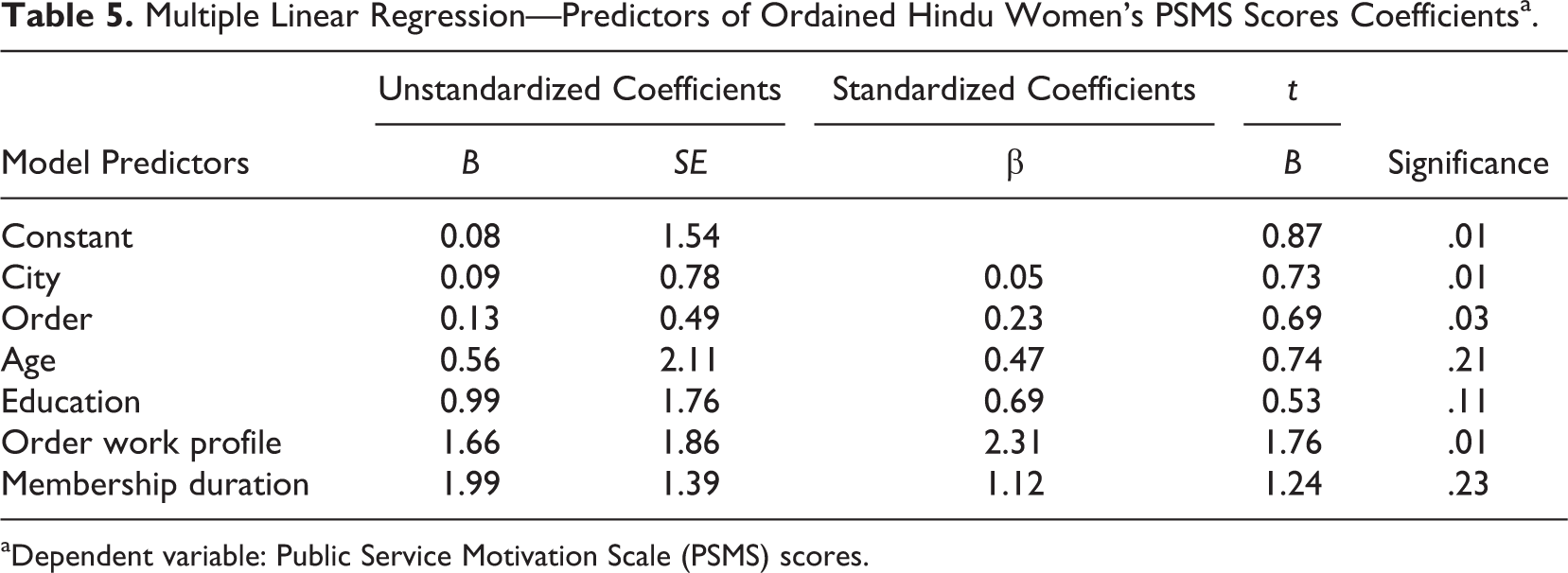
aDependent variable: Public Service Motivation Scale (PSMS) scores.
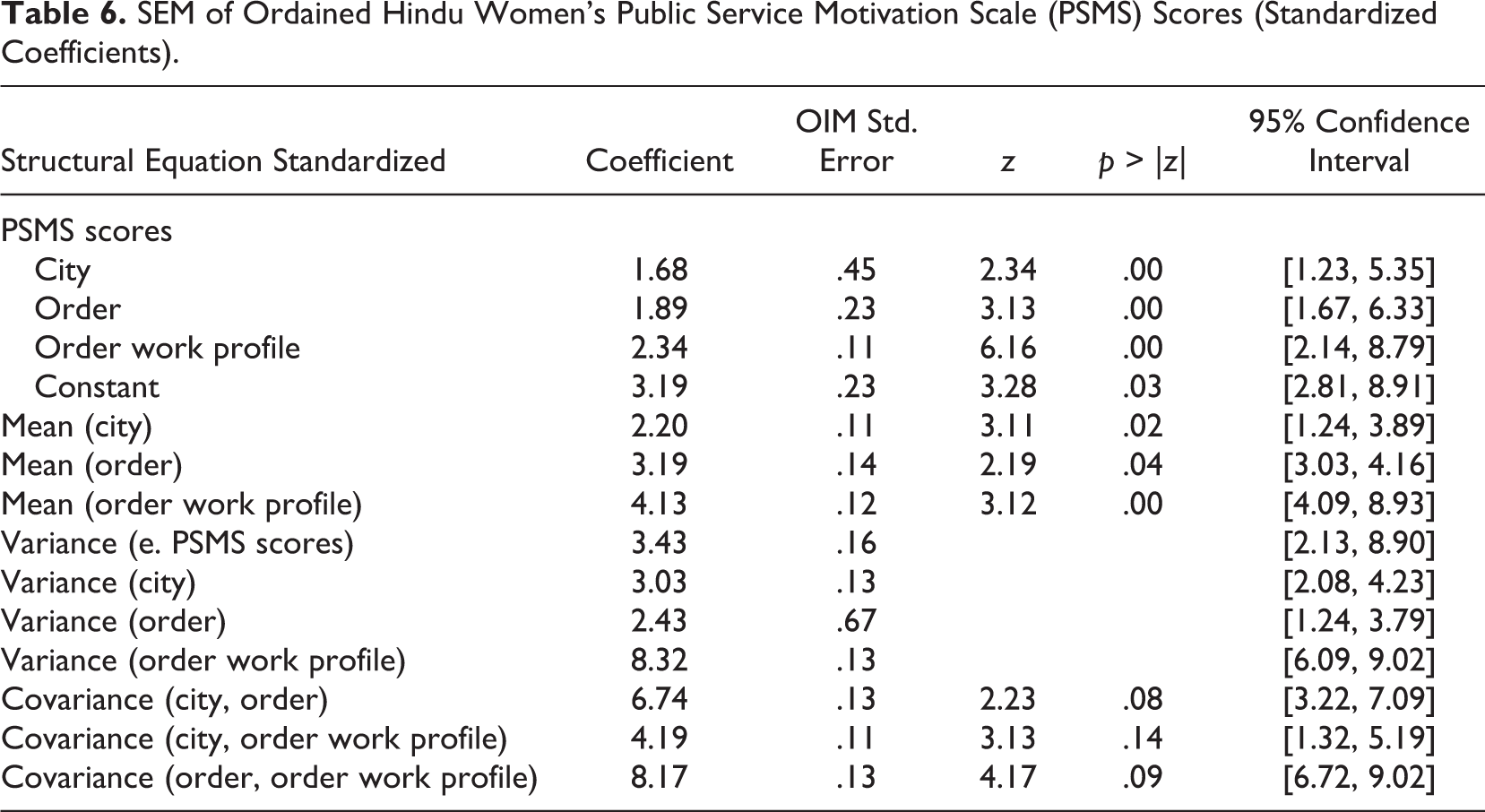
To further test the significance of city and order-related variables, structural equation model with standardized coefficients has been developed (Table 6) using the maximum likelihood method, four iterations and log likelihood= −187.83. The SEM shows that city, order, and order work profile influence the PSMS scores of the ordained Hindu women. The goodness of fit measures were also significant, indicating model reliability, χ2(2) = 38.76, p < .001; GFI = .93; NFI = .96; RMSEA = .05. None of the covariances are significant.
SEM of Ordained Hindu Women’s Public Service Motivation Scale (PSMS) Scores (Standardized Coefficients).
Discussion and Conclusion
Results prove the initial hypotheses. Ordained Hindu women believed that commitment to religious orders, celibacy, and social service countered patriarchy. Variations existed in views of women aligned to centers of orders in relatively affluent cities (New York and London) vis-à-vis Mumbai and Johannesburg, those who did a combination of religious teaching, social service, and administrative work in the order vis-à-vis sole focus on religious teaching, and those who were members of the order for a longer duration, that is, 10 years or more vis-à-vis newer entrants. Specifically, Brahmakumaris differed from the Chinmaya Mission women on views on celibacy, with Brahmakumaris emphasizing on asexuality and Chinmaya Mission members focusing on sublimation of sexual needs towards transcendentalism as the bulwark of opposition to patriarchy. In terms of social service as countering patriarchy, Brahmakumaris saw it being done through promoting ideas of universal justice and Chinmaya Mission members put a premium on feminist care ethics. Order-related variables such as work done and duration of being ordained were impactful variables, with actual engagement in service and longer duration of membership contributing to more evolved and mature views. City-wise variations also existed, with ordained women aligned to centers based on New York and London having different views vis-à-vis those based in Mumbai and Johannesburg. While this needs a further and more focused investigation, two possibilities emerge: City-wise differences could be attributable to differences between orders, or city spaces and associated cultures contribute to differences in worldviews of ordained women.
The FPS and PSMS scores were higher for ordained Hindu women who did a combination of religious teaching, social service, and administrative work in the order as well as those who were senior order members, vis-à-vis those who focused on religious teaching alone and those who were recent entrants. Log regression and structural equation models also showed that Brahmakumaris, ordained Hindu women residing in affluent cities, and those who were better qualified than their counterparts, that is, having postgraduate and professional qualifications, scored higher on the FPS and PSMS.
Results overall suggest that ordained Hindu women promote the womanist or feminist agenda from a Hindu feminist theological standpoint (DeNapoli, Pechilis, Khandelwal, and Hausner) with variations due to city location, duration of being ordained, and versatile work profile within the order (combination of religious teaching and social service). Higher scores on the FPS are emblematic of diverse feminist attitudes which women of the order possess, foregrounded cumulatively through social service, which is their core means of reaching out. The diversity of feminist attitudes essentially transcend the conservative perspective, to more liberal, radical, socialist, cultural, and intersectional perspectives.
This would mean that ordained Hindu women of the two orders are inclined to believe and promote some of the following core ideas on feminism: the choice of traditional or alternative family is a matter of personal choice; role of the state in ensuring equal opportunities for women; women’s right to work outside home; personal freedom in sexual orientations; engendering law for women’s empowerment; and addressing men, patriarchy and the male psyche. Further, ordained Hindu women are also likely to promote freedom from sexual exploitation of women, the act of celibacy being an innovative, and theological premise on which to argue for sexual freedom of women. The initiative of joining the order is a feminist theological assertion, which challenges patriarchal dominance in matters of religion and divinity. Further feminist value of care is redefined by women of the order as womanhood is performed not through traditional caring roles (of wife and mother), but nontraditional roles of social service for the wider publics, and patronizing values of peace, caring, and nonviolence, within a theological frame of reference.
Study Limitations
One of the core study limitations is the absence of qualitative narratives of women within the orders, and their ideas of empowerment, emancipation as well as possible micropolitics of power. Further the study does not answer two important questions, which could form the focus for further research. The first question is the extent to which the intrinsic faith orientation influences feminist attitudes of ordained Hindu women. The second question is the difference in the development of feminist attitudes and social service motivation of the ordained Hindu women due to the reason for joining the order, that is, choice or circumstances. In the present survey, the second question also emerged as a practical limitation. This was because all women within the order saw their membership therein as a performance of duty and their being the chosen ones (DeNapoli, 2009), irrespective of their original and actual reason for coming into it. Hence more engaging research is needed to understand how this performance can be deconstructed to actually comprehend the inner lives and worldviews of the ordained Hindu women, or to authoritatively establish the impossibility of being able to do so.
Practical Implications
The results have practical implications for the domain of women and social work, for the discipline of social work and for feminist theology. For the domain of women and social work, this study results talk of a cohort of women who perform service as a matter of religious duty and theologically motivated ideas of the greater common good.
For the discipline of social work and the discourse on values, this is a different form of feminist care ethics, beyond natural kinship ties. Ordained Hindu women promote a worldview that mainstream helping ethics could be patriarchal and hence a consciousness is needed which looks for alternatives to present structures. The move is to go beyond objectivism/scientism, akin to what philosopher Polanyi proposed as ontological reorientation. There is an emphasis on a feminist inspired dialogic position on social desirables such as equity, rights, and justice. Common good and public good are thus redefined simultaneously as norms, normative and patriarchal structures are simultaneously challenged through the act of social service and by role modelling for the service recipients.
One core category herein is transcendence, which is to be attained through Hindu feminist theological praxis/practice comprising ideals of duty, destiny, and devotion (see DeNapoli, 2013; Pechilis, 2004, 2012). This is further driven by consciousness of universal goodness, temporality (i.e., the urgency of action) and a shared language of intersubjectivity with followers and service recipients.
For feminism and feminist theology in particular, results argue for renunciation, celibacy, and social service by ordained women as a determinate way to realize the feminist theological goals of deconstructing patriarchal hegemony in religion.
Footnotes
Declaration of Conflicting Interests
The author(s) declared no potential conflicts of interest with respect to the research, authorship, and/or publication of this article.
Funding
The author(s) received no financial support for the research, authorship, and/or publication of this article.