




Abstract
Feminist scholarship highlights the key role the family plays in promoting or hindering gender equality. This article explores how young university students (N = 1,038) imagine their future regarding family arrangements in the Maule region (Chile). Quantitative and qualitative data suggest young people recognize and value diversity in family ideals, with significant gender differences. However, Chilean legislation and public social policy take the traditional family as the blueprint for state action, jeopardizing those projects that depart from the traditional one. Public policy and social work need to acknowledge the multiplicity of family ideals held by the younger generations to promote gender equality.
Feminist scholarship has highlighted the important role the family, as an institution, plays out in promoting or hindering gender equality and women’s opportunities to make an autonomous life plan. This discussion becomes a key one at a time in which families are changing around the world. Marriage is becoming less common, fertility rates are declining, more women than ever are engaging in paid work outside the house, and the relationships between parents and their offspring often have to be redefined in light of the new ways that mark the entrance into adulthood for young people (Juárez & Gayet, 2014). Yet, some inequalities entrenched in family dynamics remain, such as the unequal distribution of domestic and carework along gender lines and legal mechanisms that establish differentiated rights regarding property for married men and women (International Labour Organization [ILO], 2016).
This article seeks to examine how a sample of students (N = 1,038) attending university in 2016 in the Maule region (southern Chile) imagine their future regarding family life. This, in order to better understand the dynamics of change in a society that has undergone rapid economic and demographic transformation in the last three decades, but still remains fairly conservative in cultural and legislative terms. As is well known, the country was the location for a socioeconomic experiment under Augusto Pinochet’s rule (1973–1989) that liberalized the economic system, undermining mechanisms of social protection that were based on the ideal of the traditional, biparental family (Thomas, 2011). But at the same time, it promoted an environment of social and sexual conservatism that lingered long after the country returned to institutional democracy and normal legislative activity. For instance, legal differences between children born in and out of wedlock existed until 1998, and a law on divorce was promulgated as recently as 2004. As it is often the case, social practices were changing at a different, faster pace. Because of this, Chileans born in the decade of 1990 grew in a context of multiple family models and arrangements not always recognized by the state. We argue that this has direct implications for social work practice, considering the profession’s goal of enabling people to live with greater success in realizing their potential and addressing life’s challenges, without imposing values or worldviews on them (Murphy, Duggan, & Joseph, 2013), even if these are condition for accessing the state.
Young Chileans born in the 90s are the focus of our study. The reasons for focusing on this particular group are 2-fold: On the one hand, research has shown a linkage between higher levels of formal education and a more critical stance regarding traditional family and gender norms (Programa de las Naciones Unidas para el Desarrollo [PNUD], 2010). On the other hand, college-educated women have increased their levels of participation in the workforce in greater proportions than any other group of Chilean women, reaching 77.5% in 2013 (Ministerio de Desarrollo Social de Chile, 2015) compared to the national average of 45.5%. Although in this regard Chile lags behind other Latin American countries with similar levels of demographic and economic development (Contreras, Hurtado, & Sara, 2012), this signals a change in gender roles and expectations for this group. The Maule region is particularly interesting in this regard because it is Chile’s most rural area. In Maule, average women’s participation in the workforce reaches only 39.6%, below the national average of 45.5% (Ministerio de Desarrollo Social de Chile, 2015), despite having an important percentage of women with tertiary education.
Methodologically, this article is based on quantitative and qualitative techniques to understand how these young women and their male peers imagine their future when they think about the challenge of setting up their own families and households.
A Changing Context: More Diversity, More Equality?
The demographic and social transformations occurred in Chile since the decade of 1990 are part of a tendency found in most Latin American countries (Ullmann, Maldonado, & Rico, 2014). From a sociodemographic viewpoint, such trends point toward longer life expectancy, falling fertility rates—the average number of children per women in Chile fell from 2.4 in 1992 to 1.9 in 2014—and changing attitudes toward marriage and parenthood. After a golden age for marriage that took place between the decades of 1930 and 1970, the number of marriages in Chile started to decline from 1980s onward. Marriage was also being delayed: The average age for (first) marriage for women rose from 26 years old in 2000 to 32.3 in 2013 and from 28.8 to 35.1 for men in the same period (Instituto Nacional de Estadísticas, 2014). According to national data, marriage is still a valued institution, but the percentage of people who thinks about it as a long-life commitment has sharply decreased, especially among ages 18–25 (PNUD, 2010). This is probably due to an ongoing process of secularization that has stripped marriage of its religious value in a nominally Catholic country (Valenzuela, Bargsted, & Somma, 2013) but also to the growing legitimacy of other forms of establishing long-term relationships, like cohabitation, among young people.
The size and composition of Latin American families have also experienced a growing diversification. Two-parent families are still the biggest proportion in the region, but their numbers tend to diminish in favor of single-parent households, mostly headed by women (Child Trends, 2015). In Chile, the percentage of women heads of household rose from 20.2 in 1990 to 37.9 in 2013; of these, 88% support their families single-handedly (Ministerio de Desarrollo Social de Chile, 2015). However, the growing diversity in family arrangements was not coupled with legislation or social conditions that would make possible to attain greater gender equality, despite the intentions manifested by the democratic governments of the Concertación 1 to do so.
Although there were significant improvements, such as the approval and enactment of legislation on domestic and gender violence in 1994 and 2005, the so-called agenda valórica (value-laden agenda) regarding gender and family issues moved rather slowly. The approval of a law on divorce took 10 years (1994–2004) and a bitter legislative debate (Gómez, 2014), making Chile the last Latin American country to pass a law on divorce. Chilean legislation did not grant legal status to consensual unions either until April 2015, when a bill on the matter was approved. Before this legislation (Law 20.830), new unions after separation had no legal existence. Thus, couples living together for years had no recognition from the state, posing issues concerning social rights, property, and parentage. The new legislation allows same-sex unions, but legislators were very careful about making clear that the new law sought to resolve property issues without challenging the heterosexual nature of legal marriage.
In a similar vein, the way in which couples split up paid work and family responsibilities did not receive attention until very recently. International data suggest there is no one dominant pattern for dividing paid and domestic work in any world region (Child Trends, 2015), but that this type of arrangement is influenced by the educational and job opportunities women and men may encounter. Affordable, good quality support services for the care of children and the elderly also play a role. This is important because the load of domestic and carework imposed on women due to cultural reasons hinders their possibilities of making progress in other areas of life, such as paid work and professional training (Chopra, Kelbert, & Iyer, 2013; ILO, 2016). In Chile, there is an important gap between women’s and men’s participation in the workforce: Women’s employment is highly dependent on levels of formal education, whereas men’s employment is not. Also, there is a significant gender gap in salaries across all educational levels—a gap that averages 17% (Brega, Durán, & Sáez, 2015), but increases with the number of years of formal training a woman acquires. These differences are at least partially explained by the cultural assumption that women’s “proper” role is at home, taking care of children or otherwise dependent family members; a role that would make them unreliable or costly in their employers’ eyes (Brega et al., 2015). National data suggest that traditional gender norms regarding family responsibilities would explain what Contreras, Hurtado, and Sara (2012) call the Chilean exception: a highly educated female population (only surpassed by Cuban women) with low levels of engagement in the workforce. The relative exception are college-educated women.
As Staab (2012) points out, the historical “maternalism” of Chilean social policy implies that women’s unpaid work within the family has been taken for granted as a basis for social welfare. Thus, reforms in this area have sought to make easier for women to conciliate the often competing demands of earning and caring instead of attempting to involve men or expand state-sponsored facilities (Blofield & Martínez, 2015). Even the remarkable expansion of day care public centers under Michelle Bachelet’s administrations (2006–2010 and 2014–) has been made under the logic of equalizing opportunities for children but not necessarily for women. Yet, it represented an improvement in terms of including impoverished women outside the labor market in the day care system. But for middle-class women in the labor market, the right to day care is still tied to the number of female employees an organization has 2 (art. 203 of the Labor Code), instead of the number of employees with children in a given company. Even the extension of maternity leave from 12 to 24 weeks (Ley N°, 20.545/2011), which opens the possibility for men to take paid leave to care for their young children, is not mandatory but depends upon the mother’s decision to cede this right to her partner. Until 2015, only 0.3% of fathers had made use of this right, showing the persistence of the traditional gender division of labor regarding childcare.
Nonetheless, processes of secularization and modernization (however, incomplete) have opened up new possibilities for Chilean young women: for instance, to enroll in higher education in unprecedented numbers. Today, more women enter the higher education system than men, and more women finish their professional training than their male counterparts (Sistema de Información para la Educación Superior, 2015). This opens up new opportunities in terms of better earnings and economic independence. Nonetheless, women still concentrate in typically female professions, earn less than their male colleagues, and face highly stratified social policies that do not promote male involvement in carework.
In this context, the literature has documented the need for a more active, personal construction of one’s own biography, when traditional social and economic action frameworks seem to fade. This process, often referred to in literature as “individuation”(Araujo & Martucelli, 2010), implies that individuals face a multiplicity of life options from which to choose, understanding that the leeway to choose varies significantly according to class, gender, age, and ethnicity (Nash, 2008; PNUD, 2012). Thus, processes that were taken for granted in the past—to marry, to have children—are now subjected to a greater margin of personal decision. A hallmark of contemporary societies is that people must now (at least in part) organize their biographies through their own actions and decisions. They must actively “build themselves” as subjects within the framework of a given cultural, social, and economic context. Individuation is, therefore, “a specific analytical perspective of study that inquires about the type of individual that is structurally formed by a society in a given historical period” (Araujo & Martucelli, 2010, p. 8).
This process is ambivalent: On the one hand, it tends to weaken social norms that might have prevented individuals from considering some options as part of their life plan. But on the other hand, it may deepen inequalities, because these changes in social norms often emerge in a context where criteria of social stratification such as class, gender, or ethnicity still operate in practice either through structural constraints or even social public policy that has been framed without considering the new scenarios individuals may face (Manuel, 2006). In the family realm, authors like Fineman (2005) and Nussbaum (2011) have shown how the state (through public policy) is an active agent in shaping families, understood as biological (based on kinship), but also political artifacts. Public policy may encourage people to make or rule out decisions regarding marriage, offspring, and care of family members depending on whether some decisions are rewarded or penalized. Therefore, personal values and preferences have to be mobilized in a context in which public policy may be compatible with certain family ideals but not others.
Young (under 30) university students have grown up against the backdrop of more diverse families, but a diversity that has cost. Social policy frequently does not accommodate these new family arrangements, often putting women departing from the traditional family at the risk of economic hardship and/or the “double burden” represented by having to perform paid and domestic work (Herrera, Salinas, & Valenzuela, 2011). In such a scenario, we believe it is important to have information about how young people—and women in particular—imagine the constitution and inner workings of their own future families. Young people with tertiary education are often the leading edge in social change and, as we have mentioned, college-educated women tend to be more critical of traditional family arrangements than their noneducated peers. Their aspirations differ from the ones held by their male peers too, bringing new challenges for public policy.
Method
Participants
The population focus of our study was composed of a random sample of 1,038 students from three universities: 32.1% male and 67.9%, female. The higher female ratio can be explained by the progressive feminization of careers in health sciences, area that contributes with the highest number of students overall. A vast majority of students (92.4%) are not married or living with a sexual partner and do not have children. Average age was 21 years. Public universities contributed with 43% of the sample, and the remaining 57% came from private institutions. No statistically significant differences along the public/private divide were found. Most students in our sample (75%) belong to the lowest three quintiles of income in the Maule region. Regarding family background with higher education, 12% declared their mothers had complete higher education, whereas 11% declared their fathers achieved the same educational level. In addition to the survey, 48 students participated in focus groups and 12 in individual in-depth interviews.
Procedure
After obtaining the necessary permits from university authorities (school directors), a random sample was obtained from each institution. All students were given information about the study and told their participation was voluntary. The application of the self-administered questionnaire was supervised by experts in the classroom and the average time required to answer the survey was 20 min. Prior to the application, a written form of informed consent was given to each one of the participants, who had to sign it to give their explicit consent to the use of data for scientific purposes. A standard demographic questionnaire was administered to assess participants’ gender, age, family background, marital status, and family income among other data. Participants’ perceptions on family issues were registered using a self-administered questionnaire based on Likert-type scales, specifically elaborated for this study. Content validity was assessed through experts’ judgment (five experts on youth and family issues), process that determined the final number of items on the instrument based on the criterion of 80% of the experts agreeing on an item. The questionnaire was then validated on a sample of 45 students for clarity of language and nonambiguity of the items. Once the data were processed using the SPSS statistical package (Version 21), we carried out descriptive analyses and χ2 tests in order to assess the possible existence of gender differences.
Students were also invited to provide qualitative information through their participation in a focus group or individual in-depth interview. In all cases, participants were given another form of informed consent prior to the interviews. Steps were also taken to ensure anonymity and confidentiality of data. Firstly, four mixed-sex focus groups of 12 participants each were carried out, with the purpose of exploring the main topics derived from the survey’s results. The data were processed using the Atlas.ti software (Version 7) in order to identify recurring ideas and associations on gender and family in the students’ discourses. Open coding was initially used. Then, recurring themes were consolidated into a list of categories. For instance, “love relationships” was coded to categories such as personal meaning, importance for personal project, expectations, reasons for staying in a relationship or leaving it, and links with expectations about having children. The type of relationships established between codes (contradiction, complementary, subordination, etc.) was also registered. In a third stage, the results of coding for male and female participants’ were compared in order to assess differences and similarities and find patterns regarding both the topics covered and the type of relationships established between categories (Saldaña, 2009). With this information, a different set of 12 female students were invited for individual in-depth interviews, with the purpose of checking and expanding our understanding of the students’ discourse. The same process of analysis was carried out with this group. The first author undertook qualitative data analysis in consultation with the second author. The findings were sent for checking to a third specialist, not involved in this research, to minimize bias. Positive feedback was received. The focus of this analysis was the ways in which students understand family and how they imagine their own future in this regard, considering family choices in the context of a life plan that includes other, related options, such as personal or professional development.
Results
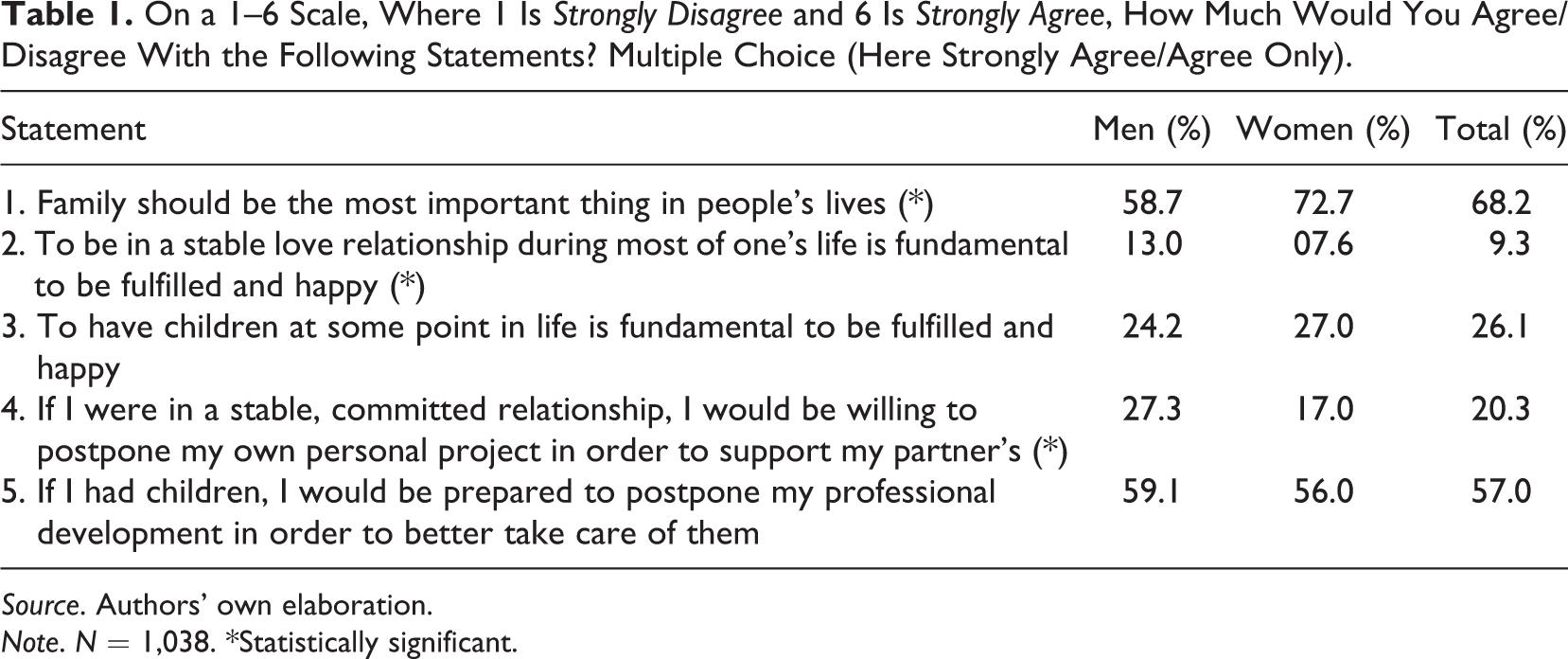
In order to place youngsters’ family ideals and future choices in the context of a life plan, it was first necessary to gather information about the importance attached to family as an element of happiness or personal fulfillment. Table 1 provides information on this point.
On a 1–6 Scale, Where 1 Is Strongly Disagree and 6 Is Strongly Agree, How Much Would You Agree/Disagree With the Following Statements? Multiple Choice (Here Strongly Agree/Agree Only).
Source. Authors’ own elaboration.
Note. N = 1,038. *Statistically significant.
As Table 1 shows, young women tend to agree in greater numbers than their male peers with the idea that family is of the greatest importance in people’s lives (Statement 1, χ2 = 24.72, p = .000, Cramer’s V = .346). However, they do not attach the same importance to have a stable love partnership (Statement 2): In fact, they agree in a smaller proportion than men on having a partner/spouse as a key factor to be fulfilled and happy (7.6% vs. 13.0%, χ2 = 28.24, p = .000, Cramer’s V = .255). Women are also less inclined to postpone or give up their own personal projects in favor of a partner’s or spouse’s plans, even when in a stable, committed relationship (Statement 4), although here the association is weaker (χ2 = 34.69, p = .000, Cramer’s V = .184). Relationships with children are a different matter: Answers are much more divided on the issue, with no statistically significant differences by sex. Also, both men and women declare to be prepared to postpone their professional development in order to better take care of their children (again, no statistically significant differences were found). These results suggest that, within the idea of family, the sense of commitment toward children is different from the sense of obligation toward a spouse.
Qualitative data help to understand this difference. A majority of our informants—especially women—pointed out that whereas romantic love (and thus romantic partnership) may be uncertain and cannot be conceived of as a basis for a life project from an emotional viewpoint, children should represent an integral part of a life project for those who want them. They are at the core of the idea of family. But for women, children and a spouse do not necessarily go together in the long run, no matter how desirable a long-term partnership may be. Men, by contrast, tend to have the women-and-children binomial more present, which is probably related to a context in which usually children stay with the mother after a divorce. The following quotes illustrate this idea: I think people fall in love and think “Oh, this is going to be forever.” But it is so rarely the case […] Long relationships are full of issues [that are important]. You get to know your partner better, and then you may discover that things do not work. But a child is for life, it is maybe the only love that will really last. (Female, 22 years old, no children) I saw my parents trying to stay together because they had to. [It] did not work, and then my Mum had to take care of us [two siblings] on her own. We did not get to see much of my Dad. I think you can make a mistake in choosing a girlfriend, that is ok, but [regarding] who you have children with, that is complicated. (Male, 22 years old, no children)
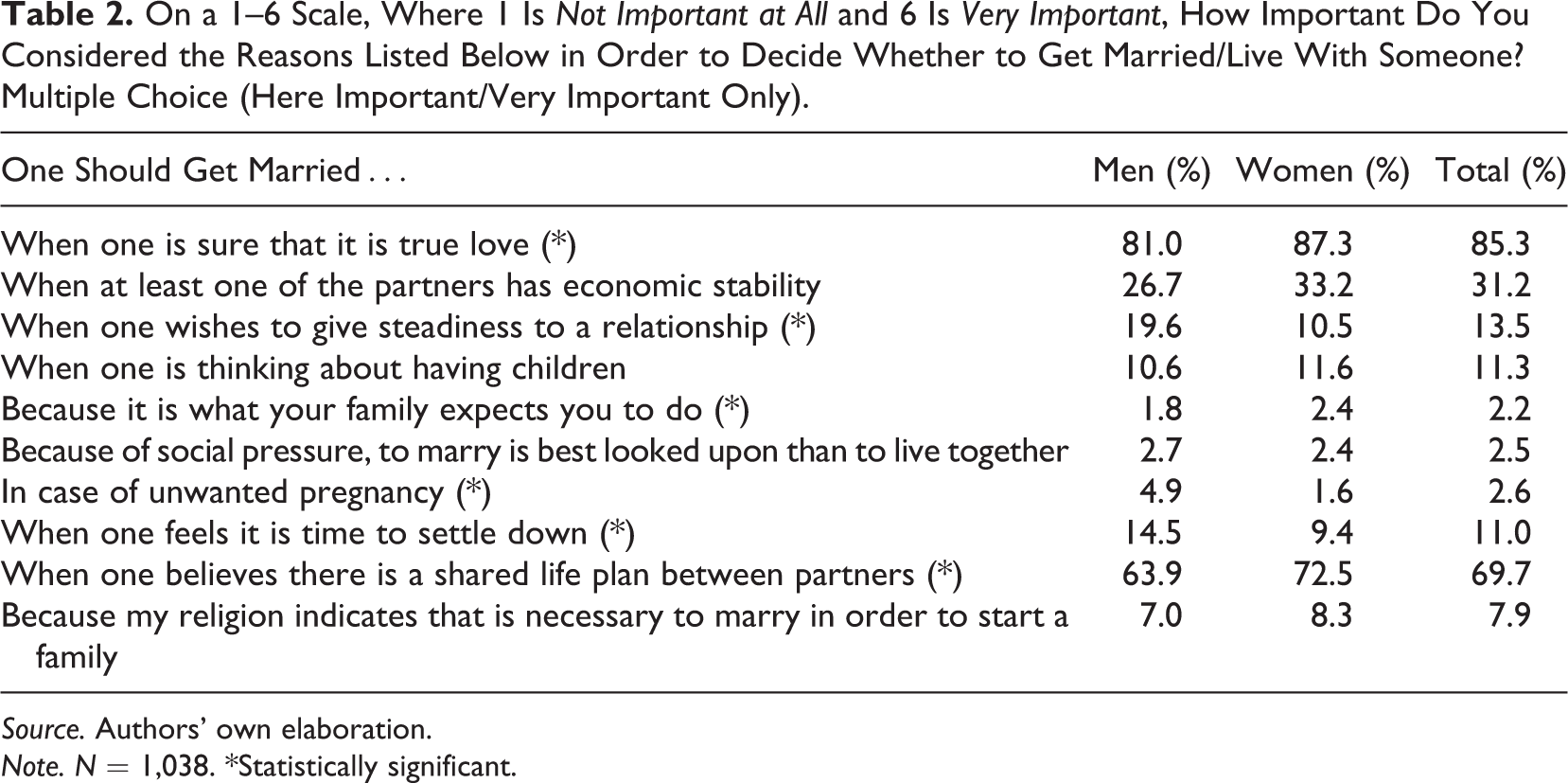
On a 1–6 Scale, Where 1 Is Not Important at All and 6 Is Very Important, How Important Do You Considered the Reasons Listed Below in Order to Decide Whether to Get Married/Live With Someone? Multiple Choice (Here Important/Very Important Only).
Source. Authors’ own elaboration.
Note. N = 1,038. *Statistically significant.
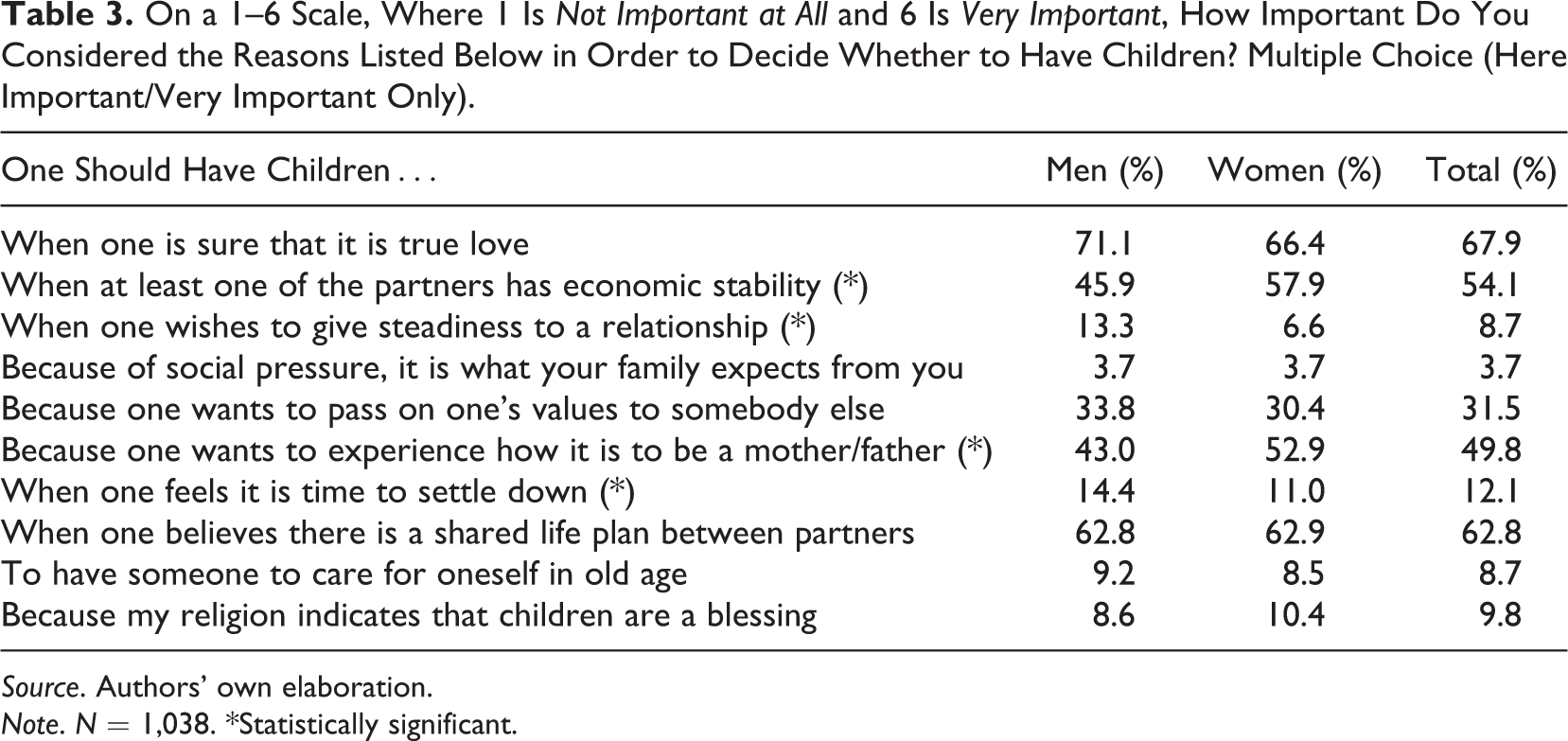
On a 1–6 Scale, Where 1 Is Not Important at All and 6 Is Very Important, How Important Do You Considered the Reasons Listed Below in Order to Decide Whether to Have Children? Multiple Choice (Here Important/Very Important Only).
Source. Authors’ own elaboration.
Note. N = 1,038. *Statistically significant.
As Table 2 shows, love is still mentioned as the main reason to marry, and it is more important for women (χ2 = 7.30, p = .026, Cramer’s V = .384). Having shared life plans follows it (χ2 = 8.24, p = .016, Cramer’s V = .289), with economic stability in the third place. Qualitative data show that, besides the statistical differences, the way in which male and female students in our sample think of shared life plans also differs: Whereas men often speak of finding somebody that fits the type of family they would like to have, women talk about finding someone who could accept they may have plans and interests outside the family realm. The following quotes illustrate this difference: Me and my girlfriend talked a lot about what we wanted [for the future]. When I realized she wanted the same things I do, children and that, I thought she definitively could be the one. (Male, 24 years old, no children) I think the most important thing [for a relationship to work] is respect, you know? That he understands that I have dreams, things I would like to do, just as he does. That my dreams are as important as his…that I am working hard to have a profession and stuff. (Female, 23 years old, married, no children)
Regarding the data on Table 3, although the association between economic stability as a factor of importance to have children and sex is weak, data from the focus groups and interviews show that students in our sample do not assume that only men should provide the desired economic stability. Far from it, women assert their own earning power and ability to support their households as part of their self-esteem and as a factor that would enable them to make choices within the family realm, such as whether to stay in a relationship or not or whether (and when) to have children. The following quotes are typical of female students’ discourses on this point: I would not quit paid work even if my husband made a lot of money. I do not believe in just staying home, be all day with the children and that. Because I like what I am studying and I’d like to do that [for a living]. But also because, you know what? I think nobody really respects a woman that does not earn her own money. (Female, 23 years old, married, two children aged 4 and 6) I think I would keep working even if I win the lottery. ‘Cause you never know…you know, I want children, but I am not sure I want a husband [laughs]. Or it [marriage] may not work […] But if I have my own [money], it is like “If I want a baby, I’ll have it.” (Female, 21 years old, no children)
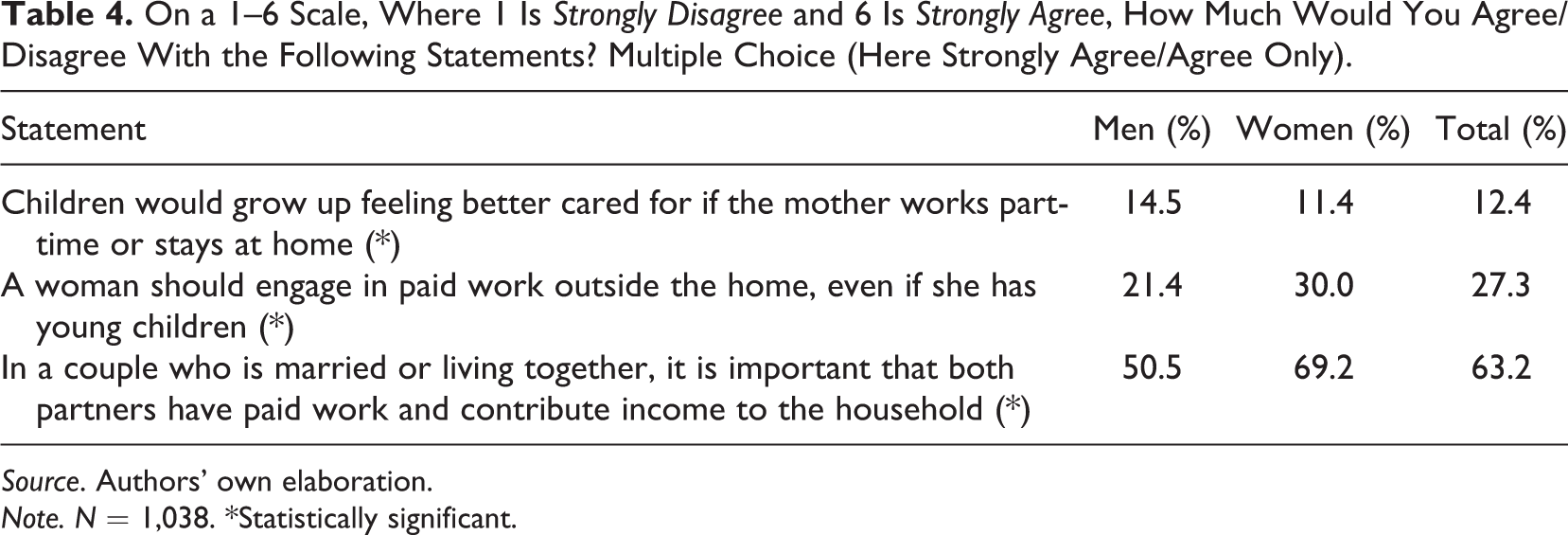
Access to higher education—which brings higher earnings—is perceived as giving women the opportunity to get economic independence and provide material support for their aspirations, including motherhood. Here it is important to stress that we are not arguing that this is necessarily a movement toward gender equality, since women are still at disadvantage in the labor market and bear a disproportionate (when compared to men’s) burden regarding domestic and carework, the latter including not only children but also the elderly and chronically ill or disabled family members (Rico & Robles, 2016). Nonetheless, it does stress the distinction made by women between choices regarding spouses and those concerning offspring. Men, on the other hand, seem to be less enthusiastic in terms of giving up the traditional breadwinner role. Table 4 offers numeric data on this point.
On a 1–6 Scale, Where 1 Is Strongly Disagree and 6 Is Strongly Agree, How Much Would You Agree/Disagree With the Following Statements? Multiple Choice (Here Strongly Agree/Agree Only).
Source. Authors’ own elaboration.
Note. N = 1,038. *Statistically significant.
As Table 4 shows, a small proportion of students, both male and female, agree with the idea that having a stay-at-home mother is important for children (Statement 1). The difference by sex is statistically significant, but the association is weak (χ2 = 10.69, p = .005, Cramer’s V = .102). When the question specifically refers to young children (Statement 2), those who agree are still a minority, but women tend to agree in bigger proportions and certainly more than men (χ2 = 8.37, p = .015, Cramer’s V = .291). And when asked about a partnership that includes a dual economic contribution, women are a majority, with statistically significant differences (χ2 = 35.40, p = .000, Cramer’s V = .386). In this context, it may be the case that young women are affirming their capacity to economically support a household on their own if needed be. But is it also possible that these women see in university education a possibility to gain economic independence to an extent that is unprecedented in their family history. Greater economic independence is often coupled with more bargaining power in the household and the possibility of establishing a more egalitarian gender relationship with a partner/spouse. Young women have seen older women assuming the role of breadwinners, in some case, as lone parents who have to be both providers and caregivers at the same time. Therefore, the traditional meaning of paid job for both men and women has been altered, losing part of its gendered characteristics. This change would explain the importance attached to economic independence for female university students. Some key implications of these findings are discussed below.
Discussion
The data presented suggest that students in our sample recognize diversity as a key element of family arrangements: Insofar as having a long-term sexual partnership and/or children is characterized as options taken according to personal preferences, families can be as diverse as personal life plans. In the context of this recognition of diversity, male students are closer to the traditional, biparental model than their female peers. The reasons for this are 2-fold: On the one hand, in a cultural setting in which women are still seen as the main (if not only) caregivers, it is difficult for men to distinguish women from caregiving. Recent studies on masculinity suggest that young men are willing to embrace the emotional side of parenthood but not necessarily the load of domestic and carework that goes with it (Aguayo, Correa, & Cristi, 2011). In other words, men do want more emotional closeness with their children but not to radically transform the traditional sexual division of labor. On the other hand, in a society that does not allocate high value to carework, but tends to better reward other activities (such as paid work), abandoning the provider role means to give up power and prestige—the power and prestige attached to the male role that sustains gender inequality. We certainly do not imply that this is a fully conscious decision; rather, it relates to the way masculinity is socially constructed as a place of privilege.
In the same context, female students affirm a personal project that is more diverse: Decisions on long-term sexual partnership and children do not necessarily go together. For these women, the traditional family may be regarded as a desirable state, but it is not the linchpin of the family (or personal) project. As we mentioned earlier, professional training is seen as giving the opportunity to economically support a wider range of aspirations, inside and outside the family realm. However, it is important to stress that these are expectations and plans that will have to be negotiated against the backdrop of cultural and structural constraints. Higher acceptance of diverse family models does not necessarily mean more equality in terms of the conditions and resources that can be mobilized to achieve personal life plans. We argue that the (de facto) acceptance of family diversity does not mean more equal conditions to pursue the type of family one has reasons to value.
This is particularly important for social work practice, insofar as social workers seek to enable people to address challenges in their lives in a framework of respect for clients’ autonomy and right to self-determination (Murphy et al., 2013). Social workers are often the main point of contact between citizens and social policy. Because of that, they have a key role in enabling people to remain in control of their own lives, doing the most with the resources available to them. Thus, it is crucial for social workers to understand clients’ motivations and beliefs but also how the current social structure may be a factor in maintaining the clients’ difficulties. Better conditions to design and pursue a life plan based on one’s own preferences and values are, according to Sen (2009) and Nussbaum (2011), the hallmark of more egalitarian and fair societies.
Yet, legislation and public social policy often take the traditional family, centered on the heterosexual couple, as the blueprint for state action (Fineman, 2005), thwarting life plans that depart from the traditional cannon or increasing the cost of such options for some social groups—particularly, for women. Thus, paradoxically, the same state that discursively promotes the critical scrutiny of traditional gender and family norms may, at the same time, assume the traditional family as the norm for legislation and public policy (De Martino, 2016). In doing so, it may jeopardize the cultural “push” for greater gender equality that may come from younger, better-educated generations. Of course, we understand that class plays a role here too: Research suggests that Latin American women with lower levels of education tend to be more conservative and have different living arrangements than their better educated counterparts (Esteve, García-Román, & Lesthaeghe, 2012). This is all the more important considering women in lower classes are the main users of family-oriented programs sponsored by the state that may reinforce traditional views. Although our research focuses on Chile, we believe that the rapid pace of social and familial change in many countries all over the world (Child Trends, 2015) poses, for social workers, the challenge of continuously question some of the key assumptions underlying social policy and welfare systems: the conflation of women’s and family needs, carework as a female responsibility and basis for women’s identity, paid work as the linchpin of men’s, and the heterosexual couple at the center of social policy. But for many young people all over the world, identity (and life plans) is not centered so clearly on family and employment anymore at least not in their traditional forms (Côté, 2017).
Conclusion
The changes seen in Latin American families are the product of a complex set of forces that include cultural factors—for instance, processes of individuation, the questioning of traditional gender roles, and secularization—that blur the religious meaning attached to marriage and family values. But there have been also structural and economic changes, such as unemployment crisis that periodically threaten the provider male role, often forcing women into the labor market. In Latin America, female participation in the workforce is the result of improved educational opportunities but also of cyclical economic crisis and an increasingly deregulated labor market that poses the need of finding new sources of income. Therefore, students in our sample have been exposed to changes in family models that—as it often happens with any cultural change—are the product of ambivalent and even contradictory forces. On the one hand, cultural changes open the opportunity of more diverse, democratic family arrangements, where family members can negotiate in relative equality their contribution to family welfare but also their own life plans and aspirations. In such a setting, the breadwinner and caregiver roles should not be determined along gender lines, but on the basis of personal values and abilities, and public policy should support such a variety of arrangements. This is consistent with the normative horizon proposed by theoretical approaches that highlight individuals’ values and worldviews as an important element of social welfare (Sen, 2009). From this perspective, we argue that young people in our sample are seeking new ways of steering their own personal and family projects in a manner that is consistent with their own values, within the limits imposed by the current social context.
On the other hand, as we have argued before, such limits refer to a context in which gender is still a key criterion for distributing social opportunities, be those in the realm of education, paid work, or regarding the possibilities of counting on state support to choose the way in which family life is organized. When the labor market presents an important bias against women and the state takes the biparental family (with a clearly defined caregiver role for women) as the blueprint for social policy in this area, women are more susceptible to pay the costs, so to speak, of embarking (willingly or not) on family projects that depart from the traditional one. So, social workers have the challenge of supporting these young adults’ efforts to position themselves in the new scenarios they are set in in order to increase younger generations’ chances of successfully developing the life plan they have dreamed for themselves.
Footnotes
Declaration of Conflicting Interests
The author(s) declared no potential conflicts of interest with respect to the research, authorship, and/or publication of this article.
Funding
The author(s) disclosed receipt of the following financial support for the research, authorship, and/or publication of this article: This work was supported by the Chilean National Committee for Scientific and Technological Research (CONICYT) under grant FONDECYT 1150250.