




Abstract
This study examined the construction of the maternal identity among Jewish Israeli women whose children are raised by their father in a sociocultural context that valorizes the maternal role in the lives of women. Interpretive interactionist analysis of in-depth interviews with 13 nonresidential mothers identified the discursive strategies that they used to negotiate a troubled maternal identity due to their nonnormative position. The mothers deflected guilt and responsibility for the fact that they do not live with their children. Further, they exhibited two dynamics of maternal identity construction: internalizing the critical discourse and constructing a nonresidential identity as a “good enough” mother. The findings support the view that hegemonic social discourses affect the construction of maternal identity by nonresidential mothers. At the same time, they are also indicative of the creation of an alternative discourse that portrays a nonresidential maternal identity as positive.
Dominant social, cultural, and professional discourses view motherhood as the core of a woman’s feminine identity (Ennis, 2014). Thus, the feminine identity of women who do not meet the general expectation of motherhood might be negatively affected. Specifically, women who do not live with their children violate the prevailing norms concerning the maternal role. In this article, the term “nonresidential mothers” refers to separated or divorced women whose children live with their father. In the initial stages of a study about the experience of nonresidential mothers in Israel, we noted that the participants attempted to portray themselves as good and normal women and mothers. This observation led us to explore in this study how nonresidential mothers in Israel construct their maternal identity.
Identity construction is a process of coaction that is achieved through relationships and context (Gergen, 2009)—social forces shape individual identity, while individuals forge their identity through language, relationships, and cultural attributes. Accordingly, we posit that women’s stories about their maternal identity as nonresidential mothers are sites of identity construction, as they negotiate hegemonic discourses of motherhood in an attempt to make sense of their experiences. We further suggest that such women experience a troubled maternal identity that they resolve through interactions with others.
The analytic notion of troubled identity refers to the processes of structuring personal identity, where lived experiences are constructed as social problems (Gubrium & Holstein, 2001). Examples of such troubled maternal identities may be found for mothers of women who are ex-convicts (Geiger & Fischer, 2003), mothers addicted to drugs (Gueta & Addad, 2013; Virokannas, 2011), women who have experienced intimate partner violence and are involved with the child welfare system (Hughes, Chau, & Vokrri, 2015), and low-income women with symptoms of postpartum depression (Abrams & Curran, 2011). Troubled identities are not automatically accepted by their subjects. Rather, they spur the individual to engage in identity work, an interpretive process facilitated by the discursive environment, linking the personal self to the troubled identity (Gubrium & Holstein, 2001).
The prevailing cultural discourse about “good mothers” in Western countries suggests that women are generally expected, in the absence of pathology, to care for their children with boundless devotion and unconditional love (e.g., Douglas & Michaels, 2004; Ennis, 2014). Feminist scholars view the discourse about good mothers as an aspect of patriarchal motherhood, one that oppresses women (O’Reilly & Porter, 2005). O’Reilly (2006) offers an alternative vision for mothers—that of empowered mothering. Empowered mothering rests on the notion that the development of a mother’s selfhood is beneficial to mothering and not antithetical to it. Empowered mothers do not always put their children’s needs before their own nor do they only look to motherhood to define and realize their identity. Rather, their selfhood is fulfilled and expressed through work, activism, friendships, relationships, hobbies, and motherhood (O’Reilly, 2006). Mothers who deviate from social norms regarding good mothering (e.g., Babcock, 1998; Hughes et al., 2015; Kielty, 2008b) may experience a troubled identity. Yet their experience of a troubled identity may be influenced by the alternative notion of empowered mothering. Hence, the concept of troubled identity has heuristic value when exploring the challenges that nonresidential mothers face when constructing their maternal identity.
Accounts are linguistic devices useful in the examination of a troubled identity construction. They have been proposed as a means by which individuals try to explain their untoward behavior and reconcile their actions with society’s expectations of themselves (Scott & Lyman, 1968). Accounts are classified as either justifications or excuses: Justifications are accounts where one accepts responsibility for the behavior but denies that it is morally wrong; with excuses, the individual accepts that the enacted behavior, role, or identity is deviant but denies responsibility for it. The acceptance of such accounts by others restores equilibrium (Scott & Lyman, 1968). Although accounts may be thought of as stories that people tell about themselves to reinforce their identity and self-worth, in this study, we have treated accounts as a possible reflection of the nonresidential mothers’ response to social criticism of their nonnormative identity in their bid to construct a positive maternal identity for themselves.
The Israeli Context
As in other countries (Hughes et al., 2015), the cultural discourse about good mothers in Israel places the best interest of the child over the wishes of the mother (Gueta & Addad, 2014; Peled & Levin Rotberg, 2013; Sinai Glazer & Peled, 2016), and care for the children is seen as almost exclusively the responsibility of the mother. This motherhood ideology places a great deal of expectations on women (Gueta & Addad, 2014), including primary responsibility for family, marriage, and raising children (Fogiel-Bijaoui, 2005). Moreover, motherhood is deemed to be particularly important among Jewish women for religious and demographic reasons (Birenbaum-Carmeli, 2009).
The divorce rate for Jewish married couples in Israel is on the rise and, in 2013, was 2 of the 1,000 (Central Bureau of Statistics, 2013). Among divorce cases involving minor children, 70.6% of social workers’ recommendations handed to the court in 2013 were mother’s sole custody while 14.6% were father’s sole custody (National Council for the Child, 2015). This tendency of the courts is supported by the tender years presumption, according to which children under 6 years of age should live with their mother in cases of parental separation, unless special circumstances call for a different custody arrangement (Hacker, 2005, 2013). The data for the present study were collected against the backdrop of an active public discourse in Israel surrounding the recommendations of a governmental committee that called for the abolition of the tender years doctrine in custody law and replacing it with a nongendered emphasis on parental responsibility.
Rationale and Objectives of the Study
Many studies of nonresidential mothers have found them to be inordinately preoccupied with being labeled “bad” or “unfit” mothers (e.g., Babcock, 1998; Kielty, 2008a, 2008b). Nonresidential mothers seem to be conscious of, and struggle with, social perceptions that question their maternal capacity and normative functioning. Internalizing a mother-blaming discourse can lead these mothers to feelings of shame, guilt, and self-blame) Geiger & Fischer, 2003, 2005; Hughes et al., 2015). However, women occasionally negotiate or challenge the negative perceptions that are forced on them by the hegemonic discourses concerning their status and roles as mothers (Abrams & Curran, 2011; Gueta & Addad, 2013; Gueta, Peled, & Sander-Almoznino, 2016). Accordingly, the principal research question was: How do nonresidential mothers in Israel negotiate their maternal identity in the context of discourses surrounding motherhood?
Method
This study was conducted in accordance with the Interpretive Interactionism approach and its recommended steps regarding the interpretive process (Denzin, 2001). Interpretive interactionism builds on the traditions of symbolic interaction, interpretive phenomenology, feminist social theory, and postmodern theory in an attempt to shed light on life experiences that radically alter and shape the meaning that individuals attribute to themselves. In particular, it is concerned with the social construction of gender, power, and knowledge among the members of a stigmatized population (Denzin, 2001; Olesen, 2000). Thus, it facilitates the synergy between social–cultural and individualistic understandings of mothering and was most suitable to studying the linguistic devices and discourses used by women who may experience a troubled identity.
Participants
Inclusion criteria required that participants be fluent in the Hebrew language and have at least one child living with the child’s father. No formal records are kept on Israeli nonresidential mothers, and we had no prior direct or indirect acquaintance with this population. The sensitive and the stigmatizing experience of being a nonresidential mother in Israel further complicated recruitment efforts. Similar complications seem to have led to small sample sizes in other studies of this population (e.g., Bemiller, 2010—16 women; Clumpus, 1996—10 women).
Ultimately, participants were recruited in one of the three ways. First, we asked several welfare organizations (e.g., welfare departments and contact centers) to identify potential participants, which generated contact information of 10 women over a period of several months. Second, information about the study was sent to a mailing list maintained by a large continuing education program at an Israeli university, resulting in responses from seven women. Finally, one woman was referred by a fellow participant. A preliminary telephone conversation was conducted with each of the 17 women who had agreed to consider participation, providing them with complete information about the study’s goals, procedures, and ethical considerations. Following this conversation, four declined to take part due to lack of time, lack of interest, or suspicion. For the characteristics of the 13 participants, see Table 1.
Sample Characteristics.
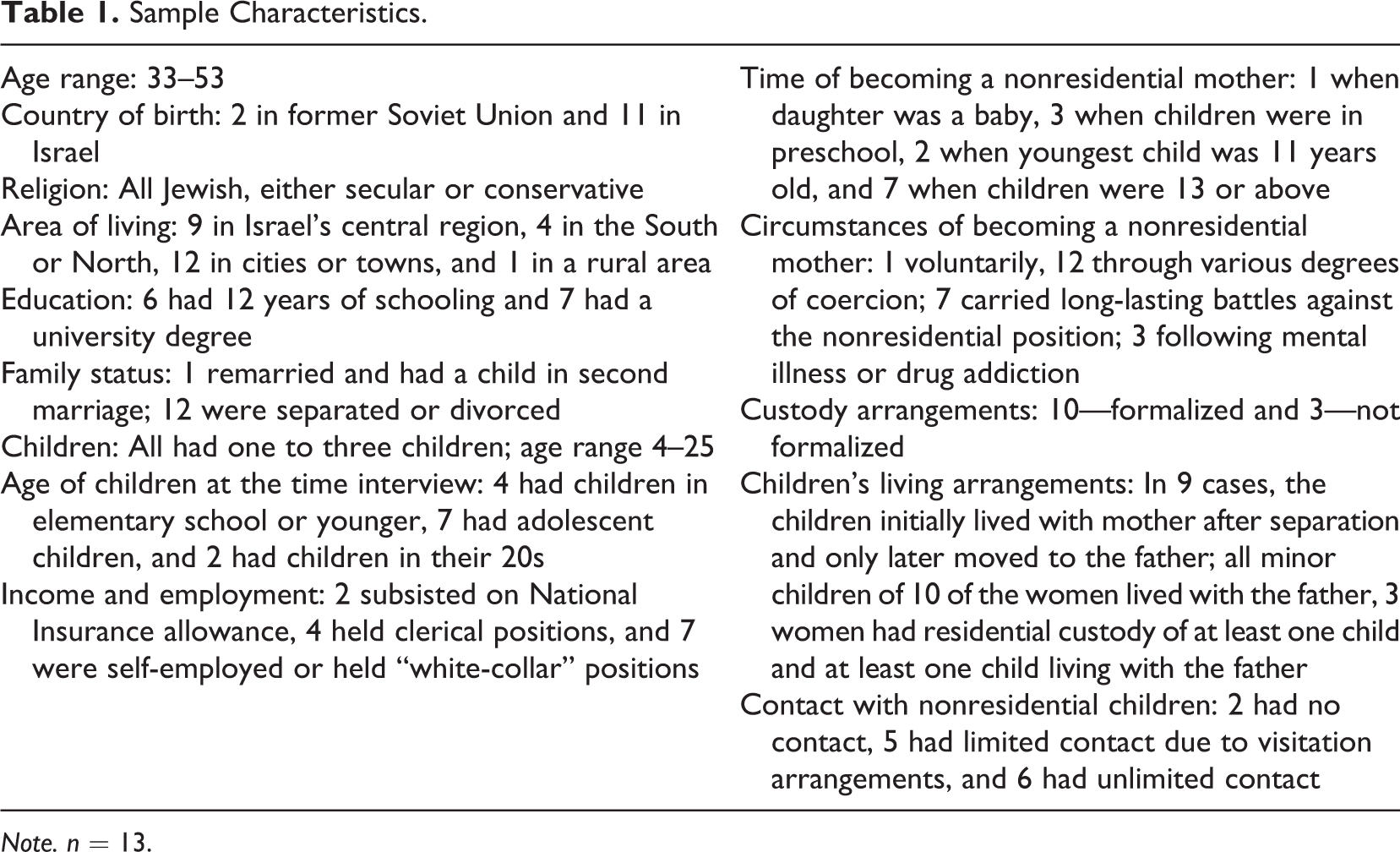
Note. n = 13.
Procedures
Semistructured in-depth interviews (Patton, 2001) were conducted with each of the 13 participants by a trained social worker, who is herself a married mother of four children. The audio-recorded interviews were conducted in Hebrew between June 2012 and June 2013 at a time and place chosen by the participants; most took place at coffee shops or at the women’s homes. The interviews began with a general question, which allowed the interviewee to present herself and her life story freely, including the story of how her nonresidential situation came about. The following issues were then brought up by the interviewer, if they had not yet been covered: the reasons and processes that led the children to live with their father; and the participant’s relationships with her children, with the children’s father, and with related significant others. Each interview lasted between 60 and 90 min and was subsequently transcribed for analysis.
Data Analysis
Data analysis was conducted by the lead author and then discussed with the third author, until deemed to be sufficiently illuminating, contextualized, relationally grounded, and coherent (Denzin, 2001). This process consisted of several stages. First, each of the interviews was analyzed separately to capture the individual dimensions of maternal identity construction. Particular attention was paid to the mother’s opening statement and presentation of self at the start of the interview, the scope of her description of how she became a nonresidential mother, and whether other life domains or identities were displayed. The 13 individual analyses were then discussed, compared, and contrasted, noting the women’s efforts to construct a maternal identity in their interaction with the interviewer, and seeking to distill the initial themes into major thematic structures. We then focused on how the participants constructed a normative identity in general, and as mothers in particular, and identified four such themes: (a) I didn’t abandon my children, (b) I am a victim, (c) constructing a normative identity, and (d) maintaining a degree of motherhood. Evidence regarding the main themes repeated itself and so we believe that the analysis reached saturation within the existing data. During the writing as a form of inquiry (Richardson, 2000) process, we condensed these four themes into two central ones: displacing responsibility for one’s nonresidential situation and the construction of nonresidential maternal identity. Finally, the two central themes were contextualized in relevant theoretical and empirical literature in a bid to achieve both a thick description of the women’s perceptions and analytic clarity. The analysis was carried out on the Hebrew interview transcripts, and the results were initially written in Hebrew and then translated into English.
A reflexive examination of the data analysis process suggested that the judgmental hegemonic discourse concerning nonresidential mothers was present in some of the interviews—both in the interviewer’s questions and in the participant’s responses. For example, in the interview with Amira, who had not raised her daughter since babyhood, the interviewer said: It sounds quite difficult, but look—you’re really fighting, and good on you for doing so. You don’t give up. It sounds like the girl is very important to you. Which means that you want to be the kind of mother who doesn’t leave her girl—am I right? A child only has one mother, after all.
Furthermore, the authors themselves are mothers who grew up and live in Israel and are social workers and feminist scholars. We are familiar with, and affected by, both local sociocultural notions of motherhood and critical discourses of motherhood and of gender. Thus, the analysis and writing phases of this study were accompanied by a continual critical dialogue about these issues, a tension between feelings of empathy and identification with the participants’ experiences, and a critical analytic position. For example, we debated the appropriateness of using the notion of “accounts” in the study, to which we attributed a heuristic value with regard to understanding identity construction, but which may also be perceived as portraying the participants as being manipulative when presenting their maternal identity.
Ethical Considerations
The study was approved by the institutional review board of Israel’s Ministry of Welfare and Social Services. The informed consent process was conducted orally. The interviews were conducted in a warm and friendly atmosphere. Throughout the analysis and writing stage, efforts were made to avoid being judgmental and to maintain respect and empathy toward the participants’ perspectives. Participants were promised confidentiality (e.g., all participant names have been changed) and invited to contact the interviewer, or the first author, should they wish to discuss issues that arose during the interview any further. Participants who wanted a copy of their interview transcript received one on request. One asked to omit certain identifying information, out of concern that her child’s identity might be revealed. Finally, a research report was sent to those participants who expressed a wish to accept it upon completion of the study.
Findings
Throughout all the interviews, participants conducted a dialogue with the hegemonic discourse about motherhood and its consequent troubled identity (Gubrium & Holstein, 2001). First, we describe this dialogue and then present the ways used by participants to deflect from themselves any guilt or responsibility for their nonresidential situation. Then, we present the two main positions taken by participants in their construction of a nonresidential maternal identity: While some accepted the social labeling and reflected it in their narrative of a troubled maternal identity, others tried to negotiate and reframe it in an effort to construct a positive maternal identity.
“It’s Not My Fault”: Attributing Responsibility to Other People and Factors
All women were aware that their nonresidential position is seen negatively by others and renders them deviant. For example, Batya described how others viewed her “like a female cuckoo abandoning her chicks” when she moved away and left behind three teenage girls with their father. Yardena, also a mother of three adolescents, had a similar description of how others viewed her: “You’re a mother who doesn’t raise her own children, who’s lost custody, something must be wrong with you.”
Yet, while all the interviewees saw the fact that they were not raising their children as an undesirable situation, they appeared to try to reject notions of mother blaming and to shed their perceived label as bad, unfit, or deviant mothers. They spent a substantial part of the interview portraying themselves as having no choice or demonstrating why they were helpless or blameless for their nonresidential situation. The most common reasons that they put forward for their nonresidential situations were financial difficulties, the father’s attributes, and mental illness, and most mentioned more than one of those reasons.
Financial difficulties
Ariella stated that her teenage sons went to live with their father because he was financially better off, while emphasizing the contrast between their father’s ability to provide for them materially and her own financial hardship: I can’t keep up—not with the amazing computer that they got from their father, computer games that at that time were terribly important to them. Financially, I left behind [with the ex-spouse] a factory,…savings, and a car.…I don’t even have a place to put them up. [The kids] want very much for me to demand them back…but [the authorities] tell me only if I have the option of renting an apartment. But in the situation I’m in today, with a full disability allowance of NIS 2,400 [∼$635 USD per month], I don’t have the option of renting an apartment; I don’t have the option of maintaining [it].
The father’s attributes
A key theme in how the participants constructed their mothering story was the father’s responsibility for the fact that the children do not live with them. Eight of them pointed out that they were too weak to stand up to a belligerent and vindictive father who refused to let them raise their children. Yardena’s description of the father’s threat is typical of these accounts: He said when we’ve divorced that he’ll make sure that I’ll be miserably poor, and then I won’t be able to sleep at night because I’ll be afraid that he’ll take the children away from me.…Bottom line: there was incitement. He would tell them what kind of a terrible person I am, that only an insane mother gets divorced, that I ruined his life, and that I ruined his health.
It appears that all participants had internalized the prevailing view that a woman who does not raise her own children is deficient as a mother. Suetta, for example, recalled how she felt before leaving her three children: “At first I couldn’t imagine that I would ever do such a thing.…something that is not done, I also felt guilty about them when I left.”
Mental illness
Three women referred to mental illness and addiction as the reasons that prevented them from raising their children. Amira, a mother of a 4-year-old daughter said, [My mother] understood that it wasn’t deliberate. I was very sick, and in a bad way with myself, mentally speaking: I didn’t have any strength. I also explained to her: ‘Look, if I were okay, I would never have left her in a million years!’ Of course not! Who could have taken her away from me if I were okay? No one!
The Construction of a Nonresidential Maternal Identity
Throughout the interviews, participants constructed narratives of nonresidential maternal identity. Some admitted that their mothering was deficient, in line with the common social perception of nonresidential mothers; others challenged their labeling as problem mothers and portrayed their nonresidential maternal identity as good enough mothering. As far as we can tell, these two attitudes toward maternal identity did not appear to be related to the participants’ sociodemographic or functional characteristics, nor to the ages of the children or to the amount of time that the women had not raised their children.
Nonresidential mothering as a troubled identity
Five of the participants expressed particular anguish over the disparity between the good mothering discourse and their own situation as mothers and over their nonresidential status. They were particularly preoccupied with their maternal identity: The story of how they had become nonresidential mothers became the focus of the interview and dominated their account, at the expense of other aspects of their lives, even when they had made notable achievements in their personal, academic, or professional lives. This is evident in the account put forward by Michal, whose children were 5 and 6 years of age when she left her husband 3 years earlier: “I’m adjusting to the new situation with difficulty. This is something that is not right, it’s not something that I want for myself, [it has] been forced upon me.”
Highly evident in these interviews were the participants’ feelings of pain, lack of control, and helplessness, as well as a sense of calamity and injustice concerning their situation, directed toward society’s representatives which brought to it (e.g., social workers and judges). Michal and Yardena described their separation from their children as a constant pain: Just the fact that the children aren’t growing up with me is a hardship that just doesn’t go away. It sounds harsh, but it’s like they took a part of me away. They’re not here, and with God’s blessing they’ll always be here, but they’re here and not here, they’re with me and not with me. [Michal] I couldn’t live at home…every time I went into the children’s room that they no longer sleep in…[weeps]. It’s just so hard. So yes, almost five years have gone by and I can’t get over it…they made sure to clip my wings. [Yardena] Just a bottle of water for my son who goes on a trip…not to see them wake up in the morning, not to prepare [his] sandwich. [That’s] the meanest and the hardest thing that anyone could have in life.
These mothers had not come to terms with their nonresidential situation and had not managed to construct a positive or adequate nonresidential maternal identity for themselves. Rather, they appeared to see themselves as bad mothers, which was a constant source of frustration and disappointment for them. However, their negative views were consistent with and perhaps perpetuated by conventional perceptions of motherhood.
Reframing a “good enough” maternal identity
Contrary to the mothers who were deeply troubled by not residing with their children, eight participants—including three who had custody of one or more of their children—defied the notion that they had a problematic maternal identity and presented themselves as good enough mothers. Indeed, they portrayed their nonresidential position as the best possible solution for the situation. Some appeared to have somewhat reconciled with or even voluntarily opted for their situation or to have adjusted to it, even while still feeling hurt by it. Ariella said, You [the kids] need to be wherever is best for you: I won’t drag you over here, not by threats and not out of pity, like ‘Look, you have to care for your mother.’ They’re children, and they should be where is best for them. So the compromise was, every lunchtime I make up a pot and arrive at their father’s house and sit down to eat with them at his place.…School, doctors, and everything related to studies and medicine is exclusively mine [laughs], and lunch. So, somewhere I’ve held on to some kind of motherhood territory. I try twice a week [to see the children]. That’s how I define things for myself now: Mondays and Wednesdays to be with them on a regular basis, and in the evening. It’s not a lot of time, just an hour or two. And one Friday on, one off, at least. Look: I’m also studying, you need to study a lot, and we’ll see how I…because I want to finish [my degree] already.
These women described their former partner as a good enough father, even when describing him as belligerent and violent. This duality is evident in Ariella’s account. At one point in the interview, she said, “I’m confident that when they’re with him…he’s a devoted father.” At another point in the interview, however, she mentioned an instance when, a few years earlier, the father had been physically violent toward their son: When my eldest son was hit by his father, I picked up [the phone and] I filled a complaint with the police and the authorities and the school, and I raised holy hell. That was the last time any of them got slapped by him. Thank God he loves the girl. He’s a good father…praise the Lord that I got a guy like that and not someone else, someone who might have sent her off to some foster family or something like that. These positive portrayals of the father—particularly when coupled with a few disturbing descriptions as well—might be seen as an essential part of the women’s construction of their positive maternal identity as one who ensures and knows that her children are being cared for properly, even if she is not living with them.
Discussion
This study’s findings shed light on the variety of flexible and occasionally contradictory discursive strategies that nonresidential Jewish Israeli mothers used to construct their maternal identity in the context of a research interview. The findings help to understand the hegemonic discourses surrounding motherhood. They suggest that the participants had internalized the hegemonic discourse within Jewish society in Israel, which valorizes devoted and total motherhood in women’s lives and sees nonresidential motherhood as an anomalous condition that needs justification. The participants seemed to have been engaged throughout their interview in intensive discursive work in a bid to construct a positive maternal—and general—identity, despite their “improper” residential situation.
The participants seemed to view the fact they did not reside with their children as problematic and refrained from presenting nonresidential motherhood as positive or acceptable. However, like other “nonnormative” women and nonresidential mothers (Bemiller, 2010; Kielty, 2008a, 2008b), they displaced responsibility for their nonresidential situation and resorted to justifications and excuses to explain how they had become nonresidential mothers. These constructions may be indicative of the magnitude of stigma associated with being a nonresidential mother, with all the attendant dynamics of the troubled identity that emerges as a result.
We identified two distinct patterns of maternal identity construction that the interviewees used when dealing with their troubled identity. The first is an internalization of the problem identity. The fact that comparatively few of the interviewees adopted this strategy may be due to the feelings of guilt and pain that it entails, which may also explain why some prospective participants refused to be interviewed for this study. The expression of pain over their inability to preserve a positive, normative maternal identity is likely to elicit understanding and even sympathy by other people. Thus, these women’s protestations against their nonresidential situation and the fact that they cannot reconcile themselves to it may help bolster their self-integrity and self-esteem and help shield them from negative attributions by others (Bemiller, 2010; Kielty, 2008a).
The second pattern of maternal identity construction was to defy and reframe the hegemonic discourse surrounding motherhood. These participants seemed to have come to terms with their situation and to have been in a less vulnerable emotional position than the ones internalizing a problem maternal identity. Of particular interest are the ways in which these participants succeeded in constructing a good enough identity in the interviews, contrary to the hegemonic and expected narrative. First, they presented the children living with the father as a sufficiently good solution for all concerned, including for the children themselves. In her qualitative study of nonresidential mothers in Britain, Kielty (2008a) found that those who had a say in determining the residential arrangement were usually more reconciled to it and presented their maternal practices as satisfactory. O’Reilly (2006) suggests that mothers who are content with and fulfilled by their life make better mothers. The use of the contention that the children are “alright” to construct a positive maternal identity is echoed in other studies of women engaged in socially unsanctioned behavior. For example, women who are former drug addicts constructed their identity as normative by stressing that their family and children’s lives were functioning satisfactorily (Virokannas, 2011). Other women who experienced intimate partner violence and were involved with the child welfare system stressed that being a good mother means willingly giving up custody of their children when they believed that it was for the best interest of their children (Hughes et al., 2015). This positive construction of identity might be interpreted as a form of protection against feelings of anxiety, guilt, and pain (Breakwell, 2010). Alternatively, it may be seen as an expression of empowered motherhood opposing to hegemonic notions of motherhood (O’Reilly, 2006)—an attempt to forge an alternative positive maternal identity, in which love and care for the children are evident even when the mother is not living with them.
Further, these participants made a point of underlining, and casting in the best possible light, other identities of theirs apart from their maternal identity (which they portrayed as good enough). This might be seen as a talking back discursive strategy (Juhila, 2004), with which they challenge conventional definitions of their gender category. Presenting themselves in this manner may be a form of renegotiating the definition of their identity—by challenging, enabling, and normalizing their nonresidential situation and establishing a positive feminine identity that does not rely exclusively on their status as mothers. Yet in the Jewish Israeli context, which sanctifies childbirth and motherhood, this is a daring and radical narrative, which might expose these mothers to the risk of being labeled “bad mothers.”
Such positioning echoes the feminist discourse that questions patriarchal hegemonic constructions of feminine and maternal identity (Hays, 1996; O’Reilly, 2006; Rich, 1976). This discourse disputes the absolute equation of motherhood with femininity and the myth of motherhood, as summed up by Chodorow (1978): “The reproduction of mothering…extends from an expectation that ‘women mother’” (p. 57). It contends that it is neither obvious nor reasonable to assume that women are obliged to be, or want to be, mothers come what may, on the grounds that motherhood is an enjoyable and satisfying experience and that the sanity and function of a woman who does not want to be a mother must be suspect (Donath, 2014; Rich, 1976).
This study also has a bearing upon the discussion currently taking place in many countries concerning child custody arrangements (Boyd, 2010). Specifically to the Israeli context, the bill currently before the Israel Parliament will change the existing custody law from instructing children under 6 years of age to live with their mother in cases of parental separation, unless special circumstances call for a different custody arrangement (Hacker, 2005, 2013), to a nongendered emphasis on joint parental responsibility (Hacker, 2013; Hacker & Halperin-Kaddari, 2013). Indeed, the law was not changed yet, but it opened a public debate and suggested to impact custody court judgmental decisions (Ben-Noon, 2015). If this bill becomes law, many more Israeli women will find themselves losing custody of their children and may encounter similar challenges to their maternal identity as described by the women we interviewed. As Hacker (2005) points out, “The day in which women and men will be able to shape their parental biographies free from gendered social expectations and coercions is still far on the horizon” (p. 426).
The present study contributes to a theoretical conceptualization of maternal identity among nonresidential mothers. It is important to note, however, that its findings cannot be generalized but are only transferable, while taking into account its particular research and cultural context. Future studies might examine the maternal identity of nonresidential mothers in other cultural contexts as well as the possible associations between various constructions of maternal identity and distinct personal, biographical, situational, and social characteristics. It would also be interesting to gain a deeper understanding of how nonresidential mothers’ relationships with significant others—such as their children, their friends, their own parents, the children’s father, and care professionals—contribute to the construction of their nonresidential identity. Such studies may reveal additional discursive strategies used by these women in constructing their maternal identity.
Practical Implications to Social Work
The dynamics of troubled maternal identity, as experienced by the participants in our study, suggest that nonresidential mothers may need a safe, supportive environment to help them cope with feelings of guilt, pain, frustration, anger, and social deviation (Cohen, Finzi-Dottan, & Tangir, 2014) as well as efforts to construct a positive or empowered maternal identity. Social workers should be conscious of the interaction between the social and cultural messages that they are conveying and the women’s own self-labeling and identity constructions (Hughes et al., 2015). Further, social workers serving both parents and children should consider women’s choice to be a nonresidential mother as a legitimate option, and potentially the best option, in the reality of their lives. As for social work education, the current study suggests it is advisable to expose social work students to various living arrangements of mothers and their children and to the diverse experiences of mothering within these arrangements. In particular, students may benefit from meeting nonresidential mothers and hearing their stories and views regarding this unique social phenomenon.
Footnotes
Authors’ Note
This article is dedicated to Prof. Orna Cohen, who instigated this study and passed away before its completion.
Acknowledgment
We thank the participants of this study who gave us a glimpse into the complexity of their lives and their views.
Declaration of Conflicting Interests
The author(s) declared no potential conflicts of interest with respect to the research, authorship, and/or publication of this article.
Funding
The author(s) received no financial support for the research, authorship, and/or publication of this article.