




Abstract
This study examined provider perspectives on school sabotage. Service providers participated in semi-structured interviews exploring these questions: Are service providers aware of instances of school sabotage occurring? What are the tactics that service providers have observed? What do service providers identify as the key impacts of school sabotage? The following are the themes: (1) tactics of abusive partners include disruption of financial aid, physical violence or stalking at school, and disrupting academic efforts; (2) survivors experience consequences, including emotional and academic impacts; (3) abusers display emotions including jealousy, resentment, and insecurity; and (4) many survivors use education as a pathway to safety and opportunity.
Keywords
Background
Intimate partner violence (IPV) is an epidemic that impacts at least one in four women in the United States over their life course (Black et al., 2011). The criminal justice system and many IPV scholars have focused on the prevalence and consequences of physical assault by an intimate partner as a defining feature of IPV. However, the definition and conceptualization of IPV have been expanding as scholars, advocates, and survivors have worked together to articulate a broader understanding of IPV that includes physical, sexual, emotional, economic, and psychological forms of control (DeKeseredy, 2000; Department of Justice [DOJ], 2014; Golden, Perreira, & Durrance, 2013). As articulated by the DOJ, IPV is “a pattern of abusive behavior…used by one partner to gain or maintain power and control over another intimate partner…. This includes any behaviors that intimidate, manipulate, humiliate, isolate, frighten, terrorize, coerce, threaten, blame, hurt, injure, or wound someone” (DOJ, 2014). As our conceptualization of IPV has broadened, new avenues for scholarship and intervention have emerged. The current study provides service provider perspectives on one such area, school sabotage, with special attention to the impact of IPV and school sabotage on women attending community college.
School Sabotage as a Form of Economic Abuse
Economic abuse has received increasing scholarly attention as definitions of IPV have broadened. It encompasses behaviors that control a woman’s ability to acquire, use, or maintain economic resources and that thus threaten her economic security and potential for self-sufficiency (Adams, Sullivan, Bybee, & Greeson, 2008). Scholars and advocates have identified tactics of economic abuse including disrupting employment, controlling and limiting access to finances, and destroying credit (Adams et al., 2008; Postmus, Plummer, McMahon, Murshid, & Kim, 2012; Sanders, 2015) as well as consequences including increased mental health challenges, greater experiences of material hardship, and relational difficulties (Huang, Postmus, Vikse, & Wang, 2013; Voth Schrag, 2015).
Within the constellation of tactics comprising economic abuse, comparatively little attention has been paid to behaviors aimed at sabotaging survivor’s efforts to gain educational credentials (Adams, Greeson, Kennedy, & Tolman, 2013). Studies reveal that survivors have faced tactics including the destruction of homework, behaviors that keep a survivor from studying or attending class, and stalking or harassment at school (Brush, 2004; Raphael, 2000; Sanders, 2015). Others have argued that abusive partners may also belittle or demean educational goals and stifle educational expectations (Collin-Vézina, Hébert, Manseau, Blais, & Fernet, 2006). Taken together, these and other behaviors that control a woman’s ability to successfully gain desired educational credentials, and thus threaten her long-term job stability and self-sufficiency, could form a specific subset of economic abuse, which practitioners term “school sabotage.” These behaviors are closely linked to the better documented phenomenon of work interference, in which abusive partners intentionally disrupt a survivor’s employment, and which scholars and advocates have demonstrated negatively impacts survivors’ economic security and self-sufficiency (Riger, Ahrens, & Blickenstaff, 2001; Riger, Staggs, & Schewe, 2004; Sanders, 2015; Staggs, Long, Maon, Krishnan, & Riger, 2007). Riger, Ahrens, and Blickenstaff (2001) developed a quantitative measure for these forms of economic abuse, the Work/School Abuse Scale, which can be used to assess abusive tactics aimed at sabotaging either work or school. However, the scale was normed on a sample that included very few students and, as far as we are aware, has only been used in the “work” form, to assess tactics that impact a woman’s employment.
There is a growing consensus regarding the substantial negative effects of economic abuse on survivors’ long-term well-being and security. However, the dynamics of IPV and women’s educational attainment, including what comprises common tactics of school sabotage and how school sabotage impacts survivors in terms of mental health, economic, and educational outcomes, are comparatively unexplored. The current study seeks to further this dialog by exploring the dynamics of school sabotage among a unique and potentially vulnerable group of students—those attending community colleges.
School Sabotage and Higher Education
Experiencing the tactics of IPV, including school sabotage, may be an important barrier to the educational attainment of survivors. This risk has been inferred in previous studies, which have identified a nonlinear relationship between IPV and education (Breiding, Black, & Ryan, 2008; Coker et al., 2002). Breiding, Black, and Ryan (2008) found that women who have begun, but not completed, college are more likely to have experienced IPV compared to both high school graduates and college graduates. In their analysis of IPV rates by educational attainment, both Breiding et al. (2008) and Coker et al. (2002) find the highest rates of IPV not among those with the lowest levels of education but among those with “some college.” Breiding and colleagues (2008) underscore this unexpected finding as an important point for future investigation, noting that: For both men and women, those who completed some college had significantly higher prevalence than those who graduated from high school but never attended college…Further research is needed to identify why those who attend college, but do not graduate, are more likely to experience IPV than those who graduate from high school but never attend college. (p. 117)
The potential that the tactics of school sabotage could lead to decreased educational attainment is especially concerning, given that educational attainment is directly related to long-term earning potential and a woman’s ability to be economically self-sufficient. Education is an important determinant of economic stability, employment, and lifetime earnings and is a particularly powerful protective factor for women (Adams et al., 2013; Cancian & Meyer, 2000; Pandey & Zhan, 2007; Pandey, Zhan, & Kim, 2006). As described by Adams, Greeson, Kennedy, and Tolman (2013), “When compared with women with less than a high school education, women’s earnings increased by 57% with a high school degree, 81% with some college education, 181% with a college degree, and 318% with an advanced degree” (p. 3284).
For IPV survivors in particular, access to economic resources expands women’s opportunities, increases self-sufficiency, and can buffer against economic dependence on an abusive partner (Adams et al., 2013; Raphael, 2000). Given that even a few additional semesters of training can make an important difference in long-term earning potential (Belfield & Bailey, 2011), exploring the tactics that an abusive partner may use to undermine a survivor’s educational journey, with an eye toward implications for intervention and prevention, could support the development of a more effective system of care for vulnerable survivors.
One population who may especially benefit from increased scholarly attention around the impact of forms of IPV, including school sabotage, on educational attainment and completion is community college students. In the United States, the term “community college” generally refers to 2-year public institutions that provide post high school higher education, including the granting of certificates, diplomas, and associates degrees, with a focus on occupational readiness or matriculation on to a 4-year institution (American Association of Community Colleges [AACC], 2014). In 2014, 45% of all undergraduate students in the United States were attending a community college, with these students disproportionately representing many of the groups at an increased risk for IPV, including low-income women and racial minorities. However, as demonstrated in a systematic review of the literature on dating and sexual violence in institutions of higher education, no studies in the past 5 years have been conducted within this population (Voth Schrag, 2016). The average community college student attends school part-time (60%), while also holding down employment (73% of part-time students, 62% of full-time students). Fifty-seven percent are women and 49% come from ethnic minority groups. The average age of a community college student is 28, with 57% of students falling between ages 22 and 39, which puts them in a key age range for vulnerability to IPV (Black et al., 2011). Seventeen percent of community college students are single parents and 36% are the first in their families to attend college (AACC, 2014). These differences from “traditional” undergraduate students, among whom our studies of IPV in the college setting have been conducted, mean that much of the literature may miss important IPV dynamics for this population of college students, and that specific attention is warranted.
Additionally, attention to dynamics that may impede student’s success in community college (like school sabotage) is important and timely in order to support the economic stability of individual students and to enhance broader social policy priorities. At the individual level, enrollment in and completion of community college degrees have substantial positive impacts for the economic well-being of students. In a summary of 17 published studies, Belfield and Bailey (2011) found that the average earnings of an individual with an associate degree were 13% higher for men and 21% higher for women compared to those with a high school diploma. Similar increases in earnings were found for students achieving vocational certificates, with uniquely high benefits for female students. Jacobson, LaLonde, and Sullivan (2005) found increased earnings, even if courses taken did not lead to a degree or certificate, with significant gains for even a semester’s worth of credits. Beyond monetary gains, identified individual benefits to enrollment and completion of community college include improved overall physical health, less criminal justice involvement, and decreased reliance on safety net programs (Belfield & Jenkins, 2014).
Addressing dynamics that may impact community college enrollment and completion is also important at the societal level. According to Belfield and Jenkins (2014), each additional associate degree awarded by a community college is associated with an increase in lifetime tax revenues of US$142,010 compared to those of a high school graduate. Further, efforts to promote the success of community college students, such as efforts to address and prevent school sabotage, are in line with current national priorities. President Obama launched the American Graduation Initiative (AGI) in July 2013, which invests in community colleges to create educational transfer partnerships with other institutions, enhance their linkage to the workforce, teach basic skills, build online and distance learning content, and address the basic needs of students. Specific funds are set aside for programs aimed at helping students stay in school and graduate, which could be leveraged to address the needs of IPV survivors if a link is found between experiences of school sabotage and retention or completion (The White House, 2014). The 2014 Health Care and Education Reconciliation Budget includes over US$2 billion in funding to promote AGI priorities over the next 4 years.
Coercive Control Theory (CCT)
Along with empirical evidence pointing to the potential benefit of exploring the dynamics of school sabotage in this population, CCT provides a theoretical framework that outlines why an abuser would engage in school sabotage. CCT challenges traditional perspectives on what IPV is, focusing on microcontrol over an intimate partner established via a host of coercive tactics that includes violence (Dutton & Goodman, 2005; Stark, 2007). CCT explains IPV in terms of the destruction of women’s autonomy and the entrapment of women’s lives in an attempt to assert masculine privilege. It views the underlying goal of establishing coercive control as breaking down autonomy, decision-making, and self-efficacy. Coercive control includes threats, intimidation, gas-lighting, economic and psychological tactics, with physical violence viewed as one tool in the arsenal of the abusive partner, not the end or primary goal in itself (Arnold, 2009). As argued by Evan Stark (2007) and others: freedom in personal life is crucial for providing the space where women practice their basic rights, experiment with different identities, garner support to resist devaluation, and imagine themselves through various life projects. Coercive control subverts this process of self-determination and undermines women’s personhood. (Arnold, 2009, p. 1434)
Aim of the Study
Given the potential impact of school sabotage on the short- and long-term outcomes of abused women, and the paucity of literature in this area, this research aims to describe the perspectives of service providers regarding the tactics and impacts of school sabotage. Service providers were interviewed because they come into contact with a large number of women in the course of their work and are thus able to make comments about behavioral trends and perceived frequency of school sabotage tactics. In order to deepen our understanding of the dynamics of school sabotage, interviews were structured with three primary research questions in mind: Are service providers aware of instances of school sabotage occurring among their students/clients? What are school sabotage tactics that service providers have observed? What do service providers identify as the key impacts of school sabotage on survivors lives?
Method
Sample Selection
Participants (n = 10) were recruited to the study via e-mail and selected based on their professional background as social service providers who have worked with community college students around meeting their basic needs and addressing interpersonal problems. Purposive sampling of service providers included e-mails sent directly to providers identified as appropriate current or former employees of five partner organizations (one IPV agency that partners with the local community college system to provide on-campus services focused on economic and social empowerment and four community college campuses that each employ student support staff aimed at dealing with “life created barriers” to completion). Service providers were identified based on job description and had job titles such as advocate, counselor, or student support specialist. Fifty-eight individuals were targeted for participation and 10 completed an interview (5 from the IPV agency and 5 service providers working at community colleges). Participating service providers were entirely women and ranged in age from 26 to 65, with an average of 9.3 years of experience (range = 25 years–1 year). Five identified as white, three as black, and one each as Latina and Asian American. Nine had master’s degree and one had an associate’s degree. All participants work primarily with adults.
Interview Protocol
The research protocol was approved by the university’s institutional review board to protect human subjects prior to data collection. In-depth, in-person interviews were conducted by the first author between fall 2012 and spring 2015. The time frame for data collection was extended after initial interviews in fall 2012, when the study team determined that this was a fruitful area for further exploration, and additional interviews were sought. Most interviews took place at the respondents’ place of work, including offices in service agencies and academic institutions, and averaged around 60 min in length. Informed consent was gained prior to beginning the interview, and all interviews were audiotaped and transcribed word for word.
A semi-structured interview guide was developed with input and feedback from five experts in the field of IPV and women’s services as well as a community advisory board of five previous IPV service recipients who have attended community college. The community advisory board was recruited in collaboration with an IPV service agency. Questions were based on the literature, existing theoretical frameworks, and the experiences of advocates and survivors. The guide included questions focused on the respondents’ perceptions of the extent and impact of IPV among students as well as their perceptions of the tactics and impacts of school sabotage. The process was designed to allow for flexibility to explore areas as they emerged in the interview in order to enhance the quality of the final results (Padgett, 2008).
Data Analysis
Each interview was transcribed by the first author and reviewed (either via audio or text) prior to subsequent interviews. Analysis began with transcripts being reviewed in their entirety, with attention to any discontinuities in the text such as contradictions in the narrative or situations in which a question was misunderstood or a participant was unable to answer (Lehrner & Allen, 2008). A process of memo writing was also engaged to document discrepancies identified or issues raised by this first round of analysis. After initial narrative analysis, data were coded by key topic areas, using initial interview questions and existing literature to guide the development of a list of deductive codes (e.g., data regarding the participants’ perceptions of the types of school sabotage were grouped, data regarding the felt impacts of school sabotage were grouped, and data regarding the participants’ perspectives on IPV in general were grouped). A second round of coding then focused on developing themes inductively from the grouped data, with attention to identifying ideas that were repeated over multiple interviews. Themes were identified and explored using content (occurrence of specific ideas) and relational (relationships between ideas) analysis. A final round of focused coding sought to refine the analysis, continually referencing any discrepancies and understandings gained through initial holistic analysis. Underused codes were eliminated or merged, and a codebook was developed with definitions and relationships between codes explicated. Once coding was complete, conclusions were drawn based on the themes arising from the data (Padgett, 2010). The qualitative data analysis software Dedoose version 7.5.9 was employed for ease of coding and for the printing of coding reports as well as to organize data and track memos. Along with key themes, exemplar quotations representing key ideas are used in reporting and discussion of findings.
Findings
There was broad agreement among service providers regarding the existence and negative impacts of school sabotage in the lives of students. See Table 1 for an overview of key dynamics identified. Four primary themes, some with a number of subthemes, emerged from the data. These were (1) abusive partners use a variety of controlling and coercive tactics to sabotage their partner’s educational pursuits, including disrupting financial aid, physical violence or stalking at school, disruption of academic efforts, and applying guilt; (2) survivors experience serious consequences, including emotional and academic impacts; (3) abusers display a range of emotions including jealousy, resentment, and insecurity; and (4) many survivors are determined to use education as a pathway to safety and opportunity.
Theme 1: Abusive partners use a variety of controlling and coercive tactics in order to sabotage their partner’s educational pursuits.
Identified Dynamics of School Sabotage.
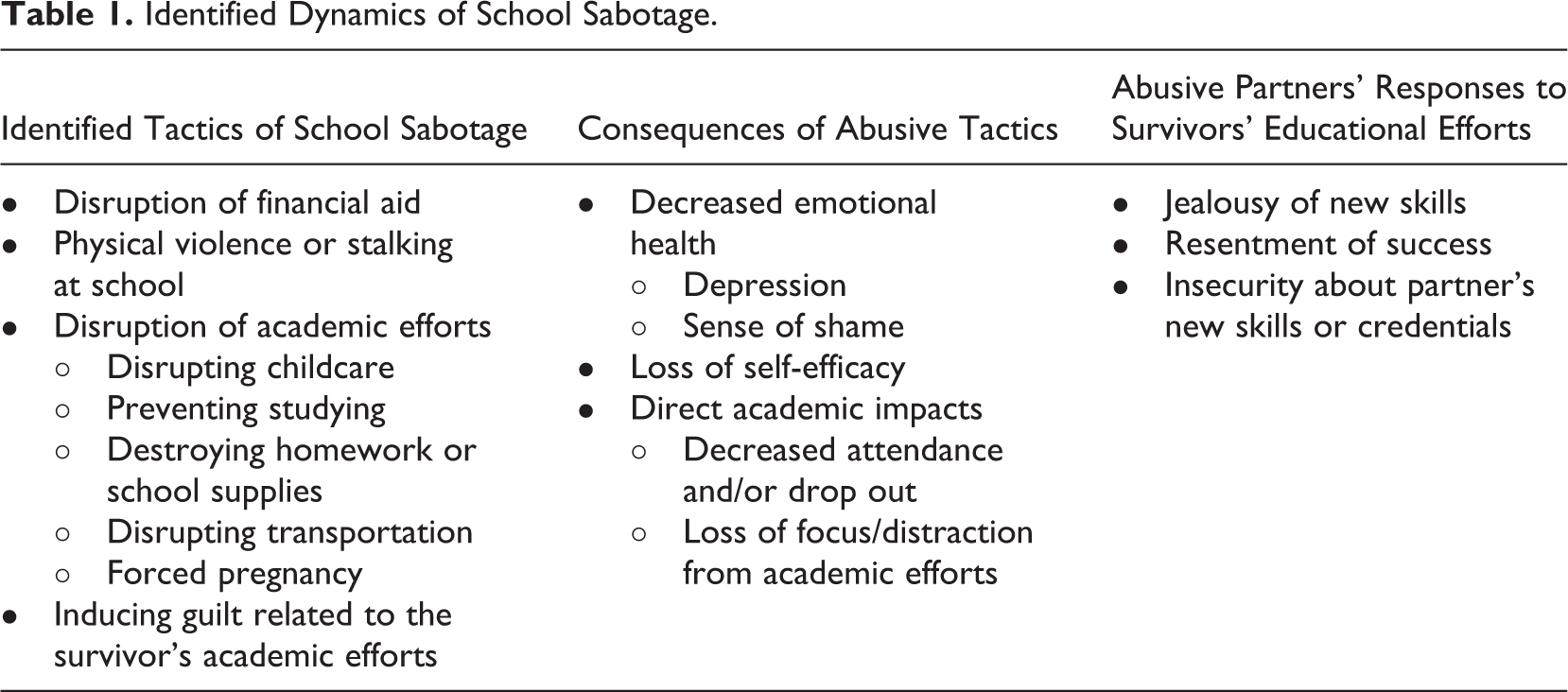
The first and strongest theme to emerge highlights a variety of ways that an abusive partner might directly interfere with a woman’s education efforts and makes it clear that service providers are aware of many instances of school sabotage occurring among their students/clients. One participant placed tactics of school sabotage squarely within the constellation of coercive controlling behaviors, sharing her opinion that: initially [abusive partners] were good with her going back to school, but then it started impacting them and they didn’t like it. And they would describe behaviors that very specifically were undermining partners as they were attempting to do that. Disruption of financial aid. A high percentage of community college students receive federal financial aid dollars, including Pell grants and student loans, and participants identified this as a key area of interference by abusive partners. One participant stated, “Sometimes they take the money that the women…. The financial aid money. Just controlling whatever they earn or whatever they bring. Taking their money.” Another participant reflected on a woman she was currently working with, stating “[She is] trying to go back to school right now, and he destroyed her credit history, so she can’t get student loans and can’t go back to school.” Physical violence/stalking at school. Providers talked about physical violence and stalking on campus as a central aspect of IPV in the school context. In these instances, providers noted the role of campus police in diffusing the situation and ensuring the safety of students and bystanders. They also described how the emotional strain of experiencing such violence in school can have repercussions on student’s academic success as well as their physical and mental health. A particularly disturbing example was provided by one provider who stated: I had, just yesterday, a man out fighting his girl. We had to call the campus police and he was all up against her, threw things at her, we had students come up and tell us all about it, and we had to call campus police.
When witnessing physical violence at school, providers stated that they frequently relied on campus police to help diffuse the situation. One staff member noted that: I saw these two young people pushing and shoving each other and the girl seemed like she wanted to leave and he wouldn’t let her and he would push her, and so at that point I called campus police and in most cases if its active right there and I have no relationship, I will call campus police. Sometimes it does happen where the abuser will come all the way to the school, and several times the police and other people will get involved. Or they have been hired by their boyfriends, so we deal with a lot of that. Disruption of academic efforts. Financial sabotage, physical violence, and stalking are all facets of IPV that are experienced by survivors whether or not they are in school. Direct interference with academic pursuits, however, is a facet of IPV unique to those survivors who are attending school and thus could be considered as a defining characteristic of school sabotage. Participants consistently identified abusive and controlling behaviors that partners used to undermine women’s academic efforts, including preventing studying or destroying homework, failing to follow through with childcare, sabotaging transportation to school, and forced pregnancy. One provider reflected on the variety of tactics of abusive partners, noting that she had experienced: Men who said I was sick of being the babysitter and I was not going to babysit our kids any longer, so they would stop coming home when she needed them to do that to get to class. Men who would take her books and rip them apart or make sure she didn’t have access to them.
Another provider reflected on the dependence many of her students had on their abusive partners for transportation to and from school, remembering: I know one young lady, her boyfriend was- the transportation issue was bringing her to school. And when he would get mad at her about whatever, he wouldn’t bring her to school. And so, she was such a good student, so we’d say “what happened” and she’d say “well, he wouldn’t bring me, and he doesn’t allow me to ride the bus.”
One provider noted that other forms of IPV can have a direct impact on academic efforts. She described an example of a survivor she had worked with, whose partner had forced her into pregnancy, drawing a direct link between reproductive coercion and school sabotage. She remembered: She was pretty independent, her family had relied on her tremendously—she had been a stabilizing force helping her mom, etc. She met her partner, she was working, stable, pursuing education, meet her partner and through a short period of time there were red flags of emotional abuse and controlling behaviors and one of the first things that he attempted to do was force her to get pregnant, which happened quickly, diminished her ability to continue working, going to school, caring for her family. Inducing guilt. A number of respondents talked about witnessing abusive partners trying to make students feel guilty about the toll that their academic efforts were taking on their family. One provider identified it as a type of coercive control, going on to note: Kind of…making them feel guilty because they are not doing the things they used to do before—the cooking, the cleaning—they are trying to sabotage that effort that they are trying to make. To change their lifestyle.
Another provider repeatedly used the phrase “guilt trips,” for example, when she remembered a partner who would state: We needed to buy this for the house or we needed money to fix the car and instead you use it to pay for your classes (because not everybody is on financial aid here). So just those little guilt trips can make it harder. Theme 2: Survivors experience serious consequences, including emotional and academic impacts.
A second key theme emerged around the way that providers perceive the impacts of abusive behaviors, including their identification of emotional and academic impacts which negatively affect survivors’ emotional health, sense of self, and academic achievement.
Emotional Health and Sense of Self-Efficacy
According to the respondents, many of academic challenges faced by women could often be traced back to the emotional scars of abuse. One participant reflected: The bruises and the breaks and all of that heal, but what it robs you of is it takes a part of you away. Who you are. And dealing with school and college and all the demands of college and life in general. You need your whole self. So it’s a part of them that is missing that they can’t devote to improving themselves. So it impacts their studies, their health, in every way. It impacts their parenting. And they don’t know how deeply it effects them because it has become a part of their life. Some people, they are just not going to be happy for you. And you have to get those people out of your life because it’s going to be negatively affecting your schooling and even if you feel like you are focused, those negative emotions are going to come throughout your life and you are not going to be able to get anything done. I felt that, it just came to the point where I had to take a break because I was not emotionally stable enough to even think about school or anything, you know?
Academic Achievement
Participants reflected on how the emotional scars of abuse are linked to key indicators of academic success. One participant stated that she feels that IPV impacts “attendance, because they are less likely to show up to school.”
Why do you think that is?
Sometimes I think it’s shame, sometimes it’s scars that they may have both physical and emotionally. And they would rather hide. So that is how it sometimes impacts.
Participants also highlighted that experiences of school sabotage can impact a student’s focus and concentration, which is needed for academic success. One provider shared: I was just like, that’s kind of turbulent, and this is finals week now. And they are out there fighting and all these emotions are running through, and you know that is going to be sitting in the back of her head. And during finals week. A lot of times they can’t focus, they are dealing with depression as a result of all that. And even though they want to move forward and they are scared of their partner…. Some of them struggle, but some of them in spite of all that are making it. Theme 3: Since school enrollment is a serious challenge to abusers’ control, in response abusers display a range of emotions including jealousy, resentment, and insecurity.
Aligning with CCT, another theme that emerged from these data is that many abusive partners harbor a level of resentment against women for their academic pursuits. Respondents repeatedly remarked about observing dynamics of jealousy or insecurity stemming from the new skills, knowledge, and self-confidence that can come along with academic success. As one participant noted, this can add additional guilt. She stated: You have older women that this man sees them progressing, and sees them getting new ideas, or something they read in their text book, and you hear a lot of “you just trying to make me feel like I’m dumb”…and “I knew that would happen when you went to that school.” I experienced it with my daughter’s dad. He was jealous of my success. I think you do because they see you bettering yourself, but they are still sitting here at this same job they have been at for years, have not progressed. Theme 4: Despite abusive partner’s sabotage attempts, many survivors are determined to use education as a pathway to safety and opportunity.
Even with so many reflections on the barriers and challenges of IPV, a final theme emerging from the interviews was hopeful in nature—a sense that for students engaged in school, education can be one mechanism to build a better and safer life. One participant reflected on student’s motivations for going to school in the face of such barriers, stating that: They are coming to school because it’s a way that they think their life will change, and they have found the support system that has encouraged them to go back to school, get an education, so…um…many of them still have the emotional scars do not go away many of them for a long time. Getting people employed is fabulous, but most of the women we are seeing have very few educational skills, so unless they are going to stay in a job that is going to be not much about minimum wage, they are pretty much there for a long period of time, so we have to do something around allowing women to gain real skills allowing them to have real jobs that can lead to some change.
Discussion
This study examined the perceptions of service providers regarding school sabotage among adult students. Findings highlight the unique forms of abuse that providers have observed, the impacts they have seen on survivors’ emotional and academic outcomes, and the benefits of educational attainment for survivors. These findings suggest implications that span domains of practice, policy, and research.
As participants described the kinds of abusive tactics they observed, it became clear that community college students face many tactics that are well-documented in other areas of the IPV literature (such as financial sabotage, physical violence, and stalking) and also tactics that are unique to their status as students. These interviews highlight the ways that “school sabotage” is an important domain within our conceptualization of economic abuse as a form of IPV. Student/survivors may face tactics that are unique to the pursuit of an education (i.e., destroying homework, belittling the value of a survivor’s educational goals). They may also face tactics that are reminiscent of IPV experiences in many contexts but that have unique characteristics in the academic setting (i.e., sabotaging of financial aid, physical violence at school). Ensuring that faculty, staff, and IPV service providers recognize school as a place where coercive control could be exercised—even by a nonattending partner—is an important step toward supporting student survivors. Participants also pointed out that school sabotage has both emotional and academic impacts on survivors, and they highlighted the ways that emotional barriers can lead directly to academic challenges including decreased achievement and attendance. Thus, developing programs to support survivors and prevent IPV in community college contexts could promote enhanced academic achievement and long-term educational and economic stability for women and families.
Providers also identified being in school as an opportunity to overcome life barriers, noting the positive emotional, psychological, and practical impacts of success in the classroom. They reflected on the opportunity to develop new and supportive communities that may help break down the isolation that often accompanies abusive relationships. Many participants also reported that a key dynamic they had observed in many abusive relationships is an abusive partner’s resentment of a woman’s attempts to develop her skills and knowledge. Consequently, as a woman attempts to expand her opportunities, an abusive partner may escalate their abusive and controlling tactics.
Implications for Practice
Even as important attention is focused on reducing sexual assault on college campuses, the findings of this study suggest that it is important to view the dynamics and impacts of violence against women for students more broadly. The results of this study point to several important areas for attention by IPV advocates and school-based social service personnel.
Interventions to Increase Retention at Community Colleges
President Obama’s education policy agenda includes a significant emphasis on the use of community college to prepare the 21st-century workforce (AACC, 2014). The first goal set related to this agenda has been to increase student completion rates by 50% by 2020, with an emphasis on eradicating attainment gaps in income, race, ethnicity, and gender. Given that school sabotage may be directly linked to poorer academic outcomes, particularly among women, steps could be taken to increase community college retention by increasing support for survivors of IPV.
Personnel Should Be Prepared to Address School Sabotage Among Students
Because many are already aware of and screening for physical IPV, school-based mental health or health professionals should consider including aspects of school sabotage in their IPV screening efforts. Further, personnel should be prepared to engage in basic safety planning or provide resources and links to community-based IPV services as needed. Others who frequently interact with students, including academic support staff, student programming staff, women’s office staff, and teaching faculty, should be provided education about the dynamics of IPV and how they can be manifested in the form of school sabotage. Faculty should be provided with examples of school or community-based resources that may be of assistance to students and trained on identifying situations in which IPV might be negatively impacting student’s academic efforts. Campus police should know how to intervene safely around on-campus incidents and be prepared to support students in accessing legal remedies. Campus-based student-support personnel (including counselors or other mental health professionals) should develop prevention education programs that include strategies for fostering social support and breaking down isolation for all students, which could be especially useful for survivors of IPV. These student service staff members may also be able to help survivors by advocating for the implementation of school-wide policies for the provision of accommodations, such as extensions on homework to address the consequences of school sabotage and other forms of IPV.
Service Providers Should Be Aware of Potential Links Between School Sabotage and Other Forms of IPV
Those working with students should consider the possibility that partners who express feelings of jealously or threat related to women’s academic pursuits may be more likely to perpetrate other forms of violence within the relationship. These providers should be trained to recognize school sabotage and other IPV warning signs and to develop safety plans that address their needs on and off campus.
IPV Service Providers Should Be Prepared to Address School Sabotage With Survivors
Identified school sabotage tactics should be incorporated into screening and assessment tools used by IPV service agencies and community-based services providers. Advocates should be aware of the damaging messages survivors who are in school may be receiving and be prepared to address them. They should also be prepared to engage in academic safety planning with survivors, identifying and developing strategies to deal with the specific batter-generated risks faced by survivors attending school (Davies & Lyon, 2014). This could include developing alternate strategies to meet childcare or transportation needs, working with faculty to address direct acts of homework destruction, and establishing emotional supports.
Implications for Policy
The Campus Sexual Violence Elimination Act, passed in 2013, sets significant requirements for institutions of higher education to engage in prevention, intervention, and education around issues of domestic violence and sexual assault on campus. Given that little evidence-based knowledge around these issues within the community college context exists, the findings of this study could be a starting place for community colleges seeking to meet these requirements (Voth Schrag, 2016).
Implications for Other Academic Settings
While participants in the current study were particularly focused on the context of community colleges, there may be important lessons for other academic settings as well. Many of the dynamics of school sabotage identified by community college participants may also be salient at traditional 4-year universities for older/nontraditional students and for graduate students who are more likely to be in established relationships. Financial sabotage, homework destruction, and failing to follow through with childcare arrangements are all tactics that may uniquely impact students in longer term, live-in relationships. These students are typically not the focus of campus-based sexual and dating violence prevention and intervention efforts and may benefit from specific attention.
Further, future investigation may reveal the negative impact of school sabotage at the high school level among teen dating partners, and high school service personnel (including school social workers) should be educated around these issues and included in intervention and prevention efforts.
Implications for Research
These findings also point to the need for additional research. Along with qualitative studies aimed at understanding school sabotage from the perspective of student/survivors, there is a clear need for quantitative data to confirm and extend these findings.
Development of Screening and Measurement Tools
Further development of quantitative measures, both for scientific purposes and to serve as assessment tools for service providers, will be an important step in the near term. The identified domains of “school sabotage,” including disrupting financial aid, physical violence or stalking at school, disruption of academic efforts, and applying guilt or emotional sabotage, also provide a useful beginning for the development of screening and assessment tools. The Work/School Abuse Scale can be used to assess experiences of IPV among students, however it does not include items tapping many of the domains identified by study participants, including direct academic interference (i.e., destroying items, preventing studying) and the disruption of academic finances (i.e., taking student loan money; Riger et al., 2001). The findings of this study suggest that continued work on measurement refinement is warranted. Along with measurement development for further academic work, screening questions that could be used by IPV service providers or school-based student service staff should be tested and disseminated.
Frequency and Prevalence
Once validated measures of school sabotage have been established, studies should assess the frequency and prevalence of school sabotage on various types of campuses and among different populations. These include community college students, commuter college students, traditional 4-year students, teens, and graduate students. This work will help establish an understanding of the severity of the problem and point to key areas for prevention and intervention development.
Impacts and Associations
Once the extent of school sabotage tactics is understood, longitudinal research is called for to gain deeper insight into the unique impacts of school sabotage. Studies should assess the causal mechanisms between specific abusive tactics and negative survivor outcomes, including potential academic, emotional, and mental health consequences. In order to understand if the tactics of school sabotage should be seen as key risk markers for students who may be experiencing other forms of IPV, the extent to which it is correlated with other forms of IPV should be examined.
Limitations
Several limitations should be considered when evaluating the conclusions and implications of this study. First, these interviews reflect the perceptions of service providers, some of whom do and some of whom do not also identify as survivors of IPV, thus work focusing on the voice of survivors must receive future attention. These data also do not answer a number of important questions, including the extent to which school attendance increases an abusive partner’s violence or controlling behaviors and the impact of school sabotage on survivor’s long-term academic trajectories. Future work should specifically target IPV survivors to understand their perspectives, especially around the impact of school sabotage and potential areas for intervention. Next, interviews were conducted with a small number of respondents (n = 10). While a number of important themes were clear from this group of interviews, future work with a larger group of participants may be able to develop these themes more deeply. Additionally, while the study sought to specifically address the needs of community college survivors, the IPV agency providers interviewed have experience with students from a number of backgrounds, which may be reflected in their responses. Respondents were also all residents of the same midwest metropolitan area, and the social service dynamics of the region, including a strong emphasis on the economic impact of IPV, could have influenced the types of responses provided by participants. Participating community college staff members were all part of the same community college system, and their responses could be similarly influenced by the culture and climate of the system.
Conclusion
For women who have faced emotional and social isolation due to IPV, engaging in school may provide a “golden moment” that could enhance their long-term safety. Engaging with a new community could break down isolation, and academic success could enhance their safety and long-term security. In addressing school sabotage, along with other forms of IPV experienced by students, providers have an opportunity to partner together with survivors in developing skills and credentials that can enhance their long-term economic prospects and well-being.
Footnotes
Declaration of Conflicting Interests
The author(s) declared no potential conflicts of interest with respect to the research, authorship, and/or publication of this article.
Funding
The author(s) received no financial support for the research, authorship, and/or publication of this article.