




Abstract
This article reports findings from a literature review of facilitators and barriers to domestic violence service seeking among American Muslim women. Racial, cultural, and ethnic differences were also examined. Facilitators and barriers to domestic violence service seeking were (1) cultural perceptions of abuse; (2) religious perceptions of abuse; (3) children; (4) feelings of embarrassment, fear, and shame; (5) immigration status and language barriers; (6) education level; (7) knowledge and perception of services; and (8) informal supports and support systems. However, the extant literature does not fully capture the diversity of American Muslims. Implications for future research are discussed.
Introduction
According to the Centers for Disease Control and Prevention (CDC), approximately one in three women have experienced rape, physical violence, or stalking by an intimate partner in their lifetime (Black et al., 2011). Of the numbers of women who had experienced domestic violence by an intimate partner, more than one in three reported experiencing multiple forms of abuse. In a retrospective telephone survey study conducted between 2003 and 2005, 44% of women reported experiencing domestic violence in their adult lifetime, and 11.7% reported experiencing domestic violence in the past 5 years (Thompson et al., 2006). Further, women reported experiencing multiple types of abuse; 69.2% of women who reported being physically abused also reported experiencing another type of domestic violence, including forced sex or some other form of sexual contact. Twenty-one percent of women reported having been abused by two or more partners in their lifetime (Thompson et al., 2006). According to the National Intimate Partner and Domestic Violence Survey, in the United States someone is physically abused by an intimate partner every 20 minutes (CDC, 2014).
Research on the American Muslim community is still an emerging field of study, and only a few studies have attempted to capture domestic violence prevalence rates among this population. In 1999, Sharifa Al-Khateeb reported on the first study conducted on domestic violence in the American Muslim community. Al-Khateeb surveyed 63 community workers, leaders, and community members nationally who estimated that domestic violence occurred in 10% of Muslim homes. It was not reported if data collected represented a lifetime prevalence rate or onetime occurrence. In either case, this number is likely to be much higher. Adam and Schewe (2007) examined domestic violence in the South Asian community in Chicago using a religiously mixed sample comprised of Hindus (n = 37) and Muslims (n = 41). Measuring domestic violence using four subscales of the Revised Conflict Scale (Straus, Hamby, Boney-McCoy, & Sugarman, 1996), researchers found that 73.2% (n = 41) of South Asian Muslim women in the study experienced some type of abuse in their lifetime. While this study focused only on a subset of the American Muslim community, findings suggest that the overall prevalence of domestic violence in the American Muslim community may actually be higher than the national average. From February to March 2009, two Muslim organizations, SoundVision and Islamic Social Services Association, conducted a national online survey to examine the prevalence and perceptions of domestic violence in the American Muslim community (Ghayyur, n.d.). A majority of respondents were women (77.14%) and 43.67% identified with being South Asian; no specific percentages were provided for the other racial and ethnic groups represented, but respondents also identified as black, white, and Arab. While a majority of respondents (the exact percentage was not provided) had not experienced physical abuse in a relationship, 70% of respondents reported that they or someone they knew had been a victim of domestic violence.
Defined by Oxford Dictionary Online as a “dislike of or prejudice against Islam or Muslims, especially as a political force,” Islamophobia is a reality for American Muslims. As a result of heinous terrorist acts by people claiming to be Muslims, since 9/11 the American Muslim community has faced hate and backlash. In 2015 alone, Muslims were targets of anti-Islam protestors in Austin, Texas (McGaughy, 2015), a Muslim child was arrested for building a clock that was mistaken by school officials as being a bomb (Fantz, Almasy, & Stapleton, 2015), and leading Republican Party presidential candidates fervently called for banning Muslims from entering the United States, an unconstitutional plea that polls showed to actually be supported by 36% of Americans (Abadi, 2015). These incidences reflect a fear and misunderstanding of Muslims and the religion of Islam, a reality that has implications for service delivery and for women seeking domestic violence services. In fact, American Muslim women have reported facing discrimination when seeking domestic violence services. In one account, “[shelter] administrators urged [a woman] to throw off her veil, saying it symbolized the male oppression native to Islam that she wanted to escape” (MacFarquhar, 2008, p. 12). This lack of religious understanding presents a barrier to women’s options for seeking help for abuse. Further, depending on their cultural or ethnic background, American Muslim women may face additional hurdles including language barriers and cultural assumptions made on the part of practitioners (Faizi, 2001; Graham, Bradshaw, & Trew, 2009). In addition, women may not seek services at non-Muslim run shelters, because they feel they cannot relate to the other women in shelters (Faizi, 2001). American Muslim women, therefore, may delay seeking services until their situations become dire. Due to this, American Muslims have created organizations to meet the needs of women and to address domestic violence within the American Muslim community. These include direct service agencies such as Muslimat An-Nisa in Baltimore, Domestic Harmony Foundation in New York, and Sisters Nurturing Sisters in Chicago; legal organizations such as Karamah in DC; and organizations that conduct research and provide training to the Muslim community on domestic violence issues such as Peaceful Families Project. The aim of this article is to examine facilitators and barriers to domestic violence service seeking for American Muslim women.
Researchers have explored women’s domestic violence help and service-seeking behaviors from a variety of populations and have found various facilitators and barriers to domestic violence service and help seeking. One barrier includes the effectiveness of their prior help-seeking strategies. In a study examining black women’s experiences in seeking help for domestic violence (Gillum, 2008), women reported being dissatisfied with the formal services they received. Specifically, women who sought help from the legal system cited that the police were unresponsive or the abuser did not receive any legal penalty (Gillum, 2008). This later led women to distrust police and prevented them from calling in future instances of violence for fear of it backfiring.
Duterte et al. (2008) identified that the type and severity of abuse women faced correlated with the types of help women sought. Experiencing physical or sexual abuse appeared to facilitate help seeking. Women who were victims of physical abuse or sexual abuse were more likely than those who experienced psychological abuse alone to seek legal services. When severity was examined, researchers found that as the severity of physical abuse increased, rates of medical service seeking increased.
Fugate, Landis, Riordan, Naureckas, and Engel (2005) explored women’s nonuse of formal and informal help-seeking strategies. Sampling from community health centers and one hospital in Chicago, researchers examined the nonuse of four help-seeking strategies: going to an agency or counselor, seeking medical help, going to the police, or talking to someone. Of the four ways of seeking help, women reported utilizing an agency or counselor the least often. Women indicated facing a number of barriers to seeking help from a domestic violence agency or counselor, such as their desire to protect their partner and preserve the relationship, as well as expressing concerns about privacy and confidentiality. Across all four ways of seeking help, the theme of severity of abuse emerged; women reported not seeking certain types of help because they felt the abuse was not serious enough. Findings suggest that there is a “threshold” of severity of abuse; it is not until the abuse crosses the threshold that women seek formal services or informal help for domestic violence.
Domestic Violence Movement and Feminist Theory
The battered women’s movement, informed by both the feminist and the antirape movements, emerged in the late 1970s (Schechter, 1982). Advocates in every state and on the federal level established shelters, advocacy organizations, and eventually laws against violence against women, shifting domestic violence from identification as a private issue to one of public concern and responsibility. In addition, research on domestic violence and its effects has expanded and developed into a field of study (National Center on Domestic Violence, Trauma, and Mental Health, 2012). Scholars are conducting research on domestic violence in nearly every social work program in the country, and the Council on Social Work Education’s (2015) Annual Program Meeting offers a track dedicated to the work on violence against women.
Feminist perspective posits that domestic violence exists because of the patriarchal structure of our society that supports gender inequities and maintains male dominance and power (Brewster, 2002; Dobash & Dobash, 1992; Gilfus, Trabold, O’Brien, & Fleck-Henderson, 2010; Kelly, 2011; McPhail, Busch, Kulkami, & Rice, 2007; Schechter, 1982). Further, inequality at the structural level influences intimate relationships, and men replicate male dominance. This article connects personal experience to the larger structure of the society, focusing on gender as a system of oppression. Feminist theory “has become the conceptual basis for the most widely accepted definitions of [domestic violence] used in developing public policies and standard intervention practice for both victims and perpetrators of [domestic violence]” (Gilfus et al., 2010, p. 2).
However, the feminist perspective has been criticized from scholars both within and outside the feminist movement (McPhail et al., 2007). One critique of this perspective is that it essentializes gender (Chavis & Hill, 2009; Crenshaw, 1989, 1991), and scholars argue that there are groups that may be marginalized in service delivery if other social identity considerations, such as race, disability status, and religion, among others, are not examined (Alkhateeb & Abugideiri, 2007; Bent-Goodley, 2009; Richie, 2012; Sokoloff & Pratt, 2005). Intersectionality is a framework and methodology that expands the feminist lens to examine how various social identities “intersect at the micro level of individual experience to reflect interlocking systems of privilege and oppression … at the macro social-structural level” (Bowleg, 2012, p. 1267). Coined by Crenshaw (1989, 1991), this perspective is particularly useful in examining women’s experiences of domestic violence, as it can aid social workers in assessing and uncovering the influence of other forms of oppression she may be experiencing in the society that may complicate seeking help (Lockhart & Danis, 2010). Lockhart and Danis (2010) identify that an intersectional framework enhances one’s understanding of cultural competence, a key ethical concern for the social work profession (National Association of Social Workers, 2008). An intersectional framework is especially useful for understanding the American Muslim community, given the diversity among American Muslims. The Muslim population in the United States is estimated at 2.6 million people (Pew Research Center’s Forum on Religion & Public Life, 2011); and of the total population of Muslims, 65% are foreign-born (Pew Research Center, 2007). American Muslims are the most ethnically diverse religious group in the United States (Gallup, 2009). The three largest ethnic groups of Muslims are Arabs (24%), African Americans (20%), and South Asians (18%; Pew Research Center, 2007); however, Muslims are also comprised of Europeans, Iranians, Africans, Latinos, and white Americans (Pew Research Center, 2007; Younis, 2009).
To advance feminist social work practice, we must understand the needs of all women who experience violence. The following literature review explores the American Muslim community by addressing the following questions: What does the literature identify as being barriers and facilitators of domestic violence service seeking for American Muslim women? Given the racial, cultural, and ethnic diversity of the American Muslim community, this article also addresses the question: What are the differences in barriers and facilitators of domestic violence service seeking between different racial, cultural, and ethnic groups in the American Muslim community?
Method
To conduct the literature review, the author followed steps delineated by Creswell (2008) to analyze the literature. This process entailed identifying key words and searching electronic databases to locate articles that met inclusion criteria. The next step was to create a “literature map” to organize the articles while simultaneously writing summaries of each article. After each article was summarized, the author then read and reread the article summaries to identify themes, keeping the initial research question in mind.
Because the first article on domestic violence in the American Muslim community was published in 1999, studies conducted from 1999 to present were eligible for inclusion. Social work and social science databases such as PsycINFO, Social Services Abstracts, Sociological Abstracts, Academic OneFile, PsycARTICLES, and Academic Search Complete were reviewed. Key terms used were domestic violence, Muslim, Muslim women, and United States (used to limit findings to Muslim women in the United States.) and various combinations of these terms. Also, since there is differing terminology for abuse, intimate partner violence, interpersonal violence, and batter* women were also used as key terms. To further expand the search, key terms such as immigrant and religion were used in place of “Muslim.” Studies that met criteria for selection were those that examined perceptions of domestic violence service seeking and barriers to service seeking. Studies that explicitly stated that Muslim women were included in the study, whether exclusively or with other groups, were included in the selection criteria.
Results
Ten journal articles and one dissertation met the criteria for the current review. Table 1 provides a summary of the results. Eight themes were identified that facilitated and/or hindered domestic violence service seeking by American Muslim women, and some of the articles included more than one theme. These themes were (1) cultural perceptions of abuse; (2) religious perceptions of abuse; (3) children; (4) feelings of embarrassment, fear, and shame; (5) immigration status and language barriers; (6) education level; (7) knowledge and perception of services; and (8) informal supports and support systems. Due to the paucity of the literature in this area, no conclusions could be made about differences between racial, cultural, and ethnic groups. However, results highlight the racial, cultural, and ethnic identities included in the literature to begin to provide insight into the unique experiences of groups within the American Muslim community. The following sections examine each theme in detail.
Factors That Facilitate and Hinder Domestic Violence Service Seeking.
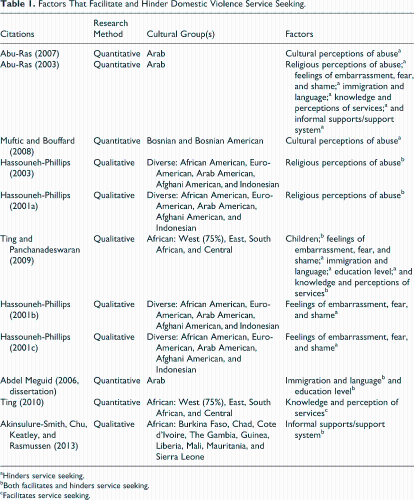
aHinders service seeking.
bBoth facilitates and hinders service seeking.
cFacilitates service seeking.
Cultural Perceptions of Abuse
Researchers have examined cultural perceptions of domestic violence among American Muslims. The literature search revealed two qualitative studies, one focused on Arab women (Abu-Ras, 2007) and another focusing on Bosnian women (Muftic & Bouffard, 2008), that examined cultural perceptions of domestic violence. Researchers found that holding cultural perceptions that reflect patriarchal views can create barriers not only in seeking help for domestic violence services but also service utilization related to—but not directly intended to address—domestic violence such as mental health services.
Abu-Ras (2007) investigated domestic violence service utilization and the relationship between cultural beliefs and service utilization among Arab immigrant survivors of abuse in the Detroit area seeking services through a local community agency. Abu-Ras hypothesized that women with “traditional” beliefs about women were less likely to use formal services for domestic violence.
Thirty percent of women reported utilizing medical services including being hospitalized, going to an emergency room, and discussing medical problems with a medical professional; 68% utilized family services including speaking with a family therapist or religious/spiritual advisor; 20% utilized mental health services including hospitalization for psychological/emotional problems, taking medication, speaking with a counselor, or attending group sessions; 52% utilized legal services; and 25% reported utilizing social services including calling a hotline, residing in a shelter, or seeking counseling. Participants reported using mental health and social services the least frequently, and Abu-Ras noted that this finding may be related to negative cultural perceptions of mental illness. Participants reported high rates of family and legal services, likely due in part to the types of referrals made by social service providers, as the study relied on a nonrandom sample of Arab women who were all affiliated with one social service organization outside of Detroit (Abu-Ras, 2007).
One third of the women perceived the wives’ actions as contributing to the perpetration of the abuse. Abu-Ras (2007) attempts to explain this finding, stating that Arab “[w]omen may use self-blame and justification as mechanisms for rationalizing the violence to help them cope with partner abuse and tolerate the violence related to traditional sex-role expectations of women” (p. 1020). While the majority of women in the study held traditional beliefs, only 16% to 25% felt that domestic violence was justified in special cases.
Upon further analysis, Abu-Ras identified associations between service utilization and the independent variables, “justification of wife abuse” and “blaming the woman for violence against her,” both measured by items on the Beliefs About Wife Beating Scale developed by Saunders, Lynch, Grayson, and Linz (1987) and adapted by Haj-Yahia (1998). Women who did not justify wife abuse or blame the wife for violence were more likely to use social services than women who did. Women who did not hold patriarchal beliefs, as measured by the Familial Patriarchal Beliefs Scale (Smith, 1990), were more likely than women who did hold strong patriarchal beliefs to seek legal services.
Muftic and Bouffard (2008) conducted a study comparing domestic violence experiences and perceptions of Bosnian women in the United States and in Bosnia. Nearly 88% of the sample identified as Muslim. Researchers found that Bosnian American women appeared to hold more conservative views about domestic violence than Bosnian women. Specifically, there was a statistically significant difference between the Bosnian American and Bosnian women’s agreement with the statement, “Wives could avoid being battered by their husbands, if they knew when to stop talking.” Given Abu-Ras’s (2007) findings on the associations between service seeking and blaming women for abuse, this belief may present a barrier to service seeking. There were generally high rates of domestic violence in the group, with one third of both Bosnian and Bosnian American women reporting physical abuse. In addition, most of the women in the study believed that domestic violence was a social problem.
Religious Perceptions of Abuse
Three articles (two studies) examined the role of religion in American Muslim women’s seeking help for domestic violence. One article used quantitative methods and focused on the experiences of Arab women (Abu-Ras, 2003), while the other two articles sampled an ethnically diverse group of women and utilized qualitative methodology. Religion and religious perceptions of abuse appears to both facilitate and hinder domestic violence service seeking among American Muslim women.
Abu-Ras (2003) found that participants cited religion as a barrier to seeking help for domestic violence. Specifically, 43.3% of participants stated that “their religion discouraged them from seeking outside help” (Abu-Ras, 2003, p. 43). Interestingly, Hassouneh-Phillips (2003) found that women who experienced domestic violence found strength in their faith and often used faith as a way to cope. However, faith also presented a barrier for some women. For example, the belief in an afterlife influenced women’s choice to prolong staying in the relationship; “the idea that this life does not matter and that Allah will reward women who suffer as they strive to keep their families in tact emerged” as a theme (p. 688). Women who desired to leave the relationship and get an Islamic divorce encountered difficulty in obtaining one, an issue complicated by the absence of a formal Islamic judicial system in the United States (Hassouneh-Phillips, 2001a). This caused an additional barrier for women who tried to leave an abusive marriage.
Children
One study identified that having children may serve to both facilitate and hinder service seeking. Ting and Panchanadeswaran (2009) conducted a qualitative study examining barriers to domestic violence help-seeking among African immigrant women. Forty percent of the sample (n = 6) identified as Muslim. Participants reported that they decided to leave the relationship, when they realized that their children’s safety was at risk or when they realized the children were becoming aware of the abuse.
Muslim African immigrant women in polygamous marriages had additional considerations in regard to their children. Women reported staying in the abusive relationships because they did not want to leave their children with another wife or have their children lose their status in the family (Ting & Panchanadeswaran, 2009).
Feelings of Embarrassment, Fear, and Shame
Across three studies (four articles), feeling of embarrassment, fear, and shame hindered women from seeking services and/or help for abuse. Abu-Ras (2003) found that a majority of Arab immigrant women in the study had feelings of fear, shame, and embarrassment toward seeking help for domestic violence outside of their families. Almost half of respondents reported feeling embarrassed when talking to social workers, and 62.7% reported feeling embarrassed when seeking medical help.
Ting and Panchanadeswaran (2009) found in their qualitative study that African immigrant women expressed shame of being a victim of domestic violence and of having a failed marriage. Women also expressed the desire to preserve the image of African immigrants. According to Ting and Panchanadeswaran, “[participants] did not want U.S. police or judges to think that immigrant African men are abusive like the stereotypical African American men” (p. 824). Their fear of stigma not only stemmed from a gendered view and what it means to be a “victim,” but also a racialized one, in which they feared being associated with a stereotypical notion of “blackness.”
In a qualitative study of ethnically diverse Muslim women, Hassouneh-Phillips (2001c) found that women’s beliefs as to what it means to be a good wife was manipulated by their partners as a way to isolate them, creating an additional barrier to service seeking. In addition, while the practice of polygamy was not seen as an abusive act by participants, participants felt that polygamy was used as a way to abuse, “it was not polygamy that the majority of participants saw as problematic, but instead the behavior of husbands” (Hassouneh-Phillips, 2001b, p. 743). Similar concerns were raised by Ting and Panchanadeswaran’s (2009) study of African immigrant women. While the participants did not necessarily view polygamy as abusive, they expressed concern over the stigma they would face if they sought help, particularly because although they were legally married in their home country, their marriage was not recognized in the United States.
Immigration and Language
Two studies revealed that immigration status may cause a delay in, or prevent women from, seeking domestic violence services for African immigrant Muslim women and Arab immigrant Muslim women. In addition, limited English language proficiency and limited knowledge of the rights afforded to victims of domestic violence limit the options for seeking help (Abu-Ras, 2003; Ting & Panchanadeswaran, 2009). Cost of services, lack of interest by medical professionals, and language barriers posed delays in service seeking for Arab women (Abu-Ras, 2003). Abu-Ras (2003) found that the second most cited personal resource barrier to domestic violence service utilization for Arab immigrant women was a lack of informal supports (74%) followed closely by lack of English language proficiency (70%).
Education Level
The two studies that examined the role of education on American Muslim women’s domestic violence service seeking have showed conflicting findings. Abdel Meguid (2006) found that an Arab woman’s length of stay in the United States and level of education influenced her perception of domestic violence, suggesting that additional barriers may be present for newer less educated Arab women as opposed to those who have been in the United States longer with higher levels of education.
Although researchers have found that educational attainment is a factor that influences Arab American Muslim women to seek help for the abuse (Abdel Meguid, 2006), immigration can be a barrier to the benefit of this resource. Ting and Panchanadeswaran (2009) identified that an additional barrier to financial self-sufficiency for African immigrant women is the fact that while some women were college educated back in their home countries, they had difficulty transferring their degrees, making it difficult for them to get stable employment and housing.
Knowledge and Perceptions About Services
Two studies identified that being knowledgeable about services made it more likely for Muslim women to seek help, the inverse was also found. Abu-Ras (2003) asked Arab American participants to identify barriers that prevented them from seeking help for domestic violence. A majority of women perceived the cost of services (92.5%) to be too high. Lack of interest by doctors (65.6%) and the absence of services specifically designed for Arab women (46.3%) were also cited as barriers. Most striking is that 92.3% of participants had little to no knowledge of the types of services available to victims of domestic violence.
For African immigrant women, there appears to be a positive relationship between the knowledge of services and one’s utilization of them. A lack of knowledge of domestic violence services and legal rights of victims serves as a barrier to women leaving abusive relationships (Ting & Panchanadeswaran, 2009). In a later study, Ting (2010) reported that awareness of formal organizations and services, along with support from family and friends, facilitated African immigrant women’s leaving abusive relationships (Ting & Panchanadeswaran, 2009).
Informal Supports/Support System
Two studies found that informal support systems, such as family and friends, can serve to both facilitate and hinder service seeking for Muslim women. Abu-Ras (2003) found that the second most cited personal resource barrier for Arab American women in seeking services for domestic violence was fear of what their family and friends might think if they sought outside help (74%). Over 80% of women reported lacking a family support network and 70.1% reported that friends and family would likely discourage efforts to seek outside assistance (Abu-Ras, 2003).
In their qualitative study of West African immigrants’ experiences of domestic violence, Akinsulere-Smith, Chu, Keatley, and Rasmussen (2013) identified a three-step pathway that African immigrant women use when seeking help for abuse. First, women sought help from their families. Some participants reported that family members pressured women to reconcile with their partner and to drop legal charges (Akinsulure-Smith, Chu, Keatley, & Rasmussen, 2013). The next step in the pathway was seeking help from community elders or religious leaders. Lastly, women sought help through formal social services such as going to shelter, calling the police, or seeking protective orders. Although women eventually utilized services, they only did so if the community could not fulfill their needs.
Discussion
Domestic violence is a problem in every community, and research is emerging about the experiences of survivors in the American Muslim community. Studies have already begun to reveal what facilitates and hinders American Muslim women’s domestic violence service seeking; and in some ways, the results of this literature review mirror the larger literature on domestic violence. For example, feelings of embarrassment, fear, and shame; lack of knowledge of resources; and immigration status are well documented barriers to domestic violence service or help seeking (Dutton, Orloff, & Hass, 2000; Fugate, Landis, Riordan, Naureckas, & Engel, 2005; Raina, Lohman, & Maldonado, 2014; Raj & Silverman, 2002).
However, the research literature partially answers the questions posed. First, the current literature does not fully reveal differences between cultural groups and does not fully represent the diversity of the American Muslim community. Of the 11 articles examined, 3 focus on Arab Muslim women, 2 of which use the same data set. Four articles utilizing the same data set did provide knowledge of the community in a multicultural context (Hassouneh-Phillips, 2003, 2001a, 2001b, 2001c); however, not all the women in the study experienced violence, and the researcher did not explore women’s experiences by their racial, cultural, or ethnic background. Abdel Meguid’s (2006) study had the largest sample size with 224 Arab women, but the researcher acknowledged the need to expand the study to American Muslim communities of different cultural backgrounds.
These limitations make it difficult to generalize findings to all Muslims in America as several voices are missing. For example, no study reflects the experience of women who converted to Islam later in life. Just as Muftic and Bouffard (2008) acknowledge that people carry their culture with them no matter what country they move to, the same can be said in regard to culture being carried into faith.
Most studies focused on barriers, and few conclusions could be made about facilitators to service seeking. We need studies that are strength focused and examine the agency women carry with them. By only focusing on problems, we limit the ability to capitalize on what is going well. Further, we limit the ability for us to learn from the experiences of American Muslim women.
The current literature review examined service seeking, but it did not examine the variety of ways in which women seek help. For example, Hassouneh-Phillips (2003) found that prayers and reciting the Quran were ways in which women coped with the abuse, thereby seeking help from a higher power. Further, while some studies found that informal supports may have discouraged women from seeking outside help, such informal supports served to reduce the violence the women were facing (Akinsulure-Smith et al., 2013). This type of intervention cannot be undervalued, and it cannot be assumed that the only way in which women seek or should seek help is through formal services. The variety of ways in which women cope and seek help needs to be further examined.
Conclusion
Future research should build on the themes identified in this review of the extant literature, exploring how factors such as education level, immigration status, and racial and ethnic identity influence service seeking. In addition, further examination is needed of the context of American Muslim women’s experience to better understand how some factors, like informal supports and religion, can serve as both facilitators and barriers to seeking services. Lastly, a major gap in the literature on domestic violence in the American Muslim community is the lack of an intersectional analysis, a lens that others have found to be useful in examining the diversity of experiences of marginalized groups, particularly as it relates to examining privilege and oppression (Mehrotra, 2010). Intersectional research that examines how race/ethnicity, gender, and religion play a role in American Muslim women’s experiences can serve to advance our knowledge in this area and aid us in developing holistic, culturally competent, and affirming services to victims of domestic violence.
Footnotes
Acknowledgments
The author would like to thank Dr. Patricia O’Brien, Dr. Susan Phillips, Dr. Elizabeth Bowen, and Suhad Tabahi, PhD colleague, for their review and feedback on this article. The author would also like to thank the Institute for Research on Race and Public Policy at the University of Illinois at Chicago for providing a supportive space to complete this article.
Declaration of Conflicting Interests
The author(s) declared no potential conflicts of interest with respect to the research, authorship, and/or publication of this article.
Funding
The author(s) received no financial support for the research, authorship, and/or publication of this article.