




Abstract
Most frontline child welfare workers are female, as are most adult clients. The authors posit that caseworkers who are themselves mothers bring valuable perspectives and expertise to their work; however, their experience and wisdom as mothers is essentially invisible within the profession or at least within the professional literature. This mixed-methods study investigated how the experience of being a mother affects caseworkers’ relationships with client–mothers as well as whether they perceive the child welfare system valuing their unique perspective. Twenty-four participants from diverse positions within the child welfare field completed an interview protocol. Participants overwhelmingly responded that their parenting was informed by their work with families, that their experiences and wisdom as mothers was largely ignored by their agencies, and that their employers’ practices were often not family-friendly. There was variance in participants’ beliefs about whether the client–mothers experienced bias or empowerment within the system. Half of participants identified as feminist. Maternal ambivalence appeared not to be an area of shared experience between workers and clients.
Primary caregivers in child welfare cases are largely female; thus, case assessments tend to be an examination of mothering within the context of social issues including poverty, domestic violence, and substance use. The authors of this study have been developing training materials (under contract) for child welfare professionals for many years. As mothers and past providers of direct services themselves, the authors were intrigued as to why their field, ostensibly focused on engaging families—particularly mothers—to protect children, has completely ignored the relationship between female caseworkers who are mothers (hereafter referred to as caseworkers) and client-mothers (hereafter referred to as clients). Thorough review of the literature yielded no attention to this topic; therefore, the authors developed an interview protocol addressing what implications the mothering commonality has for workers and clients. Specifically, the researchers asked whether the child welfare system values their employees’ experiences of mothering and how the experience of being a mother influences casework practice with clients. The researchers also examined stresses common to both caseworkers and clients; what relationship, if any, exists between identifying bias, empowering clients, and labeling oneself a feminist; and whether maternal ambivalence might be a platform for engagement between workers and clients.
Literature Review
Women and the Child Welfare System
In 1995, scholar Karen Swift observed that “although the protection mandate of child welfare excludes mothers, it is mothers who have always been defined, thought of, and spoken about as the clients of the system” (p. 494). A study by the Public Health Agency of Canada (2010) found that 91% of primary caregivers in substantiated child abuse and neglect reports are mothers. In the United States, the Federal 2010 Child Maltreatment Report noted that women were unique perpetrators of child maltreatment and abuse 53.6% of the time compared to 45.2% for men (U.S. Department of Health and Human Services, 2011). 1 In many cases where male caregivers perpetrate abuse, the mother is held responsible for future protection of the children. Armstrong (1995, p. 19) noted that in the American system, it is “not the offender’s task to restrain himself, but the mother’s task to restrain him, or face losing her child to the state” and it has been argued that many states overreach and intrude on the constitutional rights of non-offending parents as well (Douglas & Walsh, 2010; Sankaran, 2009).
When a family comes to the attention of child welfare, it is most likely that the mother will be engaged in a relationship with another woman—the caseworker—since women workers outnumber males about four to one in the child welfare profession (Fallon, MacLaurin, Trocmé, Gail, & Golden, 2011; National Child Welfare Workforce Institute, 2011). The U.S. Census Bureau (2012) reports that 70.5% of women with children ages 18 or younger work full or part time and Statistics Canada (2011) reports that 72.9% of women with children under 16 were part of the employed workforce; therefore, it is likely that the majority of female child welfare workers have children of their own at home.
The few scholars who have examined gender in child welfare have noted a lack of attention to gender implications within the workforce which, they argue, is linked to a larger societal devaluation of caregiving for children. Swift (1995, p. 487) observed that “women have not only dominated the ranks of clients, frontline workers, and support staff, but child welfare itself focuses on the women’s world of caring for children.” Morris (2005, p.134) has written about how the gender socialization of girls as child caregivers leads to the investment of so many women in the professional field of child welfare. She viewed the worker as a surrogate mother, writing:
Child protection workers are required to act as nurturing agents of the state, to apply a set of bureaucratic principles to assure that children are parented in appropriate ways. In a sense, they act as surrogate mothers who tend the public young by the authority of a legal statute.
The limited literature on the relationships between women as workers and women as clients is steeped in role conflict. Miller and Stiver (1997, p. 49) have provided a powerful analysis of why these roles appear to be inherently at odds, noting “Indeed … a dominant group is not likely to create mutually empowering relationships, else it would not remain dominant. Thus, a patriarchal society would not evolve a system of relationships based in mutuality.” Perhaps because of this power differential inherent in a system that is reflective of the larger patriarchy, there has been no focus in the field on what may be a major shared commonality between many female caseworkers and female clients: their mothering experiences.
Cultural Constructions of Motherhood
Swift’s (1995) call for a systemic change of view about women within child welfare occurred almost 20 years ago, yet little movement seems to have occurred in this area. As Miller and Stiver (1997) also noted, too often mothers are the only ones left filling in for the totality of society. Reproductive justice advocate Mikki Kendell (2014) reported a wrenching example: A single mother from South Carolina was jailed after allowing her 9-year-old to play at a well-used park without supervision when her child care plans fell through. Kendell argues that if the mother, who was a low-paid food services worker, was in the same socioeconomic status as advocates of the “free-range kids movement” (i.e., largely upper-middle class, well-educated white women), she might have argued “her daughter’s right to unsupervised play time as a developmental necessity” (2014, p. 4). Instead, she was charged with child neglect and separated from her daughter for 17 days. As this example illustrates, there is no “taking on the system,” because women in the system feel powerless and are overwhelmed by their individual challenges. The proverbial village has abandoned the “common mom” and her efforts are “not supported and valued but instead are demeaned, she cannot fulfill this responsibility alone” (Miller & Stiver, 1997, p. 60). Miller and Stiver continue, “Many women feel like failures and, indeed, are labeled as such.”
Cultural myths of the bad mother and the good mother implicitly permeate the child welfare system. Hunter and Longhurst (2013) summarize studies of the good mother and associate this archetype with femininity, including being nurturing, offering protection, and remaining selfless. Yet motherhood is not shaped by gender alone. How motherhood is constructed in the relationship between client and caseworker is also influenced by the intersection of women’s other identities and oppressions, such as race, class, immigration or colonization histories, sexualities, and abilities (Mehrotra, 2010). Hill Collins (1994, p. 45) has written that for women of color and indigenous women, “Motherhood cannot be analyzed in isolation from its context.”
When a report of possible abuse or maltreatment is received, it implies a breakdown of parenting and a caseworker is assigned to investigate. She is figuratively the model of a good mother as she assesses the family’s needs and provides services to protect the child from the actions or omissions of the bad parent (usually, the mother). Women of color, poor women, those who have been marginalized, who question authority, or have been unable to protect their children from men’s violence, have often found themselves under investigation. Although two thirds of all reported cases of child abuse and neglect in the United States are not substantiated (i.e., caretakers are cleared of having caused abuse or neglect to their children), the stigma that surrounds being investigated by child welfare can be devastating to families. This cultural construction of motherhood underlies the relationship between the caseworker and the client, for it is within this relationship that an examination, both spoken (e.g., interviews related to how a child was injured) and unspoken (e.g., observations about the quality of the family’s living situation) of mothering occurs.
One alternative to the good mother/bad mother construct is that of the ambivalent mother, which may more accurately describe the experience of many mothers. Parker (1997, p. 28) defined ambivalence as “the experience shared variously by all mothers in which loving and hating feelings exist side by side”. Within child welfare relationships, clients’ behaviors that may suggest maternal ambivalence include abusing or neglecting their children or surrendering their parental rights. Caseworkers’ maternal ambivalence has not been previously studied in the literature.
Method
Theoretical Background, Procedure, and Participants
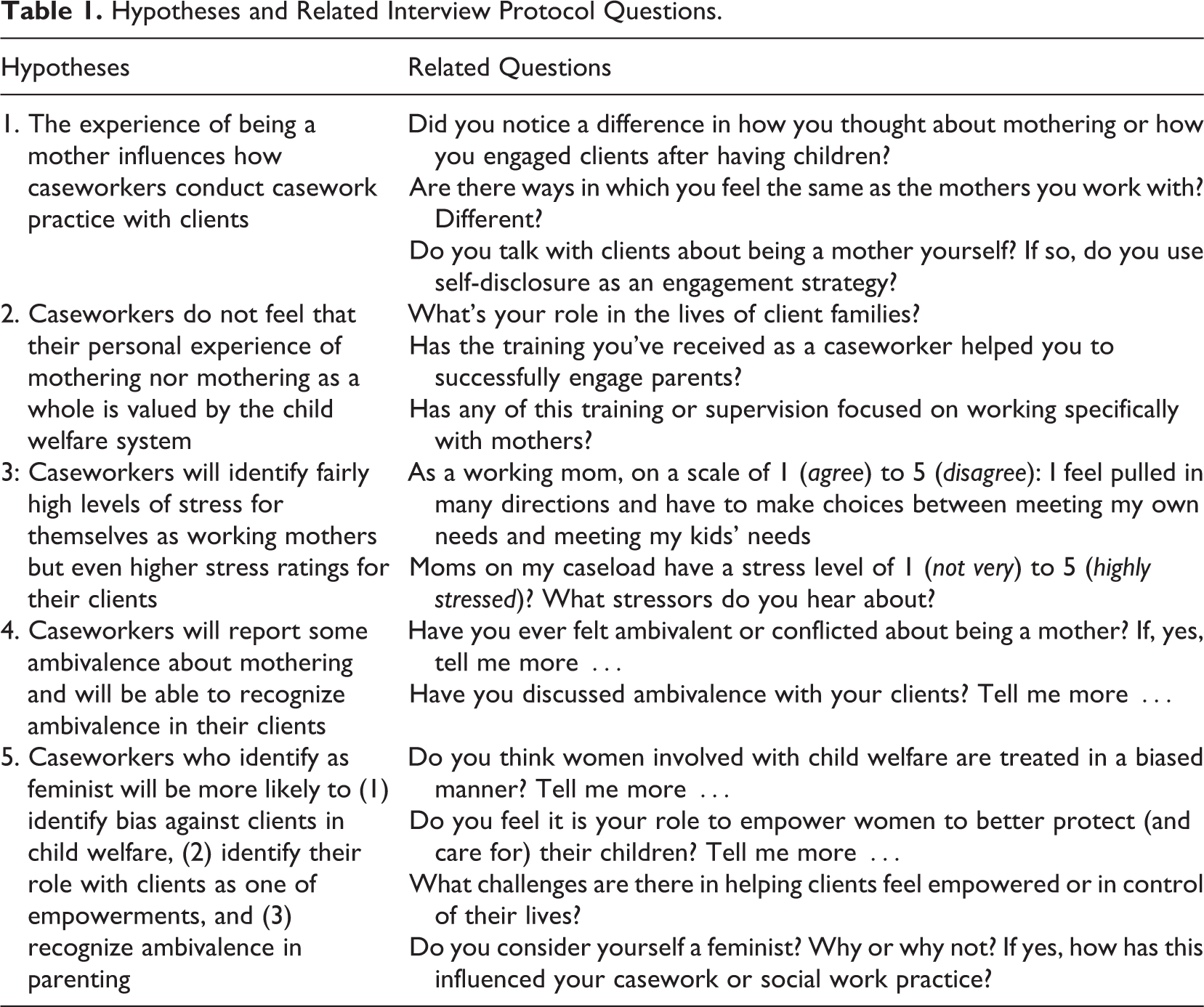
The researchers developed a mixed-methods study to interview 24 caseworkers from the United States and Canada. A pragmatic approach was taken for the construction of the interview, as it allowed for multiple forms of data collection and considered the social context in which the participants lived and worked (Creswell, 2007; Evans, Coon, & Ume, 2011). As no survey instruments existed on this topic, the authors created a 43-question research instrument that was approved by their Institutional Review Board. Both closed- and open-ended questions were included to allow for tabulation of quantitative data alongside free narrative for qualitative analysis. Table 1 contains a sample of the questions participants were asked, grouped according to the investigation’s five hypotheses. Interviews were conducted by telephone and through virtual meetings. Participants were a self-selected group who responded to a flyer (e-mailed to or posted at social service offices) stating that researchers were interested in interviewing mothers who presently or formerly worked in the child welfare field, or personal requests from the interviewers. They were made aware that there was no compensation provided for participating in the study. Interviews were recorded and confidentiality was maintained by assigning pseudonyms. Participants’ current jobs covered the gamut of child welfare, including intake, child protection, adoption, foster care, and foster parent training. Half were from Nova Scotia, Manitoba, or British Columbia and half were from New York State. Half were in their 40s. The majority was currently actively parenting with a partner and 20% were single parents. Their children ranged in age from 1 to over 21. More than half of participants had a master’s or graduate degree, mostly in human services or social work. Seventy-five percent identified as Caucasian and 25% as women of color.
Hypotheses and Related Interview Protocol Questions.
Data Analysis
SPSS text analysis for surveys Version 2.1 was used to analyze responses to the open-ended interview questions. Words or phrases that appeared frequently from responses were extracted and grouped together and each response was assigned a category of positive, negative, or neutral by the SPSS software. Phrases considered positive might contain words such as “liked” or “felt helpful.” A negative response might contain “inadequate support” or “extremely stressful.” Neutral phrases were not judged to contain either positive or negative wordings and thus could not be assigned a category. The top responses to each closed question were ranked in descending order based on the frequency of responses for each choice. The more the responses, the higher the ranking. Results were tabulated as the frequency of responses (count) and as a percentage of the total sample (or number of replies) for each question. For examination of relationships between some protocol items, Crosstabs and Pearson correlations were run using SPSS. Crosstabs determined whether responses to one question were contingent upon the response to a different question, while the Pearson correlation determined whether there was a linear relationship between the responses to the questions examined (Miller & Salkind, 2002).
Findings
This study yielded considerable overlap in the responses between the first two hypotheses—therefore, these findings are presented together. Findings from the other hypotheses (see Table 1) are discussed subsequently.
Work and Motherhood
To understand what brought the study participants into child welfare work, participants were asked what they found to be most satisfying or important about their job. The top three responses used the verb “helping” (i.e., helping kids, helping families, and helping parents). Helena, a foster parent trainer, spoke about her experience as a working mother in the system, stating:
I was with a birth mom and I thought I was helping her; I asked her some questions, I held the baby. I thought I did all this great work by simply visiting her. But after I had my daughter, I thought, “My God, I should have offered her so much more support.” I remember her telling me, “Why don’t you stay longer? Don’t leave.” She needed more. It’s a way I connect with my clients. “I’m a mom just like you.” Even when a mom is calling me and screaming about her kid, I know she just wants to help him. It gives you a little more empathy maybe, that maybe someone who doesn’t have a child doesn’t know that connection and might not be able to realize what she’s saying.
Study participants believed that their work was positively influenced by their experience and wisdom as mothers, as evidenced by over 93% agreeing that becoming a mother made a difference in how they engaged clients. Qualitative analysis of their responses indicated positive themes such as having more empathy and being better able to understand clients’ points of view. In retrospect, the researchers regret not explicitly asking how mothering impacted caseworkers’ work, but many participants raised that topic on their own.
Angela, an adoption supervisor, said:
After I had my own kids, I’d look back and think, “Seriously, did anyone believe that shit coming out of my mouth?” Now I understand how exhausting it was, the pressure to be perfect, the things that families were afraid to voice … You do child welfare work, and you see all the mistakes you can make. And even though we talk about having a strengths perspective, you are still terrified. We’re a very rich agency, but we don’t have day care for staff. We’re a small community, so it’s hard to take a parenting program [for] ourselves. The system doesn’t think of us as our own mom, dad, family. To them, I am only a social worker.
Subjective Stress
While discussing the relationship between work and home, many participants mentioned that the work made them mistrustful of community caregivers and even their own family members. They talked about the stress that they brought home from the job and how it affected their relationships with their children and partners. Despite often ranking their own stress levels as high, caseworkers were able to empathize with the even greater stress that they reported clients face. A sentiment repeatedly expressed during the interviews was, “There, but for the grace of God, go I.” Almost 90% of participants acknowledged that, as mothers, they shared many of the same stresses as their clients, particularly related to the stress of meeting children’s daily needs, concerns about children’s behavior and their futures.
Michelle, a senior caseworker with 9 years of experience, reported:
I think it is very difficult to do this job if you’re not a mother. I don’t think you can possibly understand that moment when you want to rip your hair out, if you’ve never been through it.… One more thing about mom wisdom—regardless of the skill set of the parent, that love is real. It’s about capability more than anything else …..
Maternal Ambivalence
For the purposes of this study, the authors chose to define maternal ambivalence more simply than Parker (1997). The question posed in the interview protocol was, “Have you ever discussed the idea of ambivalence or not really being sure they want to be mothers 100% of the time with your clients?” Approximately 70% of participants answered this question affirmatively. Common themes for discussion of this topic with clients related to surrendering rights to their children, teenage or unexpected parenthood, and adoption.
While caseworkers seemed well aware of maternal ambivalence in some of their clients’ lives, respondents did not largely relate to these feelings in their own lives. Seventy-three percent of participants said they had not personally felt ambivalence about mothering and many were emphatic on this point. Consider the contrast between Angela and Violet’s experiences. Whereas Angela reported: “No, my life is centered around my kids. At no point did I ever feel like I didn’t want to be a mother. I might threaten to go on strike, but that’s a little different.” Violet, an adoption worker with 14 years of experience in the field, said:
I was talking with someone yesterday who is about to adopt and how hard it was when we first brought our children home. I remember thinking, “I can’t do this. It’s so much harder than I thought.” I even thought about putting her up for adoption. I think it’s less okay to complain when you are an educated mom. There is all this pressure to be a supermom. Especially as a child welfare worker, all eyes are on you.
Identifications and Empowerment
At the center of this study is the examination of the relationship between caseworkers and clients within a system. Since the study was restricted to caseworkers’ experiences (as client data are highly confidential and not easily accessed), quantitative data could not be accessed as to the demographic makeup or experiences of the clients served by the interviewed caseworkers. Several questions in the interview protocol (see Table 1) attempted to gain a broad insight into clients’ mothering in a cultural context. Additionally, the researchers investigated whether caseworkers would be able to identify their own, others, or systematic acts of bias with clients. In 62.5% of the interviews, participants responded affirmatively that clients were treated with bias. Numerous participants elaborated on gender bias, specifically noting that case files are always opened in the mother’s name, even if she isn’t the focus of the investigation. Some also mentioned that the placement of blame, for example, of a non-accidental injury, is often directed toward the mother regardless of who was responsible for a child at the time. A few participants noted the good mother versus bad mother construction as it plays out in the roles of birth and foster mothers. Heather, an urban social worker explained:
I think they [birth mothers and foster mothers] are very polarized. The birth moms who lost their kids are judged as bad mothers, and foster mothers are seen as the “rescuers” and are put on a pedestal. Except by the birth moms, who think the foster moms are only in it for the money.
Asked whether they believed their role was to empower clients, 83.3% of participants said, “Yes.” Jane, a rural child protective worker, echoed similar thoughts from others, sharing: “It’s about being an advocate: working collaboratively with moms; looking for opportunities; supporting them in whatever way possible.”
The researchers inquired how many participants were comfortable labeling themselves or their casework practice as feminist, asking, “Would you consider yourself a feminist?”
2
Fifty percent of study respondents said, “Yes.” When asked to further describe her feminist identity, Jorga, answered:
There are a lot of ceilings for us, a lot of things we cannot have. Take my own career: None of the men at the agency take a year off for [parental] leave. So, as a result, 90% of the men are in supervisory roles and high positions, whereas the frontline staff are female. Going somewhere in our careers means often neglecting our families. Men don’t have to make that choice.
Discussion
Participants in this study were excited to share their experiences as they reported having rarely discussed their mothering within the context of their child welfare work. Their comments reflected multifaceted awareness of how their mothering experiences shape their relationships with their clients, even if they have never been invited to voice this professionally. Participants demonstrated a keen empathy for the strengths, stressors, and traumas that face clients. Their mothering narratives were often poignant and impressive for the depth of their compassion and commitment to the field. Throughout the interviews, the caseworkers discussed their motivation to help women and children who they perceived as similar in many ways to themselves and their families.
While participants were able to identify individual similarities and differences among themselves and their clients, few spoke to how the child welfare system structurally oppresses women, outside of investigating mothers more routinely than fathers and labeling cases in a mother’s name. When asked about bias, participants often discussed individual worker-to-client issues. Workers related their own experiences of bias against them as working mothers and many recounted stories of time away from their own families to address client needs. Only one caseworker, Angela, made an explicit connection between gender bias, racism, and classism. In the experience of the authors, most child welfare training they have surveyed barely addresses cultural differences and never delves into issues of oppression and privilege.
Most workers believed it was within their job role to empower clients. Writing on women workers and clients collaborating for empowerment on a community project, Callahan and Lumb (1995, p. 809) observed that “one of the clearest messages from workers throughout the project was their sense of isolation and lack of power. Just as clients feel marginalized and stigmatized by child welfare, so do workers.” For the participants in this study, as working mothers within a system dedicated to child well-being and protection, they expressed a similar sentiment. Perhaps what is missing from the child welfare system in relation to empowerment is a discussion, as Callahan and Lumb (1995, p. 799) suggested, of “the shared problems of workers and clients as members of stigmatized groups.” Swift (1995, p. 495) also recognized the possibility for an empowered relationship between women workers and clients, arguing that while it is essential to make women’s victimization visible, it is also necessary not to portray women as “damaged, powerless, and in need of ongoing intervention by child welfare and other authorities.” She went on to note the strengths, resiliency, and resourcefulness shown by many mothers in child welfare and suggested that if the child welfare system were reinvented by women, it might become “less hierarchical, less divisive, less competitive, more participatory, and vastly more preventive in its directions” (1995, p. 498). Crenshaw (1991, p. 1251), in her ground-breaking article on intersectionality, cautioned: “The fact that minority women suffer from the effects of multiple subordination, coupled with institutional expectations based on inappropriate nonintersectional contexts, shapes and ultimately limits the opportunities for meaningful intervention on their behalf.”
The researchers determined no significant relationship between the workers who identified as feminist and those who also agreed that there was bias against clients. Fifty percent of participants identified themselves as feminist. Valentich (2011) suggested that either naming oneself as feminist or practicing the principles of feminist social work promotes positive change with clients. She argued that “a stable sense of professional identity as a feminist social worker … promotes change because clients can sense the strength of the commitment to help and will draw on that as a resource” (2011, p. 28). So even though only half of participants were comfortable labeling themselves as feminists, the fact that so many expressed belief in women’s equality and in creating relationships that empowered clients suggests that feminist social work still matters in practice. Roberts (2006) provided an analysis from a macro social work perspective, observing that “feminism’s reinterpretation of private problems as political issues, its ambition to emancipate and improve the lives of all women, and its method of taking women’s voices seriously—especially the voices of the most disadvantaged women—can shed critical light on these thorny questions of child welfare” (p. 44). Feminism, with its focus on empowerment and intersectionality, may still be able to address issues within the child welfare system.
In addition to empowerment, maternal ambivalence was another issue that the authors hypothesized as a potential platform for caseworkers to join clients. They thought that if caseworkers were to connect authentically with clients around the good and the bad of motherhood in a nonjudgmental way, the professional casework relationship might become more collaborative. This, in turn, could lead to the greater provision of the right services at the right time in order to expedite the safety, permanency, and well-being of their children. Some study participants seemed relieved to talk about their ambivalence, whereas others shied away, as if it were taboo. This suggested to the researchers that maternal ambivalence, like labeling oneself a feminist, may have been more acceptable to discuss as such when feminism was a more ascendant political movement.
Parker (1997, p. 28) emphasized that “maternal ambivalence is curiously hard to believe in” and it appears that North American culture may leave little room for the perception of oneself as anything but an ideal mother. Yet in an analysis of the good mother myth as it related to parents with HIV, Hunter and Longhurst (2013, p. 174) recognized that “In contemporary Canadian society, there is evidence that the concept of motherhood is no longer encompassed by a dichotomy of ‘good mother’ and ‘bad mother.’ A third category—the ‘good enough mother,’ has emerged.” Shira (as cited in Hunter & Longhurst, 2013, p. 67) describes the “good enough mother” as providing “the necessities in order for a child to have a sufficient … but not thriving life.” Barbara Almond (as cited in Barnett, 2011) suggests that the good enough mother is “not without ambivalence, but offsets it with enough real love and sensitivity to respond to their child in a flexible, realistic way (p. 17).” The good enough mother may be akin to the concept of minimum degree of care (meeting the minimum basic needs for children’s development) within the American child welfare system. From a strengths-based perspective, using the language of being a good enough mother may yet be a way for workers and clients to discuss any maternal ambivalence and an ideal shared between workers and clients that has the potential to lead to improved child well-being (Asmussen, 2012). The good enough mother acknowledges both her own and the child’s needs.
Limitations
In addition to a small sample size, this study was limited in that its subjects were self-selected. The authors suspect that they talked to the “supermoms” of child welfare—women who, after putting in a full day’s work and taking care of their own children, found time to, for example, facilitate a monthly support group for parents who have had a child die. It is possible that a larger, anonymous, random sample of working mothers would lead to more reports of maternal ambivalence as well as more diverse views of being a working mother within the child welfare system. Caution should be used to generalize the findings to the experience of all women who are mothers employed by child welfare, especially because only 25% of the participants identified as women of color and none of the caseworkers self-identified as being lesbian, bisexual, or transgender or of living with a disability. Furthermore, additional information may have been gained if the authors had asked specifically about the influence of their work on the caseworker’s parenting and had more broadly defined the term ambivalence.
Recommendations for Future Research
An important area for future investigation includes whether outcomes would be different if, instead of entering their clients’ lives solely as an agent of the state, caseworkers were able to use their parenting status to engage and empower clients in an authentic way. As Miller and Stiver (1997) suggested, the legitimization of one woman’s feelings and experiences by another, especially one she believes has an authoritative role in her life, can be validating. They write, “When someone else ‘goes with us’ in the feelings, we are more able to believe that our feelings are legitimate” (1997, p. 33). To begin to understand what a mutually empowering relationship between a client and worker would look like, it would also be essential to learn from clients about their experiences relating to caseworkers, areas of commonality, and areas of difference and need. Hill Collins (1994, p. 48) has noted, “We must distinguish between what has been said about subordinated groups in the dominant discourse, and what such groups might say about themselves if given the opportunity”.
Exploring the relationship between caseworker–mothers and their clients also opens the possibility of expanding the examination of other roles. For example, do male caseworkers who are fathers experience similar effects on their parenting and work as caseworker–mothers report? Do caseworkers who are parents relate differently to the youth on their caseload than their nonparent, professional counterparts? If so, how? How does the mother bond affects the relationship between caseworkers and foster mothers? Is this different than with birth mothers?
Implications for Practice
In addition to research recommendations, this study presents implications for practice. An international initiative called “mother-friendly care” promotes care for women during labor and birth that is supportive, evidence based, and respectful (Lothian, 2007). The authors believe this study raises the question of what “mother-friendly” casework practice (i.e., evidence based, supportive, and respectful to mothers) might look like to clients; for example, would caseworkers be able to gather more information about a mother’s ability to meet her child(ren)’s needs if they together were to describe areas of mothering they find manageable or unmanageable? Additionally, how might clients, workers, and the system be transformed if workers and clients were empowered to accomplish something of mutual benefit in their community? Finally, what could the child welfare system learn from its employees by asking about their needs as parents in order to further benefit both workers and clients?
Conclusion
Feminist author Adrienne Rich (1979, p. 11), who regularly examined maternal themes in her work, wrote that it is “the connections between and among women” that “are the most feared, the most problematic, and the most potentially transforming force on the planet.” The authors and many participants of this study, all mothers working within the field of child welfare, express the shared desire that their field should extend more respect to both caseworker and client–mothers and begin to value their collective strengths, instead of only paying lip service to client strengths in case documentation. A system recognizing and supporting the mutual empowerment of caseworker-mothers and client-mothers would be truly transformative to child welfare practice and could only promote positive outcomes for children.
Footnotes
Declaration of Conflicting Interests
The author(s) declared no potential conflicts of interest with respect to the research, authorship, and/or publication of this article.
Funding
The author(s) received no financial support for the research, authorship, and/or publication of this article.