




Abstract
This article investigated the frequency with which feminist identity and constructs are evident in the missions of state domestic violence coalitions in the United States. Findings from the analysis yielded low frequencies of feminist constructs present in the documents analyzed. Less than 10% of coalitions explicitly self-identified as feminist organizations in their materials, while fewer than 10% of coalitions acknowledged the relationship between patriarchy (9.8%) and gender inequality (7.8%) with violence against women. Coalitions more frequently employed the de-gendered language of empowerment and anti-oppressive frameworks rather than explicitly feminist perspectives. Implications of these findings for feminist informed advocacy are provided.
With the establishment of Chiswick’s Women’s Aide in London, England, by Erin Pizzey in 1971, the contemporary battered women’s movement was born (D. Martin, 1976). Although the origins of the battered women’s movement may not have been explicitly feminist in nature, the role of feminist ideologies and organized feminist activism in propelling the growth of the movement has been extensively documented (see Schechter, 1982 for a foundational account of this history). Despite the monumental role of feminism in raising public awareness about the issue of woman abuse and institutionalizing social services to assist survivors of such violence, as early as the 1980s, a number of feminist scholars and activists began voicing concern about the perceived decline of visible feminist identification and politics in battered women’s service organizations (e.g., Adams, 2008; Grossholtz, 1982; Lakeman, 2000). Research with staff at individual domestic violence agencies has provided some validity for these concerns, documenting that some staff are unaware of the feminist origins of the battered women’s movement while others outright reject feminist approaches to work with survivors of abuse (Lehrner & Allen, 2009). Additional research has documented the enactment of agency practices and policies in some battered women’s organizations inconsistent with feminist principles (Donnelly, Cook, & Wilson, 1999; Srinivasan & Davis, 1991). Still other research has indicated that graduating social work students are most knowledgeable of psychologically oriented theories of domestic violence, with very few being familiar with or endorsing feminist perspectives of this violence (Black, Weisz, & Bennett, 2010).
The purpose of the present study is to provide an empirical evaluation of the premise that the role of explicit feminist identification and politics in battered women’s organizing is in decline. Through a quantitative content analysis of organizational mission statements and other relevant public documents of state domestic violence coalitions, this project sought to examine the frequency with which coalitions endorsed a feminist identification and/or utilized feminist constructs in guiding their organizational work.
Domestic Violence Coalitions
The National Coalition Against Domestic Violence (NCADV) was established in 1978 through grassroots organizing to institutionalize battered women’s political organizing on a national level (Morrison & Lootens, 1982). Although NCADV seeks to provide advocacy and leadership on a national scale, a range of state domestic violence coalitions separately evolved through localized grassroots activism to provide such coordination and leadership at the state level (Davis, Hagen, & Early, 1994). Although they emerged through grassroots activism, coalitions are now institutionalized within the battered women’s service system. Presently, there is one federally recognized state domestic violence coalition in all 50 states as well as the District of Columbia and other U.S. territories (U.S. Department of Health & Human Services, Administration for Children & Families, Family and Youth Services Bureau [USDHHS, ACF, FYSB], 2014a).
Although state domestic violence coalitions do not themselves provide direct services to survivors of violence, they exert an enormous amount of influence over the direction of such services. According to the USDHHS, ACF, FYSB (2011), state coalitions “are the voice of victims and of the programs that serve them” (2). As such, state coalitions are leaders in constructing social responses to intimate partner violence within their state. Similar to NCADV, state coalitions are membership organizations comprised of service providers in the domestic violence sector as well as concerned individuals. Among the responsibilities they hold are providing training and technical assistance to support domestic violence service organizations, coordinating needs assessments within their state, working in collaboration with other government systems that serve abuse survivors to coordinate service systems, and engaging in public education (USDHHS, ACF, FYSB, 2011). Perhaps one of the most important tasks charged of state coalitions, however, is their role in “planning and monitoring the distribution of FVPSA grants to their state” (USDHHS, ACF, FYSB, 2011, 6). Federal Family Violence Prevention and Services Grants constitute “the primary federal funding stream dedicated to the support of emergency shelter and related assistance for victims of domestic violence and their children” (USDHHS, ACF, FYSB, 2014b, 1). Because of the powerful leadership role that state coalitions play to coordinate services, provide training, and support the funding of individual battered women’s service organizations, examining the visibility of feminism within these organizations may help provide a barometer for the presence of (and support for) feminism within battered women’s organizations.
Feminist Identification: Does It Matter?
Among feminist academics, divergent perspectives have been documented on what constitutes feminist practice. Some feminist social work scholars (e.g., Orme, 2003) have lamented the rise of what Joan Orme has named the “It’s feminist because I say so” approach to feminist social work practice. Mary Bricker-Jenkins (2002) has argued that such identity-based approaches, which define feminist practice as anything that is done by individuals who claim the label of feminist, are highly problematic because of their failure to articulate conceptual frameworks or methods that differentiate feminist models of practice from other practice theories and modalities. As such, these authors contend that a sole, or even a primary, focus on feminist identity oversimplifies feminist practice and reinforces relativist approaches to feminism which privilege identity claims over substance. In a similar vein, others (e.g., Lazzari, Colarossi, & Collins, 2009; Valentich, 2011) have argued that a focus on the promotion of feminist principles that underlie all feminist work may be more fruitful in advancing feminist social change agendas than a focus on whether such work is explicitly labeled as feminist. Indeed, they argue such a promotion may be an important precursor to the development and claiming of a feminist identity by those who may otherwise have eschewed the feminist label (Valentich, 2011). Likewise, scholars studying feminist organizations have argued that even if an organization is not guided by an explicit feminist ideology in its mission or purpose, it may still qualify as a feminist organization if it promotes feminist outcomes (P. Y. Martin, 1990). Collectively, this work suggests that an explicit feminist identification may be neither a necessary nor a sufficient condition for feminist social change work.
However, in an era when a respected national publication such as Time Magazine lists “feminist” as a candidate in its poll of words that should be banned in 2015 (Steinmetz, 2014), the potential consequences of a movement away from feminist identification must be considered in the context of the broader backlash against feminist social movements. In a cultural climate in which feminist identity is perceived as potentially being more contentious than the continuing social inequalities which feminism seeks to redress, we argue that the continued public naming of feminist work as feminist is an important political endeavor. Although the retreat from open feminist identity claims by individuals and agencies who implicitly do feminist work without naming it as such may be due to a complex constellation of reasons (e.g., fears of distancing potential funders and alienating survivors who may be deterred from seeking services from explicitly feminist organizations, internal disagreements regarding the specific forms of feminism an agency embraces, etc.), we are concerned that a public movement away from the feminist label, particularly by those who are engaged in feminist social change work, may inadvertently be interpreted by those who seek to undermine feminist social gains as evidence that feminism itself is a problematic social enterprise. When feminist individuals and organizations do not explicitly identify the nature of their work as feminist, it reduces the visibility of feminist organizing in society as a whole and contributes to the misconception that feminism is no longer necessary or, at worst, is “dead” (as famously implied by Time magazine on its June 29, 1998, cover). Considering that even within the social work profession itself, feminism is increasingly less visible, with a decline of almost 24% over a 10-year period in the number of articles published in social work journals that contained an explicit self-identified feminist perspective (Barretti, 2011), the continued vitality of feminist practice may be dependent on its continued visibility.
The Present Study
Against this backdrop, we sought to examine the visibility of feminist identity and constructs in guiding the work of state domestic violence coalitions in the United States. Because our primary concern was with the extent to which organizations publicly claimed a feminist identity, we elected to focus our analysis on the language that organizations used to describe their work to the public via their agency websites. Although some organizations may internally consider themselves feminist, we were interested in discerning to what extent organizations publicized such an identity openly to those outside of their organization. As websites are arguably one of the most common entry points for individuals in the public to access information about an agency, we were interested in learning how organizations spoke (or did not speak) about feminism in this venue. The key questions posed in this study were (1) how many state domestic violence coalitions explicitly self-identified as feminist organizations or explicitly acknowledged the role of feminism in guiding their work? and (2) to what extent did coalitions utilize feminist constructs in their description of their mission, vision, goals, purposes, philosophy, or principles?
Data Sources
To answer these questions, we conducted a quantitative content analysis of websites of state domestic violence coalitions. A complete list of all state domestic violence coalitions, and links to their official websites, was obtained through the federal U.S. Department of Justice, Office on Violence Against Women (n.d.) website in 2010. This list included coalitions in all 50 states, the District of Columbia, and the U.S. territories Guam and Puerto Rico (N = 53). As website information was not available for Guam and Puerto Rico, they were excluded from the present study, resulting in a total sample of 51 websites. Available website text publicly posted in 2010 was printed and served as the primary text for analysis.
Selection of Texts
The full contents of all websites were initially reviewed to assess structure, type, and consistency of information categories presented across websites prior to the selection of specific sections of texts for analysis. According to Brody and Nair (1997), a mission statement is “a reflection of the organization’s fundamental purpose and an indication of what it wants to accomplish in relation to the beneficiaries of its work” (p. 34). Mission statements are critical to identifying the overall purpose and long-term goals of an organization by defining “what impact the organization wants to effect” (p. 34). As such, it was anticipated that mission statements would be selected as the primary textual sources of analysis.
The majority of organizations (n = 40, 78.4%) made their official mission statements available on their websites. In addition to mission statements, however, the initial review of websites identified other categories of texts which also referenced organizations’ long-term goals, core values, or guiding philosophies. These sections included “About us” statements (n = 22, 43.1%), statements of philosophy (n = 15, 29.4%), vision statements (n = 14, 27.4%), statements of purpose (n = 8, 15.6%), principles of unity (n = 7, 13.7%), statements of goals and/or objectives (n = 6, 11.7%), and guiding principles (n = 6, 11.7%). To enhance the sampling validity of texts selected, it was subsequently determined that all of these categories of texts would be selected for analysis, in addition to mission statements, as they provided information about the organization analogous to that of mission statements.
Procedures
All texts were analyzed using quantitative content analysis. Quantitative content analysis is commonly utilized as a descriptive research method to analyze the frequency of manifest meanings in data sources, those that are “visible at the surface level or literally present in the text” (Kondracki, Wellmann, & Amundson, 2002, p. 225). As the primary purpose of the present study was to assess explicit indicators of feminist identity and feminist concepts in the texts of coalitions, quantitative content analysis procedures were most appropriate to achieve this goal. Data analysis was completed by a research team that included two trained undergraduate-level research assistants (RA), one graduate-level RA, and the principle investigator (PI).
In accordance with these recommendations, a thorough review of the feminist theoretical and research literature was conducted by the two undergraduate-level RAs in two principle areas: (1) literature which defined feminist approaches to intimate partner violence and (2) literature which defined feminist organizations. From this search, a preliminary list of terms was compiled as potential indicators of concepts that reflected feminist identity and/or politics in battered women’s organizations. Independent from this process, the PI conducted a qualitative content analysis of all of the selected texts from the websites of the coalitions to develop a list of terms used in the data sources themselves. Following the procedures for open coding outlined by Esterberg (2002), line-by-line open coding of the texts was conducted by the PI in this process. This generated a second list of terms which was then aggregated with the list of terms compiled from the literature review.
Procedures outlined by Weber (1990) were used to guide the quantitative content analysis. The final coding scheme, derived from the aforementioned process, included the creation of a word frequency list (with each word indicative of a construct of interest). The PI of the project and the graduate-level RA each then independently coded all documents for indicators of words on this list. Frequency counts were then tabulated for each word, and the corresponding categories, and presented as descriptive statistics (percentages). According to Krippendorff (2004), “owing to the large volume of text that content analysts typically consider, tabulation is by far the most common technique used to render data comprehensible” (p. 192). Comparisons of the tabulation for each of the two independent coders was then completed, resulting in initial rates of agreement ranging between a low of 85% to a high of 100% for each term. When there was a discrepancy between the ratings of the coders, the original data sources were then reexamined until 100% congruence was achieved.
Results
Explicit Feminist Identification
Only 5 (9.8%) of the 51 coalitions self-identified as feminist organizations or explicitly indicated that their services were informed by feminist values, theories, or politics (Table 1). Over 90% of statewide domestic violence coalitions in the United States did not self-identify as feminist organizations or explicitly credit the influence of feminism in shaping current agency beliefs, purposes, or practices.
Coalitions With Explicit Reference to Feminism.
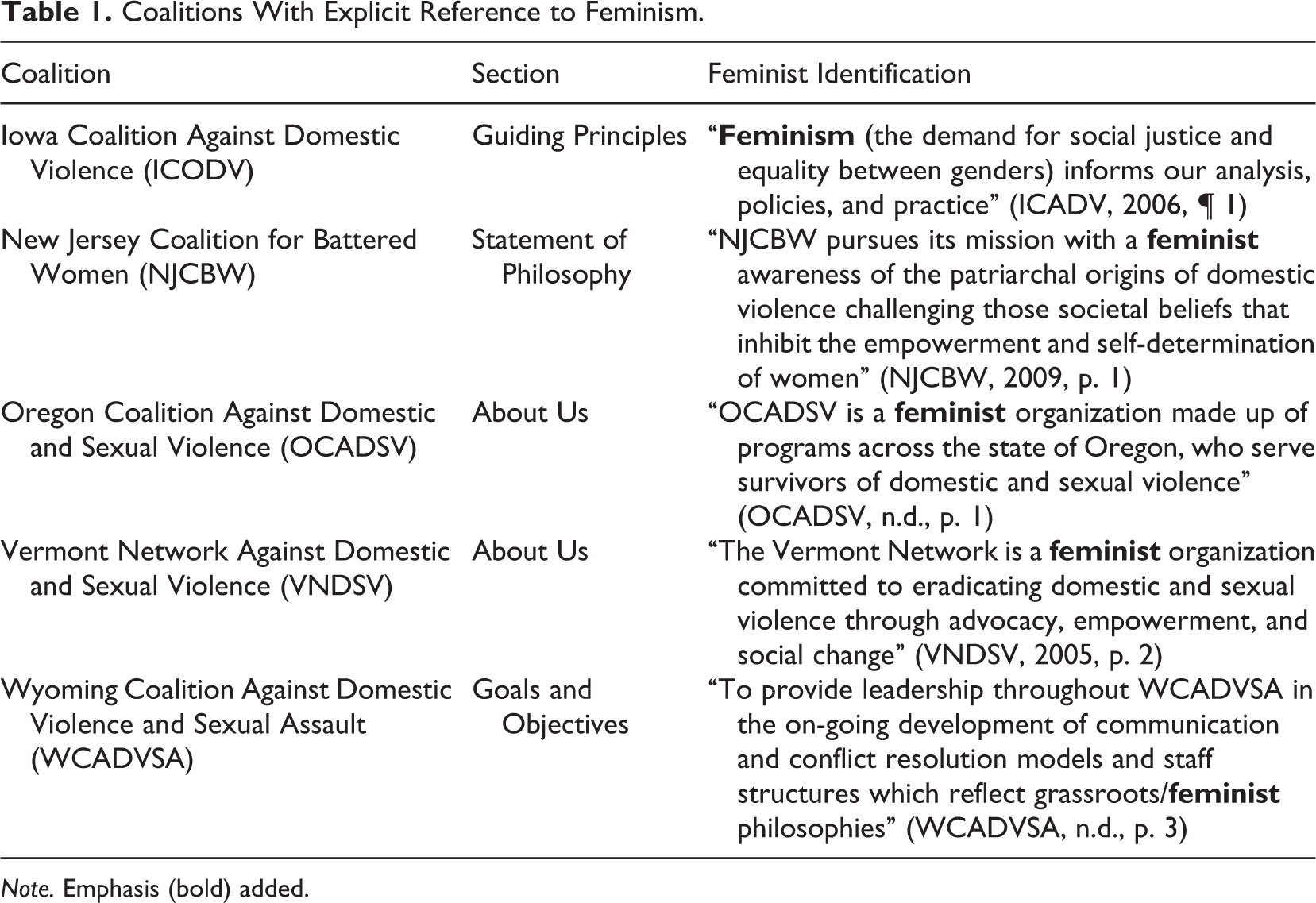
Note. Emphasis (bold) added.
Gendered Constructs
A total of 36 (70.6%) of the 51 coalitions referenced at least one gendered construct (i.e., battered women, violence against women, woman abuse, feminism or feminist, patriarchy, sexism, gender equality, gender inequality, or gender oppression) in the materials reviewed for this analysis. Among coalitions using gendered terminology, the most commonly used term was “violence against women” (n = 21), followed by “battered women” (n = 17). The average number of gendered constructs referenced by organizations that used gendered language was 2.17, with a range from a low of one gendered construct (n = 13) to a high of six gendered constructs (n = 1). A list of all of the constructs evidenced in the materials reviewed for this analysis and the corresponding numbers of organizations referencing each construct are outlined in Table 2.
Summary Table of Constructs Employed by Coalitions.
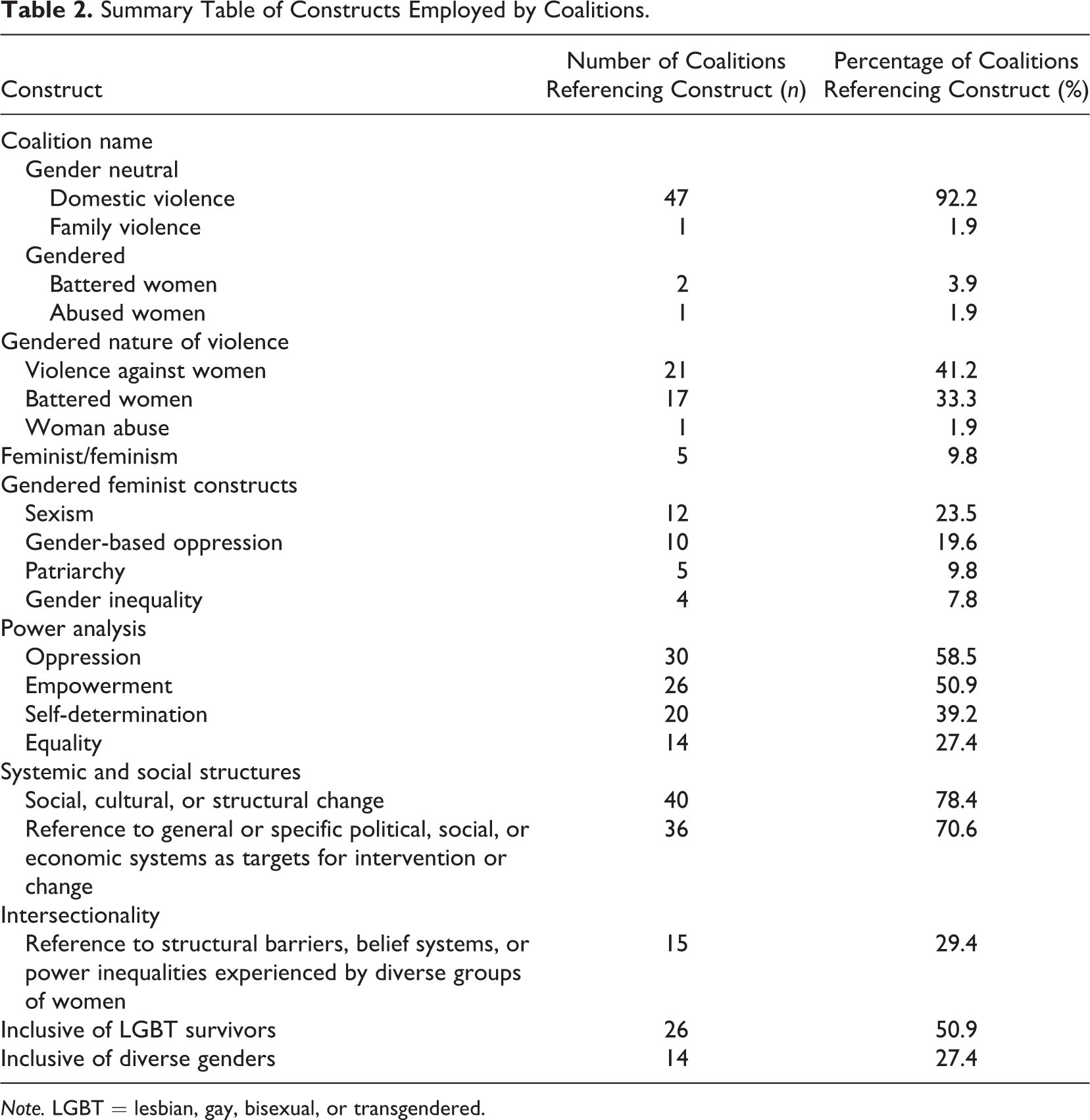
Note. LGBT = lesbian, gay, bisexual, or transgendered.
Patriarchy
Forty-six coalitions (90.2%) did not expressly discuss patriarchy or patriarchal social structures in the agency materials reviewed for this analysis. Five coalitions (9.8%) made clear reference to patriarchy but, interestingly, only one of those five agencies was an agency that espoused an explicit feminist identity (New Jersey Coalition for Battered Women, New Jersey). The remaining four state coalitions that made explicit reference to the construct of patriarchy were Indiana, Minnesota, North Carolina, and Nebraska.
Gender inequality
Four coalitions (7.8%) employed the use of the term “gender inequality” or explicitly discussed the notion of institutionalized differences in societal roles or power based on gender. For example, the North Carolina Coalition Against Domestic Violence (NCCADV) specifically referenced the term gender inequality in conjunction with patriarchy (NCCADV, 2009, Declaration of Values section, ¶ 2). The Louisiana Coalition Against Domestic Violence (LCADV) likewise stated, “This Coalition recognizes that inequality between men and women is a major cause of woman abuse” (LCADV, n.d., Philosophy section, ¶ 2). Similarly, the Arkansas Coalition Against Domestic Violence (ACADV) unambiguously stated that one of its purposes was “to expose the roots of domestic violence in the institutionalized subservience of women in today’s culture” (ACADV, n.d., Purpose section, bullet 2). The Montana Coalition Against Domestic and Sexual Violence (MCADSV) implicated male supremacy as a fundamental contributor to women’s victimization, stating in their agency philosophy that “… violence, we believe, is firmly rooted in our society’s belief in the supremacy of men over women” (MCADSV, n.d., Philosophy Statement section, 1).
Sexism
Just under one quarter of the coalitions (n = 12, 23.5%) utilized the word sexism. Frequently, sexism was discussed in conjunction with other interrelated oppressive belief systems thought to contribute to violence (e.g., Hawaii State Coalition Against Domestic Violence, 2010, Our Philosophy section, 1). In other instances, it was discussed in conjunction with the elimination of other belief systems as a targeted focus of action (e.g., MCADSV, n.d., Goals section, 1). Others, such as the New York State Coalition Against Domestic Violence (NYSCADV), noted the necessity to challenge sexism in society as a whole as essential to antiviolence efforts (NYSCADV, 2008, Principles for Practice section, 1).
Power Analysis
Although the vast majority of coalitions did not explicitly self-identify as feminist in framing the issue of violence against women, numerous organizations did use terminology that recognized the importance of power. Most commonly, however, gender neutral words were employed in this capacity.
Oppression
Over half of the coalitions (58.8%, n = 30) explicitly named the term “oppression” in their discussion of violence. Most commonly, it was used in a manner that indicated inclusivity of multiple types of oppression (e.g., “all forms of oppression”) or to specify targeted dimensions of oppression (e.g., “race,” “class,” “religion,” etc.). Of the 30 coalitions that utilized the term oppression, only 10 coalitions explicitly linked this to an overt naming of gender-based oppression, women, or sexism. For instance, the Colorado Coalition Against Domestic Violence (CCADV) stated “… the oppression of one woman is the oppression of all women” (CCADV, n.d., Philosophy section, bullet 5).
Equality
Just over one in four coalitions (n = 14, 27.4%) incorporated the term “equality” in their materials. Most frequently, state coalitions specifically discussed “equality in relationships” (e.g., Colorado, Indiana, Maine, Mississippi, New Mexico, Oklahoma, and South Dakota) or in terms of “equal partners” (New York). In other cases, state coalitions approached equality more inclusively, such as by referencing “equality among all people” (e.g., Louisiana).
Empowerment and self-determination
Approximately half (n = 26, 50.9%) of the agencies expressly used the term “empowerment” or language referencing a victim’s sense of power. Although some organizations were concerned with the empowerment of women in general (e.g., Florida Coalition Against Domestic Violence, n.d., Mission Statement section, 1), others discussed empowerment specific to victims (e.g., ACADV, n.d., Mission Statement section, bullet 5). Relatedly, 20 coalitions (39.2%) noted the importance of “self-determination” or the right of individuals to make decisions or take control of their own lives. Although some coalitions, such as the Alaska Network on Domestic Violence and Sexual Assault (ANDVSA), noted a belief in the “self-determination of women” (ANDVSA, 2009, Our Philosophy section, 4), self-determination was most commonly discussed in conjunction with individual victim’s rights.
Systemic Structures
Although the language of power was used more frequently than other constructs, the use of terms with explicit power implications by coalitions was far from universal. With that said, over three fourths of the coalitions (n = 40, 78.4%) noted the necessity for social, cultural, and/or structural change or referenced general or specific political, social, or economic systems (n = 36,70.5%) as targets for intervention.
Social change
Social change was the most prevalent construct evident in the materials of state domestic violence coalitions, with all but 11 coalitions employing language indicative of the need for social change. The exact nature and extent of this change varied tremendously. Some coalitions implicated the necessity to challenge ideas or attitudes. For instance, the North Dakota Council on Abused Women’s Services (NDCAWS) noted its ambition and vision of “Challenging ideas and attitudes that perpetuate violence” (NDCAWS, n.d., Our Ambition and Mission section, bullet 2) and the mission statement of the West Virginia Coalition Against Domestic Violence (WVCADV) included its mandate to “transform social, cultural, and political attitudes” (WVCADV, n.d., Mission Statement section, 2). Others did not specifically cite the nature or target of social change but spoke more generically about participating in processes for change. For example, the Georgia Coalition Against Domestic Violence (GCADV) spoke of the need to “mobilize the general public on issues of domestic violence” (GCADV, 2006, Goals/Objectives section, bullet 2). In rare cases (e.g., the Iowa Coalition Against Domestic Violence [ICADV]), social change efforts were directly linked to necessity for “social and economic justice for women” (ICADV, 2006, Guiding Principles section, 3).
Political, economic, or social systems
The most common targets of social change efforts were political, economic, or social systems. Most frequently, this involved advocating for public policy or legislative changes to make systems more responsive to the needs of victims. This is epitomized, for example, among the stated goals of the ACADV “to strengthen the existing support systems serving battered women and their children; to develop legislation that provides legal protections to victims; to promote public policies which meet the needs of victims” (ACADV, n.d., ACADV Goals section, bullets 1–3). Participating in legislative change is noted as the primary purpose of many coalitions, such as the Utah Domestic Violence Council (UDVC) whose listed purposes included “to develop and review suggested domestic violence policies and procedures; recommend and support legal and legislative action; suggest and support initiatives, including training focused on providing effective domestic violence intervention/prevention services to Utah communities” (UDVC, 2007, Purposes of UDVC section, bullets 1–3). An explicit focus on criminal justice systems was also common to many coalitions. For instance, the Washington State Coalition Against Domestic Violence (WSCADV) cited its role in “working for laws that ensure safety and justice for survivors” (WSCADV, 2008, Who We Are section, bullet 1).
Intersectionality
A final source of analysis involved the inclusivity of organizations and their recognition of the diversity of identities among survivors. Just less than one third (n = 15, 29.4%) of coalitions explicitly acknowledged structural barriers, belief systems, or power inequalities experienced by marginalized groups of women, such as racism, heterosexism, ageism, anti-Semitism, and colonization. The explicit (e.g., purposeful naming of “gay men and lesbian women”) or implied (e.g., through a stated commitment to challenging homophobia, heterosexism, or discrimination on the basis of sexual orientation) inclusion of lesbian, gay, bisexual, or transgendered survivors was evidenced in the language of approximately half (n = 26, 50.9%) of the coalitions.
Discussion
Feminist scholars have expressed concern regarding the diminished visibility of feminist politics in antiviolence organizing as part of a larger public backlash against feminist gains. Findings from the present study document some validity for these concerns, in that less than 10% of state domestic violence coalitions explicitly self-identified as feminist organizations or explicitly acknowledged feminism in guiding their work. Given the role of state coalitions as “the voice of victims and the programs that serve them” (USDHHS, ACF, FYSB, 2011, 2) and as coordinators of the complex system of services for survivors of intimate partner violence within states, the absence of an overt acknowledgment of feminism in this work is striking.
Research with women’s antiviolence activists, professionals, and organizations has documented numerous reasons why agencies serving survivors of violence may have distanced themselves from an overt feminist stance. A common concern expressed is the need to minimize feminist politics or dilute overt feminist content in order to secure external funding or attract community support, resources, or volunteers (e.g., English, 2006; Grossholtz, 1982; Haaken & Yragui, 2003; Lehrner & Allen, 2009; Maier, 2008; Tice, 1990). This need was believed to be particularly strong in conservative and/or rural communities with limited services available to survivors (e.g., English, 2006; Tice, 1990). Given these concerns, it is interesting that the present study found that the state coalitions in some states that are historically conservative and/or encompass large rural populations were still able to embrace an explicit feminist identity (i.e., Wyoming) or to use feminist constructs such as patriarchy (i.e., North Carolina, Nebraska, and Indiana) and gender inequality (i.e., Louisiana, Montana, and Arkansas) in describing their work. This does not negate the concerns expressed by some (e.g., English, 2006; Grossholtz, 1982; Haaken & Yragui, 2003; Lehrner & Allen, 2009; Maier, 2008; Tice, 1990) that overt feminist organizing faces particular resistance in some settings; however, it does suggest that such resistance may not be insurmountable. The fact that the aforementioned agencies receive federal funding and are recognized leaders of the service systems in their states while still embracing either an explicit or an implicit endorsement of feminist perspectives on violence suggests that the need to distance oneself from a feminist stance may be more perceived than real in some circumstances.
Some scholars (e.g., Adams, 2008; Lakeman, 2000) have cited concerns about the potential consequences of the lack of an open feminist identification even in agencies that implicitly endorse feminist goals without naming them as such. Without an explicit statement of feminist identity, there may be confusion and lack of consistency among agency staff in the endorsement of an organization’s feminist mission or enactment of feminist principles. Research with staff of antiviolence agencies provides preliminary empirical support for such fears in both domestic violence organizations (Lehrner & Allen, 2009) and rape crisis centers (Maier, 2008). As such, it can be cautioned that even if an agency believes it is “implicitly” feminist, these goals and values should be explicitly named as such and communicated as such to agency personnel via training to ensure there is a consistent understanding and application of this among staff.
The open embrace of a feminist identity in antiviolence work is certainly not without challenge, but we believe that it is a challenge worth the uptake. The explicit naming of feminist politics as feminist increases the visibility of feminism in its many forms, and we believe that continued visibility is important for increased social acceptance of feminism in the broader society. As the term feminism remains at best contentious and at worst vilified (it should be noted that the term feminism was winning the Time Magazine poll by a significant margin before the editors pulled it from the poll and apologized for its original inclusion; Merlan, 2014), an explicit endorsement of feminist identity by organizations which are the leaders in the antiviolence movement within their states lends credibility to the notion that feminism is not only a legitimate but also a necessary perspective to eradicate gender-based violence.
Limitations and Future Directions
Although our analysis had many strengths (e.g., a national sample; the use of multiple coders to increase the reliability of findings), there are notable limitations to our work. Importantly, we did not speak to coalition staff persons to elicit data on the reasons why coalitions choose to frame their work in particular ways or whether the organizations themselves would characterize their work as feminist. We also did not examine internal agency documents that may have shed further light on the perspectives used by agencies to approach their work. As these coalition-derived data would have undoubtedly provided a richer contextual understanding of the issues explored in this study, their absence must be recognized as a significant limitation. Further, the present study did not explore potential correlates of feminist identification, such as agency size, budget, geographic region, political climate, and so on, which may have provided further contextual information about factors potentially associated with an organization’s decision to openly embrace a feminist identity. Further research which explores such correlates will provide an important contribution to our ability to untangle the complexities of factors that may constrain an organization’s ability to explicitly endorse a feminist identification.
Conclusions
Despite these limitations, our work provides a significant original contribution to the literature in this area. Through the use of a national sample of organizations that hold recognized leadership roles in antiviolence work, this scholarship helps to map the national landscape of visible feminist identity within the domestic violence movement. Such a mapping, we hope, will provide empirical data to inform ongoing debates about the role of feminism in antiviolence work and spur dialogues within individual organizations about both the struggles and the benefits of feminist identification in the current political climate.
Footnotes
Declaration of Conflicting Interests
The author(s) declared no potential conflicts of interest with respect to the research, authorship, and/or publication of this article.
Funding
The author(s) received no financial support for the research, authorship, and/or publication of this article.