




Abstract
This study aimed to assess the mediating impact of depression on the association between three forms of intimate partner violence (economic abuse, physical/sexual abuse, and emotional abuse) and later experiences of material hardship. Partial mediation effects were found for economic and physical/sexual abuse, while no impact of emotional abuse on experiences of material hardship was observed. Experiencing economic (odds ratio [OR] = 1.39) or physical/sexual abuse (OR = 1.55) both had strong direct effects on later experiences of material hardship. Implications for social work practice include the need to address both economic abuse and long-term economic stability with survivors.
Introduction
Intimate partner violence (IPV) is an epidemic in the United States. Recent Centers for Disease Control and Prevention (CDC) data suggest that one in three women have experienced rape, physical violence, and/or stalking by an intimate partner in their lifetime, and nearly half have experienced psychological aggression (Black et al., 2011). The impact of IPV on society is extreme. The National Violence Against Women Survey established a lifetime estimate of 25,677,735 American women experiencing some form of physical IPV, stalking, or rape (Black et al., 2011). Further, the individual consequences of IPV on women survivors are severe, with clear evidence of the harm to women’s health, mental health, economic, and personal well-being (Black et al., 2011; Golding, 1999; Jewks, 2002). Scholars have done significant work over the past 40 years to explicate the impacts of IPV on women; however, much remains to be done. In particular, the impact of economic forms of abuse such as destroying credit, stealing financial resources, and limiting participation in economic decision making is a relatively new area of analysis (Postmus, Huang, & Mathisen-Stylianou, 2012). The current study aims to further our understanding of different forms of IPV, including economic abuse (EA), on women’s later economic well-being by testing the mediating effect of depression on later experiences of material hardship.
Background
As articulated by Crenshaw (1991) and others, feminist notions of intersectionality suggest that “layers” of identities—including gender, race, class, and social characteristics—are interlaced with each other to create a complex and multifaceted oppressive reality that stands in opposition to growth and independence (Bowie & Dopwell, 2013; Hill Collins, 2000). This idea is applied in the work of Davies and colleagues (1998). They articulate a framework of “life-generated risks,” including the interconnected impacts of racism, sexism, classism, poverty, and structural inequality, and “batterer generated risks,” including the actions taken by an abusive partner to establish and maintain power and control. They suggest that each survivor’s IPV experience is a unique combination of life- and batterer-generated risks.
When considering the link between IPV and poverty, the connection between life- and batter-generated risks is clear. Women face a greater prevalence and a greater severity of poverty than their male counterparts (Broussard, Joseph, & Thompson, 2012; Reid & LeDrew, 2013; U.S. Census Bureau, 2011). Forces including structural inequality, workplace inequity, child-rearing and family responsibilities, and oppressive social institutions combined limit women’s economic security (Bowie & Dopwell, 2013; Broussard et al., 2012). These are compounded abusive partners who sabotage employment, steal money, make economic threats, and cause the physical and mental health consequences of IPV, all of which have been cited as additional barriers to economic security (Adams, Sullivan, Bybee, & Greeson, 2008; Anderson, Fallin, & Al-Modallal, 2014; Pyles & Banerjee, 2010; Sanders, Weaver, & Schnabel, 2007). The additive effect of life- and batterer-generated economic risks to women is to further entrench both poverty and abuse. As argued by Pyles and colleagues (2012, p. 92) “economic justice continues to be one of the most elusive forms of justice for women…Without access to economic opportunity, it is difficult to be self-sufficient enough to live free of abuse.”
IPV and Economic Well-Being
National estimates for physical IPV show that it is found disproportionately among women at the bottom of the income distribution. One nation-wide study found IPV at rates 7 times higher among those in the lowest 1/7th of the population in terms of income compared to those in the highest 1/7th (Rennison & Welchans, 2000; Tolman & Raphael, 2000). These findings are confirmed in studies using multiple measures for poverty and studies assessing differential impacts of race and education on experiences of domestic violence (Tolman & Raphael, 2000). This difference is particularly concerning because “for women, the consequences of poverty include not only hardships such as homelessness and hunger but also additional vulnerability to being trapped in relationships with abusive men” (Brush, 2004, p. 24). For these women, IPV means not only the daily threat of physical violence but also having a partner sabotage their already limited options for economic stability. Poverty further entraps women by making them even more dependent on their partners to provide the basic necessities of life (Adams et al., 2008; Anderson et al., 2014; Brush, 2004; Raphael, 2000).
IPV has been found to be associated with a host of negative economic indicators for survivors and their families, including difficulties in gaining and maintaining employment, economic dependence, housing instability, difficulty in accessing educational and advancement opportunities, material hardship, and decreased human capital (Anderson et al., 2014; Christy-McMullin & Shobe, 2007; Lindhorst, Oxford, & Gilmore, 2007; Postmus et al., 2012; Pyles & Banerjee, 2010; Raphael, 2000). One longitudinal study of the effects of IPV on women’s work found a 10% reduction in work hours over the course of 3 years for survivors compared to nonsurvivors (Tolman & Wang, 2005).
EA
An important but understudied pathway in the association between IPV and poverty could be the direct impact of abusive behaviors on the financial stability of women and families. This includes forms of direct economic sabotage that have been labeled “‘economic abuse” (Mathisen Stylianou, Postmus, & McMahon, 2013). Tactics of EA include limiting, destroying, and controlling a woman’s access to economic resources and preventing her participation in the economic life and decisions of the family (Adams et al., 2008; Sanders & Schnabel, 2006; Sanders et al., 2007). IPV advocates report tactics including the deliberate sabotaging of resources, destroying credit, preventing women’s ability to obtain and maintain employment or credentials, and stealing money or property (Anderson et al., 2014; Pyles & Banerjee, 2010; Sanders & Schnabel, 2006).
Postmus and colleauges (2012) identified EA as leading to decreased economic self-sufficiency among a sample of IPV service recipients, suggesting that EA uniquely impacts women’s economic well-being. However, there is little quantitative data evaluating the impact of EA on women outside the IPV service sector. The majority of our knowledge regarding the impact of EA comes from qualitative and ethnographic investigations that do not specifically single out EA as the phenomenon under investigation but that do specify many of the behaviors that have now been defined as EA as critical factors in women’s continued impoverishment and in choosing to stay in abusive relationships (Adams et al., 2008; Hays, 2004; Josephson, 2002; Raphael, 2000). As argued by Adams and colleagues (2008, p. 1346), “The lack of economic resources that EA creates not only fosters economic dependence on an abuser but also threatens a woman’s short-term and long-term economic health—and possibly her mental and physical health.” These dual harms—the direct impact on a woman’s ability to get and stay safe due to economic limitations combined with the physical and mental health challenges brought on by IPV—clearly explain the corrosive disadvantages inflicted by EA.
Material Hardship and Poverty
Before continuing, it is important to note that how we conceptualize poverty has important implications for the interpretation of our findings that may be particularly salient in IPV research. Historically, the United States has employed a threshold measure of household income to assess poverty. A “poverty line” has been used to determine whether a family has the monetary resources necessary to support what society has agreed upon to be their basic needs (Heflin, London, & Scott, 2011; Iceland, 2005; Iceland & Bauman, 2007). Given the discussion regarding the nature of EA, including the fact that it limits women’s access to household income and includes the stealing of women’s money, any measurement of poverty that assess income at the household level should be treated cautiously, as the extent to which women have access to or control over “household” income is unknown. We must consider the possibility that, while it is coming into her household, she may not have any safe way to leverage that income.
For IPV research, an alternative poverty metric that taps the lived experience of poverty and economic instability may be a better measure. Thus, in the current study, the construct of poverty is assessed in terms of experiences of material hardship, allowing the identification of women who face shortfalls in meeting basic needs such as food, housing, and medical care (Beverly, 2001; Heflin et al., 2011).
IPV and Mental Health Challenges
IPV is also associated with increased rates of depression and other mental health impacts among survivors (Dillon, Hussain, Loxton, & Rahman, 2013; Golding, 1999). One meta-analysis found a three- to sixfold increase in depression, posttraumatic stress disorder (PTSD), substance use, and suicidality in IPV survivors compared to other women (Golding, 1999). Of specific interest for the current study, Postmus, Huang, and Mathisen Stylianou (2012) found an association between EA and mothers’ experience of depression, controlling for other forms of IPV.
Scholars have pointed to the increased risk of mental health challenges as one pathway connecting IPV and long-term economic disadvantage (Adams, Bybee, Tolman, Sullivan, & Kennedy, 2013; Goodman, Smyth, Borget, & Singer, 2009; Lindhorst et al., 2007; Tolman & Wang, 2005). Particular attention has been paid to the link between mental health and employment, with a substantial literature suggesting that depression and PTSD are major barriers to employment stability and access to employment for survivors of IPV (Crowne et al., 2011; Mascaro, Arnett, Santana, & Kaslow, 2007; Tolman & Wang, 2005). However, the impact of mental health on the association between IPV and women’s felt experience of poverty has not been assessed. Further, no study has thus far evaluated the impact of mental health on economic outcomes for different forms of IPV separately. The current study will build on these findings by evaluating the extent to which depression serves as a pathway between forms of IPV, including EA, emotional abuse, and physical/sexual abuse and later material hardship among women. The development of this knowledge related to the pathways between IPV and economic hardship is critical in order to develop and implement effective interventions.
Research Questions
In order to address unanswered questions regarding the roles of depression and EA in the economic experiences of IPV survivors, the current study asks the following research questions:
Does a clinical depression diagnosis mediate the association between IPV and later material hardship? Are these associations stable across types of IPV victimization, including physical/sexual, emotional, and EA?
Methodology
Data
The current study utilizes data from 3,282 women with children interviewed in waves 4 and 5 of the Fragile Families and Child Wellbeing Study (Fragile Families, 2011). The sample for multivariate analyses only included those respondents who answered questions related to IPV in their current or most recent relationship (Ns = 2,775 and 2,777). Fragile Families was designed to be nationally representative for births in hospitals in cities over 200,000 (Fragile Families, 2011). To establish time ordering, independent variables are taken from data collected in 2005, and dependent variables are taken from data collected from 2009 to 2010. The Fragile Families data set is particularly suited to the current analysis because it was designed to support research on problems faced by vulnerable families and has been used previously to evaluate EA separately from other IPV forms (Postmus et al., 2012; Reichman, Teitler, Garfinkel, & McLanahan, 2001).
Measures
The existence of EA is assessed only in the respondents’ current or most recent intimate relationship and is measured dichotomously (Postmus et al., 2012). Women are considered to have experienced EA if they answered “sometimes” or “often” to either of the questions “how often [did/does partner] try to keep you from going to work or school” or “how often [did/does partner] withhold money, make you ask for money, or take your money?” Physical/sexual and emotional IPV are measured similarly, with respondents being classified dichotomously based on their responses to questions related to these forms of IPV. Physical and sexual IPV are grouped together due to small cell size.
Mother’s depression is measured dichotomously using the clinical cutoff for depression from the Composite International Diagnostic Interview.
The dependent variable is reported experience of a material hardship taken from data collected 4years after the independent variables. Material hardship is measured dichotomously based on answers to 11 questions such as “in the past 12 months, were you evicted from your home or apartment due to inability to pay.” A respondent reporting at least one form of disruption was considered to have experienced material hardship. Respondents reported a mean of 1.5 (SD= 1.9, variance = 3.5) material hardships in the previous 12 months, with a range from 0 to 10 items endorsed.
Analysis
Analyses were conducted using STATA SE Version 12. Descriptive, bivariate, and logistic regression analyses are used to assess our research questions. Mediation analysis for the impact of depression on the association between IPV and material hardship was conducted using the steps outlined by Baron and Kenny (1986). Three models were tested, evaluating the mediating effect of depression on the association between three forms of IPV, economic, emotional, and physical/sexual abuse and experiencing material hardship 4 years later. All models included material hardship at baseline as a control variable. Observations that are missing in the dependent variable, and those from women who did not report having a current or recent intimate partner, have been excluded from the analysis. No significant differences were found between missing and nonmissing items on the independent variables of interest so list-wise deletion has been employed to address missing items.
Results
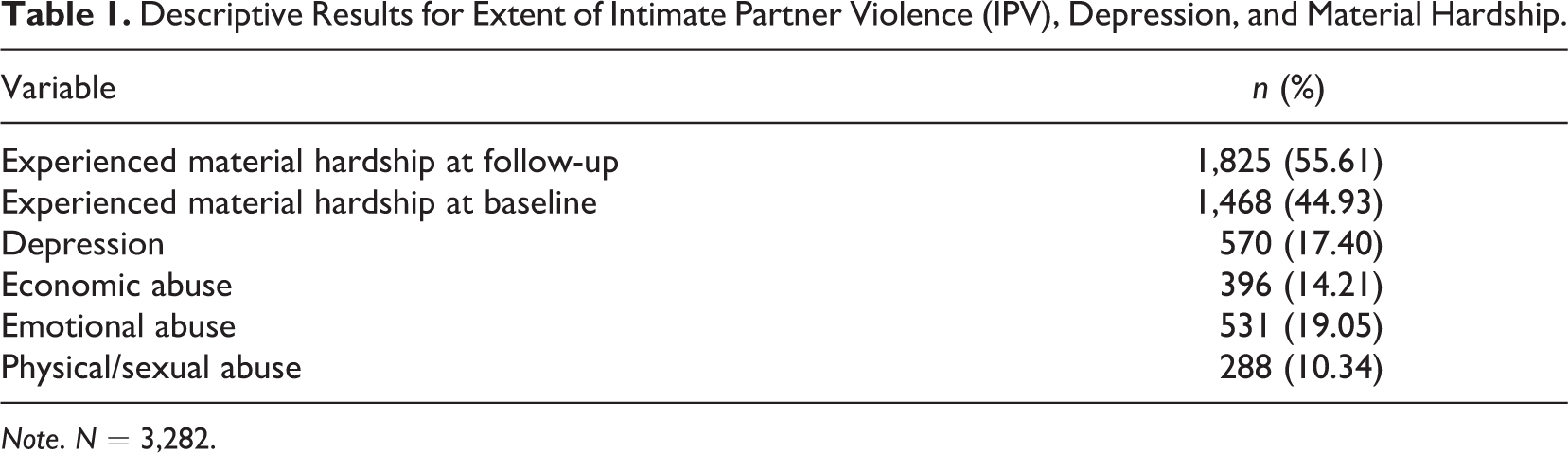
Descriptive Results for Extent of Intimate Partner Violence (IPV), Depression, and Material Hardship.
Note. N = 3,282.
EA
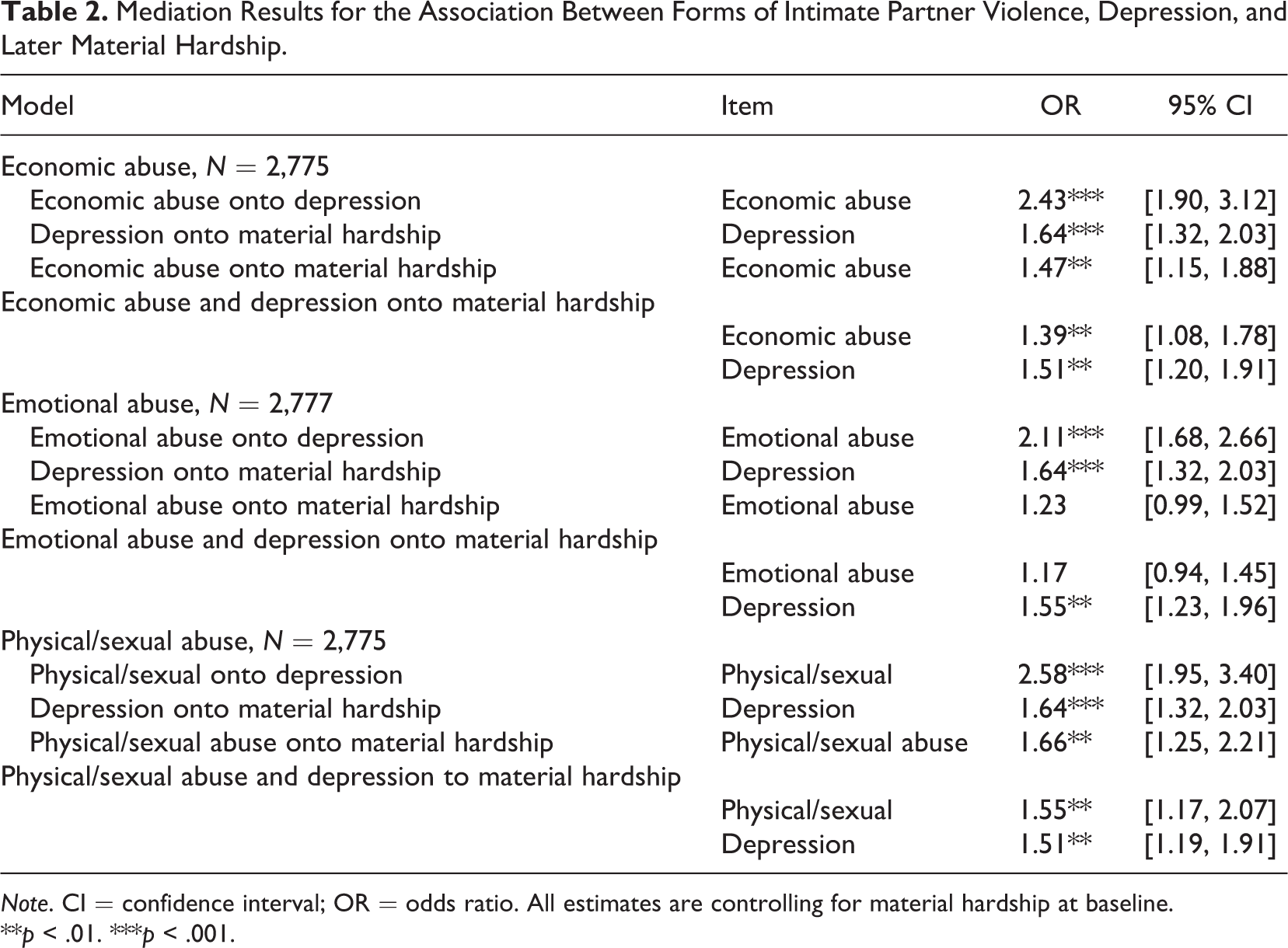
Depression symptomology partially mediated the relationship between experiencing EA and later material hardship (see Table 2 and Figure 1). When controlling for experiencing material hardship at baseline, reporting EA at baseline was associated with a 2.4 times greater likelihood of meeting the clinical cutoff for depression at baseline (odds ratio [OR] = 2.43, 95% confidence interval [CI] = [1.90, 3.12]), and meeting criterion for depression was associated with 64% increase in the likelihood of experiencing material hardship (OR = 1.64, 95% CI = [1.32, 2.03]). Without including depression as a mediator, there was a 47% increase in the odds of experiencing hardship for EA survivors (OR = 1.47, 95% CI = [1.15, 1.88]). With the mediating effect included, the odds of experiencing hardship were 39% more likely (OR = 1.39, 95% CI = [1.08, 1.78]), reduced from 47% more likely, suggesting that depression partially mediates the association between EA and hardship but that EA has a strong independent effect as well.
Mediation model for depression mediating the association between economic abuse and later material hardship (controlling for material hardship at baseline). ***p < .001. & **p < .01. Mediation Results for the Association Between Forms of Intimate Partner Violence, Depression, and Later Material Hardship.
Note. CI = confidence interval; OR = odds ratio. All estimates are controlling for material hardship at baseline. **p < .01. ***p < .001.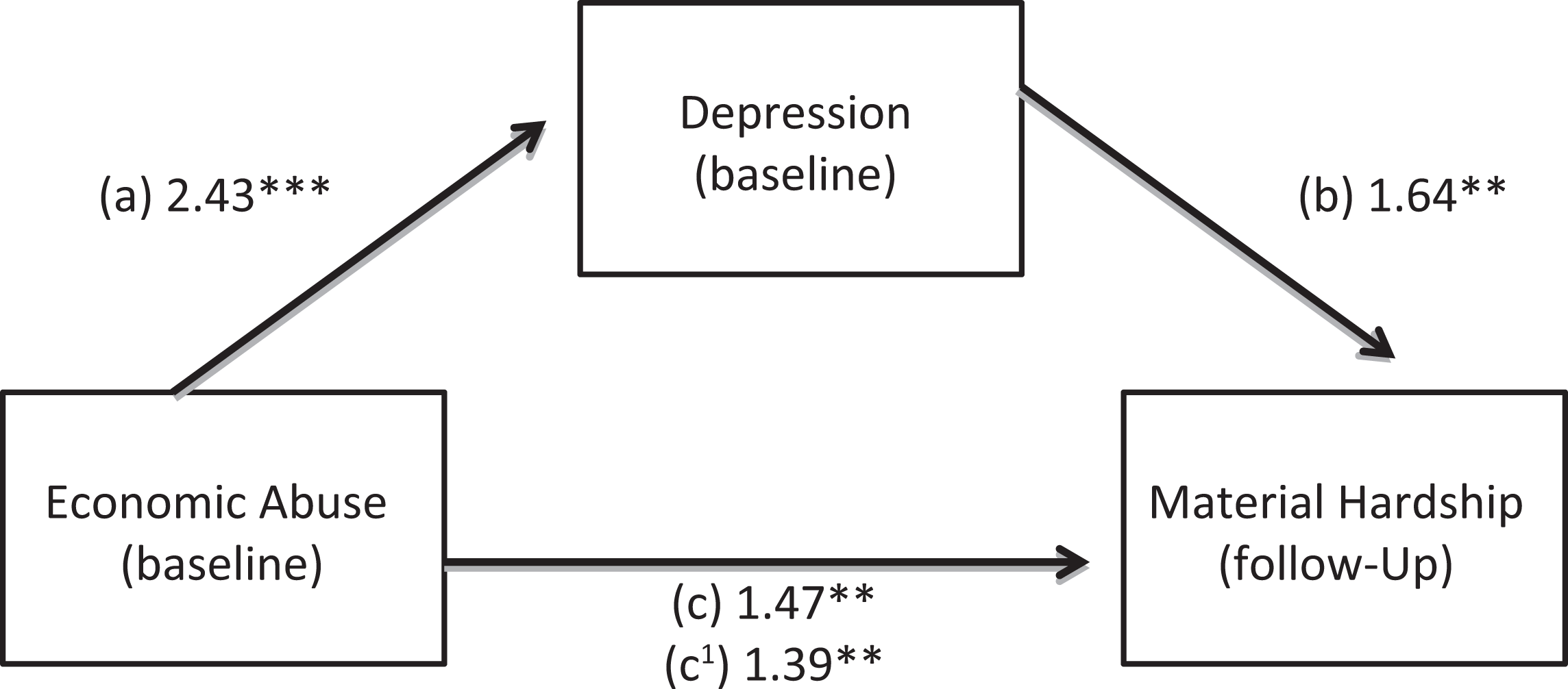
Emotional Abuse
Experiencing emotional abuse was not associated with a change in the odds of later hardship, either in the direct model (OR = 1.23, 95% CI = [.99, 1.52]) or in the mediated model (OR = 1.17, 95% CI = [0.94, 1.45]; see Table 2). However, experiencing emotional abuse was associated with experiencing depression at baseline, with a 2 times increase in the likelihood of depression (OR = 2.11, 95% CI = [1.68, 2.66]).
Physical/Sexual Abuse
Depression partially mediated the relationship between experiencing physical and/or sexual abuse and later hardship (see Table 2). Reporting abuse at baseline was associated with a 64% increase in odds of depression (OR = 1.64, 95% CI = [1.34, 2.03]). Without including depression as a mediator, there were 2.6 times greater odds of experiencing hardship for physical and/or sexual abuse survivors (OR = 2.58, 95% CI = [1.95, 3.40]). With the mediating effect included, the odds of experiencing hardship were 55% more likely (OR = 1.55, 95% CI = [1.17, 2.07]), reduced from 66% more likely, suggesting that depression partially mediates the association between physical/sexual abuse and hardship but that a strong direct effect remains.
Discussion
The current study used data from a nationally representative cohort of new mothers to explore the impact of depression on the association between three forms of IPV and later material hardship. Study respondents reported high rates of hardship as well as IPV. Over half (55.61%) the sample reported at least one hardship at follow-up.
Over one quarter (27%) of respondents reported experiencing at least one form of IPV in their current or most recent relationship. Fourteen percent of participants reported EA, highlighting the widespread nature of this understudied phenomenon. Along with the CDC data suggesting that 22% of women reported that they ever had a partner who “kept you from having your own money to use,” there is increasing evidence that EA should be considered a significant national issue (Black et al., 2011). Practitioners and policy makers should work toward developing effective responses to economically abusive partners and effective supports to address the consequences of EA. Bringing EA into the national discourse surrounding IPV could empower survivors, and support the development of effective prevention and intervention efforts. High rates were also observed for emotional abuse (19%) and physical/sexual abuse (10%).
An important contribution of this study is that it assesses the impact of EA on later economic outcomes for non-IPV service-receiving women. No known study has quantitatively assessed the specific impact of EA on later economic outcomes (in this case, four years later) nor has it been examined in a non IPV-service sample. This study found evidence that EA creates unique batterer-generated risks for survivors, with specific and negative impacts on later economic outcomes for women. A comparatively small portion of the effect was carried through the mediating impact of depression, suggesting that economically abusive tactics have a significant direct impact on women’s likelihood of experiencing material hardship. The impact is also long lasting, with this study demonstrating that economically abusive behaviors increase a woman’s risk of future material hardship years into the future. Women who have experienced EA face a host of challenges. These findings suggest that because the impacts of EA on economic outcomes are both direct and mediated through increased rates of depression, mental health treatment must be complemented with economic and financial interventions to support survivors of EA.
Practitioners should be made aware of the impact of EA and be empowered with tools to help women address these impacts. An important way to facilitate this work could be adding EA indicators to the intake and assessment tools used by IPV advocates. Tools including the Scale of EA (Adams et al., 2008), the Domestic Violence Financial Inventory (Weaver, Sanders, Campbell, & Schnabel, 2009), and the Work/School Abuse Scale (Riger, Ahrens, & Blickenstaff, 2001) could be used to help identify survivors of EA and match them with effective interventions (Adams, 2011).
Emotional abuse was the most frequently reported form of IPV in this sample, with 19% identifying it in their current or most recent relationship. Experiencing emotional abuse significantly increased the likelihood of depression; however, it was not significantly associated with later material hardship experiences in either model. This finding highlights that different forms of IPV may have different associations with women’s long-term economic stability and that teasing apart the impacts of economic and emotional abuse, which are often measured together in scales or subscales, could further our understanding of the impact of IPV on economic well-being while underscoring the importance of quality mental health care for survivors of IPV.
Ten percent of women reported physical and/or sexual abuse. These experiences were associated with 2.6 times the odds of depression. The association between physical/sexual abuse and later material hardship was partially mediated by depression, with a 66% increase in the likelihood of experiencing material hardship in the direct effects model and a 55% increase in the mediated model. Similar to EA, a relatively small portion of the effect of physical/sexual abuse on material hardship was carried through depression, suggesting that mental health is one of the routes through which IPV impacts economic stability but that other pathways may be equally or more important when considering interventions aimed at supporting survivors economically.
These findings extend our knowledge regarding the impact of IPV, and EA specifically, on women’s financial futures, particularly for non-IPV service-seeking women. These findings suggest that there is a sustained negative impact on economic stability, above and beyond its relationship to mental health. These outcomes suggest a need for continued development and implementation of economic support services for survivors in order to enhance safety and promote economic justice. The observed long-term impact of IPV on economic stability suggests the need for collaboration between IPV services and scholars to further the evaluation and dissemination of promising practices including economic education, credit counseling, and matched savings to support survivors in addressing the long-term economic impacts of abuse (Postmus et al., 2012; Sanders, 2014; Sanders & Schnabel, 2007; Sanders et al., 2006).
Further, the finding that EA is both prevalent and impactful for women in the general population is significant. For scholars, differences observed between emotional and economic forms of abuse suggest that it may be beneficial to include EA as a separate construct in quantitative research, particularly in future national surveillance studies. Deepening our understanding of the nature and dynamics of EA in the general population is an important stepping stone in efforts to better serve survivors. Without such work, when we see programs that are effective in addressing survivor needs, we lack the ability to articulate why they work or replicate them with confidence.
The tactics used by perpetrators of EA harm women’s long-term economic standing and compromise women’s ability to live independently. They are a direct threat to economic justice for survivors. For IPV advocates, considering the batterer-generated risks of EA along with the intersecting life-generated risks of racism, sexism, classism, poverty, and structural inequality could increase the effectiveness of advocacy interventions in order to promote the long-term safety and security of survivors.
Limitations
The current study should be viewed in light of important limitations in analysis and execution. As a secondary analysis of previously collected data, it uses blunt measures to assess IPV and material hardship. Although the ability to look at a large number of women in the population provides unique advantages, the use of publically available data means that none of the variables are specified as well as desired. Future investigations should incorporate validated scales for forms of abuse. Similarly, the use of binomial logistic regression limits the ability to assess the strength of the relationship at different levels of severity of the outcome. Future work should include continuous measures to understand variations in the extent of the relationships. Further, the Fragile Families study only retained 71% of respondents at Wave 5, limiting claims to the generalizability of these findings. Additionally, data were collected from women giving birth in urban hospitals, so these data may not be representative for older women, those who have not had children, and those in rural areas without access to the large urban hospitals included in the study catchment area.
Footnotes
Declaration of Conflicting Interests
The author(s) declared no potential conflicts of interest with respect to the research, authorship, and/or publication of this article.
Funding
The author(s) received no financial support for the research, authorship, and/or publication of this article.