




Abstract
The purpose of this study was to reposition the field’s understanding of unwed Korean mothers through narratives told by seven women about their experiences with social services and support during pregnancy and child rearing. Using a qualitative research framework combined with a phenomenological method, this study conveys their voices. The interviews indicate a discrepancy between the women’s needs and the services available, a discrepancy largely caused by the traditional social exclusion of unwed mothers. The interviews highlight the need to transform the current system from one that discriminates against unwed mothers to one that supports them in their child-rearing efforts.
South Korea (hereinafter Korea), a key sending country in intercountry adoption (Selman, 2009), continues to lack comprehensive services for unwed mothers and their children. Historically, many of the children born to unwed mothers have been given up for adoption, either within Korea or abroad; in fact, Korean society still largely regards unwed motherhood as a breach of social norms (Korean Women’s Development Institute [KWDI], 2009). However, recent studies show that a steadily increasing number of unwed mothers are actively asserting their right to raise their own children. Independent reports from maternity homes show that the percentage of unwed mothers rearing their children has increased dramatically, from 6.9% in 1997 to 9.6% in 2000 and to 31.9% in 2005 (Ministry of Gender Equality & Family, 2010).
In Korea, childbirth and child rearing are strongly expected to take place within the domain of marriage. Thus, having children outside marriage is typically considered a transgression of normative social behavior. Recently, a small number of women have begun to contest this discourse. These women have advocated the term bihonmo, which means single mother by choice—a notion that challenges the more negative term mihonmo, which means unwed mother. However, their campaign has had relatively little influence in the wider segments of society so far; the majority of men and women still seem largely in favor of the traditional institution of marriage. Even the term single mother is often found problematic by many people—too general, vague, and unspecific in practical usage. Rather, the public tends to prefer clear distinctions that divide mothers into categories of widows, divorcees, and unwed mothers. Some scholars explain that the main issue producing these distinctions—between unwed mothers and mothers in general—is the loss of virginity prior to marriage (KWDI, 2009; Yi, 2012). In public discourse, this issue plays an enormous factor in determining the social status and legitimacy of motherhood. In a historical perspective, the term unwed mother referred to war widows, prostitutes, runaways—or, in other words, women unwanted or ill fated. Some of these negative connotations have survived; today, the term unwed mother generally implies an involuntary, failed relationship with the child’s father prior to marriage (KWDI, 2011). Without support from the child’s father, the options for unwed mothers have ranged from having an abortion, 1 relinquishing the child for adoption, temporarily leaving the care responsibility to a child welfare institution, sending the child to a group home or foster care family, raising the child with support from parents and extended family, or raising the child themselves (Hong, 2006; KWDI, 2010). In the absence of support from their families in addition to widespread rejection from Korean society, many women have chosen relinquishment for adoption as a solution to their child-rearing difficulties. Critics have pointed out the conflict of interest of adoption agencies (i.e., managing or being closely connected to a majority of residential facilities for unwed mothers, while depending on the availability of unwed mothers who relinquish their children for adoption). 2
Studies about unwed mothers have been conducted since the early 1970s in Korea, but the current body of literature must be viewed with caution due to methodological limitation. One limitation has been data collection: The scope of most studies has been limited to school dropouts and runaway teen mothers, thereby overlooking the many women living independently with their children. Another limitation of these studies has been a lack of long-term data on unwed mothers’ long-term experiences with child rearing.
This study aims to give a voice to unwed Korean mothers and reposition them within the larger context of Korean family ideology and adoption studies in the hope of broadening the general acceptance of alternative families. Specifically, the study focuses on the women’s experiences at residential facilities for unwed mothers and discrepancies between their needs and the services available to them. To obtain this information, we asked seven unwed mothers to provide retrospective accounts of their pregnancy and subsequent experiences up to the time of the interview.
Korean Ideology on Healthy Families
Neo-Confucianism was introduced as a state ideology to premodern Korea more than 600 years ago; the social and ethical doctrines promulgated through neo-Confucianism have had great implications for contemporary society’s view on women. Patriarchal values prescribed the principle of three duties for women (sam-jong-ji-do): As a daughter, they must obey their father; as a wife, they must obey their husband; and as a mother, they must obey their son upon the death of their husband. Only through marriage would an adult woman develop her identity and ensure her social position. Even today, only a traditional nuclear family—a married man and woman with children—is considered to be a normal family (Yi, 2012). The historical emphasis on the institution of marriage remains evident in the Healthy Family Act of 2005, which defines family as a relationship based on marriage, blood, or adoption. In other words, cohabiting partners and unwed mothers and their children are not considered to constitute a family. Furthermore, Yi (2012) explained how a much distorted perception of virginity has been fostered in Korean society, causing a witch hunt-like behavior toward unwed mothers. These women are regarded as immoral women and essentially unfit mothers, largely blamed for inflicting their situation on themselves.
The hoju family registration system was introduced in Korea during the Japanese colonial period (1905–1945) and was in effect until 2008. 3 A key principle of this system was that only men could be the head of a family (household). Consequently, at birth, a girl was registered as her father’s daughter, and upon marriage she was registered as her husband’s wife. In the absence of the biological father (or his permission), another adult male must give permission to include the child in his family registry for the child to be officially recorded. Thus, the implication of family estrangement for unwed mothers reaches beyond emotional and financial struggles, essentially jeopardizing the legal existence of her child. Although the hoju system has been abolished in favor of an individual registry system, which allows unwed mothers to register and take guardianship of children under their own name, the patriarchal ideology guiding the hoju system remains strong in Korean society.
The Unwed Mothers
Research on unwed mothers is a field of research under development in Korea. Studies on unwed mothers have primarily focused on women’s experiences during their temporary stay in residential facilities. Data collection based on samples from residential facilities has not been able to represent the entire cohort of unwed mothers because women living in residential facilities tend to be substantially younger than those living independently (KWDI, 2010). Researchers have also questioned the heavy focus on institutionalization, arguing that more attention should be given to community-based solutions to promote unwed mothers’ independence (Kim & Kim, 2006). Although these studies have increased the public’s awareness of unwed mothers and their difficulties, the research does not offer a comprehensive understanding of the long-term difficulties that unwed mothers generally face as they seek to reintegrate into society and pursue independent lives (Choi, 2006; Kim & Kim, 2006). Consequently, relevant policies and social services have targeted only a small segment of the potential beneficiaries. Still, even the adequacy of these efforts must be subject to questioning, as service providers and lawmakers commonly conceptualize unwed mothers as misbehaved, irresponsible, and incompetent adolescents. The infantalization and powerlessness of this group of women are highlighted in Lee’s (2011) study, in which she illustrates how the unwed mother’s pregnancy quickly becomes a matter of importance for the entire family. In all seven of Lee’s case studies, the unwed mothers expressed a desire to keep and raise their children, whereas their families had a clear preference for adoption. Left with no social acceptance or credibility, the unwed mothers had little power to make their own decision on the matter.
In other countries, women have faced similar estrangement from their families and society upon unwed pregnancy. One of the most significant accounts is Ann Fessler’s The Girls Who Went Away (2007), a collection of oral stories by more than one hundred American unwed mothers who surrendered their children for adoption from the end of World War II to the passing of Roe v. Wade in 1973. The author delivers a convincing case for the importance of listening to women, and even more so, the importance of a paradigm shift from adoption to family preservation. Today, most social workers have moved away from the traditional practice of morally condemning unwed mothers (and fathers), instead reframing the issue of single parenthood in terms of antipoverty and unemployment (Blank, 2007; Waldfogel, 2009).
However, the absence of Korean unwed mothers in the international literature is striking. Despite giving birth to 166,595 officially recorded international Korean adoptees between 1953 and 2012 (Statistics Korea, 2012), the voices of Korean natural mothers remain largely unheard. A few exceptions are the works of Kim (2007, 2010) and oral histories collected from a residential facility for unwed mothers, Ae Ran Won (Dorow, 1999; Han, 2010). These narratives speak to the difficulties women face before, during, and after relinquishing their child, both for those who later reunite with their son or daughter and for those who do not.
Studies show that unwed mothers have very different socioeconomic backgrounds (Lee, Seo, Park, & Lee, 2002). Contrary to common belief, the number of unwed teen mothers is decreasing, while the number of unwed mothers in their late 20s and 30s is increasing (KWDI, 2010). According to estimates from the Korean census, the number of families headed by unwed mothers has steadily increased in the last few decades, from 90,986 in 1995 to 117,764 in 2000 to 133,234 in 2005 (Korean Unwed Mothers Support Network [KUMSN], 2009). However, even these numbers testify to the social exclusion of unwed mothers, as the census only records children born to married individuals, divorcees, and widowers or widows. Reliable, accurate, and updated statistical information on the number of unwed mothers is therefore not available.
Analyzing the child rearing trend among unwed mothers, scholars speculate that several factors have contributed to these changes. First, the National Basic Livelihood Security System in 2000 guarantees a small yet stable amount of financial support to unwed mothers. Second, abolishing the hoju system 3 in favor of the individual registry system protects women’s legal rights to their own children. Third, a more positive view of alternative family structures has emerged in the media and political discourse, increasing society’s understanding and acceptance of nontraditional families, such as those headed by an unwed mother (Choi, 2006).
Social Services
Unwed mothers’ vulnerable status and the inadequate legal protection of their interests have been recently addressed in the adoption law revisions and Single-Parent Family Support (SPFS) Act (Chong, 2011). 4 As of this writing, government-supported services for unwed mothers are organized under four main programs: the SPFS Program, the National Basic Livelihood Security System, the Childcare Support System, and the Healthcare and Nutrition Services (KWDI, 2010). The SPFS offers a variety of social services to unwed mothers as part of a larger effort to support single-parent families. However, critics have pointed out that the program fails to encourage unwed mothers to keep and raise their children (KWDI, 2010). The most blatant example is the monthly welfare benefit for unwed mothers, which amounts to Korean Won (KRW) 70,000 a month, KRW 80,000 less than what domestic adoptive parents receive. 5 The SPFS also offers a single-parent assistance program to young mothers, but only for mothers aged 24 years and under. Table 1 shows the details of these services.
Social Services.
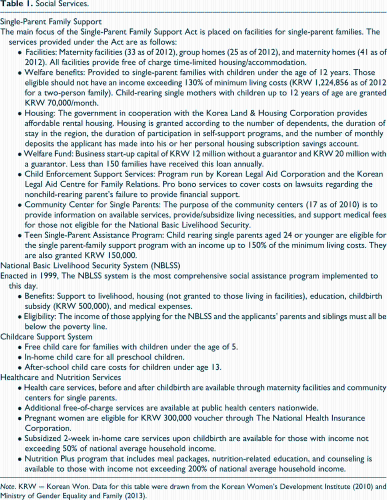
Note. KRW = Korean Won. Data for this table were drawn from the Korean Women’s Development Institute (2010) and Ministry of Gender Equality and Family (2013).
Regarding legal support for unwed mothers, a system under the SPFS was established to enforce payment of mandated child support from noncustodial parents. Although parents are mandated to share the financial burden of child rearing, the KWDI (2011) found that only 20 of the 213 (9.39%) unwed mothers were receiving monthly child support. Other services in accordance with the SPFS Act include the 17 community centers for single parents established nationwide by the Health Family Support Centers since 2010, which provide information, subsidize daily necessities, and meet medical needs. Although the centers offer essential services, critics have pointed out that they do not reach out to many women in need of their services. The SPFS also provides various types of housing, such as free residence in agency-owned single-family homes, free group homes for mothers and children, and fully subsidized rent for apartments, but the demand far exceeds the supply (KWDI, 2010). Based on these findings, scholars have recommended an increase in residential facilities for unwed mothers, while promoting community services.
The National Basic Livelihood Security System is Korea’s most comprehensive antipoverty measure to date, offering free medical services and housing. However, because eligibility requires not only the applicant but also her parents and siblings to live below the poverty line, many unwed mothers are disqualified from these services. In reality, unwed mothers who are abandoned by a family that lives above the poverty line are left without support, not only from their family but also from the government (Kang, 2002). 6 Other services, such as the Childcare Support System and the Healthcare and Nutrition Services Program, have been more successful in supporting the women in their dual roles of caretaker and breadwinner.
Through in-depth interviews, this study examines the various experiences of unwed mothers raising their children. We focus on the services the women received from residential facilities for unwed mothers and society at large, and how these services met the women’s subjective needs. The participants’ responses served as a vehicle for understanding the experiences of unwed mothers who are rearing their children.
Method
Data Collection
A purposive sampling strategy was used to select the participants for this study. We selected participants from different age groups and with different experiences with social welfare services. The sample included two mothers in their teens, three mothers in their 20s, and two mothers in their 30s. All women have had prior experiences with more than one residential facility, service provider, or organization, which allowed them to compare the relevance and quality of the services they received. At the time of the interviews, two participants were living with their children in residential facilities for unwed mothers, two participants were living with their parents, one participant was caring for her child and grandmother, and two participants were living independently with their children. The participants’ children ranged from 1 to 6 years of age.
Data collection consisted of semistructured interviews conducted between November 2009 and February 2010. For their comfort and convenience, the interviews were conducted at locations chosen by the interviewees. The interviews lasted an average of approximately 2 hr, encouraging the participants to speak freely about their experiences. The key questions were “As an unwed mother, what is your experience with social services received at facilities for unwed mothers and with society at large?” and “How did these meet your needs?” All interviews were recorded with the participants’ permission and transcribed for data analysis.
Analysis
A qualitative research methodology was used in this study. To examine the essence of the unwed mothers’ experiences, we analyzed the data using Giorgi’s (1985, 1997) phenomenological approach. This approach aims to clarify the essential meaning of a phenomenon as experienced by the participants in their daily lives and thereby describe the phenomenon as accurately as possible. A common challenge for qualitative researchers is to set aside their existing intellectual perceptions of their research topic. Because all the authors of this study have a long experience in the field of adoption, child relinquishment, and child rearing, we carefully discussed throughout the process how this might influence our reading of the data obtained from the unwed mothers. Furthermore, as Padgett (2008) recommended, we consulted a peer debriefing support group consisting of professional social workers and other unwed mothers before, during, and after the completion of the interviews. Their feedback and ideas helped the researchers stay honest and true to the topic.
Two researchers were present during all interviews: One conducted the interview and one took notes and supervised the process. The researcher who had conducted the interview also transcribed the interview, after which all participants read the transcripts of their interview to confirm that the content was accurate and that their intended meaning had been understood. Immediately after the interview, the researchers listened to and read through the transcript several times before each coded the data according to Giorgi’s (1997) procedure. The analysis generated 37 natural meaning units that could be collapsed into nine themes under four focal meanings. In this article, we discuss three of the focal meanings that are organized into six themes and 28 natural meanings.
This qualitative study attempted to arrive at an in-depth understanding of the experiences of unwed mothers by purposefully selecting participants with multiple experiences of social welfare services. The small sample size prevents the study results from being generalized to all unwed mothers. Nevertheless, the study contributes to the field by providing insight into the complexity of experiences faced by unwed mothers who have received social welfare services.
Findings
The outcome of the descriptive documents based on the participants’ responses is summarized in Table 2. The individual experiences of the unwed mothers were grouped into six themes: (a) searching for support, (b) finding support, hope, and disappointment, (c) facing social condemnation, (d) experiencing injustice and unfair treatment, (e) establishing an organization for unwed mothers, and (f) pursuing an ordinary life. The six themes were then clustered into three focal meanings: (a) beginning an unknown path, (b) struggling with a harsh reality, and (c) designing a new path.
Constructive Elements of the Experiences of Unwed Mothers Who Are Rearing Their Children.
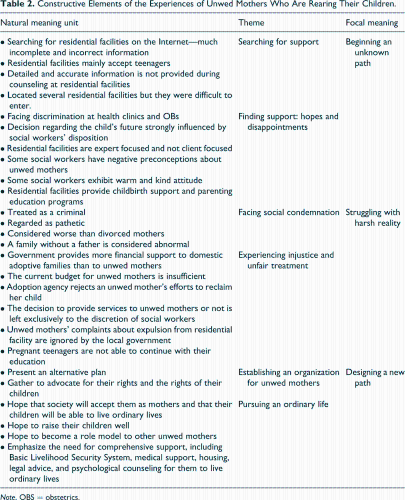
Note. OBS = obstetrics.
Beginning an Unknown Path
Searching for support
All the participants told stories about how family members and the child’s father vehemently disapproved of the pregnancy and actively tried to force them to either have an abortion or give up the child for adoption. Refusing to comply with these demands, the unwed mothers were left on their own, disconnected from family support. Four of the women had no income or place to stay when their families became aware of their pregnancy. Based on these experiences, all the unwed mothers expressed an urgent need for government assistance and financial support. They also shared the belief that changing society’s negative perception of unwed motherhood is fundamental to improving support for unwed mothers. The need for a change in social perception of unwed mothers is a recurring theme among scholars inquiring into unwed mothers’ child-rearing experiences (Kim & Kim, 2006; KUMSN, 2009).
For the study participants, the search for support most often began with the Internet. The women were able to locate a broad but vaguely defined spectrum of services through various online forums and organizational websites. Although few organizations make their intake conditions explicit, the participants soon realized through their inquiries that residential facilities preferred younger women over older women and those without a job or with little work over those with a full-time job. These experiences suggest a highly selective intake procedure that gives preference to women of a less independent nature, whereas older women, who are more likely to choose child rearing over child relinquishment, are less attractive to such institutions. One woman spoke of her search for shelter: Especially if you call service numbers starting with 080 and 1588 they will tell you that “we only accept teen mothers.” They say that older women cause too much trouble and can’t adjust to life in a residential facility. If you take a closer look at these facilities, then you will see that these are the ones that send children for adoption. (Participant 1)
Finding support: Hope and disappointment
Overcoming initial rejection from family members, the child’s father, and the father’s family, five of the women entered residential facilities to receive prenatal care and advice regarding their child’s future. Although some institutions were very supportive of child rearing, others only provided information about the adoption process when contacted by the women. In addition to the difficulties of navigating the market of residential facilities, challenges include the often informal relationship between some residential facilities and adoption agencies and the tendency of adoption agencies to promote themselves as maternity homes for unwed mothers. The failure to provide comprehensive and unbiased information implies a counseling method aimed at securing potential child relinquishments, rather than ensuring the woman’s ability to make an informed decision about her child’s future. In search for information about options for herself as an unwed mother and her child, one woman was repeatedly and exclusively informed about adoption: I called [the adoption agency], but I was only informed about legal termination of parental custody. I called another [adoption agency], and they said they would ask around for the possibility of private adoption. They would take care of everything and just told me to make the decision. (Participant 2)
Struggling With a Harsh Reality
Facing social condemnation
The unwed mothers shared stories of discrimination by family, friends, and society in response to their decision to raise their children. The participants were constantly reminded of the absence of their child’s father in daily life, such as when hailing a cab or going to the hospital. They were blamed not only for the father’s absence but also for not being married. In fact, the stigma associated with unwed motherhood was described as much worse when compared to divorce or widowhood: The perception of unwed mothers is the worst—like a criminal. Just like the woman I mentioned a minute ago, she told me, “When you pursue such a life style, you caused it all by yourself.” So people think we have to endure it—but this is not something for women to endure alone. We [the child’s father and I] were supposed to do it [raise the child] together. (Participant 1)
Experiencing injustice and unfair treatment
The unwed mothers cited a lack of financial support as their most urgent problem. Because they were raising children without any help from others, job security was a key priority. However, the five mothers who were actively searching for jobs after giving birth explained how they had been rejected solely because of their status as unwed child-rearing mothers. Thus, despite their efforts to become financially independent, all these women had to rely on support from public or private organizations for either a shorter or longer period of time. As recipients of social services, the unwed mothers also experienced forms of institutionalized injustice and discrimination from the government, private social welfare organizations, and the educational system. Younger mothers in particular struggle to complete their educational programs; indeed, they are often encouraged to discontinue their studies at the expense of future career opportunities (KWDI, 2010). At first, I thought about returning to school, but I couldn’t as my stomach grew bigger and bigger…The circumstances just don’t allow me to go to school, even if I wanted. It’s like, I’m jealous when I see other teenagers in their school uniform, but then I think how there is nothing to do about this situation and I just have to forget about it. (Participant 6)
Designing a New Path
Establishing an organization for unwed mothers
Unlike unwed mothers of the past, today’s unwed mothers refuse to be silenced. They have begun voicing their discontent with discrimination and unfair treatment within the current social welfare system. Their unpleasant experiences have motivated them to establish their own advocacy group (Korean Unwed Mother’s Family Association [KUMFA]). KUMFA is a nationwide advocacy group that provides peer support, mentoring, and forums for networking. In pursuit of child rearing, they have had to establish a support system that is not available from existing official or private organizations. One of the members explained the importance of their group as follows: “Let’s make our own independent services,” [I said]. So the mothers came together in our organization because the State isn’t providing any support, and that’s how we can survive. So we wanted to provide enough support for the mothers to raise their children well. (Participant 1)
Pursuing an ordinary life
Improvements and changes to the current social welfare system are relevant only if they can help unwed mothers and their children to lead “ordinary lives.” More than financial support, what the mothers really want is to lead lives that are just as “ordinary” as those of any other families in society. Their efforts to bring about change in the social welfare system are aimed at creating an environment where their children will be able to pursue as many opportunities as everyone else. One participant noted, I just wish my son would always be happy.… I don’t want to force him to do anything, I wish most of all he will grow up healthy. You know, if he follows his dreams, that should do. (Participant 7)
Discussion
This study is among the first to convey the voices of unwed, Korean, child-rearing mothers to an international audience. Despite the heavy foreign influence on unwed motherhood through the adoption system, the group has vastly been overlooked by international social workers and feminist scholars. The adoption system has played a crucial role in facilitating the removal of these socially undesired children, but at the same time has not been very successful in supporting the unwed mothers in their child-rearing efforts. Unwed motherhood has been commonly perceived as a pathological, irresponsible behavior in Korea, and recent studies point out the conflicting interests in providing rehabilitating services for these women while placing their children up for adoption (Kwon, 2014).
The lived experiences of unwed, child-rearing mothers suggest that the women have been marginalized from Korean society, which they have encountered multiple difficulties in their child-rearing efforts, and that these challenges are often amplified by hostility from social work professionals and their families. In an effort to overcome these obstacles, several of the interviewees took the initiative to organize KUMFA, a self-help and advocacy group for unwed mothers. With private donations, the women established KUMFA in 2009. Today, the organization counts approximately 200 paying members and consists of three national branches in Seoul, Daegu, and Ulsan. Drawing on their personal experiences with the social service delivery system, KUMFA aims to supplement the current social services while also advocating for unwed mothers’ right to rear their own children free of stigma and discrimination. KUMFA received its nongovernmental organization status from the Ministry of Gender Equality and Family in 2010, although the organization has yet to receive any financial support. In 2013, KUMFA received funds from Seoul’s Development Fund for Women in support of their activities.
The unwed mothers’ initiative to organize is both a manifestation of their assertion of child-rearing rights and a testimony to the State’s failure of inclusion. Unwed mothers’ reliance on peer-group support for political, social, and economic opportunities is a reaction to decades of social exclusion. Although neo-Confucianism may not be considered a State ideology in contemporary Korea, scholars argue that these patriarchal values still guide the standards of moral and ethical behavior in personal relationships in general and in family relationships in particular (Choi, 2013). Korean society has experienced tremendous economic growth since the Korean War, a change that has influenced the role of the family. Certainly, traditional family patterns do not fit well with the demands of modern life; still, new family patterns, such as unwed motherhood, have not been accepted.
In practice, domestic as well as international social workers must recognize how the conditions have changed for the modern family. We must pursue solutions that prioritize family preservation instead of family breakups. These recommendations become even more crucial, knowing that today’s unwed mothers struggle to make the choice to raise their children.
This study contributes to family-based services, one of the dominating fields in social work practice. A broader and more accepting approach to the so-called alternative families would be to develop better and more effective services—the most important aim for any individual involved in social work practice or research. This study will help individuals affected by unwed motherhood to understand women’s struggles, as Korean society moves toward greater respect and support for their choice to rear their children.
Footnotes
Acknowledgment
We thank all the unwed, child-rearing mothers who volunteered to participate in this study.
Declaration of Conflicting Interests
The author(s) declared no potential conflicts of interest with respect to the research, authorship, and/or publication of this article.
Funding
The author(s) received no financial support for the research, authorship, and/or publication of this article.