




Abstract
We present the development and validation of a new measure to assess perceptions of community and social contexts (macro contexts) linked to controllability in relationships. The Controllability in Intimate Relationships Scale measures a person’s perceived situation regarding power, resources, and independence. This measure is a first step toward assessing links between macro contexts and control in intimate partner violence. Analyses conducted on the sample of 241 college students and community members included analysis of variance, Cronbach’s α, standard error of measurement, and exploratory and confirmatory factor analyses. Results showed good reliability and model fit. Implications for research and practice are discussed.
Keywords
Intimate partner violence (IPV) has been declared a substantial public health problem with a range of plausible causes and risk factors at multiple levels of society (Black et al., 2011). With an estimated 1 in 18 Americans experiencing physical IPV, rape, or stalking each year, there is a pressing need to better understand multilevel causes and risk factors in order to facilitate IPV prevention (Black et al., 2011). Desire for control is among the most-cited risk factors for IPV. Johnson and Ferraro (2000) identified control as a defining feature of intimate terrorism (one of four types of IPV identified in the study, typically involving the greatest violence, male to female violence, and increasing severity over time). Tests of the Johnson and Ferraro typology corroborate that a significant portion of IPV is linked to control behaviors (Graham-Kevan & Archer, 2003); others have found that, at least in married relationships, both men and women may be equally motivated by control (Felson & Outlaw, 2007). Yet, Felson and Outlaw also found that husbands and wives differed in their methods of control. We suggest this difference is best explained by an interplay between desire for control and gendered community and social contexts (macro contexts) that facilitate control.
A major challenge to understanding the role of control and macro contexts in IPV is that existing measures of IPV tend to focus on incidents of violence and aggression. The emphasis on violent acts is understandable and important, yet it omits the control-related implications of the violent action (Dutton & Nicholls, 2005; Dye, 2003; Fritz & O’Leary, 2004; Hamby, 2005). For example, two violent acts of resistance against a controlling partner “count” as two acts of IPV, whereas one act of violence that establishes long-term control over a partner counts as a single act of IPV. Without an understanding of the victim’s macro context, it is difficult to impute the implications of specific IPV acts. Items assessing injury are a notable exception to this limitation. Yet, injury is a measure of physical consequences and while extremely important, it is not an adequate proxy for control. The lack of adequate measures of macro-control contexts impedes understanding of the role of control in IPV and constitutes a critical gap in the IPV literature, especially for understanding health and interpersonal consequences of IPV.
One solution would be to assess a victim’s or potential victim’s perceived balance of control in a relationship. This is complicated by respondent psychology and a priori expectations of control over others, an expectation likely higher for abusers. An alternative is to use economic status and social support to index victim resources. A limitation here is that this overlooks the victim’s assessment of the adequacy of their contextual circumstance. The field needs to assess controllability in subjective, victim-relevant terms that consider the relative impact of controlling acts on those with different macro contexts and varied personal needs or preferences.
A person’s macro contexts involve relationships to organizations, communities, and policies. Evidence shows that risk for abuse in intimate partner relationships differs by the victim’s contextual situation, including social support and community social disorganization (Browning, 2002; Fisher, 2004; Goodman, Dutton, Vankos, & Weinfurt, 2005). To the extent that IPV is motivated by the attempt to control an intimate partner, it is essential to understand the link between IPV and macro contexts that a perpetrator may use to obtain control.
State of IPV, Control, and Contexts Measurement
IPV measures have progressed in measuring physical, psychological, and sexual IPV acts, and somewhat in measuring the consequences of aggression (Fisher & Cullen, 2000; Thompson, Basile, Hertz, & Sitterle, 2006). Current measures relating to control capture specific control tactics on the part of the perpetrator (e.g., physical violence, social isolation, and controlling finances; Johnson, 2006; Lehmann, Simmons, & Pillai, 2012; Strauchler et al., 2004). The limitation of measuring control tactics in isolation is that it overlooks the relative impact of a perpetrator’s actions depending on the influence of the victim’s context. For example, a control item such as “would not let me see my friends, family, etc.” could have different effects for women with extensive versus limited support networks (Strauchler et al., 2004). Thus, current measures of control tactics—such as threats of violence, economic coercion, abuse of privilege, coercion using children, isolation, and sexual abuse to gain compliance—fail to take into account the relative impact of these actions within different macro contexts (Johnson, 2006).
Virtually, no measures capture broad contexts that can facilitate control. A recent measure developed by Lehmann, Simmons, and Pillai (2012) assesses coercive acts but not the victim’s macro context. A study by Goodman, Dutton, Vankos, and Weinfurt (2005) explored victim’s tangible, emotional, and social support resources related to repeat IPV victimization. One of their measures assessed dependence on a partner’s material resources. This 3-item scale (α = .75) asks whether the participant would lose transportation or money for food and rent if they were to leave their partner. The questions importantly assess specific ways in which a victim can be controlled and were taken into account in development of the Controllability in Intimate Relationships Scale (CIRS). Taken alone, the 3 items present a challenge in which they assume normative resource needs. There may be many different, valid concerns that relate to a victim’s context that differ from a priori instrumental resources, such as victim dependence on a specific housing status, which may be instrumental in accessing existing social support.
Recent research highlights the importance of macro contexts to IPV. A longitudinal study of women’s IPV reporting measured social organization and neighborhood economic development indicators to identify factors that promoted women’s report of IPV victimization (Browning, 2002). In this study, social disorganization and lack of community economic development hindered women’s report of IPV, even after controlling for frequency and severity of IPV (Browning, 2002). In a review of IPV literature, Fisher (2004) recommended that, among other items, further research be conducted toward socioeconomic and cultural contextual factors in IPV. Fisher’s call seeks measurement of how contextual factors relate to IPV (Fisher, 2004). Since Fisher’s call, research has measured community economic development, employment, and living situation as factors relating to IPV consequences and outcomes (Goodman et al., 2005). In addition, current measurement of IPV contextual factors tends to lack sensitivity to how a perpetrator may be able to exercise control over victims with different macro contexts.
Although measuring macro context in IPV has advanced, researchers have barely begun to quantitatively study macro context in relation to control. Stark (2007) argues that a male perpetrator’s control over female victims is achieved through coercive behaviors that are facilitated by the unequal social status of women in society. Whitaker (2014) examined macro context and control in a sample of over 2,000 college undergraduates and found a connection between contexts and young men’s desire for control over women partners. The role of specific social–ecological contexts in facilitating control is empirically underdeveloped.
Thus, the literature identifies control as an essential construct but lacks measures of macro contexts pertinent to control and measures of how macro contexts facilitate control in IPV that applies in varied contextual situations, such as control by abject economic deprivation versus control by potential loss of a highly valued resource. Given the lack of measures, it is difficult to address a critical gap in the literature: How a person’s macro contextual situation facilitates a perpetrator’s control over that person. This article presents a first step toward addressing these gaps. We develop the CIRS to measure a person’s perceived controllability—the multidimensional and varied macro contextual factors that may facilitate a perpetrator’s control over that person. Further, we design the CIRS to assess perceived controllability whether or not the respondent is in an intimate relationship.
Method
Item Generation
We used 5-item domains to facilitate concept coverage and feedback from the reviewers. Johnson (2006) found several types of controlling acts that clustered by their relationship to IPV: threats of violence, economic control, privilege, children, physical or social isolation, and emotional and sexual abuse (Johnson, 2006). Social support and social organization are additional empirically supported factors exploited to achieve control (Browning, 2002; Goodman et al., 2005). We grouped these into five controllability domains to generate items: social, financial, physical, cultural/beliefs, and institutional. During development of controllability items, we included the controlling acts that are identified in the literature. The social domain included respondents’ sources of emotional or social support, the financial domain included respondents’ sources of monetary support to meet personal needs, the cultural domain included beliefs about which party should hold power in intimate relationships, the physical domain included respondents’ access to material resources for action and self-preservation, and the institutional domain included respondents’ relationships with health and safety systems.
Content Validity
We generated 45–60 items under each domain and submitted the item list, grouped by domain, to six content validity reviewers: two state agency domestic violence program officials, two domestic violence shelter counselor/case managers with over 5 years of experience, and two professors with substantive knowledge and research expertise in IPV reviewers were presented with the overall purpose of the scale and explanations of each of the domains. Reviewers were then asked to select among the following responses to each item (scaled such that higher scores represented greater item endorsement): The item did not match the domain definition or the respondent did not understand the item (1), the item matched the domain but should be reworded (2), and the item matched the domain and the respondent approved of the wording (3). Reviewers were also asked to suggest new items or domains and to suggest alternative wording to existing items. Items were considered for removal if the mean rating across respondents was less than 2. After computing average item ratings, 128 items with a score under 2 were removed. The lowest average rating of the retained items was 2.4. Twenty-four items that reviewers perceived to be redundant were also removed. No new items were recommended, although several modifications were made to improve item wording. The final instrument retained 46 items with 8 to 11 items per domain.
Intended Audience
The scale was designed to be administered to women and men of any sexual orientation, although the instrument did not ask about sexual orientation. In addition, a victim’s macro contextual situation, while potentially influenced by a perpetrator, does not inherently depend upon an existing relationship with a perpetrator. For example, a potential victim lacking financial independence may be dependent upon family while not in a relationship and more vulnerable to IPV later (Goodman et al., 2005). Thus, this scale was developed to be administered to people who were with and without current intimate partners. By doing this, we aimed to develop a scale that practitioners could use with people in relationships or those considering readiness for a relationship, such as IPV survivors. By developing a scale to assess potential for controllability when someone is in a relationship or considering one, we provide a tool that may be used to enhance resilience through increased awareness and that practitioners can use for community-level efforts to reduce controllability and prevent IPV.
Instrument
The instrument included demographic items and questions to test CIRS construct validity. Items included age, sex, race, ethnicity, occupation, income, education level, relationship status, living arrangements, sources of financial support, and level of control the participant feels other people have over his or her life. The final CIRS included 9 items on respondents’ access to social support and dependence on someone else’s social support network; 8 items on respondents’ perceived employability and economic self-sufficiency; 9 items on how respondents felt they should act in an intimate relationship; 9 items on perceived access to instrumental physical resources; and 11 items on respondents’ awareness of and access to social services and their views on the responsiveness of institutions to their needs. Response options ranged from 1 = strongly disagree to 7 = strongly agree. After reverse scoring appropriate items, higher scores indicated higher levels of controllability on all items.
Sample Recruitment
With institutional review board approval, 250 male and female adult research participants were recruited from upper-level classes at a public university, a public community college, and community events. The university and college samples were racially diverse (24% and 26% black, 56% and 57% white, respectively), but relatively young (mean ages 24.0 and 22.0; standard deviation [SD] = 7.2 and 5.3, respectively). The community setting was less racially diverse (13% black and 81% white) but had more diverse ages (mean age = 41.9; SD = 10.7). By recruiting participants from three settings, we hoped to obtain greater variability in responses to CIRS items and in variables to be used for establishing evidence of validity. Participants at the community college and the university were recruited by e-mailing instructors from social sciences and human services departments (with written departmental approval) and inviting each instructor to provide their students the opportunity to participate in the study. Community participants were recruited at a mall and two community events. After obtaining verbal and written informed consent, participants were informed of available IPV resources and invited to complete the 15-min paper survey in the presence of a researcher in class or in the community recruitment setting. We collected surveys and assigned a unique identifier at data entry.
Sample Demographics
Of the 250 surveys, 5 were excluded because the respondent was under 18 years and 4 were excluded because the instrument was left blank. Participants under 18 were asked to review notes and not complete the instrument; however, five respondents who reported their age as 17 completed the instrument. The researchers shredded these responses immediately once identified. There were 241 completed surveys from university classrooms (n = 101), community college classrooms (n = 109), and the community (n = 31). A missing data analysis of the completed surveys revealed very little missing data in the scale item pool: 35 of the 46 items had from 1 to 3 missing values and 11 items had 0 missing values. Based on visual inspection of missing data and nonsignificant χ2 tests of missing items by race, relationship status, and location, the missing data pattern appeared to be missing at random. We replaced missing items with the series mean, with a negligible effect on item SDs. Respondents were 74% female, with a mean age of 24.4 years (SD = 8.3). Participants were 58% white, 24% black, 8% Hispanic, 2% Asian, and 8% other. Most participants had not completed a bachelor’s or advanced degree (79%) and 64% earned less than US$15,000 per year. Most were in a relationship (65%), less than half lived with family other than an intimate partner (42%), less than half reported being financially independent (44%), and 58% reported having control over their lives versus another person having partial or complete control.
Results
The α coefficient for the global scale was .81, which is above the .70 α threshold of acceptability for research purposes (Nunnally & Bernstein, 1994). The standard error of measurement (SEM) was used to assess the relationships between the SDs of the scale and subscale scores with their respective α coefficients. Springer, Abell, and Hudson (2002) proposed that a scale’s SEM should be smaller than 5% of the response range; in this case, the preferred SEM would be less than .3. The SEM for the global scale was .21.
Exploratory Factor Analysis (EFA)
We used EFA to explore CIRS dimensionality. Inspection of item frequencies and ranges supported the multivariate normality assumption required for EFA. The Kaiser–Meyer–Olkin statistic was .74, indicating that sampling was adequate to proceed. Bartlett’s test of sphericity indicated a strong relationship among the variables (Bartlett’s test χ2 = 3266.53, df = 1035, p = .000). Because there was theoretical support for correlations among the factors, a Direct Oblimin rotation was conducted resulting in 14 factors with Eigenvalues greater than 1, which together explained 64.7% of total variance. Item content for each emergent factor was reviewed for conceptual clarity and redundancy. We found that three factors with 5 or more item loadings provided insight into three concepts suggesting concrete resources, dependence on a partner, and interpersonal power. The remaining factors had weak loadings (only 1 or 2 items loading at or above .40) and were excluded from subsequent factor analyses because we were unable to determine their conceptual meaning. Component items from excluded factors were considered for inclusion in a retained factor based on conceptual contribution and cross-loading with an emergent labeled factor.
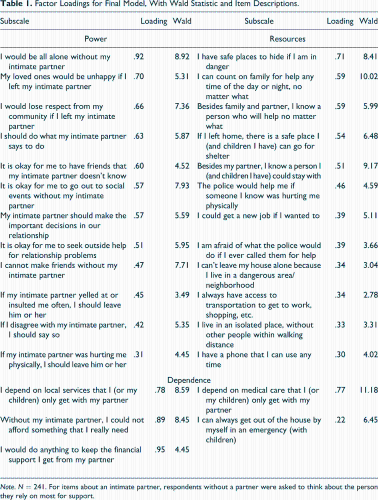
Item content analysis of the strongest factors resulted in labeling three factors: power, dependence, and resources. Twenty-nine items were retained in the three factors (see Table 1 for item descriptions). We defined the power factor as respondents’ assessment of their ability and freedom to change their situation given their community, cultural, and social context. Most of the power items originated in the social and cultural/beliefs domains. Example items include: “I would lose respect from my community if I left my intimate partner” and “I would be isolated without my intimate partner.” We defined dependence as the degree to which respondents assessed that they would not have needed resources without their existing relationship with a partner or primary source of support. The majority of the dependence items originated in the financial and institutional domains. Examples include: “Without my intimate partner, I could not afford something that I really need” and “I depend on medical care that I (or my children) only get with my intimate partner.” Finally, we defined the resources factor as a respondent’s appraisal of their access to instrumental resources via external systems. The resources items originated in the social, physical, and institutional domains. Examples include: “If I left home, there is a safe place I (and any children I have) can go for shelter” and “I have or could easily get a new job to support myself (and any children I have).”
Factor Loadings for Final Model, With Wald Statistic and Item Descriptions.
Note. N = 241. For items about an intimate partner, respondents without a partner were asked to think about the person they rely on most for support.
Confirmatory Factor Analysis (CFA)
We conducted a CFA on the reduced item pool using LISREL 8.80, which supported the three-factor model. Table 2 shows results for an initial model (Model A) with error covariance among only the latent factors. Model A global fit was poor, with a 2.15 (p = .00) χ2 degree of freedom ratio and fit indices from .81 to .84. The root mean square error of approximation (RMSEA) was over .05 (p = .00), indicating a significant departure from model fit. Model A resulted in 22 (5%) residuals over |3|, from −3.04 to 6.73. Modification indices recommended two paths (with decreases in χ2 of 8 and 9) and three error covariances—two with an estimated decrease in χ2 > 10.
Summary of Fit Indices From Confirmatory Factor Analysis.
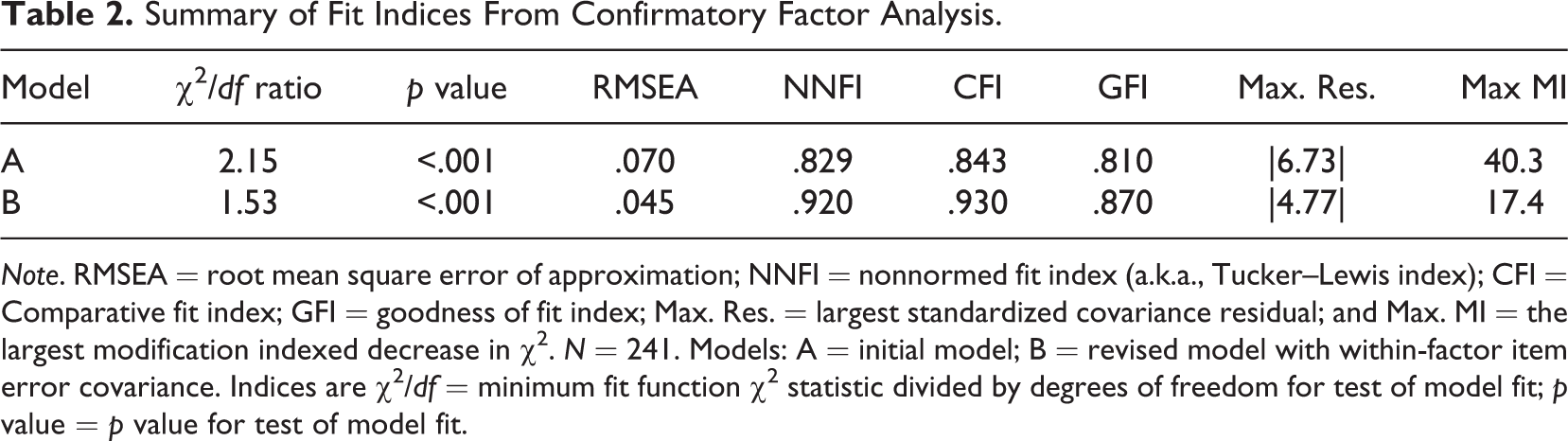
Note. RMSEA = root mean square error of approximation; NNFI = nonnormed fit index (a.k.a., Tucker–Lewis index); CFI = Comparative fit index; GFI = goodness of fit index; Max. Res. = largest standardized covariance residual; and Max. MI = the largest modification indexed decrease in χ2. N = 241. Models: A = initial model; B = revised model with within-factor item error covariance. Indices are χ2/df = minimum fit function χ2 statistic divided by degrees of freedom for test of model fit; p value = p value for test of model fit.
We respecified the model (Model B) to allow correlated error terms within latent factors if the estimated reduction in χ2 was 10 or greater and the correlation was theoretically supported. The global fit of the second model was good, with a χ2 degree of freedom ratio of 1.53 (p < .001), and fit indices from .87 to .93. The RMSEA was .45 (p = .84), indicating no significant departure from model fit. The second model had 14 (3%) residuals over |3|, from −3.44 to 4.77. Despite 8 items with factor loadings under .40, the Wald statistic supported that each item made a significant contribution to its latent factor at the α = .05 cutoff of 1.96 (Table 1).
Three-Factor Model Reliability
The final model had 29 items and improved reliability compared to the five-domain model. The three-factor model revealed items clustered as resource deprivation, dependence, and lack of power. The revised scale also offered a lower respondent burden. Reliabilities reported in Table 3 were at or near the .70 cutoff for exploratory research purposes advocated by Nunnally and Bernstein (1994). The power and resources subscale SEMs were below or near Springer et al.’s (2002) recommended limit of 5% of the scale score range. However, the dependence SEM (.47) was above the recommended limit, indicating a larger than desired spread in scores, which is likely due to including fewer items (5) compared to the other scales. A likely effect of the larger SEM is a decreased likelihood of significant findings in means-based analyses. The global scale reliability remained within acceptable ranges for research (α = .83; SEM = .22), indicating a strong global controllability measure. The subscales showed moderate intercorrelations of .58 to .70, which supports a three-factor structure.
Reliability and Intercorrelations for Three-Factor Model.
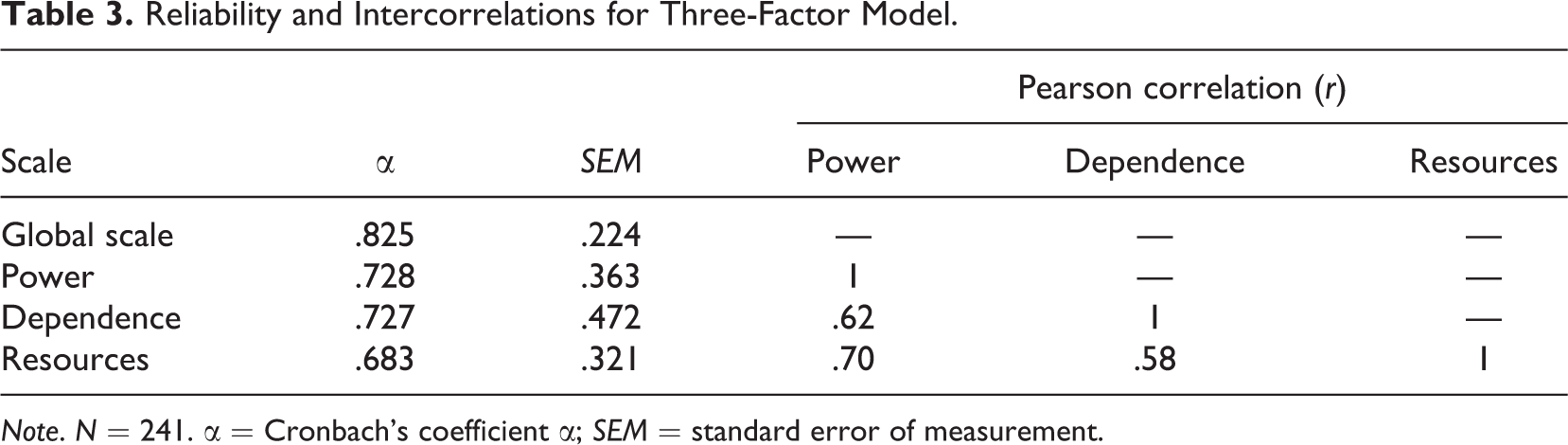
Note. N = 241. α = Cronbach’s coefficient α; SEM = standard error of measurement.
Convergent and discriminant validity hypotheses were tested to examine evidence of the construct validity of the final three-factor model. Hypotheses were limited, in part, because we did not anticipate the three-factor model and therefore did not include measures to validate those specific constructs. A one-way analysis of variance was performed across categories of each convergent and discriminant indicator with Bonferroni post hoc multiple comparisons. Participant race was the discriminant indicator for the global scale and three subscales, meaning that we hypothesized no significant relationships between race and controllability. Although IPV context studies have found associations between IPV and race and ethnicity (Black et al., 2011), one objective of this scale development was to identify controllability with less reliance on normative macro context indicators, which may be racially or ethnically biased. By relying on respondents’ assessment of their situation regarding power, dependence, and resources rather than on normative levels of these dimensions, we hoped this scale might overcome such limitations. The results support this goal; all multiple comparisons were nonsignificant for the global scale and subscales.
We examined convergent construct validity using the respondents’ self-assessment of whether they or another person had most of the control over their life. We expected that respondents with greater perceived control by others would also perceive a context that failed to support their power, dependence, and resources. This would be supported with significant Bonferroni post hoc tests. The Bonferroni post hoc multiple comparison for external control was significant at α = .05 for the global CIRS (M −.56; p < .001), power subscale (M = −.73; p < .01), and resources subscale (M = −.42; p < .001), but not the dependence subscale (M = −.51; p = .083). However, the financial independence contrasts for respondents who support themselves through employment, wealth, or loans versus those who rely on other people to support them, was a significant indicator of construct validity for the dependence subscale (M = −.65; p < .001). Thus, the dependence scale received mixed support for convergent construct validity.
Discussion
The CIRS and subscales make a meaningful contribution to IPV literature and literature on macro social work and empowerment. Scale scores reflect a respondent’s perceived context without being based on externally established cutoffs for resource adequacy, such as a predefined income level, or form of transportation access (e.g., Goodman et al., 2005). The broad applicability of the new subscales and their ability to assess perceived controllability in a variety of contexts are vital to research investigating how varied contexts influence diverse victims or potential victims.
Based on the good model fit and moderate correlations among factors, there is initial support for a three-factor structure. The global scale and resources and power subscales correlated with the concept of someone else’s control over the respondent’s life, which provides evidence of concept validity. The dependence subscale did not correlate with control but did with financial independence. Overall, discriminant validity with race was well supported. The lack of association between dependence and control was an unexpected finding of this study. Future work may address potential problems in the methods chosen to explore validity. Measures of social and financial resources, interpersonal dependence, and power and authority should be considered for use in construct validity. In addition, 58% of our sample contained people who identified themselves as having complete control over their lives.
Having established viability of controllability constructs here, future studies with greater proportions of people in intimate relationships and experiencing partner control are needed to improve understanding of the psychometric properties and validate use in clinical IPV contexts. Future studies should confirm the factor structure. Because we conducted a CFA following the EFA on the same sample, there may have been a bias toward confirmation of the final three-factor solution. In our case, the CFA produced no modification indices suggesting significant new paths from items to hypothesized constructs, thus proving useful in clarifying the factor structure and whether weak loadings obtained in the EFA needed to be reconsidered.
As controllability is a new construct, conceptual clarity is an important achievement of scale validation. During scale development, items were grouped by substantive domains with support in the literature. The domains (e.g., social and financial) reflect areas of life that contribute to controllability, whereas the latent factors indicate three dimensions of controllability by which perpetrators might obtain control over a partner. Thus, certain aspects of a person’s social, physical, financial, cultural, or institutional domains can increase dependence, reduce resources, or restrict power to make life decisions. Although we used EFA to discern factor structure, our conclusion that the three-factor structure was viable was based not only on improved reliability but ultimately on the conceptual significance of the three-factor model.
Based on the initial validation results of the three-factor model, the global controllability and subscales show promise for use in future research seeking to understand how victims perceive their macro contexts in relation to personal control, how perpetrators obtain control in intimate relationships, the relationship between varied contexts that support control and IPV, and research to identify which macro contexts can be changed to inhibit a perpetrator’s control over a partner. The psychometric properties of CIRS show promise for use in intervention research.
The full 29-item global CIRS had a reliability of .83, which exceeds the cutoff of .80 that Springer et al. (2002) consider an acceptable reliability for use with individuals. In addition, the SEM for the global scale was .22, which is considerably smaller than 5% of the response range and indicates that the reliability may be underestimated due to lack of variability within this sample on controllability (Springer, Abell, & Hudson, 2002). Although a majority of the sample was college students, the high proportion of respondents supporting themselves financially and the variety of ethnicities, relationship statuses, and living situations provide significant variation among key factors relating to controllability. Yet, a larger sample supporting multiple group analysis is necessary to determine whether the dimensionality will hold up across groups.
With further development, the CIRS has potential to enhance activities in varied practical settings toward reducing oppression. The CIRS has a low respondent burden due to its length and ease of use (Flesch-Kincaid grade, via Microsoft Word = 6.1). Domestic violence advocates or social workers could use the CIRS for direct practice and to inform existing advocacy efforts. Practitioners in office, shelter, or outreach settings could assess people who are thinking about a relationship, in one, or leaving one. The social worker or advocate could examine the subscales and items, using low scores as a lead in to conversations on client needs for resources, independence, or power. This could help to strategically focus efforts on community, system, and relationship-level supports for IPV survivors. Practitioners could also use the CIRS to identify possible macro contextual trends across several clients, and in turn address needed community policy or system change. For example, if several clients lack resources pertaining to social support or financial independence, then practitioners can use this information as an incentive to examine and potentially to inform existing community advocacy efforts designed to make community systems more responsive to client groups or that aim to increase specific community resources. By understanding what macro contexts are making clients more susceptible to control in intimate relationships, social workers and advocates can better tailor their advocacy agenda to empower clients where they need help the most.
These results contribute to IPV literature by exploring structure and properties of the first measure of multidimensional contextual factors that facilitate control in IPV. Control motivates many cases of IPV (Felson & Outlaw, 2007; Graham-Kevan & Archer, 2003) and the social environment facilitates control (Stark, 2007; Whitaker, 2014). We conceptualize control in IPV based on lack of autonomy in the relationship and social environment. This suggests including lack of autonomy and oppressions as foci of an analysis, in addition to concepts such as gender and patriarchy. The contextual factors examined in this study constitute forms of oppression that inhibit autonomy and facilitate control (Stark, 2007). This study thus presents a new way of measuring perceptions of multiple oppressions that influence IPV. Although the results are tentative, the scale shows promise as a tool for researchers and eventually practitioners by furthering discussion and evidence on how system and social contexts impact control in IPV.
Footnotes
Declaration of Conflicting Interests
The author(s) declared no potential conflicts of interest with respect to the research, authorship, and/or publication of this article.
Funding
The author(s) received no financial support for the research, authorship, and/or publication of this article.