




Abstract
Helping learners understand the intersectionality of gender, race, and class can be challenging. This study describes the use of the film The Help to stimulate discussion about racism and intersectionality. As evidenced by posttest survey data, the film enabled learners to identify the importance of gender, race/ethnicity, and social class. Qualitative analysis revealed that viewing The Help with a diverse audience can provide a forum to explore multiple concepts associated with intersectionality. This study shows that carefully selected films help remove some barriers to learning cultural competence by creating an environment in which individuals feel safe discussing personal biases.
In an increasingly multicultural world, it is essential that social workers and other helping professionals understand the influence that gender, race, age, ethnicity, religion, sexual orientation, and other cultural dynamics have on the development and effectiveness of helping relationships with clients, programs, and communities (Lee, 2008). Social work educators have achieved curriculum change through infusion of content on gender, race, class, and sexual orientation in learning processes and pedagogical perspectives (Lum, Zuniga, & Gutierrez, 2004). Enlightening students requires educators to understand the history of different racial and ethnic groups and the levels of power and privilege that exist in society. While educators recognize the value of using feature film clips and guided discussions as an instructional aide to illustrate key concepts (Parker, Frye, & Robinson, 2006), using a full-length feature film within the context of a community event and followed by a panel discussion has not been implemented as a widely practiced teaching strategy. This study describes the use of a carefully selected historic film and guided panel discussion to help learners to understand the intersectionality of gender, race, and class.
Challenges in Teaching Intersectionality
Social work education is designed to raise awareness of human behaviors that may be unintentional and based upon conscious or unconsciously held prejudices and biases. Course material on oppression, discrimination, and inequality can be difficult for students to read, hear, and/or watch, because it can provoke strong personal reactions. Exposure to such materials forces students to reexamine many of the values and beliefs they hold about themselves and those around them. Feminist educators can play a critical role in developing learning techniques to overcome this resistance and build cultural competence (Collins, 2000). The National Association of Social Workers (2001) defines cultural competence as the process by which individuals and systems preserve and protect the worth and dignity of individuals from all cultures (race, class, gender, religion, ethnicity, and sexual orientation). Teaching these concepts requires the educator to encourage intelligent and constructive dialogue about sensitive issues such as power and privilege in the context of oppression and discrimination (Lee, 2008; Lee, Blythe, Goforth, 2009; Lee, Brown, Bertera, 2010). The guiding principles of feminist social work education are to examine knowledge construction; validate and give a voice to the issues of race, class, and gender as marginalizing experiences; and address constructs of authority in order to build community and encourage leadership development, activism, and advocacy (Dore, 1994; Maher & Tetreault, 2001; Samuels & Ross-Sheriff, 2008). To this end, students should learn necessary practice behaviors to support social change that empower individuals through self-discovery, awareness, and action.
Another challenge is to help adult learners understand the complex concept of intersectionality. Defined as the interconnected relationship and impact of oppression based on an individual’s gender, race, and class, intersectionality informs both a person’s lived experiences and creates their worldview (Collins, 2000; Crenshaw, 1991). Risman (2004) offers that failure to address the complex and multiple facets of oppression is to presume that an individual’s culture is limited to one axis of their identity. Using African American women as a central frame of reference, black feminist theory argues that the intersectionality of gender, socioeconomic status, and race combine to form an oppressive force against all people (Collins, 2000; Johnson, 2009). Through analyzing the intersection of gender, socioeconomic status, and race in black women’s lives through the lens of their history and culture, it is possible to gain insight into the sociopolitical and cultural characteristics of this disenfranchised group. Although some discuss intersectionality as a theoretical perspective and indicate its teaching as a necessity for gaining cultural competence (Lum, 2007), there is limited literature addressing the application and evaluation of feminist intersectionality theory on the micro level of the practice environment (Samuels & Ross-Sheriff, 2008).
Finding ways to decrease or minimize resistance to diversity curriculum is one of the greatest challenges faced by educators (Parker et al., 2006). Films can complement texts, lectures, and discussions when teaching diversity concepts (Lim, Diamond, Chang, Primm, & Lu, 2008). Kolb’s learning style indicator identifies four primary modes of learning through experience, reflection, theory, and experimentation (Kolb & Kolb, 1999). Incorporating film into classroom exercises enables students to engage in each of these modes and provides a complete visual context for a specific situation (Parker et al., 2006).
Additionally, using vicarious responses to film as a learning tool lends itself to the learning expectations and needs of millennial generation students (McGlynn, 2005). Born between the years 1980 and 2000, millennial generation students tend to think of newer movies as more relevant to them and their world. Using recent popular films allows the instructor to engage students in a language that reflects their generational culture (McGlynn, 2005). Films enable emotional reactions to racism through the experiences of the characters, facilitating personal change via uncomfortable self-reflection (Lim et al., 2008). Films also allow individuals to experience emotions vicariously, thus enabling them to acknowledge and process the emotions in a less personally threatening context.
Wahab and Gibson (2007) offer that individuals have dual experiences and often internal conflict when in the midst of a vicarious experience. In a collaborative learning environment, not only does the individual experience their own response to a medium but also an empathetic response to their peer’s experiences. Hence, many social work educators can use such films for opening discussions about racism, classism, and sexism. This article describes an innovative approach to using film in diversity curriculum within the environment of a learning community.
The Exploring Diversity Film Festival (EDFF)
The EDFF was held at a university in a vibrant “new South” city that has recently been undergoing dramatic demographic changes. This southeastern urban area has experienced significant post–Civil War growth and consistent with the zeitgeist of the New South, uses reinvention and adaptation to meet the community needs of its diverse and rapidly changing population (Levine Museum of the New South, 2013). Nearly all (96%) of the county residents live in urban areas and the city is largely known as a banking town (U.S. Census Bureau, 2010). The university, as the only premier urban research institution in the region, is preparing to serve a diverse population of students and community members by engaging in efforts to increase inclusion of community members with diverse backgrounds. The Graduate Social Work Association collaborated with a faculty member to obtain two university-funded diversity grants to take on the challenging task of initiating dialogue on sensitive issues. Sponsored by the Department of Social Work, nonprofit community organizations, and the university Multicultural Resource Center, the EDFF was held on campus at the Student Union and was free and open to the public.
Humphreys (2011) offers that in order to develop the self-awareness, skills, and knowledge to develop cultural competence, it is necessary to provide individuals with a historic framework to begin to understand past and present forms of oppression. The rationale of selecting The Help (Columbus, Barnathan, & Taylor, 2011) is that this historic and popular film is an excellent medium to educate individuals about the intersectionality of race, gender, and class. Set in Jackson, Mississippi, in the early 1960s, The Help tells the story of Skeeter, a young, white, female journalist who returns to her systematically racist hometown to write for the local newspaper (Stockett, 2009). The newspaper assigns her to write a column on housecleaning, a topic deemed to be gender appropriate. Her limited knowledge of housecleaning, because she has never had to do much, leads her to solicit information from Aibeleen, an African American maid employed by her friend. As their relationship progresses and Skeeter observes the racist treatment of maids in Jackson, she decides to begin a writing project chronicling the true story of the lives of maids in Jackson, Mississippi. Skeeter enlists the assistance of Aibeleen and subsequently Minny, Aibeleen’s best friend, to help her with the project. Through the lens of two African American maids, the film depicts the interactions, celebrations, oppression, racism, marginalization, and discrimination experienced by women who were African American maids in the 1960s.
By showing courage in the face of hate and adversity, the women are empowered through the telling of their story and thus end up becoming the facilitators of incremental change in a previously adamantly racist town. Arguably, the fiction The Help, attends to black feminist theory, as it presents the lives of low socioeconomic status, oppressed black women within the context of their historical experience. Through observing the cumulative impact of the intersection of race, class, and gender, the viewer is able to gain insight into the marginalization that has shaped black culture in the United States. Furthermore, participants are also able to gain insight into the intersectionality of gender, race, and socioeconomic status of the white, upper-middle-class, female employers in the film and how their personal experiences with being white and female in the 1960s impacted how they interacted with each other and the African American women in the film.
Consistent with the guiding principles of feminist education (Dore, 1994; Ropers-Huilman, 2002; Weitz, 2010), the EDFF incorporated the feminist learning experiences of safety, validated peer exchange, opportunity for group problem solving, and choice in participation method. The study reported here explored whether the use of the featured film could help achieve cultural competency learning objectives. It was expected that by providing a framework within which participants could process sensitive issues that arose when viewing the films, individuals would experience a positive model for coping with diversity issues and enhance their ability to find value in differences.
Method
Target Audience and Research Procedures
The target audience for the film was general community members. Because of the university affiliation, the vast majority of EDFF participants were students, alumni, professionals, and their significant others. Entitled as “Who Is The Help Today?” flyers for the event were distributed to various list serves for social work, counseling, nursing, and educational professionals, as well as to current and former students. Additionally, event information was posted on online event calendars and forwarded to local field agencies and the congregational community.
A community panel followed the film and consisted of one middle-aged white man and two middle-aged African American women. The male was an upper-level administrator at one of the colleges within the university. The two African American women were employed by the university as housekeepers. The facilitator of the panel was a white, middle-aged woman. The facilitated discussions were intended to empowers participants to express their opinions in a safe environment of shared power (Shrewsbury, 1993) and candidly use each other’s statements and observations to identify potential solutions to the resistance of acceptance of diversity in today’s culture.
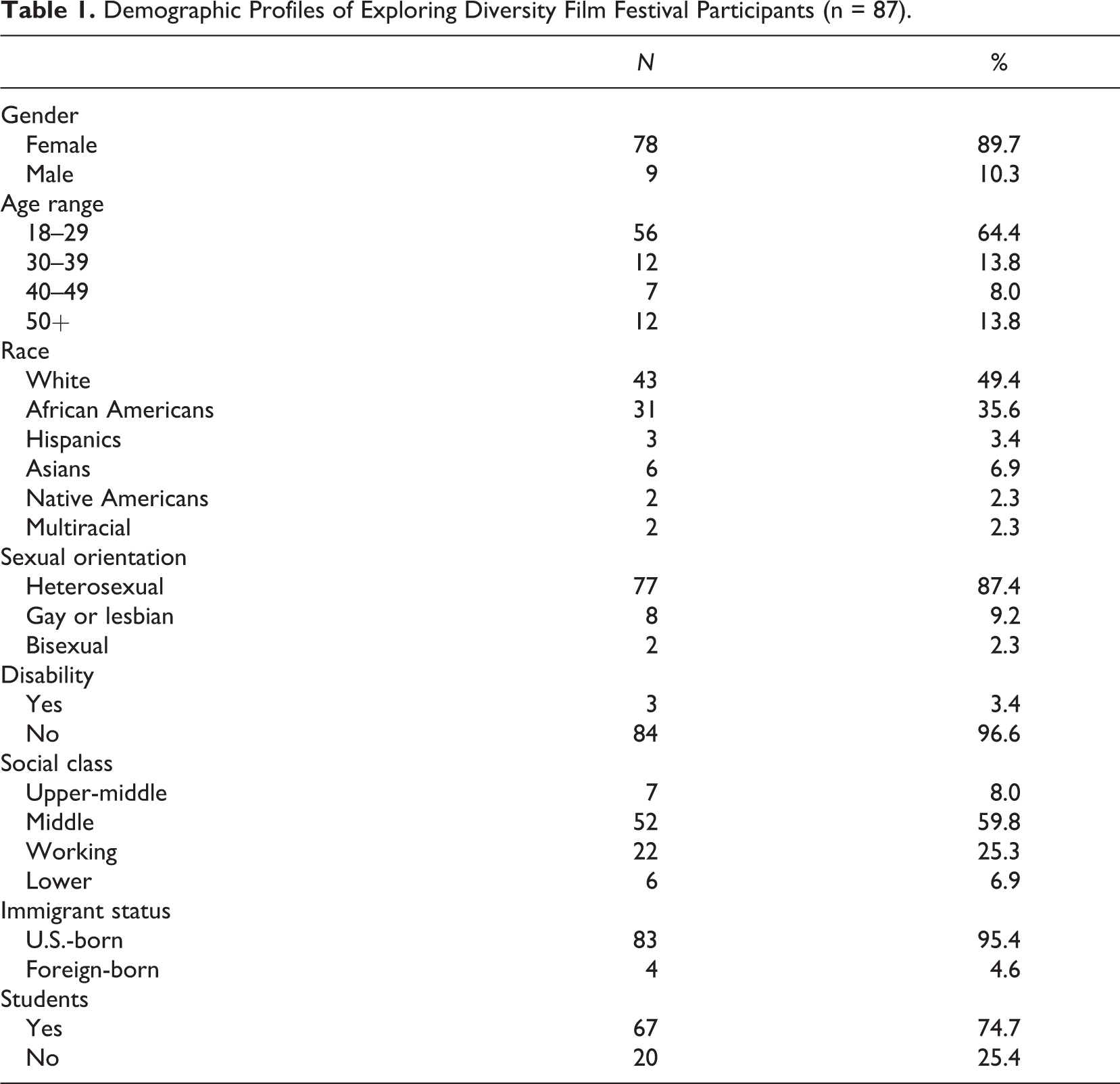
The university’s Human Subjects Review Committee approved the proposal for this study. All participants were asked to complete a brief opinion survey to provide their feedback on the film topic, discussion, and event execution. Before the event and survey administration, the general purpose of the study was explained. The audience was informed that participation was voluntary and their responses were confidential. One hundred eighty-eight people attended the event and 87 responded to the survey, indicating a 46.3% response rate (Table 1).
Demographic Profiles of Exploring Diversity Film Festival Participants (n = 87).
Measures
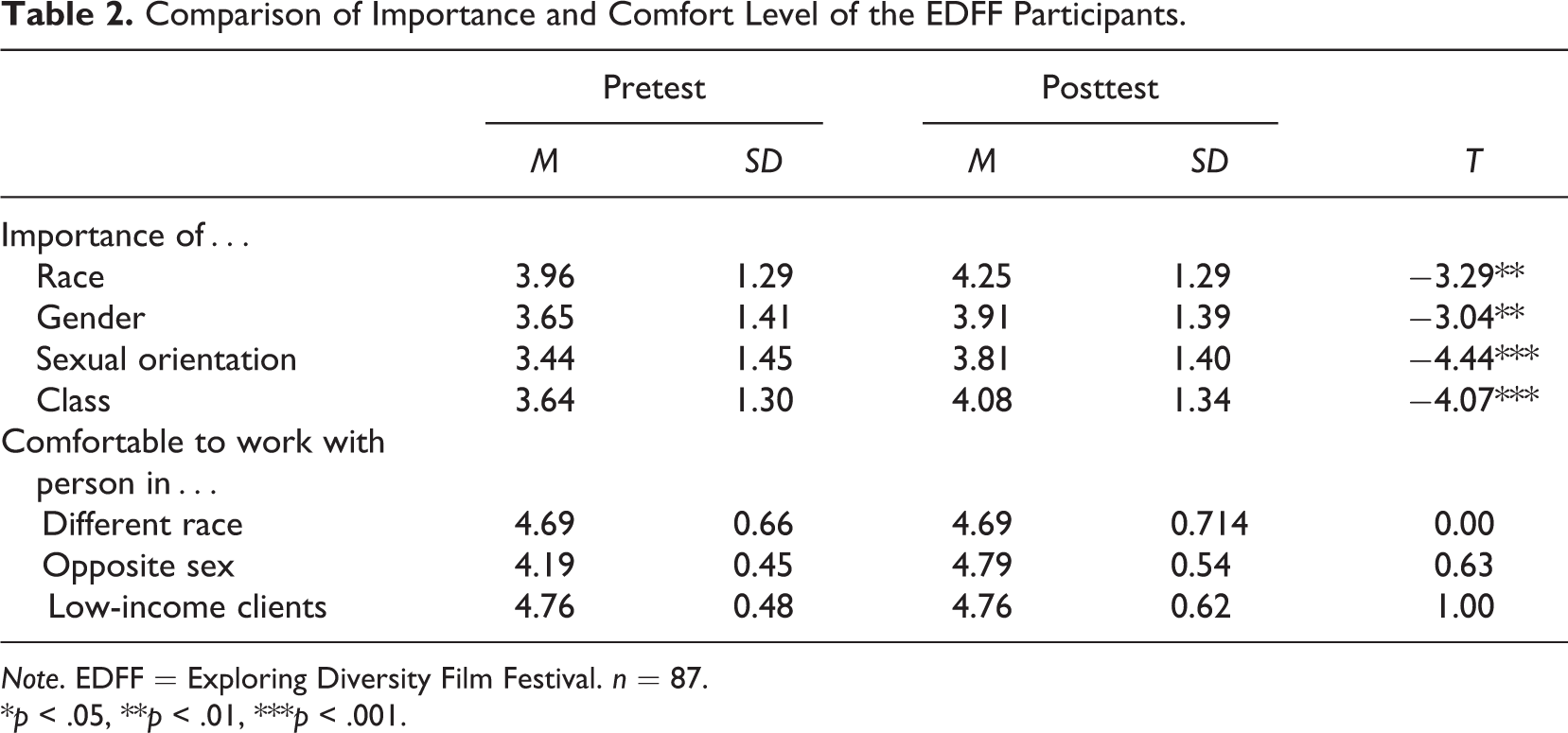
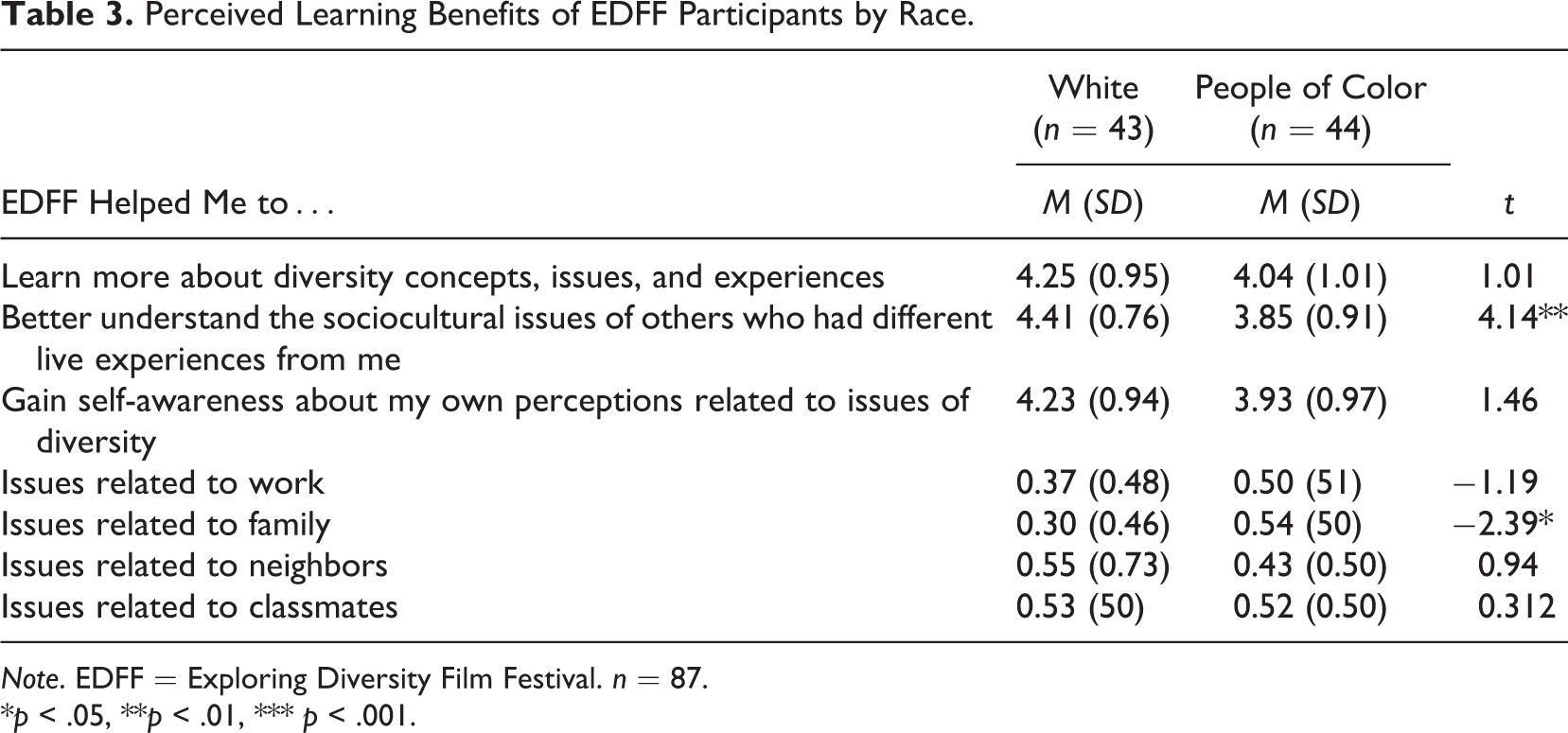
The survey instrument developed for the study was based on earlier work by the author (Lee et al., 2010). EDFF participants were asked to use a 5-item Likert-type scale to rate the importance of the diversity topics: race/ethnicity, gender, and social class. The pretest was administered prior to the showing of the feature film, and the posttest was administered at the close of the event. Likewise, EDFF respondents were asked to rate their comfort level in working with people from diverse backgrounds before and after the film (see Table 2). Four items assessed students’ perceptions and the learning benefits of using vicarious experiences as related to cultural competency. The survey instrument included questions to assess the impact of the film on dimensions of student relationships to evaluate whether viewing the film assisted in enhancing participants’ relationships with fellow students, family members, and neighbors (see Table 3). Brief demographic information was requested, including race, gender, age range, self-identification of social class.
Comparison of Importance and Comfort Level of the EDFF Participants.
Note. EDFF = Exploring Diversity Film Festival. n = 87.
*p < .05, **p < .01, ***p < .001.
Perceived Learning Benefits of EDFF Participants by Race.
Note. EDFF = Exploring Diversity Film Festival. n = 87.
*p < .05, **p < .01, *** p < .001.
A large poster of a leafless tree was posted on the wall at the event. Prior to the event’s beginning, participants were encouraged to create “leaves” to post on our “tree of thoughts.” The leaves consisted of any thoughts, words, or phrases that described individual participants’ ideas about diversity. The tree of thought was used as a visual tool to begin to get audience members thinking about what diversity meant prior to viewing the film. During the panel discussion, participants were encouraged to talk about their emotional reactions to the film, such as which person in the film they identified with. The discussion was then broadened and participants were asked if they had been in similar situations, such as not speaking out against racism and sexism, or had been victims of discrimination like the characters in the film. The panel discussion was videotaped and transcribed. The transcript and students’ post film reflections via an online discussion forum were used for qualitative analysis.
Data Analysis
Descriptive statistics were used to report sociodemographic profiles of the EDFF participants. Analyses of mean scores and paired t tests were conducted to note any statistically significant change after the film and panel discussion in participants’ views of the importance of diversity and their level of comfort in working with diverse populations (Table 2). Learning benefits perceived by white audience members and people of color were compared using an independent t test (Table 3).
To identify major themes, the authors analyzed the transcript of the community panel and student’s postings on an online discussion forum. In the process of interpreting and analyzing the qualitative data, the researchers incorporated open coding to examine the learning benefits reported by the general audience and social work students. While reading (and rereading) the text line by line, categories were generated through the “emic” process with which experiences can be understood and captured from the individual’s point of view (Denzin & Lincoln, 2005, p. 12). The interpretation was driven by what emerged from the data, guiding the description of how the concepts of diversity were understood by the EDFF participants.
Results
Demographic Profiles of EDFF Participants
The vast majority of the EDFF survey respondents were women (n = 78, 89.7%) in their 20s (n = 56, 64.4%). Almost half of the respondents were white (n = 43, 49.4%); 35.6% (n = 31) were African American. The remaining participants self-identified as Hispanic (3.4%), Asian (6.9%), Native American (2.3%), or multiracial (2.3%). The vast majority (n = 76, 87.4%) identified as heterosexual. The social class self-identified by the respondents was middle class (n = 52, 59.8%), working class (n = 22, 25.3%), lower class (n = 6, 9%), and upper-middle class (n = 7, 8%). Very few participants identified minority status in terms of disability or immigrant status: Three (3.4%) reported having disabilities and four (4.6%) were immigrants born outside the United States. The composition of 89 respondents included 67 (74.75%) college students and 20 (25.4%) community members (nonstudents). Twenty-six students (29.9%) were social work majors (24 bachelor of social work [BSWs] and 2 master of social work [MSWs]). Eleven (12.4%) social work practitioners also responded to the survey.
Pre- and Posttest Comparison
Table 2 shows the results of a paired t test, including mean scores and standard deviations. The EDFF helped the participants to see the importance of diversity in the major areas depicted in the film. As a result of the EDFF, participants were able to value the importance of gender (t = −3.04, p < .01), race/ethnicity (t = −3.29, p < .01), and social class (t = −4.07, p < .001). Viewing of one film, however, did not significantly change individual level of comfort in working with people of color, individuals of the opposite sex, or low-income persons.
Table 3 contains 8 items that measure learning benefits of the EDFF that may have helped the participants with learning cultural competence. When responses to these items were compared by race, whites in the audience scored significantly higher than people of color on 5 items, but 4 of the 5 items did not show statistically significant differences. Being white had a favorable impact on perceived learning about the views of others (t = 4.14, p < .01).
With regard to a question whether viewing the film assisted in enhancing participants relationships with family members, people of color perceived more learning benefits than whites (t = −2.39, p < .05).
Qualitative Analysis of the Community Panel
Qualitative data revealed that viewing The Help was an emotional experience for most participants. Panelists and EDFF participants expressed a range of emotions, including “anger,” “hurt,” “disgust,” “embarrassment,” “horror,” “heartbreak,” “sadness,” “disappointment,” “sympathy,” “empathy,” “appreciation,” “a sense of empowerment,” “guilt,” “gratitude,” and “thankfulness that things have changed.”
The Help facilitated discussions about racism, discrimination, power, and privilege, difficult topics that many people feel uncomfortable talking about, especially in a mixed racial group. Through viewing the film, participants were able to observe the historically overlooked and not so fictitious experiences, interactions, and behavior of African American maids and white employers during the 1960s.
There appeared to be three major themes among EDFF participants and on the panel. The first was minimizing the existence of racism in today’s society and noting tremendous change since the 60s. A young African American male in the audience stated that “I did go through it a little bit, but as far as the younger generation, I don’t think we have too many problems with racism.” Guided discussions revealed a disconnect between millennium era learners and the breadth and depth of racism and gender discrimination prior to the women’s and civil rights movements. For many adult learners in the audience, the first function of the film was to educate them on the types of experiences that individuals in subordinate groups had during this time period. A white male panelist offered a historical perspective: The feeling that I have about the movie is I am deeply embarrassed because that was, well…that actually really did reflect the attitudes and treatment of black people at that time from what I could see…The segregation was there in the movie theatre, in the buses, the cabs, restaurants. It was painfully accurate from my point of view.
Once participants developed an awareness of others’ experiences and their own privilege, they were able to reflect upon their own reactions and others’ responses to what the characters experience in the film.
The second theme was that racism had become a subtle foe working more insidiously on a systems level yet still serving as an oppressive force. Several participants offered that classism is the new racism and is commonly experienced by domestic workers and individuals working in the service industry. An African American female in the audience, whose grandmother, mother, and herself worked as housekeepers reflected: And I experienced some of the things that happened in the movie…. I cried from personal experience. I’ve been spit at. I’ve had a door slammed in my face. And it wasn’t like that every day but it’s something, when you think you forgot about it, and you see something like that, It all comes back…. You don’t see too many African American housekeepers now. You see predominantly Hispanic housekeepers now that work in public places like the hotels.
A third theme expressed by participants was that racism is “alive and well,” and a continual challenge for people of color. An African American male in the audience who chose to live abroad through his military career concurred that: So my sojourn, or my travels, outside the United States brought insight to me…. One way I can deconstruct color is to get back to my African roots and that way I can avoid this whole debilitating, oppressive concept of color…. by doing so I’m able to focus on the strengths of the kings and queens of my heritage who came across to this country on the middle passage. Who brought their strengths and their histories and culture with them. And so that’s what helps me to get through in the United States of America…. So I thrive by focusing on what little space I have in the context of racism; there is this little space where [his full name] can thrive.
Despite these differing emotions and views, participants noted that their attendance at the film event and participation in the panel served as a learning tool to raise awareness about the experiences of individuals who are different from themselves.
To educate about the lived experiences of African American female maids in the 1960s, the authors made a strategic decision to invite housekeeping staff currently employed by the university. However, unintentionally, a white, male administrator who had been a former boss of one of the women, accompanied the housekeepers on the panel. Once this differential in power dynamic was revealed, the authors began to question if the African American panelists were minimizing the racism they had experienced. One of the African American female panelists remarked, “Everybody says that [a southern state] is home of the KKK but in some instances I have been treated better by other races sometimes than my own.” The other African American panelist shared that her experience with integration was that “the other race welcomed us with open arms,” which was highly unlikely due to the extreme opposition to integration in the southern United States. These two African American female panelists minimized both the historic racism of their youth and the state of racism in America today.
Social Work Students’ Reflections
Among the BSW students who came to the event and took the course taught by the author, there were 24 online discussion posts written by students and 10 response postings in which students responded to each other via an online discussion forum. Through dialogue on the online forum, students began to educate each other about their own cultures and experiences with oppression. Some differences were observed between the online posts of white students and students of color.
Students of color shared their own personal experiences with racism. One African American male who dated a white young woman, described an interracial relationship in high school: Her parents were in disgust of me…every outward racial slur and degrading behavior I went through. The question that came to mind was why? Why did they hate me so much? Why did they disapprove of me?…. This was my first encounter with outward and blunt racism. It confused me more than it angered me. I could take someone hating me with proper reason but I couldn’t wrap my mind around someone hating me over something I had NO control over, the color of my skin.
White students reflected that classism has taken the place of racism and individuals today are discriminated against based on their socioeconomic status more than their race. Several white students indicated that this change might be due to the social unacceptability of being openly racist. One student wrote: “I think the days of overt racism are gone…. Today I believe racism comes with a smile and is more in the policies and procedures that work to keep a person from improving or having access to growth.” Another offered: “In today’s society [racism] has not changed, it just has a better cover up…many minorities are discriminated against more for their sexuality, religion, and class background…racism still exists and hides itself very well.”
Via online posting, several white students also offered more contemporary perspectives: “The help is any group being held down and seen as unimportant to others due to their lack of education, challenges in living, or lack of resources”; “The help is now more often a financial category, not a racial one.” One white male student commented: “The biggest problem we are going to face in the next 50 years is no longer race. It’s going to be among the poor and absolutely against the rich. That’s the diversity we are facing from here on out.”
Some students of color also commented that African Americans were no longer the target of racism positing that today’s racism is targeted at Hispanics and undocumented domestic workers. One student commented: “The help is the Hispanic population and is based on an economic standard of pay.” Another said, “Latinos are not accepted, do labor intensive work, and are paid less than minimum wage.” Finally, one student offered, “People look down on Hispanics, even if they are legal.” All of these comments indicate that the social work students viewed the current working conditions of Hispanic domestic workers as very similar to those experienced by the African American maids depicted in the film The Help. This facilitated the learning of cultural competence through peer learning and vicarious exchange.
Discussion
Recognizing that intersectionality is a prominent component of third-wave feminism (Collins, 2000; Crenshaw, 1991), this observational study demonstrated an innovative educational strategy to integrate intersectionality of gender, race, and class in contemporary social work practice and education (Coleman, 2009; Samuels & Ross-Sheriff, 2008). Vicarious experiences via a carefully selected feature film accompanied by feminist teaching strategies can create an environment where individuals feel more comfortable discussing diversity issues in a community format. The findings indicate that fictional stories can help individuals understand some of the stressors that members of nonmajority groups have to deal with daily, and it can also help adult learners understand the impact of racism, sexism, and classism. Consistent with the Littlefield and Robertson (2005), the authors attempted to adhere to a feminist pedagogical framework and create a “liberatory” learning environment, which was interactive and collaborative.
Since films can make a difficult topic safer by externalizing it, The Help viewed with a racially mixed audience provided a context within which multiple concepts, sensitive issues, and emotions regarding diversity could be explored and discussed (Lim et al., 2008). However, vicarious experiences alone cannot only result in a change in perspective. It can also reinforce assumptions and biases. Therefore, successful use of a film involves as much, if not more, preparation than a traditional lecture. Guided discussions of interactions and emotions experienced by film characters can lead to enlightened discussions about diversity and its effects on multiple systems (Parker et al., 2006).
Furthermore, the qualitative responses revealed that each individual participant’s own lived experience as a member of a particular race, gender, or socioeconomic class impacted the way they perceived the film character’s experiences and the current state of oppression in the United States. Consistent with black feminist theory, perception is largely shaped by the collective historic experience of an individual rather than being defined by one aspect of an individual’s cultural identity. Through the progression of the facilitated panel discussion, it became clear that the participants did not view the causes of oppression as mutually exclusive categories.
The findings of this study were intended to stimulate conversations at the community level and should be interpreted in light of its limitations. The opinion survey was administered at an educational event and was subject to social desirability bias. However, the use of triangulation of both survey and qualitative data provided unique perspectives. The historical reconstruction of race, gender, and social class brought by this popular film and community panel discussion created a useful distance for the participants to address the material. As revealed in qualitative data, this community event generated thought-provoking discussions about differences over time and the growing significance of “classism” as a form of oppression in postmodern society.
The composition and dynamic of the community panel was provocative. As described earlier, statements to minimize racism to a certain degree were made by both young adult participants and African American panelists. One of the most powerful moments during the panel discussion was when a white male panelist validated historic segregation and institutionalized racism. Given the authority associated with this administrator and his position in the university, it is possible that the two African American female panelists may have minimized oppression out of a desire to remain employed or be seen as amenable, in order to retain their jobs. This painted a telling picture about how the intersection of race, class, and gender in the two women’s lived experiences were shaping their interactions in this particular social situation. Nevertheless, these two female panelists were able to draw upon their past and current experiences to share a message of mutual respect and optimism, making a strong statement with regard to the women’s personal empowerment.
The evolution of The Help provided a teaching moment to reflect on the importance of allies. The stereotypical portrayal of African American maids and Skeeter Phelan as the community’s white savior can be particularly problematic and even offensive to African American communities. In spite of the many critiques about the novel and film, it is a coming-of-age story of a protofeminist young white woman who became a strong ally (Stockett, 2009). Empowerment efforts of this white woman to listen to, learn from, and publicize the struggle in the oppressed communities can be a good role model for some white learners who have been suffering with their own “white guilt,” associated with the actions of their race, ancestors, and coming from privileged backgrounds. In the learning of cultural competence and the process of becoming a white ally, it is not enough to merely acknowledge the previous mistreatment of another’s culture by one’s own. Particularly for social workers, in accordance with the profession’s Code of Ethics, it is also necessary to process the feelings invoked by these realizations, such as the feelings of guilt, and mitigate them by taking an active role to increase one’s own cultural competence by working toward social justice for vulnerable, marginalized, and oppressed populations (National Association of Social Workers, 2001).
As the title of the EDFF event indicated, the authors intended that participants would be able to rethink “who is the help today” and critically examine the status of domestic workers in contemporary America. As revealed in students’ comments about the today’s racism, which is targeted at Hispanics and undocumented domestic workers, this work of fiction has real-life parallels we have yet to confront in the 21st century. The working conditions of undocumented domestic workers have left them almost completely at the mercy of their employers, setting up the perfect conditions for abuse or neglect (Walter, Bourgois, Loinaz, & Schillinger, 2002). These conditions are not much different from how African American domestic workers were treated in the 1960s. The Help has provided a strategic opportunity to increase visibility for the challenges faced by present day domestic workers and created momentum for advocacy efforts for domestic workers rights in contemporary North America.
In conclusion, this community event on a university campus and sponsored by an internal university diversity grant provided opportunities for personal reflection, group discussion, and coordinated action for students, faculty, alumni, professionals, and community residents. Vicarious experiences via a carefully selected feature film and accompanied by feminist teaching strategies can create an environment where individuals feel more comfortable discussing diversity issues in a community format. Through guided discussion, adult learners are able to gain sensitivity and decrease bias based on an exchange of direct and vicarious responses with their classmates. More research is needed, both qualitatively and quantitatively to assess the effectiveness of the use of film and guided discussion to teach cultural competence and the complicated topic of intersectionality.
Footnotes
Acknowledgment
The authors would like to thank the UNC Charlotte Department of Social Work, the UNC Charlotte Multicultural Resource Center, and Crossroads Charlotte for sponsoring the Exploring Diversity Film Festival.
Declaration of Conflicting Interests
The author(s) declared no potential conflicts of interest with respect to the research, authorship, and/or publication of this article.
Funding
The author(s) disclosed receipt of the following financial support for the research, authorship, and/or publication of this article: This research is funded by Chancellor’s Diversity Challenge Fund and the Scholarship for Teaching and Learning at University of North Carolina at Charlotte.