




Abstract
In this article, I address the meaning of the blessing in the lives of Bedouin women in Israel as it is reflected in their life stories and discuss the significance attributed to “the blessing that has vanished.” The Bedouin sector in the State of Israel is undergoing radical changes in terms of types of residence, lifestyle, society, and culture, with far-reaching consequences for Bedouin society in general and for women in particular. In certain respects, Bedouin society is becoming more progressive and open, while in others it is becoming more closed and conservative. In young women, progress stimulates the desire for self-realization, the yearning to determine their own future and assume new roles, while conservatism places obstacles before them. A narrative study conducted among 30 Bedouin women from three generations aimed to examine how they experience the changes that occurred during three periods of settlement. It was found that for each generation these changes have a different meaning. Among the central themes that arose in the study were the home, the good wife, couple’s relationships, means of expression, and others. This article focuses on the theme of the blessing and its significance as it is expressed in the life stories of Bedouin women.
Blessing existed in our lives, brought prosperity, happiness, enjoyment, satisfaction, and protection. We used to walk alone, far from home…and we were not afraid. No one harmed us because there was a blessing…in everything, in the people, in nature, even the air we breathed was fresh and pure and not polluted like it is today, when there is no security, no trust, no happiness; the blessing has vanished…
Background
The Bedouins in Israel number approximately 160,000 and constitute 12% of the country’s Arab population and 18% of the non-Jewish population. In the Negev, an arid region in southern Israel that constitutes two thirds of the country’s land area, approximately 100,000 Bedouins live in 7 recognized towns and 28 unrecognized villages. Of these, approximately 50,000 reside in unrecognized villages (Levinson & Abu Saad, 2004). “Unrecognized village” is the term used to describe an Arab–Palestinian settlement in Israel whose existence is not recognized by the state on the grounds that it is located on state-owned land rather than private land owned by its inhabitants. These settlements have no local councils and are not included in the regional council. They have no jurisdictional boundaries and their residents are not entitled to the provision of services such as being connected to the water system, the electricity grid, or the telephone system. They are not included in the planning of health and education services or in the planning of the highway system and public transportation (Yiftachel, 2009).
In recent years, this society has undergone social and cultural processes that have significantly affected its social fabric, including women’s status and situation. Despite the many shared attributes of Bedouin society, it is also characterized by heterogeneous lifestyles and settlement styles and differences in social affiliations and status. The transformation process of Bedouin society may be divided into three periods according to settlement type: The nomadic period, the period of restriction, and the period of permanent settlement (Al-Atawna, 2002; Levinson & Abu Saad, 2004).
The Nomadic Period (In This Study I Refer to the Period From 1938 to 1950)
During this period, the Bedouins had a unique lifestyle and their social structure was based on a complex, heterogeneous, and hierarchical tribal division (Allassad Alhuzaeel, 2013). The sector was divided into several tribes, each consisting of a collection of subtribes under the leadership of one sheikh who functioned as a political, spiritual, and religious leader. Nomadic women enjoyed some autonomy, which was expressed in their authority to buy and sell within their living space (Tal, 1995). There was no strict separation between them and the men, and they had hidden influence on everything connected to the management of the nuclear family and even the extended family. One of their primary duties was finding spouses for their children (Peters, 1978) and upholding family honor by being responsible for raising young girls and for stringency regarding modest dress (Keddie, 2007). Women enjoyed great mobility in the open desert, where they moved in groups as part of the fulfillment of their role, which included bringing water for the tribe from distant wells (Allassad Alhuzaeel, 2009).
The Period of Restriction (the Sayag; 1949–1966)
The establishment of the state of Israel was an important turning point for the Bedouin, who subsequently became entangled in intensive processes that undermined their sociocultural stability (Meir & Ben David, 1996). In the early 1950s, the 11,000 Negev Bedouin were transferred to a restricted 1,500 km2 area in the northern Negev called the sayag. Uprooted from their lands and placed under military rule, they were forbidden in the early years of the regime to look for means of sustenance outside this area, although it was insufficient for traditional grazing or dry land farming (Meir & Ben David, 1996).
The geographical changes and crowded conditions of this time forced Bedouin women to deal with a reality that was different, limiting, and which exposed her in many ways (Abu-Rabia-Queder, 2009). Guarding of women increased, since they were more exposed to other tribes within the sayag, and this situation restricted their mobility and reduced different functions of their roles. The men, not allowed to hunt, stayed at home more than they had in the past and assumed some of the women’s roles, such as making decisions about everyday life and supplying wood and water (Dinero, 1997).
Women manifestly went from being dominators to being dominated. Their status in the family was gradually lowered, and their function became limited to household maintenance. They lost their exclusive role in raising and educating children due to the intervention of fathers and the educational system, although they often set the daily agenda indirectly and behind the scenes (Abu-Rabia-Queder, 2009).
The Period of Permanent Settlement
The process of settling Bedouin society that began during the period of restriction gained momentum from the 1970s onward. Israel, like other countries in the Middle East, aimed to control the Bedouin by ending the nomadic process (Dinero, 1997). Nomadism was perceived as antimodern and contrary to the norms of the modern state. Other reasons for wanting to control the Bedouins included the desire to organize them, study them, and help them to adapt to the spirit of the modern state (Yiftachel, 2009).
The transition to permanent settlement decisively influenced Bedouin women, with different consequences for each generation. The women of the first generation, born into and used to a nomadic life, lost many of their traditional roles as modern appliances took over many of their old tasks or made them unnecessary. Their leisure and inactivity affected their degree of control over their families, their ability to instill traditional values, and their child raising (Al-Krenawi, 1996). Second-generation women who lived in both the period of restriction and the period of permanent settlement experienced fundamental geographical and social changes and had to develop unique tools for dealing with these. Some were satisfied to work behind the scenes, while others tried to take center stage; some took part in community enrichment programs, and others focused on their homes. The third generation, born and raised in permanent communities, is trying to integrate rapidly into the world outside the tribes. Each year the number of young women who graduate high school and receive college degrees increases, as does the number of women who work and help to support their families. With the advancement of this process, the traditional support network from which women once drew their power has become less extensive and influential than it was during the nomadic period (Abu-Asba, 2008).
Bedouin Women Making Change
The process of urbanization led to the creation of new opportunities for Bedouin women and gave them the power to challenge their patriarchal society. Despite being in transition from a traditional lifestyle to a modern one, Bedouin women still suffer from a double marginality; on one hand, they belong to Bedouin society, which is a minority in the Jewish society in Israel, while on the other, their own society excludes and marginalizes them as women. The processes of modernization and settlement have allowed Bedouin women to acquire education and slowly integrate into the labor market, opening up new opportunities and creating new roles for them. For example, taking children to medical treatment (formerly a male role) in the community and outside of it provides opportunities for women to meet one another.
Keddie (2007) claims that in order to bring about rapid change, the support of the masses and local political involvements are needed. Bedouin women are agents of social change carefully, slowly and at their own pace, at first in small circles at the family and then in the outside circles of the community and the society.
Women in the Arab world, unlike Western women, have not chosen a revolutionary path; they could not afford to be revolutionary due to a lack of education and employment resources. For example, Bedouin women choose to place their personal stories and distinctive voice at the center of the collective story.
In the last decade, a handful of Bedouin women have been active in the local, public, and international arenas. Among the most prominent of these women are Ferial Abu Nadi who presented a report on Negev Bedouin and the rights of indigenous peoples at the United Nations and Amal El-Sana who works at the local, national, and international levels to advance social justice and reduce gaps in Bedouin society. In the local arena, Bedouin women seek to convey a reassuring message, discussing general issues of Bedouin society without putting issues of femininity on the agenda. In the international sphere, on the other hand, they bring up issues that plague Bedouin women, such as polygamy, violence against women, unemployment, and poverty. Some of these issues are presented in academic publications that often address a limited audience outside the Bedouin sector (Abu-Rabia-Queder, 2008).
Recently, the woman-to-woman association has begun to address problems related to Bedouin woman in permanent settlements. This organization’s activities are ushering in a new era by promoting and establishing welfare associations run by Bedouin women, especially young women who have managed to acquire an education and a profession.
In the field of religion, Bedouin women’s voices are stronger. Religious leaders have emerged recently who deliver sermons on religion and the rights of women in religion. This is a new phenomenon in the Arab world in general. Women’s voices are being heard in the area of religion, advocating for women’s interests and rights (Alsbt, 2006; Graham-Brown, 2001).
The status of Bedouin women is affected by and is in some ways similar to the status of women in the Middle East in general. Keddie argues (2007) that few studies address the history of women in the Middle East and that the studies that do exist have been conducted by historians who relied on writings rather than questionnaires and observations. She also claims that the discourse on Muslim women is not free from ideology and politics. Thus, some writing about women stems from a desire to “correct” perceptions about Islam and seeks to demonstrate that Muslim women are more discriminated against than other women, due to the discriminating patriarchal worldview (and not the religion).
Social changes do not occur in a vacuum but rather against the background of existing beliefs, values, customs, and ways of life. Lila Abu-Lughod notes two ways in which indigenous societies have responded to modernization and Westernization in their lands: One was to attempt to establish distance between the local culture and the West and to talk about Islamic modernity, while the other was to allow for a mixture of local and western perceptions (Abu-Lughod, 1986). Among the Bedouins, change is taking place against the background of their being an indigenous people that is dependent upon state authorities and the market economy. This encounter with change has created new perceptions, not quite modern/Western, but also not entirely indigenous (Abu-Lughod, 1986; Tal, 1995). Changes in lifestyle that stem from settlement type are intertwined with changes in Bedouin women’s lives and status that have accompanied modernization. As agents of change, Bedouin women comprise a safe bridge between the generations from tradition to modernity and openness (Allassad Alhuzaeel, 2013).
Research Method
Thirty Bedouin women from three generations of 10 families participated in the study. In each family, I interviewed the grandmother, daughter, and granddaughter in order to examine the intergenerational transference of the family’s cultural heritage, a cornerstone of Bedouin culture. Participants were selected using the snowball method, with each woman referring me to another.
This study was conducted in the framework of the requirements for a PhD and approved by a university committee. The research was conducted in the qualitative paradigm and in accordance with the phenomenological tradition. In this study, I used the life story interview, an open tool that enables the researcher to obtain the richest narrative possible of the lives of interviewees (Gergen, 1992; McAdams, 1988). It is impossible to separate the narrator’s personal story from the social–historical context in which it is narrated. The life story mediates between society and the individual, the social–cultural meaning assigned to events and experiences and their personal meaning, and collective memory and personal memory. Data collection that uses life story interviews is an extremely efficient tool in a study that examines the meaning of social changes in the lives of Bedouin women.
The fact that I am a Bedouin woman who was born into the participants’ society and lives in it, and who experienced the changes together with them, made data collection and analysis easier. As a third-generation Bedouin woman, I had to keep a researcher’s log and document what I experienced during the study so that I could, on one hand, use the processes I underwent in order to understand the women’s documented stories, and on the other, distinguish between my experiences and interpretations and those of the interviewees. Indeed, while analyzing the findings, I often based my understanding of the lives of the women on my personal experiences.
My goal was to clarify the meaning the study participants assigned to their lives, experiences, and the personal and historical events they have directly or indirectly been part of. Since the research dealt with experience, content, and explanatory theory, I employed interpretive analysis by interpreting meaning units (Strauss & Corbin, 1990; Tutty, Rothery, & Grinnell, 1996). This analysis included four stages: reading the life stories as complete texts; sorting based on units of meaning; grouping these units into categories and themes; and combining these themes into one complete picture for each generation separately and for the intergenerational transitions. In the first stage, I read the interviews, attempting to locate the central elements reflected in their content and structure.
In the second stage, I sorted the material into units of meaning, utilizing the step-by-step structured analysis method of Tutty, Rothery, and Grinnell (1996): (1) distributing the material into units of meaning; (2) determining the properties of each unit. The phenomenological researcher refers to each unit of meaning as equal in value and develops a list of statements or meaning units that are not repetitive and do not overlap. At this point, I reduced the meaning units to those that met the research questions; (3) organizing units of meaning into categories and themes. Categories were initially formed into clusters that together produced a theme; (4) connecting the themes: I attempted to assemble a complete picture of the conceptualizations of the meanings that characterize the interviewees in general and in each generation separately.
The main ethical issue that preoccupied me was being a Bedouin woman whose life and experiences are similar to those of the woman in the study. My concern was that my personal opinions might make their way into the study, so I made sure to consult with my supervisor and colleagues. The agreement of the women to participate in the study was recorded at the beginning of each interview. I shared the findings with the women and asked for permission to publish them. I respected their wishes and did not publish findings that they asked me not to make public. In addition, I confirm that the study was conducted in accordance with the rules of professional ethics.
Findings
This article focuses on the theme of “blessing.” The theme of blessing is unique that is revealed in this study from the life stories of Bedouin women in three different settlement periods and in three generations. In Arabic and religious literature, the meaning of blessing is abundance, integrity, perfection, agreement, serenity, contentment, and relaxation. The power of the blessing, as it appears in the women’s narratives, reflects their belief in a spiritual force that reigns over their lives, blesses their work, and protects them from evil. First-generation women call this power a blessing. Among women of the second generation it is characterized as “religious belief,” while in the third generation it appears in the guise of traditional behavior that provides security and relative freedom. In all three generations, the blessing fulfills the function of providing existential security and protection against the powers that could endanger women.
The Blessing—the First Generation (the Grandmothers)
In the life stories of women of the first generation, the blessing is central and extremely significant. In the presence of the blessing, poverty is experienced as wealth, little is perceived as much, and lack is seen as abundance. The blessing expresses a worldview that holds that one should be content with what there is and can be found everywhere: in material resources, children, the community, agriculture, and even personal relationships. By maintaining modesty and simplicity, women allowed the blessing to be present in their lives. Many descriptions that indicate the relationship between women’s behavior and the blessing are found in women’s descriptions of birth, for example. The following is a description by Um Faiz: I went with my daughter Mariam to gather wood for cooking…I began to feel strong contractions. I said, “God save me,” and with all my strength picked up the pile of wood and loaded the donkey, I said to Mariam, “Just hold my donkey.” She asked: “Mother, what happened to you?” I said, “Just hold it.” I held on to the donkey’s neck and dragged myself home. I went in, heated water—they say that bathing in hot water eases the delivery. Believe me…we lived under the blessing and God helped us and so I bathed and put on my dress and the baby came out. I was alone. There is a blessing in life and it protects us.
As these words imply, women’s modest behavior, even during labor, is directly related to the blessing, which is reflected in a modest delivery at home, in not exposing one’s labor pains to the husband, and in producing a healthy child. This narrative illustrates how first-generation women relive the details of their past and glorify them in comparison to the lives of women today. In the grandmothers’ generation, women did not involve their husbands in female affairs. Significantly, although the first-generation women’s stories may sound exaggerated, this exaggeration reflects their longing for that period. What is most noticeable about their stories is the belief in the presence of a spiritual power that protects the women, a force that helped women of their generation adapt to and cope with dangers, poverty, and lack of resources.
In the following quotation, Um Diav describes the contribution of the blessing to protecting food: Before the rain, we would store the wheat, digging a hole in the ground, placing straw at the bottom and heaping the flour over it, covering it with straw and over that earth. Food can keep like this up to…four years, preserved by the…blessing. Today there is no blessing; we store food in bags and…mice eat it, we store it in tin barrels and…moths gnaw at it.
Here Um Diav describes how, through very simple means, food can be preserved for years. More advanced, modern storage methods that use sealed containers cannot withstand the ravages of pests in this way. What is important here is not how sophisticated the preservation method is but rather belief in the blessing. I worked all day, ate little, but there was a blessing in food, a feeling of satiety, a feeling that the food was tasty and nutritious. I nursed all of my children, I did not give them [cow’s] milk, as women do today. Now we eat a lot, there is a variety of food, but we cannot breastfeed the children. There is no blessing.
Here Um Faiz recalls the abundance that existed alongside the blessing.
In summary, according to the life stories of first-generation Bedouin women, it is possible to understand that the blessing is related to the land, soil, and open space and that as this space is reduced, the blessing gradually disappears. A simple life, while difficult, contributes to the presence of the blessing. The blessing functions like a broad umbrella that protects the women in all realms of their lives.
The Blessing—the Second Generation (the Mothers)
The women of this generation compare themselves to their mothers on one hand, and to their daughters on the other. They describe their lives as focused on their homes and themselves. They bridge between the generations in the home and feel that everything depends on them. At the same time, they are not appreciated by those around them, so they turn to religion and feel that their blessing is fueled by religious belief. From their life stories, we can learn about the blessing in their lives, through negation. That is, they describe the blessing that first-generation women saw in their lives and its disappearance from their own lives and those of their daughters. Naama expresses this situation as follows: Life then was hard and cruel, but we were all in it together, blessed. When someone died, everyone was by his side, helping and supporting them. There was collaboration, a connection, no personal motivations or concerns, and everyone placed the concerns of others above their own. We all protected each other’s honor. A few years from now, people won’t speak with their own brothers.
According to Um Haled: Then, there was a blessing that made people closer to one another, a connection. People treated each other well, complemented one another—if someone lacked flour he took from his neighbor…. Today there is no blessing, connections between people are weak, people don’t depend on each other—if you need something you go to the store and buy it, you do not need a neighbor. People have drifted away from each other, God help us.
Interestingly, the women quoted here interpret the blessing of the first generation as the sense of mutual aid, togetherness, and appreciation of food. Their mothers’ community life was perceived as based on mutual dependence and interest-free support, while, today there is growing alienation; people no longer depend on one another and there is no mutual respect, nor is there respect for products that may be scarce. In the absence of all of these, there is no blessing, only the request that “God help us.” Because only God can help, the blessing is connected in the minds of the second-generation women to the fulfillment of religious obligations. It is between the woman and God. The blessing is gone, but God is here, God is a great help to us if we ask, if we pray, if we admit our mistakes. God help us, we are weak, we need your help. (Um Haled)
While in the first generation the key word was blessing, in the second generation the key words are “God” and “prayer.” Belief in God takes over the role of the blessing in providing strength and protection from danger. According to the words of second-generation women, women must pray to God, fast, and ask forgiveness for their actions, so that He will “rescue” them and postpone the “judgment.” The basic assumptions of these approaches are different from one another. In the first generation, the basic assumption was that women usually behaved well and the blessing was present in their lives until they sinned, while the assumption in the second generation is that women and their daughters usually do not behave properly, so they must ask forgiveness in order to be worthy of the blessing. The third assumption is connected to the many changes in women’s lifestyle during the period of the sayag. These changes altered women’s approach to their lives, as evidenced in their life stories, which focus on the return to religion, materialism and free time, polygamy, and the many demands of their children.
The Blessing—the Third Generation
The word blessing is absent from the stories of third-generation women, although they are also in need of blessing and protection. An analysis of third-generation women’s life stories indicates that the woman herself carries out the function of protection by achieving a fine balance between personal fulfillment and independence on one hand and the preservation of cultural traditions on the other. Women who preserve traditions can fulfill themselves with confidence, while those who rebel endanger themselves. This phenomenon is apparent in the description of Hanin, who chooses to emphasize her unequivocal choice of a Bedouin identity, which requires very clear rules of behavior: I am a Bedouin woman, which means I have certain principles. A girl won’t dance in front of strangers…It is unacceptable to remove one’s headscarf; we are not peasants. I think before every action I take. I remember that I am a Bedouin woman, and Bedouin women are shy. I have never thought to behave differently.
Hanin, an educated 30-year-old woman, who titled her life story “The Wisdom of the Present,” describes very clearly how before doing anything, she must consider whether as a Bedouin woman she can behave as she wants to. The trick is to know to choose the appropriate behavior, since if she does so, she will not be open to criticism and sanctions. In the quotation above, we can see that Hanin begins with the first person “I” and then switches to the third person: “we are not peasants,” indicating that part of her calculated behavior consists of looking at herself (I) against the background of the collective (we). This wisdom is so ingrained in her that she notes that she has never thought to act otherwise.
The congruence of personal and collective identity helps women to think reasonably, consider their every move, and plan ahead, in contrast to women for whom no such congruence exists, who exhibit considerable confusion, as we can observe, for example, in Lola’s life story, which begins with an “I” that is different from “them,” which makes it difficult for her to pave her own way and find the wisdom to protect herself: I want to talk about our family structure. It is known that the family is not open regarding issues such as marriage, supposedly upholding tradition, but modern…A person must adapt to his or her situation. Granted, you have to maintain the tradition and norms, but not everything. For example, the institution of marriage: which is better, for women to remain rotten without marriage or to marry outside the tribe? It’s better for them to marry out.
As we can see, Lola considers herself a Bedouin woman who observes tradition but not the whole tradition. She claims it is impossible to be traditional and modern at the same time. Unlike Hanin, she does not distinguish between an “I” and a “we,” but between an “I” and a “them.” Her use of these pronouns indicates that she is distanced from the collective regarding marriage. This critical position, which places her against the collective rather than within it, could be dangerous for her.
Conclusion
The blessing is the internal worldview of Bedouin women that dictates the way they behave and their sense of security. In each generation, it assumes a different character affected by the changes occurring in Bedouin society in terms of type of settlement and increasing exposure to the modern, western world. In the first generation, the worldview is associated with wide open spaces and the land and exists in any act women perform as long as their behavior is modest and frugal. For this generation, the spiritual is more important than the material. The blessing protects them and gives purpose to their lives.
For second-generation women, the material dominates the spiritual. They experience stress as a result of the pursuit of property, excess free time, and endless demands from their children, over whose upbringing they long ago lost control. The inner blessing has disappeared and they are searching for an external blessing to save them from these pressures. These women believe that those who fulfill God’s commandments will be saved.
The third generation of women relies only on themselves. Their blessing is the wisdom and patience to follow traditional Bedouin values in order to fulfill their own personal ambitions. In a sense, there is a circular process in which the women in the first and third generation believe in themselves, while those in the middle generation turn to religion as an external form of rescue.
Discussion
The world is undergoing many rapid technological, economic, cultural, social, and demographic transformations. Bedouin society in Israel is an integral part of this world, of a rapidly changing country, and also of the Arab world, which is changing and becoming more open even as it adheres to tradition and religion.
Bedouin women are also experiencing these changes, some of which are to their benefit. Unlike their mothers, they manage to obtain education, become integrated into the labor market, and participate in providing for their families (Abu-Rabia-Queder, 2009; Allassad Alhuzail, 2013). Modern conveniences make their daily lives easier, and abundant health and educational services assist them. However, this is not the whole picture. The process of change is complex and complicates Bedouin women’s lives, requiring them to develop effective coping and adjustment strategies (Allassad Alhuzail, 2009). A kind of societal wall is disintegrating, revealing a complex, unclear, and threatening world different from the world of the past, when this “wall” protected them from exposure and the challenges women faced were reasonable and consistent with their lifestyles (Abu-Rabia-Queder, 2009; Cwikel & Segal-Engelchin, 2005).
Al-Atawna (2002), in his study of Bedouin women, found that the better-educated they are, the greater their psychological well-being, but violence toward them increases. Bedouin society’s cultural norms prohibit public discussion of private issues, so women tend to repress their feelings. Moreover, the conflict between traditional norms and personal needs contributes to women’s stress (Cwikel & Segel-Engelchin, 2005). Bedouin women are highly aware of their situation and of the options available to them. They have chosen a nonrevolutionary path and preserved many aspects of their tradition as a means of coping with the challenges that lay before them, which include the opportunity to acquire education and an occupation, the crossing of tribal spaces, and the transition to modernization (Joseph & Slymovics, 2001). Another challenge, the increasingly powerful Islamic religion, the development of religious political movements, and worldwide exposure to Islam, has created a situation of return to religion as a refuge and a way of coping with what is, in the eyes of young women, a limiting and at times restraining tradition. In order to cope with the gap between the forces that promote the preservation of the collective and those that call for the development of the individual, young women must conceal their progressive aspirations by adopting traditional behaviors and accepting the traditional–religious authority of protection. Accordingly, many have recently adopted religious attire (gilbab), which is not a traditional Bedouin dress, in order to gain the trust of the collective so that they can pursue education (Keddie, 2007; Weiner-Levi, 2003).
Bedouin women also face the challenge of their spatial mobility having been reduced, creating permitted and forbidden spaces. Life in the permanent settlements is more crowded than tribal life, which provided a large permitted public space without threatening codes of modesty as permanent settlements do. Thus, the woman’s permitted space has been reduced to the limits of the neighborhood, and what extends beyond the boundaries of the neighborhood has become a forbidden space (Fenster, 2005).
The challenges described above and the disintegration of the wall create another reality in Bedouin women’s lives. Their coping depends on their wisdom, and in their wisdom they raise the need for protection, especially among younger women. This is an external form of protection that will provide them with the replacement of the wall that has disintegrated and the blessing that has disappeared (Allassad Alhuzail, 2013).
In the first generation, the existence of the blessing requires less external protection, according to the women’s feelings. In the second generation, undermining the sense of inner blessing leads to a search for external faith, such as religion. In the third generation, the disappearance of the blessing leads to a need for a high degree of external protection (religion, men, dress code, and so on.)
Congruence between the inner and outer worlds creates a safe, inclusive, and embracing atmosphere that offers a psychological space in which to develop personally and socially (Allassad Alhuzail, 2009, 2013). This congruence provides confidence and understanding, two elements that grant us control over our lives. Such congruence existed during the nomadic period, which was characterized by living according to the Bedouin tradition—a modest lifestyle that emphasized Bedouin values such as honoring guests, respecting human dignity, and helping others, a lifestyle that preserved the tribal form of communal life and living in tents constructed by the women. The external world and atmosphere correlated with women’s inner world, a world that was simple and modest world, wise and planned, that recognized traditional values and succeeded in maintaining them. This congruence between the two worlds created an equilibrium that satisfied women and allowed them to feel secure and not in need of the internal and external protection and supervision of their tribes.
The cornerstones of the character of Bedouin women of the first generation were stable. Indeed, these cornerstones guided and supported them in their adjustment to a changing reality. In contrast, young Bedouin women live in two different social contexts and are forced to adjust to both while maintaining tradition and integrating into the process of modernization (Al-Atawna, 2002; Abu-Rabia-Queder, 2008). This adjustment demands of them a certain level of adaptation and flexibility. Bedouin women find themselves entrapped in a complex way. On one hand, Bedouin society offers them a frame of reference in which they enjoy security and self-esteem. On the other, going out into the modern world undermines this confidence and respect, and these young women are perceived as “girls” and as naked in the eyes of first-generation women, while the modern society into which they are integrating displays negative attitudes towards them (Abu-Asba, 2008; Allassad Alhuzail, 2009). Moreover, a Bedouin woman is not able to experience herself as a unique being because she is constantly aware of the way in which the dominant male culture defines her as a woman.
Despite the apparent openness and improved status of women in the third generation, there is still a gap between the concepts, values, and expectations that girls are taught at school and the reality in which they live (Weiner-Levi, 2003). The contradiction between these two worlds is great and ultimately traditional customs shape their destinies.
The processes of modernization and openness bring with them changes in women’s position and provide women with options for progress, but on the other hand, the circle of supervision and protection becomes more rigid and suffocating (Dinero, 1997; Tal, 1995). In Bedouin society, restrictions on dress and external appearance have recently been witnessed; religious dress has become a way of attaining freedom and trust on the part of the family. Strict compliance with rules of feminine virtue, such as wearing the veil or demonstrating sexual indifference, generates respect. Bedouin women are taking this position by choice and not due to coercion, choosing protection despite its limitations in order to achieve higher goals of liberty, freedom, progress, and change (Abu-Rabia-Queder, 2009; Allassad Alhuzail, 2013; Fenster, 2005).
Bedouin women situate themselves at the center of power in order to exert influence and make changes by passing women’s wisdom from one woman to another. They use their feminine wisdom to evaluate situations and determine where to locate themselves along three axes: the silenced female voice, on one hand and, on the other, a voice that is heard; preservation, on the one hand, and change on the other, and, last, blessing on the one hand and protection on the other (see Figure 1).
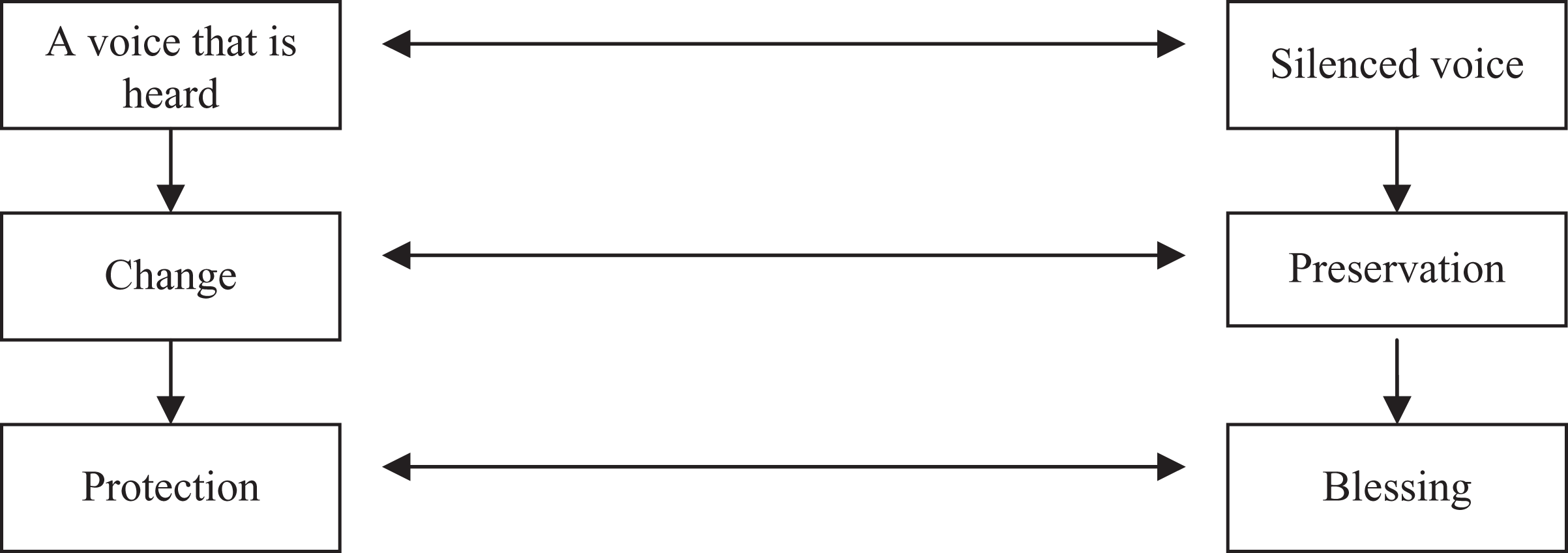
Coping axes of Bedouin women in transition.
Preservation and change, a silenced female voice and a female voice that is heard, and blessing and protection are the three horizontal axes along which Bedouin women cope with changes in Bedouin society, as Figure 1 shows. There are also two vertical axes that express strategic intergenerational differences: One that characterizes the women of the first generation who choose to silence the female voice, preserving cultural traditions and the blessing, while the other, preferred by women of the third generation, causes the female voice to be heard and favors change and protection (Allassad Alhuzail, 2009).
The obvious difference between the two is the degree of risk that women are willing to take upon themselves. While the first generation of women choose a strategy of influence “behind the scenes,” women of the third generation choose to stand out and are exposed to more dangers, but this situation also leads to a change in their status. Thus, a new, uniquely Bedouin form of feminism is born.
In conclusion, I view Bedouin women as belonging to a society distinct from others in southern Israel and in Israel in general. These women represent the demands of the society they live in, whose values they preserve. They are aware of these demands and adhere to them, thus acting as catalysts for social change, change that begins in the inner circles of Bedouin society and gradually reaches the external ones. Bedouin women are generating change in their own way and at their own pace. The younger generation is still in the midst of a process, a process that has led to the disappearance of the blessing and the need for protection. As social workers, we must understand the process that women are undergoing and be sensitive to how it influences them. Treatment interventions must be drawn from a thorough understanding of the significance of the loss of blessing in the lives of women and the discovery of healthy alternatives from within women’s personal cultural experience.
Footnotes
Declaration of Conflicting Interests
The author declared no potential conflicts of interest with respect to the research, authorship, and/or publication of this article.
Funding
The author received no financial support for the research, authorship, and/or publication of this article.