




Abstract
Although uncommitted sexual relationships have become increasingly accepted by adolescents, the contexts and socioemotional consequences of these relationships are unknown, particularly among Mexican American youths. Using focus group methodology, we explored the dating experiences of Mexican and European American male and female middle adolescents and found that “hookups” are a salient dating experience that generally occurs in the context of substance use and parties. Females, particularly Mexican American, were more likely to hold mismatched expectations of their desire for a hookup to transition into a more committed type of relationship. A feminist developmental lens is invoked in the discussion of the findings.
I hooked up with some guy last Friday … Is that a relationship?
(European American female student, 10th grade)
Scholars have noted that sexual intimacy in adolescence and emerging adulthood has undergone a shift away from traditional forms of dating and courtship toward the heightened acceptance and practice of sexual behavior in nonexclusive relationships (Paul, Wenzel, & Harvey, 2008). Evolving dating and sexual norms necessitate a change in how the intimate lives of youths are conceptualized, and in recent years, studies have begun to unravel the complex realities of the sexually intimate experiences of youths. Many questions remain unanswered, however, because multiple terms, such as hooking up and friends with benefits (Bay-Cheng, Robinson, & Zucker, 2009; Manning, Giordano, & Longmore, 2006) have been used to categorize the relationships of adolescents that eschew traditional labels. Moreover, most research has been conducted with primarily European American college-age samples (Paul et al., 2008), and it is unclear how uncommitted sexual relationships are related to the unique developmental considerations of adolescents across ethnically diverse samples (Impett, Schooler, & Tolman, 2006). Understanding how adolescents conceptualize their intimate relationships and the meaning they ascribe to them is necessary for the effective implementation of programs and policies.
The research reported here examined the meaning of hooking up relationships for adolescents within a specific developmental period (the 10th to 12th grades) and across gender and ethnicity (male and female adolescents and Mexican Americans and European Americans). A qualitative investigation was conducted from a phenomenological perspective to give the youths a voice to their lived experiences; this study design offered an empowering opportunity for Mexican American adolescents in particular to benefit from an open and safe space in which to discuss their experiences with their similarly aged peers in a casual group setting (Umaña-Taylor & Bámaca, 2004). Although the original aim of the focus group study was to gain a better understanding of adolescents’ “romantic” relationships, the term hooking up emerged naturally in adolescents’ dialogue and was hence further explored to determine how these relationships are defined, the contexts in which they occur, instigating or motivating factors to engage in these relationships, and their consequences for adolescents’ lives.
Feminist Developmental Framework
Given the gendered nature of hookup experiences that emerged from the adolescents’ dialogue, the findings are interpreted via a feminist developmental framework (see Impett et al., 2006). This perspective encapsulates a set of feminist theories that hold central the role of patriarchal contexts in shaping female adolescents’ sexual experiences. Feminist psychodynamic contributions to this framework further center relationship experiences as fundamentally integrated into females’ identity development during the adolescent years (Impett et al., 2006; Tolman, 2002). In seeking to understand female adolescents’ experiences with hooking up, we contextualize dating and sexual experiences as situated within societal messages that center primarily on male desire; while said of the United States (Tolman, 2002), this patriarchal context is perhaps even more pronounced in Mexican culture (Raffaelli & Ontai, 2001). It follows that female adolescents may seek to please a partner and in so doing abjure their own desires and feelings to behave in an inauthentic manner (e.g., yielding to unwanted sexual activity; Impett et al., 2006). We use this framework to interpret female adolescents’ experiences with hooking up relationships, acknowledging the pressure to behave in accordance with patriarchal gender norms that assign females increased status and femininity via sexual behavior defined by male desire (Impett et al., 2006; Tolman, 2002).
Review of the Literature
Adolescents’ Sexual Experiences
Although the sexual and socioemotional contexts of hooking up relationships among ethnically diverse youths are not yet fully understood, it is known that many adolescents are sexually experienced, and many engage in sexual activity outside the context of romance. Approximately 12% of seventh-grade adolescents reported having had sexual intercourse (Markham, Peskin, Addy, Baumler, & Tortolero, 2009), and by high school, this figure jumps to just under half of U.S. youths, with 14% of youths having engaged in coitus with four or more partners (Eaton et al., 2011). Latino youths reported slightly higher rates of sexual intercourse than did European American youths (49.1% vs. 42.0% in 2009; Eaton et al., 2011), reported higher rates of multiple partners (14.2% vs. 10.5% in 2009; Eaton et al., 2011), and were less likely to report using protection (Markham et al., 2009). Furthermore, in the past 20 years, there has been a small yet significant decline in the prevalence of sexual experience and multiple sex partners during adolescence for only non-Latino youths (Eaton et al., 2011).
The majority of adolescents’ first sexual experiences are with a committed partner; however, recent data from the National Survey of Family Growth indicate that one fourth of males and one fifth of females first experience coitus with an acquaintance or friend (Martinez, Copen, & Abma, 2011). Many otherwise participate in oral sex and view it as more socially acceptable and less emotionally consequential than vaginal intercourse (Halpern-Felsher, Cornell, Kropp, & Tschann, 2005). To administer effective sexual health programming, a better contextual understanding of these sexual encounters is needed, including the nature of hooking up relationships.
The Nature of Hookups
Stemming from research on college youths, hookups have been described as “short-lived and intense sexual exploration apart from emotional connection that rarely builds beyond one or two ‘steamy’ meetings” (Paul et al., 2008, p. 375). The typical hookup script requires no expectation of a future relationship, allows room for various sexual activities (not necessarily sexual intercourse), and characteristically takes place between acquaintances (Paul, 2006). By definition, this type of relationship differs from friends with benefits relationships (FWBRs) in that the latter emerges from cross-sex friendships and sexual activity is implemented more routinely (Hughes, Morrison, & Asada, 2005). Neither type of relationship assumes a commitment or romanticism—perhaps alluring characteristics during a time in which adolescents are developing their sexual identities (Tolman, 2002).
In addition to gaining an increased understanding of the type of sexual experimentation involved in hooking up relationships, it is imperative that a more in-depth understanding of their socioemotional contexts be obtained. For example, although the National Longitudinal Study of Adolescent Health referred to sexual behavior outside an exclusive relationship as “nonromantic” (see Manning, Giordano, & Longmore, 2005), data from another large sample of 7th, 9th, and 11th graders found that one third of youths hoped that a more committed relationship would emerge from a nondating sexual one (Manning et al., 2006). Despite socially constructed meanings surrounding “casual” sex, one third of the teenagers who had sex with nondating partners felt that sex had created increased intimacy between them. Uncommitted sexual encounters evidence potentially contrasting desires, intentions, and feelings of both partners. Incongruent expectations, in turn, often result in confusion, emotional pain, and disappointment (Paul et al., 2008).
The “Party” Context
Sexual relationships that lack commitment often go hand in hand with the use of alcohol as part of a “party” social scene (Davies & Windle, 2000; Fielder & Carey, 2010). The underage use of alcohol is extremely common in the United States: Three fourths of 12th graders have used alcohol on at least one occasion, and one fourth of 10th and 12th graders consumed at least five drinks in a row in the previous 2 weeks (Johnston, O’Malley, Bachman, & Schulenberg, 2006). Using propensity score matching, Acworth, de Roos, and Katayama (2012) found that adolescents who had used alcohol or marijuana in the previous 30 days were more likely to have had sexual intercourse, and sexual intercourse without protection, in the past year than those who did not. Although a casual sexual partnership may seem alluring, alcohol has played a large role in college students’ worst hookup experiences. Common emotions include regret, discomfort, confusion, and embarrassment (Paul et al., 2008). One reason for this severance between expectations and the actual emotional impact is that youths may hold ambivalent attitudes about whether or not they would like for sexual activity to occur. Adolescents who both desire and do not desire sexual activity to occur are more likely to engage in it while under the influence of alcohol, when their sense of self-control is unstable and context-driven (Suvivuo, Tossavainen, & Kontula, 2008). That is, alcohol creates an opportunity through which sexual advancement and negotiation are facilitated.
Gender Considerations
Females are subject to a societal double standard that pejoratively labels them for engaging in sexual behavior outside an exclusive relationship. In a study of Mexican American youths, for example, Flores, Eyre, and Millstein (1998) reported that male adolescents wanted females to be sexually attractive but not give the appearance that they fool around. In addition, Kreager and Staff (2009) found that a higher number of sexual partners were significantly and positively associated with popularity for male adolescents; the reverse was true for female adolescents. Accordingly, male adolescents identify more benefits associated with sexual intercourse, whereas female adolescents are more likely to associate sex with shame and guilt (Cuffee, Hallfors, & Waller, 2007). Patriarchal societal constructions of gender undoubtedly affect the sexual lives of youths; for example, young adults who enjoy reality dating programs are more likely to believe that the male sex drive is uncontrollable (Morgan & Zurbriggen, 2007). Societal constructions of gender intersect with cultural norms, however, and Mexican American teenagers have historically been understudied.
Ethnic Considerations
It may be that the meaning of hookup behavior for Mexican American adolescents is distinct from that of European American adolescents, especially given the literature pointing to different sexual experiences. Manning, Giordano, and Longmore (2005) reported that being a Latina adolescent was associated with increased odds of having casual sex; however, Flores et al. (1998) found that Mexican American female adolescents preferred to have sex when they were ready and had found the “right one” (p. 77). In addition, a focus group study with Latina adolescents exemplified the importance of having sex within a romantic context: an ideal that was admittedly renounced at times toward the aim of obtaining a boyfriend (O’Sullivan & Meyer-Bahlburg, 2003). In alignment with a feminist developmental standpoint, opposing behaviors and desires point to the central role of intimate relationships as situated within patriarchal contexts in the construction of adolescents’ developing sexualities.
Latino cultural values afford greater sexual virility to males (Raffaelli, 2005), whereas parents often expect females to remain virgins until marriage (O’Sullivan & Meyer-Bahlburg, 2003). Within this cultural script, the female role as mother and caretaker is revered (Organista, 2007). It follows that Latina female adolescents desire earlier transitions to marriage and child rearing than do female European Americans (East, 1998). Parents may restrict their daughters’ dating until a certain age (Raffaelli & Ontai, 2001), at which point, given the collectivist nature of Latino families (Organista, 2007), romantic partners may be integrated into the family system. Mexican American youths residing in border states may form a unique set of bicultural norms, given their close proximity to Mexico. For example, Matsunaga, Hecht, Elek, and Ndiaye (2010) found that bicultural Mexican-origin youths from a Southwest border state tended to explore only weakly their ethnic heritage yet strongly identified with it when both parents were born in the United States. To our knowledge, no research has examined and compared qualitative accounts of Mexican American and European American adolescents’ experiences specifically with hookup behavior.
Method
Sample
Seventy-five Mexican American (n = 41) and European American (n = 34) 10th- to 12th-grade adolescents (M = 16.04 years old, SD = .83, 53% females) from a large Southwestern border state were recruited to participate in focus groups. Potential participants were told that the purpose of the groups was to gain a better understanding of adolescents’ dating relationships. Saturation was met after 12 groups were conducted. The groups were divided by ethnicity and gender, which allowed for within- and between-group comparisons, and ranged from five to eight participants each (M = 5.86, SD = 1.55). The participants were recruited during the summer months via community summer programs (e.g., Boys and Girls Clubs; 54% of the sample), high schools (32%), and word of mouth (15%). Students came from 25 different high schools and were all transitioning into the 10th, 11th, and 12th grades (M = 11.09, SD = .76).
In line with a phenomenological study design that sought to capture the lived experiences of adolescents, the participants identified their own ethnicity as Mexican American or European American and were grouped as such, rather than, for example, by language preference or country of birth. High school youths were purposefully recruited in line with Padgett’s (2008) guidelines for researching “typical” samples. The participants came from diverse rural and urban geographic areas that varied by population density, languages spoken, and crime rates. Although 90% of the Mexican American participants were born in the United States, they were significantly less likely to come from homes that spoke only English, to have parents born in the United States, or to have parents with a post-high school education (see Table 1). At the time the data were collected in a self-report survey, 39% of the participants were dating someone; 41% of those relationships were not exclusive. Over half (54%) of the nonexclusive daters were females and 62% were Mexican American. Most of the youths (92.5%) preferred to date members of the other sex.
Demographic and Household Characteristics of the Focus Group Participants by Ethnicity.
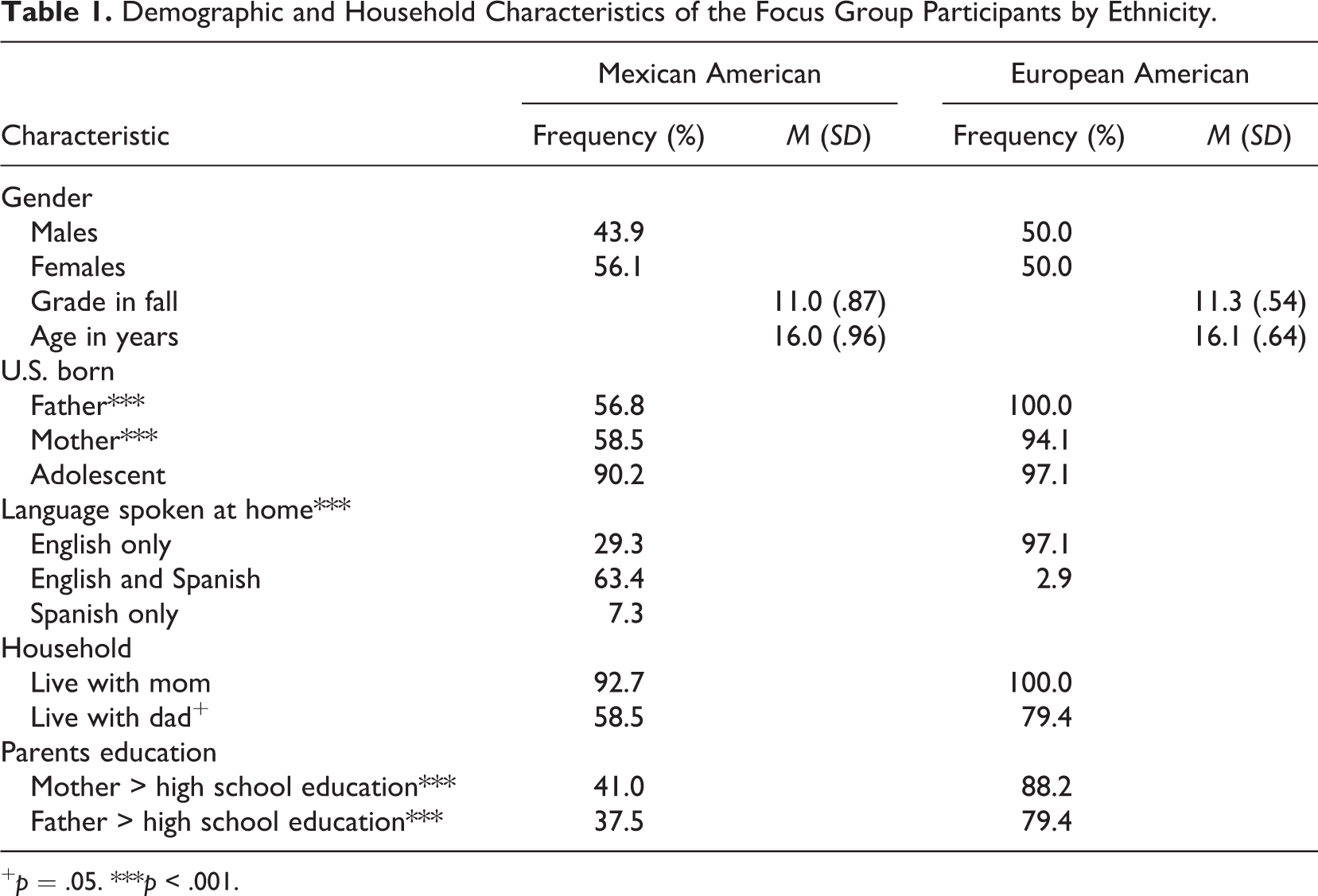
+ p = .05. ***p < .001.
Procedure
Following approval from the local institutional review board, 90 adolescents completed a brief telephone screening survey to determine whether they were eligible to participate in the study (i.e., ethnic self-identification and grade). All met the criteria for participation and were invited to participate. The first author then spoke to all the participants and their parents to obtain both their oral and written consent. Five youths were unable to be scheduled to participate, and another three did not show up and were unable to be rescheduled. Two focus group audio files were lost as a result of technical difficulties, but two additional groups were then scheduled. The resulting sample size was 75 youths. The groups were conducted either at a research lab (a converted apartment building) or at the youths’ recreational centers, and all the youths brought signed parental permission forms and assented to their own participation. Respect for all the participants’ viewpoints was emphasized, as was the confidentiality of other group members’ dialogues. Some participants knew one another prior to the group; regardless, all the participants created pseudo names to be used throughout the discussion. The focus groups were approximately 1.5 hr in duration, and the participants were given refreshments, food, and $10 incentives. The participants were also given an informational handout about healthy and unhealthy dating relationships, including referrals to local and online resources.
Questions for the focus groups were developed thoughtfully from a review of the current literature on adolescents’ dating and sexuality. The key questions were kept consistent to make comparisons across the groups. The focus groups allowed the participants to interact as they would in their day-to-day lives—to be influenced and to influence one another through dialogues concerning relationships. The first author moderated all the focus groups, with the help of an assistant moderator for each group (n = 3 assistant moderators). Either the assistant moderator or the moderator (or both) was matched in ethnicity and/or gender to the type of group. The assistant moderator took notes, while the first author kept conversations on track with minimal oral prompts (Krueger & Casey, 2000). The aim was to allow for a natural dialogue to emerge while making sure everyone had a chance to contribute. The participants generated in-depth descriptions of their understanding of relationships following a series of questions on the meaning of romantic relationships in their lives (e.g., “What does it mean to be in a romantic relationship?”). The moderator redirected any discussion regarding participation in specific forms of sexual activity to the participants’ social and emotional experiences from participating in various types of intimate relationships. Given that the youths did not use the phrase “romantic relationship” to describe their dating and sexual involvement, but naturally described hooking up relationships as experiences that were salient to them, the study focused exclusively on dialogues pertaining to this type of sexual relationship.
Plan of Analysis
The focus groups were digitally recorded, transcribed verbatim, and entered into a qualitative software program (QST NVivo; Gibbs, 2002). The transcriptions were analyzed via a form of inductive content analysis whereby themes were developed using the group, rather than the individual, as the unit of analysis. Frequency, emotional expressions, specificity, and extensiveness offered weight to the participants’ responses (Krueger & Casey, 2000). In line with a phenomenological study design, themes and subthemes emerged from the data rather than from preexisting theory (Padgett, 2008). Two coders analyzed the data (one moderator and one assistant moderator). The data were then coded by a third researcher to verify the reliability of the coding scheme. Phrases that were coded into the same theme were noted as agreements, and phrases that were missed or coded into discrepant themes were noted as disagreements. Reliability was determined as the number of agreements over the total number of coded responses (κ = .71). This conservative method of reliability assessment yielded a lower-bound reliability estimate. The results were then interpreted in terms of meaning for the participants within and across gender and race/ethnicity. Themes that emerged from the data are presented alongside supporting quotations from the adolescents when possible.
Results
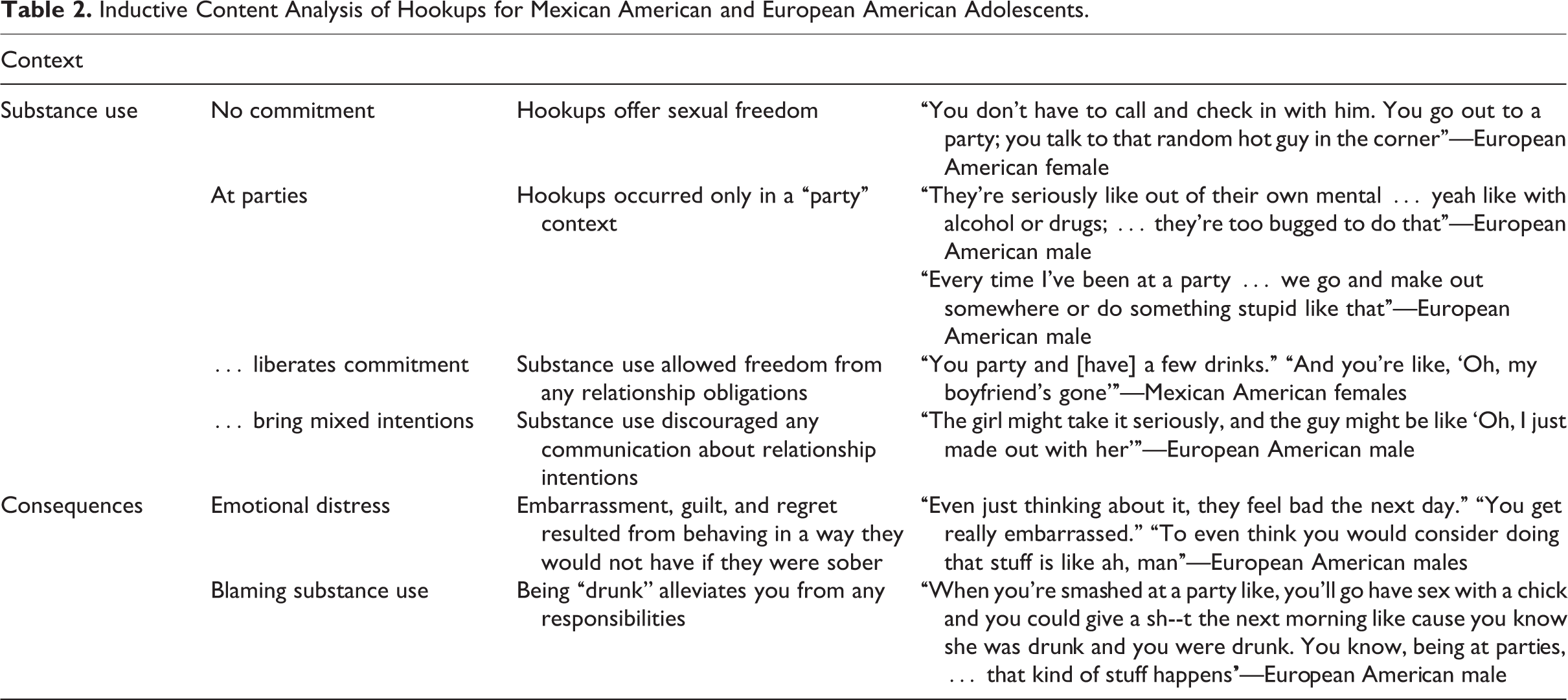
Four major adolescent-defined relational categories emerged from the focus group conversations: going out, dating, FWBRs, and hookups. These types of relationships varied by the level of emotional investment and commitment; going out relationships contained the highest level of emotional investment and commitment and hookups contained the least. The experience of moving from one relationship to another did not follow a linear or developmental progression. That is, some participants moved from one type of relationship to another (i.e., progressing or regressing in emotional investment and commitment), whereas others experienced only one type of relationship. Furthermore, the participants often experienced more than one type of relationship simultaneously (e.g., going out and hooking up). Hookups were described as much more salient and typical of the high school “dating scene.” For example, one group of European American male participants discussed: “just random hookups like….” “That happens so much more than people like—people getting in a long-lasting relationship.” In line with a phenomenological study design that gives weight to the experiences and concerns of the youths themselves, hookups were investigated further. The participants’ descriptions and experiences with hookups broadly fell into a discussion around the definitions, contexts, and consequences of hookups. Themes that emerged from these categories are discussed here (see Table 2). Each quotation represents a different speaker in the group.
Inductive Content Analysis of Hookups for Mexican American and European American Adolescents.
Definition
A “Relationship” Based on Sexual Behaviors
Hookups were discussed primarily by the European American participants and were viewed as brief, single-interaction sexual encounters. These physical relationships lacked an emotional or intimate connection and typically involved “making out” but also included sexual intercourse. The participants described sexual attraction as a strong component of hookups because of the physical nature of the relationships. Although they did not conceptualize hookups as “relationships,” they consistently discussed them in a relational or dating context (e.g., “I hooked up with some guy last Friday. [Laughter] Is that a relationship?” European American female). The physical nature of hooking up is illustrated in the following discussion by four female European Americans:
Some relationships can be so much more physical than others.
Yeah, especially if you are just with a different person all the time. [laughs]
But a lot of people do that.
A lot.
No Commitment
Compared to other types of relationships (e.g., going out, FWBRs), hookups were described as relationships that involved little obligation or exclusivity. A low level of commitment was generally attributed to the onetime interaction and because they may not have been friends or have known each other previously (e.g., “more like an acquaintance,” European American male). A group of European American males explained that the distinction between a FWBR and hookups was the frequency of occurrence and that for these adolescents, hooking up was more common:
There are not a lot of people who have like friends that they like repeatedly have benefits with … [laughs] You know what I’m saying.
I got you.
I got you.
Like they have benefits like one time, onetime friends with benefits.
Context
Substance Use at Parties
Hookups were highly contextualized; they occurred only in party settings (e.g., “random people hooking up,” “especially at a party,” European American males), in which substance use was involved (e.g., “hot drunken sex,” European American male). The adolescents desired sexual experiences, and hooking up when their inhibitions were lowered was one way in which they could achieve them. This point was further illustrated in this group of European American males, who stated that alcohol was a cause of their sexual arousal and set the stage for hookups to occur:
People are either drunk or stoned and [you] … get like naturally horny when you’re like screwed up.
When you’re under the influence, you don’t suppress your natural feelings, so they just like come out.
Yeah you’re just like “hey.”
So you make a stupid decision.
You have a mouth [refers to the participant not speaking] that’s how it was for you that one night.
Exactly it’s really true.
Substance Use Liberates Commitment
Substances also provided the adolescents with an excuse for not upholding any relationship obligations. In fact, those who were in committed partnerships also talked about participating in hookups within this context (e.g., “You party and [have] a few drinks.” “And you’re like, “Oh, my boyfriend’s gone,” Mexican American females). The participants discussed how preserving trust in a relationship was difficult when a partner attended a social gathering because of the shared expectation that flirting and sexual activity are often part of the “party” context. This view was exemplified by a Mexican American female imitating her boyfriend: “‘Oh, don’t worry, I am just going to a get-together with my friends. There will be no party.’ He hangs up the phone, ‘Hey girl, what’s your name?’ And then you go to that party and you see him all hugged up around the girls.’” A European American female described her heartbreak on finding out that her boyfriend had hooked up with someone after using substances: “My boyfriend [and I] were going to lose our virginities together. And then … he got drunk and high with some chick who he had never met, and he said he didn’t remember any of it. But he woke up the next morning in her bed with no clothes on, and they had had sex.”
Substance Use Brings Mixed Intentions
The participants noted the lack of communication with their partners prior to engaging in a hookup. Particularly given that one or both parties were likely to be under the influence of drugs or alcohol, it was unlikely that any discussion of the relational intentions was held. Although the participants understood that the relational obligations of a hookup were nonexistent, some would admit to engaging in one in the hopes that it would turn into a committed partnership, even if the chance was remote. This was particularly true for the female participants and was noted by both the male and female participants. For example, one European American female said: “Girls do it because they think … if they make out with this guy, then maybe he will want to date them.”
Consequences
Emotional Distress
Part of the allure of hookups was that there was no obligation to get to know a partner or to have to communicate with him or her again in the future. On the other hand, because of this foundation, the participants noted that they experienced significant embarrassment, guilt, and regret following a hookup. Emotional distress was highlighted when they felt that their behaviors differed from how they would have behaved if they were sober.
Blaming Substance Use
Other participants avoided embarrassment or other negative consequences (e.g., mitigating a breakup with their committed partner) using their inebriated state as an excuse for their behavior. In addition, there was no need to experience guilt or distress over a hookup partner’s feelings because the emotional connection to the partner was minimal.
Gender Considerations: Challenges for Females
Unlike FWBRs, hookups were often in the company of a large number of people and thus often resulted in significant consequences for females. More specifically, peers frequently exaggerated stories or created rumors that were likely to affect the females more negatively than the males. As one European American male put it: “Let’s say that a girl went to a party and made out with like one guy; then when you hear about it at school, it becomes so much worse, and then everyone’s just like ‘she’s the biggest slut ever,’ and it’s just [that she] made out with like one guy or something.”
The females were also more affected by false expectations than were the males. Although both the male and female participants engaged in hookups, the females were more likely to be described as hooking up in the hopes that it would turn into a going out or dating relationship (e.g., “Girls think about relationships differently than guys do,” European American female). The male participants similarly reported that females may misinterpret hooking up as the start of a more serious relationship. As one European American male said: “Well, you gotta be with them upfront cause; … if two people make out, the girl might take it seriously and the guy might be like ‘oh I just made out with her.’” The females explained their tendency to engage in sexual activity as a way of exerting power or control (e.g., “Well, sometimes a women’s body or sexuality can be the most empowering thing that [she] has,” European American female). It was understood, however, that hooking up rarely turned into anything more.
Ethnic Considerations: Mexican Americans’ Sexual Relationships
The European American youths used the term hookups and felt more positively toward uncommitted sexual activity than did the Mexican American youths. In the few instances in which the Mexican American participants discussed hooking up, the term itself was not used and the discussion of flirting or sexual behavior was framed as problematic and in the context of cheating on a more committed partner while at a party. The Mexican American participants discussed the types of relationships that were marked by higher levels of commitment and investment. A more serious relationship was seen as ideal when possible, although FWBRs were also common. As one Mexican American male said: “For me it was just dating, so it was just hugs and kisses, so it wasn’t really nothing romantic …. So it was just like a friend, that’s like with benefits I guess.” Just as the European American females often desired a more serious relationship to emerge from hooking up, the Mexican American (and European American) females were more likely to desire eventual commitment from a FWBRs partner (e.g., “Sometimes it sucks because like you already fell for that person but they didn’t for you,” Mexican American female). The Mexican American participants framed much of their dating discussions in the context of parental rule setting (e.g., avoiding dating or sneaking around) and family values around romantic relationships (e.g., integrating dating partners into their daily and family lives).
Discussion
The participants in the study (particularly the European American adolescents) clearly defined hookups within a shared set of meanings and expectations for behaviors. While usually referred to as “making out,” but inclusive of other sexual activity including intercourse, hooking up was limited to a single event in which there was no expectation of or allowance for commitment or exclusivity. It was not uncommon to have many hookup partners, each occurrence marked by physical attraction rather than companionship. Hookups were distinct from FWBRs in that they took place at large social gatherings, resulting in public exposure. The emphasis on the frequency of sexual occurrence, rather than on the nature of the friendship, blurs scholarly definitions of FWBRs and suggests that repeated hookups may be recoined as such (regardless of shared outside activities together). That is, a couple who met at a party may subsequently get together on their own, thus forming a quasi-friendship whose primary motivation is for nonpublic sexual enjoyment. Hookups were particularly problematic for the females’ reputations, given the double standard that applauds males for their virility and labels females as “sluts.” Moreover, unattainable desires concerning hookups plagued the female participants to a greater extent than the male participants; the participants thought that females were more desirous of a relationship following uncommitted sexual activity—something that the males warned other males to be “upfront” about with partners from the start.
Evoking a Feminist Developmental Lens
A feminist developmental framework suggests that the formation of relationships may be especially salient to adolescent females during a time of sexual identity development. Females negotiate their sexual selves in the context of patriarchal norms that favor male sexual exploration and female self-silencing (Impett et al., 2006). Females’ inability to engage sexually and in alignment with their desires (whether it is for a relationship or in uncommitted sexual contexts) may negatively affect their developing identities through perpetual self-denial. This inability not only carries negative psychological and emotional consequences (e.g., depression and reduced individual functioning; Harper & Welsh, 2007), but entails a risk to their sexual health (e.g., refusing unwanted intercourse and forgoing condoms; Impett et al., 2006).
The participants’ dialogues confirmed societal messages that favor males’ casual sexual behavior (Cuffee et al., 2007; Kreager & Staff, 2009). Although typically adhering to the females’ experiences, our findings suggest the relevance of a feminist developmental perspective to gain a better understanding of the males’ internalized gender role ideologies. Specifically, and contrary to others’ findings (Cuffee et al., 2007), the male participants displayed remorse for their hookup behavior (e.g., “Even just thinking about it, they feel bad the next day,” European American male). The male participants perceived females as more desirous of a relationship following hookups, which may have contributed to their negative feelings afterward. If they were also desirous of a relationship, as in Manning, Giordano, and Longmore’s (2006) study, the norms of masculinity dictated that they should not voice their vulnerable feelings (Chu, Porche, & Tolman, 2005). As expected from patriarchal societal contexts that discourage females from discussing their true feelings concerning their sexual and relationship desires (Impett et al., 2006; Tolman, 2002) and encourage males’ sexual appetites (Cuffee et al., 2007; Kreager & Staff, 2009), it is unlikely that either partner discussed the emotional pain resulting from hookups.
Hookups and Identity Formation
A feminist developmental framework emphasizes the crucial role of sexual agency in female adolescents’ healthy development of self. In contrast, Paul (2006) argued that emotional difficulty may result from hookups when the motivation behind them is to become a different kind of self—one who is attractive, sexual, popular, and not alone. Indeed, the findings of our study point to the importance of viewing hookups as part of a peer culture that promotes casual sex and alcohol or drug use within a party context in middle adolescence. Adolescents who are well liked (or are motivated to be) and are part of certain social circles may be more likely to engage in a cluster of such behaviors. Davies and Windle (2000) found that peer relationships suffered when teenagers were in exclusive relationships and were fostered when they were part of the “party” scene. Paul discussed how this desire for acceptance may be especially difficult to manage in the face of lived experiences that actually leave youths feeling unsure about themselves, lonely, and shameful. It may be that entering into a cycle of repeated hookups becomes a way to continue grasping for an illusory and unattainable desire (Paul, 2006), a phenomenon that exerts a particular risk for the healthy sexual development of female adolescents for whom sexual experiences are central to their identity development.
The Role of Alcohol
Female adolescents are taught to associate their worth with sexual prowess (Impett et al., 2006). Consequently, they may use hookups as a means by which to assert their social presence as an attractive and desirable individual, a “self” that may not accurately reflect how they feel about themselves; among college youths, Paul, Wenzel, and Harvey (2008) contended that this dissonance may facilitate the use of alcohol. Indeed, the participants in our study viewed the use of alcohol and drugs as a social lubricant that lowered their inhibitions and increased the likelihood of casual sexual encounters. This view resulted in mixed intentions and feelings. On one hand, the participants desired casual sexual encounters and used substances as a means of justification; on the other hand, they felt that such decisions were “stupid” afterward. The findings support narratives of female Finnish adolescents who held ambivalent attitudes about sexual intercourse in the context of alcohol use (Suvivuo et al., 2008). Specifically, the adolescents’ dialogues in our study (e.g., “You don’t suppress your natural feelings,” European American male) mirrored narratives of adolescents with a “shaky and situation dependent self-control” (Suvivuo et al., 2008, p. 156). Female adolescents in particular may be drawn to alcohol to exercise sexual agency and to excuse so-called deviant behavior (uncommitted sexual relationships).
Types of Relationships: The Role of Noncommitment and Ethnicity
Part of the regret of hooking up stemmed from emotional discomfort in future interactions with the sexual partner and/or guilt from cheating on a more exclusive dating partner. Mexican American females in particular noted that being cheated on is typical in dating relationships (Williams & Hickle, 2011), perhaps indicating that while they may choose to be in more committed types of relationships, such relationships may not actually contain a high degree of commitment.
Although they mentioned cheating on a partner at a party, the Mexican American participants were less likely than the European American participants to discuss hookup behavior and did not use the term itself. Hookups may be more salient for European American adolescents, in part because of parental messages to avoid boyfriends or girlfriends who distract them from academics and athletics. European American adolescents are more likely than Latino adolescents to pursue postsecondary educational goals (U.S. Bureau of the Census, 2011), in part because of several structural level factors in our society that limit these youths (e.g., educational exclusion, poverty, and institutional racism). College aspirations may be tied to a lessened desire to engage in a committed relationship while still in high school and a tendency to engage in a hookups culture instead; indeed, European American adolescents are more likely to frame relational dialogues in terms of futuristic ideals (Adams & Williams, 2011).
On the other hand, Latino adolescents, in line with traditional values emphasizing the importance of family life, are more apt both to desire and to pursue marriage and children at younger ages (East, 1998). The tendency for Mexican American adolescents in particular not to discuss hooking up relationships may, therefore, reflect a cultural strength that includes stronger socialization toward more serious romantic relationships and admonishes more casual hookup relationships, perhaps stemming from a traditional Catholic value system in tandem with greater parental monitoring (Raffaelli & Ontai, 2001). Furthermore, the Catholic Church has specific prohibitions against contraception (to prevent procreation) and abortion that may also influence the perceptions or acceptance of hookups among Mexican American adolescents. Correspondingly, the Mexican American adolescents in our study discussed their involvement in more committed types of relationships, although FWBRs were not uncommon (see Williams & Adams, 2013). They may have thought that an FWBR entailed a greater potential for a transition to a more serious type of relationship or could also have been easier to hide from their parents who restricted their dating relationships. For example, the Mexican American youths’ parents may have been more apt to accept a “friend” into the home while setting curfews that made partying less likely. Given that our sample of youths were from a Southwest border state, the Mexican American youths’ partial use of popularized U.S. dating labels align with their tendency to embrace a bicultural identity (Matsunaga, Hecht, Elek, and Ndiaye 2010). Continued research on the cultural underpinnings of uncommitted sexual relationships among diverse and acculturating adolescents is warranted.
Limitations of the Study
Our exploration of the definition and meaning of hookup experiences has revealed the unique and subjective perspectives of Mexican American and European American adolescents. Nonetheless, the findings are limited in their transferability because they represent a specific population of Mexican American and European American adolescents in the Southwest. Furthermore, triangulation of the data across multiple sources (e.g., survey data, observations, and personal interviews) would have helped to strengthen the reliability and validity of the findings (Golafshani, 2003). Also, soliciting more information on the use of drugs and alcohol, peer influences and the desire for acceptance, and belief systems as they pertain to family and educational goals would have aided the interpretation of the findings. It may be argued that adolescents in a focus group setting may not have been as likely to voice opinions or experiences that differed from those of their peers, particularly given that hooking up was described as taking place within a party scene, which is perhaps socially sanctioned and normative among popular youths. However, the focus groups offered the opportunity to gain a better understanding of how peers shape shared meaning and scripts for sexual behavior.
Conclusion
Qualitative inquiry is especially well suited for enriching an understanding of how middle adolescents themselves define and characterize their dating and sexual relationships, which then can be used to provide the more effective delivery of services to this population (Padgett, 2008). This initial exploration of Mexican American and European American youths’ experiences with hooking up relationships indicates that programs should contextualize curricula within a peer culture of hookups and partying for (at least certain) European American adolescents; Mexican American adolescents, on the other hand, may be better reached through messages that attend to more committed types of relationships or include less stigmatizing language (e.g., casual dating). Moreover, the findings suggests that adolescents may need assistance in processing emotional frustration, hurt, and embarrassment resulting from mismatched expectations and desires following hookup behavior. Within a society that silences the discussion of sexual intimacy (e.g., abstinence-only programming) and further disapproves of uncommitted sexual behavior for females in particular, adolescents may feel alone and unsupported in their sexual and emotional development. In contrast to a script that prescribes hookups as thrilling and provocative (Paul & Hayes, 2002), we found that female adolescents may be most susceptible to emotional pain, particularly when they use their sexual bodies in an attempt to negotiate more committed types of relationships. We found that interpretations of the female participants’ experiences were best understood within a feminist developmental framework. Continued scholarly work on how these emotions are processed, including how female adolescents may develop a resistance to patriarchal sexual messages, may help to ascertain how adolescents may be aided in their development of resilient and sexually healthy selves.
Footnotes
Declaration of Conflicting Interests
Funding sources collaborated with the first author in specifying the study design and data collection methods. The analyses and interpretation of data, writing of this manuscript, and decision to submit it for publication were not the funders, but rather, the authors of this study.
Funding
The Alltel Connect-Me-Grant and the Norton School Family and Consumer Sciences at the University of Arizona provided funding for this study.