




Abstract
The mixed-method study examined welfare-reliant, female heads of households and the multilayered and persistent barriers they face in their attempts to obtain employment to sustain their families. The 30 respondents, aged 25–34, were African Americans and Latinas receiving various forms of public assistance and were plagued by a host of serious problems. The African American respondents were native-born American citizens who spoke only English, and almost all the Latina respondents spoke only Spanish and were born in South or Central America, Cuba, or the West Indies. A higher level of interpersonal violence was reported among the African American cohort. There were other strong contrasts between the cohorts, including the mean number of children, educational level, work experience, and type of housing. The theoretical framework for the study was liberationist feminist social work practice. The results revealed an alarming array of simultaneously occurring “metastressors” that are complex, comprehensive, suffocating to many respondents, and more difficult to resolve over time. The study challenges the assumptions on which the Temporary Assistance for Need Families operates, including its political origins and its current regulations that mandate time limits on assistance in spite of persistent national economic problems. The issue of intersectionality is explored in relation to gender and racial oppression in the United States and in terms of promoting positive social change among oppressed groups.
More than 15 years ago, U.S. society began experiencing the most radical change in social policy since President Franklin Delano Roosevelt’s New Deal responded to the economic crisis of the early 1930s. The New Deal resulted in the creation of a minimum safety net for low-income and impoverished Americans. As part of the Social Security Act of 1935, the federal government created Aid to Dependent Children (which later became Aid to Families with Dependent Children, AFDC) that provided cash assistance to eligible poor families. The Personal Responsibility and Work Opportunity Reconciliation Act of 1996 (PRWORA) abolished AFDC and replaced it with Temporary Assistance for Needy Families (TANF), an income support program characterized by a work first philosophy and accompanied by lifetime limits, strict enforcement of welfare-to-work guidelines, penalties and financial sanctions for noncompliance with regulations, and more restrictive eligibility criteria. The most glaring change from AFDC to TANF was the 60-month lifetime maximum. Since states were given options on TANF time limits, several chose time limits of 4, 3, or even 2 years on eligibility for cash assistance. Guidelines were also stiffened in relation to immigrants’ eligibility for governmental assistance, child care, Medicaid, child support enforcement, food stamps, and Supplemental Security Income (Edin & Lein, 1997; Farrell, Rich, Turner, Seith, & Bloom, 2008; Weil & Finegold, 2002).
The study reported here focused on TANF-reliant African American and Latina female heads of households and the persistent barriers they face in their attempts to search for and secure decent jobs. African Americans and Latinos constitute 12.6% and 16.3% of the U.S. population, respectively (Humes, Jones, & Ramirez, 2011), but accounted for 35.5% and 27% of the 1.7 million TANF family cases in 2007 (U. S. Department of Health and Human Services, 2007). This population faces multiple life challenges and barriers to employment, including the lack of education and job skills, transportation constraints, the lack of suitable child care, legal issues, and discrimination in the labor market (Bloom, 2011; Bowie, Dutton-Stepick, & Stepick, 2001; Holzer & Stoll, 2001). The study was an in-depth examination of the myriad obstacles they face to employment, and the results provide perspectives on the problem through the eyes of the respondents. The findings also demonstrate the complexity of employment barriers for women of color, their magnitude, and the implications of their simultaneity. The empirical assessment and analysis of factual data will facilitate the design of evidence-based interventions to foster economic independence, self-actualization, and the ability to sustain their families’ well-being.
The research provides a multifaceted perspective on specific life stressors experienced by TANF-reliant African American and Latina women and how they contribute to negative employment search and/or career outcomes. Documented life stressors were used as a construct for assessing employment barriers. We posit that life stressors can be classified in the same vein as employment barriers for TANF-reliant female heads of households, since the actual stressors in many cases parallel or even represent the barriers themselves. Research has demonstrated that living with multiple stressors negatively affects an individual’s mental and physical health and makes an employment search even more challenging (Goodrum, 2005). On the basis of the empirical data, we developed a model in which life stressors can be classified in the same vein as employment barriers for TANF-reliant female heads of households, since the actual stressors in many cases parallel or even represent the barriers themselves. This model suggests that life stressors and employment barriers are not static, predictable, and formulaic situations, but dynamic, sometimes layered, and evolving scenarios that are unique to each individual head of household in the study. The term metastressor has been applied to the layered, evolving, and unresolved employment barriers that we discovered.
Theoretical Framework
Liberationist Feminist Social Work Practice
The overarching theoretical perspective for the study was what Baines (1997, p. 298) characterized as liberal, or “liberationist,” feminist social work practice, although secondary elements of feminist theory were also interwoven into the salient issues of the study. Related perspectives with explanatory and/or analytical value included empowerment (Hill Collins, 2000) and the significance of intersectionality among race, class, and gender (Crenshaw, 1991; Hooks, 1984). These multifaceted perspectives are succinctly critiqued in this article in relation to specific public policies, defined here as general courses of action, decisions, regulations, and laws that governmental or legislative entities decide on (Kilpatrick, n.d.). The specific public policies that we analyzed included the matrix of rules and regulations of which state TANF programs in the United States are comprised.
All the respondents were heads of households. The TANF program was a daily, integral, and regulatory aspect of virtually all their lives. As such, their reported experiences in the state welfare system help highlight and frame the theoretical foci and context of their ongoing efforts to find employment, particularly their own subjective assessments expressed during personal interviews. We posit that (1) the structure and regulations of the TANF program are specifically designed to control and oppress women, particularly those who are single, impoverished, and heads of households who have young children; (2) the public welfare system also (directly and indirectly) perpetuates poverty, second-class citizenship, and inequality in the United States and (by design) contributes to an infinite pool of low-wage labor to support American industry (Glenn, 2000); and (3) the state-defined measure of “success” (i.e., termination of families from TANF assistance) is inappropriate and inhumane and exacerbates family, community, and social problems in the United States.
Baines (1997) reported on feminist social work practices in an underfunded urban hospital in a poor, ethnically diverse community. Her research focus was a mental health unit within the hospital—along with its typical urban dynamics, including a constituency of impoverished patients who were on public assistance who used the emergency room as their only health care provider—and an overworked medical staff. Baines’s study provided a useful research framework for our study because (1) the community setting for her study was similar, in terms of class, race, and gender oppression issues; (2) her concerns regarding unrealistic and gender-biased standards for public intervention outcomes were also similar; and (3) her recognition that institutionalized policy practices can often contribute to the maintenance of inequality and marginalization parallels our concerns regarding the current TANF program.
In light of the foregoing information, the liberationist feminist framework was appropriate for our study. Feminism recognizes and critiques social relations that are built on male supremacy and/or male worldviews (e.g., state and congressional legislative bodies and stereotypical characterizations of welfare-reliant citizens as “takers”) and follows this critique with concrete efforts to change the status quo (including the current male-defined conceptual foundations of public assistance in the United States), thus empowering women (Hill Collins, 2000). Baines (1997) emphasized the transformative aspect of liberationist feminism in her declaration:
A liberation feminist practice must be established that incorporates the fact that most social work clients exist outside the middle class, White, male experience and require practitioners to acknowledge and use the privilege inherent in their racial class to intervene decisively and politically at all levels of social relations. (p. 298)
Intersectionality
The issue of intersectionality was also an integral theoretical perspective vis-à-vis our study. Originally promulgated by Crenshaw (1991), intersectionality theory critically analyzes the various “layers” of physical or otherwise categorized human demographic traits, such as gender, race, and class. All the different layers interplay on various levels and interlock (Hill Collins, 2000), thus creating a complex, mundane, multilevel oppressive reality that stultifies personal growth, efforts to achieve independence, and social equality. The nature of this interconnectedness is consistent with a key variable of our research, that is, metastressors—a simultaneously recurring and multilayered reality of daily issues, events, and crises that serve as complex barriers to employment and economic self-sufficiency.
Method
In light of these issues, the following were the research questions for the study:
What were the prevalent life stressors experienced by TANF-reliant African American and Latina heads of households during the study period? What prevalent themes emerged from the respondents’ comments on employment barriers?
Sampling Procedures
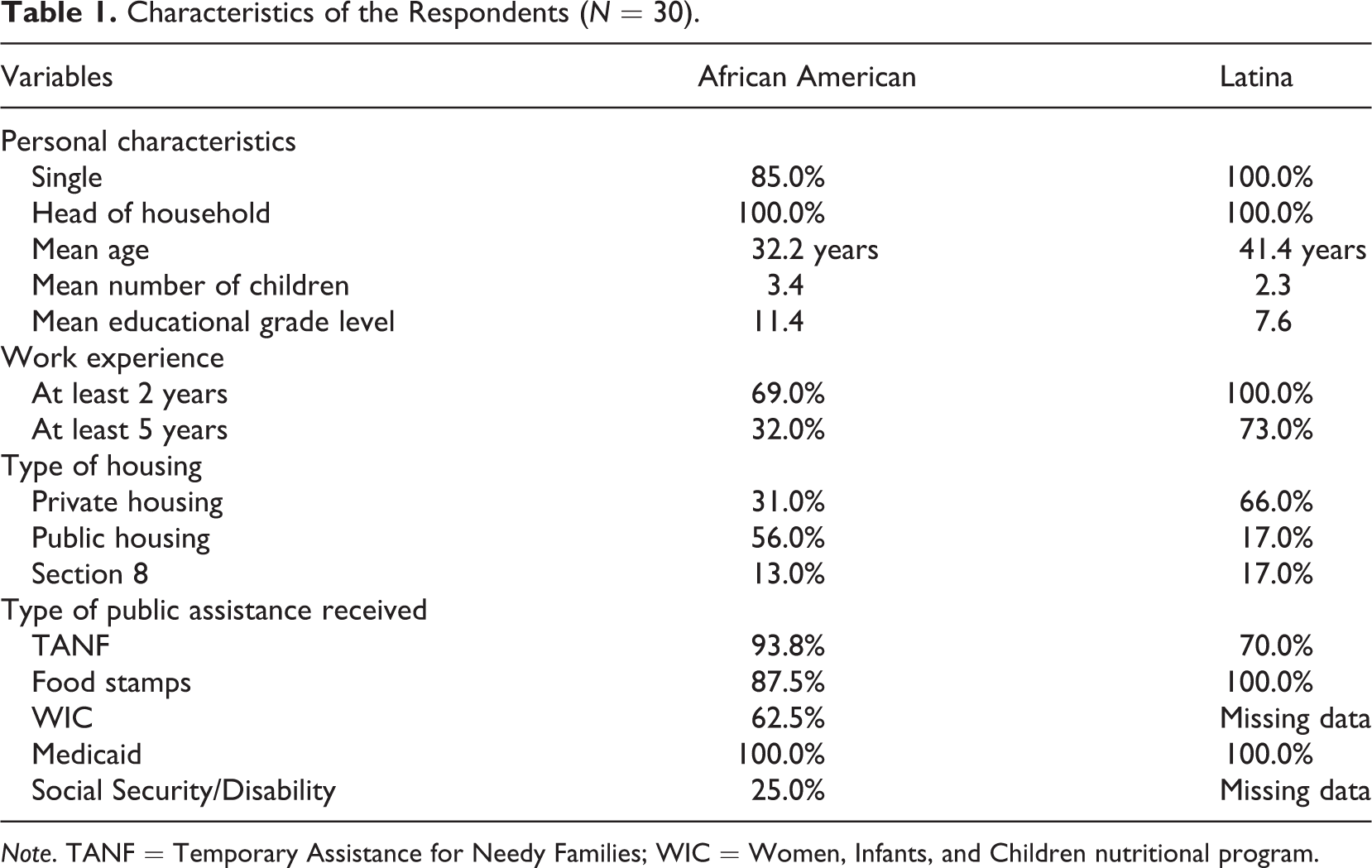
A purposive sampling method was used for the research. The 30 respondents (17 African American and 13 Latina women heads of their family households) were required to be aged 18 or older, and current or recent public assistance recipients (e.g., receiving TANF, food stamps, Medicaid, and the Women, Infants, and Children [WIC] nutritional program) during the previous 24 months. The specific types of public assistance received by the two cohorts are indicated in Table 1. The women were recruited and referred from community-based organizations, such as Head Start and other child care centers, Community Action Agencies, and food banks. As the participants were recruited, the snowball technique was also used to connect us with other prospective respondents who met the criteria for inclusion.
Characteristics of the Respondents (N = 30).
Note. TANF = Temporary Assistance for Needy Families; WIC = Women, Infants, and Children nutritional program.
The study was derived from a larger, longitudinal, multisite national study on welfare reform that was broader in scope and assessed a range of outcomes using large-scale surveys, ethnography, and institutional/neighborhood indicators (Brock, Nelson, & Reiter, 2002). The first author was a co-principal investigator and senior ethnographer for Brock et al. The larger study was a coordinated data collection by researchers from several universities. The primary grant recipient and publisher of Brock, Nelson, and Reiter (2002) was the Manpower Demonstration Research Corporation, which also coordinated human subject reviews and approvals with investigators from the participating schools.
Research Design
A mixed-method research strategy was used with a three-tiered data collection protocol: (1) a qualitative time-series (longitudinal) design achieved by repeated interviews over time, (2) a cross-sectional quantitative design achieved by using two behavioral rating scales, and (3) an archival data design achieved by targeted reviews of administrative data provided by the state welfare office.
Data Collection
Qualitative data were collected using the Structured Interview Schedule (SIS), a multitopic and open-ended questionnaire that was designed for repeated interviews over an extended period. Since this was a longitudinal study, the SIS questions changed over time to reflect different respondents’ stages in their transition from AFDC to TANF. All the respondents were receiving various types of public assistance (e.g., TANF, food stamps, or WIC), Medicaid, and/or Supplemental Security Income or social security) at the time of the transition. The original SIS questions addressed the respondents’ initial experiences with the rule changes in the welfare office. It also asked about different facets of the respondents’ lives, including their economic well-being, family status, and outcomes of their job search, and the barriers they encountered. The SIS protocol was developed by Edin and Lein (1997) in their four-city study that examined single mothers and their economic survival strategies. A Spanish-speaking research assistant was trained in all the data-collection procedures to ensure the standardization and integrity of the methods with the Spanish-speaking respondents.
Administrative records from the state welfare office were used to fill gaps in information and to verify data from the interviews. Telephone calls were made as needed to schedule additional interviews or to follow up on the respondents. Data were collected at different intervals between July 1997 and November 2000 (40 months). A total of 120 in-depth interviews were conducted. Almost all the initial 2–4 hour interviews were done in the respondents’ homes, but others were conducted in public venues, such as libraries. Subsequent follow-up interviews were attempted approximately every 6 months, and these interviews took 1-2 hours to complete. At the minimum, at least two interviews were attempted per respondent every year. Some respondents were regularly available to meet, but others were more challenging to contact, usually because of family responsibilities, medical appointments, and so forth. Another challenge for the study was that several months of Spanish-language transcripts over the study period had not been translated by the time of the study.
The qualitative data were complemented by two self-report instruments, the Difficult Living Circumstances (DLC) scale (Barnard, Johnson, Booth, & Bee, 1989) and the Intimate partner Violence (IPV) scale (Polit, London, & Martinez, 2001; Polit et al., 2001). The DLC scale assesses a respondent’s personal environmental influences and indicates the presence of life stressors in the previous 12 months related to substance abuse, physical abuse, emotional abuse, finances, community support, and housing. The IPV scale inquires about different types of IPV that a respondent had experienced in the previous 12 months. The questions address whether the respondent was yelled at; “put down”; controlled; threatened with physical harm; or physically hit, slapped, or otherwise harmed by a relative or acquaintance.
The phenomenon of IPV was examined as a possible employment barrier on the basis of findings that link it to the inability of TANF-reliant women to enter the workforce as mandated by PRWORA (Polit, London, & Martinez, 2001; Polit et al., 2001). In addition to strong correlations between IPV and the implementation of TANF laws in 1996 (Staggs, Long, Mason, Krishnan, & Riger, 2007), IPV often results in physical trauma, injury, and/or death; relationship problems; low self-esteem; eating disorders; clinical depression; and suicidal ideation (Centers for Disease Control and Prevention, 2007), all of which are major obstacles to successful employment-seeking outcomes. Reliability coefficients were not reported for the DLC or IPV Scales.
Data Analysis
The qualitative data were content analyzed by identifying and enumerating prevalent themes that were deduced from the data from the interviews and text analyses. A thematic text analysis was the specific technique used in the study. The salient themes were identified and enumerated from the respondents’ statements in the interviews. The analysis was done by a single researcher reading individual transcripts, manually assessing repeated themes and developing general data categories for the themes, assigning codes to each category and identifying quantitative meaning units, and determining the frequency with which the meaning units appeared in each data category (Cresswell, 2003). When theme saturation was reached, the coding and analysis were concluded. A similar analytical approach was used when assessing data from the administrative records, which were also used to validate or invalidate the data from the respondents’ interviews. The data from the DLC and IPV Scales were analyzed using frequency distributions and measures of central tendency to assess the patterns of responses to the survey questions.
Results
Setting of the Study and Respondents’ Characteristics
The respondents came from two ethnically distinct African American and Latina neighborhoods in a moderately sized, culturally diverse city along the Sunbelt of the Atlantic coast. The metropolitan population of 2.6 million (at the time of the study) included 20.3% African Americans and Caribbean blacks, and more than 57% Latinos. A substantial segment of the city’s population speaks only Spanish, and more than 50% of the residents are foreign-born (Bowie & Stepick, 1998).
On average, the African American respondents were 9 years younger than the Latina respondents, even though the former had higher levels of education. All the African American respondents were U.S. citizens and spoke only English. On the other hand, virtually all Latina respondents spoke only Spanish, and their places of birth and/or nationalities included Cuba, the Dominican Republic, Puerto Rico, Columbia, and Honduras. Additional characteristics of the respondents are presented in Table 1, including family composition, educational level achieved, work history, type of residence, and types of public assistance received at the time of the study.
Not all the respondents received TANF assistance or other types of public assistance. Many received support from friends and relatives. Some of the respondents worked sporadic or seasonal minimum-wage jobs (e.g., an Election Day assistant and a strip-club dancer), while others received part-time income working “off the books” (Bowie, n.d.b.). This phenomenon of an “informal and underground economy” (Edin & Lein, 1997, p. 186) has been reported in previous research on welfare-reliant women. In addition, some of the respondents were undocumented immigrants who were not eligible for TANF assistance at the time even though they did qualify for food stamps.
Research Question 1: Prevalent Life Stressors
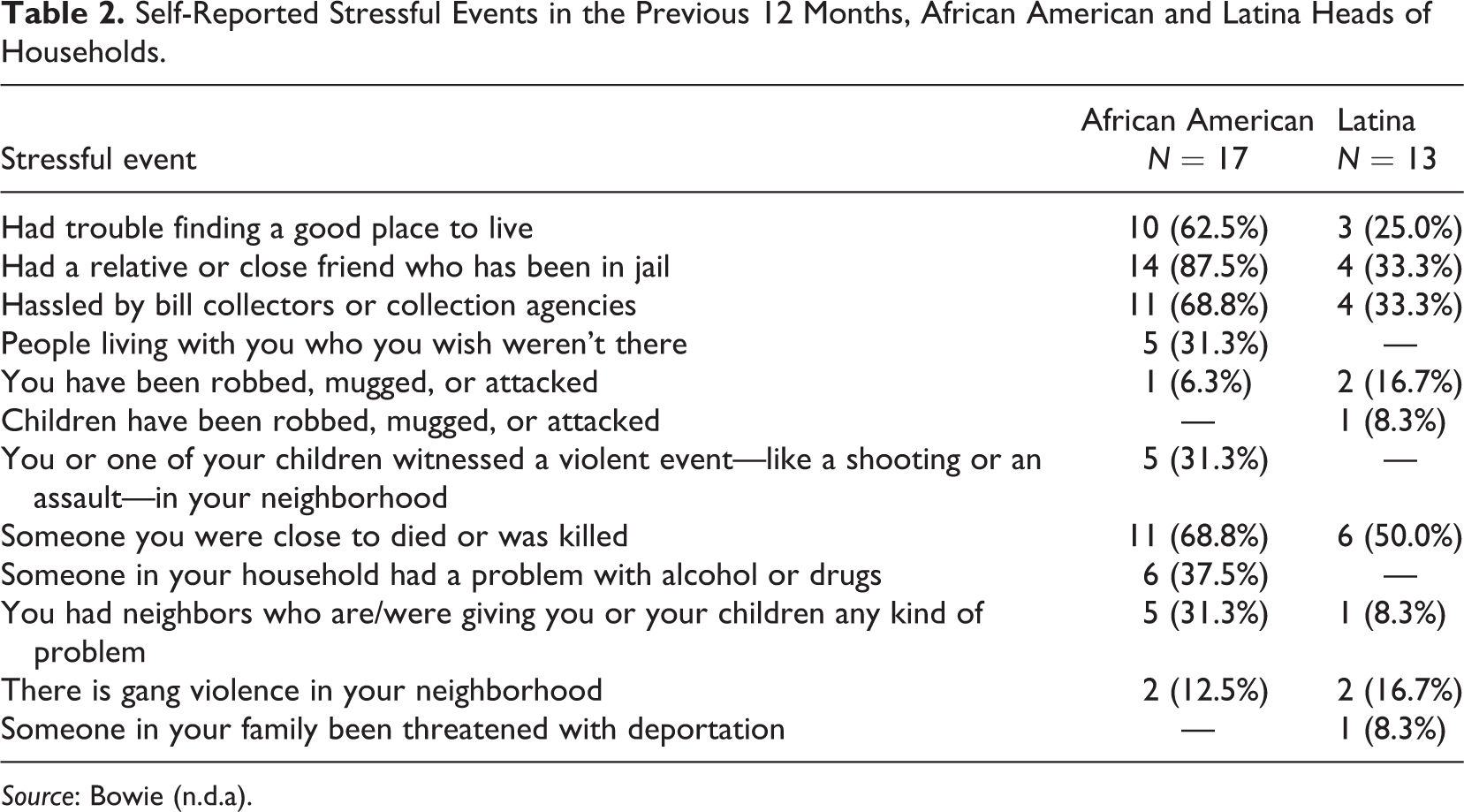
Life stressors among the respondents were ascertained with data from the DLC and IPV Scales, and the findings indicate that substantial percentages of the African American and Latina respondents had experienced a variety of stressful events during the previous 12 months. As Table 2 indicates, 87.5% of the African American women had a relative or close friend who had been jailed. The next most frequently reported event was someone close to them dying or being killed (68.8%), or the respondents being hassled by bill collectors or collection agencies (68.8%). Most of the African American respondents (62.5%) also had trouble finding a good place to live. For the Latina women, the most frequently reported stressful event during the previous 12 months (50%) was someone close to them dying or being killed. The next most frequent stressful event was tied between having a relative or close friend in jail and being hassled by bill collectors or collection agencies.
Self-Reported Stressful Events in the Previous 12 Months, African American and Latina Heads of Households.
Source: Bowie (n.d.a).
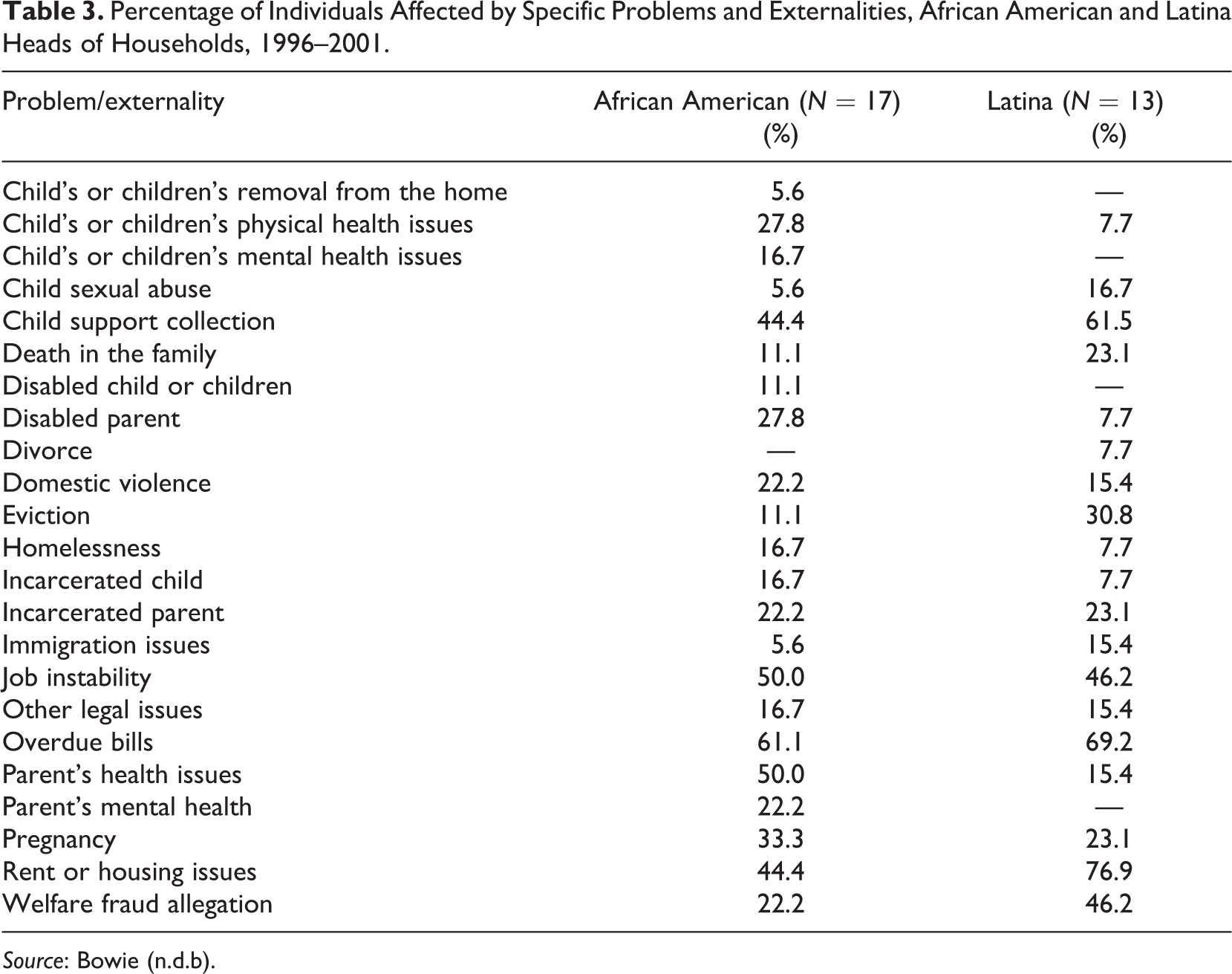
Additional life stressors were identified by analyzing the transcripts of the respondents’ interviews and administrative data provided by the state welfare office. Table 3 lists the personal problems and external issues experienced by the African American and Latina respondents during the study period. A total of 23 problem/externality categories were identified from the data. The problem that came up most often for the African American cohort was personal finances and the inability to pay overdue bills (61% of the respondents). The second most documented issues (50%) were job instability and health issues that the women faced, followed by the inability to collect child support (44.4%). For the Latina cohort, the paramount issue or problem faced by 76.9% of them was related to housing, specifically, the inability to locate and/or afford safe and suitable housing for their families. Other frequently cited problems for the Latina cohort included overdue bills (69.2%), the inability to collect child support (62.0%), and allegations of welfare fraud (46.2%).
Percentage of Individuals Affected by Specific Problems and Externalities, African American and Latina Heads of Households, 1996–2001.
Source: Bowie (n.d.b).
The IPV scale indicated that 63% of the African American women reported experiencing IPV during the previous 12 months, and a single Latina respondent reported an experience of IPV during that time. The most frequent forms of IPV for the African American cohort were someone yelling at them (62.5%); reportedly trying to control them (50%); threatening physical harm (37.5%); and being physically hit, slapped, kicked, or receiving some other physical harm. The Latina respondent reported being yelling at, someone attempting to control her, and threats of physical harm in the previous 12 months. The level of IPV among Latina respondents was surprisingly low (8%) relative to previous research with similar populations (Polit, London, & Martinez, 2001; Polit et al., 2001).
There are two possible reasons for the low level of IPV reported by the Latina respondents. First, as was indicated previously, some of the Latinas in the sample were undocumented immigrants. They may have been especially cautious about disclosing violence in their homes for fear that this information would interfere with the benefits received at the time, lead to their or their partners’ deportation, or simply create unwanted attention. A second possible reason is that ethnicity may have played a role in the extent of disclosure by the respondents. The research assistant who interviewed the Latina respondents, for instance, was Mexican American, whereas the Latina respondents came from various countries, including Cuba, the Dominican Republic, Puerto Rico, Columbia, and Honduras. Some of the different Latino cultures have relationships characterized by historical friction, division, and tension among them, which may have resulted in some of the respondents being less than forthcoming in discussing IPV with an individual outside their specific ethnic group.
A related contradictory finding was that the African American respondents reported higher levels of IPV using the self-report instrument versus the level of IPV reported during the face-to-face interviews using the SIS interview schedule (see Table 3), perhaps because of a greater willingness to self-report on a survey versus personal disclosure in a face-to-face recorded interview. In contrast, the Latina respondents reported higher levels of IPV during personal interviews than the single report on the IPV survey.
Research Question 2: Respondents’ Perspectives on Employment Barriers
To illustrate and contextualize the themes identified in the study, selected quotes from respondents’ SIS surveys are presented next. The names used are pseudonyms to protect the identity of respondents. The themes that emerged from the qualitative data analysis were generally consistent with the findings from the quantitative instruments, but the SIS allowed for a more in-depth examination of the dynamics associated with specific types of employment barriers among the respondents. Five primary themes emerged from the data that were associated with the inability to secure and maintain steady employment: (1) physical and mental health, (2) family stressors, (3) labor market issues, (4) housing and neighborhood issues, and (5) IPV. The selected illustrative quotes provide unique, “up close and personal” perspectives on the different types of problems experienced and how they converged and became distractions and barriers to the main TANF goal of steady employment and economic self-sufficiency.
Physical and Mental Health
At the time of the study, Lillian was a 38-year-old woman who was surviving on disability benefits, suffered from obesity and associated illnesses, and had two young children to care for, along with her mother. She described a catastrophic medical situation that resulted in her losing her apartment and almost her life: I was very sick, … and I went into the hospital. My lungs collapsed, … and I was in a coma. I [was admitted] in ’95 and finally got out in ’96. I lost my apartment when I was in the hospital, and I lost everything ‘cause my mother didn’t know how things was working out. I called [the women’s shelter] … and told them I have a daughter, and I’m disabled. They had a disability [unit], … I and stayed there. I’m trying to get my daughter back into school … (Bowie, n.d.b) I used to take Prozac. I stopped [it]; … it wasn’t [helpful]. It made me hallucinate about things, like seeing wild things, stuff like that. I think the medication was kinda too strong for me … . I feel that as long as I don’t think about my problems, I don’t get depressed … . I was isolating myself, you know? That was depressing me, and now I get out more … . When I feel myself getting depressed, I get out. And I just go, go to somebody’s house. I don’t have to isolate myself. That’s when I get depressed. (Bowie, n.d.b)
Doreen has three children who ranged in age from 3 to 14 years at the time of the study. During the previous year, she faced challenges locating stable housing, as well as dealing with the job search mandated by the welfare office. In the past, the constant stress caused her to experience seizures. She said: Emotionally, I’m doing good. I’ve learned to give it to God. Anything that can go on to bother me, I … give it to God and leave it alone. He’ll work it out. I’m learning. It’s a lot of pressure. I used to let pressure ball up into me so much [that] I would go into a seizure, but I haven't had a seizure now in three or four years. I’m getting better learning to deal with my frustration; … I don’t let it bother me. I ain’t letting it ball up in my head. (Bowie, n.d.b)
Family Stressors
The quantitative data analysis indicated that family-associated issues were major impediments to the respondents’ search for employment or ability to maintain a job if they were fortunate enough to obtain one. Cited most frequently among the issues was a constant need for decent housing, conflicts with children and neighbors, incarcerated relatives, and undesirable residential cohabitants, even though many other issues were mentioned (Bowie, n.d.b). Consider the case of LeJean:
LeJean was a 35-year-old unemployed public housing resident at the time of the study with four preteen and one 4-year-old children. She was not able to mount a serious search for employment or hold a job because of family distractions, including two children who had been recently arrested. She lamented her dilemma this way: Oh, it’s been a battle. It’s been a battle … being in a financial bind was not a help… . With most of [my children] getting into their teens, they having conflicts not only with me, but between one another. [My daughter was] fighting a girl over senseless stuff. [She] doesn’t start fights, but she doesn’t back down—that’s her problem. The police pressed charges against her … because she had prior aggravated battery [charges] from three or four other fights. She doesn’t talk; … when it’s festered up so much, she explodes. That’s why I lost my lost job … . [I have to be] constantly in court with [her]. (Bowie, n.d.b) They said he was disrupting … . I went out there a couple of days ago … . [Justin’s] reading is very low. He is in the 6th grade, [but] he is on a 2nd-grade level. He come home, I make him read. I done bought all these books; … my girls play school with him, flash cards … and let him spell. [Justin] don’t know how to read or how to spell a word. What kind of work is [the school] … giving him!? The only thing [he] is passing is P.E. [physical education] and band … . He needs reading, language arts, math, and science—that’s what he need to do … . They insist on putting him in the 7th grade. I say no! He going to be in the 6th grade. How can he pass to the 7th grade when he don’t know the three letter words? … I had to go to the big regional office to put him back in the 6th grade. (Bowie, n.d.b)
Labor Market Issues
As expected, labor market issues were intrinsic themes on multiple levels in the study, since they focused on welfare leavers and their attempts to earn sufficient income to achieve economic independence from the state. One of the major themes to emerge involved the challenges associated with the job search, as well as the instability and poor working hours of the few jobs they were able to obtain during the study period.
Margarita expressed her frustration at the prospect of searching for another job, even though she was currently employed by a major department store in another part of the county: They wanted me to come all the way … [across town] … for [a minimum-wage job], and I did. And they would give me only 24 hours … . I told them that I could not live like this … . My rent is $325. How can I pay my rent if you keep doing this to me? (Bowie, n.d.b) I worked Thursday through Sunday. I just had a day off yesterday … . This week [the supervisor] … gets me to open [at] 7:50 [
Teresa reflected on what she had experienced and made it clear that she understood the role of education and the limitations if you do not have it: With no education it’s hard to find something. The first thing they ask you, “do you have a high school diploma or GED?” If you are going for a hotel job or a job at Burger King or McDonald’s or maybe some convenience store, you can get a job like that with no education. But if you want to work in the mall, somewhere like a department store, you gotta have some kind of education … a decent job, you can’t get. (Brock et al., 2004, p. 127) I have applied everywhere. It is not because I do not want to work; people think that is the reason. On the 26th, I began a 30-hour daycare class, … which will allow me to work in daycares [sic]. I hope that maybe with such a certificate I will have some luck. I have looked in Burger King, McDonald’s, Taco Bell, and many factories around here, and none of them have called me. Since I don’t speak English, it is difficult. Even the bakery where my son works, I have applied three times to see if they will let me do the cleaning, at least … . Even if it is not full time, I would be happy with that. (Brock et al., 2004, p. 131) Everybody [there] wants to control somebody. When you [are] a … [temporary employee], … they treat you like dirt; … they throw this … [at you], “you know I’ll fire you!” They love that! That’s all they [say]—fired! “You can get fired!” I’m sick of that word! … I have to look at my kids and come back to work] … . I hate my job! (Bowie, n.d.b)
Housing and Neighborhood Issues
Many of the respondents were unable to sustain an employment search because of affordable housing problems, as well as the safety of their living environments. Doreen was an unemployed single parent who had to live in a motel for shelter. She was reportedly evicted from her apartment in the middle of the winter season and forced to live on the streets while caring for an adolescent daughter who was nine months pregnant: I knew eventually I had to move by the end of the month … . The lady told me that we had to get out because they was going to be fixing the windows or whatever. The next day I come back and she had … [changed the lock on] … the door. I called the police, … but there wasn’t nothing they could do. They told me if I go in, … they would arrest me … for breaking and entering … . [The homeless shelter] … told me I had to be living on the street with [my] … pregnant daughter in order for them to pick me off the street [and] … just give me a place to stay. (Bowie, n.d.b) Basically [the] … avenue is drug infested … really bad, a high area for drugs and crime. I prefer [my children] not to walk through there. Police are very visible, but just this year two people have gotten shot. The other area back here has a lot of vagrants … . There was a young woman coming home from church late one night, [and she] disappeared. They found her body a couple of days later by a dumpster, wrapped up in a blanket, and she was dead … she was sexually assaulted and killed. (Bowie, n.d.b)
IPV
A final theme to emerge in the study was the issue of IPV. As we pointed out in the quantitative analysis, several of the women—especially in the African American cohort—reported that they experienced IPV, including yelling, controlling, threats, and physical harm. Michelle was one of the few respondents to discuss IPV: We were on and off; I knew we weren’t [going to get married], but I was caught up. [I] didn’t know how to get out of it, and it became abusive. We were fighting each other, and … he ultimately beat me up! I wasn’t having that. I had to let that go. (Bowie, Dias-Bowie, Fields, & Bryant, 2009, p. 290) This man won’t help me pay my bills. Won’t give me no money, but want to be jealous. I don’t get it. [He is] … very dangerous. I’m going to have to off him, or he will do it to me. It’s kill or be killed! See, the welfare people don’t realize that; … they think it’s all peaches and cream in a relationship. I don’t give him nothing! That’s why me and him be fighting ‘cause I don’t give him no money. Yeah, they be wanting to fight you when you don’t give them money! (Bowie, n.d.b)
Discussion
The barriers to employment that the respondents faced were wide ranging in scope, complexity, and severity. They generally persisted while these women tried to handle home and family responsibilities and concurrently negotiate the pressure-cooker, “do-or-die” political and regulatory environment of contemporary public welfare. Women in relationships in which they are subject to IPV also face the dilemma of losing benefits if they do not report the name of the abusive father of their children. Some of the stressors reflect those faced by non-welfare-reliant Americans, economic, including instability and difficulty paying bills, but the depth and breadth of the employment barriers faced by the TANF recipients in the study made the goal of self-sufficiency seem unattainable.
Metastressors
The picture that emerged was confirmatory, yet still frightening, because of the mismatch between the number of families who were directly affected; the multiple, intertwined, and omnipresent metastressors; and the lack of interest, resources, or political will by the nation’s leaders. There was indeed the standard fare of transportation, child care, and educational barriers discussed extensively in the literature on welfare reform. The collective situation from the study data, however, showed a group of voiceless, desperate women who were enveloped in a cocoon of invisible personal, social, and economic barriers to employment seeking or actually obtaining a good job. The barriers identified in the study included unaddressed physical and mental health problems suffered by the respondents and/or their children; health, family stressors, labor market and education issues; neighborhood and housing problems; intimate partner relationship problems; and food insecurity issues.
The problems were further compounded by the potpourri of complicated TANF rules and regulations (that were continually evolving at the time of the study), punitive social policies backed up by sanctions for noncompliance (e.g., withholding, reducing, or terminating welfare “benefits”), and a revolving door of welfare workers with staggeringly large caseloads. The qualitative data and text analysis provided several “snapshots” of the unseen world of modern welfare recipients. The picture is not pretty, nor is it consistent with the popular perception of TANF-reliant women as people who simply “don’t want to work.” It is imperative that social workers, researchers, educators, and policy makers grasp the true magnitude, severity, and complexity of barriers (represented by different unresolved life stressors) faced by women of color that was substantiated by the study. The five categories of employment barriers are not an exhaustive list, and the illustrative quotes make it clear that a sufficient and realistic response must include a paradigm shift at the policy (TANF) level; a major commitment to and the development of intervention resources for addressing the myriad of social problems faced by TANF-reliant women; and the creation of realistic opportunities for education, training, gainful employment, and thus independence.
We have used the term metastressors to characterize this scenario of multilayered and integrated impediments to obtaining employment. The term megastressors was initially considered to highlight the sheer scope and magnitude of challenges faced by the women in the study. We used metastressors instead because of its emphasis on “change [and] transformation [that is] … more comprehensive [and] … at a later stage of development” (American Heritage Dictionary, 1991, p. 789). Most of the identified metastressors were not resolved at the conclusion of the study. As the definition implies, however, most barriers and stressors that were identified in the study underwent transformation over time, becoming more comprehensive and complex and more challenging to resolve. Unfortunately, most of the situational transformation that we observed was not of a positive and liberating nature for the women in the study. Further research is needed to shed light on the evolving complexity of these issues and to continue to collect data and perspectives from those who are most affected by TANF and related programs.
Consistent with the complex and multifaceted nature of the metastressors and employment barriers faced by TANF recipients, solutions also need to be multilevel (starting at the policy practice level) and comprehensive to address properly the interconnected factors that come into play. A Marshall Plan-type multilevel strategy is needed to address the problem (as well as the commitment of resources for its implementation) and to provide meaningful assistance to TANF recipients. The seemingly Darwinist-type (Trattner, 1999) assumptions on which it is based must be challenged by empirical findings that highlight the deleterious political, structural, and philosophical issues with respect to key aspects of TANF, including its current policy that allows 2-, 3-, 4-, and 5-year welfare time limits in different states.
The Role of Social Work
Social work professionals must aggressively work to ensure that adequate social and health care services, as well as academic and financial resources, are provided to enhance the probability of recipients’ success in finding employment and achieving a meaningful level of self-sufficiency. Long-term studies and research with appropriate levels of scientific rigor should be continued, as well as formative, summative, process, and outcome evaluations of national and state TANF programs and case management efforts and outcomes. Finally, social work policy practitioners, advocacy groups, and educators should develop alternative policy proposals for transitioning TANF into a strengths-based intervention model and emergency policy proposals for assisting TANF recipients who have exhausted their benefits and are no longer eligible for welfare (Butler et al., 2012; National Association of Social Workers, 2009; Saleebey, 2006).
Enterprise Economics
The “enterprise economics” strategy of the Clinton administration would be an appropriate strengths-based model, in that it involved governmental investment in human capital (including education and training of workers), technology, and infrastructure used by the public (Dye, 1998). This type of human investment paradigm would provide welfare-reliant women (and men) with genuine opportunities for a long-term permanent transformation to a higher level of personal development, meaning a higher income-earning potential and a higher quality of family life.
The findings from our study indicate that the TANF program, as currently conceptualized and implemented, does not facilitate economic independence and self-sufficiency for low-income women of color. As Ozawa and Kirk (1996) pointed out, the welfare system blames TANF recipients for their economic and social problems without focusing on larger, macro-level political and historical factors that contributed to the status quo of different low-income ethnic and gender groups. This myopic manner of victim blaming ignores the intersectionality of many external factors that contribute to the status of welfare recipients, including the American economic system; poverty and its associated ills; IPV; public welfare policies; partisan politics; and the historical traditions of racial, gender, and economic discrimination in the United States.
Intersectionality
The issue of intersectionality is important in terms of realistically assessing the complex and layered nature of gender and racial oppression in the United States; informing theory and research at the individual, intimate partner, and societal levels; and promoting positive social change among oppressed groups (Shields, 2008). Intersectional research on women was also promoted by Simien (2007) because it investigates “the simultaneity of oppression in American politics” (p. 264). A general example is reflected in the multifaceted and paradoxical dilemmas of the respondents in our study. The respondents were typically not well educated, yet not permitted to increase their level of education and employability beyond token, dead-end training programs, for the most part. They demonstrated a range of documented and chronic metastressors; yet there are few, if any, mechanisms in TANF for facilitating the resolution of these metastressors (because of the “work first” philosophy). The women had the pressure of finding employment in an often hostile, employer “buyers’ market” that sometimes forced them to compromise their dignity and self-respect and be powerless in negotiating wages, working conditions, and job benefits. When the TANF time limit expires, women and their children are basically left to fend for themselves without any future safety net in place for their families in the event of an emergency. TANF expires, but the metastressors continue.
Intersectionality research is a viable alternative form of examining honest and objective outcomes and the major flaws of the TANF program, including its flawed and contradictory logic regarding employment searches, work incentives, the nonavailability living-wage jobs, and related social and policy inequalities. This type of research highlights (1) the social and political construction of TANF; (2) its emphasis on macroinstitutional and microintimate partner power relations (e.g., TANF-reliant women, public welfare case managers, and low-wage employers in the business community) that create and sustain social hierarchies; and (3) the perspectives and experiences of different oppressed groups, especially women of color, and (4) it is interdisciplinary and driven by the pursuit of social justice (Hill Collins, 1998; Weber, 2001; Zambrana, 2001; Zinn & Dill, 1996).
Limitations
The study had limitations that should be noted. The first limitation was that because of the sampling strategy, longitudinal research design, and small sample, the results cannot be generalized to all TANF-reliant African American and Latina women. The second limitation was the negligible prevalence of IPV reported by the Latina respondents—an aberration from results reported in the literature with similar samples. The self-report data on IPV from the different study instruments (SIS, DLC scale, and IPV scale) also had contradicting outcomes, with different levels of reported IPV. Future studies with large immigrant populations should anticipate the possible reluctance of undocumented immigrant respondents to reveal personal information and develop data collection strategies for addressing and overcoming this obstacle. This challenge of reluctant responses by immigrant populations could be facilitated by deliberately using data collectors (interviewers) whose ethnicity and cultural background match those of potential respondents. The third limitation was that reliability coefficients were not established for the two scales used in the study, thus leaving questions about their strength or stability. The final limitation was that a substantial amount of raw interview data from the Latina cohort could not be accessed because of transcripts that have yet to be translated into English. In spite of the limitations, the findings advance the social work knowledge base, specifically regarding the complexity and connectedness of metastressors among TANF-reliant women of color and how they represent serious impediments to gainful employment.
Implications for Social Work and Social Welfare
The United States is at an important juncture in relation to federal welfare and national responsibility for the well-being of its citizens. The “safety net” for the poor that has been in place since the Great Depression of the 1930s made Americans recognize that factors beyond our control can often lead to difficult life circumstances and impoverishment. The intense climate of fiscal conservatism and apathetic political climate suggest that the public has lost its appetite for helping the neediest and most disadvantaged segments of the American population. In many respects, it appears that the final phase of the 1980s era “Reagan Revolution,” which initiated the process of dismantling and deprioritizing human services expenditures and shifted national resources to benefit corporations and the wealthy, has indeed arrived.
Footnotes
Declaration of Conflicting Interests
The author(s) declared no potential conflicts of interest with respect to the research, authorship, and/or publication of this article.
Funding
The author(s) received no financial support for the research, authorship, and/or publication of this article.