




Abstract
On the basis of a qualitative study with immigrant women in Windsor, Ontario, this article looks at women’s responses to the challenges they face in the Canadian workplace, together with the value they place on working outside the home. The women reflected on their job searches, employment conditions, and work experiences as mediated by the norms and traditions of their home countries. Because of the struggle to obtain a job and the delicacy of retaining a job in a precarious economic climate, the women did not fight the discrimination they encountered in the workplace.
Research on the economic activities of immigrant women in Canada and the United States has increased over the past two decades. Some of this research has examined how immigrant women juggle the demands of family and paid work in the new societies in which they have settled, thereby demonstrating the need for governmental policies that address the specific challenges they face (Barber, 2000; Grahame, 2003). Another area of research has focused on examining the gender-slanted ways of engaging women and men in the new societies they are living in. The findings from such research speak to the need for policies and practices that combine legal and sociopolitical considerations when attempting to allow women to compete effectively with men in the economic arena (Gromek-Broc, 2006). Despite the increased research interest in immigrant studies and gender parity, there is still a paucity of Canadian research that specifically explores the sociopolitical benefits that immigrant women derive from their working experiences in their new country, the tensions and conflicts they may experience as they navigate workplace norms in their new country, and their strategies for reconciling these norms with those of their country of origin.
This article addresses these gaps by presenting findings from a 2006 to 2008 study based on our larger study, Immigrant Women Negotiating Canadian Work Cultures (Dlamini, Anucha, & George, 2006), undertaken with immigrant women in Windsor, Canada, who, within 5 years of their arrival in Canada (the Statistics Canada benchmark for defining new immigrants), had been able to obtain employment. It illuminates the experiences of a group of immigrant women in Windsor by critically examining their responses to the challenges they face in the Canadian workplace and the value they place on working outside the home. The women in our study engaged in this analysis by reexamining their job searches, employment conditions, and how their work experiences were mediated by home-country sociocultural norms and traditions. Our findings suggest that the Canadian government needs to rethink its practice of defining and equating model immigrants with skilled professionals, since this practice masks both the complex factors and the conditions that immigrant women face in finding initial employment in Canada and in their employment experiences thereafter.
Overview of the Literature
Growth in the Canadian population over the past two decades has been credited to an increase in immigration. Furthermore, between 1996 and 2001, the racialized population significantly increased from 2.9% to 24.6% of the Canadian population as a whole (Teelucksingh & Galabuzi, 2005). In 1993, immigration policies shifted from focusing on using the home countries of the applicants as an important evaluative factor for candidacy for immigration to an emphasis on the economic and professional skills of the applicants. This change occurred because the Canadian government, like many Western countries, increasingly views immigration through the lens of economic competence on the basis of assumptions that skilled professionals (both male and female) are most likely to obtain employment and are therefore less likely to become dependent on welfare support. Skilled professionals—physicians, teachers, engineers, and the like—are viewed as the most suitable and desirable candidates for immigration.
Because of Canada’s changing pattern of immigration, there are now more racialized persons in the workforce, both men and women (Teelucksingh & Galabuzi, 2005). Nevertheless, racialized people are still experiencing income gaps and higher rates of unemployment. Frenette and Morissette (2005) found that for recent immigrants with less than a high school education, between 1996 and 2001, the low-income rate increased by 24%; to 50% for those with a high school education and to 66% for recent immigrants who are university educated. These findings suggest that education does not facilitate either access to the higher paying labor market or mobility into higher paying positions once individuals are already employed (Teelucksingh & Galabuzi, 2005).
Compared to their careers in their home countries, many immigrants to Canada (especially women) experience a drop in status (Basran & Zong, 1998). Salaff and Greve (2004) studied the employment status of 50 professional couples in Canada: Of the 50 couples, at least one member of 23 couples had lost job status compared to the positions they had held in their home countries. For women, the drop was more significant than for their husbands. Salaff and Greve suggested that Canada values women’s education and work experience differently from that of men’s and that these differences may be attributed to institutional and professional systems in Canada. Consequently, the percentage of recent immigrant women with professional occupations who were able to work in their professions in Canada decreased from 40% in the 1980s to 25% in 2000 (Couton, 2002).
Teelucksingh and Galabuzi (2005) suggested that there are attitudinal barriers among employers, including a belief that immigrants from certain countries are not as competent because the standards of the educational systems in these countries are not equal to the standards of the Canadian educational system. Couton (2002) pointed out that discrimination in the workplace can be both intended and unintended and can arise from a lack of information, fear, or prejudice. Along this line, Aydemir and Skuterud (2005) noted that the reasons for the declining job-entry earnings of recent immigrants is that their foreign work experience is not valued as highly as Canadian experience.
The most significant barrier to employment for immigrants has been referred to as a “double disadvantage” whereby employers and professional regulatory bodies do not readily recognize foreign credentials and work experience and employers insist that employees must have Canadian work experience. To address this problem, Ontario established the Office of Fairness Commissioner, which oversees the licenses of 40 regulatory bodies for Ontario to ensure the transparency of registration practices, objective, impartial, and fair (For details, see www.fairnesscommissioner.ca). Immigrants who previously worked in companies with some exposure to North American standards fare better in having their work experience acknowledged and in obtaining employment in Canada. Some immigrants have noted that the requirement for Canadian experience is often unrelated to the competencies of the positions for which they are applying (Dlamini & Anucha, 2005; Teelucksingh & Galabuzi, 2005). It also appears that the more education or credentials an immigrant has, the harder it will be for him or her to find a job that is comparable to what he or she held in his or her country of origin (Li, 2001). Finally, immigrants who want their credentials recognized, especially those in regulated professions, experience other barriers, such as the costs of examinations or certification and limited internship positions through which to gain employment experience.
Overall, the literature has demonstrated the existence of many barriers to gainful employment for recent immigrants. For women, obstacles related to their gender and race further complicate these barriers. It is therefore critical to explore the ways in which women make meaning of their work experiences as they navigate the norms of a new culture and working climate.
Method
Using a qualitative methodology, our study examined how the social and human capital that immigrant women had acquired in their countries of origin were converted for use in the Canadian economy. It also assessed how gender and other factors, such as race and ethnicity, mediated this conversion and influenced the women’s access to employment opportunities.
According to the 2006 Canadian census, 23.3% (74,770) of the total population (320,730) of the Census Metropolitan Area of Windsor, Ontario, are immigrants. Windsor’s racial diversity is often compared with that of Detroit, a city with a well-documented history of racial conflict that climaxed with the race riots of 1943 and 1967 and initiated the so-called white flight to the suburbs (Fasenfest, Booza, & Metzger, 2004). Such overt incidences of racial conflict are considered remote from or even unimaginable in the psyches of Windsor-born residents, making it difficult for immigrants who are subjected to Windsor’s more genteel form of racism to confront it accordingly. In the local southern Ontario region, historical narratives of slaves escaping to Canada and settling around Windsor play a key role in mainstream Canada’s self-definition as a sanctuary from American slavery and racial discrimination, a notion that oversimplifies the complexity of the lived experiences of black immigrants both then and now (Walcott, 2003). This oversimplification of the lived experiences of black immigrants, as well as the inevitable comparison of Windsor with Detroit, makes it difficult for immigrant women to talk about, officially report, or even have their experiences of unfair and/or racist treatment in the workplace meaningfully addressed.
Our study used a methodology that focused on three interrelated critical areas. First, we dialogued with and profiled six community organizations that support immigrant women at various stages of settlement to understand the resources that are available for immigrant women who are pursuing employment opportunities in Windsor–Essex County. One of these six organizations, Women Enterprise Skills Training (WEST), specifically provides services that address the employment needs of racialized women. We therefore worked in close collaboration with WEST during all phases of the research. Second, we conducted 37 in-depth interviews with immigrant women who had been in Canada for fewer than 5 years and who had local work experience. Third, we held two community forums—one with a subset of the women who had participated in the in-depth interviews and the other with representatives from the six organizations that we had profiled. The purpose of these forums was to allow the women and the agencies to assist us in contextualizing the findings from the interviews.
This article discusses the findings from the in-depth interviews with 37 women during the second phase of the research. The participants were selected purposively (Ristock & Pennell, 1996) from the six profiled organizations to gain access to women who had work experience in Canada. To be eligible to participate, a woman had to be currently employed and to have had at least 1 year of Canadian work experience. The women had emigrated from five geographic regions: Africa (3), Asia (18), Eastern Europe (6), the Middle East (8), and South America (2). The region of Asia included women from Eastern (9), Southern (8), and Western Asia (1). The majority of the women (32) were married; 4 were single, and the status of 1 was not clearly disclosed to the researchers.
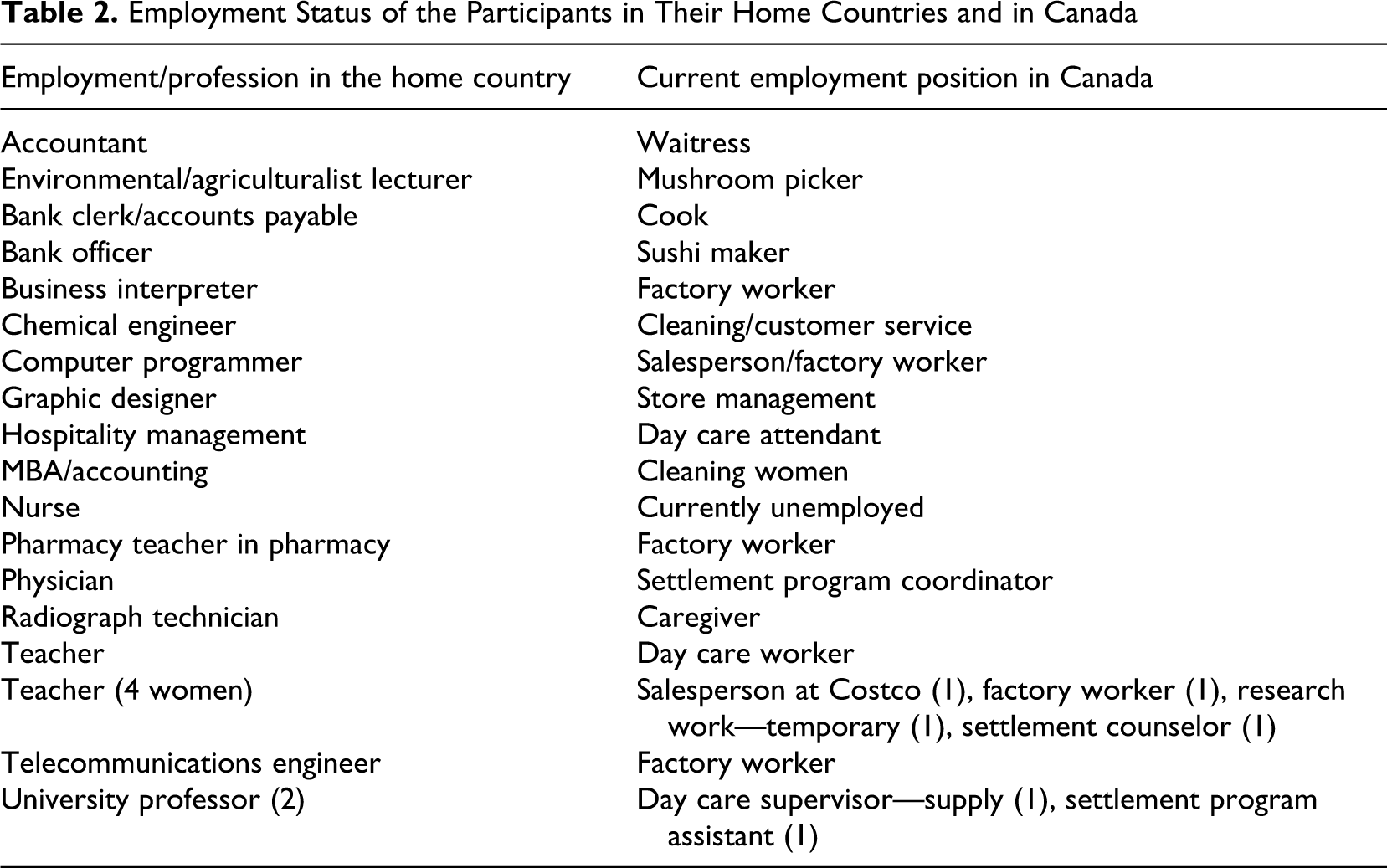
The immigrant women who were interviewed were mainly in their prime employment years and ranged in age from 22 to 54. Each participant had to be currently employed and have a minimum of 1 year of Canadian work experience. One woman lost her job after the interview was set up and was therefore unemployed. Of the 37 women, 9 were working in positions in Canada that were equivalent in status and pay to their positions in their home countries. Three more women were working in positions in Canada that could be considered related to their employment or professions in their home countries: a lawyer now working as a law office assistant, a nurse providing respite care, and a teacher working as a day care assistant. Table 1 lists the positions of the nine women who were employed in equivalent jobs at the time of our study, and Table 2 lists the positions of the participants in their home countries and in Canada.
Job-Congruent Employment Positions of the Participants
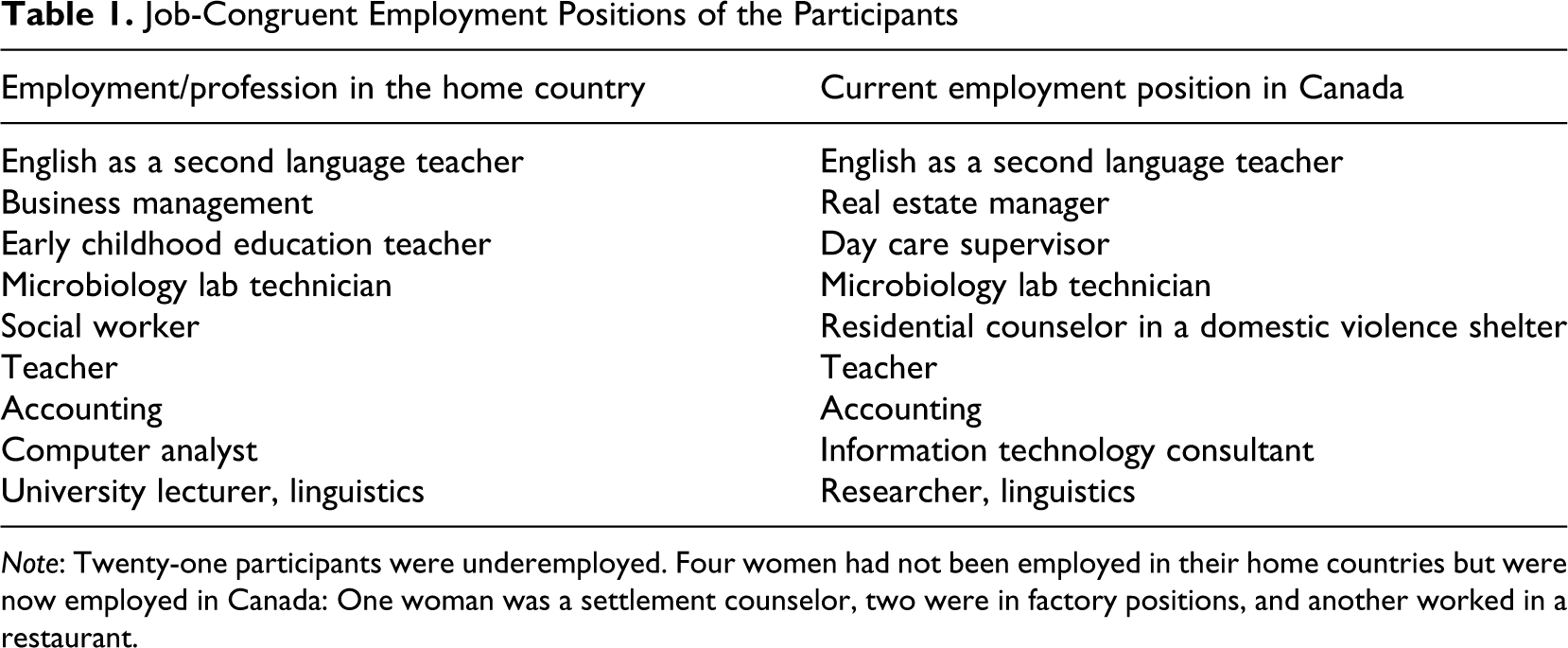
Note: Twenty-one participants were underemployed. Four women had not been employed in their home countries but were now employed in Canada: One woman was a settlement counselor, two were in factory positions, and another worked in a restaurant.
Employment Status of the Participants in Their Home Countries and in Canada
Findings
We began the in-depth interviews by asking the women about their reasons for migrating and their settlement experiences. We followed with questions about their employment and social status in both their countries of origin and in Canada. Finally, we asked them about their work experiences and what they saw as instrumental in helping them navigate the Canadian work culture.
Migration and Settlement
The participants identified several reasons for emigrating to Canada, including family members and friends who had already migrated to Canada, opportunities for better education and employment, better opportunities for their children, and the chance to live in a peaceful country. The following comment illustrates the multiple reasons a family can have for migrating: “I like this country, and it’s comforting for a better life, your education, your career, and your kid’s education. So the reason I decided to go to Canada, like my husband and I decided to go to Canada, [is] because it is a peaceful country and more multicultural people live here.”
A frequently mentioned reason for settling specifically in Windsor was its close proximity to the United States, particularly Michigan, where many women had family members. Although some women described positive settlement experiences because of the support they received from friends and family members on their arrival (e.g., providing a temporary place to stay, introductions to agencies that provide English classes, assistance in finding a permanent home, and connections to their cultural community), the majority of women (26 of the 37) described struggles they had faced because of the lack of information or misinformation they had received before migrating about what Canada was like and what employment opportunities would be available. They mentioned instances in which people who had already migrated would not disclose their struggles with finding employment to aspiring migrants from their countries of origin. Other women noted that the Canadian embassies or consulates in their home countries also contributed to these high expectations by glorifying the opportunities that Canada will make available to them. This misinformation led potential migrants to think that the migration and settlement processes would be easy. For this group of women who had high expectations before they came to Canada, the experience of migrating was long and arduous.
For a third group of women, migration and settlement experiences could not be expressed as simple binary opposites of good or bad; their experiences were more nuanced. As one woman put it: “Migration [in] one way is good because you came and you have a good life, but [in] another way, you are far from your family [in the home country]. If you heard someone is sick, if you heard somebody has died, it’s like, oh my gosh . . . . It is really hard, you can’t go back, you know.” Overall, the women identified three tasks that are central to settling successfully in Canada: finding a place to live, taking English classes, and finding employment. Although they experienced poor living arrangements immediately upon arrival and other stresses of settlement, by far the most frustrating task was trying to find employment, especially employment that was consistent with their education or prior occupation.
Job Search
The discussions about job-search strategies and experiences clearly articulated the challenges and frustrations the participants had faced. While they understood that it takes time to find a job upon immigrating, they had not imagined that it would take over a year to obtain one. This lengthy time of job hunting forced them to take any type of job that was offered to them, regardless of whether it matched their educational and/or professional qualifications. One woman noted:
Actually, I sent many résumés to agencies, and I got just one response. I thought maybe my résumé wasn’t good. I was very happy when I got there . . . . I went to the agency for an interview; the clerk told me it was a labor job [a physical blue-collar job]. I was still happy because anyhow, I wanted to work. You know, since I came to Canada, I hadn’t worked for more than one year, so I was happy.
Another area of frustration the participants identified was to be told that they needed Canadian experience to obtain a position. Dejong and Madamba (2001) referred to this requirement as leading to a double-disadvantage positioning of the immigrant. The following comment describes a common occurrence for many of the women:
Like when I put in my résumé, of course I didn’t have experience because I am new here in Canada. They asked me before, “Do you have experience?” I said no because I am here just four months. Oh, you know it’s difficult; we need [Canadian] experience to work. It’s not important that you have it in another country; they mean here in Canada.
The interview data show that the participants were resourceful in their job search. They used newspapers and the Internet, attended programs at agencies for newcomers, registered with employment agencies, volunteered, and spoke with friends and family members. Some women identified employment programs in agencies for newcomers as being especially helpful in developing their résumés and writing cover letters, and sometimes these agencies were even able to assist the women in actually finding a job.
Most of the women said that employment or temporary agencies were new and foreign institutions; therefore, they needed time to acquaint themselves with how these agencies operated. Even without going through a temporary agency, many women obtained only temporary jobs that often did not result in permanent employment. Indeed, few of the women who were interviewed had worked in one position on a long-term basis.
Although the participants were able to find jobs in Canada using a variety of job-search resources and strategies, the majority obtained employment through referrals by friends and were not working in positions that were equivalent to those that they had held in their home countries. Some women obtained jobs that were similar or related to their previous jobs; even so, they were working for lower wages in Canada. Volunteering in positions related to their area of qualification often helped women find a job. For example, a woman who was a physician in her home country volunteered in a nursing home; ultimately, she obtained a job in a hospital as a nursing aide.
Work Experiences
Work outside the home
Although all the participants were interested in working outside the home, their reasons varied. For some women, working was necessary to support themselves and their families. Other women wanted to work to support their husbands’ transition into the Canadian labor force—for example, working while their husbands searched for permanent jobs, gained Canadian experience, or attended school. In some instances, the women viewed obtaining a job as a way to gain power and financial independence within the family structure. It was a way to become “equal” with their husbands and to feel “useful,” as two participants noted:
The fact that you can do—you’re useful in a certain aspect—for me is the basic idea. This doesn’t mean that you can’t be useful as a housewife, but to have your own money, to be able to choose something and pay for it, not to ask your husband every time for everything, every little detail: That’s good. To be equal to your husband, you don’t have to wait for his hand, you have to work. If you work, you and your husband are equal. If you don’t work, you are going to get down because you wait for his hand; you wait for money from his hand . . . . But if you work, you can bring it to yourself, and you don’t have to ask. Culturally, they don’t want to work, and it’s that culture, that social construct, that they have in their minds that prevents them from venturing outside. And here [in Canada], the belief is that lots of [immigrant] men don’t allow their wives to go out to work, but it’s not true. There are as many women who don’t want to work outside as there are men who refuse [to allow] their wives to work. If you actually go into the depth of it, [with] men who come to Canada, I think very few of them don’t want their wives or partners to work because they understand that in this country, to survive economically, both partners have to work. I think women and men are different, even though they are human beings. But physically they are different, and there’s lot of good jobs that are better for women . . . . We cannot do heavy work . . . . But women are very thoughtful, you know, and they pay more attention to detail. So I think teaching, librarian, and executive assistant.
Overall, most participants were much in favor of the economic and social freedom that they said working outside the home provided. These women stated that being able to work provided them with more independence and suggested that women should be able to take on any type of work as long as it made them happy. Regardless of their views on the ramifications of work outside the home, the majority of participants stated that women still carry the lion’s share of responsibility for their families and homes.
Experiences of working outside the home. The majority of participants felt that obtaining a job in Canada was crucial for fitting in with perceived Canadian values because this is what Canadian-born women do: As one women said:
Especially if you’re coming from a different country, you have to prove yourself, so you have to show that you’re working, you have to show that you’re not lazy, and you have to really try to learn as fast as possible because at the same time, I don’t think anybody is very patient, so you have to do your best, and that means working extra hours. I want to become a part of this society, become a useful member, and expand whatever [our knowledge] because I came here with the intention that we have to belong to Canada. We have to feel like we are useful members of this society, so we have to update our knowledge and skills. So my culture is harder for me. [This woman was expressing the hardship she was experiencing as a result of her home country’s culture, which did not prepare women to participate fully and contribute as citizens.]
In general, many participants were working in low-paying temporary positions in Canada. The nature of the temporary work made it more difficult to establish work relationships with supervisors and coworkers. Some women stated that it was frustrating to find a positive work environment and then, when the job was over, start over again with a new job with a new employer where they had to learn new work patterns and try to establish new collegial relations. Some women described supervisors who were supportive and suggested that good relationships came with trust. The supervisors had first to see that the immigrant women employees were hard workers and could be trusted, and once this trust had been established, the work environment improved. One woman explained: “You have to have a person inside, and then after that, they will see what kind of person you are to trust you and make a job.” Indeed, some women even received promotions in situations in which supervisors recognized their hard work.
Similar situations were described for relationships with colleagues. The participants said that Canadian people were nice and friendly but, in some cases, more formal and reserved than they were used to. Some women were uncomfortable speaking their minds to coworkers for fear of offending them or being seen as politically incorrect. Others described how their colleagues had to get to know them better and trust them, and then the work environment improved.
Unfair Treatment
Approximately half the women referred to cases of unfair treatment in the workplace, the majority of which involved supervisors, although there were also incidents of unfair treatment that arose from interactions with colleagues and customers. Unfair treatment by supervisors included being talked to rudely; being yelled at for making mistakes; being taken advantage of, such as being ordered (i.e., not requested) to work additional hours; and, in a few cases, being subjected to sexual harassment.
When the women were asked if they had reported such cases of unfair treatment, all but one woman stated that they did not tell anyone at work for fear of losing their jobs. In the one situation in which the woman had reported the unfair treatment to her supervisor, the employer did not give it credence and did not respond to her complaint or assist her by either rectifying the situation or assigning her to another supervisor. Another participant chose to quit her job rather than have to confront the situation. This woman described the difficulty in these encounters: “I just quit, and then I received the papers and everything for my taxes and everything, so that was it. I brought back everything, the equipment, and said nothing. I said, ‘Have a good day, a nice day, and thank you for training,’ and that’s it.” It is important to note that not all the women put up with the unfair treatment; however, in these instances, their cultural backgrounds and experiences led them to deal with the problem differently from Canadian-born residents, as in the following instance:
I was hit on by the screaming lawyer . . . . But you know, I just said, “Hey, don’t be silly,” because that’s the Brazilian culture. We don’t . . . . You know how we have [a] sexual harassment policy here in Canada? That’s not so big in Brazil; you just tell them . . . . [to] get lost, right, and that’s basically what I told him, “Get lost.” And even [then] he turned to me and said, “You know, you can sue me for that here in Canada.” I said, “Yeah, but I’m not going to waste my time doing that. You know, who would believe me?”
In some instances, the participants believed that the unfair treatment was directly related to their “newcomer” status and cultural backgrounds. They indicated that their accents often seemed to be a point of contention and that people unjustifiably assumed that just because the women spoke differently, they could not understand job instructions or perform as other Canadians would be expected to. As one woman said:
I had a customer one time, and he was, like, you’re not a real Canadian . . . . I was, like, why, because I was talking, and, of course, you could tell I’m not born or raised here, so he was, like, you have an accent or whatever. I was, yeah, but I am Canadian. He was, like, I fought for this country, what did you do? I was, like, nothing, but I’m Canadian, I’m working here, and I’m doing good. Working with your own people or somebody who speaks your language, they take advantage of you . . . . They didn’t want to pay me in checks [this participant wanted to file an income for her tax return, which she believed could be proved only through documentation with checks] . . . . I was forced to leave because I asked for checks, and they said no and then they started, like . . . . I was, like, you’re from the same [background], and you speak the same language . . . .Come on, you understand how it goes, and they said no.
Discussion
Numerous works on immigrant women who work outside the home have documented both the gains and the losses that these women experience. The gains include increased decision-making power, greater autonomy in the household, and greater access to community resources. Others have even put the gains from immigrants’ regular wage work relationally; that is, they have compared these impacts in relation to women’s gender relations with men. Sassen (1996), for instance, stated that when women gain greater personal autonomy and independence, men lose ground because women gain more control over budgeting and other domestic decisions, and women receive greater assistance from men in domestic chores. These are sites of everyday practices that challenge gender roles as they are traditionally understood. In addition to the gains in the private domain that we found in our study, our findings concur with findings from other studies that have documented that access to public services and other public resources gives women an opportunity to become part of the dominant society and to participate in community life. As one participant stated, “I want to become a part of this society, become a useful member, and expand whatever [knowledge] because I came here with the intention that we have to belong to Canada. We have to feel like we are useful members of this society.”
The losses that women experience from working outside the home include continued oppression and the loss of dignity in the workplace because of overall gender inequities, coupled with discrimination on the basis of race, religion, and social class (Hondagneu-Sotelo, 1994; Pessar, 1995; Simon, 1992). Some studies have further demonstrated the intricate connection between losses and gains, arguing against viewing immigrant women’s wage-work experiences as either all positive or all negative. Foner (1998) presented an analysis of the complex ways in which immigration changes women’s status both for better and for worse, stating that wage work “often empowers migrant women at the same time as it places severe burdens and constraints on them” (p. 6). Some studies have investigated the tensions between immigrant women’s individual rights and group rights; they have found that immigrant women’s rights to live and work, in relation to men, are often undermined by Western governments’ official tendency to overvalue group rights, which, more often than not, are governed by values that still privilege male power (Okin, 1999).
The women in our study were clear that their family status had improved by working outside the home. The extent of this improvement, however, depended on their role in their new jobs compared to their work roles in their home countries. What became important is that for many of the women, the move to Windsor and their ability to obtain a job there had led to important benefits in different aspects of their home lives. Similar to the women in Foner’s (1998) study in New York, many of the women in our Windsor study expected to be copartners with their husbands and to take part in decision making with regard to “heading the household,” even if some of them couched their wage work as “helping” their husbands.
This higher status within the household that the women accrued through working outside the home was also culturally informed, in that the women compared the roles of their husbands in their countries of origin with their husbands’ roles in Canada. As the women indicated, in their countries of origin, men tended to make all the household decisions, including decisions about finances; moreover, men did not participate in household chores or child-based responsibilities. Even women who had occupied highly respected positions, such as physicians, in their countries of origin acknowledged this high male status. The sense of empowerment and personal freedom and the sense of having the power to do what they wanted, both of which were associated with working outside the home and having their own money, is one of the overarching findings of our study. As one woman so eloquently put it: “To be equal to your husband, you don’t have to wait for his hand; you have to work. If you work, you and your husband are equal.”
Alongside these gains came losses. The women spoke of the loss of family members and friends, as well as the loss of family-based support, especially with child care, which they had in their countries of origin. These women had lost the support from their countries of origin that had made it possible for them to hold down full-time jobs without having to worry about their children. Because most of the women worked in low-skill and thus low-paying positions, none could afford to pay for child care; in their countries of origin, they would have received support for child care from their extended families. The realities of working at what the women referred to as “survivor jobs” meant that the women had to carry the burden of their households as well as that of their wage jobs, which presented many challenges—a phenomenon that has been dubbed in the feminist literature as the double burden (Pessar, 1995).
Thus, the empowerment and freedom gained from wage work in Canada did not necessarily change the way that the women positioned themselves within their families—that is, primarily as child bearers and home keepers. This situation meant that the preimmigration gender-role patterns and ideologies did not simply vanish with the women’s changed status and often created a cognitive dissonance for the women. Most articulated their position as mothers and caregivers first and foremost; they also expressed their belief in their gender role in the way they spoke about the kinds of jobs that women are destined to do as compared to men.
Discrimination in the Workplace
What was new and interesting for us in this study was the ways in which all the women addressed (or did not address) discrimination in their workplaces. We approached our 2006–2008 study fully aware of the challenges faced by immigrant women in obtaining jobs in the Canadian economy. We anticipated that the energy that the women used to search for and obtain jobs would be transferred to resist workplace discrimination. In other words, we assumed that the struggle to find a job would be mirrored by a struggle against discrimination in the workplace itself. We wanted to learn more about the women’s workplace activism in countering various forms of discrimination through the use of the social capital they had brought with them from their countries of origin as well as that accrued through their efforts to find a job.
Contrary to our assumptions, however, the data in our later study indicate that for a variety of reasons, the women in the study did not fight against the discrimination they encountered in the workplace. They did not just put up with the unfair treatment they received, but some even chose to quit their jobs instead of fighting their oppressors. The unfair treatment came from supervisors, colleagues, and even from other immigrant male superiors whom the women had expected would treat them fairly because of what they perceived to be a commonality of culture and/or language. Regardless of the source of the unfair treatment, most women did not confront it.
There were several reasons for this reluctance to fight back. First, the struggle to obtain a job in the first place meant that the women were very much aware of the delicate nature of retaining a job in a precarious economic climate. When we conducted the research in 2006–2008, Windsor was experiencing the largest percentage increase since 1996 in visible minority residents in Ontario (People for Education, 2005). Minorities in general have been documented in Canadian literature as the most “willing” to take on manual labor, such as garbage collection and other low-paying jobs (McCall, 1990). This situation meant that employers had a larger-than-usual pool from which to draw employees, causing higher job-search competition among the immigrants themselves.
Second, as a (former) motor city, Windsor was facing significant downturns in the industry, resulting in the closure of many car factories and ancillary businesses, which, in turn, left many Canadian-born Windsorites unemployed and with difficult-to-sustain lifestyles. The economic slowdown increased the levels of xenophobia, ethnic marginalization, and gender discrimination despite the much-acclaimed Canadian Charter of Rights and Freedoms. To find a low-skill job became a great achievement, and unskilled workers were easily replaceable. The women in our study were well aware of these realities and were forced to choose between the two evils: learn to live with discrimination or confront the possible loss of a job.
A third reason for this unwillingness to confront and oppose unfair treatment had to do with influences from the women’s cultures of origin. Some employers in Windsor were aware that the home countries of these women did not have policies against unfair treatment, especially sexual harassment. Employers and supervisors who sexually harassed immigrant women did so with the knowledge that the women would not report them, either to their husbands or to the authorities, because of the influence of the cultures of their countries of origin and their lack of knowledge of Canadian laws concerning workplace sexual harassment. This situation resulted in the women handling unfair treatment, especially sexual harassment, in one of three ways: (1) putting up with the harassment; (2) quitting the job; or (3) using strategies learned in their countries of origin, as in the case cited earlier in which one woman from Brazil stood up to a lawyer who was sexually harassing her.
Despite the lack of agency exhibited by the women in our study, it is important to recognize that not all immigrant women are resigned to inaction when confronted with discrimination. For example, Chandler and Jones (2011) chronicled the pivotal roles played by Mexican American women in the evolution of unions in the casino industry. Focusing on the metamorphosis of these women from powerless, unskilled laborers to agents of social change highlights the ability of immigrant women to resist exploitation in the workplace. Furthermore, in Canada, minority women’s higher representation than minority men in union membership (Reitz & Verma, 2004) suggests at least a modicum of advocacy and resistance to workplace exploitation. Reitz and Verma also found that black immigrant women in particular are the best represented group in Canadian unions, while the racial gap for other minority, immigrant women is not statistically significant. In a study that compared the lives of low-income hotel workers in Seattle and Vancouver, Zuberi (2006) concluded that because they belonged to unions, workers in Vancouver lived safer, healthier, and socially viable lives than did their American counterparts. Similar to the women in our study, the American workers had little or no ways to start or belong to a union; consequently, it was easier for employers to intimidate them.
This study’s critical finding about women’s inability to fight workplace discrimination and harassment also highlights the importance of studies that have explored the gendering and internationalization of the political economy. Studies, such as those by Chowdhry (1994), Marchand and Runyan (2000), Sassen (1990, 1996), and Wichterich (2000), have examined the ways in which economic production now includes women and how the public and private spheres have come to a collapse to serve capitalist needs. These studies have also analyzed the place of women in the new global division of labor, as well as the differential impacts of internationalized production on women. This finding also aligns with Sassen’s (1996) analysis of the processes of economic globalization and the recomposition of labor. In this scenario, Sassen stipulated that when capitalist corporations are unable to sustain a sufficient level of surplus extraction, they are forced to reorganize the production process to maintain levels of profitability and necessarily cause a great spatial shift in the arrangement of labor (human migration). Reorganizing the production process can include disciplining labor by breaking the strength of industrial unions, producing technological innovations that cut the costs of production (by lowering the dependence on labor, deskilling labor, or increasing the speed of production), or finding alternative sources of labor. The participants in our study, who inadvertently became part of the global market that serves an already challenged economy, experienced these latter strategies.
Conclusion
Our study illuminates how the activities of immigrant women are shaped by both local (Windsor) and global (their countries of origin) cultures that are steeped in patriarchal and capitalist traditions. These traditions inform not only women’s household culture and community culture, but their workplace activities as well. With Canada being a well-established democracy and the world’s leader in multiculturalism and human rights (Cardenas, 2003), it is assumed that women who immigrate to Canada will automatically take up and exercise their democratic rights, regardless of their history, sociocultural background, and country of origin. Yet, for the women in our study, their rights in general and their right against discrimination, sexual harassment in particular, are yet to be fully realized. In this era of globalization and international migration, there is a need for more Canadian studies that explore the cultural and economic contradictions and the affirmations and ambiguities that lead to complexities in immigrant women’s lives.
Footnotes
Acknowledgment
We thank the Canadian Race Relations Foundation for providing funding for the research from which the data we used originated.
Declaration of Conflicting Interests
The authors declared no potential conflicts of interest with respect to the research, authorship, and/or publication of this article.
Funding
The authors disclosed receipt of the following financial support for the research, authorship, and/or publication of this article: The Canadian Race Relations Foundation provided the funding for the research from which the data we used originated.