




Abstract
Research has shown that welfare policy plays a significant role in the subordination of women, and with each new policy iteration, it is important to continue to expose the way in which policy intentionally or unintentionally places women at a disadvantage. Using a socialist feminist framework, this article explores child care as a work-support benefit and the realities of the lived experience of those who receive child care subsidies. This policy is examined for its role in subordinating women as they attempt to navigate both work and family responsibilities while trying to move toward financial independence.
There is no doubt that for financially vulnerable women with children, making ends meet is a daily struggle (Edin & Lein, 1997). Low-wage work does not pay enough to raise a family, often leaving mothers to rely on the government safety net for support. Of particular importance for women as they move from Temporary Assistance to Needy Families (TANF) to employment and for women who work in low-wage jobs is the use of benefits known as work supports.
Central to the 1996 Personal Responsibility and Work Opportunity Reconciliation Act (PRWORA) is the provision of work supports. These supports may include cash assistance, food stamps, utilities assistance, tax credits, and support for child care. Work-support benefits are provided to help women maintain regular employment by supplementing low-wage work to “make work pay.” One of the most critical work supports is the child care subsidy, which is available while a woman receives TANF and once she goes to work, on the basis of income eligibility guidelines. The child care subsidy is particularly significant for single mothers because it allows them to work and plan for the care of their children.
Using a socialist feminist framework, this article explores the policy context of child care subsidies for women with low incomes and the experience of women as they manage work, provide for their children, and navigate the child care benefits system. The article adds to the literature on work-support benefits and child care assistance by its unique feminist critique. It also demonstrates how one state used women’s lived experience to change policy. It is based on a 2-year project commissioned by the Women’s Foundation of Colorado to explore more fully how financially vulnerable families manage government-subsidized child care. The project included a mixed-method study of women’s experiences with child care subsidies reported elsewhere (Roll, 2010) and a 2-year policy planning initiative, which resulted in the introduction and passage of legislation at the state level. This article serves as a policy analysis that synthesizes much of the current literature and our empirical findings within a socialist feminist framework as a means of revealing the limitations and implications for women of current policy on child care work support in the United States.
We begin with a review of child care policy as a work-support benefit for women with children. We then illustrate the many dilemmas that women face while trying to access and maintain support that surfaced during the project through both the mixed-methods study and in meetings with providers and local policy advocates. We then present an analysis of the child care subsidy policy from a socialist feminist framework and present conclusions and policy recommendations to guide the work going forward.
Child Care Policy as a Work Support
Child care as a work-support benefit was developed as a mechanism to help women enter the formal workforce. In large part, the most recent iterations of child care subsidies were the result of the sociopolitical context of the late 1980s and early 1990s. Although child care policy has been part of federal policy dating back to the New Deal of the 1930s, the changing mores of society have greatly influenced the child care debate in recent decades. In the 1980s, child care was still seen primarily as a service for families who had two working parents and secondarily for single mothers (National Research Council, 1990). At that time, advocates argued that more women had to work because husbands were not able to earn enough or because they were single parents. Also, there was evidence that child care helped decrease turnover and absenteeism and increase productivity (National Research Council, 1990). This argument changed as the focus of child care subsidies shifted from working families to those on welfare.
A central theme in the public discourse of the 1990s was that too many families were dependent on the public welfare system, and the rhetoric demanded that the government find ways to move people into paid employment. In particular, there was decreasing support for women on welfare to be allowed to stay home with their children while women in paid employment could not. This decreasing support marked a significant shift from public welfare programs as a moral and ethical obligation to those that blame poor families and scrutinize their work and private lives and has defined much of family policy in the past two decades (Abramovitz, 1996; Harris & Parisi, 2005).
With the goal of moving families to become self-sufficient, policies were introduced beginning with the Family Support Act of 1988 and culminating in a major revamping of the public welfare system through the PRWORA in 1996. Two principles that were key to this legislation were “work first” and “make work pay” (Carnevale & Sylvester, 1999). “Make work pay” implied that a job should support a family and that work-support benefits could help women move into jobs, especially entry-level jobs. Recognizing that nearly one quarter of jobs in the United States pay less than a livable wage and offer no benefits, a central component of PRWORA work-support policies was to bridge the gap between low wages and living expenses (Albelda & Boushey, 2007). The premise was that additional benefits, such as the Earned Income Tax Credit, food stamps, and child care subsidies, could sustain a family and decrease dependence on income assistance from the government.
Child care policy as a part of welfare reform began with the 1988 Family Support Act. Then in 1990, Congress established the Child Care Development Block Grant (CCDBG) with the goal of increasing state flexibility, promoting parental choice, increasing public education for parents about child care options, improving child care licensing, and supporting parents to move off public assistance. In addition, three programs under Title IV-A of the Social Security Act were established: (1) child care for families receiving Aid to Families with Dependent Children (AFDC), (2) transitional child care (TCC) for families leaving public assistance, and (3) child care for qualifying low-income families. The identification of these separate qualifying categories resulted in child care being funded through four distinct funding streams: AFDC child care, TCC, Title IV-A child care, and the CCDBG (National Association of Child Care Resource and Referral Agencies [NACCRRA], 2010a). With the introduction of PRWORA, three of the four child care funding streams were combined to reduce redundancy and confusion in eligibility and implementation practices at the state level. They became the mandatory funding through federal funds under TANF, and the CCDBG remained a discretionary program at the state level.
States primarily use this combination of funds to subsidize child care for TANF recipients, families who are transitioning off TANF, and families who earn low incomes who have never been on TANF. States can set child care subsidy rules, such as eligibility requirements, payment methods, and copayment rates. For families with a parent or parents who are working, income eligibility for child care subsidies is set as a percentage of poverty. Although states have a great deal of discretion, guidelines are generally set to include families with incomes that are between 100% and 240% of the poverty line (NACCRRA, 2010b). Despite the enormous cost of child care, spending on child care at the state level is the lowest of all the work-support benefits, including food stamps, the Earned Income Tax Credit, and Medicaid (Zedlewski, Adams, Dubay, & Kenney, 2006).
Studies have found that child care costs are one of the main reasons why low-income parents have not been able to maintain employment (Joo, 2008; Loprest, 2003; Press, Johnson-Dias, & Fagan, 2005), and financially vulnerable families have identified child care as a critical support to prevent a return to cash assistance (Edin & Lein, 1997; Lengyel & Campbell, 2002). Loprest (2003) found that 28% of families who left welfare without the assistance of child care subsidies returned to TANF within 3 months, compared to 19.5% of families who received the child care benefit. Press et al. (2005) found that among the many individual and structural barriers to employment, a lack of child care caused the biggest problem, lowering the rate of employment by 24%. In addition to the fact that child care allows parents to obtain employment, there is an overall economic benefit for families who have access to subsidized child care. Families who receive a child care subsidy pay less for child care (Brooks, Risler, Hamilton, & Nackerud, 2002) and have reported a positive effect on their financial well-being, allowing them to afford to pay other bills or even save money (Forry, 2009). Layzer and Burstein (2007) found that child care subsidies reduced the poverty rate of working parents from 52% to 34%.
It has been well documented that child care subsidies help women with children enter the workforce and maintain employment. In addition, a child care subsidy increases the overall financial well-being of low-income women with children. However, as part of the larger welfare policy system and within the U.S. economic climate, the child care subsidy policies can, in fact, adversely affect women with children in a variety of ways. A socialist feminist lens exposes how these policies can actually work against women in their quest for financial stability, subordinating them in their dual role as caregivers and wage earners.
A Socialist Feminist Framework for Analysis
Socialist feminism was born out of the work of Marx (1867/1967) and his theories on class oppression. According to Marx, the capitalist system is the root of cultural and social organization. In this system, when a community or group of people cannot compete in the economy, they are relegated to a lower status. Engels (1884/1972), building on Marx, showed that women are devalued in the economic system because their work has traditionally focused on maintaining the household and therefore does not have the same value as the work of men, which actually leads to financial gains for a family. There is no doubt that the dynamics of class oppression are closely aligned with the same forces that have caused the discrimination and oppression of women (Rubin, 1974).
Benston’s (1970) early feminist work spoke to the undervaluing or absence of women in the means of production because the majority of their work is unpaid, in that it is the work of caregiving and homemaking. Benston illustrated that the work of reproduction has a use value, rather than an exchange value or surplus value, and therefore has been considered outside the capitalist system (Saulnier, 1996). Even as women have entered the workforce in greater numbers, their reproduction work continues to be devalued. The foundation for feminist economics illustrates that household work is economic in nature; yet, it holds little to no value in the formal economy (Schor, 1992). Blackburn, Browne, Brooks, and Jarman (2002) agreed and argued that social reproduction is the fundamental reason for men having an advantage in the workforce. Despite changes in the labor market, they contended, women are still culturally responsible for raising children and maintaining the family and therefore are often at a disadvantage when it comes to finding and securing work.
In a purely Marxist view, social reproduction is about creating a supply of workers (Ferguson, 1999). However, the economy is not solely an arena for the exchange of goods and services, but a structure that serves as a basis for people to meet their basic needs. Social reproduction theory argues that women’s roles in work and at home go far beyond solely the production of laborers. Research has demonstrated that social reproduction is important in the transmission of values; emotional, intellectual, and social support; and other noneconomic benefits (Ferguson, 1999).
In summary, even though women have increasingly entered the workforce, policies, and the culture around paid work and home life have largely remained the same. Thus, a single woman with children finds herself trying to manage her roles as both a wage earner and a caregiver in an environment that gives her limited support for her work at home and simultaneously devalues her in the formal economy. Increasingly, in the global economy, as women are disproportionately affected by changes in the market, there is a need for scholarship and policy analysis that illuminates these disparities.
Lived Experience of Work-Support Benefits
From a socialist feminist framework, a critical look at work-support benefits, specifically child care subsidy policies and practices, reveals a number of important issues that women face. These issues include (1) access to subsidized child care, (2) low-wage work, (3) the child care cliff effect and the conundrum that women face as they balance income and family responsibilities, and (4) policy implementation rules that work against women as caretakers. Each issue serves as a barrier for women with children as they work toward financial self-sufficiency.
Access
One of the major problems with the child care benefit is that its funding is limited and insufficient; so many eligible families are not receiving this critical support. States have the authority to set their own income eligibility guidelines and therefore vary greatly in how many families can have access to benefits. In such states as Maine, New Hampshire, Wyoming, and Hawaii, families whose incomes fall below 250% of the poverty level can access benefits (NACCRRA, 2010b). However, in states like Nebraska, which has the lowest threshold, families can make only 125% of the federal poverty guidelines to qualify for a child care subsidy, which equals a mere 37% of the state’s median income. In Colorado, where our study took place, and in two other states, counties can set their eligibility limits. These limits range from 130% to 296% in Colorado and 150% to 243% in Texas (NACCRRA, 2010b). What we witnessed in Colorado, as is true elsewhere as budgets tighten, states and counties lower the eligibility limits as a mechanism to cut back on the number of eligible families, often making low-wage working families ineligible for the program.
Limited funding creates other barriers as well. For example, although every state has a child care voucher program, in 2009, 19 states had waiting lists (National Council of State Legislatures, 2009). Not every child care center accepts vouchers, and many child care centers are open only during regular business hours and therefore are not accessible to women who work nontraditional hours.
Through the socialist feminist lens, this limited access disproportionately affects women with children and creates barriers to their participation in the formal economy, unlike men and women without children. It is women with children who most often access government-supported child care. On the basis of the eligibility requirements spelled out in PRWORA, all these mothers are working or in job training activities. When funding and rules limit access to benefits, it is women who cannot maintain regular employment. In addition, as child care centers close, options for working mothers, overwhelmingly women in child care jobs, are limited further. Indeed, 94.5% of child care workers in 2011 were women, totaling 1,163,000 women working in a low-wage environment (Current Population Survey, 2011), subject to constant challenges in a limited funding environment.
Low-Wage Work
Although work-support benefits are meant to help women in low-wage jobs, the persistence of women’s poverty because of disparities in the workforce is a fundamental concern from a socialist feminist perspective. These disparities are the result, in large part, of changing demographics. Whereas families used to be more consistently composed of one wage earner and one homemaker, now families increasingly consist of one parent with children—overwhelmingly, female-headed households. That workplace structures, hours, and flexibility have not changed to meet these shifting demographics has created a workforce–workplace mismatch that low-wage women with children find particularly difficult to navigate (Williams & Boushey, 2010). To illustrate, in 1960, 20% of mothers worked, and of those 20%, 18.5% were unmarried (McLanahan, 2004). In 2010, the overall rate of labor force participation of mothers with children was 71.9% (Bureau of Labor Statistics, 2011). Single mothers accounted for almost 10 million American households in 2010, 65% of whom were employed (U.S. Census Bureau, 2010). Working hours and conditions over the past several decades have remained largely unchanged, despite these significant changes in the demographic characteristics of workers.
Furthermore, although more families are working, incomes are declining. In 1979, the median family income of low-income workers was $26,709 (Williams & Boushey, 2010). Yet in 2008, low-income families were making only $19,011 in inflation-adjusted dollars. This change is, in large part, the result of the increase of single mothers in the workplace and the types of jobs that are more readily available to women (McLanahan, 2004).
An additional factor is the types of jobs that are most often available to poor women who have less education and training than their middle-income counterparts. According to a study by the National Center for Children in Poverty (Douglas-Hall & Chau, 2007), low-income parents who work are more likely to be employed in service occupations. These jobs are the least likely to offer livable wages; full-time hours; health insurance; and benefits, such as sick and vacation time.
Service industry and other jobs that are available to low-wage workers are often the least flexible (Henly & Lambert, 2005). Yet, families at the lower level of the income scale often have the greatest pressures because of limited resources. Single mothers in particular have fewer options for balancing work and caregiving responsibilities. Often families with low incomes are caring not only for children, but for elders as well, yet with limited additional support (Pavalko & Artis, 1997). These families also have a higher likelihood of having a special-needs child at home (Heymann, 2000).
From a socialist feminist perspective, the capitalist system depends on a low-wage workforce. Therefore, by providing child care and pushing women off governmental support, the system essentially guarantees a supply of low-wage of labor that is essentially composed of poor, single mothers. Particularly, as family dynamics have changed and the workforce–workplace mismatch has occurred, the economic system keeps financially vulnerable families struggling at the bottom.
In terms of affording child care, women with low incomes pay a larger proportion of their paychecks for child care. Families in poverty with young children can count on 32% of their monthly family incomes going to child care, which is almost 5 times more than families at 200% of the poverty line or higher (Smith & Gozjolko, 2010). During our study, women told us stories of trying to get ahead with their jobs, bank tellers, child care workers, or call center receptionists, for example, knowing that they could never make it on their salaries alone and that the work-support benefits were key to survival.
The Cliff Effect
A major flaw in work-support benefits, including the child care subsidy, is that these work supports are lost as a woman’s income increases, but often before sufficient income can be sustained to replace that support. Known as a “benefit cliff,” a small increase in earnings can cause a woman to lose all the benefits, that is, terminating her from the program. This loss of benefits results in the “cliff effect,” which means that one is worse off financially for increasing one’s income. For example, a pay raise of 50 cents per week may cause a family to lose child care benefits, but the increase in income is not nearly enough to cover the cost of child care (Dinan, Chau, & Cauthen, 2007). The cliff effect for the loss of child care benefits is one of the most significant in terms of a family’s economic well-being, as Figure 1 demonstrates. This is a unique situation that creates a significant hardship for women who are trying to get ahead in the labor market and to provide good-quality care for their children.
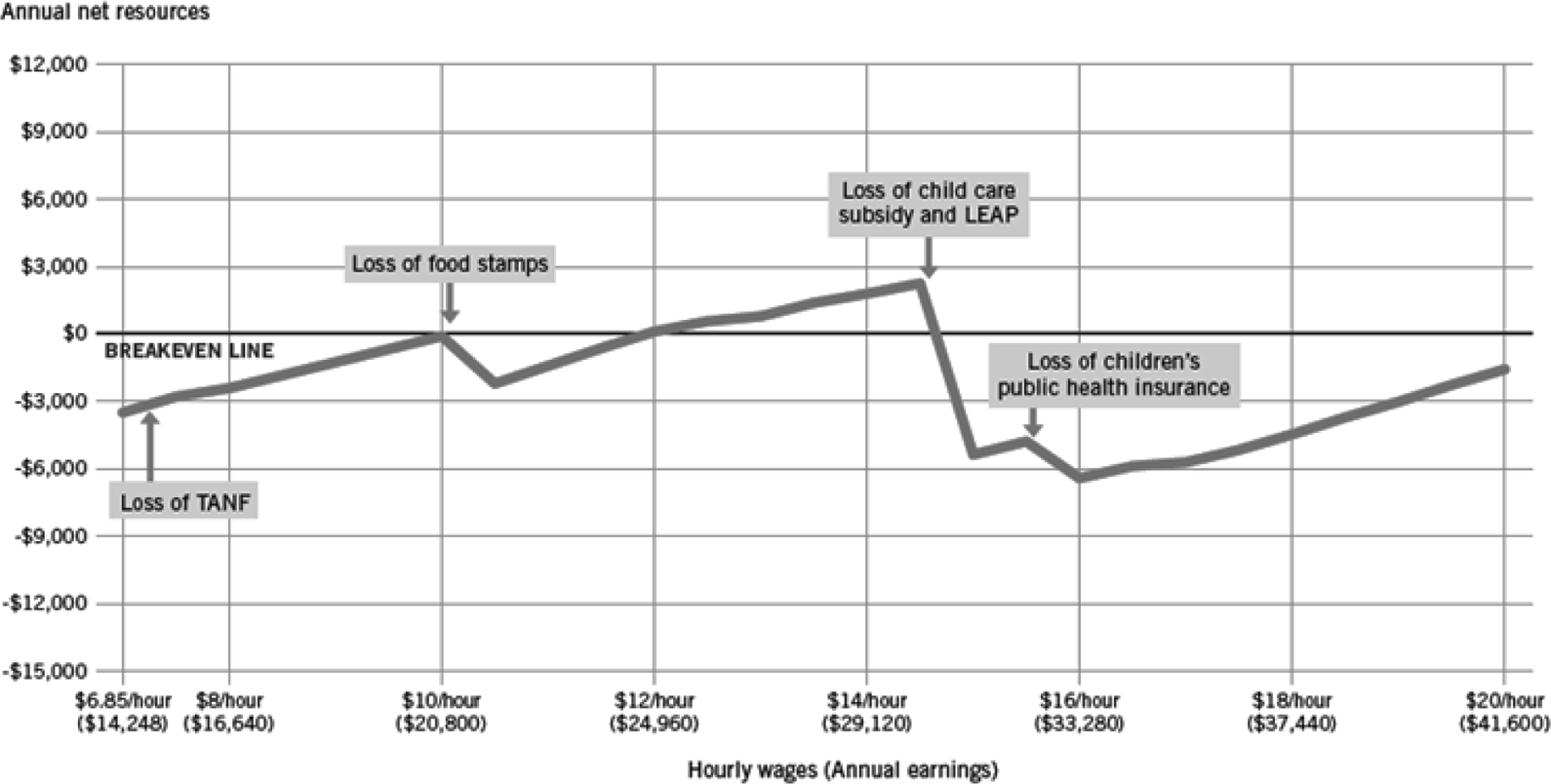
Change in net resources as earnings increase. Source: Dinan, Chau, and Cauthen (2007).
In 2009, as part of our work on child care subsidies in Colorado, we surveyed 332 families who had used a child care subsidy from 2007 to 2009 and then followed up with 21 in-depth interviews with mothers from a subsample of the original 332 families (Roll, 2010). The women described their arduous experience of applying for and maintaining benefits, constantly calculating their income and child care subsidies, and working carefully to avoid a benefit cliff or losing the benefit.
The survey and interview data highlighted the decisions that the women made to avoid the cliff effect, and thus to lose their child care subsidy and be worse off financially. For example, 61 (18%) of the women did not take extra hours at their jobs, 46 (14%) did not accept a raise at their jobs, 35 (11%) had declined a job offer, 32 (10%) had not gotten married or changed their family status in some other way, 10 (3%) had not accepted child support, and 12 (4%) had not turned in their redetermination paperwork. Other studies of families who accessed government-subsidized child care have reported similar results (Capizanno, Adams, & Ost, 2006; Lengyel & Campbell, 2002). The women with low-income families whom we interviewed made significant decisions that they deemed necessary for survival.
From a socialist feminist perspective, the catch-22 or double bind of taking a pay increase and being worse off financially because of the loss of a child care subsidy means that women are subordinated in both their production and reproduction roles. The child care benefit cliff abruptly takes away a significant financial incentive and therefore maintains women in low-paying jobs. Women must often choose not to advance in the formal economy. One woman who was interviewed reflected that after turning down three raises, when she applied for another job, she would erroneously look like a $9.50 per hour employee when she was really a $14 per hour employee. According to a feminist economic perspective, gender is a factor in all economic reasoning and social norms are part of economic choices (Blank & Reimers, 2003; Rubery, 2005). The women who were interviewed for the project made decisions that privileged their caretaking responsibilities or made decisions not to follow the norms of marriage or the rules of child support in order to maintain a benefit that they described as essential for both their children and their finances. One woman told us how she had to give up her ambition to have a career in banking to ensure that her children would have good-quality child care until they were of school age. The norms and values of caretaking and reproduction are situated in a social cultural context that expects women to care for children, yet penalizes them for that role.
Policy Implementation Issues
The final struggle that women face in relation to child care as a work-support benefit is the rules and regulations. These regulations are broad at the federal level and set more specifically at the state and county levels. Our project began with the intent of examining how women manage when facing a benefit cliff because of an increase in income. However, through meetings with community child care providers and from the women we interviewed, it became clear that the rules of the child care subsidy program were unusually difficult and caused women to go on and off benefits frequently over time. We called the process of losing the child care subsidy for reasons other than a permanent increase in income, “minicliffs.”
Minicliffs are essentially the result of the rules and regulations that perhaps inadvertently cause families to lose their child care benefits. They most often hinge on the requirement that to access child care assistance, a mother must be working, looking for work, or be in school. However, in multiple circumstances, these required activities may be interrupted for short periods. These minicliffs could result in the loss of benefits either permanently or frequently over time, furthering the chaotic nature of life on low-wage work. Others have found similar administrative-type barriers that keep families from securing and maintaining consistent benefits over time. For example, in a synthesis of the research, Adams, Snyder, and Banghart (2008) found that families face multiple barriers to accessing benefits for which they qualify, including reporting requirements, inconsistencies and the lack of coordination with other programs, and inadvertent terminations because of temporary changes in circumstances.
One example of the effect of minicliffs occurs for women during pregnancy and childbirth. One single mother of three whom we interviewed described taking a maternity leave for the birth of her third child. Because during this leave, she was not in a “school or job-related activity,” she lost child care benefits and had to care for her older children at home with a newborn by herself. In addition, this mother lost her spot at her child care center for the 3 months she was on maternity leave. Because she lost her space, she had to get on the center’s waiting list and feared losing her job because her three child care slots were not guaranteed when she was ready to return to work. Another example was specific to teenage mothers who were attending school. When there was a school vacation week, and thus the young women were not in a “school or job-related activity,” they lost their benefits. Unless they can come up with the money to pay for care, mothers are often forced to relinquish their spots in child care.
The second minicliff is a temporary change in monthly income because of inconsistent child support payments. Pursuing and claiming child support is a requirement of the child care subsidy (P.L. 104-193). However, for many women, the inconsistency in which child support was received created both stress and problems with benefit rules. The women had trouble with sporadic child support payments in that the payments would intermittently push them over the income cap, but only for a month here and there, resulting in inconsistencies in the receipt of benefits and thus child care.
The third minicliff that surfaced during this project was the reporting requirements. By way of example, the child care program in the state of this project required a semiannual redetermination and had an 11-day period in which families had to report a change in income. The women who were interviewed reported the difficulties they had keeping up with the paperwork and the burden of reporting changes in income that could occur frequently, depending on the number of hours they worked in any given week. If a woman did not meet the required dates or deadlines for the redetermination or change in income requirements, she would temporarily lose her benefits. The women described difficulties, such as getting off work to make appointments, keeping track of the exact number of hours they worked from week to week, and getting accurate information from caseworkers.
An analysis of these minicliffs points out some interesting contradictions from a socialist feminist perspective. Rigid reporting requirements are presumably in place for accountability and to ensure that only families who qualify for the program are benefiting. Yet, many of the jobs that maintain our economy and are held by low-wage workers tend to be much less consistent than are the jobs held by their middle-class counterparts (Shulman, 2003). In fact, women in the TANF work first and time-limited welfare policy environment have been forced to take jobs with less consistent hours and schedules (Henly, Shaefer, & Waxman, 2006), but are then penalized by child care policy that does not take this situation into consideration.
Another contradiction that surfaced was that few families who receive child care subsidies have increases in income above the allowed limits in a 1-year period, yet the rules required the semiannual redetermination of eligibility for benefits. To illustrate, from July 2007 to June 2008, the Colorado child care assistance program served 15,968 families. During that year, only 2.5% of the families in the program reached an income above 185% of the family poverty level, meaning that in the 28 counties that cut off benefits at 185% of the family poverty level, these 2.5% of the families may have become ineligible, but in the remaining 39 counties where the eligibility levels were even higher, the likelihood of these families going over the income level during the eligibility period was low. In addition, a state audit of the program found that from July 2003 to October 2007, only 3% of the families were deemed ineligible as a result of their scheduled redeterminations. At the same time, in three of the counties that provided feedback to the auditors, workers spent as much as 25–65% of their time on the redetermination paperwork (State of Colorado, 2008).
The evidence was clear that the likelihood that families would become ineligible during a 12-month eligibility period because their income was higher than the limit was low; yet, the administrative costs for redetermining whether families were eligible was high. Furthermore, the cost to families who had to take time from work to gather all the necessary paperwork and deal with the program’s rules was exorbitant. One woman described it as a “yoke around my neck.”
On the basis of the interviews for the project, the women recognized that child care subsidies were essential to their economic survival, but described them as arduous to qualify for and maintain in the context of many rules. The minicliffs, or temporary changes in circumstances that caused the loss of child care benefits, caused the women a tremendous amount of frustration. The lack of consistent benefits because of the small and often temporary changes in circumstances was extremely disruptive to work and family life and put a great deal of stress on the women we interviewed.
From a socialist feminist perspective, it is evident that child care policy and rules serve to regulate the lives of women (Abramovitz, 1996; Naples, 1991) and specifically to undermine their roles as both caregivers and workers. As caregivers, women are penalized for having another child or attending specialized programs for teenage parents, choices that then jeopardize their child care benefits. They are penalized for not being married and having to accept erratic child support payments. As workers, they are forced into low-wage jobs with often little flexibility and then must manage benefit requirements that can have a negative impact on their employment status. And perhaps what is most difficult for women who are economically disadvantaged is being both workers and caregivers; they experience stress in both roles because of the focus on rules over people.
Policy Initiative
A central goal of the project was to combine research findings with advocacy to inform state policy. A coalition of women’s organizations, policy advocacy groups, and child care providers met for 2 years to study the policy issues and propose changes that would lessen the cliff effect for financially vulnerable families who are involved in the child care system. Our discussions resulted in the development of House Bill 1035, which was passed in the 2009 legislative session in Colorado.
House Bill 1035 directly targeted the minicliffs by changing several of the governmental oversights of the child care program in Colorado that were excessively burdensome to both families and program administrators. Not only did the legislation move the redetermination period from 6 months to 12 months statewide, but it aligned eligibility for children who were dually enrolled in Head Start and the child care subsidy program. These changes were widely supported by families, providers, and agency staff and greatly lessened the burden of reporting and paperwork on working and financially vulnerable families.
Conclusion
This article has critiqued the policy of child care subsidies as a work support from a socialist feminist perspective. One of the limitations of this critique is that the project that served as a basis of the critique was in one state. That said, the strength of this work is that it has focused on the lived experiences of women in a complex policy environment, a perspective that is often ignored in the discourse on welfare reform (Christopher, 2004; Gatta & Deprez, 2008).
Our analysis leads to three conclusions. The first is that PRWORA, even more dramatically than previous welfare policies, has created a conflict for women in their dual roles as caregivers and wage earners. Women with children who are receiving income assistance are expected to enter the workforce, often taking jobs with limited hours, pay, and benefits, and then to figure out child care arrangements despite unpredictable schedules and limited access to care. Many women are never able to access child care subsidies (Witte & Queralt, 2002), and for those who do receive child care subsidies, it is a difficult process. From a socialist feminist perspective, work in the marketplace is valued over the caretaking of children, reinforcing the patriarchal norms of devaluing the responsibility for child care that is being carried out primarily by women. Fundamentally, women who are working for low wages are often in jobs that are unstable and unpredictable (Henly & Lambert, 2005), which makes planning for things like child care particularly challenging. Because women who are the primary caregivers of families and access child care benefits are overwhelmingly single mothers with children, the burden of navigating child care disproportionately affects women.
The second conclusion is that work-support policy, specifically child care subsidies, undermines women in the labor market, reinforcing low-wage work and limiting women’s ability to be independent of assistance. The cliff effect demonstrates that women often must choose to continue to receive child care assistance and forgo opportunities to increase their income and financial well-being. By encouraging women to turn down raises, obtain more hours at work, or receive child support, well-intentioned work-support policy decreases women’s ability to compete in the current economy and maintains the economic and power differences between men and women. The cliff effect perpetuates a social and economic reality that is helping some women to get by, but not to get ahead. In addition, the rules and requirements of the child care subsidy program have created barriers that make the benefit difficult to access and maintain. Again, women are penalized for their caretaking role by the very policy that is intended to help them and their children.
Finally, on the basis of the feminist principle of exposing women’s lived experience of social welfare policy, we support what Henrici (2006) called the “destabilizing problems” that women must cope with in the environment of welfare reform policy. Women cope by carefully strategizing their options, and the stress of the process is “a yoke around the neck.”
As a result of our analysis, we make the following recommendations. For policy makers, given that the research is clear that child care subsidies increase positive economic outcomes for women (Layzer & Burstein, 2007) and lessen the need for cash assistance, continued and even increased funding of subsidies is essential. In addition, there needs to be a more gradual loss of benefits that allows families to advance in the workplace while still receiving governmental support. This change could be designed similar to the Earned Income Tax Credit, which phases in slowly, plateaus, and then phases out more slowly than it phased in.
This recommendation supports that of Meyers (2007), who made a compelling argument that many of what she termed targeted welfare benefits, child care included, lack any type of bridge or transition to allow families to move off public assistance permanently. Like the child care cliff effect, Medicaid and the Children’s Health Insurance Program provide health care coverage for low-income families, but as their earnings increase, the families are cut off before they are able to obtain employment at a level that would provide employer-provided benefits. In addition, many of the child care rules could be changed so that public dollars are not spent on cumbersome administrative oversight but, rather, aid families in appropriate levels of reporting and accountability.
In a broader policy context, additional policy initiatives would do well to consider minimum wage laws, family leave for low-income part-time workers, paid sick days, and support for higher educational attainment, all of which would help women economically and support them in their work and production roles. Alternatively, policy makers could consider universal child care systems, such as those in European countries that Bergmann (1999) argued would accomplish two things: Children would experience a safer and more enriching environment while parents would be able to work in more consistent and fruitful employment, thus reducing their need for governmental support.
For social workers who work with women who are affected by child care policy and who experience the lack of access, burdensome rules, and benefits cliffs, it is important to understand the emotional cost of the policies and the decisions that women make for survival. As women weigh decisions about not advancing in the workplace, not marrying, or not taking sporadic child support, these decisions need to be supported and understood in the context of the economic, political, social, and cultural realities of welfare reform.
Footnotes
Declaration of Conflicting Interests
The author(s) declared no potential conflicts of interest with respect to the research, authorship, and/or publication of this article.
Funding
The author(s) received no financial support for the research, authorship, and/or publication of this article.