




Abstract
This article presents the findings of a qualitative study that explored the help-seeking pathways of seven African American women following a nonsexual criminal victimization. The help-seeking narrative was reconstructed by conducting in-depth interviews with the women and their identified informal and formal providers of support. The findings revealed that the chosen help-seeking pathway was influenced by each woman’s appraisal of the perceived benefits and costs of seeking assistance. Implications for practice are discussed.
In response to any social or psychological problem or crisis event, an individual may take the step of seeking help (Gourash, 1978; Kurihara, Kato, Reverger, & Tirta, 2006; Rogler & Cortes, 1993; Steel et al., 2006). How people decide to use informal and/or formal support systems and at what point during a crisis they decide to seek various types of support (Cohen, 1992; Sarason & Sarason, 2009; Sarason, Sarason, & Pierce, 1992) remains an important question. Rogler and Cortes (1993) defined help seeking as a set of transactions between a help seeker and help provider, also called a pathway. Pathways begin at the onset of the distress. They are not random and are influenced by the subjective experience of the individual, cultural norms, expressions of distress, and the context of social networks (Steel et al., 2006; Uehara, 2001). In other words, pathways are structured by the convergence of psychosocial and cultural factors and have sufficient integrity to be studied directly as unfolding processes (Rogler & Cortes, 1993).
Researchers have established that social and cultural factors influence the range of contacts that individuals have with various professionals (Allen, 1996; Anderson & Hill Collins, 1998; Davis & Proctor, 1989; Friedman & Marsella, 1996; Myers, 1988; Root, 1996). Other factors that have been found to influence the help-seeking pathway include social support networks, the severity of symptoms, socioeconomic status, and the individual’s perception of the presenting problem (Andrews, Brewin, Rose, & Kirk, 2000; Falsetti & Resick, 1995). More specifically, gender and the victim–offender relationship are also associated with different help-seeking strategies (Kaukinen, 2002; McGruder-Johnson, Davidson, Gleaves, Stock, & Finch, 2000; Van Hook, 2000), and several studies on resilience have identified kinship ties, women’s relationships with each other, and even prayer in locating important coping strategies for African American women who are facing life stressors (McAdoo, 1980; McCray, 1980; Neighbors, Jackson, Bowman, & Gurin, 1983; Root, 1996). Additional studies have examined women’s resourcefulness, flexibility, resilience, and creativity in response to stressful life events as protective factors (Allen & Britt, 1983; Lykes, 1983).
In the past, help seeking has been understood primarily by focusing on the traits of the help seeker or on outcomes as evaluated by institutional providers of help (Gourash, 1978; Kessler, 1992; Neighbors, 1985; Veroff, 1981). These ways of understanding help seeking have provided some insights into the help-seeking process; however, they do not capture the full complexity of the influences that direct the help seeker along the pathway.
Contextualization of the Help-Seeking Event
The qualitative study presented in this article explored the subjective experience of the help seeker in concert with the responses of help providers from the point at which a criminal victimization first occurred to the point of resolution. More specially, the study explored the initiation of help seeking by African American women who were victims of a nonsexual crime by an unknown offender. This crisis event was chosen because of the lack of research in the literature and a desire to explore how the context of the criminal justice system influenced the help-seeking process (Anderson, 1998; Hart & Rennison, 2003; Kaukinen, 2002; Kilpatrick, Saunders, Veronen, Best, & Von, 1987; Lurigio, 1987).
The population of the study was based on the disproportionate number of African American women who are victims of crime and my interest in understanding how this vulnerable, yet resilient, group may appraise and respond to a crisis event (Hart & Rennison, 2003). African American women are deemed vulnerable because of the intersection of race, class, and gender oppression (Hill Collins, 2007). This vulnerability may put African American women at risk for social, emotional, and psychological problems (Davis & Proctor, 1989; Frye, 1998). Conversely, some studies have examined how personal identity and the experience as a “cultural other” may be a protective factor and a source of resilience when these women are faced with personal crises or social problems (Anderson & Hill Collins, 1998; Aptheker, 1982; Higgins, 1994). Identity can act as a protective factor against psychological trauma. But it may also be associated with negative cognitive appraisals—based on past experiences of oppression, sexism, and victimization—that can be attached to an event (Allen, 1996; Jackson & Sears, 1992; Marsella, Friedman, & Spain, 1996; Root, 1996). Therefore, the women in this study could have perceived a criminal victimization as another oppressive assault compounded by preexisting simultaneous oppressions, or such a crisis event might have served as a catalyst for personal growth and increased self-efficacy, one that affirms a woman’s ability to mobilize individual strengths and available sources of support.
Method
Black feminist epistemology informed the purpose and methodology of my qualitative study. Perspectives of feminist research shaped the interview process, in which the participants were encouraged to tell their stories. An emphasis on giving voice to African American women by sharing their stories from their perspectives is a means of raising consciousness and transcending the limitations of race, class, and gender (Hill Collins, 2007).
I used a convenience sampling strategy to identify potential participants for the study. Women were recruited along predetermined strata, such as age, socioeconomic status, education, marital status, and access to health care. I chose northwestern Indiana as the location of the study because the 2000 U.S. Census indicated that there was a large percentage of African American residents in an urban and suburban environment with diverse levels of income and education. This geographic area also has a high incidence of simple and aggravated assault of women, which are the crimes that I investigated in this study (Hart & Rennison, 2003). Fliers were posted throughout the communities of northwestern Indiana. Participants were required to be African American women aged 18–60 who had experienced a nonsexual criminal victimization within the previous 3–6 months by an unknown offender. This time frame was selected to obtain data after any help-seeking activity had been initiated. It was also chosen to avoid any increased traumatization immediately following the crisis event by the participant’s restorying and to minimize recall bias (Kessler, 1992).
To capture fully the transactional process inherent in help seeking and help providing, I collected narrative data through semistructured in-depth interviews from three sources: the victim of the crime, one to two sources of support in her informal network, and/or the service provider or providers from the formal institutions that the women interacted with during the help-seeking episode. The help-seeking process was captured within the context of the complimentary transactions between the help seeker and the help provider.
Procedure
I used grounded theory as a theoretical framework and method of analysis for data collected in the interviews. Grounded theory helped to identify themes and emerging theory for understanding the women’s and support providers’ subjective experiences of help-seeking actions. This thematic analysis uncovered major categories that were then compared and contrasted across the participants. I inductively derived themes from the participants’ experiences of the process of help seeking and help providing and transcribed, organized, and entered the narrative data into one hermeneutic unit in the ATLAS.ti program as primary documents for each participant. Each case study included the interviews with the participant, the one or two informal support providers, and the formal support provider or providers, which provided a cluster of data for each participant. I coded the interviews into specific preliminary categories. When it was clear that a category was mentioned with high frequency and was well connected to other categories, I adopted it as a core category. Through the analysis of narrative text, I developed a coding scheme and used it to make comparisons across the cases. Further axial coding yielded a refining of the coding list, and what emerged was an understanding of how the women’s subjective meaning of seeking and receiving help influenced the help-seeking process.
The Participants
The seven African American women who participated in the study ranged in age from 29 to 48 and had diverse educational backgrounds, from Kim, who earned a law degree from Harvard University, to Beverly, who had completed her general education degree (see Table 1 for the characteristics of the participants). Each woman was asked to describe herself and to provide a brief history, which produced self-narratives. Many had been through severe adversity. For example, Tisha had survived two bouts of cancer, and Beverly was ostracized because of her sexual orientation. These women were positioned in their families as caretakers of their own children, siblings, and parents. Kim was caring for her mother, who had been diagnosed with Alzheimer’s disease, and Keisha, Deborah, and Beverly were single mothers. Several of the women also managed life demands outside the domestic sphere in the work sphere. Keisha balanced work and school, while Kim and Tisha managed high-level administrative positions in which they encountered racism and sexism. These women shared the common characteristics of pride, nurturing, and a history of overcoming adversity and seeking a better life for themselves and their families. The self-narratives provided a glimpse into the beautiful tapestry of these women’s lives, which contextualized their responses to the criminal victimization that occurred during this chapter of their lives.
Characteristics of Participants (N = 7)
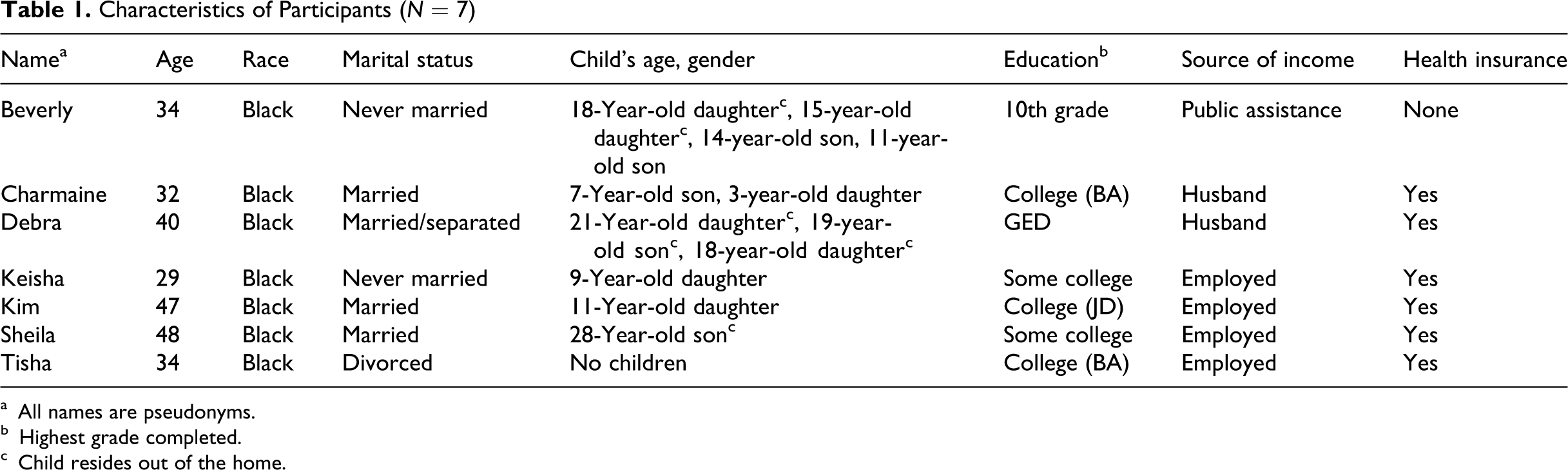
a All names are pseudonyms.
b Highest grade completed.
c Child resides out of the home.
In addition to the participants, the recruitment yielded 11 informal support providers and 2 formal support providers. All the participants identified at least one informal support provider (see Table 2); formal support providers were more limited, as shown in Table 3. Most of the informal support providers lived in close proximity to the help seekers and were primarily women: mothers, sisters, a daughter, a female cousin, and female friends. Two men were identified as informal support providers; Sheila identified her husband of 25 years as an informal support provider (he was present when she was robbed in a convenience store), and Keisha identified her boyfriend of 3 years, who provided a safe haven for her at his apartment after her crisis event. The majority had lifelong relationships with family members. The support providers were strongly embedded in the women’s daily lives.
Characteristics of the Informal Support Providers (N = 11)
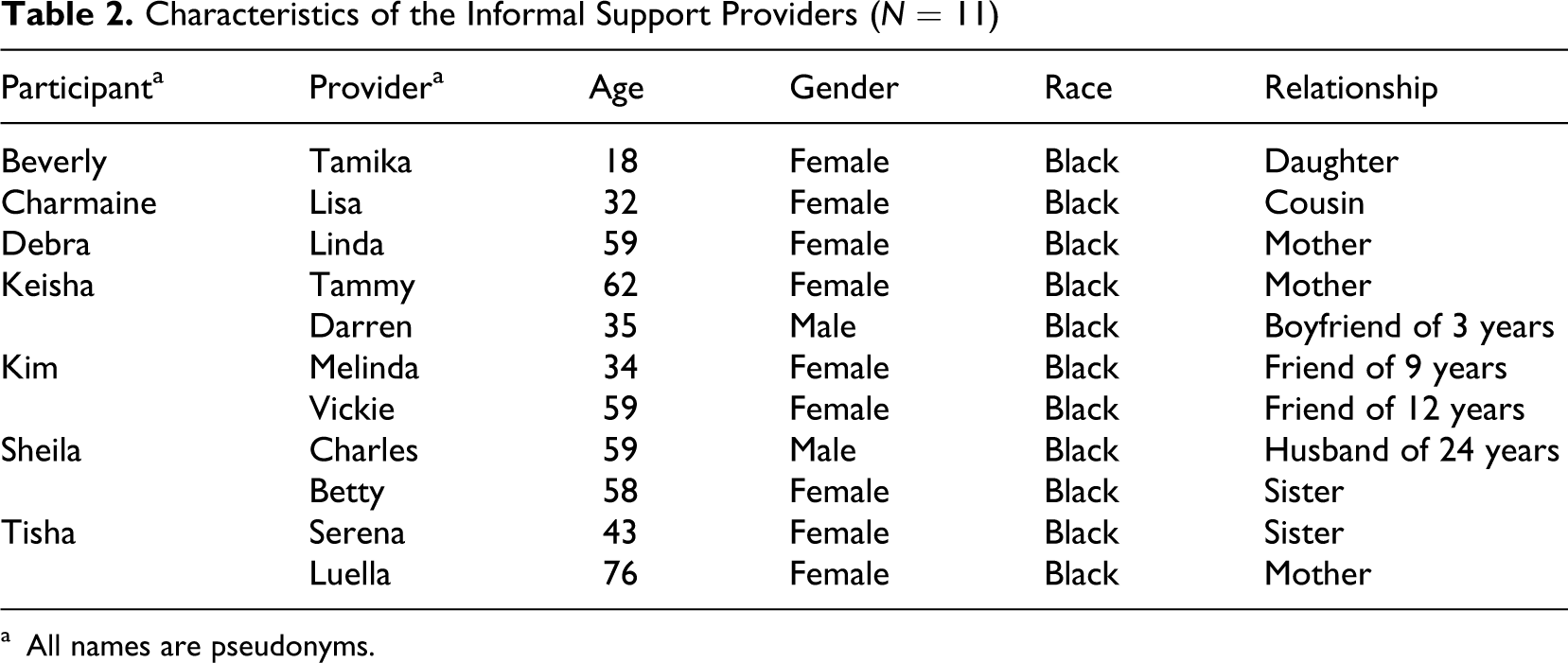
a All names are pseudonyms.
Characteristics of the Formal Support Providers (N = 2)
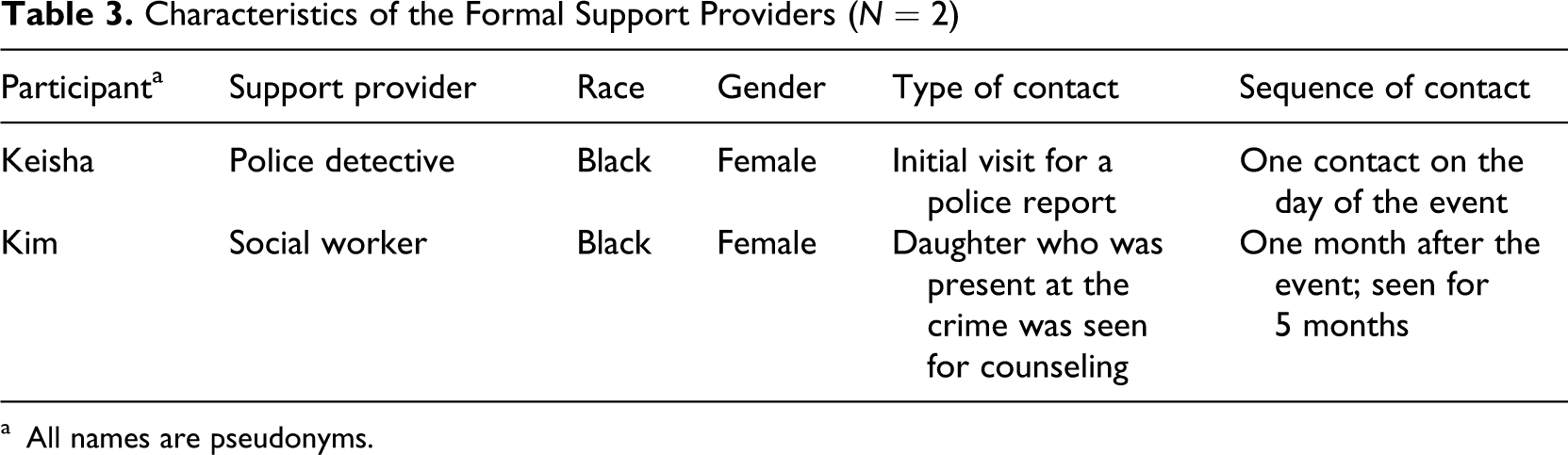
a All names are pseudonyms.
Findings
The study sought to explore help-seeking transactions between the women and the informal and formal support providers that they used. However, what emerged was that the help-seeking transactions were primarily with informal support providers. Two of the seven women actually sought formal help after their initial transactions with law enforcement personnel who were first responders. Tisha made contact with her employee assistance program and was not called back. Kim initiated mental health services for her daughter who was with her during the robbery and did not receive services for herself. This is an interesting finding and supports previous findings that women primarily use informal support (Caldwell, 1996; Chatters, Taylor, & Neighbors, 1989; Neighbors & Jackson, 1996). The findings provide an in-depth look at the complexities of help-seeking transactions with informal providers of support and a glimpse into the subjective experience of the help seeker. This exploration of the women’s subjective experience of the precipitating event and their perceived risks poses a possible explanation of why these women did not seek formal assistance (Andrews et al., 2000; Falsetti & Resick, 1995).
Theme 1: Perceived Risks in Help Seeking
The participants’ responses yielded a complex theme of a perceived risk inherent in seeking help. Three aspects of this theme were discovered: the fear of being vulnerable, the fear of not being responded to by perceived help providers, and choosing caring of oneself over care for others.
For the seven women, help seeking meant being vulnerable and exposed, which was in direct contrast to their need to be strong, independent, and self-reliant. These women viewed themselves as the caretakers and providers of support in their social network and were less familiar and comfortable with being in need of support. This defense against perceived vulnerability was experienced and negotiated in various ways by the women and influenced the help-seeker–help-provider transactions.
Keisha described her discomfort with the vulnerability associated with help seeking this way: I guess the more vulnerable I am at times, the meaner I can be. I don’t want to allow my walls to come down, I don’t want to be sitting here crying, I don’t want to feel like that; then I am like, leave me alone stop talking to me. My instinct, my reaction, my reflex is to be like, I am not crying, get off of me.
Similarly, Tisha described her difficulty with being vulnerable: It is hard to be vulnerable, hard for me to ask. I am the one who gives; I am a giving person. I let things bottle up. I am a no-nonsense person; if anything is going on in my life, it’s nobody’s business.
Tisha’s sister provided insight into Tisha’s discomfort with vulnerability: She feels that she does not need help because people might see she’s not what she is. She don’t need anyone, and she has to be totally in control. She is more comfortable providing the help. She is trying to get back to her same routine and bounce right back and doesn’t want people to know. With her, you will see anger rather than her vulnerable side.
The discomfort with perceived vulnerability often resulted in difficulty verbalizing needs and accepting support. Tisha and Kim described unspoken needs that made it difficult for their help providers to know what they needed. This left the women feeling unsupported. As Tisha explained “Hard for my family to give and hard for me to ask.” Similarly, Kim did not verbalize her needs and was anticipating that someone would figure out what she needed: “I would have liked someone to take me out to dinner, to make a gesture,” but as Keisha’s boyfriend asked “How you are able to even provide if you don’t know what she is looking for?”
In addition, some of the women perceived a risk to be the possibility that no support would be offered at all. Perceived vulnerability, therefore, resulted in the inability easily to accept help that was offered. Tisha’s sister said that she encountered resistance when she tried to help: “I try to give her support, and sometimes she is receptive, and sometimes it goes in one ear and out the other.” Tisha’s sister continued to offer support; however, at some point, she withdrew because of the resistance she received. Keisha also possessed this characteristic of resisting support; however, she was able to acquiesce eventually and accept support with the persistence of her boyfriend.
Another risk in help seeking that the participants expressed was the perceived cost of time associated with formal help seeking. The women viewed time as a resource. They consistently made decisions about how best to utilize what they already felt was insufficient time to meet their daily demands. As Keisha said “I don’t even have time to break down; it is a little overwhelming to me.” The women perceived help seeking as a luxury, which illustrates the choices the women were often faced with in working out the logistics of their lives, responding to the needs of others, or taking care of their own needs. Kim had this to say about the issue of time and help seeking: “I was busy. My reaction never came. I guess, I did not have the luxury. I am thinking about whether I would talk to someone; I would have to figure out who and how to fit it in my schedule.”
The majority of these women were caretakers of minor children and/or their parents. In all but one of the incidents of criminal victimization, at least one other person was present, such as a child, a relative, a parent with diminished capacity, or a spouse. From the initiation of the crime and throughout the help-seeking pathway, the women were always conscious of the needs of these vulnerable others and put their needs before their own. Charmaine commented on the issue of time in relation to her child care responsibilities this way: “I didn’t have time to be going like boo hoo, sitting, crying in front of [the kids]; I didn’t really want to.” The participants concentrated on tending to the needs of others around them. For example, Kim was with her daughter and her mother, who has Alzheimer’s disease, when she was robbed at gunpoint in her car. She said that her first priority then and afterward was responding to the needs of her daughter: “My daughter was screaming, ‘You could have been killed.’ It took her 20 minutes to a half hour to calm down. My husband was here, and he helped calm her down.” Debra, who was alone when she was mugged, immediately thought of driving home even though she received facial lacerations during the attack. Because the perpetrators took her mail and therefore knew where she lived, she was worried about her children’s and mother’s safety. She described her frantic need to get home: I worried about them harming my family; my daughter and mother were home. I didn’t think of anything else but that they could go to my house, and all I thought about was getting home. The first thing that I did after they showed me the mail was to go home. I came straight home.
Although all the women had a strong preference for caring for others over themselves, most were able to negotiate care for themselves during the help-seeking pathway. The two exceptions were Kim and Tisha. Kim was unable to focus on herself and targeted her efforts toward providing support to and comfort for her daughter. Kim continued to prioritize the needs of her daughter throughout the help-seeking pathway and sought assistance for her daughter through counseling to help her regain her sense of safety: When I talked to my friends, we primarily talked about my daughter. My daughter is afraid of strangers in cars, has been choosing to stay home, and has not been back over to my mother’s house. I took her for counseling.
Kim’s avoidance of dealing with herself and, instead, need to care for the needs of others was consistent with her customary coping style, which resulted in no support being offered and the lack of resolution of events that occurred in her life.
Discussion
The women in the study seemed to weigh the risks inherent in help seeking, such as a sense of vulnerability and exposure and the possibility of receiving no support versus the benefits of seeking help in regaining a sense of safety and replacing their possessions. When the perceived risks outweighed the benefits, the women chose to limit their formal help-seeking efforts to the initial crisis point immediately following the event. These women also weighed their sense of caring for themselves versus caring for others who shared the trauma and whom they viewed as vulnerable. There was a consistent strain in deciding whose needs took priority, and, in most cases, the care of others took precedence; help-seeking efforts were directed toward meeting the needs of these vulnerable persons. For African American women generally, this is an important factor, since they often assume the role of primary caretaker, which they usually do not abdicate during a crisis (Constantine, 2002; Davis, Sloan, & Tang, 2011; McAdoo, 1980; McCray, 1980; Root, 1996). The women often put their emotional needs on hold because they viewed their primary responsibility as caring for others, so making the effort to seek help for themselves either was not a priority or did not seem to be a feasible option. The exceptions were those participants who were able to gain unsolicited support in the form of someone providing child care following the criminal victimization event. Given that support without having to seek it, they were able to focus on themselves, which expedited their resolution of distress.
The women’s construction of self at this point in their lives acted primarily as a protective and buffering factor as they faced the distress of the crisis event. An interesting factor emerged in exploring the benefits of a resilient self and how this self-perception might at times interfere with the ability to express vulnerability and to seek and accept support from others. Most of these women were perceived by others in their network as resilient women who filled the role of help provider for others. This shared meaning of self directed the transactions that occurred along the help-seeking pathway. The help seeker found it difficult to display and communicate distress, and the help provider failed to see beyond the protective mask of resilience to read the cues of the help seeker. An example of this dynamic could be seen in the case of Kim who sought counseling for her daughter but was never invited to participate in counseling to address her own needs.
The analysis raised the issue of the possible “cost of being strong” that was poignantly stated by Kim in response to a friend’s comment: “I talked with another friend, and she said, ‘I know that you are resilient.’ I know she meant well, but I said, ‘OK, I need to keep going.’ This cut off my sense that I could emotionally react.” These women had effectively managed their lives, juggled multiple demands, provided support to others, and worked in the public domain, often anticipating racism and sexism. Their tendency to persevere and project a strong and competent demeanor at times masked their true internal state and sometimes made it difficult to express their distress openly and seek support.
There were variations in the women’s comfort with expressing distress. As Dragnus (1996) noted, there are cultural components that accompany the experience of a traumatic event, and expressions of emotional pain are culturally determined. There are observable public reactions and more subjective and internal processes. The findings of this study support Dragnus’s findings. The participants attached meaning to the traumatic event on the basis of their sense of self. They also found that there was a risk to being seen as vulnerable by those outside their close, informal network. Their communication of distress was limited to those they trusted and felt would not take advantage of their vulnerability. After the immediate crisis, most of the women limited the amount of public display of distress and retreated to internal processing. They resumed their normal activities and were seen as being “OK” by those who did not know them beyond this public persona. Those who were able to expose their vulnerability within their informal network were able to receive the support they needed to regain their sense of equilibrium. Those who found it to be more of a risk withdrew and did not receive support.
The findings also confirmed previous findings that the subjective appraisal of the problem by help seekers determines their sense of what type of support is needed (Andrews et al., 2000; Falsetti & Resick, 1995). In this situation, the women appraised this event as the loss of their possessions, sense of safety, and normal routines. Their expectations of support were to address these losses. At the initial crisis, the role of law enforcement was to provide a sense of safety. However, after realizing that the perpetrator would most likely not be caught, the women shifted their help-seeking efforts to their informal support systems. None of the women initially appraised this as a situation that necessitated mental health intervention.
The results of the study confirmed the findings of some previous studies of social support and help seeking among African American women in that the participants primarily used sources of informal support who shared a cultural context and were primarily women (Caldwell, 1996; Chatters et al., 1989; Neighbors & Jackson, 1996). Most of the women also had a dense informal support network that was primarily in close geographic proximity. The literature on social support has focused on the cultural dynamics involved in accessing support and found that these dynamics also determined membership in a network and the type of support sought and provided (Dunkel-Schetter, 1982; House, 1981; Wortman & Dunkel-Schetter, 1987). The informal supports the participants identified were individuals whom they perceived as responsive.
Strengths and Limitations
The strengths of this study were in the methodology. Few studies have simultaneously explored this process from the perspective of the individual person in concert with the actual providers of support during a help-seeking event. The study did so by initiating an analysis of the specific distressful event and the help-seeking pathway from the personal accounts of the women and the informal and formal sources of assistance. The use of a narrative approach was culturally sensitive because it promoted empowerment and enabled the women to relate their experiences. The participants were viewed as the experts of their experiences and were invited to share these experiences in a participatory manner that validated and affirmed their self-narratives.
This study had some limitations in that it was not intended to be generalizable to the population at large or, more specifically, to all African American women who have experienced a nonsexual violent crime. The limited sample and the methodology that was chosen were intended to generate data and theory from this sample. Because the sample was not representative of others who have had similar experiences, the results can be understood only in the context of these women’s experiences. An additional limitation was the lack of transactions with formal support providers, which altered the original intent of the study. However, the examination of the subjective experience of these women in concert with the informal support providers provided a deeper understanding of the environmental challenges and internal processes that African American women may encounter when seeking help after a stressful life event occurs.
Implications
The results of the study have implications for social work practice. Practitioners need to be aware of ethnocultural differences in the expression of distress. In the assessment process, the emphasis is on the detection of observable symptoms, a change in behavioral patterns, or the self-reporting of emotional distress by the help seeker (Allen, 1996; Marsella et al., 1996). The African American women in the study were more likely to resume a public image of being resilient while masking their internal distress. They were also uncomfortable sharing their vulnerabilities with those outside their trusted informal networks. These findings reinforce the need for a culturally sensitive assessment process in which establishing trust is an important step. Practitioners also need to go beyond the observable public reactions to assess the more private internal world of their clients.
The findings also suggest the need to explore more effective strategies in providing formal support to victims of trauma within the systems that they are immediately engaged in after a crisis event. In this study, the first responders were police officers and detectives who were instrumental in providing crisis intervention. However, they were not effective in providing useful information on recovery from trauma and providing links to community resources beyond the initial crisis. Social workers could be instrumental in engaging women who are interfacing with the criminal justice system by working with them to give voice to their needs.
In addition, the findings support the benefits of including an assessment of the social support network of the individual who is seeking assistance to determine the quality, density, and viability of the network. The participants primarily used their informal networks and continued to do so even after they received formal assistance. Those with a viable support system fared better when confronted by the adverse life situations. This perceived support system acted as a protective and buffering factor. When key members of the network are not available, the person may be at risk of prolonged emotional distress because there is no one with whom to share the experience, and the person will most likely not receive the needed support.
Most important, the findings highlighted the need for practitioners to consider the multiple demands that women balance. Women are consistently negotiating between their multiple roles of caretaker, provider, and worker inside and outside the home. An assessment and acknowledgment of this reality is essential. Practitioners should not only offer support to women but should assist them in navigating their competing demands and promote self-care in the face of an acute trauma.
In summary, this qualitative study examined the complex processes embedded in help seeking and help providing from the subjective experience of the help seekers and providers. What emerged was a glimpse of how the women perceived the risks inherent in seeking and accepting support. The findings supported the idea that resilience is a protective factor and introduced another dimension of resilience as a guard against displaying vulnerability. In addition, the multiple identities and roles of the women emerged as a reality that cannot be ignored. Practitioners should seek to understand the lives of women and the tenuous balancing of competing demands that may provide obstacles to seeking formal help. The findings also suggest the benefit of replicating this methodological approach with a larger sample. A precipitating event could be chosen that would provide a more significant number of transactions with formal help providers as well as informal support providers.
Footnotes
The author declared no potential conflicts of interest with respect to the research, authorship, and/or publication of this article.
The author disclosed receipt of the following financial support for the research, authorship, and/or publication of this article: In 2006, the author received a Council of Social Work Education Dissertation Award, which was a financial award to support this research.